FLIPPED CLASSROOM
FLIPPED CLASSROOM
BLENDED LEARNING
BLENDED LEARNING
&
&
FLEXIBLE LEARNING
FLEXIBLE LEARNING
FLIPPED CLASSROOM
FLIPPED CLASSROOM
A flipped classroom is an instructional strategy where
traditional learning environments are inverted. In this model,
students first explore new content at home, often through
videos or readings, and then engage in hands-on activities,
discussions, or problem-solving during class time
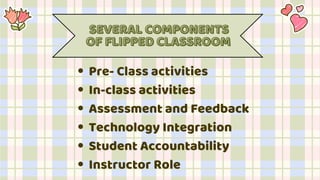
SEVERAL COMPONENTS
SEVERAL COMPONENTS
OF FLIPPED CLASSROOM
Pre- Class activities
In-class activities
Assessment and Feedback
Technology Integration
Student Accountability
Instructor Role
Blended learning combines traditional
face-to-face classroom methods with
online learning, leveraging both to enhance
the educational experience.
BLENDED LEARNING
BLENDED LEARNING
TYPES OF BLENDED
TYPES OF BLENDED
LEARNING
LEARNING
The Flipped Classroom Model
The Enriched virtual model
Students learn primarily online, though face-to-face
sessions with the teacher are also required
The Individual rotation model
The Individual Rotation model allows students to rotate
through stations, but on individual schedules set by a
teacher or software algorithm. Unlike other rotation
models, students do not necessarily rotate to every
station; they rotate only to the activities scheduled on
their playlists.
The A la Carte Model
In this model, students can choose individual online
courses from a catalogue to complement their traditional
classroom learning. This model is like a menu at a
restaurant, where students can pick and choose the
courses they want.
The Flex model
The flex learning model is a form of blended learning that
combines online and face-to-face instruction. In this
model, students attend a physical classroom but access
most of the learning materials through a computer, such
as video lectures, online quizzes, and documentaries
A broad term used to describe the design and
delivery of programs, courses, and learning
interventions in such a way as to cater for
student demands for variety, access, recognition
of diverse learning styles, and student control
over and customizability of the learning
experience.
FLEXIBLE LEARNING
FLEXIBLE LEARNING
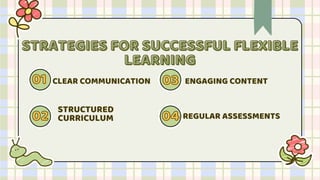
CLEAR COMMUNICATION
STRUCTURED
CURRICULUM
STRATEGIES FOR SUCCESSFUL FLEXIBLE
LEARNING
LEARNING
ENGAGING CONTENT
REGULAR ASSESSMENTS
01
01
02
02
03
03
04
04
THANK YOU
THANK YOU

Flipped Classroom, Blended Learning, Flexible learning.pdf

  • 1.
    FLIPPED CLASSROOM FLIPPED CLASSROOM BLENDEDLEARNING BLENDED LEARNING & & FLEXIBLE LEARNING FLEXIBLE LEARNING
  • 2.
    FLIPPED CLASSROOM FLIPPED CLASSROOM Aflipped classroom is an instructional strategy where traditional learning environments are inverted. In this model, students first explore new content at home, often through videos or readings, and then engage in hands-on activities, discussions, or problem-solving during class time
  • 3.
    SEVERAL COMPONENTS SEVERAL COMPONENTS OFFLIPPED CLASSROOM OF FLIPPED CLASSROOM Pre- Class activities In-class activities Assessment and Feedback Technology Integration Student Accountability Instructor Role
  • 4.
    Blended learning combinestraditional face-to-face classroom methods with online learning, leveraging both to enhance the educational experience. BLENDED LEARNING BLENDED LEARNING
  • 5.
    TYPES OF BLENDED TYPESOF BLENDED LEARNING LEARNING
  • 6.
  • 7.
    The Enriched virtualmodel Students learn primarily online, though face-to-face sessions with the teacher are also required
  • 8.
    The Individual rotationmodel The Individual Rotation model allows students to rotate through stations, but on individual schedules set by a teacher or software algorithm. Unlike other rotation models, students do not necessarily rotate to every station; they rotate only to the activities scheduled on their playlists.
  • 9.
    The A laCarte Model In this model, students can choose individual online courses from a catalogue to complement their traditional classroom learning. This model is like a menu at a restaurant, where students can pick and choose the courses they want.
  • 10.
    The Flex model Theflex learning model is a form of blended learning that combines online and face-to-face instruction. In this model, students attend a physical classroom but access most of the learning materials through a computer, such as video lectures, online quizzes, and documentaries
  • 11.
    A broad termused to describe the design and delivery of programs, courses, and learning interventions in such a way as to cater for student demands for variety, access, recognition of diverse learning styles, and student control over and customizability of the learning experience. FLEXIBLE LEARNING FLEXIBLE LEARNING
  • 12.
    CLEAR COMMUNICATION STRUCTURED CURRICULUM STRATEGIES FORSUCCESSFUL FLEXIBLE STRATEGIES FOR SUCCESSFUL FLEXIBLE LEARNING LEARNING ENGAGING CONTENT REGULAR ASSESSMENTS 01 01 02 02 03 03 04 04
  • 13.