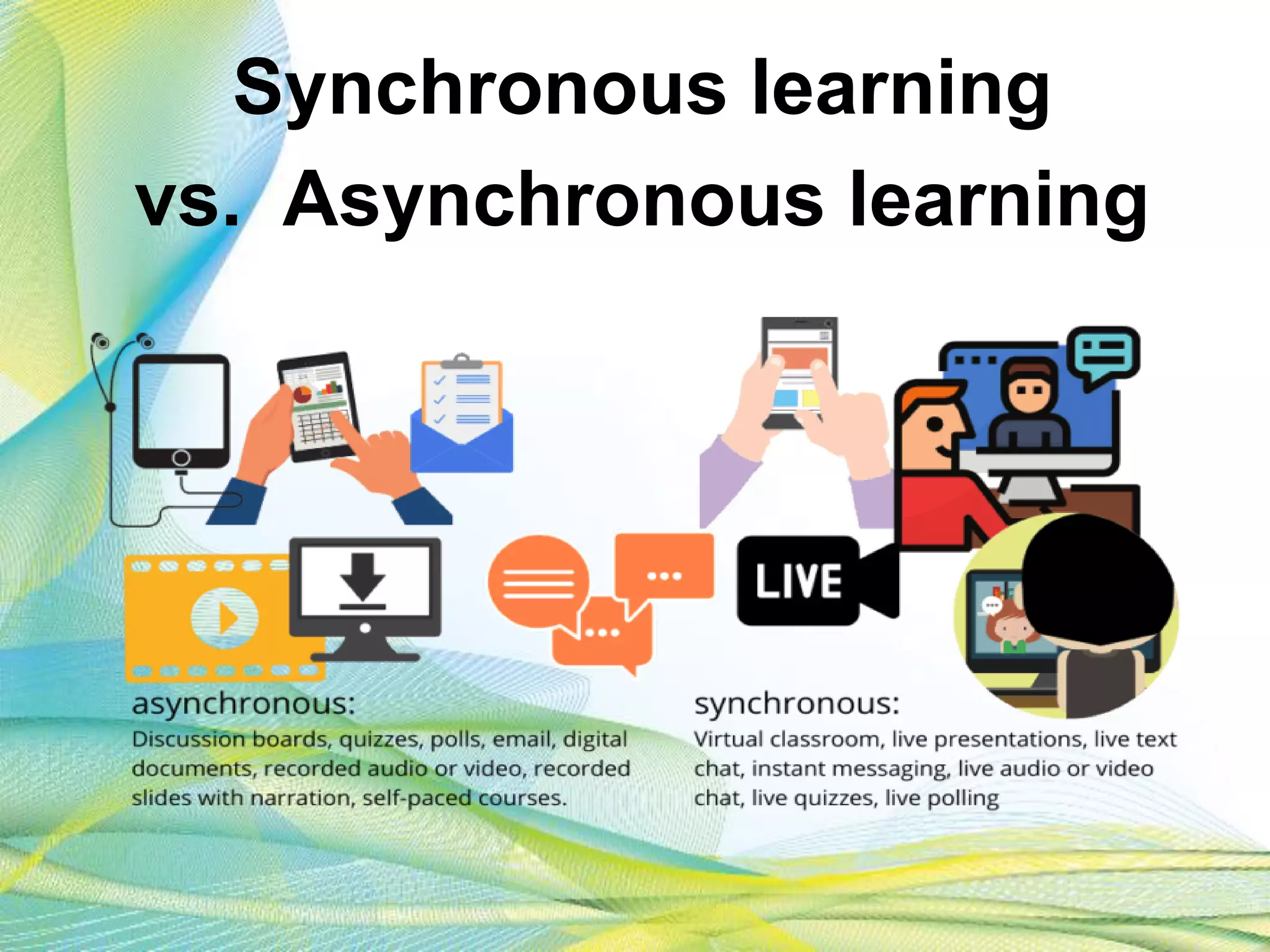
Synchronous learning
vs. Asynchronous learning
Synchronous learning is online or distance
education that happens in real time,
whereas asynchronous learning occurs
through online channels without real-time
interaction.
Synchronous learning vs.
Asynchronous learning
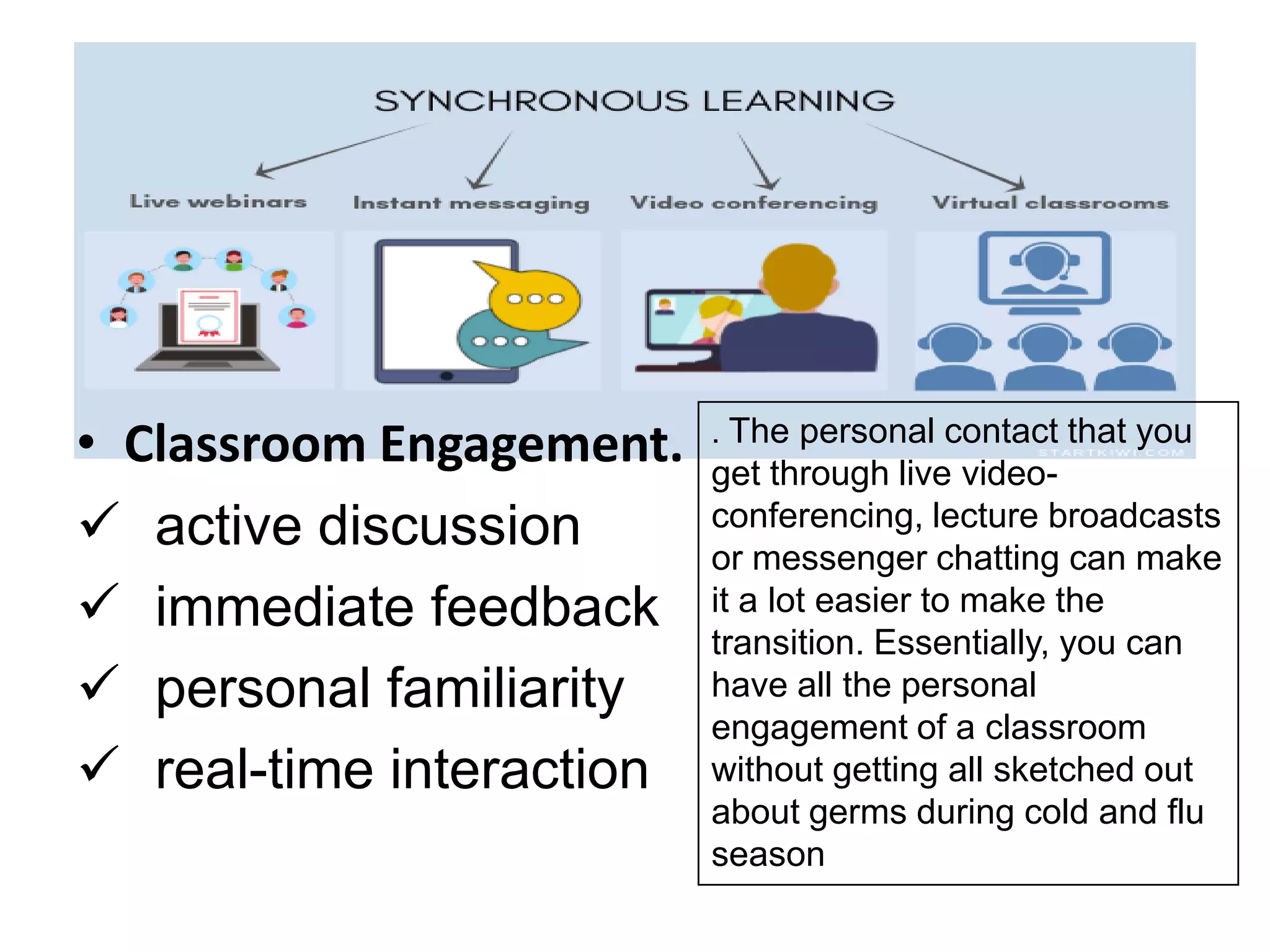
Synchronous learning
• Classroom Engagement.
 active discussion
 immediate feedback
 personal familiarity
 real-time interaction
. The personal contact that you
get through live video-
conferencing, lecture broadcasts
or messenger chatting can make
it a lot easier to make the
transition. Essentially, you can
have all the personal
engagement of a classroom
without getting all sketched out
about germs during cold and flu
season
2. Dynamic Learning.
 superior way to learn
 more dynamic exploration of topics, ideas and
concepts
 speed and immediacy
Videoconferencing, for instance, makes it possible to
ask questions and receive answers mid-lesson; to
discourse and debate with classmates at a brisk and
exciting pace; to collectively drive a conversation into
unexpected new directions. The synchronous learning
evokes the same level of accountability and engagement
as classroom attendance. If you thrive at a swift pace,
surrounded by competing and complementary ideas, this
is as close as you’ll come to the real thing.
3. Instructional Depth
 interact regularly and frequently with your
professors.
 opportunity for face-to-face discussion
 individual guidance
 establish mentorship
You’ll actually get to know your instructors. This is
not just a good way to confirm your instructor’s
credibility. If you’re the type of student that does
your best work with the help of accessible and
supportive instruction, you’re probably a
synchronous learner.
Disadvantages of Synchronous Learning
• Rigid Schedule
• Technical Difficulties
• Lack of digital skills
• Lack of resources
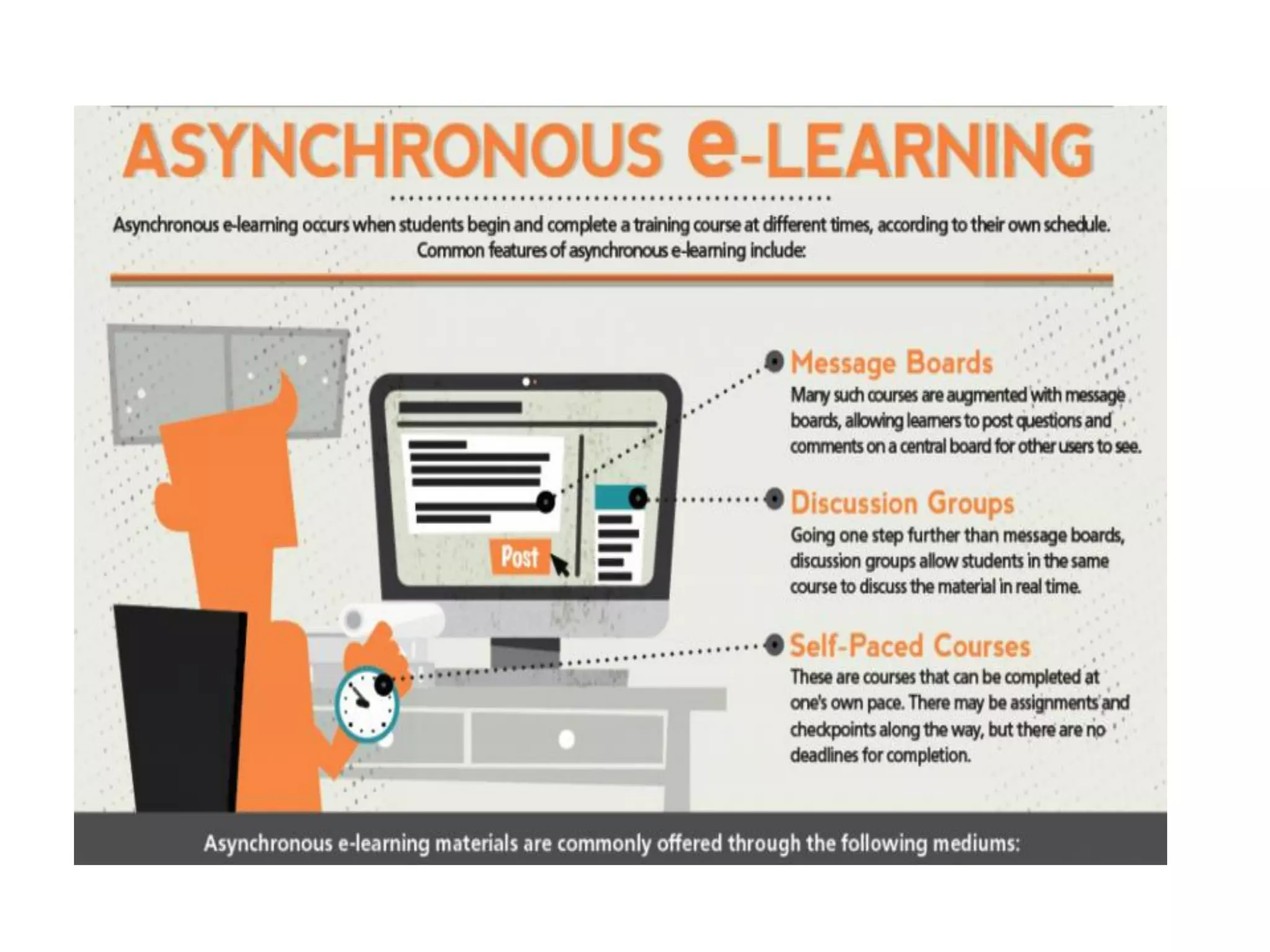
Asynchronous Learning
• Asynchronous learning happens on your schedule.
While your course of study, instructor or degree program
will provide materials for reading, lectures for viewing,
assignments for completing, and exams for evaluation,
you have the ability to access and satisfy these
requirements within a flexible time frame. Methods of
asynchronous online learning include self-guided lesson
modules, streaming video content, virtual libraries,
posted lecture notes, and exchanges across discussion
boards or social media platforms.
Advantages of Asynchronous Learning
• Flexibility
• Pacing
• Affordability
Flexibility. If you’ve got a demanding schedule or
weird hours, you’re probably an asynchronous learner.
Your learning will typically revolve around materials that
can be accessed on your own time, (though often within
a set time frame like a week or two). Materials might
include text-based lecture notes, self-guided interactive
learning modules, or pre-recorded lectures and
podcasts. If you need to complete a module on the train
ride to work; if you have to listen to a lecture on
headphones while your baby naps; if you work the
graveyard shift at a sewage treatment facility, sleep until
the middle of the afternoon and do your best reading
while Dr. Oz reruns blather in the background, you
totally can. Asynchronous learning gives you the
materials. It’s up to you to complete them at your
convenience.
Pacing. One of the most empowering features of
asynchronous learning is the fact that your experience
is typically self-guided. Read at your pace. View on your
time. Complete based on your understanding…as
opposed to the pressure to hit a deadline. If you’re a
quick learner, you can choose to power through
materials and units that come easily to you. If it takes
you a bit more time to absorb new information and
knowledge, this path also gives you the chance to
review information, take notes, and practice retention
without concern over the speed of a lecture or the pace
of your classmates. Shape your learning experience
based on your needs as opposed to the tempo of the
classroom.
Affordability. If one of the leading motives behind your
online education is affordability, there are countless
opportunities for learning that carry a lower price-tag
because they can be administrated without day to day
instruction. Though there are many asynchronous
experiences in which you can and must interact
directly with an instructor—often through methods of
communication with high time latency like email or
social media—there are just as many ways of learning
without any professorial support. Self-guided
modules, video tutorials, and virtual libraries all offer
you the chance to pursue your education with a
minimum of oversight, and therefore, at a minimal
expense.
Disadvantages of Asynchronous
Learning
• Isolation
• Risk of Apathy
Isolation. If you like the personal touch, and you do
your best pontificating when you feel like people are
actually listening, asynchronous learning can be a
lonely experience. Social media and email simply can’t
deliver the same kind of intellectual energy as real-
time interaction. This atmosphere is also a less
collaborative one. The opportunities to interface with,
debate, and network with classmates are scarcer. In a
lot of ways, asynchronous learning is best for you if
your plan is simply to get in, get some skills, and get
out. (There's nothing wrong with that plan, by the way.)
But if you’re looking for the kind of enrichment that
comes from discussion, feedback, and just a little bit of
social interaction, you might be disappointed by your
asynchronous learning experience.
Risk of Apathy. While working in a self-guided
environment sounds really great and empowering,
it’s important to be honest with yourself. Are you
truly the kind of learner with the drive, not just to
pace yourself and commit to a set of personal
goals, but to remain passionate and enthusiastic
about the subject matter without the support and
evaluation of an instructor? The reality is that some
learners benefit best from access to clearly stated
expectations, immediate feedback, and, to an
extent, a watchful eye. If you’re this type of learner,
the free-form nature of asynchronous learning
could be demotivating. Beware of complacency.
Challenges
 Conversion
/transition
 facilitation
Adoption
logistics
Options/
Solutions
 blended/flexible
 findings ways
Blended/Flexible
• Many hybrid learning models will include a
blend of both asynchronous and synchronous
online learning.
(Source:
https://thebestschools.org/magazine/synchr
onous-vs-asynchronous-education/)
Asynchronous Learning vs Synchronous Learning

Asynchronous Learning vs Synchronous Learning

  • 1.
  • 2.
    Synchronous learning isonline or distance education that happens in real time, whereas asynchronous learning occurs through online channels without real-time interaction. Synchronous learning vs. Asynchronous learning
  • 3.
    Synchronous learning • ClassroomEngagement.  active discussion  immediate feedback  personal familiarity  real-time interaction . The personal contact that you get through live video- conferencing, lecture broadcasts or messenger chatting can make it a lot easier to make the transition. Essentially, you can have all the personal engagement of a classroom without getting all sketched out about germs during cold and flu season
  • 4.
    2. Dynamic Learning. superior way to learn  more dynamic exploration of topics, ideas and concepts  speed and immediacy Videoconferencing, for instance, makes it possible to ask questions and receive answers mid-lesson; to discourse and debate with classmates at a brisk and exciting pace; to collectively drive a conversation into unexpected new directions. The synchronous learning evokes the same level of accountability and engagement as classroom attendance. If you thrive at a swift pace, surrounded by competing and complementary ideas, this is as close as you’ll come to the real thing.
  • 5.
    3. Instructional Depth interact regularly and frequently with your professors.  opportunity for face-to-face discussion  individual guidance  establish mentorship You’ll actually get to know your instructors. This is not just a good way to confirm your instructor’s credibility. If you’re the type of student that does your best work with the help of accessible and supportive instruction, you’re probably a synchronous learner.
  • 6.
    Disadvantages of SynchronousLearning • Rigid Schedule • Technical Difficulties • Lack of digital skills • Lack of resources
  • 9.
    Asynchronous Learning • Asynchronouslearning happens on your schedule. While your course of study, instructor or degree program will provide materials for reading, lectures for viewing, assignments for completing, and exams for evaluation, you have the ability to access and satisfy these requirements within a flexible time frame. Methods of asynchronous online learning include self-guided lesson modules, streaming video content, virtual libraries, posted lecture notes, and exchanges across discussion boards or social media platforms.
  • 10.
    Advantages of AsynchronousLearning • Flexibility • Pacing • Affordability
  • 11.
    Flexibility. If you’vegot a demanding schedule or weird hours, you’re probably an asynchronous learner. Your learning will typically revolve around materials that can be accessed on your own time, (though often within a set time frame like a week or two). Materials might include text-based lecture notes, self-guided interactive learning modules, or pre-recorded lectures and podcasts. If you need to complete a module on the train ride to work; if you have to listen to a lecture on headphones while your baby naps; if you work the graveyard shift at a sewage treatment facility, sleep until the middle of the afternoon and do your best reading while Dr. Oz reruns blather in the background, you totally can. Asynchronous learning gives you the materials. It’s up to you to complete them at your convenience.
  • 12.
    Pacing. One ofthe most empowering features of asynchronous learning is the fact that your experience is typically self-guided. Read at your pace. View on your time. Complete based on your understanding…as opposed to the pressure to hit a deadline. If you’re a quick learner, you can choose to power through materials and units that come easily to you. If it takes you a bit more time to absorb new information and knowledge, this path also gives you the chance to review information, take notes, and practice retention without concern over the speed of a lecture or the pace of your classmates. Shape your learning experience based on your needs as opposed to the tempo of the classroom.
  • 13.
    Affordability. If oneof the leading motives behind your online education is affordability, there are countless opportunities for learning that carry a lower price-tag because they can be administrated without day to day instruction. Though there are many asynchronous experiences in which you can and must interact directly with an instructor—often through methods of communication with high time latency like email or social media—there are just as many ways of learning without any professorial support. Self-guided modules, video tutorials, and virtual libraries all offer you the chance to pursue your education with a minimum of oversight, and therefore, at a minimal expense.
  • 14.
    Disadvantages of Asynchronous Learning •Isolation • Risk of Apathy
  • 15.
    Isolation. If youlike the personal touch, and you do your best pontificating when you feel like people are actually listening, asynchronous learning can be a lonely experience. Social media and email simply can’t deliver the same kind of intellectual energy as real- time interaction. This atmosphere is also a less collaborative one. The opportunities to interface with, debate, and network with classmates are scarcer. In a lot of ways, asynchronous learning is best for you if your plan is simply to get in, get some skills, and get out. (There's nothing wrong with that plan, by the way.) But if you’re looking for the kind of enrichment that comes from discussion, feedback, and just a little bit of social interaction, you might be disappointed by your asynchronous learning experience.
  • 16.
    Risk of Apathy.While working in a self-guided environment sounds really great and empowering, it’s important to be honest with yourself. Are you truly the kind of learner with the drive, not just to pace yourself and commit to a set of personal goals, but to remain passionate and enthusiastic about the subject matter without the support and evaluation of an instructor? The reality is that some learners benefit best from access to clearly stated expectations, immediate feedback, and, to an extent, a watchful eye. If you’re this type of learner, the free-form nature of asynchronous learning could be demotivating. Beware of complacency.
  • 17.
  • 18.
    Blended/Flexible • Many hybridlearning models will include a blend of both asynchronous and synchronous online learning. (Source: https://thebestschools.org/magazine/synchr onous-vs-asynchronous-education/)