BLENDED LEARNING
ANU SAJI
PHYSICAL SCIENCE
online learning
What is online learning??
• It is one type of ‘Distance Learning’.
• It refers to the use of internet technology to deliver and enhance knowledge,
skills and know-how.
• It is a new approach to learning where the learner has control over WHAT,
WHEN and WHERE he learns.
Approaches to online learning
• Synchronous learning
1. Instruction and collaboration in real time via
internet.
2. It typically involves
 Live chat
 Audio and video conferencing
 Data and applications sharing.
1. Asynchronous learning
2. This method uses time delayed capabilities of
internet
3. It typically involves
 E-mail
 Threaded discussion
 File attachments
TRADITIONAL CLASSROOMS
 Interaction between learner and teacher
 Immediate feedback
 Socialization
 Motivates learner
BLENDED LEARNING
BLENDED LEARNING
WHAT IS BLENDED LEARNING??
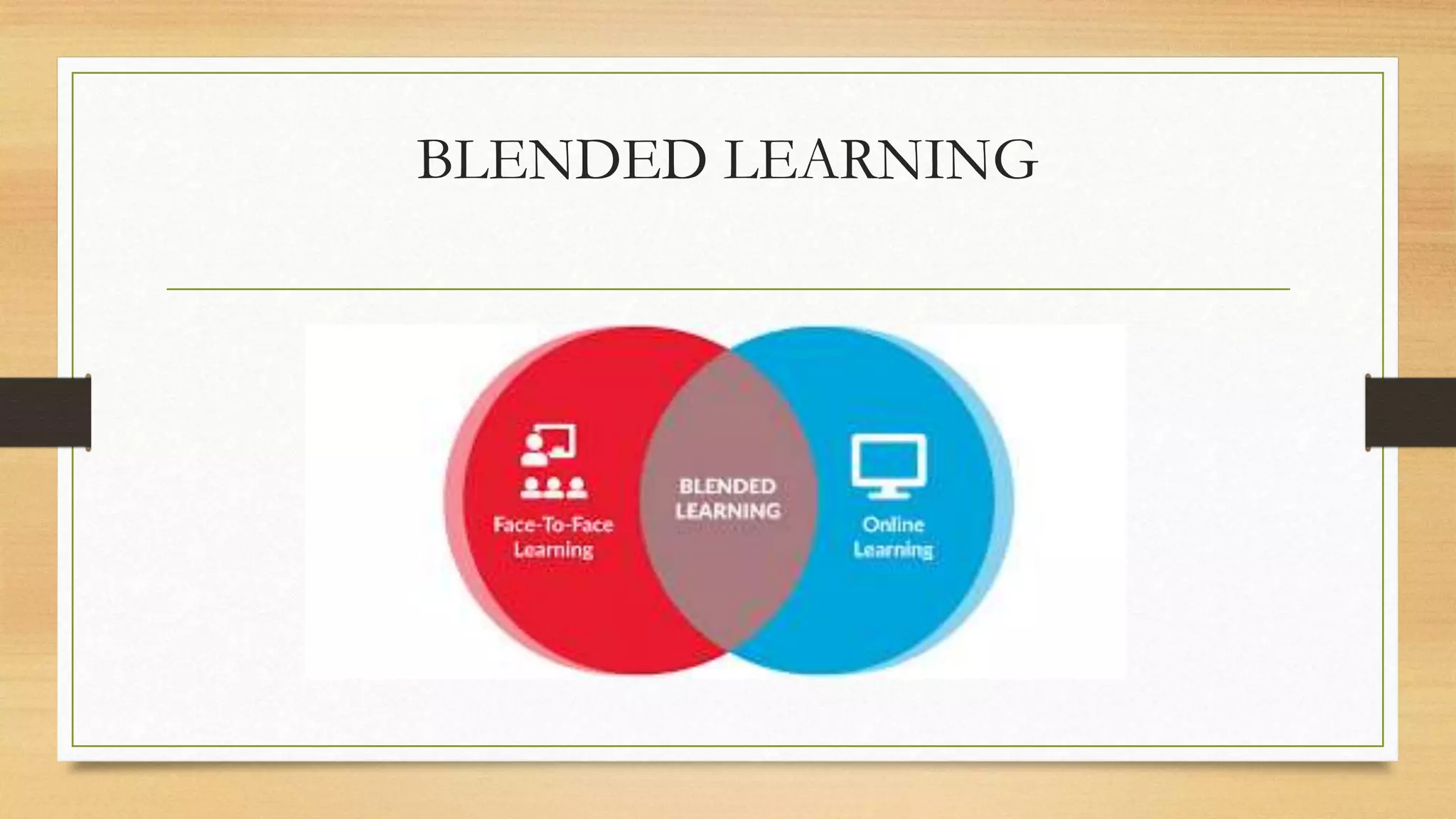
• It is an approach to education that combines online educational materials
and opportunities for interaction with traditional classroom method.
• It requires the physical presence of both student and teacher.
• A major part of activities take place ‘Online’ while traditional classroom
time is reduced but not eliminated.
In general,
• Some learning happens online in a format where student has control over the
path and pace at which they engage with content
• Some learning takes place in an instructor led classroom
• It creates a truly integrated learning environment
TYPES OF LMS
 MOODLE
 BLACKBOARD
 EDMODO
 GOOGLE CLASSROOM
 CANVAS
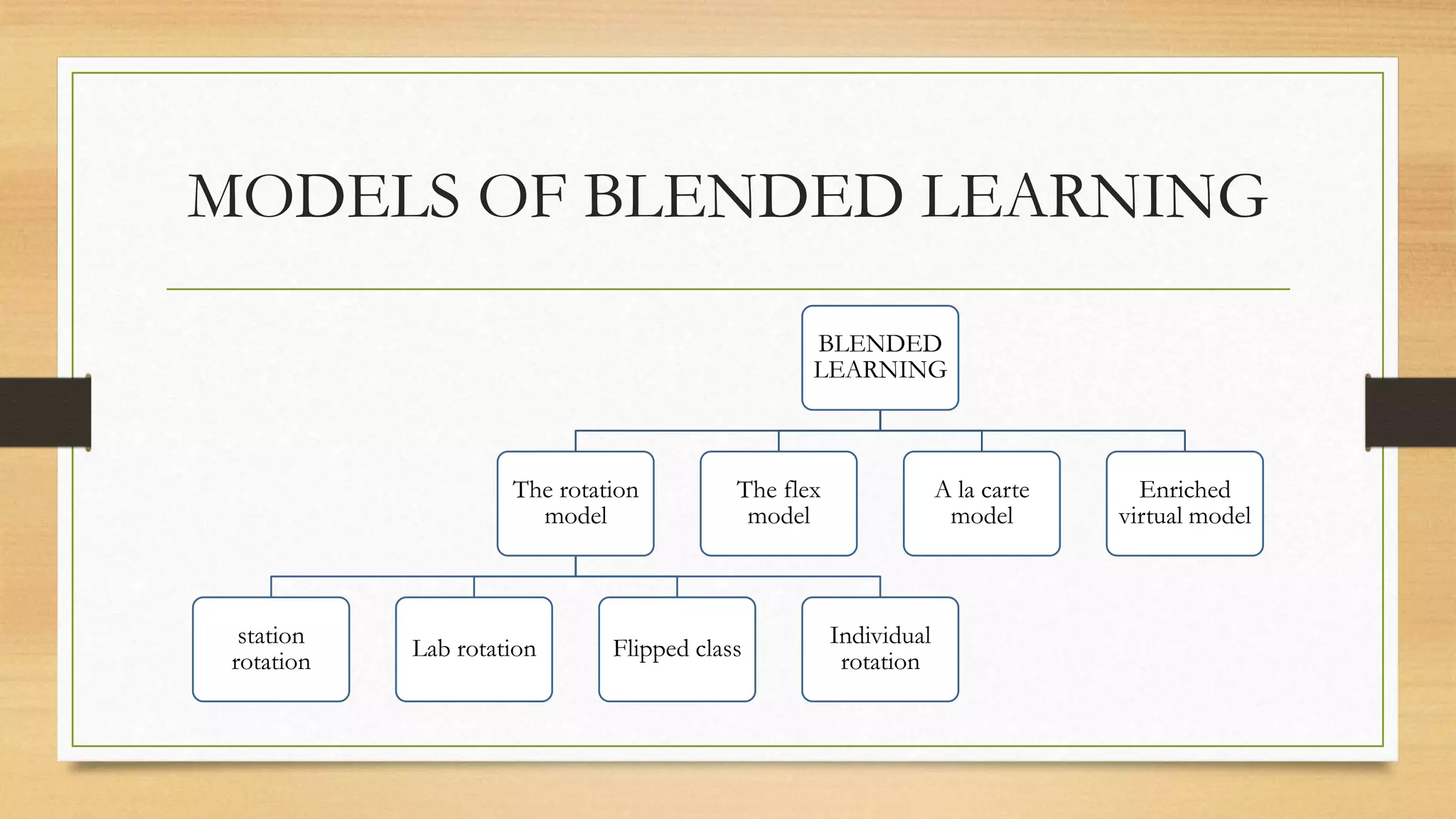
MODELS OF BLENDED LEARNING
BLENDED
LEARNING
The rotation
model
station
rotation
Lab rotation Flipped class
Individual
rotation
The flex
model
A la carte
model
Enriched
virtual model
ROTATION MODEL
• Station Rotation
Within a single classroom students rotate through all learning
activities on the same schedule.
• Lab Rotation
Students rotate to a computer lab for learning activities instead of
staying within the classroom.
ROTATION MODEL
• Flipped Classroom
Students spend their time away from school learning content
independently through online video lectures and class time is used for home
works.
• Individual Rotation
A teacher sets each student’s daily schedule which allows students
to rotate to the activities based on their needs.
FLEX MODEL
• Delivers most content online, but in traditional school setting.
• Teachers guide students
• Provides greater opportunities for individualization in terms of pace and
content
A LA CARTE MODEL
• Lets learners take an online course in addition to core curriculum
• They can take an online course while commuting to work or in the comfort
of their own home.
ENRICHED VIRTUAL MODEL
• Face to face learning sessions with teacher
• They can complete remaining works remotely
• Often at the end of this, students come together for a final session in which
they present what they learned.
Features of blended learning
Flexibility
Effectiveness
Efficiency
Cost effectiveness
Personalization
Extended reach
Covers all learning styles
Disadvantages of blended learning
Means to be a major distraction to students in class
Tends to weaken concentration of students
If gadgets are allowed to bring to school, there are chances of diversion
from actual concepts
Lack of motivation.
thank you…!!!!!

Blended learning

  • 1.
  • 2.
  • 3.
    What is onlinelearning?? • It is one type of ‘Distance Learning’. • It refers to the use of internet technology to deliver and enhance knowledge, skills and know-how. • It is a new approach to learning where the learner has control over WHAT, WHEN and WHERE he learns.
  • 4.
    Approaches to onlinelearning • Synchronous learning 1. Instruction and collaboration in real time via internet. 2. It typically involves  Live chat  Audio and video conferencing  Data and applications sharing. 1. Asynchronous learning 2. This method uses time delayed capabilities of internet 3. It typically involves  E-mail  Threaded discussion  File attachments
  • 5.
    TRADITIONAL CLASSROOMS  Interactionbetween learner and teacher  Immediate feedback  Socialization  Motivates learner
  • 6.
  • 7.
  • 8.
    WHAT IS BLENDEDLEARNING?? • It is an approach to education that combines online educational materials and opportunities for interaction with traditional classroom method. • It requires the physical presence of both student and teacher. • A major part of activities take place ‘Online’ while traditional classroom time is reduced but not eliminated.
  • 9.
    In general, • Somelearning happens online in a format where student has control over the path and pace at which they engage with content • Some learning takes place in an instructor led classroom • It creates a truly integrated learning environment
  • 10.
    TYPES OF LMS MOODLE  BLACKBOARD  EDMODO  GOOGLE CLASSROOM  CANVAS
  • 11.
    MODELS OF BLENDEDLEARNING BLENDED LEARNING The rotation model station rotation Lab rotation Flipped class Individual rotation The flex model A la carte model Enriched virtual model
  • 12.
    ROTATION MODEL • StationRotation Within a single classroom students rotate through all learning activities on the same schedule. • Lab Rotation Students rotate to a computer lab for learning activities instead of staying within the classroom.
  • 13.
    ROTATION MODEL • FlippedClassroom Students spend their time away from school learning content independently through online video lectures and class time is used for home works. • Individual Rotation A teacher sets each student’s daily schedule which allows students to rotate to the activities based on their needs.
  • 14.
    FLEX MODEL • Deliversmost content online, but in traditional school setting. • Teachers guide students • Provides greater opportunities for individualization in terms of pace and content
  • 15.
    A LA CARTEMODEL • Lets learners take an online course in addition to core curriculum • They can take an online course while commuting to work or in the comfort of their own home.
  • 16.
    ENRICHED VIRTUAL MODEL •Face to face learning sessions with teacher • They can complete remaining works remotely • Often at the end of this, students come together for a final session in which they present what they learned.
  • 17.
    Features of blendedlearning Flexibility Effectiveness Efficiency Cost effectiveness Personalization Extended reach Covers all learning styles
  • 18.
    Disadvantages of blendedlearning Means to be a major distraction to students in class Tends to weaken concentration of students If gadgets are allowed to bring to school, there are chances of diversion from actual concepts Lack of motivation.
  • 19.