Pedagogical
skills: Blended
Learning
PROF. BAISORAYA A. SAMPIANO-PARCON
Let’s have a quick review…
What is pedagogy?
The word comes from the Greek root in which
paidos means "child" and agogos means "lead";
literally translated "to lead the child".
For some time it was called as the art of
teaching and science of learning.
Now this is out of date…..The most modern
definition of pedagogy says “ It is a cultural
process, to bring out the all innate abilities and
nourish the acquired abilities of a child through a
systematic and planned manner.
What do we understand by innate &
acquired abilities of a child?
Innate: Already exist-Aptitude
Aptitude related to visual and performing
art, mathematical, scientific,
technological, kinesthetic etc
Acquired: From the Environment
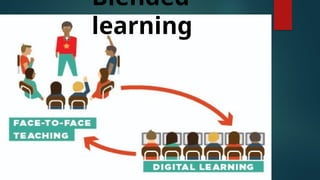
Blended
learning
Learning Outcomes:
Define blended learning.
Differentiate the four models of
blended learning
What is blended
learning?
“to combine or mix mode of Web-based
technology to accomplish an
educational goal”.
“to combine various pedagogical approaches
(e.g. constructivisim, behaviourism,
cognitivism) to produce an optimal learning
outcome with or without instructional
technology”.
“to combine any form of instructional
technology with face-to-face instructor-led
training.
(Driscoll, 2002)
Therefore blended
learning is……
An integrated approach to teaching and
learning that includes multiple modes of
instruction and students practice.
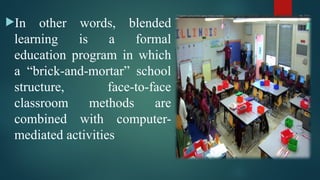
In other words, blended
learning is a formal
education program in which
a “brick-and-mortar” school
structure, face-to-face
classroom methods are
combined with computer-
mediated activities
Why
The goal of blended learning is to
provide the most efficient and
effective instruction experience to
combining delivery modalities.
Blended learning aims to join the best
of classroom teaching and learning
with the best of online teaching and
learning.
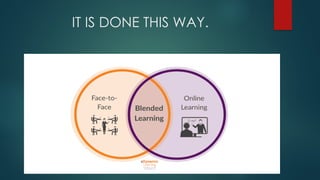
IT IS DONE THIS WAY.
Task
Think about the pros and cons of blending
one of your course.
Pros
Can save time, effort and cost.
More effective than single methods of
instruction
Allow sharing with other learners from
various regions.
Suit individual learning styles
Encourage self-directed learning
Cons
Can be a complex job to bring the right
blends together, involve more work
and planning
Students unfamiliar and unable to
make the most out of the experience.
Learning methods that don’t fit the
course objectives.
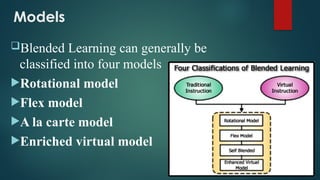
Models
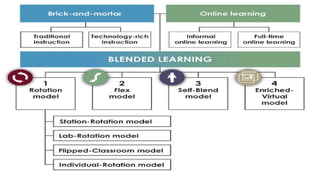
Blended Learning can generally be
classified into four models
Rotational model
Flex model
A la carte model
Enriched virtual model
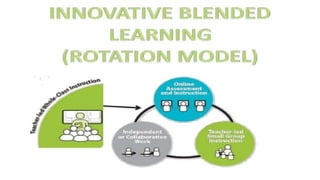
SAY SOMETHING ABOUT THE
PICTURE…..
Rotation Model
Students rotate on a fixed schedule between
learning online in a one-to-one, self-paced
environment and sitting in a classroom with a
traditional face-to-face teacher.
Students rotate at fixed points in time
between a classroom and computer lab
Students learn predominantly online
The classroom is generally reserved for other
learning activities.
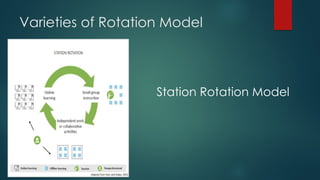
Varieties of Rotation Model
Station Rotation Model
students learn using software or other online-
based coursework on classroom computers.
Students can do a variety of activities,
including but not limited to previewing,
completing, or reviewing skill lessons, reading
stories, or taking computer-administered
assessments. Through these kinds of tech-
based activities, students have opportunities to
work independently and privately, free from
concerns about how they will perform in front
of their peers.
For the offline part of their learning,
students receive direct instruction from a
teacher, followed up by a variety of
activities, which could include modeled
and independent reading, workbook
pages or other pencil-and-paper tasks,
one-on-one tutoring, small-group work,
projects, games, flash cards—the list of
possibilities is nearly endless.
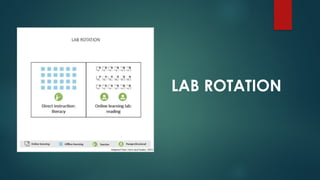
LAB ROTATION
Lab rotation is very similar to station rotation,
except that with lab rotation, students fulfill the
online learning part of instruction in a computer
lab rather than in the classroom. One benefit of
this model is that using the lab frees up
classroom space for other activities within the
rotation model.
Adequate access to a computer lab is an
important consideration for this model.
In intervention settings, students typically have
additional access to the computer lab
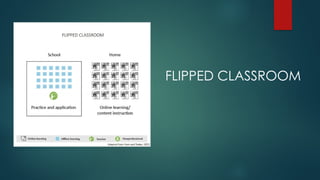
FLIPPED CLASSROOM
In a flipped classroom, students learn the lesson
content offsite via the computer and use class
time for activity-based learning rather than
passive learning. For example, students can
complete software lessons outside of class time
and then do homework during class time, when
a teacher is available for assistance. This model
helps ensure that students are actively engaged
in learning while in the classroom, which is one
reason why it is a favorite of secondary schools.
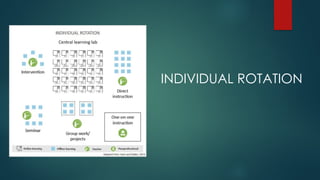
INDIVIDUAL ROTATION
In individual rotation, students move
through a variety of different learning
modalities, but rather than the rotation
being prescribed by a teacher or
schedule, it is customized for each
student according to individual needs.
This model is adjustable, which frees
students from having to move through
every modality at every stage in their
coursework and instead lets them work
in modalities that better meet their
needs at any given point. Teachers are
available to clarify or expand on the
information learned online and provide
support.
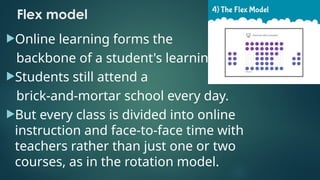
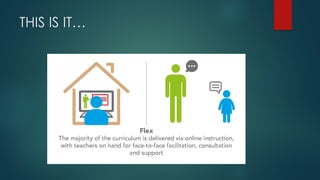
Flex model
Online learning forms the
backbone of a student's learning
Students still attend a
brick-and-mortar school every day.
But every class is divided into online
instruction and face-to-face time with
teachers rather than just one or two
courses, as in the rotation model.
Programs with a flex model feature an
online platform that delivers most of the
curricula.
Teachers provide on-site support on a
flexible and adaptive as-needed basis
through in-person tutoring sessions and
small group sessions.
THIS IS IT…
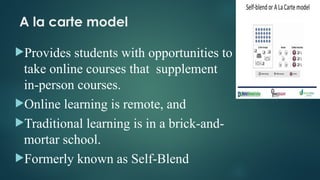
A la carte model
Provides students with opportunities to
take online courses that supplement
in-person courses.
Online learning is remote, and
Traditional learning is in a brick-and-
mortar school.
Formerly known as Self-Blend
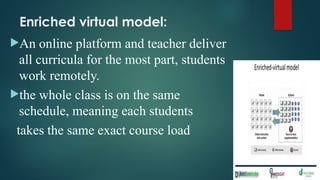
Enriched virtual model:
An online platform and teacher deliver
all curricula for the most part, students
work remotely.
the whole class is on the same
“ ”
schedule, meaning each students
takes the same exact course load
7 of the best blended learning
strategies-Bri Stauffer
1. Use Multiple Types of Instructional Materials
While it may be tempting to stick to your main
textbook, you’ll need more than that to truly
provide a blended experience!
Along with your textbook, try supplementing
your lessons with free resources from the
Internet, online discussion groups, your home-
grown teaching resources, and test prep
materials.
A typical day in a blended classroom could look like
this:
 Class starts with a bell ringer activity you found on the
Internet
 You instruct students to read a section of the textbook
 A teacher-led discussion follows
 Students break into groups to complete a related
activity you’ve created
 You end the class assigning homework from your
textbook or eBook
2. Incorporate Technology for
Reinforcement
Some topics can best be taught by
showing a video, such as how blood
travels through the body. After that, you
could instruct your students to discuss the
video online through social media or a
digital teaching tool you have.
You could also try using a mobile app or
interactive game if one fits your courses.
Quizlet and Kahoot! are two popular
options.
However you decide to include
technology, keep in mind that it should
have an applicable purpose to help
increase your students’ understanding
and retention of information.
Don’t add technology just to check
the box!
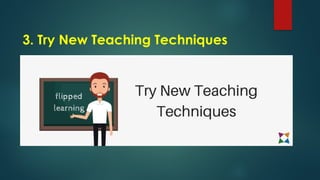
3. Try New Teaching Techniques
 Differentiated instruction is a more specific
technique of varying your instruction to
meet the needs of your individual students.
With differentiation, you could have three
versions of a lesson based on students’
performance in the classroom.
flipped learning means students do typical
classroom work at home. This leaves class
time open for teacher-led discussions,
projects, and hands-on skill work.
4. Keep Your Traditional Teaching Methods
Traditional lectures still have a place
in a blended classroom.
A lecture with an accompanying Po
werPoint presentation
is a great way to introduce a new
concept before you try branching
out into your other blended
strategies.
Also, a good classroom discussion is
an irreplaceable part of an effective
classroom. Your students can explore
a topic more in-depth with a
discussion that you facilitate.
Student-centered techniques are a
must, but your role as a facilitator is still
just as important even when adding
blended learning strategies to your
classes.
5. Vary Your Assessments
So how can you add more
variety to your assessments?
Here are a few ideas to get you started:
Keep some traditional, paper-based
assessments
Add digital quizzes throughout the course
Include essays as end-of-course
assignments
Assign presentations for unit wrap-up
Use self-assessed or peer-assessed
assignments
By varying your
formative and summative assessment
styles
, you’re not only including a new
technique for blended instruction.
You’re also providing your students
with more opportunities to showcase
their knowledge in ways that better
fit their strengths, rather than always
using traditional paper-based exams.
6. Mix Up Group Work Styles
Another blended learning strategy to
explore is mixing up how group work
is done in (and out) of the classroom.
By including online collaboration for
group work and discussions, you
provide a different way for students
to interact with each other.
7. Try Digital Curriculum
Digital curriculum systems often include a
variety of teaching materials, such as
digital lessons, hands-on activities,
guided notes, teacher presentations,
and group projects.
You’ll likely also find different types of
formative and summative assessments
within a digital curriculum that measure
your students' knowledge and
understanding in a variety of ways.
Which Blended Learning
Strategies are Right for
You?
At the end of the day, choosing the right
blended learning strategies depends on
your needs and the time you have
available for implementation.
Choosing the right strategy all depends
on what will provide the right amount of
balance for you while also helping your
students learn better.
 However, if you’re struggling to find
time to implement even one of
these strategies, consider our last
suggestion - using digital
curriculum.
Digital curriculum is the only item on
the list that involves the least amount
of work on your end. After all - the
materials and flexibility for blended
learning are built right into the
system!
Blended Learning is not new, but is it
getting Bigger all the time…..
Thank you for Listening…..
Selamat Siang…

blended-learning-aims-define-blended-learning-to-differentiate-the.pptx

  • 1.
  • 2.
    Let’s have aquick review…
  • 3.
    What is pedagogy? Theword comes from the Greek root in which paidos means "child" and agogos means "lead"; literally translated "to lead the child". For some time it was called as the art of teaching and science of learning. Now this is out of date…..The most modern definition of pedagogy says “ It is a cultural process, to bring out the all innate abilities and nourish the acquired abilities of a child through a systematic and planned manner.
  • 4.
    What do weunderstand by innate & acquired abilities of a child? Innate: Already exist-Aptitude Aptitude related to visual and performing art, mathematical, scientific, technological, kinesthetic etc Acquired: From the Environment
  • 5.
  • 6.
    Learning Outcomes: Define blendedlearning. Differentiate the four models of blended learning
  • 7.
    What is blended learning? “tocombine or mix mode of Web-based technology to accomplish an educational goal”.
  • 8.
    “to combine variouspedagogical approaches (e.g. constructivisim, behaviourism, cognitivism) to produce an optimal learning outcome with or without instructional technology”. “to combine any form of instructional technology with face-to-face instructor-led training. (Driscoll, 2002)
  • 9.
    Therefore blended learning is…… Anintegrated approach to teaching and learning that includes multiple modes of instruction and students practice.
  • 10.
    In other words,blended learning is a formal education program in which a “brick-and-mortar” school structure, face-to-face classroom methods are combined with computer- mediated activities
  • 11.
    Why The goal ofblended learning is to provide the most efficient and effective instruction experience to combining delivery modalities. Blended learning aims to join the best of classroom teaching and learning with the best of online teaching and learning.
  • 12.
    IT IS DONETHIS WAY.
  • 13.
    Task Think about thepros and cons of blending one of your course.
  • 14.
    Pros Can save time,effort and cost. More effective than single methods of instruction Allow sharing with other learners from various regions. Suit individual learning styles Encourage self-directed learning
  • 15.
    Cons Can be acomplex job to bring the right blends together, involve more work and planning Students unfamiliar and unable to make the most out of the experience. Learning methods that don’t fit the course objectives.
  • 16.
    Models Blended Learning cangenerally be classified into four models Rotational model Flex model A la carte model Enriched virtual model
  • 17.
    SAY SOMETHING ABOUTTHE PICTURE…..
  • 18.
    Rotation Model Students rotateon a fixed schedule between learning online in a one-to-one, self-paced environment and sitting in a classroom with a traditional face-to-face teacher. Students rotate at fixed points in time between a classroom and computer lab Students learn predominantly online The classroom is generally reserved for other learning activities.
  • 19.
    Varieties of RotationModel Station Rotation Model
  • 20.
    students learn usingsoftware or other online- based coursework on classroom computers. Students can do a variety of activities, including but not limited to previewing, completing, or reviewing skill lessons, reading stories, or taking computer-administered assessments. Through these kinds of tech- based activities, students have opportunities to work independently and privately, free from concerns about how they will perform in front of their peers.
  • 21.
    For the offlinepart of their learning, students receive direct instruction from a teacher, followed up by a variety of activities, which could include modeled and independent reading, workbook pages or other pencil-and-paper tasks, one-on-one tutoring, small-group work, projects, games, flash cards—the list of possibilities is nearly endless.
  • 22.
  • 23.
    Lab rotation isvery similar to station rotation, except that with lab rotation, students fulfill the online learning part of instruction in a computer lab rather than in the classroom. One benefit of this model is that using the lab frees up classroom space for other activities within the rotation model. Adequate access to a computer lab is an important consideration for this model. In intervention settings, students typically have additional access to the computer lab
  • 24.
  • 25.
    In a flippedclassroom, students learn the lesson content offsite via the computer and use class time for activity-based learning rather than passive learning. For example, students can complete software lessons outside of class time and then do homework during class time, when a teacher is available for assistance. This model helps ensure that students are actively engaged in learning while in the classroom, which is one reason why it is a favorite of secondary schools.
  • 26.
  • 27.
    In individual rotation,students move through a variety of different learning modalities, but rather than the rotation being prescribed by a teacher or schedule, it is customized for each student according to individual needs.
  • 28.
    This model isadjustable, which frees students from having to move through every modality at every stage in their coursework and instead lets them work in modalities that better meet their needs at any given point. Teachers are available to clarify or expand on the information learned online and provide support.
  • 29.
    Flex model Online learningforms the backbone of a student's learning Students still attend a brick-and-mortar school every day. But every class is divided into online instruction and face-to-face time with teachers rather than just one or two courses, as in the rotation model.
  • 30.
    Programs with aflex model feature an online platform that delivers most of the curricula. Teachers provide on-site support on a flexible and adaptive as-needed basis through in-person tutoring sessions and small group sessions.
  • 31.
  • 32.
    A la cartemodel Provides students with opportunities to take online courses that supplement in-person courses. Online learning is remote, and Traditional learning is in a brick-and- mortar school. Formerly known as Self-Blend
  • 33.
    Enriched virtual model: Anonline platform and teacher deliver all curricula for the most part, students work remotely. the whole class is on the same “ ” schedule, meaning each students takes the same exact course load
  • 35.
    7 of thebest blended learning strategies-Bri Stauffer 1. Use Multiple Types of Instructional Materials
  • 36.
    While it maybe tempting to stick to your main textbook, you’ll need more than that to truly provide a blended experience! Along with your textbook, try supplementing your lessons with free resources from the Internet, online discussion groups, your home- grown teaching resources, and test prep materials.
  • 37.
    A typical dayin a blended classroom could look like this:  Class starts with a bell ringer activity you found on the Internet  You instruct students to read a section of the textbook  A teacher-led discussion follows  Students break into groups to complete a related activity you’ve created  You end the class assigning homework from your textbook or eBook
  • 38.
    2. Incorporate Technologyfor Reinforcement
  • 39.
    Some topics canbest be taught by showing a video, such as how blood travels through the body. After that, you could instruct your students to discuss the video online through social media or a digital teaching tool you have. You could also try using a mobile app or interactive game if one fits your courses. Quizlet and Kahoot! are two popular options.
  • 40.
    However you decideto include technology, keep in mind that it should have an applicable purpose to help increase your students’ understanding and retention of information. Don’t add technology just to check the box!
  • 41.
    3. Try NewTeaching Techniques
  • 42.
     Differentiated instructionis a more specific technique of varying your instruction to meet the needs of your individual students. With differentiation, you could have three versions of a lesson based on students’ performance in the classroom. flipped learning means students do typical classroom work at home. This leaves class time open for teacher-led discussions, projects, and hands-on skill work.
  • 43.
    4. Keep YourTraditional Teaching Methods
  • 44.
    Traditional lectures stillhave a place in a blended classroom. A lecture with an accompanying Po werPoint presentation is a great way to introduce a new concept before you try branching out into your other blended strategies.
  • 45.
    Also, a goodclassroom discussion is an irreplaceable part of an effective classroom. Your students can explore a topic more in-depth with a discussion that you facilitate. Student-centered techniques are a must, but your role as a facilitator is still just as important even when adding blended learning strategies to your classes.
  • 46.
    5. Vary YourAssessments
  • 47.
    So how canyou add more variety to your assessments?
  • 48.
    Here are afew ideas to get you started: Keep some traditional, paper-based assessments Add digital quizzes throughout the course Include essays as end-of-course assignments Assign presentations for unit wrap-up Use self-assessed or peer-assessed assignments
  • 49.
    By varying your formativeand summative assessment styles , you’re not only including a new technique for blended instruction. You’re also providing your students with more opportunities to showcase their knowledge in ways that better fit their strengths, rather than always using traditional paper-based exams.
  • 50.
    6. Mix UpGroup Work Styles
  • 51.
    Another blended learningstrategy to explore is mixing up how group work is done in (and out) of the classroom. By including online collaboration for group work and discussions, you provide a different way for students to interact with each other.
  • 52.
    7. Try DigitalCurriculum
  • 53.
    Digital curriculum systemsoften include a variety of teaching materials, such as digital lessons, hands-on activities, guided notes, teacher presentations, and group projects. You’ll likely also find different types of formative and summative assessments within a digital curriculum that measure your students' knowledge and understanding in a variety of ways.
  • 54.
  • 55.
    At the endof the day, choosing the right blended learning strategies depends on your needs and the time you have available for implementation. Choosing the right strategy all depends on what will provide the right amount of balance for you while also helping your students learn better.
  • 56.
     However, ifyou’re struggling to find time to implement even one of these strategies, consider our last suggestion - using digital curriculum.
  • 57.
    Digital curriculum isthe only item on the list that involves the least amount of work on your end. After all - the materials and flexibility for blended learning are built right into the system!
  • 58.
    Blended Learning isnot new, but is it getting Bigger all the time….. Thank you for Listening….. Selamat Siang…