Conventional and Non
Conventional Methods of
Teaching
Presented by:- Prof. Indira Dhull
INTRODUCTION
 Education plays a pivotal role to the pace of economic growth of the
nation; therefore, effective teaching is essential.
 Effective teaching does not solely revolve around getting the vast amount
of knowledge into the learner; it delves deeper into the technicalities,
ensuring that teaching is based on assisting the learner's progress from one
level to another.
 Education is in state of transition. The “old” method of teaching is being
called into question and a “new” method of learning is being advocated to
replace it.
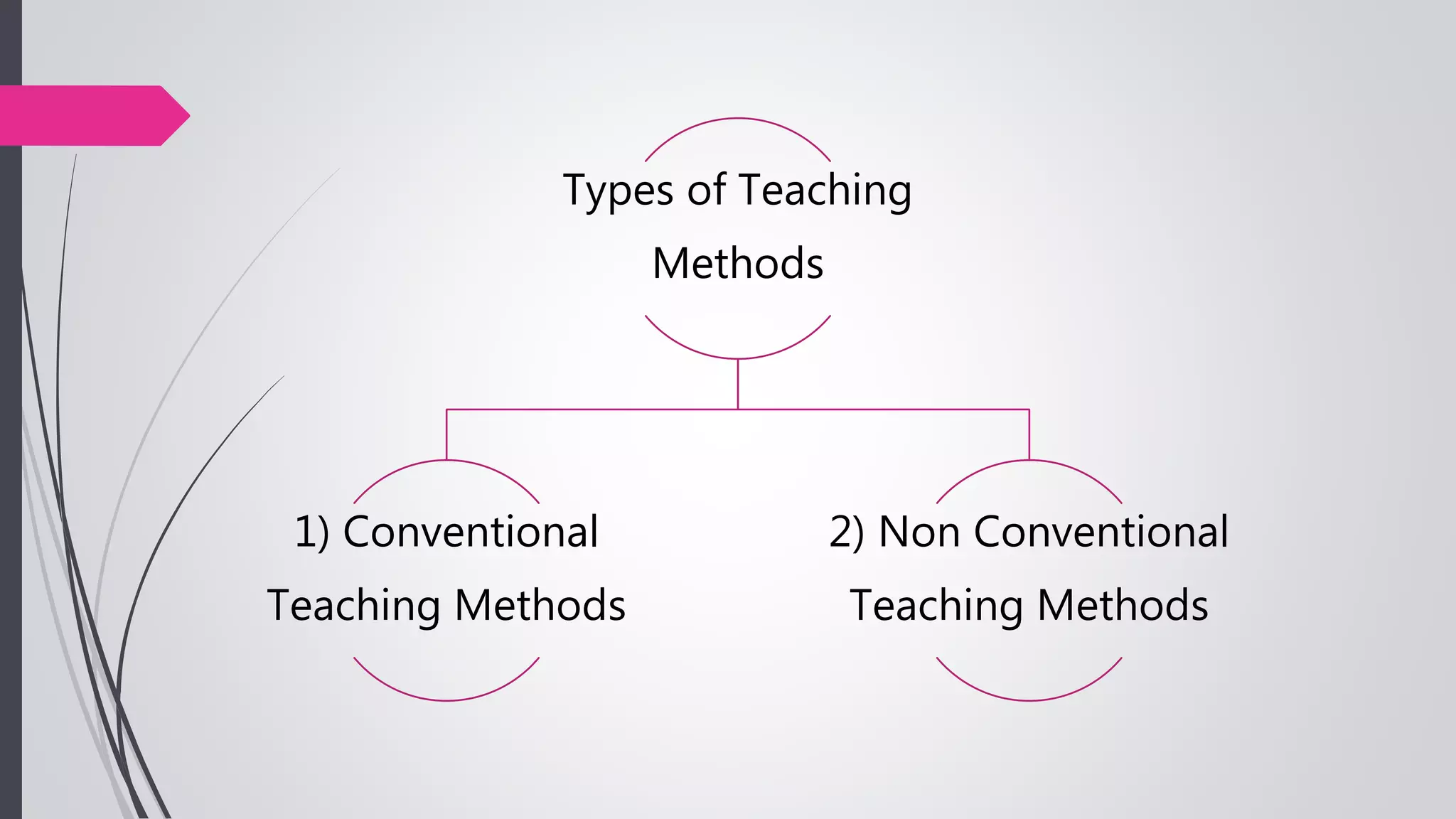
Types of Teaching
Methods
1) Conventional
Teaching Methods
2) Non Conventional
Teaching Methods
1) Conventional Teaching Methods
 Conventional teaching is also known as back to basics, Traditional
teaching or customary teaching.
 It refers to a teaching method involving instructors and the students.
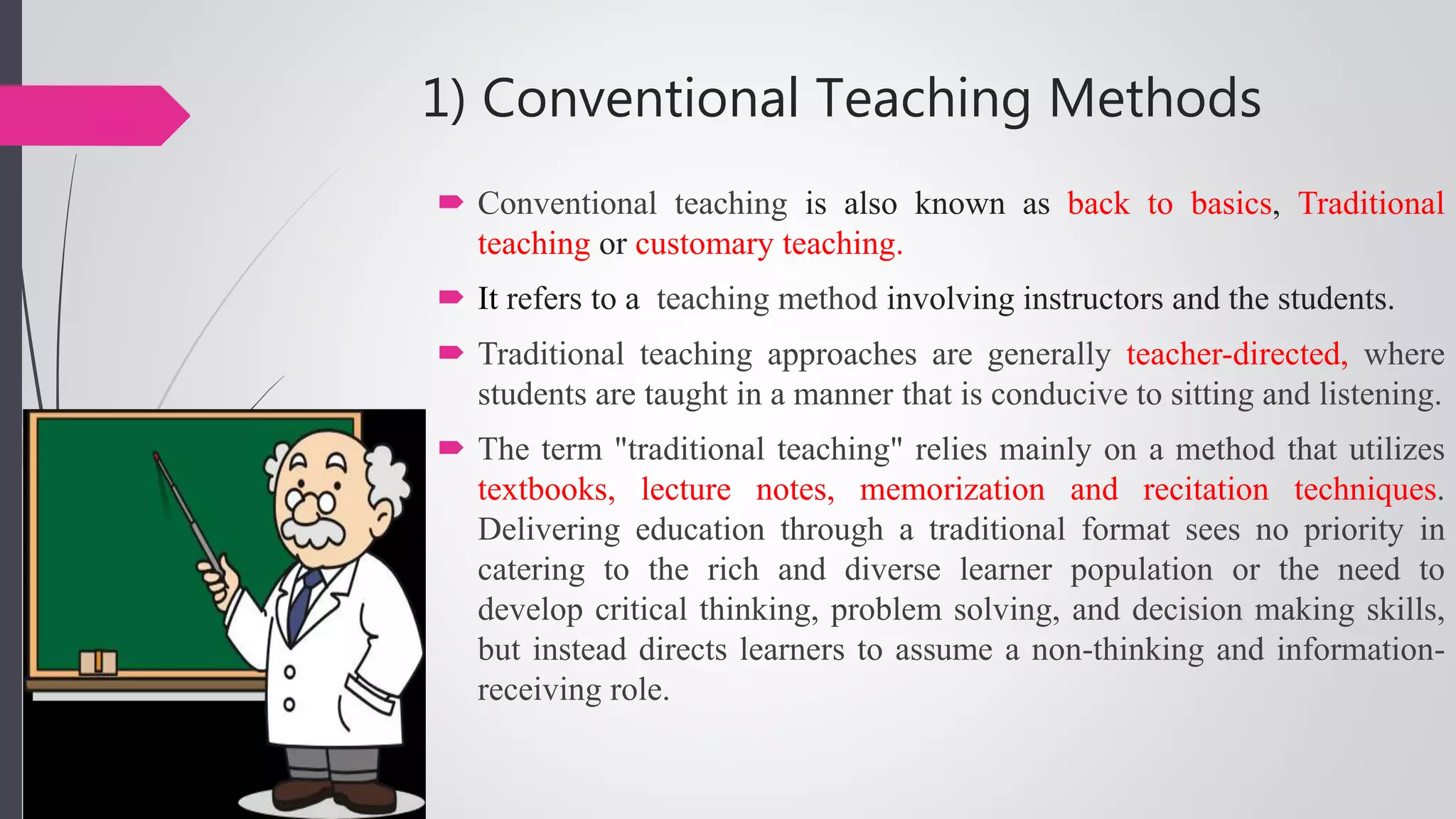
 Traditional teaching approaches are generally teacher-directed, where
students are taught in a manner that is conducive to sitting and listening.
 The term "traditional teaching" relies mainly on a method that utilizes
textbooks, lecture notes, memorization and recitation techniques.
Delivering education through a traditional format sees no priority in
catering to the rich and diverse learner population or the need to
develop critical thinking, problem solving, and decision making skills,
but instead directs learners to assume a non-thinking and information-
receiving role.
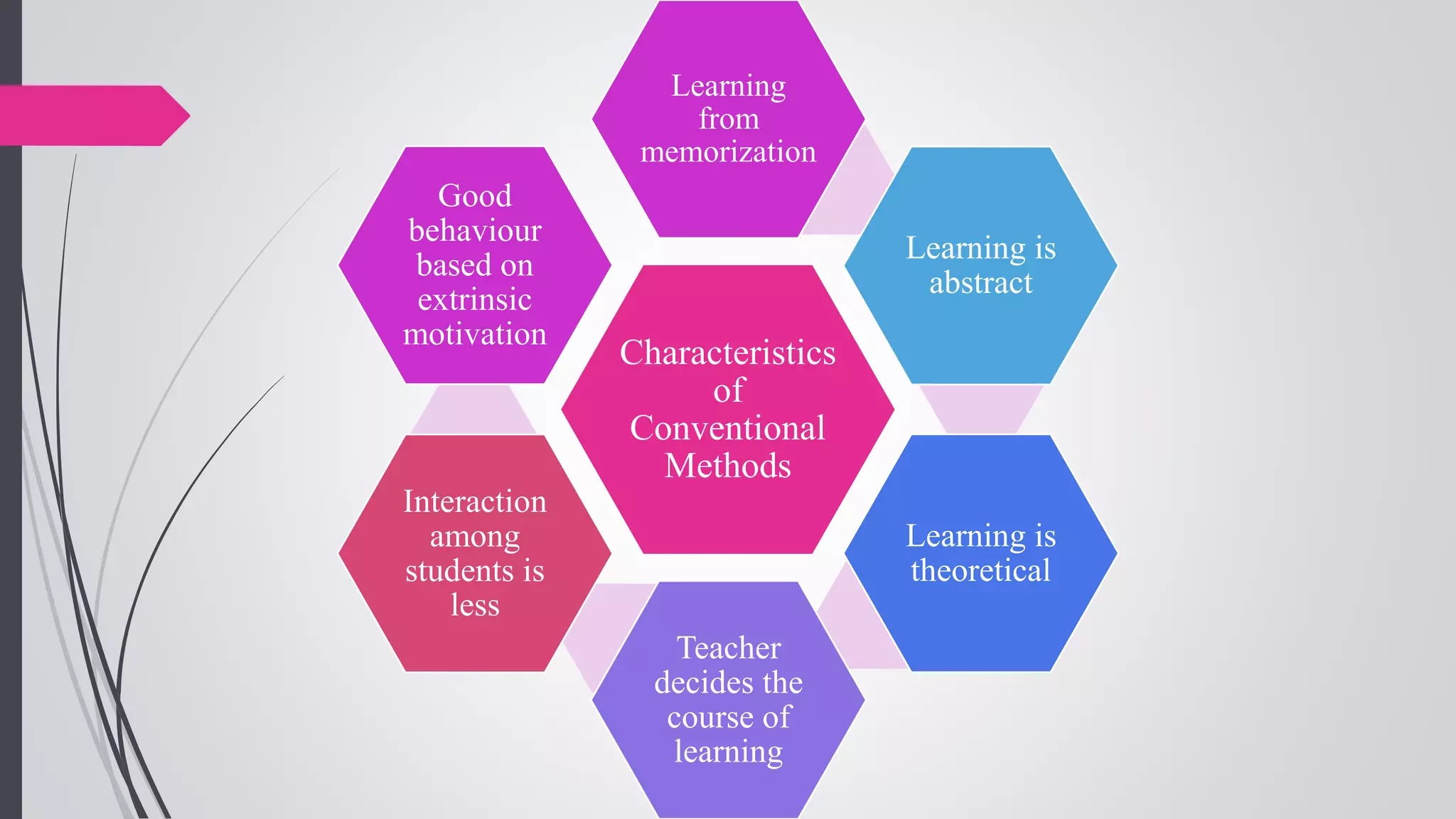
Characteristics
of
Conventional
Methods
Learning
from
memorization
Learning is
abstract
Learning is
theoretical
Teacher
decides the
course of
learning
Interaction
among
students is
less
Good
behaviour
based on
extrinsic
motivation
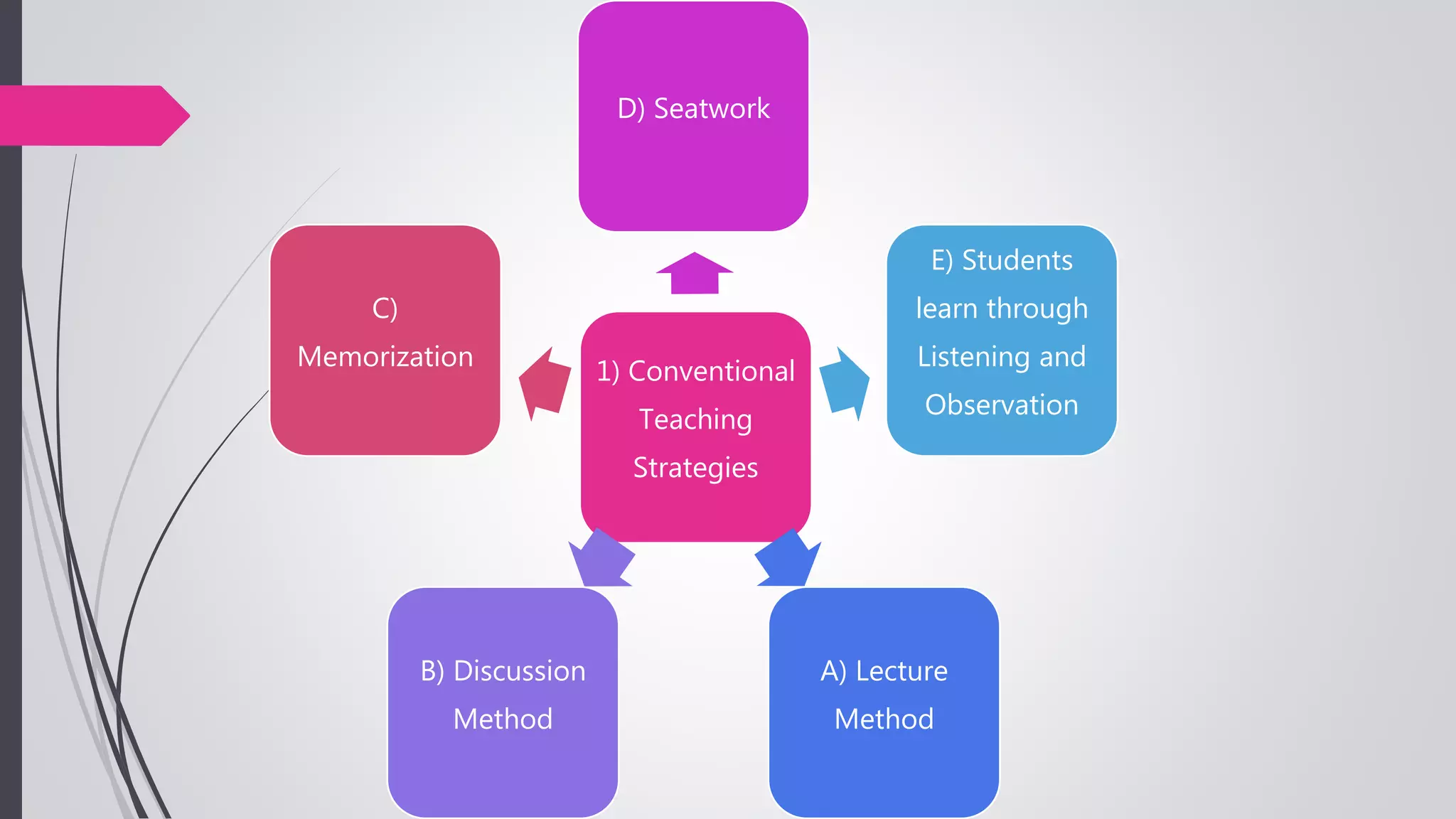
1) Conventional
Teaching
Strategies
D) Seatwork
E) Students
learn through
Listening and
Observation
A) Lecture
Method
B) Discussion
Method
C)
Memorization
A) Lecture Method
Many teachers consider lectures the most effective tool of teaching and
learning. The professor condenses the vast study material, and delivers to the
students in an organized way, which significantly reduces the burden on the
student.
 ADVANTAGES
 Lectures can be used to meet the
specific needs of the audiences.
 Lectures can be used to condense
a huge amount of information and
can be presented to a larger
audiences.
 Lectures can appeal to the
students who learn best by
listening
 DISADVANATGES
 Lectures would be suitable only for
effective communicators. Reading the
material on the slide is not effective in
lectures.
 Students are made passive in lectures and
cannot give feedback to the teacher.
 Teachers would presume that all the
students learn at the same pace and are at
the same level of understanding. (But
they actually are not!)
B) Discussion Method
 The discussion method of conventional teaching is based on the Socratic
method.
 This Method demands that students come to class well prepared. They
think out their arguments in advance to answer their peers’ questions and
counter-arguments, it sharpens their powers of reason, analysis, and
articulation.
 It thus provides them with fundamental skills necessary for success in any
discipline or profession.
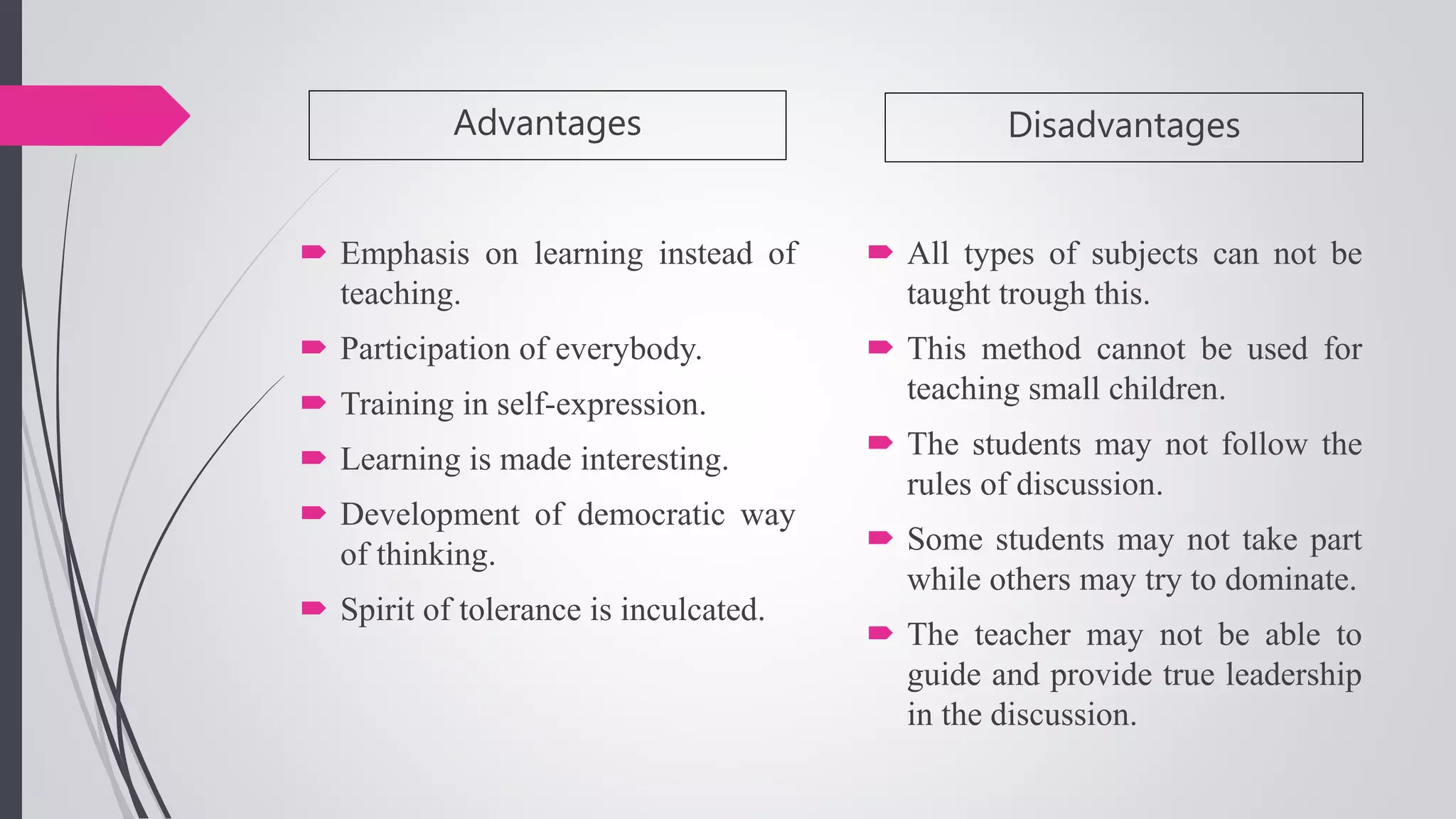
Advantages
 Emphasis on learning instead of
teaching.
 Participation of everybody.
 Training in self-expression.
 Learning is made interesting.
 Development of democratic way
of thinking.
 Spirit of tolerance is inculcated.
Disadvantages
 All types of subjects can not be
taught trough this.
 This method cannot be used for
teaching small children.
 The students may not follow the
rules of discussion.
 Some students may not take part
while others may try to dominate.
 The teacher may not be able to
guide and provide true leadership
in the discussion.
Advantages of Conventional
Teaching
 Presenting information in a quick
manner.
 Teaching learners who learn best
by listening.
 Traditional teaching method is
cheaper than the modern teaching
methods.
 Some subjects like mathematics
or chemistry are best taught on a
blackboard as there is a need of
explaining the concept at each
every step.
Disadvantages of
Conventional Teaching
 Not all learners learn best by
listening.
 Keeping learner’s interest is often
difficult.
 The approach tends to require
little or no critical thinking.
 The approach assumes that all
learners learn in same
interpersonal way.
2) Non Conventional Teaching Methods
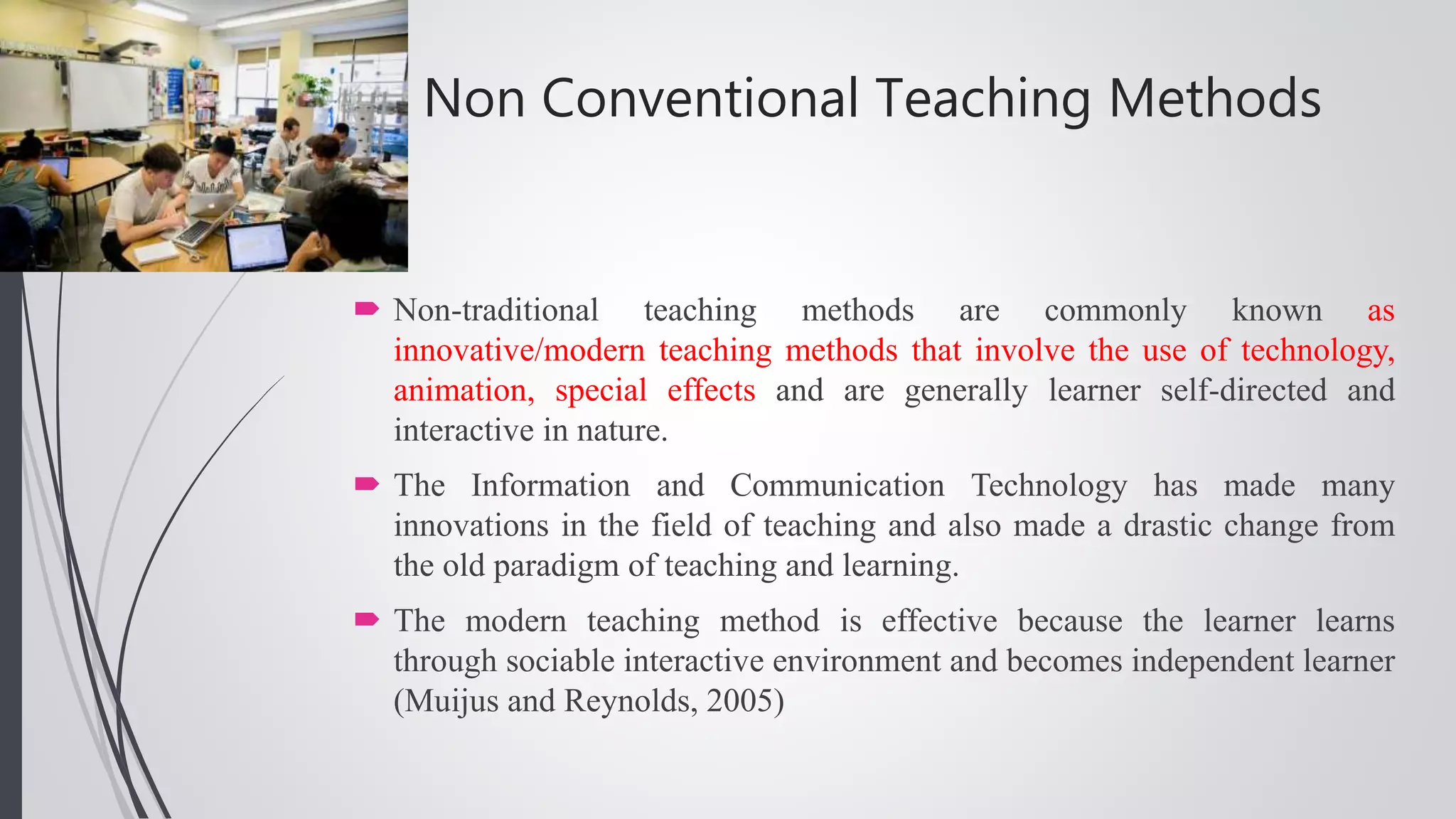
 Non-traditional teaching methods are commonly known as
innovative/modern teaching methods that involve the use of technology,
animation, special effects and are generally learner self-directed and
interactive in nature.
 The Information and Communication Technology has made many
innovations in the field of teaching and also made a drastic change from
the old paradigm of teaching and learning.
 The modern teaching method is effective because the learner learns
through sociable interactive environment and becomes independent learner
(Muijus and Reynolds, 2005)
2) Non
Conventional
Teaching
Methods
E) Flipped
Classroom
Projects
F) Computer
Assisted Method
of Teaching
A) Peer
Assisted
Learning
B) Problem
Based
Learning
C)
Team Based
Learning
D) Small
Group
Discussions
A) Peer Assisted Learning
 The “peer assisted learning” method of learning was adopted by British Higher
Education system in the 1990s. It is considered as a “student-to-student”
support system. In this system, some students are identified as PAL leaders
within their classroom. Academic brilliance and good communication skills are
the basis on which the PAL leaders are nominated. These PAL leaders are
responsible for the learning of others in a classroom.
 PAL leaders are trained for their role at the beginning of the semester with an
induction course.
 PAL leaders would be chosen from the same classroom of students to which
PAL leader would belong to.
 A PAL coordinator would observe the work of PAL leaders and give them
feedback on their performances.
 PAL leaders can be appreciated and paid a minimal amount for their teaching
sessions with other students.
•PAL program creates a better teaching learning environment for the students to
learn the subject.
•Students have the option to learn only what is required for them and do not
need to attend the topics which they are already well-versed with.
The knowledge of the PAL leader would be amplified and boost their
confidence.
•Students can learn both basic and complicated concepts easily.
PAL leaders are able to share simpler, better techniques of learning, which
can boost the performance of other students
•Students who have a phobia of approaching teachers benefit from the PAL
program.
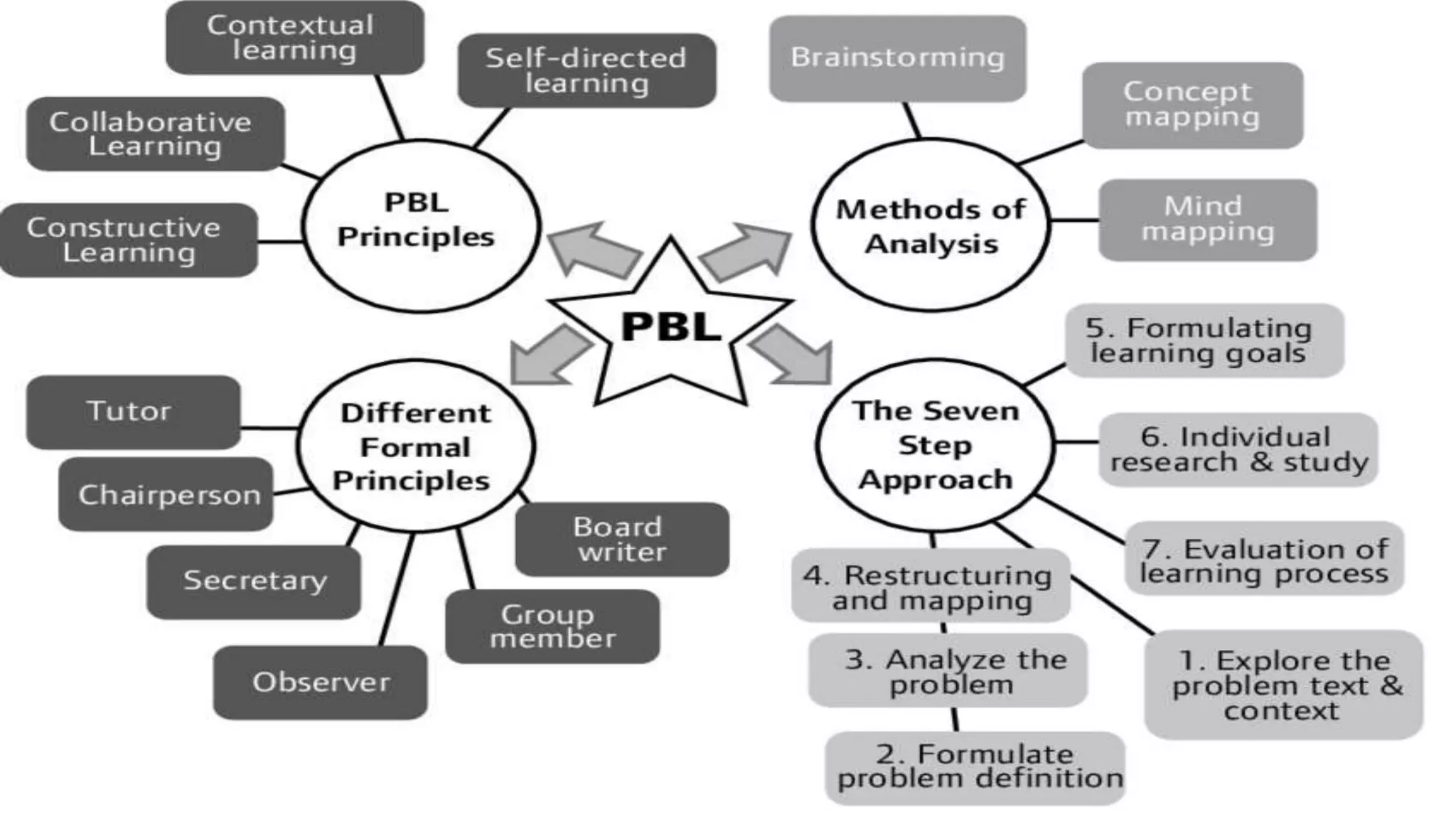
B) Problem Based Learning
 Tight et al. (2009) defined problem based learning (PBL) to be “a total
education strategy based on the principle of using real-world problems as a
starting point for the acquisition and integration of new knowledge.
 In addition to course content, PBL can promote the development of critical
thinking skills, problem-solving abilities, and communication skills. It can
also provide opportunities for working in groups, finding and evaluating
research materials, and life-long learning (Duch et al, 2001).
 The PBL tutorial process involves working in small groups of learners.
Each student takes on a role within the group that may be formal or
informal and the role often alternates. It is focused on the student's
reflection and reasoning to construct their own learning.
C) Team Based Learning
 Team Based Learning (TBL) is a structured form of small-group learning that
emphasizes student preparation out of class and application of knowledge in
class.
 The teacher establishes the learning objectives and chooses the problems on
which the students will focus but then acts as a guide while teams work toward
their solution to the problem.
Four principles underlying Team-Based Learning
 Groups should be properly formed (e.g. Intellectual talent should be equally
distributed among the groups). These teams are fixed for the whole course.
 Students are accountable for their pre-learning and for working in teams.
 Team assignments must promote both learning and team development.
 Students must receive frequent and immediate feedback.
3 Step Cycle of TBL
D) Small Group Discussions
 Small group discussion provides opportunities for students to speak in
front of others and to receive feedback from teachers and peers.
 Small groups can be an effective learning situation in which students
learn from their teachers and interaction with each other.
 Group discussion increases active participation of students. It also helps
self-directed learning and to exchange ideas.
 The shy and less articulate are more able to contribute
 Students learn from each other
 Everyone gets more practice at expressing their ideas
 A two way discussion is almost always more creative than individual
thoughts.
Strategies for Small Group Discussions
STRATEGIES FEATURES
1) Collaborative Mind
Mapping
The students can create an online mind map by using web applications such as
Google Docs & Sheets and Mindmeister. This helps in communicating the
ideas on a two dimensional canvas. Students can post their questions for
discussions in mind maps.
2) Think Pair Share Think-Pair-Share (TPS) is a collaborative learning strategy in which students
work together to solve a problem or answer a question about an assigned
reading. This technique requires students to (1) think individually about a topic
or answer to a question; and (2) share ideas with classmates.
3) Simple Jigsaw In groups of five, assign each participant a brief unique reading (for in-class or
out-of-class). The group is given a general topic to discussion, and each
participant takes a turn discussing it from the viewpoint of their unique reading.
4) Debate In this discussion method, the class is divided into two groups of participants,
who then debate a topic in a reasoned and organized fashion. This could be a
formal parliamentary debate or a more simplistic mode
E) Flipped Classroom Projects
 A flipped
classroom is an
instructional strategy
and a type of blended
learning that reverses
the traditional
learning environment
by delivering
instructional content,
often online, outside
of the classroom.
F) Computer Assisted Method of Teaching
 It is an approach to teaching and learning in which computer
technology is used as an aid to the presentation,
reinforcement and assessment of material to be learned,
usually including a substantial interactive element.
 Promotes interactive learning.
 Promoted educational management.
 Provides additional learning opportunities.
Advantages
 Motivates learners.
 Provides consistency in
presentation.
 Can adjust difficulty to level of
learner.
 Can present concepts or processes
dynamically and using multiple
forms of representation.
 Can maintain records of student
performance.
 Provides immediate feedback.
Disadvantages
 Equipment and software can be
costly.
 Development takes time and
money.
 Not compatible for every student.
 Requires training for teaching.
Advantages of Non
Conventional Teaching
Methods
 These teaching methods are
considered very effective learning
tool as the active student
participation is a must.
 These methods leas to a long term
knowledge.
 Effective for students who don’t
work well solo.
 These methods develop
teamwork and interpersonal
communication skills.
Disadvantages of Non
Conventional Methods
 These modern methods require
students to be well prepared for
the lecture which is a hindrance
as it is not a possible every time.
 Not effective for a large group of
students.
 Students who are academically
strong may provide more input
and have a better participation
than other students. Hence, it may
create a learning imbalance
among the students.
Conventional Teaching Non Conventional Teaching
Content
The content is established by a curriculum,
and all learners study the same topics at the
same time.
Learners study topics based on curriculum
and standards but are allowed numerous
choices in a topic of study.
Learners have access to limited information,
selected by the teacher or the school library.
Learners have infinite access to unlimited
information of varying degrees of quality.
Topics of study are typically isolated and
disconnected from each other.
Learners study content in a way that shows
connections between subjects.
Learners memorize facts and occasionally
analyze information critically. There is little
focus on applying facts or Concepts to a
variety of real world situations.
Learners learn concepts as well as facts, and
frequently engage in high-level analysis,
evaluation, and synthesis of a variety of
kinds of material. There is an emphasis on
showing how concepts apply to a variety of
real world situations
Conventional
Teaching
Non Conventional Teaching
Instruction
The teacher is the information
giver and helps in acquiring skills
and knowledge.
The teacher is the facilitator
providing opportunities for
to apply skills and construct their
own knowledge
Teaching is an instructive process Teaching is a constructive process.
Learners complete short, isolated
activities and lessons around
specific content pieces and skills
Learners work on activities and
projects connected to long-term
goals aimed at building deep
conceptual understanding and
proficient strategy use.
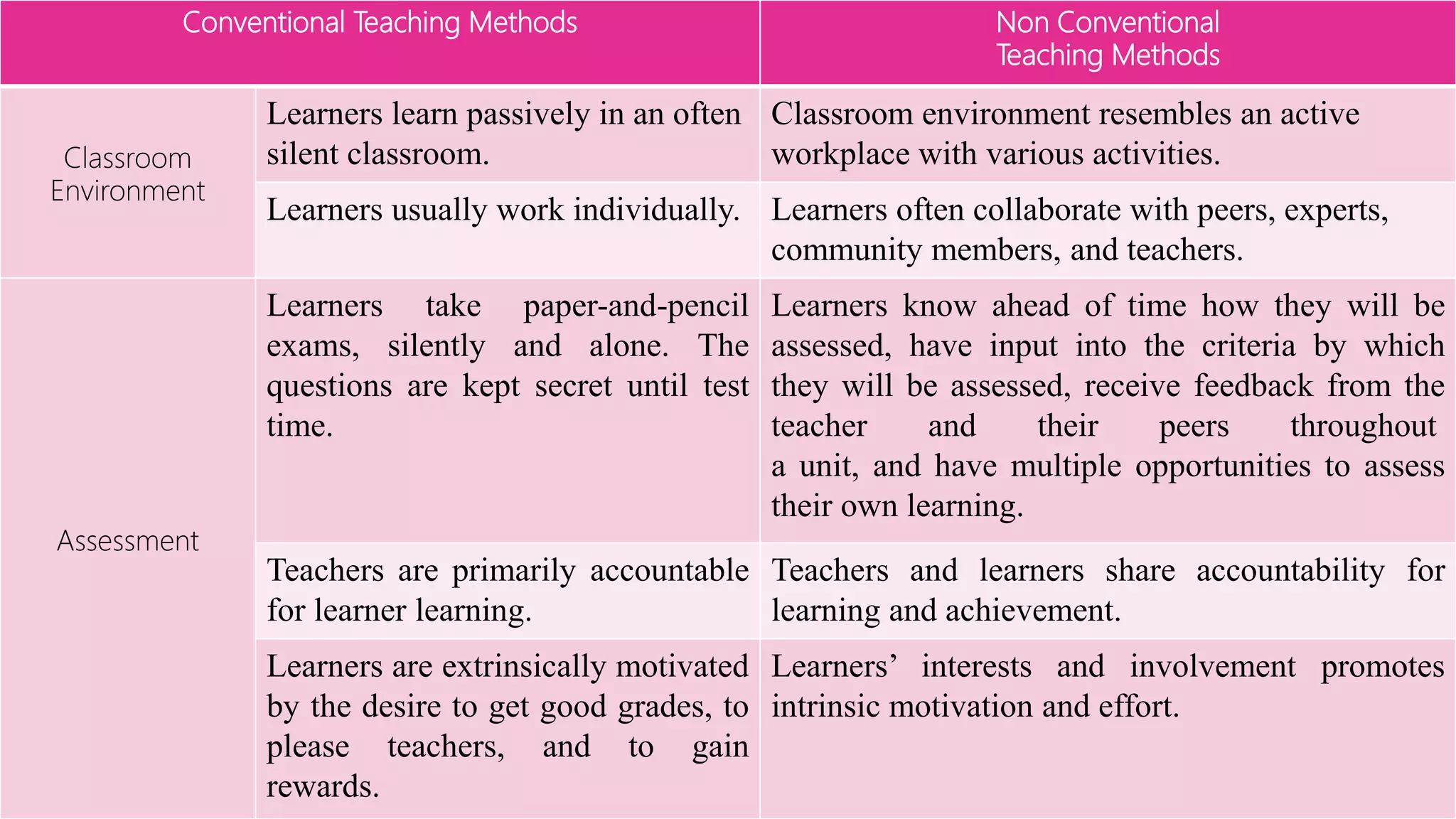
Conventional Teaching Methods Non Conventional
Teaching Methods
Classroom
Environment
Learners learn passively in an often
silent classroom.
Classroom environment resembles an active
workplace with various activities.
Learners usually work individually. Learners often collaborate with peers, experts,
community members, and teachers.
Assessment
Learners take paper-and-pencil
exams, silently and alone. The
questions are kept secret until test
time.
Learners know ahead of time how they will be
assessed, have input into the criteria by which
they will be assessed, receive feedback from the
teacher and their peers throughout
a unit, and have multiple opportunities to assess
their own learning.
Teachers are primarily accountable
for learner learning.
Teachers and learners share accountability for
learning and achievement.
Learners are extrinsically motivated
by the desire to get good grades, to
please teachers, and to gain
rewards.
Learners’ interests and involvement promotes
intrinsic motivation and effort.
Conventional
Teaching Methods
Non Conventional
Teaching Methods
Conclusion
Traditional teaching methods have been used for centuries to teach students.
Teaching today’s generation calls for a change in education approach from
conventional to a more comprehensive, communicative and technological
way. Conventional teaching methods make students uninterested in class,
discouraged, bored, stop trying in accomplishing tasks given, do poorly in
tests and makes learner passive. So, to overcome such issues non
conventional teaching methods have been introduced. These modern teaching
methods makes teaching learning more interesting.
Innovative methods of teaching

Innovative methods of teaching

  • 1.
    Conventional and Non ConventionalMethods of Teaching Presented by:- Prof. Indira Dhull
  • 2.
    INTRODUCTION  Education playsa pivotal role to the pace of economic growth of the nation; therefore, effective teaching is essential.  Effective teaching does not solely revolve around getting the vast amount of knowledge into the learner; it delves deeper into the technicalities, ensuring that teaching is based on assisting the learner's progress from one level to another.  Education is in state of transition. The “old” method of teaching is being called into question and a “new” method of learning is being advocated to replace it.
  • 3.
    Types of Teaching Methods 1)Conventional Teaching Methods 2) Non Conventional Teaching Methods
  • 4.
    1) Conventional TeachingMethods  Conventional teaching is also known as back to basics, Traditional teaching or customary teaching.  It refers to a teaching method involving instructors and the students.  Traditional teaching approaches are generally teacher-directed, where students are taught in a manner that is conducive to sitting and listening.  The term "traditional teaching" relies mainly on a method that utilizes textbooks, lecture notes, memorization and recitation techniques. Delivering education through a traditional format sees no priority in catering to the rich and diverse learner population or the need to develop critical thinking, problem solving, and decision making skills, but instead directs learners to assume a non-thinking and information- receiving role.
  • 5.
    Characteristics of Conventional Methods Learning from memorization Learning is abstract Learning is theoretical Teacher decidesthe course of learning Interaction among students is less Good behaviour based on extrinsic motivation
  • 6.
    1) Conventional Teaching Strategies D) Seatwork E)Students learn through Listening and Observation A) Lecture Method B) Discussion Method C) Memorization
  • 7.
    A) Lecture Method Manyteachers consider lectures the most effective tool of teaching and learning. The professor condenses the vast study material, and delivers to the students in an organized way, which significantly reduces the burden on the student.  ADVANTAGES  Lectures can be used to meet the specific needs of the audiences.  Lectures can be used to condense a huge amount of information and can be presented to a larger audiences.  Lectures can appeal to the students who learn best by listening  DISADVANATGES  Lectures would be suitable only for effective communicators. Reading the material on the slide is not effective in lectures.  Students are made passive in lectures and cannot give feedback to the teacher.  Teachers would presume that all the students learn at the same pace and are at the same level of understanding. (But they actually are not!)
  • 8.
    B) Discussion Method The discussion method of conventional teaching is based on the Socratic method.  This Method demands that students come to class well prepared. They think out their arguments in advance to answer their peers’ questions and counter-arguments, it sharpens their powers of reason, analysis, and articulation.  It thus provides them with fundamental skills necessary for success in any discipline or profession.
  • 9.
    Advantages  Emphasis onlearning instead of teaching.  Participation of everybody.  Training in self-expression.  Learning is made interesting.  Development of democratic way of thinking.  Spirit of tolerance is inculcated. Disadvantages  All types of subjects can not be taught trough this.  This method cannot be used for teaching small children.  The students may not follow the rules of discussion.  Some students may not take part while others may try to dominate.  The teacher may not be able to guide and provide true leadership in the discussion.
  • 10.
    Advantages of Conventional Teaching Presenting information in a quick manner.  Teaching learners who learn best by listening.  Traditional teaching method is cheaper than the modern teaching methods.  Some subjects like mathematics or chemistry are best taught on a blackboard as there is a need of explaining the concept at each every step. Disadvantages of Conventional Teaching  Not all learners learn best by listening.  Keeping learner’s interest is often difficult.  The approach tends to require little or no critical thinking.  The approach assumes that all learners learn in same interpersonal way.
  • 11.
    2) Non ConventionalTeaching Methods  Non-traditional teaching methods are commonly known as innovative/modern teaching methods that involve the use of technology, animation, special effects and are generally learner self-directed and interactive in nature.  The Information and Communication Technology has made many innovations in the field of teaching and also made a drastic change from the old paradigm of teaching and learning.  The modern teaching method is effective because the learner learns through sociable interactive environment and becomes independent learner (Muijus and Reynolds, 2005)
  • 12.
    2) Non Conventional Teaching Methods E) Flipped Classroom Projects F)Computer Assisted Method of Teaching A) Peer Assisted Learning B) Problem Based Learning C) Team Based Learning D) Small Group Discussions
  • 13.
    A) Peer AssistedLearning  The “peer assisted learning” method of learning was adopted by British Higher Education system in the 1990s. It is considered as a “student-to-student” support system. In this system, some students are identified as PAL leaders within their classroom. Academic brilliance and good communication skills are the basis on which the PAL leaders are nominated. These PAL leaders are responsible for the learning of others in a classroom.  PAL leaders are trained for their role at the beginning of the semester with an induction course.  PAL leaders would be chosen from the same classroom of students to which PAL leader would belong to.  A PAL coordinator would observe the work of PAL leaders and give them feedback on their performances.  PAL leaders can be appreciated and paid a minimal amount for their teaching sessions with other students.
  • 14.
    •PAL program createsa better teaching learning environment for the students to learn the subject. •Students have the option to learn only what is required for them and do not need to attend the topics which they are already well-versed with. The knowledge of the PAL leader would be amplified and boost their confidence. •Students can learn both basic and complicated concepts easily. PAL leaders are able to share simpler, better techniques of learning, which can boost the performance of other students •Students who have a phobia of approaching teachers benefit from the PAL program.
  • 15.
    B) Problem BasedLearning  Tight et al. (2009) defined problem based learning (PBL) to be “a total education strategy based on the principle of using real-world problems as a starting point for the acquisition and integration of new knowledge.  In addition to course content, PBL can promote the development of critical thinking skills, problem-solving abilities, and communication skills. It can also provide opportunities for working in groups, finding and evaluating research materials, and life-long learning (Duch et al, 2001).  The PBL tutorial process involves working in small groups of learners. Each student takes on a role within the group that may be formal or informal and the role often alternates. It is focused on the student's reflection and reasoning to construct their own learning.
  • 17.
    C) Team BasedLearning  Team Based Learning (TBL) is a structured form of small-group learning that emphasizes student preparation out of class and application of knowledge in class.  The teacher establishes the learning objectives and chooses the problems on which the students will focus but then acts as a guide while teams work toward their solution to the problem. Four principles underlying Team-Based Learning  Groups should be properly formed (e.g. Intellectual talent should be equally distributed among the groups). These teams are fixed for the whole course.  Students are accountable for their pre-learning and for working in teams.  Team assignments must promote both learning and team development.  Students must receive frequent and immediate feedback.
  • 18.
  • 19.
    D) Small GroupDiscussions  Small group discussion provides opportunities for students to speak in front of others and to receive feedback from teachers and peers.  Small groups can be an effective learning situation in which students learn from their teachers and interaction with each other.  Group discussion increases active participation of students. It also helps self-directed learning and to exchange ideas.  The shy and less articulate are more able to contribute  Students learn from each other  Everyone gets more practice at expressing their ideas  A two way discussion is almost always more creative than individual thoughts.
  • 20.
    Strategies for SmallGroup Discussions STRATEGIES FEATURES 1) Collaborative Mind Mapping The students can create an online mind map by using web applications such as Google Docs & Sheets and Mindmeister. This helps in communicating the ideas on a two dimensional canvas. Students can post their questions for discussions in mind maps. 2) Think Pair Share Think-Pair-Share (TPS) is a collaborative learning strategy in which students work together to solve a problem or answer a question about an assigned reading. This technique requires students to (1) think individually about a topic or answer to a question; and (2) share ideas with classmates. 3) Simple Jigsaw In groups of five, assign each participant a brief unique reading (for in-class or out-of-class). The group is given a general topic to discussion, and each participant takes a turn discussing it from the viewpoint of their unique reading. 4) Debate In this discussion method, the class is divided into two groups of participants, who then debate a topic in a reasoned and organized fashion. This could be a formal parliamentary debate or a more simplistic mode
  • 21.
    E) Flipped ClassroomProjects  A flipped classroom is an instructional strategy and a type of blended learning that reverses the traditional learning environment by delivering instructional content, often online, outside of the classroom.
  • 22.
    F) Computer AssistedMethod of Teaching  It is an approach to teaching and learning in which computer technology is used as an aid to the presentation, reinforcement and assessment of material to be learned, usually including a substantial interactive element.  Promotes interactive learning.  Promoted educational management.  Provides additional learning opportunities.
  • 23.
    Advantages  Motivates learners. Provides consistency in presentation.  Can adjust difficulty to level of learner.  Can present concepts or processes dynamically and using multiple forms of representation.  Can maintain records of student performance.  Provides immediate feedback. Disadvantages  Equipment and software can be costly.  Development takes time and money.  Not compatible for every student.  Requires training for teaching.
  • 24.
    Advantages of Non ConventionalTeaching Methods  These teaching methods are considered very effective learning tool as the active student participation is a must.  These methods leas to a long term knowledge.  Effective for students who don’t work well solo.  These methods develop teamwork and interpersonal communication skills. Disadvantages of Non Conventional Methods  These modern methods require students to be well prepared for the lecture which is a hindrance as it is not a possible every time.  Not effective for a large group of students.  Students who are academically strong may provide more input and have a better participation than other students. Hence, it may create a learning imbalance among the students.
  • 25.
    Conventional Teaching NonConventional Teaching Content The content is established by a curriculum, and all learners study the same topics at the same time. Learners study topics based on curriculum and standards but are allowed numerous choices in a topic of study. Learners have access to limited information, selected by the teacher or the school library. Learners have infinite access to unlimited information of varying degrees of quality. Topics of study are typically isolated and disconnected from each other. Learners study content in a way that shows connections between subjects. Learners memorize facts and occasionally analyze information critically. There is little focus on applying facts or Concepts to a variety of real world situations. Learners learn concepts as well as facts, and frequently engage in high-level analysis, evaluation, and synthesis of a variety of kinds of material. There is an emphasis on showing how concepts apply to a variety of real world situations
  • 26.
    Conventional Teaching Non Conventional Teaching Instruction Theteacher is the information giver and helps in acquiring skills and knowledge. The teacher is the facilitator providing opportunities for to apply skills and construct their own knowledge Teaching is an instructive process Teaching is a constructive process. Learners complete short, isolated activities and lessons around specific content pieces and skills Learners work on activities and projects connected to long-term goals aimed at building deep conceptual understanding and proficient strategy use.
  • 27.
    Conventional Teaching MethodsNon Conventional Teaching Methods Classroom Environment Learners learn passively in an often silent classroom. Classroom environment resembles an active workplace with various activities. Learners usually work individually. Learners often collaborate with peers, experts, community members, and teachers. Assessment Learners take paper-and-pencil exams, silently and alone. The questions are kept secret until test time. Learners know ahead of time how they will be assessed, have input into the criteria by which they will be assessed, receive feedback from the teacher and their peers throughout a unit, and have multiple opportunities to assess their own learning. Teachers are primarily accountable for learner learning. Teachers and learners share accountability for learning and achievement. Learners are extrinsically motivated by the desire to get good grades, to please teachers, and to gain rewards. Learners’ interests and involvement promotes intrinsic motivation and effort.
  • 28.
  • 29.
    Conclusion Traditional teaching methodshave been used for centuries to teach students. Teaching today’s generation calls for a change in education approach from conventional to a more comprehensive, communicative and technological way. Conventional teaching methods make students uninterested in class, discouraged, bored, stop trying in accomplishing tasks given, do poorly in tests and makes learner passive. So, to overcome such issues non conventional teaching methods have been introduced. These modern teaching methods makes teaching learning more interesting.