Blended learning combines online and in-person learning where students learn through digital and online media as well as traditional classroom methods. It involves using different modes of delivery and teaching styles in an interactive learning environment. There is no set formula for a blended learning model, but common approaches include the rotation model where students rotate between online and classroom settings, and the flex model where online learning is the backbone of student learning. Blended learning provides benefits to both educators and learners by increasing flexibility, personalizing instruction, and optimizing resources. While it requires strong technical resources and support, blended learning models are expected to continue evolving with new technologies.
Blended Learning
A presentationon Educational Delivery Modality
By Noble Ahiaklo-Kuz
MPhil Art Education
Kwame Nkrumah University of Science and Technology, Ghana
2.
What is BlendedLearning?
Introduction
Blended learning, according to Friesen (2012), is a formal education
program in which a student learns at least in part through delivery of
content and instruction via digital and online media with some element of
student control over time, place, path, or pace.
The concept of blended learning has been around for a long time, but its
terminology was not firmly established until about the start of 21st century
Currently, use of the term blended learning mostly involves "combining
Internet and digital media with established classroom forms that require
the physical co-presence of teacher and students. (Friesen, 2012)
3.
What is BlendedLearning?
Introduction cont’d
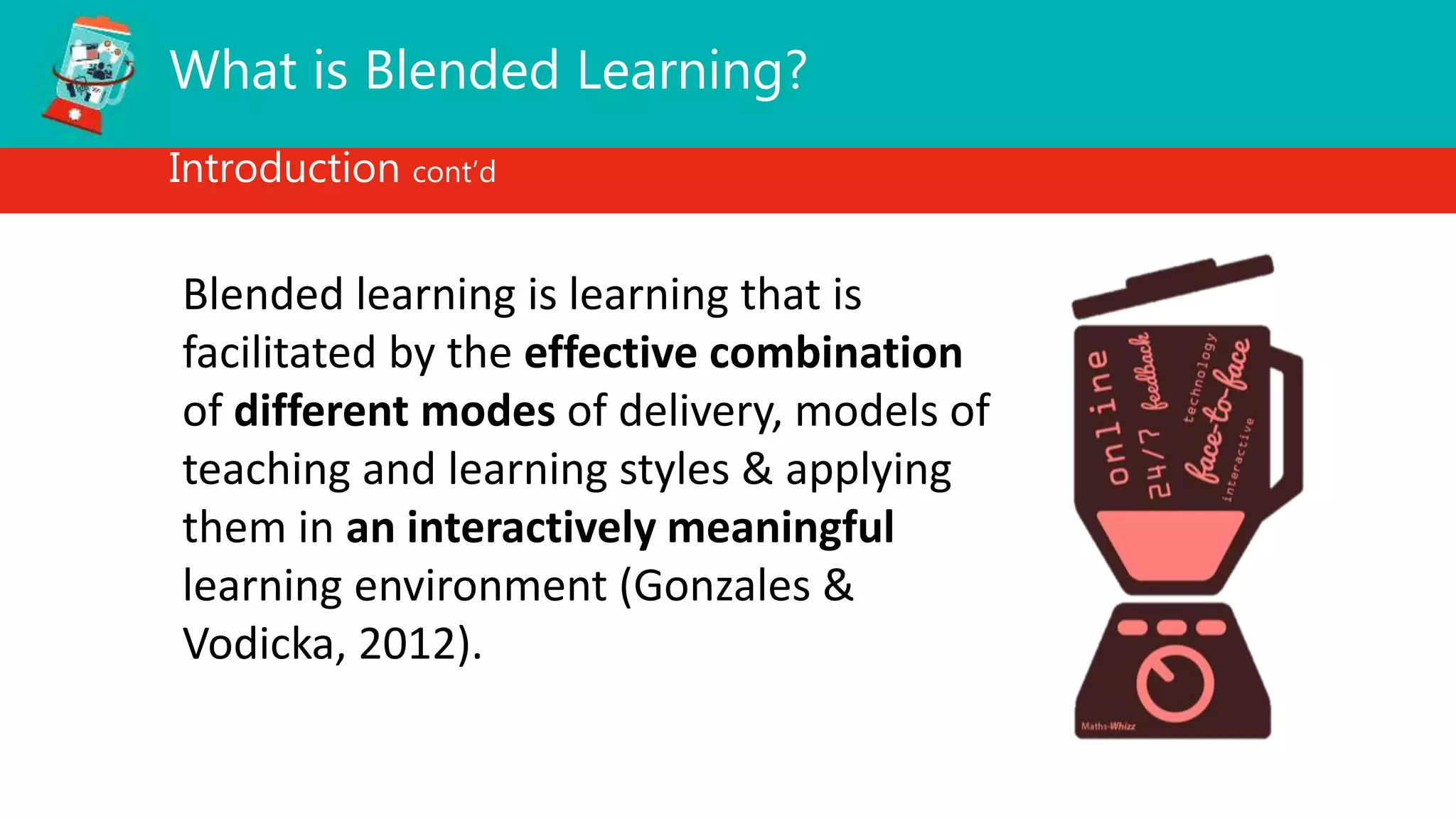
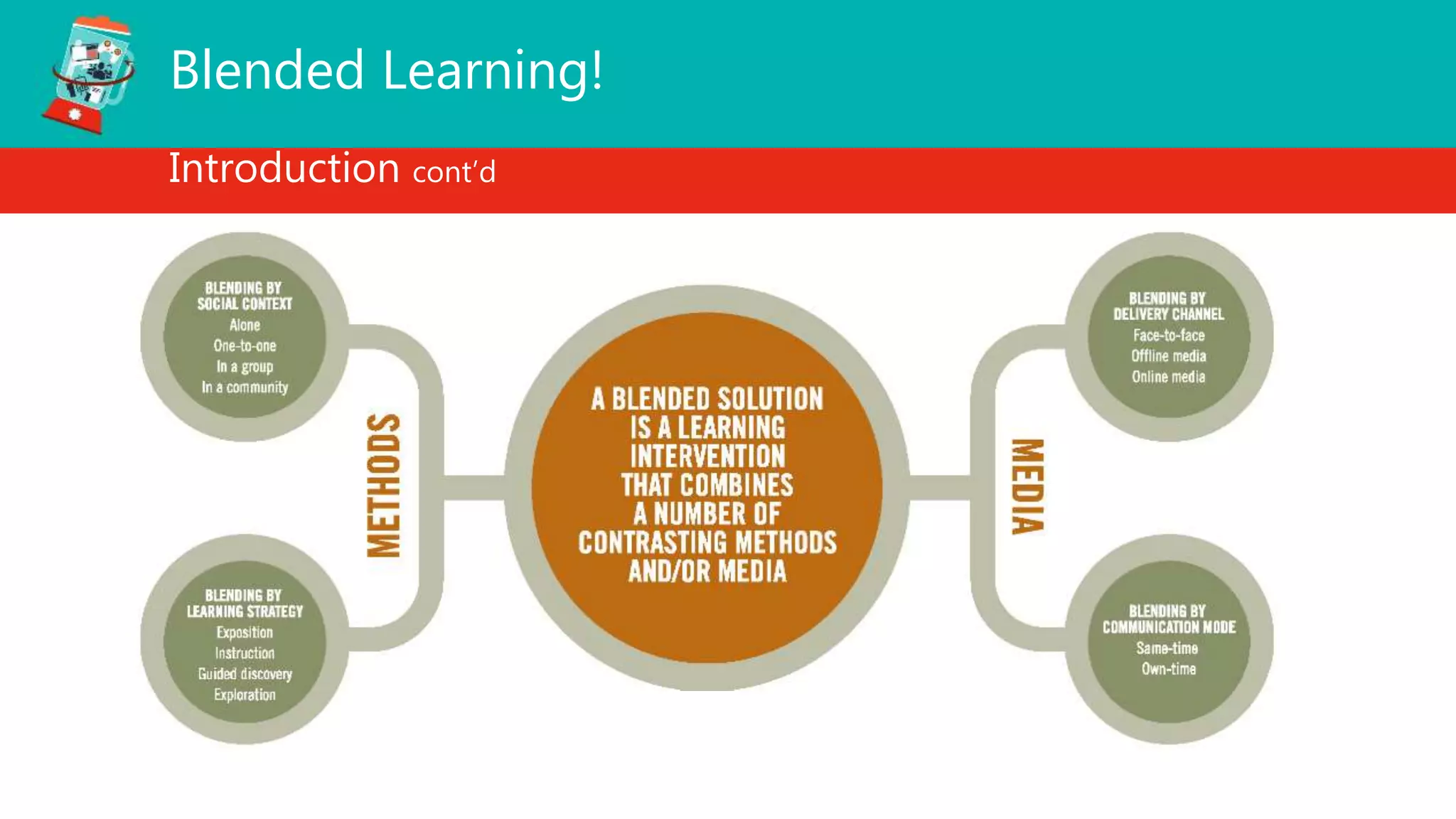
Blended learning is learning that is
facilitated by the effective combination
of different modes of delivery, models of
teaching and learning styles & applying
them in an interactively meaningful
learning environment (Gonzales &
Vodicka, 2012).
What is BlendedLearning?
What goes into the blender?
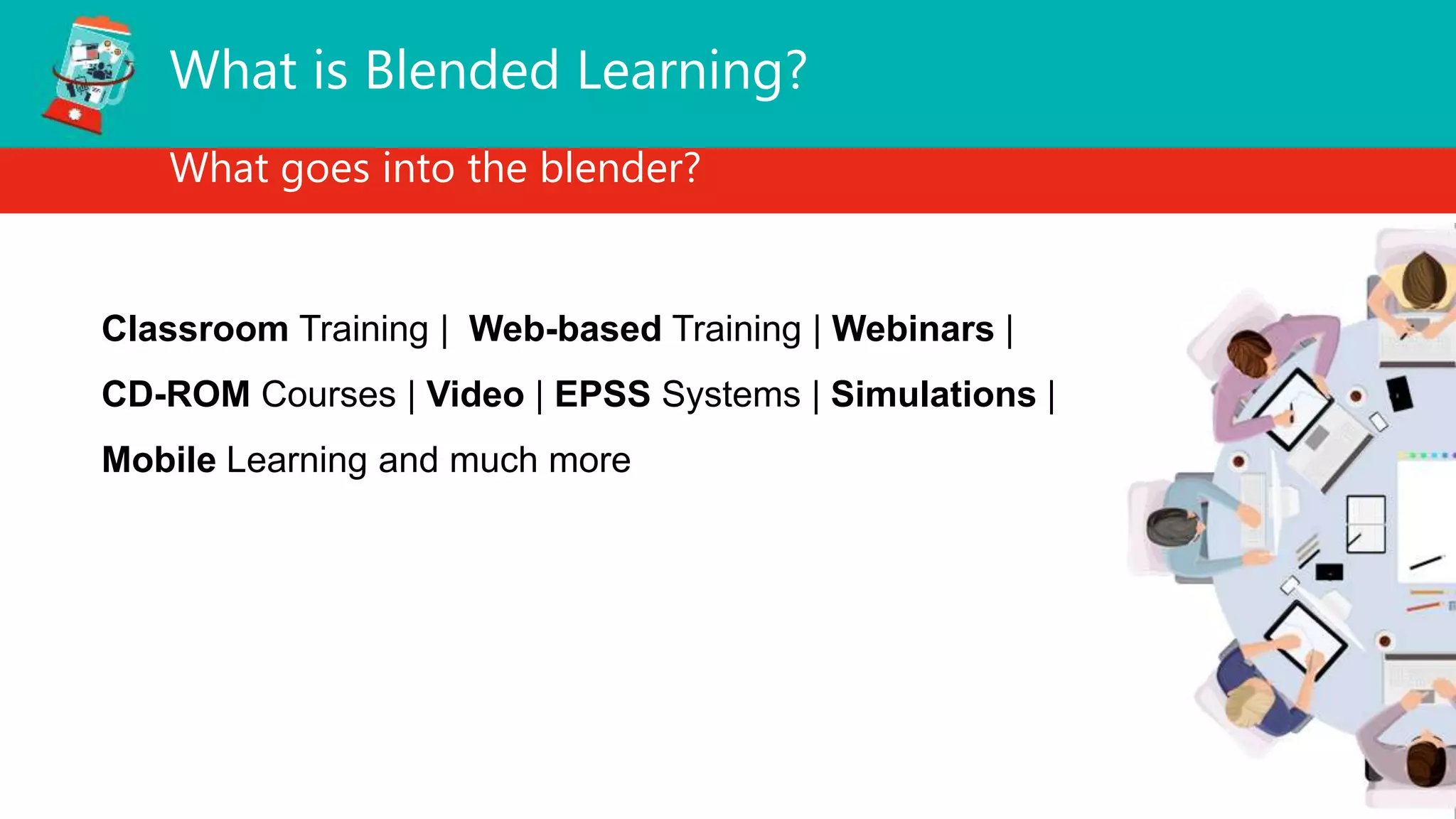
Classroom Training | Web-based Training | Webinars |
CD-ROM Courses | Video | EPSS Systems | Simulations |
Mobile Learning and much more
6.
What is BlendedLearning?
What goes into the blender?
There is no fixed formula or models in Blended
learning. It depends on analysis of the learners’
requirements, their level of understanding,
competencies at stake, the nature & location
of the audience & resources available
7.
What is BlendedLearning?
Introduction cont’d
“Blended instruction combines the best of
empowering technology and human touch so
we can help each student learn more than
ever before.”
– Alex Hernandez, partner at the Charter
School Growth Fund
Why go forBlended Learning!
Benefits to Educators
• Increased success
• Different modalities to meet more student needs
• Costs and savings, optimizing resources, scale, speed &
throughput Offers the flexibility to retain core
competencies & balance demand - clients’ budgets and
time availability.
• Frees teacher from the race with the bell
• Lessons begin in class, continue online
• Differentiation that meets the needs of individual
students
• Extends the communication channels between home
and school
10.
Why go forBlended Learning!
Benefits to Learners
• Learning environment responds to each students needs and interests
• Supports students beyond the school day with resources
• Flexible scheduling
• Control over pace
• Variety of experiences
• Personalized learning
• Use of technology
• Facilitate a simultaneous independent and collaborative learning
experience.
Blended Learning Models
Elementcommon to all models
•Group Work / Collaboration
•Differentiation
•Discussions
•Community of Inquiry
13.
Blended Learning Models
Downsides
•Blended learning needs good technical resources or tools with for
effective delivery and access to content.
• Lack of IT literacy skills can be a barrier to effective utilization of
the modality, thus needing good technical support.
• Extra task for Instructor, with the creation of online content and
correspondence
• Some students can easily lapse behind with digital and online
content, in the absence of instructor’s supervision
14.
Blended Learning!
The Future
•Advancesin technology will have an impact on
emerging models of Blended Learning
•Any new technology has typically been co-opted and
added to the blend
15.
References
• Current Topicsin Teaching & Learning with Technology. https://sites.psu.edu/wendymahan/blendedlearning/.
Retrieved 2016-2-15
• Friesen, Norm (2012). "Report:Defining Blended Learning“
• Interactive Learning Centers Announces Name Change to EPIC Learning. (1999, March 5). The Free Library. (1999).
Retrieved February 18, 2016 from
http://www.thefreelibrary.com/Interactive+Learning+Centers+Announces+Name+Change+to+EPIC+Learning.-
a054024665
• Lothridge, Karen; et al. (2013). "Blended learning: efficient, timely, and cost effective.". Journal for Forensic
Sciences.
• Gonzales, Lisa; Vodicka, Devin (2012). Blended Learning: A Disruption that Has Found Its Time. Retrieved February
18, 2016 from http://eric.ed.gov/?id=EJ989773
Editor's Notes
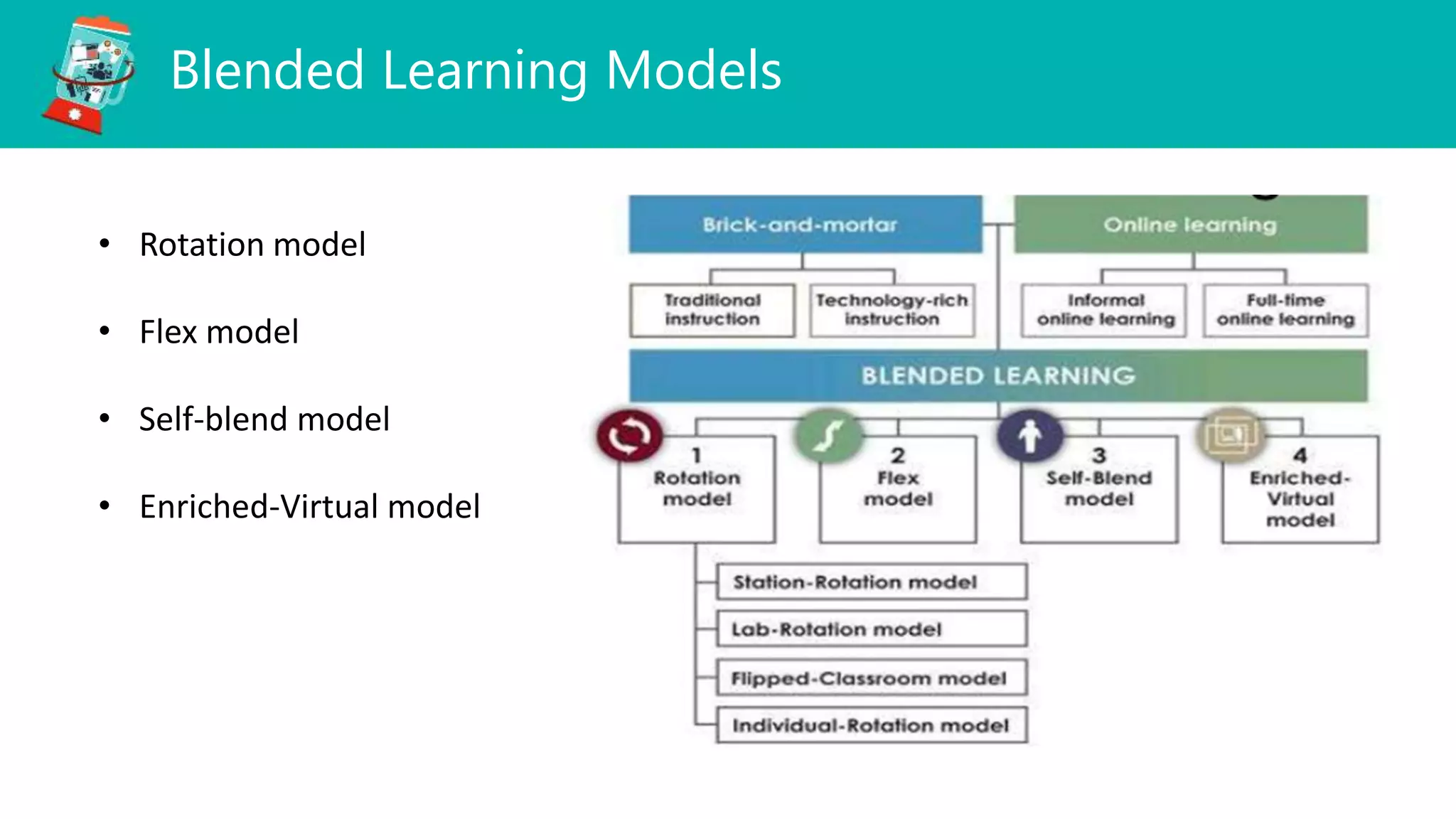
#12 The Rotation Model: This involves a course that rotates between different learning modalities on a fixed schedule, which is determined by the teacher. The modalities can either be stations in a classroom, labs, and/or online environment (flipped classrooms). A fourth type of Rotation Model is the Individual Rotation Model in which a student moves to different modalities in a course based on an individualized, customized schedule. Additionally, in the Individualized Rotation Model, the student does not necessarily visit every available modality.
The Flex Model: This mainly engages the online platform and may involve several courses. It is compatible with learners need and schedule and with an online instructor for correspondence. It may also incorporate a face-to-face correspondence
Self-Blended Model: This involves students taking a program that is the combination of totally online courses (with an online instructor) and traditional face-to-face courses.
The Enriched Virtual Model: This involves a “whole school experience” where each individual course is divided into online and face-to-face components.
#15 Dozens of technologies currently emerging will impact academic learning as well as training environments. It will dramatically expand Blended Learning options and opportunities