Flipped Classroom
By
Stephen Sunguro
What is a Flipped classroom?
A form of blended learning
Uses educational technology to influence
student learning environments
Teachers can use videos or screen
casting
From group teaching to individual teaching
Class time is used for high order thinking
problems
What is a Flipped classroom?
It can also be known as reverse teaching,
backwards classroom or reverse
instruction
Students take responsibility of their
learning
It focuses more on facilitation and
moderation than lecturing
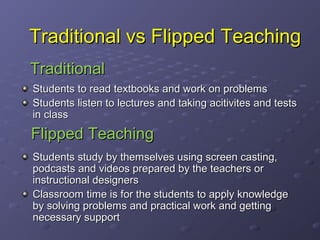
Traditional vs Flipped teaching
Traditional
1. Flipped teaching is a form of blended learning
2. Students to read textbooks and work on problems
3. Students listen to lectures and taking activities and
tests in class
Flipped Teaching
1. Students study by themselves using screen casts,
podcasts and videos prepared by the teachers and or
instructional designers
2. Classroom time is for the students to apply knowledge
by solving problems and practical work and getting
necessary support
What is Flipped Teaching?
Flipped teaching is a form of blended
learning
It uses educational technology
It can also be known as reverse teaching,
backwards classroom, reverse instruction,
Students take responsibility of their own
learning
It focuses more on facilitation and
moderation than lecturing
Flipped classroom models
In flipped classrooms:
Students watch lectures at home at their
pace while communication with peers via
online session, forums, chat rooms, and
blogging etc
Concept engagement takes place in the
class with the help of the instructor.
How it works
Use of videos, podcasts, screen casting
Students receive instant feedback
Blended learning approach
Online lectures
Teacher support students in class
Instructional model changes so that
students can receive more instructional
support in class
Downsides of Flipped Classroom
In some schools there is lack of
equipment and support to deliver quality
videos
Loss of face to face lectures
Video recording and editing requires a lot
of effort and dedicated skilled staff which
may not be available in some school
settings
References
http://flippedclassroom.org/
http://net.educause.edu/ir/library/pdf/eli7081.pdf
http://www.flippedclassroom.com/
http://www.uq.edu.au/tediteach/flipped-classroom/what-is-fc.html
http://www.knewton.com/flipped-classroom/
Stephen Sunguro
stephensu.2014@gmail.com

Flipped classroom

  • 1.
  • 2.
    What is aFlipped classroom? A form of blended learning Uses educational technology to influence student learning environments Teachers can use videos or screen casting From group teaching to individual teaching Class time is used for high order thinking problems
  • 3.
    What is aFlipped classroom? It can also be known as reverse teaching, backwards classroom or reverse instruction Students take responsibility of their learning It focuses more on facilitation and moderation than lecturing
  • 4.
    Traditional vs Flippedteaching Traditional 1. Flipped teaching is a form of blended learning 2. Students to read textbooks and work on problems 3. Students listen to lectures and taking activities and tests in class Flipped Teaching 1. Students study by themselves using screen casts, podcasts and videos prepared by the teachers and or instructional designers 2. Classroom time is for the students to apply knowledge by solving problems and practical work and getting necessary support
  • 5.
    What is FlippedTeaching? Flipped teaching is a form of blended learning It uses educational technology It can also be known as reverse teaching, backwards classroom, reverse instruction, Students take responsibility of their own learning It focuses more on facilitation and moderation than lecturing
  • 6.
    Flipped classroom models Inflipped classrooms: Students watch lectures at home at their pace while communication with peers via online session, forums, chat rooms, and blogging etc Concept engagement takes place in the class with the help of the instructor.
  • 7.
    How it works Useof videos, podcasts, screen casting Students receive instant feedback Blended learning approach Online lectures Teacher support students in class Instructional model changes so that students can receive more instructional support in class
  • 8.
    Downsides of FlippedClassroom In some schools there is lack of equipment and support to deliver quality videos Loss of face to face lectures Video recording and editing requires a lot of effort and dedicated skilled staff which may not be available in some school settings
  • 9.
  • 10.