Blended learning
Presented to:
Dr. Alaa Mohamed
Presented by:
Hanan Soliman
Objectives
• By the end of this topic, the student will be able to:
• Define blended learning
• Differentiate between types of blended learning.
• Explain Models of blended learning
• List Prerequisite of blended learning
• List Advantages of blended learning
Introduction
• The world is changing constantly and the various domains are also influenced by
the change. There is no exemption even in the education domain. The evolution
of the digital learning platforms has a huge impact in educational institutions and
has eventually put the traditional methods in the back seat. However, there are
demands for both technology and traditional learning methods. As a result of
this, the art of combining digital learning tools with more traditional classroom
face to face teaching gave birth to the term “Blended Learning”.
Definition of blended learning
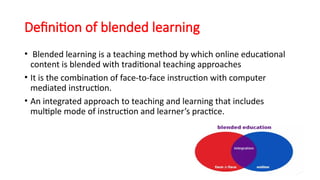
• Blended learning is a teaching method by which online educational
content is blended with traditional teaching approaches
• It is the combination of face-to-face instruction with computer
mediated instruction.
• An integrated approach to teaching and learning that includes
multiple mode of instruction and learner’s practice.
Types of blended learning
• Concept based blended learning: the online part is concept training and
meant for individual use (e.g., self-paced e-learning : a form of online
learning which allows students to work on their own schedule and at their
own speed. it gives them the freedom to explore topics at their own pace
and go back and review material as needed), and the face to face part is
collaborative learning (e.g., scenario simulation, work groups, small
seminars).
collaboration-oriented blended learning
• The online part is computer supported collaborative learning (e.g.,
virtual communities), and the face to face part is individual oriented
(e.g., conventional classroom instruction, PowerPoint presentation,
mentoring (
Models of blended learning
• Blended face-to-face class model
• Blended online class
• The flipped classroom
• The rotation model
• The self blend model
• The blended MOOC
Blended face-to-face class model
• the blended face-to-face class model is based in the classroom,
although a significant amount of classroom time has been
replaced by online activities. Seat time is required for this
model, while online activities are used to supplement the in
person classes; readings, quizzes or other assessments are
done online at home.
• This model allows students and faculty to share more high
value instructional time because class time is used for higher-
order learning activities such as discussions and group
projects.
Blended online class
• this class is the inverse of the blended face-to face class. The
class is mostly conducted online, but there are some
required in person activities such as lectures or labs.
The rotation model
• This model includes the teacher rotating students between classroom lectures
and online learning time. Students receive a lecture and then get some time to
online work. The teacher can assign students some reading time, online tasks
or digital exercises during their rotation time. Many times teachers rotate time
in a similar way by assigning students certain classroom tasks after a lecture.
For example, primary school students are often tasked with writing an essay or
completing a math problem during the class, work in groups on a project, etc.
The rotation model simply takes this type of rotation to digital platforms.
The rotation model
• In this model, students in a course rotate between various modalities, one of which
is online learning. There are various sub-models: station rotation, lab rotation and
individual rotation. Station rotation, for example, requires students to rotate
between stations in the classroom at an instructor’s discretion. Others work well on
a college campus the lab rotation model, for example, requires students in a course
to rotate among locations on campus (at least one of which is an online learning
lab). In the individual rotation model, a student rotates through learning modalities
on a customized schedule.
The flipped classroom
• The flipped classroom reverses the traditional class structure of
listening to a lecture in class and completing homework activities
at home. Students in flipped classes watch a short lecture video
online and come into the classroom to complete activities such as
group work, projects or other exercises. The flipped classroom
model can be seen as a sub-model of the blended face-to-face or
blended online class
The blended MOOC
• The blended MOOC is a form of flipped classroom using in-
person class meetings to supplement a massive open online
course. Students access MOOC materials — perhaps from
another institution or instructor if the course is openly
accessible — outside of class and then come to a class
meeting for discussions or in-class activities.
The self blend model
• While many of the blended learning models on this list are at the
course level, self-blending is a programme-level model and is
familiar to many college students. Learners using this model are
enrolled in a school but take online courses in addition to their
traditional face-to-face courses. They are not directed by a faculty
member and choose which courses they will take online and which
they will take in person.
Flex
• In order to allow people with a busy lifestyle or individuals in remote
areas to acquire degrees, many countries have set up what can be
described as virtual universities. This is pretty much the flex model, where
the majority of the content is delivered via digital platforms, with face to
face support for students. This might include a university offering online
learning, with the option for students to visit during working hours or
specified time for further help from the faculty.
How to use Blended Learning ?
• Formulate your blended learning goals in advance.
• Combine online & face-to- face instruction.
• Define your core learning objectives and goals.
• Specify how and when technology will be used.
• Create learning activities that offer the best of both worlds.
Characteristics of blended learning
Teachers are well versed with both the modes
• It is an important feature of the blended learning that teachers are
very dynamic, techno savvy and fully trained to work efficiently in
both the format traditional classroom format and ICT supported
format. They will be well equipped in using traditional methods and
other modern technologies
Characteristics of blended learning
Diverse role of teacher
• teacher in blended learning is playing different role, traditional role of
a teacher in classroom, she acts as motivator, as a resource person, as
an organizer, as a developer, when she develops content to be
provided through ICT, as a guide on the side. Thus teacher gets
freedom from the monotonous traditional roles and she can try her
hands in diverse areas that are good for her professional growth also.
Characteristics of blended learning
Students have the option of the two modes
• Students get face to face interaction as well they interact in
virtual space students get ample of time to interact with
other students pursuing same course. They can interact with
them inside college campus and also in virtual space
Characteristics of blended learning
Students get full experience in using new technology
• Students involved in blended learning gain capability to
exploit available technologies to the fullest of their benefit
Characteristics of blended learning
Students get training in different life skills
• The major life skills are empathy, decision making capability, love, patience,
communication, self management, critical thinking. The blended learning
helps the students to practice these skills. Students get acquainted with few
skills like love, empathy, patience in classroom through his teachers,
classmates, and few like self management, decision making, critical thinking,
communication through the online experiences.
Characteristics of blended learning
Student constructs knowledge rather than just consuming it.
• Blended learning also includes constructivism. Students
construct their own knowledge rather than depending on
others to design teaching learning strategies for them.
Prerequisite of Blended Learning
Well trained teacher
• Teachers should be well acquainted with the concept of blended learning and
fully trained and skilled to blend both types of approaches- tradition and
technological. They should be trained to develop content in digital form so that it
can be available to students online. They should be well versed with internet
browsing and internet terminology, should be aware of all the websites that can
be useful for the students while learning online. Teacher should know how to
utilize blogs, you tube facility, software like Skype, goggle talk and others for
video conferencing and social networking sites for educational purposes
Prerequisite of Blended Learning
Teacher with scientific attitude
• it is very important that teachers have scientific attitude. They should have
good observation skill, they should be optimistic should have problem
solving skills. Scientific attitude will help the teachers to deal positively with
failures she will get while working on this innovative concept and will help
to analyze the conditions objectively.
Prerequisite of Blended Learning
Teacher with wider outlook and positive approach toward change
As it is must for the success of any innovative idea or method blended
learning process also need teachers that have a wider outlook and
should be flexible, they should be ready to accept the changes and very
innovative and dynamic.
Prerequisite of Blended Learning
Complete facilities as well
• furnished computer lab, internet connection, provision for video chatting- it is
the compulsory factor of blended learning. Blended learning largely depend on
infrastructure, University should not only have good classrooms but should
also have a well-furnished compute laboratories with sufficient number of
computes to cater to all the students of one class and the internet facility, a
Wi-Fi campus if possible.
Prerequisite of Blended Learning
Students have access to internet at their private computer
• In addition to University having fully ICT friendly campus students
should have basic hardware support to learn online and offline at
their residence also. This requires a positive attitude and good
investments schemes from the government.
Prerequisite of Blended Learning
Flexibility in the system
• The system should be flexible, flexible time table, examinations
system all this is very crucial for implementing blended learning
Prerequisite of Blended Learning
Formative evaluation and continuous internal assessment
• Higher educational bodies should be ready to completely implement
continuous internal assessment(CAI) and other tools of formative
evaluation as summative evaluation is not supported in the blended
learning . The provision should be made for online examination for
making the system more flexible
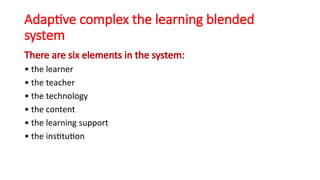
Adaptive complex the learning blended
system
There are six elements in the system:
• the learner
• the teacher
• the technology
• the content
• the learning support
• the institution
Learners
• The role of learners changes, or adapts, as learners engage
for the first time or in new ways with the elements in the
system. Most important is the change from passive to active
learner. This is key to the support and training of lifelong
learners, a characteristic identified as important in 21st-
century society
Teachers
• The role of teachers is also new in blended environments and will co-
evolve with students as both engage with and adapt to each other
and the other four elements in the system. These “teachers” will be
identified by new labels, such as facilitators, mentors, advisors and
moderator
Content
• Subject matter is still an important influence on the delivery of learning.
Content refers to subject matter and the material elements used to engage
learners in the process of mastering that subject. The interactive, dynamic,
media-rich materials available online create opportunities for teachers and
learners to add content before, during and even after the course
experience. The dynamic between the learner, the teacher, the technology,
the learning support and the institution impacts the choice and use of
content.
Technology
• Technology in general terms refers to any equipment or
mechanism that extends the human capacity to get things done,
the creation and use of technical means, and their interrelation
with life. Technology for learning requires new roles for the
learner and teacher and new ways of accessing and working with
content. the technology has to be seen as part of the system of
blended learning, one that includes all elements working in
Learner support
• Helping learners master the content and become competent learners has to be part
of their education. Support can involve technology troubleshooting, material access
and learning to communicate effectively online, as well as all the other usual support
around understanding content and assignments. learner support means “academic
support focusing on helping learners to develop effective learning strategies, such as
time management and collaborative skills, and technical support aiming to help
students improve their knowledge of the technological tools and the fluency with
which they use the tools to complete specific learning tasks
Institution
• Just as classroom-based learning requires buildings, desks,
lighting and other accessories of brick-and-mortar
institutions, blended learning requires technological
infrastructure and digital janitors. Institutional support is a
necessary if not sufficient condition for successful blended
learning.
Advantages of blended learning
• Combining traditional classroom based education with the
convenience and cost efficiency of e-learning is an alternative to
isolated e-learning.
• Blended learning allows student teacher and student-student
interactions in an online environment at various times.
• Some have seen blended learning approaches increase the level of
active learning strategies, peer to-peer learning strategies, and learner
centered strategies used
• Learner flexibility and ease in accessing the learning in the blended learning
environments has also increasing weight as more learners with external
obligations, especially the adult learners, ask for further education
• Students become more techno savvy and they gain enhanced digital fluency
• Students have more strengthened professionalism as they develop qualities
like self motivation, self-responsibility, discipline
• It updates course content and so gives new life to established courses
Disadvantages
• Blended learning has a strong dependence on the technical resources or tools with
which the blended learning experience is delivered
• Providing effective feedback is more time-consuming when electronic media are used in
comparison to traditional (e.g., Paper-based) assessments.
• Lack of access to network infrastructure.
• Before a blended learning scenario can be considered ready for use, the lecturer has to
do long, detailed and extensive work. Preparation for startup is very time consuming.
• There can be limited contact between lecturer and students and so some of the
dynamism that comes with face-to- face interaction can be lost.
• Based on what students are used to, they often prefer the paper versions of the
materials than to see them online so the face-to- face sessions in the blended
programmes usually have a comparatively more successful “feel” for the students.
blended learning.pptxblended learning.pptx

blended learning.pptxblended learning.pptx

  • 1.
    Blended learning Presented to: Dr.Alaa Mohamed Presented by: Hanan Soliman
  • 2.
    Objectives • By theend of this topic, the student will be able to: • Define blended learning • Differentiate between types of blended learning. • Explain Models of blended learning • List Prerequisite of blended learning • List Advantages of blended learning
  • 4.
    Introduction • The worldis changing constantly and the various domains are also influenced by the change. There is no exemption even in the education domain. The evolution of the digital learning platforms has a huge impact in educational institutions and has eventually put the traditional methods in the back seat. However, there are demands for both technology and traditional learning methods. As a result of this, the art of combining digital learning tools with more traditional classroom face to face teaching gave birth to the term “Blended Learning”.
  • 5.
    Definition of blendedlearning • Blended learning is a teaching method by which online educational content is blended with traditional teaching approaches • It is the combination of face-to-face instruction with computer mediated instruction. • An integrated approach to teaching and learning that includes multiple mode of instruction and learner’s practice.
  • 6.
    Types of blendedlearning • Concept based blended learning: the online part is concept training and meant for individual use (e.g., self-paced e-learning : a form of online learning which allows students to work on their own schedule and at their own speed. it gives them the freedom to explore topics at their own pace and go back and review material as needed), and the face to face part is collaborative learning (e.g., scenario simulation, work groups, small seminars).
  • 7.
    collaboration-oriented blended learning •The online part is computer supported collaborative learning (e.g., virtual communities), and the face to face part is individual oriented (e.g., conventional classroom instruction, PowerPoint presentation, mentoring (
  • 8.
    Models of blendedlearning • Blended face-to-face class model • Blended online class • The flipped classroom • The rotation model • The self blend model • The blended MOOC
  • 9.
    Blended face-to-face classmodel • the blended face-to-face class model is based in the classroom, although a significant amount of classroom time has been replaced by online activities. Seat time is required for this model, while online activities are used to supplement the in person classes; readings, quizzes or other assessments are done online at home.
  • 10.
    • This modelallows students and faculty to share more high value instructional time because class time is used for higher- order learning activities such as discussions and group projects.
  • 11.
    Blended online class •this class is the inverse of the blended face-to face class. The class is mostly conducted online, but there are some required in person activities such as lectures or labs.
  • 12.
    The rotation model •This model includes the teacher rotating students between classroom lectures and online learning time. Students receive a lecture and then get some time to online work. The teacher can assign students some reading time, online tasks or digital exercises during their rotation time. Many times teachers rotate time in a similar way by assigning students certain classroom tasks after a lecture. For example, primary school students are often tasked with writing an essay or completing a math problem during the class, work in groups on a project, etc. The rotation model simply takes this type of rotation to digital platforms.
  • 13.
    The rotation model •In this model, students in a course rotate between various modalities, one of which is online learning. There are various sub-models: station rotation, lab rotation and individual rotation. Station rotation, for example, requires students to rotate between stations in the classroom at an instructor’s discretion. Others work well on a college campus the lab rotation model, for example, requires students in a course to rotate among locations on campus (at least one of which is an online learning lab). In the individual rotation model, a student rotates through learning modalities on a customized schedule.
  • 14.
    The flipped classroom •The flipped classroom reverses the traditional class structure of listening to a lecture in class and completing homework activities at home. Students in flipped classes watch a short lecture video online and come into the classroom to complete activities such as group work, projects or other exercises. The flipped classroom model can be seen as a sub-model of the blended face-to-face or blended online class
  • 15.
    The blended MOOC •The blended MOOC is a form of flipped classroom using in- person class meetings to supplement a massive open online course. Students access MOOC materials — perhaps from another institution or instructor if the course is openly accessible — outside of class and then come to a class meeting for discussions or in-class activities.
  • 16.
    The self blendmodel • While many of the blended learning models on this list are at the course level, self-blending is a programme-level model and is familiar to many college students. Learners using this model are enrolled in a school but take online courses in addition to their traditional face-to-face courses. They are not directed by a faculty member and choose which courses they will take online and which they will take in person.
  • 17.
    Flex • In orderto allow people with a busy lifestyle or individuals in remote areas to acquire degrees, many countries have set up what can be described as virtual universities. This is pretty much the flex model, where the majority of the content is delivered via digital platforms, with face to face support for students. This might include a university offering online learning, with the option for students to visit during working hours or specified time for further help from the faculty.
  • 18.
    How to useBlended Learning ? • Formulate your blended learning goals in advance. • Combine online & face-to- face instruction. • Define your core learning objectives and goals. • Specify how and when technology will be used. • Create learning activities that offer the best of both worlds.
  • 19.
    Characteristics of blendedlearning Teachers are well versed with both the modes • It is an important feature of the blended learning that teachers are very dynamic, techno savvy and fully trained to work efficiently in both the format traditional classroom format and ICT supported format. They will be well equipped in using traditional methods and other modern technologies
  • 20.
    Characteristics of blendedlearning Diverse role of teacher • teacher in blended learning is playing different role, traditional role of a teacher in classroom, she acts as motivator, as a resource person, as an organizer, as a developer, when she develops content to be provided through ICT, as a guide on the side. Thus teacher gets freedom from the monotonous traditional roles and she can try her hands in diverse areas that are good for her professional growth also.
  • 21.
    Characteristics of blendedlearning Students have the option of the two modes • Students get face to face interaction as well they interact in virtual space students get ample of time to interact with other students pursuing same course. They can interact with them inside college campus and also in virtual space
  • 22.
    Characteristics of blendedlearning Students get full experience in using new technology • Students involved in blended learning gain capability to exploit available technologies to the fullest of their benefit
  • 23.
    Characteristics of blendedlearning Students get training in different life skills • The major life skills are empathy, decision making capability, love, patience, communication, self management, critical thinking. The blended learning helps the students to practice these skills. Students get acquainted with few skills like love, empathy, patience in classroom through his teachers, classmates, and few like self management, decision making, critical thinking, communication through the online experiences.
  • 24.
    Characteristics of blendedlearning Student constructs knowledge rather than just consuming it. • Blended learning also includes constructivism. Students construct their own knowledge rather than depending on others to design teaching learning strategies for them.
  • 25.
    Prerequisite of BlendedLearning Well trained teacher • Teachers should be well acquainted with the concept of blended learning and fully trained and skilled to blend both types of approaches- tradition and technological. They should be trained to develop content in digital form so that it can be available to students online. They should be well versed with internet browsing and internet terminology, should be aware of all the websites that can be useful for the students while learning online. Teacher should know how to utilize blogs, you tube facility, software like Skype, goggle talk and others for video conferencing and social networking sites for educational purposes
  • 26.
    Prerequisite of BlendedLearning Teacher with scientific attitude • it is very important that teachers have scientific attitude. They should have good observation skill, they should be optimistic should have problem solving skills. Scientific attitude will help the teachers to deal positively with failures she will get while working on this innovative concept and will help to analyze the conditions objectively.
  • 27.
    Prerequisite of BlendedLearning Teacher with wider outlook and positive approach toward change As it is must for the success of any innovative idea or method blended learning process also need teachers that have a wider outlook and should be flexible, they should be ready to accept the changes and very innovative and dynamic.
  • 28.
    Prerequisite of BlendedLearning Complete facilities as well • furnished computer lab, internet connection, provision for video chatting- it is the compulsory factor of blended learning. Blended learning largely depend on infrastructure, University should not only have good classrooms but should also have a well-furnished compute laboratories with sufficient number of computes to cater to all the students of one class and the internet facility, a Wi-Fi campus if possible.
  • 29.
    Prerequisite of BlendedLearning Students have access to internet at their private computer • In addition to University having fully ICT friendly campus students should have basic hardware support to learn online and offline at their residence also. This requires a positive attitude and good investments schemes from the government.
  • 30.
    Prerequisite of BlendedLearning Flexibility in the system • The system should be flexible, flexible time table, examinations system all this is very crucial for implementing blended learning
  • 31.
    Prerequisite of BlendedLearning Formative evaluation and continuous internal assessment • Higher educational bodies should be ready to completely implement continuous internal assessment(CAI) and other tools of formative evaluation as summative evaluation is not supported in the blended learning . The provision should be made for online examination for making the system more flexible
  • 32.
    Adaptive complex thelearning blended system There are six elements in the system: • the learner • the teacher • the technology • the content • the learning support • the institution
  • 33.
    Learners • The roleof learners changes, or adapts, as learners engage for the first time or in new ways with the elements in the system. Most important is the change from passive to active learner. This is key to the support and training of lifelong learners, a characteristic identified as important in 21st- century society
  • 34.
    Teachers • The roleof teachers is also new in blended environments and will co- evolve with students as both engage with and adapt to each other and the other four elements in the system. These “teachers” will be identified by new labels, such as facilitators, mentors, advisors and moderator
  • 35.
    Content • Subject matteris still an important influence on the delivery of learning. Content refers to subject matter and the material elements used to engage learners in the process of mastering that subject. The interactive, dynamic, media-rich materials available online create opportunities for teachers and learners to add content before, during and even after the course experience. The dynamic between the learner, the teacher, the technology, the learning support and the institution impacts the choice and use of content.
  • 36.
    Technology • Technology ingeneral terms refers to any equipment or mechanism that extends the human capacity to get things done, the creation and use of technical means, and their interrelation with life. Technology for learning requires new roles for the learner and teacher and new ways of accessing and working with content. the technology has to be seen as part of the system of blended learning, one that includes all elements working in
  • 37.
    Learner support • Helpinglearners master the content and become competent learners has to be part of their education. Support can involve technology troubleshooting, material access and learning to communicate effectively online, as well as all the other usual support around understanding content and assignments. learner support means “academic support focusing on helping learners to develop effective learning strategies, such as time management and collaborative skills, and technical support aiming to help students improve their knowledge of the technological tools and the fluency with which they use the tools to complete specific learning tasks
  • 38.
    Institution • Just asclassroom-based learning requires buildings, desks, lighting and other accessories of brick-and-mortar institutions, blended learning requires technological infrastructure and digital janitors. Institutional support is a necessary if not sufficient condition for successful blended learning.
  • 39.
    Advantages of blendedlearning • Combining traditional classroom based education with the convenience and cost efficiency of e-learning is an alternative to isolated e-learning. • Blended learning allows student teacher and student-student interactions in an online environment at various times. • Some have seen blended learning approaches increase the level of active learning strategies, peer to-peer learning strategies, and learner centered strategies used
  • 40.
    • Learner flexibilityand ease in accessing the learning in the blended learning environments has also increasing weight as more learners with external obligations, especially the adult learners, ask for further education • Students become more techno savvy and they gain enhanced digital fluency • Students have more strengthened professionalism as they develop qualities like self motivation, self-responsibility, discipline • It updates course content and so gives new life to established courses
  • 41.
    Disadvantages • Blended learninghas a strong dependence on the technical resources or tools with which the blended learning experience is delivered • Providing effective feedback is more time-consuming when electronic media are used in comparison to traditional (e.g., Paper-based) assessments. • Lack of access to network infrastructure. • Before a blended learning scenario can be considered ready for use, the lecturer has to do long, detailed and extensive work. Preparation for startup is very time consuming. • There can be limited contact between lecturer and students and so some of the dynamism that comes with face-to- face interaction can be lost. • Based on what students are used to, they often prefer the paper versions of the materials than to see them online so the face-to- face sessions in the blended programmes usually have a comparatively more successful “feel” for the students.