Blended Learning in
Basic Education
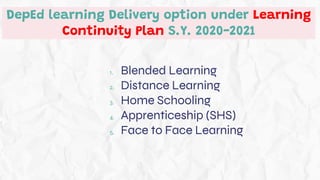
1. Blended Learning
2. Distance Learning
3. Home Schooling
4. Apprenticeship (SHS)
5. Face to Face Learning
DepEd learning Delivery option under Learning
Continuity Plan S.Y. 2020-2021
What is blended
learning?
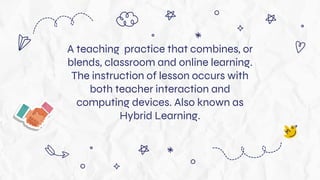
A teaching practice that combines, or
blends, classroom and online learning.
The instruction of lesson occurs with
both teacher interaction and
computing devices. Also known as
Hybrid Learning.
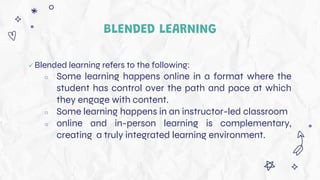
BLENDED LEARNING
 Blended learning refers to the following:
○ Some learning happens online in a format where the
student has control over the path and pace at which
they engage with content.
○ Some learning happens in an instructor-led classroom
○ online and in-person learning is complementary,
creating a truly integrated learning environment.
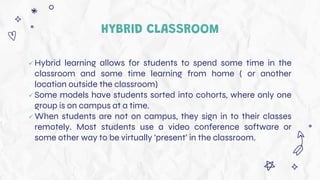
HYBRID CLASSROOM
 Hybrid learning allows for students to spend some time in the
classroom and some time learning from home ( or another
location outside the classroom)
 Some models have students sorted into cohorts, where only one
group is on campus at a time.
 When students are not on campus, they sign in to their classes
remotely. Most students use a video conference software or
some other way to be virtually ‘present’ in the classroom.
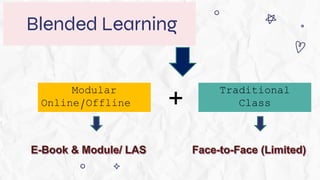
Blended Learning
Modular
Online/Offline
Traditional
Class
+
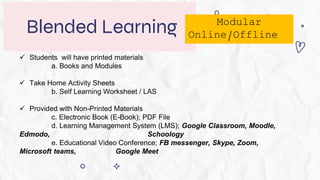
Blended Learning Modular
Online/Offline
 Students will have printed materials
a. Books and Modules
 Take Home Activity Sheets
b. Self Learning Worksheet / LAS
 Provided with Non-Printed Materials
c. Electronic Book (E-Book); PDF File
d. Learning Management System (LMS); Google Classroom, Moodle,
Edmodo, Schoology
e. Educational Video Conference; FB messenger, Skype, Zoom,
Microsoft teams, Google Meet
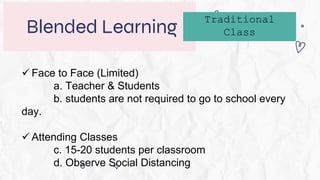
Blended Learning
 Face to Face (Limited)
a. Teacher & Students
b. students are not required to go to school every
day.
 Attending Classes
c. 15-20 students per classroom
d. Observe Social Distancing
Traditional
Class
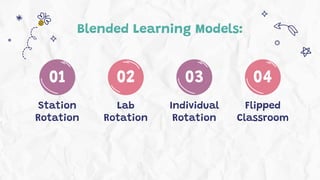
Blended Learning Models:
01
Station
Rotation
02
Lab
Rotation
03
Individual
Rotation
04
Flipped
Classroom
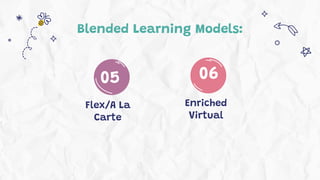
Blended Learning Models:
05
Flex/A La
Carte
06
Enriched
Virtual
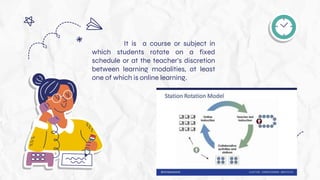
Station
Rotation
It is a course or subject in
which students rotate on a fixed
schedule or at the teacher’s discretion
between learning modalities, at least
one of which is online learning.
Lab Rotation
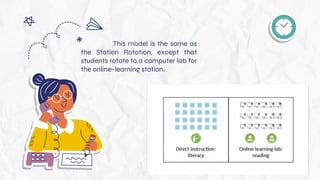
This model is the same as
the Station Rotation, except that
students rotate to a computer lab for
the online-learning station.
Individual
Rotation
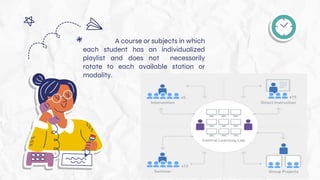
A course or subjects in which
each student has an individualized
playlist and does not necessarily
rotate to each available station or
modality.
Flipped
Classroom
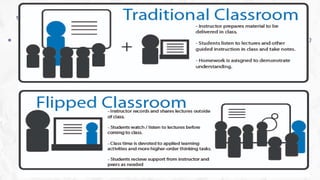
A course or subject in which students
participate in online learning off-site in place of
traditional homework and then attend the brick-and-
mortar school for face to face, teacher-guided practice
or projects.
Flex/ A la Carte
Flex
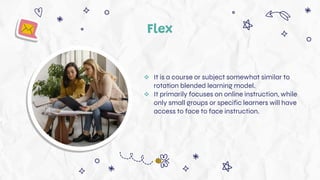
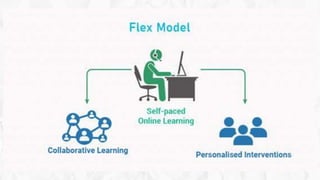
 It is a course or subject somewhat similar to
rotation blended learning model.
 It primarily focuses on online instruction, while
only small groups or specific learners will have
access to face to face instruction.
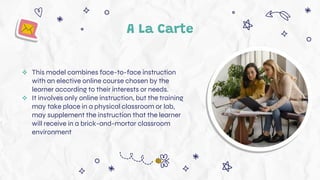
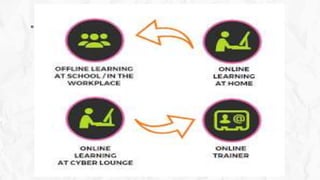
A La Carte
 This model combines face-to-face instruction
with an elective online course chosen by the
learner according to their interests or needs.
 It involves only online instruction, but the training
may take place in a physical classroom or lab,
may supplement the instruction that the learner
will receive in a brick-and-mortar classroom
environment
Enriched Virtual
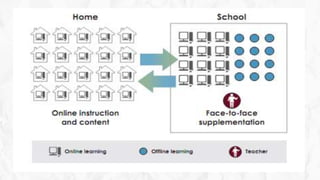
 It centered around face-to-face
instruction, which is supplemented by
online tools and resources after the
instructor-led sessions have completed.
Model for Flexible Learning
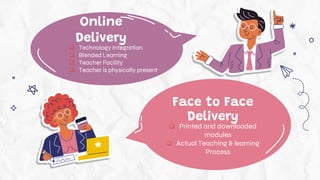
Modalities
Online
Delivery
 Technology Integration
 Blended Learning
 Teacher Facility
 Teacher is physically present
Face to Face
Delivery
 Printed and downloaded
modules
 Actual Teaching & learning
Process
Challenges
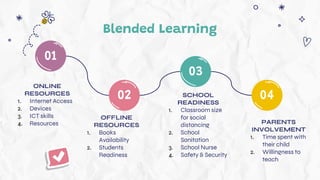
Blended Learning
ONLINE
RESOURCES
1. Internet Access
2. Devices
3. ICT skills
4. Resources
02
OFFLINE
RESOURCES
1. Books
Availability
2. Students
Readiness
03
SCHOOL
READINESS
1. Classroom size
for social
distancing
2. School
Sanitation
3. School Nurse
4. Safety & Security
PARENTS
INVOLVEMENT
1. Time spent with
their child
2. Willingness to
teach
04
01
Thank
You!

Blended learning

  • 1.
  • 2.
    1. Blended Learning 2.Distance Learning 3. Home Schooling 4. Apprenticeship (SHS) 5. Face to Face Learning DepEd learning Delivery option under Learning Continuity Plan S.Y. 2020-2021
  • 3.
  • 4.
    A teaching practicethat combines, or blends, classroom and online learning. The instruction of lesson occurs with both teacher interaction and computing devices. Also known as Hybrid Learning.
  • 5.
    BLENDED LEARNING  Blendedlearning refers to the following: ○ Some learning happens online in a format where the student has control over the path and pace at which they engage with content. ○ Some learning happens in an instructor-led classroom ○ online and in-person learning is complementary, creating a truly integrated learning environment.
  • 6.
    HYBRID CLASSROOM  Hybridlearning allows for students to spend some time in the classroom and some time learning from home ( or another location outside the classroom)  Some models have students sorted into cohorts, where only one group is on campus at a time.  When students are not on campus, they sign in to their classes remotely. Most students use a video conference software or some other way to be virtually ‘present’ in the classroom.
  • 7.
  • 8.
    Blended Learning Modular Online/Offline Students will have printed materials a. Books and Modules  Take Home Activity Sheets b. Self Learning Worksheet / LAS  Provided with Non-Printed Materials c. Electronic Book (E-Book); PDF File d. Learning Management System (LMS); Google Classroom, Moodle, Edmodo, Schoology e. Educational Video Conference; FB messenger, Skype, Zoom, Microsoft teams, Google Meet
  • 9.
    Blended Learning  Faceto Face (Limited) a. Teacher & Students b. students are not required to go to school every day.  Attending Classes c. 15-20 students per classroom d. Observe Social Distancing Traditional Class
  • 10.
  • 11.
    Blended Learning Models: 05 Flex/ALa Carte 06 Enriched Virtual
  • 12.
  • 13.
    It is acourse or subject in which students rotate on a fixed schedule or at the teacher’s discretion between learning modalities, at least one of which is online learning.
  • 14.
  • 15.
    This model isthe same as the Station Rotation, except that students rotate to a computer lab for the online-learning station.
  • 16.
  • 17.
    A course orsubjects in which each student has an individualized playlist and does not necessarily rotate to each available station or modality.
  • 18.
  • 19.
    A course orsubject in which students participate in online learning off-site in place of traditional homework and then attend the brick-and- mortar school for face to face, teacher-guided practice or projects.
  • 21.
  • 22.
    Flex  It isa course or subject somewhat similar to rotation blended learning model.  It primarily focuses on online instruction, while only small groups or specific learners will have access to face to face instruction.
  • 24.
    A La Carte This model combines face-to-face instruction with an elective online course chosen by the learner according to their interests or needs.  It involves only online instruction, but the training may take place in a physical classroom or lab, may supplement the instruction that the learner will receive in a brick-and-mortar classroom environment
  • 26.
  • 27.
     It centeredaround face-to-face instruction, which is supplemented by online tools and resources after the instructor-led sessions have completed.
  • 29.
    Model for FlexibleLearning Modalities
  • 30.
    Online Delivery  Technology Integration Blended Learning  Teacher Facility  Teacher is physically present Face to Face Delivery  Printed and downloaded modules  Actual Teaching & learning Process
  • 31.
  • 32.
    Blended Learning ONLINE RESOURCES 1. InternetAccess 2. Devices 3. ICT skills 4. Resources 02 OFFLINE RESOURCES 1. Books Availability 2. Students Readiness 03 SCHOOL READINESS 1. Classroom size for social distancing 2. School Sanitation 3. School Nurse 4. Safety & Security PARENTS INVOLVEMENT 1. Time spent with their child 2. Willingness to teach 04 01
  • 33.

Editor's Notes

  • #14 Other modalities might include activities such as small-group or full-class instruction, group projects, individual tutoring, and pencil-and-paper assignments. The students experience the rotation within a contained classroom or group classroom. Parang partial face-to-face, in which ang
  • #20 The primary delivery of content and instruction is online, which differentiates a Flipped Classroom from students who are merely doing homework practice online at night.
  • #23 A course or subject in which online learning is the back-bone of student learning, even if it directs students to offline activities at times. Students move on an individually customized, fluid schedule among learning modalities. The teacher record is on-site, and students learn mostly on the brick-and-mortar campus, except for homework assignments.
  • #25 Not all pupunta ng school,
  • #28 A course or subject in which students have required face-to-face learning sessions with their teacher of record and then are free to complete their remaining coursework remotely from the face to face teacher.