Lecture No 9
Herbicides – Definition – Advantages & Limitations of Herbicide
usage in India – Nomenclature of Herbicides – Herbicide label
information – Presently available herbicides in the market
1. What is meant by Herbicide?
2. Historical development of herbicides
3. Objectives of herbicide usage
4. Advantages of herbicide usage in Agriculture
5. Disadvantages of herbicide use/ Chemical methods
6. Nomenclature of herbicides
7. Authorities
8. Herbicide label information
9. Presently available herbicides in the market
1. What is meant by Herbicide
The word herbicide is derived from Latin
Herba
word means plant and
Caedere means to kill
Herbicides are chemicals capable of killing
or inhibiting the growth of plants.
2.Historical Development of Herbicides
• Common salt, ash etc. have been used for centuries to control weeds
• Selective control of weeds in 1896 observed by French farmer
that
Bordeaux mixture sprayed on Grapevine to control
downy mildew.
It was found that CuSo4 present in the Bordeaux
mixture was
responsible for its weed killing effect.
• Between 1896 and 1908 several inorganic salts as also sulphuric acid
were found selective to small grain crops.
• 1945 - 2,4-D & MCPA in USA & England independently by
P.W.Zimmerman and Hitchkock. were found highly selective for cereals
and phytotoxic to broad leaved weeds.
• In Agriculturally developed countries, herbicides form over 45% of the
total pesticides used. In India, share of herbicides is only 8% of the total
pesticides consumed. The average herbicide usage in India is
3. Objectives of herbicides usage
•To replace the drudgery of manual weeding.
•The labour power could be saved
•Increasing costs of hired labour and limited supply
of fuel for mechanical weed control demands use
of herbicides
•Herbicides
Physical,
methods.
at substituting the
are not
aimed Biological
or
good crop husbandry
•In water bodies herbicides can be
efficiently employed to free them of their weedy
vegetation.
4. Advantages of herbicides
• Herbicides are useful in areas where incessant rainfall
may hinder the physical weeding during monsoonal season
• Herbicide usage reduce the competition for labour
• They control germinating weeds and there by make the crop
weed free
• They are useful to control weeds mimic weeds.
• Herbicides doesn’t dictate strict row spacing.
• They have long lasting effect on control of brush weeds and
perennial weeds.
• Convenient to use on thorny / spiny weeds.
• Control weeds on erodible soils where tillage may accelerate
soil and water erosion
4.Advantages of herbicides contd…….
• They kill the weeds in situ
without dissemination propagules
• Sprays easily reach the inaccessible areas
• Reduce the demand for labour
• Greater possibility of mechanization.
• Easy crop harvesting.
• Weeds controlled in crop rows
• Increase WUE in dry lands and less crop failures
5. Disadvantages
• No
automatic
signal to stop farmer who
may
applying the chemical inaccurately.
• Contaminate the environment.
• Drift hazards/ runoff/ wash off
• Many herbicides are needed to control
weeds depending upon farm diversity.
• Skill is needed in the use herbicides
• In sequence cropping-selectivity is a major problem.
• Neighbours field damage by warfare
8
6. Nomenclature of herbicides
Each herbicide has a trade name (sometimes
more
than one), a common name, and a chemical
name.
1.Common name: Short form - agreed upon by
a committee.
2.Trade name: Offered by the manufacturer.
registered- several trade
names.
Glyphosate: Glycel – Excel; –
Monsanto Roundup -No weed -
Dhanuka
3.Chemical name: Full molecular
structure.
S.
No.
Common
Name
Trade
name
Chemical name
1 2,4-D Fernoxone 2,4-Dichlorophenoxy acetic
acid
2 MCPA Agroxone 2-Methyl-4-chloro phenoxy
acetic acid
3 Alachlor Lasso 2-Chloro-2,6-diethyl-N-
(methoxy methyl) acetanilide
4 Atrazine Atrataf 2-chloro-4-ethylamino-6-
isopropylamino-s-
triazine
5 Benthiocar
b
Saturn S-(4-chlorobenzyl)-N,N-
diethylthiocarbamate 9
Nomenclature
10
7.Authorities to accept names
1. ANSI : American National Standard
Institute.
2. BSI : British Standard Institute.
3. IOS
4. WSSA
: International Organization for Standardization.
: Weed Science Society of America.
5. ISWS
6. NRCWS
: Indian Society of Weed Science.
: National Research Centre for Weed Science,
Jabalpur
: Directorate of Weed Science Research, Jabalpur
(MP)
6. DWS R
8.Herbicide label information
• A herbicide label is a legal document
providing important information
about a herbicide, its appropriate use,
and the precautions needed to avoid
off-target movement and to protect
environmental quality. A herbicide label
answers the “what, where, when,” and
“how” questions about the product.
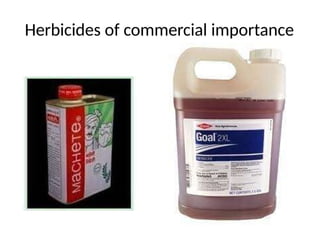
Herbicides of commercial importance
Herbicide label information
Toxicity
categories
LD50
[mg/kg
body wt]
Colour
of
the triangle
Signal
word
Warning
symbol
Extremely toxic 0-50 Bright red Poison
Skull
and
Cross
Highly toxic 51-500
Bright
yellow
Poison -
Moderately
toxic
501-5000 Bright blue Danger -
Slightly toxic >5000 Bright green Caution -
Herbicide label information to be noted
information should be collected in the following format
1. Common name
2. Trade name
3 Formulation
4 Active ingredient
5 . Carrier
6 Net weight
7. Antidote
8. Manufacturers address
9. Date of expiry
10. Recommended dose per acre
9. Commonly
available
herbicides
in India
Common names Trade name Percentage
Alachlor Lasso 50EC
Anilofos Aniloguard 30EC
Atrazine Atrataf 50WP
Butachlor Machete 50EC
Clomozone Command 50EC
Ethoxysulfuron Sunrise 15 WG
Fenoxaprop-p-ethyl Whipsuper 10EC
Glyphosate Glycel / Roundup 41SL
Metolachlor Dual 50EC
Imazethypr Persuit 10EC
Oxyfluorfen Goal 25EC
Oxadiargyl Raft SC, Topstar WG 6EC
Paraquat Gramoxone 24SL
Pendimethalin Stomp 30EC
Pretilachalor Rifit 50EC
Pretilacholar-S Sofit 30.7% EC
Pyrazosulfuron-ethyl Saathi 10WP
Quizalofop-ethyl Turgasuper EC
2,4-D Fernoxone 80WP
2,4-DEE Agrodon 48EC
Glufosinate Basta 15%SL
Isoproturon arelon 75%WP
Propanil Stam F 34 34%EC
Thiobencarb Saturn 50%EC
Trifluralin Tip top 48%EC
Metaxuron Dosanex 80%WP
Cinmethylin Argold, Cinch
Bis -pyribac sodium Nominee gold 10%SC
Metsulfuron methyl Algrip 20%WP
Chlorimuron
+metsulfuron
methyl
Almix 20%WP
Chlorimuron -ethyl Kloben 25%WP
Classification of Hb based on chemical nature and selectivity
1. Based on chemical structure
i) Organic ii) Inorganic
2. Based on Selectivity :
i) Selective ii) Non selective
3. Based on mode of action
i) Contact ii) Translocated (Systemic)
4. Based on residual action in soil
i) Residual ii) Non residual herbicides
5. Based on Spectrum of weed control
i) Narrow spectrum ii) Broad spectrum herbicides
6. Based on duration of weed control
i) Soil sterilant ii) Fumigants
7. Based on Time of application
i) Pre planting herbicides ii) Pre Emergence iii) Post Emergence Hbs
8. Based on method of application
i) Soil active herbicides ii) Foliage active herbicides
1.Blanket application
2. Directed spraying
3. Spot treatment
4. Protected spraying
1. Surface application
2. Sub- surface layering
3. Band application
4. Soil fumigation
5. Herbigation
9. Methods of treating brush and trees
i) Cut stump treatment
ii) Basal bark treatment
iii) Foliage treatment
10. Other methods of Herbicide Application
i) D.C.A. (Direct Contact Application ii)
Herbicide wax bars
iii) Herbicide cloth mulch
iv) Herbicide rouging gloves
v) Soil Injection
Classification of herbicides.
1) Classification based on chemical
nature [structure]
• Herbicides are primarily
grouped in to
• inorganic herbicides
• organic herbicides.
Classification of herbicides.
1.1 Organic herbicides:
• These herbicides contain carbon atoms in their
molecules. They may be oils or non oils. Eg. diesel
oil, xylene type of aromatic oils.
• Majority of present day herbicides are non oils.
• There are about 292 (MAC HRAC 2010) herbicides
are available.
• They differ each other like behavior in soil, plants,
mode of action etc. based on this
chemical nature;
the herbicides are grouped into
22
groups.
Classification of herbicides.
1.2 Inorganic herbicides do not contain carbon
atoms in their molecules. They were the first
chemicals used for weed control.
• Arsenic acid, sulphuric acid are acid type of
inorganic herbicides.
• Whereas sodium arsenate, sodium chlorate,
copper sulphate etc are inorganic salts
Based on chemical structure
Sl.No Group Herbicides
1 Aliphatic acids
Dalapon, TCA, Glyphosate, Methyl bromide
Cacodylic acid ,MSMA,DSMA
2 Amides
Alchlor, Butachlor, Propachlor, Metalachlor,
Diphenamide, Propanil
3 Benzoics 2,3,6, TBA, Dicamba, tricamba, Chloramben
4 By Pyridillums Paraquat, Diquat
5 Carbamates
Propham, Chlorpropham, Barban, Dichlormate,
Asulam
6 Thiocarbamates
Butylate, Diallate, EPTC, Molinate,
Triallate, Benthiocarb, Metham
7 Dithiocarbamates CDEC, Metham
8 Nitriles Bromoxynil, Ioxynil, Dichlobenil
Based on chemical structure contd...
S.No Group Herbicides
9 Dintroanilins
Fluchloralin, Trifluralin, Pendimethalin, Nitralin
Isoproturon
10 Phenols Dinoseb, DNOC,PCP
11
Phynoxy alkanoic
acids
2,4-D, 2,4,5-T, MCPA, MCPB, 2,4-DB, Dichlorprop
12 Traizines Atrazine, Simazine, Metribuzine, Amytrin, Terbutrin
13 Ureas
Monuron, Diuron, Linuron, Metoxuron, Isoproturon,
Methabenz thiozuron
14 Uracils Bromacil, Terbacil, Lenacil
15 Diphenyl ethers Nitrofen, Oxyfluorfen, Nitrofluorfen
16
Aryloxypheno
xy propionate
Diclopop , Fenoxaprop-p, Quizalofop-p, Haloxyfop-
p Fluazifop-p
Based on chemical structure contd…
S.No Group Herbicides
17 Cyclohexanedione
Sethoxydim, Clethodim,
Tralkoxydim, Cycloxidim
18 Imidazolines
Imazapyr, Imazamethabenz,
Imazaquin, Imazamax
Imazethapyr
19 Isoxazolidinones Clomazone
20 Oxadiazoles Oxadiazon, oxadiargyl
21 Oxadiazolides Methazole
22 N-phenylphthalamides Flumiclorac
23 Phenylpyridazones Sulfentrazone
Based on chemical structure
Sl.No Group Herbicides
25 Pyrazoliums Difenzoquat, Metflurazone
26
Picolinic acids
Pyridine
Picloram , Dithiopyr, Pyrithiobac, Fluridone,
Thiazopyr
27 Quinolines Quinclorac
28 Sulfonylureas
Bensulfuron, Chlorimuron, Metsulfuron,
Sulfosulfuron
Triasulfuron, bispyriubac Na
29 Triazolinones Pyridates
30 Cineoles Cinmethylin
31 Others
Pichloram, Pyrazon, Endothal, Oxadiazon,
Amitrole, Anilofos
•A selective herbicide is one that will kill some
plant species when applied to a mixed plant
population, without causing serious injury to the
other species. Selective herbicides are used in
crop areas, lawns, gardens, and grasslands. 2,4-
D, atrazine, EPTC, trifluralin, alachlor, butachlor,
fluchloralin and pendimethalin are selective
herbicides used on crop land.
•Non-selective herbicide: It is one that kills plants
without regard to species, for example, paraquat,
Diquat, sodium chlorate, weed oils, and acrolein.
The non-selective herbicides are employed for
general vegetation control on industrial sites,
fallow land, and in aquatics and tennis
courts.*Certain selective herbicides when applied
at high rates, can act as non-selective plant killers,
for instance, simazine and diuron.
Contact herbicide kills plants by coming in contact with the plant tissue
rather than as a result of its translocation. Thus, a contact herbicide
applied to the foliage of a plant will not kill its roots, though in simple
annuals the roots of the treated plants may die because they were
deprived of their shoots. The established weeds will regrow from their
crown buds, roots, or rhizomes, shortly after treatment with a contact
herbicide. Some common contact herbicides are paraquat, diquat,
Propanil, and petroleum oil
Translocated (systemic) herbicide moves within the plant from the
point
of treatment to its other parts, to variable extent.
Some herbicides may exhibit both, contact and translocation activities. For
example, atrazine is a translocated herbicide when absorbed by the weed from the soil,
but a contact herbicide when it is sprayed on the plant shoots.
4. Based on residual action in soil
i) Residual herbicides
it maintains its phytotoxic effects in soil for considerable time after its
application. This residue period may be three to four weeks in some
herbicides, such as 2,4-D and EPTC, and much longer, up to several months,
in others.
ii)A non-residual herbicide is inactivated in soil immediately, or within a few
days, after it reaches the soil, Paraquat, diquat, amitrole, DSMA, and weed
oils are non-residual or very short persistence herbicides.
The non-residual herbicides are good for a quick knockdown of the existing
weeds. They do not provide any extended period of weed control
i) Narrow Spectrum: - In a mixed population
active
only on one weed species.
Ex: Metoxuron, Diclofop
Phalaris minor and Avena fatua
Disadvantage additional herbicides need to be
used.
ii) Broad Spectrum:- Wide spectrum of weed
flora.
Most herbicides.
i)
• A soil sterilant prevents the growth of plants when present in the soil*.
Temporary soil sterilants sterilize the soil for up to 16 weeks, whereas the
permanent soil sterilants remain active for two or more years. The temporary soil
sterilants are usually volatile compounds which leave the soil in vapour form after a
few days to a few weeks of application. During this period these are supposed to
have killed all live plant parts in the soil. Such soil sterilants are also called soil
fumigants.
MB, Metham, and dazomet are good examples of soil fumigants used in
agriculture
and horticulture for the treatment of seedbeds and pot soil.
ii) Permanent soil sterilants used in causing bare ground in industrial and other non-
crop areas for one or more seasons. Sodium chlorate, substituted ureas, several
symmetrical triazines, arsenics, and borates are the major permanent soil sterilant in
use currently.
7. Based on time of application
1) Pre- sowing or pre-plant treatment: Anytime before the crop is
sown.
This is of 2 types
a) Pre-sowing or pre-plant desiccation: -
Applied to desiccate the standing weed vegetation.
eg: Paraquat & Glyphosate.
b) Pre-sowing or Pre-plant incorporation: -
Applied and incorporated before sowing.
eg: Fluchloralin, Pendimethalin,
Trichloralin
2) Pre-emergence application:
Soon after sowing before neither the crop nor the weds
germinated.
Crop & weed have not emerged.
eg: Benthiocarb, Atrazine in maize,
Diuron in Cotton & Pendimethalin
Weed
Crop seedling
Crop seed
Weed seed
Weed seed Weed
35
3) Post emergence application
Applied after the emergence of both crop and
weed.
Ex: Propanil in Rice at 25 DAT
2,4-D at 30 DAT of Paddy.
4) Lay by application ***VIMP
Application after ridging in sugarcane and cotton.
Eg. Atrazine in sugarcane after last interculture and
making ridges
8.Classification based on methods of application of
herbicides
• Methods of application of herbicides are
decided largely by their modes of action and
selectivity. Important methods of application
of herbicides to crop and non-crop lands are
given, as follows
• Soil-Active and Foliage-Active Herbicides
i) Soil-Active Herbicide
• A soil-active herbicide is one that is applied primarily
to the soil rather than to the vegetation.
• They inhibits germination/sprouting of their rhizomes/
tubers.
• Eliminates early weed-crop competition for the period
of 4 to 8 weeks, depending upon the herbicide/ dose.
• The soil-active herbicides are applied at the times
of planting.
• Weed free inter-rows of established crops to
obtain extended period of weed control.
• EgSimazine, Alachlor, Trifluralin, and EPTC.
• On non-crop lands, the soil-active herbicides used are
soil sterilants and fumigants Eg. EPTC
1.Surface Application
• Soil active herbicides are applied uniformly on
the surface of the soil either by spraying or by
broadcasting, where they may be either left
into the soil
undisturbed or
incorporated physically.
Eg. Dinitroanilines, Triazines,
2.Sub-Surface Layering
• It is the application of an herbicide in a
concentrated band, about 7-10 cm below the soil
surface
• Incorporation of soil applied herbicide
• The technique has proved effective in controlling
perennial weeds like Cyperus rotundus and
Convolvulus arvensis. Eg Carbamate fluchloralin,
trifluralin and nitralin herbicides,
• The immediate use of the technique is probably
in orchards and vineyards, besides certain wide-
row crops like sugar beet and tobacco.
iii) Band Application
• The band application of a herbicide
constitutes its application to a restricted band
along the crop rows, leaving an untreated
band in the inter-rows.
• The band application of herbicides is primarily
a cost saving device since it reduces the
quantity of herbicide in the ratio of the
treated band width to the crop row width.
iv) Soil Fumigation
Herbicides used for fumigation are called as
fumigants. Depending upon the nature of the
soil fumigant, it can be applied either
1) by soil injection (Chloropicrin)
2) by releasing it under sealed, plastic
covers (Methyl bromide) or
3) by direct soil surface application (Metham).
Soil fumigation under sealed plastic
covers
v) Herbigation
• Application of herbicides with irrigation water
both by surface and sprinkler systems.
• In India farmers apply fluchloralin for chillies
and tomato,
• while in western countries application of EPTC
with sprinkler irrigation water is very common
in Lucerne.
ii) Methods of Application of Foliage-Active Herbicides
• A Foliage-active herbicide is applied to weeds
after their emergence from the soil.
• They are absorbed by the plant foliage and
these are translocated to the other plant
parts.
Eg 2,4,5-T, paraquat, diquat, MCPB, amitrole,
and herbicidal oils.
There may be some herbicides that are both
soil-active and foliage- active, for example,
2,4-D, picloram, and atrazine.
1. Blanket Application
• Blanket (or over-the-top) it is uniform
application of herbicides to standing crops
with disregard to the location of the crop
plants.
• Only highly selective herbicides are applied
by this method, e.g. 2,4-D in wheat. rice ,
MCPB in pea, 2,4-DB in Lucerne, and picloram
in sugarcane cf. surface application of
herbicide
2. Directed Spraying
• It is the application of herbicide to weeds, which
are growing in the inter-rows of crop avoiding the
crop foliage as much as possible.
• One important pre-requisite of directed spraying
is that farmer must get his row crops well grown
over the weeds at the time of treatment.
• Orchards and plantations are good venues of
directed herbicide sprays.
• Usually, the directed spraying is adopted with
herbicides that are partially selective to the
treated crops.
Post-emergence directed spray
3. Spot treatment
• Spot treatment is the application of herbicides
to small patches of weeds, leaving the weed-
free gaps untreated.
• This is used for treating patches of noxious,
perennial weeds in certain crop fields with
potent herbicides. (Paraquat treatment for
cuscuta in Blackgram)
• Spot treatment in the non-crop areas to
prevent wastage of herbicide.
4. Protected Spraying
• Non-selective herbicides can be employed to
obtain selective weed control in distantly
planted vegetables and ornamentals either by
covering the non-target plants before
application of the herbicide with plastic or
metallic covers or by spraying herbicide
underneath a hooded or shielded sprayer.
Glyphosate application underneath a hooded or shielded
sprayer that prevents spray contact with sugarcane
foliage
9.Methods of treating brush weeds and trees
• Brush weeds and unwanted trees are
treated
with herbicides by different methods.
i) Foliage treatment
ii) Basal bark treatment
iii) cut stump treatment
i)Foliage treatment
Whenthe brush leaves are fully
expanded & growing actively.
- Ground sprayers can cover up to
2.5 m high brush
–Foliage treatment is the
most common method of treating
brush.
ii) Basal bark treatment
A better method of dealing with
tall brushes. Basal 30 cm of
stem bark is peeled off then
spraying is done to the point of
liberal run-off
iii) Cut stump treatment
Cut the stump few inches above the ground
followed by liberal application of the herbicide on
the cut surface /Wick dipped in herbicide solution
may be wrapped and applied twice at an hour
interval.
10.Other ways for treating brush and trees
• Other ways by which the concentrated herbicides are
applied to unwanted trees are, frill, notch, and injection
methods.
• The frill, notch, and injection methods are adopted on
thick stem trees which are 8 cm or more in diameter.
• The frills and notches are made with sharp tools into the
sapwood at convenient stem height and filled with
herbicides.
• The herbicide injections are made into holes made in the
tree trunk. Usually, one herbicide injection per 2.5 cm
stem thickness is adequate.
Other methods of Herbicide Application
D.C.A.(Direct Contact Application:
D.C.A includes all techniques involving wiping, rubbing, and
smearing of herbicide onto the target plant surfaces.
It may be achieved by using herbicide wax bars, herbicide
cloth mulch, herbicide rouging gloves, etc.
The herbicide laden wax bars are dragged against weeds
growing much taller to the crop plants.
Herbicide cloth mulches are spread in the crop inter-rows.
The rouging gloves carry arrangement to smear herbicide
onto the weed gripped by the worker.
Many other ways of DCA of herbicides can be designed to suit
specific situations.
Soil injection: Herbicides like ethylene, carbon bisulphide and
vernolate are applied by soil injections, at prescribed
spacings, before planting of the crops.
Thank you

herbicides .pptx

  • 1.
    Lecture No 9 Herbicides– Definition – Advantages & Limitations of Herbicide usage in India – Nomenclature of Herbicides – Herbicide label information – Presently available herbicides in the market 1. What is meant by Herbicide? 2. Historical development of herbicides 3. Objectives of herbicide usage 4. Advantages of herbicide usage in Agriculture 5. Disadvantages of herbicide use/ Chemical methods 6. Nomenclature of herbicides 7. Authorities 8. Herbicide label information 9. Presently available herbicides in the market
  • 2.
    1. What ismeant by Herbicide The word herbicide is derived from Latin Herba word means plant and Caedere means to kill Herbicides are chemicals capable of killing or inhibiting the growth of plants.
  • 3.
    2.Historical Development ofHerbicides • Common salt, ash etc. have been used for centuries to control weeds • Selective control of weeds in 1896 observed by French farmer that Bordeaux mixture sprayed on Grapevine to control downy mildew. It was found that CuSo4 present in the Bordeaux mixture was responsible for its weed killing effect. • Between 1896 and 1908 several inorganic salts as also sulphuric acid were found selective to small grain crops. • 1945 - 2,4-D & MCPA in USA & England independently by P.W.Zimmerman and Hitchkock. were found highly selective for cereals and phytotoxic to broad leaved weeds. • In Agriculturally developed countries, herbicides form over 45% of the total pesticides used. In India, share of herbicides is only 8% of the total pesticides consumed. The average herbicide usage in India is
  • 4.
    3. Objectives ofherbicides usage •To replace the drudgery of manual weeding. •The labour power could be saved •Increasing costs of hired labour and limited supply of fuel for mechanical weed control demands use of herbicides •Herbicides Physical, methods. at substituting the are not aimed Biological or good crop husbandry •In water bodies herbicides can be efficiently employed to free them of their weedy vegetation.
  • 5.
    4. Advantages ofherbicides • Herbicides are useful in areas where incessant rainfall may hinder the physical weeding during monsoonal season • Herbicide usage reduce the competition for labour • They control germinating weeds and there by make the crop weed free • They are useful to control weeds mimic weeds. • Herbicides doesn’t dictate strict row spacing. • They have long lasting effect on control of brush weeds and perennial weeds. • Convenient to use on thorny / spiny weeds. • Control weeds on erodible soils where tillage may accelerate soil and water erosion
  • 6.
    4.Advantages of herbicidescontd……. • They kill the weeds in situ without dissemination propagules • Sprays easily reach the inaccessible areas • Reduce the demand for labour • Greater possibility of mechanization. • Easy crop harvesting. • Weeds controlled in crop rows • Increase WUE in dry lands and less crop failures
  • 7.
    5. Disadvantages • No automatic signalto stop farmer who may applying the chemical inaccurately. • Contaminate the environment. • Drift hazards/ runoff/ wash off • Many herbicides are needed to control weeds depending upon farm diversity. • Skill is needed in the use herbicides • In sequence cropping-selectivity is a major problem. • Neighbours field damage by warfare
  • 8.
    8 6. Nomenclature ofherbicides Each herbicide has a trade name (sometimes more than one), a common name, and a chemical name. 1.Common name: Short form - agreed upon by a committee. 2.Trade name: Offered by the manufacturer. registered- several trade names. Glyphosate: Glycel – Excel; – Monsanto Roundup -No weed - Dhanuka 3.Chemical name: Full molecular structure.
  • 9.
    S. No. Common Name Trade name Chemical name 1 2,4-DFernoxone 2,4-Dichlorophenoxy acetic acid 2 MCPA Agroxone 2-Methyl-4-chloro phenoxy acetic acid 3 Alachlor Lasso 2-Chloro-2,6-diethyl-N- (methoxy methyl) acetanilide 4 Atrazine Atrataf 2-chloro-4-ethylamino-6- isopropylamino-s- triazine 5 Benthiocar b Saturn S-(4-chlorobenzyl)-N,N- diethylthiocarbamate 9 Nomenclature
  • 10.
    10 7.Authorities to acceptnames 1. ANSI : American National Standard Institute. 2. BSI : British Standard Institute. 3. IOS 4. WSSA : International Organization for Standardization. : Weed Science Society of America. 5. ISWS 6. NRCWS : Indian Society of Weed Science. : National Research Centre for Weed Science, Jabalpur : Directorate of Weed Science Research, Jabalpur (MP) 6. DWS R
  • 11.
    8.Herbicide label information •A herbicide label is a legal document providing important information about a herbicide, its appropriate use, and the precautions needed to avoid off-target movement and to protect environmental quality. A herbicide label answers the “what, where, when,” and “how” questions about the product.
  • 12.
  • 13.
    Herbicide label information Toxicity categories LD50 [mg/kg bodywt] Colour of the triangle Signal word Warning symbol Extremely toxic 0-50 Bright red Poison Skull and Cross Highly toxic 51-500 Bright yellow Poison - Moderately toxic 501-5000 Bright blue Danger - Slightly toxic >5000 Bright green Caution -
  • 14.
    Herbicide label informationto be noted information should be collected in the following format 1. Common name 2. Trade name 3 Formulation 4 Active ingredient 5 . Carrier 6 Net weight 7. Antidote 8. Manufacturers address 9. Date of expiry 10. Recommended dose per acre
  • 15.
    9. Commonly available herbicides in India Commonnames Trade name Percentage Alachlor Lasso 50EC Anilofos Aniloguard 30EC Atrazine Atrataf 50WP Butachlor Machete 50EC Clomozone Command 50EC Ethoxysulfuron Sunrise 15 WG Fenoxaprop-p-ethyl Whipsuper 10EC Glyphosate Glycel / Roundup 41SL Metolachlor Dual 50EC Imazethypr Persuit 10EC Oxyfluorfen Goal 25EC Oxadiargyl Raft SC, Topstar WG 6EC Paraquat Gramoxone 24SL Pendimethalin Stomp 30EC Pretilachalor Rifit 50EC Pretilacholar-S Sofit 30.7% EC Pyrazosulfuron-ethyl Saathi 10WP Quizalofop-ethyl Turgasuper EC 2,4-D Fernoxone 80WP 2,4-DEE Agrodon 48EC Glufosinate Basta 15%SL Isoproturon arelon 75%WP Propanil Stam F 34 34%EC Thiobencarb Saturn 50%EC Trifluralin Tip top 48%EC Metaxuron Dosanex 80%WP Cinmethylin Argold, Cinch Bis -pyribac sodium Nominee gold 10%SC Metsulfuron methyl Algrip 20%WP Chlorimuron +metsulfuron methyl Almix 20%WP Chlorimuron -ethyl Kloben 25%WP
  • 17.
    Classification of Hbbased on chemical nature and selectivity 1. Based on chemical structure i) Organic ii) Inorganic 2. Based on Selectivity : i) Selective ii) Non selective 3. Based on mode of action i) Contact ii) Translocated (Systemic) 4. Based on residual action in soil i) Residual ii) Non residual herbicides 5. Based on Spectrum of weed control i) Narrow spectrum ii) Broad spectrum herbicides 6. Based on duration of weed control i) Soil sterilant ii) Fumigants 7. Based on Time of application i) Pre planting herbicides ii) Pre Emergence iii) Post Emergence Hbs
  • 18.
    8. Based onmethod of application i) Soil active herbicides ii) Foliage active herbicides 1.Blanket application 2. Directed spraying 3. Spot treatment 4. Protected spraying 1. Surface application 2. Sub- surface layering 3. Band application 4. Soil fumigation 5. Herbigation 9. Methods of treating brush and trees i) Cut stump treatment ii) Basal bark treatment iii) Foliage treatment 10. Other methods of Herbicide Application i) D.C.A. (Direct Contact Application ii) Herbicide wax bars iii) Herbicide cloth mulch iv) Herbicide rouging gloves v) Soil Injection
  • 19.
    Classification of herbicides. 1)Classification based on chemical nature [structure] • Herbicides are primarily grouped in to • inorganic herbicides • organic herbicides.
  • 20.
    Classification of herbicides. 1.1Organic herbicides: • These herbicides contain carbon atoms in their molecules. They may be oils or non oils. Eg. diesel oil, xylene type of aromatic oils. • Majority of present day herbicides are non oils. • There are about 292 (MAC HRAC 2010) herbicides are available. • They differ each other like behavior in soil, plants, mode of action etc. based on this chemical nature; the herbicides are grouped into 22 groups.
  • 21.
    Classification of herbicides. 1.2Inorganic herbicides do not contain carbon atoms in their molecules. They were the first chemicals used for weed control. • Arsenic acid, sulphuric acid are acid type of inorganic herbicides. • Whereas sodium arsenate, sodium chlorate, copper sulphate etc are inorganic salts
  • 22.
    Based on chemicalstructure Sl.No Group Herbicides 1 Aliphatic acids Dalapon, TCA, Glyphosate, Methyl bromide Cacodylic acid ,MSMA,DSMA 2 Amides Alchlor, Butachlor, Propachlor, Metalachlor, Diphenamide, Propanil 3 Benzoics 2,3,6, TBA, Dicamba, tricamba, Chloramben 4 By Pyridillums Paraquat, Diquat 5 Carbamates Propham, Chlorpropham, Barban, Dichlormate, Asulam 6 Thiocarbamates Butylate, Diallate, EPTC, Molinate, Triallate, Benthiocarb, Metham 7 Dithiocarbamates CDEC, Metham 8 Nitriles Bromoxynil, Ioxynil, Dichlobenil
  • 23.
    Based on chemicalstructure contd... S.No Group Herbicides 9 Dintroanilins Fluchloralin, Trifluralin, Pendimethalin, Nitralin Isoproturon 10 Phenols Dinoseb, DNOC,PCP 11 Phynoxy alkanoic acids 2,4-D, 2,4,5-T, MCPA, MCPB, 2,4-DB, Dichlorprop 12 Traizines Atrazine, Simazine, Metribuzine, Amytrin, Terbutrin 13 Ureas Monuron, Diuron, Linuron, Metoxuron, Isoproturon, Methabenz thiozuron 14 Uracils Bromacil, Terbacil, Lenacil 15 Diphenyl ethers Nitrofen, Oxyfluorfen, Nitrofluorfen 16 Aryloxypheno xy propionate Diclopop , Fenoxaprop-p, Quizalofop-p, Haloxyfop- p Fluazifop-p
  • 24.
    Based on chemicalstructure contd… S.No Group Herbicides 17 Cyclohexanedione Sethoxydim, Clethodim, Tralkoxydim, Cycloxidim 18 Imidazolines Imazapyr, Imazamethabenz, Imazaquin, Imazamax Imazethapyr 19 Isoxazolidinones Clomazone 20 Oxadiazoles Oxadiazon, oxadiargyl 21 Oxadiazolides Methazole 22 N-phenylphthalamides Flumiclorac 23 Phenylpyridazones Sulfentrazone
  • 25.
    Based on chemicalstructure Sl.No Group Herbicides 25 Pyrazoliums Difenzoquat, Metflurazone 26 Picolinic acids Pyridine Picloram , Dithiopyr, Pyrithiobac, Fluridone, Thiazopyr 27 Quinolines Quinclorac 28 Sulfonylureas Bensulfuron, Chlorimuron, Metsulfuron, Sulfosulfuron Triasulfuron, bispyriubac Na 29 Triazolinones Pyridates 30 Cineoles Cinmethylin 31 Others Pichloram, Pyrazon, Endothal, Oxadiazon, Amitrole, Anilofos
  • 26.
    •A selective herbicideis one that will kill some plant species when applied to a mixed plant population, without causing serious injury to the other species. Selective herbicides are used in crop areas, lawns, gardens, and grasslands. 2,4- D, atrazine, EPTC, trifluralin, alachlor, butachlor, fluchloralin and pendimethalin are selective herbicides used on crop land. •Non-selective herbicide: It is one that kills plants without regard to species, for example, paraquat, Diquat, sodium chlorate, weed oils, and acrolein. The non-selective herbicides are employed for general vegetation control on industrial sites, fallow land, and in aquatics and tennis courts.*Certain selective herbicides when applied at high rates, can act as non-selective plant killers, for instance, simazine and diuron.
  • 28.
    Contact herbicide killsplants by coming in contact with the plant tissue rather than as a result of its translocation. Thus, a contact herbicide applied to the foliage of a plant will not kill its roots, though in simple annuals the roots of the treated plants may die because they were deprived of their shoots. The established weeds will regrow from their crown buds, roots, or rhizomes, shortly after treatment with a contact herbicide. Some common contact herbicides are paraquat, diquat, Propanil, and petroleum oil Translocated (systemic) herbicide moves within the plant from the point of treatment to its other parts, to variable extent.
  • 29.
    Some herbicides mayexhibit both, contact and translocation activities. For example, atrazine is a translocated herbicide when absorbed by the weed from the soil, but a contact herbicide when it is sprayed on the plant shoots.
  • 30.
    4. Based onresidual action in soil i) Residual herbicides it maintains its phytotoxic effects in soil for considerable time after its application. This residue period may be three to four weeks in some herbicides, such as 2,4-D and EPTC, and much longer, up to several months, in others. ii)A non-residual herbicide is inactivated in soil immediately, or within a few days, after it reaches the soil, Paraquat, diquat, amitrole, DSMA, and weed oils are non-residual or very short persistence herbicides. The non-residual herbicides are good for a quick knockdown of the existing weeds. They do not provide any extended period of weed control
  • 31.
    i) Narrow Spectrum:- In a mixed population active only on one weed species. Ex: Metoxuron, Diclofop Phalaris minor and Avena fatua Disadvantage additional herbicides need to be used. ii) Broad Spectrum:- Wide spectrum of weed flora. Most herbicides.
  • 32.
    i) • A soilsterilant prevents the growth of plants when present in the soil*. Temporary soil sterilants sterilize the soil for up to 16 weeks, whereas the permanent soil sterilants remain active for two or more years. The temporary soil sterilants are usually volatile compounds which leave the soil in vapour form after a few days to a few weeks of application. During this period these are supposed to have killed all live plant parts in the soil. Such soil sterilants are also called soil fumigants. MB, Metham, and dazomet are good examples of soil fumigants used in agriculture and horticulture for the treatment of seedbeds and pot soil. ii) Permanent soil sterilants used in causing bare ground in industrial and other non- crop areas for one or more seasons. Sodium chlorate, substituted ureas, several symmetrical triazines, arsenics, and borates are the major permanent soil sterilant in use currently.
  • 33.
    7. Based ontime of application 1) Pre- sowing or pre-plant treatment: Anytime before the crop is sown. This is of 2 types a) Pre-sowing or pre-plant desiccation: - Applied to desiccate the standing weed vegetation. eg: Paraquat & Glyphosate. b) Pre-sowing or Pre-plant incorporation: - Applied and incorporated before sowing. eg: Fluchloralin, Pendimethalin, Trichloralin 2) Pre-emergence application: Soon after sowing before neither the crop nor the weds germinated. Crop & weed have not emerged. eg: Benthiocarb, Atrazine in maize, Diuron in Cotton & Pendimethalin
  • 34.
  • 35.
    35 3) Post emergenceapplication Applied after the emergence of both crop and weed. Ex: Propanil in Rice at 25 DAT 2,4-D at 30 DAT of Paddy. 4) Lay by application ***VIMP Application after ridging in sugarcane and cotton. Eg. Atrazine in sugarcane after last interculture and making ridges
  • 36.
    8.Classification based onmethods of application of herbicides • Methods of application of herbicides are decided largely by their modes of action and selectivity. Important methods of application of herbicides to crop and non-crop lands are given, as follows • Soil-Active and Foliage-Active Herbicides
  • 37.
    i) Soil-Active Herbicide •A soil-active herbicide is one that is applied primarily to the soil rather than to the vegetation. • They inhibits germination/sprouting of their rhizomes/ tubers. • Eliminates early weed-crop competition for the period of 4 to 8 weeks, depending upon the herbicide/ dose. • The soil-active herbicides are applied at the times of planting. • Weed free inter-rows of established crops to obtain extended period of weed control. • EgSimazine, Alachlor, Trifluralin, and EPTC. • On non-crop lands, the soil-active herbicides used are soil sterilants and fumigants Eg. EPTC
  • 38.
    1.Surface Application • Soilactive herbicides are applied uniformly on the surface of the soil either by spraying or by broadcasting, where they may be either left into the soil undisturbed or incorporated physically. Eg. Dinitroanilines, Triazines,
  • 39.
    2.Sub-Surface Layering • Itis the application of an herbicide in a concentrated band, about 7-10 cm below the soil surface • Incorporation of soil applied herbicide • The technique has proved effective in controlling perennial weeds like Cyperus rotundus and Convolvulus arvensis. Eg Carbamate fluchloralin, trifluralin and nitralin herbicides, • The immediate use of the technique is probably in orchards and vineyards, besides certain wide- row crops like sugar beet and tobacco.
  • 41.
    iii) Band Application •The band application of a herbicide constitutes its application to a restricted band along the crop rows, leaving an untreated band in the inter-rows. • The band application of herbicides is primarily a cost saving device since it reduces the quantity of herbicide in the ratio of the treated band width to the crop row width.
  • 42.
    iv) Soil Fumigation Herbicidesused for fumigation are called as fumigants. Depending upon the nature of the soil fumigant, it can be applied either 1) by soil injection (Chloropicrin) 2) by releasing it under sealed, plastic covers (Methyl bromide) or 3) by direct soil surface application (Metham).
  • 43.
    Soil fumigation undersealed plastic covers
  • 44.
    v) Herbigation • Applicationof herbicides with irrigation water both by surface and sprinkler systems. • In India farmers apply fluchloralin for chillies and tomato, • while in western countries application of EPTC with sprinkler irrigation water is very common in Lucerne.
  • 45.
    ii) Methods ofApplication of Foliage-Active Herbicides • A Foliage-active herbicide is applied to weeds after their emergence from the soil. • They are absorbed by the plant foliage and these are translocated to the other plant parts. Eg 2,4,5-T, paraquat, diquat, MCPB, amitrole, and herbicidal oils. There may be some herbicides that are both soil-active and foliage- active, for example, 2,4-D, picloram, and atrazine.
  • 46.
    1. Blanket Application •Blanket (or over-the-top) it is uniform application of herbicides to standing crops with disregard to the location of the crop plants. • Only highly selective herbicides are applied by this method, e.g. 2,4-D in wheat. rice , MCPB in pea, 2,4-DB in Lucerne, and picloram in sugarcane cf. surface application of herbicide
  • 47.
    2. Directed Spraying •It is the application of herbicide to weeds, which are growing in the inter-rows of crop avoiding the crop foliage as much as possible. • One important pre-requisite of directed spraying is that farmer must get his row crops well grown over the weeds at the time of treatment. • Orchards and plantations are good venues of directed herbicide sprays. • Usually, the directed spraying is adopted with herbicides that are partially selective to the treated crops.
  • 48.
  • 49.
    3. Spot treatment •Spot treatment is the application of herbicides to small patches of weeds, leaving the weed- free gaps untreated. • This is used for treating patches of noxious, perennial weeds in certain crop fields with potent herbicides. (Paraquat treatment for cuscuta in Blackgram) • Spot treatment in the non-crop areas to prevent wastage of herbicide.
  • 50.
    4. Protected Spraying •Non-selective herbicides can be employed to obtain selective weed control in distantly planted vegetables and ornamentals either by covering the non-target plants before application of the herbicide with plastic or metallic covers or by spraying herbicide underneath a hooded or shielded sprayer.
  • 51.
    Glyphosate application underneatha hooded or shielded sprayer that prevents spray contact with sugarcane foliage
  • 52.
    9.Methods of treatingbrush weeds and trees • Brush weeds and unwanted trees are treated with herbicides by different methods. i) Foliage treatment ii) Basal bark treatment iii) cut stump treatment
  • 53.
    i)Foliage treatment Whenthe brushleaves are fully expanded & growing actively. - Ground sprayers can cover up to 2.5 m high brush –Foliage treatment is the most common method of treating brush.
  • 54.
    ii) Basal barktreatment A better method of dealing with tall brushes. Basal 30 cm of stem bark is peeled off then spraying is done to the point of liberal run-off
  • 55.
    iii) Cut stumptreatment Cut the stump few inches above the ground followed by liberal application of the herbicide on the cut surface /Wick dipped in herbicide solution may be wrapped and applied twice at an hour interval.
  • 58.
    10.Other ways fortreating brush and trees • Other ways by which the concentrated herbicides are applied to unwanted trees are, frill, notch, and injection methods. • The frill, notch, and injection methods are adopted on thick stem trees which are 8 cm or more in diameter. • The frills and notches are made with sharp tools into the sapwood at convenient stem height and filled with herbicides. • The herbicide injections are made into holes made in the tree trunk. Usually, one herbicide injection per 2.5 cm stem thickness is adequate.
  • 59.
    Other methods ofHerbicide Application D.C.A.(Direct Contact Application: D.C.A includes all techniques involving wiping, rubbing, and smearing of herbicide onto the target plant surfaces. It may be achieved by using herbicide wax bars, herbicide cloth mulch, herbicide rouging gloves, etc. The herbicide laden wax bars are dragged against weeds growing much taller to the crop plants. Herbicide cloth mulches are spread in the crop inter-rows. The rouging gloves carry arrangement to smear herbicide onto the weed gripped by the worker. Many other ways of DCA of herbicides can be designed to suit specific situations. Soil injection: Herbicides like ethylene, carbon bisulphide and vernolate are applied by soil injections, at prescribed spacings, before planting of the crops.
  • 63.