-:
Content:-
 Introduction
 Component of F.M.S
Processing Station
Material Handling
Computer Control
 Levels of Flexibility
 Types of F.M.S Layout
 Objectives of F.M.S
)
What is F.M.S ?
-A flexible Manufacturing System (F.M.S) is an
arrangement of machines ,interconnected by a
transport system . The transport carries work to the
machine on pallets or other interface units so the
work-machine registration on is accurate , rapid and
automatic.
OR
-F.M.S consist of a group of Processing work Stations
interconnected by means of an automated material
handling and storage system and controlled by
integrated Computer Control .
In manufacturing flexibility means-
The Capability of Producing Different parts
without major retooling.
A measure of of how fast the company converts its
process(es) From making an old line of product to
produce a new product.
The ability to change a production schedule ,to
modify a part or to handle multiple parts.
So a flexible manufacturing system is a
manufacturing system in which there is some
amount of flexibility that allows the system to react
in the case of changes whether predicted or
unpredicted. )
Basic component of F.M.S-
Work stations or Processing Stations
Automated material handling
Computer control system
Work station or processing station:-In Present day,
Work station are typically computer numerical
control(C.N.C) Machine tool that performs different
machining operation on families of parts .Flexible
manufacturing system are being designed with other
type of processing equipment including inspection
station , assembly work and sheet metal process.
The various types of workstation are:-
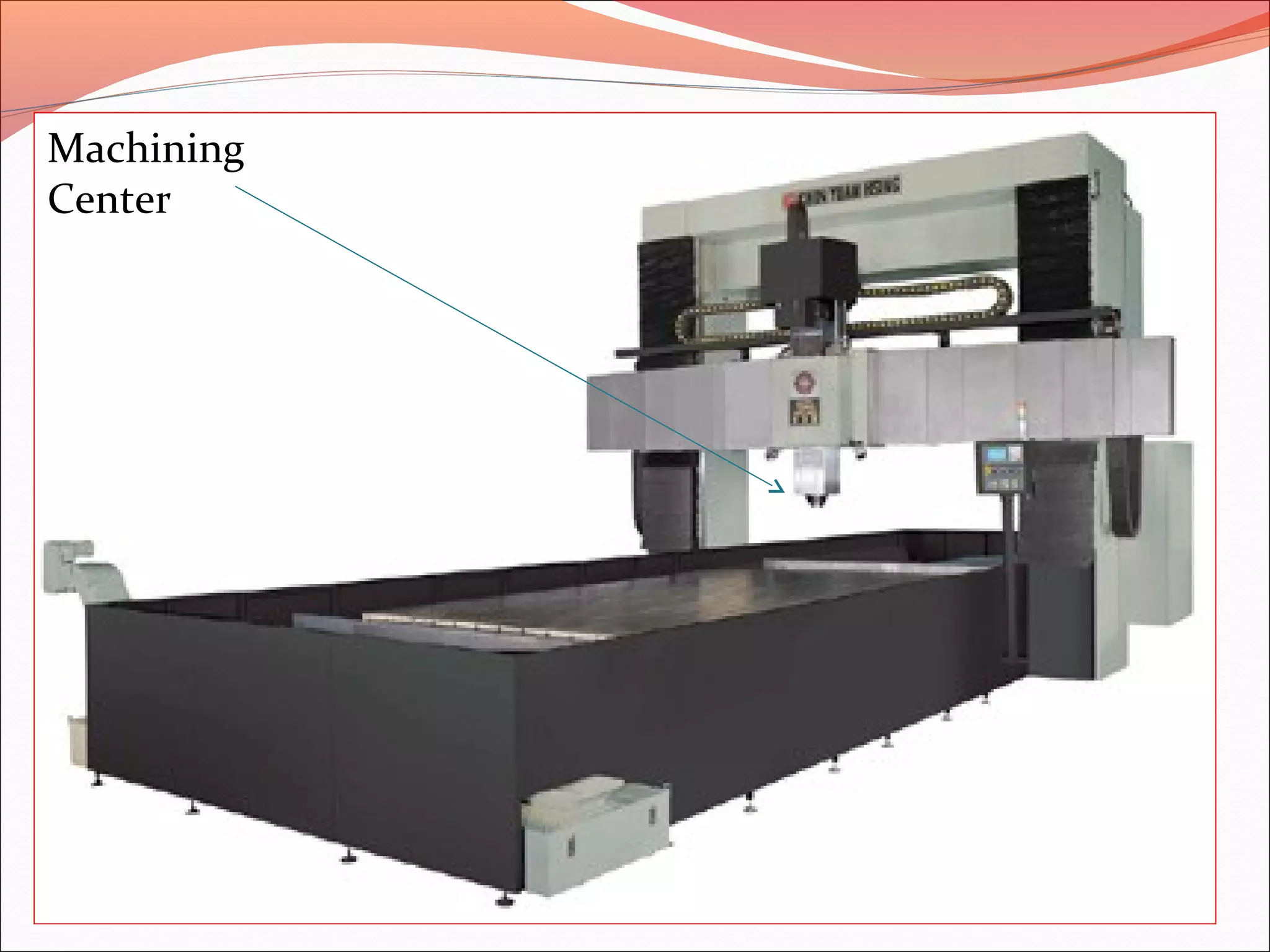
 Machining Center:-It is a Sophisticated CNC
machine that performs milling ,drilling, tapping and
boring operation at the same location with variety
of tools.
or
It is highly automated straight alone machine which
can be used as a component of F.M.S. The special
feature like automated tool changing , tool
storage ,use of pallatised work parts ,C.N.C contol
makes it more compatible with F.M.S & Milling,
drilling, boring and tapping operation can achieve
with this.
Machining
Center
 Head Changer:-Head changer is a special machine
tool with the capability of change Tool heads . Tool
heads are usually multiple spindle tool module that
can be stored in a Rake Drum located on or near the
machine.
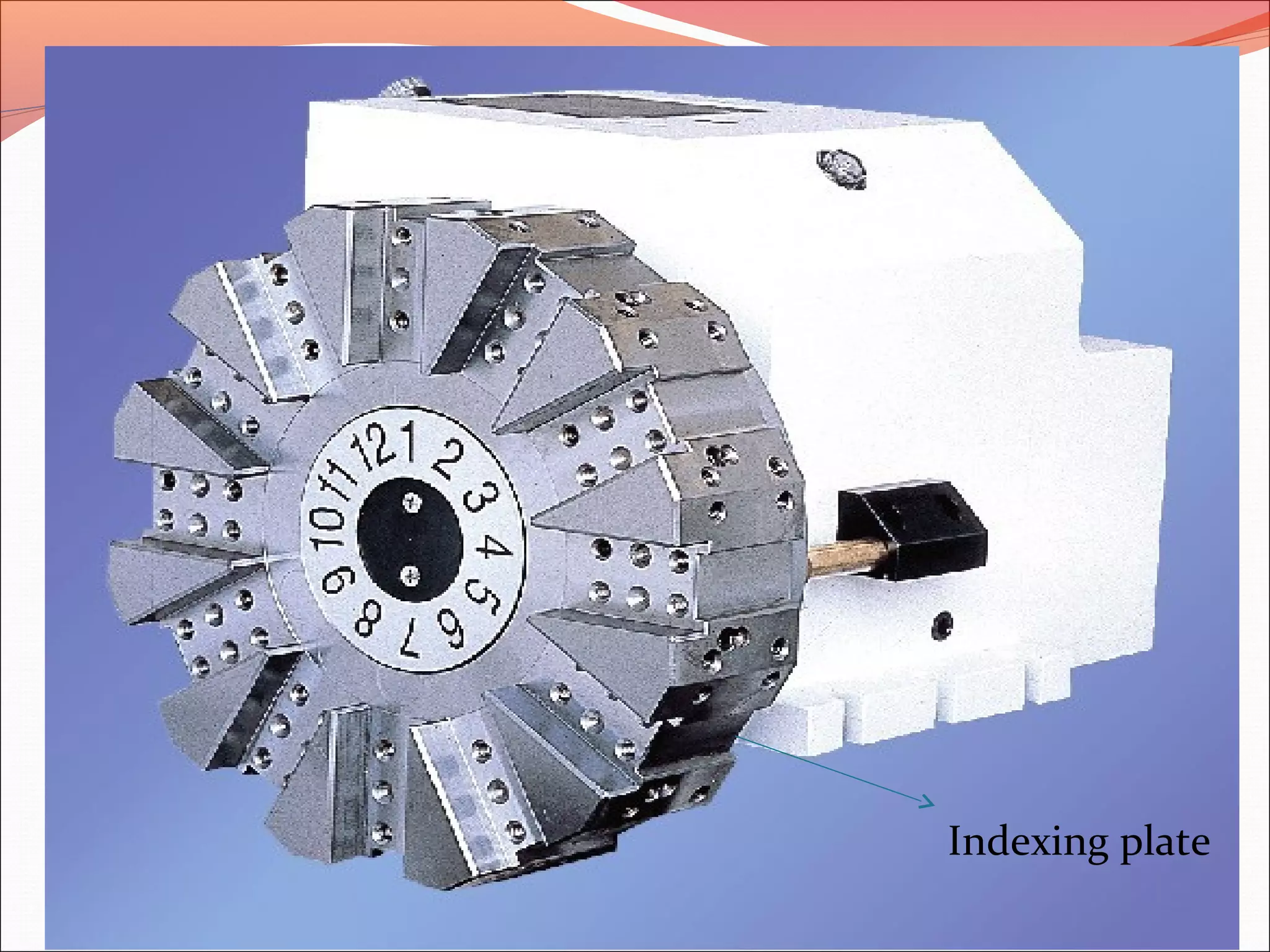
 Head Indexes:-In this heads are attach semi
permanently to an Indexing mechanism on the
machine tools.eg-Gear Cutting.
Indexing plate
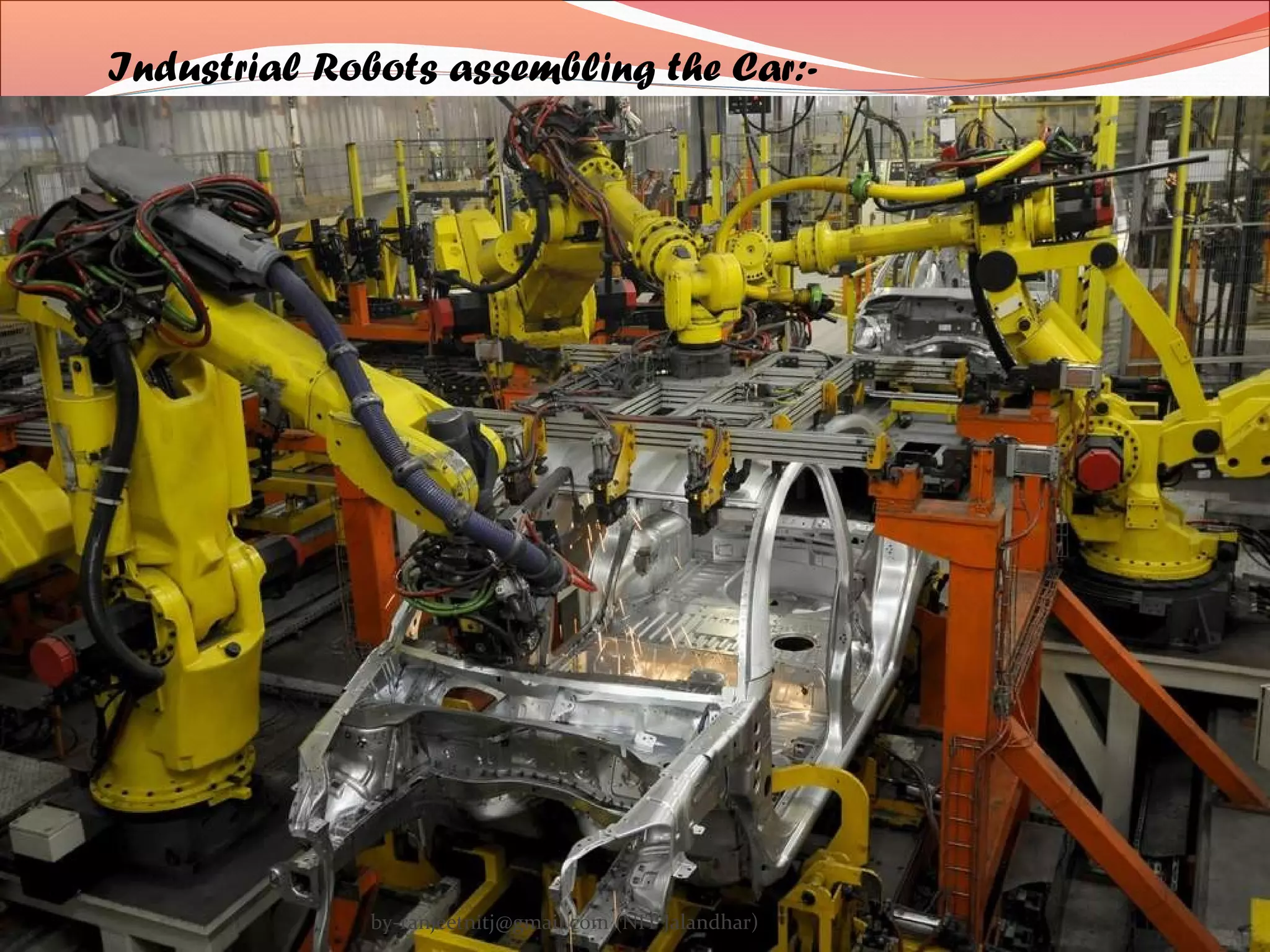
 Assembly Work Station :-Industrial Robots are
usually consider to be the most appropriate
automated assembly work station in the F.M.S ,they
can be programmed to perform task with variation
in sequences.
 Inspection Station:-Inspection Station are designed
for inspecting the completed work , In F.M.S
inspection can be happen either at work station or
by designing Special Inspection Station for this
purpose
Industrial Robots assembling the Car:-
by-ranjeetnitj@gmail.com (NIT Jalandhar)
Load and Unload Station:-as identifies from the name
load and unload station are used for loading and
unloading of work parts in the F.M.S.
The various Feature of Load and Unload stations are:-
-It act as a physical interface between the F.M.S and
rest of the Factory.
-Raw work parts enter the system at load station,
while finished work parts exit at unload station
-Manual loading/unloading is more prevalent
2. Automated Material Handling & Storage System:-
The various Automated material handling
system are used to transport work parts and
subassembly parts between the processing
station .The other function of automatic material
handling and storage system are:-
 Random and Independent movement of work parts
between processing stations.
 Handling of variety of work part configuration
 Temporary storage
 Convenient access for Loading and unloading
station.
For automated material handling and storage of work
parts is done by A.G.V(Automated Guided
Vehicles),A.S.R.S & Conveyors . we are describing
A.G.V Below:-
Automated Guided Vehicle:-Automated Guided
Vehicles (AGVs) are vehicles that are equipped with
automatic guidance systems and are capable of
following prescribed paths. Unlike traditional robots,
AGVs are not manipulators, they are driverless
vehicles that are programmed to follow a guide path.
In automated factories and facilities AGV’s move
pallets and containers. In offices they may be used to
deliver and pick up the mail.
Features of A.G.V:-
It transport material from loading to unloading
station.
It Reduces labor cost.
Highly flexible ,intelligent and versatile material
handling system.
Because it is driverless vehicle so it is safe & more
accurate.
Types Of A.G.V:-There are many types of A.G.V but
3 are basic types describe below:-
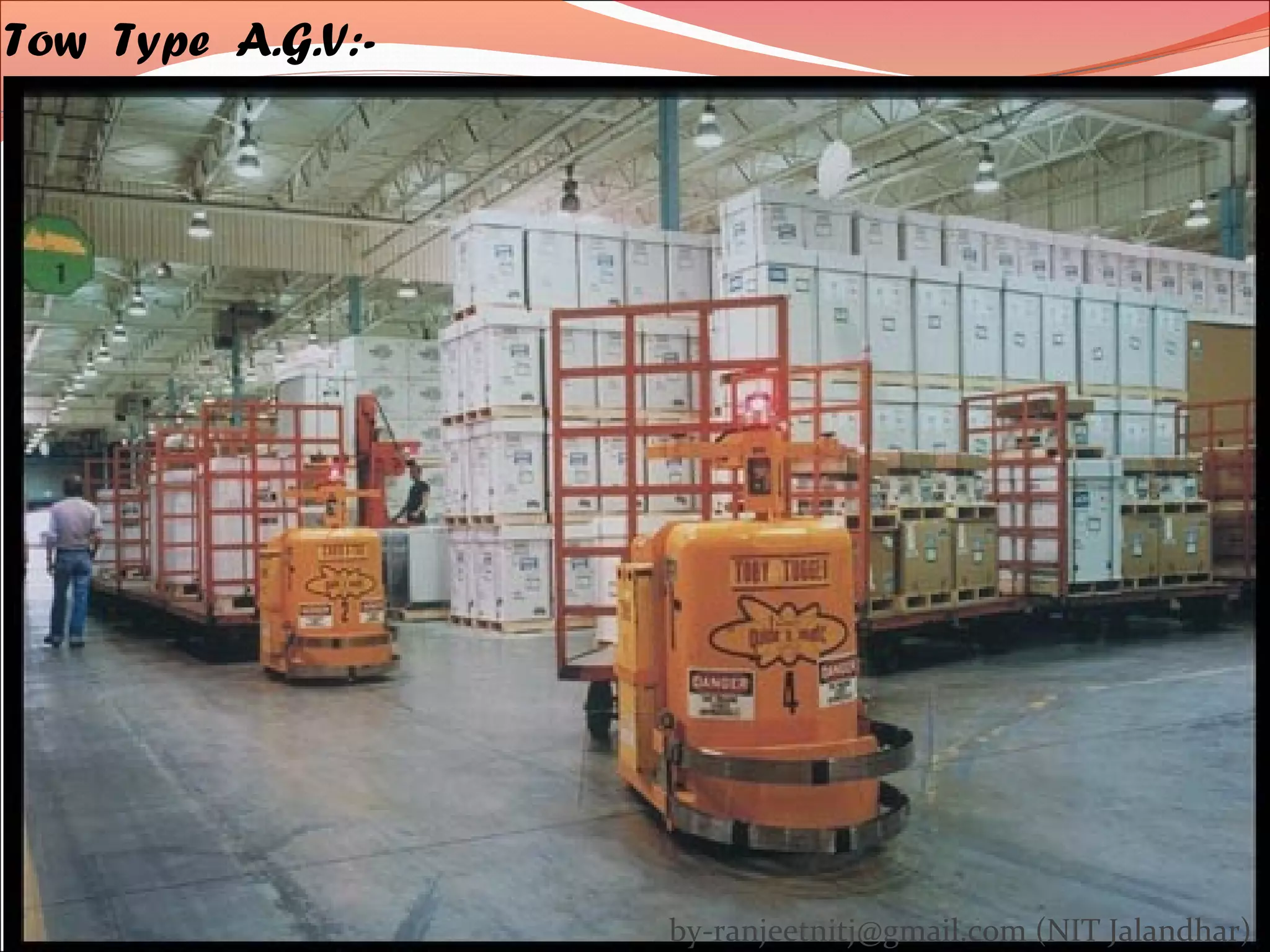
AGVS Towing Vehicles :-it was the first type
introduced and are still a very popular type today.
Towing vehicles can pull a multitude of trailer types
and have capacities ranging from 8,000 pounds to
60,000 pounds and are usually manned by an operator
who adds and removes the trailers at designated stops.
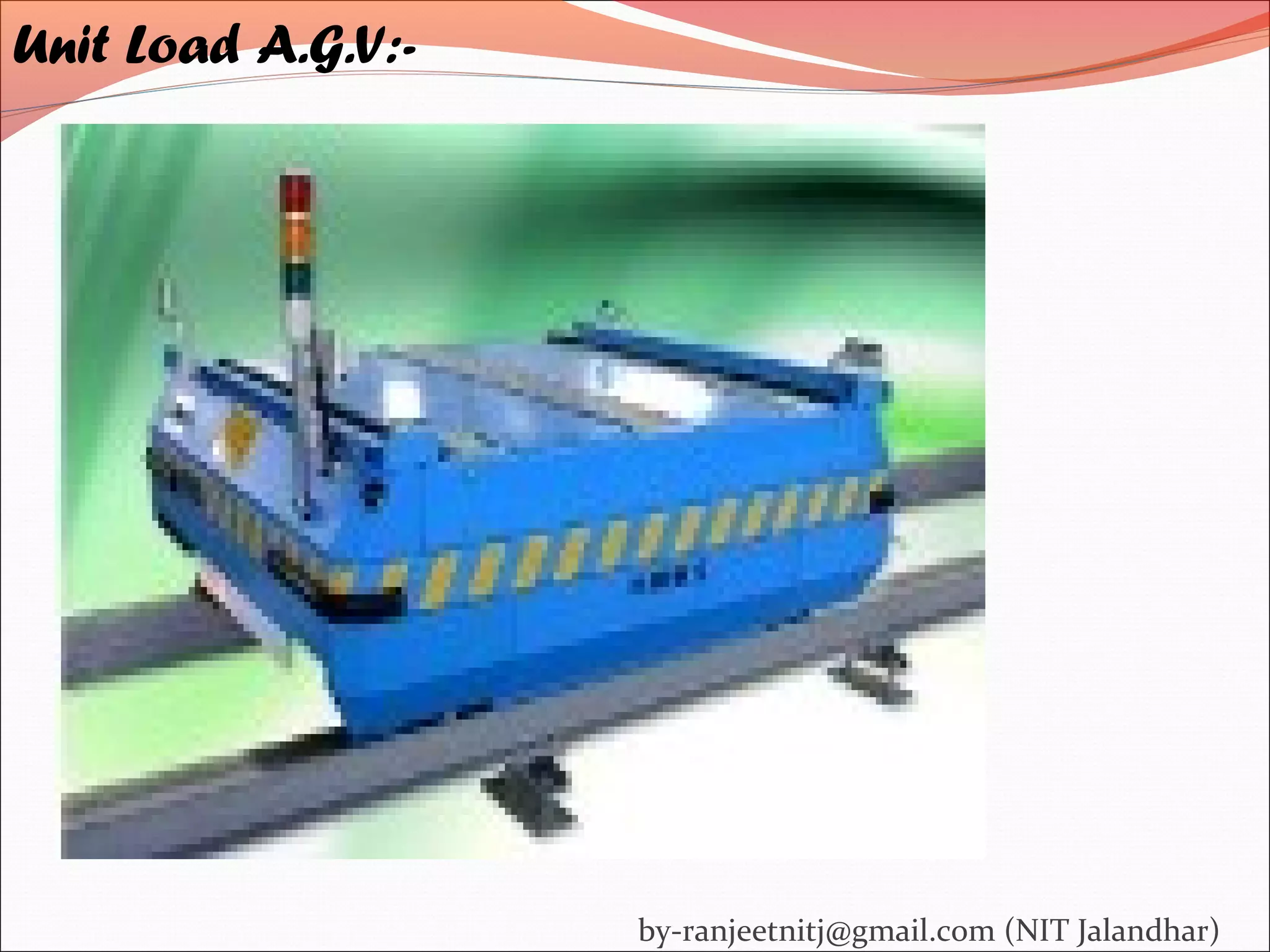
AGVS Unit Load Vehicles :-these are equipped with
decks, which permit unit load transportation and often
automatic load transfer. The decks can either be lift
and lower type, powered of non-powered roller, chain
or belt decks or custom decks.
Tow Type A.G.V:-
by-ranjeetnitj@gmail.com (NIT Jalandhar)
Unit Load A.G.V:-
by-ranjeetnitj@gmail.com (NIT Jalandhar)
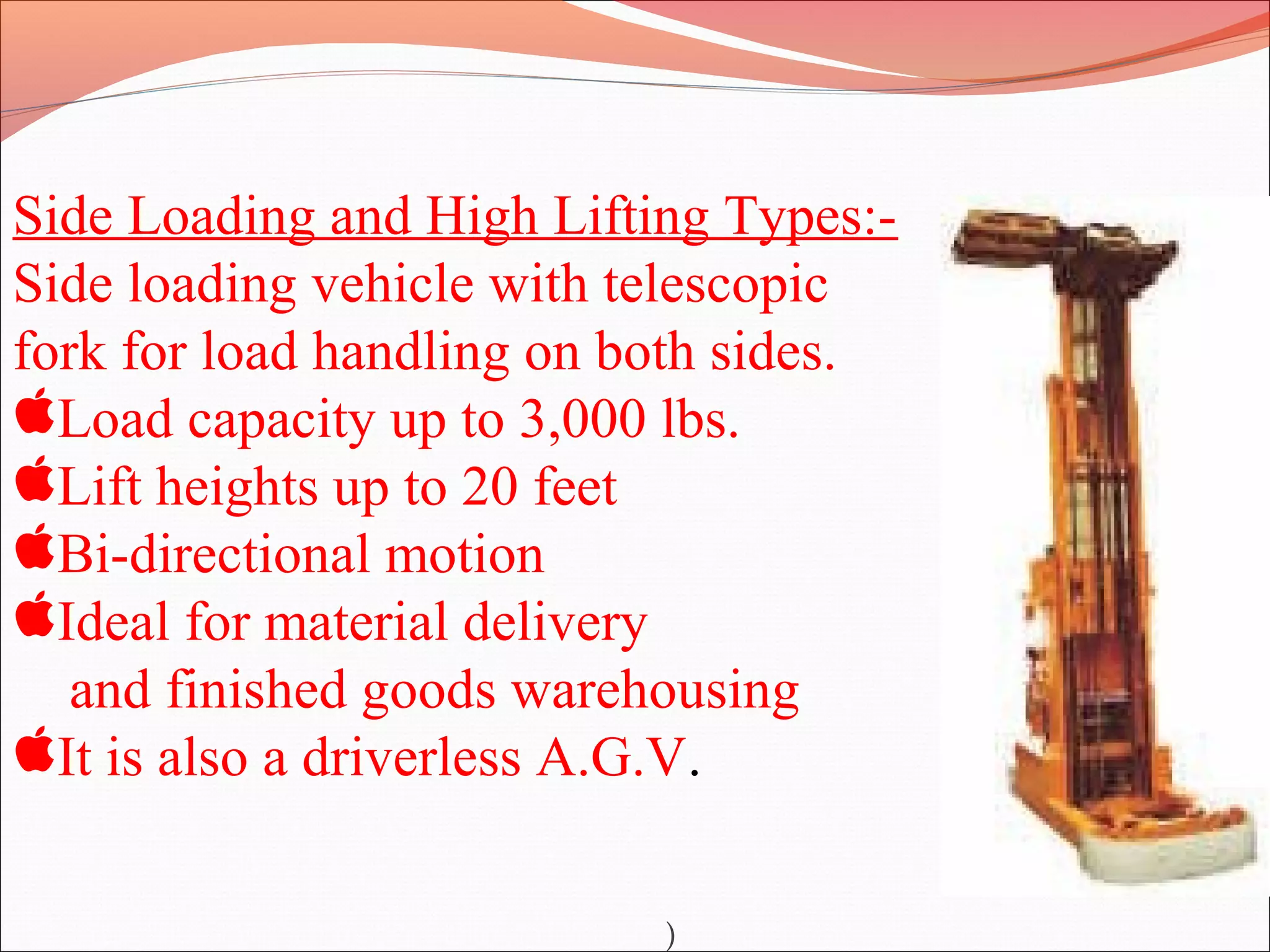
Side Loading and High Lifting Types:-
Side loading vehicle with telescopic
fork for load handling on both sides.
Load capacity up to 3,000 lbs.
Lift heights up to 20 feet
Bi-directional motion
Ideal for material delivery
and finished goods warehousing
It is also a driverless A.G.V.
)
Third and most important part of F.M.S is Computer
Control system:-
3. Computer Control System:-It is used to co-ordinate
the activities of processing station and material
handling System in the F.M.S. The various function
of computer control system are:-
Control of each work station.
 Distribution of control instruction to work station.
Production control.
 Traffic control.
Shuttle control.
Work handling system and monitoring.
System performance monitoring and reporting.
Levels of Flexibility
There are three basic level of manufacturing
flexibility:-
(a) Basic flexibilities
Machine flexibility: The different operation types
that a machine can Perform is called machine
flexibility . More operation performance more flexible
the machine . Process and product flexibility are
dependent on machine flexibility.
Material handling flexibility: A measure of the ease
with which different part types can be transported and
properly positioned at the various machine tools in a
 Operation flexibility: A measure of the ease with
which alternative operation sequences can be used
for processing a part type.
(b) System flexibilities
Volume flexibility: It is the ability of the System to
Varied the production volume of different product to
accommodate changes.
Expansion flexibility: The ability to build a system
and expand it incrementally by volume , production
or processes.
Routing flexibility: A measure of the alternative
paths that a processing part can effectively follow
through a system for a given process plan.
OR
It can be defined as a capacity to produce or make
an alternative work station . This Type of flexibility
requires where there is an equipment break down ,tool
failure or other interruption in the processing.
Process flexibility: A measure of the volume of the
set of part types that a system can produce without
incurring any setup.
Product flexibility: It Refers to ability to change
over to a new set of Product Economically & quickly
Response to the changing market condition &
Requirements. The change over time
)
include the Time of designing ,Planning, Tooling &
Fixing of new product .
(c) Aggregate flexibilities
Program flexibility: The ability of a system to run
for reasonably long periods without external
intervention.
Production flexibility: It is the volume of the set of
part types that a system can produce without major
investment in capital equipment.
Market flexibility: The ability of a system to
efficiently adapt to changing market conditions. It can
be product, process or production type.
-:LAYOUT CONFIGURATION:-
Types of F.M.S Layout Configuration:-
There are five types of F.M.S Layout Configuration:-
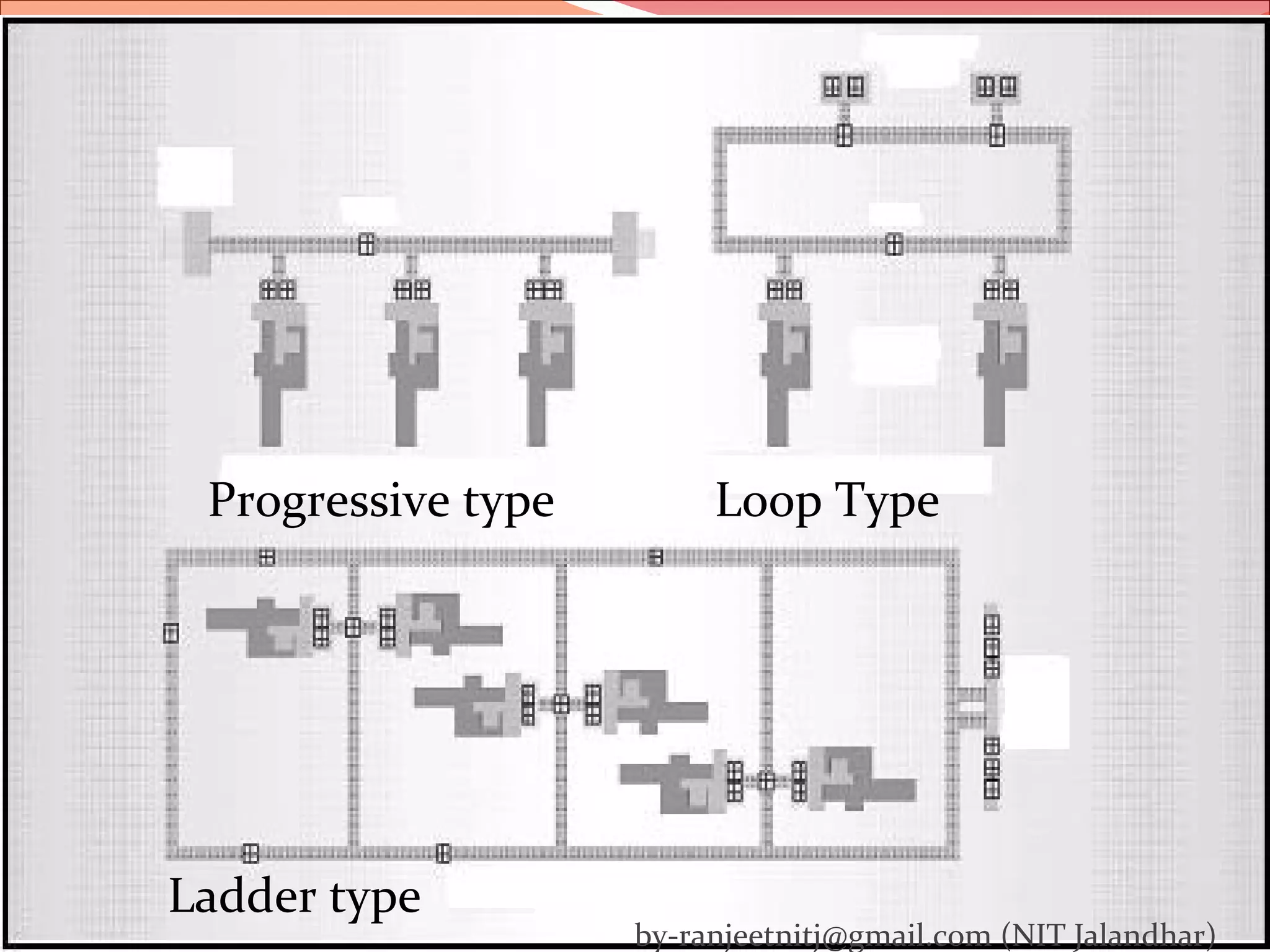
1. Progressive or Line type: The machines and
handling system are arranged in a line as shown in
Fig. It is most appropriate for a system in which the
part progress from one workstation to the next in a
well defined sequence with no back flow. The

operation of this type of system is
very similar to transfer type. Work always flows in
unidirectional path as shown in Fig.
)
2. Loop Type: The basic loop configuration is as
shown in Fig.. The parts usually move in
one direction around the loop, with the capability to
stop and be transferred to any station. The
loading and unloading station are typically located at
one end of the loop Fig.
3. Ladder Type: The configuration is as shown in Fig.
The loading and unloading station
is typically located at the same end. The sequence to
the operation/transfer of parts from one machine
tool to another is in the form of ladder steps as shown
in Fig.
Progressive type Loop Type
Ladder type
by-ranjeetnitj@gmail.com (NIT Jalandhar)
4. Open Field Type: In the open field type, The
loading and unloading station is typically located at
the same end. The parts will go through all the
substations, such as CNC machines, coordinate
measuring machines and wash station by the help of
AGV’s from one substation to another.
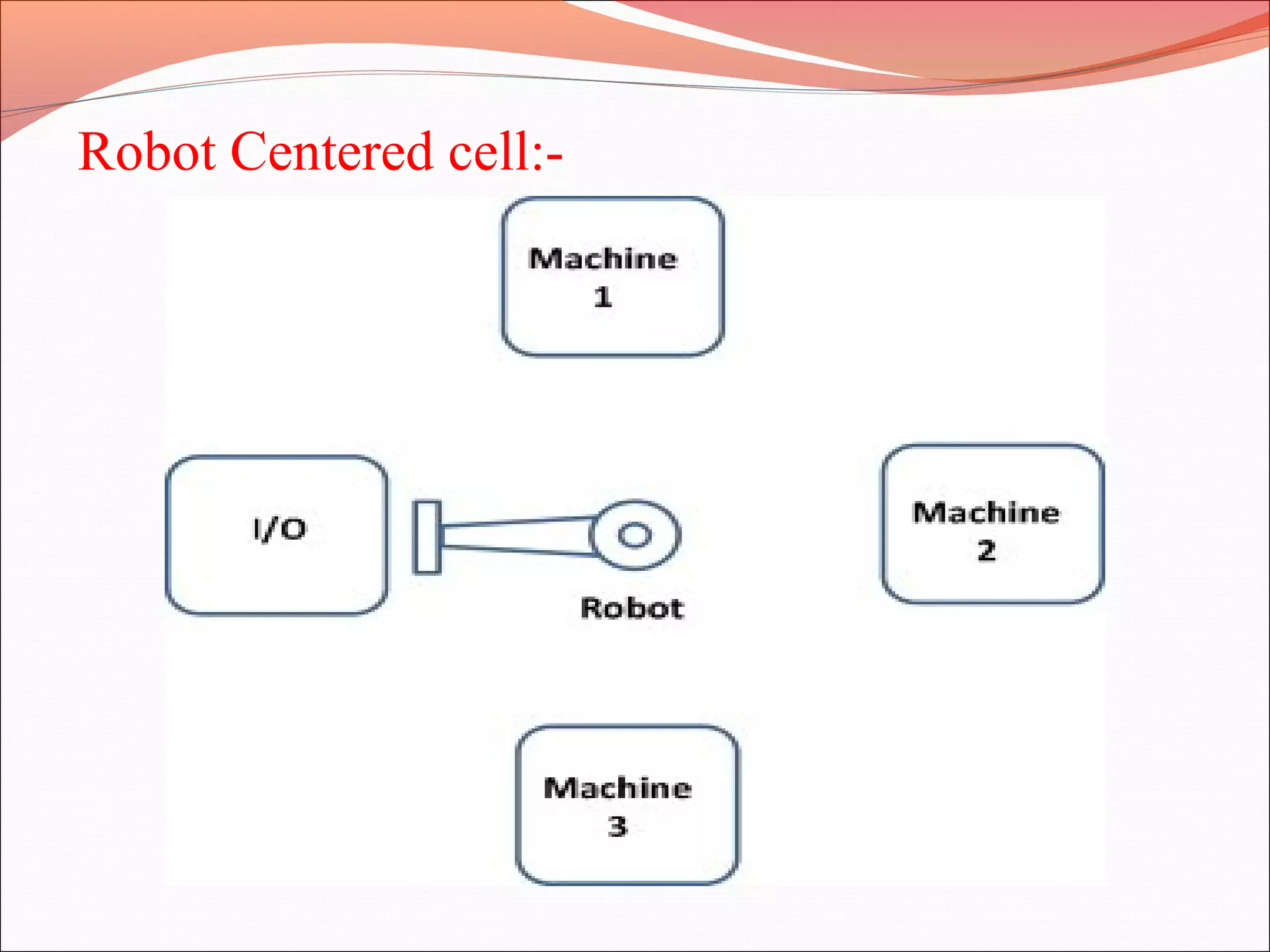
5.Robot Centered Type: Robot centred cell is a
relatively new form of flexible system in which
one or more robots are used as the material handling
systems .Industrial robots can be equipped with
grippers that make them well suited for handling of
rotational parts.
Robot Centered cell:-
Objectives or AIMS of F.M.S:-
Decreased Lead TimesDecreased Lead Times
Increased machine utilizationIncreased machine utilization
Improved Due Date ReliabilityImproved Due Date Reliability
Decreased Store Inventors levelsDecreased Store Inventors levels
Remove Labour CostRemove Labour Cost
Decreased Work in ProgressDecreased Work in Progress
Increased QualityIncreased Quality
Flexiblemanufacturingsystemss

Flexiblemanufacturingsystemss

  • 1.
  • 2.
    Content:-  Introduction  Componentof F.M.S Processing Station Material Handling Computer Control  Levels of Flexibility  Types of F.M.S Layout  Objectives of F.M.S )
  • 3.
    What is F.M.S? -A flexible Manufacturing System (F.M.S) is an arrangement of machines ,interconnected by a transport system . The transport carries work to the machine on pallets or other interface units so the work-machine registration on is accurate , rapid and automatic. OR -F.M.S consist of a group of Processing work Stations interconnected by means of an automated material handling and storage system and controlled by integrated Computer Control .
  • 4.
    In manufacturing flexibilitymeans- The Capability of Producing Different parts without major retooling. A measure of of how fast the company converts its process(es) From making an old line of product to produce a new product. The ability to change a production schedule ,to modify a part or to handle multiple parts. So a flexible manufacturing system is a manufacturing system in which there is some amount of flexibility that allows the system to react in the case of changes whether predicted or unpredicted. )
  • 5.
    Basic component ofF.M.S- Work stations or Processing Stations Automated material handling Computer control system Work station or processing station:-In Present day, Work station are typically computer numerical control(C.N.C) Machine tool that performs different machining operation on families of parts .Flexible manufacturing system are being designed with other type of processing equipment including inspection station , assembly work and sheet metal process. The various types of workstation are:-
  • 6.
     Machining Center:-Itis a Sophisticated CNC machine that performs milling ,drilling, tapping and boring operation at the same location with variety of tools. or It is highly automated straight alone machine which can be used as a component of F.M.S. The special feature like automated tool changing , tool storage ,use of pallatised work parts ,C.N.C contol makes it more compatible with F.M.S & Milling, drilling, boring and tapping operation can achieve with this.
  • 7.
  • 8.
     Head Changer:-Headchanger is a special machine tool with the capability of change Tool heads . Tool heads are usually multiple spindle tool module that can be stored in a Rake Drum located on or near the machine.  Head Indexes:-In this heads are attach semi permanently to an Indexing mechanism on the machine tools.eg-Gear Cutting.
  • 9.
  • 10.
     Assembly WorkStation :-Industrial Robots are usually consider to be the most appropriate automated assembly work station in the F.M.S ,they can be programmed to perform task with variation in sequences.  Inspection Station:-Inspection Station are designed for inspecting the completed work , In F.M.S inspection can be happen either at work station or by designing Special Inspection Station for this purpose
  • 11.
    Industrial Robots assemblingthe Car:- by-ranjeetnitj@gmail.com (NIT Jalandhar)
  • 12.
    Load and UnloadStation:-as identifies from the name load and unload station are used for loading and unloading of work parts in the F.M.S. The various Feature of Load and Unload stations are:- -It act as a physical interface between the F.M.S and rest of the Factory. -Raw work parts enter the system at load station, while finished work parts exit at unload station -Manual loading/unloading is more prevalent
  • 13.
    2. Automated MaterialHandling & Storage System:- The various Automated material handling system are used to transport work parts and subassembly parts between the processing station .The other function of automatic material handling and storage system are:-  Random and Independent movement of work parts between processing stations.  Handling of variety of work part configuration  Temporary storage  Convenient access for Loading and unloading station.
  • 14.
    For automated materialhandling and storage of work parts is done by A.G.V(Automated Guided Vehicles),A.S.R.S & Conveyors . we are describing A.G.V Below:- Automated Guided Vehicle:-Automated Guided Vehicles (AGVs) are vehicles that are equipped with automatic guidance systems and are capable of following prescribed paths. Unlike traditional robots, AGVs are not manipulators, they are driverless vehicles that are programmed to follow a guide path. In automated factories and facilities AGV’s move pallets and containers. In offices they may be used to deliver and pick up the mail.
  • 15.
    Features of A.G.V:- Ittransport material from loading to unloading station. It Reduces labor cost. Highly flexible ,intelligent and versatile material handling system. Because it is driverless vehicle so it is safe & more accurate.
  • 16.
    Types Of A.G.V:-Thereare many types of A.G.V but 3 are basic types describe below:- AGVS Towing Vehicles :-it was the first type introduced and are still a very popular type today. Towing vehicles can pull a multitude of trailer types and have capacities ranging from 8,000 pounds to 60,000 pounds and are usually manned by an operator who adds and removes the trailers at designated stops. AGVS Unit Load Vehicles :-these are equipped with decks, which permit unit load transportation and often automatic load transfer. The decks can either be lift and lower type, powered of non-powered roller, chain or belt decks or custom decks.
  • 17.
  • 18.
  • 19.
    Side Loading andHigh Lifting Types:- Side loading vehicle with telescopic fork for load handling on both sides. Load capacity up to 3,000 lbs. Lift heights up to 20 feet Bi-directional motion Ideal for material delivery and finished goods warehousing It is also a driverless A.G.V. )
  • 20.
    Third and mostimportant part of F.M.S is Computer Control system:- 3. Computer Control System:-It is used to co-ordinate the activities of processing station and material handling System in the F.M.S. The various function of computer control system are:- Control of each work station.  Distribution of control instruction to work station. Production control.  Traffic control. Shuttle control. Work handling system and monitoring. System performance monitoring and reporting.
  • 21.
    Levels of Flexibility Thereare three basic level of manufacturing flexibility:- (a) Basic flexibilities Machine flexibility: The different operation types that a machine can Perform is called machine flexibility . More operation performance more flexible the machine . Process and product flexibility are dependent on machine flexibility. Material handling flexibility: A measure of the ease with which different part types can be transported and properly positioned at the various machine tools in a
  • 22.
     Operation flexibility:A measure of the ease with which alternative operation sequences can be used for processing a part type.
  • 23.
    (b) System flexibilities Volumeflexibility: It is the ability of the System to Varied the production volume of different product to accommodate changes. Expansion flexibility: The ability to build a system and expand it incrementally by volume , production or processes. Routing flexibility: A measure of the alternative paths that a processing part can effectively follow through a system for a given process plan. OR
  • 24.
    It can bedefined as a capacity to produce or make an alternative work station . This Type of flexibility requires where there is an equipment break down ,tool failure or other interruption in the processing. Process flexibility: A measure of the volume of the set of part types that a system can produce without incurring any setup. Product flexibility: It Refers to ability to change over to a new set of Product Economically & quickly Response to the changing market condition & Requirements. The change over time )
  • 25.
    include the Timeof designing ,Planning, Tooling & Fixing of new product . (c) Aggregate flexibilities Program flexibility: The ability of a system to run for reasonably long periods without external intervention. Production flexibility: It is the volume of the set of part types that a system can produce without major investment in capital equipment. Market flexibility: The ability of a system to efficiently adapt to changing market conditions. It can be product, process or production type.
  • 26.
    -:LAYOUT CONFIGURATION:- Types ofF.M.S Layout Configuration:- There are five types of F.M.S Layout Configuration:- 1. Progressive or Line type: The machines and handling system are arranged in a line as shown in Fig. It is most appropriate for a system in which the part progress from one workstation to the next in a well defined sequence with no back flow. The operation of this type of system is very similar to transfer type. Work always flows in unidirectional path as shown in Fig. )
  • 27.
    2. Loop Type:The basic loop configuration is as shown in Fig.. The parts usually move in one direction around the loop, with the capability to stop and be transferred to any station. The loading and unloading station are typically located at one end of the loop Fig.
  • 28.
    3. Ladder Type:The configuration is as shown in Fig. The loading and unloading station is typically located at the same end. The sequence to the operation/transfer of parts from one machine tool to another is in the form of ladder steps as shown in Fig.
  • 29.
    Progressive type LoopType Ladder type by-ranjeetnitj@gmail.com (NIT Jalandhar)
  • 30.
    4. Open FieldType: In the open field type, The loading and unloading station is typically located at the same end. The parts will go through all the substations, such as CNC machines, coordinate measuring machines and wash station by the help of AGV’s from one substation to another. 5.Robot Centered Type: Robot centred cell is a relatively new form of flexible system in which one or more robots are used as the material handling systems .Industrial robots can be equipped with grippers that make them well suited for handling of rotational parts.
  • 32.
  • 33.
    Objectives or AIMSof F.M.S:- Decreased Lead TimesDecreased Lead Times Increased machine utilizationIncreased machine utilization Improved Due Date ReliabilityImproved Due Date Reliability Decreased Store Inventors levelsDecreased Store Inventors levels Remove Labour CostRemove Labour Cost Decreased Work in ProgressDecreased Work in Progress Increased QualityIncreased Quality