ALLELOPATHY AND ITS APPLICATION
AS A WEED MANAGEMENT TOOL
OUTLINE
1.OVERVIEW
2.INTRODUCTION
3.ALLELOPATHY
4.ALLELOPATHY AND ALLELOCHEMICALS
5.PLANT WITH ALLELOPATHIC POTENTIAL
FOR WEED CONTROL
6.ADVANTAGES AND DISADVANTAGES
7.LIMITATIONS AND FUTURE PROSPECTIVE
8.CONCLUSION
Weeds are a serious threat to crop production as they
interfere with the crop growth and development and result
in significant crop losses. Weeds actually cause yield loss
higher than any other pest in crop production. As a result,
synthetic herbicides have been widely used for weed
management. Heavy usage of synthetic herbicides,
however, has resulted in public concerns over the impact of
herbicides on human health and the environment. Due to
various environmental and health issues associated with
synthetic herbicides, researchers have been exploring
alternative environmentally friendly means of controlling
weed.
OVERVIEW
INTRODUCTION
Weeds are one of the most challenging problems
facing agricultural production all over the world.
Weeds compete for light, nutrients, water, and
space that reduces crop growth and yield.
Additionally, weeds also harbor insect pests,
bacterial, fungal, and viral pathogens, further
reducing the crop yield.
ALLELOPATHY
DEFINITIO
N
GREEK WORDS
Allelon which means “of each
other”
Pathos which means “to suffer”
“ALLELOPATHY REFERS CHEMICALS
RELEASED INTO THE ENVIRONMENT
WHERE IT AFFECTS THE
DEVELOPMENT AND GROWTH OF
NEIGBORING PLANTS”
ALLELOPATHY AND ALLELOCHEMICALS
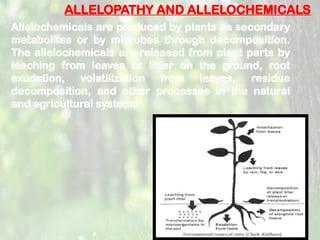
Allelochemicals are produced by plants as secondary
metabolites or by microbes through decomposition.
The allelochemicals are released from plant parts by
leaching from leaves or litter on the ground, root
exudation, volatilization from leaves, residue
decomposition, and other processes in the natural
and agricultural systems
Plants with allelopathic potential
for weed control
Black walnut (Juglans nigra L.)
The allelopathic agent present in black walnut is a
phenolic compound called juglone (5-hydroxy-1,4-
napthoquinone). Juglone inhibited the growth of
strawberry plants and had a negative impact on plant
nutrient uptake.
INHIBITS
black walnut strawberry
INHIBITS
Eucalyptus (Eucalyptus spp.)
Phenolic acids and volatile terpenes are the
allelochemicals present in the leaves, bark, and
roots of Eucalyptus spp. Eucalyptus essential oils
reduced the germination of Common amaranth
(Amaranthus retroflexus L.)
Eucalyptus spp.
Amaranthus retroflexus L
Application of allelopathy in
agriculture
Intercropping
Intercropping is the practice of growing different
crops together at the same time in the same field.
Intercropping cowpea with maize has shown to
reduce the growth of jungle rice.
Intercropping cowpea with maize
Crop rotation
Crop rotation is a method of growing different
crops in a systematic and sequential way in the
same field over a growing season. The growth of
barnyardgrass in soil after the harvest of an
allelopathic rice cultivar PI312777 was suppressed
compared to the soil of a non-allelopathic rice
cultivar.
Cover crops
The integration of cover crops is rising in
many agriculture practices as it reduces the
use of herbicide and acts as an alternative to
tillage for controlling weeds. The use of
sorghum as a cover crop for suppression of
broadleaf weeds.
sorghum as a cover crop
Mulchin
g
Mulching is a process of adding any material
to the surface of soil to reduce weed growth,
improve soil moisture, and reduce surface
runoff. In field studies, many crop residues
used as mulch have been shown to suppress
weeds via allelopathy. Sorghum mulch has
been shown to decrease purple nutsedge
growth.
Mulching
SOME OF THE ADVANTAGES AND
DISADVANTAGES OF ALLELOPATHY
ADVANTAGES:
1) Natural weed control
2) Reduces use of chemical pesticides
3) Enhances soil fertility
DISADVANTAGES:
1) Autotoxicity
2) Soil sickness
3) Can harm beneficial plants
Firstly many allelochemicals are very expensive to isolate
and synthesize, regardless of having excellent herbicidal
properties. One example is the cyclic tetrapeptide tentoxin, a
good herbicide, but is very expensive to synthesize.
Secondly, there is a misconception in the public that
everything in nature is probably healthy.
Limitations and future prospective
Regardless of many challenges in implementing the
allelopathy concept for weed management, there is
immense opportunity for exploring allelopathy as a
new tool for weed management. Research lacks on the
safety of using the known extracted allelochemicals
on various crops. Future research needs to focus on
the mechanisms of allelochemical selectivity, their
modes of action, their interaction with different
species, and ways to implement them.
The concept of allelopathy can be employed in
the organic management of weeds and reduce
our heavy reliance on synthetic herbicides.
Although practices, such as intercropping, crop
rotation, cover crops and mulching have been
used conventionally for various benefits,
integration of allelopathic crops would enhance
its weed suppression benefit.
Currently it is difficult to replace chemical weed
management entirely, but an integrated weed
management approach may lead to success.
Conclusion
REFERENCES
Adekalu, K., Olorunfemi, I., Osunbitan, J. (2007). Grass
mulching effect on infiltration, surface runoff and soil loss
of three agricultural soils in Nigeria. Bioresource
Technol. 98 (4), 912–917.
doi: 10.1016/j.biortech.2006.02.044
Albouchi, F., Hassen, I., Casabianca, H., Hosni, K.
(2013). Phytochemicals, antioxidant, antimicrobial and
phytotoxic activities of Ailanthus altissima (Mill.)
swingle leaves. South Afr. J. Bot. 87, 164–174.
doi: 10.1016/j.sajb.2013.04.003
Anaya, A. L. (1999). Allelopathy as a tool in the
management of biotic resources in
agroecosystems. Crit. Rev. Plant Sci. 18(6), 697–739.
doi: 10.1080/07352689991309450
THANK YOU

allelopathy aaaaaaaaaaaaaaaaaaaaaaa.pptx

  • 1.
    ALLELOPATHY AND ITSAPPLICATION AS A WEED MANAGEMENT TOOL
  • 2.
    OUTLINE 1.OVERVIEW 2.INTRODUCTION 3.ALLELOPATHY 4.ALLELOPATHY AND ALLELOCHEMICALS 5.PLANTWITH ALLELOPATHIC POTENTIAL FOR WEED CONTROL 6.ADVANTAGES AND DISADVANTAGES 7.LIMITATIONS AND FUTURE PROSPECTIVE 8.CONCLUSION
  • 3.
    Weeds are aserious threat to crop production as they interfere with the crop growth and development and result in significant crop losses. Weeds actually cause yield loss higher than any other pest in crop production. As a result, synthetic herbicides have been widely used for weed management. Heavy usage of synthetic herbicides, however, has resulted in public concerns over the impact of herbicides on human health and the environment. Due to various environmental and health issues associated with synthetic herbicides, researchers have been exploring alternative environmentally friendly means of controlling weed. OVERVIEW
  • 4.
    INTRODUCTION Weeds are oneof the most challenging problems facing agricultural production all over the world. Weeds compete for light, nutrients, water, and space that reduces crop growth and yield. Additionally, weeds also harbor insect pests, bacterial, fungal, and viral pathogens, further reducing the crop yield.
  • 5.
    ALLELOPATHY DEFINITIO N GREEK WORDS Allelon whichmeans “of each other” Pathos which means “to suffer” “ALLELOPATHY REFERS CHEMICALS RELEASED INTO THE ENVIRONMENT WHERE IT AFFECTS THE DEVELOPMENT AND GROWTH OF NEIGBORING PLANTS”
  • 6.
    ALLELOPATHY AND ALLELOCHEMICALS Allelochemicalsare produced by plants as secondary metabolites or by microbes through decomposition. The allelochemicals are released from plant parts by leaching from leaves or litter on the ground, root exudation, volatilization from leaves, residue decomposition, and other processes in the natural and agricultural systems
  • 7.
    Plants with allelopathicpotential for weed control Black walnut (Juglans nigra L.) The allelopathic agent present in black walnut is a phenolic compound called juglone (5-hydroxy-1,4- napthoquinone). Juglone inhibited the growth of strawberry plants and had a negative impact on plant nutrient uptake. INHIBITS black walnut strawberry
  • 8.
    INHIBITS Eucalyptus (Eucalyptus spp.) Phenolicacids and volatile terpenes are the allelochemicals present in the leaves, bark, and roots of Eucalyptus spp. Eucalyptus essential oils reduced the germination of Common amaranth (Amaranthus retroflexus L.) Eucalyptus spp. Amaranthus retroflexus L
  • 9.
    Application of allelopathyin agriculture Intercropping Intercropping is the practice of growing different crops together at the same time in the same field. Intercropping cowpea with maize has shown to reduce the growth of jungle rice. Intercropping cowpea with maize
  • 10.
    Crop rotation Crop rotationis a method of growing different crops in a systematic and sequential way in the same field over a growing season. The growth of barnyardgrass in soil after the harvest of an allelopathic rice cultivar PI312777 was suppressed compared to the soil of a non-allelopathic rice cultivar.
  • 11.
    Cover crops The integrationof cover crops is rising in many agriculture practices as it reduces the use of herbicide and acts as an alternative to tillage for controlling weeds. The use of sorghum as a cover crop for suppression of broadleaf weeds. sorghum as a cover crop
  • 12.
    Mulchin g Mulching is aprocess of adding any material to the surface of soil to reduce weed growth, improve soil moisture, and reduce surface runoff. In field studies, many crop residues used as mulch have been shown to suppress weeds via allelopathy. Sorghum mulch has been shown to decrease purple nutsedge growth. Mulching
  • 13.
    SOME OF THEADVANTAGES AND DISADVANTAGES OF ALLELOPATHY ADVANTAGES: 1) Natural weed control 2) Reduces use of chemical pesticides 3) Enhances soil fertility DISADVANTAGES: 1) Autotoxicity 2) Soil sickness 3) Can harm beneficial plants
  • 14.
    Firstly many allelochemicalsare very expensive to isolate and synthesize, regardless of having excellent herbicidal properties. One example is the cyclic tetrapeptide tentoxin, a good herbicide, but is very expensive to synthesize. Secondly, there is a misconception in the public that everything in nature is probably healthy. Limitations and future prospective Regardless of many challenges in implementing the allelopathy concept for weed management, there is immense opportunity for exploring allelopathy as a new tool for weed management. Research lacks on the safety of using the known extracted allelochemicals on various crops. Future research needs to focus on the mechanisms of allelochemical selectivity, their modes of action, their interaction with different species, and ways to implement them.
  • 15.
    The concept ofallelopathy can be employed in the organic management of weeds and reduce our heavy reliance on synthetic herbicides. Although practices, such as intercropping, crop rotation, cover crops and mulching have been used conventionally for various benefits, integration of allelopathic crops would enhance its weed suppression benefit. Currently it is difficult to replace chemical weed management entirely, but an integrated weed management approach may lead to success. Conclusion
  • 16.
    REFERENCES Adekalu, K., Olorunfemi,I., Osunbitan, J. (2007). Grass mulching effect on infiltration, surface runoff and soil loss of three agricultural soils in Nigeria. Bioresource Technol. 98 (4), 912–917. doi: 10.1016/j.biortech.2006.02.044 Albouchi, F., Hassen, I., Casabianca, H., Hosni, K. (2013). Phytochemicals, antioxidant, antimicrobial and phytotoxic activities of Ailanthus altissima (Mill.) swingle leaves. South Afr. J. Bot. 87, 164–174. doi: 10.1016/j.sajb.2013.04.003 Anaya, A. L. (1999). Allelopathy as a tool in the management of biotic resources in agroecosystems. Crit. Rev. Plant Sci. 18(6), 697–739. doi: 10.1080/07352689991309450
  • 17.