Flexible Manufacturing Systems (FMS)
• A Flexible Manufacturing System (FMS) is a
production system consisting of a set of identical
and/or complementary numerically controlled
machine which are connected through an
automated transportation system.
• Each process in FMS is controlled by a dedicated
computer (FMS cell computer).
Flexible Automation
•Ability to adapt to engineering changes in parts
•Increase in number of similar parts produced on the
system
•Ability to accommodate routing changes
•Ability to rapidly change production set up
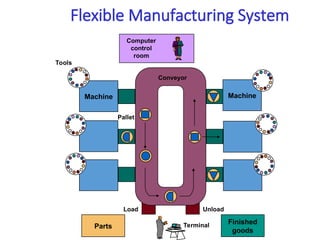
Flexible Manufacturing System
Parts
Finished
goods
Load Unload
Computer
control
room
Terminal
Machine Machine
Tools
Conveyor
Pallet
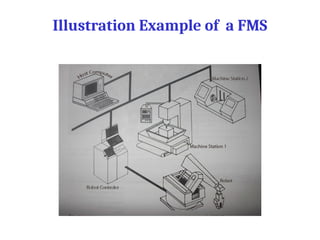
Illustration Example of a FMS
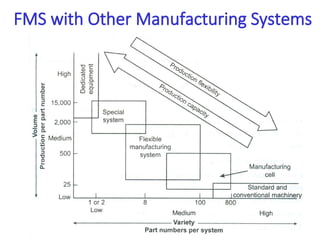
FMS with Other Manufacturing Systems
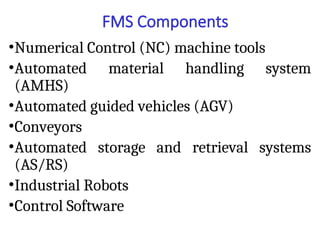
FMS Components
•Numerical Control (NC) machine tools
•Automated material handling system
(AMHS)
•Automated guided vehicles (AGV)
•Conveyors
•Automated storage and retrieval systems
(AS/RS)
•Industrial Robots
•Control Software
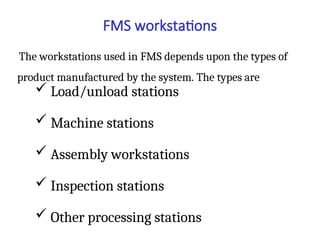
FMS workstations
The workstations used in FMS depends upon the types of
product manufactured by the system. The types are
 Load/unload stations
 Machine stations
 Assembly workstations
 Inspection stations
 Other processing stations
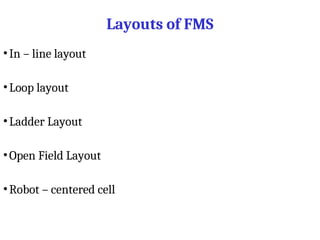
Layouts of FMS
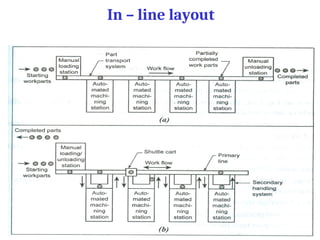
•In – line layout
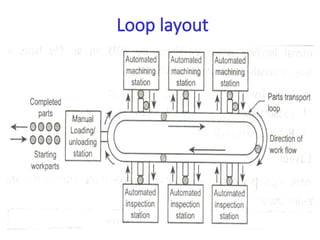
•Loop layout
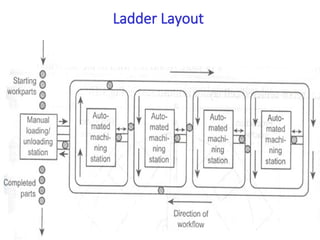
•Ladder Layout
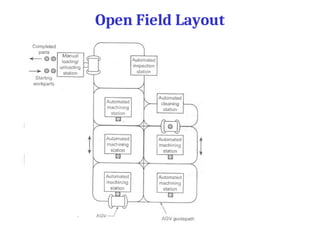
•Open Field Layout
•Robot – centered cell
In – line layout
Loop layout
Ladder Layout
Open Field Layout
Robot – centered cell
Material Handling
It is defined as the functions and systems associated with the
transportation, storage and physical control to work-in-process material
in manufacturing.
Functions of Material Handling System
• Random, independent movement of work parts between
stations.
• Handle a variety of work part configurations
• Temporary storage
• Convenient access for loading and unloading work parts
• Compatible with computer control
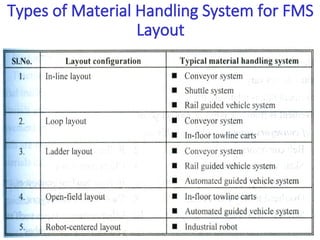
Types of Material Handling System for FMS
Layout
Types of Material Handling Equipment
•Conveyors
•Cranes and Hoists
•Industrial Trucks
•Monorails and RGV
•AGVs
•Industrial Robots
Computer Control System
This is used to control the automated and semi-
automated equipment and to participate in the overall
coordination and management of the manufacturing
systems.
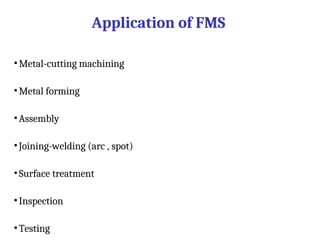
Application of FMS
•Metal-cutting machining
•Metal forming
•Assembly
•Joining-welding (arc , spot)
•Surface treatment
•Inspection
•Testing
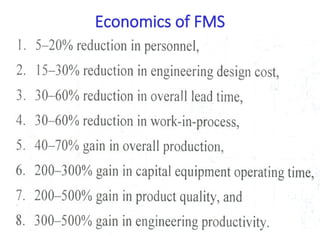
Economics of FMS
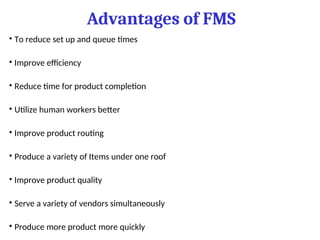
Advantages of FMS
• To reduce set up and queue times
• Improve efficiency
• Reduce time for product completion
• Utilize human workers better
• Improve product routing
• Produce a variety of Items under one roof
• Improve product quality
• Serve a variety of vendors simultaneously
• Produce more product more quickly

Flexible Manufacturing system in computer Integrated Manufacturing

  • 1.
    Flexible Manufacturing Systems(FMS) • A Flexible Manufacturing System (FMS) is a production system consisting of a set of identical and/or complementary numerically controlled machine which are connected through an automated transportation system. • Each process in FMS is controlled by a dedicated computer (FMS cell computer).
  • 2.
    Flexible Automation •Ability toadapt to engineering changes in parts •Increase in number of similar parts produced on the system •Ability to accommodate routing changes •Ability to rapidly change production set up
  • 3.
    Flexible Manufacturing System Parts Finished goods LoadUnload Computer control room Terminal Machine Machine Tools Conveyor Pallet
  • 4.
  • 5.
    FMS with OtherManufacturing Systems
  • 6.
    FMS Components •Numerical Control(NC) machine tools •Automated material handling system (AMHS) •Automated guided vehicles (AGV) •Conveyors •Automated storage and retrieval systems (AS/RS) •Industrial Robots •Control Software
  • 7.
    FMS workstations The workstationsused in FMS depends upon the types of product manufactured by the system. The types are  Load/unload stations  Machine stations  Assembly workstations  Inspection stations  Other processing stations
  • 8.
    Layouts of FMS •In– line layout •Loop layout •Ladder Layout •Open Field Layout •Robot – centered cell
  • 9.
  • 10.
  • 11.
  • 12.
  • 13.
  • 14.
    Material Handling It isdefined as the functions and systems associated with the transportation, storage and physical control to work-in-process material in manufacturing.
  • 15.
    Functions of MaterialHandling System • Random, independent movement of work parts between stations. • Handle a variety of work part configurations • Temporary storage • Convenient access for loading and unloading work parts • Compatible with computer control
  • 16.
    Types of MaterialHandling System for FMS Layout
  • 17.
    Types of MaterialHandling Equipment •Conveyors •Cranes and Hoists •Industrial Trucks •Monorails and RGV •AGVs •Industrial Robots
  • 18.
    Computer Control System Thisis used to control the automated and semi- automated equipment and to participate in the overall coordination and management of the manufacturing systems.
  • 19.
    Application of FMS •Metal-cuttingmachining •Metal forming •Assembly •Joining-welding (arc , spot) •Surface treatment •Inspection •Testing
  • 20.
  • 21.
    Advantages of FMS •To reduce set up and queue times • Improve efficiency • Reduce time for product completion • Utilize human workers better • Improve product routing • Produce a variety of Items under one roof • Improve product quality • Serve a variety of vendors simultaneously • Produce more product more quickly