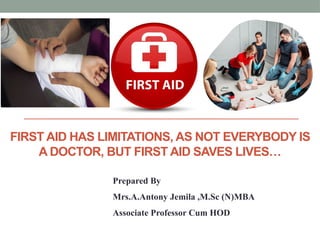
FIRST AID HASLIMITATIONS, AS NOT EVERYBODY IS
A DOCTOR, BUT FIRST AID SAVES LIVES…
Prepared By
Mrs.A.Antony Jemila ,M.Sc (N)MBA
Associate Professor Cum HOD
2.
DEFINITION
First aid isthe first assistance or treatment given
to a casualty or a sick person for any injury or sudden
illness before the arrival of an ambulance, the arrival
of a qualified paramedical or medical person or before
arriving at a facility that can provide professional
medical care.
3.
SYMBOL FOR FIRSTAID
The International Organization for
Standardization (ISO) specified symbol for First Aid is a
symmetrical white cross on a green background.
4.
AIMS OF FIRSTAID
The primary purpose of giving First Aid is to sustain the life of a
person before the arrival of a qualified medical expert, reduce her/his
discomfort due to pain
The aims of first aid are:
• To preserve life,
• To prevent the worsening of one’s medical condition,
• To promote recovery,
• To ensure safe transportation to the nearest healthcare facility.
5.
PRINCIPLES OF FIRSTAID
The basic principles of First Aid are as follows:
• (i) Preserve life: This includes preserving the life of the
casualty and the rescuer.
• (ii) Ensure protection of the casualty from further harm:
• The treatment area needs to be safe and must not have
excess people.
• (iii) Provide pain relief: This includes the use of ice packs
or applying a sling.
• (iv) Prevent the condition from worsening: Ensure that
the First Aid procedures do not worsen the patient’s
condition
6.
Rules of FirstAid
• Check: Find out what has happened and what is wrong with
the person. Comfort the person and arrange for a shelter.
• Call: Arrange for a professional medical aid.
• Care: Help the victim, preferably without moving her/him
• Look: Make a thorough visual inspection of the damage-
affected area
• Listen to all sources of information - the community,
government records, and media reports
• Understand the gravity of the dangers and the suffering of
victims as well as the capacity to respond.
7.
GOLDEN RULES OFFIRST AID
• Do the first thing first
• Remove the victim from the cause of injury or the cause of injury
from the victim.
• Resuscitate the victim
• Loosen all tight clothing or materials around the victim’s neck
waist, wrist, etc.
• Arrest bleeding, cover all wounds, burns or scalds and immobilize
all fractures.
• Do not allow people to crowd a victim and do not move a victim
unless you really have to (dangerous environment, risk of falling
debris, explosion etc)
• Reassure the victim and get help as soon as possible
• Improvise all necessary materials, which are not readily available.
• Guide against or treat for shock
• Dispose/transport the victim properly
8.
The scope offirst aid
• Is to apply a consistent set of standards, and treatment, in
a logical order.
• Victim assessment by a first aider is to identify injuries,
treat, and transport victims.
9.
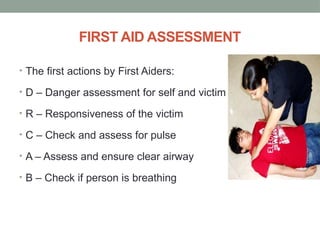
FIRST AID ASSESSMENT
•The first actions by First Aiders:
• D – Danger assessment for self and victim
• R – Responsiveness of the victim
• C – Check and assess for pulse
• A – Assess and ensure clear airway
• B – Check if person is breathing
10.
• Agonal gaspsare common in the first few minutes of a cardiac
arrest (present in up to 40% of victims) and are associated with
higher survival, if recognized as a sign of cardiac arrest (and
treatment is begun).
• Agonal gasps are an indication for starting CPR immediately.
• Therefore, first aid providers should begin CPR if the victim is
unconscious (unresponsive) and not breathing normally.
•
11.
FIRST AID KIT
•The first aid kit box contains the following
items
• Torch – Battery powered.
• Sterile hand gloves – for use on cuts, wounds, abrasions.
• Antiseptic liquid – for use on cuts, wounds, abrasions, bites.
• Crepe Bandage – to cover sprains and/ or use on blunt injury
of limbs/ joints.
• Triangular bandage
12.
• Compressed rollerbandage – For use on wound with gauze or in making
sling and tie splints.
• Surgical cotton rolls – for cleaning e.g. clearing dirt, grime and debris
with water/ antiseptic solution.
• Adhesive plaster/ tape – to hold bandage in place.
• Adhesive bandage – to use on cuts/ wounds over body parts that may not
require use of large bandages (if needed hair should be shaved to prevent
discomfort or further injury)
• Sterile Gauze – to cover cuts, wounds or abrasions for preventing
infection. Eye Pads – Covering an injured.
• Sterilized paraffin Gauze – to use on burn or scald before covering ii with
any bandage.
13.
• Silversulfadiazine ointment – Used on burns and scalds.
• Mouth to mouth resuscitator – Used in assisting mouth to
mouth breathing. An infection barrier for performing artificial
respiration as part of CPR.
• Scissor – For cutting bandage, cloth, tape etc.
• ORS packets – Oral rehydration solution packets.
• Glucose powder – To be mixed with water as a drink for quick
energy and/ or rehydration.
• Forceps – Can be used to hold sterile gauze or access areas
that may not be easy to reach.
• Safety pins – For holding bandages or clothes in place.
• Splints - A strip of rigid material used for supporting and
immobilizing a broken bone
14.
STEPS IN HANDLINGEMERGENCY
• 1. Make the area safe.
• 2. Evaluate the injured person’s condition.
• 3. Seek help.
• 4. Give first aid.
15.
STEP 1: MAKETHE AREA SAFETY
• Our own safety should always come first.
• Check for any danger: is there a threat from traffic, fire, electricity
cables, etc.; never approach the scene of an accident if you are
putting yourself in danger
• Do your best to protect both the injured person(s) and other people
on the scene
• Be aware that the property of the injured person is at risk. Theft can
occur. So mind your safety, and seek police or emergency help if an
accident scene is unsafe and you cannot offer help without putting
yourself in danger.
• An important part of safety also includes washing your hands and
wearing gloves or a protection when coming in contact with the
injured or sick person’s blood or body fluids.
16.
STEP2: EVALUATE THECONDITION OF
THE SICK OR INJURED PERSON
If it is safe, you can evaluate the sick or injured person’s
condition. Always check that he is conscious and breathing
normally. Situations in which consciousness or breathing are
impaired are often life threatening. Bleeding can also happen
inside the body and can be life-threatening although the loss of
blood is not seen.
17.
STEP3:SEEK HELP
Once youhave evaluated the sick or injured person’s condition you can
decide if help is needed urgently. If help is needed, ask a bystander to call for
help. Ask him to come back and confirm that help is underway. If you call for
help, be prepared to have the following information available:the location
where the help is required (address, street, specific reference points, location;
if in a building: floor, room); the telephone or mobile number you are calling
from; the nature of the problem; what happened (car accident, fall, sudden
illness, explosion, …); how many injured; nature of the injuries (if you
know); what type of help is needed: ambulance, police, fire brigade, or other
services; and any other information that might help.
18.
STEP 4: PROVIDEFIRST AID
• Give first aid as needed.
• When providing first aid, try to protect an ill or injured person from
cold and heat.
• Do not give anything to eat or drink to a person who is severely
injured, feeling nausea, becoming sleepy, or falling unconscious..
Important exceptions include hypothermia (low body temperature),
hypoglycaemic shock (low blood sugar in a diabetes patient),
diarrhoea and fever leading to dehydration and in case of heat
exhaustion or heatstroke.
19.
WHEN CAN ISTOPPROVIDING FIRSTAID?
• The question arises when your first aid ‘duty’ comes to an end?
Within first aid, CPR is a lifesaving activity. But when you can
stop giving CPR? There are four reasons allowing you to stop
CPR: you see a sign of life, such as breathing; someone trained in
first aid or a medical professional takes over; you are too
exhausted to continue; or the scene becomes unsafe for you to
continue.
20.
Important Points tobe remembered by First-Aiders
• First-Aiders must always remain calm and assess the situation first before
rushing to help the victim.
• First Aiders must ensure to remove any dangers from the casualty, or remove the
casualty from dangers, and prevent the crowding of casualties by bystanders.
• It is important that the First-Aiders -call for appropriate help as per the
assessment of the situation.
• As most first aid treatment does involve touching the victim, it is very important
that the First-Aider gains their permission, so as to avoid causing offence or
distress.
21.
• It isimportant to understand that first aid has its
limitations and does not take the place of professional
medical treatment.
• First Aiders should also take care to listen to any remarks
or requests a casualty makes.
• The First Aider’s responsibility ends when the casualty is
handed over to the care of a competent health provider.





![[kierownicy 8 - en] basic principles of providnig fristaid](https://cdn.slidesharecdn.com/ss_thumbnails/8-basicprinciplesofprovidnigfristaid-30-110221082412-phpapp01-thumbnail.jpg?width=640&height=640&fit=bounds)


