Fire detection and Alarms
Subject- Building service-IV
Guided by – Prof. Arun Atre
Minerva college of Architecture
Date- 4february,2021
Presented by-Asawari Patil
Gauri Gaikwad
Sakshi Sankpal
Vinayak Waghmare
Index
• Intelligent building?
• Features in intelligent building
• Fire detection and alarm system
• Need of fire detection and alarm system
• Working of fire detector
• Understanding of fire alarm
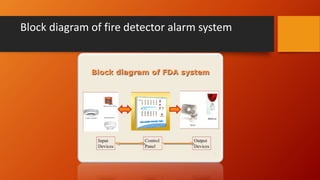
• Block diagram of fire detector alarm system
• Input devices
• Types of input devices
• Output devices
• Cost of FDA system
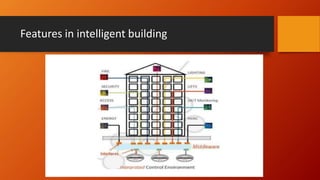
Intelligent building
• “Intelligent Building a building that integrates technology and process to
create a facility that is safer, more comfortable and productive for its
occupants, and more operationally efficient for its owners.
Features in intelligent building
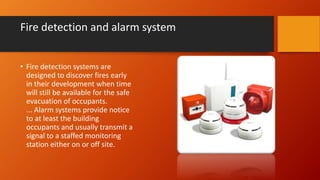
Fire detection and alarm system
• Fire detection systems are
designed to discover fires early
in their development when time
will still be available for the safe
evacuation of occupants.
... Alarm systems provide notice
to at least the building
occupants and usually transmit a
signal to a staffed monitoring
station either on or off site.
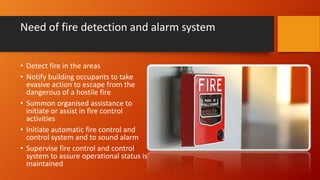
Need of fire detection and alarm system
• Detect fire in the areas
• Notify building occupants to take
evasive action to escape from the
dangerous of a hostile fire
• Summon organised assistance to
initiate or assist in fire control
activities
• Initiate automatic fire control and
control system and to sound alarm
• Supervise fire control and control
system to assure operational status is
maintained
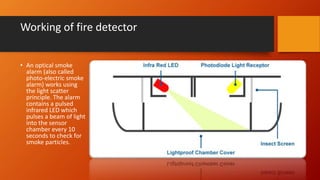
Working of fire detector
• An optical smoke
alarm (also called
photo-electric smoke
alarm) works using
the light scatter
principle. The alarm
contains a pulsed
infrared LED which
pulses a beam of light
into the sensor
chamber every 10
seconds to check for
smoke particles.
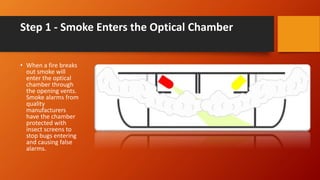
Step 1 - Smoke Enters the Optical Chamber
• When a fire breaks
out smoke will
enter the optical
chamber through
the opening vents.
Smoke alarms from
quality
manufacturers
have the chamber
protected with
insect screens to
stop bugs entering
and causing false
alarms.
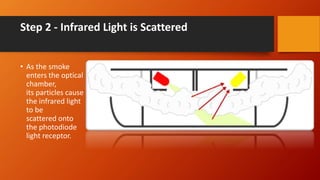
Step 2 - Infrared Light is Scattered
• As the smoke
enters the optical
chamber,
its particles cause
the infrared light
to be
scattered onto
the photodiode
light receptor.
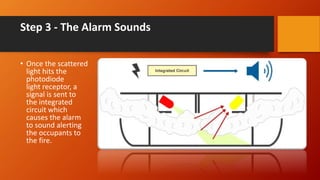
Step 3 - The Alarm Sounds
• Once the scattered
light hits the
photodiode
light receptor, a
signal is sent to
the integrated
circuit which
causes the alarm
to sound alerting
the occupants to
the fire.
Where Optical Smoke Alarms can be Situated
• Optical smoke alarms
can be situated in
bedrooms and living
rooms and in the
ground floor
hallway. The optical
technology makes the
alarms less prone to
false alarms from
cooking fumes.
Understanding of fire alarm
• Fire alarm is mandatory for every building other than small
residences. A fire alarm system is required only in important and
public buildings (as per Indian Codes in 2008).
• • A fire alarm system consists of fire sensors, such as smoke and
heat detectors, located throughout the building, connected to a
main alarm panel by special cables.
• The panel is in turn connected to a set of hooters or speakers that
give an audible alarm throughout the building and its surrounding
areas.
• In most areas smoke detectors are used to sense fires they cannot
be used in areas like kitchens where smoke is usually present.
• In such areas heat detectors are used ( which actually detect a
sudden increase in heat) .
• Devices such as a manual call point (a small button placed near
exits that can be pressed by anyone who realizes that there is a
fire) and a response indicator (a small red light that is placed
outside a door this lights if the smoke detector inside has been
activated in order to tell the fire-fighters the location of the fire)
are also used
Block diagram of fire detector alarm system
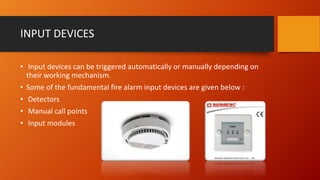
INPUT DEVICES
• Input devices can be triggered automatically or manually depending on
their working mechanism.
• Some of the fundamental fire alarm input devices are given below :
• Detectors
• Manual call points
• Input modules
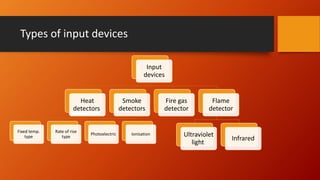
Types of input devices
Fixed temp.
type
Rate of rise
type
Photoelectric Ionisation
Input
devices
Heat
detectors
Smoke
detectors
Fire gas
detector
Flame
detector
Ultraviolet
light
Infrared
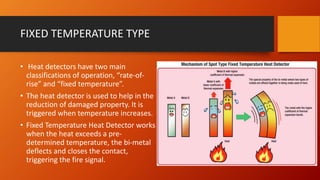
FIXED TEMPERATURE TYPE
• Heat detectors have two main
classifications of operation, “rate-of-
rise” and “fixed temperature”.
• The heat detector is used to help in the
reduction of damaged property. It is
triggered when temperature increases.
• Fixed Temperature Heat Detector works
when the heat exceeds a pre-
determined temperature, the bi-metal
deflects and closes the contact,
triggering the fire signal.
ADVANTAGES AND DISADVANTAGES OF FIXED
HEAT DETECTION ADVANTAGES
• Lower cost than smoke detector units
• More reliable than smoke detector units
• Not affected by dusty or dirty environments
• Minimal maintenance DISADVANTAGES
• Slower to respond than smoke detectors
• Will not detect products of combustion
• Only suitable for protection of property
RATE-OF-RISE TYPE THERMAL DETECTOR
• Rate of Rise Thermal Detectors triggers the fire alarm when the rate of
temperature increase in the surroundings rises above a certain rate. The
air in the air chamber will expand and close the contact which is used to
generate the alarm.
• Will initiate an alarm when the rise in temperature exceeds 12-15F per
minute
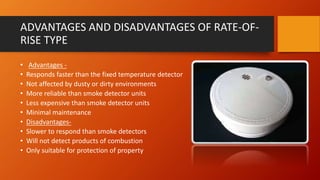
ADVANTAGES AND DISADVANTAGES OF RATE-OF-
RISE TYPE
• Advantages -
• Responds faster than the fixed temperature detector
• Not affected by dusty or dirty environments
• More reliable than smoke detector units
• Less expensive than smoke detector units
• Minimal maintenance
• Disadvantages-
• Slower to respond than smoke detectors
• Will not detect products of combustion
• Only suitable for protection of property
OUTPUT DEVEICES
• Most common output devices are sounders, beacons and output
modules.
• Sounders and beacons warn people that there is a fire incident audibly
• Therefore people can leave the building. These devices save lives in case
of emergency.
• Output module is another fundamental output device in fire alarm
systems. They are used for integration of fire alarm systems and other
electrical or mechanical systems in the building. Output modules control
other systems in case of fire For example, elevators can be directed to
ground floor or exhaust fans can be triggered
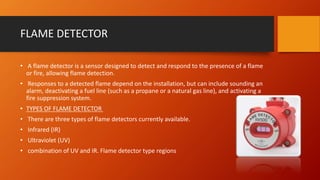
FLAME DETECTOR
• A flame detector is a sensor designed to detect and respond to the presence of a flame
or fire, allowing flame detection.
• Responses to a detected flame depend on the installation, but can include sounding an
alarm, deactivating a fuel line (such as a propane or a natural gas line), and activating a
fire suppression system.
• TYPES OF FLAME DETECTOR
• There are three types of flame detectors currently available.
• Infrared (IR)
• Ultraviolet (UV)
• combination of UV and IR. Flame detector type regions
Ultraviolet detector
• Ultraviolet(UV) detectors work by detecting the UV radiation emitted at
the instant of ignition.
• While capable of detecting fires and explosions within 3–4 milliseconds, a
time delay of 2–3 seconds is often included to minimize false alarms which
can be triggered by other UV sources such as lightning, arc welding,
radiation, and sunlight.
• UV detectors typically operate with wavelengths shorter than 300 nm to
minimize the effects of natural background radiation.
CRITERIA TO DETERMINE LAYOUT OF THE FIRE
DETECTORS
• The design, construction and operational features of all types of detectors shall be in accordance with
relevant standards.
• The number of fire detectors to be installed is governed by
• Total area to be protected
• Type of building construction
• air movement & air velocity
• ceiling obstructions
• concentration of equipment in the area covered
• sensitivity required
• Area is divided into zones to be protected
• Areas above false ceiling and below false flooring shall be considered as separate zones.
• Under ideal conditions of smooth ceiling and average room size, one detector is recommended to protect
the area.
• Detectors must always installed at the highest point of the ceiling and minimum coverage indicated by
manufacture shall be considered.
• The number of detectors and their location should be so selected that complete coverage is obtained.
COMPONENTS OF COMMERCIAL FDA SYSTEM
• The main components of commercial fire detection systems :
• Manual alarm stations
• Automatic fire alarm detectors
• Supervisory devices
• Supervised water flow devices
• Systems designed to meet stringent fire code
• Monitor Fire Suppression/Sprinkler Systems
COST OF FDA SYSTEM
• The cost of a fire alarm system is based on the size of your building, the
number of floors and square footage being covered, as well as any special
adherence to local and federal occupational codes.
• A basic fire alarm system, which could include smoke, heat and CO2
detectors and alarms with monitoring, for example, can cost anywhere
from Rs. 137.72 to Rs. 206.58 per square foot up to Rs. 275.44 to Rs.
413.16 per square foot for a more complex system for a larger building.
Thank you!
• Reference-
• https://www.slideshare.net/FathimaNasi/fire-detection-and-
alarm-system-168883469?qid=748ed4f2-823f-4dd0-b79d-
7067ff562a10&v=&b=&from_search=1

Fire detection and alarm system

  • 1.
    Fire detection andAlarms Subject- Building service-IV Guided by – Prof. Arun Atre Minerva college of Architecture Date- 4february,2021 Presented by-Asawari Patil Gauri Gaikwad Sakshi Sankpal Vinayak Waghmare
  • 2.
    Index • Intelligent building? •Features in intelligent building • Fire detection and alarm system • Need of fire detection and alarm system • Working of fire detector • Understanding of fire alarm • Block diagram of fire detector alarm system • Input devices • Types of input devices • Output devices • Cost of FDA system
  • 3.
    Intelligent building • “IntelligentBuilding a building that integrates technology and process to create a facility that is safer, more comfortable and productive for its occupants, and more operationally efficient for its owners.
  • 4.
  • 5.
    Fire detection andalarm system • Fire detection systems are designed to discover fires early in their development when time will still be available for the safe evacuation of occupants. ... Alarm systems provide notice to at least the building occupants and usually transmit a signal to a staffed monitoring station either on or off site.
  • 6.
    Need of firedetection and alarm system • Detect fire in the areas • Notify building occupants to take evasive action to escape from the dangerous of a hostile fire • Summon organised assistance to initiate or assist in fire control activities • Initiate automatic fire control and control system and to sound alarm • Supervise fire control and control system to assure operational status is maintained
  • 7.
    Working of firedetector • An optical smoke alarm (also called photo-electric smoke alarm) works using the light scatter principle. The alarm contains a pulsed infrared LED which pulses a beam of light into the sensor chamber every 10 seconds to check for smoke particles.
  • 8.
    Step 1 -Smoke Enters the Optical Chamber • When a fire breaks out smoke will enter the optical chamber through the opening vents. Smoke alarms from quality manufacturers have the chamber protected with insect screens to stop bugs entering and causing false alarms.
  • 9.
    Step 2 -Infrared Light is Scattered • As the smoke enters the optical chamber, its particles cause the infrared light to be scattered onto the photodiode light receptor.
  • 10.
    Step 3 -The Alarm Sounds • Once the scattered light hits the photodiode light receptor, a signal is sent to the integrated circuit which causes the alarm to sound alerting the occupants to the fire.
  • 11.
    Where Optical SmokeAlarms can be Situated • Optical smoke alarms can be situated in bedrooms and living rooms and in the ground floor hallway. The optical technology makes the alarms less prone to false alarms from cooking fumes.
  • 12.
    Understanding of firealarm • Fire alarm is mandatory for every building other than small residences. A fire alarm system is required only in important and public buildings (as per Indian Codes in 2008). • • A fire alarm system consists of fire sensors, such as smoke and heat detectors, located throughout the building, connected to a main alarm panel by special cables. • The panel is in turn connected to a set of hooters or speakers that give an audible alarm throughout the building and its surrounding areas.
  • 13.
    • In mostareas smoke detectors are used to sense fires they cannot be used in areas like kitchens where smoke is usually present. • In such areas heat detectors are used ( which actually detect a sudden increase in heat) . • Devices such as a manual call point (a small button placed near exits that can be pressed by anyone who realizes that there is a fire) and a response indicator (a small red light that is placed outside a door this lights if the smoke detector inside has been activated in order to tell the fire-fighters the location of the fire) are also used
  • 14.
    Block diagram offire detector alarm system
  • 15.
    INPUT DEVICES • Inputdevices can be triggered automatically or manually depending on their working mechanism. • Some of the fundamental fire alarm input devices are given below : • Detectors • Manual call points • Input modules
  • 16.
    Types of inputdevices Fixed temp. type Rate of rise type Photoelectric Ionisation Input devices Heat detectors Smoke detectors Fire gas detector Flame detector Ultraviolet light Infrared
  • 17.
    FIXED TEMPERATURE TYPE •Heat detectors have two main classifications of operation, “rate-of- rise” and “fixed temperature”. • The heat detector is used to help in the reduction of damaged property. It is triggered when temperature increases. • Fixed Temperature Heat Detector works when the heat exceeds a pre- determined temperature, the bi-metal deflects and closes the contact, triggering the fire signal.
  • 18.
    ADVANTAGES AND DISADVANTAGESOF FIXED HEAT DETECTION ADVANTAGES • Lower cost than smoke detector units • More reliable than smoke detector units • Not affected by dusty or dirty environments • Minimal maintenance DISADVANTAGES • Slower to respond than smoke detectors • Will not detect products of combustion • Only suitable for protection of property
  • 19.
    RATE-OF-RISE TYPE THERMALDETECTOR • Rate of Rise Thermal Detectors triggers the fire alarm when the rate of temperature increase in the surroundings rises above a certain rate. The air in the air chamber will expand and close the contact which is used to generate the alarm. • Will initiate an alarm when the rise in temperature exceeds 12-15F per minute
  • 20.
    ADVANTAGES AND DISADVANTAGESOF RATE-OF- RISE TYPE • Advantages - • Responds faster than the fixed temperature detector • Not affected by dusty or dirty environments • More reliable than smoke detector units • Less expensive than smoke detector units • Minimal maintenance • Disadvantages- • Slower to respond than smoke detectors • Will not detect products of combustion • Only suitable for protection of property
  • 21.
    OUTPUT DEVEICES • Mostcommon output devices are sounders, beacons and output modules. • Sounders and beacons warn people that there is a fire incident audibly • Therefore people can leave the building. These devices save lives in case of emergency. • Output module is another fundamental output device in fire alarm systems. They are used for integration of fire alarm systems and other electrical or mechanical systems in the building. Output modules control other systems in case of fire For example, elevators can be directed to ground floor or exhaust fans can be triggered
  • 22.
    FLAME DETECTOR • Aflame detector is a sensor designed to detect and respond to the presence of a flame or fire, allowing flame detection. • Responses to a detected flame depend on the installation, but can include sounding an alarm, deactivating a fuel line (such as a propane or a natural gas line), and activating a fire suppression system. • TYPES OF FLAME DETECTOR • There are three types of flame detectors currently available. • Infrared (IR) • Ultraviolet (UV) • combination of UV and IR. Flame detector type regions
  • 23.
    Ultraviolet detector • Ultraviolet(UV)detectors work by detecting the UV radiation emitted at the instant of ignition. • While capable of detecting fires and explosions within 3–4 milliseconds, a time delay of 2–3 seconds is often included to minimize false alarms which can be triggered by other UV sources such as lightning, arc welding, radiation, and sunlight. • UV detectors typically operate with wavelengths shorter than 300 nm to minimize the effects of natural background radiation.
  • 24.
    CRITERIA TO DETERMINELAYOUT OF THE FIRE DETECTORS • The design, construction and operational features of all types of detectors shall be in accordance with relevant standards. • The number of fire detectors to be installed is governed by • Total area to be protected • Type of building construction • air movement & air velocity • ceiling obstructions • concentration of equipment in the area covered • sensitivity required • Area is divided into zones to be protected • Areas above false ceiling and below false flooring shall be considered as separate zones. • Under ideal conditions of smooth ceiling and average room size, one detector is recommended to protect the area. • Detectors must always installed at the highest point of the ceiling and minimum coverage indicated by manufacture shall be considered. • The number of detectors and their location should be so selected that complete coverage is obtained.
  • 25.
    COMPONENTS OF COMMERCIALFDA SYSTEM • The main components of commercial fire detection systems : • Manual alarm stations • Automatic fire alarm detectors • Supervisory devices • Supervised water flow devices • Systems designed to meet stringent fire code • Monitor Fire Suppression/Sprinkler Systems
  • 26.
    COST OF FDASYSTEM • The cost of a fire alarm system is based on the size of your building, the number of floors and square footage being covered, as well as any special adherence to local and federal occupational codes. • A basic fire alarm system, which could include smoke, heat and CO2 detectors and alarms with monitoring, for example, can cost anywhere from Rs. 137.72 to Rs. 206.58 per square foot up to Rs. 275.44 to Rs. 413.16 per square foot for a more complex system for a larger building.
  • 27.
    Thank you! • Reference- •https://www.slideshare.net/FathimaNasi/fire-detection-and- alarm-system-168883469?qid=748ed4f2-823f-4dd0-b79d- 7067ff562a10&v=&b=&from_search=1