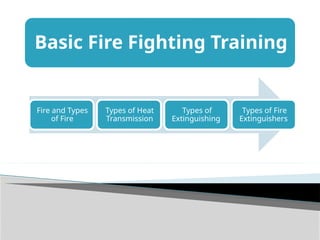
Basic Fire Fighting Training
Fire and Types
of Fire
Types of Heat
Transmission
Types of
Extinguishing
Types of Fire
Extinguishers
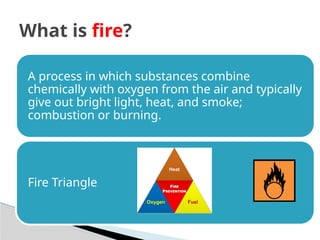
A process in which substances combine
chemically with oxygen from the air and typically
give out bright light, heat, and smoke;
combustion or burning.
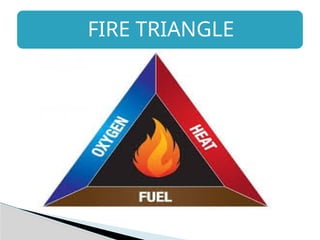
Fire Triangle
What is fire?
FIRE TRIANGLE
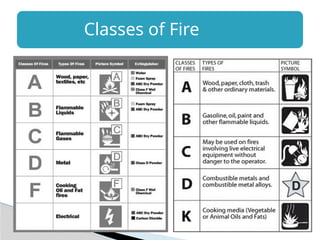
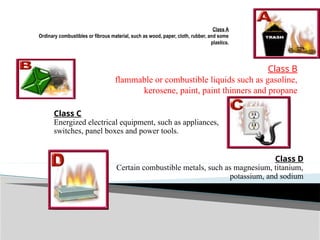
Classes of Fire
Class A
Ordinary combustibles or fibrous material, such as wood, paper, cloth, rubber, and some
plastics.
Class B
flammable or combustible liquids such as gasoline,
kerosene, paint, paint thinners and propane
Class C
Energized electrical equipment, such as appliances,
switches, panel boxes and power tools.
Class D
Certain combustible metals, such as magnesium, titanium,
potassium, and sodium
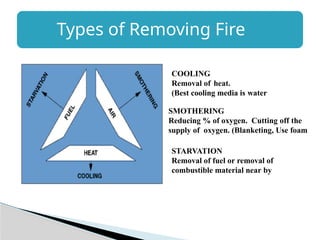
Types of Removing Fire
COOLING
Removal of heat.
(Best cooling media is water
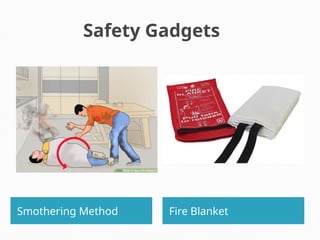
SMOTHERING
Reducing % of oxygen. Cutting off the
supply of oxygen. (Blanketing, Use foam
STARVATION
Removal of fuel or removal of
combustible material near by
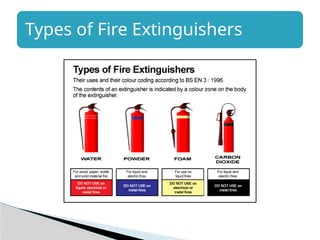
Types of Fire Extinguishers
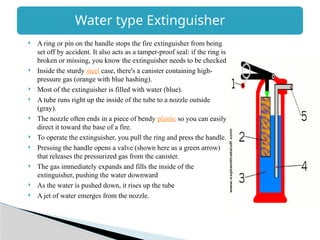
Water type Extinguisher
 A ring or pin on the handle stops the fire extinguisher from being
set off by accident. It also acts as a tamper-proof seal: if the ring is
broken or missing, you know the extinguisher needs to be checked.
 Inside the sturdy steel case, there's a canister containing high-
pressure gas (orange with blue hashing).
 Most of the extinguisher is filled with water (blue).
 A tube runs right up the inside of the tube to a nozzle outside
(gray).
 The nozzle often ends in a piece of bendy plastic so you can easily
direct it toward the base of a fire.
 To operate the extinguisher, you pull the ring and press the handle.
 Pressing the handle opens a valve (shown here as a green arrow)
that releases the pressurized gas from the canister.
 The gas immediately expands and fills the inside of the
extinguisher, pushing the water downward
 As the water is pushed down, it rises up the tube
 A jet of water emerges from the nozzle.
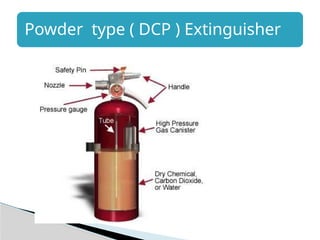
Powder type ( DCP ) Extinguisher
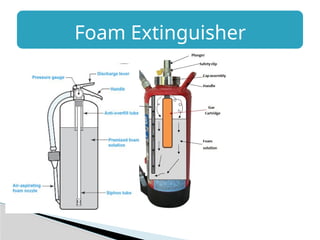
Foam Extinguisher
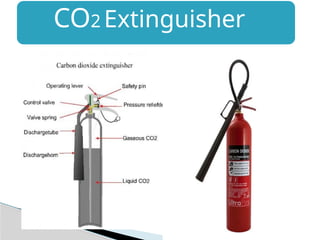
CO2 Extinguisher
CO2 Extinguisher
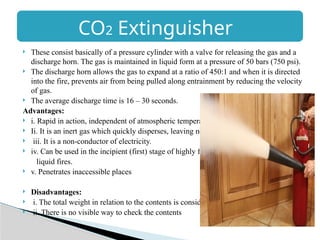
 These consist basically of a pressure cylinder with a valve for releasing the gas and a
discharge horn. The gas is maintained in liquid form at a pressure of 50 bars (750 psi).
 The discharge horn allows the gas to expand at a ratio of 450:1 and when it is directed
into the fire, prevents air from being pulled along entrainment by reducing the velocity
of gas.
 The average discharge time is 16 – 30 seconds.
Advantages:
 i. Rapid in action, independent of atmospheric temperature.
 Ii. It is an inert gas which quickly disperses, leaving no trace.
 iii. It is a non-conductor of electricity.
 iv. Can be used in the incipient (first) stage of highly flammable
liquid fires.
 v. Penetrates inaccessible places
 Disadvantages:
 i. The total weight in relation to the contents is considerable
 ii. There is no visible way to check the contents
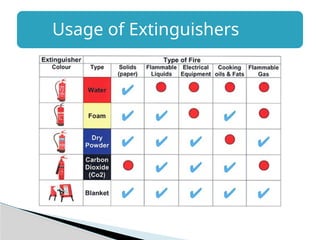
Usage of Extinguishers
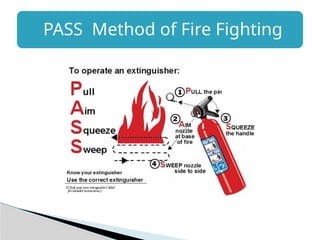
PASS Method of Fire Fighting
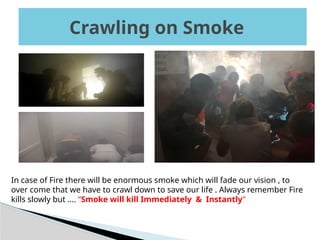
Crawling on Smoke
Crawling on Smoke
In case of Fire there will be enormous smoke which will fade our vision , to
over come that we have to crawl down to save our life . Always remember Fire
kills slowly but …. “Smoke will kill Immediately & Instantly”
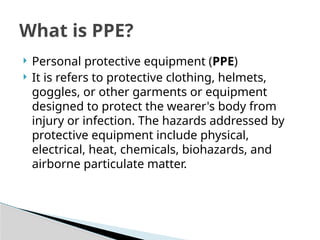
 Personal protective equipment (PPE)
 It is refers to protective clothing, helmets,
goggles, or other garments or equipment
designed to protect the wearer's body from
injury or infection. The hazards addressed by
protective equipment include physical,
electrical, heat, chemicals, biohazards, and
airborne particulate matter.
What is PPE?
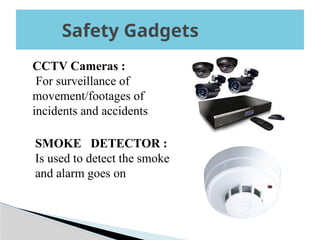
Safety Gadgets
CCTV Cameras :
For surveillance of
movement/footages of
incidents and accidents
SMOKE DETECTOR :
Is used to detect the smoke
and alarm goes on
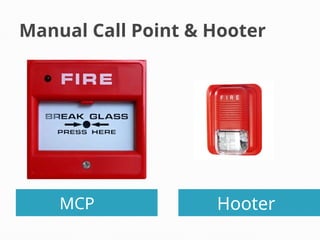
Manual Call Point & Hooter
MCP Hooter
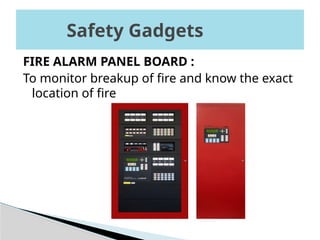
FIRE ALARM PANEL BOARD :
To monitor breakup of fire and know the exact
location of fire
Safety Gadgets
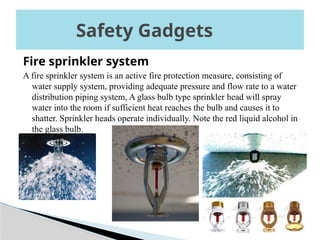
Fire sprinkler system
A fire sprinkler system is an active fire protection measure, consisting of
water supply system, providing adequate pressure and flow rate to a water
distribution piping system, A glass bulb type sprinkler head will spray
water into the room if sufficient heat reaches the bulb and causes it to
shatter. Sprinkler heads operate individually. Note the red liquid alcohol in
the glass bulb.
Safety Gadgets
Safety Gadgets
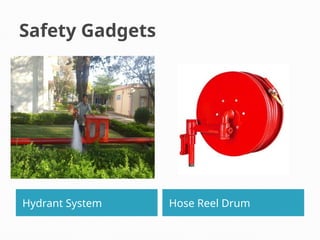
Hydrant System Hose Reel Drum
Safety Gadgets
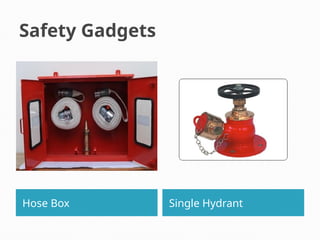
Hose Box Single Hydrant
Safety Gadgets
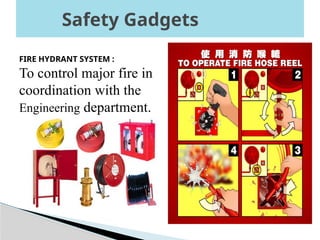
FIRE HYDRANT SYSTEM :
To control major fire in
coordination with the
Engineering department.
Safety Gadgets
Smothering Method Fire Blanket
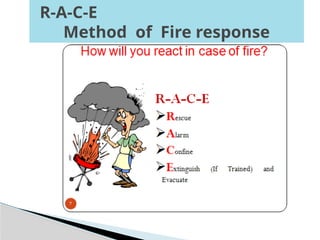
R-A-C-E
Method of Fire response
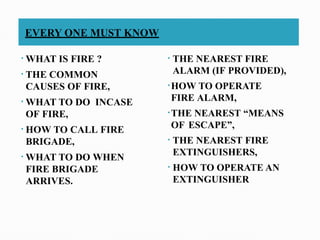
EVERY ONE MUST KNOW
• WHAT IS FIRE ?
• THE COMMON
CAUSES OF FIRE,
• WHAT TO DO INCASE
OF FIRE,
• HOW TO CALL FIRE
BRIGADE,
• WHAT TO DO WHEN
FIRE BRIGADE
ARRIVES.
• THE NEAREST FIRE
ALARM (IF PROVIDED),
• HOW TO OPERATE
FIRE ALARM,
• THE NEAREST “MEANS
OF ESCAPE”,
• THE NEAREST FIRE
EXTINGUISHERS,
• HOW TO OPERATE AN
EXTINGUISHER
At SIMS – 7777 (Security), 7676 (Maintenance)
Fire Control - 101, 112
Ambulance – 108, 102
Police Station – 100
Fire Station CMBT – 044-24792610
EMERGENCY CONTACT NUMBER
What the fire alarm sound like in your building
The Escape routes within your building
If you discover a fire, how to raise the alarm
What to do if you hear the fire alarm
Who to call if a fire starts
How to open fire exit doors
Why is it important to go to the assembly area?
Why fire doors should remain closed at all times?
Why are fire extinguishers provided?
As a staff of the Hospital you have a
responsibility for fire safety. Make sure
you know
Ensure that you know;
The escape routes
Emergency exit doors and how to open them
Location and types of fire fighting equipment
Locations of call points
Any specific fire procedures including the assembly points
Who are your Reporting authorities/Safety Managers.
Whom to report to for any defects or bad practices.
On Your Return to Your Workplace
Today
F - Find what type the fire is.
I - Inform to everyone by raising alarm
R - React Immediately, Restrict the fire by closing
doors, Isolating the fuel electricity supply
E - Extinguish the fire by using the correct type fire
extinguish media
FIRE Simple Definition
Safety & Security
Department
SIMS
CALL 7777 IN CASE OF
FIRE & EMERGENCY
THANK YOU !!

Fire training is a ppt for fire training

  • 1.
    Basic Fire FightingTraining Fire and Types of Fire Types of Heat Transmission Types of Extinguishing Types of Fire Extinguishers
  • 2.
    A process inwhich substances combine chemically with oxygen from the air and typically give out bright light, heat, and smoke; combustion or burning. Fire Triangle What is fire?
  • 3.
  • 4.
  • 5.
    Class A Ordinary combustiblesor fibrous material, such as wood, paper, cloth, rubber, and some plastics. Class B flammable or combustible liquids such as gasoline, kerosene, paint, paint thinners and propane Class C Energized electrical equipment, such as appliances, switches, panel boxes and power tools. Class D Certain combustible metals, such as magnesium, titanium, potassium, and sodium
  • 6.
    Types of RemovingFire COOLING Removal of heat. (Best cooling media is water SMOTHERING Reducing % of oxygen. Cutting off the supply of oxygen. (Blanketing, Use foam STARVATION Removal of fuel or removal of combustible material near by
  • 7.
    Types of FireExtinguishers
  • 8.
    Water type Extinguisher A ring or pin on the handle stops the fire extinguisher from being set off by accident. It also acts as a tamper-proof seal: if the ring is broken or missing, you know the extinguisher needs to be checked.  Inside the sturdy steel case, there's a canister containing high- pressure gas (orange with blue hashing).  Most of the extinguisher is filled with water (blue).  A tube runs right up the inside of the tube to a nozzle outside (gray).  The nozzle often ends in a piece of bendy plastic so you can easily direct it toward the base of a fire.  To operate the extinguisher, you pull the ring and press the handle.  Pressing the handle opens a valve (shown here as a green arrow) that releases the pressurized gas from the canister.  The gas immediately expands and fills the inside of the extinguisher, pushing the water downward  As the water is pushed down, it rises up the tube  A jet of water emerges from the nozzle.
  • 9.
    Powder type (DCP ) Extinguisher
  • 10.
  • 11.
  • 12.
    CO2 Extinguisher  Theseconsist basically of a pressure cylinder with a valve for releasing the gas and a discharge horn. The gas is maintained in liquid form at a pressure of 50 bars (750 psi).  The discharge horn allows the gas to expand at a ratio of 450:1 and when it is directed into the fire, prevents air from being pulled along entrainment by reducing the velocity of gas.  The average discharge time is 16 – 30 seconds. Advantages:  i. Rapid in action, independent of atmospheric temperature.  Ii. It is an inert gas which quickly disperses, leaving no trace.  iii. It is a non-conductor of electricity.  iv. Can be used in the incipient (first) stage of highly flammable liquid fires.  v. Penetrates inaccessible places  Disadvantages:  i. The total weight in relation to the contents is considerable  ii. There is no visible way to check the contents
  • 13.
  • 14.
    PASS Method ofFire Fighting
  • 16.
    Crawling on Smoke Crawlingon Smoke In case of Fire there will be enormous smoke which will fade our vision , to over come that we have to crawl down to save our life . Always remember Fire kills slowly but …. “Smoke will kill Immediately & Instantly”
  • 17.
     Personal protectiveequipment (PPE)  It is refers to protective clothing, helmets, goggles, or other garments or equipment designed to protect the wearer's body from injury or infection. The hazards addressed by protective equipment include physical, electrical, heat, chemicals, biohazards, and airborne particulate matter. What is PPE?
  • 18.
    Safety Gadgets CCTV Cameras: For surveillance of movement/footages of incidents and accidents SMOKE DETECTOR : Is used to detect the smoke and alarm goes on
  • 19.
    Manual Call Point& Hooter MCP Hooter
  • 20.
    FIRE ALARM PANELBOARD : To monitor breakup of fire and know the exact location of fire Safety Gadgets
  • 21.
    Fire sprinkler system Afire sprinkler system is an active fire protection measure, consisting of water supply system, providing adequate pressure and flow rate to a water distribution piping system, A glass bulb type sprinkler head will spray water into the room if sufficient heat reaches the bulb and causes it to shatter. Sprinkler heads operate individually. Note the red liquid alcohol in the glass bulb. Safety Gadgets
  • 22.
  • 23.
  • 24.
    Safety Gadgets FIRE HYDRANTSYSTEM : To control major fire in coordination with the Engineering department.
  • 25.
  • 26.
  • 28.
    EVERY ONE MUSTKNOW • WHAT IS FIRE ? • THE COMMON CAUSES OF FIRE, • WHAT TO DO INCASE OF FIRE, • HOW TO CALL FIRE BRIGADE, • WHAT TO DO WHEN FIRE BRIGADE ARRIVES. • THE NEAREST FIRE ALARM (IF PROVIDED), • HOW TO OPERATE FIRE ALARM, • THE NEAREST “MEANS OF ESCAPE”, • THE NEAREST FIRE EXTINGUISHERS, • HOW TO OPERATE AN EXTINGUISHER
  • 29.
    At SIMS –7777 (Security), 7676 (Maintenance) Fire Control - 101, 112 Ambulance – 108, 102 Police Station – 100 Fire Station CMBT – 044-24792610 EMERGENCY CONTACT NUMBER
  • 30.
    What the firealarm sound like in your building The Escape routes within your building If you discover a fire, how to raise the alarm What to do if you hear the fire alarm Who to call if a fire starts How to open fire exit doors Why is it important to go to the assembly area? Why fire doors should remain closed at all times? Why are fire extinguishers provided? As a staff of the Hospital you have a responsibility for fire safety. Make sure you know
  • 31.
    Ensure that youknow; The escape routes Emergency exit doors and how to open them Location and types of fire fighting equipment Locations of call points Any specific fire procedures including the assembly points Who are your Reporting authorities/Safety Managers. Whom to report to for any defects or bad practices. On Your Return to Your Workplace Today
  • 32.
    F - Findwhat type the fire is. I - Inform to everyone by raising alarm R - React Immediately, Restrict the fire by closing doors, Isolating the fuel electricity supply E - Extinguish the fire by using the correct type fire extinguish media FIRE Simple Definition
  • 33.
    Safety & Security Department SIMS CALL7777 IN CASE OF FIRE & EMERGENCY THANK YOU !!

Editor's Notes

  • #18 In case of Fire there will be enormous smoke will fade our vision , to over come that we have to crawl down to save our life . Keep remember Fire kill slowly but Smoke kills instantly