FIRE ALARM SYSTEM
By :
MUHMMAD FARID, AHMED MUHAMMAD, MUHMMAD
ZARIA, MAHMOUD AFEFY
Overview
 Fire alarm system is installed for protection
of life, property and mission. In order to a
fire alarm system to be useful, it must be
able to perform these functions:
Detect the presence of a fire.
Notify the occupants.
Notify the fire department
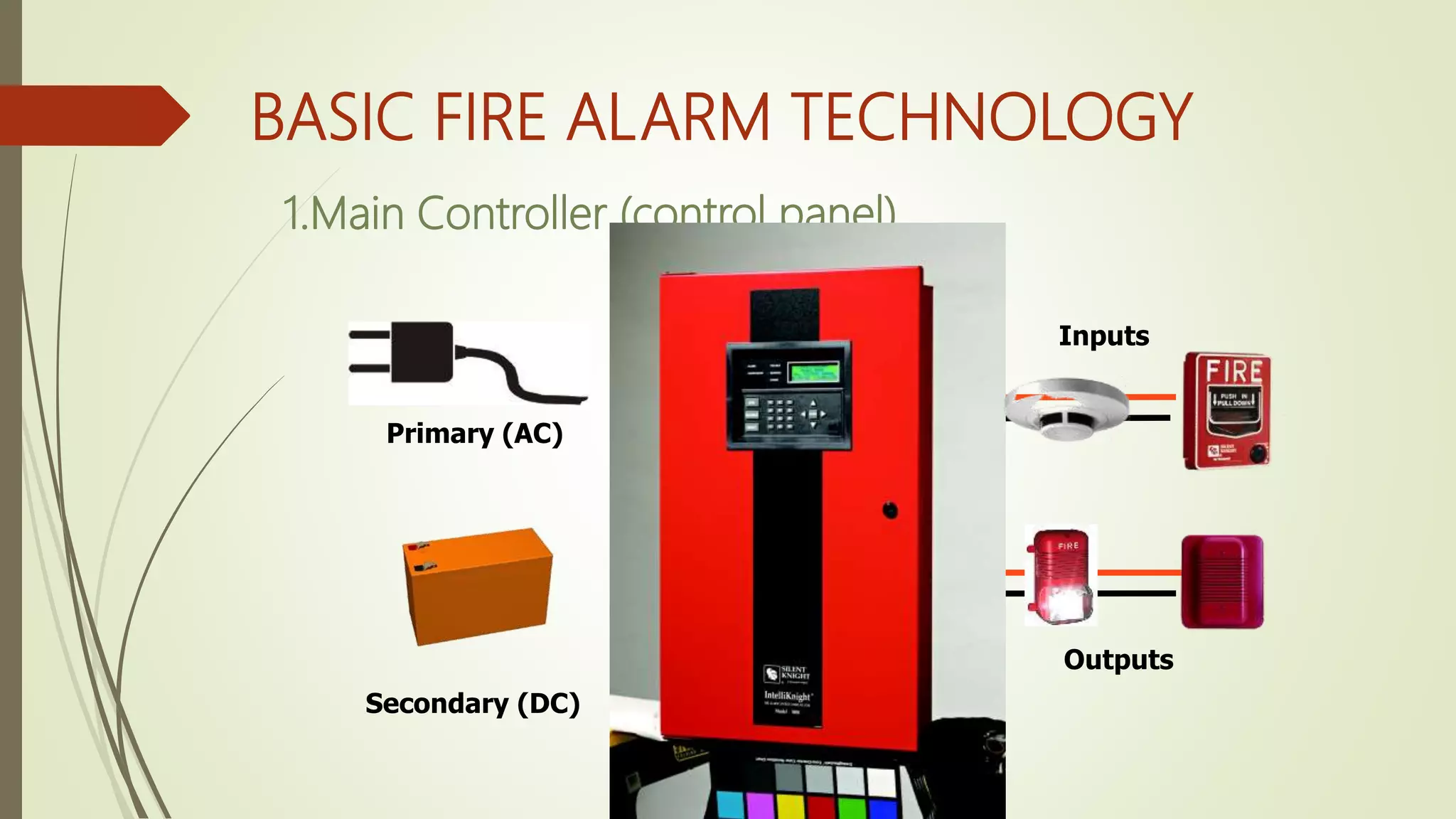
BASIC FIRE ALARM TECHNOLOGY
Secondary (DC)
Primary (AC)
Outputs
Inputs
1.Main Controller (control panel)
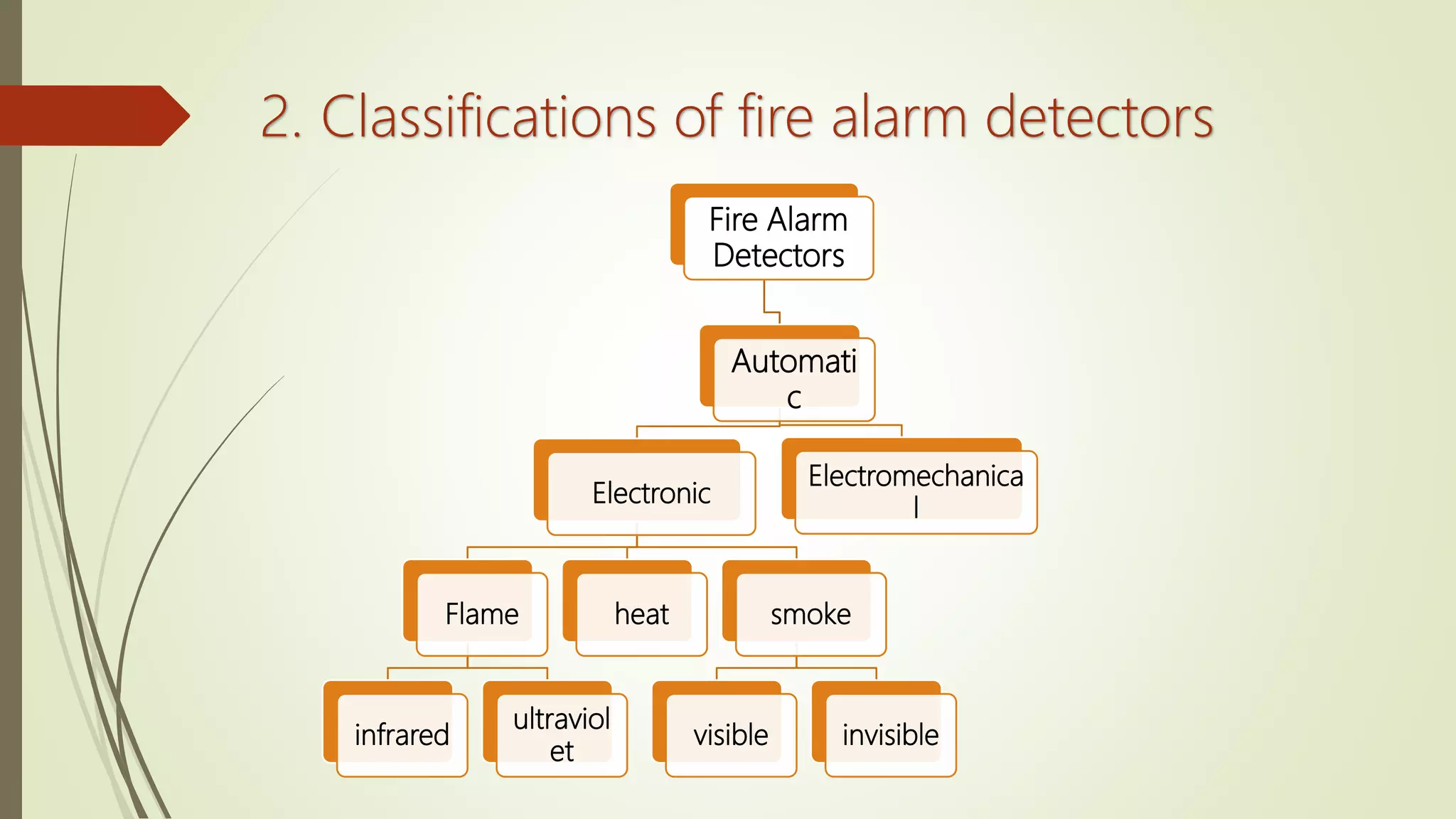
Fire Alarm
Detectors
Automati
c
Electronic
Flame
infrared
ultraviol
et
heat smoke
visible invisible
Electromechanica
l
2. Classifications of fire alarm detectors
3. Selection For Detectors
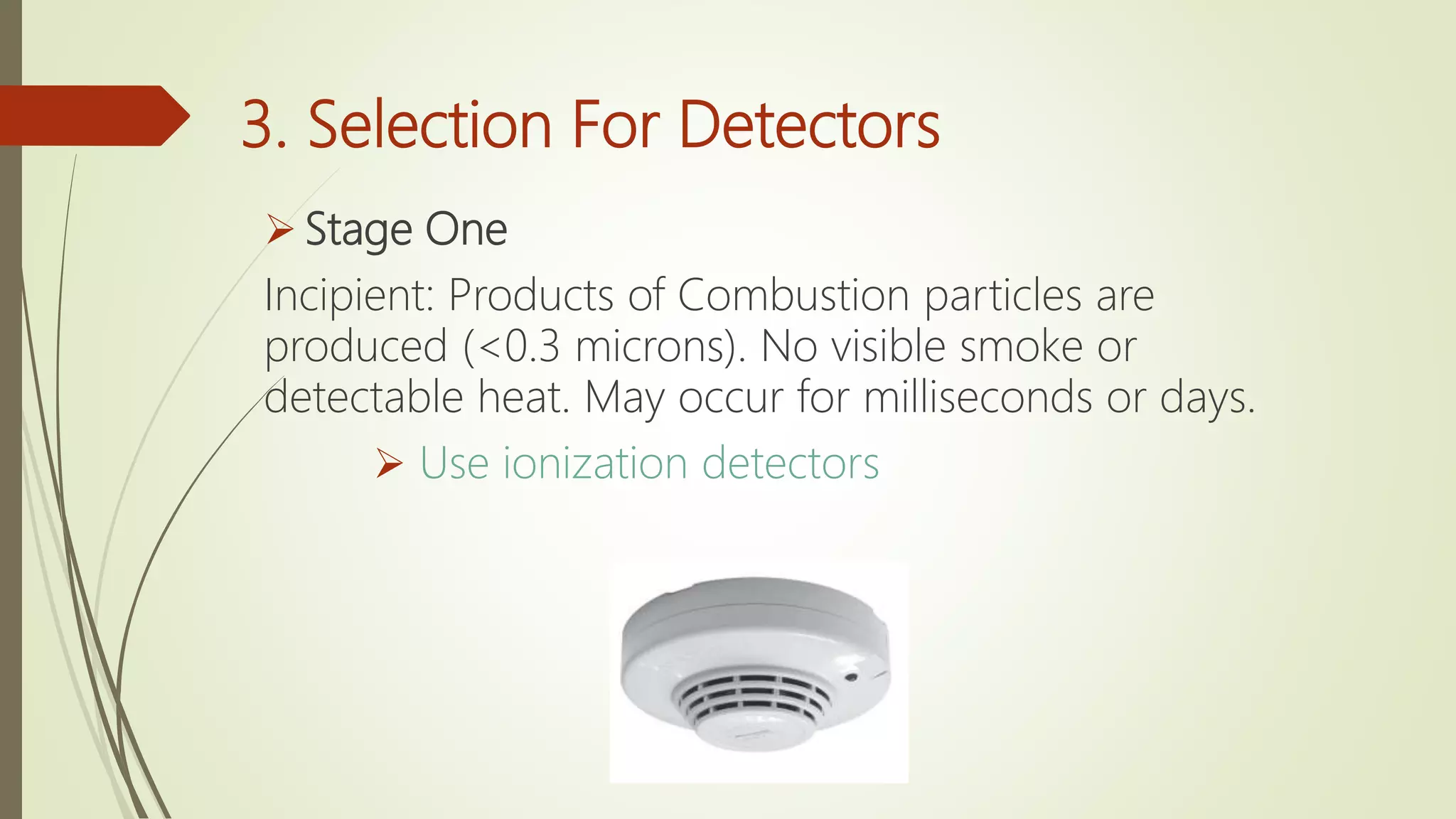
 Stage One
Incipient: Products of Combustion particles are
produced (<0.3 microns). No visible smoke or
detectable heat. May occur for milliseconds or days.
 Use ionization detectors
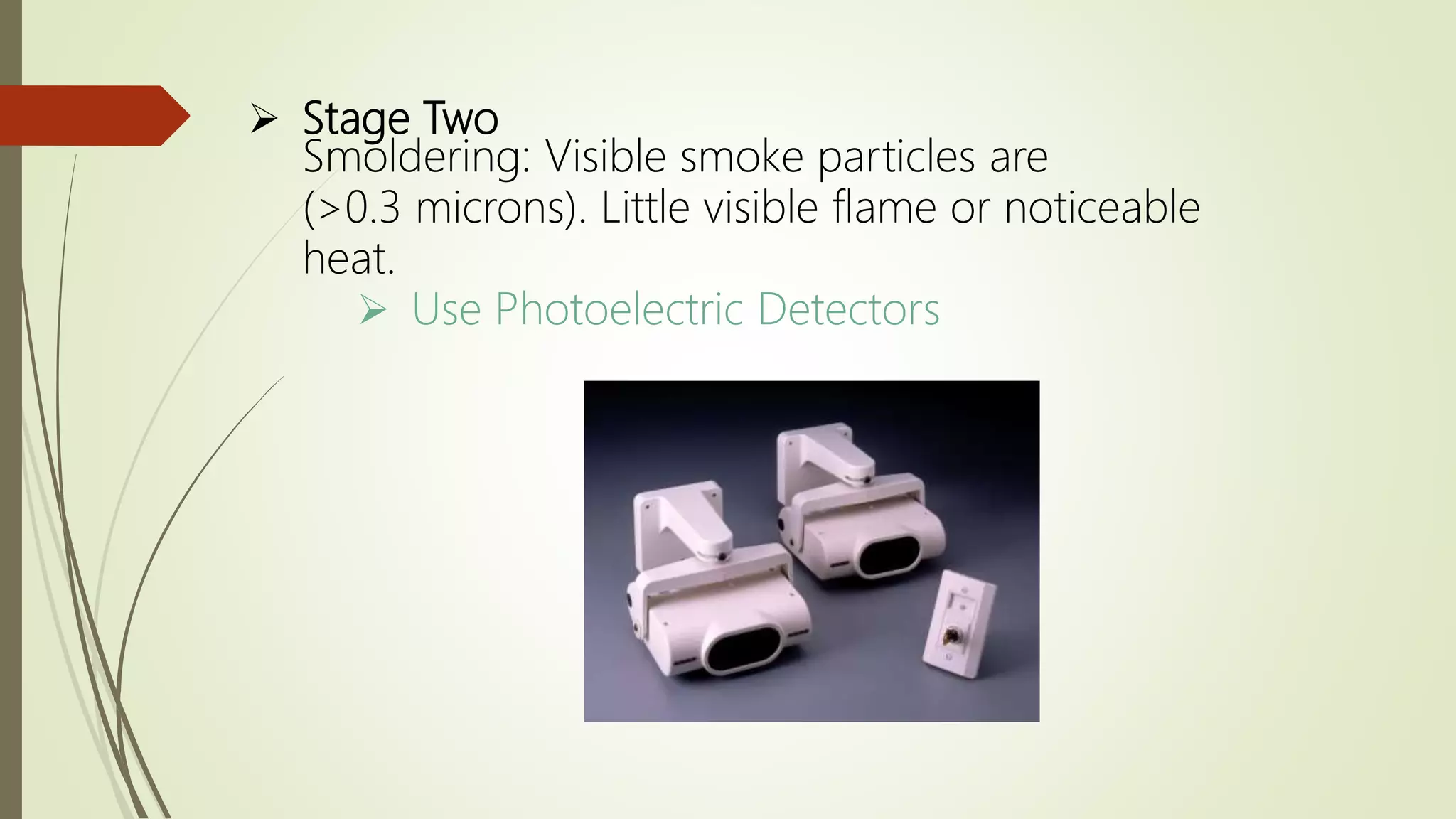
 Stage Two
Smoldering: Visible smoke particles are
(>0.3 microns). Little visible flame or noticeable
heat.
 Use Photoelectric Detectors
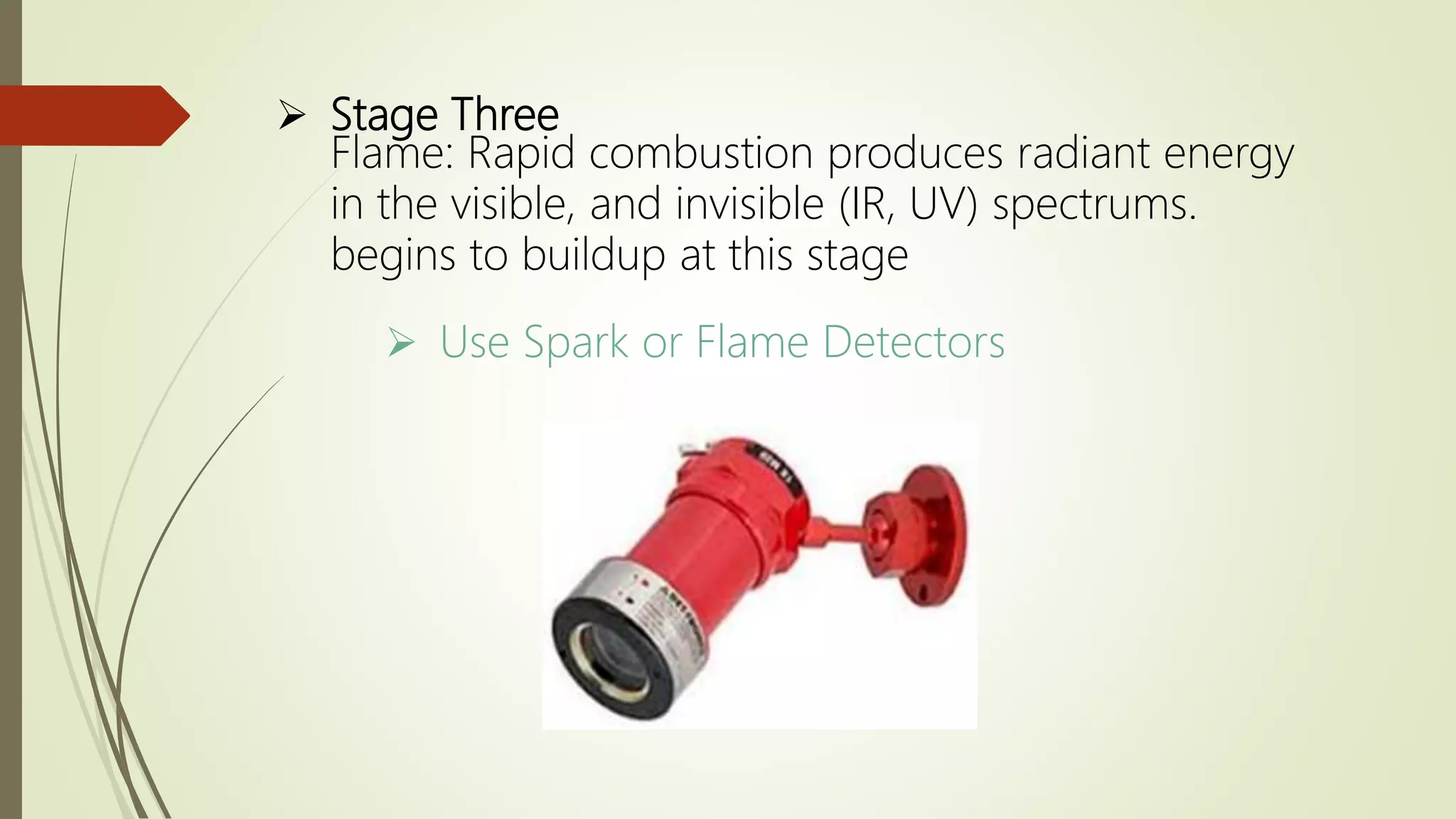
 Stage Three
Flame: Rapid combustion produces radiant energy
in the visible, and invisible (IR, UV) spectrums.
begins to buildup at this stage
 Use Spark or Flame Detectors
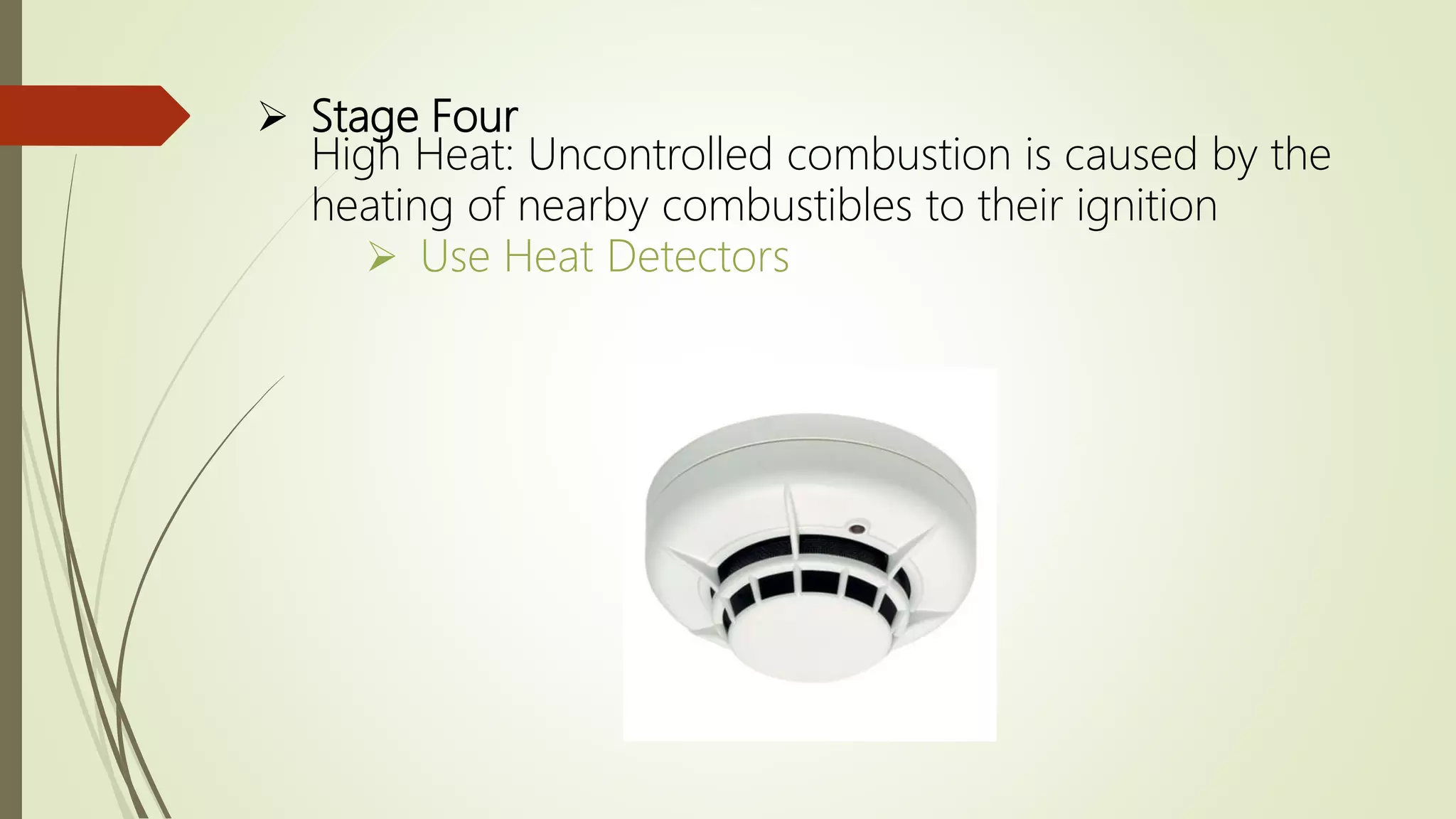
 Stage Four
High Heat: Uncontrolled combustion is caused by the
heating of nearby combustibles to their ignition
 Use Heat Detectors
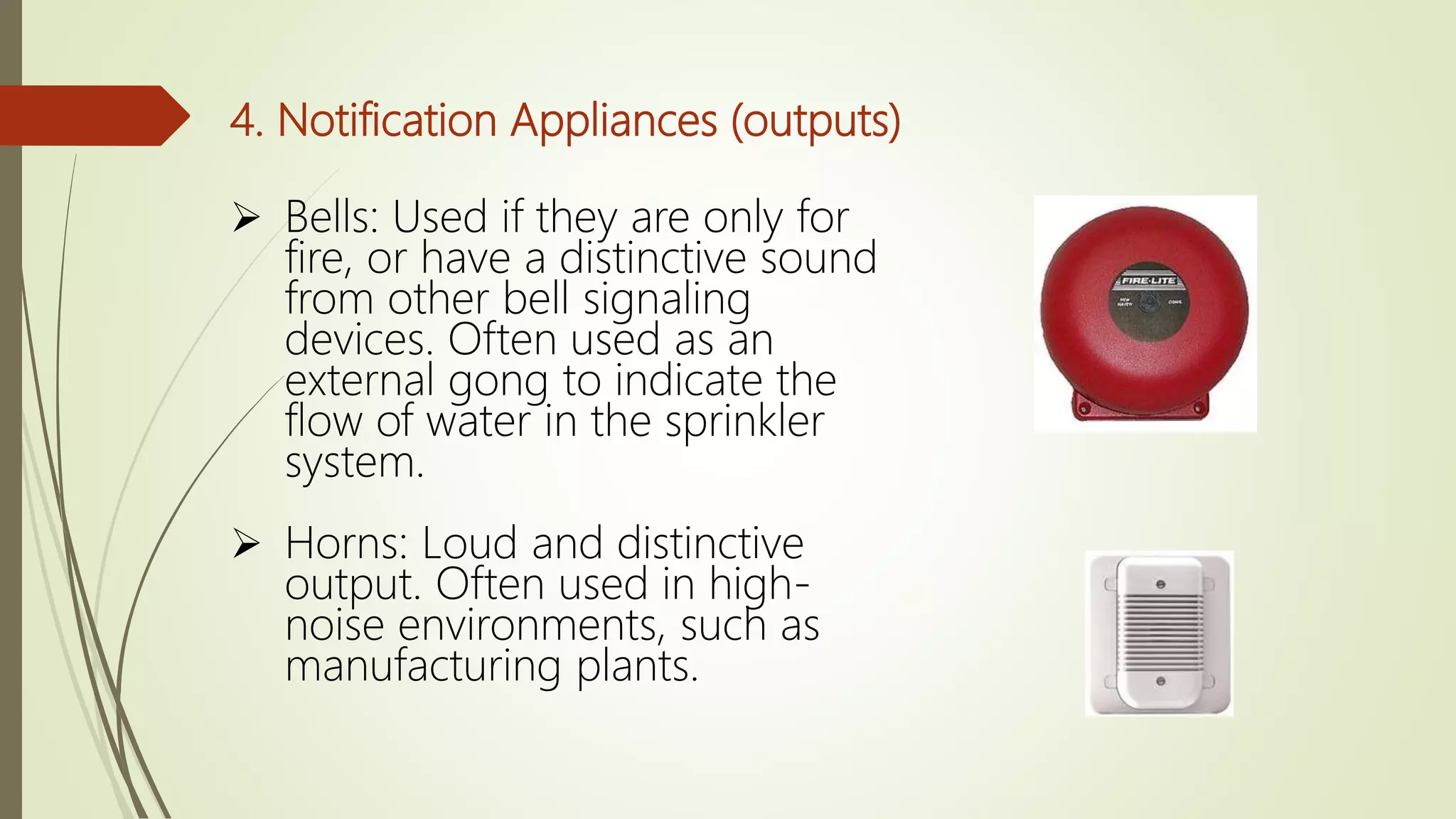
4. Notification Appliances (outputs)
 Bells: Used if they are only for
fire, or have a distinctive sound
from other bell signaling
devices. Often used as an
external gong to indicate the
flow of water in the sprinkler
system.
 Horns: Loud and distinctive
output. Often used in high-
noise environments, such as
manufacturing plants.
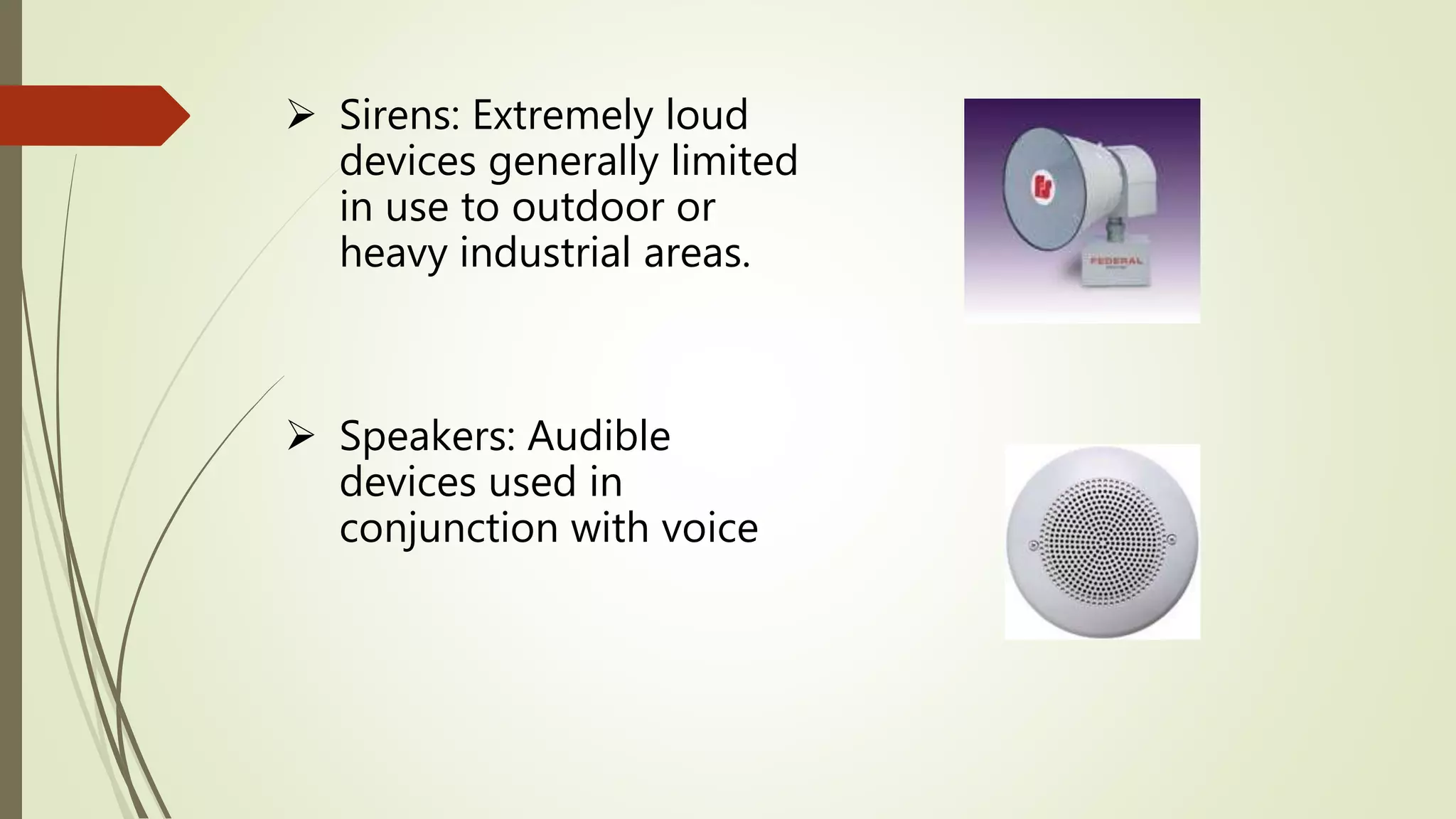
 Sirens: Extremely loud
devices generally limited
in use to outdoor or
heavy industrial areas.
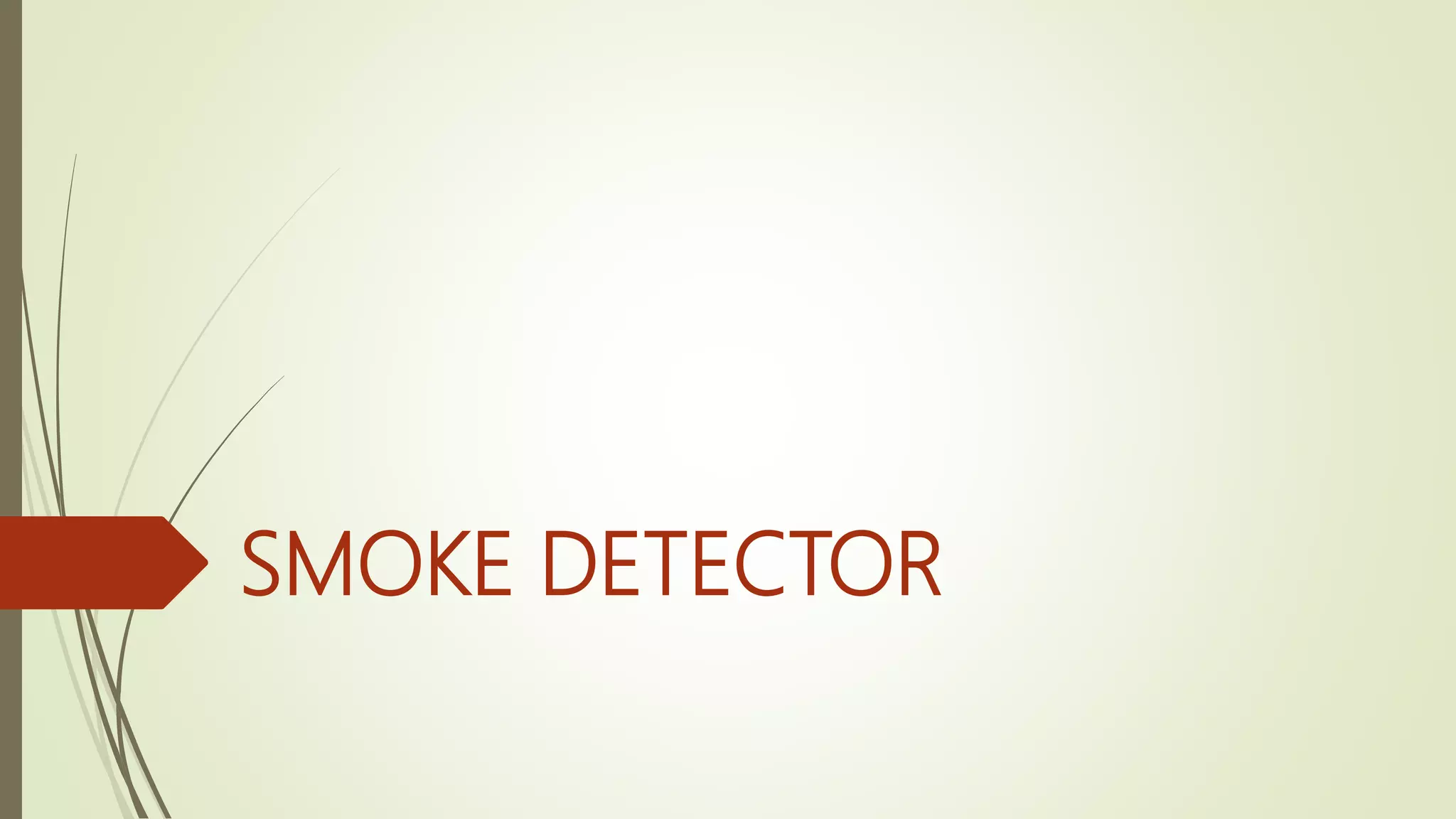
 Speakers: Audible
devices used in
conjunction with voice
SMOKE DETECTOR
SMOKE DETECTOR
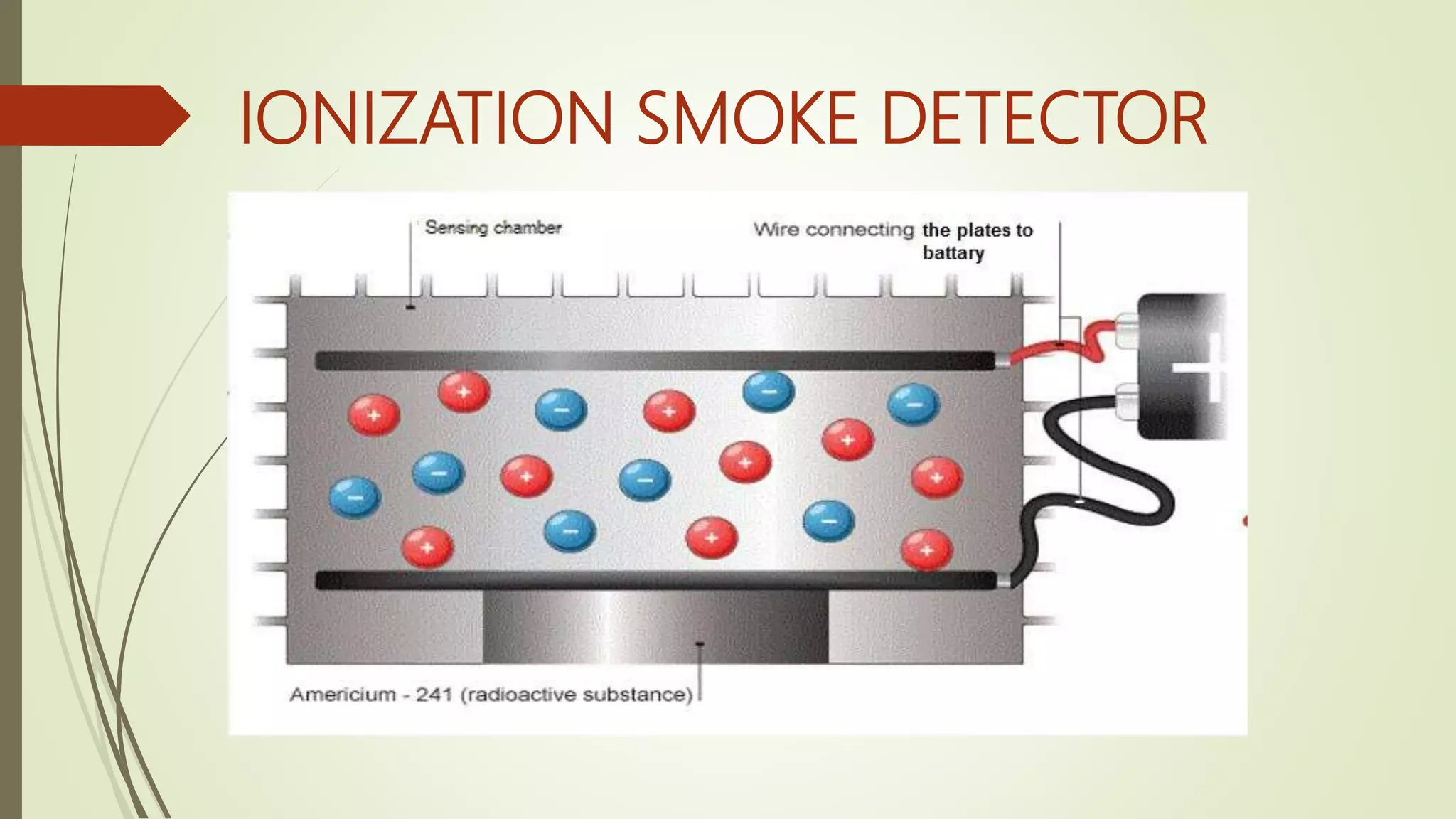
 A smoke detector is a device that senses smoke,
typically as an indicator of fire.
 Smoke detector consists of two parts:
 A sensor to sense the smoke
 An electronic horn to horn the people
 Two basic types of smoke detectors are used
today ionization and photoelectric.
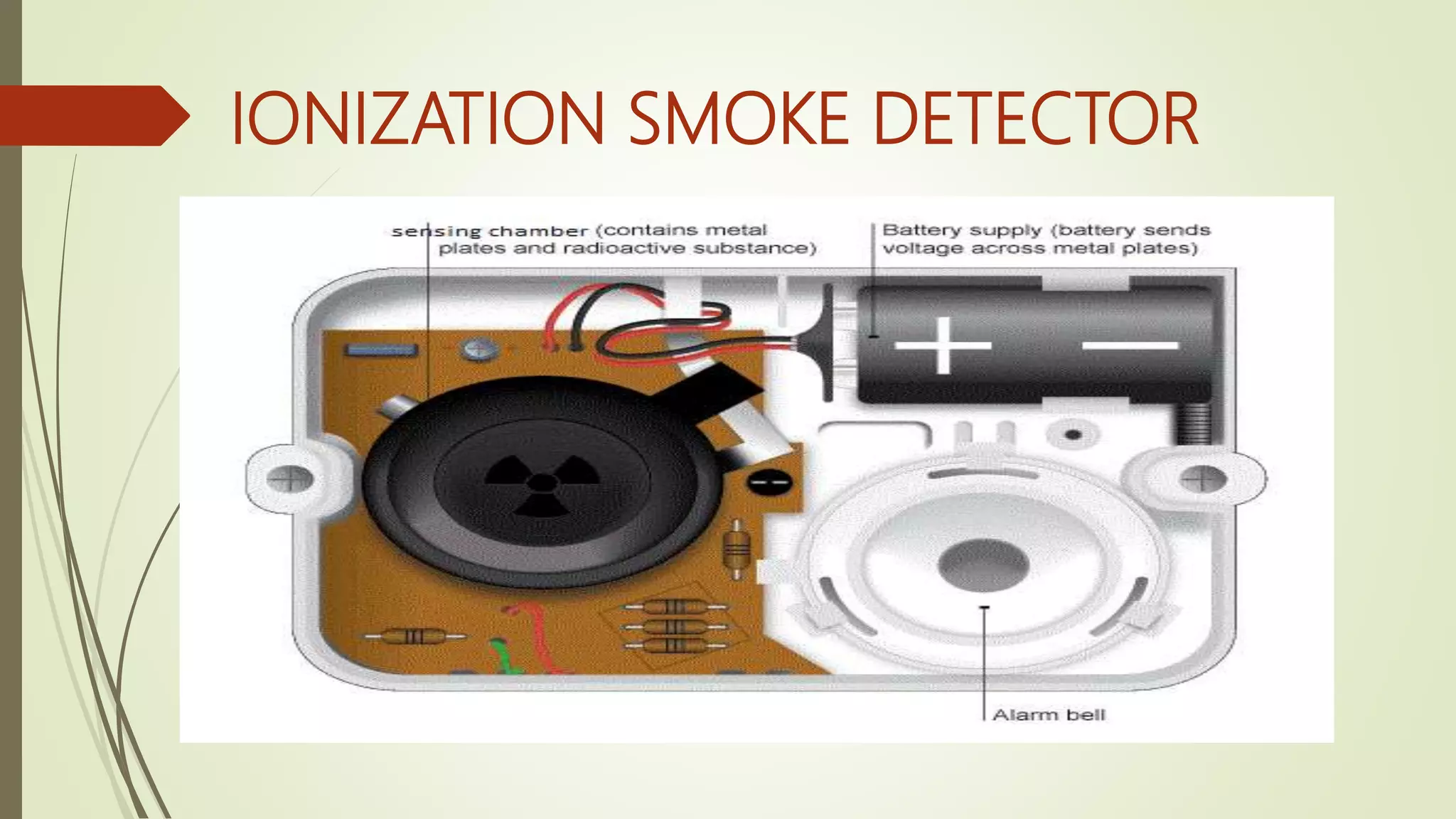
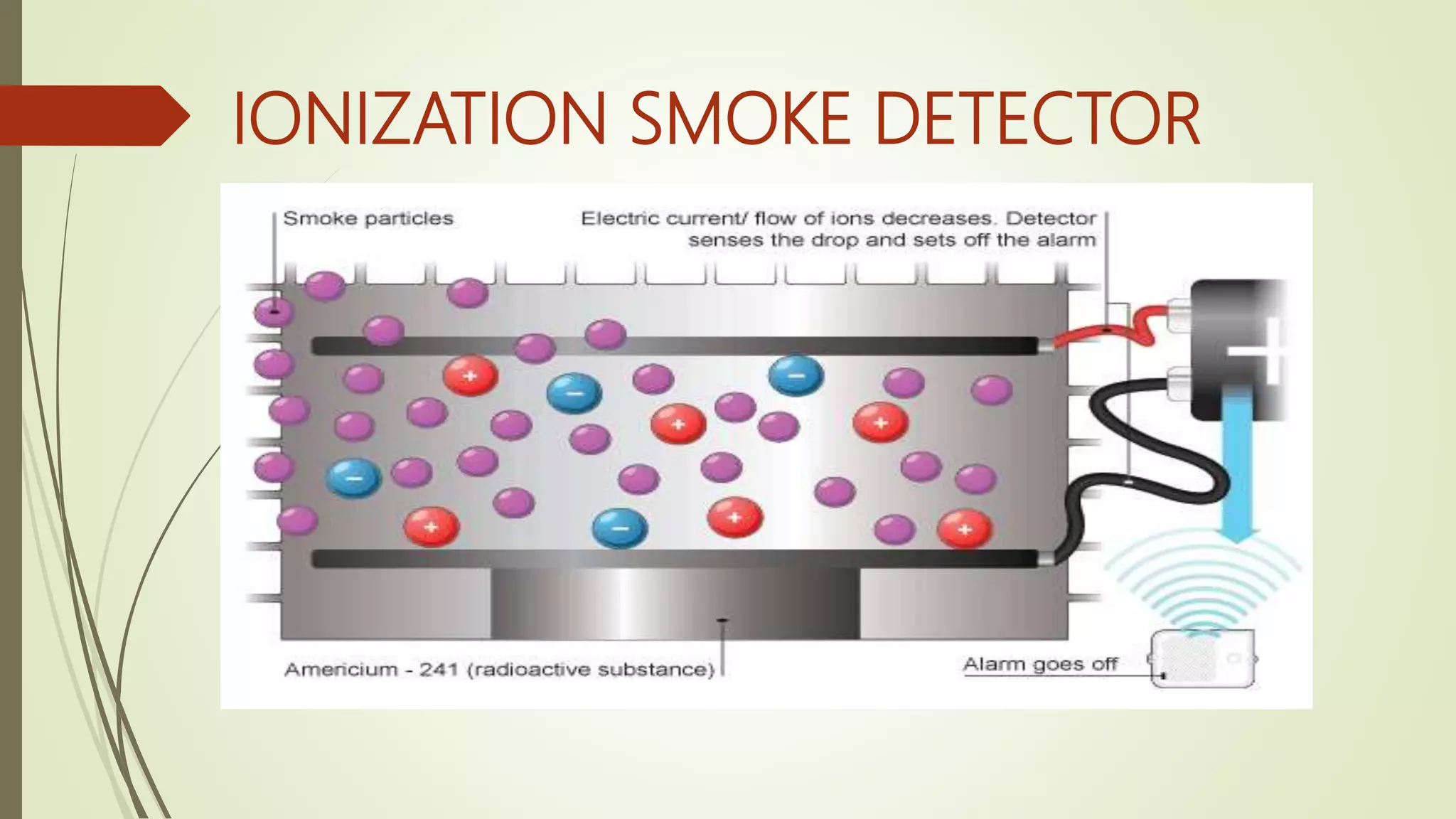
IONIZATION SMOKE DETECTOR
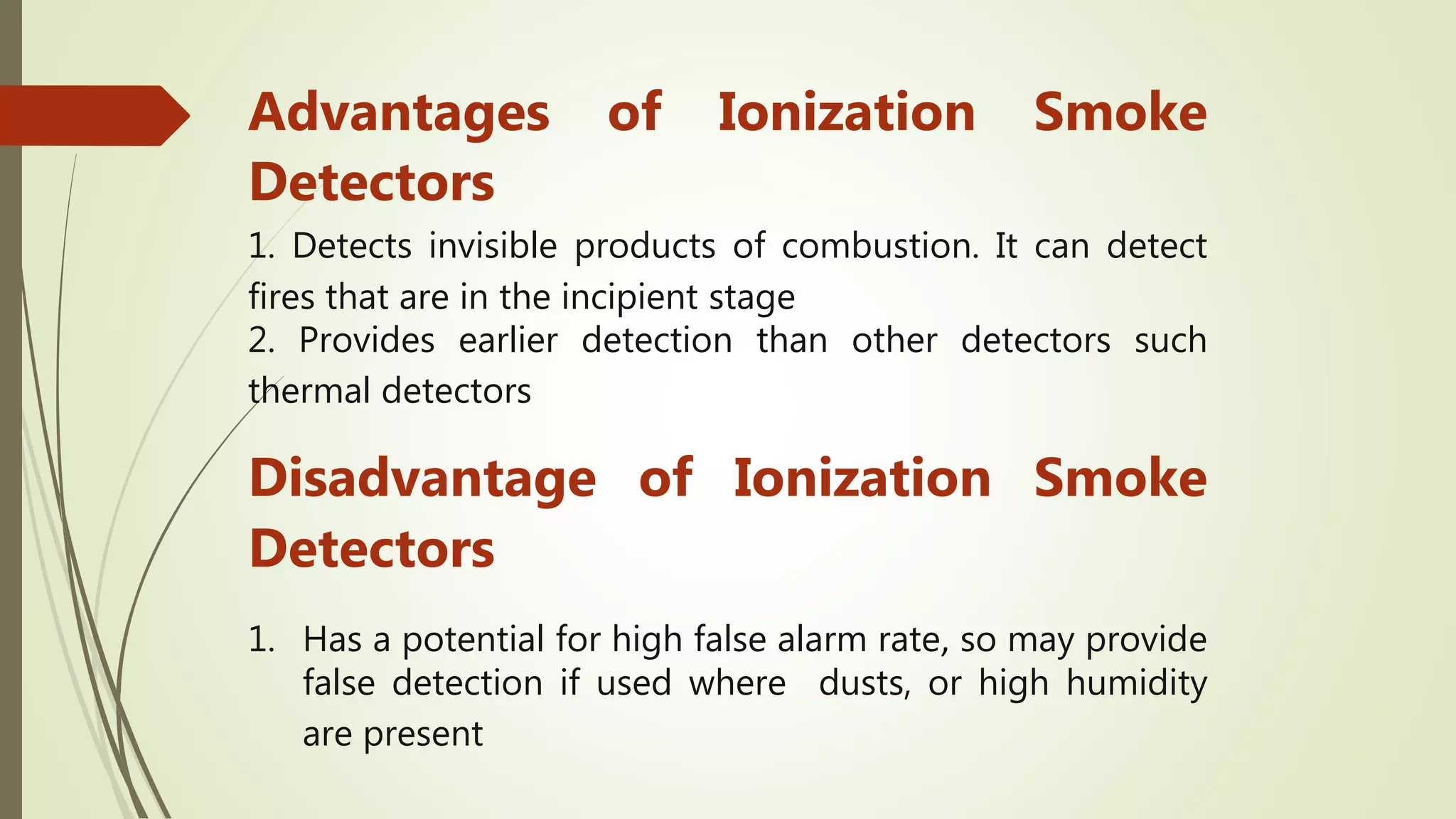
Advantages of Ionization Smoke
Detectors
1. Detects invisible products of combustion. It can detect
fires that are in the incipient stage
2. Provides earlier detection than other detectors such
thermal detectors
Disadvantage of Ionization Smoke
Detectors
1. Has a potential for high false alarm rate, so may provide
false detection if used where dusts, or high humidity
are present
PHOTOELECTRIC SMOKE DETECTOR
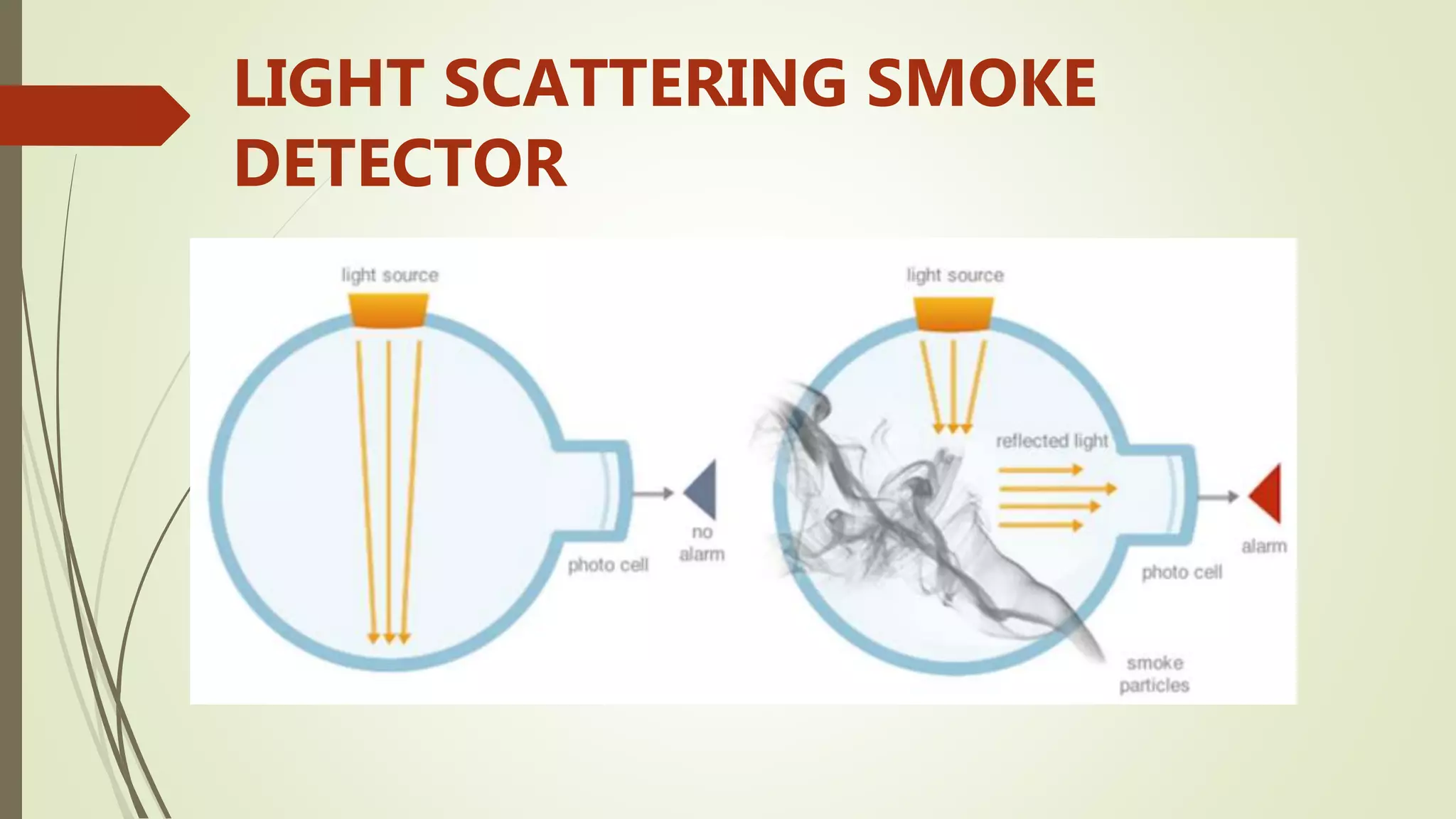
The photoelectric type detector utilizes light as a detection
mechanism.
A photoelectric, or optical, smoke detector contains a
source of infrared, visible, or ultraviolet light, a lens, and a
photoelectric receiver (typically a photodiode).
 There are two types of photoelectric smoke detectors:
Light sensing(scattering)
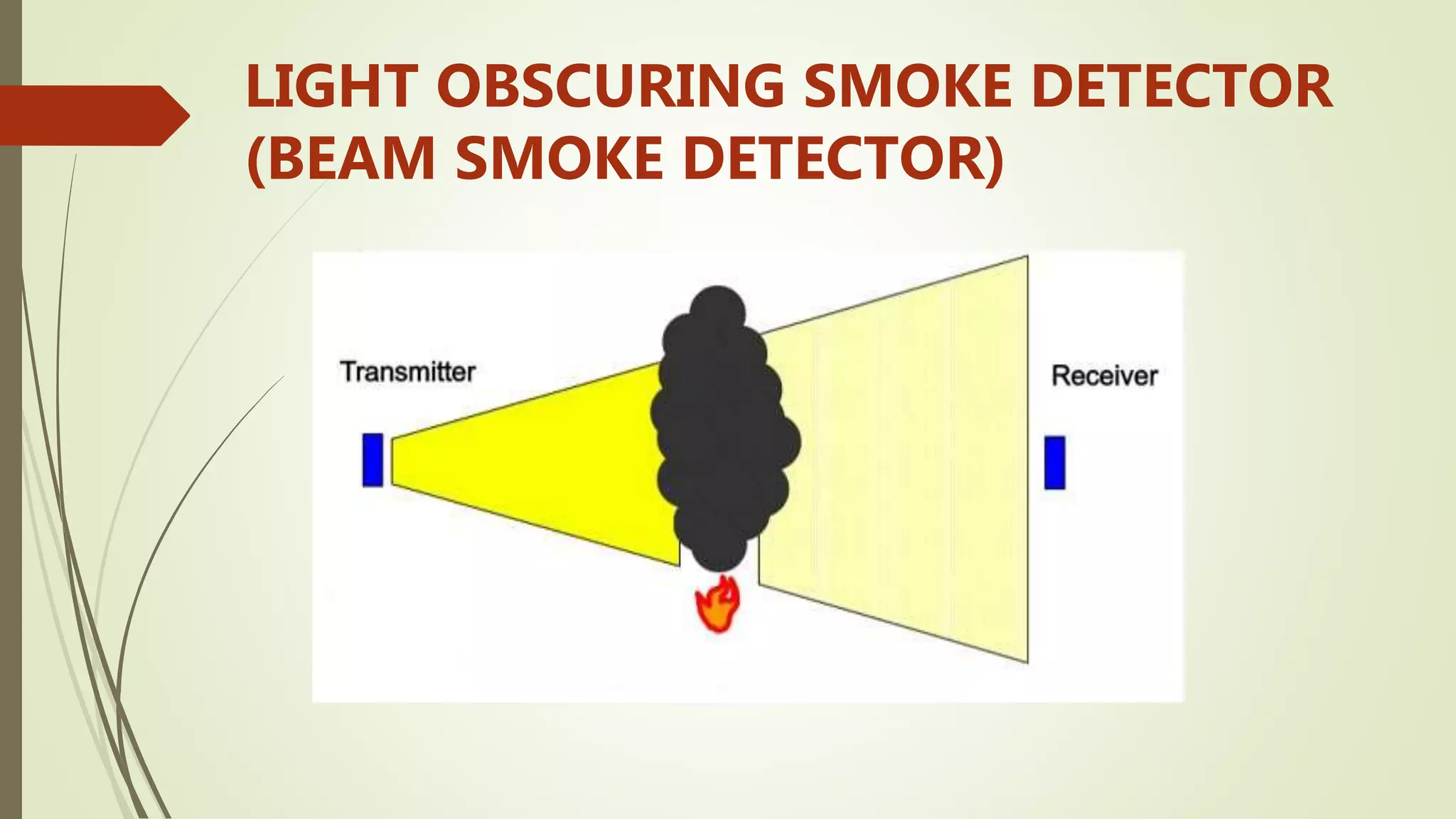
Light obscuring(blocking)
LIGHT SCATTERING SMOKE
DETECTOR
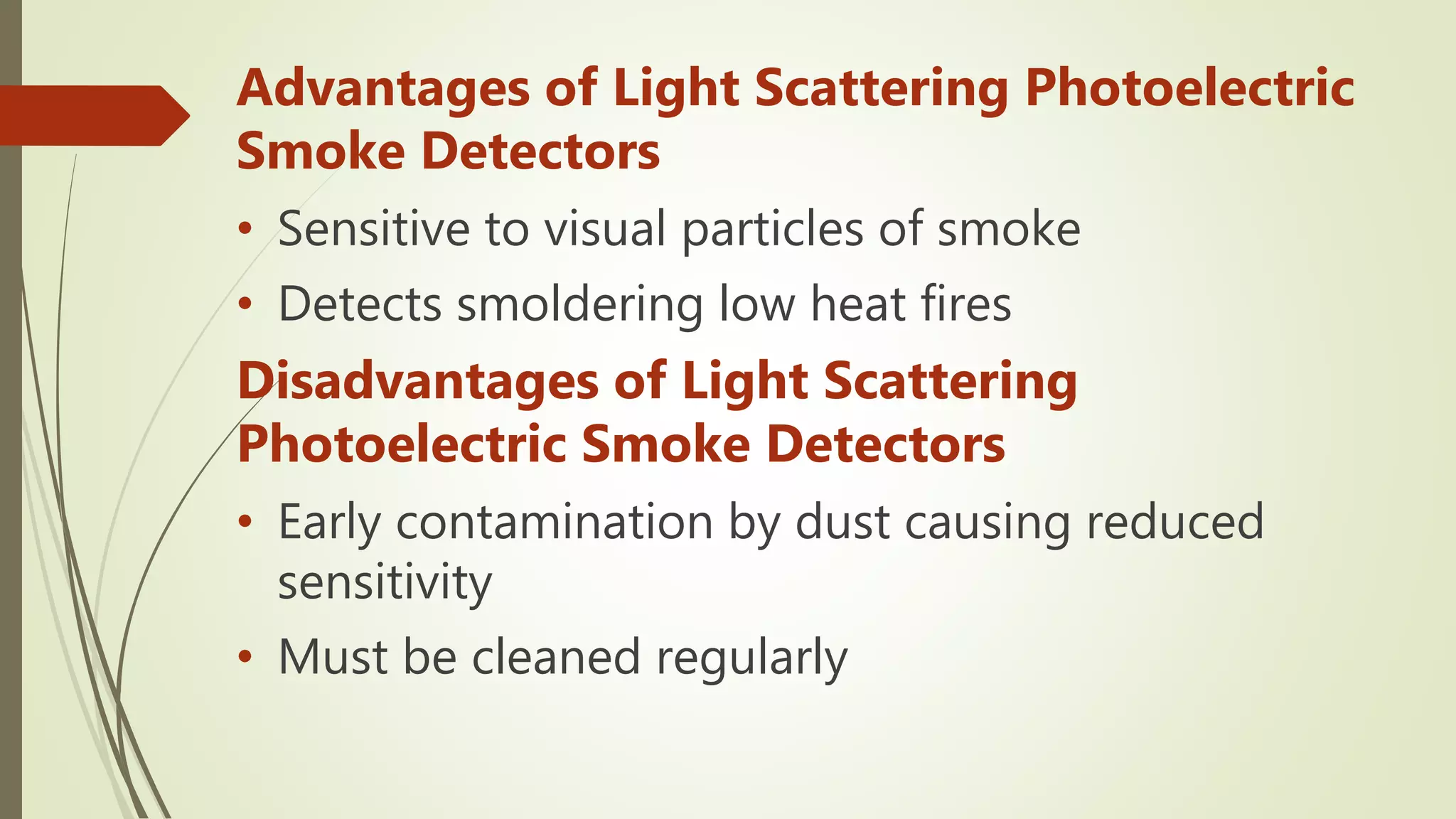
Advantages of Light Scattering Photoelectric
Smoke Detectors
• Sensitive to visual particles of smoke
• Detects smoldering low heat fires
Disadvantages of Light Scattering
Photoelectric Smoke Detectors
• Early contamination by dust causing reduced
sensitivity
• Must be cleaned regularly
LIGHT OBSCURING SMOKE DETECTOR
(BEAM SMOKE DETECTOR)
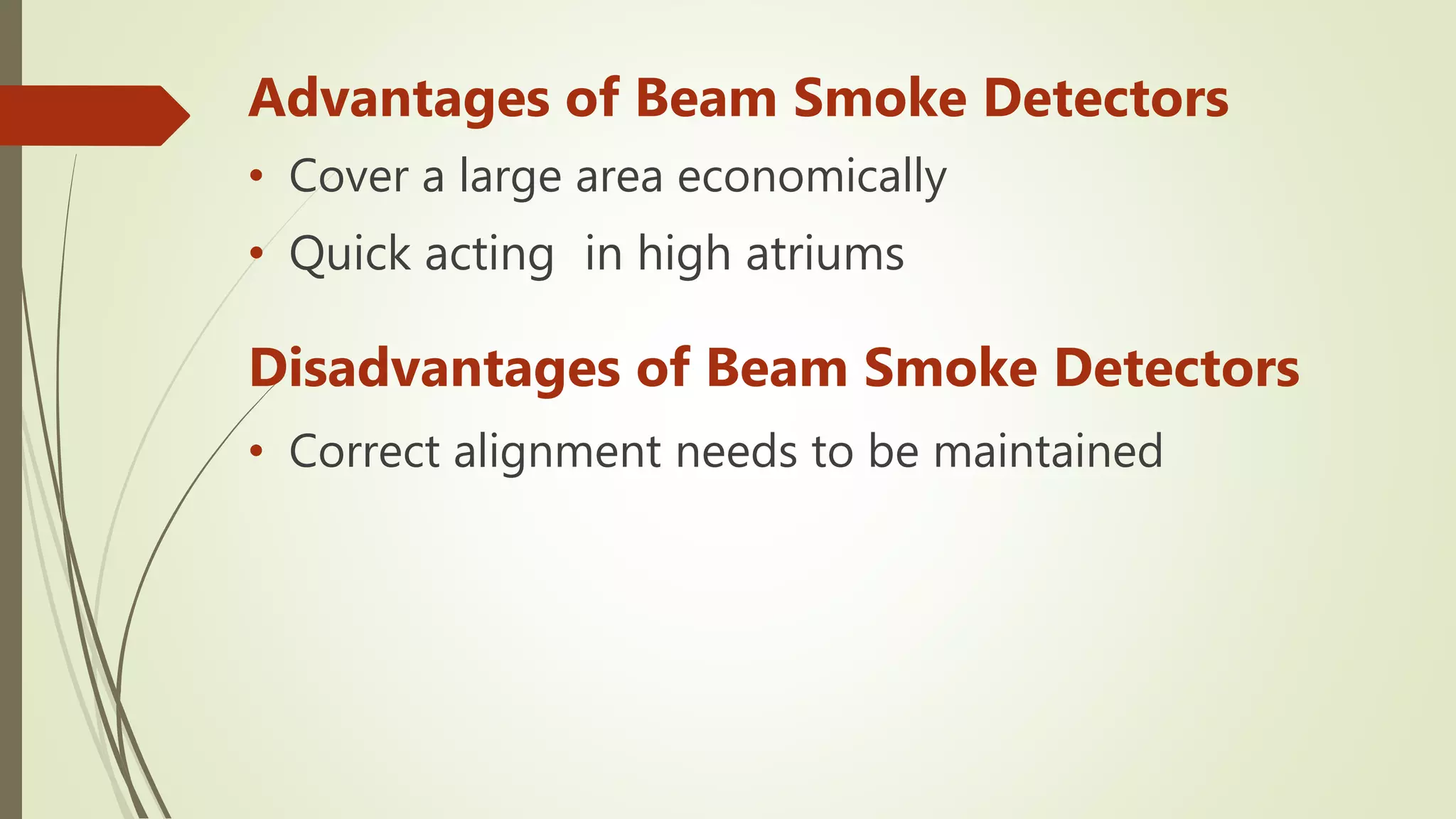
Advantages of Beam Smoke Detectors
• Cover a large area economically
• Quick acting in high atriums
Disadvantages of Beam Smoke Detectors
• Correct alignment needs to be maintained
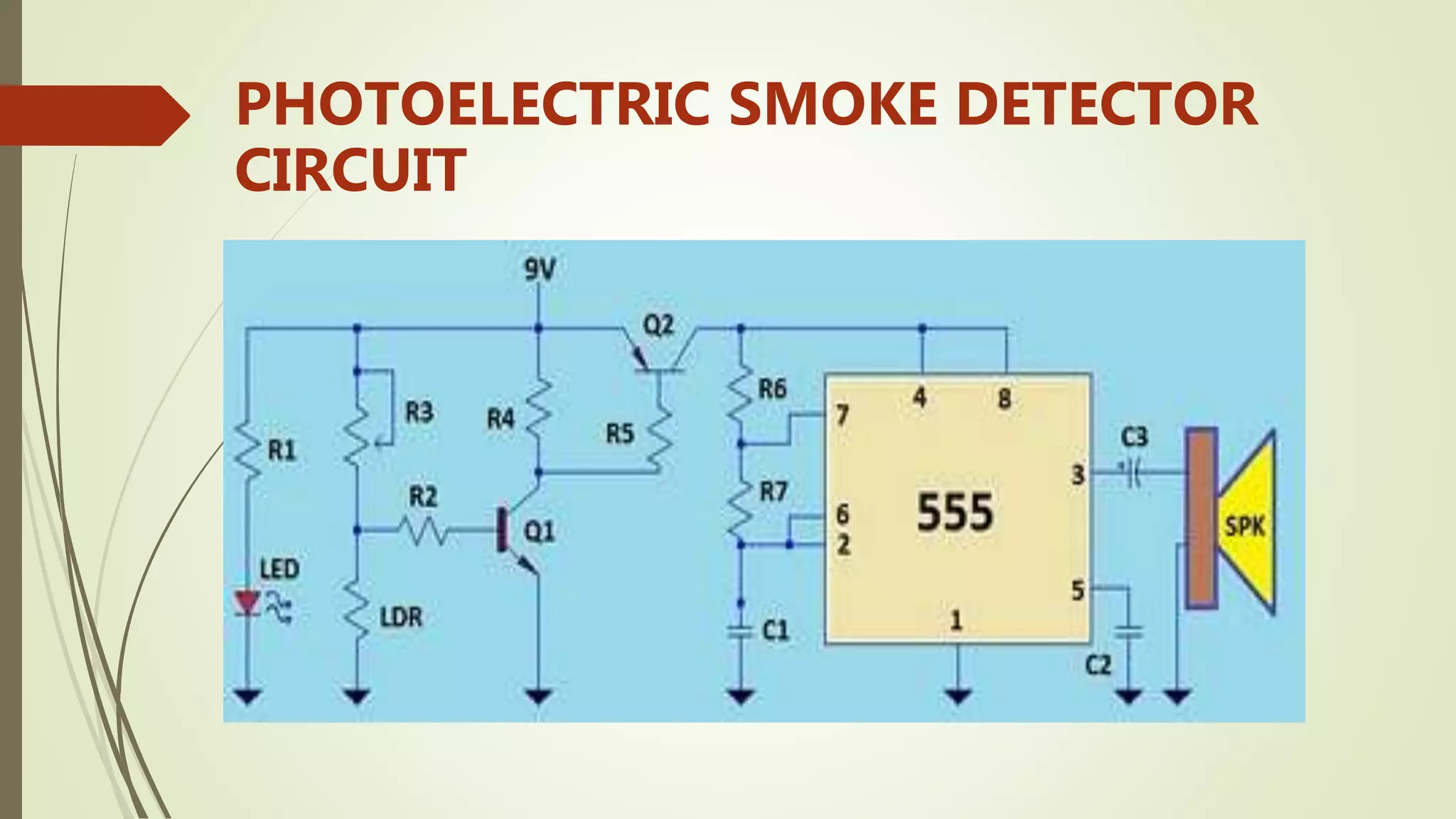
PHOTOELECTRIC SMOKE DETECTOR
CIRCUIT
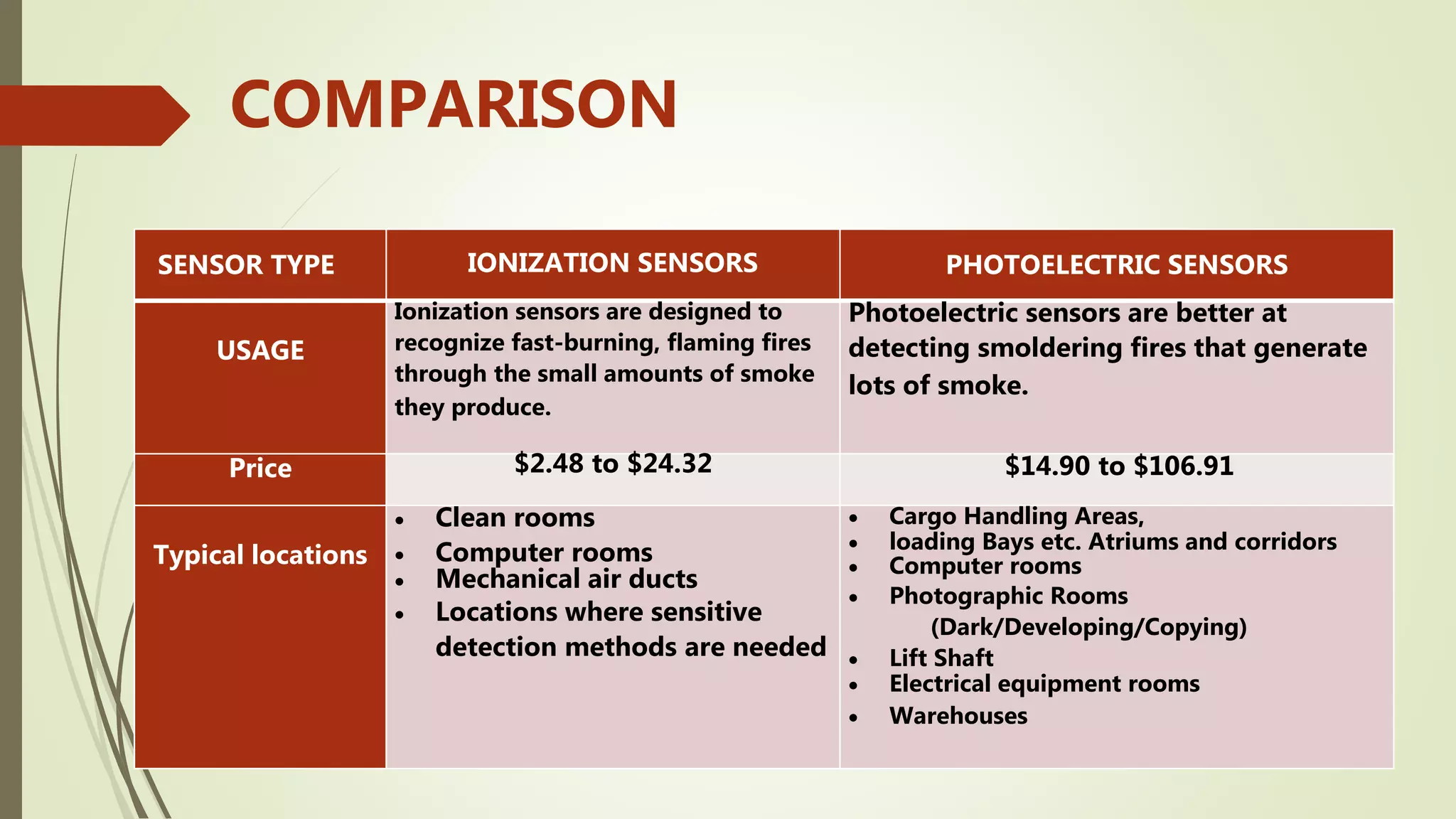
COMPARISON
SENSOR TYPE IONIZATION SENSORS PHOTOELECTRIC SENSORS
USAGE
Ionization sensors are designed to
recognize fast-burning, flaming fires
through the small amounts of smoke
they produce.
Photoelectric sensors are better at
detecting smoldering fires that generate
lots of smoke.
Price $2.48 to $24.32 $14.90 to $106.91
Typical locations
 Clean rooms
 Computer rooms
 Mechanical air ducts
 Locations where sensitive
detection methods are needed
 Cargo Handling Areas,
 loading Bays etc. Atriums and corridors
 Computer rooms
 Photographic Rooms
(Dark/Developing/Copying)
 Lift Shaft
 Electrical equipment rooms
 Warehouses
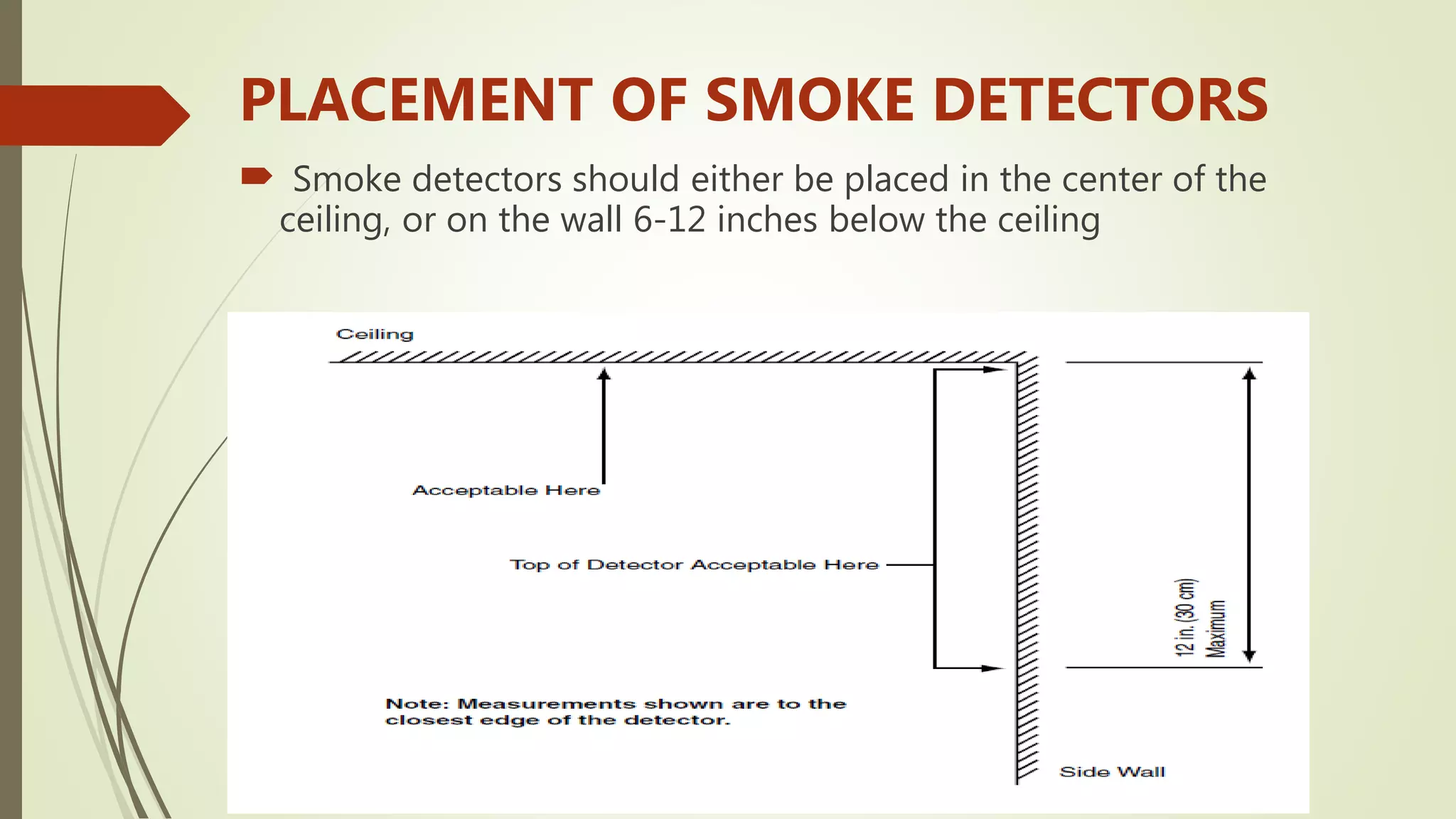
PLACEMENT OF SMOKE DETECTORS
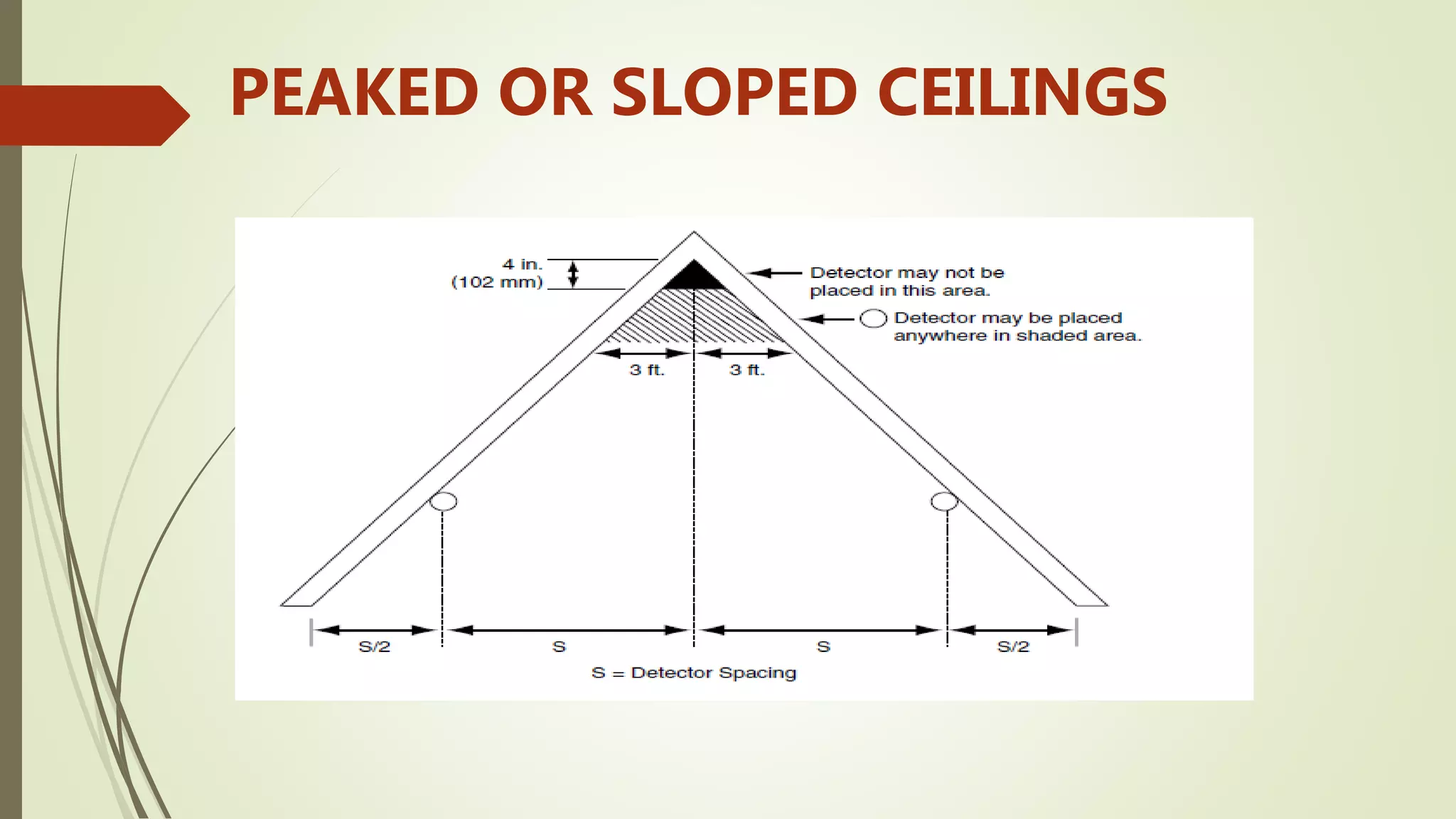
 Smoke detectors should either be placed in the center of the
ceiling, or on the wall 6-12 inches below the ceiling
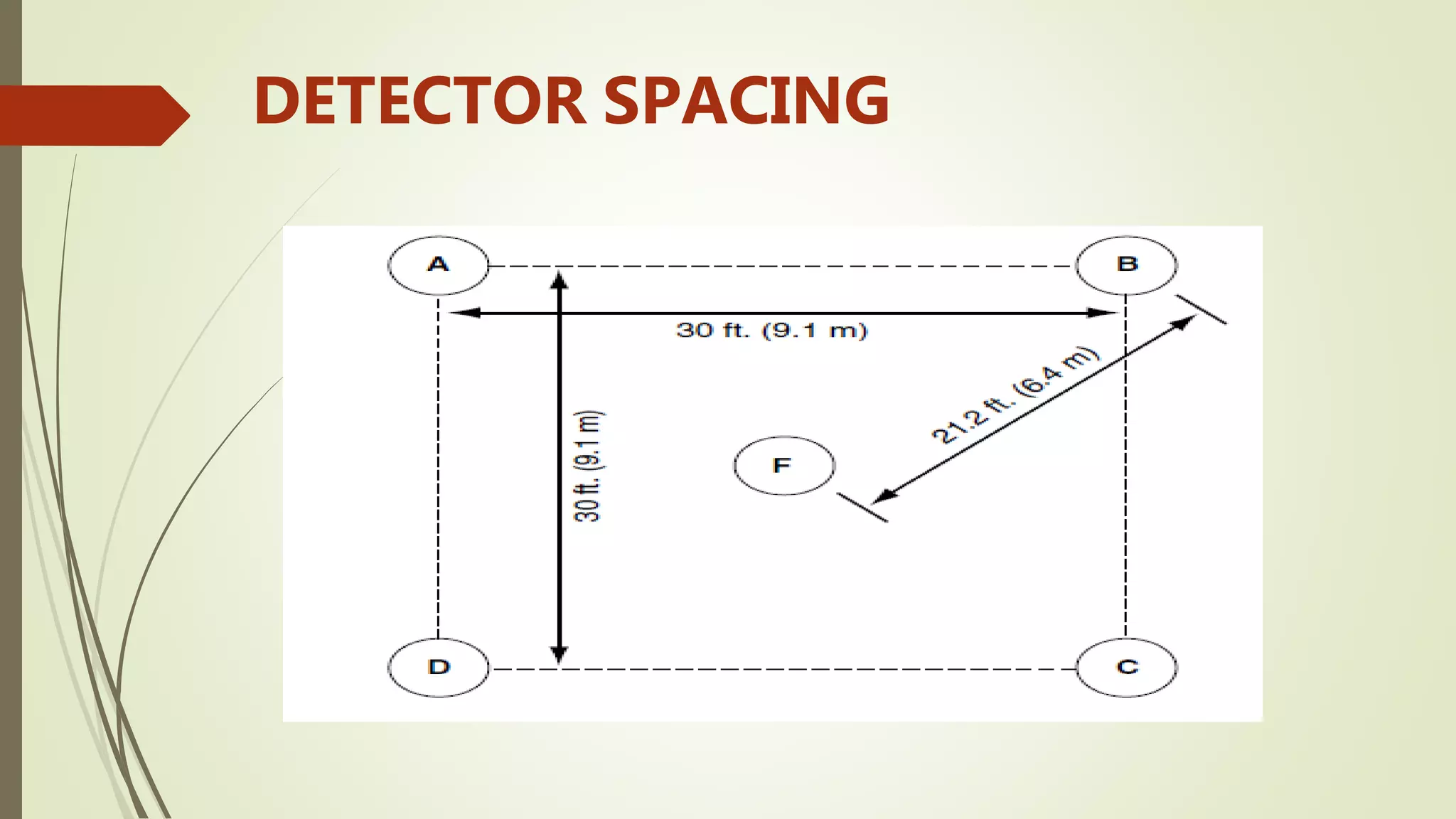
DETECTOR SPACING
PEAKED OR SLOPED CEILINGS
FLAME DETECTOR
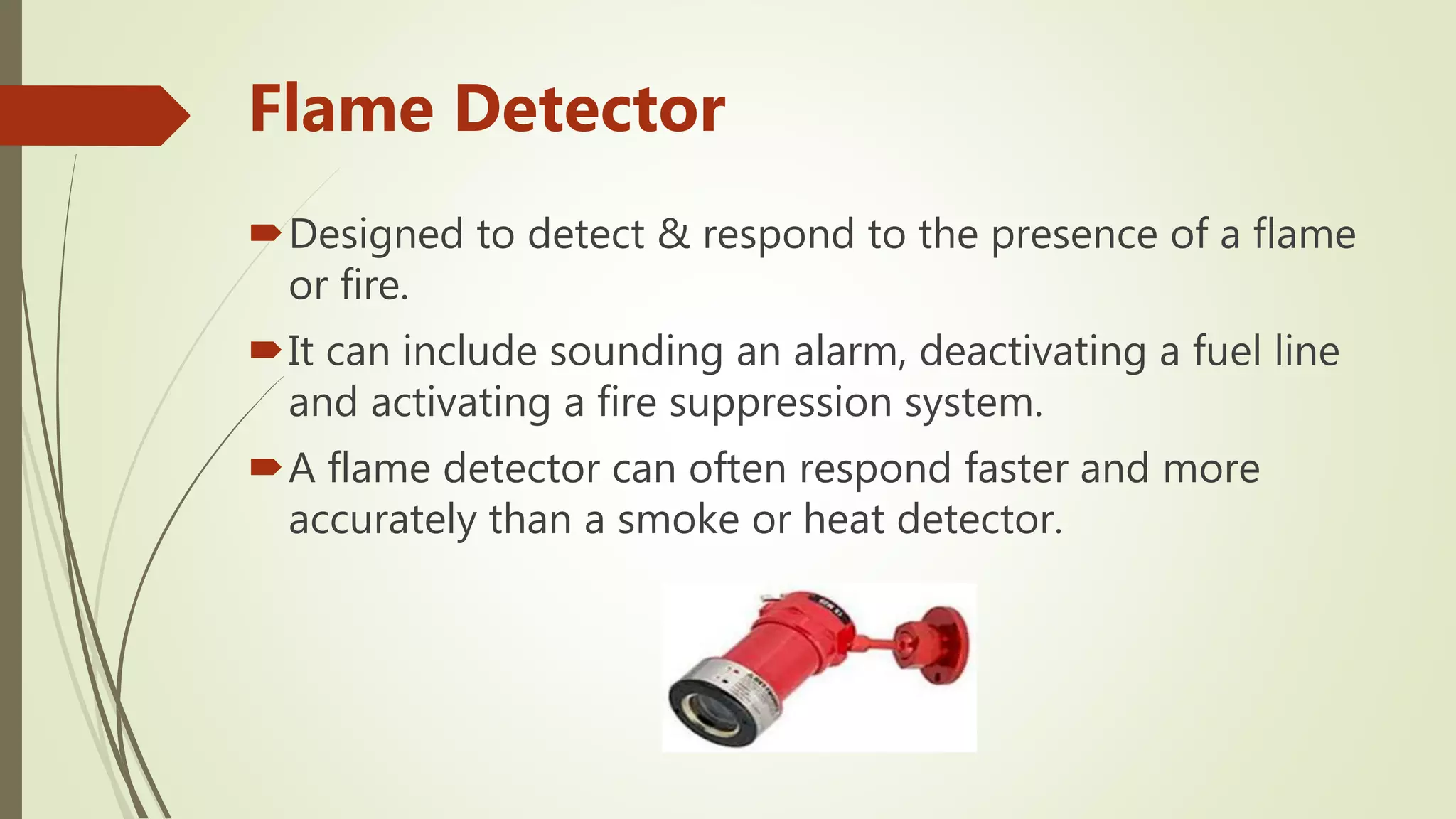
Flame Detector
Designed to detect & respond to the presence of a flame
or fire.
It can include sounding an alarm, deactivating a fuel line
and activating a fire suppression system.
A flame detector can often respond faster and more
accurately than a smoke or heat detector.
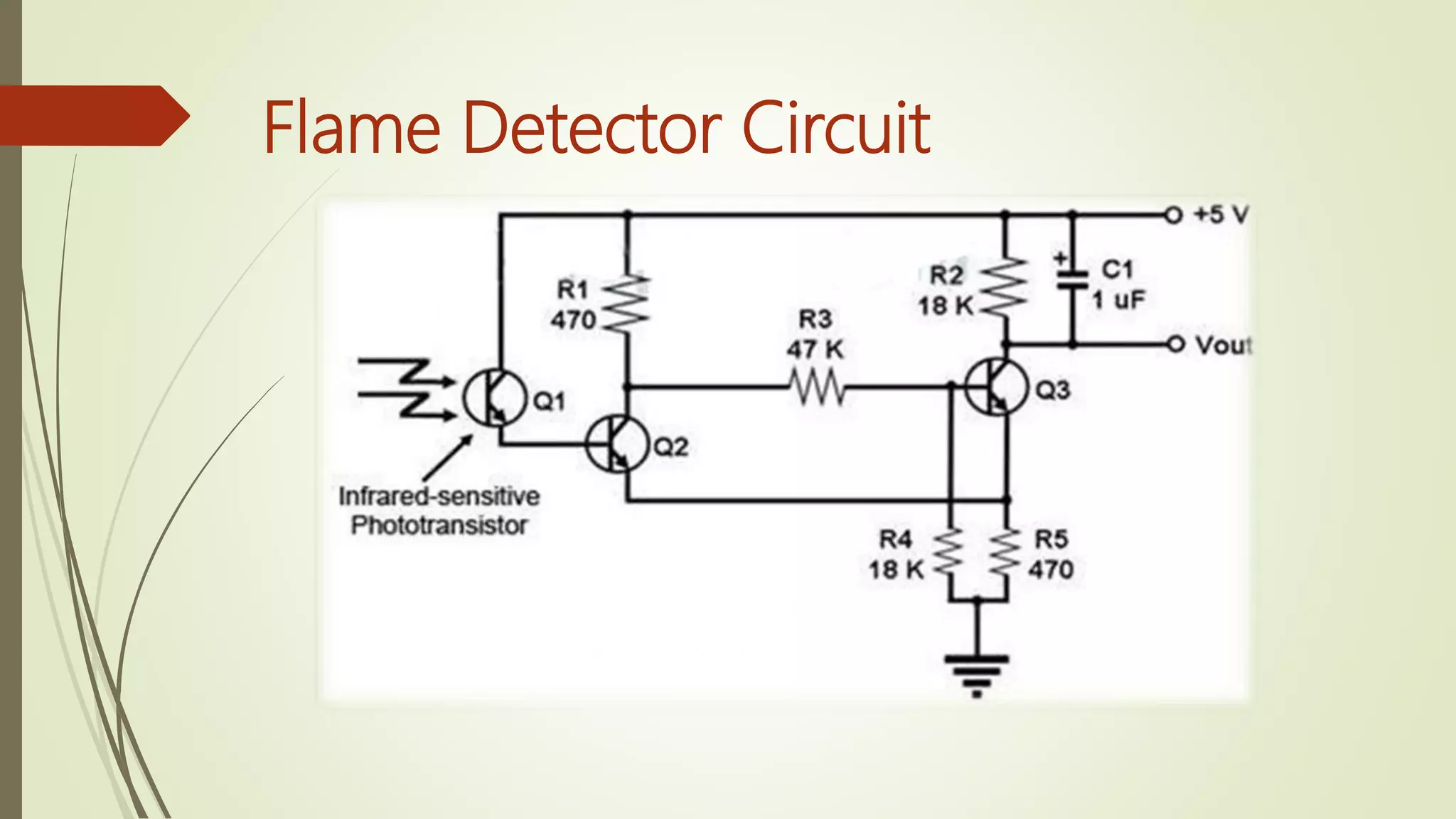
Flame Detector Circuit
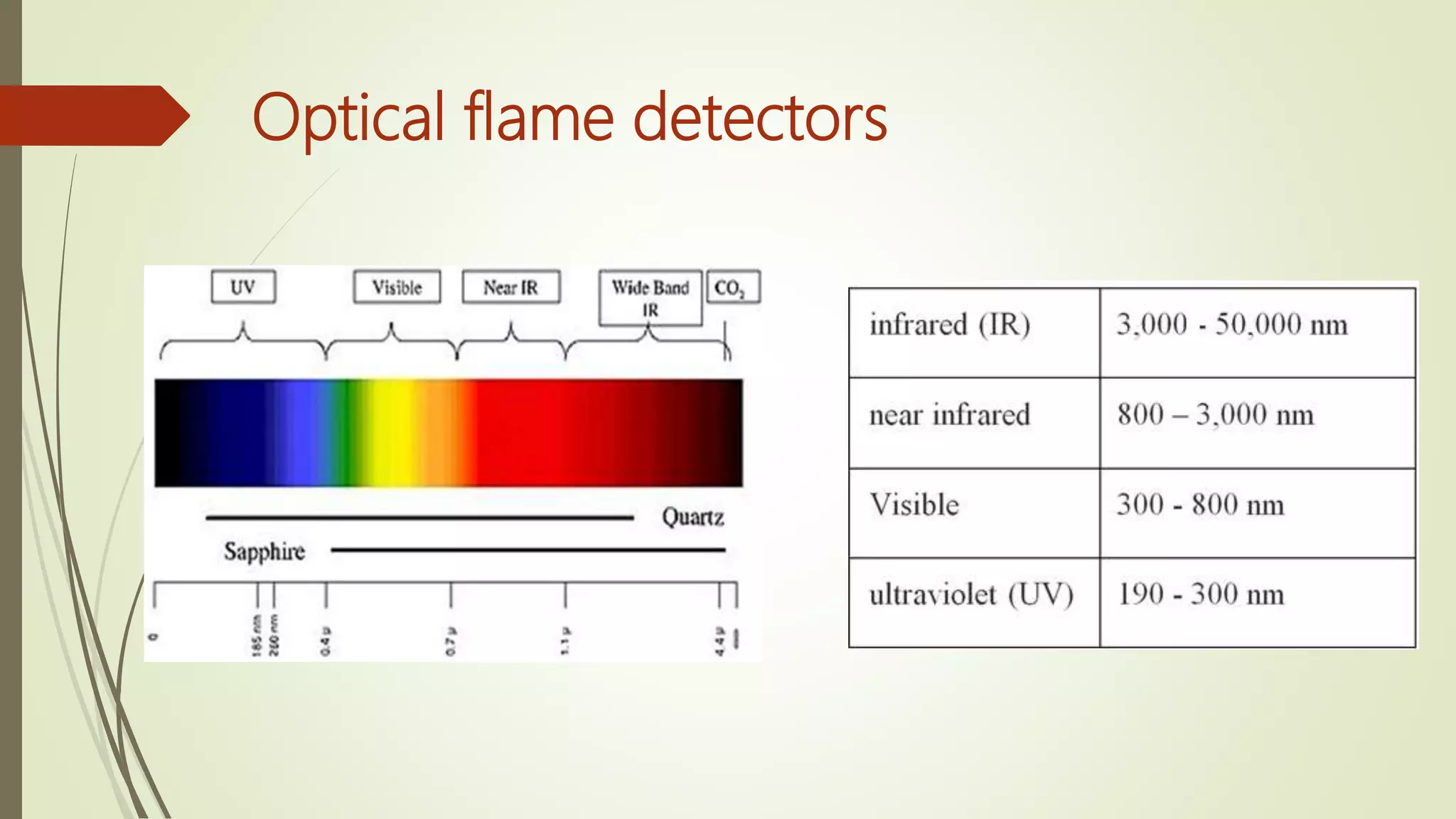
Optical flame detectors
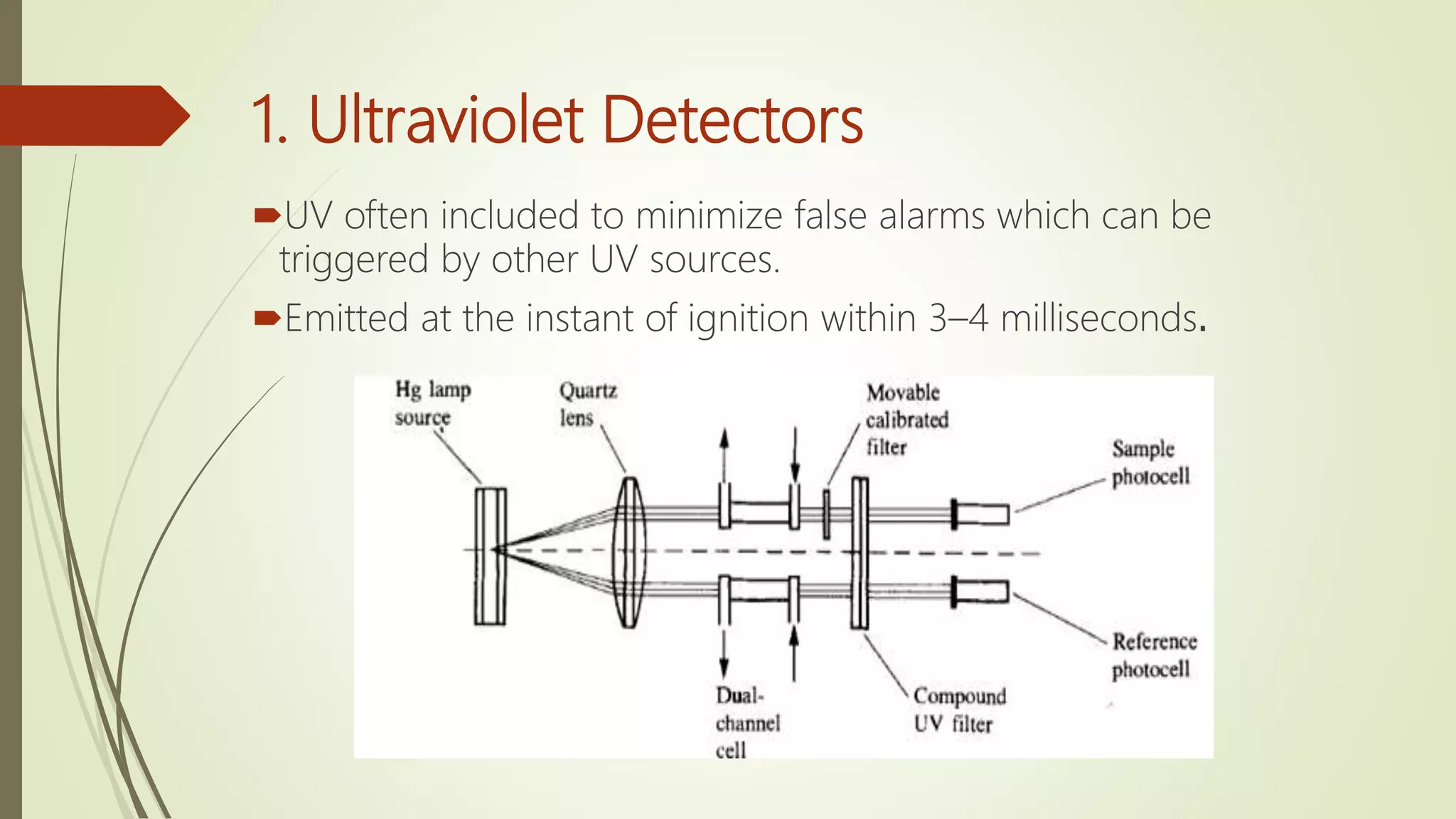
1. Ultraviolet Detectors
UV often included to minimize false alarms which can be
triggered by other UV sources.
Emitted at the instant of ignition within 3–4 milliseconds.
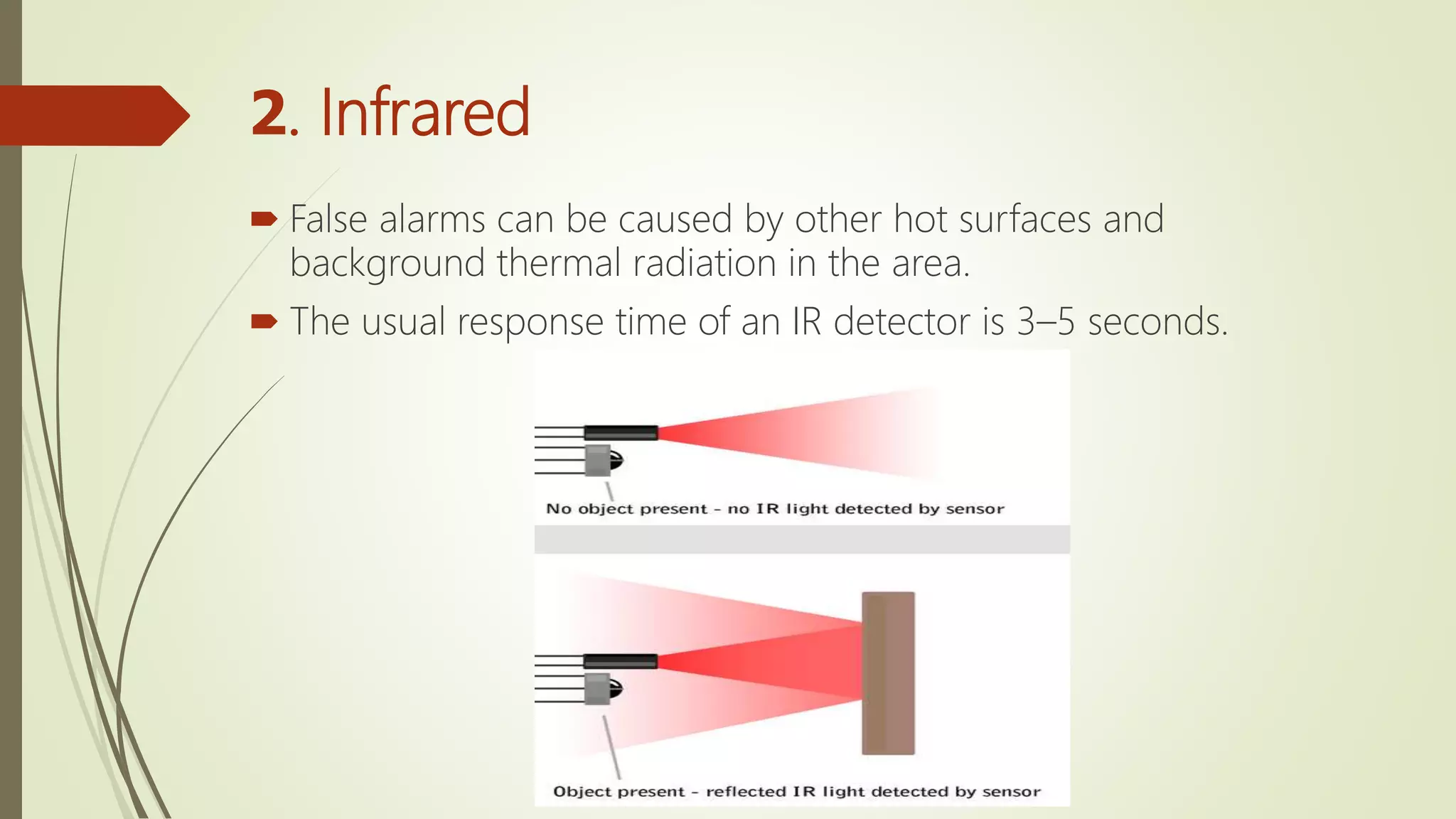
2. Infrared
 False alarms can be caused by other hot surfaces and
background thermal radiation in the area.
 The usual response time of an IR detector is 3–5 seconds.
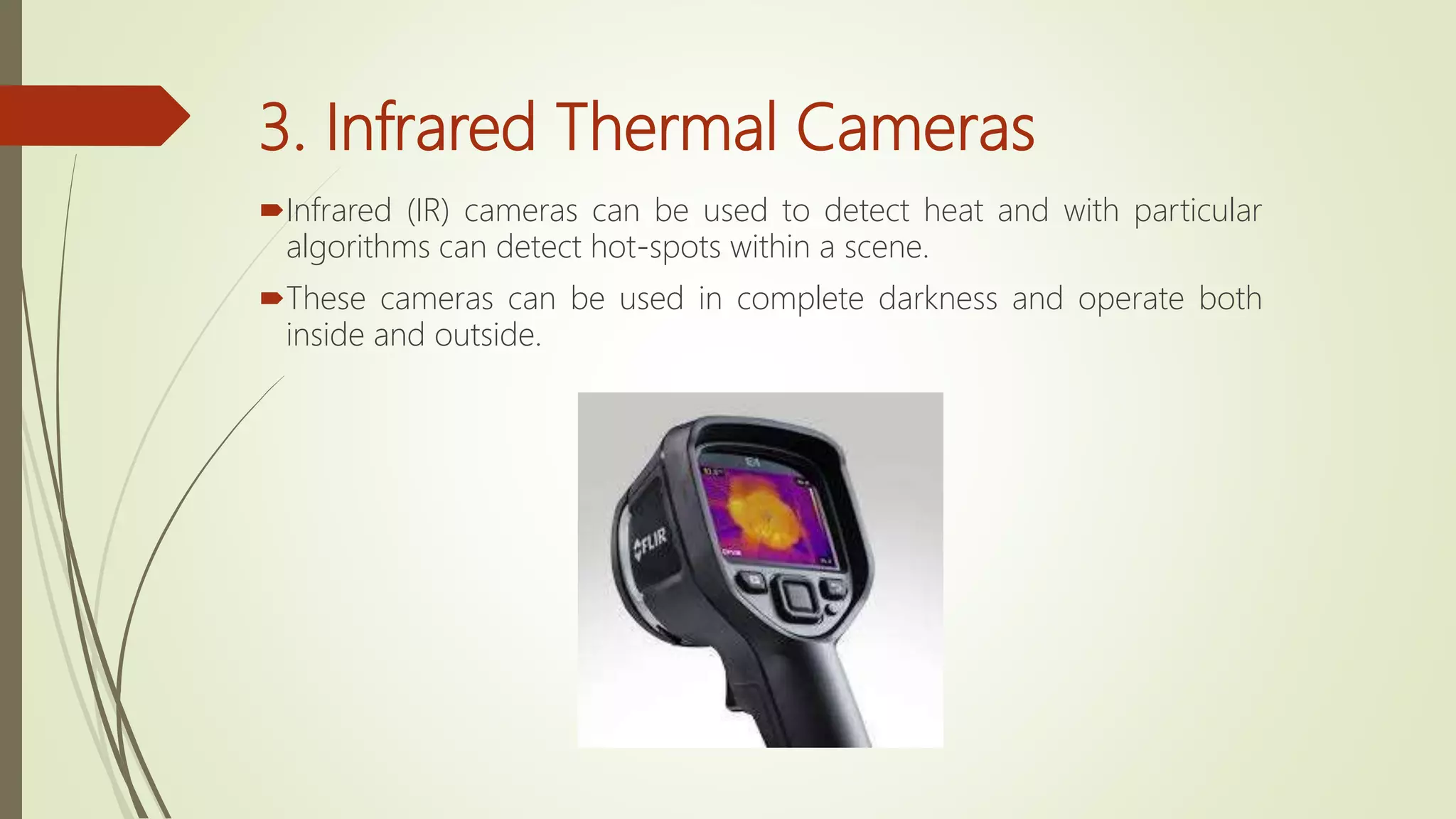
3. Infrared Thermal Cameras
Infrared (IR) cameras can be used to detect heat and with particular
algorithms can detect hot-spots within a scene.
These cameras can be used in complete darkness and operate both
inside and outside.
4. UV/IR
These detectors are sensitive to both UV and IR
wavelengths.
Detect flame by comparing the threshold signal
of both ranges.
This helps minimize false alarms.
5. IR3 flame detection
Triple-IR flame detectors compare three specific
wavelength bands within the IR spectral region.
IR3 detectors can detect at up to 65m (215ft) in less
than 5 seconds.
Most IR detectors are designed to ignore constant
background IR radiation.
Applications
Hydrogen stations.
Gas-fuelled cookers.
Industrial heating and drying systems.
Domestic heating systems.
Industrial gas turbines.
Advantages
Detection distance
Sensitivity
Speed of response
Reliability
Disadvantages
Narrow field of vision.
Expensive.
Difficult to maintain.

Fire alarm system and common types of detectors

  • 1.
    FIRE ALARM SYSTEM By: MUHMMAD FARID, AHMED MUHAMMAD, MUHMMAD ZARIA, MAHMOUD AFEFY
  • 2.
    Overview  Fire alarmsystem is installed for protection of life, property and mission. In order to a fire alarm system to be useful, it must be able to perform these functions: Detect the presence of a fire. Notify the occupants. Notify the fire department
  • 3.
    BASIC FIRE ALARMTECHNOLOGY Secondary (DC) Primary (AC) Outputs Inputs 1.Main Controller (control panel)
  • 4.
    Fire Alarm Detectors Automati c Electronic Flame infrared ultraviol et heat smoke visibleinvisible Electromechanica l 2. Classifications of fire alarm detectors
  • 5.
    3. Selection ForDetectors  Stage One Incipient: Products of Combustion particles are produced (<0.3 microns). No visible smoke or detectable heat. May occur for milliseconds or days.  Use ionization detectors
  • 6.
     Stage Two Smoldering:Visible smoke particles are (>0.3 microns). Little visible flame or noticeable heat.  Use Photoelectric Detectors
  • 7.
     Stage Three Flame:Rapid combustion produces radiant energy in the visible, and invisible (IR, UV) spectrums. begins to buildup at this stage  Use Spark or Flame Detectors
  • 8.
     Stage Four HighHeat: Uncontrolled combustion is caused by the heating of nearby combustibles to their ignition  Use Heat Detectors
  • 9.
    4. Notification Appliances(outputs)  Bells: Used if they are only for fire, or have a distinctive sound from other bell signaling devices. Often used as an external gong to indicate the flow of water in the sprinkler system.  Horns: Loud and distinctive output. Often used in high- noise environments, such as manufacturing plants.
  • 10.
     Sirens: Extremelyloud devices generally limited in use to outdoor or heavy industrial areas.  Speakers: Audible devices used in conjunction with voice
  • 11.
  • 12.
    SMOKE DETECTOR  Asmoke detector is a device that senses smoke, typically as an indicator of fire.  Smoke detector consists of two parts:  A sensor to sense the smoke  An electronic horn to horn the people  Two basic types of smoke detectors are used today ionization and photoelectric.
  • 13.
  • 14.
  • 15.
  • 16.
    Advantages of IonizationSmoke Detectors 1. Detects invisible products of combustion. It can detect fires that are in the incipient stage 2. Provides earlier detection than other detectors such thermal detectors Disadvantage of Ionization Smoke Detectors 1. Has a potential for high false alarm rate, so may provide false detection if used where dusts, or high humidity are present
  • 17.
    PHOTOELECTRIC SMOKE DETECTOR Thephotoelectric type detector utilizes light as a detection mechanism. A photoelectric, or optical, smoke detector contains a source of infrared, visible, or ultraviolet light, a lens, and a photoelectric receiver (typically a photodiode).  There are two types of photoelectric smoke detectors: Light sensing(scattering) Light obscuring(blocking)
  • 18.
  • 19.
    Advantages of LightScattering Photoelectric Smoke Detectors • Sensitive to visual particles of smoke • Detects smoldering low heat fires Disadvantages of Light Scattering Photoelectric Smoke Detectors • Early contamination by dust causing reduced sensitivity • Must be cleaned regularly
  • 20.
    LIGHT OBSCURING SMOKEDETECTOR (BEAM SMOKE DETECTOR)
  • 21.
    Advantages of BeamSmoke Detectors • Cover a large area economically • Quick acting in high atriums Disadvantages of Beam Smoke Detectors • Correct alignment needs to be maintained
  • 22.
  • 23.
    COMPARISON SENSOR TYPE IONIZATIONSENSORS PHOTOELECTRIC SENSORS USAGE Ionization sensors are designed to recognize fast-burning, flaming fires through the small amounts of smoke they produce. Photoelectric sensors are better at detecting smoldering fires that generate lots of smoke. Price $2.48 to $24.32 $14.90 to $106.91 Typical locations  Clean rooms  Computer rooms  Mechanical air ducts  Locations where sensitive detection methods are needed  Cargo Handling Areas,  loading Bays etc. Atriums and corridors  Computer rooms  Photographic Rooms (Dark/Developing/Copying)  Lift Shaft  Electrical equipment rooms  Warehouses
  • 24.
    PLACEMENT OF SMOKEDETECTORS  Smoke detectors should either be placed in the center of the ceiling, or on the wall 6-12 inches below the ceiling
  • 25.
  • 26.
  • 27.
  • 28.
    Flame Detector Designed todetect & respond to the presence of a flame or fire. It can include sounding an alarm, deactivating a fuel line and activating a fire suppression system. A flame detector can often respond faster and more accurately than a smoke or heat detector.
  • 29.
  • 30.
  • 31.
    1. Ultraviolet Detectors UVoften included to minimize false alarms which can be triggered by other UV sources. Emitted at the instant of ignition within 3–4 milliseconds.
  • 32.
    2. Infrared  Falsealarms can be caused by other hot surfaces and background thermal radiation in the area.  The usual response time of an IR detector is 3–5 seconds.
  • 33.
    3. Infrared ThermalCameras Infrared (IR) cameras can be used to detect heat and with particular algorithms can detect hot-spots within a scene. These cameras can be used in complete darkness and operate both inside and outside.
  • 34.
    4. UV/IR These detectorsare sensitive to both UV and IR wavelengths. Detect flame by comparing the threshold signal of both ranges. This helps minimize false alarms.
  • 35.
    5. IR3 flamedetection Triple-IR flame detectors compare three specific wavelength bands within the IR spectral region. IR3 detectors can detect at up to 65m (215ft) in less than 5 seconds. Most IR detectors are designed to ignore constant background IR radiation.
  • 36.
    Applications Hydrogen stations. Gas-fuelled cookers. Industrialheating and drying systems. Domestic heating systems. Industrial gas turbines.
  • 37.
    Advantages Detection distance Sensitivity Speed ofresponse Reliability Disadvantages Narrow field of vision. Expensive. Difficult to maintain.