ACTIVE FIRE FIGHTING SYSTEM
• Function :
1- To detect the early stage of fire
2- To give the fire emergency warning
3- To help people rescuing themselves
4- To give an early stage of help.
• 2 types of Active System :
1- Portable
2- Fixed
PORTABLE ACTIVE SYSTEM
FIRE EXTINGUISHER
FIRE BLANKET
FIRE EXTINGUISHER
• A portable fire extinguisher must contain the type of fire
extinguishing agent suitable for the fire it is required to
extinguish.
• It must also be clearly identifiable by colour coding for its
intended purpose.
• Fires can be grouped:
● Solid fuels, e.g. wood, paper, cloth, etc.
● Flammable liquids, e.g. petrol, oil, paints, fats, etc.
● Flammable gases, e.g. methane, propane, acetylene, etc.
● Flammable metals, e.g. zinc, aluminium, uranium, etc.
● Electrical.
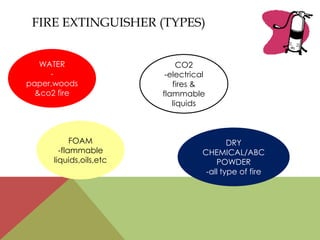
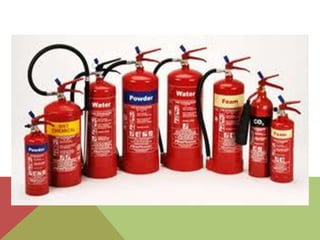
FIRE EXTINGUISHER (TYPES)
WATER
-
paper,woods
&co2 fire
FOAM
-flammable
liquids,oils,etc
DRY
CHEMICAL/ABC
POWDER
-all type of fire
CO2
-electrical
fires &
flammable
liquids
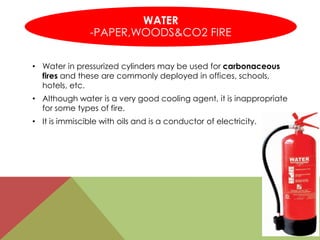
• Water in pressurized cylinders may be used for carbonaceous
fires and these are commonly deployed in offices, schools,
hotels, etc.
• Although water is a very good cooling agent, it is inappropriate
for some types of fire.
• It is immiscible with oils and is a conductor of electricity.
WATER
-PAPER,WOODS&CO2 FIRE
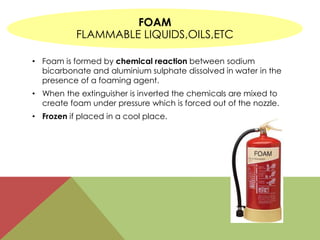
• Foam is formed by chemical reaction between sodium
bicarbonate and aluminium sulphate dissolved in water in the
presence of a foaming agent.
• When the extinguisher is inverted the chemicals are mixed to
create foam under pressure which is forced out of the nozzle.
• Frozen if placed in a cool place.
FOAM
FLAMMABLE LIQUIDS,OILS,ETC
• carbon dioxide is pressurised as a liquid inside a cylinder
• Does not impinge/colourless/odourless
• Disadvantages :
- Not refillable
- Unreasonable weighing
CO2
-ELECTRICAL FIRES & FLAMMABLE
LIQUIDS
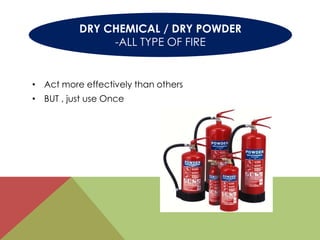
• Act more effectively than others
• BUT , just use Once
DRY CHEMICAL / DRY POWDER
-ALL TYPE OF FIRE
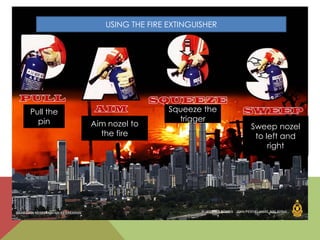
USING THE FIRE EXTINGUISHER
Pull the
pin Aim nozel to
the fire
Squeeze the
trigger
Sweep nozel
to left and
right
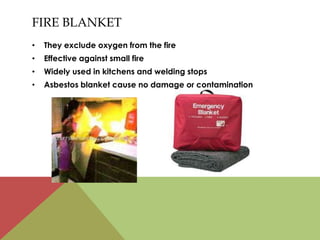
FIRE BLANKET
• They exclude oxygen from the fire
• Effective against small fire
• Widely used in kitchens and welding stops
• Asbestos blanket cause no damage or contamination
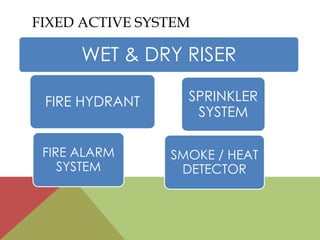
FIXED ACTIVE SYSTEM
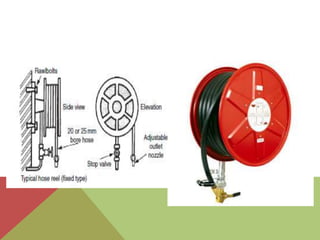
WET & DRY RISER
FIRE HYDRANT
FIRE ALARM
SYSTEM
SMOKE / HEAT
DETECTOR
SPRINKLER
SYSTEM
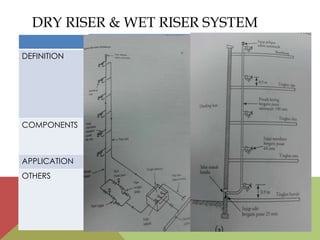
DRY RISER & WET RISER SYSTEM
DRY RISER WET RISER
DEFINITION System equipped with
valves & plumbing that
facilitates Fire Brigade
pump water to the
upper floors.
System equipped with
valves and pipes that have
a fixed water charges
COMPONENTS -Landing valve
-Main inlet connection
-duty/standby pump
-hose reel
-jockey pump
APPLICATION Height > 30.5m Height < 30.5m
OTHERS -Pipe is always empty
-located where users
are least likely
to be endangered by
the fire
Internal hydrant and water
is always in charge.
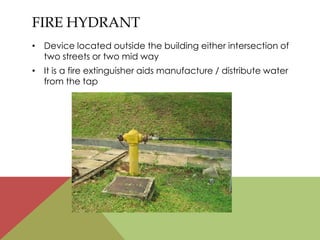
FIRE HYDRANT
• Device located outside the building either intersection of
two streets or two mid way
• It is a fire extinguisher aids manufacture / distribute water
from the tap
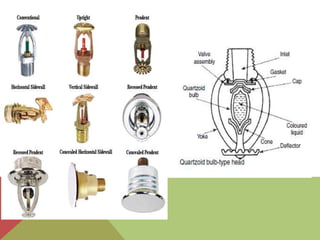
SPRINKLER SYSTEM
• Water sprinklers provide an automatic spray dedicated
to the area of fire outbreak
• Sprinkler heads have temperature sensitive elements
that respond immediately to heat
• A rapid response which reduces and isolates fire
damage, sprinklers use less water to control a fire than
the firefighting service, therefore preventing further
damage from excess water.
SPRINKLER SYSTEM
INSTALLATION CRITERIA
1- Pipe materials - Copper tube (BS EN 1057)
- Post-chlorinated polyvinylchloride (CPVC)
2- System -mains supplied, wet.
3- Pipe sizes - 25 mm minimum
4- Sprinkler head spacing - area covered by one
head, maximum 12 m2 .
5- Maximum distance between heads 4 m.
6- Maximum distance from wall to ceiling mounted head 2 m.
7- Operating pressure - Minimum 0.5 bar (50 kPa).
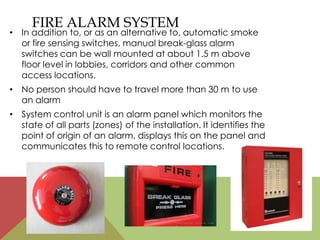
FIRE ALARM SYSTEM
• In addition to, or as an alternative to, automatic smoke
or fire sensing switches, manual break-glass alarm
switches can be wall mounted at about 1.5 m above
floor level in lobbies, corridors and other common
access locations.
• No person should have to travel more than 30 m to use
an alarm
• System control unit is an alarm panel which monitors the
state of all parts (zones) of the installation. It identifies the
point of origin of an alarm, displays this on the panel and
communicates this to remote control locations.
DISCUSSION 1
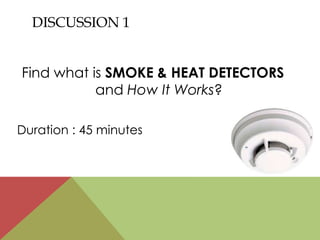
Find what is SMOKE & HEAT DETECTORS
and How It Works?
Duration : 45 minutes
ASSIGNMENT 1
Do a personal visit to IFSEC Southeast Asia 2013 that will be held
on 11-13 September 2013 at Kuala Lumpur Convention Centre.
Task :
1. Choose at least three type of different Fire Fighting System.
2. Ask the exhibitors How they work ?/What are their specialty ?/
How much the cost ?
3. Write a report regarding the information that you get from the
exhibition.
Report’s Requirements :
1. Attach the entry passes as evidence that you had been to the
exhibition.
2. Make all the brouchers or templates as References
DEADLINE : 27 SEPTEMBER 2013 (FRIDAY BEFORE 12 NOON)
THIS IS AN INDIVIDUAL ASSIGNMENT

Fire fighting active system

  • 2.
    ACTIVE FIRE FIGHTINGSYSTEM • Function : 1- To detect the early stage of fire 2- To give the fire emergency warning 3- To help people rescuing themselves 4- To give an early stage of help. • 2 types of Active System : 1- Portable 2- Fixed
  • 3.
    PORTABLE ACTIVE SYSTEM FIREEXTINGUISHER FIRE BLANKET
  • 4.
    FIRE EXTINGUISHER • Aportable fire extinguisher must contain the type of fire extinguishing agent suitable for the fire it is required to extinguish. • It must also be clearly identifiable by colour coding for its intended purpose. • Fires can be grouped: ● Solid fuels, e.g. wood, paper, cloth, etc. ● Flammable liquids, e.g. petrol, oil, paints, fats, etc. ● Flammable gases, e.g. methane, propane, acetylene, etc. ● Flammable metals, e.g. zinc, aluminium, uranium, etc. ● Electrical.
  • 5.
    FIRE EXTINGUISHER (TYPES) WATER - paper,woods &co2fire FOAM -flammable liquids,oils,etc DRY CHEMICAL/ABC POWDER -all type of fire CO2 -electrical fires & flammable liquids
  • 7.
    • Water inpressurized cylinders may be used for carbonaceous fires and these are commonly deployed in offices, schools, hotels, etc. • Although water is a very good cooling agent, it is inappropriate for some types of fire. • It is immiscible with oils and is a conductor of electricity. WATER -PAPER,WOODS&CO2 FIRE
  • 8.
    • Foam isformed by chemical reaction between sodium bicarbonate and aluminium sulphate dissolved in water in the presence of a foaming agent. • When the extinguisher is inverted the chemicals are mixed to create foam under pressure which is forced out of the nozzle. • Frozen if placed in a cool place. FOAM FLAMMABLE LIQUIDS,OILS,ETC
  • 9.
    • carbon dioxideis pressurised as a liquid inside a cylinder • Does not impinge/colourless/odourless • Disadvantages : - Not refillable - Unreasonable weighing CO2 -ELECTRICAL FIRES & FLAMMABLE LIQUIDS
  • 10.
    • Act moreeffectively than others • BUT , just use Once DRY CHEMICAL / DRY POWDER -ALL TYPE OF FIRE
  • 11.
    USING THE FIREEXTINGUISHER Pull the pin Aim nozel to the fire Squeeze the trigger Sweep nozel to left and right
  • 12.
    FIRE BLANKET • Theyexclude oxygen from the fire • Effective against small fire • Widely used in kitchens and welding stops • Asbestos blanket cause no damage or contamination
  • 13.
    FIXED ACTIVE SYSTEM WET& DRY RISER FIRE HYDRANT FIRE ALARM SYSTEM SMOKE / HEAT DETECTOR SPRINKLER SYSTEM
  • 14.
    DRY RISER &WET RISER SYSTEM DRY RISER WET RISER DEFINITION System equipped with valves & plumbing that facilitates Fire Brigade pump water to the upper floors. System equipped with valves and pipes that have a fixed water charges COMPONENTS -Landing valve -Main inlet connection -duty/standby pump -hose reel -jockey pump APPLICATION Height > 30.5m Height < 30.5m OTHERS -Pipe is always empty -located where users are least likely to be endangered by the fire Internal hydrant and water is always in charge.
  • 16.
    FIRE HYDRANT • Devicelocated outside the building either intersection of two streets or two mid way • It is a fire extinguisher aids manufacture / distribute water from the tap
  • 17.
    SPRINKLER SYSTEM • Watersprinklers provide an automatic spray dedicated to the area of fire outbreak • Sprinkler heads have temperature sensitive elements that respond immediately to heat • A rapid response which reduces and isolates fire damage, sprinklers use less water to control a fire than the firefighting service, therefore preventing further damage from excess water.
  • 18.
    SPRINKLER SYSTEM INSTALLATION CRITERIA 1-Pipe materials - Copper tube (BS EN 1057) - Post-chlorinated polyvinylchloride (CPVC) 2- System -mains supplied, wet. 3- Pipe sizes - 25 mm minimum 4- Sprinkler head spacing - area covered by one head, maximum 12 m2 . 5- Maximum distance between heads 4 m. 6- Maximum distance from wall to ceiling mounted head 2 m. 7- Operating pressure - Minimum 0.5 bar (50 kPa).
  • 20.
    FIRE ALARM SYSTEM •In addition to, or as an alternative to, automatic smoke or fire sensing switches, manual break-glass alarm switches can be wall mounted at about 1.5 m above floor level in lobbies, corridors and other common access locations. • No person should have to travel more than 30 m to use an alarm • System control unit is an alarm panel which monitors the state of all parts (zones) of the installation. It identifies the point of origin of an alarm, displays this on the panel and communicates this to remote control locations.
  • 21.
    DISCUSSION 1 Find whatis SMOKE & HEAT DETECTORS and How It Works? Duration : 45 minutes
  • 22.
    ASSIGNMENT 1 Do apersonal visit to IFSEC Southeast Asia 2013 that will be held on 11-13 September 2013 at Kuala Lumpur Convention Centre. Task : 1. Choose at least three type of different Fire Fighting System. 2. Ask the exhibitors How they work ?/What are their specialty ?/ How much the cost ? 3. Write a report regarding the information that you get from the exhibition. Report’s Requirements : 1. Attach the entry passes as evidence that you had been to the exhibition. 2. Make all the brouchers or templates as References DEADLINE : 27 SEPTEMBER 2013 (FRIDAY BEFORE 12 NOON) THIS IS AN INDIVIDUAL ASSIGNMENT