Halogenated Total Flooding FireHalogenated Total Flooding Fire
Suppression AgentsSuppression Agents
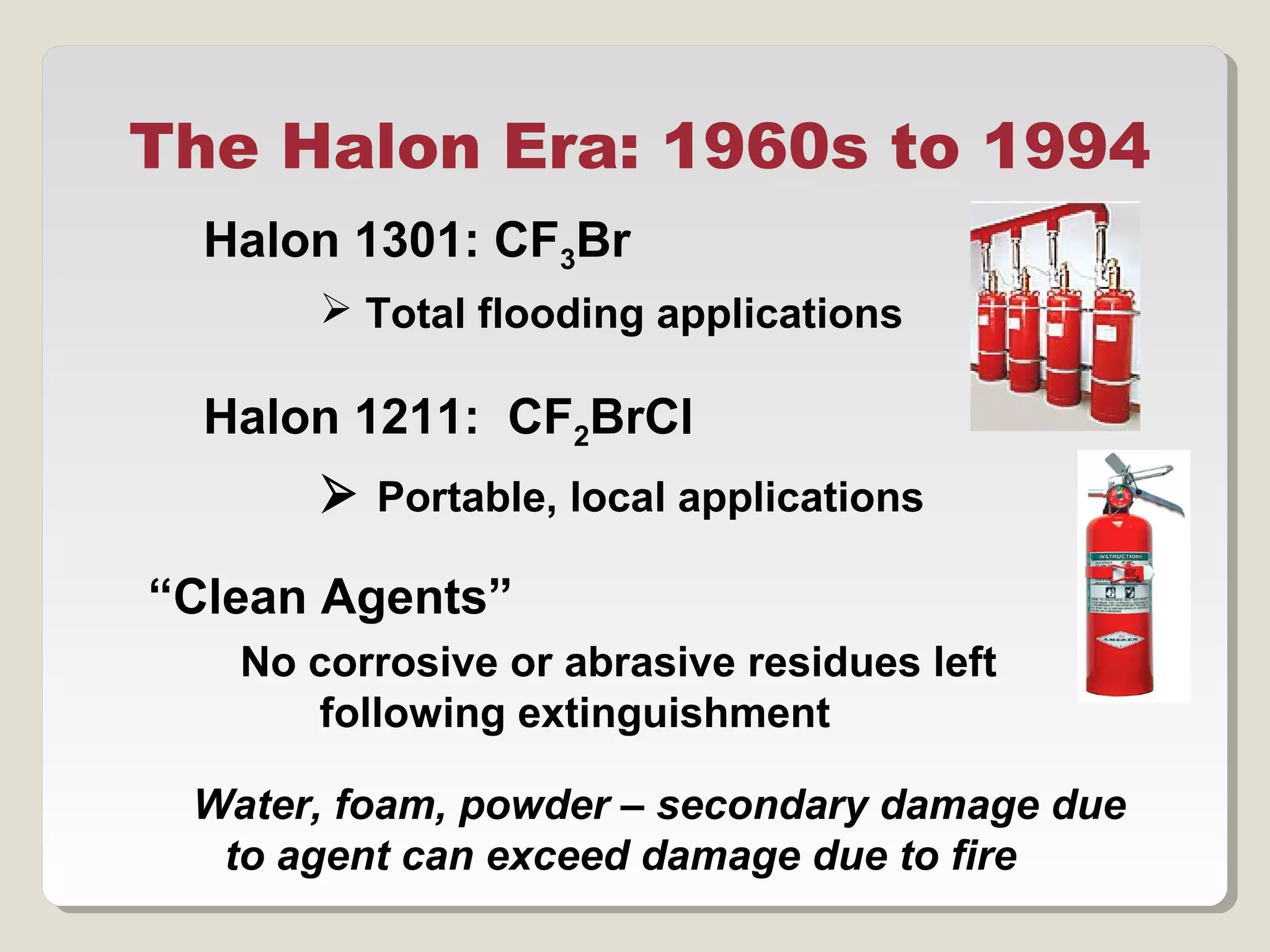
The Halon Era: 1960s to 1994
Halon 1301: CF3Br
 Total flooding applications
Halon 1211: CF2BrCl
 Portable, local applications
“Clean Agents”
No corrosive or abrasive residues left
following extinguishment
Water, foam, powder – secondary damage due
to agent can exceed damage due to fire
Clean Agents under NFPA 2001
 Safe for occupied areas protection
 No corrosive residues
No damage to sensitive/expensive assets
 No cleanup required after discharge
No business interruption
Source: Alinenan ROI Report, January 2004.
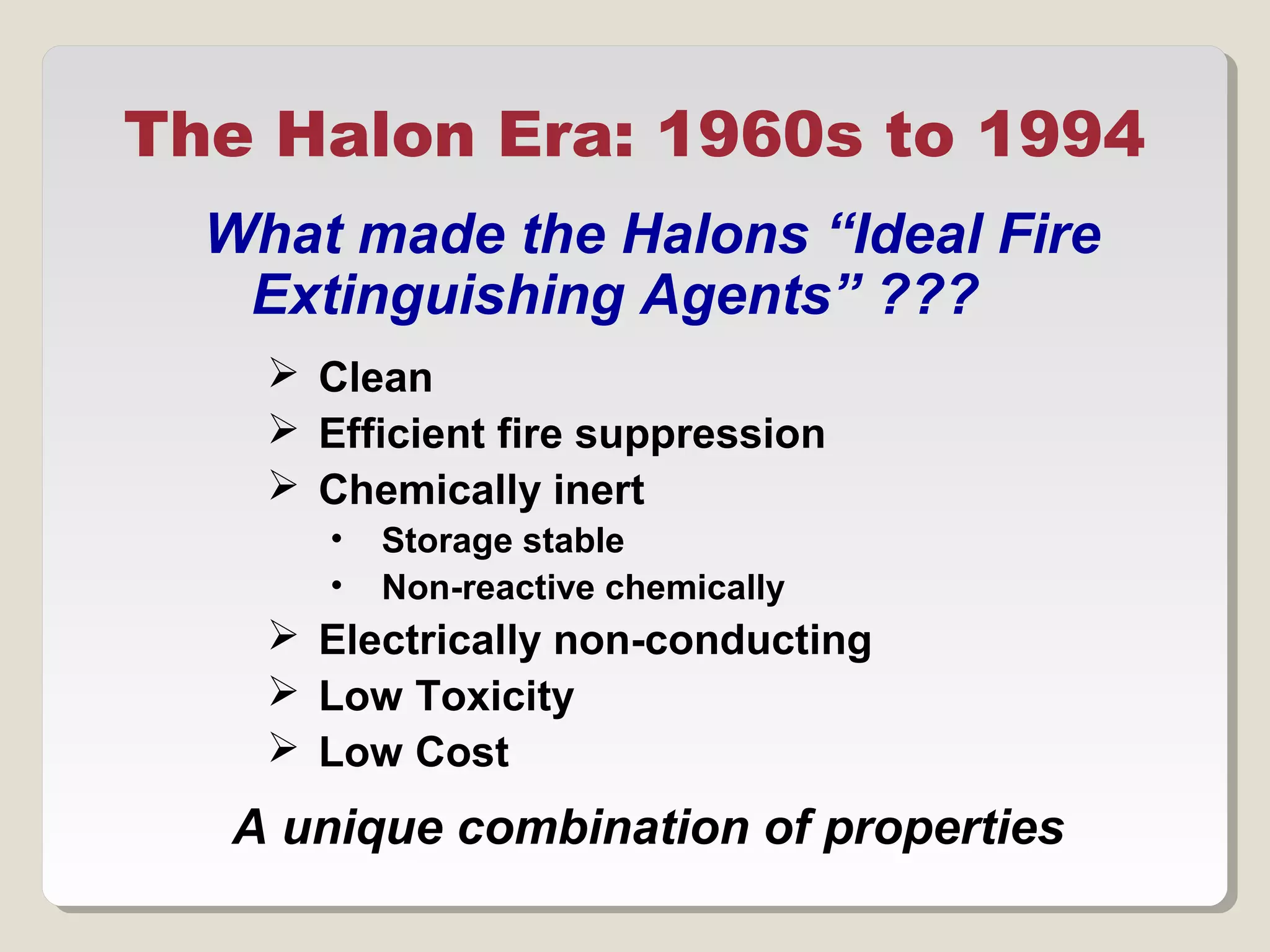
The Halon Era: 1960s to 1994
What made the Halons “Ideal Fire
Extinguishing Agents” ???
 Clean
 Efficient fire suppression
 Chemically inert
• Storage stable
• Non-reactive chemically
 Electrically non-conducting
 Low Toxicity
 Low Cost
A unique combination of properties
Source: U.S. EPA
Ozone Depletion
Properties of the Ideal Halon ReplacementProperties of the Ideal Halon Replacement
• Clean
• Efficient fire suppression
• Chemically inert
 Long term storage stability
 No chemical reactions with water, fuels, assets
• Electrically non-conducting
• Low toxicity
• Zero ODP
• Zero GWP
• Reasonable manufacturing cost
No replacement has been found which
satisfies ALL of the above requirements
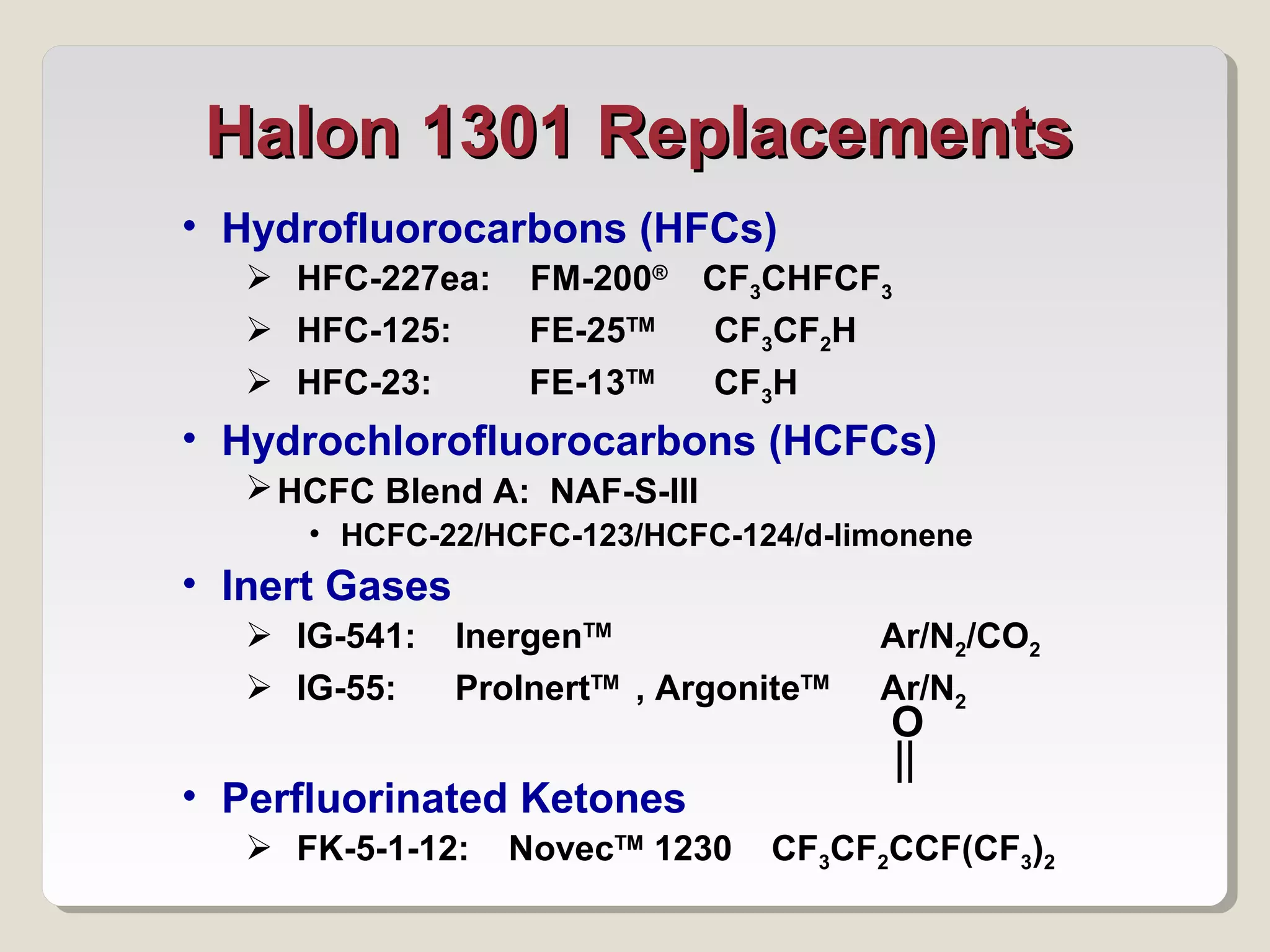
Halon 1301 ReplacementsHalon 1301 Replacements
• Hydrofluorocarbons (HFCs)
 HFC-227ea: FM-200®
CF3CHFCF3
 HFC-125: FE-25TM
CF3CF2H
 HFC-23: FE-13TM
CF3H
• Hydrochlorofluorocarbons (HCFCs)
HCFC Blend A: NAF-S-III
• HCFC-22/HCFC-123/HCFC-124/d-limonene
• Inert Gases
 IG-541: InergenTM
Ar/N2/CO2
 IG-55: ProInertTM
, ArgoniteTM
Ar/N2
• Perfluorinated Ketones
 FK-5-1-12: NovecTM
1230 CF3CF2CCF(CF3)2
O
Halogenated Agents:
Extinguishing Mechanism
• Primarily via physical mechanism of
heat removal
 Reduces flame temperature below
that required to maintain
combustion
 Efficient mechanism – extinguishing
concentrations typically 4.2 to 12% v/v
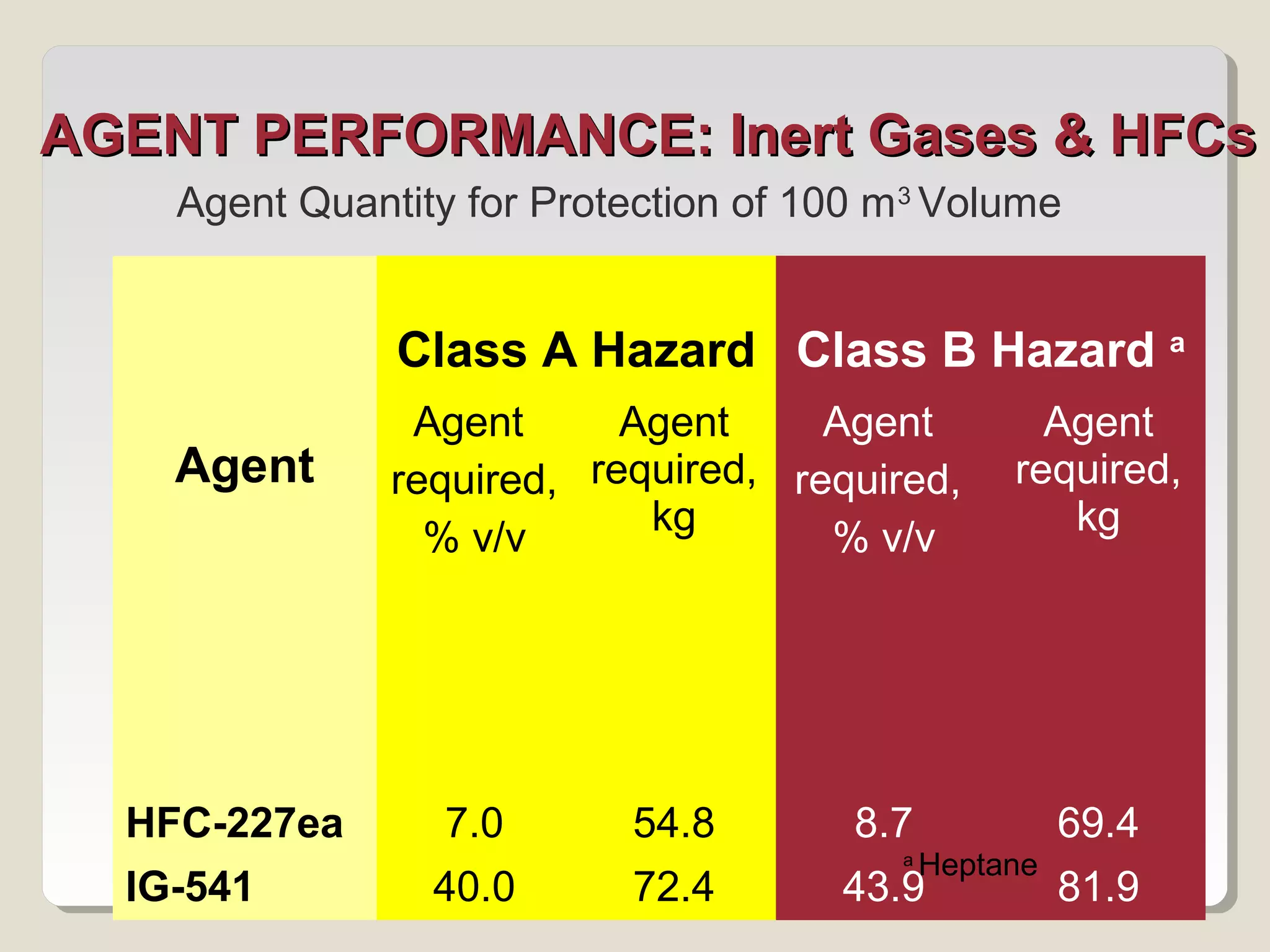
Agent Quantity for Protection of 100 m3
Volume
Agent
Class A Hazard Class B Hazard a
Agent
required,
% v/v
Agent
required,
kg
Agent
required,
% v/v
Agent
required,
kg
HFC-227ea 7.0 54.8 8.7 69.4
IG-541 40.0 72.4 43.9 81.9
AGENT PERFORMANCE: Inert Gases & HFCsAGENT PERFORMANCE: Inert Gases & HFCs
a
Heptane
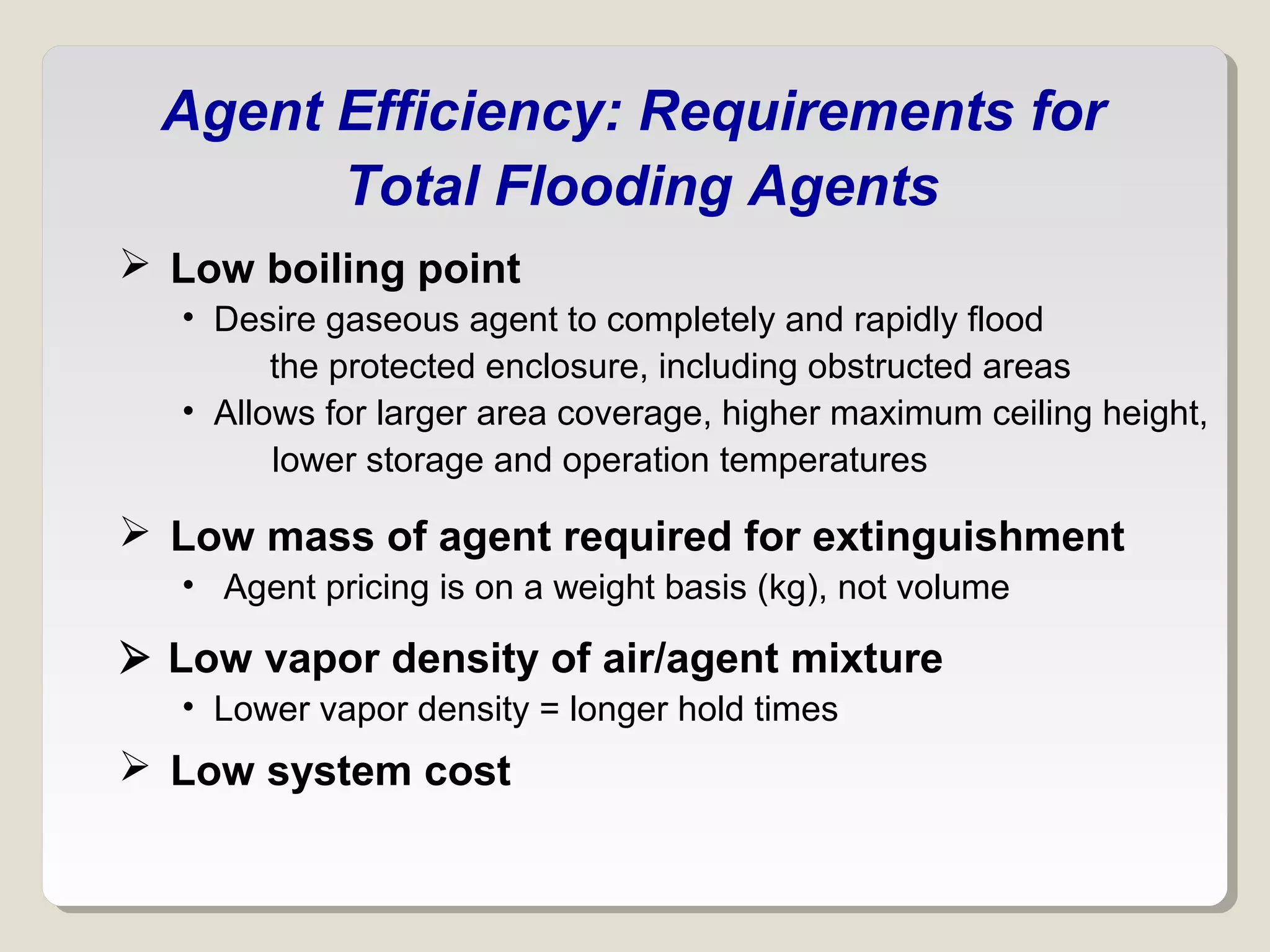
Agent Efficiency: Requirements for
Total Flooding Agents
 Low boiling point
• Desire gaseous agent to completely and rapidly flood
the protected enclosure, including obstructed areas
• Allows for larger area coverage, higher maximum ceiling height,
lower storage and operation temperatures
 Low mass of agent required for extinguishment
• Agent pricing is on a weight basis (kg), not volume
 Low vapor density of air/agent mixture
• Lower vapor density = longer hold times
 Low system cost
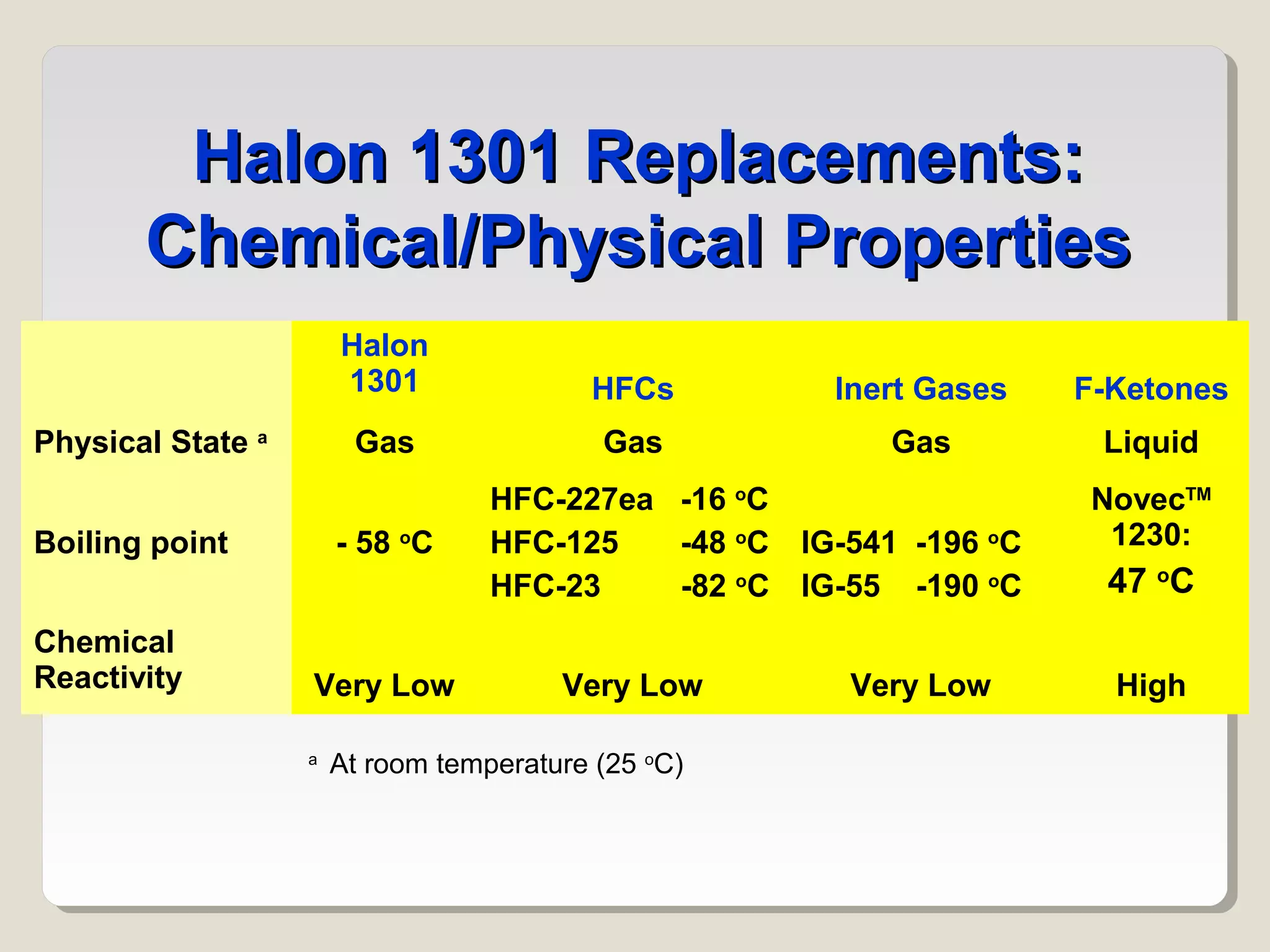
Halon 1301 Replacements:Halon 1301 Replacements:
Chemical/Physical PropertiesChemical/Physical Properties
Halon
1301 HFCs Inert Gases F-Ketones
Physical State a
Gas Gas Gas Liquid
Boiling point - 58 o
C
HFC-227ea -16 o
C
HFC-125 -48 o
C
HFC-23 -82 o
C
IG-541 -196 o
C
IG-55 -190 o
C
NovecTM
1230:
47 o
C
Chemical
Reactivity Very Low Very Low Very Low High
a
At room temperature (25 o
C)
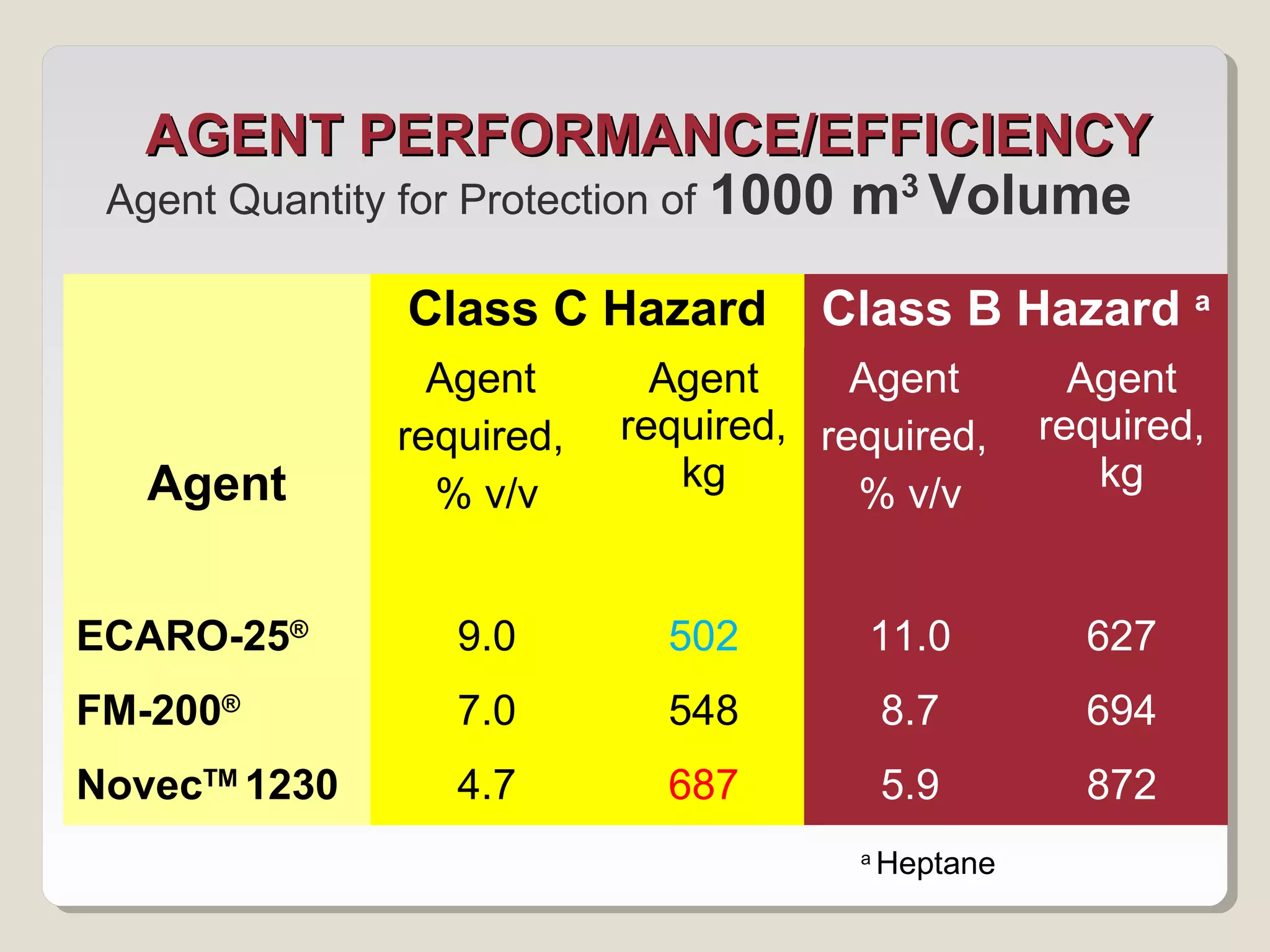
Agent Quantity for Protection of 1000 m3
Volume
Agent
Class C Hazard Class B Hazard a
Agent
required,
% v/v
Agent
required,
kg
Agent
required,
% v/v
Agent
required,
kg
ECARO-25®
9.0 502 11.0 627
FM-200®
7.0 548 8.7 694
NovecTM
1230 4.7 687 5.9 872
AGENT PERFORMANCE/EFFICIENCYAGENT PERFORMANCE/EFFICIENCY
a
Heptane
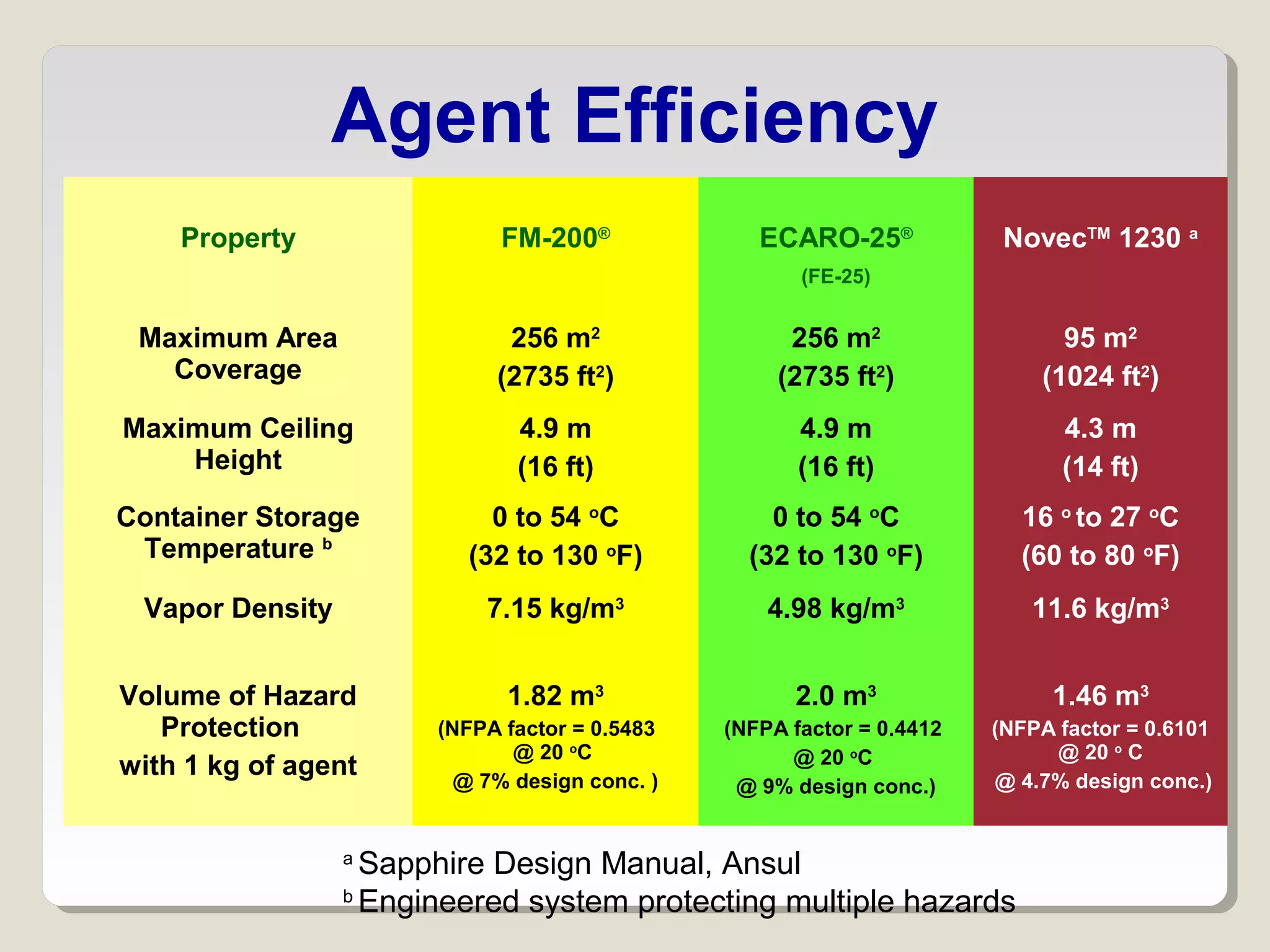
Agent Efficiency
Property FM-200®
ECARO-25®
(FE-25)
NovecTM
1230 a
Maximum Area
Coverage
256 m2
(2735 ft2
)
256 m2
(2735 ft2
)
95 m2
(1024 ft2
)
Maximum Ceiling
Height
4.9 m
(16 ft)
4.9 m
(16 ft)
4.3 m
(14 ft)
Container Storage
Temperature b
0 to 54 o
C
(32 to 130 o
F)
0 to 54 o
C
(32 to 130 o
F)
16 o
to 27 o
C
(60 to 80 o
F)
Vapor Density 7.15 kg/m3
4.98 kg/m3
11.6 kg/m3
Volume of Hazard
Protection
with 1 kg of agent
1.82 m3
(NFPA factor = 0.5483
@ 20 o
C
@ 7% design conc. )
2.0 m3
(NFPA factor = 0.4412
@ 20 o
C
@ 9% design conc.)
1.46 m3
(NFPA factor = 0.6101
@ 20 o
C
@ 4.7% design conc.)
a
Sapphire Design Manual, Ansul
b
Engineered system protecting multiple hazards
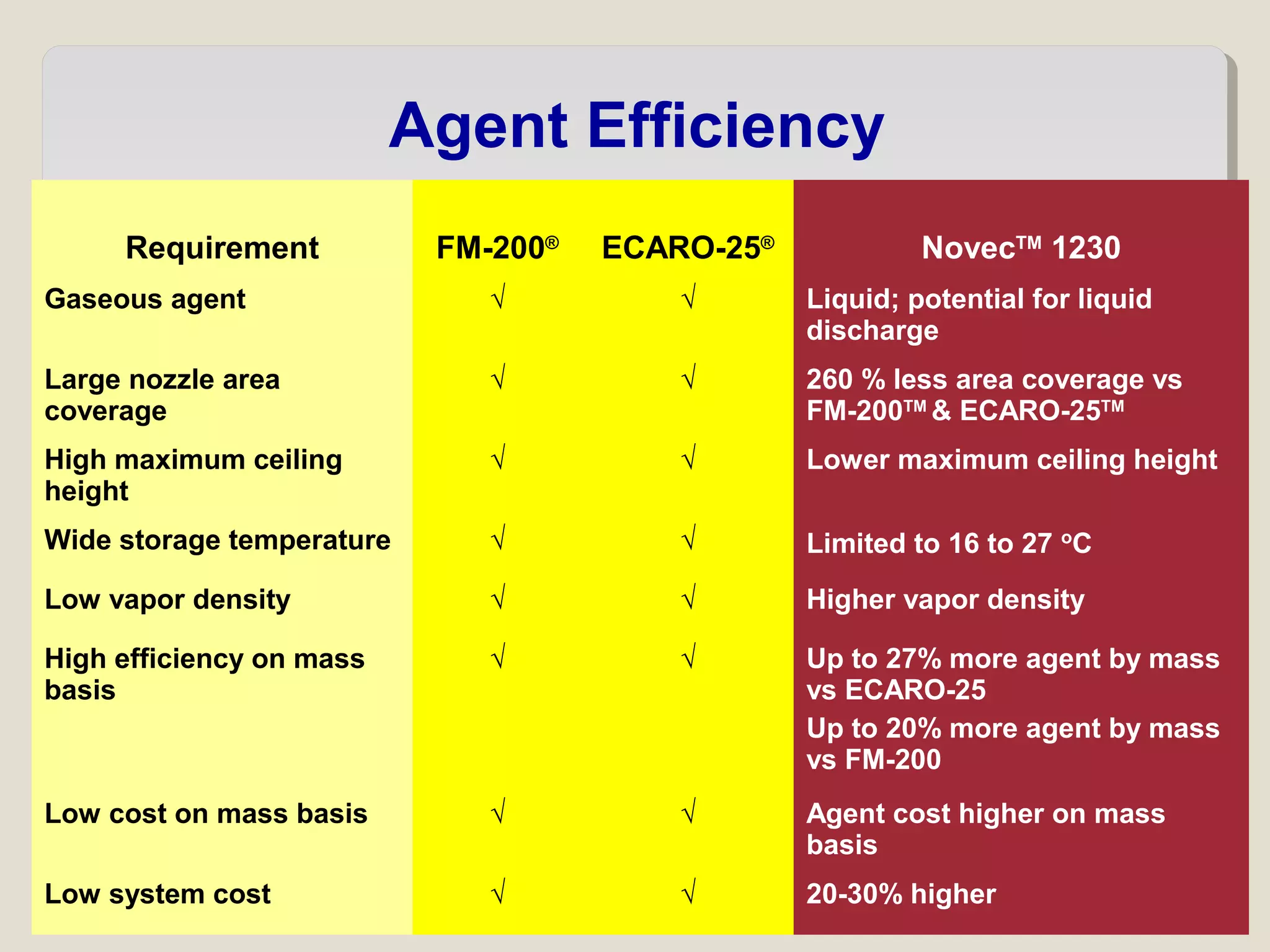
Agent Efficiency
Requirement FM-200®
ECARO-25®
NovecTM
1230
Gaseous agent √ √ Liquid; potential for liquid
discharge
Large nozzle area
coverage
√ √ 260 % less area coverage vs
FM-200TM
& ECARO-25TM
High maximum ceiling
height
√ √ Lower maximum ceiling height
Wide storage temperature √ √ Limited to 16 to 27 o
C
Low vapor density √ √ Higher vapor density
High efficiency on mass
basis
√ √ Up to 27% more agent by mass
vs ECARO-25
Up to 20% more agent by mass
vs FM-200
Low cost on mass basis √ √ Agent cost higher on mass
basis
Low system cost √ √ 20-30% higher
Halon Replacements:Halon Replacements:
Chemical/Physical PropertiesChemical/Physical Properties
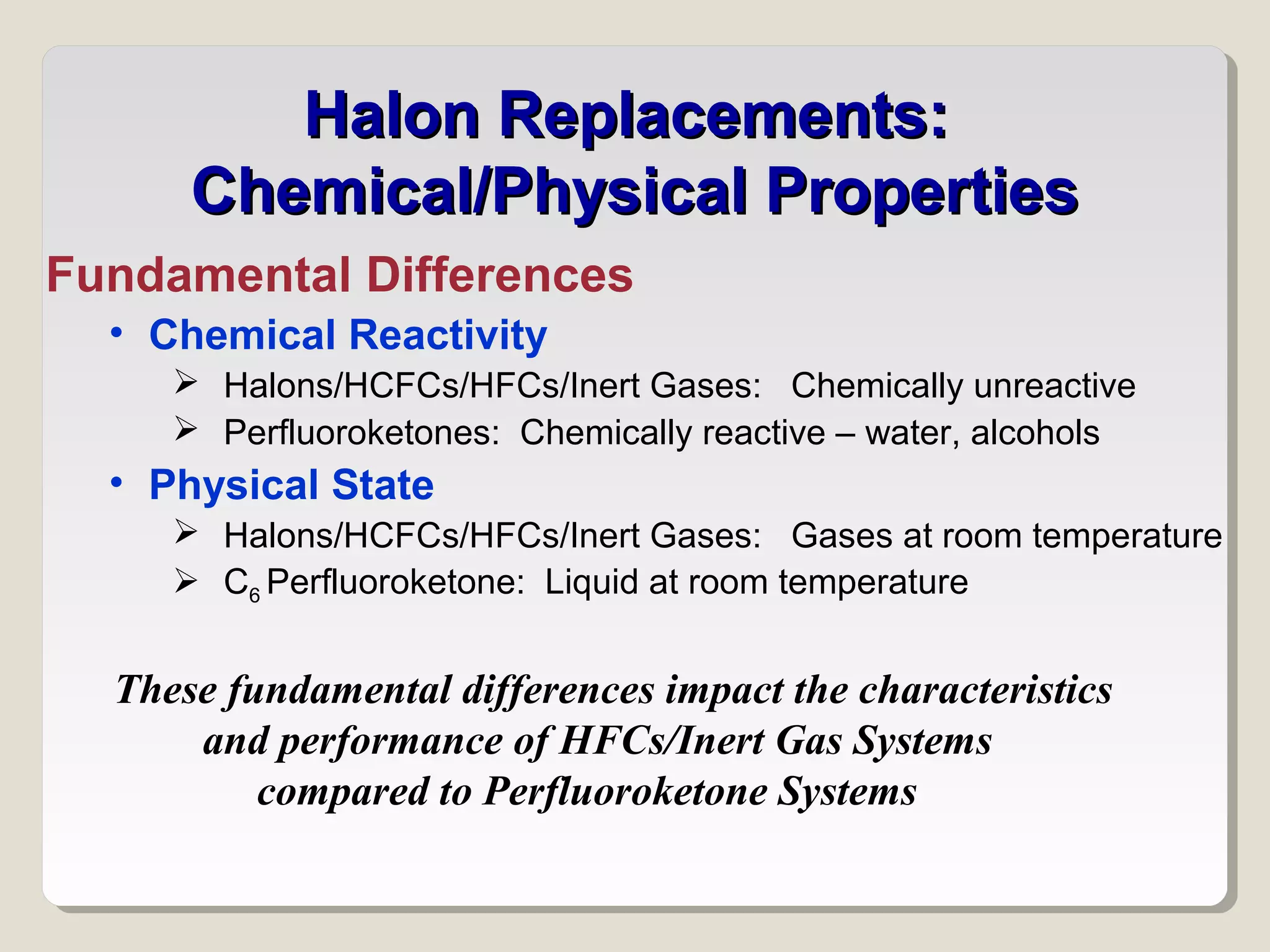
Fundamental Differences
• Chemical Reactivity
 Halons/HCFCs/HFCs/Inert Gases: Chemically unreactive
 Perfluoroketones: Chemically reactive – water, alcohols
• Physical State
 Halons/HCFCs/HFCs/Inert Gases: Gases at room temperature
 C6 Perfluoroketone: Liquid at room temperature
These fundamental differences impact the characteristics
and performance of HFCs/Inert Gas Systems
compared to Perfluoroketone Systems
NovecTM
1230
CF3CHFCF3
+ CF3CF2C(O)OCH3
CF3CHFCF3 + CF3CF2COOH
CF3CHFCF3
+ CF3CF2C(O)OCH2CH3
CF3CHFCF3 + CF3CF2C(O)NH2
CF3CHFCF3
+ CF3CF2C(O)NR2
CF3CHFCF3
+ CF3CF2C(O)NHR
Chemistry of NovecChemistry of NovecTMTM
1230:1230:
Reactions with water, alcohols, aminesReactions with water, alcohols, amines
a. H2O; b. CH3OH; c. CH3CH2OH;
d. NH3; e. RNH2; f. NHR2
a
b
c
d
e
f
FM-200 as by product
No reaction
FM-200FM-200®®
: No reaction with: No reaction with
water, alcohols, amineswater, alcohols, amines
a. H2O; b. CH3OH; c. CH3CH2OH;
d. NH3; e. RNH2; f. NHR2
FM-200®
No reaction
No reaction
No reaction
No reaction
No reaction
a b
c
d
e
f
FE-25 ®
NovecNovecTMTM
1230 Chemistry:1230 Chemistry:
Reaction with Water: HydrolysisReaction with Water: Hydrolysis
CF3CF2C(O)CF(CF3)2 + H2O CF3CF2COOH + CF3CHFCF3
NovecTM
1230 F-Propionic acid HFC-227ea
● NovecTM
1230 reacts with water
- produces HFC-227ea (FM-200®
) and F-propionic acid a
● “The hydrolysis leaves a corrosive aqueous phase
that will act on metals” a
● Hydrolysis to F-propionic acid and HFC-227ea occurs when
NovecTM
1230 is absorbed across the lung-air interface b
a
3M: P.E. Tuma, 24th
IEEE 2008 SEMI-THERM Symposium Proceedings, p. 173
b
3M Technical Brief, Novec 1230 Fire Protection Fluid Safety Assessment, 2004
NovecNovecTMTM
1230 Chemistry:1230 Chemistry:
Reaction with Water: HydrolysisReaction with Water: Hydrolysis
CF3CF2C(O)CF(CF3)2 + H2O CF3CF2COOH + CF3CHFCF3
NovecTM
1230 F-Propionic acid HFC-227ea
● Rapid hydrolysis: half life < 2.5 min @ pH 1-9 a
● Well-known reaction of perfluoroketones b
● Perfluoroketones react with many common chemicals
(water, alcohols, amines,…) c
● “Contact with water or solvents either polar or hydrocarbon
could render NovecTM
1230 fluid ineffective” d
a
NICNAS Std/1019, August 2002, 3M NovecTM Fire Protection Fluid 1230
b
Saloutina, et. al., Izv. Akad. Nauk SSSR (8),1893 (1982)
c
Gambarayan, et. Al., Angew. Chemie Int. Ed., 5(11), 947 (1966)
d
3M: Sapphire Installation Manual, 5/15/2003
Perfluoropropionic AcidPerfluoropropionic Acid
CF3CF2COOH
 Strong Acid/Extremely Corrosive
• Is a perfluorocarboxylic acid – among strongest acids known
• Attacks steel, forming iron salt [DuPont, 2004]
 Toxic [MSDS]
• Causes eye and skin burns
• May cause severe & permanent damage to digestive tract
• Causes gastrointestinal burns
• Causes chemical burns to respiratory tract
• PFCAs known tumor promoters [Env. Sci. Tech 2005, 39, 5517]
• PFCAs are known peroxisome proliferators [Ibid.]
 Liver damage
Halon Replacements andHalon Replacements and
Chemical ReactivityChemical Reactivity
Low Chemical Reactivity Required –
Chemical Reactivity Impacts:
Performance/Leakage
Handling
Human Exposure
Cleanliness
Environmental Impact
Potential Consequences ofPotential Consequences of
Chemical ReactivityChemical Reactivity
System Performance CompromisedSystem Performance Compromised
Agent reacted is not available for suppression
“Contact with water or solvents either polar or hydrocarbon
could render Novec 1230 fluid ineffective” a
Systems in place 10-20 years
● Systems must remain leak-free throughout this period
● Chemical reactions producing even small amounts of
corrosive products could lead to corrosion and eventual
leakage of agent, compromising the effectiveness and
safety of the system
a
Sapphire Installation Manual, 5/15/2003
• Special Handling ProceduresSpecial Handling Procedures
• Example: vent driers, nitrogen purges required to
prevent contact of NovecTM
1230 with moist air a
• Human Exposure ImplicationsHuman Exposure Implications
• NovecTM
1230 hydrolyzed when crossing lung-air
interface to produce HFC-227ea and F-propionic
acid b
Potential Consequences ofPotential Consequences of
Chemical ReactivityChemical Reactivity
a
3M: Sapphire Installation Manual, 5/15/2003
b
3M Technical Brief, Novec 1230 Fire Protection Fluid Safety Assessment, 2004
• Atmospheric Impact ImplicationsAtmospheric Impact Implications
• Example: Atmospheric hydrolysis of NovecTM
1230
not considered in evaluation of GWP
• The extent of atmospheric hydrolysis, e.g., on
atmospheric aerosols, could render GWP of
perfluoroketones similar to that of HFCs
• Cleanliness ImplicationsCleanliness Implications
• Detrimental chemical reaction with enclosure,
enclosure contents
Potential Consequences ofPotential Consequences of
Chemical ReactivityChemical Reactivity
NovecNovecTMTM
1230 Discharge on Plastic Cladding1230 Discharge on Plastic Cladding
Chemical Reactivity
Requirements FM-200®
/
ECARO-25®
NovecTM
1230
Low Chemical
Reactivity
√ Characterized by high
chemical reactivity
No reaction with
alcohols, amines √ Reacts with alcohols, amines
No reaction with
solvents √
Incompatible with polar or
hydrocarbon solvents
“Additional work is needed to assess the
reactivity of C6K [NovecTM
1230]…” a
Source: 3M: 24thIEEE SEMI-THERM Symposium, 2008, page 173.
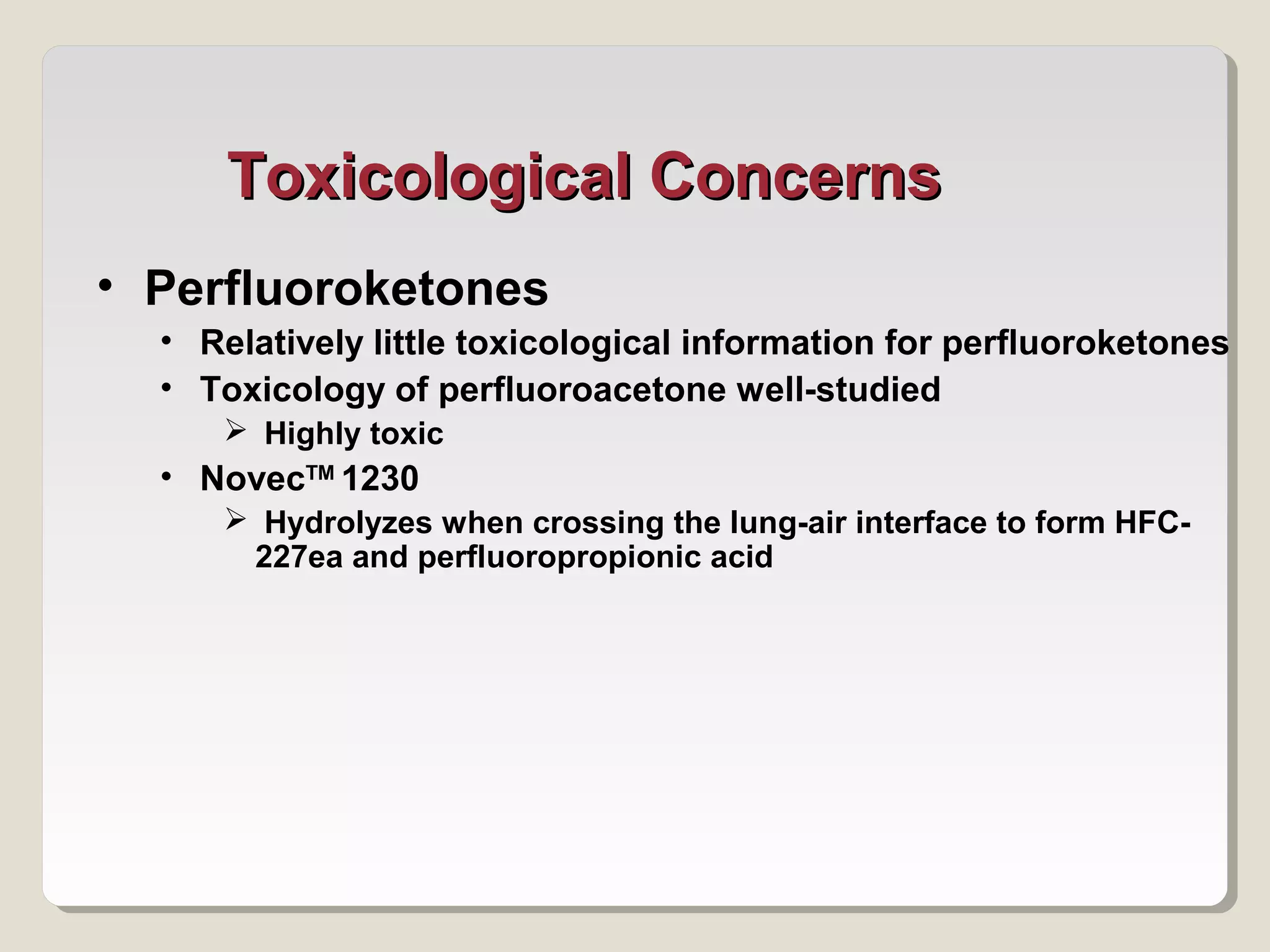
Toxicological ConcernsToxicological Concerns
• Perfluoroketones
• Relatively little toxicological information for perfluoroketones
• Toxicology of perfluoroacetone well-studied
 Highly toxic
• NovecTM
1230
 Hydrolyzes when crossing the lung-air interface to form HFC-
227ea and perfluoropropionic acid
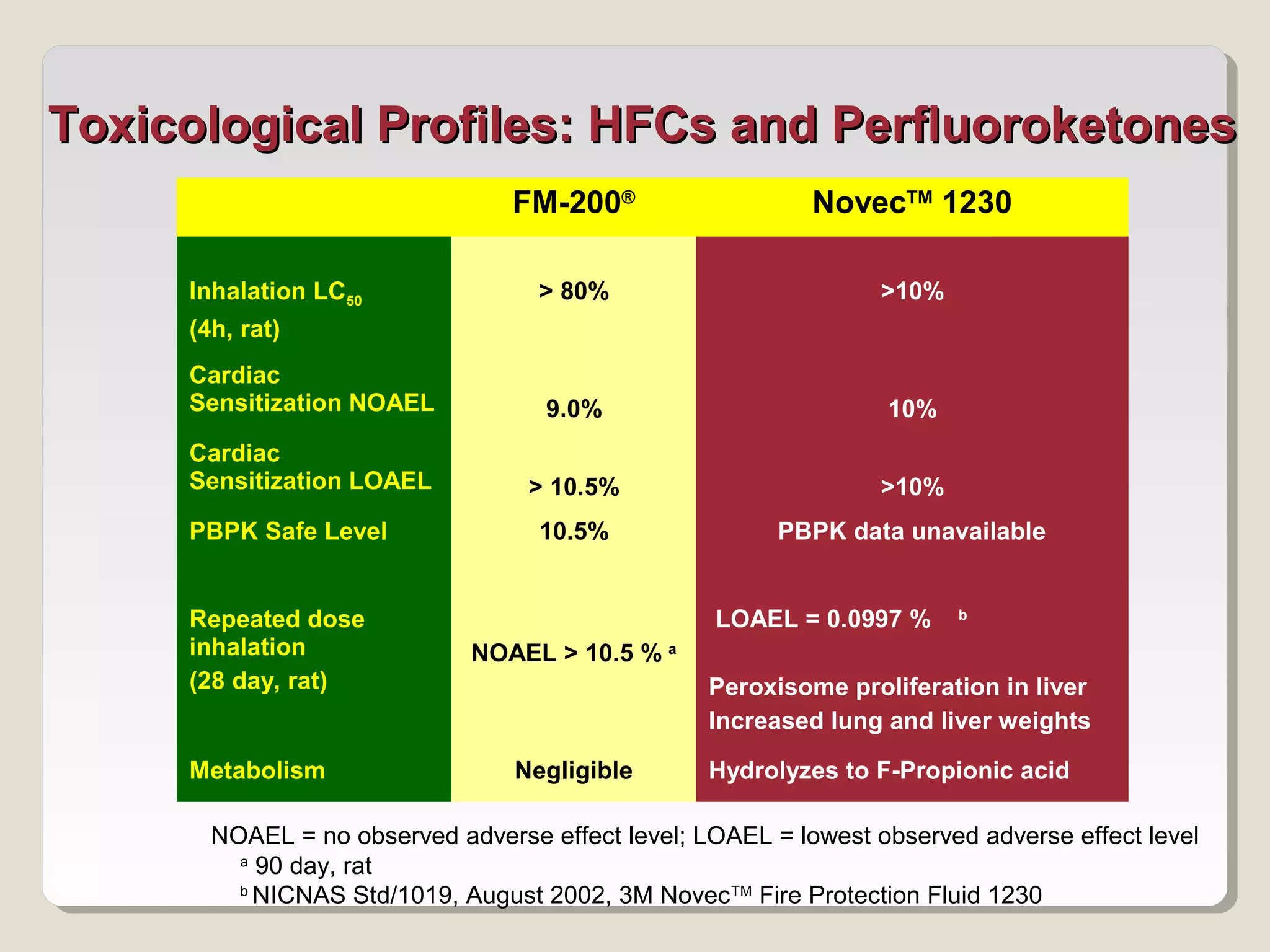
Toxicological Profiles: HFCs and PerfluoroketonesToxicological Profiles: HFCs and Perfluoroketones
FM-200®
NovecTM
1230
Inhalation LC50
(4h, rat)
> 80% >10%
Cardiac
Sensitization NOAEL 9.0% 10%
Cardiac
Sensitization LOAEL > 10.5% >10%
PBPK Safe Level 10.5% PBPK data unavailable
Repeated dose
inhalation
(28 day, rat)
NOAEL > 10.5 % a
LOAEL = 0.0997 % b
Peroxisome proliferation in liver
Increased lung and liver weights
Metabolism Negligible Hydrolyzes to F-Propionic acid
a
90 day, rat
b
NICNAS Std/1019, August 2002, 3M NovecTM
Fire Protection Fluid 1230
NOAEL = no observed adverse effect level; LOAEL = lowest observed adverse effect level
• NovecTM
1230
 Class A = 4.5
 NOAEL = 10%
 “Safety margin” 10/4.5 = 2.23
• FM-200®
 Class A = 6.7%
 NOAEL = 9%
“Safety margin” 9/6.7 = 1.35
““Safety Margin”Safety Margin”
Problem: NOAEL/LOAEL method so conservative that
Halon 1301 would not be allowed despite its long history
with an excellent safety record! a
Observations During CardiacObservations During Cardiac
Sensitization Testing of NovecSensitization Testing of NovecTMTM
12301230
Source: Novec 1230 Premanufacture Notice; US EPA Premanufacture Notice,
EPA case no. TS-120546, 2000.
“The severity of the clinical response prevented exposure above 15.48%”
NovecTM
1230 Conc.,
% v/v
Response
1.01 Agitation, pawing at mask, eyes half closed
1.98 Agitation, deep slow breathing, eyes half closed, muscle tremors, pawing at
mask
5.04 Agitation, eyes half closed, muscle tremors, pawing at mask
9.97 Eyes closed, shallow breathing, muscle tremors, pawing at mask
15.48 Rapid breathing, excessive struggling, staggering, loss of bladder control,
trembling, partial collapse, muscle tremors
Exposure Considerations
FM-200®
NovecTM
1230
Not metabolized
Approved for use in MDI
to deliver medicaments
orally
Hydrolyzes when crossing
lung-air interface to
produce HFC-227ea and
F-Propionic acid
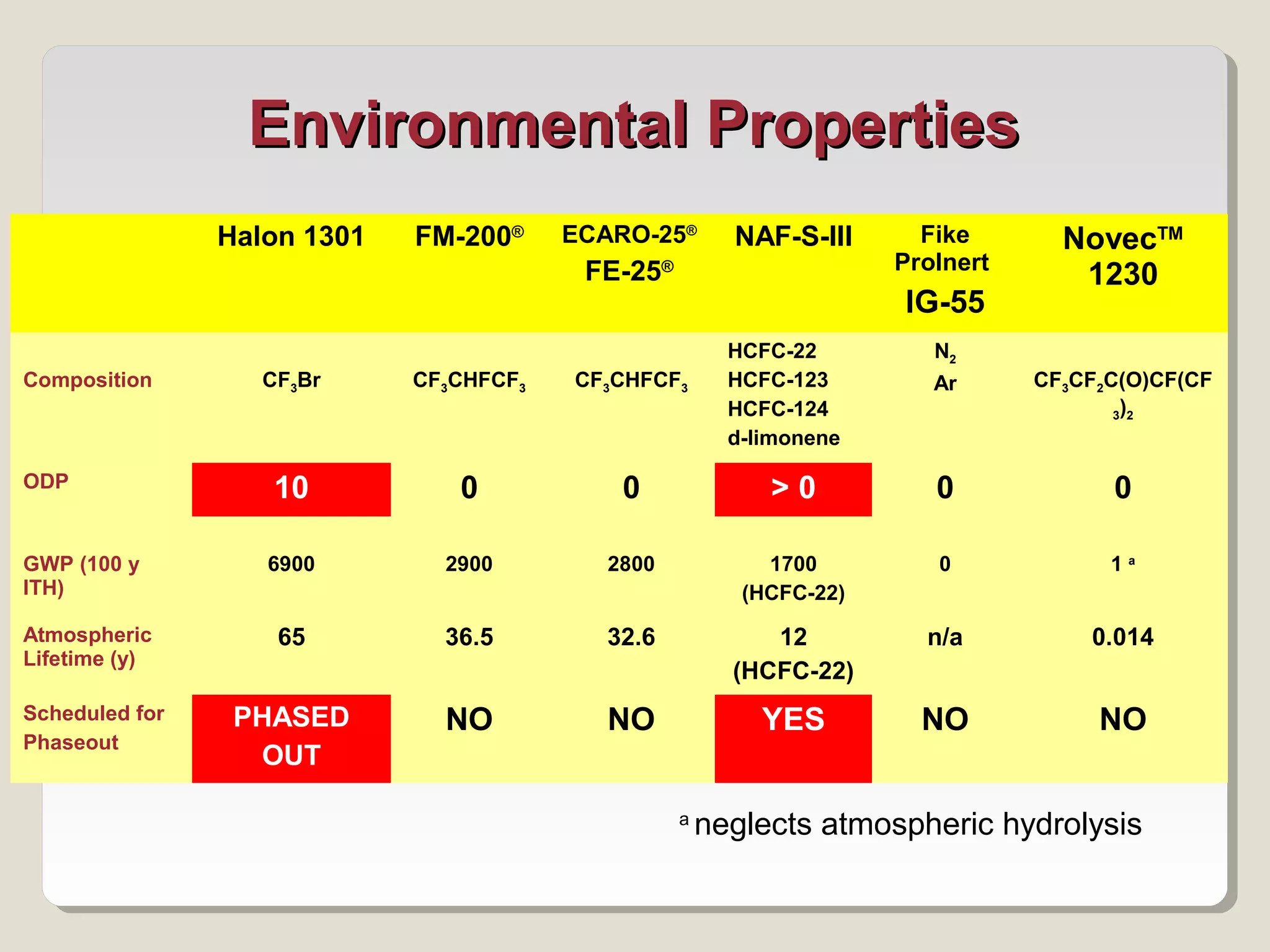
Environmental PropertiesEnvironmental Properties
Halon 1301 FM-200® ECARO-25®
FE-25®
NAF-S-III Fike
ProInert
IG-55
NovecTM
1230
Composition CF3Br CF3CHFCF3 CF3CHFCF3
HCFC-22
HCFC-123
HCFC-124
d-limonene
N2
Ar CF3CF2C(O)CF(CF
3)2
ODP 10 0 0 > 0 0 0
GWP (100 y
ITH)
6900 2900 2800 1700
(HCFC-22)
0 1 a
Atmospheric
Lifetime (y)
65 36.5 32.6 12
(HCFC-22)
n/a 0.014
Scheduled for
Phaseout
PHASED
OUT
NO NO YES NO NO
a
neglects atmospheric hydrolysis
Environmental RegulationsEnvironmental Regulations
• Montreal Protocol
• Related to ozone depleting substances
HFCs all zero ODP, so not subject to Montreal Protocol
• Kyoto Protocol
 Related to greenhouse gases (GHGs)
 HFCs are one type of GHG
 Kyoto Protocol concerned with emission reductions
• No limits or banning of HFCs in fire suppression applications
• F-Gas Regulations
 Similar to Kyoto Protocol
 No limits or banning of HFCs in fire suppression applications
Impact of Emissions of HFCs from FireImpact of Emissions of HFCs from Fire
Suppression ApplicationsSuppression Applications
• Impact of all HFC emissions
< 3% of total impact of all GHG emissions
• Impact of HFC emissions from fire fighting
< 1% of total impact of all HFC emissions, hence….
• Impact of HFC emissions from fire fighting
< 0.03% of total impact of all GHG emissions
Fire suppression systems regarded as
essentially non-emissive
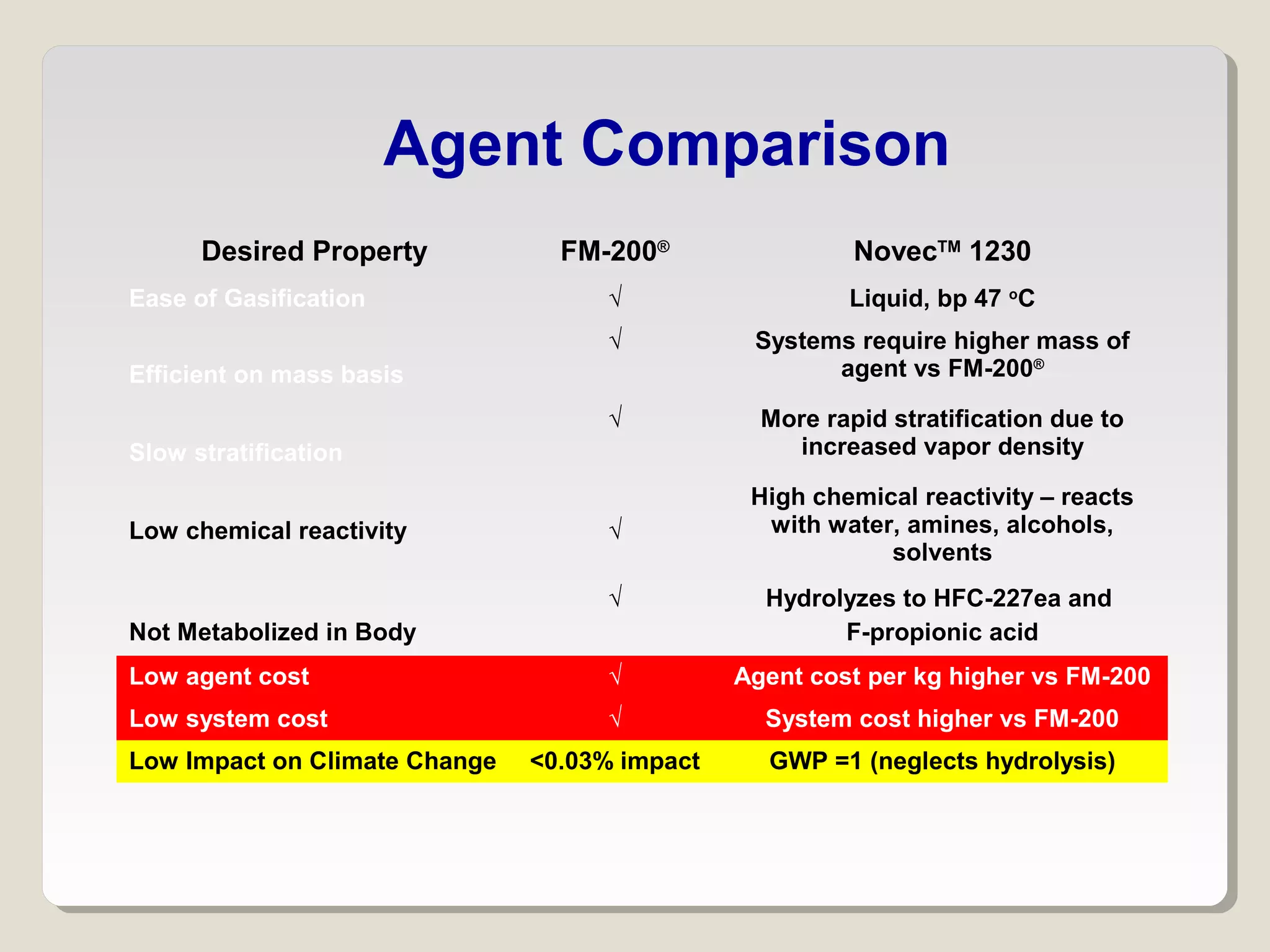
Desired Property FM-200®
NovecTM
1230
Ease of Gasification √ Liquid, bp 47 o
C
Efficient on mass basis
√ Systems require higher mass of
agent vs FM-200®
Slow stratification
√ More rapid stratification due to
increased vapor density
Low chemical reactivity √
High chemical reactivity – reacts
with water, amines, alcohols,
solvents
Not Metabolized in Body
√ Hydrolyzes to HFC-227ea and
F-propionic acid
Low agent cost √ Agent cost per kg higher vs FM-200
Low system cost √ System cost higher vs FM-200
Low Impact on Climate Change <0.03% impact GWP =1 (neglects hydrolysis)
Agent Comparison
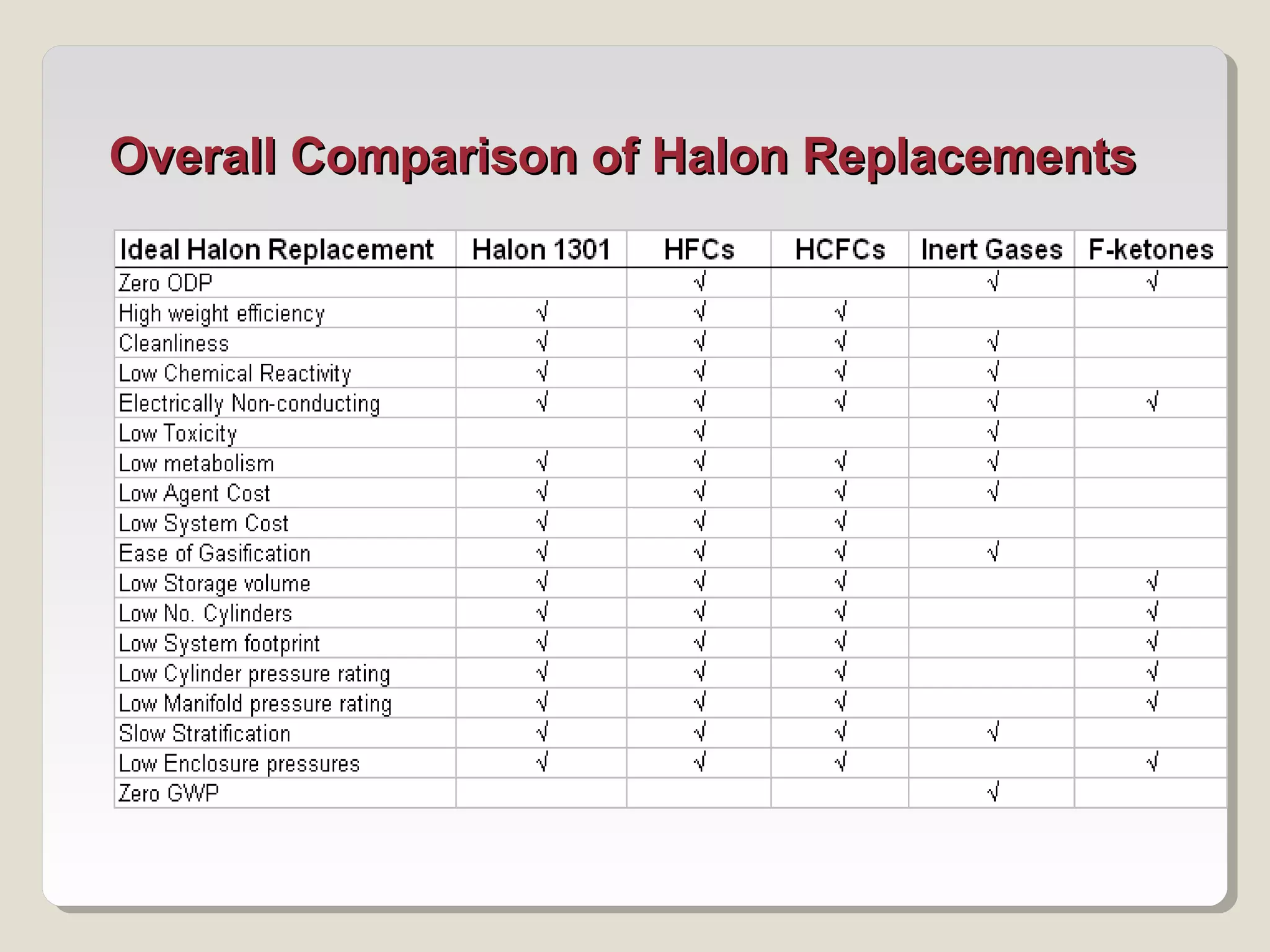
Overall Comparison of Halon ReplacementsOverall Comparison of Halon Replacements

Fire System comparison fm ecaro-25 vs novec 1230

  • 1.
    Halogenated Total FloodingFireHalogenated Total Flooding Fire Suppression AgentsSuppression Agents
  • 2.
    The Halon Era:1960s to 1994 Halon 1301: CF3Br  Total flooding applications Halon 1211: CF2BrCl  Portable, local applications “Clean Agents” No corrosive or abrasive residues left following extinguishment Water, foam, powder – secondary damage due to agent can exceed damage due to fire
  • 3.
    Clean Agents underNFPA 2001  Safe for occupied areas protection  No corrosive residues No damage to sensitive/expensive assets  No cleanup required after discharge No business interruption Source: Alinenan ROI Report, January 2004.
  • 4.
    The Halon Era:1960s to 1994 What made the Halons “Ideal Fire Extinguishing Agents” ???  Clean  Efficient fire suppression  Chemically inert • Storage stable • Non-reactive chemically  Electrically non-conducting  Low Toxicity  Low Cost A unique combination of properties
  • 5.
  • 6.
    Properties of theIdeal Halon ReplacementProperties of the Ideal Halon Replacement • Clean • Efficient fire suppression • Chemically inert  Long term storage stability  No chemical reactions with water, fuels, assets • Electrically non-conducting • Low toxicity • Zero ODP • Zero GWP • Reasonable manufacturing cost No replacement has been found which satisfies ALL of the above requirements
  • 7.
    Halon 1301 ReplacementsHalon1301 Replacements • Hydrofluorocarbons (HFCs)  HFC-227ea: FM-200® CF3CHFCF3  HFC-125: FE-25TM CF3CF2H  HFC-23: FE-13TM CF3H • Hydrochlorofluorocarbons (HCFCs) HCFC Blend A: NAF-S-III • HCFC-22/HCFC-123/HCFC-124/d-limonene • Inert Gases  IG-541: InergenTM Ar/N2/CO2  IG-55: ProInertTM , ArgoniteTM Ar/N2 • Perfluorinated Ketones  FK-5-1-12: NovecTM 1230 CF3CF2CCF(CF3)2 O
  • 8.
    Halogenated Agents: Extinguishing Mechanism •Primarily via physical mechanism of heat removal  Reduces flame temperature below that required to maintain combustion  Efficient mechanism – extinguishing concentrations typically 4.2 to 12% v/v
  • 9.
    Agent Quantity forProtection of 100 m3 Volume Agent Class A Hazard Class B Hazard a Agent required, % v/v Agent required, kg Agent required, % v/v Agent required, kg HFC-227ea 7.0 54.8 8.7 69.4 IG-541 40.0 72.4 43.9 81.9 AGENT PERFORMANCE: Inert Gases & HFCsAGENT PERFORMANCE: Inert Gases & HFCs a Heptane
  • 10.
    Agent Efficiency: Requirementsfor Total Flooding Agents  Low boiling point • Desire gaseous agent to completely and rapidly flood the protected enclosure, including obstructed areas • Allows for larger area coverage, higher maximum ceiling height, lower storage and operation temperatures  Low mass of agent required for extinguishment • Agent pricing is on a weight basis (kg), not volume  Low vapor density of air/agent mixture • Lower vapor density = longer hold times  Low system cost
  • 11.
    Halon 1301 Replacements:Halon1301 Replacements: Chemical/Physical PropertiesChemical/Physical Properties Halon 1301 HFCs Inert Gases F-Ketones Physical State a Gas Gas Gas Liquid Boiling point - 58 o C HFC-227ea -16 o C HFC-125 -48 o C HFC-23 -82 o C IG-541 -196 o C IG-55 -190 o C NovecTM 1230: 47 o C Chemical Reactivity Very Low Very Low Very Low High a At room temperature (25 o C)
  • 12.
    Agent Quantity forProtection of 1000 m3 Volume Agent Class C Hazard Class B Hazard a Agent required, % v/v Agent required, kg Agent required, % v/v Agent required, kg ECARO-25® 9.0 502 11.0 627 FM-200® 7.0 548 8.7 694 NovecTM 1230 4.7 687 5.9 872 AGENT PERFORMANCE/EFFICIENCYAGENT PERFORMANCE/EFFICIENCY a Heptane
  • 13.
    Agent Efficiency Property FM-200® ECARO-25® (FE-25) NovecTM 1230a Maximum Area Coverage 256 m2 (2735 ft2 ) 256 m2 (2735 ft2 ) 95 m2 (1024 ft2 ) Maximum Ceiling Height 4.9 m (16 ft) 4.9 m (16 ft) 4.3 m (14 ft) Container Storage Temperature b 0 to 54 o C (32 to 130 o F) 0 to 54 o C (32 to 130 o F) 16 o to 27 o C (60 to 80 o F) Vapor Density 7.15 kg/m3 4.98 kg/m3 11.6 kg/m3 Volume of Hazard Protection with 1 kg of agent 1.82 m3 (NFPA factor = 0.5483 @ 20 o C @ 7% design conc. ) 2.0 m3 (NFPA factor = 0.4412 @ 20 o C @ 9% design conc.) 1.46 m3 (NFPA factor = 0.6101 @ 20 o C @ 4.7% design conc.) a Sapphire Design Manual, Ansul b Engineered system protecting multiple hazards
  • 14.
    Agent Efficiency Requirement FM-200® ECARO-25® NovecTM 1230 Gaseousagent √ √ Liquid; potential for liquid discharge Large nozzle area coverage √ √ 260 % less area coverage vs FM-200TM & ECARO-25TM High maximum ceiling height √ √ Lower maximum ceiling height Wide storage temperature √ √ Limited to 16 to 27 o C Low vapor density √ √ Higher vapor density High efficiency on mass basis √ √ Up to 27% more agent by mass vs ECARO-25 Up to 20% more agent by mass vs FM-200 Low cost on mass basis √ √ Agent cost higher on mass basis Low system cost √ √ 20-30% higher
  • 15.
    Halon Replacements:Halon Replacements: Chemical/PhysicalPropertiesChemical/Physical Properties Fundamental Differences • Chemical Reactivity  Halons/HCFCs/HFCs/Inert Gases: Chemically unreactive  Perfluoroketones: Chemically reactive – water, alcohols • Physical State  Halons/HCFCs/HFCs/Inert Gases: Gases at room temperature  C6 Perfluoroketone: Liquid at room temperature These fundamental differences impact the characteristics and performance of HFCs/Inert Gas Systems compared to Perfluoroketone Systems
  • 16.
    NovecTM 1230 CF3CHFCF3 + CF3CF2C(O)OCH3 CF3CHFCF3 +CF3CF2COOH CF3CHFCF3 + CF3CF2C(O)OCH2CH3 CF3CHFCF3 + CF3CF2C(O)NH2 CF3CHFCF3 + CF3CF2C(O)NR2 CF3CHFCF3 + CF3CF2C(O)NHR Chemistry of NovecChemistry of NovecTMTM 1230:1230: Reactions with water, alcohols, aminesReactions with water, alcohols, amines a. H2O; b. CH3OH; c. CH3CH2OH; d. NH3; e. RNH2; f. NHR2 a b c d e f FM-200 as by product
  • 17.
    No reaction FM-200FM-200®® : Noreaction with: No reaction with water, alcohols, amineswater, alcohols, amines a. H2O; b. CH3OH; c. CH3CH2OH; d. NH3; e. RNH2; f. NHR2 FM-200® No reaction No reaction No reaction No reaction No reaction a b c d e f FE-25 ®
  • 18.
    NovecNovecTMTM 1230 Chemistry:1230 Chemistry: Reactionwith Water: HydrolysisReaction with Water: Hydrolysis CF3CF2C(O)CF(CF3)2 + H2O CF3CF2COOH + CF3CHFCF3 NovecTM 1230 F-Propionic acid HFC-227ea ● NovecTM 1230 reacts with water - produces HFC-227ea (FM-200® ) and F-propionic acid a ● “The hydrolysis leaves a corrosive aqueous phase that will act on metals” a ● Hydrolysis to F-propionic acid and HFC-227ea occurs when NovecTM 1230 is absorbed across the lung-air interface b a 3M: P.E. Tuma, 24th IEEE 2008 SEMI-THERM Symposium Proceedings, p. 173 b 3M Technical Brief, Novec 1230 Fire Protection Fluid Safety Assessment, 2004
  • 19.
    NovecNovecTMTM 1230 Chemistry:1230 Chemistry: Reactionwith Water: HydrolysisReaction with Water: Hydrolysis CF3CF2C(O)CF(CF3)2 + H2O CF3CF2COOH + CF3CHFCF3 NovecTM 1230 F-Propionic acid HFC-227ea ● Rapid hydrolysis: half life < 2.5 min @ pH 1-9 a ● Well-known reaction of perfluoroketones b ● Perfluoroketones react with many common chemicals (water, alcohols, amines,…) c ● “Contact with water or solvents either polar or hydrocarbon could render NovecTM 1230 fluid ineffective” d a NICNAS Std/1019, August 2002, 3M NovecTM Fire Protection Fluid 1230 b Saloutina, et. al., Izv. Akad. Nauk SSSR (8),1893 (1982) c Gambarayan, et. Al., Angew. Chemie Int. Ed., 5(11), 947 (1966) d 3M: Sapphire Installation Manual, 5/15/2003
  • 20.
    Perfluoropropionic AcidPerfluoropropionic Acid CF3CF2COOH Strong Acid/Extremely Corrosive • Is a perfluorocarboxylic acid – among strongest acids known • Attacks steel, forming iron salt [DuPont, 2004]  Toxic [MSDS] • Causes eye and skin burns • May cause severe & permanent damage to digestive tract • Causes gastrointestinal burns • Causes chemical burns to respiratory tract • PFCAs known tumor promoters [Env. Sci. Tech 2005, 39, 5517] • PFCAs are known peroxisome proliferators [Ibid.]  Liver damage
  • 21.
    Halon Replacements andHalonReplacements and Chemical ReactivityChemical Reactivity Low Chemical Reactivity Required – Chemical Reactivity Impacts: Performance/Leakage Handling Human Exposure Cleanliness Environmental Impact
  • 22.
    Potential Consequences ofPotentialConsequences of Chemical ReactivityChemical Reactivity System Performance CompromisedSystem Performance Compromised Agent reacted is not available for suppression “Contact with water or solvents either polar or hydrocarbon could render Novec 1230 fluid ineffective” a Systems in place 10-20 years ● Systems must remain leak-free throughout this period ● Chemical reactions producing even small amounts of corrosive products could lead to corrosion and eventual leakage of agent, compromising the effectiveness and safety of the system a Sapphire Installation Manual, 5/15/2003
  • 23.
    • Special HandlingProceduresSpecial Handling Procedures • Example: vent driers, nitrogen purges required to prevent contact of NovecTM 1230 with moist air a • Human Exposure ImplicationsHuman Exposure Implications • NovecTM 1230 hydrolyzed when crossing lung-air interface to produce HFC-227ea and F-propionic acid b Potential Consequences ofPotential Consequences of Chemical ReactivityChemical Reactivity a 3M: Sapphire Installation Manual, 5/15/2003 b 3M Technical Brief, Novec 1230 Fire Protection Fluid Safety Assessment, 2004
  • 24.
    • Atmospheric ImpactImplicationsAtmospheric Impact Implications • Example: Atmospheric hydrolysis of NovecTM 1230 not considered in evaluation of GWP • The extent of atmospheric hydrolysis, e.g., on atmospheric aerosols, could render GWP of perfluoroketones similar to that of HFCs • Cleanliness ImplicationsCleanliness Implications • Detrimental chemical reaction with enclosure, enclosure contents Potential Consequences ofPotential Consequences of Chemical ReactivityChemical Reactivity
  • 25.
    NovecNovecTMTM 1230 Discharge onPlastic Cladding1230 Discharge on Plastic Cladding
  • 26.
    Chemical Reactivity Requirements FM-200® / ECARO-25® NovecTM 1230 LowChemical Reactivity √ Characterized by high chemical reactivity No reaction with alcohols, amines √ Reacts with alcohols, amines No reaction with solvents √ Incompatible with polar or hydrocarbon solvents “Additional work is needed to assess the reactivity of C6K [NovecTM 1230]…” a Source: 3M: 24thIEEE SEMI-THERM Symposium, 2008, page 173.
  • 27.
    Toxicological ConcernsToxicological Concerns •Perfluoroketones • Relatively little toxicological information for perfluoroketones • Toxicology of perfluoroacetone well-studied  Highly toxic • NovecTM 1230  Hydrolyzes when crossing the lung-air interface to form HFC- 227ea and perfluoropropionic acid
  • 28.
    Toxicological Profiles: HFCsand PerfluoroketonesToxicological Profiles: HFCs and Perfluoroketones FM-200® NovecTM 1230 Inhalation LC50 (4h, rat) > 80% >10% Cardiac Sensitization NOAEL 9.0% 10% Cardiac Sensitization LOAEL > 10.5% >10% PBPK Safe Level 10.5% PBPK data unavailable Repeated dose inhalation (28 day, rat) NOAEL > 10.5 % a LOAEL = 0.0997 % b Peroxisome proliferation in liver Increased lung and liver weights Metabolism Negligible Hydrolyzes to F-Propionic acid a 90 day, rat b NICNAS Std/1019, August 2002, 3M NovecTM Fire Protection Fluid 1230 NOAEL = no observed adverse effect level; LOAEL = lowest observed adverse effect level
  • 29.
    • NovecTM 1230  ClassA = 4.5  NOAEL = 10%  “Safety margin” 10/4.5 = 2.23 • FM-200®  Class A = 6.7%  NOAEL = 9% “Safety margin” 9/6.7 = 1.35 ““Safety Margin”Safety Margin” Problem: NOAEL/LOAEL method so conservative that Halon 1301 would not be allowed despite its long history with an excellent safety record! a
  • 30.
    Observations During CardiacObservationsDuring Cardiac Sensitization Testing of NovecSensitization Testing of NovecTMTM 12301230 Source: Novec 1230 Premanufacture Notice; US EPA Premanufacture Notice, EPA case no. TS-120546, 2000. “The severity of the clinical response prevented exposure above 15.48%” NovecTM 1230 Conc., % v/v Response 1.01 Agitation, pawing at mask, eyes half closed 1.98 Agitation, deep slow breathing, eyes half closed, muscle tremors, pawing at mask 5.04 Agitation, eyes half closed, muscle tremors, pawing at mask 9.97 Eyes closed, shallow breathing, muscle tremors, pawing at mask 15.48 Rapid breathing, excessive struggling, staggering, loss of bladder control, trembling, partial collapse, muscle tremors
  • 31.
    Exposure Considerations FM-200® NovecTM 1230 Not metabolized Approvedfor use in MDI to deliver medicaments orally Hydrolyzes when crossing lung-air interface to produce HFC-227ea and F-Propionic acid
  • 32.
    Environmental PropertiesEnvironmental Properties Halon1301 FM-200® ECARO-25® FE-25® NAF-S-III Fike ProInert IG-55 NovecTM 1230 Composition CF3Br CF3CHFCF3 CF3CHFCF3 HCFC-22 HCFC-123 HCFC-124 d-limonene N2 Ar CF3CF2C(O)CF(CF 3)2 ODP 10 0 0 > 0 0 0 GWP (100 y ITH) 6900 2900 2800 1700 (HCFC-22) 0 1 a Atmospheric Lifetime (y) 65 36.5 32.6 12 (HCFC-22) n/a 0.014 Scheduled for Phaseout PHASED OUT NO NO YES NO NO a neglects atmospheric hydrolysis
  • 33.
    Environmental RegulationsEnvironmental Regulations •Montreal Protocol • Related to ozone depleting substances HFCs all zero ODP, so not subject to Montreal Protocol • Kyoto Protocol  Related to greenhouse gases (GHGs)  HFCs are one type of GHG  Kyoto Protocol concerned with emission reductions • No limits or banning of HFCs in fire suppression applications • F-Gas Regulations  Similar to Kyoto Protocol  No limits or banning of HFCs in fire suppression applications
  • 34.
    Impact of Emissionsof HFCs from FireImpact of Emissions of HFCs from Fire Suppression ApplicationsSuppression Applications • Impact of all HFC emissions < 3% of total impact of all GHG emissions • Impact of HFC emissions from fire fighting < 1% of total impact of all HFC emissions, hence…. • Impact of HFC emissions from fire fighting < 0.03% of total impact of all GHG emissions Fire suppression systems regarded as essentially non-emissive
  • 36.
    Desired Property FM-200® NovecTM 1230 Easeof Gasification √ Liquid, bp 47 o C Efficient on mass basis √ Systems require higher mass of agent vs FM-200® Slow stratification √ More rapid stratification due to increased vapor density Low chemical reactivity √ High chemical reactivity – reacts with water, amines, alcohols, solvents Not Metabolized in Body √ Hydrolyzes to HFC-227ea and F-propionic acid Low agent cost √ Agent cost per kg higher vs FM-200 Low system cost √ System cost higher vs FM-200 Low Impact on Climate Change <0.03% impact GWP =1 (neglects hydrolysis) Agent Comparison
  • 37.
    Overall Comparison ofHalon ReplacementsOverall Comparison of Halon Replacements