Fire Alarm System Components
and Functions
Objectives
• Describe a fire alarm system.
• List five functions fire alarm systems provide.
• List and describe the three types of fire alarm
signals.
• Discuss the characteristics of conventional
fire alarm system technology.
• Discuss the characteristics of addressable
fire alarm system technology.
Objectives
• Discuss the functions of a fire alarm
control panel and annunciation panel.
• List and describe the different components
that make up a fire alarm system.
• List and describe devices that interface
with a fire alarm system to supervise the
condition of other fire protection systems.
Introduction
• Fire alarm systems provide notification of
fire emergencies.
– Survival depends on time from recognition to
evacuation.
• Three main system components of
systems:
– Initiating device
– Notification device
– Control panel
Introduction
• Some systems can send signals in
addition to occupant notification.
– To locations where trained staff receive and
act
– To other fire and life safety systems
Introduction
• Many system components ensure
functionality and operational capabilities.
– Some systems are basic; others perform
complex tasks.
– All components have a purpose and must be
evaluated and tested by a nationally
recognized lab.
Fire Alarm Control Panel/Unit
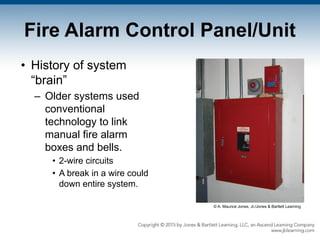
• History of system
“brain”
– Older systems used
conventional
technology to link
manual fire alarm
boxes and bells.
• 2-wire circuits
• A break in a wire could
down entire system.
© A. Maurice Jones, Jr./Jones & Bartlett Learning
Fire Alarm Control Panel/Unit
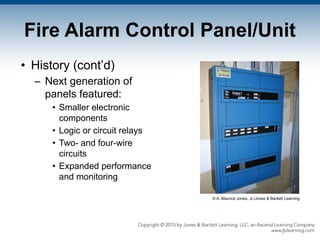
• History (cont’d)
– Next generation of
panels featured:
• Smaller electronic
components
• Logic or circuit relays
• Two- and four-wire
circuits
• Expanded performance
and monitoring
© A. Maurice Jones, Jr./Jones & Bartlett Learning
Fire Alarm Control Panel/Unit
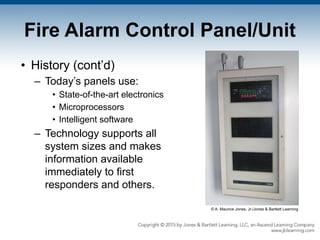
• History (cont’d)
– Today’s panels use:
• State-of-the-art electronics
• Microprocessors
• Intelligent software
– Technology supports all
system sizes and makes
information available
immediately to first
responders and others.
© A. Maurice Jones, Jr./Jones & Bartlett Learning
Fire Alarm Control Panel/Unit
• The panel has multiple functions:
– Monitors integrity of system circuits and devices
– Processes input signals from initiating devices
– Drives notification appliances
– Provides an interface with other system
– Powers power supply
• Two independent sources of power are used:
– Power utility and backup source
Fire Alarm Control Panel/Unit
• Types of fire alarm signals
– Not all information communicated by alarm
system means there is a fire.
– Alarms alert occupants to a fire emergency.
– Trouble signals sound when there is a problem
with system integrity.
– Supervisory signals sound when there is a
change in normal ready status of other fire
protection systems or devices connected to the
control panel.
Initiating Devices
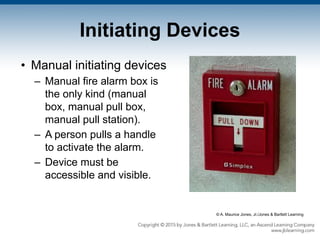
• Manual initiating devices
– Manual fire alarm box is
the only kind (manual
box, manual pull box,
manual pull station).
– A person pulls a handle
to activate the alarm.
– Device must be
accessible and visible.
© A. Maurice Jones, Jr./Jones & Bartlett Learning
Initiating Devices
• Manual initiating devices (cont’d)
– NFPA 72, National Fire Alarm and Signaling
Code, lists requirements for boxes.
– Boxes must be within 5ʹ of exit, 42–48″ above
the floor, colored red unless environment
precludes use of color.
– Boxes must be listed and approved for moist,
damp, or wet conditions.
• Protect from corrosion, rust, electrical shorting,
grounding
Initiating Devices
• Manual initiating devices (cont’d)
– Protective covers:
• Protect from environment
• Protect from physical damage
• Deter individuals from pulling to create false alarm
Initiating Devices
• Manual initiating devices (cont’d)
– Operational characteristics create categories:
• Non-coded
• Coded
• General alarm
• Pre-signal
• Break-glass
• Non-break-glass
• Single-action
• Double-action
– Once fire alarm box is pulled, it requires resetting.
Initiating Devices
• Automatic initiating devices
– Classified by fire signature component they
detect: heat, smoke, flame, or gas
– Also classified by class and size of hazard
they protect
• Spot detectors: specific area
• Line detectors: area along an uninterrupted linear
route
• Air sampling detectors: pull air from a protected
area and check for products of combustion
Initiating Devices
• Automatic initiating devices (cont’d)
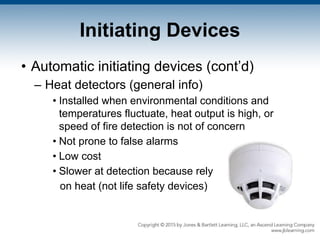
– Heat detectors (general info)
• Installed when environmental conditions and
temperatures fluctuate, heat output is high, or
speed of fire detection is not of concern
• Not prone to false alarms
• Low cost
• Slower at detection because rely
on heat (not life safety devices)
Initiating Devices
• Automatic initiating devices (cont’d)
– Heat detectors (types)
• Fixed-temperature heat detectors
• Rate-of-rise heat detectors
• Fixed-temperature/rate-of-rise detectors
• Rate-compensation heat detectors
Initiating Devices
• Automatic initiating devices (cont’d)
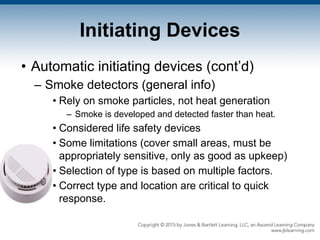
– Smoke detectors (general info)
• Rely on smoke particles, not heat generation
– Smoke is developed and detected faster than heat.
• Considered life safety devices
• Some limitations (cover small areas, must be
appropriately sensitive, only as good as upkeep)
• Selection of type is based on multiple factors.
• Correct type and location are critical to quick
response.
Initiating Devices
• Automatic initiating devices (cont’d)
– Smoke detectors (types)
• Ionized smoke detectors
• Light-scattering photoelectric smoke detectors
• Light-obscuration photoelectric smoke detectors
(beam detectors)
• Air sampling smoke detectors
• Duct smoke detectors
• Video smoke and flame detectors
• Multiple-parameter, low-false-alarm fire detectors
Initiating Devices
• Automatic initiating devices (cont’d)
– Radiant energy sensing fire detectors
• Also called flame or spark/ember detectors
• Look for specific portions of the light spectrum
produced by flames, sparks, and embers
• Used especially in industrial/manufacturing
• Installed where hazard level is high, rapid and
sensitive detection is critical, and remote detection
of small fires is critical
• Right type of detector based on environment and
fuel type, and sources of non-fire radiant energy
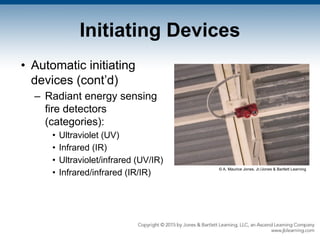
Initiating Devices
• Automatic initiating
devices (cont’d)
– Radiant energy sensing
fire detectors
(categories):
• Ultraviolet (UV)
• Infrared (IR)
• Ultraviolet/infrared (UV/IR)
• Infrared/infrared (IR/IR)
© A. Maurice Jones, Jr./Jones & Bartlett Learning
Initiating Devices
• Automatic initiating devices (cont’d)
– Gas sensing fire detectors
• Utilize multiple sensing technologies (infrared,
semiconductor, electrochemical, catalytic bead)
• Detect gas and vapors
• Protect high hazard environments (e.g., offshore oil
and gas rigs, HVAC air intakes, oil and gas wells)
Initiating Devices
• Automatic initiating devices (cont’d)
– Signal processing/alarm verification
• Most modern alarms/detectors can validate
conditions before sounding an alarm.
• Signal processing checks the smoke in the
detector at specified intervals, initiating an alarm
when threshold is exceeded for a certain amount of
time.
• With alarm verification, when the panel receives a
signal it delays to see if the condition clears before
sounding an alarm.
Initiating Devices
• Automatic initiating devices (cont’d)
– Water flow initiating devices
• Also known as a water flow switch
• Use a flexible round paddle or vane that inserts
into the wet sprinkler piping
• The paddle can activate a switch, which sends a
signal to the panel and activates the alarm
• Installed by sprinkler contractor but wired to fire
alarm system by fire alarm or electrical contractor
• Switches have built-in adjustable time delay;
compensate for fluctuations in water pressure
Initiating Devices
• Automatic initiating devices (cont’d)
– Alarm pressure switch initiating devices
• Installed by fire sprinkler contractor; wired by fire
alarm or electrical contractor
• Screw into a fitting in the sprinkler system’s pipe
components package
• Operate when pressure setting rises above/drops
below a certain threshold
• No time delay
• May require manual reset
Notification Appliances
• Overview
– Notifying occupants is the most important
function of the fire alarm system.
– Many different notification appliances are
used.
– System type and device location depend on
multiple factors.
Notification Appliances
• Public mode/private mode notification
– Public mode notification alerts occupants
visually or audibly.
• Most common
• Appropriate for locations where people can make
decisions and take action
– Grocery stores
– Schools
– Office buildings
Notification Appliances
• Public mode/private mode notification
(cont’d)
– Private mode is used when sounding a
general alarm is impractical.
• When occupants are not physically or mentally
capable or when their movement is restricted
– Nursing homes
– Hospitals
– Jails
• Trained individuals receive signal and implement
emergency procedures.
Notification Appliances
• Coded, non-coded, and textual signals
– Coded signals: Generate a predetermined
number of visual or audible patterns for a
specific duration to identify the location of the
initiating device
– Non-coded signals: Provide a constant visual
or audible signal until reset
– Textual signals: Voice message over
speakers, text message on an annunciation
panel, or symbol flashing on a screen
Notification Appliances
• Audible appliances (general info)
– Must be loud enough to be heard over regular
noise level of the area
• NFPA 72 requirements
– Must make a distinctive sound
• ANSI S3.41, three-pulse temporal pattern
– Must relay information intelligibly
• Clear and understandable
Notification Appliances
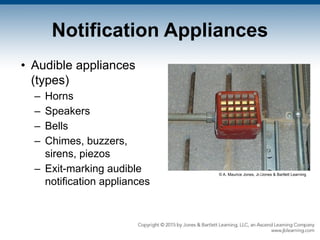
• Audible appliances
(types)
– Horns
– Speakers
– Bells
– Chimes, buzzers,
sirens, piezos
– Exit-marking audible
notification appliances
© A. Maurice Jones, Jr./Jones & Bartlett Learning
Notification Appliances
• Visible appliances (general info)
– Produce flashing lights seen when the fire alarm
system activates
– Necessary in case audible alarms are not heard
– Required by adopted building, fire accessibility,
and life safety codes
– Installed in public/common areas, employee work
areas, high-ambient-noise-level areas, sleeping
rooms in institutional/residential occupancies
Notification Appliances
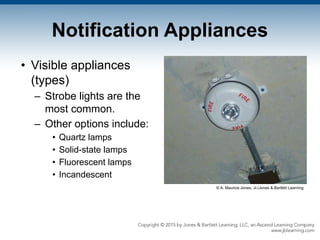
• Visible appliances
(types)
– Strobe lights are the
most common.
– Other options include:
• Quartz lamps
• Solid-state lamps
• Fluorescent lamps
• Incandescent
© A. Maurice Jones, Jr./Jones & Bartlett Learning
Notification Appliances
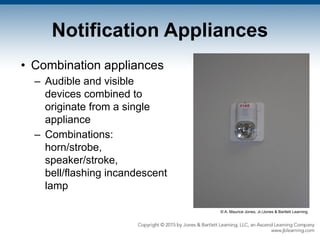
• Combination appliances
– Audible and visible
devices combined to
originate from a single
appliance
– Combinations:
horn/strobe,
speaker/stroke,
bell/flashing incandescent
lamp
© A. Maurice Jones, Jr./Jones & Bartlett Learning
Notification Appliances
• Addressable notification appliances
– New appliance that can interact with software
via microprocessor-based fire alarm control
panel to:
• Program candela rating
• Determine and adjust power levels
• Perform tests
• Print status reports
Annunciation Panels
• Overview
– First, fire fighters respond to the main
entrance and initiate operational activities;
then they look for the annunciation panel.
– The panel provides valuable information on
initiating device, involved system(s), and
location of fire.
– Some panels are simple (handwritten); others
incorporate LCD textual messaging or touch
screens.
Annunciation Panels
• Components
– Some panels provide a graphic representation
of a building footprint.
– Different colored lights, lenses, or
light-emitting diodes identify the type of signal
being generated by the initiating device.
– Panels serve multiple functions, from system
reset to control features that assist first
responders.
Annunciation Panels
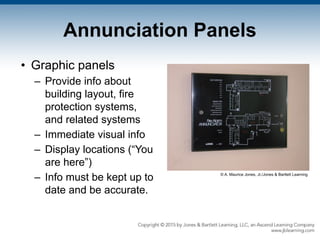
• Graphic panels
– Provide info about
building layout, fire
protection systems,
and related systems
– Immediate visual info
– Display locations (“You
are here”)
– Info must be kept up to
date and be accurate.
© A. Maurice Jones, Jr./Jones & Bartlett Learning
Annunciation Panels
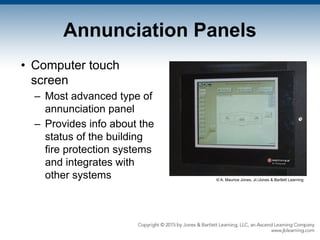
• Computer touch
screen
– Most advanced type of
annunciation panel
– Provides info about the
status of the building
fire protection systems
and integrates with
other systems © A. Maurice Jones, Jr./Jones & Bartlett Learning
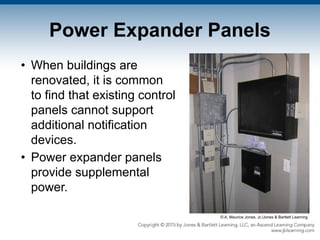
Power Expander Panels
• When buildings are
renovated, it is common
to find that existing control
panels cannot support
additional notification
devices.
• Power expander panels
provide supplemental
power.
© A. Maurice Jones, Jr./Jones & Bartlett Learning
Other Components and
Systems
• Other components associated with fire
alarm systems include:
– Electronic valve supervisory devices
• Tamper switches can send supervisory signals.
– Pressure switches
• Switches can initiate alarm/generate supervisory
signal
– Air and water temperature sensors/water level
sensors
• Sensors can send supervisory signals.
Summary
• One of the most important functions of the
fire alarm system is to notify building
occupants that there is a fire condition. The
fire alarm system is also capable of sending
different signals to an on- or off-site location
where trained staff take the appropriate
action.
Summary
• Over the past 40 or so years, fire alarm
control panel technology has evolved from
very simple to very complex. The most
sophisticated and newest systems use
microprocessor-based software-driven
systems that interface with building and life
safety systems.
Summary
• Some fire alarm systems have the capability
of sending signals to other building systems
to perform life safety functions such as
capturing elevators, recalling elevators to a
particular floor, turning off the power to
elevators, unlocking exit doors, starting fans,
closing smoke dampers, pressurizing stair
towers and elevator shafts, and closing
smoke doors to compartmentalize an area of
a building.
Summary
• The fire alarm system provides critical
information to first responders by identifying
alarm type and location, and supervising
other fire and life safety systems and
components.
• Many different components are necessary to
ensure full system functionality and
operational capability during a fire
emergency.
Summary
• Fire alarm panels monitor and control all
system devices and initiate the appropriate
type of signal, which includes alarm, trouble,
or supervisory.
• Initiating devices provide manual or
automatic means of activating fire alarm and
supervisory signals.
Summary
• Notification appliances provide audible,
visual, and textual signals to begin
evacuation or relocation of occupants.
• The annunciation panel provides visible and
valuable information concerning the device
signaling an alarm and area of the building
where the fire is located.

fire-alarm-system-discussion.ppt (1).pdf

  • 1.
    Fire Alarm SystemComponents and Functions
  • 2.
    Objectives • Describe afire alarm system. • List five functions fire alarm systems provide. • List and describe the three types of fire alarm signals. • Discuss the characteristics of conventional fire alarm system technology. • Discuss the characteristics of addressable fire alarm system technology.
  • 3.
    Objectives • Discuss thefunctions of a fire alarm control panel and annunciation panel. • List and describe the different components that make up a fire alarm system. • List and describe devices that interface with a fire alarm system to supervise the condition of other fire protection systems.
  • 4.
    Introduction • Fire alarmsystems provide notification of fire emergencies. – Survival depends on time from recognition to evacuation. • Three main system components of systems: – Initiating device – Notification device – Control panel
  • 5.
    Introduction • Some systemscan send signals in addition to occupant notification. – To locations where trained staff receive and act – To other fire and life safety systems
  • 6.
    Introduction • Many systemcomponents ensure functionality and operational capabilities. – Some systems are basic; others perform complex tasks. – All components have a purpose and must be evaluated and tested by a nationally recognized lab.
  • 7.
    Fire Alarm ControlPanel/Unit • History of system “brain” – Older systems used conventional technology to link manual fire alarm boxes and bells. • 2-wire circuits • A break in a wire could down entire system. © A. Maurice Jones, Jr./Jones & Bartlett Learning
  • 8.
    Fire Alarm ControlPanel/Unit • History (cont’d) – Next generation of panels featured: • Smaller electronic components • Logic or circuit relays • Two- and four-wire circuits • Expanded performance and monitoring © A. Maurice Jones, Jr./Jones & Bartlett Learning
  • 9.
    Fire Alarm ControlPanel/Unit • History (cont’d) – Today’s panels use: • State-of-the-art electronics • Microprocessors • Intelligent software – Technology supports all system sizes and makes information available immediately to first responders and others. © A. Maurice Jones, Jr./Jones & Bartlett Learning
  • 10.
    Fire Alarm ControlPanel/Unit • The panel has multiple functions: – Monitors integrity of system circuits and devices – Processes input signals from initiating devices – Drives notification appliances – Provides an interface with other system – Powers power supply • Two independent sources of power are used: – Power utility and backup source
  • 11.
    Fire Alarm ControlPanel/Unit • Types of fire alarm signals – Not all information communicated by alarm system means there is a fire. – Alarms alert occupants to a fire emergency. – Trouble signals sound when there is a problem with system integrity. – Supervisory signals sound when there is a change in normal ready status of other fire protection systems or devices connected to the control panel.
  • 12.
    Initiating Devices • Manualinitiating devices – Manual fire alarm box is the only kind (manual box, manual pull box, manual pull station). – A person pulls a handle to activate the alarm. – Device must be accessible and visible. © A. Maurice Jones, Jr./Jones & Bartlett Learning
  • 13.
    Initiating Devices • Manualinitiating devices (cont’d) – NFPA 72, National Fire Alarm and Signaling Code, lists requirements for boxes. – Boxes must be within 5ʹ of exit, 42–48″ above the floor, colored red unless environment precludes use of color. – Boxes must be listed and approved for moist, damp, or wet conditions. • Protect from corrosion, rust, electrical shorting, grounding
  • 14.
    Initiating Devices • Manualinitiating devices (cont’d) – Protective covers: • Protect from environment • Protect from physical damage • Deter individuals from pulling to create false alarm
  • 15.
    Initiating Devices • Manualinitiating devices (cont’d) – Operational characteristics create categories: • Non-coded • Coded • General alarm • Pre-signal • Break-glass • Non-break-glass • Single-action • Double-action – Once fire alarm box is pulled, it requires resetting.
  • 16.
    Initiating Devices • Automaticinitiating devices – Classified by fire signature component they detect: heat, smoke, flame, or gas – Also classified by class and size of hazard they protect • Spot detectors: specific area • Line detectors: area along an uninterrupted linear route • Air sampling detectors: pull air from a protected area and check for products of combustion
  • 17.
    Initiating Devices • Automaticinitiating devices (cont’d) – Heat detectors (general info) • Installed when environmental conditions and temperatures fluctuate, heat output is high, or speed of fire detection is not of concern • Not prone to false alarms • Low cost • Slower at detection because rely on heat (not life safety devices)
  • 18.
    Initiating Devices • Automaticinitiating devices (cont’d) – Heat detectors (types) • Fixed-temperature heat detectors • Rate-of-rise heat detectors • Fixed-temperature/rate-of-rise detectors • Rate-compensation heat detectors
  • 19.
    Initiating Devices • Automaticinitiating devices (cont’d) – Smoke detectors (general info) • Rely on smoke particles, not heat generation – Smoke is developed and detected faster than heat. • Considered life safety devices • Some limitations (cover small areas, must be appropriately sensitive, only as good as upkeep) • Selection of type is based on multiple factors. • Correct type and location are critical to quick response.
  • 20.
    Initiating Devices • Automaticinitiating devices (cont’d) – Smoke detectors (types) • Ionized smoke detectors • Light-scattering photoelectric smoke detectors • Light-obscuration photoelectric smoke detectors (beam detectors) • Air sampling smoke detectors • Duct smoke detectors • Video smoke and flame detectors • Multiple-parameter, low-false-alarm fire detectors
  • 21.
    Initiating Devices • Automaticinitiating devices (cont’d) – Radiant energy sensing fire detectors • Also called flame or spark/ember detectors • Look for specific portions of the light spectrum produced by flames, sparks, and embers • Used especially in industrial/manufacturing • Installed where hazard level is high, rapid and sensitive detection is critical, and remote detection of small fires is critical • Right type of detector based on environment and fuel type, and sources of non-fire radiant energy
  • 22.
    Initiating Devices • Automaticinitiating devices (cont’d) – Radiant energy sensing fire detectors (categories): • Ultraviolet (UV) • Infrared (IR) • Ultraviolet/infrared (UV/IR) • Infrared/infrared (IR/IR) © A. Maurice Jones, Jr./Jones & Bartlett Learning
  • 23.
    Initiating Devices • Automaticinitiating devices (cont’d) – Gas sensing fire detectors • Utilize multiple sensing technologies (infrared, semiconductor, electrochemical, catalytic bead) • Detect gas and vapors • Protect high hazard environments (e.g., offshore oil and gas rigs, HVAC air intakes, oil and gas wells)
  • 24.
    Initiating Devices • Automaticinitiating devices (cont’d) – Signal processing/alarm verification • Most modern alarms/detectors can validate conditions before sounding an alarm. • Signal processing checks the smoke in the detector at specified intervals, initiating an alarm when threshold is exceeded for a certain amount of time. • With alarm verification, when the panel receives a signal it delays to see if the condition clears before sounding an alarm.
  • 25.
    Initiating Devices • Automaticinitiating devices (cont’d) – Water flow initiating devices • Also known as a water flow switch • Use a flexible round paddle or vane that inserts into the wet sprinkler piping • The paddle can activate a switch, which sends a signal to the panel and activates the alarm • Installed by sprinkler contractor but wired to fire alarm system by fire alarm or electrical contractor • Switches have built-in adjustable time delay; compensate for fluctuations in water pressure
  • 26.
    Initiating Devices • Automaticinitiating devices (cont’d) – Alarm pressure switch initiating devices • Installed by fire sprinkler contractor; wired by fire alarm or electrical contractor • Screw into a fitting in the sprinkler system’s pipe components package • Operate when pressure setting rises above/drops below a certain threshold • No time delay • May require manual reset
  • 27.
    Notification Appliances • Overview –Notifying occupants is the most important function of the fire alarm system. – Many different notification appliances are used. – System type and device location depend on multiple factors.
  • 28.
    Notification Appliances • Publicmode/private mode notification – Public mode notification alerts occupants visually or audibly. • Most common • Appropriate for locations where people can make decisions and take action – Grocery stores – Schools – Office buildings
  • 29.
    Notification Appliances • Publicmode/private mode notification (cont’d) – Private mode is used when sounding a general alarm is impractical. • When occupants are not physically or mentally capable or when their movement is restricted – Nursing homes – Hospitals – Jails • Trained individuals receive signal and implement emergency procedures.
  • 30.
    Notification Appliances • Coded,non-coded, and textual signals – Coded signals: Generate a predetermined number of visual or audible patterns for a specific duration to identify the location of the initiating device – Non-coded signals: Provide a constant visual or audible signal until reset – Textual signals: Voice message over speakers, text message on an annunciation panel, or symbol flashing on a screen
  • 31.
    Notification Appliances • Audibleappliances (general info) – Must be loud enough to be heard over regular noise level of the area • NFPA 72 requirements – Must make a distinctive sound • ANSI S3.41, three-pulse temporal pattern – Must relay information intelligibly • Clear and understandable
  • 32.
    Notification Appliances • Audibleappliances (types) – Horns – Speakers – Bells – Chimes, buzzers, sirens, piezos – Exit-marking audible notification appliances © A. Maurice Jones, Jr./Jones & Bartlett Learning
  • 33.
    Notification Appliances • Visibleappliances (general info) – Produce flashing lights seen when the fire alarm system activates – Necessary in case audible alarms are not heard – Required by adopted building, fire accessibility, and life safety codes – Installed in public/common areas, employee work areas, high-ambient-noise-level areas, sleeping rooms in institutional/residential occupancies
  • 34.
    Notification Appliances • Visibleappliances (types) – Strobe lights are the most common. – Other options include: • Quartz lamps • Solid-state lamps • Fluorescent lamps • Incandescent © A. Maurice Jones, Jr./Jones & Bartlett Learning
  • 35.
    Notification Appliances • Combinationappliances – Audible and visible devices combined to originate from a single appliance – Combinations: horn/strobe, speaker/stroke, bell/flashing incandescent lamp © A. Maurice Jones, Jr./Jones & Bartlett Learning
  • 36.
    Notification Appliances • Addressablenotification appliances – New appliance that can interact with software via microprocessor-based fire alarm control panel to: • Program candela rating • Determine and adjust power levels • Perform tests • Print status reports
  • 37.
    Annunciation Panels • Overview –First, fire fighters respond to the main entrance and initiate operational activities; then they look for the annunciation panel. – The panel provides valuable information on initiating device, involved system(s), and location of fire. – Some panels are simple (handwritten); others incorporate LCD textual messaging or touch screens.
  • 38.
    Annunciation Panels • Components –Some panels provide a graphic representation of a building footprint. – Different colored lights, lenses, or light-emitting diodes identify the type of signal being generated by the initiating device. – Panels serve multiple functions, from system reset to control features that assist first responders.
  • 39.
    Annunciation Panels • Graphicpanels – Provide info about building layout, fire protection systems, and related systems – Immediate visual info – Display locations (“You are here”) – Info must be kept up to date and be accurate. © A. Maurice Jones, Jr./Jones & Bartlett Learning
  • 40.
    Annunciation Panels • Computertouch screen – Most advanced type of annunciation panel – Provides info about the status of the building fire protection systems and integrates with other systems © A. Maurice Jones, Jr./Jones & Bartlett Learning
  • 41.
    Power Expander Panels •When buildings are renovated, it is common to find that existing control panels cannot support additional notification devices. • Power expander panels provide supplemental power. © A. Maurice Jones, Jr./Jones & Bartlett Learning
  • 42.
    Other Components and Systems •Other components associated with fire alarm systems include: – Electronic valve supervisory devices • Tamper switches can send supervisory signals. – Pressure switches • Switches can initiate alarm/generate supervisory signal – Air and water temperature sensors/water level sensors • Sensors can send supervisory signals.
  • 43.
    Summary • One ofthe most important functions of the fire alarm system is to notify building occupants that there is a fire condition. The fire alarm system is also capable of sending different signals to an on- or off-site location where trained staff take the appropriate action.
  • 44.
    Summary • Over thepast 40 or so years, fire alarm control panel technology has evolved from very simple to very complex. The most sophisticated and newest systems use microprocessor-based software-driven systems that interface with building and life safety systems.
  • 45.
    Summary • Some firealarm systems have the capability of sending signals to other building systems to perform life safety functions such as capturing elevators, recalling elevators to a particular floor, turning off the power to elevators, unlocking exit doors, starting fans, closing smoke dampers, pressurizing stair towers and elevator shafts, and closing smoke doors to compartmentalize an area of a building.
  • 46.
    Summary • The firealarm system provides critical information to first responders by identifying alarm type and location, and supervising other fire and life safety systems and components. • Many different components are necessary to ensure full system functionality and operational capability during a fire emergency.
  • 47.
    Summary • Fire alarmpanels monitor and control all system devices and initiate the appropriate type of signal, which includes alarm, trouble, or supervisory. • Initiating devices provide manual or automatic means of activating fire alarm and supervisory signals.
  • 48.
    Summary • Notification appliancesprovide audible, visual, and textual signals to begin evacuation or relocation of occupants. • The annunciation panel provides visible and valuable information concerning the device signaling an alarm and area of the building where the fire is located.