The next 15 minutes could
change your life…
Forever…
Have you planned for your financial future???
Wedding of Children
Wealth Creation
Children Education
Comfortable Retired life
Passing Wealth to the
next generation
And many more…
Dream House
… your road map to
Financial Independence.
It is the process of helping you …
• identify and prioritise your goals
• realize them in a planned, disciplined and systematic manner
…by taking a holistic view of your financial life.
360° Financial Planning – A 4 Step Approach
Step 1 Where you stand now? Financial Status Analysis
•Cash Flow Planning
•Investment Planning
•Insurance (Protection) Planning
•Children's Future Planning
•Tax Planning
•Retirement Planning
Step 4 Regular Review of progress…
Step 3 How to get there? Tools
Step 2 Where do you want to go? Goal analysis
Steps:
1. Analysis of your Monthly Income and Expenditure (Household Budget)
2. Calculation of Surplus Cash (Monthly Savings) available for meeting financial goals
3. Computation of your Personal Net Worth - Assets and Liabilities
4. Compilation of your Current Investment Portfolio
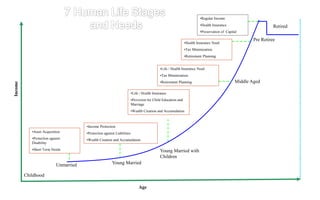
Unmarried Young Married
Middle Aged
Young Married with
Children
Pre Retiree
Retired
Age
Income
•Asset Acquisition
•Protection against
Disability
•Short Term Needs
•Income Protection
•Protection against Liabilities
•Wealth Creation and Accumulation
•Life / Health Insurance
•Provision for Child Education and
Marriage
•Wealth Creation and Accumulation
•Life / Health Insurance Need
•Tax Minimization
•Retirement Planning
•Health Insurance Need
•Tax Minimization
•Retirement Planning
•Regular Income
•Health Insurance
•Preservation of Capital
Childhood
Steps:
1. Identify sources of cash inflows
2. Create cushion for emergencies
3. Prioritise goals
4. Estimate future outflows
5. Match inflows and outflows
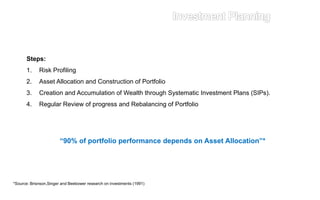
Steps:
1. Risk Profiling
2. Asset Allocation and Construction of Portfolio
3. Creation and Accumulation of Wealth through Systematic Investment Plans (SIPs).
4. Regular Review of progress and Rebalancing of Portfolio
“90% of portfolio performance depends on Asset Allocation”*
*Source: Brisnson,Singer and Beebower research on investments (1991)
‘Always provide for your unpredictable needs before your
predictable financial needs.’
Steps:
1. Identify and Evaluate risks on your life, health and assets.
2. Make provisions for adequate coverage using appropriate products.
For protection against unforeseen …
Steps:
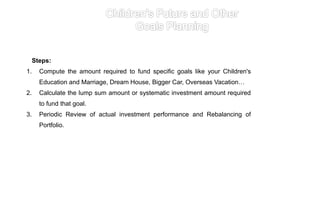
1. Compute the amount required to fund specific goals like your Children's
Education and Marriage, Dream House, Bigger Car, Overseas Vacation…
2. Calculate the lump sum amount or systematic investment amount required
to fund that goal.
3. Periodic Review of actual investment performance and Rebalancing of
Portfolio.
Tax Planning
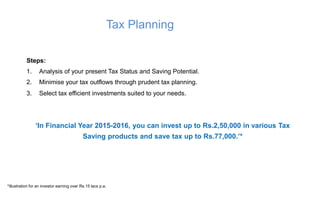
Steps:
1. Analysis of your present Tax Status and Saving Potential.
2. Minimise your tax outflows through prudent tax planning.
3. Select tax efficient investments suited to your needs.
*Illustration for an investor earning over Rs.15 lacs p.a.
‘In Financial Year 2015-2016, you can invest up to Rs.2,50,000 in various Tax
Saving products and save tax up to Rs.77,000.’*
Tax Planning
Retirement Planning
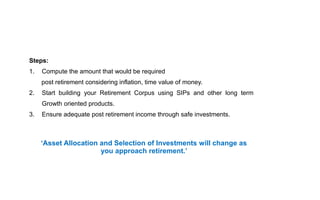
Steps:
1. Compute the amount that would be required
post retirement considering inflation, time value of money.
2. Start building your Retirement Corpus using SIPs and other long term
Growth oriented products.
3. Ensure adequate post retirement income through safe investments.
‘Asset Allocation and Selection of Investments will change as
you approach retirement.’
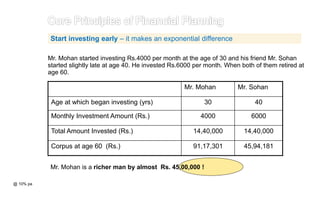
Mr. Mohan started investing Rs.4000 per month at the age of 30 and his friend Mr. Sohan
started slightly late at age 40. He invested Rs.6000 per month. When both of them retired at
age 60.
Mr. Mohan Mr. Sohan
Age at which began investing (yrs) 30 40
Monthly Investment Amount (Rs.) 4000 6000
Total Amount Invested (Rs.) 14,40,000 14,40,000
Corpus at age 60 (Rs.) 91,17,301 45,94,181
Mr. Mohan is a richer man by almost Rs. 45,00,000 !
@ 10% pa
Start investing early – it makes an exponential difference
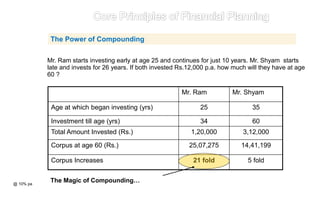
Mr. Ram starts investing early at age 25 and continues for just 10 years. Mr. Shyam starts
late and invests for 26 years. If both invested Rs.12,000 p.a. how much will they have at age
60 ?
Mr. Ram Mr. Shyam
Age at which began investing (yrs) 25 35
Investment till age (yrs) 34 60
Total Amount Invested (Rs.) 1,20,000 3,12,000
Corpus at age 60 (Rs.) 25,07,275 14,41,199
Corpus Increases 21 fold 5 fold
The Magic of Compounding…@ 10% pa
The Power of Compounding
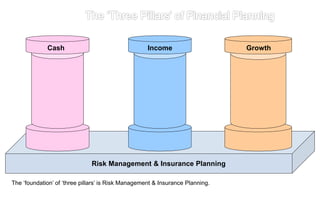
Risk Management & Insurance Planning
The ‘foundation’ of ‘three pillars’ is Risk Management & Insurance Planning.
Cash Income Growth
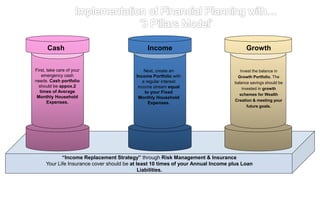
Cash Income Growth
First, take care of your
emergency cash
needs. Cash portfolio
should be appox.2
times of Average
Monthly Household
Expenses.
Next, create an
Income Portfolio with
a regular interest
income stream equal
to your Fixed
Monthly Household
Expenses.
Invest the balance in
Growth Portfolio. The
balance savings should be
invested in growth
schemes for Wealth
Creation & meeting your
future goals.
“Income Replacement Strategy” through Risk Management & Insurance
Your Life Insurance cover should be at least 10 times of your Annual Income plus Loan
Liabilities.
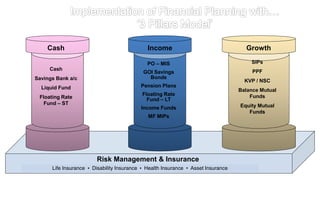
Cash
Savings Bank a/c
Liquid Fund
Floating Rate
Fund – ST
PO – MIS
GOI Savings
Bonds
Pension Plans
Floating Rate
Fund – LT
Income Funds
MF MIPs
SIPs
PPF
KVP / NSC
Balance Mutual
Funds
Equity Mutual
Funds
Risk Management & Insurance
Life Insurance • Disability Insurance • Health Insurance • Asset Insurance
Cash Income Growth
Thank You

Financial planning

  • 1.
    The next 15minutes could change your life… Forever…
  • 2.
    Have you plannedfor your financial future??? Wedding of Children Wealth Creation Children Education Comfortable Retired life Passing Wealth to the next generation And many more… Dream House
  • 3.
    … your roadmap to Financial Independence.
  • 4.
    It is theprocess of helping you … • identify and prioritise your goals • realize them in a planned, disciplined and systematic manner …by taking a holistic view of your financial life. 360° Financial Planning – A 4 Step Approach Step 1 Where you stand now? Financial Status Analysis •Cash Flow Planning •Investment Planning •Insurance (Protection) Planning •Children's Future Planning •Tax Planning •Retirement Planning Step 4 Regular Review of progress… Step 3 How to get there? Tools Step 2 Where do you want to go? Goal analysis
  • 5.
    Steps: 1. Analysis ofyour Monthly Income and Expenditure (Household Budget) 2. Calculation of Surplus Cash (Monthly Savings) available for meeting financial goals 3. Computation of your Personal Net Worth - Assets and Liabilities 4. Compilation of your Current Investment Portfolio
  • 6.
    Unmarried Young Married MiddleAged Young Married with Children Pre Retiree Retired Age Income •Asset Acquisition •Protection against Disability •Short Term Needs •Income Protection •Protection against Liabilities •Wealth Creation and Accumulation •Life / Health Insurance •Provision for Child Education and Marriage •Wealth Creation and Accumulation •Life / Health Insurance Need •Tax Minimization •Retirement Planning •Health Insurance Need •Tax Minimization •Retirement Planning •Regular Income •Health Insurance •Preservation of Capital Childhood
  • 7.
    Steps: 1. Identify sourcesof cash inflows 2. Create cushion for emergencies 3. Prioritise goals 4. Estimate future outflows 5. Match inflows and outflows
  • 8.
    Steps: 1. Risk Profiling 2.Asset Allocation and Construction of Portfolio 3. Creation and Accumulation of Wealth through Systematic Investment Plans (SIPs). 4. Regular Review of progress and Rebalancing of Portfolio “90% of portfolio performance depends on Asset Allocation”* *Source: Brisnson,Singer and Beebower research on investments (1991)
  • 9.
    ‘Always provide foryour unpredictable needs before your predictable financial needs.’ Steps: 1. Identify and Evaluate risks on your life, health and assets. 2. Make provisions for adequate coverage using appropriate products. For protection against unforeseen …
  • 10.
    Steps: 1. Compute theamount required to fund specific goals like your Children's Education and Marriage, Dream House, Bigger Car, Overseas Vacation… 2. Calculate the lump sum amount or systematic investment amount required to fund that goal. 3. Periodic Review of actual investment performance and Rebalancing of Portfolio.
  • 11.
    Tax Planning Steps: 1. Analysisof your present Tax Status and Saving Potential. 2. Minimise your tax outflows through prudent tax planning. 3. Select tax efficient investments suited to your needs. *Illustration for an investor earning over Rs.15 lacs p.a. ‘In Financial Year 2015-2016, you can invest up to Rs.2,50,000 in various Tax Saving products and save tax up to Rs.77,000.’* Tax Planning
  • 12.
    Retirement Planning Steps: 1. Computethe amount that would be required post retirement considering inflation, time value of money. 2. Start building your Retirement Corpus using SIPs and other long term Growth oriented products. 3. Ensure adequate post retirement income through safe investments. ‘Asset Allocation and Selection of Investments will change as you approach retirement.’
  • 13.
    Mr. Mohan startedinvesting Rs.4000 per month at the age of 30 and his friend Mr. Sohan started slightly late at age 40. He invested Rs.6000 per month. When both of them retired at age 60. Mr. Mohan Mr. Sohan Age at which began investing (yrs) 30 40 Monthly Investment Amount (Rs.) 4000 6000 Total Amount Invested (Rs.) 14,40,000 14,40,000 Corpus at age 60 (Rs.) 91,17,301 45,94,181 Mr. Mohan is a richer man by almost Rs. 45,00,000 ! @ 10% pa Start investing early – it makes an exponential difference
  • 14.
    Mr. Ram startsinvesting early at age 25 and continues for just 10 years. Mr. Shyam starts late and invests for 26 years. If both invested Rs.12,000 p.a. how much will they have at age 60 ? Mr. Ram Mr. Shyam Age at which began investing (yrs) 25 35 Investment till age (yrs) 34 60 Total Amount Invested (Rs.) 1,20,000 3,12,000 Corpus at age 60 (Rs.) 25,07,275 14,41,199 Corpus Increases 21 fold 5 fold The Magic of Compounding…@ 10% pa The Power of Compounding
  • 15.
    Risk Management &Insurance Planning The ‘foundation’ of ‘three pillars’ is Risk Management & Insurance Planning. Cash Income Growth
  • 16.
    Cash Income Growth First,take care of your emergency cash needs. Cash portfolio should be appox.2 times of Average Monthly Household Expenses. Next, create an Income Portfolio with a regular interest income stream equal to your Fixed Monthly Household Expenses. Invest the balance in Growth Portfolio. The balance savings should be invested in growth schemes for Wealth Creation & meeting your future goals. “Income Replacement Strategy” through Risk Management & Insurance Your Life Insurance cover should be at least 10 times of your Annual Income plus Loan Liabilities.
  • 17.
    Cash Savings Bank a/c LiquidFund Floating Rate Fund – ST PO – MIS GOI Savings Bonds Pension Plans Floating Rate Fund – LT Income Funds MF MIPs SIPs PPF KVP / NSC Balance Mutual Funds Equity Mutual Funds Risk Management & Insurance Life Insurance • Disability Insurance • Health Insurance • Asset Insurance Cash Income Growth
  • 18.