PANDURANG PATKAR,
BSc, LL.B, MBA, A.III, CFP.
Founder & Director, FUTURECARE – BFSI Training Academy
CERTIFIED FINANCIAL PLANNER & BFSI TRAINER
( Finance, Stock Market, Wealth Management, CFP ,Insurance & NISM courses Training)
BTM Layout, Bangalore-76
pandurangpatkar101@gmail.com, 9535422995
What is Financial Planning
Financial Planning is the process of
meeting an individual’s Life’s Financial
Goals through the proper management
of one’s finances.
 Financial Planning is the blueprint for management of all
financial affairs for our entire life.
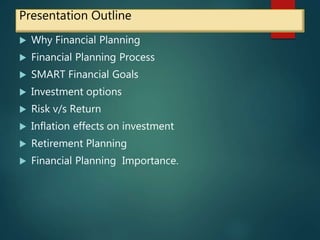
Presentation Outline
 Why Financial Planning
 Financial Planning Process
 SMART Financial Goals
 Investment options
 Risk v/s Return
 Inflation effects on investment
 Retirement Planning
 Financial Planning Importance.
Why Financial Planning
 Financial Planning gives clarity in your life
 It provides direction & meaning to your financial decisions.
 It gives you confidence to achieve your Goals
 Prevention is better than cure – with Financial Plan you are prepared
for any unforeseen events which affect your finance
 It helps to curtail your unnecessary expenses.
 With financial planning, you are able to foresee your goal
achievements.
 Financial Planning propels you to put planning in to action.
 Financial Planning gives you peace of mind.
Financial Goals Blueprint
….for OUR GOALS, OUR DREAMS!
We WORK for…
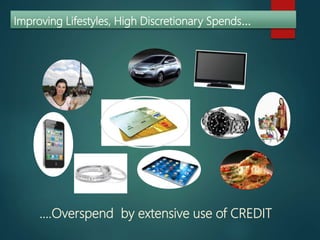
Improving Lifestyles, High Discretionary Spends…
….Overspend by extensive use of CREDIT
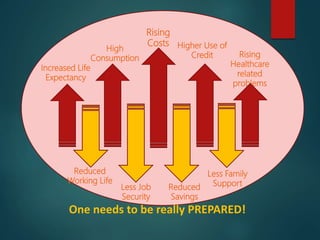
Increased Life
Expectancy
Reduced
Working Life
Rising
Costs
Less Family
Support
High
Consumption
Less Job
Security
Rising
Healthcare
related
problems
Reduced
Savings
Higher Use of
Credit
One needs to be really PREPARED!
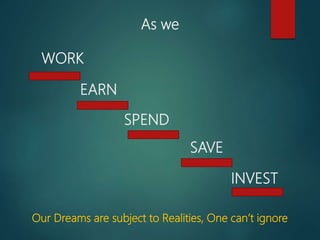
As we
WORK
EARN
SPEND
SAVE
INVEST
Our Dreams are subject to Realities, One can’t ignore
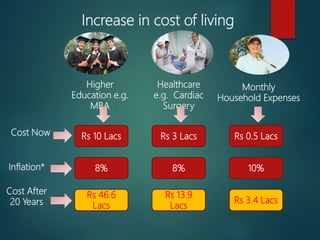
Increase in cost of living
Rs 10 Lacs
8%
Rs 46.6
Lacs
Cost Now
Inflation*
Cost After
20 Years
Higher
Education e.g.
MBA
Rs 3 Lacs
8%
Rs 13.9
Lacs
Healthcare
e.g. Cardiac
Surgery
Rs 0.5 Lacs
10%
Rs 3.4 Lacs
Monthly
Household Expenses
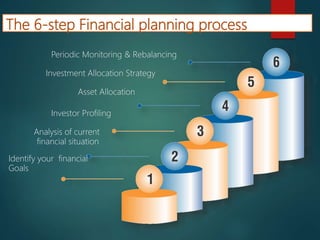
The 6-step Financial planning process
Periodic Monitoring & Rebalancing
Investment Allocation Strategy
Asset Allocation
Investor Profiling
Analysis of current
financial situation
Identify your financial
Goals
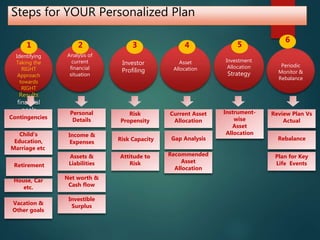
Steps for YOUR Personalized Plan
Identifying
Taking the
RIGHT
Approach
towards
RIGHT
Results
financial
goals
Analysis of
current
financial
situation
Investor
Profiling
Asset
Allocation
Investment
Allocation
Strategy
Periodic
Monitor &
Rebalance
Contingencies
Child’s
Education,
Marriage etc.
Retirement
House, Car
etc.
Vacation &
Other goals
Personal
Details
Income &
Expenses
Assets &
Liabilities
Investible
Surplus
Net worth &
Cash flow
Risk
Propensity
Risk Capacity
Attitude to
Risk
Current Asset
Allocation
Gap Analysis
Recommended
Asset
Allocation
Instrument-
wise
Asset
Allocation
1 2 3 4 5
6
Review Plan Vs
Actual
Rebalance
Plan for Key
Life Events
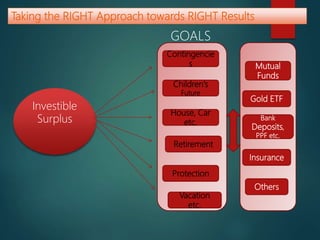
Taking the RIGHT Approach towards RIGHT Results
Mutual
Funds
Gold ETF
Bank
Deposits,
PPF etc.
Insurance
Others
Children‘s
Future
Contingencie
s
Protection
House, Car
etc.
Retirement
Vacation
etc.
Investible
Surplus
GOALS
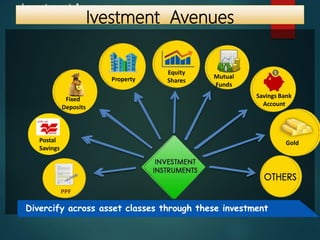
Ivestment Avenues
Divercify across asset classes through these investment
PPF
Fixed
Deposits
Property
Equity
Shares
Mutual
Funds
Savings Bank
Account
Gold
Postal
Savings
Investment Avenues
PPF
Fixed
Deposits
Property
Equity
Shares
Mutual
Funds
Savings Bank
Account
GoldPostal
Savings
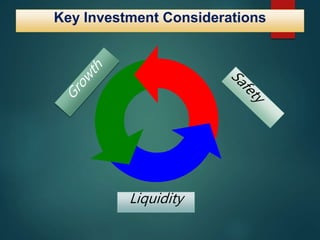
Key Investment Considerations
Liquidity
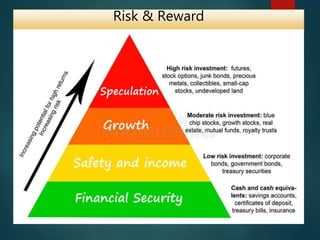
Risk & Reward
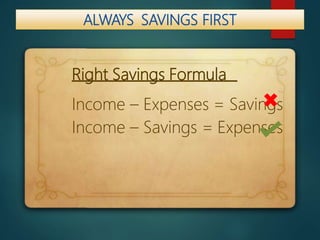
ALWAYS SAVINGS FIRST
Right Savings Formula
Income – Expenses = Savings
Income – Savings = Expenses
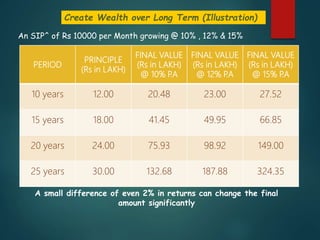
Create Wealth over Long Term (Illustration)
An SIP^ of Rs 10000 per Month growing @ 10% , 12% & 15%
PERIOD
PRINCIPLE
(Rs in LAKH)
FINAL VALUE
(Rs in LAKH)
@ 10% P.A
FINAL VALUE
(Rs in LAKH)
@ 12% P.A
FINAL VALUE
(Rs in LAKH)
@ 15% P.A
10 years 12.00 20.48 23.00 27.52
15 years 18.00 41.45 49.95 66.85
20 years 24.00 75.93 98.92 149.00
25 years 30.00 132.68 187.88 324.35
A small difference of even 2% in returns can change the final
amount significantly
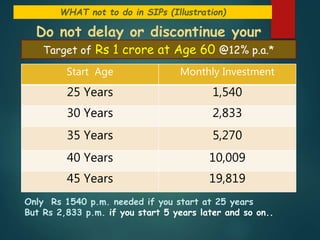
WHAT not to do in SIPs (Illustration)
Do not delay or discontinue your
SIPTarget of Rs 1 crore at Age 60 @12% p.a.*
Start Age Monthly Investment
25 Years 1,540
30 Years 2,833
35 Years 5,270
40 Years 10,009
45 Years 19,819
Only Rs 1540 p.m. needed if you start at 25 years
But Rs 2,833 p.m. if you start 5 years later and so on..
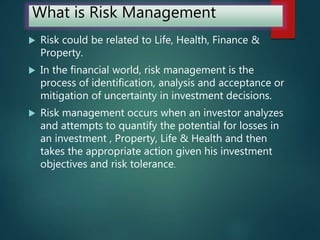
What is Risk Management
 Risk could be related to Life, Health, Finance &
Property.
 In the financial world, risk management is the
process of identification, analysis and acceptance or
mitigation of uncertainty in investment decisions.
 Risk management occurs when an investor analyzes
and attempts to quantify the potential for losses in
an investment , Property, Life & Health and then
takes the appropriate action given his investment
objectives and risk tolerance.
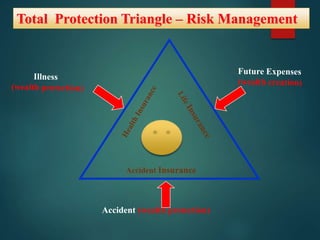
Total Protection Triangle – Risk Management
Accident Insurance
Accident (wealth protection)
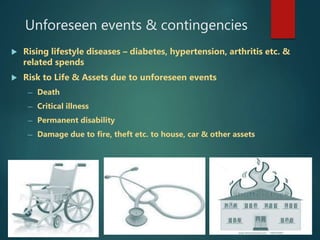
Unforeseen events & contingencies
 Rising lifestyle diseases – diabetes, hypertension, arthritis etc. &
related spends
 Risk to Life & Assets due to unforeseen events
― Death
― Critical illness
― Permanent disability
― Damage due to fire, theft etc. to house, car & other assets
Life Needs Financial Goals
Living Needs Goals
Bills
Loans
Medical
Expenses
Rent
Child’s
Education
New Car
Marriage
Retirement
You can’t protect the Income earner from any unfortunate incident…
But you can Protect the Income
What if AmaLLL ma dies in an accident...lLFIRLIFE INSURANCE ( Term Plan )
LIFE PROTECTION
Protection for yourself is a
PRICELESS SECURITY TO YOUR Family
Against all the RISKS that can drain you off the hard earned returns
By Protecting yourself, you are only making yourself
more certain about achieving your Financial Goals.
Wealth
Creation
Wealth
Protection
The Perfect Integration……
TERM INSURANCE
T OO L
Income Needs
Income & Future Needs
Protection Protection
Meet all your Financial Goals
without a Compromise
Why Retirement Plan
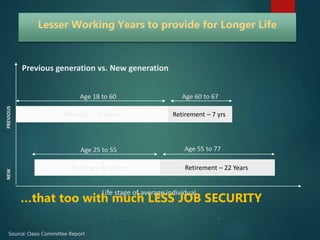
 Unlike the US and Europe, where senior citizens receive
social security benefits from the state, India is not a
welfare state.
 In the absence of sufficient retirement savings, the only
fallback option available for Indian senior citizens is
their family.
 Taking care of parents in their old age is part of our
Indian culture.
 With changing social and economic dynamics, our
society is moving towards nuclear family units either due
to cultural factors or due to economic factors (children
living in different cities or even countries)
Retirement- Golden years
Previous generation vs. New generation
Source: Oasis Committee Report
Working – 42 years
Working – 30 years Retirement – 22 Years
Retirement – 7 yrs
Age 18 to 60 Age 60 to 67
Age 25 to 55 Age 55 to 77
Life stage of average individual
Lesser Working Years to provide for Longer Life
PREVIOUSNEW
…that too with much LESS JOB SECURITY
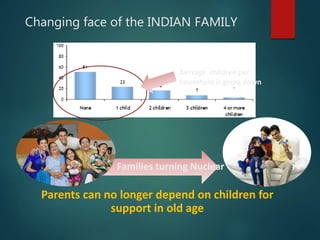
Changing face of the INDIAN FAMILY
Average children per
household is going down
Families turning Nuclear
Parents can no longer depend on children for
support in old age
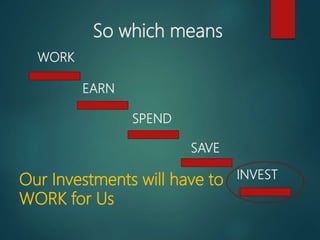
So which means
WORK
EARN
SPEND
SAVE
INVESTOur Investments will have to
WORK for Us
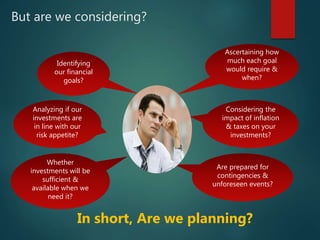
But are we considering?
Ascertaining how
much each goal
would require &
when?
Considering the
impact of inflation
& taxes on your
investments?
Identifying
our financial
goals?
Analyzing if our
investments are
in line with our
risk appetite?
Whether
investments will be
sufficient &
available when we
need it?
Are prepared for
contingencies &
unforeseen events?
In short, Are we planning?
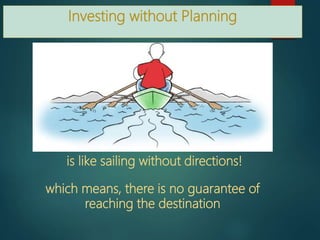
Investing without Planning
is like sailing without directions!
which means, there is no guarantee of
reaching the destination
Self Medication is dangerous
Investment Truths
 It’s not your salary that makes you Rich
It’s your spending habits.
 A penny saved is penny earned
 Beware of little expenses, a small leak will sink a
great ship
Planning First…….
Become a Informed & Knowledgeable Investor
 An Investment in Knowledge pays the Best Interest.
Action speaks louder than words
42

Financial Planning

  • 2.
    PANDURANG PATKAR, BSc, LL.B,MBA, A.III, CFP. Founder & Director, FUTURECARE – BFSI Training Academy CERTIFIED FINANCIAL PLANNER & BFSI TRAINER ( Finance, Stock Market, Wealth Management, CFP ,Insurance & NISM courses Training) BTM Layout, Bangalore-76 pandurangpatkar101@gmail.com, 9535422995
  • 3.
    What is FinancialPlanning Financial Planning is the process of meeting an individual’s Life’s Financial Goals through the proper management of one’s finances.  Financial Planning is the blueprint for management of all financial affairs for our entire life.
  • 4.
    Presentation Outline  WhyFinancial Planning  Financial Planning Process  SMART Financial Goals  Investment options  Risk v/s Return  Inflation effects on investment  Retirement Planning  Financial Planning Importance.

  • 5.
    Why Financial Planning Financial Planning gives clarity in your life  It provides direction & meaning to your financial decisions.  It gives you confidence to achieve your Goals  Prevention is better than cure – with Financial Plan you are prepared for any unforeseen events which affect your finance  It helps to curtail your unnecessary expenses.  With financial planning, you are able to foresee your goal achievements.  Financial Planning propels you to put planning in to action.  Financial Planning gives you peace of mind.

  • 6.
  • 7.
    ….for OUR GOALS,OUR DREAMS! We WORK for…
  • 8.
    Improving Lifestyles, HighDiscretionary Spends… ….Overspend by extensive use of CREDIT
  • 9.
    Increased Life Expectancy Reduced Working Life Rising Costs LessFamily Support High Consumption Less Job Security Rising Healthcare related problems Reduced Savings Higher Use of Credit One needs to be really PREPARED!
  • 10.
    As we WORK EARN SPEND SAVE INVEST Our Dreamsare subject to Realities, One can’t ignore
  • 11.
    Increase in costof living Rs 10 Lacs 8% Rs 46.6 Lacs Cost Now Inflation* Cost After 20 Years Higher Education e.g. MBA Rs 3 Lacs 8% Rs 13.9 Lacs Healthcare e.g. Cardiac Surgery Rs 0.5 Lacs 10% Rs 3.4 Lacs Monthly Household Expenses
  • 12.
    The 6-step Financialplanning process Periodic Monitoring & Rebalancing Investment Allocation Strategy Asset Allocation Investor Profiling Analysis of current financial situation Identify your financial Goals
  • 13.
    Steps for YOURPersonalized Plan Identifying Taking the RIGHT Approach towards RIGHT Results financial goals Analysis of current financial situation Investor Profiling Asset Allocation Investment Allocation Strategy Periodic Monitor & Rebalance Contingencies Child’s Education, Marriage etc. Retirement House, Car etc. Vacation & Other goals Personal Details Income & Expenses Assets & Liabilities Investible Surplus Net worth & Cash flow Risk Propensity Risk Capacity Attitude to Risk Current Asset Allocation Gap Analysis Recommended Asset Allocation Instrument- wise Asset Allocation 1 2 3 4 5 6 Review Plan Vs Actual Rebalance Plan for Key Life Events
  • 14.
    Taking the RIGHTApproach towards RIGHT Results Mutual Funds Gold ETF Bank Deposits, PPF etc. Insurance Others Children‘s Future Contingencie s Protection House, Car etc. Retirement Vacation etc. Investible Surplus GOALS
  • 15.
    Ivestment Avenues Divercify acrossasset classes through these investment PPF Fixed Deposits Property Equity Shares Mutual Funds Savings Bank Account Gold Postal Savings Investment Avenues PPF Fixed Deposits Property Equity Shares Mutual Funds Savings Bank Account GoldPostal Savings
  • 17.
  • 18.
  • 19.
    ALWAYS SAVINGS FIRST RightSavings Formula Income – Expenses = Savings Income – Savings = Expenses
  • 20.
    Create Wealth overLong Term (Illustration) An SIP^ of Rs 10000 per Month growing @ 10% , 12% & 15% PERIOD PRINCIPLE (Rs in LAKH) FINAL VALUE (Rs in LAKH) @ 10% P.A FINAL VALUE (Rs in LAKH) @ 12% P.A FINAL VALUE (Rs in LAKH) @ 15% P.A 10 years 12.00 20.48 23.00 27.52 15 years 18.00 41.45 49.95 66.85 20 years 24.00 75.93 98.92 149.00 25 years 30.00 132.68 187.88 324.35 A small difference of even 2% in returns can change the final amount significantly
  • 21.
    WHAT not todo in SIPs (Illustration) Do not delay or discontinue your SIPTarget of Rs 1 crore at Age 60 @12% p.a.* Start Age Monthly Investment 25 Years 1,540 30 Years 2,833 35 Years 5,270 40 Years 10,009 45 Years 19,819 Only Rs 1540 p.m. needed if you start at 25 years But Rs 2,833 p.m. if you start 5 years later and so on..
  • 22.
    What is RiskManagement  Risk could be related to Life, Health, Finance & Property.  In the financial world, risk management is the process of identification, analysis and acceptance or mitigation of uncertainty in investment decisions.  Risk management occurs when an investor analyzes and attempts to quantify the potential for losses in an investment , Property, Life & Health and then takes the appropriate action given his investment objectives and risk tolerance.
  • 23.
    Total Protection Triangle– Risk Management Accident Insurance Accident (wealth protection)
  • 24.
    Unforeseen events &contingencies  Rising lifestyle diseases – diabetes, hypertension, arthritis etc. & related spends  Risk to Life & Assets due to unforeseen events ― Death ― Critical illness ― Permanent disability ― Damage due to fire, theft etc. to house, car & other assets
  • 25.
    Life Needs FinancialGoals Living Needs Goals Bills Loans Medical Expenses Rent Child’s Education New Car Marriage Retirement
  • 26.
    You can’t protectthe Income earner from any unfortunate incident… But you can Protect the Income What if AmaLLL ma dies in an accident...lLFIRLIFE INSURANCE ( Term Plan )
  • 27.
    LIFE PROTECTION Protection foryourself is a PRICELESS SECURITY TO YOUR Family Against all the RISKS that can drain you off the hard earned returns By Protecting yourself, you are only making yourself more certain about achieving your Financial Goals.
  • 28.
  • 29.
    TERM INSURANCE T OOL Income Needs Income & Future Needs Protection Protection Meet all your Financial Goals without a Compromise
  • 30.
    Why Retirement Plan Unlike the US and Europe, where senior citizens receive social security benefits from the state, India is not a welfare state.  In the absence of sufficient retirement savings, the only fallback option available for Indian senior citizens is their family.  Taking care of parents in their old age is part of our Indian culture.  With changing social and economic dynamics, our society is moving towards nuclear family units either due to cultural factors or due to economic factors (children living in different cities or even countries)
  • 31.
  • 32.
    Previous generation vs.New generation Source: Oasis Committee Report Working – 42 years Working – 30 years Retirement – 22 Years Retirement – 7 yrs Age 18 to 60 Age 60 to 67 Age 25 to 55 Age 55 to 77 Life stage of average individual Lesser Working Years to provide for Longer Life PREVIOUSNEW …that too with much LESS JOB SECURITY
  • 33.
    Changing face ofthe INDIAN FAMILY Average children per household is going down Families turning Nuclear Parents can no longer depend on children for support in old age
  • 34.
    So which means WORK EARN SPEND SAVE INVESTOurInvestments will have to WORK for Us
  • 35.
    But are weconsidering? Ascertaining how much each goal would require & when? Considering the impact of inflation & taxes on your investments? Identifying our financial goals? Analyzing if our investments are in line with our risk appetite? Whether investments will be sufficient & available when we need it? Are prepared for contingencies & unforeseen events? In short, Are we planning?
  • 36.
    Investing without Planning islike sailing without directions! which means, there is no guarantee of reaching the destination
  • 37.
  • 38.
    Investment Truths  It’snot your salary that makes you Rich It’s your spending habits.  A penny saved is penny earned  Beware of little expenses, a small leak will sink a great ship
  • 39.
  • 40.
    Become a Informed& Knowledgeable Investor  An Investment in Knowledge pays the Best Interest.
  • 41.
  • 42.