Factors Affecting
Demand
What Factors affect Demand?
Demand Changes Why?
 There are many factors beyond price that can cause changes in
demand.
 Because these changes can be difficult to predict, short lived, or
relative, Demand Schedules and Demand Curve Graphs cannot
adequately address them as they show change in quantity
demanded in relation to the single factor of price.
 Changes in these other aspects do not cause movement along
a Demand Curve; they move the Demand Curve itself!
 Changes that increase overall demand shift the Demand Curve
to the right as the quantity demanded increases at all prices.
 Changes that decrease overall demand shift the Demand Curve
to the left as the quantity demanded decreases at all prices.
Factors that Change Demand
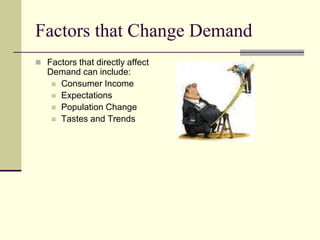
 Factors that directly affect
Demand can include:
 Consumer Income
 Expectations
 Population Change
 Tastes and Trends
Consumer Income
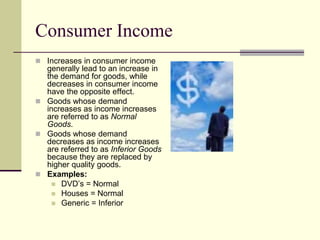
 Increases in consumer income
generally lead to an increase in
the demand for goods, while
decreases in consumer income
have the opposite effect.
 Goods whose demand
increases as income increases
are referred to as Normal
Goods.
 Goods whose demand
decreases as income increases
are referred to as Inferior Goods
because they are replaced by
higher quality goods.
 Examples:
 DVD’s = Normal
 Houses = Normal
 Generic = Inferior
Expectations
 Consumer expectations
regarding price changes directly
affect demand.
 If consumers feel prices for a
good will drop soon, they will
wait to purchase the good at a
later date and a lower price.
 If prices are expected to rise,
consumers will purchase the
good now as opposed to waiting
and risking paying more.
 Examples:
 Gasoline
 Non-Perishable Food
 Cars and Houses
Population Change
 As population increases, the
demand for goods increases
as well because each
member of the population
has needs to be filled.
 However, these needs
change over time as
segments of the population
age and their wants and
needs change.
 Examples:
 Education
 Recreational Materials
 Housing
Tastes and Trends
 Consumers are notoriously
fickle about the types and
styles of goods that they
consume.
 Goods that are extremely
popular one year may have
little or no demand on them
the next.
 Predicting these trends, and
adapting production to them,
is extremely difficult.
 Examples:
 Beanie Babies
 Pokimon Cards
 Tie-Dye Clothes

Factors Affecting Demand

  • 1.
  • 2.
    Demand Changes Why? There are many factors beyond price that can cause changes in demand.  Because these changes can be difficult to predict, short lived, or relative, Demand Schedules and Demand Curve Graphs cannot adequately address them as they show change in quantity demanded in relation to the single factor of price.  Changes in these other aspects do not cause movement along a Demand Curve; they move the Demand Curve itself!  Changes that increase overall demand shift the Demand Curve to the right as the quantity demanded increases at all prices.  Changes that decrease overall demand shift the Demand Curve to the left as the quantity demanded decreases at all prices.
  • 3.
    Factors that ChangeDemand  Factors that directly affect Demand can include:  Consumer Income  Expectations  Population Change  Tastes and Trends
  • 4.
    Consumer Income  Increasesin consumer income generally lead to an increase in the demand for goods, while decreases in consumer income have the opposite effect.  Goods whose demand increases as income increases are referred to as Normal Goods.  Goods whose demand decreases as income increases are referred to as Inferior Goods because they are replaced by higher quality goods.  Examples:  DVD’s = Normal  Houses = Normal  Generic = Inferior
  • 5.
    Expectations  Consumer expectations regardingprice changes directly affect demand.  If consumers feel prices for a good will drop soon, they will wait to purchase the good at a later date and a lower price.  If prices are expected to rise, consumers will purchase the good now as opposed to waiting and risking paying more.  Examples:  Gasoline  Non-Perishable Food  Cars and Houses
  • 6.
    Population Change  Aspopulation increases, the demand for goods increases as well because each member of the population has needs to be filled.  However, these needs change over time as segments of the population age and their wants and needs change.  Examples:  Education  Recreational Materials  Housing
  • 7.
    Tastes and Trends Consumers are notoriously fickle about the types and styles of goods that they consume.  Goods that are extremely popular one year may have little or no demand on them the next.  Predicting these trends, and adapting production to them, is extremely difficult.  Examples:  Beanie Babies  Pokimon Cards  Tie-Dye Clothes