FINANCIAL PLANNING
What is Financial Planning ? Financial planning is the process of successfully meeting financial needs of life through the proper management of finances.  It is your roadmap to Financial Health, & Sustainable Wealth creation.
Why you need Financial Planning? Life without Financial planning is like Unplanned Vacation. If you wish to achieve your financial goals successfully & peacefully you must plan your financial life.
Problems of Random investment Wrong selection – flavor of the month. Wrong timing – mostly near top. Short term investment. Inadequate investment.
Who needs Financial Planning? Whatever may be level of your income or assets , you need financial planning. It is myth that only rich people need financial planning.
How to do Financial Planning? By scientific Asset Allocation .
What is Asset Allocation? Investing predefined percentage of your savings in different Asset classes.
Why Asset Allocation so important? Diversification. Thumb rule No. 1  Never put all your eggs in one basket . Different asset classes give better return for specific time duration. 94% of  portfolio return will depend on Asset allocation only.
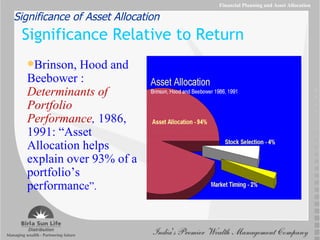
Significance of Asset Allocation Significance Relative to Return Brinson, Hood and Beebower :  Determinants of Portfolio Performance ,  1986, 1991: “Asset Allocation helps explain over 93% of a portfolio’s performanc e”. Financial Planning and Asset Allocation
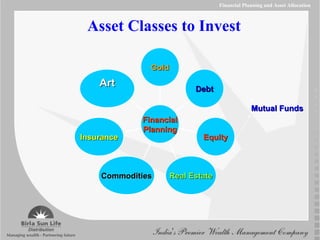
Financial Planning and Asset Allocation Asset Classes to Invest Mutual Funds Art Insurance Commodities Real Estate Equity Debt Gold Financial Planning
How to do Asset Allocation Determine the  C urrent financial situation. What you wish to achieve?  Your  Financial Goals. How much risk you wish to take?  Your  Risk Profile.
Step 1 – Current Status Find out  Net saving available for Investment. Wealth accumulated till today.
Step 2 – Goal Setting What is your intention of investment? Simply put,  How much  money you need? &  When  you need the money? (Time horizon) Specific financial goals are vital to financial planning.
Financial Goals - Examples Mandatory Goals:- Children education Children marriage Retirement Planning. Pension. Purchase of residential premises. Purchase of vehicle.
Optional Goals:- Up gradation of Residence. Luxury Car. Purchase of Luxury items at Home. Vacation Abroad. Wealth creation  – Crorepati, Billionaire. Charity – Religious or Social. Inheritance – Estate planning. Early Retirement -  Financial freedom .
Goal setting Specify amount required & approximate time period when money required. Types of goals. Short term Goals  1-2 years. Medium term goals 3-5 years. Long term goals 5-10 years. Distant goals > 15-20 years.
Risk Profile Two types of Risk in any investment. Risk of Purchasing power loss. Risk of Capital loss. Strong correlation between risk & reward. Aim of financial planning is to get maximum return with minimum risk.
Risk Profile Financial Capacity Income status, more important Net  Saving  status. Age :- Younger the age higher is risk taking capacity. Dependents  in family. Liabilities,  Loans  taken.
Risk Profile Mental capacity – Temperament . How will you react to temporary fall in value of your investment? Risk averse , Conservative. Moderate risk taking personality. Aggressive investor.
Risk Profile Technical Knowledge . Even if financial & mental capacity strong, technical knowledge required to invest in Shares, Art – Painting, Real Estate.  Either take professional help or take Mutual Fund route.
Do & Don'ts Don’t buy on tips, impulse or under influence of ‘left behind’ feeling. Don’t chase last year topper Stick to your asset allocation.  Basic aim of Financial planning is to get  sufficient fund at specific time  for defined financial goal, not to get Super high return .
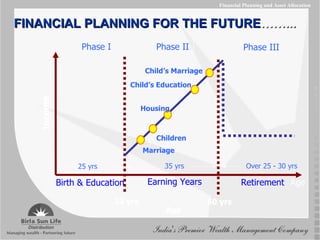
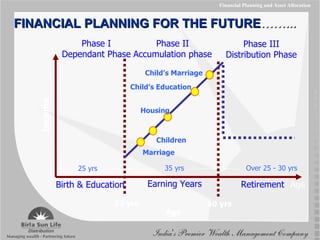
FINANCIAL PLANNING FOR THE FUTURE ……... Financial Planning and Asset Allocation Birth & Education Earning Years Retirement 35 yrs 25 yrs Over 25 - 30 yrs Housing Child’s Education Child’s Marriage Phase I Dependant Phase Phase III Distribution Phase Phase II Accumulation phase Income Age Marriage Children 22 yrs 60 yrs Age
Type of Assets (1)  Liquid Assets –  Cash, Savings a\c, Floating rate mutual fund. Ideal for short term goals.  (2)  Income generating Assets –  Bank F.D.,PPF, NSC, Bonds. Ideal for medium term goal.  (3)  Capital appreciation Assets  – Equity- Shares, Real Estate, Gold, Art. Ideal for long term goal.
FEW EXAMPLES OF  ASSET ALLOCATIONS Financial Planning and Asset Allocation
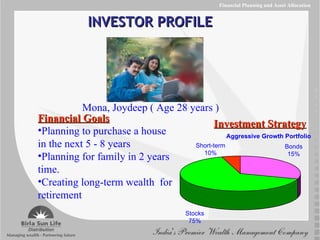
INVESTOR PROFILE Mona, Joydeep ( Age 28 years ) Financial Goals Planning to purchase a house in the next 5 - 8 years Planning for family in 2 years time. Creating long-term wealth  for retirement Investment Strategy Stocks 75% Short-term 10% Aggressive Growth Portfolio Bonds 15% Financial Planning and Asset Allocation
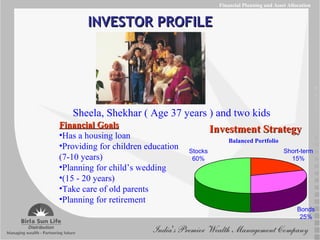
INVESTOR PROFILE Sheela, Shekhar ( Age 37 years ) and two kids Financial Goals Has a housing loan Providing for children education (7-10 years) Planning for child’s wedding  (15 - 20 years) Take care of old parents Planning for retirement Investment Strategy Balanced Portfolio Stocks 60% Short-term 15% Bonds 25% Financial Planning and Asset Allocation
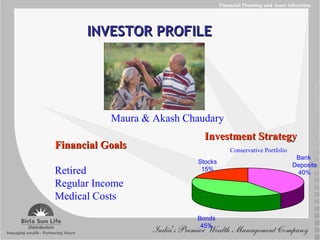
INVESTOR PROFILE Maura & Akash Chaudary Financial Goals Retired Regular Income Medical Costs Investment Strategy Conservative Portfolio Stocks 15% Bank  Deposits 40% Bonds 45% Financial Planning and Asset Allocation
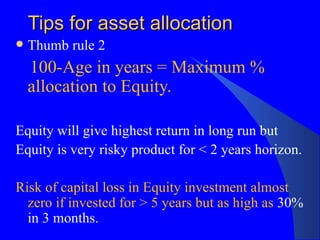
Tips for asset allocation Thumb rule 2 100-Age in years = Maximum % allocation to Equity. Equity will give highest return in long run but Equity is very risky product for < 2 years horizon. Risk of capital loss in Equity investment almost zero if invested for > 5 years but as high as  30% in 3 months.
Emergency Kit Before planning new investment, it is very important to prepare emergency kit to  Protect your Current financial status. Insurance  is first & vital step in any financial planning.
Insurance Aim  – Financial Compensation for any unexpected loss.  Cover the Risk. Personal Risks . Loss of income.  Property Risks . Damage to property. Liability Risks . Losses due to damage to others.
Life Insurance  -  Basic Aim  – Financial protection to your dependents in case of your premature death. Life of  earning member  of family,  ONLY , should be insured. Insurance should be taken for financial risk protection only  NOT  for Investment or Tax planning. Insurance is  very bad investment  product .
Which type of Policy? Term Insurance It is purest form of insurance & so best. Most of  us need only this insurance. Whole life policy .  Pension Schemes .  Do not buy Endowment, Money back, Capital protection plan, Children plan or  U nit  Li nked  P lans ULIP.  Best option is Term Insurance + PPF / ELSS scheme of mutual fund.
How much? Income based calculation. 10 times your annual gross income.  Need based calculation. 200*Monthly home expense  + Loan taken  +  Pending Financial goals -  Current value of your financial assets (excluding your residential premises). You must take Term insurance = Loan taken.
General Insurance policies Personal Risk protection (1 )  Accident Insurance . Pays sum assured on accidental death + pays income loss due to Partial or permanent disability due to accident.  (2)  Mediclaim Insurance . ICICI Lombard has family Mediclaim policy. (3)  Critical illness Insurance Available as rider with life insurance.
General Insurance cont. Property risk insurance . (1 )  Business assets . Damage may be due to  Natural calamities, fire, theft. (2)  Vehicles Comprehensive cover. (3)  Personal assets – Householder Policy. Insurance against damage to Residential Property.
Liability Insurance Professional Indemnity insurance. Third party insurance for Vehicle. Term insurance equal to loan amount.
Cash Flow Management Income – Business Expense  = Take home cash. Take Home Cash – Home expense -  Taxation -  Interest & Installment payments on loan taken =  Saving ( cash available for investment)
Cash Management, Options (1) Investment in Income generating assets. (2) Investment in Expense generating assets ( ? Liabilities).
Income Generating Assets Regular Income  in form of Interest , Dividend , or Rent . Capital Gain  from investment . This  additional or Alternate income  will supplement  your business income, increase cash available for investment & when it crosses your professional income you will achieve  financial freedom.
Expense generating Investment Residential home, Vehicles, Ornaments, Over insurance. If your  all  saving is diverted to these investments you will have lesser & lesser cash available for actual investment. When your professional income decreases you will be in trouble.
Financial definition of asset, liability. The investment which brings cash inside your pocket is  Asset. The investment which takes out cash from your pocket is  Liability. Balance investment in both classes.
Cash Management Thumb rule No.3 15-20% of your take home cash should go to income generating investments. Your EMI should not exceed 30% of your take home cash. During early stages of life allocate higher portion to Assets. Ideally your  Alternate income  should fund your Luxury, Liabilities. Delay expenses, DO NOT delay Investments.
Investment Step 1 Asset Allocation Step 2 Provision for Insurance Step 3 Cash flow planning Step 4 Actual investment.
Investment Options Capital protection + Income generation. (1) Govt. Assured return schemes.  (2) Bank Deposits.  (3) Bonds. (4) Company deposit, debentures. (5) Mutual fund Debt schemes
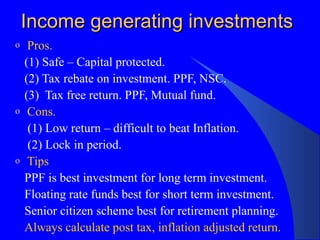
Income generating investments Pros. (1) Safe – Capital protected. (2) Tax rebate on investment. PPF, NSC. (3)  Tax free return. PPF, Mutual fund. Cons. (1) Low return – difficult to beat Inflation. (2) Lock in period. Tips PPF is best investment for long term investment. Floating rate funds best for short term investment. Senior citizen scheme best for retirement planning. Always calculate post tax, inflation adjusted return.
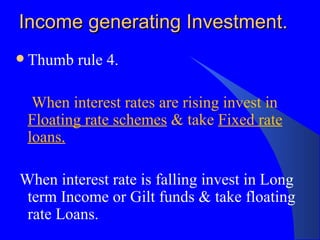
Income generating Investment. Thumb rule 4. When interest rates are rising invest in  Floating rate schemes  & take  Fixed rate   loans. When interest rate is falling invest in Long term Income or Gilt funds & take floating rate Loans.
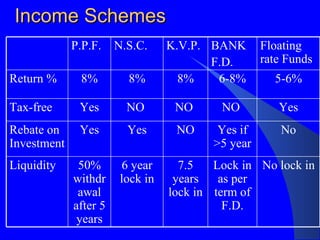
Income Schemes P.P.F. N.S.C. K.V.P. BANK F.D. Floating rate Funds Return % 8% 8% 8% 6-8% 5-6% Tax-free Yes NO  NO  NO  Yes Rebate on Investment Yes Yes NO Yes if >5 year No Liquidity 50% withdrawal after 5 years 6 year lock in 7.5 years lock in Lock in as per term of F.D. No lock in
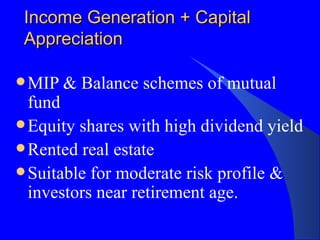
Income Generation + Capital Appreciation MIP & Balance schemes of mutual fund Equity shares with high dividend yield Rented real estate Suitable for moderate risk profile & investors near retirement age.
Capital Appreciation Equity shares -  Direct, IPO, Mutual fund, PMS. Real estate Gold Art – paintings Equity  & Real Estate are best long term  Wealth creator  & Equity is most tax efficient investment.
Speculative investment Trading in equity shares. Derivative trading Commodity trading Very risky product . No speculator has become Billionaire. Only brokers make money.  Never trade with borrowed money.
Mutual Fund What is Mutual fund? (1 )  Fund collected from different investors for common purpose, managed by Professional manager & Income distributed to investors in proportion to their investment. Investors allotted Units for investment. Initial price is always Rs. 10 per unit.  (3)  Market price of unit is called NAV.  Market value of investment / Units allotted = NAV
Mutual fund Advantages Diversification Professional management Income tax benefits.  Liquidity. Systematic regular investment of small amount possible.
Mutual Fund Types (1 )  Debt Schemes . (a) Floating rate scheme.  (b) Income or bond schemes.  (c) Gilt schemes.  (d) MIP – 5 to 30% investment in equity. Debt schemes ideal for regular income, capital protection & short term goals .
Mutual fund Types cont. (2 )  Balance Schemes (a) Debt oriented. 40% investment in equity. (b) Equity oriented. 65% or more investment in equity. Best for medium term financial goals 2-4 years. Best for beginner  in equity market investment.
Mutual fund Types cont. (3 )  Equity schemes (a) Diversified Equity schemes.  Flexi cap diversified equity scheme is best investment for Wealth creation. ( b) ELSS -  Equity linked saving scheme. Best for tax planning.  (c) Sector – Thematic funds.  (d) Index fund.  (e) Exchange traded funds.
Mutual fund Types cont. (4 )  Specialty funds . (a) Exchange traded Gold fund. (b) Real estate fund. (c) Art fund.
Plans – Options Dividend plan Options (1)  Dividend Payout . (2)  Dividend Reinvestment . Growth plan. best plan for wealth creation.
Mutual Fund Types Close Ended Open Ended
How to invest? Lump sum investment. S.I.P. Systematic Investment Plan S.T.P. Systematic Transfer plan If you invest directly at fund office or online there is no entry load.
Fund Selection Say NO to NFO  New fund offer Existing Diversified mutual Fund schemes  having consistent performance during last 5 years. Beware of Agents/ Brokers advise :- (a)  NFO – At par offer , Low NAV.  (b)  Dividend declared .  (c)  Churning – Profit booking.
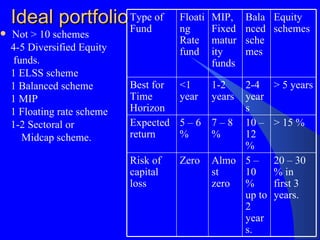
Ideal portfolio Not > 10 schemes 4-5 Diversified Equity  funds. 1 ELSS scheme 1 Balanced scheme 1 MIP 1 Floating rate scheme 1-2 Sectoral or  Midcap scheme. Type of Fund Floating Rate fund MIP, Fixed maturity funds Balanced schemes Equity schemes Best for Time Horizon <1 year 1-2 years 2-4 years > 5 years Expected return 5 – 6 % 7 – 8 % 10 – 12 % > 15 % Risk of capital loss Zero Almost zero 5 – 10 % up to 2 years. 20 – 30 % in first 3 years.
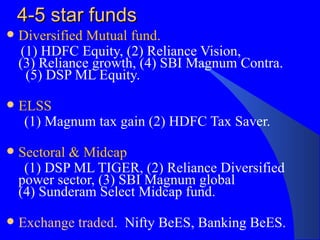
4-5 star funds Diversified Mutual fund. (1) HDFC Equity, (2) Reliance Vision,  (3) Reliance growth, (4) SBI Magnum Contra.  (5) DSP ML Equity. ELSS (1) Magnum tax gain (2) HDFC Tax Saver.  Sectoral & Midcap (1) DSP ML TIGER, (2) Reliance Diversified power sector, (3) SBI Magnum global  (4) Sunderam Select Midcap fund. Exchange traded .  Nifty BeES, Banking BeES.
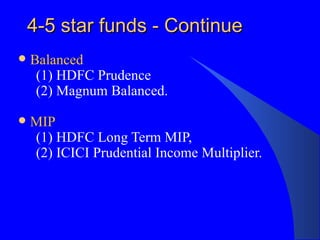
4-5 star funds - Continue Balanced (1) HDFC Prudence  (2) Magnum Balanced. MIP (1) HDFC Long Term MIP, (2) ICICI Prudential Income Multiplier.
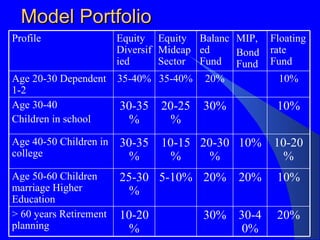
Model Portfolio Profile Equity Diversified Equity Midcap Sector Balanced  Fund MIP,  Bond Fund Floating rate Fund Age 20-30 Dependent 1-2 35-40% 35-40% 20% 10% Age 30-40 Children in school 30-35% 20-25% 30% 10% Age 40-50 Children in college 30-35% 10-15% 20-30% 10% 10-20% Age 50-60 Children marriage Higher Education 25-30% 5-10% 20% 20% 10% > 60 years Retirement planning 10-20% 30% 30-40% 20%
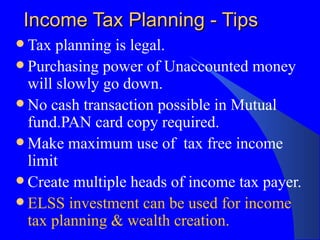
Income Tax Planning - Tips Tax planning is legal.  Purchasing power of Unaccounted money will slowly go down. No cash transaction possible in Mutual fund.PAN card copy required.  Make maximum use of  tax free income limit Create multiple heads of income tax payer. ELSS investment can be used for income tax planning & wealth creation.
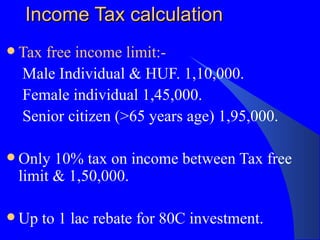
Income Tax calculation Tax free income limit:- Male Individual & HUF. 1,10,000. Female individual 1,45,000. Senior citizen (>65 years age) 1,95,000. Only 10% tax on income between Tax free limit & 1,50,000. Up to 1 lac rebate for 80C investment.
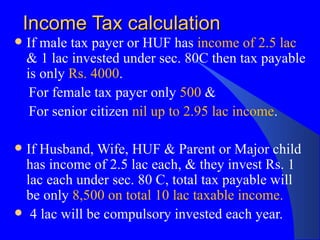
Income Tax calculation If male tax payer or HUF has  income of 2.5 lac  & 1 lac invested under sec. 80C then tax payable is only  Rs. 4000 .  For female tax payer only  500  &  For senior citizen  nil up to 2.95 lac income . If Husband, Wife, HUF & Parent or Major child has income of 2.5 lac each, & they invest Rs. 1 lac each under sec. 80 C, total tax payable will be only  8,500 on total 10 lac taxable income. 4 lac will be compulsory invested each year.
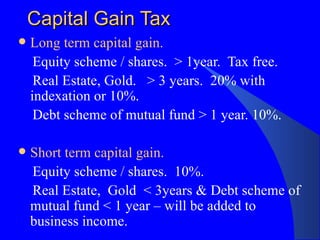
Capital Gain Tax Long term capital gain. Equity scheme / shares.  > 1year.  Tax free. Real Estate, Gold.  > 3 years.  20% with indexation or 10%. Debt scheme of mutual fund > 1 year. 10%. Short term capital gain. Equity scheme / shares.  10%. Real Estate,  Gold  < 3years & Debt scheme of mutual fund < 1 year – will be added to business income.
Income Tax Planning Tips Multiple heads of Tax payer in family. Gift  to parents & major children is tax free, clubbing free, without any limit. Give  loan to spouse  at low interest rate, instead of gift to avoid clubbing of income. Take maximum advantage of  Tax free income . (1) Long term capital gain on shares & equity mutual fund. (2) Dividend from mutual funds & shares. (3) P.P.F. interest. Tax free bond interest. (4) Agriculture income.
Income Tax Planning Tips Home loan .- Principle payment eligible for 80C rebate, Interest deducted from income up to 1.5 lac per year per head. Real esta te  – buy cheap , sell at highest possible price after 3 years. Capital gain tax can be saved by investing in  Capital gain bonds  up to 50 lac. Up to 1 k.g.  gold  per married women & 500 gram gold per unmarried women in family , will be allowed during income tax search.
Retirement Planning Retirement doesn't mean stoppage of work, it means freedom from compulsion to work for money –  Financial freedom . Why? To maintain same life style even after retirement Life expectancy is increasing. 80+ age not unusual. Female spouse will live 5 years more then male. Inflation will make difficult to maintain same level of living standard. You & your spouse may not like to remain dependent on children. We don’t have govt. social security scheme.
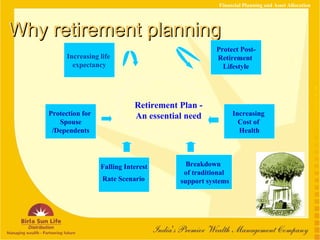
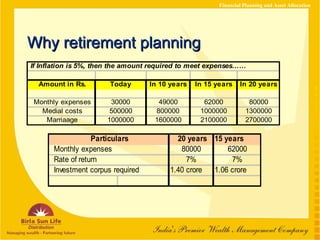
Why retirement planning Financial Planning and Asset Allocation Retirement Plan - An essential need Increasing life  expectancy Protect Post- Retirement  Lifestyle Increasing  Cost of  Health Protection for  Spouse /Dependents Falling Interest Rate Scenario   Breakdown  of traditional support systems
FINANCIAL PLANNING FOR THE FUTURE ……... Financial Planning and Asset Allocation Birth & Education Earning Years Retirement 35 yrs 25 yrs Over 25 - 30 yrs Housing Child’s Education Child’s Marriage Phase I Phase III Phase II Income Age Marriage Children 22 yrs 60 yrs Age
Why retirement planning Financial Planning and Asset Allocation
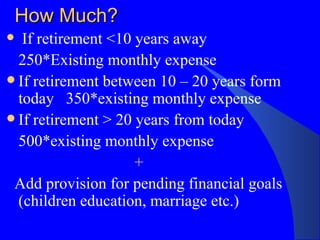
How Much? If retirement <10 years away  250*Existing monthly expense If retirement between 10 – 20 years form today  350*existing monthly expense If retirement > 20 years from today 500*existing monthly expense + Add provision for pending financial goals (children education, marriage etc.)
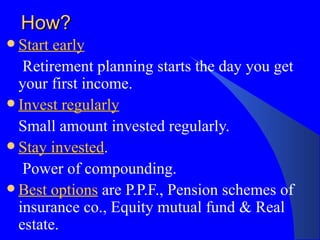
How? Start early Retirement planning starts the day you get your first income. Invest regularly Small amount invested regularly. Stay invested . Power of compounding. Best options  are P.P.F., Pension schemes of insurance co., Equity mutual fund & Real estate.
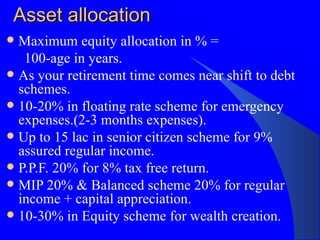
Asset allocation Maximum equity allocation in % = 100-age in years. As your retirement time comes near shift to debt schemes. 10-20% in floating rate scheme for emergency expenses.(2-3 months expenses). Up to 15 lac in senior citizen scheme for 9% assured regular income. P.P.F. 20% for 8% tax free return. MIP 20% & Balanced scheme 20% for regular income + capital appreciation. 10-30% in Equity scheme for wealth creation.
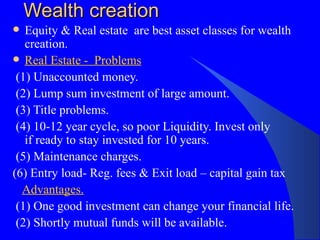
Wealth creation Equity & Real estate  are best asset classes for wealth creation. Real Estate -  Problems (1) Unaccounted money. (2) Lump sum investment of large amount. (3) Title problems. (4) 10-12 year cycle, so poor Liquidity. Invest only  if ready to stay invested for 10 years. (5) Maintenance charges. (6) Entry load- Reg. fees & Exit load – capital gain tax  Advantages. (1) One good investment can change your financial life.  (2) Shortly mutual funds will be available.
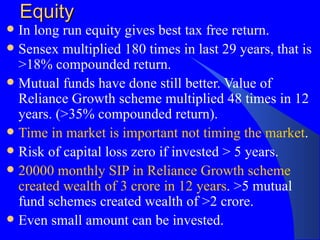
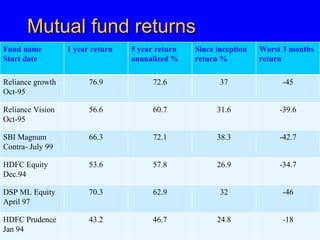
Equity  In long run equity gives best tax free return. Sensex multiplied 180 times in last 29 years, that is >18% compounded return.  Mutual funds have done still better. Value of Reliance Growth scheme multiplied 48 times in 12 years. (>35% compounded return). Time in market is important not timing the market . Risk of capital loss zero if invested > 5 years. 20000 monthly SIP in Reliance Growth scheme created wealth of 3 crore in 12 years . >5 mutual fund schemes created wealth of >2 crore. Even small amount can be invested.
Mutual fund returns Fund name  Start date 1 year return 5 year return annualized % Since inception return % Worst 3 months return Reliance growth Oct-95 76.9 72.6 37 -45 Reliance Vision Oct-95 56.6 60.7 31.6 -39.6 SBI Magnum Contra- July 99 66.3 72.1 38.3 -42.7 HDFC Equity Dec.94 53.6 57.8 26.9 -34.7 DSP ML Equity April 97 70.3 62.9 32 -46 HDFC Prudence Jan 94 43.2 46.7 24.8 -18
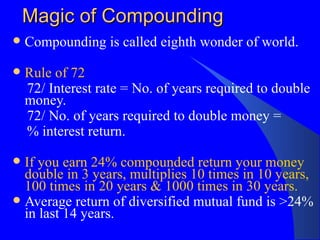
Magic of Compounding Compounding is called eighth wonder of world. Rule of 72 72/ Interest rate = No. of years required to double money. 72/ No. of years required to double money =  % interest return. If you earn 24% compounded return your money double in 3 years, multiplies 10 times in 10 years, 100 times in 20 years & 1000 times in 30 years. Average return of diversified mutual fund is >24% in last 14 years.
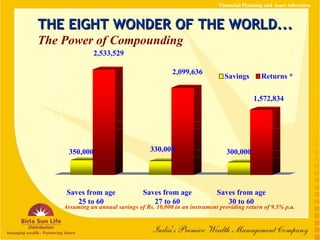
THE EIGHT WONDER OF THE WORLD... The Power of Compounding 350,000 2,533,529 330,000 2,099,636 300,000 1,572,834 Savings Returns * Saves from age 25 to 60 Saves from age 27 to 60 Saves from age 30 to 60 Assuming an annual savings of Rs. 10,000 in an instrument providing return of 9.5% p.a. Financial Planning and Asset Allocation
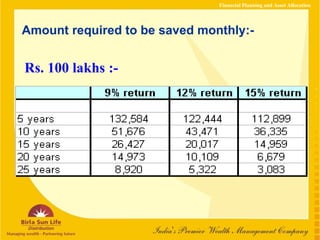
Amount required to be saved monthly:- Financial Planning and Asset Allocation Rs. 100 lakhs :-
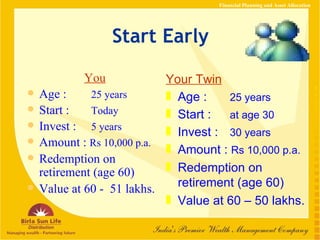
Start Early You Age :  25 years Start :  Today Invest : 5 years Amount :  Rs 10,000 p.a. Redemption on retirement (age 60) Value at 60 -  51 lakhs. Your Twin Age :  25 years Start :  at age 30 Invest : 30 years Amount :  Rs 10,000 p.a. Redemption on retirement (age 60) Value at 60 – 50 lakhs. Financial Planning and Asset Allocation
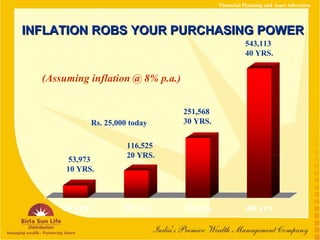
INFLATION ROBS YOUR PURCHASING POWER (Assuming inflation @ 8% p.a.) Rs. 25,000 today 53,973 10 YRS. 116,525 20 YRS. 251,568 30 YRS. 543,113 40 YRS. Financial Planning and Asset Allocation
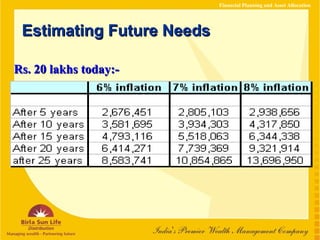
Estimating Future Needs Financial Planning and Asset Allocation Rs. 20 lakhs today:-
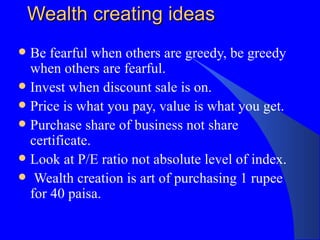
Wealth creating ideas Be fearful when others are greedy, be greedy when others are fearful. Invest when discount sale is on. Price is what you pay, value is what you get. Purchase share of business not share certificate. Look at P/E ratio not absolute level of index. Wealth creation is art of purchasing 1 rupee for 40 paisa.
Stock market quotes In short term market is like Voting machine, in long run it is like weighing machine. Bull will climb staircase but bear will always jump through window. Tops & bottoms are for fools & liars. Most important organ for investment is stomach.
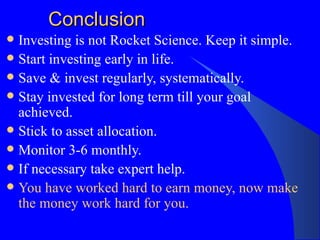
Conclusion Investing is not Rocket Science. Keep it simple. Start investing early in life. Save & invest regularly, systematically. Stay invested for long term till your goal achieved. Stick to asset allocation. Monitor 3-6 monthly. If necessary take expert help. You have worked hard to earn money, now make the money work hard for you.
Self help Self help is best help. Devote some time for your financial planning. Magazines:-  (1)  Mutual fund insight  from Valueresearch Co. (2)  Outlook Money  from Outlook Express group. Websites:- (1)  moneycontrol.com  Personal finance section & Mutual fund section. Portfolio can be created & maintained. (2)  valueresearchonline.com  best analysis of mutual funds, rating, & mutual fund portfolio analysis.
Thank You

Financial planning

  • 1.
  • 2.
    What is FinancialPlanning ? Financial planning is the process of successfully meeting financial needs of life through the proper management of finances. It is your roadmap to Financial Health, & Sustainable Wealth creation.
  • 3.
    Why you needFinancial Planning? Life without Financial planning is like Unplanned Vacation. If you wish to achieve your financial goals successfully & peacefully you must plan your financial life.
  • 4.
    Problems of Randominvestment Wrong selection – flavor of the month. Wrong timing – mostly near top. Short term investment. Inadequate investment.
  • 5.
    Who needs FinancialPlanning? Whatever may be level of your income or assets , you need financial planning. It is myth that only rich people need financial planning.
  • 6.
    How to doFinancial Planning? By scientific Asset Allocation .
  • 7.
    What is AssetAllocation? Investing predefined percentage of your savings in different Asset classes.
  • 8.
    Why Asset Allocationso important? Diversification. Thumb rule No. 1 Never put all your eggs in one basket . Different asset classes give better return for specific time duration. 94% of portfolio return will depend on Asset allocation only.
  • 9.
    Significance of AssetAllocation Significance Relative to Return Brinson, Hood and Beebower : Determinants of Portfolio Performance , 1986, 1991: “Asset Allocation helps explain over 93% of a portfolio’s performanc e”. Financial Planning and Asset Allocation
  • 10.
    Financial Planning andAsset Allocation Asset Classes to Invest Mutual Funds Art Insurance Commodities Real Estate Equity Debt Gold Financial Planning
  • 11.
    How to doAsset Allocation Determine the C urrent financial situation. What you wish to achieve? Your Financial Goals. How much risk you wish to take? Your Risk Profile.
  • 12.
    Step 1 –Current Status Find out Net saving available for Investment. Wealth accumulated till today.
  • 13.
    Step 2 –Goal Setting What is your intention of investment? Simply put, How much money you need? & When you need the money? (Time horizon) Specific financial goals are vital to financial planning.
  • 14.
    Financial Goals -Examples Mandatory Goals:- Children education Children marriage Retirement Planning. Pension. Purchase of residential premises. Purchase of vehicle.
  • 15.
    Optional Goals:- Upgradation of Residence. Luxury Car. Purchase of Luxury items at Home. Vacation Abroad. Wealth creation – Crorepati, Billionaire. Charity – Religious or Social. Inheritance – Estate planning. Early Retirement - Financial freedom .
  • 16.
    Goal setting Specifyamount required & approximate time period when money required. Types of goals. Short term Goals 1-2 years. Medium term goals 3-5 years. Long term goals 5-10 years. Distant goals > 15-20 years.
  • 17.
    Risk Profile Twotypes of Risk in any investment. Risk of Purchasing power loss. Risk of Capital loss. Strong correlation between risk & reward. Aim of financial planning is to get maximum return with minimum risk.
  • 18.
    Risk Profile FinancialCapacity Income status, more important Net Saving status. Age :- Younger the age higher is risk taking capacity. Dependents in family. Liabilities, Loans taken.
  • 19.
    Risk Profile Mentalcapacity – Temperament . How will you react to temporary fall in value of your investment? Risk averse , Conservative. Moderate risk taking personality. Aggressive investor.
  • 20.
    Risk Profile TechnicalKnowledge . Even if financial & mental capacity strong, technical knowledge required to invest in Shares, Art – Painting, Real Estate. Either take professional help or take Mutual Fund route.
  • 21.
    Do & Don'tsDon’t buy on tips, impulse or under influence of ‘left behind’ feeling. Don’t chase last year topper Stick to your asset allocation. Basic aim of Financial planning is to get sufficient fund at specific time for defined financial goal, not to get Super high return .
  • 22.
    FINANCIAL PLANNING FORTHE FUTURE ……... Financial Planning and Asset Allocation Birth & Education Earning Years Retirement 35 yrs 25 yrs Over 25 - 30 yrs Housing Child’s Education Child’s Marriage Phase I Dependant Phase Phase III Distribution Phase Phase II Accumulation phase Income Age Marriage Children 22 yrs 60 yrs Age
  • 23.
    Type of Assets(1) Liquid Assets – Cash, Savings a\c, Floating rate mutual fund. Ideal for short term goals. (2) Income generating Assets – Bank F.D.,PPF, NSC, Bonds. Ideal for medium term goal. (3) Capital appreciation Assets – Equity- Shares, Real Estate, Gold, Art. Ideal for long term goal.
  • 24.
    FEW EXAMPLES OF ASSET ALLOCATIONS Financial Planning and Asset Allocation
  • 25.
    INVESTOR PROFILE Mona,Joydeep ( Age 28 years ) Financial Goals Planning to purchase a house in the next 5 - 8 years Planning for family in 2 years time. Creating long-term wealth for retirement Investment Strategy Stocks 75% Short-term 10% Aggressive Growth Portfolio Bonds 15% Financial Planning and Asset Allocation
  • 26.
    INVESTOR PROFILE Sheela,Shekhar ( Age 37 years ) and two kids Financial Goals Has a housing loan Providing for children education (7-10 years) Planning for child’s wedding (15 - 20 years) Take care of old parents Planning for retirement Investment Strategy Balanced Portfolio Stocks 60% Short-term 15% Bonds 25% Financial Planning and Asset Allocation
  • 27.
    INVESTOR PROFILE Maura& Akash Chaudary Financial Goals Retired Regular Income Medical Costs Investment Strategy Conservative Portfolio Stocks 15% Bank Deposits 40% Bonds 45% Financial Planning and Asset Allocation
  • 28.
    Tips for assetallocation Thumb rule 2 100-Age in years = Maximum % allocation to Equity. Equity will give highest return in long run but Equity is very risky product for < 2 years horizon. Risk of capital loss in Equity investment almost zero if invested for > 5 years but as high as 30% in 3 months.
  • 29.
    Emergency Kit Beforeplanning new investment, it is very important to prepare emergency kit to Protect your Current financial status. Insurance is first & vital step in any financial planning.
  • 30.
    Insurance Aim – Financial Compensation for any unexpected loss. Cover the Risk. Personal Risks . Loss of income. Property Risks . Damage to property. Liability Risks . Losses due to damage to others.
  • 31.
    Life Insurance - Basic Aim – Financial protection to your dependents in case of your premature death. Life of earning member of family, ONLY , should be insured. Insurance should be taken for financial risk protection only NOT for Investment or Tax planning. Insurance is very bad investment product .
  • 32.
    Which type ofPolicy? Term Insurance It is purest form of insurance & so best. Most of us need only this insurance. Whole life policy . Pension Schemes . Do not buy Endowment, Money back, Capital protection plan, Children plan or U nit Li nked P lans ULIP. Best option is Term Insurance + PPF / ELSS scheme of mutual fund.
  • 33.
    How much? Incomebased calculation. 10 times your annual gross income. Need based calculation. 200*Monthly home expense + Loan taken + Pending Financial goals - Current value of your financial assets (excluding your residential premises). You must take Term insurance = Loan taken.
  • 34.
    General Insurance policiesPersonal Risk protection (1 ) Accident Insurance . Pays sum assured on accidental death + pays income loss due to Partial or permanent disability due to accident. (2) Mediclaim Insurance . ICICI Lombard has family Mediclaim policy. (3) Critical illness Insurance Available as rider with life insurance.
  • 35.
    General Insurance cont.Property risk insurance . (1 ) Business assets . Damage may be due to Natural calamities, fire, theft. (2) Vehicles Comprehensive cover. (3) Personal assets – Householder Policy. Insurance against damage to Residential Property.
  • 36.
    Liability Insurance ProfessionalIndemnity insurance. Third party insurance for Vehicle. Term insurance equal to loan amount.
  • 37.
    Cash Flow ManagementIncome – Business Expense = Take home cash. Take Home Cash – Home expense - Taxation - Interest & Installment payments on loan taken = Saving ( cash available for investment)
  • 38.
    Cash Management, Options(1) Investment in Income generating assets. (2) Investment in Expense generating assets ( ? Liabilities).
  • 39.
    Income Generating AssetsRegular Income in form of Interest , Dividend , or Rent . Capital Gain from investment . This additional or Alternate income will supplement your business income, increase cash available for investment & when it crosses your professional income you will achieve financial freedom.
  • 40.
    Expense generating InvestmentResidential home, Vehicles, Ornaments, Over insurance. If your all saving is diverted to these investments you will have lesser & lesser cash available for actual investment. When your professional income decreases you will be in trouble.
  • 41.
    Financial definition ofasset, liability. The investment which brings cash inside your pocket is Asset. The investment which takes out cash from your pocket is Liability. Balance investment in both classes.
  • 42.
    Cash Management Thumbrule No.3 15-20% of your take home cash should go to income generating investments. Your EMI should not exceed 30% of your take home cash. During early stages of life allocate higher portion to Assets. Ideally your Alternate income should fund your Luxury, Liabilities. Delay expenses, DO NOT delay Investments.
  • 43.
    Investment Step 1Asset Allocation Step 2 Provision for Insurance Step 3 Cash flow planning Step 4 Actual investment.
  • 44.
    Investment Options Capitalprotection + Income generation. (1) Govt. Assured return schemes. (2) Bank Deposits. (3) Bonds. (4) Company deposit, debentures. (5) Mutual fund Debt schemes
  • 45.
    Income generating investmentsPros. (1) Safe – Capital protected. (2) Tax rebate on investment. PPF, NSC. (3) Tax free return. PPF, Mutual fund. Cons. (1) Low return – difficult to beat Inflation. (2) Lock in period. Tips PPF is best investment for long term investment. Floating rate funds best for short term investment. Senior citizen scheme best for retirement planning. Always calculate post tax, inflation adjusted return.
  • 46.
    Income generating Investment.Thumb rule 4. When interest rates are rising invest in Floating rate schemes & take Fixed rate loans. When interest rate is falling invest in Long term Income or Gilt funds & take floating rate Loans.
  • 47.
    Income Schemes P.P.F.N.S.C. K.V.P. BANK F.D. Floating rate Funds Return % 8% 8% 8% 6-8% 5-6% Tax-free Yes NO NO NO Yes Rebate on Investment Yes Yes NO Yes if >5 year No Liquidity 50% withdrawal after 5 years 6 year lock in 7.5 years lock in Lock in as per term of F.D. No lock in
  • 48.
    Income Generation +Capital Appreciation MIP & Balance schemes of mutual fund Equity shares with high dividend yield Rented real estate Suitable for moderate risk profile & investors near retirement age.
  • 49.
    Capital Appreciation Equityshares - Direct, IPO, Mutual fund, PMS. Real estate Gold Art – paintings Equity & Real Estate are best long term Wealth creator & Equity is most tax efficient investment.
  • 50.
    Speculative investment Tradingin equity shares. Derivative trading Commodity trading Very risky product . No speculator has become Billionaire. Only brokers make money. Never trade with borrowed money.
  • 51.
    Mutual Fund Whatis Mutual fund? (1 ) Fund collected from different investors for common purpose, managed by Professional manager & Income distributed to investors in proportion to their investment. Investors allotted Units for investment. Initial price is always Rs. 10 per unit. (3) Market price of unit is called NAV. Market value of investment / Units allotted = NAV
  • 52.
    Mutual fund AdvantagesDiversification Professional management Income tax benefits. Liquidity. Systematic regular investment of small amount possible.
  • 53.
    Mutual Fund Types(1 ) Debt Schemes . (a) Floating rate scheme. (b) Income or bond schemes. (c) Gilt schemes. (d) MIP – 5 to 30% investment in equity. Debt schemes ideal for regular income, capital protection & short term goals .
  • 54.
    Mutual fund Typescont. (2 ) Balance Schemes (a) Debt oriented. 40% investment in equity. (b) Equity oriented. 65% or more investment in equity. Best for medium term financial goals 2-4 years. Best for beginner in equity market investment.
  • 55.
    Mutual fund Typescont. (3 ) Equity schemes (a) Diversified Equity schemes. Flexi cap diversified equity scheme is best investment for Wealth creation. ( b) ELSS - Equity linked saving scheme. Best for tax planning. (c) Sector – Thematic funds. (d) Index fund. (e) Exchange traded funds.
  • 56.
    Mutual fund Typescont. (4 ) Specialty funds . (a) Exchange traded Gold fund. (b) Real estate fund. (c) Art fund.
  • 57.
    Plans – OptionsDividend plan Options (1) Dividend Payout . (2) Dividend Reinvestment . Growth plan. best plan for wealth creation.
  • 58.
    Mutual Fund TypesClose Ended Open Ended
  • 59.
    How to invest?Lump sum investment. S.I.P. Systematic Investment Plan S.T.P. Systematic Transfer plan If you invest directly at fund office or online there is no entry load.
  • 60.
    Fund Selection SayNO to NFO New fund offer Existing Diversified mutual Fund schemes having consistent performance during last 5 years. Beware of Agents/ Brokers advise :- (a) NFO – At par offer , Low NAV. (b) Dividend declared . (c) Churning – Profit booking.
  • 61.
    Ideal portfolio Not> 10 schemes 4-5 Diversified Equity funds. 1 ELSS scheme 1 Balanced scheme 1 MIP 1 Floating rate scheme 1-2 Sectoral or Midcap scheme. Type of Fund Floating Rate fund MIP, Fixed maturity funds Balanced schemes Equity schemes Best for Time Horizon <1 year 1-2 years 2-4 years > 5 years Expected return 5 – 6 % 7 – 8 % 10 – 12 % > 15 % Risk of capital loss Zero Almost zero 5 – 10 % up to 2 years. 20 – 30 % in first 3 years.
  • 62.
    4-5 star fundsDiversified Mutual fund. (1) HDFC Equity, (2) Reliance Vision, (3) Reliance growth, (4) SBI Magnum Contra. (5) DSP ML Equity. ELSS (1) Magnum tax gain (2) HDFC Tax Saver. Sectoral & Midcap (1) DSP ML TIGER, (2) Reliance Diversified power sector, (3) SBI Magnum global (4) Sunderam Select Midcap fund. Exchange traded . Nifty BeES, Banking BeES.
  • 63.
    4-5 star funds- Continue Balanced (1) HDFC Prudence (2) Magnum Balanced. MIP (1) HDFC Long Term MIP, (2) ICICI Prudential Income Multiplier.
  • 64.
    Model Portfolio ProfileEquity Diversified Equity Midcap Sector Balanced Fund MIP, Bond Fund Floating rate Fund Age 20-30 Dependent 1-2 35-40% 35-40% 20% 10% Age 30-40 Children in school 30-35% 20-25% 30% 10% Age 40-50 Children in college 30-35% 10-15% 20-30% 10% 10-20% Age 50-60 Children marriage Higher Education 25-30% 5-10% 20% 20% 10% > 60 years Retirement planning 10-20% 30% 30-40% 20%
  • 65.
    Income Tax Planning- Tips Tax planning is legal. Purchasing power of Unaccounted money will slowly go down. No cash transaction possible in Mutual fund.PAN card copy required. Make maximum use of tax free income limit Create multiple heads of income tax payer. ELSS investment can be used for income tax planning & wealth creation.
  • 66.
    Income Tax calculationTax free income limit:- Male Individual & HUF. 1,10,000. Female individual 1,45,000. Senior citizen (>65 years age) 1,95,000. Only 10% tax on income between Tax free limit & 1,50,000. Up to 1 lac rebate for 80C investment.
  • 67.
    Income Tax calculationIf male tax payer or HUF has income of 2.5 lac & 1 lac invested under sec. 80C then tax payable is only Rs. 4000 . For female tax payer only 500 & For senior citizen nil up to 2.95 lac income . If Husband, Wife, HUF & Parent or Major child has income of 2.5 lac each, & they invest Rs. 1 lac each under sec. 80 C, total tax payable will be only 8,500 on total 10 lac taxable income. 4 lac will be compulsory invested each year.
  • 68.
    Capital Gain TaxLong term capital gain. Equity scheme / shares. > 1year. Tax free. Real Estate, Gold. > 3 years. 20% with indexation or 10%. Debt scheme of mutual fund > 1 year. 10%. Short term capital gain. Equity scheme / shares. 10%. Real Estate, Gold < 3years & Debt scheme of mutual fund < 1 year – will be added to business income.
  • 69.
    Income Tax PlanningTips Multiple heads of Tax payer in family. Gift to parents & major children is tax free, clubbing free, without any limit. Give loan to spouse at low interest rate, instead of gift to avoid clubbing of income. Take maximum advantage of Tax free income . (1) Long term capital gain on shares & equity mutual fund. (2) Dividend from mutual funds & shares. (3) P.P.F. interest. Tax free bond interest. (4) Agriculture income.
  • 70.
    Income Tax PlanningTips Home loan .- Principle payment eligible for 80C rebate, Interest deducted from income up to 1.5 lac per year per head. Real esta te – buy cheap , sell at highest possible price after 3 years. Capital gain tax can be saved by investing in Capital gain bonds up to 50 lac. Up to 1 k.g. gold per married women & 500 gram gold per unmarried women in family , will be allowed during income tax search.
  • 71.
    Retirement Planning Retirementdoesn't mean stoppage of work, it means freedom from compulsion to work for money – Financial freedom . Why? To maintain same life style even after retirement Life expectancy is increasing. 80+ age not unusual. Female spouse will live 5 years more then male. Inflation will make difficult to maintain same level of living standard. You & your spouse may not like to remain dependent on children. We don’t have govt. social security scheme.
  • 72.
    Why retirement planningFinancial Planning and Asset Allocation Retirement Plan - An essential need Increasing life expectancy Protect Post- Retirement Lifestyle Increasing Cost of Health Protection for Spouse /Dependents Falling Interest Rate Scenario Breakdown of traditional support systems
  • 73.
    FINANCIAL PLANNING FORTHE FUTURE ……... Financial Planning and Asset Allocation Birth & Education Earning Years Retirement 35 yrs 25 yrs Over 25 - 30 yrs Housing Child’s Education Child’s Marriage Phase I Phase III Phase II Income Age Marriage Children 22 yrs 60 yrs Age
  • 74.
    Why retirement planningFinancial Planning and Asset Allocation
  • 75.
    How Much? Ifretirement <10 years away 250*Existing monthly expense If retirement between 10 – 20 years form today 350*existing monthly expense If retirement > 20 years from today 500*existing monthly expense + Add provision for pending financial goals (children education, marriage etc.)
  • 76.
    How? Start earlyRetirement planning starts the day you get your first income. Invest regularly Small amount invested regularly. Stay invested . Power of compounding. Best options are P.P.F., Pension schemes of insurance co., Equity mutual fund & Real estate.
  • 77.
    Asset allocation Maximumequity allocation in % = 100-age in years. As your retirement time comes near shift to debt schemes. 10-20% in floating rate scheme for emergency expenses.(2-3 months expenses). Up to 15 lac in senior citizen scheme for 9% assured regular income. P.P.F. 20% for 8% tax free return. MIP 20% & Balanced scheme 20% for regular income + capital appreciation. 10-30% in Equity scheme for wealth creation.
  • 78.
    Wealth creation Equity& Real estate are best asset classes for wealth creation. Real Estate - Problems (1) Unaccounted money. (2) Lump sum investment of large amount. (3) Title problems. (4) 10-12 year cycle, so poor Liquidity. Invest only if ready to stay invested for 10 years. (5) Maintenance charges. (6) Entry load- Reg. fees & Exit load – capital gain tax Advantages. (1) One good investment can change your financial life. (2) Shortly mutual funds will be available.
  • 79.
    Equity Inlong run equity gives best tax free return. Sensex multiplied 180 times in last 29 years, that is >18% compounded return. Mutual funds have done still better. Value of Reliance Growth scheme multiplied 48 times in 12 years. (>35% compounded return). Time in market is important not timing the market . Risk of capital loss zero if invested > 5 years. 20000 monthly SIP in Reliance Growth scheme created wealth of 3 crore in 12 years . >5 mutual fund schemes created wealth of >2 crore. Even small amount can be invested.
  • 80.
    Mutual fund returnsFund name Start date 1 year return 5 year return annualized % Since inception return % Worst 3 months return Reliance growth Oct-95 76.9 72.6 37 -45 Reliance Vision Oct-95 56.6 60.7 31.6 -39.6 SBI Magnum Contra- July 99 66.3 72.1 38.3 -42.7 HDFC Equity Dec.94 53.6 57.8 26.9 -34.7 DSP ML Equity April 97 70.3 62.9 32 -46 HDFC Prudence Jan 94 43.2 46.7 24.8 -18
  • 81.
    Magic of CompoundingCompounding is called eighth wonder of world. Rule of 72 72/ Interest rate = No. of years required to double money. 72/ No. of years required to double money = % interest return. If you earn 24% compounded return your money double in 3 years, multiplies 10 times in 10 years, 100 times in 20 years & 1000 times in 30 years. Average return of diversified mutual fund is >24% in last 14 years.
  • 82.
    THE EIGHT WONDEROF THE WORLD... The Power of Compounding 350,000 2,533,529 330,000 2,099,636 300,000 1,572,834 Savings Returns * Saves from age 25 to 60 Saves from age 27 to 60 Saves from age 30 to 60 Assuming an annual savings of Rs. 10,000 in an instrument providing return of 9.5% p.a. Financial Planning and Asset Allocation
  • 83.
    Amount required tobe saved monthly:- Financial Planning and Asset Allocation Rs. 100 lakhs :-
  • 84.
    Start Early YouAge : 25 years Start : Today Invest : 5 years Amount : Rs 10,000 p.a. Redemption on retirement (age 60) Value at 60 - 51 lakhs. Your Twin Age : 25 years Start : at age 30 Invest : 30 years Amount : Rs 10,000 p.a. Redemption on retirement (age 60) Value at 60 – 50 lakhs. Financial Planning and Asset Allocation
  • 85.
    INFLATION ROBS YOURPURCHASING POWER (Assuming inflation @ 8% p.a.) Rs. 25,000 today 53,973 10 YRS. 116,525 20 YRS. 251,568 30 YRS. 543,113 40 YRS. Financial Planning and Asset Allocation
  • 86.
    Estimating Future NeedsFinancial Planning and Asset Allocation Rs. 20 lakhs today:-
  • 87.
    Wealth creating ideasBe fearful when others are greedy, be greedy when others are fearful. Invest when discount sale is on. Price is what you pay, value is what you get. Purchase share of business not share certificate. Look at P/E ratio not absolute level of index. Wealth creation is art of purchasing 1 rupee for 40 paisa.
  • 88.
    Stock market quotesIn short term market is like Voting machine, in long run it is like weighing machine. Bull will climb staircase but bear will always jump through window. Tops & bottoms are for fools & liars. Most important organ for investment is stomach.
  • 89.
    Conclusion Investing isnot Rocket Science. Keep it simple. Start investing early in life. Save & invest regularly, systematically. Stay invested for long term till your goal achieved. Stick to asset allocation. Monitor 3-6 monthly. If necessary take expert help. You have worked hard to earn money, now make the money work hard for you.
  • 90.
    Self help Selfhelp is best help. Devote some time for your financial planning. Magazines:- (1) Mutual fund insight from Valueresearch Co. (2) Outlook Money from Outlook Express group. Websites:- (1) moneycontrol.com Personal finance section & Mutual fund section. Portfolio can be created & maintained. (2) valueresearchonline.com best analysis of mutual funds, rating, & mutual fund portfolio analysis.
  • 91.