Financial Planning 101
1
Financial Planning
Financial planning is the long-term
process of wisely to achieve one’s
finances so one can achieve their
financial goals.
It is your roadmap to Financial well
being and Sustainable Wealth
creation.
Misconceptions of
Financial Planning
• Financial Planning is all about Budgeting and cutting back on unnecessary expenses
• If I'm generally moving in the right direction, my financial goals will take care of
themselves
• Financial planning is for people who are wealthier, older or younger than me
• Working with a financial planner means that I can sit back during the process
• Financial planning is a quick fix for my Finances
• Once I have a financial plan in place I can forget about it.
• Having a Financial plan isn't going to make a difference in my Case
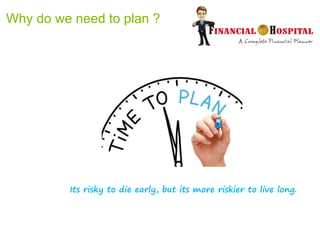
Why do we need to plan ?
Its risky to die early, but its more riskier to live long.
People change the basic principal
EARN – SAVE = SPEND
and now……
Life is not easy …
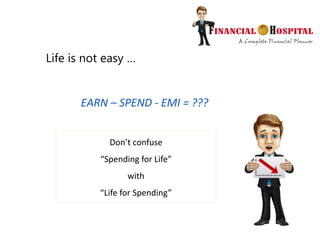
EARN – SPEND - EMI = ???
Life is not easy …
Don’t confuse
“Spending for Life”
with
“Life for Spending”
Why do we need to plan ?
 Generation Gap
 Changes in Life Style
 Increasing Inflation – The new Demon
 Absence Social Security System
Generation Gap
 Absence of Joint Families and Business
 Less Dependency
 Parents support us and we support parents. Do you
expect your kids to support you?
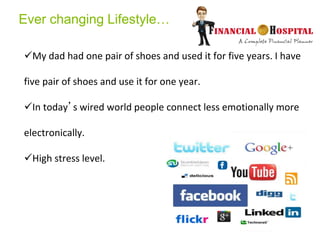
My dad had one pair of shoes and used it for five years. I have
five pair of shoes and use it for one year.
In today’s wired world people connect less emotionally more
electronically.
High stress level.
Ever changing Lifestyle…
Inflation
If you have expenses TODAY
Rs. 1,00,000/-
Per month
The value after 30 years…..
(with Inflation of 8%)
Inflation
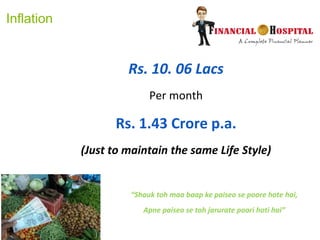
Rs. 10. 06 Lacs
Per month
Rs. 1.43 Crore p.a.
(Just to maintain the same Life Style)
“Shauk toh maa baap ke paiseo se poore hote hai,
Apne paiseo se toh jarurate poori hoti hai”
Absence of Social Security
• You don’t work for the government?
They don’t care about you after you stop contributing to the
nations GDP.
• No pension receivable after your private jobs end.
• Only EPF amount is not sufficient during retirement. In addition
to that the EPF and interest rates are falling.
• Health costs are rising.
• Rental yield is VERY LOW in India.
Why Planning is Important
IF YOU DIE EARLY
A good and decent TERM PLAN will safeguard your needs.
IF YOU DON’T DIE EARLY
Disciplined approach towards investment will ensure safety.
Why Insurance is Important
LIFE INSURANCE
1. TERM PLAN (Life Risk)
2. ENDOWMENT (Interest Rate Risk)
3. ULIP PLAN
4. PENSION PLAN
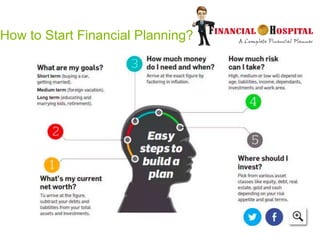
How to Start Financial Planning?
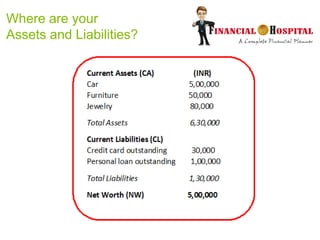
Where are your
Assets and Liabilities?
Prioritize on your Goals
 Plan for your Child’s Education
 Plan for your Child’s Higher Education
 Buying a new house property
 Foreign Tour
 Plan for your Child’s Marriage
 Plan for Retirement
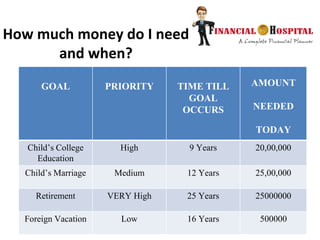
How much money do I need
and when?
GOAL PRIORITY TIME TILL
GOAL
OCCURS
AMOUNT
NEEDED
TODAY
Child’s College
Education
High 9 Years 20,00,000
Child’s Marriage Medium 12 Years 25,00,000
Retirement VERY High 25 Years 25000000
Foreign Vacation Low 16 Years 500000
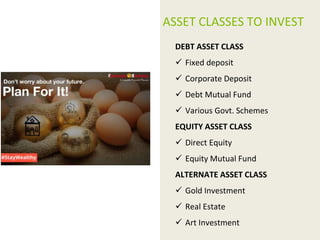
ASSET CLASSES TO INVEST
DEBT ASSET CLASS
 Fixed deposit
 Corporate Deposit
 Debt Mutual Fund
 Various Govt. Schemes
EQUITY ASSET CLASS
 Direct Equity
 Equity Mutual Fund
ALTERNATE ASSET CLASS
 Gold Investment
 Real Estate
 Art Investment
20
Don’t confuse Saving with Investment?
If you have Rs. 1000 and you don’t want to spend this
money, you can put it in a piggy bank, burry in the wall,
hide it at a secret place, etc. etc. But these all will not
give you anything extra, if you want to earn something
extra from that Rs. 1000, you should invest it in a reliable
some financial product.
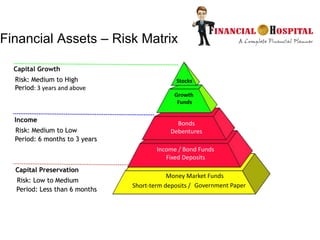
Financial Assets – Risk Matrix
Capital Preservation
Income
Capital Growth
Risk: Medium to High
Risk: Medium to Low
Risk: Low to Medium
Period: 3 years and above
Period: 6 months to 3 years
Period: Less than 6 months
Growth
Funds
Stocks
Income / Bond Funds
Fixed Deposits
Bonds
Debentures
Money Market Funds
Short-term deposits / Government Paper
22
WHAT IS DEBT?
In English the meaning of debt is LOAN, the same is the meaning of Debt in investment too.
It is a CONTRACT between an issuer and investor on pre-determined rate of interest,
maturity and the repayment of the principal amount.
The major investor in this is an institutional investor (corporate, Banks, Insurance etc.)
Instrument Features:
 Maturity: The period of bonds, it is the life span of a bond, after which this bond doesn’t
exist in the market.
 Interest/Coupon: This is a amount that an issuer pays to the investor on a
daily/weekly/monthly/quarterly/annually.
 Principal Amount: This is the money that an investor invest.
23
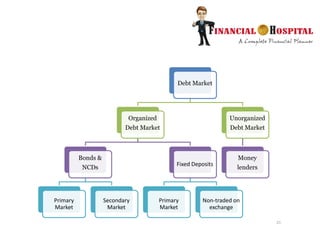
Debt Market
Organized
Debt Market
Bonds &
NCDs
Primary
Market
Secondary
Market
Fixed Deposits
Primary
Market
Non-traded on
exchange
Unorganized
Debt Market
Money
lenders
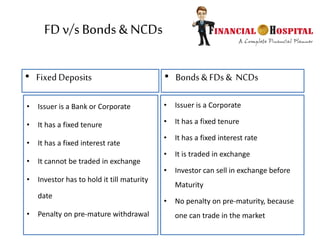
FD v/s Bonds & NCDs
• Fixed Deposits
• Issuer is a Bank or Corporate
• It has a fixed tenure
• It has a fixed interest rate
• It cannot be traded in exchange
• Investor has to hold it till maturity
date
• Penalty on pre-mature withdrawal
• Bonds & FDs & NCDs
• Issuer is a Corporate
• It has a fixed tenure
• It has a fixed interest rate
• It is traded in exchange
• Investor can sell in exchange before
Maturity
• No penalty on pre-maturity, because
one can trade in the market
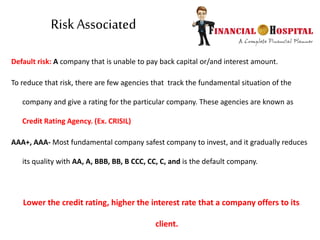
Risk Associated
Default risk: A company that is unable to pay back capital or/and interest amount.
To reduce that risk, there are few agencies that track the fundamental situation of the
company and give a rating for the particular company. These agencies are known as
Credit Rating Agency. (Ex. CRISIL)
AAA+, AAA- Most fundamental company safest company to invest, and it gradually reduces
its quality with AA, A, BBB, BB, B CCC, CC, C, and is the default company.
Lower the credit rating, higher the interest rate that a company offers to its
client.
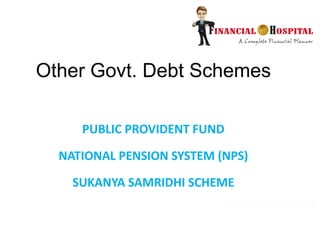
Other Govt. Debt Schemes
PUBLIC PROVIDENT FUND
NATIONAL PENSION SYSTEM (NPS)
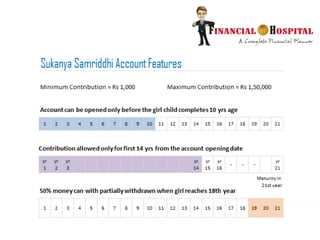
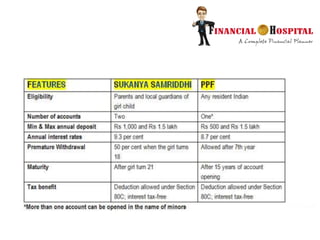
SUKANYA SAMRIDHI SCHEME
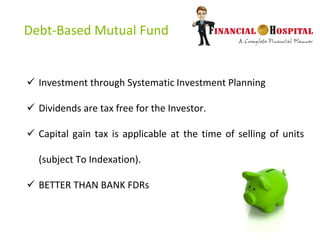
Debt-Based Mutual Fund
 Investment through Systematic Investment Planning
 Dividends are tax free for the Investor.
 Capital gain tax is applicable at the time of selling of units
(subject To Indexation).
 BETTER THAN BANK FDRs
REAL ESTATE
Real estate is a profitable option to invest one’s money in
but it is not risk free.
Risks involved in real estate investment are
 Unreliable tenants.
 Market decline.
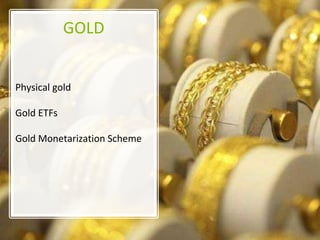
GOLD
Physical gold
Gold ETFs
Gold Monetarization Scheme
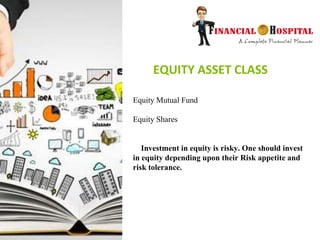
EQUITY ASSET CLASS
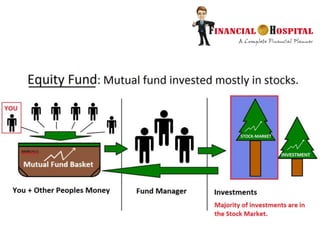
Equity Mutual Fund
Equity Shares
Investment in equity is risky. One should invest
in equity depending upon their Risk appetite and
risk tolerance.
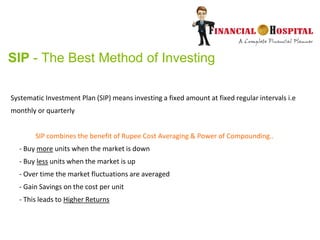
SIP - The Best Method of Investing
Systematic Investment Plan (SIP) means investing a fixed amount at fixed regular intervals i.e
monthly or quarterly
SIP combines the benefit of Rupee Cost Averaging & Power of Compounding..
- Buy more units when the market is down
- Buy less units when the market is up
- Over time the market fluctuations are averaged
- Gain Savings on the cost per unit
- This leads to Higher Returns
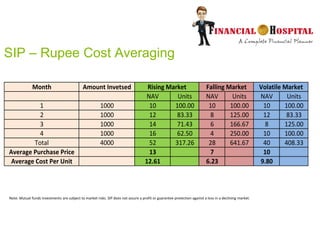
SIP – Rupee Cost Averaging
Month Amount Invetsed
NAV Units NAV Units NAV Units
1 1000 10 100.00 10 100.00 10 100.00
2 1000 12 83.33 8 125.00 12 83.33
3 1000 14 71.43 6 166.67 8 125.00
4 1000 16 62.50 4 250.00 10 100.00
Total 4000 52 317.26 28 641.67 40 408.33
Average Purchase Price 13 7 10
Average Cost Per Unit 12.61 6.23 9.80
Rising Market Falling Market Volatile Market
Note: Mutual funds investments are subject to market risks. SIP does not assure a profit or guarantee protection against a loss in a declining market.
SIP
The Best Method of
Investing
Economic Times 29th July 2015
0
10
20
30
40
50
60
70
80
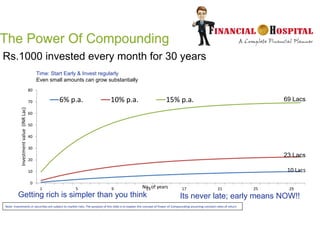
1 5 9 13 17 21 25 29
Investmentvalue(INRLac)
No. of years
6% p.a. 10% p.a. 15% p.a.
10 Lacs
23 Lacs
69 Lacs
Getting rich is simpler than you think
Rs.1000 invested every month for 30 years
Time: Start Early & Invest regularly
Even small amounts can grow substantially
Its never late; early means NOW!!
Note: Investments in securities are subject to market risks. The purpose of this slide is to explain the concept of Power of Compounding assuming constant rates of return
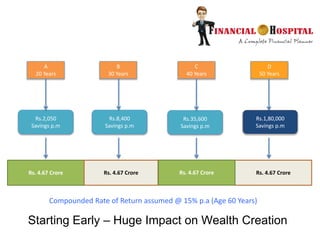
Starting Early – Huge Impact on Wealth Creation
A
20 Years
B
30 Years
C
40 Years
D
50 Years
Rs.2,050
Savings p.m
Rs.8,400
Savings p.m
Rs.35,600
Savings p.m
Rs.1,80,000
Savings p.m
Compounded Rate of Return assumed @ 15% p.a (Age 60 Years)
Rs. 4.67 Crore Rs. 4.67 Crore Rs. 4.67 CroreRs. 4.67 Crore
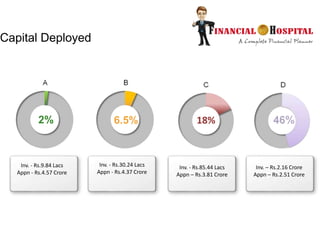
Capital Deployed
2% 6.5% 18%
Inv. - Rs.9.84 Lacs
Appn - Rs.4.57 Crore
This is a sample text
Insert your desired
text here.
Inv. - Rs.30.24 Lacs
Appn - Rs.4.37 Crore
Inv. - Rs.85.44 Lacs
Appn – Rs.3.81 Crore
Inv. – Rs.2.16 Crore
Appn – Rs.2.51 Crore
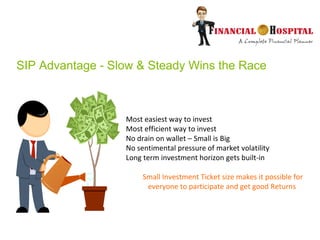
SIP Advantage - Slow & Steady Wins the Race
Most easiest way to invest
Most efficient way to invest
No drain on wallet – Small is Big
No sentimental pressure of market volatility
Long term investment horizon gets built-in
Small Investment Ticket size makes it possible for
everyone to participate and get good Returns
Final Note…
 Plan Today for a Better Tomorrow.
 The best age to start for your retirement is
either 20 or NOW
 Stick to the basics, basic is always simple &
beautiful.
 Always educate your kids about your
inheritance values, cultures and roots.
 Remember to prepare your WILL today!
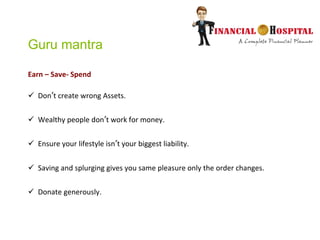
Guru mantra
Earn – Save- Spend
 Don’t create wrong Assets.
 Wealthy people don’t work for money.
 Ensure your lifestyle isn’t your biggest liability.
 Saving and splurging gives you same pleasure only the order changes.
 Donate generously.
Benefits of having a
Certified Financial Planner
• Want to better manage your finances better, but aren't sure where to start
• Don't have time to do your own financial planning
• Want a professional opinion about the plan you've developed
• Don't have sufficient expertise in certain areas such as investments,
insurance, taxes or retirement planning
• Have an immediate need or unexpected life event
Just for you….
“Investment is a boring activity . It is better to get bored and be wealthy than to get excited and end poorly.
“
Lavish Bhambhani
lavish@financialhospital.in

Financial planning 101

  • 1.
  • 2.
    Financial Planning Financial planningis the long-term process of wisely to achieve one’s finances so one can achieve their financial goals. It is your roadmap to Financial well being and Sustainable Wealth creation.
  • 3.
    Misconceptions of Financial Planning •Financial Planning is all about Budgeting and cutting back on unnecessary expenses • If I'm generally moving in the right direction, my financial goals will take care of themselves • Financial planning is for people who are wealthier, older or younger than me • Working with a financial planner means that I can sit back during the process • Financial planning is a quick fix for my Finances • Once I have a financial plan in place I can forget about it. • Having a Financial plan isn't going to make a difference in my Case
  • 4.
    Why do weneed to plan ? Its risky to die early, but its more riskier to live long.
  • 5.
    People change thebasic principal EARN – SAVE = SPEND and now…… Life is not easy …
  • 6.
    EARN – SPEND- EMI = ??? Life is not easy … Don’t confuse “Spending for Life” with “Life for Spending”
  • 7.
    Why do weneed to plan ?  Generation Gap  Changes in Life Style  Increasing Inflation – The new Demon  Absence Social Security System
  • 8.
    Generation Gap  Absenceof Joint Families and Business  Less Dependency  Parents support us and we support parents. Do you expect your kids to support you?
  • 9.
    My dad hadone pair of shoes and used it for five years. I have five pair of shoes and use it for one year. In today’s wired world people connect less emotionally more electronically. High stress level. Ever changing Lifestyle…
  • 10.
    Inflation If you haveexpenses TODAY Rs. 1,00,000/- Per month The value after 30 years….. (with Inflation of 8%)
  • 11.
    Inflation Rs. 10. 06Lacs Per month Rs. 1.43 Crore p.a. (Just to maintain the same Life Style) “Shauk toh maa baap ke paiseo se poore hote hai, Apne paiseo se toh jarurate poori hoti hai”
  • 12.
    Absence of SocialSecurity • You don’t work for the government? They don’t care about you after you stop contributing to the nations GDP. • No pension receivable after your private jobs end. • Only EPF amount is not sufficient during retirement. In addition to that the EPF and interest rates are falling. • Health costs are rising. • Rental yield is VERY LOW in India.
  • 13.
    Why Planning isImportant IF YOU DIE EARLY A good and decent TERM PLAN will safeguard your needs. IF YOU DON’T DIE EARLY Disciplined approach towards investment will ensure safety.
  • 14.
    Why Insurance isImportant LIFE INSURANCE 1. TERM PLAN (Life Risk) 2. ENDOWMENT (Interest Rate Risk) 3. ULIP PLAN 4. PENSION PLAN
  • 15.
    How to StartFinancial Planning?
  • 16.
    Where are your Assetsand Liabilities?
  • 17.
    Prioritize on yourGoals  Plan for your Child’s Education  Plan for your Child’s Higher Education  Buying a new house property  Foreign Tour  Plan for your Child’s Marriage  Plan for Retirement
  • 18.
    How much moneydo I need and when? GOAL PRIORITY TIME TILL GOAL OCCURS AMOUNT NEEDED TODAY Child’s College Education High 9 Years 20,00,000 Child’s Marriage Medium 12 Years 25,00,000 Retirement VERY High 25 Years 25000000 Foreign Vacation Low 16 Years 500000
  • 19.
    ASSET CLASSES TOINVEST DEBT ASSET CLASS  Fixed deposit  Corporate Deposit  Debt Mutual Fund  Various Govt. Schemes EQUITY ASSET CLASS  Direct Equity  Equity Mutual Fund ALTERNATE ASSET CLASS  Gold Investment  Real Estate  Art Investment
  • 20.
    20 Don’t confuse Savingwith Investment? If you have Rs. 1000 and you don’t want to spend this money, you can put it in a piggy bank, burry in the wall, hide it at a secret place, etc. etc. But these all will not give you anything extra, if you want to earn something extra from that Rs. 1000, you should invest it in a reliable some financial product.
  • 21.
    Financial Assets –Risk Matrix Capital Preservation Income Capital Growth Risk: Medium to High Risk: Medium to Low Risk: Low to Medium Period: 3 years and above Period: 6 months to 3 years Period: Less than 6 months Growth Funds Stocks Income / Bond Funds Fixed Deposits Bonds Debentures Money Market Funds Short-term deposits / Government Paper
  • 22.
    22 WHAT IS DEBT? InEnglish the meaning of debt is LOAN, the same is the meaning of Debt in investment too. It is a CONTRACT between an issuer and investor on pre-determined rate of interest, maturity and the repayment of the principal amount. The major investor in this is an institutional investor (corporate, Banks, Insurance etc.) Instrument Features:  Maturity: The period of bonds, it is the life span of a bond, after which this bond doesn’t exist in the market.  Interest/Coupon: This is a amount that an issuer pays to the investor on a daily/weekly/monthly/quarterly/annually.  Principal Amount: This is the money that an investor invest.
  • 23.
    23 Debt Market Organized Debt Market Bonds& NCDs Primary Market Secondary Market Fixed Deposits Primary Market Non-traded on exchange Unorganized Debt Market Money lenders
  • 24.
    FD v/s Bonds& NCDs • Fixed Deposits • Issuer is a Bank or Corporate • It has a fixed tenure • It has a fixed interest rate • It cannot be traded in exchange • Investor has to hold it till maturity date • Penalty on pre-mature withdrawal • Bonds & FDs & NCDs • Issuer is a Corporate • It has a fixed tenure • It has a fixed interest rate • It is traded in exchange • Investor can sell in exchange before Maturity • No penalty on pre-maturity, because one can trade in the market
  • 25.
    Risk Associated Default risk:A company that is unable to pay back capital or/and interest amount. To reduce that risk, there are few agencies that track the fundamental situation of the company and give a rating for the particular company. These agencies are known as Credit Rating Agency. (Ex. CRISIL) AAA+, AAA- Most fundamental company safest company to invest, and it gradually reduces its quality with AA, A, BBB, BB, B CCC, CC, C, and is the default company. Lower the credit rating, higher the interest rate that a company offers to its client.
  • 26.
    Other Govt. DebtSchemes PUBLIC PROVIDENT FUND NATIONAL PENSION SYSTEM (NPS) SUKANYA SAMRIDHI SCHEME
  • 29.
    Debt-Based Mutual Fund Investment through Systematic Investment Planning  Dividends are tax free for the Investor.  Capital gain tax is applicable at the time of selling of units (subject To Indexation).  BETTER THAN BANK FDRs
  • 30.
    REAL ESTATE Real estateis a profitable option to invest one’s money in but it is not risk free. Risks involved in real estate investment are  Unreliable tenants.  Market decline.
  • 31.
    GOLD Physical gold Gold ETFs GoldMonetarization Scheme
  • 32.
    EQUITY ASSET CLASS EquityMutual Fund Equity Shares Investment in equity is risky. One should invest in equity depending upon their Risk appetite and risk tolerance.
  • 34.
    SIP - TheBest Method of Investing Systematic Investment Plan (SIP) means investing a fixed amount at fixed regular intervals i.e monthly or quarterly SIP combines the benefit of Rupee Cost Averaging & Power of Compounding.. - Buy more units when the market is down - Buy less units when the market is up - Over time the market fluctuations are averaged - Gain Savings on the cost per unit - This leads to Higher Returns
  • 35.
    SIP – RupeeCost Averaging Month Amount Invetsed NAV Units NAV Units NAV Units 1 1000 10 100.00 10 100.00 10 100.00 2 1000 12 83.33 8 125.00 12 83.33 3 1000 14 71.43 6 166.67 8 125.00 4 1000 16 62.50 4 250.00 10 100.00 Total 4000 52 317.26 28 641.67 40 408.33 Average Purchase Price 13 7 10 Average Cost Per Unit 12.61 6.23 9.80 Rising Market Falling Market Volatile Market Note: Mutual funds investments are subject to market risks. SIP does not assure a profit or guarantee protection against a loss in a declining market.
  • 36.
    SIP The Best Methodof Investing Economic Times 29th July 2015
  • 37.
    0 10 20 30 40 50 60 70 80 1 5 913 17 21 25 29 Investmentvalue(INRLac) No. of years 6% p.a. 10% p.a. 15% p.a. 10 Lacs 23 Lacs 69 Lacs Getting rich is simpler than you think Rs.1000 invested every month for 30 years Time: Start Early & Invest regularly Even small amounts can grow substantially Its never late; early means NOW!! Note: Investments in securities are subject to market risks. The purpose of this slide is to explain the concept of Power of Compounding assuming constant rates of return
  • 38.
    Starting Early –Huge Impact on Wealth Creation A 20 Years B 30 Years C 40 Years D 50 Years Rs.2,050 Savings p.m Rs.8,400 Savings p.m Rs.35,600 Savings p.m Rs.1,80,000 Savings p.m Compounded Rate of Return assumed @ 15% p.a (Age 60 Years) Rs. 4.67 Crore Rs. 4.67 Crore Rs. 4.67 CroreRs. 4.67 Crore
  • 39.
    Capital Deployed 2% 6.5%18% Inv. - Rs.9.84 Lacs Appn - Rs.4.57 Crore This is a sample text Insert your desired text here. Inv. - Rs.30.24 Lacs Appn - Rs.4.37 Crore Inv. - Rs.85.44 Lacs Appn – Rs.3.81 Crore Inv. – Rs.2.16 Crore Appn – Rs.2.51 Crore
  • 40.
    SIP Advantage -Slow & Steady Wins the Race Most easiest way to invest Most efficient way to invest No drain on wallet – Small is Big No sentimental pressure of market volatility Long term investment horizon gets built-in Small Investment Ticket size makes it possible for everyone to participate and get good Returns
  • 41.
    Final Note…  PlanToday for a Better Tomorrow.  The best age to start for your retirement is either 20 or NOW  Stick to the basics, basic is always simple & beautiful.  Always educate your kids about your inheritance values, cultures and roots.  Remember to prepare your WILL today!
  • 42.
    Guru mantra Earn –Save- Spend  Don’t create wrong Assets.  Wealthy people don’t work for money.  Ensure your lifestyle isn’t your biggest liability.  Saving and splurging gives you same pleasure only the order changes.  Donate generously.
  • 43.
    Benefits of havinga Certified Financial Planner • Want to better manage your finances better, but aren't sure where to start • Don't have time to do your own financial planning • Want a professional opinion about the plan you've developed • Don't have sufficient expertise in certain areas such as investments, insurance, taxes or retirement planning • Have an immediate need or unexpected life event
  • 44.
    Just for you…. “Investmentis a boring activity . It is better to get bored and be wealthy than to get excited and end poorly. “
  • 46.