Amity Business School
MBA(HR) Class of 2017,
Semester II
FINANCIAL MANAGEMENT
FIBA601
Lecture 1
Amity Business School
What is Financial Management?
Financial Management is that managerial activity
which is concerned with the planning and controlling
of the firm’s financial resources.
It encompasses the procurement of the funds in the
most economic and prudent manner and employment
of these funds in the most optimum way to maximize
the return to the owner.
Amity Business School
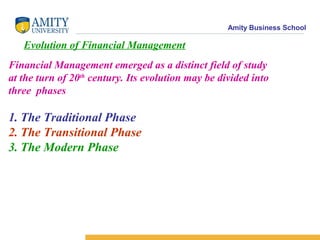
Evolution of Financial Management
Financial Management emerged as a distinct field of study
at the turn of 20th
century. Its evolution may be divided into
three phases
1. The Traditional Phase
2. The Transitional Phase
3. The Modern Phase
Amity Business School
The Traditional Phase
Features
The focus of financial management was mainly on certain episodic
events like formation, issuance of capital, expansion etc in the life
Cycle of the firm.
The approach was mainly descriptive and institutional.
The outsider’s points of view was dominate. Financial Management
Was viewed mainly from the point of the investment bankers, lenders
and other outsiders….
Amity Business School
The Transitional Phase
The transitional phase began around the early forties and continued
through the early fifties.
Though the nature of financial management during this phase was
similar to that of the traditional phase, great emphasis was placed on
day to day problems faced by the finance managers in the areas of
fund analysis, planning and control
Amity Business School
The Modern Phase
The modern phase began in the mid fifties and has
witnessed an accelerated Pace of development with the
infusion of ideas from economic theory and Application
of quantitative methods of analysis.
Significant contribution to the development of modern theory of Financial Management
Theory of Portfolio Management developed by Harry Markowitz in 1950
The Theory of Leverage and Valuation of Firm developed by Modigliani &
Miller in 1958
The Presentation of Option Valuation Model by Black and Scholes in 1970
Amity Business School
he trust of financial decision making is on Procurement of funds
nd their optimal Utilisation through investment, financing, dividends
nd working capital decision.
he scope of financial management extends to 3 key decisions areas:
. Investment Decision
. Financing Decision
. Dividend Decision
Amity Business School
Investment Decision
Investment decisions pertain to selection of the most productive
avenues with a view to maximise the returns on investment and
consequently the shareholders wealth.
Investment decisions which are alternatively referred to as capital
Budgeting decisions are crucial for survival and growth of any
Firm as they involve large capital outlay.
Acquisition of Fixed Assets
Land
Building
Machines
Intangibles
Long term Assets
(What & When to Buy)
Survival
& Growth
Amity Business School
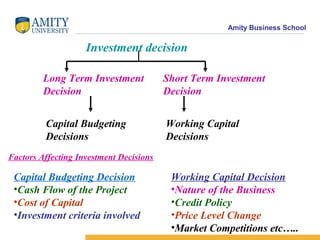
Investment decision
Long Term Investment
Decision
Short Term Investment
Decision
Capital Budgeting
Decisions
Working Capital
Decisions
Factors Affecting Investment Decisions
Capital Budgeting Decision
•Cash Flow of the Project
•Cost of Capital
•Investment criteria involved
Working Capital Decision
•Nature of the Business
•Credit Policy
•Price Level Change
•Market Competitions etc…..
Amity Business School
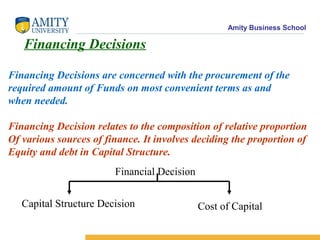
Financing Decisions
Financing Decisions are concerned with the procurement of the
required amount of Funds on most convenient terms as and
when needed.
Financing Decision relates to the composition of relative proportion
Of various sources of finance. It involves deciding the proportion of
Equity and debt in Capital Structure.
Financial Decision
Capital Structure Decision Cost of Capital
Amity Business School
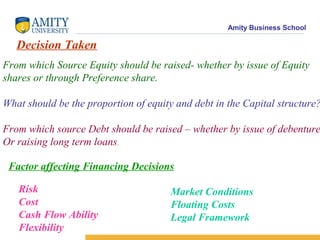
Decision Taken
From which Source Equity should be raised- whether by issue of Equity
shares or through Preference share.
What should be the proportion of equity and debt in the Capital structure?
From which source Debt should be raised – whether by issue of debenture
Or raising long term loans.
Factor affecting Financing Decisions
Risk
Cost
Cash Flow Ability
Flexibility
Market Conditions
Floating Costs
Legal Framework
Amity Business School
Dividend Decision
Dividend decision involves deciding whether to distribute the profits
as dividend to shareholders or to retain profits and reinvest in
the business.
Objective
The main objective of dividend decision is to divide net earnings in an
Optimum manner so as to pay dividend to the shareholders and to
Retain earnings for reinvestments with the objective of maximizing
The wealth of shareholders
Decision Taken
How much earnings should be retained for reinvestment opportunities?
How much earnings should be distributed as dividend to shareholders?

Lecture 1. introduction to financial management

  • 1.
    Amity Business School AmityBusiness School MBA(HR) Class of 2017, Semester II FINANCIAL MANAGEMENT FIBA601 Lecture 1
  • 2.
    Amity Business School Whatis Financial Management? Financial Management is that managerial activity which is concerned with the planning and controlling of the firm’s financial resources. It encompasses the procurement of the funds in the most economic and prudent manner and employment of these funds in the most optimum way to maximize the return to the owner.
  • 3.
    Amity Business School Evolutionof Financial Management Financial Management emerged as a distinct field of study at the turn of 20th century. Its evolution may be divided into three phases 1. The Traditional Phase 2. The Transitional Phase 3. The Modern Phase
  • 4.
    Amity Business School TheTraditional Phase Features The focus of financial management was mainly on certain episodic events like formation, issuance of capital, expansion etc in the life Cycle of the firm. The approach was mainly descriptive and institutional. The outsider’s points of view was dominate. Financial Management Was viewed mainly from the point of the investment bankers, lenders and other outsiders….
  • 5.
    Amity Business School TheTransitional Phase The transitional phase began around the early forties and continued through the early fifties. Though the nature of financial management during this phase was similar to that of the traditional phase, great emphasis was placed on day to day problems faced by the finance managers in the areas of fund analysis, planning and control
  • 6.
    Amity Business School TheModern Phase The modern phase began in the mid fifties and has witnessed an accelerated Pace of development with the infusion of ideas from economic theory and Application of quantitative methods of analysis. Significant contribution to the development of modern theory of Financial Management Theory of Portfolio Management developed by Harry Markowitz in 1950 The Theory of Leverage and Valuation of Firm developed by Modigliani & Miller in 1958 The Presentation of Option Valuation Model by Black and Scholes in 1970
  • 7.
    Amity Business School hetrust of financial decision making is on Procurement of funds nd their optimal Utilisation through investment, financing, dividends nd working capital decision. he scope of financial management extends to 3 key decisions areas: . Investment Decision . Financing Decision . Dividend Decision
  • 8.
    Amity Business School InvestmentDecision Investment decisions pertain to selection of the most productive avenues with a view to maximise the returns on investment and consequently the shareholders wealth. Investment decisions which are alternatively referred to as capital Budgeting decisions are crucial for survival and growth of any Firm as they involve large capital outlay. Acquisition of Fixed Assets Land Building Machines Intangibles Long term Assets (What & When to Buy) Survival & Growth
  • 9.
    Amity Business School Investmentdecision Long Term Investment Decision Short Term Investment Decision Capital Budgeting Decisions Working Capital Decisions Factors Affecting Investment Decisions Capital Budgeting Decision •Cash Flow of the Project •Cost of Capital •Investment criteria involved Working Capital Decision •Nature of the Business •Credit Policy •Price Level Change •Market Competitions etc…..
  • 10.
    Amity Business School FinancingDecisions Financing Decisions are concerned with the procurement of the required amount of Funds on most convenient terms as and when needed. Financing Decision relates to the composition of relative proportion Of various sources of finance. It involves deciding the proportion of Equity and debt in Capital Structure. Financial Decision Capital Structure Decision Cost of Capital
  • 11.
    Amity Business School DecisionTaken From which Source Equity should be raised- whether by issue of Equity shares or through Preference share. What should be the proportion of equity and debt in the Capital structure? From which source Debt should be raised – whether by issue of debenture Or raising long term loans. Factor affecting Financing Decisions Risk Cost Cash Flow Ability Flexibility Market Conditions Floating Costs Legal Framework
  • 12.
    Amity Business School DividendDecision Dividend decision involves deciding whether to distribute the profits as dividend to shareholders or to retain profits and reinvest in the business. Objective The main objective of dividend decision is to divide net earnings in an Optimum manner so as to pay dividend to the shareholders and to Retain earnings for reinvestments with the objective of maximizing The wealth of shareholders Decision Taken How much earnings should be retained for reinvestment opportunities? How much earnings should be distributed as dividend to shareholders?