Project Selection
•Pest Analysis, Swot Analysis, Porter’s Five Force Model
•Non-numeric Models
•Numeric Models
Chapter 2
Challenges of Contemporary
Organizations
02/22/15Yu-Lin Huang
Project selection is the process of evaluating individual
projects or groups of projects, and then choosing to
implement some set of them so that the objectives of the
parent organization will be achieved
How to tie their projects more closely with the
organization’s goals and objectives?
How to handle the growing number of ongoing projects?
How to make these projects more successful?
Strategic Planning Process
Strategic Analysis
Guiding Principles
Vision
Mission Statement
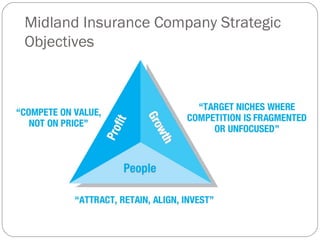
Strategic Objectives
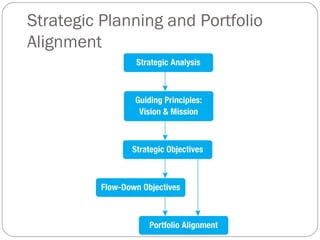
Strategic Planning and Portfolio
Alignment
Strategic Analysis: PEST Analysis
PEST analysis is a business measurement tool
An acronym for Political, Economic, Social and Technological
factors
Used to assess the market for a business or organizational unit
Measures the market potential and situation, particularly indicating
growth or decline, and thereby market attractiveness, business
potential, and suitability of access
02/22/15Yu-Lin Huang
The PEST subject should be a clear definition of the market
being addressed, which might be from any of the following
standpoints:
a company looking at its market
a product looking at its market
a brand in relation to its market
a local business unit
a strategic option, such as entering a new market or
launching a new product
a potential acquisition
a potential partnership
an investment opportunity
02/22/15Yu-Lin Huang
02/22/15Yu-Lin Huang 7
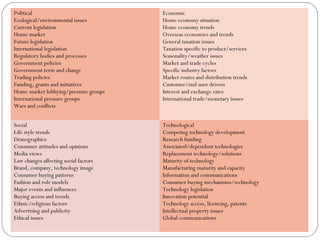
Political
Ecological/environmental issues
Current legislation
Home market
Future legislation
International legislation
Regulatory bodies and processes
Government policies
Government term and change
Trading policies
Funding, grants and initiatives
Home market lobbying/pressure groups
International pressure groups
Wars and conflicts
Economic
Home economy situation
Home economy trends
Overseas economies and trends
General taxation issues
Taxation specific to product/services
Seasonality/weather issues
Market and trade cycles
Specific industry factors
Market routes and distribution trends
Customer/end-user drivers
Interest and exchange rates
International trade/monetary issues
Social
Life style trends
Demographics
Consumer attitudes and opinions
Media views
Law changes affecting social factors
Brand, company, technology image
Consumer buying patterns
Fashion and role models
Major events and influences
Buying access and trends
Ethnic/religious factors
Advertising and publicity
Ethical issues
Technological
Competing technology development
Research funding
Associated/dependent technologies
Replacement technology/solutions
Maturity of technology
Manufacturing maturity and capacity
Information and communications
Consumer buying mechanisms/technology
Technology legislation
Innovation potential
Technology access, licencing, patents
Intellectual property issues
Global communications
SWOT Analysis
SWOT is an acronym for Strengths, Weaknesses,
Opportunities, Threats
Provides a good framework for reviewing strategy,
position and direction of a company or business
proposition, or any other idea.
SWOT analysis is used for business planning, strategic
planning, competitor evaluation, marketing, business and
product development and research reports.
02/22/15Yu-Lin Huang
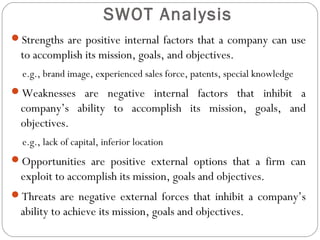
Strengths are positive internal factors that a company can use
to accomplish its mission, goals, and objectives.
e.g., brand image, experienced sales force, patents, special knowledge
Weaknesses are negative internal factors that inhibit a
company’s ability to accomplish its mission, goals, and
objectives.
e.g., lack of capital, inferior location
Opportunities are positive external options that a firm can
exploit to accomplish its mission, goals and objectives.
Threats are negative external forces that inhibit a company’s
ability to achieve its mission, goals and objectives.
SWOT Analysis
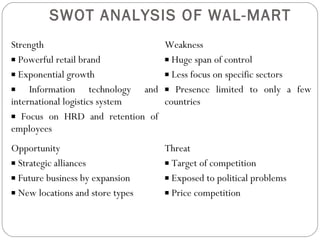
SWOT ANALYSIS OF WAL-MART
Strength
 Powerful retail brand
 Exponential growth
 Information technology and
international logistics system
 Focus on HRD and retention of
employees
Weakness
 Huge span of control
 Less focus on specific sectors
 Presence limited to only a few
countries
Opportunity
 Strategic alliances
 Future business by expansion
 New locations and store types
Threat
 Target of competition
 Exposed to political problems
 Price competition
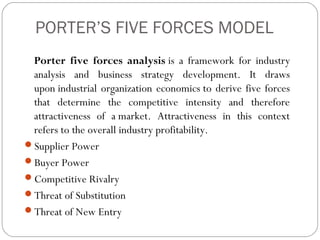
PORTER’S FIVE FORCES MODEL
Porter five forces analysis is a framework for industry
analysis and business strategy development. It draws
upon industrial organization economics to derive five forces
that determine the competitive intensity and therefore
attractiveness of a market. Attractiveness in this context
refers to the overall industry profitability.
Supplier Power
Buyer Power
Competitive Rivalry
Threat of Substitution
Threat of New Entry
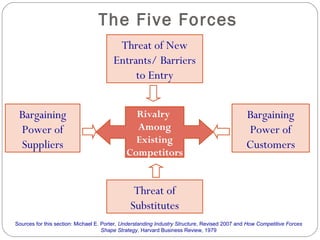
The Five Forces
Threat of New
Entrants/ Barriers
to Entry
Bargaining
Power of
Customers
Threat of
Substitutes
Bargaining
Power of
Suppliers
Sources for this section: Michael E. Porter, Understanding Industry Structure, Revised 2007 and How Competitive Forces
Shape Strategy, Harvard Business Review, 1979
Rivalry
Among
Existing
Competitors
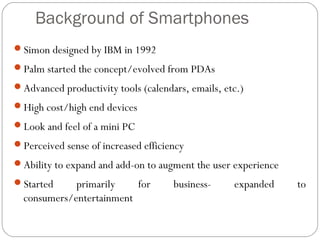
Background of Smartphones
Simon designed by IBM in 1992
Palm started the concept/evolved from PDAs
Advanced productivity tools (calendars, emails, etc.)
High cost/high end devices
Look and feel of a mini PC
Perceived sense of increased efficiency
Ability to expand and add-on to augment the user experience
Started primarily for business- expanded to
consumers/entertainment
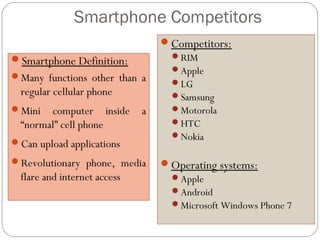
Smartphone Competitors
Smartphone Definition:
Many functions other than a
regular cellular phone
Mini computer inside a
“normal” cell phone
Can upload applications
Revolutionary phone, media
flare and internet access
Competitors:
RIM
Apple
LG
Samsung
Motorola
HTC
Nokia
Operating systems:
Apple
Android
Microsoft Windows Phone 7
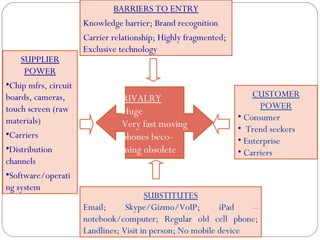
BARRIERS TO ENTRY
Knowledge barrier; Brand recognition
Carrier relationship; Highly fragmented;
Exclusive technology
CUSTOMER
POWER
• Consumer
• Trend seekers
• Enterprise
• Carriers
SUBSTITUTES
Email; Skype/Gizmo/VoIP; iPad –
notebook/computer; Regular old cell phone;
Landlines; Visit in person; No mobile device
SUPPLIER
POWER
•Chip mfrs, circuit
boards, cameras,
touch screen (raw
materials)
•Carriers
•Distribution
channels
•Software/operati
ng system
RIVALRY
Huge
Very fast moving
phones beco-
ming obsolete
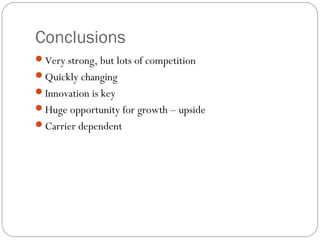
Conclusions
Very strong, but lots of competition
Quickly changing
Innovation is key
Huge opportunity for growth – upside
Carrier dependent
Guiding Principles
The vision describes the future of the organization
“vivid description of a preferred future”
Require extra effort to be achieved
Often multiyear goals that end in suggesting the need for a new
vision
The mission statement provides a mechanism for achieving
the vision
“organization’s core purpose, core values”, beliefs, culture, primary
business, primary customers
Mission Statement Considerations
Purpose – communicates why an organization exists
Beliefs – what the leaders of an organization stand for
Core values – how decisions will be made and how people will be
treated
Culture – how members should act
Primary business areas – what business the organization engages in
Primary customers – which groups of people need to be satisfied
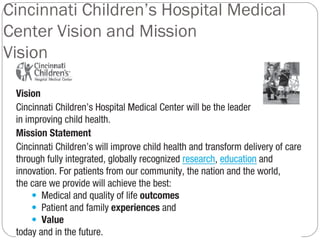
Cincinnati Children’s Hospital Medical
Center Vision and Mission
Vision
Strategic Objectives
Means of achieving the vision and mission
Objective setting occurs annually
Describe short term and long term results
Describe measures of achievement
Effective objectives are SMART
Specific
Measurable
Achievable
Results-based
Time-specific
Midland Insurance Company Strategic
Objectives
Portfolio Alignment
Assess organization’s ability to perform projects
Portfolios
Programs
Projects and subprojects
Portfolios
Organizations require work activities including ongoing
operational work and temporary project work
Try to achieve a sense of balance in portfolios
Some large and some small projects
Some high-risk, high-reward projects and some low-risk projects
Some projects that can be completed quickly and some that take
substantial time
portfolio – “a collection of projects or programs and other
work that are grouped together to facilitate effective
management of that work to meet strategic business
objectives. The projects or programs of the portfolio may not
necessarily be interdependent or directly related.” PMBOK®
portfolio – “a collection of projects or programs and other
work that are grouped together to facilitate effective
management of that work to meet strategic business
objectives. The projects or programs of the portfolio may not
necessarily be interdependent or directly related.” PMBOK®
Programs
Programs last as long as the organization lasts
Specific projects within a program are of limited duration
Portfolios and programs are managed at a level above the
typical project manager
program – “a group of related projects managed in a
coordinated way to obtain benefits and control not
available from managing them individually. Programs may
include elements of work outside of the scope of discrete
projects in the program.” PMBOK® Guide
program – “a group of related projects managed in a
coordinated way to obtain benefits and control not
available from managing them individually. Programs may
include elements of work outside of the scope of discrete
projects in the program.” PMBOK® Guide
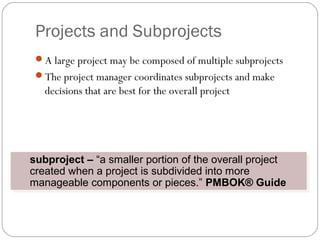
Projects and Subprojects
A large project may be composed of multiple subprojects
The project manager coordinates subprojects and make
decisions that are best for the overall project
subproject – “a smaller portion of the overall project
created when a project is subdivided into more
manageable components or pieces.” PMBOK® Guide
subproject – “a smaller portion of the overall project
created when a project is subdivided into more
manageable components or pieces.” PMBOK® Guide
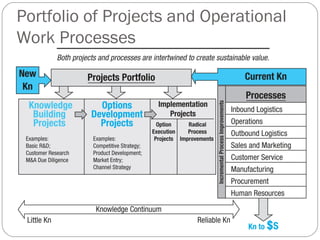
Portfolio of Projects and Operational
Work Processes
Reasons for Project Failure
Not enough resources
Not enough time
Unclear expectations
Changes to the project
Disagreement about expectations
The Project Portfolio
A collection of projects grouped to be collectively managed
Projects are selected to contribute to the organization’s goals
Portfolio alignment identifies, selects, and prioritizes
projects to help achieve an organization’s strategic goals
Assess Organization’s Ability to
Perform Projects
Do we have a teamwork attitude, free and open communication,
creativity, and empowered decision-making?
Do we have a clearly defined project management process?
Do our associates have the right attitudes, skills, and
competencies to use the project management process?
Are our leaders at each level willing to take appropriate personal
risk?
Assess Organization’s Ability to
Perform Projects
Does senior leadership establish a strong leadership foundation?
Do individuals and teams exhibit leadership at their respective
levels?
Do we monitor and understand our external environment?
Identifying Potential Projects
People from all levels and all functional areas should participate
Identify twice as many potential projects as the organization has
time and resources to perform
Develop a brief description of all potential projects
The “elevator speech”
business case – “provides the information needed from
a business standpoint to determine if the project is worth
the investment.” PMBOK® Guide
business case – “provides the information needed from
a business standpoint to determine if the project is worth
the investment.” PMBOK® Guide
statement of work – “narrative description of products or
services to be provided by the project.” PMBOK® Guide
statement of work – “narrative description of products or
services to be provided by the project.” PMBOK® Guide
Project Selection Procedure: A Cross- Industry Sampler
Hoechst AG, a pharmaceutical firm uses a scoring portfolio model
with 119 questions in five major categories i.e.: business strategy
fit, probability of technical success, commercial success, strategic
leverage and reward to the company. Within each of these factors
there are specific questions which are scored on a 1-10 by the
management.
The Royal Bank of Canada uses the following criteria for portfolio
scoring: Project importance( strategic importance, magnitude of
impact and economic benefits) ease of doing (cost of development,
project complexity and resource availability) Expected annual
expenditure and total project spending are then added to this rank
ordered list to prioritize project options.
Project selection is the process of evaluating individual projects
or groups of projects, and then choosing to implement some
set of them so that the objectives of the parent organization
will be achieved
Managers often use decision-aiding models to extract the
relevant issues of a problem from the details in which the
problem is embedded
Models represent the problem’s structure and can be useful in
selecting and evaluating projects
Project Selection
Realism - reality of manager’s decision
Capability- able to simulate different scenarios and optimize
the decision
Flexibility - provide valid results within the range of conditions
Ease of Use - reasonably convenient, easy execution, and
easily understood
Cost - Data gathering and modeling costs should be low
relative to the cost of the project
Easy Computerization - must be easy and convenient to
gather, store and manipulate data in the model
Criteria for Project Selection Models (By Souder)
Market analysis
Production Factors /Technical analysis
Financial analysis
Economic analysis
Ecological analysis
Personnel factors
Key Issues in Project Analysis
Marketing Factors
Size of potential market for output
Probable market share of output
Time until market share is acquired
Impact on current product line
Consumer acceptance
Impact on consumer safety
Estimated life of output
Spin-off project possibilities
Production factors
• Time until ready to install
• Length of disruption during installation
• Learning curve-time until operating as desired.
• Effects on waste & rejects
• Energy requirements
• Facility & other equipment requirements
• Safety of process
• Other applications of technology
• Changes in cost to produce a unit output
• Change in raw material usage
• Availability of raw materials
• Required development time & cost
• Impact on current suppliers
• Change in quality of output
Financial Factors
• Profitability
• Impact on cash flows
• Payout period
• Cash requirements
• Time until break-even
• Size of investment required
• Impact on seasonal &cyclic fluctuations
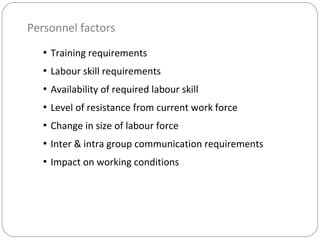
Personnel factors
• Training requirements
• Labour skill requirements
• Availability of required labour skill
• Level of resistance from current work force
• Change in size of labour force
• Inter & intra group communication requirements
• Impact on working conditions
Administrative & Miscellaneous factors
• Meet govt. safety, environmental standards
• Impact on information system
• Reaction of stock holders & securities market
• Patent & trade secret protection
• Impact of image with customers, suppliers & competitors
• Degree to which we understand new technology
• Managerial capacity to direct & control new process
Nature of Project Selection Models
2 Basic Types of Models
Non-numeric
Numeric
Two Critical Facts:
Models do not make decisions - People do!
All models, however sophisticated, are only partial
representations of the reality the are meant to reflect
Nonnumeric Models
Sacred Cow - project is suggested by a senior and powerful
official in the organization
Operating Necessity - the project is required to keep the
system running
Competitive Necessity - project is necessary to sustain a
competitive position
Product Line Extension - projects are judged on how they fit
with current product line, fill a gap, strengthen a weak link, or
extend the line in a new desirable way
Comparative Benefit Model - several projects are considered
and the one with the most benefit to the firm is selected
Numeric Models:
Scoring Models
Financial Models (Profit/Profitability)
Numeric Models: Scoring
Unweighted 0-1 Factor Model
Unweighted Factor Scoring Model
Weighted Factor Scoring Model
Constrained Weighted Factor Scoring Model
Goal Programming with Multiple Objectives
NUMERIC MODELS – SCORING
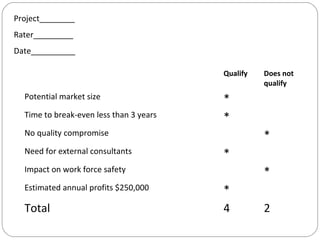
UNWEIGHTED 0-1 FACTOR MODEL - A set of relevant
factors is selected by management & then listed in a
preprinted form. One or more raters score the project on
each factor, whether or not it qualifies for an individual
criterion.
Qualify Does not
qualify
Potential market size *
Time to break-even less than 3 years *
No quality compromise *
Need for external consultants *
Impact on work force safety *
Estimated annual profits $250,000 *
Total 4 2
Project________
Rater_________
Date__________
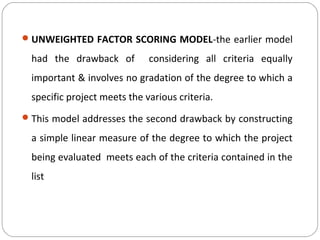
UNWEIGHTED FACTOR SCORING MODEL-the earlier model
had the drawback of considering all criteria equally
important & involves no gradation of the degree to which a
specific project meets the various criteria.
This model addresses the second drawback by constructing
a simple linear measure of the degree to which the project
being evaluated meets each of the criteria contained in the
list
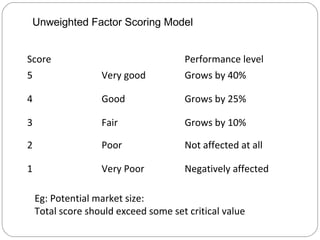
Unweighted Factor Scoring Model
Score Performance level
5 Very good Grows by 40%
4 Good Grows by 25%
3 Fair Grows by 10%
2 Poor Not affected at all
1 Very Poor Negatively affected
Eg: Potential market size:
Total score should exceed some set critical value
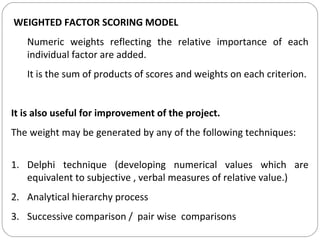
WEIGHTED FACTOR SCORING MODEL
Numeric weights reflecting the relative importance of each
individual factor are added.
It is the sum of products of scores and weights on each criterion.
It is also useful for improvement of the project.
The weight may be generated by any of the following techniques:
1. Delphi technique (developing numerical values which are
equivalent to subjective , verbal measures of relative value.)
2. Analytical hierarchy process
3. Successive comparison / pair wise comparisons
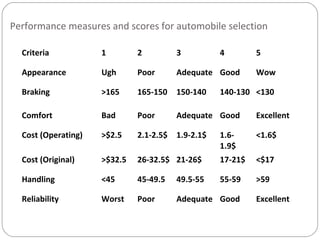
Exercise
Use a weighted scoring model to chose an automobile. The
performance measures and scores, as also the relative
weights of each criterion are shown in the following table.
Performance measures and scores for automobile selection
Criteria 1 2 3 4 5
Appearance Ugh Poor Adequate Good Wow
Braking >165 165-150 150-140 140-130 <130
Comfort Bad Poor Adequate Good Excellent
Cost (Operating) >$2.5 2.1-2.5$ 1.9-2.1$ 1.6-
1.9$
<1.6$
Cost (Original) >$32.5 26-32.5$ 21-26$ 17-21$ <$17
Handling <45 45-49.5 49.5-55 55-59 >59
Reliability Worst Poor Adequate Good Excellent
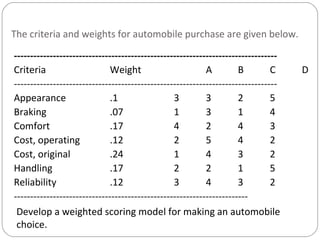
The criteria and weights for automobile purchase are given below.
---------------------------------------------------------------------------------
Criteria Weight A B C D
---------------------------------------------------------------------------------
Appearance .1 3 3 2 5
Braking .07 1 3 1 4
Comfort .17 4 2 4 3
Cost, operating .12 2 5 4 2
Cost, original .24 1 4 3 2
Handling .17 2 2 1 5
Reliability .12 3 4 3 2
------------------------------------------------------------------------
Develop a weighted scoring model for making an automobile
choice.
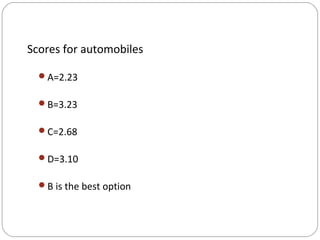
Scores for automobiles
A=2.23
B=3.23
C=2.68
D=3.10
B is the best option
Sensitivity analysis
A weighted scoring model can also be used for project
improvement.
For any given criterion, the difference between the criterion’s
score and the highest possible score on that criterion,
multiplied by the weight of the criterion, is a measure of the
potential improvement in the project score that would result,
were the project’s performance on the specific criterion
sufficiently improved.
It may be that such an improvement is not feasible.
Such an analysis yields valuable statement of comparative
benefits of project improvements.
By adding resources we can study the degree to which a
project’s score is sensitive to attempts for improvement.
• Involves constraints representing project characteristics that must
be present or absent in order for the project to be acceptable.
•It is the sum of products of scores and weights on each criterion,
multiplied by a value of 1, if the ith project satisfies the kth
constraint & 0 if it does not
• Other elements in this model are the same as in the previous
model. A company may have decided that they would not undertake
any project that would significantly lower the quality of the final
product.
CONSTRAINED WEIGHTED FACTOR SCORING MODEL
Financial models
Profit / profitability
Pay back period
Average Rate of return
Discounted cash flow
Internal rate of return
Profitability Index
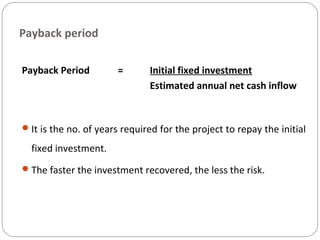
Payback period
Payback Period = Initial fixed investment
Estimated annual net cash inflow
It is the no. of years required for the project to repay the initial
fixed investment.
The faster the investment recovered, the less the risk.
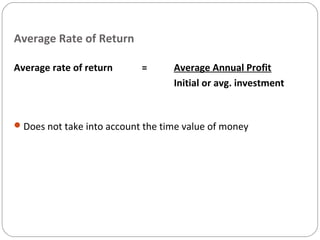
Average Rate of Return
Average rate of return = Average Annual Profit
Initial or avg. investment
Does not take into account the time value of money
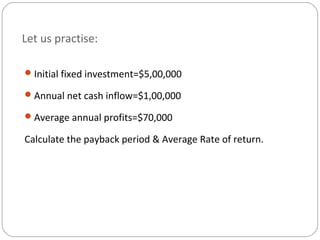
Let us practise:
Initial fixed investment=$5,00,000
Annual net cash inflow=$1,00,000
Average annual profits=$70,000
Calculate the payback period & Average Rate of return.
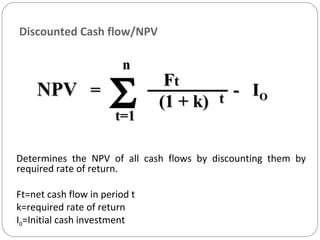
NPVNPV = - I= - IOO
FFtt
(1 + k)(1 + k) tt
nn
t=1t=1
Σ
Discounted Cash flow/NPV
Determines the NPV of all cash flows by discounting them by
required rate of return.
Ft=net cash flow in period t
k=required rate of return
I0=Initial cash investment
n
t=1
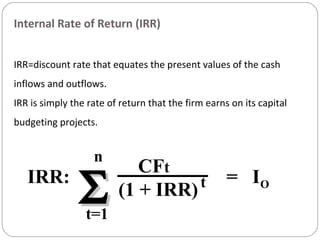
ΣΣIRR: = IO
CFt
(1 + IRR)t
Internal Rate of Return (IRR)
IRR=discount rate that equates the present values of the cash
inflows and outflows.
IRR is simply the rate of return that the firm earns on its capital
budgeting projects.
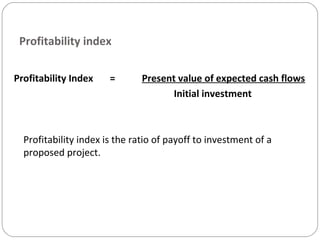
Profitability index
Profitability Index = Present value of expected cash flows
Initial investment
Profitability index is the ratio of payoff to investment of a
proposed project.
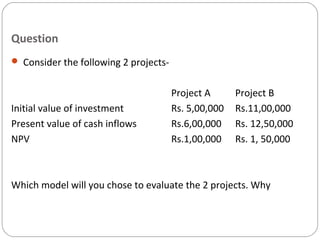
Question
 Consider the following 2 projects-
Project A Project B
Initial value of investment Rs. 5,00,000 Rs.11,00,000
Present value of cash inflows Rs.6,00,000 Rs. 12,50,000
NPV Rs.1,00,000 Rs. 1, 50,000
Which model will you chose to evaluate the 2 projects. Why
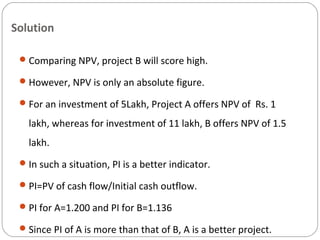
Solution
Comparing NPV, project B will score high.
However, NPV is only an absolute figure.
For an investment of 5Lakh, Project A offers NPV of Rs. 1
lakh, whereas for investment of 11 lakh, B offers NPV of 1.5
lakh.
In such a situation, PI is a better indicator.
PI=PV of cash flow/Initial cash outflow.
PI for A=1.200 and PI for B=1.136
Since PI of A is more than that of B, A is a better project.
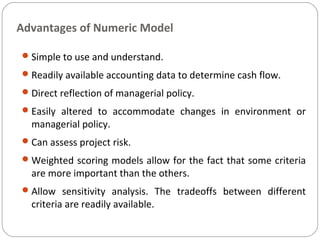
Advantages of Numeric Model
Simple to use and understand.
Readily available accounting data to determine cash flow.
Direct reflection of managerial policy.
Easily altered to accommodate changes in environment or
managerial policy.
Can assess project risk.
Weighted scoring models allow for the fact that some criteria
are more important than the others.
Allow sensitivity analysis. The tradeoffs between different
criteria are readily available.
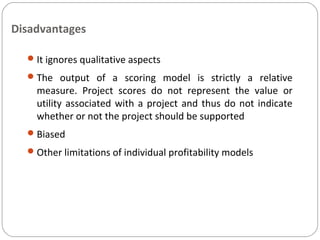
Disadvantages
It ignores qualitative aspects
The output of a scoring model is strictly a relative
measure. Project scores do not represent the value or
utility associated with a project and thus do not indicate
whether or not the project should be supported
Biased
Other limitations of individual profitability models
The Project Portfolio
A collection of projects grouped to be collectively managed
Projects are selected to contribute to the organization’s goals
Portfolio alignment identifies, selects, and prioritizes
projects to help achieve an organization’s strategic goals
Assess Organization’s Ability to
Perform Projects
Do we have a teamwork attitude, free and open communication,
creativity, and empowered decision-making?
Do we have a clearly defined project management process?
Do our associates have the right attitudes, skills, and
competencies to use the project management process?
Are our leaders at each level willing to take appropriate personal
risk?
Assess Organization’s Ability to
Perform Projects
Does senior leadership establish a strong leadership foundation?
Do individuals and teams exhibit leadership at their respective
levels?
Do we monitor and understand our external environment?
Project Portfolio Process
1. Establish a project council
2. Identify project categories and criteria
Based on the extent of product and process change:
 Derivative projects –are projects with objectives or deliverables that are
only incrementally different in both product and process from existing
offerings.
 Platform projects –The planned outputs of these projects represent major
departures from existing offerings in terms of either the product/service
itself or the process used to make and deliver it or both.
 Breakthrough projects –These projects typically involve a newer
technology than platform projects. It may be a “disruptive” technology
that is known to the industry or something proprietary that the
organization has been developing over
 R&D Projects –are visionary endeavors oriented toward using newly
developed technologies, or existing technologies in a new manner.
3. Collect Project Data
4. Assess Resource Availability
5. Reduce the project and criteria set
6. Prioritize the projects within categories
7. Select the projects to be funded and held in reserve.
8. Implement the process.
Project Proposals
Which projects should be bid on
How should the proposal-preparation process be organized
and staffed
How much should be spent on preparing proposals for bids
How should the bid prices be set
What is the bidding strategy Is it ethical
Project Proposal Contents
Executive Summary
Cover Letter
Nature of the technical problem
Plan for Implementation of Project
Plan for Logistic Support & Administration of the project
Description of group proposing to do the work
Any relevant past experience that can be applied

project selection

  • 1.
    Project Selection •Pest Analysis,Swot Analysis, Porter’s Five Force Model •Non-numeric Models •Numeric Models Chapter 2
  • 2.
    Challenges of Contemporary Organizations 02/22/15Yu-LinHuang Project selection is the process of evaluating individual projects or groups of projects, and then choosing to implement some set of them so that the objectives of the parent organization will be achieved How to tie their projects more closely with the organization’s goals and objectives? How to handle the growing number of ongoing projects? How to make these projects more successful?
  • 3.
    Strategic Planning Process StrategicAnalysis Guiding Principles Vision Mission Statement Strategic Objectives
  • 4.
    Strategic Planning andPortfolio Alignment
  • 5.
    Strategic Analysis: PESTAnalysis PEST analysis is a business measurement tool An acronym for Political, Economic, Social and Technological factors Used to assess the market for a business or organizational unit Measures the market potential and situation, particularly indicating growth or decline, and thereby market attractiveness, business potential, and suitability of access 02/22/15Yu-Lin Huang
  • 6.
    The PEST subjectshould be a clear definition of the market being addressed, which might be from any of the following standpoints: a company looking at its market a product looking at its market a brand in relation to its market a local business unit a strategic option, such as entering a new market or launching a new product a potential acquisition a potential partnership an investment opportunity 02/22/15Yu-Lin Huang
  • 7.
    02/22/15Yu-Lin Huang 7 Political Ecological/environmentalissues Current legislation Home market Future legislation International legislation Regulatory bodies and processes Government policies Government term and change Trading policies Funding, grants and initiatives Home market lobbying/pressure groups International pressure groups Wars and conflicts Economic Home economy situation Home economy trends Overseas economies and trends General taxation issues Taxation specific to product/services Seasonality/weather issues Market and trade cycles Specific industry factors Market routes and distribution trends Customer/end-user drivers Interest and exchange rates International trade/monetary issues Social Life style trends Demographics Consumer attitudes and opinions Media views Law changes affecting social factors Brand, company, technology image Consumer buying patterns Fashion and role models Major events and influences Buying access and trends Ethnic/religious factors Advertising and publicity Ethical issues Technological Competing technology development Research funding Associated/dependent technologies Replacement technology/solutions Maturity of technology Manufacturing maturity and capacity Information and communications Consumer buying mechanisms/technology Technology legislation Innovation potential Technology access, licencing, patents Intellectual property issues Global communications
  • 8.
    SWOT Analysis SWOT isan acronym for Strengths, Weaknesses, Opportunities, Threats Provides a good framework for reviewing strategy, position and direction of a company or business proposition, or any other idea. SWOT analysis is used for business planning, strategic planning, competitor evaluation, marketing, business and product development and research reports. 02/22/15Yu-Lin Huang
  • 9.
    Strengths are positiveinternal factors that a company can use to accomplish its mission, goals, and objectives. e.g., brand image, experienced sales force, patents, special knowledge Weaknesses are negative internal factors that inhibit a company’s ability to accomplish its mission, goals, and objectives. e.g., lack of capital, inferior location Opportunities are positive external options that a firm can exploit to accomplish its mission, goals and objectives. Threats are negative external forces that inhibit a company’s ability to achieve its mission, goals and objectives. SWOT Analysis
  • 10.
    SWOT ANALYSIS OFWAL-MART Strength  Powerful retail brand  Exponential growth  Information technology and international logistics system  Focus on HRD and retention of employees Weakness  Huge span of control  Less focus on specific sectors  Presence limited to only a few countries Opportunity  Strategic alliances  Future business by expansion  New locations and store types Threat  Target of competition  Exposed to political problems  Price competition
  • 11.
    PORTER’S FIVE FORCESMODEL Porter five forces analysis is a framework for industry analysis and business strategy development. It draws upon industrial organization economics to derive five forces that determine the competitive intensity and therefore attractiveness of a market. Attractiveness in this context refers to the overall industry profitability. Supplier Power Buyer Power Competitive Rivalry Threat of Substitution Threat of New Entry
  • 12.
    The Five Forces Threatof New Entrants/ Barriers to Entry Bargaining Power of Customers Threat of Substitutes Bargaining Power of Suppliers Sources for this section: Michael E. Porter, Understanding Industry Structure, Revised 2007 and How Competitive Forces Shape Strategy, Harvard Business Review, 1979 Rivalry Among Existing Competitors
  • 13.
    Background of Smartphones Simondesigned by IBM in 1992 Palm started the concept/evolved from PDAs Advanced productivity tools (calendars, emails, etc.) High cost/high end devices Look and feel of a mini PC Perceived sense of increased efficiency Ability to expand and add-on to augment the user experience Started primarily for business- expanded to consumers/entertainment
  • 14.
    Smartphone Competitors Smartphone Definition: Manyfunctions other than a regular cellular phone Mini computer inside a “normal” cell phone Can upload applications Revolutionary phone, media flare and internet access Competitors: RIM Apple LG Samsung Motorola HTC Nokia Operating systems: Apple Android Microsoft Windows Phone 7
  • 15.
    BARRIERS TO ENTRY Knowledgebarrier; Brand recognition Carrier relationship; Highly fragmented; Exclusive technology CUSTOMER POWER • Consumer • Trend seekers • Enterprise • Carriers SUBSTITUTES Email; Skype/Gizmo/VoIP; iPad – notebook/computer; Regular old cell phone; Landlines; Visit in person; No mobile device SUPPLIER POWER •Chip mfrs, circuit boards, cameras, touch screen (raw materials) •Carriers •Distribution channels •Software/operati ng system RIVALRY Huge Very fast moving phones beco- ming obsolete
  • 16.
    Conclusions Very strong, butlots of competition Quickly changing Innovation is key Huge opportunity for growth – upside Carrier dependent
  • 17.
    Guiding Principles The visiondescribes the future of the organization “vivid description of a preferred future” Require extra effort to be achieved Often multiyear goals that end in suggesting the need for a new vision The mission statement provides a mechanism for achieving the vision “organization’s core purpose, core values”, beliefs, culture, primary business, primary customers
  • 18.
    Mission Statement Considerations Purpose– communicates why an organization exists Beliefs – what the leaders of an organization stand for Core values – how decisions will be made and how people will be treated Culture – how members should act Primary business areas – what business the organization engages in Primary customers – which groups of people need to be satisfied
  • 19.
    Cincinnati Children’s HospitalMedical Center Vision and Mission Vision
  • 20.
    Strategic Objectives Means ofachieving the vision and mission Objective setting occurs annually Describe short term and long term results Describe measures of achievement Effective objectives are SMART Specific Measurable Achievable Results-based Time-specific
  • 21.
    Midland Insurance CompanyStrategic Objectives
  • 22.
    Portfolio Alignment Assess organization’sability to perform projects Portfolios Programs Projects and subprojects
  • 23.
    Portfolios Organizations require workactivities including ongoing operational work and temporary project work Try to achieve a sense of balance in portfolios Some large and some small projects Some high-risk, high-reward projects and some low-risk projects Some projects that can be completed quickly and some that take substantial time portfolio – “a collection of projects or programs and other work that are grouped together to facilitate effective management of that work to meet strategic business objectives. The projects or programs of the portfolio may not necessarily be interdependent or directly related.” PMBOK® portfolio – “a collection of projects or programs and other work that are grouped together to facilitate effective management of that work to meet strategic business objectives. The projects or programs of the portfolio may not necessarily be interdependent or directly related.” PMBOK®
  • 24.
    Programs Programs last aslong as the organization lasts Specific projects within a program are of limited duration Portfolios and programs are managed at a level above the typical project manager program – “a group of related projects managed in a coordinated way to obtain benefits and control not available from managing them individually. Programs may include elements of work outside of the scope of discrete projects in the program.” PMBOK® Guide program – “a group of related projects managed in a coordinated way to obtain benefits and control not available from managing them individually. Programs may include elements of work outside of the scope of discrete projects in the program.” PMBOK® Guide
  • 25.
    Projects and Subprojects Alarge project may be composed of multiple subprojects The project manager coordinates subprojects and make decisions that are best for the overall project subproject – “a smaller portion of the overall project created when a project is subdivided into more manageable components or pieces.” PMBOK® Guide subproject – “a smaller portion of the overall project created when a project is subdivided into more manageable components or pieces.” PMBOK® Guide
  • 26.
    Portfolio of Projectsand Operational Work Processes
  • 27.
    Reasons for ProjectFailure Not enough resources Not enough time Unclear expectations Changes to the project Disagreement about expectations
  • 28.
    The Project Portfolio Acollection of projects grouped to be collectively managed Projects are selected to contribute to the organization’s goals Portfolio alignment identifies, selects, and prioritizes projects to help achieve an organization’s strategic goals
  • 29.
    Assess Organization’s Abilityto Perform Projects Do we have a teamwork attitude, free and open communication, creativity, and empowered decision-making? Do we have a clearly defined project management process? Do our associates have the right attitudes, skills, and competencies to use the project management process? Are our leaders at each level willing to take appropriate personal risk?
  • 30.
    Assess Organization’s Abilityto Perform Projects Does senior leadership establish a strong leadership foundation? Do individuals and teams exhibit leadership at their respective levels? Do we monitor and understand our external environment?
  • 31.
    Identifying Potential Projects Peoplefrom all levels and all functional areas should participate Identify twice as many potential projects as the organization has time and resources to perform Develop a brief description of all potential projects The “elevator speech” business case – “provides the information needed from a business standpoint to determine if the project is worth the investment.” PMBOK® Guide business case – “provides the information needed from a business standpoint to determine if the project is worth the investment.” PMBOK® Guide statement of work – “narrative description of products or services to be provided by the project.” PMBOK® Guide statement of work – “narrative description of products or services to be provided by the project.” PMBOK® Guide
  • 32.
    Project Selection Procedure:A Cross- Industry Sampler Hoechst AG, a pharmaceutical firm uses a scoring portfolio model with 119 questions in five major categories i.e.: business strategy fit, probability of technical success, commercial success, strategic leverage and reward to the company. Within each of these factors there are specific questions which are scored on a 1-10 by the management. The Royal Bank of Canada uses the following criteria for portfolio scoring: Project importance( strategic importance, magnitude of impact and economic benefits) ease of doing (cost of development, project complexity and resource availability) Expected annual expenditure and total project spending are then added to this rank ordered list to prioritize project options.
  • 33.
    Project selection isthe process of evaluating individual projects or groups of projects, and then choosing to implement some set of them so that the objectives of the parent organization will be achieved Managers often use decision-aiding models to extract the relevant issues of a problem from the details in which the problem is embedded Models represent the problem’s structure and can be useful in selecting and evaluating projects Project Selection
  • 34.
    Realism - realityof manager’s decision Capability- able to simulate different scenarios and optimize the decision Flexibility - provide valid results within the range of conditions Ease of Use - reasonably convenient, easy execution, and easily understood Cost - Data gathering and modeling costs should be low relative to the cost of the project Easy Computerization - must be easy and convenient to gather, store and manipulate data in the model Criteria for Project Selection Models (By Souder)
  • 35.
    Market analysis Production Factors/Technical analysis Financial analysis Economic analysis Ecological analysis Personnel factors Key Issues in Project Analysis
  • 36.
    Marketing Factors Size ofpotential market for output Probable market share of output Time until market share is acquired Impact on current product line Consumer acceptance Impact on consumer safety Estimated life of output Spin-off project possibilities
  • 37.
    Production factors • Timeuntil ready to install • Length of disruption during installation • Learning curve-time until operating as desired. • Effects on waste & rejects • Energy requirements • Facility & other equipment requirements • Safety of process • Other applications of technology • Changes in cost to produce a unit output • Change in raw material usage • Availability of raw materials • Required development time & cost • Impact on current suppliers • Change in quality of output
  • 38.
    Financial Factors • Profitability •Impact on cash flows • Payout period • Cash requirements • Time until break-even • Size of investment required • Impact on seasonal &cyclic fluctuations
  • 39.
    Personnel factors • Trainingrequirements • Labour skill requirements • Availability of required labour skill • Level of resistance from current work force • Change in size of labour force • Inter & intra group communication requirements • Impact on working conditions
  • 40.
    Administrative & Miscellaneousfactors • Meet govt. safety, environmental standards • Impact on information system • Reaction of stock holders & securities market • Patent & trade secret protection • Impact of image with customers, suppliers & competitors • Degree to which we understand new technology • Managerial capacity to direct & control new process
  • 41.
    Nature of ProjectSelection Models 2 Basic Types of Models Non-numeric Numeric Two Critical Facts: Models do not make decisions - People do! All models, however sophisticated, are only partial representations of the reality the are meant to reflect
  • 42.
    Nonnumeric Models Sacred Cow- project is suggested by a senior and powerful official in the organization Operating Necessity - the project is required to keep the system running Competitive Necessity - project is necessary to sustain a competitive position Product Line Extension - projects are judged on how they fit with current product line, fill a gap, strengthen a weak link, or extend the line in a new desirable way Comparative Benefit Model - several projects are considered and the one with the most benefit to the firm is selected
  • 43.
  • 44.
    Numeric Models: Scoring Unweighted0-1 Factor Model Unweighted Factor Scoring Model Weighted Factor Scoring Model Constrained Weighted Factor Scoring Model Goal Programming with Multiple Objectives
  • 45.
    NUMERIC MODELS –SCORING UNWEIGHTED 0-1 FACTOR MODEL - A set of relevant factors is selected by management & then listed in a preprinted form. One or more raters score the project on each factor, whether or not it qualifies for an individual criterion.
  • 46.
    Qualify Does not qualify Potentialmarket size * Time to break-even less than 3 years * No quality compromise * Need for external consultants * Impact on work force safety * Estimated annual profits $250,000 * Total 4 2 Project________ Rater_________ Date__________
  • 47.
    UNWEIGHTED FACTOR SCORINGMODEL-the earlier model had the drawback of considering all criteria equally important & involves no gradation of the degree to which a specific project meets the various criteria. This model addresses the second drawback by constructing a simple linear measure of the degree to which the project being evaluated meets each of the criteria contained in the list
  • 48.
    Unweighted Factor ScoringModel Score Performance level 5 Very good Grows by 40% 4 Good Grows by 25% 3 Fair Grows by 10% 2 Poor Not affected at all 1 Very Poor Negatively affected Eg: Potential market size: Total score should exceed some set critical value
  • 49.
    WEIGHTED FACTOR SCORINGMODEL Numeric weights reflecting the relative importance of each individual factor are added. It is the sum of products of scores and weights on each criterion. It is also useful for improvement of the project. The weight may be generated by any of the following techniques: 1. Delphi technique (developing numerical values which are equivalent to subjective , verbal measures of relative value.) 2. Analytical hierarchy process 3. Successive comparison / pair wise comparisons
  • 50.
    Exercise Use a weightedscoring model to chose an automobile. The performance measures and scores, as also the relative weights of each criterion are shown in the following table.
  • 51.
    Performance measures andscores for automobile selection Criteria 1 2 3 4 5 Appearance Ugh Poor Adequate Good Wow Braking >165 165-150 150-140 140-130 <130 Comfort Bad Poor Adequate Good Excellent Cost (Operating) >$2.5 2.1-2.5$ 1.9-2.1$ 1.6- 1.9$ <1.6$ Cost (Original) >$32.5 26-32.5$ 21-26$ 17-21$ <$17 Handling <45 45-49.5 49.5-55 55-59 >59 Reliability Worst Poor Adequate Good Excellent
  • 52.
    The criteria andweights for automobile purchase are given below. --------------------------------------------------------------------------------- Criteria Weight A B C D --------------------------------------------------------------------------------- Appearance .1 3 3 2 5 Braking .07 1 3 1 4 Comfort .17 4 2 4 3 Cost, operating .12 2 5 4 2 Cost, original .24 1 4 3 2 Handling .17 2 2 1 5 Reliability .12 3 4 3 2 ------------------------------------------------------------------------ Develop a weighted scoring model for making an automobile choice.
  • 53.
  • 54.
    Sensitivity analysis A weightedscoring model can also be used for project improvement. For any given criterion, the difference between the criterion’s score and the highest possible score on that criterion, multiplied by the weight of the criterion, is a measure of the potential improvement in the project score that would result, were the project’s performance on the specific criterion sufficiently improved. It may be that such an improvement is not feasible. Such an analysis yields valuable statement of comparative benefits of project improvements. By adding resources we can study the degree to which a project’s score is sensitive to attempts for improvement.
  • 55.
    • Involves constraintsrepresenting project characteristics that must be present or absent in order for the project to be acceptable. •It is the sum of products of scores and weights on each criterion, multiplied by a value of 1, if the ith project satisfies the kth constraint & 0 if it does not • Other elements in this model are the same as in the previous model. A company may have decided that they would not undertake any project that would significantly lower the quality of the final product. CONSTRAINED WEIGHTED FACTOR SCORING MODEL
  • 56.
    Financial models Profit /profitability Pay back period Average Rate of return Discounted cash flow Internal rate of return Profitability Index
  • 57.
    Payback period Payback Period= Initial fixed investment Estimated annual net cash inflow It is the no. of years required for the project to repay the initial fixed investment. The faster the investment recovered, the less the risk.
  • 58.
    Average Rate ofReturn Average rate of return = Average Annual Profit Initial or avg. investment Does not take into account the time value of money
  • 59.
    Let us practise: Initialfixed investment=$5,00,000 Annual net cash inflow=$1,00,000 Average annual profits=$70,000 Calculate the payback period & Average Rate of return.
  • 60.
    NPVNPV = -I= - IOO FFtt (1 + k)(1 + k) tt nn t=1t=1 Σ Discounted Cash flow/NPV Determines the NPV of all cash flows by discounting them by required rate of return. Ft=net cash flow in period t k=required rate of return I0=Initial cash investment
  • 61.
    n t=1 ΣΣIRR: = IO CFt (1+ IRR)t Internal Rate of Return (IRR) IRR=discount rate that equates the present values of the cash inflows and outflows. IRR is simply the rate of return that the firm earns on its capital budgeting projects.
  • 62.
    Profitability index Profitability Index= Present value of expected cash flows Initial investment Profitability index is the ratio of payoff to investment of a proposed project.
  • 63.
    Question  Consider thefollowing 2 projects- Project A Project B Initial value of investment Rs. 5,00,000 Rs.11,00,000 Present value of cash inflows Rs.6,00,000 Rs. 12,50,000 NPV Rs.1,00,000 Rs. 1, 50,000 Which model will you chose to evaluate the 2 projects. Why
  • 64.
    Solution Comparing NPV, projectB will score high. However, NPV is only an absolute figure. For an investment of 5Lakh, Project A offers NPV of Rs. 1 lakh, whereas for investment of 11 lakh, B offers NPV of 1.5 lakh. In such a situation, PI is a better indicator. PI=PV of cash flow/Initial cash outflow. PI for A=1.200 and PI for B=1.136 Since PI of A is more than that of B, A is a better project.
  • 65.
    Advantages of NumericModel Simple to use and understand. Readily available accounting data to determine cash flow. Direct reflection of managerial policy. Easily altered to accommodate changes in environment or managerial policy. Can assess project risk. Weighted scoring models allow for the fact that some criteria are more important than the others. Allow sensitivity analysis. The tradeoffs between different criteria are readily available.
  • 66.
    Disadvantages It ignores qualitativeaspects The output of a scoring model is strictly a relative measure. Project scores do not represent the value or utility associated with a project and thus do not indicate whether or not the project should be supported Biased Other limitations of individual profitability models
  • 67.
    The Project Portfolio Acollection of projects grouped to be collectively managed Projects are selected to contribute to the organization’s goals Portfolio alignment identifies, selects, and prioritizes projects to help achieve an organization’s strategic goals
  • 68.
    Assess Organization’s Abilityto Perform Projects Do we have a teamwork attitude, free and open communication, creativity, and empowered decision-making? Do we have a clearly defined project management process? Do our associates have the right attitudes, skills, and competencies to use the project management process? Are our leaders at each level willing to take appropriate personal risk?
  • 69.
    Assess Organization’s Abilityto Perform Projects Does senior leadership establish a strong leadership foundation? Do individuals and teams exhibit leadership at their respective levels? Do we monitor and understand our external environment?
  • 70.
    Project Portfolio Process 1.Establish a project council 2. Identify project categories and criteria Based on the extent of product and process change:  Derivative projects –are projects with objectives or deliverables that are only incrementally different in both product and process from existing offerings.  Platform projects –The planned outputs of these projects represent major departures from existing offerings in terms of either the product/service itself or the process used to make and deliver it or both.  Breakthrough projects –These projects typically involve a newer technology than platform projects. It may be a “disruptive” technology that is known to the industry or something proprietary that the organization has been developing over  R&D Projects –are visionary endeavors oriented toward using newly developed technologies, or existing technologies in a new manner.
  • 71.
    3. Collect ProjectData 4. Assess Resource Availability 5. Reduce the project and criteria set 6. Prioritize the projects within categories 7. Select the projects to be funded and held in reserve. 8. Implement the process.
  • 72.
    Project Proposals Which projectsshould be bid on How should the proposal-preparation process be organized and staffed How much should be spent on preparing proposals for bids How should the bid prices be set What is the bidding strategy Is it ethical
  • 73.
    Project Proposal Contents ExecutiveSummary Cover Letter Nature of the technical problem Plan for Implementation of Project Plan for Logistic Support & Administration of the project Description of group proposing to do the work Any relevant past experience that can be applied