Personal Financial Planning (PFP) [email_address] Facebook Study Group:  http://www.facebook.com/group.php?gid=143970885148
Financial System Existence of a well organized financial system Promotes the well being and standard of living of the people of a country Money and monetary assets  Mobilize the saving  Promotes investment Promotes Infrastructure & Tax Planning
Financial System Financial System of any country consists of financial markets, financial intermediation and financial instruments or financial products  Suppliers of funds (Mainly households) Flow of financial services Incomes , and financial  claims Seekers of funds  (Mainly business firms and government) Flow of funds (savings)
Indian Financial System  Non-  Organized   Organized   Money lenders Local bankers  Traders Landlords Pawn brokers Chit Funds Regulators Financial Institutions Financial Markets Financial services
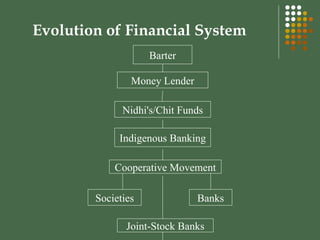
Barter Money Lender Nidhi's/Chit Funds Indigenous Banking Cooperative Movement Societies Banks Joint-Stock Banks Evolution of Financial System
Consolidation Commercial Banks Nationalization Investment Banks Development Financial Institutions Investment/Insurance Companies Stock Exchanges Market Operations Specialized Financial Institutions Merchant Banking Universal Banking
Financial System Savers Lenders Households Foreign Sectors Investors Borrowers Corporate Sector Govt.Sector Un-organized Sector Economy Interrelation--Financial system & Economy
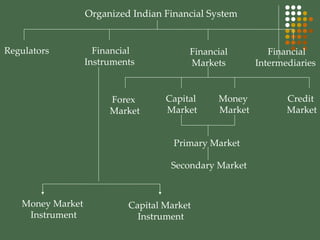
Organized Indian Financial System  Money Market  Instrument Capital Market  Instrument Forex  Market Capital  Market Money  Market Credit  Market Primary Market Financial Instruments  Financial Markets Financial Intermediaries  Secondary Market  Regulators
Financial Markets Mechanism which allows people to trade Affected by forces of supply and demand Process used In Finance, Financial markets facilitates Trade, Safety & Liquidity  Products Offered & Financial Institutions Transparency
Why Capital Markets Exist Capital markets facilitate the transfer of capital ( i.e.  financial) assets from one owner to another. They provide liquidity. Liquidity refers to how easily an asset can be transferred without loss of value. A side benefit of capital markets is that the transaction price provides a measure of the value of the asset.
Role of Capital Markets Mobilization of Savings & acceleration of Capital Formation Promotion of Industrial Growth Raising of long term Capital Ready & Continuous Markets Proper Channelisation of Funds Provision of a variety of Services
Indian Capital Market Market Instruments Intermediaries   Primary Secondary Equity Debt Hybrid Regulator   Brokers  Investment Bankers  Stock Exchanges Underwriters SEBI Players Corporate Intermediaries CRA Banks/FI FDI /FII Individual
Capital Market Instruments ADR / GDR Equity Debt Equity Shares  Preference Shares  Debentures  Zero coupon  bonds  Deep  Discount Bonds  Hybrid
Segment   Issuer   Money Market Instruments   Governmt  Central Govermnt  Zero Coupon Bonds, Coupon Bearing Bonds, Capital Index Bonds, Treasury Bills. + RBI Bonds Public Sector  Government Agencies / Statutory Bodies  Govt. Guaranteed Bonds, Debentures  Public Sector Units  PSU Bonds, Debenture, Commercial Paper  Private  Corporate  Debentures, Bonds, Commercial Paper, Floating Rate Bonds, Zero Coupon Bonds, Inter-Corporate Deposits  Banks  Certificate of Deposits, Bonds  Financial Institutions  Certificate of Deposits, Bonds
Financial  Intermediary
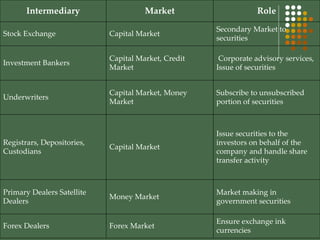
Intermediary Market Role Stock Exchange Capital Market Secondary Market to securities Investment Bankers Capital Market, Credit Market   Corporate advisory services, Issue of securities Underwriters Capital Market, Money Market Subscribe to unsubscribed portion of securities Registrars, Depositories, Custodians Capital Market Issue securities to the investors on behalf of the company and handle share transfer activity Primary Dealers Satellite Dealers Money Market Market making in government securities  Forex Dealers Forex Market Ensure exchange ink currencies
Financial Regulators Securities and Exchange Board of India (SEBI) Reserve Bank of India Ministry of Finance Tax Authorities
Investment/Speculation Investment Management is the process of managing money, including investments, budgeting, banking and taxes, also called as money management. PFP – Assessing your financial situation, objectives, formulating financial strategies of how to achieve them.  It’s a continuous activity, where the plan is reviewed regularly and performance measured against devised targets. An investment operation is one which, upon thorough analysis promises safety of principal and an adequate return. Operations not meeting these requirements are Speculative.
Investment Objective/Goals Retirement – In how many years? How much  money will you need? How long will you need it for? Daughter’s/Son’s wedding – When and how much? Daughter’s/Son’s education – When and how much? Purchase of big ticket items e.g. House, Car etc Again When & How Much? How you are going to Achieve?
Right Asset Allocation for you Equities, Fixed Income and Money market Instruments based on: Return expected on your investment Amount you will be able to save (presents well as future) Cash outflows you might have at certain points of time in the future Risk appetite Amount you will require for your retirement Liquidity Your Age.
Investment protection Vs Investment Growth Investor Characteristic Investment Growth Investment Protection Time horizon Short-term Long Term Future income Requirements Steady/High Variable/Low Volatility Limit (Risk Averseness) Low High Inflation protection Low Protection Needed High protection needed Investor take on equity market Mostly Bearish Mostly Bullish
Knowing Yourself – Your Risk Tolerance Investment Objectives – Safety of capital, current income or capital appreciation – depends upon person’s age, stage/position in life, circumstances Timeframe – The shorter your time horizon , the more conservative you should be.  Aggressive investment vehicles like stocks when you are young and you have time to make up for losses whereas if you are about to retire than opportunity to recover losses is limited.  Take Inflation (The Enemy No. 1) into account. Your Personality – Key organ for investing is the stomach, not the brain. How much volatility you can stand in your investments.  You have taken on too much risk when you can’t sleep at night because you worry about your investments. This indicates your investment personality.
Financial Planning Planning for Planned (predictable events and goals) – Investment & Saving products Cash flow planning, Tax planning, Financial Goal planning, Retirement planning, Investment & Wealth creation planning & Estate Planning's Planning for the un planned (unpredictable events) – Insurance?? Save for a rainy day to take care of emergencies and make your money grow.
Investment & Wealth Creation Planning Importance of Investment Planning – To earn more money for buying a new house, paying college education of your children, enjoying a comfortable retirement or whatever is important to you. Who needs Investment Planning: Its for every one who wishes to achieve financial goals for – Creating wealth over the long term, acquiring assets like a dream house or dream car or fulfilling need for financial security
Choosing the Right Investment Options Liquidity –how accessible is your money? Safety – What is the risk involved? Return- What can you expect to get back on your investment? Investment Approaches –Conservative, Moderate, Aggressive based on your financial needs and goals Investment choices: Equity/stock, Debt Instruments or Bonds, Cash & liquid investment based on Risk profile/appetite of the investor.
Case Study According to World Health Report, the number of wealthy people in India rose 21% and crossed 100,000, making the country world’s second fastest growing wealthy population.  In this background for such people ‘how to stay rich’ is very important. The idea behind this exercise is to explore the investment opportunities an individual can chose depending upon his/her income category. Mr. Bakshi age 35, is a senior level executive in a MNC. His annual salary besides perks is above Rs. 8 lacs and expenses Rs. 4 lacks.  He has no liabilities except an ongoing home loan and auto loan for Skoda car.  And two term insurance policies. Mr. Bakshi would like to see his wealth growing:
Case study - contd What are the different options available for Mr. Bakshi so as to compound his wealth? (Give a tabular format table comprising different investment opportunities with corresponding ROIs. What is the minimum  amount such an investor should invest every year? How diverse should be the portfolio of such Investor? Of how much per cent of the total investments should be in equities and debts? Since such an investor can raise higher loans, is it worth considering taking a loan amount and investing it? Anything you would like to add.
Investment Opportunities Marketable Assets – Company shares, Debentures, Government Securities, RBI Relief Bonds, PSU Bonds, Preference Shares, Precious objects, Money Market Instruments like Bank’s CD’s, Company’s CP’s, Treasury Bills, Real estate,  Non Marketable Assets: Bank’s/company’s Fixed Deposits, Post office Time Deposits, PO MIS, Kisan Vikas Patra, NSC. PPF, EPF, LIC, Mutual Funds,
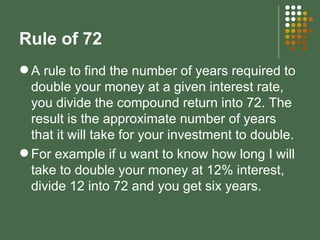
Rule of 72 A rule to find the number of years required to double your money at a given interest rate, you divide the compound return into 72. The result is the approximate number of years that it will take for your investment to double. For example if u want to know how long I will take to double your money at 12% interest, divide 12 into 72 and you get six years.
Philosophies on investment by 3 legends Warren Buffett: Value investing approach & investing for long term Focus on fundamentally strong companies which are currently undervalued Stay invested in those companies that are likely to survive & flourish in long run base on there fundamentals Only buy something that you be perfectly happy to hold if the markets shuts down for 10 years Gist: Invest with conviction (firm belief)
Philosophies on investment by 3 legends - Warren Buffett The company should be soundly managed. Tests of good management include: Share buybacks Good use of retained earnings Sticking to what you know Transparency in what they do & say
Philosophies on investment by 3 legends - Warren Buffett The company has demonstrated earning capacity with a likelihood that this will continue. Tests of earning capacity include: Company growth Dealing with inflation Capital expenditure Look through earnings Brand names
Philosophies on investment by 3 legends - Warren Buffett The company should have consistently high returns.  Warren Buffett would look at both: Returns on equity Returns on capital The company should have a prudent approach to debt The business of the company should be simple and the investor should have an understanding of the Company.
Philosophies on investment by 3 legends - Warren Buffett Assuming all these thresholds are satisfied, the investment should only be made at a reasonable consider: Price earnings ratios price, with a margin of safety. This is a matter for independent judgment by the investor but it is relevant to  Earnings and Dividend yields Book value & Comparative rates of return Investors need to take a long term approach.
Philosophies on investment by 3 legends Peter Lynch: Both value investing Style as well as growth investment style depending on the trend prevailing in the market Introduced the concept of local knowledge Invest in only what you know & you understand their business & revenue models Always be on lookout of investment opportunities Gist: Invest in what you know.
Philosophies on investment by 3 legends John Templeton:  Diversified portfolio The time of maximum pessimism is the right time to buy & the time of maximum optimism is the best time to sell – e.g. world war 2. Do not buy or sell as because others are doing so. Use your judgment. Gist: Diversity & Book Profits in select stocks
Ten Tips for the Successful Long-Term Investor –  Sell the losers and let the winners ride:- Riding a Winner Selling a Loser Don’t chase the ‘hot tip’ Don’t sweat the small stuff Do not overemphasize the P/E ratio
Ten Tips for the Successful Long-Term Investor –  Resist the lure of penny stocks Pick a strategy and stick with it Focus on the future Investors adopt a long-term perspective Be open-minded when selecting companies Taxes are important, but not that important
Financial Planning Process Determine current financial situation Develop your financial goals Identify alternative courses of action Evaluate alternatives – A) Consider: Life situation, personal values, economic factors -  B) Assess: Risk (Inflation, Interest Rate, Income, Personal & Liquidity Risk), Time Value of money (opportunity cost) C) Information sources: Printed materials – Newsletters, periodicals, books, Financial institutions, School Courses and Educational seminars, The Internet, online sources, computer software's, Financial specialists, financial planners, bankers, accountants, insurance agents lawyers, tax preparers  Create and implement your financial action plan Review and revise the financial plan.
Developing Personal Financial goals – common financial goals & Activities Obtain appropriate career training Create an effective financial recordkeeping system Develop a regular savings and investment program Accumulate an appropriate emergency fund Purchase appropriate types and amounts of insurance coverage Create and implement a flexible budget Evaluate and select appropriate investments Establish and implement a plan for retirement goals Make a will and develop an estate plan
Developing Personal Financial goals Young Single (18-35): Establish financial independence, obtain disability insurance to replace income during prolonged illness, consider home purchase for tax benefit Young couple with children under 18 : carefully manage the increased need for the use of credit, obtain an appropriate amount of life insurance for the care of dependents, use a will to name guardian for children Single parent with children under 18: obtain adequate amounts of health, life and disability insurance, contribute to savings and investment fund for college, name a guardian for children and make other estate plans
Developing Personal Financial goals Young dual-income couple, no children: coordinate insurance coverage and other benefits, develop savings and investment program for changes in life situation (large house, children), consider tax-deferred contributions to retirement funds Older couple (+50) no dependent children at home: consolidate financial assets and review estate plans, obtain health insurance for postretirement period, plan retirement housing, living expenses, recreational activities, and part time work
Developing Personal Financial goals Mixed generation household (elderly individuals and children under 18): obtain long term health care insurance and life/disability income for care of younger dependents, use dependent care service if needed, provide arrangements for handling finances of elderly if they become ill, consider splitting of investment cost, with elderly getting income while alive and principal going to surviving relatives Older (+50) single: Make arrangement for long-term health care coverage, review will and estate plan, plan retirement living facilities, living expenses and activities
Influences on Personal Financial Planning Financial decisions are affected by a personal’s life situation (income, age, household size, health), personal values and economic factors (prices, interest rates and employment opportunities) Changing Economic conditions and financial decisions: - Consumer prices – value of the rupee, changes in inflation
Influences on Personal Financial Planning - Changing Economic conditions and financial decisions – contd.. Consumer spending – demand for goods and services by individuals and households – GDP etc Interest rates – cost of money, cost of credit when you borrow; the return on your money when you save or invest Money Supply – Money available for spending in our economy Unemployment, Housing Industry, Balance of Trade and Stock market volatility
Determine personal and financial opportunity costs associated with personal financial decisions Every decision involves a trade-off with things given up. Personal opportunity costs include time, effort and health. Financial opportunity costs are based on the time value of money.  Future value and present value calculations enable you to measure the increased value (or lost interest) that results from a saving, investing, borrowing or purchasing decision.
Identify strategies for achieving personal financial goals for different life situations Successful financial planning requires specific goals combined with spending, saving, investing and borrowing strategies based on your personal situation and social and economic factors Short Term Financial strategies: Create and Implement a budget, pay off credit card debts, obtain adequate insurance, establish a regular savings program, invest in safe income producing financial instruments, use rental housing, save for the home purchase Long term financial strategies: invest in financial instrument for long term growth, select tax deferred investments, pay off consumer debts and home mortgage.
Financial Aspects of Career Planning Describe the activities associated with career planning & advancement: Assess and research personal goals, abilities, and career fields Evaluate the employment market and identify specific employment opportunities Develop a resume and cover letter for use in applying for available positions (Change employment within same career field) Interview for available positions Evaluate financial and other elements of the positions you are offered and Plan and implement a program for career development/advancement
Financial Aspects of Career Planning Evaluate the factors that influence employment opportunities Consider the selection of a career in relation to personal abilities, interests, experience, training, and goals Social influences affecting employment, such as demographic trends; Changing economic conditions and Industrial and technological trends
Financial Aspects of Career Planning Implement employment search strategies for successful career planning & development; Consider doing following: Obtain employment or related experiences by working part-time or by participating in campus and community activities.  Use career information sources to learn about employment fields and identify job opportunities. Prepare a resume and cover letter that effectively present your qualifications for a specific employment position.  Practice interview skills that project enthusiasm and competence.
Financial Aspects of Career Planning Assess the financial and legal concerns related to obtaining employment: Evaluate work environment and compensation package of prospective employers. Assess employee benefits on the basis of their market value, future value and taxability and your personal needs and goals Prospective and current employees have legal rights with regard to fair hiring practices and equal opportunity on the job.
Financial Aspects of Career Planning Analyze the techniques for career growth and advancement: Informal and formal education and training opportunities are available to foster professional development and facilitate career changes.
Money Management Strategy : financial statements and Budgeting Recognize relationships among financial documents and money management activities: Successful money management requires effective coordination of personal financial records, personal financial statements and budgeting activities
Money Management Strategy : financial statements and Budgeting Design a system for maintaining personal financial records: An organized system of financial records and documents is the foundation of effective money management This system should provide ease of access as well as security for financial documents that may be impossible to replace
Money Management Strategy : financial statements and Budgeting Develop a personal balance sheet and cash flow statement: A personal balance sheet, also known as a Net worth statement is prepared by listing all items of value (assets) and all amounts owed to others (liabilities). The difference between your total assets and your total liabilities is your net worth. A cash flow statement, also called a Personal Income & expenditure statement, is a summary of cash receipts and payments for a given period, such as a month or a year. This report provides data on your income and spending patterns.
Money Management Strategy : financial statements and Budgeting Create and implement a budget: The budgeting process involves four phases: 1. Assessing your current personal and financial situation 2. Planning your financial direction by setting financial goals and creating budget allowances 3. implementing your budget and 4. Evaluating your budgeting program
Money Management Strategy : financial statements and Budgeting Relate money management and savings activities to achieving financial goals The relationship among the personal balance sheet, cash flow statement, and budget provides the basis for  achieving long-term financial security Future value and present value calculations may be used to compute the increased value of savings for achieving financial goals.
Planning Your Tax Strategy Describe the importance of taxes for personal financial planning: Tax planning can influence spending, saving, borrowing and investing decision’ A knowledge of tax laws and maintenance of accurate tax records allow you to take advantage of appropriate tax benefits. An awareness of income taxes, sales taxes, excise taxes, property taxes, estate taxes, inheritance taxes, gift taxes, and social security taxes is vital for successful financial planning
Planning Your Tax Strategy Calculate taxable income and the amount owed for Govt’s Income Tax: Taxable income is determined by subtracting adjustments to income, deductions and allowances for exemptions from gross income. Your total tax liability is based on the published tax tables or tax schedules, less any tax credits;
Planning Your Tax Strategy Prepare a  income tax return; The major sections of returns require you to calculate: Your filing status Exemptions Income from all sources Adjustments to your income Standard deduction or itemized deductions Tax credits for which you qualify Other taxes you owe Amounts you have withheld or paid in advance and Your refund or the additional amount you owe
Planning Your Tax Strategy Identify Tax assistance sources: The main sources of tax assistance are ITO services & publications, the internet, computer software & professional tax preparers such Chartered Accountants etc Select appropriate tax strategies for different financial and personal situations: You may reduce your tax burden by carefully planning financial decisions related to consumer purchasing, the use of debt, investments and retirement planning
Consumer Credit – Use of credit by individuals and families for personal needs Analyze its advantages and disadvantages: Ability to purchase goods when needed and pay for them gradually,  The ability to meet financial emergencies, Convenience in shopping and establishment of a credit rating Disadvantage of Credit: It costs money, encourages overspending and ties up future income
Differentiate among various types of credit Close-end Credit – where borrower pays back a one-time loan in a stated period of time and with a specified number of payments Open –end credit, where borrower is permitted to take loans on a continuous basis and is billed for partial payments periodically. Assess your credit capacity (payment to income ratio) and build your credit rating
Information creditors look for when you apply for credit and steps you can take to avoid disputes Creditors determine creditworthiness on the basis of 5 C’s: Character, capacity, capital, collateral and conditions If a billing error occurs on your account notify the creditor within a reasonable time, record your dispute with respective govt. authority and return of goods (if possible).
Purpose of Credit Vehicle (Hypothecation) Personal/Education Loan Shares (Pledge) Home (Mortgage), Loan against Immovable property Purpose Objective – Tax Savings, Urgency Income – Repayment capacity
The Cost of Credit Alternatives Analyze the major sources of consumer credit Determine the cost of credit by calculating interest using various interest formulas Develop a plan to manage your debts Evaluate various private and governmental sources that assist consumers with debt problems Last Assess the choices in declaring personal bankruptcy.
The Rule of 78s First step is to add up all the digits for the number of payments scheduled. For a 12 installment loan, add the numbers 1 though 1+2+3+4+5+6+7+8+9+10+11+12 = 78 Sum of the digits explains how the rule was named. Formula N/2 x (N + 1) 12/2x(12+) = 6x13=78 Example: borrowed $3k, Interest $225 payable in 15 equal installments of $215.  Using rule of 78: 15/2x(15+1)=7.5x16=120 so total interest is divided into 120 parts. The first payment will include 15 parts of the total interest, or 15/120 $225/120x15= $28.13 , the second 14/120x14=$26.25 and so on.

Personal Financial Planning Guide

  • 1.
    Personal Financial Planning(PFP) [email_address] Facebook Study Group: http://www.facebook.com/group.php?gid=143970885148
  • 2.
    Financial System Existenceof a well organized financial system Promotes the well being and standard of living of the people of a country Money and monetary assets Mobilize the saving Promotes investment Promotes Infrastructure & Tax Planning
  • 3.
    Financial System FinancialSystem of any country consists of financial markets, financial intermediation and financial instruments or financial products Suppliers of funds (Mainly households) Flow of financial services Incomes , and financial claims Seekers of funds (Mainly business firms and government) Flow of funds (savings)
  • 4.
    Indian Financial System Non- Organized Organized Money lenders Local bankers Traders Landlords Pawn brokers Chit Funds Regulators Financial Institutions Financial Markets Financial services
  • 5.
    Barter Money LenderNidhi's/Chit Funds Indigenous Banking Cooperative Movement Societies Banks Joint-Stock Banks Evolution of Financial System
  • 6.
    Consolidation Commercial BanksNationalization Investment Banks Development Financial Institutions Investment/Insurance Companies Stock Exchanges Market Operations Specialized Financial Institutions Merchant Banking Universal Banking
  • 7.
    Financial System SaversLenders Households Foreign Sectors Investors Borrowers Corporate Sector Govt.Sector Un-organized Sector Economy Interrelation--Financial system & Economy
  • 8.
    Organized Indian FinancialSystem Money Market Instrument Capital Market Instrument Forex Market Capital Market Money Market Credit Market Primary Market Financial Instruments Financial Markets Financial Intermediaries Secondary Market Regulators
  • 9.
    Financial Markets Mechanismwhich allows people to trade Affected by forces of supply and demand Process used In Finance, Financial markets facilitates Trade, Safety & Liquidity Products Offered & Financial Institutions Transparency
  • 10.
    Why Capital MarketsExist Capital markets facilitate the transfer of capital ( i.e. financial) assets from one owner to another. They provide liquidity. Liquidity refers to how easily an asset can be transferred without loss of value. A side benefit of capital markets is that the transaction price provides a measure of the value of the asset.
  • 11.
    Role of CapitalMarkets Mobilization of Savings & acceleration of Capital Formation Promotion of Industrial Growth Raising of long term Capital Ready & Continuous Markets Proper Channelisation of Funds Provision of a variety of Services
  • 12.
    Indian Capital MarketMarket Instruments Intermediaries Primary Secondary Equity Debt Hybrid Regulator Brokers Investment Bankers Stock Exchanges Underwriters SEBI Players Corporate Intermediaries CRA Banks/FI FDI /FII Individual
  • 13.
    Capital Market InstrumentsADR / GDR Equity Debt Equity Shares Preference Shares Debentures Zero coupon bonds Deep Discount Bonds Hybrid
  • 14.
    Segment Issuer Money Market Instruments Governmt Central Govermnt Zero Coupon Bonds, Coupon Bearing Bonds, Capital Index Bonds, Treasury Bills. + RBI Bonds Public Sector Government Agencies / Statutory Bodies Govt. Guaranteed Bonds, Debentures Public Sector Units PSU Bonds, Debenture, Commercial Paper Private Corporate Debentures, Bonds, Commercial Paper, Floating Rate Bonds, Zero Coupon Bonds, Inter-Corporate Deposits Banks Certificate of Deposits, Bonds Financial Institutions Certificate of Deposits, Bonds
  • 15.
  • 16.
    Intermediary Market RoleStock Exchange Capital Market Secondary Market to securities Investment Bankers Capital Market, Credit Market   Corporate advisory services, Issue of securities Underwriters Capital Market, Money Market Subscribe to unsubscribed portion of securities Registrars, Depositories, Custodians Capital Market Issue securities to the investors on behalf of the company and handle share transfer activity Primary Dealers Satellite Dealers Money Market Market making in government securities Forex Dealers Forex Market Ensure exchange ink currencies
  • 17.
    Financial Regulators Securitiesand Exchange Board of India (SEBI) Reserve Bank of India Ministry of Finance Tax Authorities
  • 18.
    Investment/Speculation Investment Managementis the process of managing money, including investments, budgeting, banking and taxes, also called as money management. PFP – Assessing your financial situation, objectives, formulating financial strategies of how to achieve them. It’s a continuous activity, where the plan is reviewed regularly and performance measured against devised targets. An investment operation is one which, upon thorough analysis promises safety of principal and an adequate return. Operations not meeting these requirements are Speculative.
  • 19.
    Investment Objective/Goals Retirement– In how many years? How much money will you need? How long will you need it for? Daughter’s/Son’s wedding – When and how much? Daughter’s/Son’s education – When and how much? Purchase of big ticket items e.g. House, Car etc Again When & How Much? How you are going to Achieve?
  • 20.
    Right Asset Allocationfor you Equities, Fixed Income and Money market Instruments based on: Return expected on your investment Amount you will be able to save (presents well as future) Cash outflows you might have at certain points of time in the future Risk appetite Amount you will require for your retirement Liquidity Your Age.
  • 21.
    Investment protection VsInvestment Growth Investor Characteristic Investment Growth Investment Protection Time horizon Short-term Long Term Future income Requirements Steady/High Variable/Low Volatility Limit (Risk Averseness) Low High Inflation protection Low Protection Needed High protection needed Investor take on equity market Mostly Bearish Mostly Bullish
  • 22.
    Knowing Yourself –Your Risk Tolerance Investment Objectives – Safety of capital, current income or capital appreciation – depends upon person’s age, stage/position in life, circumstances Timeframe – The shorter your time horizon , the more conservative you should be. Aggressive investment vehicles like stocks when you are young and you have time to make up for losses whereas if you are about to retire than opportunity to recover losses is limited. Take Inflation (The Enemy No. 1) into account. Your Personality – Key organ for investing is the stomach, not the brain. How much volatility you can stand in your investments. You have taken on too much risk when you can’t sleep at night because you worry about your investments. This indicates your investment personality.
  • 23.
    Financial Planning Planningfor Planned (predictable events and goals) – Investment & Saving products Cash flow planning, Tax planning, Financial Goal planning, Retirement planning, Investment & Wealth creation planning & Estate Planning's Planning for the un planned (unpredictable events) – Insurance?? Save for a rainy day to take care of emergencies and make your money grow.
  • 24.
    Investment & WealthCreation Planning Importance of Investment Planning – To earn more money for buying a new house, paying college education of your children, enjoying a comfortable retirement or whatever is important to you. Who needs Investment Planning: Its for every one who wishes to achieve financial goals for – Creating wealth over the long term, acquiring assets like a dream house or dream car or fulfilling need for financial security
  • 25.
    Choosing the RightInvestment Options Liquidity –how accessible is your money? Safety – What is the risk involved? Return- What can you expect to get back on your investment? Investment Approaches –Conservative, Moderate, Aggressive based on your financial needs and goals Investment choices: Equity/stock, Debt Instruments or Bonds, Cash & liquid investment based on Risk profile/appetite of the investor.
  • 26.
    Case Study Accordingto World Health Report, the number of wealthy people in India rose 21% and crossed 100,000, making the country world’s second fastest growing wealthy population. In this background for such people ‘how to stay rich’ is very important. The idea behind this exercise is to explore the investment opportunities an individual can chose depending upon his/her income category. Mr. Bakshi age 35, is a senior level executive in a MNC. His annual salary besides perks is above Rs. 8 lacs and expenses Rs. 4 lacks. He has no liabilities except an ongoing home loan and auto loan for Skoda car. And two term insurance policies. Mr. Bakshi would like to see his wealth growing:
  • 27.
    Case study -contd What are the different options available for Mr. Bakshi so as to compound his wealth? (Give a tabular format table comprising different investment opportunities with corresponding ROIs. What is the minimum amount such an investor should invest every year? How diverse should be the portfolio of such Investor? Of how much per cent of the total investments should be in equities and debts? Since such an investor can raise higher loans, is it worth considering taking a loan amount and investing it? Anything you would like to add.
  • 28.
    Investment Opportunities MarketableAssets – Company shares, Debentures, Government Securities, RBI Relief Bonds, PSU Bonds, Preference Shares, Precious objects, Money Market Instruments like Bank’s CD’s, Company’s CP’s, Treasury Bills, Real estate, Non Marketable Assets: Bank’s/company’s Fixed Deposits, Post office Time Deposits, PO MIS, Kisan Vikas Patra, NSC. PPF, EPF, LIC, Mutual Funds,
  • 29.
    Rule of 72A rule to find the number of years required to double your money at a given interest rate, you divide the compound return into 72. The result is the approximate number of years that it will take for your investment to double. For example if u want to know how long I will take to double your money at 12% interest, divide 12 into 72 and you get six years.
  • 30.
    Philosophies on investmentby 3 legends Warren Buffett: Value investing approach & investing for long term Focus on fundamentally strong companies which are currently undervalued Stay invested in those companies that are likely to survive & flourish in long run base on there fundamentals Only buy something that you be perfectly happy to hold if the markets shuts down for 10 years Gist: Invest with conviction (firm belief)
  • 31.
    Philosophies on investmentby 3 legends - Warren Buffett The company should be soundly managed. Tests of good management include: Share buybacks Good use of retained earnings Sticking to what you know Transparency in what they do & say
  • 32.
    Philosophies on investmentby 3 legends - Warren Buffett The company has demonstrated earning capacity with a likelihood that this will continue. Tests of earning capacity include: Company growth Dealing with inflation Capital expenditure Look through earnings Brand names
  • 33.
    Philosophies on investmentby 3 legends - Warren Buffett The company should have consistently high returns. Warren Buffett would look at both: Returns on equity Returns on capital The company should have a prudent approach to debt The business of the company should be simple and the investor should have an understanding of the Company.
  • 34.
    Philosophies on investmentby 3 legends - Warren Buffett Assuming all these thresholds are satisfied, the investment should only be made at a reasonable consider: Price earnings ratios price, with a margin of safety. This is a matter for independent judgment by the investor but it is relevant to Earnings and Dividend yields Book value & Comparative rates of return Investors need to take a long term approach.
  • 35.
    Philosophies on investmentby 3 legends Peter Lynch: Both value investing Style as well as growth investment style depending on the trend prevailing in the market Introduced the concept of local knowledge Invest in only what you know & you understand their business & revenue models Always be on lookout of investment opportunities Gist: Invest in what you know.
  • 36.
    Philosophies on investmentby 3 legends John Templeton: Diversified portfolio The time of maximum pessimism is the right time to buy & the time of maximum optimism is the best time to sell – e.g. world war 2. Do not buy or sell as because others are doing so. Use your judgment. Gist: Diversity & Book Profits in select stocks
  • 37.
    Ten Tips forthe Successful Long-Term Investor – Sell the losers and let the winners ride:- Riding a Winner Selling a Loser Don’t chase the ‘hot tip’ Don’t sweat the small stuff Do not overemphasize the P/E ratio
  • 38.
    Ten Tips forthe Successful Long-Term Investor – Resist the lure of penny stocks Pick a strategy and stick with it Focus on the future Investors adopt a long-term perspective Be open-minded when selecting companies Taxes are important, but not that important
  • 39.
    Financial Planning ProcessDetermine current financial situation Develop your financial goals Identify alternative courses of action Evaluate alternatives – A) Consider: Life situation, personal values, economic factors - B) Assess: Risk (Inflation, Interest Rate, Income, Personal & Liquidity Risk), Time Value of money (opportunity cost) C) Information sources: Printed materials – Newsletters, periodicals, books, Financial institutions, School Courses and Educational seminars, The Internet, online sources, computer software's, Financial specialists, financial planners, bankers, accountants, insurance agents lawyers, tax preparers Create and implement your financial action plan Review and revise the financial plan.
  • 40.
    Developing Personal Financialgoals – common financial goals & Activities Obtain appropriate career training Create an effective financial recordkeeping system Develop a regular savings and investment program Accumulate an appropriate emergency fund Purchase appropriate types and amounts of insurance coverage Create and implement a flexible budget Evaluate and select appropriate investments Establish and implement a plan for retirement goals Make a will and develop an estate plan
  • 41.
    Developing Personal Financialgoals Young Single (18-35): Establish financial independence, obtain disability insurance to replace income during prolonged illness, consider home purchase for tax benefit Young couple with children under 18 : carefully manage the increased need for the use of credit, obtain an appropriate amount of life insurance for the care of dependents, use a will to name guardian for children Single parent with children under 18: obtain adequate amounts of health, life and disability insurance, contribute to savings and investment fund for college, name a guardian for children and make other estate plans
  • 42.
    Developing Personal Financialgoals Young dual-income couple, no children: coordinate insurance coverage and other benefits, develop savings and investment program for changes in life situation (large house, children), consider tax-deferred contributions to retirement funds Older couple (+50) no dependent children at home: consolidate financial assets and review estate plans, obtain health insurance for postretirement period, plan retirement housing, living expenses, recreational activities, and part time work
  • 43.
    Developing Personal Financialgoals Mixed generation household (elderly individuals and children under 18): obtain long term health care insurance and life/disability income for care of younger dependents, use dependent care service if needed, provide arrangements for handling finances of elderly if they become ill, consider splitting of investment cost, with elderly getting income while alive and principal going to surviving relatives Older (+50) single: Make arrangement for long-term health care coverage, review will and estate plan, plan retirement living facilities, living expenses and activities
  • 44.
    Influences on PersonalFinancial Planning Financial decisions are affected by a personal’s life situation (income, age, household size, health), personal values and economic factors (prices, interest rates and employment opportunities) Changing Economic conditions and financial decisions: - Consumer prices – value of the rupee, changes in inflation
  • 45.
    Influences on PersonalFinancial Planning - Changing Economic conditions and financial decisions – contd.. Consumer spending – demand for goods and services by individuals and households – GDP etc Interest rates – cost of money, cost of credit when you borrow; the return on your money when you save or invest Money Supply – Money available for spending in our economy Unemployment, Housing Industry, Balance of Trade and Stock market volatility
  • 46.
    Determine personal andfinancial opportunity costs associated with personal financial decisions Every decision involves a trade-off with things given up. Personal opportunity costs include time, effort and health. Financial opportunity costs are based on the time value of money. Future value and present value calculations enable you to measure the increased value (or lost interest) that results from a saving, investing, borrowing or purchasing decision.
  • 47.
    Identify strategies forachieving personal financial goals for different life situations Successful financial planning requires specific goals combined with spending, saving, investing and borrowing strategies based on your personal situation and social and economic factors Short Term Financial strategies: Create and Implement a budget, pay off credit card debts, obtain adequate insurance, establish a regular savings program, invest in safe income producing financial instruments, use rental housing, save for the home purchase Long term financial strategies: invest in financial instrument for long term growth, select tax deferred investments, pay off consumer debts and home mortgage.
  • 48.
    Financial Aspects ofCareer Planning Describe the activities associated with career planning & advancement: Assess and research personal goals, abilities, and career fields Evaluate the employment market and identify specific employment opportunities Develop a resume and cover letter for use in applying for available positions (Change employment within same career field) Interview for available positions Evaluate financial and other elements of the positions you are offered and Plan and implement a program for career development/advancement
  • 49.
    Financial Aspects ofCareer Planning Evaluate the factors that influence employment opportunities Consider the selection of a career in relation to personal abilities, interests, experience, training, and goals Social influences affecting employment, such as demographic trends; Changing economic conditions and Industrial and technological trends
  • 50.
    Financial Aspects ofCareer Planning Implement employment search strategies for successful career planning & development; Consider doing following: Obtain employment or related experiences by working part-time or by participating in campus and community activities. Use career information sources to learn about employment fields and identify job opportunities. Prepare a resume and cover letter that effectively present your qualifications for a specific employment position. Practice interview skills that project enthusiasm and competence.
  • 51.
    Financial Aspects ofCareer Planning Assess the financial and legal concerns related to obtaining employment: Evaluate work environment and compensation package of prospective employers. Assess employee benefits on the basis of their market value, future value and taxability and your personal needs and goals Prospective and current employees have legal rights with regard to fair hiring practices and equal opportunity on the job.
  • 52.
    Financial Aspects ofCareer Planning Analyze the techniques for career growth and advancement: Informal and formal education and training opportunities are available to foster professional development and facilitate career changes.
  • 53.
    Money Management Strategy: financial statements and Budgeting Recognize relationships among financial documents and money management activities: Successful money management requires effective coordination of personal financial records, personal financial statements and budgeting activities
  • 54.
    Money Management Strategy: financial statements and Budgeting Design a system for maintaining personal financial records: An organized system of financial records and documents is the foundation of effective money management This system should provide ease of access as well as security for financial documents that may be impossible to replace
  • 55.
    Money Management Strategy: financial statements and Budgeting Develop a personal balance sheet and cash flow statement: A personal balance sheet, also known as a Net worth statement is prepared by listing all items of value (assets) and all amounts owed to others (liabilities). The difference between your total assets and your total liabilities is your net worth. A cash flow statement, also called a Personal Income & expenditure statement, is a summary of cash receipts and payments for a given period, such as a month or a year. This report provides data on your income and spending patterns.
  • 56.
    Money Management Strategy: financial statements and Budgeting Create and implement a budget: The budgeting process involves four phases: 1. Assessing your current personal and financial situation 2. Planning your financial direction by setting financial goals and creating budget allowances 3. implementing your budget and 4. Evaluating your budgeting program
  • 57.
    Money Management Strategy: financial statements and Budgeting Relate money management and savings activities to achieving financial goals The relationship among the personal balance sheet, cash flow statement, and budget provides the basis for achieving long-term financial security Future value and present value calculations may be used to compute the increased value of savings for achieving financial goals.
  • 58.
    Planning Your TaxStrategy Describe the importance of taxes for personal financial planning: Tax planning can influence spending, saving, borrowing and investing decision’ A knowledge of tax laws and maintenance of accurate tax records allow you to take advantage of appropriate tax benefits. An awareness of income taxes, sales taxes, excise taxes, property taxes, estate taxes, inheritance taxes, gift taxes, and social security taxes is vital for successful financial planning
  • 59.
    Planning Your TaxStrategy Calculate taxable income and the amount owed for Govt’s Income Tax: Taxable income is determined by subtracting adjustments to income, deductions and allowances for exemptions from gross income. Your total tax liability is based on the published tax tables or tax schedules, less any tax credits;
  • 60.
    Planning Your TaxStrategy Prepare a income tax return; The major sections of returns require you to calculate: Your filing status Exemptions Income from all sources Adjustments to your income Standard deduction or itemized deductions Tax credits for which you qualify Other taxes you owe Amounts you have withheld or paid in advance and Your refund or the additional amount you owe
  • 61.
    Planning Your TaxStrategy Identify Tax assistance sources: The main sources of tax assistance are ITO services & publications, the internet, computer software & professional tax preparers such Chartered Accountants etc Select appropriate tax strategies for different financial and personal situations: You may reduce your tax burden by carefully planning financial decisions related to consumer purchasing, the use of debt, investments and retirement planning
  • 62.
    Consumer Credit –Use of credit by individuals and families for personal needs Analyze its advantages and disadvantages: Ability to purchase goods when needed and pay for them gradually, The ability to meet financial emergencies, Convenience in shopping and establishment of a credit rating Disadvantage of Credit: It costs money, encourages overspending and ties up future income
  • 63.
    Differentiate among varioustypes of credit Close-end Credit – where borrower pays back a one-time loan in a stated period of time and with a specified number of payments Open –end credit, where borrower is permitted to take loans on a continuous basis and is billed for partial payments periodically. Assess your credit capacity (payment to income ratio) and build your credit rating
  • 64.
    Information creditors lookfor when you apply for credit and steps you can take to avoid disputes Creditors determine creditworthiness on the basis of 5 C’s: Character, capacity, capital, collateral and conditions If a billing error occurs on your account notify the creditor within a reasonable time, record your dispute with respective govt. authority and return of goods (if possible).
  • 65.
    Purpose of CreditVehicle (Hypothecation) Personal/Education Loan Shares (Pledge) Home (Mortgage), Loan against Immovable property Purpose Objective – Tax Savings, Urgency Income – Repayment capacity
  • 66.
    The Cost ofCredit Alternatives Analyze the major sources of consumer credit Determine the cost of credit by calculating interest using various interest formulas Develop a plan to manage your debts Evaluate various private and governmental sources that assist consumers with debt problems Last Assess the choices in declaring personal bankruptcy.
  • 67.
    The Rule of78s First step is to add up all the digits for the number of payments scheduled. For a 12 installment loan, add the numbers 1 though 1+2+3+4+5+6+7+8+9+10+11+12 = 78 Sum of the digits explains how the rule was named. Formula N/2 x (N + 1) 12/2x(12+) = 6x13=78 Example: borrowed $3k, Interest $225 payable in 15 equal installments of $215. Using rule of 78: 15/2x(15+1)=7.5x16=120 so total interest is divided into 120 parts. The first payment will include 15 parts of the total interest, or 15/120 $225/120x15= $28.13 , the second 14/120x14=$26.25 and so on.