How to save tax through ELSS
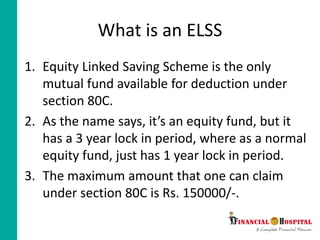
What is an ELSS
1. Equity Linked Saving Scheme is the only
mutual fund available for deduction under
section 80C.
2. As the name says, it’s an equity fund, but it
has a 3 year lock in period, where as a normal
equity fund, just has 1 year lock in period.
3. The maximum amount that one can claim
under section 80C is Rs. 150000/-.
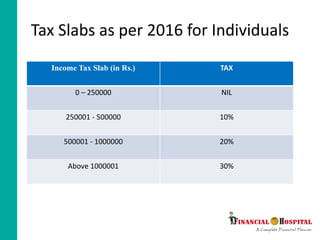
Tax Slabs as per 2016 for Individuals
Income Tax Slab (in Rs.) TAX
0 – 250000 NIL
250001 - 500000 10%
500001 - 1000000 20%
Above 1000001 30%
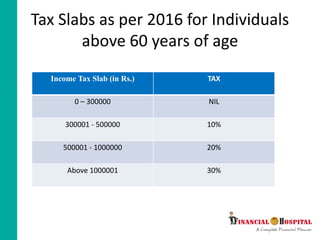
Tax Slabs as per 2016 for Individuals
above 60 years of age
Income Tax Slab (in Rs.) TAX
0 – 300000 NIL
300001 - 500000 10%
500001 - 1000000 20%
Above 1000001 30%
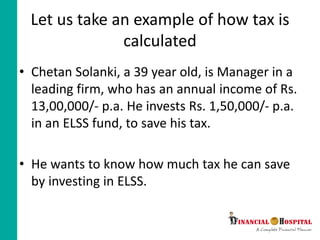
Let us take an example of how tax is
calculated
• Chetan Solanki, a 39 year old, is Manager in a
leading firm, who has an annual income of Rs.
13,00,000/- p.a. He invests Rs. 1,50,000/- p.a.
in an ELSS fund, to save his tax.
• He wants to know how much tax he can save
by investing in ELSS.
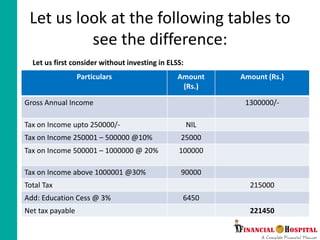
Let us look at the following tables to
see the difference:
Particulars Amount
(Rs.)
Amount (Rs.)
Gross Annual Income 1300000/-
Tax on Income upto 250000/- NIL
Tax on Income 250001 – 500000 @10% 25000
Tax on Income 500001 – 1000000 @ 20% 100000
Tax on Income above 1000001 @30% 90000
Total Tax 215000
Add: Education Cess @ 3% 6450
Net tax payable 221450
Let us first consider without investing in ELSS:
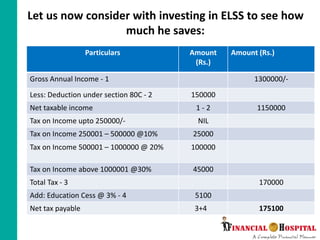
Let us now consider with investing in ELSS to see how
much he saves:
Particulars Amount
(Rs.)
Amount (Rs.)
Gross Annual Income - 1 1300000/-
Less: Deduction under section 80C - 2 150000
Net taxable income 1 - 2 1150000
Tax on Income upto 250000/- NIL
Tax on Income 250001 – 500000 @10% 25000
Tax on Income 500001 – 1000000 @ 20% 100000
Tax on Income above 1000001 @30% 45000
Total Tax - 3 170000
Add: Education Cess @ 3% - 4 5100
Net tax payable 3+4 175100
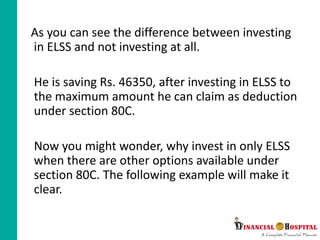
As you can see the difference between investing
in ELSS and not investing at all.
He is saving Rs. 46350, after investing in ELSS to
the maximum amount he can claim as deduction
under section 80C.
Now you might wonder, why invest in only ELSS
when there are other options available under
section 80C. The following example will make it
clear.
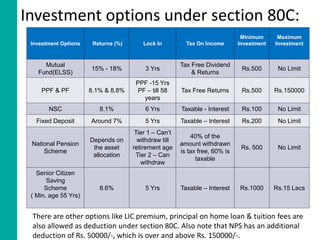
Investment options under section 80C:
Investment Options Returns (%) Lock In Tax On Income
Minimum
Investment
Maximum
Investment
Mutual
Fund(ELSS)
15% - 18% 3 Yrs
Tax Free Dividend
& Returns
Rs.500 No Limit
PPF & PF 8.1% & 8.8%
PPF -15 Yrs
PF – till 58
years
Tax Free Returns Rs.500 Rs.150000
NSC 8.1% 6 Yrs Taxable - Interest Rs.100 No Limit
Fixed Deposit Around 7% 5 Yrs Taxable – Interest Rs.200 No Limit
National Pension
Scheme
Depends on
the asset
allocation
Tier 1 – Can’t
withdraw till
retirement age
Tier 2 – Can
withdraw
40% of the
amount withdrawn
is tax free, 60% is
taxable
Rs. 500 No Limit
Senior Citizen
Saving
Scheme
( Min. age 55 Yrs)
8.6% 5 Yrs Taxable – Interest Rs.1000 Rs.15 Lacs
There are other options like LIC premium, principal on home loan & tuition fees are
also allowed as deduction under section 80C. Also note that NPS has an additional
deduction of Rs. 50000/-, which is over and above Rs. 150000/-.
• As you can see in the above table, that ELSS
has only a 3 year lock in compared to the
other investments.
• Also, ELSS is one of the investment options,
where the investment, interest and fund value
are exempt from tax, if held for 3 years.
• The returns on an ELSS fund are high, as
compared to the other investment options,
under section 80C.
Tax Free Investments
• Under section 80C, there are a few products
which have tax advantages over the other
investments.
• ELSS, ULIPs, PPF, EPF, these are some
investment options where everything is tax
free.
• The investment/premium, the interest earned
and the maturity amount, all are tax free.
Why ELSS, when you have other options
too?
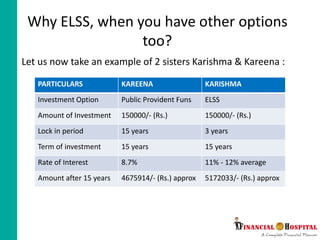
Let us now take an example of 2 sisters Karishma & Kareena :
PARTICULARS KAREENA KARISHMA
Investment Option Public Provident Funs ELSS
Amount of Investment 150000/- (Rs.) 150000/- (Rs.)
Lock in period 15 years 3 years
Term of investment 15 years 15 years
Rate of Interest 8.7% 11% - 12% average
Amount after 15 years 4675914/- (Rs.) approx 5172033/- (Rs.) approx
Please note that in the above ELSS calculation:
1. The amount of Rs. 150000/- p.a. is calculated only for 12
years, as each year’s investment has to complete 3 years.
2. The amount accumulated after 12 years, will grow for 3
years, without further investment.
3. So at the end of the 15th year, all your previous
investments will have completed 3 years (i.e. the lock in
period).
4. The average return taken is the minimum, whereas the
return goes up to 20% in 3 to 5 years.
CONCLUSION
ELSS is a good option to invest in as it is very
flexible as compared to the other investment
options. There is no restriction on
withdrawing the amount and also no penalty,
if you stop investing in the fund. It will not
only help you save tax but also help you
create a corpus, for your future goals.
Connect with us
https://www.facebook.com/financialhospital
https://twitter.com/finhospital
https://www.linkedin.com/company/financial-hospital
https://www.youtube.com/channel/UC2sNID0xPVX9T_z_7l5
7NQA
How To Save Tax Through ELSS

How To Save Tax Through ELSS

  • 1.
    How to savetax through ELSS
  • 2.
    What is anELSS 1. Equity Linked Saving Scheme is the only mutual fund available for deduction under section 80C. 2. As the name says, it’s an equity fund, but it has a 3 year lock in period, where as a normal equity fund, just has 1 year lock in period. 3. The maximum amount that one can claim under section 80C is Rs. 150000/-.
  • 3.
    Tax Slabs asper 2016 for Individuals Income Tax Slab (in Rs.) TAX 0 – 250000 NIL 250001 - 500000 10% 500001 - 1000000 20% Above 1000001 30%
  • 4.
    Tax Slabs asper 2016 for Individuals above 60 years of age Income Tax Slab (in Rs.) TAX 0 – 300000 NIL 300001 - 500000 10% 500001 - 1000000 20% Above 1000001 30%
  • 5.
    Let us takean example of how tax is calculated • Chetan Solanki, a 39 year old, is Manager in a leading firm, who has an annual income of Rs. 13,00,000/- p.a. He invests Rs. 1,50,000/- p.a. in an ELSS fund, to save his tax. • He wants to know how much tax he can save by investing in ELSS.
  • 6.
    Let us lookat the following tables to see the difference: Particulars Amount (Rs.) Amount (Rs.) Gross Annual Income 1300000/- Tax on Income upto 250000/- NIL Tax on Income 250001 – 500000 @10% 25000 Tax on Income 500001 – 1000000 @ 20% 100000 Tax on Income above 1000001 @30% 90000 Total Tax 215000 Add: Education Cess @ 3% 6450 Net tax payable 221450 Let us first consider without investing in ELSS:
  • 7.
    Let us nowconsider with investing in ELSS to see how much he saves: Particulars Amount (Rs.) Amount (Rs.) Gross Annual Income - 1 1300000/- Less: Deduction under section 80C - 2 150000 Net taxable income 1 - 2 1150000 Tax on Income upto 250000/- NIL Tax on Income 250001 – 500000 @10% 25000 Tax on Income 500001 – 1000000 @ 20% 100000 Tax on Income above 1000001 @30% 45000 Total Tax - 3 170000 Add: Education Cess @ 3% - 4 5100 Net tax payable 3+4 175100
  • 8.
    As you cansee the difference between investing in ELSS and not investing at all. He is saving Rs. 46350, after investing in ELSS to the maximum amount he can claim as deduction under section 80C. Now you might wonder, why invest in only ELSS when there are other options available under section 80C. The following example will make it clear.
  • 9.
    Investment options undersection 80C: Investment Options Returns (%) Lock In Tax On Income Minimum Investment Maximum Investment Mutual Fund(ELSS) 15% - 18% 3 Yrs Tax Free Dividend & Returns Rs.500 No Limit PPF & PF 8.1% & 8.8% PPF -15 Yrs PF – till 58 years Tax Free Returns Rs.500 Rs.150000 NSC 8.1% 6 Yrs Taxable - Interest Rs.100 No Limit Fixed Deposit Around 7% 5 Yrs Taxable – Interest Rs.200 No Limit National Pension Scheme Depends on the asset allocation Tier 1 – Can’t withdraw till retirement age Tier 2 – Can withdraw 40% of the amount withdrawn is tax free, 60% is taxable Rs. 500 No Limit Senior Citizen Saving Scheme ( Min. age 55 Yrs) 8.6% 5 Yrs Taxable – Interest Rs.1000 Rs.15 Lacs There are other options like LIC premium, principal on home loan & tuition fees are also allowed as deduction under section 80C. Also note that NPS has an additional deduction of Rs. 50000/-, which is over and above Rs. 150000/-.
  • 10.
    • As youcan see in the above table, that ELSS has only a 3 year lock in compared to the other investments. • Also, ELSS is one of the investment options, where the investment, interest and fund value are exempt from tax, if held for 3 years. • The returns on an ELSS fund are high, as compared to the other investment options, under section 80C.
  • 11.
    Tax Free Investments •Under section 80C, there are a few products which have tax advantages over the other investments. • ELSS, ULIPs, PPF, EPF, these are some investment options where everything is tax free. • The investment/premium, the interest earned and the maturity amount, all are tax free.
  • 12.
    Why ELSS, whenyou have other options too? Let us now take an example of 2 sisters Karishma & Kareena : PARTICULARS KAREENA KARISHMA Investment Option Public Provident Funs ELSS Amount of Investment 150000/- (Rs.) 150000/- (Rs.) Lock in period 15 years 3 years Term of investment 15 years 15 years Rate of Interest 8.7% 11% - 12% average Amount after 15 years 4675914/- (Rs.) approx 5172033/- (Rs.) approx
  • 13.
    Please note thatin the above ELSS calculation: 1. The amount of Rs. 150000/- p.a. is calculated only for 12 years, as each year’s investment has to complete 3 years. 2. The amount accumulated after 12 years, will grow for 3 years, without further investment. 3. So at the end of the 15th year, all your previous investments will have completed 3 years (i.e. the lock in period). 4. The average return taken is the minimum, whereas the return goes up to 20% in 3 to 5 years.
  • 14.
    CONCLUSION ELSS is agood option to invest in as it is very flexible as compared to the other investment options. There is no restriction on withdrawing the amount and also no penalty, if you stop investing in the fund. It will not only help you save tax but also help you create a corpus, for your future goals.
  • 15.