Financial Planning
What is Financial Planning?
     Financial Planning is an exercise aimed at
identifying all the financial needs of an individual
and translating these needs into monetarily
measurable goals at different times in the future.
Financial Planning ensures that right amount of
money is available in the right hands at the right
time in the future to achieve an individual’s financial
goals
Objectives Of Financial Planning
• Identifying the requirement for money for different purposes
  and prioritising them

• Converting these requirements into specific needs, in terms of
  money, and the time when it is required

• Taking stock of the investors’ current financial position to
  ascertain their net worth and net income / expenses

• Planning savings and investments in a manner that would
  enable the investors to achieve their pre-determined goals

• Optimising returns through adequate diversification in sync
  with the investors’ risk – return frame work
Why do we need Financial Planning?
 To fund our future needs through right mix of investments

 To protect our future from unforeseen contingencies

 To maintain the same standard of living even after retirement

 To enable risk management through diversification

 To choose assets commensurate with the investors’ life and wealth
  stages

 To beat the ravages of inflation
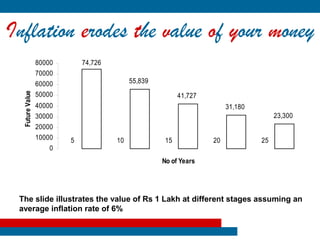
Inflation erodes the value of your money
                 80000       74,726
                 70000
                 60000                     55,839
                 50000
  Future Value


                                                          41,727
                 40000                                                  31,180
                 30000                                                                23,300
                 20000
                 10000   5            10             15            20            25
                     0
                                                    No of Years


 The slide illustrates the value of Rs 1 Lakh at different stages assuming an
 average inflation rate of 6%
Can you do your own Financial Planning?
•   Will your family be financially secure in the event of your unfortunate
    illness / demise?

•   Will the stream of cash flows arising from your asset holdings be sufficient
    to match the expected liability structure?

•   Are your finances inherently tax efficient?

•   Have you made adequate provisions for your children’s education and
    marriage?

•   Are you confident enough to enjoy your post-retirement life?


    If your answer is NO to any one or all of the above questions, you
    need a specialist to handle your finances...
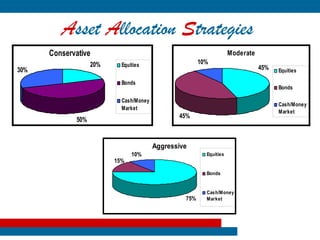
Asset Allocation Strategies
      Conservative                                                  Moderate
                   20%     Equities                    10%
30%                                                                            45%   Equities

                           Bonds
                                                                                     Bonds

                           Cash/Money
                                                                                     Cash/Money
                           Market
                                                                                     Market
                                               45%
             50%


                                        Aggressive
                               10%                       Equities
                         15%

                                                         Bonds


                                                         Cash/Money
                                                 75%     Market
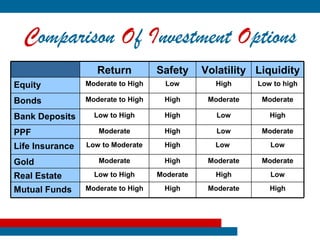
Comparison Of Investment Options
                    Return          Safety     Volatility Liquidity
Equity           Moderate to High     Low         High     Low to high

Bonds            Moderate to High    High       Moderate    Moderate

Bank Deposits      Low to High       High         Low         High

PPF                 Moderate         High         Low       Moderate

Life Insurance   Low to Moderate     High        Low          Low

Gold                Moderate         High       Moderate    Moderate

Real Estate        Low to High      Moderate      High        Low

Mutual Funds     Moderate to High    High       Moderate      High
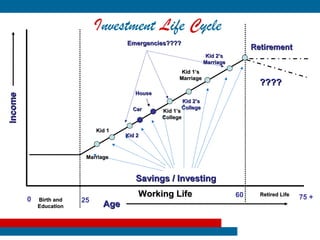
Investment Life Cycle
                                      Emergencies????
                                                                                  Retirement
                                                                   Kid 2’s
                                                                  Marriage
                                                        Kid 1’s
                                                       Marriage
                                                                                    ????
                                         House
Income


                                                        Kid 2’s
                                        Car             College
                                                 Kid 1’s
                                                 College

                              Kid 1
                                      Kid 2


                          Marriage


                                         Savings / Investing
                                          Working Life                       60     Retired Life
                                                                                                   75 +
         0   Birth and   25
             Education          Age
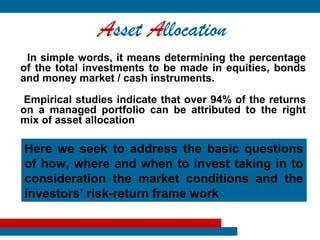
Asset Allocation
 In simple words, it means determining the percentage
of the total investments to be made in equities, bonds
and money market / cash instruments.

 Empirical studies indicate that over 94% of the returns
on a managed portfolio can be attributed to the right
mix of asset allocation

Here we seek to address the basic questions
of how, where and when to invest taking in to
consideration the market conditions and the
investors’ risk-return frame work
Wealth Creation Stage
                          Financial Goals
                          Planning to purchase a house in
                          the next ten years

                          Creating long-term wealth for
                          retirement / house
                          Aggressive Growth Portfolio

                                  Cash
                                  10%               Bonds
                                                     15%


Age – Up to 30 Years   Equity
                        75%
Wealth Management Stage
                             Financial Goals
                             Providing for children’s education
                             (5 - 8 years)

                             Planning for children’s marriage
                             (15 - 20 years)

                             Planning for retirement
                             Balanced Portfolio
                                                    Cash
                                                    20%


                        Equity                             Bonds
 Age – 30 to 55 Years                                       30%
                         50%
Wealth Preservation Stage
                                   Financial Goals
                                   Making      provisions for
                                   higher life expectancy,
                                   medical emergencies and
                                   financial independence
                                   Conservative Portfolio

                                                          Bank
                                   Equity                Deposits
                                    20%                   40%


                           Bonds
  Age – 55 Years & Above    40%
Concept of Mutual Funds

 Mutual Fund is an instrument where a number of
investors contribute to form a common pool of
money. This pool of money is invested in
accordance with a pre-determined objective. The
ownership of the fund is thus joint or “Mutual” and
the fund belongs to all the investors in the same
proportion as the amount of contribution made by
each one of them
Why Mutual Funds?
•   Mutual Funds provide the services of experienced and skilled
    professionals backed by a dedicated research team

•   They enable efficient risk management by diversifying across a wide
    variety of sectors and companies

•   They are less expensive vis-à-vis direct investment in equities as they
    seek to reap the benefits of economies of scale

•   Performance and other investment details of individual schemes are
    disclosed on a regular basis

•   Mutual funds facilitate investment of small amounts in a number of
    schemes to suit the investors’ risk - return framework
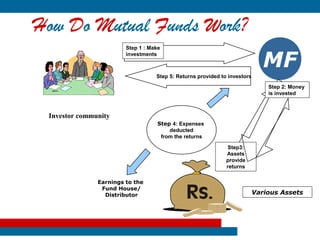
How Do Mutual Funds Work?
                        Step 1 : Make


                                                                              MF
                        investments


                                   Step 5: Returns provided to investors
                                                                               Step 2: Money
                                                                               is invested


 Investor community
                                    Step 4: Expenses
                                        deducted
                                     from the returns

                                                              Step3:
                                                              Assets
                                                              provide
                                                              returns

               Earnings to the
                Fund House/
                 Distributor                                               Various Assets
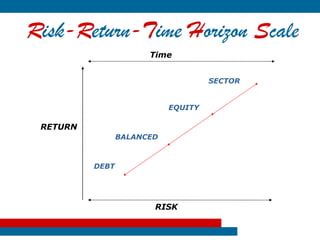
Risk-Return-Time Horizon Scale
                       Time


                                     SECTOR


                            EQUITY

 RETURN
                 BALANCED


          DEBT


                        RISK
Systematic Investment Plan (SIP)

       The Smart Investors’ Preference
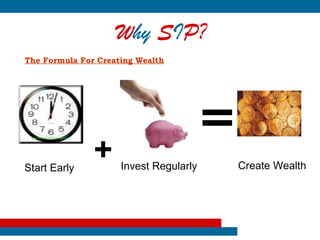
Why SIP?
The Formula For Creating Wealth


Start Early
               +     Invest Regularly   Create Wealth
Myth : Timing is essential to generate high returns
Reality: It is the time and not the timing that matters


        Is it worth the risk or the tension?
      Who can time the market to perfection?
              Not even the experts can !!
It is the small drops that make an ocean!!


We earn regularly; We spend
          regularly
 Shouldn’t we also invest
         regularly?
What Is Systematic Investing?
• It simply means investing ‘Fixed Amount’ every
  month

• A method of investing regularly to benefit from the
  stock market volatility

• The first step that may take you a long way towards
  achieving your financial goals and objectives…
Why Should One Invest Systematically?
• To imbibe financial discipline

• To eliminate the need to time the markets

• To successfully achieve the financial goals
  and objectives

• To harness the power of compounding by
  investing with a long term perspective
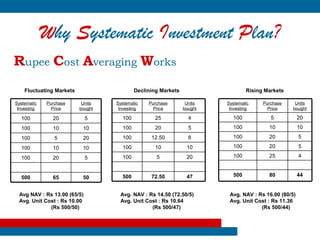
Why Systematic Investment Plan?
Rupee Cost Averaging Works
    Fluctuating Markets                    Declining Markets                    Rising Markets

Systematic   Purchase      Units   Systematic   Purchase        Units   Systematic    Purchase     Units
 Investing     Price      bought    Investing     Price        bought    Investing      Price     bought

  100          20            5       100          25             4        100            5            20
  100          10          10        100          20             5        100           10            10

  100           5          20        100         12.50           8        100           20            5

  100          10          10        100          10            10        100           20            5

  100          20            5       100           5            20        100           25            4


  500          65          50        500         72.50          47        500           80            44


 Avg NAV : Rs 13.00 (65/5)          Avg. NAV : Rs 14.50 (72.50/5)        Avg. NAV : Rs 16.00 (80/5)
 Avg. Unit Cost : Rs 10.00          Avg. Unit Cost : Rs 10.64            Avg. Unit Cost : Rs 11.36
             (Rs 500/50)                        (Rs 500/47)                          (Rs 500/44)
Power Of Compounding
“ The most powerful force in the universe is the power of
  compounding “
                                             -Albert Einstein


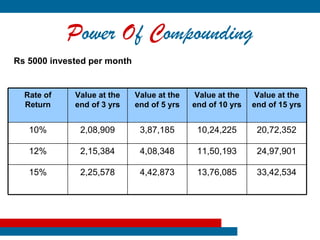
  If you invest Rs 1000 for 50 years at 10% returns p.a., you would
  receive Rs 100 every year for 50 years. So WITHOUT any
  compounding you would have Rs 6000 (initial investment Rs
  1000 + interest for 50 years Rs 5000) at the end of 50 years.
  However WITH compounding, the same Rs 1000 at 10% returns
  p.a. would mount up to Rs 1,17,391 at the end of 50 years
Power Of Compounding
Rs 5000 invested per month


  Rate of    Value at the    Value at the   Value at the    Value at the
  Return     end of 3 yrs    end of 5 yrs   end of 10 yrs   end of 15 yrs


   10%        2,08,909        3,87,185       10,24,225       20,72,352

   12%        2,15,384        4,08,348       11,50,193       24,97,901

   15%        2,25,578        4,42,873       13,76,085       33,42,534
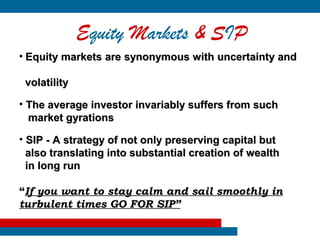
Equity Markets & SIP
•   Equity markets are synonymous with uncertainty and

    volatility

• The average investor invariably suffers from such
  market gyrations

• SIP - A strategy of not only preserving capital but
  also translating into substantial creation of wealth
  in long run

“If you want to stay calm and sail smoothly in
turbulent times GO FOR SIP”
Financial Planning Through Insurance
   “Insurance is not for the one who passes away, it is for those
    who survive”

                                                    - Anonymous
Why do we need Insurance?
• To ensure adequate coverage and protection against the risks
  and uncertainties of life

• To ensure a decent standard of living to the dependants in the
  event of unexpected demise of the bread winner

• To provide a feeling of security and financial support during
  critical hours and periods of crisis in life

• Reduced mortality rates, increased life expectancy and rising
  medical and hospitalisation expenses

• Emergence of nuclear family system – reduced dependency on
  other family members
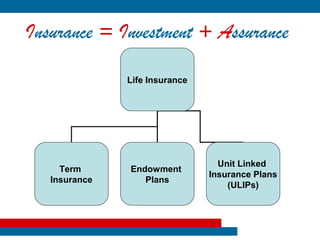
Insurance = Investment + Assurance

               Life Insurance


                                  Unit Linked
     Term      Endowment
                                Insurance Plans
   Insurance      Plans
                                    (ULIPs)
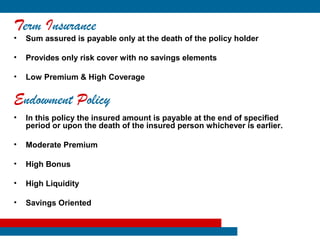
Term Insurance
•   Sum assured is payable only at the death of the policy holder

•   Provides only risk cover with no savings elements

•   Low Premium & High Coverage


Endowment Policy
•   In this policy the insured amount is payable at the end of specified
    period or upon the death of the insured person whichever is earlier.

•   Moderate Premium

•   High Bonus

•   High Liquidity

•   Savings Oriented
Unit Linked Insurance Plans
A policy, which provides for life insurance where the policy value at any time
varies according to the value of the underlying assets at the time. Investors can
also take a SIP route of investment. ULIP distinguishes itself through the
multiple benefits that it provides to the consumer. The plan is a one-stop
solution providing:
    • Investment and Savings
    • Life protection
    • Flexibility
    • Adjustable Life Cover
    • Tax benefit (as per Section 80C of Income Tax Act)
    • Transparency


    •   Options to take additional cover against
         - Death due to accident
         - Disability
         - Critical Illness
         - Surgeries
Insurance – Buy a policy, buy peace of mind

                   General
                  Insurance


       Health      Vehicle      Property
     Insurance    Insurance    Insurance
Need for Health Insurance
• Reduced human mortality rates and increasing life spans due to
  advancements in medical science

• Rising hospitalisation and medication expenses

• Compensates the loss of income to              the   family   due   to
  accident/disability to the earning member

Vehicle & Property Insurance
• Covers the risk of loss/damage to your movable and immovable
  assets

• Also provides adequate coverage to any financial liability arising
  from the risk of loss/damage to the life and property of third parties
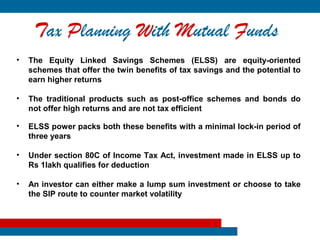
Tax Planning With Mutual Funds
•   The Equity Linked Savings Schemes (ELSS) are equity-oriented
    schemes that offer the twin benefits of tax savings and the potential to
    earn higher returns

•   The traditional products such as post-office schemes and bonds do
    not offer high returns and are not tax efficient

•   ELSS power packs both these benefits with a minimal lock-in period of
    three years

•   Under section 80C of Income Tax Act, investment made in ELSS up to
    Rs 1lakh qualifies for deduction

•   An investor can either make a lump sum investment or choose to take
    the SIP route to counter market volatility
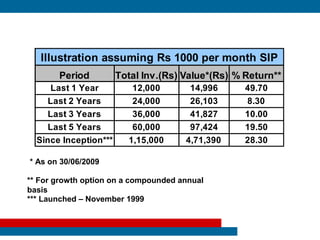
Illustration assuming Rs 1000 per month SIP
       Period          Total Inv.(Rs) Value*(Rs) % Return**
      Last 1 Year         12,000       14,996      49.70
     Last 2 Years         24,000       26,103      8.30
     Last 3 Years         36,000       41,827      10.00
     Last 5 Years         60,000       97,424      19.50
  Since Inception***     1,15,000     4,71,390     28.30

* As on 30/06/2009

** For growth option on a compounded annual
basis
*** Launched – November 1999
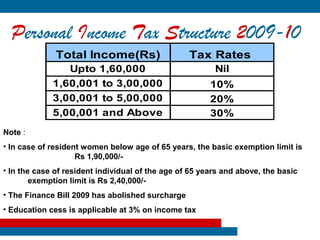
Personal Income Tax Structure 2009-10
              Total Income(Rs)                    Tax Rates
                Upto 1,60,000                            Nil
             1,60,001 to 3,00,000                       10%
             3,00,001 to 5,00,000                       20%
             5,00,001 and Above                         30%
Note :
• In case of resident women below age of 65 years, the basic exemption limit is
                    Rs 1,90,000/-
• In the case of resident individual of the age of 65 years and above, the basic
        exemption limit is Rs 2,40,000/-
• The Finance Bill 2009 has abolished surcharge
• Education cess is applicable at 3% on income tax
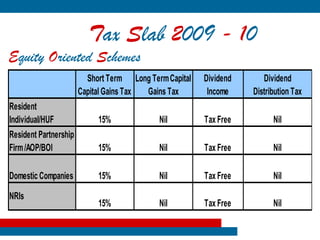
Tax Slab 2009 - 10
Equity Oriented Schemes
                         Short Term Long Term Capital   Dividend      Dividend
                       Capital Gains Tax Gains Tax       Income    Distribution Tax
Resident
Individual/HUF              15%             Nil         Tax Free         Nil
Resident Partnership
Firm /AOP/BOI               15%             Nil         Tax Free         Nil

Domestic Companies          15%             Nil         Tax Free         Nil

NRIs
                            15%             Nil         Tax Free         Nil
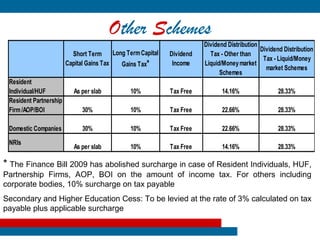
Other Schemes
                                                                         Dividend Distribution
                                                                                               Dividend Distribution
                          Short Term      Long Term Capital   Dividend     Tax - Other than
                                                                                                Tax - Liquid/Money
                        Capital Gains Tax    Gains Tax*        Income    Liquid/Money market
                                                                                                 market Schemes
                                                                               Schemes
 Resident
 Individual/HUF            As per slab          10%           Tax Free          14.16%                28.33%
 Resident Partnership
 Firm /AOP/BOI                30%               10%           Tax Free          22.66%                28.33%

 Domestic Companies           30%               10%           Tax Free          22.66%                28.33%
 NRIs
                           As per slab          10%           Tax Free          14.16%                28.33%

* The Finance Bill 2009 has abolished surcharge in case of Resident Individuals, HUF,
Partnership Firms, AOP, BOI on the amount of income tax. For others including
corporate bodies, 10% surcharge on tax payable
Secondary and Higher Education Cess: To be levied at the rate of 3% calculated on tax
payable plus applicable surcharge
Bank FDs vs. Debt Funds
 Investors in higher tax brackets are better off investing in debt funds as
against bank FDs as debt funds are inherently more tax efficient


  For example consider an investor in the highest tax bracket. Interest from
his investment in bank FDs would attract the maximum marginal tax rate
(inclusive of cess – 30.90%) applicable to him. If a one year bank FD fetches
around 10%(pre-tax), his post-tax returns would be a meager 6.91%


  As opposed to this, if he had invested in a short term debt fund (dividend
option) which also delivers close to 10% average annualized returns (over 1
year period) and distributes it among the unit-holders in the form of
dividends. The dividend income will be tax-free in his hands but the mutual
fund will be paying a dividend distribution tax of 14.16% (which is indirectly
borne by the investor). So he will be getting a net effective return of 8.58%
p.a. which is much higher as compared to the post tax returns on FDs
However, if the investor invests in a debt fund with growth
option, then the tax treatment becomes slightly different. For
example, let’s assume he invests in an Bond Fund for two years.
Appreciation in the NAV of a debt fund is treated as capital gains.
Now, at the time of redemption, returns from debt funds are
taxed as Long Term Capital Gains (LTCG) if invested for more
than a year. Now, based on the option he chooses, LTCG is either
taxed @ 11.33% without indexation or 22.66% with indexation.
Both the options are certainly better than the tax treatment of
FDs where he pays tax at the rate applicable to his marginal
income

  Moreover, just by investing for a little over 12 months in debt
funds at the end of the financial year, one can reap double
indexation benefits thereby further reducing his/her tax liability
Put simply, for similar pre-tax returns, debt funds provide better
post tax returns as compared to FDs. Moreover, no TDS is
deducted by mutual funds in case of resident individuals
Golden Rules Of Investing
• Invest early, regularly and systematically for a longer period

• Ensure adequate liquidity for contingencies of life

• Ensure adequate diversification by investing across asset
  classes and time horizons

• Do not attempt to time the market. Patience is the key

• Be realistic in expectations of returns

• Balance investments in accordance with your risk-return
  framework
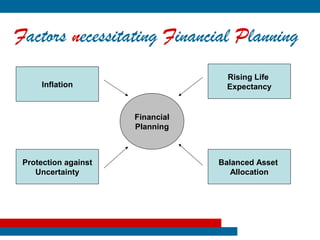
Factors necessitating Financial Planning
                                    Rising Life
     Inflation                      Expectancy


                      Financial
                      Planning


 Protection against               Balanced Asset
    Uncertainty                      Allocation
Thank
You..
PPT
   By
Aaryendr

Financial planning

  • 1.
  • 2.
    What is FinancialPlanning? Financial Planning is an exercise aimed at identifying all the financial needs of an individual and translating these needs into monetarily measurable goals at different times in the future. Financial Planning ensures that right amount of money is available in the right hands at the right time in the future to achieve an individual’s financial goals
  • 3.
    Objectives Of FinancialPlanning • Identifying the requirement for money for different purposes and prioritising them • Converting these requirements into specific needs, in terms of money, and the time when it is required • Taking stock of the investors’ current financial position to ascertain their net worth and net income / expenses • Planning savings and investments in a manner that would enable the investors to achieve their pre-determined goals • Optimising returns through adequate diversification in sync with the investors’ risk – return frame work
  • 4.
    Why do weneed Financial Planning?  To fund our future needs through right mix of investments  To protect our future from unforeseen contingencies  To maintain the same standard of living even after retirement  To enable risk management through diversification  To choose assets commensurate with the investors’ life and wealth stages  To beat the ravages of inflation
  • 5.
    Inflation erodes thevalue of your money 80000 74,726 70000 60000 55,839 50000 Future Value 41,727 40000 31,180 30000 23,300 20000 10000 5 10 15 20 25 0 No of Years The slide illustrates the value of Rs 1 Lakh at different stages assuming an average inflation rate of 6%
  • 6.
    Can you doyour own Financial Planning? • Will your family be financially secure in the event of your unfortunate illness / demise? • Will the stream of cash flows arising from your asset holdings be sufficient to match the expected liability structure? • Are your finances inherently tax efficient? • Have you made adequate provisions for your children’s education and marriage? • Are you confident enough to enjoy your post-retirement life? If your answer is NO to any one or all of the above questions, you need a specialist to handle your finances...
  • 7.
    Asset Allocation Strategies Conservative Moderate 20% Equities 10% 30% 45% Equities Bonds Bonds Cash/Money Cash/Money Market Market 45% 50% Aggressive 10% Equities 15% Bonds Cash/Money 75% Market
  • 8.
    Comparison Of InvestmentOptions Return Safety Volatility Liquidity Equity Moderate to High Low High Low to high Bonds Moderate to High High Moderate Moderate Bank Deposits Low to High High Low High PPF Moderate High Low Moderate Life Insurance Low to Moderate High Low Low Gold Moderate High Moderate Moderate Real Estate Low to High Moderate High Low Mutual Funds Moderate to High High Moderate High
  • 9.
    Investment Life Cycle Emergencies???? Retirement Kid 2’s Marriage Kid 1’s Marriage ???? House Income Kid 2’s Car College Kid 1’s College Kid 1 Kid 2 Marriage Savings / Investing Working Life 60 Retired Life 75 + 0 Birth and 25 Education Age
  • 10.
    Asset Allocation Insimple words, it means determining the percentage of the total investments to be made in equities, bonds and money market / cash instruments. Empirical studies indicate that over 94% of the returns on a managed portfolio can be attributed to the right mix of asset allocation Here we seek to address the basic questions of how, where and when to invest taking in to consideration the market conditions and the investors’ risk-return frame work
  • 11.
    Wealth Creation Stage Financial Goals Planning to purchase a house in the next ten years Creating long-term wealth for retirement / house Aggressive Growth Portfolio Cash 10% Bonds 15% Age – Up to 30 Years Equity 75%
  • 12.
    Wealth Management Stage Financial Goals Providing for children’s education (5 - 8 years) Planning for children’s marriage (15 - 20 years) Planning for retirement Balanced Portfolio Cash 20% Equity Bonds Age – 30 to 55 Years 30% 50%
  • 13.
    Wealth Preservation Stage Financial Goals Making provisions for higher life expectancy, medical emergencies and financial independence Conservative Portfolio Bank Equity Deposits 20% 40% Bonds Age – 55 Years & Above 40%
  • 14.
    Concept of MutualFunds Mutual Fund is an instrument where a number of investors contribute to form a common pool of money. This pool of money is invested in accordance with a pre-determined objective. The ownership of the fund is thus joint or “Mutual” and the fund belongs to all the investors in the same proportion as the amount of contribution made by each one of them
  • 15.
    Why Mutual Funds? • Mutual Funds provide the services of experienced and skilled professionals backed by a dedicated research team • They enable efficient risk management by diversifying across a wide variety of sectors and companies • They are less expensive vis-à-vis direct investment in equities as they seek to reap the benefits of economies of scale • Performance and other investment details of individual schemes are disclosed on a regular basis • Mutual funds facilitate investment of small amounts in a number of schemes to suit the investors’ risk - return framework
  • 16.
    How Do MutualFunds Work? Step 1 : Make MF investments Step 5: Returns provided to investors Step 2: Money is invested Investor community Step 4: Expenses deducted from the returns Step3: Assets provide returns Earnings to the Fund House/ Distributor Various Assets
  • 17.
    Risk-Return-Time Horizon Scale Time SECTOR EQUITY RETURN BALANCED DEBT RISK
  • 18.
    Systematic Investment Plan(SIP) The Smart Investors’ Preference
  • 19.
    Why SIP? The FormulaFor Creating Wealth Start Early + Invest Regularly Create Wealth
  • 20.
    Myth : Timingis essential to generate high returns Reality: It is the time and not the timing that matters Is it worth the risk or the tension? Who can time the market to perfection? Not even the experts can !!
  • 21.
    It is thesmall drops that make an ocean!! We earn regularly; We spend regularly Shouldn’t we also invest regularly?
  • 22.
    What Is SystematicInvesting? • It simply means investing ‘Fixed Amount’ every month • A method of investing regularly to benefit from the stock market volatility • The first step that may take you a long way towards achieving your financial goals and objectives…
  • 23.
    Why Should OneInvest Systematically? • To imbibe financial discipline • To eliminate the need to time the markets • To successfully achieve the financial goals and objectives • To harness the power of compounding by investing with a long term perspective
  • 24.
    Why Systematic InvestmentPlan? Rupee Cost Averaging Works Fluctuating Markets Declining Markets Rising Markets Systematic Purchase Units Systematic Purchase Units Systematic Purchase Units Investing Price bought Investing Price bought Investing Price bought 100 20 5 100 25 4 100 5 20 100 10 10 100 20 5 100 10 10 100 5 20 100 12.50 8 100 20 5 100 10 10 100 10 10 100 20 5 100 20 5 100 5 20 100 25 4 500 65 50 500 72.50 47 500 80 44 Avg NAV : Rs 13.00 (65/5) Avg. NAV : Rs 14.50 (72.50/5) Avg. NAV : Rs 16.00 (80/5) Avg. Unit Cost : Rs 10.00 Avg. Unit Cost : Rs 10.64 Avg. Unit Cost : Rs 11.36 (Rs 500/50) (Rs 500/47) (Rs 500/44)
  • 25.
    Power Of Compounding “The most powerful force in the universe is the power of compounding “ -Albert Einstein If you invest Rs 1000 for 50 years at 10% returns p.a., you would receive Rs 100 every year for 50 years. So WITHOUT any compounding you would have Rs 6000 (initial investment Rs 1000 + interest for 50 years Rs 5000) at the end of 50 years. However WITH compounding, the same Rs 1000 at 10% returns p.a. would mount up to Rs 1,17,391 at the end of 50 years
  • 26.
    Power Of Compounding Rs5000 invested per month Rate of Value at the Value at the Value at the Value at the Return end of 3 yrs end of 5 yrs end of 10 yrs end of 15 yrs 10% 2,08,909 3,87,185 10,24,225 20,72,352 12% 2,15,384 4,08,348 11,50,193 24,97,901 15% 2,25,578 4,42,873 13,76,085 33,42,534
  • 27.
    Equity Markets &SIP • Equity markets are synonymous with uncertainty and volatility • The average investor invariably suffers from such market gyrations • SIP - A strategy of not only preserving capital but also translating into substantial creation of wealth in long run “If you want to stay calm and sail smoothly in turbulent times GO FOR SIP”
  • 28.
    Financial Planning ThroughInsurance “Insurance is not for the one who passes away, it is for those who survive” - Anonymous
  • 29.
    Why do weneed Insurance? • To ensure adequate coverage and protection against the risks and uncertainties of life • To ensure a decent standard of living to the dependants in the event of unexpected demise of the bread winner • To provide a feeling of security and financial support during critical hours and periods of crisis in life • Reduced mortality rates, increased life expectancy and rising medical and hospitalisation expenses • Emergence of nuclear family system – reduced dependency on other family members
  • 30.
    Insurance = Investment+ Assurance Life Insurance Unit Linked Term Endowment Insurance Plans Insurance Plans (ULIPs)
  • 31.
    Term Insurance • Sum assured is payable only at the death of the policy holder • Provides only risk cover with no savings elements • Low Premium & High Coverage Endowment Policy • In this policy the insured amount is payable at the end of specified period or upon the death of the insured person whichever is earlier. • Moderate Premium • High Bonus • High Liquidity • Savings Oriented
  • 32.
    Unit Linked InsurancePlans A policy, which provides for life insurance where the policy value at any time varies according to the value of the underlying assets at the time. Investors can also take a SIP route of investment. ULIP distinguishes itself through the multiple benefits that it provides to the consumer. The plan is a one-stop solution providing: • Investment and Savings • Life protection • Flexibility • Adjustable Life Cover • Tax benefit (as per Section 80C of Income Tax Act) • Transparency • Options to take additional cover against - Death due to accident - Disability - Critical Illness - Surgeries
  • 33.
    Insurance – Buya policy, buy peace of mind General Insurance Health Vehicle Property Insurance Insurance Insurance
  • 34.
    Need for HealthInsurance • Reduced human mortality rates and increasing life spans due to advancements in medical science • Rising hospitalisation and medication expenses • Compensates the loss of income to the family due to accident/disability to the earning member Vehicle & Property Insurance • Covers the risk of loss/damage to your movable and immovable assets • Also provides adequate coverage to any financial liability arising from the risk of loss/damage to the life and property of third parties
  • 35.
    Tax Planning WithMutual Funds • The Equity Linked Savings Schemes (ELSS) are equity-oriented schemes that offer the twin benefits of tax savings and the potential to earn higher returns • The traditional products such as post-office schemes and bonds do not offer high returns and are not tax efficient • ELSS power packs both these benefits with a minimal lock-in period of three years • Under section 80C of Income Tax Act, investment made in ELSS up to Rs 1lakh qualifies for deduction • An investor can either make a lump sum investment or choose to take the SIP route to counter market volatility
  • 36.
    Illustration assuming Rs1000 per month SIP Period Total Inv.(Rs) Value*(Rs) % Return** Last 1 Year 12,000 14,996 49.70 Last 2 Years 24,000 26,103 8.30 Last 3 Years 36,000 41,827 10.00 Last 5 Years 60,000 97,424 19.50 Since Inception*** 1,15,000 4,71,390 28.30 * As on 30/06/2009 ** For growth option on a compounded annual basis *** Launched – November 1999
  • 37.
    Personal Income TaxStructure 2009-10 Total Income(Rs) Tax Rates Upto 1,60,000 Nil 1,60,001 to 3,00,000 10% 3,00,001 to 5,00,000 20% 5,00,001 and Above 30% Note : • In case of resident women below age of 65 years, the basic exemption limit is Rs 1,90,000/- • In the case of resident individual of the age of 65 years and above, the basic exemption limit is Rs 2,40,000/- • The Finance Bill 2009 has abolished surcharge • Education cess is applicable at 3% on income tax
  • 38.
    Tax Slab 2009- 10 Equity Oriented Schemes Short Term Long Term Capital Dividend Dividend Capital Gains Tax Gains Tax Income Distribution Tax Resident Individual/HUF 15% Nil Tax Free Nil Resident Partnership Firm /AOP/BOI 15% Nil Tax Free Nil Domestic Companies 15% Nil Tax Free Nil NRIs 15% Nil Tax Free Nil
  • 39.
    Other Schemes Dividend Distribution Dividend Distribution Short Term Long Term Capital Dividend Tax - Other than Tax - Liquid/Money Capital Gains Tax Gains Tax* Income Liquid/Money market market Schemes Schemes Resident Individual/HUF As per slab 10% Tax Free 14.16% 28.33% Resident Partnership Firm /AOP/BOI 30% 10% Tax Free 22.66% 28.33% Domestic Companies 30% 10% Tax Free 22.66% 28.33% NRIs As per slab 10% Tax Free 14.16% 28.33% * The Finance Bill 2009 has abolished surcharge in case of Resident Individuals, HUF, Partnership Firms, AOP, BOI on the amount of income tax. For others including corporate bodies, 10% surcharge on tax payable Secondary and Higher Education Cess: To be levied at the rate of 3% calculated on tax payable plus applicable surcharge
  • 40.
    Bank FDs vs.Debt Funds Investors in higher tax brackets are better off investing in debt funds as against bank FDs as debt funds are inherently more tax efficient For example consider an investor in the highest tax bracket. Interest from his investment in bank FDs would attract the maximum marginal tax rate (inclusive of cess – 30.90%) applicable to him. If a one year bank FD fetches around 10%(pre-tax), his post-tax returns would be a meager 6.91% As opposed to this, if he had invested in a short term debt fund (dividend option) which also delivers close to 10% average annualized returns (over 1 year period) and distributes it among the unit-holders in the form of dividends. The dividend income will be tax-free in his hands but the mutual fund will be paying a dividend distribution tax of 14.16% (which is indirectly borne by the investor). So he will be getting a net effective return of 8.58% p.a. which is much higher as compared to the post tax returns on FDs
  • 41.
    However, if theinvestor invests in a debt fund with growth option, then the tax treatment becomes slightly different. For example, let’s assume he invests in an Bond Fund for two years. Appreciation in the NAV of a debt fund is treated as capital gains. Now, at the time of redemption, returns from debt funds are taxed as Long Term Capital Gains (LTCG) if invested for more than a year. Now, based on the option he chooses, LTCG is either taxed @ 11.33% without indexation or 22.66% with indexation. Both the options are certainly better than the tax treatment of FDs where he pays tax at the rate applicable to his marginal income Moreover, just by investing for a little over 12 months in debt funds at the end of the financial year, one can reap double indexation benefits thereby further reducing his/her tax liability Put simply, for similar pre-tax returns, debt funds provide better post tax returns as compared to FDs. Moreover, no TDS is deducted by mutual funds in case of resident individuals
  • 42.
    Golden Rules OfInvesting • Invest early, regularly and systematically for a longer period • Ensure adequate liquidity for contingencies of life • Ensure adequate diversification by investing across asset classes and time horizons • Do not attempt to time the market. Patience is the key • Be realistic in expectations of returns • Balance investments in accordance with your risk-return framework
  • 43.
    Factors necessitating FinancialPlanning Rising Life Inflation Expectancy Financial Planning Protection against Balanced Asset Uncertainty Allocation
  • 44.
  • 45.
    PPT By Aaryendr