Debt instruments
By:-
Sowmya reddy &
Ch.swetha
BONDS:-
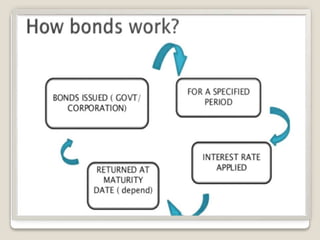
“A bond is a debt investment in which an
investor loans money to an entity which
borrows the funds for a definite period of
time at a variable or fixed interest rate”.
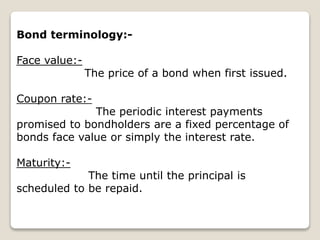
Bond terminology:-
Face value:-
The price of a bond when first issued.
Coupon rate:-
The periodic interest payments
promised to bondholders are a fixed percentage of
bonds face value or simply the interest rate.
Maturity:-
The time until the principal is
scheduled to be repaid.
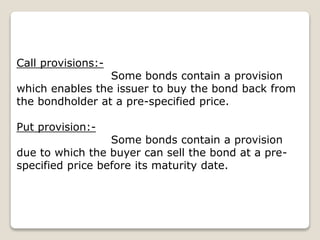
Call provisions:-
Some bonds contain a provision
which enables the issuer to buy the bond back from
the bondholder at a pre-specified price.
Put provision:-
Some bonds contain a provision
due to which the buyer can sell the bond at a pre-
specified price before its maturity date.
Bond issuers:-
There are 3 main categories of bonds:-
1) Corporate bonds are issued by companies. They
are high risk than government bonds.
2) Municipal bonds are issued by states and
municipalities. They can offer tax-free coupon
income for residents of those municipalities.
3) U.S. Treasury bonds (more than1-10years to
maturity),where as bills ( less than 1year
maturity) are collectively refered to as simply
“Treasuries”.
Varieties of bonds:-
Convertible bonds:-
These bonds can be converted
into a certain number of shares of the same
company at some fixed ratio in a particular date.
Callable bonds:-
It contains a provision that gives
the issuer the right to call back the bond before its
maturity date.
Secured bonds:-
These have specific assets of the
issuer pledged as collateral for the bond. It can be
issued by real estate or other assets.
Unsecured bonds:-
These bonds are not backed by any
specific asset of issuer. More easily issued by a
company that is financially sound.
Government bonds:-
It issued by govt. in its own
currency. When issued in foreign currency then it a
referred as sovereign bonds.
Term bonds:-
It will mature at a single specified
future date.
Serial bonds:-
Bonds that mature in installments.
Extendible and retractable bonds:-
These bonds have no fixed
maturity date. It can be extended on demand of buyer while in
retractable the date can be reduced.
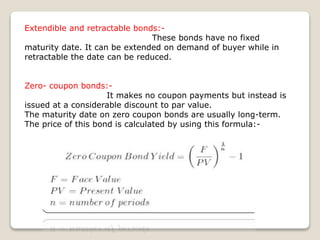
Zero- coupon bonds:-
It makes no coupon payments but instead is
issued at a considerable discount to par value.
The maturity date on zero coupon bonds are usually long-term.
The price of this bond is calculated by using this formula:-
Floating rate bonds:-
Bonds whose interest amount fluctuates in
step with the market interest rates, or some other external
measures.
The prices remains relatively stable because neither a capital
gain nor a capital loss occurs as market interest rates go up or
down.
Plain vanilla bonds:-
It is a standard type of bonds, one with a
simple expiration date and strike price and additional features.
With an exotic option, such as a knock-in-option, an additional
contingency is added so that option only becomes active once
the underlying stock hits a set price point.
Other bonds are:-
Yankee bonds :- U.S dollar dominated bond
Bulldog bond:- London dollar dominated bond
Lioncity bond:- Singapore dollar dominated bond
Masala bonds:- Indian dollar dominated bond
Masala bonds:-
it was 1st issued by world bank by
IFC(International Finance Corporation) in November
2014 and raised 1000crore for infrastructure
projects in India.
Bond ladder:-
It is a portfolio of fixed-income securities in which each security
has a significantly different maturity date.
Investors who purchase bonds usually buy them as a conservative
way to produce income.
However, investors looking for a higher yield, without reducing
the credit quality, usually need to purchase a bond with a longer
maturity.
It includes certain risk like:-
•Interest rate risk
•Credit risk and
•Liquidity risk
Bonds

Bonds

  • 1.
  • 2.
    BONDS:- “A bond isa debt investment in which an investor loans money to an entity which borrows the funds for a definite period of time at a variable or fixed interest rate”.
  • 4.
    Bond terminology:- Face value:- Theprice of a bond when first issued. Coupon rate:- The periodic interest payments promised to bondholders are a fixed percentage of bonds face value or simply the interest rate. Maturity:- The time until the principal is scheduled to be repaid.
  • 5.
    Call provisions:- Some bondscontain a provision which enables the issuer to buy the bond back from the bondholder at a pre-specified price. Put provision:- Some bonds contain a provision due to which the buyer can sell the bond at a pre- specified price before its maturity date.
  • 6.
    Bond issuers:- There are3 main categories of bonds:- 1) Corporate bonds are issued by companies. They are high risk than government bonds. 2) Municipal bonds are issued by states and municipalities. They can offer tax-free coupon income for residents of those municipalities. 3) U.S. Treasury bonds (more than1-10years to maturity),where as bills ( less than 1year maturity) are collectively refered to as simply “Treasuries”.
  • 7.
    Varieties of bonds:- Convertiblebonds:- These bonds can be converted into a certain number of shares of the same company at some fixed ratio in a particular date. Callable bonds:- It contains a provision that gives the issuer the right to call back the bond before its maturity date. Secured bonds:- These have specific assets of the issuer pledged as collateral for the bond. It can be issued by real estate or other assets.
  • 8.
    Unsecured bonds:- These bondsare not backed by any specific asset of issuer. More easily issued by a company that is financially sound. Government bonds:- It issued by govt. in its own currency. When issued in foreign currency then it a referred as sovereign bonds. Term bonds:- It will mature at a single specified future date. Serial bonds:- Bonds that mature in installments.
  • 9.
    Extendible and retractablebonds:- These bonds have no fixed maturity date. It can be extended on demand of buyer while in retractable the date can be reduced. Zero- coupon bonds:- It makes no coupon payments but instead is issued at a considerable discount to par value. The maturity date on zero coupon bonds are usually long-term. The price of this bond is calculated by using this formula:-
  • 10.
    Floating rate bonds:- Bondswhose interest amount fluctuates in step with the market interest rates, or some other external measures. The prices remains relatively stable because neither a capital gain nor a capital loss occurs as market interest rates go up or down. Plain vanilla bonds:- It is a standard type of bonds, one with a simple expiration date and strike price and additional features. With an exotic option, such as a knock-in-option, an additional contingency is added so that option only becomes active once the underlying stock hits a set price point.
  • 11.
    Other bonds are:- Yankeebonds :- U.S dollar dominated bond Bulldog bond:- London dollar dominated bond Lioncity bond:- Singapore dollar dominated bond Masala bonds:- Indian dollar dominated bond Masala bonds:- it was 1st issued by world bank by IFC(International Finance Corporation) in November 2014 and raised 1000crore for infrastructure projects in India.
  • 12.
    Bond ladder:- It isa portfolio of fixed-income securities in which each security has a significantly different maturity date. Investors who purchase bonds usually buy them as a conservative way to produce income. However, investors looking for a higher yield, without reducing the credit quality, usually need to purchase a bond with a longer maturity. It includes certain risk like:- •Interest rate risk •Credit risk and •Liquidity risk