Skills needed to be a Quantitative Analyst
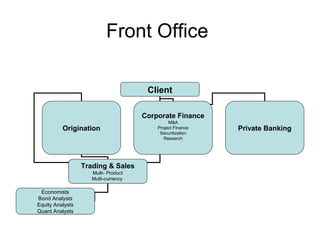
Front Office

                                       Client

                                      Corporate Finance
                                               M&A
          Origination                     Project Finance   Private Banking
                                           Securitization
                                             Research


                  Trading & Sales
                     Multi- Product
                     Multi-currency

 Economists
Bond Analysts
Equity Analysts
Quant Analysts
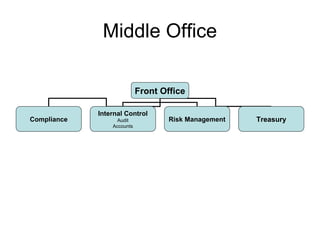
Middle Office

                            Front Office

             Internal Control
Compliance         Audit            Risk Management   Treasury
                 Accounts
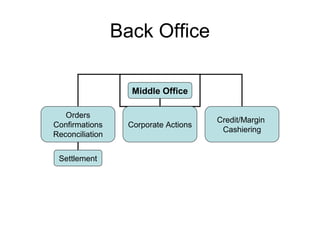
Back Office

                   Middle Office

   Orders
                                      Credit/Margin
Confirmations     Corporate Actions
                                       Cashiering
Reconciliation


 Settlement
Quant Jobs-Buy Side
•   The “Buy Side” is a financial term which describes any financial institution involved in the
    investment and trading of financial securities. These institutions normally buy large amounts of
    securities for money management purposes and will be a customer of a sell side institution, (a
    bank or broker). Most normally these firms are Hedge Funds, Mutual Funds, Pensions and
    Proprietary Trading desks. Buy side organisations generally profit from market movements and
    accruals as opposed to sell side institutions who make recommendations to customers and who
    generally profit from the difference in the bid/offer spread.

•   The buy side is the opposite of the sell-side entities, which provide recommendations for
    upgrades, downgrades, target prices and opinions to the public market. Together, the buy side
    and sell side make up both sides of the investment community.

•   For example, a buy-side analyst typically works in a non-brokerage firm (i.e. hedge fund, mutual
    fund or pension fund) and provides research and recommendations exclusively for the benefit of
    the company's own money managers (as opposed to individual investors). Unlike sell-side
    recommendations - which are meant for the public - buy-side recommendations are not available
    to anyone outside the firm. In fact, if the buy-side analyst stumbles upon a formula, vision or
    approach that works, it is kept secret.
Risk Management
•   Risk Management is concerned with separating risk control from the
    risk takers.
•   To control risks, they must be disclosed, reported, measured and
    monitored.
•   Risk Management therefore has to strike a balance between
    compliance with risk limiting rules and the ability to develop new
    business.
•   On the “Buy Side” risk managers are not always “the policemen”. As
    global markets continue to experience a tightening of the purse
    strings, there is a need for Quants to not only help quantify the risk
    of a particular asset, be that credit, equities, fx etc but also to help
    with optimising the performance of a buy side portfolio.
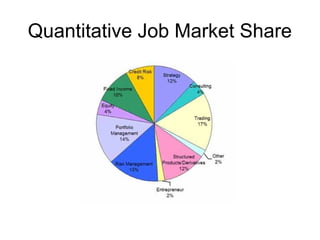
Quantitative Job Market Share
Examples of Quant Risk Jobs
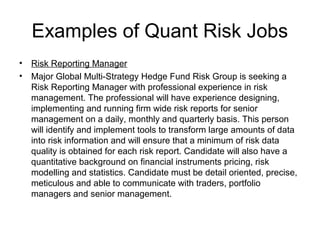
•   Risk Reporting Manager
•   Major Global Multi-Strategy Hedge Fund Risk Group is seeking a
    Risk Reporting Manager with professional experience in risk
    management. The professional will have experience designing,
    implementing and running firm wide risk reports for senior
    management on a daily, monthly and quarterly basis. This person
    will identify and implement tools to transform large amounts of data
    into risk information and will ensure that a minimum of risk data
    quality is obtained for each risk report. Candidate will also have a
    quantitative background on financial instruments pricing, risk
    modelling and statistics. Candidate must be detail oriented, precise,
    meticulous and able to communicate with traders, portfolio
    managers and senior management.
Examples of Quant Risk Jobs
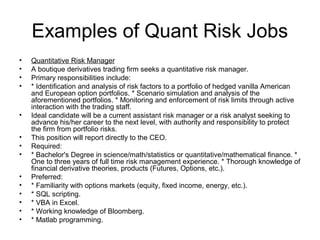
•   Quantitative Risk Manager
•   A boutique derivatives trading firm seeks a quantitative risk manager.
•   Primary responsibilities include:
•   * Identification and analysis of risk factors to a portfolio of hedged vanilla American
    and European option portfolios. * Scenario simulation and analysis of the
    aforementioned portfolios. * Monitoring and enforcement of risk limits through active
    interaction with the trading staff.
•   Ideal candidate will be a current assistant risk manager or a risk analyst seeking to
    advance his/her career to the next level, with authority and responsibility to protect
    the firm from portfolio risks.
•   This position will report directly to the CEO.
•   Required:
•   * Bachelor's Degree in science/math/statistics or quantitative/mathematical finance. *
    One to three years of full time risk management experience. * Thorough knowledge of
    financial derivative theories, products (Futures, Options, etc.).
•   Preferred:
•   * Familiarity with options markets (equity, fixed income, energy, etc.).
•   * SQL scripting.
•   * VBA in Excel.
•   * Working knowledge of Bloomberg.
•   * Matlab programming.
Computational Finance
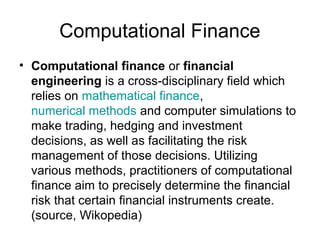
• Computational finance or financial
  engineering is a cross-disciplinary field which
  relies on mathematical finance,
  numerical methods and computer simulations to
  make trading, hedging and investment
  decisions, as well as facilitating the risk
  management of those decisions. Utilizing
  various methods, practitioners of computational
  finance aim to precisely determine the financial
  risk that certain financial instruments create.
  (source, Wikopedia)
Quant Analysts/Fin Engineers

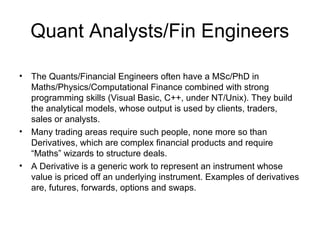
•   The Quants/Financial Engineers often have a MSc/PhD in
    Maths/Physics/Computational Finance combined with strong
    programming skills (Visual Basic, C++, under NT/Unix). They build
    the analytical models, whose output is used by clients, traders,
    sales or analysts.
•   Many trading areas require such people, none more so than
    Derivatives, which are complex financial products and require
    “Maths” wizards to structure deals.
•   A Derivative is a generic work to represent an instrument whose
    value is priced off an underlying instrument. Examples of derivatives
    are, futures, forwards, options and swaps.
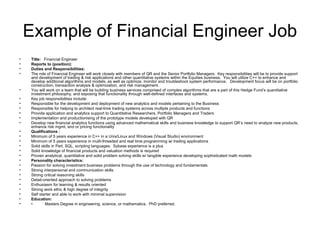
Example of Financial Engineer Job
•    Title:   Financial Engineer                                                                    
•    Reports to (position):             
•    Duties and Responsibilities:
•    The role of Financial Engineer will work closely with members of QR and the Senior Portfolio Managers. Key responsibilities will be to provide support
     and development of trading & risk applications and other quantitative systems within the Equities business. You will utilize C++ to enhance and
     develop additional algorithms and models, as well as optimize, monitor and troubleshoot system performance. Development focus will be on portfolio
     construction, transaction analysis & optimization, and risk management.
•    You will work on a team that will be building business services comprised of complex algorithms that are a part of this Hedge Fund’s quantitative
     investment philosophy, and exposing that functionality through well-defined interfaces and systems.
•    Key job responsibilities include:
•    Responsible for the development and deployment of new analytics and models pertaining to the Business
•    Responsible for helping to architect real-time trading systems across multiple products and functions
•    Provide application and analytics support to Quantitative Researchers, Portfolio Managers and Traders
•    Implementation and productionising of the prototype models developed with QR
•    Develop new financial analytics functions using advanced mathematical skills and business knowledge to support QR’s need to analyze new products,
     enhance risk mgmt, and or pricing functionality
•    Qualifications :
•    Minimum of 5 years experience in C++ in a Unix/Linux and Windows (Visual Studio) environment
•    Minimum of 5 years experience in multi-threaded and real time programming w/ trading applications
•    Solid skills in Perl, SQL, scripting languages. Sybase experience is a plus
•    Solid knowledge of financial products and valuation methods is required
•    Proven analytical, quantitative and solid problem solving skills w/ tangible experience developing sophisticated math models
•    Personality characteristics:
•    Passion for solving investment business problems through the use of technology and fundamentals
•    Strong interpersonal and communication skills
•    Strong critical reasoning skills
•    Detail-oriented approach to solving problems
•    Enthusiasm for learning & results oriented
•    Strong work ethic & high degree of integrity
•    Self starter and able to work with minimal supervision
•    Education:
•    •        Masters Degree in engineering, science, or mathematics. PhD preferred.
Algorithmic Trading
• Research into execution algorithms,
  transaction costs, Pre/Post trade analysis
• Work very closely with Traders and
  Developers
• MiFID encouraging growth in this area,
  less voice broking
• Growth beyond cash equities into FI,
  Commodities and Options
Algorithmic Trading
• Developing advanced algorithms that go far beyond
  basic TWAP/VWAP models to seek out liquidity in illiquid
  and fragmented exchanges and dark pools
• Developing pre and post trade analytics to assess
  performance and estimate market impact, involving
  statistical analysis of high frequency market tick data
• Adding value by providing customised algorithms for
  clients, and working with traders to advise clients on
  optimal algorithms
• Programming ranges from SAS/Matlab to C#/C++ or
  Java, depending on the firm and the role
Pricing and Valuation
• Usually sell side, supporting Traders and
  Structurers
• Develop models to calculate the price and
  risk of particular products
• Usually focused IR/Equity/Commodity/
  Credit derivatives, often highly exotic or
  structured products
• Can be sat on the trading desk
Pricing and Valuation
• Develop, implement and calibrate pricing and
  risk models for new and existing products
• Explain model behaviour and predictions to
  Traders
• Develop advanced analytics engines for exotic
  and hybrid products
• Need awareness of traders timescales, accuracy
  and be able to work well under pressure
• Generally require strong C++
• Particularly sharp Quants can often progress in
  Exotic Derivative trading roles
Real Time Trading/Intra-day
• Trader holds positions for a very short
  time (from minutes to hours) and makes
  numerous trades each day. Most trades
  are entered and closed out within the
  same day.
• Highly speculative and potential high risk
  activity.
• High frequency trading may deal with
  millions of trades per day.
Quant Job In Real Time Trading
•   Strong technical education, PhD (in Statistics, Mathematical Economics,
    Mathematics, Physics) or PhD or strong MS/BS (in Computer Science, Electrical
    Engineering).
•   Should be a strong programmer (enough to be a “user of programming tools” doesn’t
    have to be a professional developer). C++ helpful, perl, any of R, S+, Matlab,
    experience with UNIX environment.
•   Should have prior experience with data analysis (ideally with very large data sets).
    Hands-on knowledge of various statistical and econometrics methods (e.g. time
    series analysis) is desired.
•   Should be absolutely driven, “hungry” and commercial. Super-enthusiastic and results
    oriented. Should have demonstrated it in his/her career. Ability to lead projects is
    highly desired.
•   High frequency trading or statistical arbitrage (could be in any asset class) experience
    is highly desired. Buy side experience is desired.
•   Market/exchanges/products knowledge is highly desired.
Handy Tips for Getting A Quant Job
•   Ensure your CV/Resume is easy to read and gives a fair and accurate picture of your education,
    (including modules/courses studied) and career focus. E.g. if you are interested in trading and
    want to work in this area, back this up with certain books you may have read or traders who have
    inspired you. Be honest, it is likely you will be asked to back up statements made either by a
    recruiter or the hiring manager at interview. Always ensure your dates are full and complete as
    offers can be withdrawn for any inaccuracies.
•   If you are a “problem solver” show how you have solved complex problems in the past and how
    you maintained focus and motivation to a point of completion. Banks and Recruiters often need to
    be convinced of how these problem solving skills could be transferred to solving real life complex
    financial issues and often a PhD indicates the ability to complete a major project or research
    area.
•   Be familiar with what is going on in the Financial Markets. Start to read the Economist/FT/Wall
    Street Journal. Clients may ask for your opinion on the Credit Crisis or the latest debacle with
    Northern Rock. For Derivatives roles, clients often expect Junior Quants to have an
    understanding equal to the content within Futures, Options and Other Derivatives by John Hull.
•   Your interests and hobbies are important and give an indication of your personality, which is key.
    If you have climbed Mount Everest or have excelled in Maths competitions, state so. Find a
    balance between promoting yourself well and ensuring you do not sound arrogant.
•   Research “Brainteasers” on sites like Wilmot-these are often Math questions centred around
    probability. The client is interested in how you arrived at a decision and not necessarily the
    answer.

Quantitative Analyst Skills

  • 1.
    Skills needed tobe a Quantitative Analyst
  • 2.
    Front Office Client Corporate Finance M&A Origination Project Finance Private Banking Securitization Research Trading & Sales Multi- Product Multi-currency Economists Bond Analysts Equity Analysts Quant Analysts
  • 3.
    Middle Office Front Office Internal Control Compliance Audit Risk Management Treasury Accounts
  • 4.
    Back Office Middle Office Orders Credit/Margin Confirmations Corporate Actions Cashiering Reconciliation Settlement
  • 5.
    Quant Jobs-Buy Side • The “Buy Side” is a financial term which describes any financial institution involved in the investment and trading of financial securities. These institutions normally buy large amounts of securities for money management purposes and will be a customer of a sell side institution, (a bank or broker). Most normally these firms are Hedge Funds, Mutual Funds, Pensions and Proprietary Trading desks. Buy side organisations generally profit from market movements and accruals as opposed to sell side institutions who make recommendations to customers and who generally profit from the difference in the bid/offer spread. • The buy side is the opposite of the sell-side entities, which provide recommendations for upgrades, downgrades, target prices and opinions to the public market. Together, the buy side and sell side make up both sides of the investment community. • For example, a buy-side analyst typically works in a non-brokerage firm (i.e. hedge fund, mutual fund or pension fund) and provides research and recommendations exclusively for the benefit of the company's own money managers (as opposed to individual investors). Unlike sell-side recommendations - which are meant for the public - buy-side recommendations are not available to anyone outside the firm. In fact, if the buy-side analyst stumbles upon a formula, vision or approach that works, it is kept secret.
  • 6.
    Risk Management • Risk Management is concerned with separating risk control from the risk takers. • To control risks, they must be disclosed, reported, measured and monitored. • Risk Management therefore has to strike a balance between compliance with risk limiting rules and the ability to develop new business. • On the “Buy Side” risk managers are not always “the policemen”. As global markets continue to experience a tightening of the purse strings, there is a need for Quants to not only help quantify the risk of a particular asset, be that credit, equities, fx etc but also to help with optimising the performance of a buy side portfolio.
  • 7.
  • 8.
    Examples of QuantRisk Jobs • Risk Reporting Manager • Major Global Multi-Strategy Hedge Fund Risk Group is seeking a Risk Reporting Manager with professional experience in risk management. The professional will have experience designing, implementing and running firm wide risk reports for senior management on a daily, monthly and quarterly basis. This person will identify and implement tools to transform large amounts of data into risk information and will ensure that a minimum of risk data quality is obtained for each risk report. Candidate will also have a quantitative background on financial instruments pricing, risk modelling and statistics. Candidate must be detail oriented, precise, meticulous and able to communicate with traders, portfolio managers and senior management.
  • 9.
    Examples of QuantRisk Jobs • Quantitative Risk Manager • A boutique derivatives trading firm seeks a quantitative risk manager. • Primary responsibilities include: • * Identification and analysis of risk factors to a portfolio of hedged vanilla American and European option portfolios. * Scenario simulation and analysis of the aforementioned portfolios. * Monitoring and enforcement of risk limits through active interaction with the trading staff. • Ideal candidate will be a current assistant risk manager or a risk analyst seeking to advance his/her career to the next level, with authority and responsibility to protect the firm from portfolio risks. • This position will report directly to the CEO. • Required: • * Bachelor's Degree in science/math/statistics or quantitative/mathematical finance. * One to three years of full time risk management experience. * Thorough knowledge of financial derivative theories, products (Futures, Options, etc.). • Preferred: • * Familiarity with options markets (equity, fixed income, energy, etc.). • * SQL scripting. • * VBA in Excel. • * Working knowledge of Bloomberg. • * Matlab programming.
  • 10.
    Computational Finance • Computationalfinance or financial engineering is a cross-disciplinary field which relies on mathematical finance, numerical methods and computer simulations to make trading, hedging and investment decisions, as well as facilitating the risk management of those decisions. Utilizing various methods, practitioners of computational finance aim to precisely determine the financial risk that certain financial instruments create. (source, Wikopedia)
  • 11.
    Quant Analysts/Fin Engineers • The Quants/Financial Engineers often have a MSc/PhD in Maths/Physics/Computational Finance combined with strong programming skills (Visual Basic, C++, under NT/Unix). They build the analytical models, whose output is used by clients, traders, sales or analysts. • Many trading areas require such people, none more so than Derivatives, which are complex financial products and require “Maths” wizards to structure deals. • A Derivative is a generic work to represent an instrument whose value is priced off an underlying instrument. Examples of derivatives are, futures, forwards, options and swaps.
  • 12.
    Example of FinancialEngineer Job • Title:   Financial Engineer                                                                     • Reports to (position):              • Duties and Responsibilities: • The role of Financial Engineer will work closely with members of QR and the Senior Portfolio Managers. Key responsibilities will be to provide support and development of trading & risk applications and other quantitative systems within the Equities business. You will utilize C++ to enhance and develop additional algorithms and models, as well as optimize, monitor and troubleshoot system performance. Development focus will be on portfolio construction, transaction analysis & optimization, and risk management. • You will work on a team that will be building business services comprised of complex algorithms that are a part of this Hedge Fund’s quantitative investment philosophy, and exposing that functionality through well-defined interfaces and systems. • Key job responsibilities include: • Responsible for the development and deployment of new analytics and models pertaining to the Business • Responsible for helping to architect real-time trading systems across multiple products and functions • Provide application and analytics support to Quantitative Researchers, Portfolio Managers and Traders • Implementation and productionising of the prototype models developed with QR • Develop new financial analytics functions using advanced mathematical skills and business knowledge to support QR’s need to analyze new products, enhance risk mgmt, and or pricing functionality • Qualifications : • Minimum of 5 years experience in C++ in a Unix/Linux and Windows (Visual Studio) environment • Minimum of 5 years experience in multi-threaded and real time programming w/ trading applications • Solid skills in Perl, SQL, scripting languages. Sybase experience is a plus • Solid knowledge of financial products and valuation methods is required • Proven analytical, quantitative and solid problem solving skills w/ tangible experience developing sophisticated math models • Personality characteristics: • Passion for solving investment business problems through the use of technology and fundamentals • Strong interpersonal and communication skills • Strong critical reasoning skills • Detail-oriented approach to solving problems • Enthusiasm for learning & results oriented • Strong work ethic & high degree of integrity • Self starter and able to work with minimal supervision • Education: • • Masters Degree in engineering, science, or mathematics. PhD preferred.
  • 13.
    Algorithmic Trading • Researchinto execution algorithms, transaction costs, Pre/Post trade analysis • Work very closely with Traders and Developers • MiFID encouraging growth in this area, less voice broking • Growth beyond cash equities into FI, Commodities and Options
  • 14.
    Algorithmic Trading • Developingadvanced algorithms that go far beyond basic TWAP/VWAP models to seek out liquidity in illiquid and fragmented exchanges and dark pools • Developing pre and post trade analytics to assess performance and estimate market impact, involving statistical analysis of high frequency market tick data • Adding value by providing customised algorithms for clients, and working with traders to advise clients on optimal algorithms • Programming ranges from SAS/Matlab to C#/C++ or Java, depending on the firm and the role
  • 15.
    Pricing and Valuation •Usually sell side, supporting Traders and Structurers • Develop models to calculate the price and risk of particular products • Usually focused IR/Equity/Commodity/ Credit derivatives, often highly exotic or structured products • Can be sat on the trading desk
  • 16.
    Pricing and Valuation •Develop, implement and calibrate pricing and risk models for new and existing products • Explain model behaviour and predictions to Traders • Develop advanced analytics engines for exotic and hybrid products • Need awareness of traders timescales, accuracy and be able to work well under pressure • Generally require strong C++ • Particularly sharp Quants can often progress in Exotic Derivative trading roles
  • 17.
    Real Time Trading/Intra-day •Trader holds positions for a very short time (from minutes to hours) and makes numerous trades each day. Most trades are entered and closed out within the same day. • Highly speculative and potential high risk activity. • High frequency trading may deal with millions of trades per day.
  • 18.
    Quant Job InReal Time Trading • Strong technical education, PhD (in Statistics, Mathematical Economics, Mathematics, Physics) or PhD or strong MS/BS (in Computer Science, Electrical Engineering). • Should be a strong programmer (enough to be a “user of programming tools” doesn’t have to be a professional developer). C++ helpful, perl, any of R, S+, Matlab, experience with UNIX environment. • Should have prior experience with data analysis (ideally with very large data sets). Hands-on knowledge of various statistical and econometrics methods (e.g. time series analysis) is desired. • Should be absolutely driven, “hungry” and commercial. Super-enthusiastic and results oriented. Should have demonstrated it in his/her career. Ability to lead projects is highly desired. • High frequency trading or statistical arbitrage (could be in any asset class) experience is highly desired. Buy side experience is desired. • Market/exchanges/products knowledge is highly desired.
  • 19.
    Handy Tips forGetting A Quant Job • Ensure your CV/Resume is easy to read and gives a fair and accurate picture of your education, (including modules/courses studied) and career focus. E.g. if you are interested in trading and want to work in this area, back this up with certain books you may have read or traders who have inspired you. Be honest, it is likely you will be asked to back up statements made either by a recruiter or the hiring manager at interview. Always ensure your dates are full and complete as offers can be withdrawn for any inaccuracies. • If you are a “problem solver” show how you have solved complex problems in the past and how you maintained focus and motivation to a point of completion. Banks and Recruiters often need to be convinced of how these problem solving skills could be transferred to solving real life complex financial issues and often a PhD indicates the ability to complete a major project or research area. • Be familiar with what is going on in the Financial Markets. Start to read the Economist/FT/Wall Street Journal. Clients may ask for your opinion on the Credit Crisis or the latest debacle with Northern Rock. For Derivatives roles, clients often expect Junior Quants to have an understanding equal to the content within Futures, Options and Other Derivatives by John Hull. • Your interests and hobbies are important and give an indication of your personality, which is key. If you have climbed Mount Everest or have excelled in Maths competitions, state so. Find a balance between promoting yourself well and ensuring you do not sound arrogant. • Research “Brainteasers” on sites like Wilmot-these are often Math questions centred around probability. The client is interested in how you arrived at a decision and not necessarily the answer.