2011


                                                 Good practice report:
                             technology-enhanced learning and teaching


                                   Authors: Mike Keppell, Gordon Suddaby
                                                           & Natasha Hard


                         The Australian Learning and Teaching Council has provided funding for this
                         (project/activity –
                               hi h          di       i t )
            1
report title goes here
Support for this report has been provided by the Australian Learning and Teaching
Council Ltd., an initiative of the Australian Government Department of Education,
Employment and Workplace Relations. The views expressed in this report do not
necessarily reflect the views of the Australian Learning and Teaching Council or the
Australian Government.

This work is published under the terms of the Creative Commons Attribution-
Noncommercial-ShareAlike 3.0 Australia Licence. Under this Licence you are free to
copy, distribute, display and perform the work and to make derivative works.

Attribution: You must attribute the work to the original authors and include the
following statement: Support for the original work was provided by the Australian
Learning and Teaching Council Ltd, an initiative of the Australian Government
Department of Education, Employment and Workplace Relations.

Noncommercial: You may not use this work for commercial purposes.

Share Alike: If you alter, transform, or build on this work, you may distribute the
resulting work only under a licence identical to this one.

For any reuse or distribution, you must make clear to others the licence terms of
this work. Any of these conditions can be waived if you obtain permission from the
copyright holder. To view a copy of this licence, visit
<http://creativecommons.org/licenses/by-nc-sa/3.0/au/ > or send a letter to:

Creative Commons
543 Howard Street, 5th Floor
San Francisco California 94105
USA.

Requests and inquiries concerning these rights should be addressed to the
Learning and Teaching Excellence Branch, GPO Box 9880, Sydney NSW 2001
Location code N255EL10

or

through learningandteaching@deewr.gov.au

2011

ISBN
978-0-642-78184-0 [PRINT]
978-0-642-78185-7 [PDF]
978-0-642-78186-4 [RTF]
Acknowledgements

           We would like to acknowledge the invaluable support and insights offered by our
           advisory group throughout the development of this report. Our advisory group
           included: Dr Caroline Steel (University of Queensland), Dr Ric Canale (La Trobe
           University) and Dr John Rafferty (Charles Sturt University).


Good practice report: technology-enhanced learning and teaching                       i
Contents
       Overview ......................................................................................................................... 1
       Literature review of Australian and international scholarly research and publications ...... 8
       Conclusion .................................................................................................................... 22
       Recommendations ........................................................................................................ 24
       Completed ALTC projects and fellowships .................................................................... 26
               Innovation with quality assurance: online curriculum development for the
               University of New England's multi-institutional collaborative programs in German
               at New England, James Cook and Newcastle universities (CG6-34) ................. 26
               New technologies, new pedagogies: using mobile technologies to develop new
               ways of teaching and learning (CG6-33)............................................................ 27
               Project EnRoLE: encouraging role-based learning environments (CG6-39) ...... 28
               Remotely accessible laboratories (CG6-40)....................................................... 29
               The impact of web-based lecture technologies on current and future practices in
               learning and teaching (CG6-22)......................................................................... 30
               The seamless integration of Web3D technologies with university curricula to
               engage the changing student cohort (CG7-488) ................................................ 31
               Digital learning communities (DLC): investigating the application of social
               software to support networked learning (CG6-36) ............................................. 32
               Creating a student centred online learning environment for report writing in the
               sciences and engineering (CG6-30) .................................................................. 33
               Increasing the participation of Indigenous knowledge holders in tertiary teaching
               through the use of emerging digital technologies, Professor Michael Christie
               (2008 ALTC National Teaching Fellow) ............................................................. 34
               Encouraging benchmarking in eLearning (G17-630).......................................... 35
               Virtual microscopy for enhancing learning and teaching (CG7-398) .................. 36
               Educating the net generation: Implications for learning and teaching in Australian
               Universities (CG6-25) ........................................................................................ 37
               Development, deployment and educational assessment of an advanced
               immersive learning environment for process engineering design operations
               (CG6-21) ........................................................................................................... 38
               Building academic staff capacity for using eSimulations in professional education
               for experience transfer (CG8-771) ..................................................................... 39
               Promoting the uptake of re-usable ICT based learning designs, Professor Ron
               Oliver (2006 ALTC Associate Fellow) ................................................................ 40
               Raising the profile of diagnostic, formative and summative eAssessments.
               Providing eAssessment design principles and disciplinary examples for higher
               education academic staff, Professor Geoffrey Crisp (2009 ALTC Teaching
               Fellow)............................................................................................................... 41
               Rethinking assessment in the participatory world – assessment 2.0, Professor
               Geoffrey Crisp (2011 ALTC National Teaching Fellow) ..................................... 42
               ReMarks PDF – stage 1 (PP7-542) ................................................................... 43
               The ReMarks PDF – mark up editor stage 2 (PP9-1593) ................................... 44
               Teaching and assessing meta-attributes in engineering: identifying, developing
               and disseminating good practice (CG6-23)........................................................ 45
               A new enabling technology for learning and teaching quantitative skills (CG6-24)
                .......................................................................................................................... 46
               Learning to teach online (LTTO): developing high-quality video and text
               resources to help educators teach online (CG9-1091) ....................................... 47
               Building a network of academics who use, contribute to and disseminate an
               online, cost-effective histology learning and teaching resource for students in
               Australia and overseas, Professor Geoffrey Meyer (2009 ALTC Teaching Fellow)
                .......................................................................................................................... 48
               An integrated system for online clinical assessment of practical skills (eCAPS) for


Good practice report: technology-enhanced learning and teaching                                                                  ii
web-based courses (PP8-893) .......................................................................... 49
                Web 2.0 authoring tools in higher education learning and teaching: new
                directions for assessment and academic integrity (PP9-1350)........................... 50
       Ongoing Projects .......................................................................................................... 51
                Professional staff as leaders in enhancing student engagement: building capacity
                in emerging technologies through cascade and viral leadership (LE9-1231) ..... 52
                The eOSCE: advancing technology to improve students’ learning and
                assessment reliability (PP10-1628) ................................................................... 53
                Creating student-focused, web-learning resources to support the development of
                and provide evidence of occupational therapy students’ graduating competencies
                (PP10-1774) ...................................................................................................... 54
                VirtualPREX: innovative assessment using a 3D virtual world with pre-service
                teachers (PP10-1775) ....................................................................................... 55
                Coordinated inter-professional curriculum renewal for eHealth capability in
                clinical health professional degrees (PP10-1806) .............................................. 56
                Adoption, use and management of open educational resources to enhance
                teaching and learning in Australia (CG10-1687) ................................................ 57
                An online writing centre for undergraduate engineering students: a one stop shop
                (CG10-1713) ..................................................................................................... 58
                Learning and teaching technical competence in the built environment using
                serious video game technology (CG10-1691) .................................................... 59
       Appendix A Concept Maps ............................................................................................ 60
                1. A focus on learning design allows academics to model and share good
                practice in learning and teaching ....................................................................... 60
                2. Authentic learning provides a means of engaging students through all
                aspects of curricula, subjects, activities and assessment .................................. 61
                3. Successful academic development focuses on engaging academics over
                sustained periods of time using action learning cycles and the provision of
                leadership development opportunities ............................................................... 62
                4. Engaging teaching approaches are key to student learning ...................... 63
                5. Technology-enhanced assessment provides flexible approaches for
                academics to provide feedback to students ....................................................... 64
                6. Integrating technology-enhanced learning and teaching strategies across
                curriculum, subjects, activities and assessment results in major benefits to the
                discipline ........................................................................................................... 65
                7. Knowledge and resource sharing are central to a vibrant community of
                practice ............................................................................................................ 66
                8. Academics require sophisticated online teaching strategies to effectively
                teach in technology-enhanced higher education environments .......................... 67
                9. Academics need a knowledge of multi-literacies to teach effectively in
                contemporary technology-enhanced higher education....................................... 68
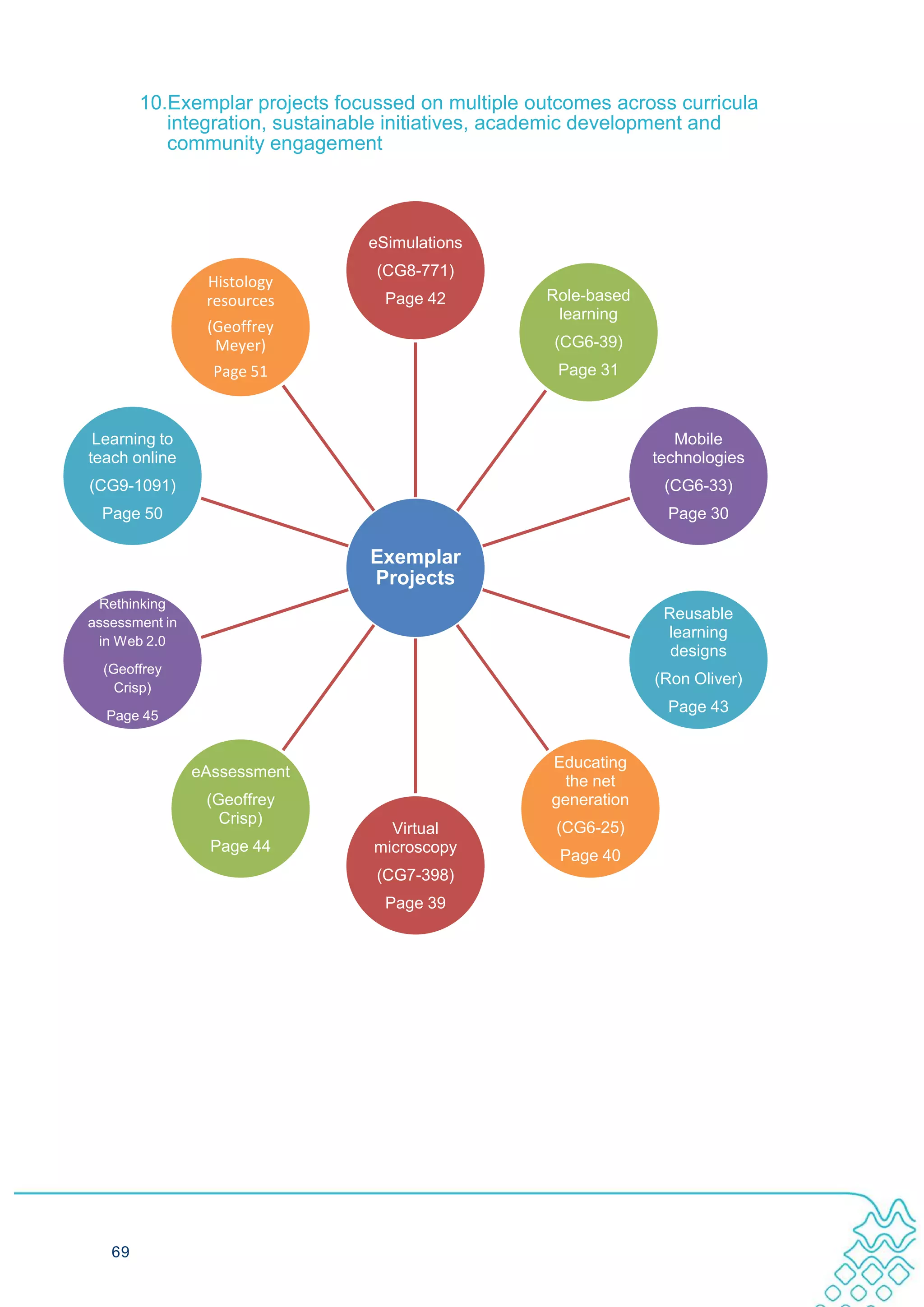
                10. Exemplar projects focussed on multiple outcomes across curricula
                integration, sustainable initiatives, academic development and community
                engagement ...................................................................................................... 69
       References ................................................................................................................... 70
       Index ............................................................................................................................. 75


Good practice report: technology-enhanced learning and teaching                                                                  iii
Overview
           Background
           The ALTC has awarded a total of 264 projects and 52 fellowships (as at 1
           December 2010) (ALTC website). These projects and fellowships represent the
           vibrancy of higher education learning and teaching across the sector since 2005.
           This good practice report (GPR) on technology-enhanced learning and teaching is
           one of 11 GPRs commissioned by ALTC as an evaluation of the projects’ and
           fellowships’ useful outcomes and good practices. The 11 GPRs include: assuring
           graduate outcomes; blended learning; curriculum renewal; supporting students’
           transition into higher education; work-integrated learning; assessment of science,
           technology, engineering and mathematics; innovative Indigenous learning and
           teaching; revitalising the academic workforce; technology-enhanced learning and
           teaching; clinical teaching; and support for international students. This GPR focuses
           on examining best practice across 25 complete projects (including three fellowships)
           and 8 ongoing projects (including one fellowship) on technology-enhanced learning
           and teaching. In February 2011 an initial report was delivered by the ALTC at the
           DEHub Summit which provided an overview of the ALTC funded projects in the area
           of technology-enhanced learning.

           Technology-enhanced learning and teaching
           Our perspective of technology-enhanced learning (TEL) and teaching aligns with
           Laurillard, Oliver, Wasson & Hoppe (2009) who suggest that the “role of technology
           [is] to enable new types of learning experiences and to enrich existing learning
           scenarios” (p. 289). In addition, they also suggest that “interactive and cooperative
           digital media have an inherent educational value as a new means of intellectual
           expression” and creativity (p. 289). Laurillard et al. (2009) also suggest that “the
           route from research to innovation, then to practice, through to mainstream
           implementation requires the following:
                • an understanding of the authentic professional contexts that will influence the
                    curriculum, pedagogy and assessment practices that need technology
                    enhancement
                • congruence between innovation and teacher values
                • teachers having time to reflect on their beliefs about learning and teaching
                    because TEL requires a more structured and analytical approach to
                    pedagogy
                • teachers and practitioners need a sense of ownership through their
                    involvement in co-development of the TEL products and environments.
                • TEL research must be conducted to reflect the interdependence between
                    researchers and users
                • education leaders need more support for the radical change of institutional
                    teaching and learning models needed, if technology is to be exploited
                    effectively
                • teachers need to be more closely engaged in the design of teaching that
                    uses technology, collaborating with peers and exchanging ideas and
                    practices” (Laurillard et al. 2009, p. 304).

           Approach
           Our approach to the development of the GPR has involved a meta-analysis of the
           33 projects. We initially developed a matrix for the comparison of projects as well as
           a means to thematically analyse the 33 projects. A subsequent analysis determined
           ten outcomes that represent best practice for technology-enhanced learning and
           teaching. Keywords for the literature were derived from these outcomes which
           guided the subsequent literature review. We also developed ten recommendations
           and described a range of exemplar projects in technology-enhanced learning.


Good practice report: technology-enhanced learning and teaching                           1
Outcomes for best practice in TEL

              1. A focus on learning design allows academics to model and share good
                  practice in learning and teaching
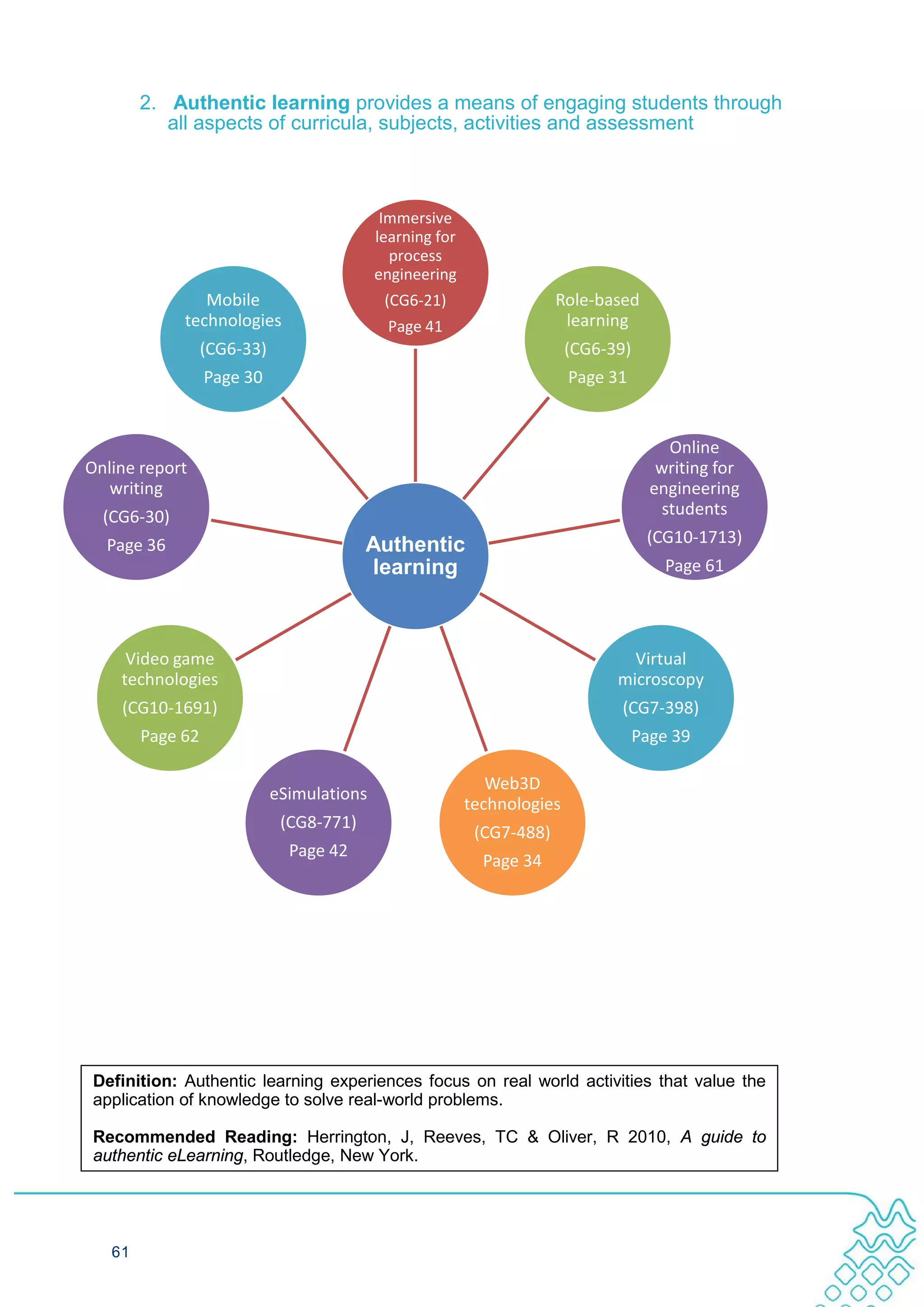
              2. Authentic learning provides a means of engaging students through all
                  aspects of curricula, subjects, activities and assessment
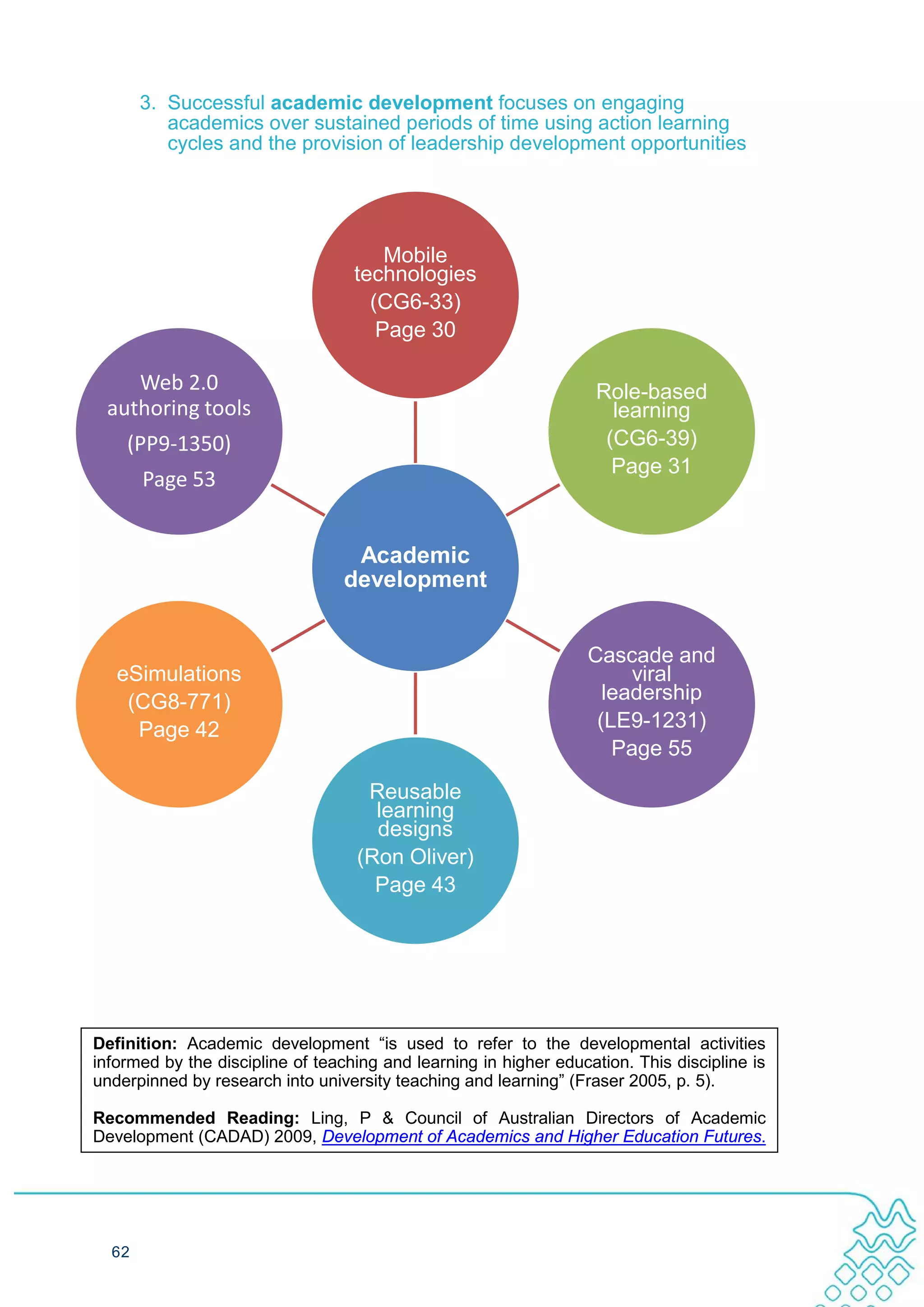
              3. Successful academic development focuses on engaging academics over
                  sustained periods of time through action learning cycles and the provision of
                  leadership development opportunities
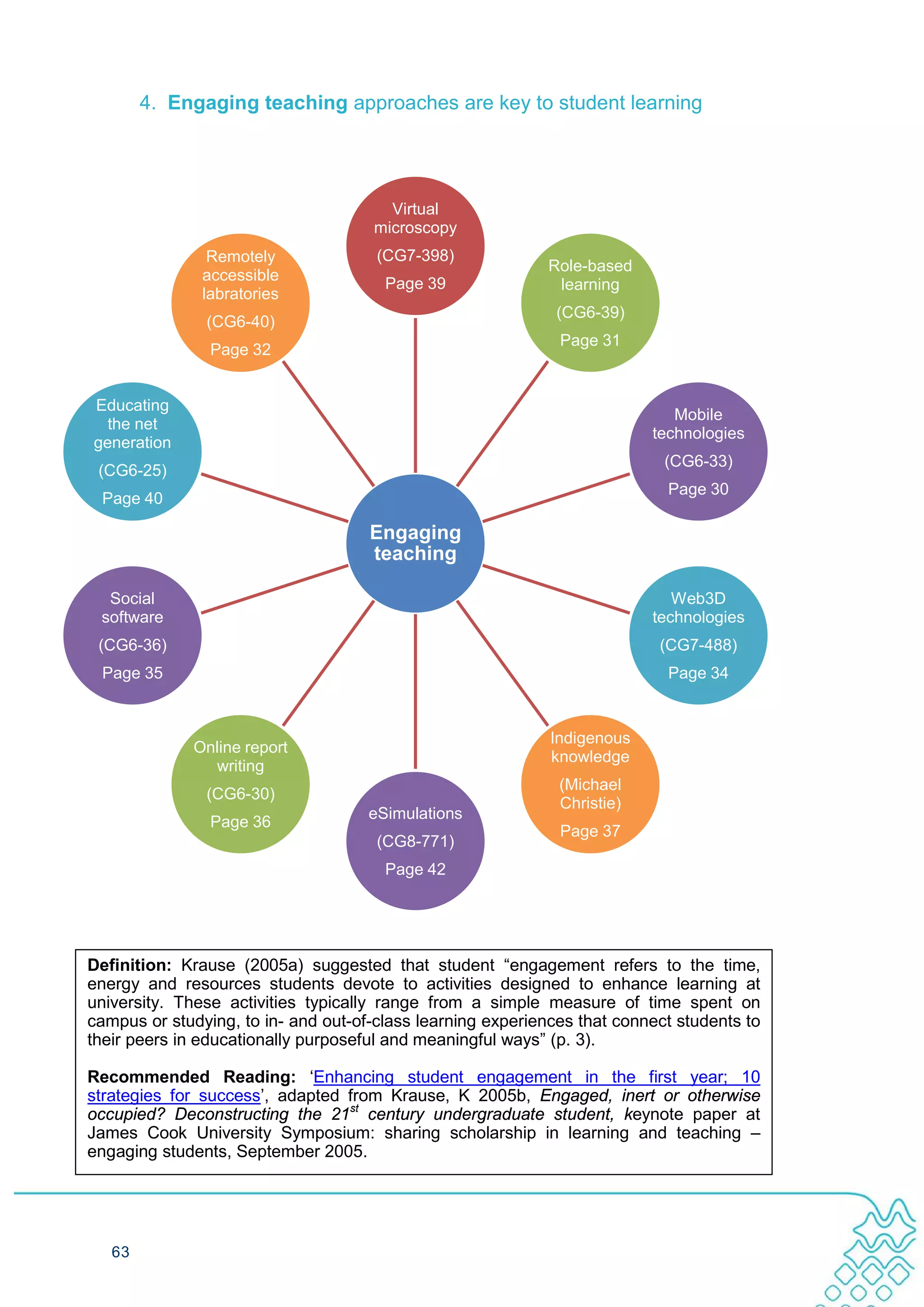
              4. Engaging teaching approaches are key to student learning
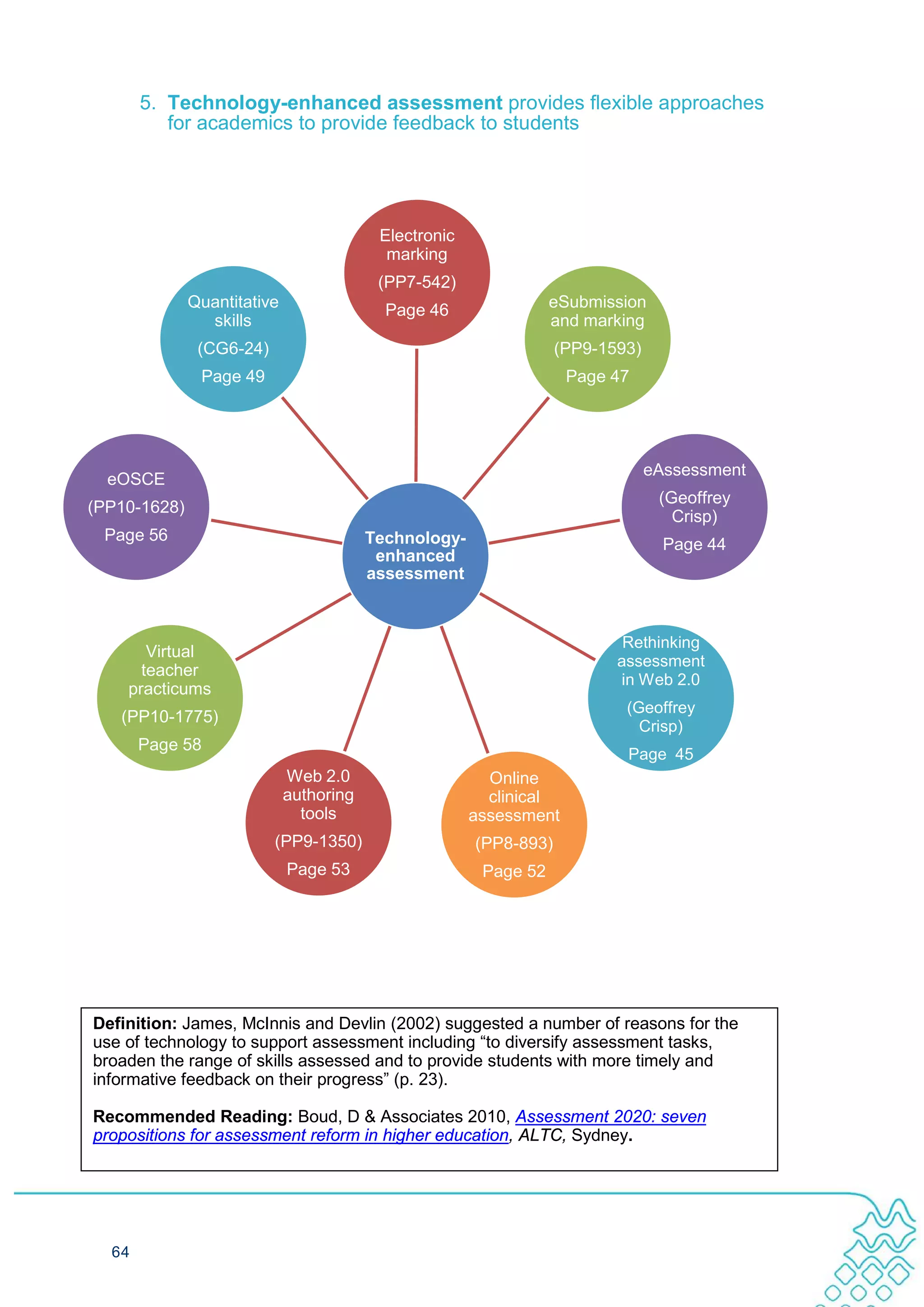
              5. Technology-enhanced assessment provides flexible approaches for
                  academics to provide feedback to students
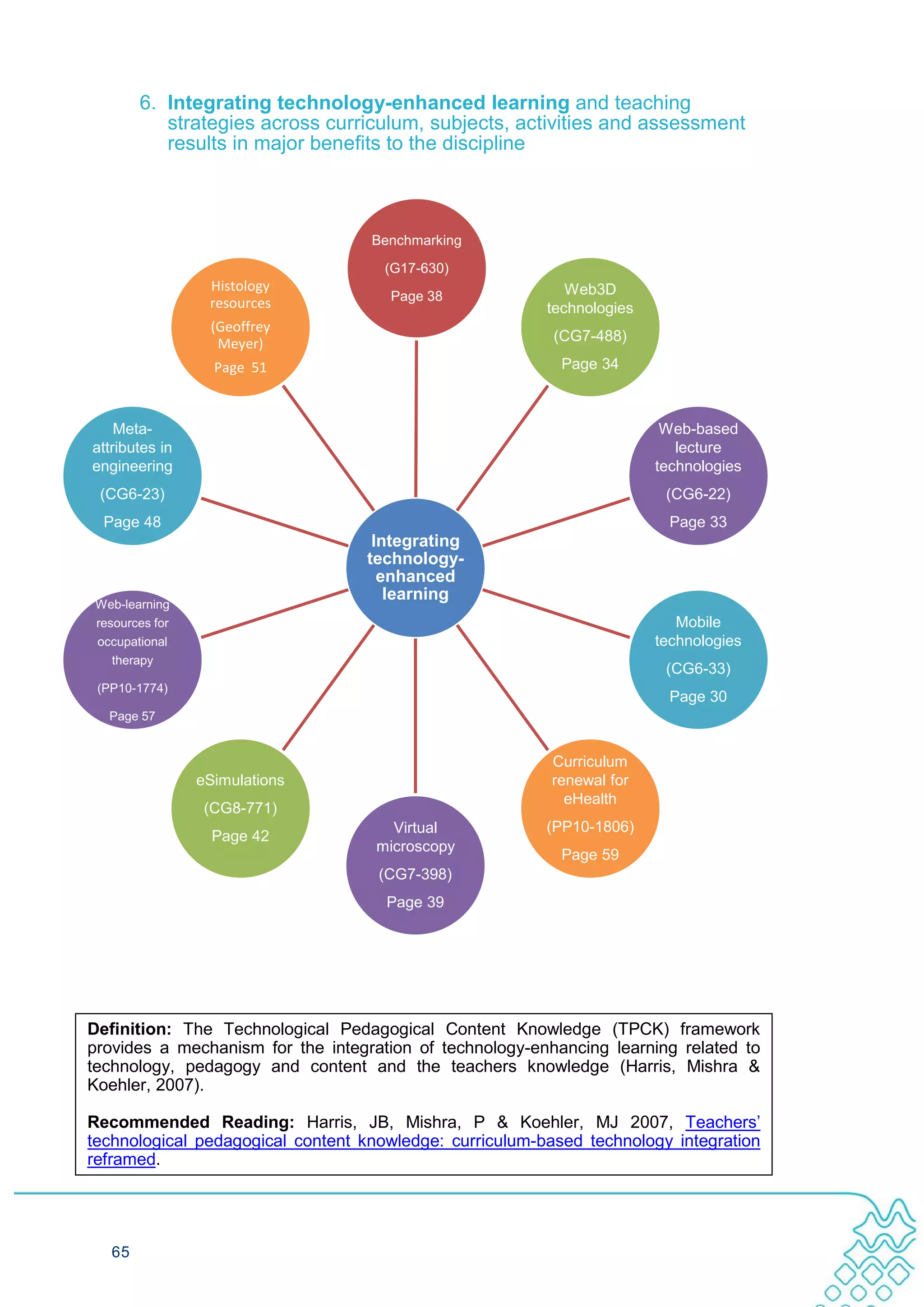
              6. Integrating technology-enhanced learning and teaching strategies across
                  curriculum, subjects, activities and assessment results in major benefits to
                  the discipline
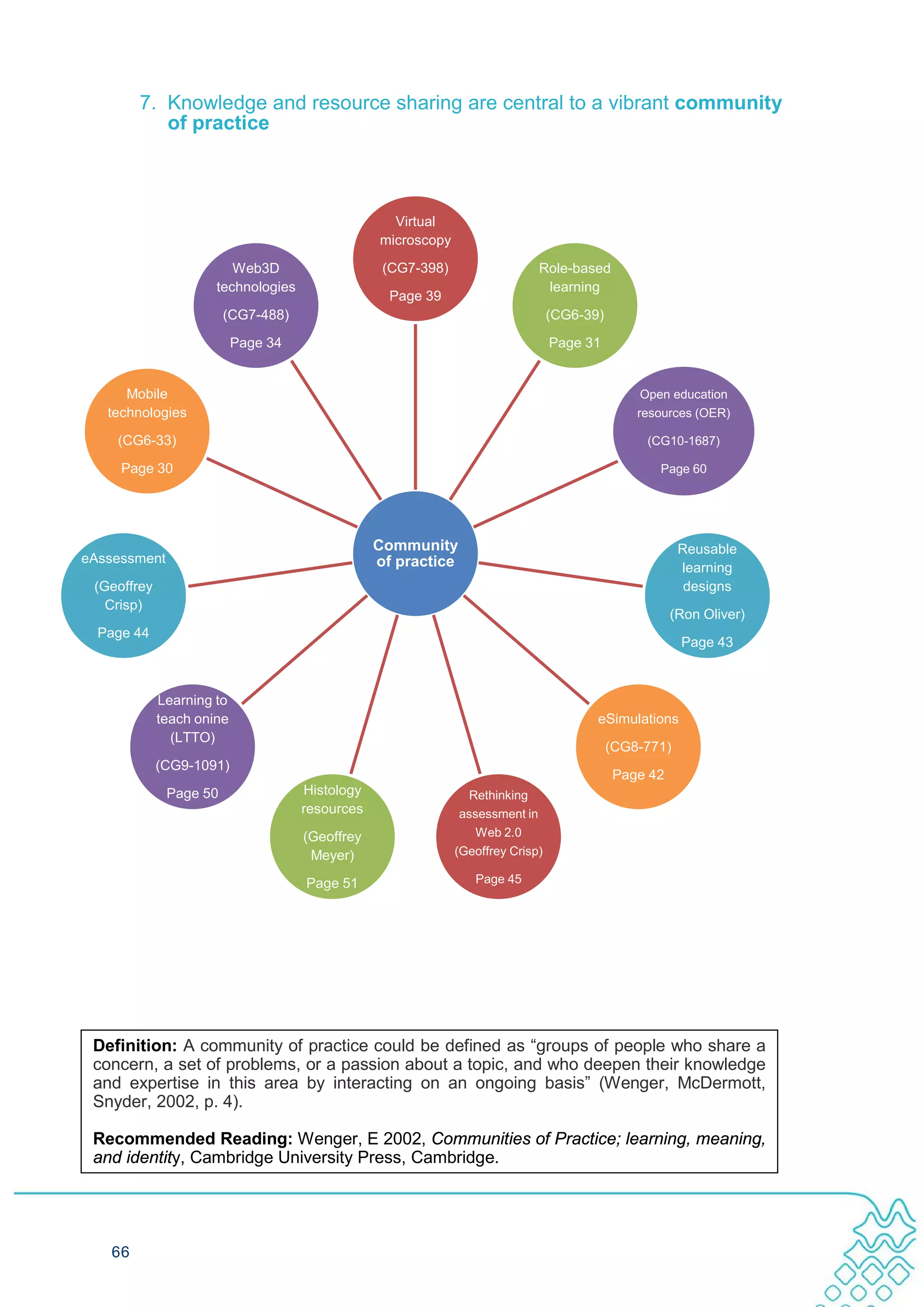
              7. Knowledge and resource sharing are central to a vibrant community of
                  practice
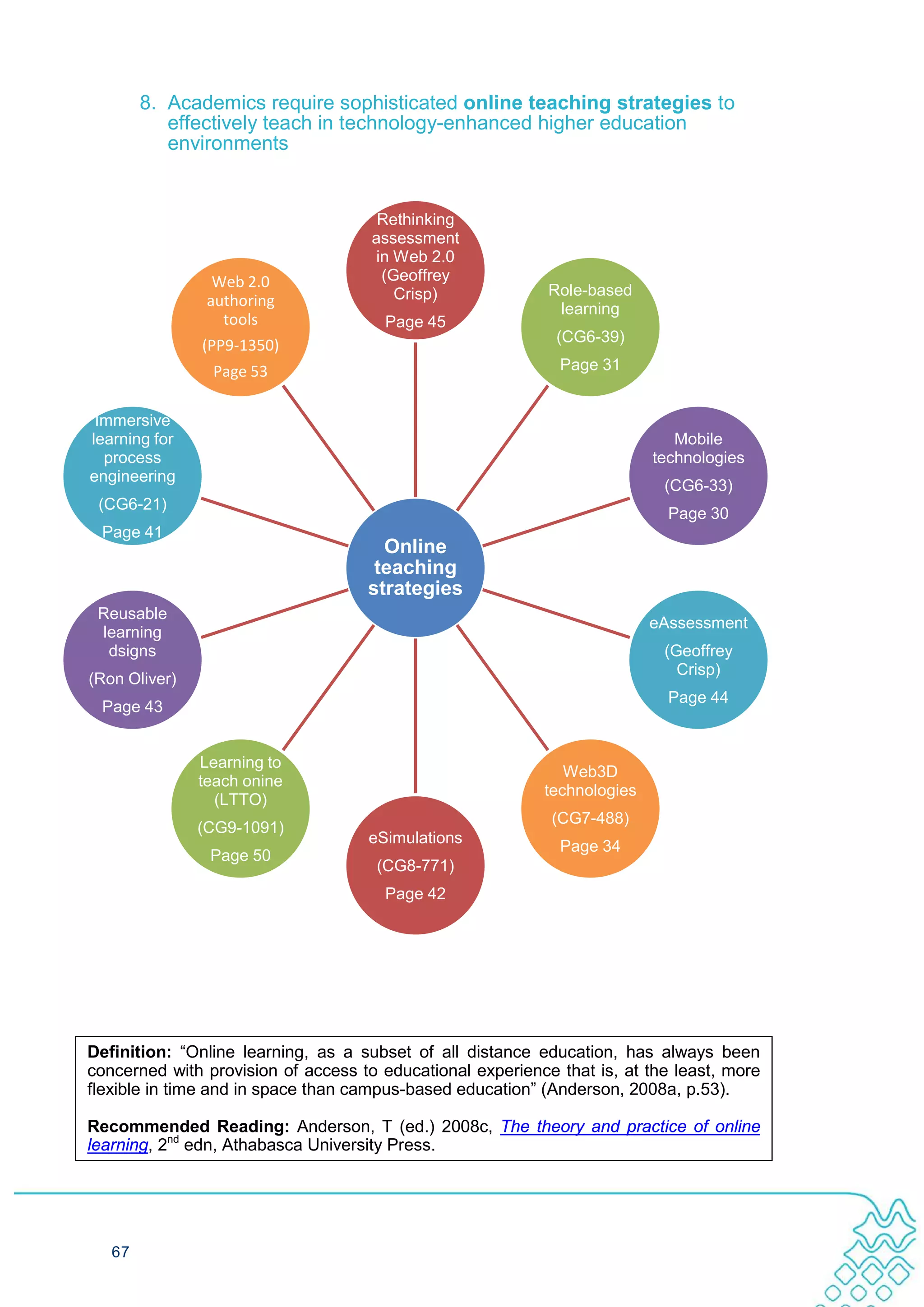
              8. Academics require sophisticated online teaching strategies to effectively
                  teach in technology-enhanced higher education environments
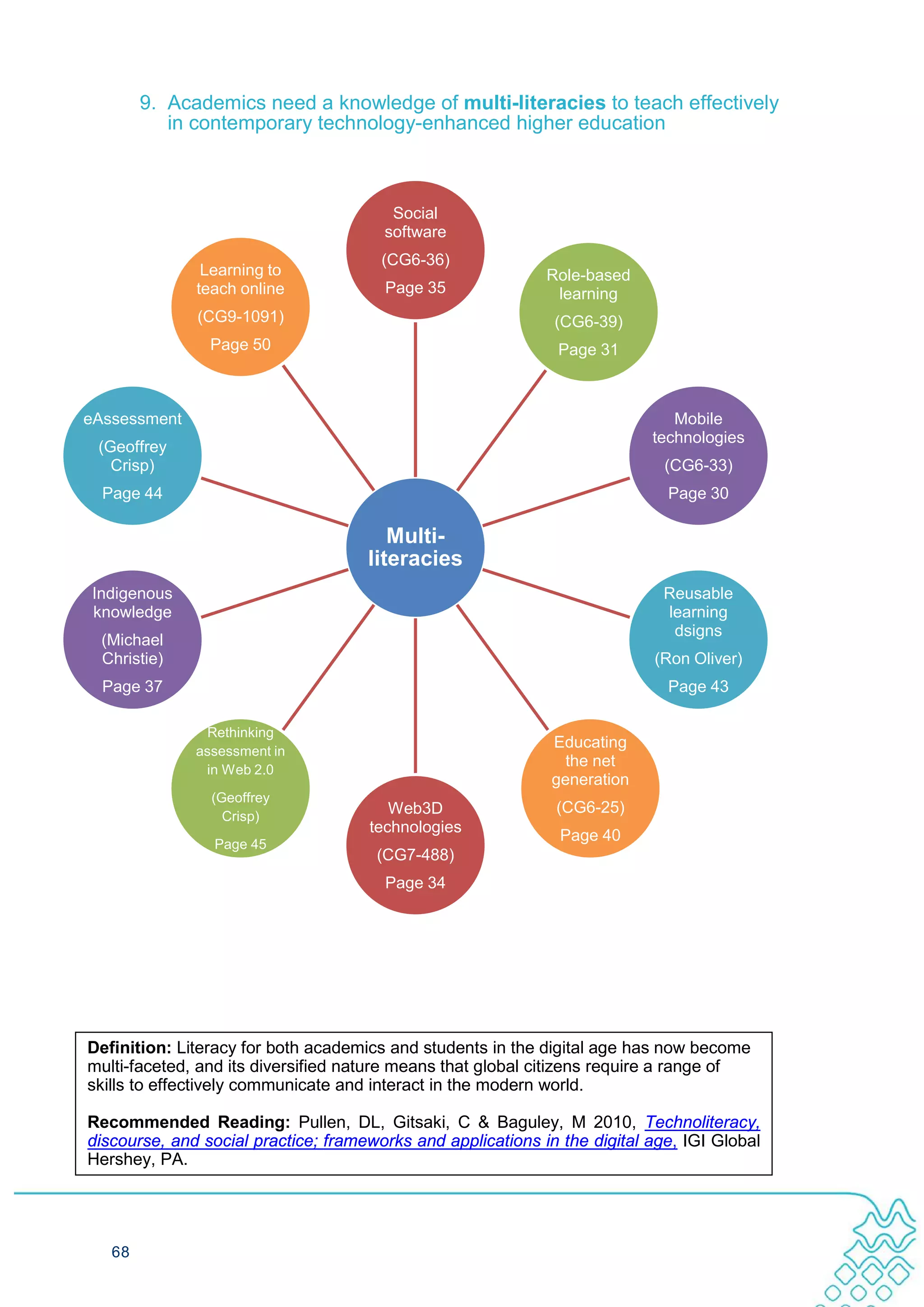
              9. Academics need a knowledge of multi-literacies to teach effectively in
                  contemporary technology-enhanced higher education
              10. Exemplar projects focused on multiple outcomes across curricula integration,
                  sustainable initiatives, academic development and community engagement.

           1. A focus on learning design allows academics to model and share good
              practice in learning and teaching

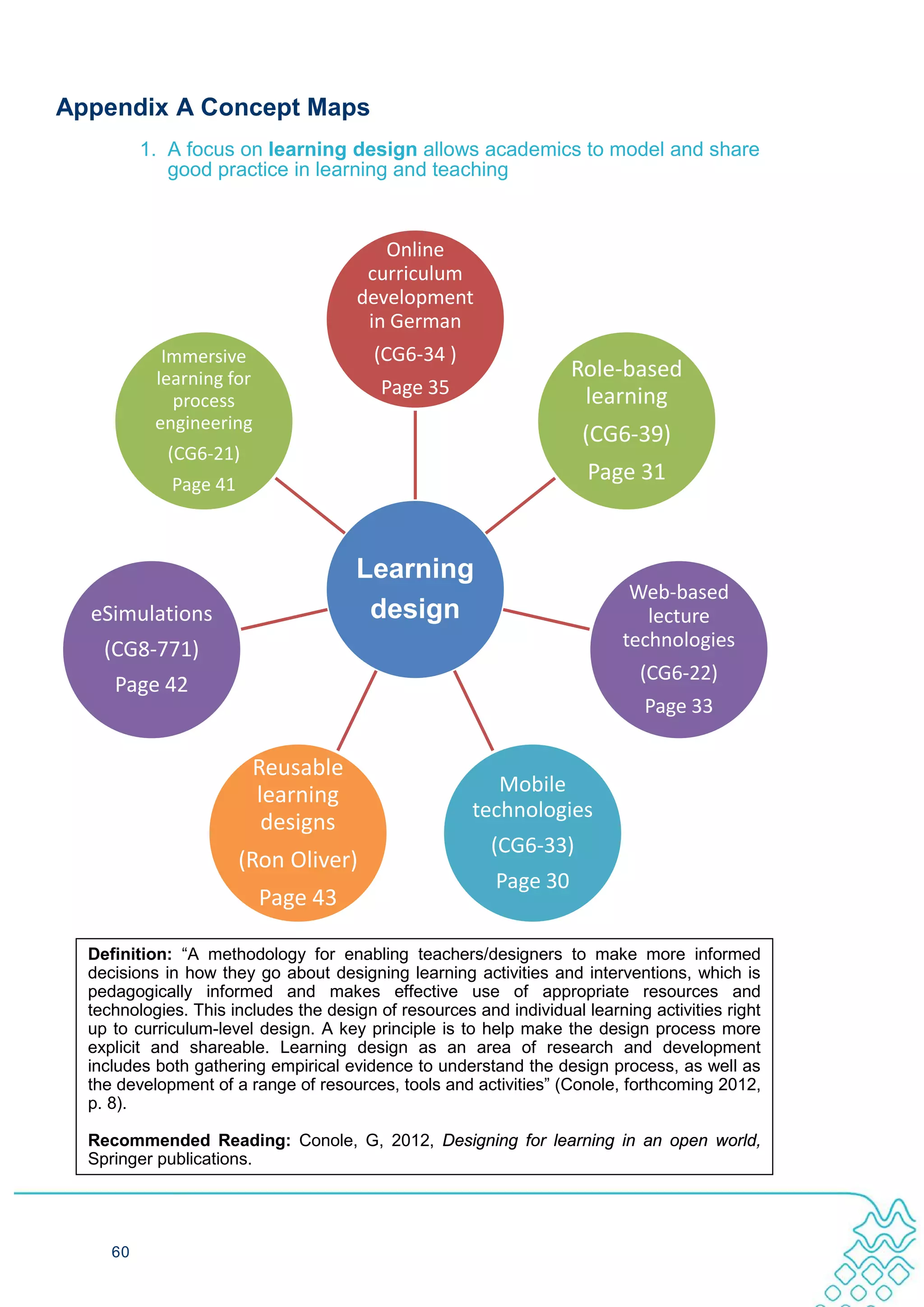
           Learning design focuses on the design of activities, subjects, assessment and
           curricula. Projects focused on learning design allow academics to model and share
           good practice in learning and teaching. A focus on learning design varied from
           discipline specific (e.g. German language, engineering), multi-disciplinary (e.g.
           eSimulations) and generic (e.g. role plays, technology-supported learning designs,
           blended learning). Learning design projects also represent a sustainable approach
           to learning and teaching as they provide shareable learning designs and design
           principles. A focus on learning design engages academics and builds the capacity of
           staff to design quality learning and teaching in higher education. Several examples
           of projects which focus on learning designs include:

              •   role-based learning environments (CG6-39)
              •   online curriculum development for collaborative programs in German (CG6-
                  34)
              •   web-based lecture technologies (WBLT) (CG6-22)
              •   promoting the sharing and reuse of technology-supported learning designs
                  (Ron Oliver 2006)
              •   using eSimulations in professional education (CG8-771)
              •   immersive learning environments for process engineering (CG6-21)
              •   using mobile technologies to develop new ways of teaching and learning
                  (CG6-33).

           2. Authentic learning provides a means of engaging students through all
              aspects of curricula, subjects, activities and assessment

           Authentic learning experiences focus on real-world activities that value the
           application of knowledge to solving real-world problems. Authentic learning is
           meaningful as it engages and immerses students in activities, subjects, assessment
           and curricula that are directly relevant for their profession and allows a transition to


Good practice report: technology-enhanced learning and teaching                             2
the workplace setting. Authentic learning experiences vary from viewing histology
           slides in the online environment, immersing students in process engineering plants,
           simulations, role plays and 3D environments that mirror real-life activities. Engaging
           academics in designing authentic learning activities such as mobile learning also
           provides academic development for staff. Several examples of projects which focus
           on authentic learning include:

              •   immersive learning environments for process engineering (CG6-21)
              •   using eSimulations in professional education (CG8-771)
              •   role-based learning environments (CG6-39)
              •   integration of web 3D technologies with university curricula (CG7-488)
              •   virtual microscopy for enhancing learning and teaching (CG7-398)
              •   online report writing in the sciences and engineering (CG6-30)
              •   using mobile technologies to develop new ways of teaching and learning
                  (CG6-33)
              •   online writing for undergraduate engineering students (CG10-1713)
              •   using serious video game technology in the built environment (CG10-1691).

           3. Successful academic development focuses on engaging academics over
              sustained periods of time through action learning cycles and the provision
              of leadership development opportunities

           Action learning focuses on engaging academics to explore pedagogies as they
           design and evaluate learning and teaching within their own discipline. In addition the
           sharing of these learning designs enhances the ability of the academics to articulate
           and share pedagogies within their community of practice. The aim is to work
           collaboratively and reflect and share ideas and experiences. A focus on building a
           community of practice at university, state and national levels encouraged the uptake
           of online role-based learning environments and utilised a cascade model of
           leadership. Organisational capacity-building was the focus of the eSimulations
           project. A cycle of action learning and action research of planning, action, evaluation
           and reflection enhanced the process. Several examples of projects that focus on
           academic development include:

              •   using mobile technologies to develop new ways of teaching and learning
                  (CG6-33)
              •   role-based learning environments (CG6-39)
              •   using eSimulations in professional education (CG8-771)
              •   promoting the sharing and reuse of technology-supported learning designs
                  (Ron Oliver 2006)
              •   web 2.0 authoring tools in higher education (PP9-1350)
              •   building capacity in emerging technologies through cascade and viral
                  leadership (LE9-1231).

           4. Engaging teaching approaches are key to student learning

           Student engagement has been defined as “active and collaborative learning,
           participation in challenging academic activities, formative communication with
           academic staff, involvement in enriching educational experiences, and feeling
           legitimated and supported by university learning communities” (Coates 2007, p.
           122). Aligning pedagogical, technical and administrative issues is also a necessary
           condition of success for creating an engaging learning environment. In addition, the
           emergence of game-like virtual worlds offers opportunities for enhanced interaction
           in educational applications within higher education courses. Engaging students in
           active, interactive and student-centred authentic learning environments is a central
           theme of each of the projects listed below:

              •   online report-writing in the sciences and engineering (CG6-30)


Good practice report: technology-enhanced learning and teaching                           3
•   investigating the application of social software to support networked learning
                  (CG6-36)
              •   educating the net generation (CG6-25)
              •   remotely accessible laboratories: enhancing learning outcomes (CG6-40)
              •   using eSimulations in professional education (CG8-771)
              •   role-based learning environments (CG6-39)
              •   integration of web 3D technologies with university curricula (CG7-488)
              •   virtual microscopy for enhancing learning and teaching (CG7-398)
              •   using mobile technologies to develop new ways of teaching and learning
                  (CG6-33)
              •   participation of Indigenous knowledge holders in tertiary teaching (Michael
                  Christie 2008).

           5. Technology-enhanced assessment provides flexible approaches for
              academics to provide feedback to students

           Assessment has a key role in teaching and learning because students define the
           curriculum or subject according to the assessment. The assessment also sends
           explicit and implicit messages to students about what is considered important.
           Assessment should be designed to identify the quality of students’ learning and how
           teaching can be more effective. Technology-enhanced assessment provides
           flexible, diverse and interactive approaches to student assessment. The quantitative
           skills project focused on a software tool which produced 138 templates of
           mathematical questions and worked examples. The ReMarks project developed a
           method for providing feedback on electronic assessment submissions and an
           eSubmission system. The fellowships focused on enhancing approaches to
           eAssessment through the articulation of an eAssessment design model and the
           collection of disciplinary examples of interactive eAssessments. Several examples
           of projects that focus on assessment include:

              •   electronic marking - ReMarks PDF & ReMarks PDF – Stage 2 (PP7-542;
                  PP9-1593)
              •   a new enabling technology for learning and teaching quantitative skills (CG6-
                  24)
              •   web 2.0 authoring tools in higher education (PP9-1350)
              •   rethinking assessment in web 2.0 environments (Geoffrey Crisp 2011)
              •   raising the profile of diagnostic, formative and summative eAssessments
                  (Geoffrey Crisp 2009)
              •   VirtualPREX: using a 3D virtual world with pre-service teachers (PP10-1775)
              •   the eOSCE: improving learning and assessment reliability (PP10-1628)
              •   online clinical assessment of practical skills (eCAPS) for web-based courses
                  (PP8-893).

           6. Integrating technology-enhanced learning and teaching strategies across
              curriculum, subjects, activities and assessment resulted in major benefits
              to the discipline

           Successful projects embedded the initiative in the curriculum, IT infrastructure and
           professional practice of academics. In addition, embedding an initiative into the
           wider curriculum is likely to lead to a more sustainable change than confining the
           initiative within a course or subject. This approach also begins to address barriers to
           new initiatives within the university environment. The virtual microscopy project
           worked with course coordinators to maximise integration, whereas the Web3D
           project focused on an action learning approach with staff to integrate the exemplars
           into the practice of the academic. This approach was highly effective in empowering
           academic staff in virtual worlds. The eSimulation project integrated simulations into
           the curriculum of three universities, and the engineering project focused on
           integration with a focus on curriculum review, graduate attributes and capabilities in


Good practice report: technology-enhanced learning and teaching                           4
line with industry expectations. Graduate attributes are descriptions of the core
           abilities and values which a university community agrees all its graduates should
           develop as a result of successfully completing their university studies. The
           Australasian Council on Open, Distance and E- Learning (ACODE) benchmarks
           raised awareness of and familiarisation with benchmarks and their use within
           institutions. Several examples of projects that focus on integration include:

              •   using mobile technologies to develop new ways of teaching and learning
                  (CG6-33)
              •   integration of web 3D technologies with university curricula (CG7-488)
              •   virtual microscopy for enhancing learning and teaching (CG7-398)
              •   using eSimulations in professional education (CG8-771)
              •   teaching and assessing meta-attributes in engineering (CG6-23)
              •   encouraging benchmarking in eLearning (G17-630)
              •   creating resources to support occupational therapy competencies (PP10-
                  1774)
              •   web-based lecture technologies (WBLT) (CG6-22)
              •   curriculum renewal for eHealth capability in health professional degrees
                  (PP10-1806)
              •   histology learning and teaching resource for students (Geoffrey Meyer 2009).

           7. Knowledge and resource sharing are central to a vibrant community of
              practice

           Communities of practice are successful ways of building and sharing a scholarly
           approach to enhancing learning and teaching practice. A community of practice
           could be defined as “groups of people who share a concern, a set of problems, or a
           passion about a topic, and who deepen their knowledge and expertise in this area
           by interacting on an ongoing basis” (Wenger, McDermott, Snyder 2002, p. 4). The
           following projects represent a selection of projects that share, interact and want to
           do things better within their community of practice:

              •   virtual microscopy for enhancing learning and teaching (CG7-398)
              •   adoption, use and management of open educational resources (CG10-1687)
              •   learning to teach online(CG9-1091)
              •   using eSimulations in professional education (CG8-771)
              •   rethinking assessment in web 2.0 environments (Geoffrey Crisp 2011)
              •   raising the profile of diagnostic, formative and summative eAssessments
                  (Geoffrey Crisp 2009)
              •   role-based learning environments (CG6-39)
              •   using mobile technologies to develop new ways of teaching and learning
                  (CG6-33)
              •   histology learning and teaching resource for students (Geoffrey Meyer 2009)
              •   integration of web 3D technologies with university curricula (CG7-488)
              •   Promoting the sharing and reuse of technology-supported learning designs
                  (Ron Oliver 2006).

           8. Academics require sophisticated online teaching strategies to effectively
              teach in technology-enhanced higher education environments

           Academics need engaging approaches to develop their online teaching strategies.
           They need to be conversant in a wider range of skills to teach effectively in online
           environments. These skills focus on being able to engage the learner in an effective
           learning environment that is learner-centred, knowledge-centred, assessment-
           centred and community-centred (Bransford, Brown & Cocking 1999). “In many ways,
           learning and teaching in an online environment are much like teaching and learning
           in any other formal educational context: learners’ needs are assessed, content is
           negotiated or prescribed, learning activities are orchestrated, and learning is


Good practice report: technology-enhanced learning and teaching                          5
assessed. The pervasive effect of the online medium, however, creates a unique
           environment for teaching and learning” (Anderson 2008b, p. 343). Several examples
           of projects that focus on online teaching strategies include:

              •   learning to teach online (CG9-1091)
              •   rethinking assessment in web 2.0 environments (Geoffrey Crisp 2011)
              •   raising the profile of diagnostic, formative and summative eAssessments
                  (Geoffrey Crisp 2009)
              •   role-based learning environments (CG6-39)
              •   using mobile technologies to develop new ways of teaching and learning
                  (CG6-33)
              •   integration of web 3D technologies with university curricula (CG7-488)
              •   promoting the sharing and reuse of technology-supported learning designs
                  (Ron Oliver 2006)
              •   using eSimulations in professional education (CG8-771)
              •   web 2.0 authoring tools in higher education (PP9-1350)
              •   immersive learning environments for process engineering (CG6-21).


           9. Academics need a knowledge of multi-literacies to teach effectively in
              technology-enhanced contemporary higher education

           To effectively participate in the modern world, students need to develop the skills
           needed to be multi-literate through providing educational experiences that embrace
           linguistic, visual, auditory, gestural and spatial modes of communication. Literacy for
           both academics and students in the digital age has now become multi-faceted, and
           its diversified nature means that global citizens require a range of skills to effectively
           communicate and interact in the modern world. Several examples of projects that
           explore multi-literacies include:

              •   investigating the application of social software to support networked learning
                  (CG6-36)
              •   educating the net generation (CG6-25)
              •   role-based learning environments (CG6-39)
              •   using mobile technologies to develop new ways of teaching and learning
                  (CG6-33)
              •   integration of web 3D technologies with university curricula (CG7-488)
              •   promoting the sharing and reuse of technology-supported learning designs
                  (Ron Oliver 2006)
              •   rethinking assessment in web 2.0 environments (Geoffrey Crisp 2011)
              •   raising the profile of diagnostic, formative and summative eAssessments
                  (Geoffrey Crisp 2009)
              •   learning to teach online (CG9-1091)
              •   participation of Indigenous knowledge holders in tertiary teaching (Michael
                  Christie 2008).

           10. Exemplar projects focused on multiple outcomes across curricula
               integration, sustainable initiatives, academic development and community
               engagement

           The following projects represent best practice projects as they traverse multiple
           outcomes as described above. For example the virtual microscopy project
           demonstrated best practice in outcomes 2, 4, 6 and 7. The mobile technologies
           project demonstrated best practice in eight of the nine outcomes described. Several
           examples of projects that represent best practice include:

              •   role-based learning environments (CG6-39)
              •   educating the net generation (CG6-25)


Good practice report: technology-enhanced learning and teaching                              6
•   learning to teach online (CG9-1091)
              •   virtual microscopy for enhancing learning and teaching (CG7-398)
              •   using mobile technologies to develop new ways of teaching and learning
                  (CG6-33)
              •   promoting the sharing and reuse of technology-supported learning designs
                  (Ron Oliver 2006)
              •   rethinking assessment in web 2.0 environments (Geoffrey Crisp 2011)
              •   raising the profile of diagnostic, formative and summative eAssessments
                  (Geoffrey Crisp 2009)
              •   histology learning and teaching resource for students (Geoffrey Meyer 2009)
              •   using eSimulations in professional education (CG8-771).


Good practice report: technology-enhanced learning and teaching                       7
Literature review of Australian and international scholarly
research and publications
           The literature review for the technology-enhanced good practice report focuses on
           the key outcomes from the evaluation of the complete and ongoing projects and
           fellowships. The literature review elaborates the core concepts of each outcome as
           highlighted in bold below.

           Outcomes
              1. A focus on learning design allows academics to model and share good
                 practice in learning and teaching
              2. Authentic learning provides a means of engaging students through all
                 aspects of curricula, subjects, activities and assessment
              3. Successful academic development focuses on engaging academics over
                 sustained periods of time through action learning cycles and the provision of
                 leadership development opportunities
              4. Engaging teaching approaches are key to student learning
              5. Technology-enhanced assessment provides flexible approaches for
                 academics to provide feedback to students
              6. Integrating technology-enhanced learning and teaching strategies across
                 curriculum, subjects, activities and assessment results in major benefits to
                 the discipline
              7. Knowledge and resource sharing are central to a vibrant community of
                 practice
              8. Academics require sophisticated online teaching strategies to effectively
                 teach in technology-enhanced higher education environments
              9. Academics need a knowledge of multi-literacies to teach effectively in
                 contemporary technology-enhanced higher education

           1. A focus on learning design allows academics to model and share good practice
              in learning and teaching

           Learning design has been defined in numerous ways within the literature. It can
           focus on the design of activities, subjects, assessment and curricula. For the
           purposes of this report learning design is defined as: “a methodology for enabling
           teachers/designers to make more informed decisions in how they go about
           designing learning activities and interventions, which is pedagogically informed and
           makes effective use of appropriate resources and technologies. This includes the
           design of resources and individual learning activities right up to curriculum-level
           design. A key principle is to help make the design process more explicit and
           shareable. Learning design as an area of research and development includes both
           gathering empirical evidence to understand the design process, as well as the
           development of a range of resources, tools and activities” (Conole forthcoming,
           2012, p. 8). Agostinho (2009) suggests that learning design “is gaining momentum
           in the e-learning literature as a concept for supporting academics to model and
           share teaching practice” (p. 1). She suggests that a learning design “represents and
           documents teaching and learning practice using some notational form so that it can
           serve as a description, model or template that can be adaptable or reused by a
           teacher to suit his/her context” (p. 19). The aim of a learning design is to provide a
           means of communication, a language for documenting and describing a learning
           experience so that other teachers can reuse the design. The learning design should
           provide guidance to other teachers. Goodyear and Yang (2009) further suggest the
           concept of design patterns which assists teachers to understand educational design
           of their own teaching. Educational design is defined as “the set of practices involved
           in constructing representations of how to support learning in particular cases” (p.
           169). Goodyear and Yang (2009) focus on both an understanding of educational
           design by teachers as well as the performance of teaching to enhance the


Good practice report: technology-enhanced learning and teaching                           8
educational experience of students. They also suggest that “better design
           performance is only worthwhile if the resulting designs and their underpinning
           conceptions of learning fit the emerging needs of the autonomous lifelong learner”
           (p.183).

           Within this report we suggest that curriculum design and learning design involve
           similar approaches. The obvious difference is the level of granularity. Conole (forth-
           coming, 2012) suggests that curriculum design is an aspect of learning design. In
           this case curriculum design looks at the learning interactions across the degree
           program as opposed to the experience of the student at the subject level.
           Curriculum design often focuses on the use of principles as these need to be
           pervasive across numerous subjects and across three to four years of the
           curriculum. Principles may include environmental, social and financial sustainability;
           ethics and global citizenship; internationalisation; professional and practice-based
           education; blended and flexible learning; Indigenous curriculum guidelines; and first
           year curriculum principles (Charles Sturt University 2010). Myers and Nulty (2009)
           suggest that we need to scaffold the learners’ experience across the curriculum. The
           concept of constructive alignment (Biggs & Tang 2007) is another principle that
           underpins curriculum design. It suggests that students construct meaning through
           their interactions in learning and teaching and that all aspects of the learning context
           should be aligned to achieve the desired learning outcomes. For this reason the
           learning environment, curriculum, degree, learning and teaching activities,
           assessment and learning outcomes should be designed in conjunction with each
           other to guarantee the richness of the student experience.

           Many of the ALTC projects mention blended learning which we consider as a
           specific approach to learning design which can be implemented at the curriculum,
           subject, activity and assessment levels. The blurring of face-to-face learning and
           teaching and online learning may involve a significant shift for both students and
           staff of universities. In addition, there is a growing acceptance that learning occurs in
           different places, which presents both exciting and challenging opportunities for
           higher education. Blended learning involves the integration of both on-campus face-
           to-face learning and teaching and on- or off-campus virtual learning environments,
           utilising the affordances of each environment to enhance the student experience.
           For the purposes of this report, flexible learning provides opportunities to improve
           the student learning experience through flexibility in time, pace, place (physical,
           virtual, on-campus, off-campus), mode of study (print-based, face-to-face, blended,
           online), teaching approach (collaborative, independent), forms of assessment and
           staffing. It may utilise a wide range of media, environments, learning spaces and
           technologies for learning and teaching. Blended and flexible learning is a design
           approach that examines the relationships between flexible learning opportunities, in
           order to optimise student engagement regardless of mode of study (Keppell 2011).

           Gerbic and Stacey (2009) provide a rationale as to why blended learning is often
           misunderstood in higher education. They suggest that the introduction of blended
           learning is challenging, as “the face-to-face setting is foundational in all contexts,
           and has a historical and experiential legitimacy” (p. 302). They also suggest that “it
           is far more difficult to create or develop the same kind of fidelity, comfort or social
           presence in online spaces” (p. 302). Other perspectives suggest that blended
           learning is “a design approach whereby both face-to-face and online learning are
           made better by the presence of each other” (Garrison & Vaughan 2008, p. 52).
           Blended learning and teaching can occur at four levels of granularity. These
           comprise activity-level blending, subject-level blending, course-level blending and
           institutional-level blending (Graham 2006). A blended learning design may also be
           enabling, enhancing or transformative. Enabling blends would address issues of
           access and equity to provide equitable opportunities in face-to-face, print-based,
           blended and fully online learning environments. Enhancing blends involves
           incremental changes to the existing teaching and learning environment.


Good practice report: technology-enhanced learning and teaching                             9
Transformative blends focus on a major redesign of the teaching and learning
           environment (e.g. online, problem based learning). Littlejohn and Pegler (2007)
           suggest that “blended e-learning offers the possibility of changing our attitudes … as
           to where and when learning takes place” (p. 2). In addition it offers an “integration of
           spaces” (p. 2) and allows flexibility in the time when learners are involved in subjects
           or courses.

           2. Authentic learning provides a means of engaging students through all aspects
              of curricula, subjects, activities and assessment

           Although, as stated in Herrington, Oliver, and Reeves (2003), “some argue it is
           impossible to design truly authentic learning experiences” (p. 60), committed
           educators strive to provide the best learning experience for their learners. It is also
           essential that the learning design is “informed from its inception by some model of
           learning and instruction” (Koschmann, Kelson, Feltovich, & Barrows 1996, p. 83).
           Authentic learning experiences focus on real-world activities that value the
           application of knowledge to solve real-world problems. Authentic learning has its
           foundations in situated learning or situated cognition. Collins (1988) defines situated
           cognition as “the notion of learning knowledge and skills in contexts that reflect the
           way the knowledge will be useful in real life” (p. 2). Authentic learning could also be
           called meaningful learning, as learning is embedded in the context in which it will be
           utilised. Cognitive apprenticeships focused on authentic tasks allow the student to
           transition to the real-world because learners have access to experts and a
           community of practice. Herrington and Oliver (2000) suggested nine principles for
           authentic learning designs:

              Providing an authentic context that mirrors the way the knowledge will be used in
              real life
              The context needs to be all-embracing and be complex and ill-structured so that
              it immerses the learner. The learner should be involved in the context over a
              sustained period of time. For this reason it is essential that the context is not
              oversimplified.

              Authentic tasks
              Tasks should have real-world relevance, be ill-defined, allow a sustained period
              of time to be engaged, and allow the learner to discern relevant and irrelevant
              information and be able to be integrated across content areas.

              Access to expert performances and processes
              Experts provide guidance in the learning process and allow novice learners to
              examine the thinking processes of experts as they solve problems. The
              apprenticeship model is an example of mentoring and inviting the learner into the
              community of practice of the expert. Learners need access to expert thinking,
              other learners at different levels of expertise and the opportunity to share stories
              within the community.

              Provides multiple roles and perspectives
              Students need to examine an authentic task from multiple perspectives. The task
              needs to allow the student to examine the task from different points of view as
              real-world problems are complex and ill-structured.

              Supports collaboration
              Through collaboration, students solve a problem or create/produce projects that
              require input from all members to achieve an outcome. Tasks need to be
              completed in pairs or groups and there needs to be incentives for collaborating
              on group projects.


Good practice report: technology-enhanced learning and teaching                            10
Promotes reflection
              Reflection is both an individual process and a social process, since the learner
              needs to articulate their thoughts through dialogue with another person. This
              process naturally occurs in collaborative projects. Allowing learners to compare
              themselves with experts and other learners develops reflection.

              Promotes the articulation of tacit knowledge
              By verbally articulating ideas in collaborative projects, learners develop and
              finetune their ideas.

              Provides coaching and scaffolding by the teacher
              The teacher needs to scaffold learning for the learner so that they can extend
              their abilities to complete a task or activity which they were unable to achieve
              without the coaching and guidance of the teacher.

              Provides authentic assessment
              A key aspect of authentic assessment is that it needs to be seamlessly
              integrated with the activity. It should embrace all aspects of collaboration,
              reflection and other aspects mentioned above. (Herrington, Reeves & Oliver
              2010).

           3. Successful academic development in projects focuses on engaging academics
              over sustained periods of time through action learning cycles and the provision
              of leadership development opportunities

           There are numerous approaches to academic development, ranging from traditional
           seminars and workshops through to sustained involvement in action learning,
           leadership development projects and fellowships. The changing global context of
           learning and teaching in higher education, the changing nature of students, and the
           impact of technology on learning and teaching all influence a need for teachers in
           higher education to continually learn through professional development and
           academic development. In addition there is growing acceptance of lifelong and life-
           wide learning (Jackson 2010). Lifelong learning encompasses both formal and
           informal learning, self-motivated learning, self-funded learning and universal
           participation (Watson 2003). We can no longer assume that school leavers are the
           major demographic group that universities need to cater for as mature age students
           are increasingly represented in higher education settings. The complexity of the
           higher education environment suggest that university teachers need to be involved
           in academic development parallel to their research and community work. Academic
           development “is used to refer to the developmental activities informed by the
           discipline of teaching and learning in higher education. This discipline is
           underpinned by research into university teaching and learning” (Fraser 2005, p. 5).

           The increasing prevalence of technology-enhanced approaches to learning and
           teaching has exposed a number of critical issues to be addressed in academic
           development. Among these, a number of which are identified in the 2009 JISC
           report “Higher Education in a Web 2.0 World”, is the importance of developing
           professional knowledge, understanding and expertise of the teacher. This is
           predicated on knowledge of the technologies, but is overarched by the need for
           relevant pedagogical knowledge. The challenge facing ALTC-funded projects with
           respect to technology-enhanced learning is to ensure that they are implemented as
           widely as possible so that they embrace academic development as an integral
           aspect of the project through sustained approaches such as action learning and
           leadership development opportunities. Action learning involves action and reflection
           cycles in relation to professional practice. Parrish et al. (2008) evaluated the
           development of leadership capacity through the leadership capacity development
           framework (LCDF) for teaching and learning in higher education. Four Australian
           universities were involved in the project that involved mentoring of academic


Good practice report: technology-enhanced learning and teaching                           11
participants. The evaluation of the project suggested that successful aspects of the
           LCDF included: professional development activities; authentic learning activities;
           reflective practice; dialogue; and cultivating appropriate professional networks.
           Lefoe (2010) suggested five critical factors for leadership for change in the area of
           assessment: implementation of strategic faculty-based projects; formal leadership
           training and related activities; opportunities for dialogue about leadership practice
           and experiences; and activities that expanded current professional networks (p.189).
           Keppell et al. (2010) concluded that distributive leadership was a catalyst for
           curriculum change. A teaching fellowship scheme at Charles Sturt University
           demonstrated how Teaching Fellows, through mentoring and sustained professional
           development, instigated strategic change. The Teaching Fellowship Scheme
           transformed teaching and learning using blended and flexible learning. By focusing
           on redesigning subjects and courses, Fellows engaged in innovative and relevant
           research to enhance their own professional development and pedagogical
           scholarship as well as achieving University goals in relation to learning and
           teaching.

           Laurillard et al. (2010) suggested that “a scholarly approach to implementing
           innovation can be more successful with academics” (p. 292). In addition, “TEL
           [technology enhanced learning] requires a more structured approach to designing
           learning and that the traditional ‘transmission’ approach is not effective” (p. 293).
           The approach they suggest is one of engagement with and involvement of the wider
           stakeholder groups. They suggest that there needs to be more active involvement
           by the group(s), and this includes being involved in the innovative project from the
           beginning so that the target groups have ownership of the process and the
           outcomes. To embed the findings and enhanced practices arising from innovative
           projects requires active engagement in academic development activities. This good
           practice review found that there did not seem to be strong evidence of widespread
           adoption and uptake of the skills, expertise, strategies, tools and understandings
           arising from the ALTC projects. Despite dissemination goals and activities and the
           promotion of dissemination strategies, the uptake of projects seemed, in general, to
           be limited to a specific context.

           This issue is not confined solely to TEL, but seems to be endemic across the higher
           education teaching and learning domain. According to Feixas and Zellweger (2010)
           it is essentially a cultural issue. They state that: “often faculty members face cultural
           and structural barriers to more seriously invest into the quality of teaching” (p. 86).
           These authors see the issue as reflective of the place of academic development
           within the higher education organisational domain in general. They suggest a
           comprehensive approach to faculty [academic] development by proposing a
           ‘conceptual framework’ which they suggest will provide a more holistic approach to
           academic development. Their approach also encompasses environmental factors
           which Feixas and Zellweger suggest are critical. A ‘new learning culture’ (p. 93) to
           support the development of changed practice for teachers is necessary. The
           challenge for academic development related to the uptake and embedding of
           technology-enhanced learning projects and initiatives is commensurate with the
           challenges associated with all academic development, and consideration of the
           options and strategies is identified in reports such as the ALTC-funded project “The
           Development of Academics and Higher Education Futures” undertaken by Ling &
           CADAD: http://www.altc.edu.au/resource-development-academics-higher-
           swinburne-2009

           4. Engaging teaching approaches are key to student learning

           Student engagement within higher education and technology-enhanced learning
           environments is a key goal for teachers. Student engagement has been defined as
           “active and collaborative learning, participation in challenging academic activities,
           formative communication with academic staff, involvement in enriching educational


Good practice report: technology-enhanced learning and teaching                              12
experiences, and feeling legitimated and supported by university learning
           communities” (Coates 2007, p. 122). Coates (2007) also stated that engagement is
           a multidimensional phenomenon. He suggested that student engagement measures
           intrinsic involvement, assesses student engagement, measures educational
           outcomes, measures students involvement in learning, considers the quality of
           university education on student learning, examines students interactions with their
           universities and student engagement information can assist in decision-making in
           relation to resource allocation.

           Krause (2005a) suggested that student “engagement refers to the time, energy and
           resources students devote to activities designed to enhance learning at university.
           These activities typically range from a simple measure of time spent on campus or
           studying, to in- and out-of-class learning experiences that connect students to their
           peers in educationally purposeful and meaningful ways” (p. 3). Krause (2005a) also
           suggested that it is necessary to take a wider view of engagement so it
           encompasses multidimensional aspects. It is also suggested that students need to
           be supported and empowered to make engagement meaningful. The introduction of
           strategies to assist students to actively engage and manage difficult circumstances
           in engagement with higher education also need to be considered. Krause (2005b)
           suggested ten strategies for success for enhancing engagement for first year
           students, since student engagement “in learning and in learning communities is a
           key to success in the first year of university” (p.1). The ten strategies for success
           are:
           • create and maintain a stimulating intellectual environment
           • value academic work and high standards
           • monitor and respond to demographic subgroup differences and their impact on
               engagement
           • ensure expectations are explicit and responsive
           • acknowledge the challenges in students’ lives
           • foster social connections
           • provide targeted self-management strategies
           • use curriculum structures, assessment and feedback to shape the student
               experience and encourage engagement
           • manage online learning experiences with care
           • support and engage teaching colleagues (Krause 2005b).

           The Curtin University Guidelines for Student Engagement use a rubric to assist
           teachers to implement student engagement. They examine learning resources,
           learning activities, communication and collaboration, student support and
           assessment and feedback. Student engagement may be enhanced by encouraging
           students to develop their own learning resources, which may involve designing a
           video or a website related to the assessment of a subject. Authentic learning
           activities focus on engaging students in real-world, ill-structured activities that
           mentor the student into their professional field of practice. For example, online
           scenarios may encourage a physiotherapy student to understand how they should
           communicate with potential patients. A student-organised conference would be an
           example of encouraging students to engage in communication and collaboration as
           they collaborate with each other to run the conference. Student support would be
           fostered through the utilisation of an e-portfolio to gather relevant material focussed
           on their synthesis of learning across the degree program. Authentic assessment
           may encourage students to investigate an issue in their local community in which
           they live and develop a plan as to how they may address the issues.

           5. Technology-enhanced assessment provides flexible approaches for
              academics to provide feedback to students

           Boud and Associates (2010), in developing ‘Assessment 2020’, articulated seven
           propositions to reform higher education. The three principles that underpin the


Good practice report: technology-enhanced learning and teaching                            13
propositions comprise: assessment is a central feature of teaching and the
           curriculum; assessment is the making of judgements about how students’ work
           meets appropriate standards; and assessment plays a key role in both fostering
           learning and the certification of students. Assessment has been most effective
           when:
           • assessment is used to engage students in learning that is productive
           • feedback is used to actively improve student learning
           • students and teachers become responsible partners in learning and assessment
           • students are inducted into the assessment practices and cultures of higher
               education
           • assessment for learning is placed at the centre of subject and program design
           • assessment for learning is a focus for staff and institutional development
           • assessment provides inclusive and trustworthy representation of student
               achievement (Boud & Associates 2010).

           Assessment has long been seen as a major area of interest within the broader field
           of technology-enhanced learning. James, McInnis and Devlin (2002) suggested a
           number of reasons for the use of technology to support assessment including “to
           diversify assessment tasks, broaden the range of skills assessed and to provide
           students with more timely and informative feedback on their progress” (p. 23). They
           also suggested that technology-enhanced assessment approaches would “meet
           student expectations for more flexible delivery and generate efficiencies in
           assessment that can ease academic staff workload” (p. 23).

           The overarching significance and importance of technology-enhanced assessment
           has been highlighted in the review of the literature on online formative assessment
           conducted by Gikandi, Morrow and Davis (2011). This comprehensive review
           “provided evidence that online formative assessment has the potential to engage
           both teacher and learner in meaningful educational experiences” (p. 2347). The
           review identified the important dimensions of online formative assessment including:
           “variety of ongoing and authentic assessment activities, appropriate learner
           autonomy, effective formative feedback and teachers role in fostering shared
           purpose and understanding of learning goals, content and outcomes” (p. 2347). It
           also reinforces the importance of embedding assessment in the learning dynamic
           and of assessing both process and product for those teaching online.

           JISC (2009) described the potential benefits of technology within the area of
           assessment. The JISC report encourages assessment designers to “reflect on how
           technology-enabled practice, grounded in principles of good assessment and
           feedback, might enhance the quality of assessment and feedback” (p. 5).
           Technology-enhanced assessment may provide the following benefits:
           • greater variety and authenticity in assessment designs
           • improved learner engagement
           • choice in the timing and location of assessments
           • capture of wider skills and attributes not easily assessed by other means e.g.
               ePortfolios
           • efficient submission, marking, moderation and data storage processes
           • consistent, accurate results with opportunities to combine human and computer
               marking
           • immediate feedback
           • increased opportunities for learners to act on feedback, for example by reflection
               in e-portfolios
           • innovative approaches based around use of creative media and online peer and
               self-assessment
           • accurate, timely and accessible evidence on the effectiveness of curriculum
               design and delivery (JISC 2009, p. 9).


Good practice report: technology-enhanced learning and teaching                         14
6. Integrating technology-enhanced learning and teaching strategies across
              curriculum, subjects, activities and assessment resulted in major benefits to the
              discipline.

           Successful projects embedded the initiative in the curriculum, IT infrastructure and
           professional practice of academics. In addition, embedding an initiative into the
           wider curriculum is likely to lead to a more sustainable change than confining the
           initiative to within a course or subject. This approach also begins to address barriers
           to new initiatives within the university environment. To effectively integrate
           technology-enhanced learning and teaching across the curriculum, subjects,
           activities and assessment, the teacher needs to have a knowledge of ‘technological
           pedagogical knowledge’. “Technological pedagogical knowledge is an
           understanding of how teaching and learning change when particular technologies
           are used. This includes knowing the pedagogical affordances and constraints of a
           range of technological tools as they relate to disciplinarily and developmentally
           appropriate pedagogical designs and strategies. It requires building a deeper
           understanding of the constraints and affordances of particular technologies and the
           educational contexts within which they function best” (Harris, Mishra & Koehler
           2007, p. 1). The technological pedagogical content knowledge (TPCK) framework
           provides a mechanism for the integration of technology-enhanced learning related to
           technology, pedagogy, content and teachers knowledge. This knowledge is
           essential for understanding that technology has changed what is considered to be
           disciplinary content, and that the type of technology influences the type of cognition
           (Harris, Mishra & Koehler 2007). Wang (2008) suggests a model of ICT integration
           that includes pedagogy, social interaction and technology. He focuses on the
           pedagogical affordances, social affordances and technological affordances when
           designing technology-enhanced learning and teaching environments.

           Another perspective in which to view integration centres on graduate attributes.
           Graduate attributes are descriptions of the core abilities and values a university
           community agrees all its graduates should develop as a result of successfully
           completing their university studies. Graduate attributes are learning outcomes that
           may also be described as qualities, capabilities, competencies and graduate
           employability (Oliver 2010). Graduate attributes are specifically defined as “the
           skills, knowledge and abilities of university graduates, beyond disciplinary content
           knowledge, which are applicable to a range of contexts” (Barrie 2004). They are
           generic attributes that are often embedded and assessed as learning outcomes
           across subjects and degree programmes. Barrie, Hughes, & Smith (2009) in the
           ALTC ‘National Graduate Attributes Project’ (GAP) identified eight categories. These
           include three enabling attributes (scholarship, global citizenship, and lifelong
           learning) and five discipline specific translation attributes (research and inquiry,
           information literacy, personal and intellectual autonomy, communication, and ethical,
           social and professional understanding). Farrell, Devlin and James (2007) developed
           nine principles to underpin The University of Melbourne’s teaching model. They are:
               1. an atmosphere of intellectual excitement
               2. an intensive research and knowledge transfer culture permeating all teaching
                    and learning activities
               3. a vibrant and embracing social context
               4. an international and culturally diverse learning environment
               5. explicit concern and support for individual development
               6. clear academic expectations and standards
               7. learning cycles of experimentation, feedback and assessment
               8. premium quality learning spaces, resources and technologies
               9. an adaptive curriculum.

           Curriculum design often focuses on the use of principles as these need to be
           pervasive across numerous subjects and across three to four years of the
           curriculum. Principles might include environmental, social and financial


Good practice report: technology-enhanced learning and teaching                           15
sustainability; ethics and global citizenship; internationalisation; professional and
           practice-based education; blended and flexible learning, Indigenous curriculum
           guidelines and first year curriculum principles (Charles Sturt University, 2010).
           Myers and Nulty (2009) suggest that we need to scaffold the learners experience
           across the curriculum.

           Benchmarks provide universities with a mechanism to self-assess. The ACODE
           benchmarks raised awareness of and familiarisation with benchmarks and
           enhanced the use of the benchmarks within institutions. Benchmarking is an area of
           ongoing and growing activity in the field of technology-enhanced learning. The term
           and the operationalising of benchmarking processes with respect to eLearning is a
           relatively recent innovation. A brief overview of the background to eLearning
           benchmarking can be found at http://www.elrc.ac.uk/download/publications/Briefing-
           Benchmarkingv0.9.doc. Benchmark initiatives and tools have appeared in
           Australasia, the United Kingdom, Europe and more recently in the USA. Within
           Australasia there are two major, different, but complementary benchmarking tools in
           use: the ACODE Benchmarks; http://www.acode.edu.au/benchmarks.php and the
           eMaturity Model (eMM); http://www.utdc.vuw.ac.nz/research/emm/. The eMM
           (Marshall, 2010) is widely used in the New Zealand context and has largely been
           funded by government agencies. The ACODE Benchmarks have had greater use in
           Australia and have been focused on Institutional self-assessment. Both these
           methodologies were early developments and have been used to considerable effect
           across the higher education sectors in both New Zealand and Australia. In the
           United Kingdom a pilot for a ‘Benchmarking of e-learning exercise’ was undertaken
           by the Higher Education Academy in association with JISC commencing in 2004.
           This project employed a range of benchmarking methodologies including: Bacsich’s
           “Pick and Mix” methodology http://www.matic-media.co.uk/benchmarking.htm; the
           Observatory of Borderless Education methodology
           http://www.obhe.ac.uk/documents/view_details?id=10; the MIT90; and the ELTI
           methodologies. A bibliography of benchmarking methodologies can be found at:
           http://elearning.heacademy.ac.uk/weblogs/benchmarking/?cat=14. Within Europe, a
           major benchmarking initiative, the Re.ViCa project, explored the ‘critical success
           factors’ associated with Virtual Campuses. Details of the overall project can be
           found at http://www.virtualcampuses.eu/index.php/Main_Page, with the critical
           success factors found at
           http://revica.europace.org/files/results/Critical%20Success%20Factors_final.pdf.
           The aims of the Re.ViCa project centred on evaluating and comparing virtual
           campuses.

           7. Knowledge and resource sharing are central to a vibrant community of
              practice

           A community of practice could be defined as “groups of people who share a concern
           or a passion for something they do and learn how to do it better as they interact
           regularly” (Wenger 2009). To create a vibrant community of practice within higher
           education there needs to be knowledge and resource sharing such as Open
           Educational Resources (OER) or the sharing of practices across the higher
           education sector. Communities of practice need to be cultivated to achieve the
           sharing of practices. Wenger, McDermott & Snyder (2002) derived seven principles
           for cultivating communities of practice that should be considered in knowledge and
           resource sharing: design for evolution; foster open dialogue between inside and
           outside perspectives; invite different levels of participation; develop both public and
           private community spaces; focus on value for community members; combine
           familiarity and excitement to sustain the community; and create a rhythm for the
           community members (p. 51). In addition, networks and communities of practice
           provide opportunities for targeted potential adopters to meet together, share
           practice, address challenges and build their practice. Networks and communities
           can be face-to-face, online, intra- or inter-institutional, and may also involve industry,


Good practice report: technology-enhanced learning and teaching                              16
the professions and students. In developing a community of practice it is often useful
           to access existing professional networks that already exist. JISC (2009) suggested
           that a major area of interest is the use of technology to enhance communication and
           engagement with respect to the development of communities of interest and
           networks. The ability to access and use social web tools and software may “provide
           gateways to a multiplicity of interactive resources for information, entertainment and,
           not least, communication” (JISC 2009).

           McDonald (2010), in relation to her ALTC Fellowship, noted that communities of
           practice (CoPs) are cited in higher education literature and ALTC applications as a
           successful way of building and sharing a scholarly approach to enhancing learning
           and teaching practice. However, there is still limited evidence of effective
           implementation approaches in higher education. It was clear that many of the
           technology-enhanced learning projects funded by ALTC endeavour to incorporate
           both an engagement and a sustainability dimension into their projects through the
           development of communities of practice. Without exception these communities of
           practice were predicated on the development of a web presence, both for the
           location of resources and the establishment of virtual spaces for engagement with
           the content and with colleagues. However, in a survey of online communities of
           practice “the greatest problem with virtual communities is withdrawing, or attrition.
           This problem can be reduced somewhat through good facilitation techniques and
           adequate scaffolding, especially in the cases of online communication techniques
           and technical support” (Johnson 2001, p. 47).

           Conole and Culver (2009) support the difficulty in sustaining communities of
           practice. They suggest that the majority of teachers do not have the technological
           knowledge and/or skills to contribute to the sort of online environments that are
           essential to sustain online communities of practice. They also note that teachers are
           not able to engage in the ‘radical rethink’ (p. 679) required to make maximum use of
           the technologies available. This is reflected in their conclusion which states that their
           highly interactive ‘cloudworks’ site http://cloudworks.ac.uk/ has not achieved its
           broader vision of becoming a conduit for sharing teaching and learning despite this
           site being actively managed. It is not surprising that when projects establish a
           website as part of the dissemination process, little activity will occur unless it is
           facilitated in a purposive manner. The ALTC has recognised the issue and has
           funded three projects aimed at enhancing dissemination. The ‘D-Cubed
           Dissemination Project InDesign Resources’ defined dissemination strategies as “any
           activities or processes designed to distribute an innovation, but also the activities
           that occur between the development of an innovation and its application in an
           appropriate setting” (Bywood, Lunnay & Roche 2008). The transfer or application of
           the innovation in another context is at the core of the ALTC strategic goals with the
           2008 guidelines and funding agreements mandating the availability of web
           resources for at least three years following the completion of fellowships and
           projects.

           What may be needed to sustain communities of practice are new ways of learning
           through networks and ecologies (Siemens 2006). The implication of this change is
           that improved lines of communication need to occur. “Connectivism is the assertion
           that learning is primarily a network-forming process” (p. 15). It is a theory of learning
           in the digital age that attempts to filter and offload knowledge to trusted members of
           a personal network. Some of the principles of connectivism include: learning
           requires a diversity of opinions; learning is a network formation; knowledge rests in
           networks; the capacity to know more is essential; and the capacity to remain current
           is valued (Siemens 2006). Wenger, White and Smith (2009) suggest that the
           convergence of technology and community requires “technology stewardship” (p.
           24). In addition the “role is important in helping communities construct and live in
           suitable digital habitats” (p. 24). Technology stewardship is a perspective, practice
           and activities that some individuals utilise to maintain and sustain the community of


Good practice report: technology-enhanced learning and teaching                             17
practice through digital networks. Gleick (2011) aptly comments on the importance
           of networks and technology by suggesting that “more and more, the lexicon is in the
           network now – preserved, even as it changes; accessible and searchable. Likewise,
           human knowledge soaks into the network, into the cloud” (p. 419).

           8. Academics need sophisticated online teaching strategies to effectively teach in
              higher education environments

           “Today, online learning is the most accessible pathway to the new knowledge
           economy and related jobs for the majority of working people. To be effective for the
           next generation, online learning has to include mobile learning, eGaming, online
           communities, and learning management systems that engage each user”
           (Pannekoek 2008, p. i). As suggested earlier, student engagement is a key goal of
           teaching and learning in the online environment. Teachers need to be conversant in
           a wider range of skills to teach effectively in online environments. These skills focus
           on being able to engage the learner in an effective learning environment that is
           learner-centred, knowledge-centred, assessment-centred and community-centred
           (Bransford, Brown & Cocking 1999). Anderson (2008a) argues that learning-centred
           is a more appropriate term than learner-centred. A learning-centred online
           environment involves understanding the learner in terms of their attitudes,
           knowledge, perspectives and preconceptions about learning in an online
           environment. Online teachers need to get to know their students to enhance their
           participation and interaction in the online teaching environment. Knowledge-centred
           learning focuses on understanding the world through the lens of the discipline
           knowledge. Shulman (2005) refers to these unique approaches as the signature
           pedagogies of the professions. “A signature pedagogy is a mode of teaching that
           has become inextricably identified with preparing people for a particular profession”
           (Shulman 2005, p. 5). A signature pedagogy has a number of unique characteristics.
           Firstly, it is an approach distinctive to the profession (e.g. clinical rounds in
           medicine). Secondly, the approach is pervasive in the curriculum and thirdly, the
           approach is pervasive across institutions and therefore essential in the education of
           the profession. In addition the affordance of the online environment allows learners
           to enhance their knowledge through a connection to people, communities, ideas and
           knowledge via the online environment (Siemens 2006). Assessment-centred
           activities in the online environment need to focus on formative and learning-oriented
           assessment (Keppell & Carless 2006; Carless 2007) activities that encourage
           reflection and authenticity related to future career aspirations. The affordances of
           the online environment also encourage peer learning and collaboration, and project-
           based learning. Community-centred learning focuses on creating new knowledge in
           a community of practice. “The challenge for teachers and course developers
           working in an online learning context, therefore, is to construct a learning
           environment that is simultaneously learner-centred, content-centred, community-
           centred, and assessment-centred (Anderson 2008a, p. 67)”.

           In addition, interaction is a key concept in learning to encourage meaningful
           learning. Information access (course and subject expectations) conveys/delivers
           information to the individual learner through the learning management system. This
           may include course design information as well as the subject related requirements in
           relation to subject information, learning outcomes, assessment and a rationale for
           the use of online tools. Information access allows easy access by learners to
           information or resources and the ability to review the content at any time through the
           learning management system. Interactive learning (learner-to-content interactions)
           determines the blends that are appropriate at subject level, taking into account
           factors such as the learning space (on-campus, at a distance, workplace learning,
           the level of learner engagement with the resources within the learning management
           system environment, and other connected environments such as ePortfolio, Web
           2.0 tools, online meeting spaces and so on). It involves an individual interaction with
           the resources. These resources would be embedded within the online environment


Good practice report: technology-enhanced learning and teaching                           18
or may involve standalone CD-ROMs, DVDs which are delivered to distance
           education learners or utilised by learners in face-to-face classes. Networked
           learning (learner-to-learner, learner-to-teacher interactions) enhance communication
           between learners, and between learners and teachers within the learning
           management system, and other connected environments such as ePortfolio, Web
           2.0 tools, online meeting spaces and so on. Peer learning is central to this
           approach, where it is expected that there would be two-way dialogue/feedback
           between learners and/or two-way dialogue/feedback between learners and the
           teacher. Within the learning management system this may include: forums, chat,
           group tasks, reflective journals, blogs, online debates, online presentations, virtual
           tutorials, and wikis. Student-generated content (learners-as-designers, assessment-
           as-learning) emphasises the design, development and presentation of products and
           artefacts which may also be associated with the formal assessment of the subject.
           These artefacts may include student-generated reflective journals, digital stories,
           presentations, e-portfolios, group projects as well as photographs, video and audio
           artefacts and web 2.0 technologies. Individual, partner and group developments
           may be utilised in this approach (Keppell 2011).

           “In many ways, learning and teaching in an online environment are much like
           teaching and learning in any other formal educational context: learners’ needs are
           assessed, content is negotiated or prescribed, learning activities are orchestrated,
           and learning is assessed. The pervasive effect of the online medium, however,
           creates a unique environment for teaching and learning” (Anderson 2008b, p. 343).
           The community of inquiry (CoI) framework (Garrison, Anderson & Archer 2000) is
           one of the most popular models of online learning. It is based on a critical thinking
           and practical inquiry model. A successful online learning community needs the
           integration of social presence, teaching presence and cognitive presence. Social
           presence focuses on the engagement of the student in the online learning
           environment. Teaching presence focuses on the actions of the teacher such as
           facilitation, design and organization, whereas cognitive presence focuses on critical
           and creative thinking (Anderson 2008b; Shea 2011). Teachers design and organise
           the learning experience by determining what will be learnt and the activities that will
           be undertaken in the online spaces before teachers and students actually meet.
           They also choreograph the discourse interactions. Anderson (2008b) suggests that
           interactions include student-student, student-content, student-teacher, teacher-
           content, teacher-teacher, content-content, learner-group and teacher-group
           interactions. The teacher is also an authority on the content and has a ‘discipline
           pedagogy’ that adds value to the teaching and learning experience. “The CoI model
           represents a powerful framework for understanding online learning in collaborative
           pedagogical environments. While it represents an ideal in which teachers and
           learners perform the same roles (expressed as teaching presence), it ignores some
           of the real world dynamics that shape and constrain much of online learning in
           practice. Learners and instructors do not perform identical roles and thus must
           engage in different behaviors to succeed” (Shea et al. 2011, p. 2561). For this
           reason Shea et al. suggest the addition of learning presence to the CoI model.
           Edwards, Perry and Janzen (2011) suggested that exemplary online educators were
           challengers, affirmers and persons of influence. Challengers referred to online
           educators who demanded high standards and had high expectations for the
           students. Affirmers were online educators who encouraged and respected their
           students throughout the course of their study. Online educators were considered a
           person of influence when they had subject matter expertise and a strong online
           presence.

           Another area of increasing importance in higher education is mobile learning,
           where learning design is critical for optimising the learning experience of mobile
           learners or mobile device users. The use of mobile technology such as
           Smartphones and iPods represents a promising area to examine online learning.
           Mobile technologies may provide further flexibility to the student experience in


Good practice report: technology-enhanced learning and teaching                           19
higher education and may become increasingly important as students and
           academics traverse physical, blended and virtual learning environments. “With its
           strong emphasis on learning rather than teaching, mobile learning challenges
           educators to try to understand learners’ needs, circumstances and abilities even
           better than before. This extends to understanding how learning takes place beyond
           the classroom, in the course of daily routines, commuting and travel, and in the
           intersection of education, life, work and leisure” (Kukulska-Hulme 2010, p.181). The
           Horizon Report (2011) suggests that there is a shift in the means by which users are
           connecting to the internet due to: “the growing number of internet-capable mobile
           devices, increasingly flexible web content, and continued development of the
           networks that support connectivity.” It is also suggested that 100 per cent of
           university students utilise mobile phones and that their portability and ubiquity are
           powerful tools for learning and teaching. Their ability to be used as electronic book
           readers, annotation tools, image, video and audio capture tools, and for creation,
           composition and social networking is becoming increasingly sophisticated (Horizon
           Report 2011).

           In addition “learning when mobile means that context becomes all-important, since
           even a simple change of location is an invitation to revisit learning, in both a literal
           sense (to apply it, reflect on it, reinforce it, share it) and metaphorical, to reconsider
           what constitutes learning or what makes it effective in a given situation” (Kukulska-
           Hulme 2009, p. 159). Conversely, it is possible to argue that the context becomes
           immaterial when mobile technologies make any place a learning space. Sharples,
           Taylor & Vauoula (2009) suggest that mobile learning needs to be considered from
           two perspectives. The first perspective focuses on mobile devices (smartphones,
           ipads, laptop computers, etc) that allow the user to be mobile due to the power of
           the technology to allow learning wherever they are. The second perspective focuses
           on the mobility of the people who travel across time and space and utilise
           technology at various places as they travel via ‘walk and use’ information terminals.
           They also focus on learning conversations within a mobile world that require
           negotiation of language and context. Macdonald and Creanor (2010) suggest that
           students may study at home, in a student residence, when travelling, in the library or
           public access area and at the workplace.

           9. Academics need a knowledge of multiliteracies to teach effectively in
              contemporary technology-enhanced higher education

           Citizenship increasingly necessitates the use of a diverse range of new technologies
           and modes and mediums of communication to be able to effectively learn and
           operate within the context of the 21st century and beyond. Thus, being “literate is
           vital for learning and working, possibly more so in the digital age than in the
           industrial age, given society’s reliance on digital technologies” (Pullen, Gitsaki &
           Baguley 2010 p.xiii). Rapidly evolving communications media and the multitude of
           platforms for learners to share and shape meaning requires new forms of digital,
           cultural and communicative literacies (McLoughlin 2011, p. 471). The DigEuLit
           Project, an initiative of the eLearning Programme of the European Commission,
           proposed three levels of digital literacy: 1 - Digital Competence: Mastery of basic
           skills and competence; 2 - Digital Use: Using digital tools for professional and
           personal needs; 3 - Digital Transformation: Creative use of technologies, including
           the development of knowledge and new tools (McLoughlin 2011, p. 473).

           Beetham (2010) defines being digitally literate as possessing “the functional access,
           skills and practices necessary to become a confident, agile adopter of a range of
           technologies for personal, academic and professional use”. Other similarly used
           terms include eLiteracy, electronic literacy, media literacy, information literacy, visual
           literacy, ICT Literacy, technological literacy and technoliteracy. With the
           interconnectedness of digital technologies, technology and communication come
           together to form another literacy commonly referred to as technoliteracy (Walker,


Good practice report: technology-enhanced learning and teaching                              20
Huddlestone & Pullen in Pullen, Gitsaki & Baguley 2010). This diversity of definition
           and plural nature of such literacies elucidates the multiliterate and complex nature of
           the concept (Pullen, Gitsaki & Baguley 2010; McLoughlin 2011).

           Multiliteracies extends to the use of social software which may describe
           technologies such as weblogs, forums, RSS feeds, social bookmarking or wikis. The
           social aspect of such technologies often arises through a blended approach to
           utilising such technologies in combination to result in the formation of communities
           (Anderson 2005). Social interaction is fundamental to the pursuit of high quality
           thinking and learning outcomes according to social constructivist theorists (Vygotsky
           1978) and social software promotes such exchanges through the development of
           online communities with a multitude of communication channels. These interactions
           can take several forms, including one-to-one (instant messaging or email), one-to-
           many (blogs or web pages) and many-to-many (wikis). The term educational social
           software is defined as “networked tools that support and encourage individuals to
           learn together while retaining individual control over their time, space, presence,
           activity, identity and relationship” (Anderson 2005, p. 4).


Good practice report: technology-enhanced learning and teaching                           21
Conclusion
           The analyses of the 33 ALTC technology-enhanced learning projects have identified
           a number of inspiring approaches and pedagogies that have informed or been
           developed through the projects. These pedagogies align with the perspective of
           Kreber (2010) where she notes:

              “pedagogy emphasises three core premises: students are validated in their
              ability to know, learning is situated in the students experience, and the concept
              of learning underpinning it is one of mutually constructing meaning. These three
              premises describe … a constructive developmental pedagogy (CDP)” (p. 173).

           These premises are pervasive throughout the 33 projects and are the genesis of the
           outcomes identified which inform the recommendations for this good practice report.

           A focus of a number of projects has been on the development of strategies and
           initiatives that have enhanced engagement of students through the use of interactive
           technologies to foster self-directed learning and improve learning outcomes. These
           include: Role-based learning environments (CG6-39), Immersive learning
           environments for process engineering (CG6-21), Educating the net generation
           (CG6-25), Web3D technologies with university curricula (CG7-488) and Virtual
           teacher practicums (PP10-1755).

           Associated and complementary to the engagement of students is the incorporation
           and use of authentic approaches and activities which enhance understanding of
           real-life interactions through the involvement and engagement of staff and students
           in immersive environments that replicate authentic learning environments. These
           include: Role-based learning environments (CG6-39), Web3D technologies with
           university curricula (CG7-488), Online clinical assessment (eCAPS) (PP8-893),
           Immersive learning environments for process engineering (CG6-21), eSimulations
           for professional education (CG8-771), Virtual microscopy (CG7-398) and Virtual
           teacher practicums (PP10-1775).

           Action learning was integral to a number of projects to enhance engagement,
           involvement and ownership of the learning process by academics and to facilitate
           greater access to and use of the learning resources. The Action Learning approach
           is also reflected in university-wide activities that integrated pedagogy with
           institutional dimensions such as planning, staff development and infrastructure
           provision. These include: Learning to teach online (CG9-1091), Teaching
           quantitative skills (CG6-24), Benchmarking (G17-630), Assessing meta-attributes in
           process engineering (CG6-23), eSimulations for professional education (CG8-771)
           and Remotely accessible laboratories (CG 6-40).

           Pedagogies associated with curriculum and learning design and the alignment of
           staff and student expectations are significant themes that have emerged from the
           analysis. These involve identification of the efficacy of learning approaches and
           assumptions of student readiness to engage with technologies. These include:
           Remotely accessible laboratories (CG6-40), Educating the net generation (CG6-25),
           Web-based lecture technologies (CG6-22), Virtual microscopy (CG7-398),
           Immersive learning environments for process engineering (CG6-21), Cascade and
           viral leadership (LE9-1231) and Web 2.0 authoring tools in higher education (PP9-
           1350).

           An increasing use of social software and the evolution of the pedagogy associated
           with the software use (multi-literacies) is evident and this enables greater
           opportunities for peer-to-peer discussion and student-generated content that
           emphasises the student-as-designer. These include: Role-based learning


Good practice report: technology-enhanced learning and teaching                         22
environments (CG6-39), Web3D technologies with university curricula (CG7-488),
           Social software to support networked learning (CG6-36) Online report writing (CG6-
           30), Virtual teacher practicums (PP10-1775) and Web 2.0 authoring tools in higher
           education (PP9-1350).

           The development of a community of practice, the sharing of re-usable learning
           objects and practices and the benefits for learners arising from this objective involve
           a number of projects focused on enhancing engagement. These include: Web3D
           technologies with university curricula (CG7-488), Educating the net generation
           (CG6-25), reusable learning designs (Oliver’s Fellowship) and Cascade and viral
           leadership (LE9-1231).

           A key pedagogy involves interactivity, with a wide range of projects including the
           enhancement of interactivity and the promotion of interactive strategies and
           initiatives such as eAssessment and feedback on electronic submissions as key
           outcomes. These include: Remotely accessible laboratories (CG6-40), Social
           software to support networked learning (CG6-36), Educating the net generation
           (CG6-25), Remarks PDF (PP7-542), Remarks PDF – Stage 2 (PP9-1593), Teaching
           quantitative skills (CG6-24), Online clinical assessment (eCAPS) (PP8-893) and
           Web 2.0 authoring tools in higher education (PP9-1350).

           Finally, the meta-analysis of the technology-enhanced learning projects has
           identified ten outcomes (p. 2). These outcomes represent the major themes
           reflected in the 33 projects reviewed. Each of these outcomes is elaborated in the
           literature review (p. 42). The outcomes represent the identifiable best practices of
           the 32 projects incorporated into projects or arising from project successes. Each
           outcome is a synthesis of the effective practices and pedagogies represented
           across the 33 projects reviewed. This triangulated approach reinforces the validity of
           both the outcomes and the recommendations.

           The outcomes provide evidence-based good-practice guidance available to inform
           institutions and individuals seeking to introduce and implement technology-
           enhanced learning initiatives. The projects in turn provide exemplars of technology-
           enhanced learning initiatives.

           These outcomes have resulted in ten recommendations focused on specific
           audiences involved with technology-enhanced learning. These recommendations
           provide a framework for enhanced practice which individuals and institutions might
           utilise when implementing technology-enhanced learning initiatives. The concept
           maps in (Appendix A: Figures 1-10) provide a graphical representation of the
           outcomes and associated projects. The concept maps provide the linkages between
           each outcome and the associated projects and provide a roadmap for the reader to
           examine sustainable and successful approaches to project development and
           implementation.

           Overall the projects are framed by ALTC’s overarching values and principles of:
           excellence, sustainability, inclusiveness, diversity, and collaboration.
           http://www.altc.edu.au/system/files/ALTC%20Strategic%20Plan%202010-2013.pdf


Good practice report: technology-enhanced learning and teaching                            23
Recommendations
           In analysing the projects and investigating the literature, we concluded that there
           was a range of conditions and factors which contributed to successful project
           outcomes addressing one or more of the overarching values and principles of:
           excellence, sustainability, inclusiveness, diversity, and collaboration as articulated
           by the ALTC. These factors led to the development of a set of recommendations
           representing a framework for success for implementing technology-enhanced
           learning initiatives. The recommendations reflect the underlying pedagogies implicit
           in the projects as noted above. They also reflect the explicit outcomes of the
           projects.

           The recommendations provide guidelines that academic practitioners, institutions
           and sponsors might consider when implementing strategies on both a macro and a
           micro scale within the university and higher education sector. It was disappointing to
           observe that when the funding ceased for many projects, enthusiasm and
           commitment to the work appeared to dissipate. The recommendations therefore
           provide essential guidance for sustainable communities of practice.

           The recommendations provide a framework for enhanced practice and the
           beginning of pathways to success, sustainability and the attainment of positive
           outcomes for projects. They also encourage the beginning of the journey described
           by Laurillard et al. (2009) who suggested that “the route from research to innovation,
           then to practice, through to mainstream implementation” (p. 304) is essential for
           enhancing learning and teaching in higher education through technology-enhanced
           learning.

           Recommendation 1:
           The active engagement and involvement of senior management is critical to
           institutional integration and uptake of technology enhanced learning and teaching
           initiatives.

           Recommendation 2:
           Project sustainability is enhanced when there is engagement with an active
           (existing) community of practice.

           Recommendation 3:
           Embedding a technology-enhanced learning and teaching initiative into the wider
           curriculum is likely to lead to a more sustainable change than confining the
           initiative to within a single course or subject.

           Recommendation 4:
           To ensure continuity and ongoing value from repositories and websites, they must
           be actively managed and maintained both during and beyond the required three
           years post completion of the project.

           Recommendation 5:
           The development of tools for use within a technology-enhanced context must be
           accompanied by rigorous evaluation across a range of relevant contexts.

           Recommendation 6:
           Assessment considerations should be an integral component of all technology-
           enhanced learning and teaching initiatives.

           Recommendation 7:
           Academic development activities need to focus on sustainable, immersive
           strategies that allow teachers to enhance their own discipline teaching.


Good practice report: technology-enhanced learning and teaching                           24
Recommendation 8:
           Academic teachers should be encouraged to model and share learning designs
           within their own university, partner institutions and symposiums and conferences in
           higher education.

           Recommendation 9:
           Teachers need to learn the language of the internet, new media and new thought
           processes, as multi-literacies in the digital age require a new set of skills in order to
           effectively communicate and interact in the modern world.

           Recommendation 10:
           Projects should consider the inclusion of postgraduate students (Honours,
           Masters, PhD) to research the technology-enhanced learning initiative.


Good practice report: technology-enhanced learning and teaching                             25
Completed ALTC projects and fellowships

           Innovation with quality assurance: online curriculum development for
           the University of New England's multi-institutional collaborative
           programs in German at New England, James Cook and Newcastle
           universities (CG6-34)
           Status: Completed, 2009

           Institutions: University of New England (lead), James Cook University, The
           University of Newcastle

           Project team: Kerry Dunne (Project Leader), Beat Lehmann, Jennifer Evans, Inge
           Wormleaton, Iain MacKay

           Keywords: German grammar, blended learning, deutsche-rklärt, eTutoring,
           vodcast, podcast

           Project website: http://tlc.une.edu.au/deutsch-erklaert/
           ALTC overview and project report: http://www.altc.edu.au/project-innovation-
           quality-assurance-une-2006

           Project aim: To use a blended approach to deliver German curriculum for distance
           learners through the use of new technologies and an iterative developmental
           approach.

           Academic development: The eTutor manual was developed to build staff capacity
           through the provision of guidelines for inducting tutors into online teaching. This was
           relevant to all academics using materials and virtual learning environments (VLEs).
           The most common challenges are addressed and suggestions focus on strategies
           that can be effectively employed to create a community of practice with learners.

           Findings and outcomes: The structure of components and modules, use of visual
           materials and guidelines outlined in the eTutor Manual are applicable to a variety of
           disciplines exploring distance or flexible learning.

           The conventional style of grammar delivery accompanied by illustrative pictures is a
           technique that could contribute to language learning.

           Resources: Project website: This website provides access to 15 online modules,
           each consisting of between 11 and 13 components addressing the grammatical
           topics in a sequential manner. Each module contains: a video exposing students to
           authentic language, interactive web based activities and games, podcasts, practice
           exercises, transcripts and learning strategies that permit their use with a variety of
           textbooks and teaching curriculum.

           The eTutor Manual: This manual provides guidelines for tutors of online teaching
           using online materials and virtual learning environments (VLEs) to teach a language
           other than English (LOTE). It is a highly valuable accompaniment to the actual
           online curriculum project “Deutsch e‐rklärt”.


Good practice report: technology-enhanced learning and teaching                            26
New technologies, new pedagogies: using mobile technologies to
           develop new ways of teaching and learning (CG6-33)
           Status: Completed, 2008

           Institution: University of Wollongong

           Project team: Jan Herrington (Project Leader), Tony Herrington (Project Leader),
           Brian Ferry (Project Leader), Ian Olney (Project Leader), Jessica Mantei, Geraldine
           Lefoe, Rob Wright

           Keywords: mLearning, action learning, design-based research, new technologies,
           pedagogy, learning design, authentic learning, academic development

           Project website: http://mlearning.uow.edu.au/ & http://ro.uow.edu.au/newtech
           ALTC overview and project report: http://www.altc.edu.au/project-new-
           technologies-new-pedagogies-using-uow-2006

           Project aim: To develop innovative pedagogies using mobile technologies to
           enhance teaching and learning in higher education.

           Academic development: Professional development (PD) workshops were held
           regularly with project members, IT and PD personnel working collaboratively,
           reflecting and sharing ideas and experiences through a group learning process
           where teaching ideas were discussed, trialled, evaluated and refined.

           Teachers were engaged directly from a Faculty of Education using an action
           learning professional development framework to explore and invent pedagogies
           appropriate to the use of a mobile device in completing a complex task within an
           authentic learning environment.

           Findings and outcomes: The methods developed for the professional development
           workshops will be applicable not only to other new and emerging technologies, but
           to a range of other contexts requiring a self-reliant action learning approach.

           Mobile technologies were integrated into adult, early childhood, environmental,
           information technology, language and literacy, mathematics, physical education,
           science, visual arts and reflective practice.

           A two-day conference was held at the end of the second year of the project after the
           cases had been implemented and evaluated.

           Resources: Edited eBook titled ‘New technologies, new pedagogies: mobile
           learning in higher education’ that explores the use of mobile devices in learning in
           higher education, and provides examples of good pedagogy.

           Project website provides access to succinct case study descriptions and exemplars
           of the pedagogies developed for the mobile learning devices.


Good practice report: technology-enhanced learning and teaching                           27
Project EnRoLE: encouraging role-based learning environments (CG6-
           39)
           Status: Completed, 2009

           Institutions: University of Wollongong (Lead), Macquarie University, The University
           of New South Wales, The University of Sydney, University of Technology Sydney

           Project team: Sandra Wills (Project Leader), Elizabeth Rosser, Elizabeth
           Devonshire, Andrew Vincent, Elyssebeth Leigh, John Shepherd

           Keywords: eLearning, evaluation, ICT-based teaching, internationalisation, learning
           design, learning objects, new technologies, peer review, role-play, simulation,
           community of practice

           Project website: http://enrole.uow.edu.au/
           ALTC overview and project report: http://www.altc.edu.au/project-project-enrole-
           encouraging-rolebased-uow-2006

           Project aim: To encourage the uptake of online role-based learning environments
           by building a community of practice at university, state and national levels. The
           project also addressed the issue of designers working in isolation and failing to
           integrate findings.

           Academic development: The project developed an effective cascade model for
           creating a community of practice. This was however, contingent on the adequate
           provision of infrastructure to support staff by way of access to technical knowledge,
           time allowances, learning design knowledge, and professional development.

           Findings and outcomes: It is essential that the use of online role based learning
           approaches are integrated into mainstream curriculum development cycles. Peer
           review processes form part of this iterative process.

           There needs to be appropriate and sustained acknowledgement of the investment
           required by academics to take risks in doing things differently.

           The project developed a community of practice for the new field including 21
           partnerships in the reuse of existing role plays and 22 EnROLE Fellows to carry on
           the work.

           Dissemination activities included 43 EnROLE events involving 816 participants in
           three Australian states, including a masked ball as a unique professional
           development model.

           Resources: Frameworks included: EnROLE Dissemination Model, EnROLE
           Fellowship Framework, EnROLE Peer Review Framework, EnROLE Partnerships
           Framework, EnROLE Uptake Model, and EnROLE Research Agenda.

           Documentation: This includes a definition of role based learning, 128 role based
           learning activities and a catalogue of 158 role play designers, 50 role play
           descriptions, 17 EnROLE Family Trees and a Generation Matrix.

           Publications include: 68 refereed publications, eight related forums for publication,
           23 quality assurance recommendations, international co-authored book, forthcoming
           international edited book and the BLUE Report.


Good practice report: technology-enhanced learning and teaching                           28
Remotely accessible laboratories (CG6-40)
           Status: Completed, 2008

           Institutions: University of Technology Sydney (Lead), Curtin University

           Project team: David Lowe (Project Leader), Steve Murray, Dikai Li, Euan Lindsay

           Keywords: Remote access, laboratories, engineering, pedagogy, eSimulation,
           authentic learning, engagement, learning design, virtual laboratory, student
           perceptions

           ALTC overview and project report: http://www.altc.edu.au/project-remotely-
           accessible-laboratories-%E2%80%93-uts-2006

           Project aim: To investigate factors that influence student reactions to, and
           engagement with remote laboratories especially relating to group dynamics and
           student trust in outcomes.

           Academic development: An ongoing cyclical process with specific training was
           required for laboratory staff members who were required to act in both a consultative
           role and as an interrogator in their engagement with student-users.

           Findings and outcomes: Increasing costs associated with the provision of
           laboratory facilities prioritises the exploration of remotely accessible laboratories for
           institutions and students.

           A mixed approach to learning involving some laboratory and some remote provision
           was a more effective option; however, the literature review exposed the lack of
           research relating to the pedagogies associated with laboratory teaching.

           The project strengthened relationships between partner, national and international
           institutions including MIT (Boston, USA), Carinthia (Villach, Austria), Stevens (New
           Jersey, USA), and Leeds (UK).

           In addition the project contributed to an enhanced understanding of the importance
           of student preferences to blended approaches, tutor support delivered remotely,
           group work conducted remotely and the importance of trust and authenticity.

           Trust and authenticity were shown to be critical factors in the design of the
           laboratories.

           Resources: A set of shareable resources related to the pedagogy and effective
           utilisation of remote laboratories was shared with a number of institutions. These
           projects materials can be accessed through direct contact with the project team
           leaders.

           A significant literature review, student survey and a number of publications were
           developed (See report for details).


Good practice report: technology-enhanced learning and teaching                              29
The impact of web-based lecture technologies on current and future
           practices in learning and teaching (CG6-22)
           Status: Completed, 2009

           Institutions: Macquarie University (lead), Murdoch University, Flinders University,
           University of Newcastle

           Project team: Maree Gosper (Project Leader), Margot McNeill, Karen Woo, Rob
           Phillips, David Green, Greg Preston

           Keywords: Web-based lecture technologies (WBLT), digital literacy, learning
           design, curriculum design, engagement

           Project website: http://www.cpd.mq.edu.au/teaching/wblt/overview.htm
           ALTC overview and project report: http://www.altc.edu.au/resource-impact-
           webbased-lecture-technologies-macquarie-2008

           Project aim: To discover how learning and teaching is influenced by the use of
           web-based lecture technologies (WBLT), specifically Lectopia (currently known as
           Echo360) and the integration of such technology into the curriculum.

           Academic development: WBLT was seen as a disruptive technology and
           challenged staff pedagogical understandings and the traditional design and
           development of curriculum. By better understanding the educational impacts of its
           use for academics and their teaching, the design and delivery of curricula,
           establishment of effective learning environments and provision of professional
           development could be improved.

           Findings and outcomes: There was a clear discrepancy between student and staff
           perceptions and experiences of WBLT. The impact and integration of such
           technologies requires considerable context-specific consideration.

           Most students (67 per cent) reported positive experiences toward the use of WBLT,
           especially the flexibility in access and support for learning it offered, whilst only 30
           per cent of staff perceived the same importance toward WBLT.

           The use of WBLT was found to contribute to a more blended relationship between
           face-to-face and distance modes and lowered in-class attendance, resulting in a
           blurring of the lines between distance and internal students.

           The passive nature of lectures raised questions as to the validity of lectures as a
           mode of teaching.

           The introduction of WBLT has professional and organisational implications
           especially in the areas of curriculum design, infrastructure and support services.

           Resources: Project website provides access to many resources including
           informative vignettes, case studies and publications.

           Staff Guide: ‘Making the most of lectures through iLecture’. This assists staff to
           enhance their usage of WBLT (iLecture).

           Guide for Students: to help students make the most of WBLT (iLecture).


Good practice report: technology-enhanced learning and teaching                             30
The seamless integration of Web3D technologies with university
           curricula to engage the changing student cohort (CG7-488)
           Status: Completed, 2010

           Institutions: University of Southern Queensland (Lead), Central Queensland
           University, Web3D Consortium (International)

           Project team: Peter Albion (Project Leader), Janet Taylor, Penny de Byl, David
           Jones

           Keywords: Learning design, eSimulation, authentic learning, academic
           development

           Project website: http://www.web3d.org/
           ALTC overview and project report: http://www.altc.edu.au/project-seamless-
           integration-web3d-usq-2007

           Project aim: To examine new approaches to the development of virtual worlds that
           are responsive to needs and limited in their resource requirements that can be
           utilised by staff without technical expertise.

           Academic development: A project officer worked with participating academics to
           support the teaching of significant elements of courses within Second Life™. This
           approach was successful in producing examples of good practice that could be
           shared with and emulated by other academics. The focus was on supporting
           participants with academic development in the technology and exploring appropriate
           pedagogy for the new environments.

           Findings and outcomes: The project pioneered the use of Second Life with
           academic staff by assisting academics to plan and implement teaching in existing
           virtual worlds that provided relatively easy-to-use tools for customising an
           environment.

           The project has been a catalyst for the development of a national network of
           educators involved in Second Life and this project was highly successful in fostering
           a community of practice.

           The popularity of computer games, especially among the younger students, and the
           emergence of networked games and game-like virtual worlds offers opportunities for
           enhanced interaction in educational applications within distance education courses.

           Resources: Project website is a comprehensive resource about the project.

           Web 3D Wiki provides access to a wide range of Web 3D information.


Good practice report: technology-enhanced learning and teaching                          31
Digital learning communities (DLC): investigating the application of
           social software to support networked learning (CG6-36)
           Status: Completed, 2008

           Institutions: University of Canberra (Lead), Queensland University of Technology,
           RMIT University

           Project team: Robert Fitzgerald (Project Leader), Stephen Barrass, John Campbell,
           Sam Hinton, Yoni Ryan, Mitchell Whitelaw, Axel Bruns, Adrian Miles, James Steele,
           Nathan McGinness

           Keywords: Social software, peer learning, digital literacies, community of practice

           ALTC overview and project report: http://www.altc.edu.au/project-digital-learning-
           communities-dlc-uc-2006

           Project aim: To apply an evidence-based approach to increase student
           engagement with peers and group learning through innovative applications of social
           software in university teaching.

           Academic development: Pilot projects fostered staff engagement

           Findings and outcomes: University students need to learn new network and
           software literacies to become digital citizens. They also need to learn how to
           collaborate with each other and the wider community.

           University ICT professionals need to examine new ways to support lecturers’
           experimentation, development and wider introduction of new software and network
           services to support student learning.

           University administrators, ICT professionals and lecturers need to understand that
           while students may browse the internet rather than actively contribute through
           producing and sharing content, there are strong indications that this is changing,
           particularly with respect to social networking applications.

           Resources: A set of pilot reports and practical guides for the application of social
           software techniques in Australian university teaching were outlined in the project
           report.

           Learning Manifesto: recognises that students and lecturers will increasingly move
           towards a model of co-production where education and its institutions will need to
           become more open.

           Social Software Cookbook: contains a collection of recipes to help users understand
           social software, Web 2.0 services, and educational practices that use network
           literacies in context.

           These resources were made public through an online wiki
           (http://wiki.mashedlc.edu.au/index.php/CookBookManifesto), they are however, no
           longer accessible at this web address. For more information please contact a
           member of the project team.


Good practice report: technology-enhanced learning and teaching                           32
Creating a student centred online learning environment for report
           writing in the sciences and engineering (CG6-30)
           Status: Completed, 2009

           Institutions: The University of Sydney, The University of New South Wales

           Project team: Peter McGee (Project Leader), Helen Drury, Janet Jones, Peter
           O'Carroll, Richard Massey, Natassia Goode, Pam Mort, Sue Starfield, Melinda
           Cook, Kathy Kuzmanovic, Aida Yalcin

           Keywords: Report writing, graduate attributes science, engineering, digital
           resources, learning design

           Project website: http://www.usyd.edu.au/learningcentre/wrise/
           ALTC overview and project report: http://www.altc.edu.au/project-creating-
           student-centred-online-sydney-2006

           Project aim: To develop, implement and disseminate an online learning
           environment to improve student report writing in the discipline areas of science and
           engineering, where traditionally students are known to struggle with their writing.

           Academic development: The project facilitated an exchange of knowledge and
           skills in the formation of collegial links across and within institutions. The project also
           developed competencies in the area of learning and an ongoing commitment and
           intent in developing learning resources to improve students’ written communication.

           Findings and outcomes: Students experienced improved understanding and
           confidence in report writing and discipline content after having used the website.

           In general, users gained better marks than non-users, although differences were not
           significant except in one instance. However, when marks were pooled across
           disciplines, on average, report marks of those who used the website were
           significantly higher than those who did not.

           Students understood discipline content better and there was an increase in their
           confidence where report writing is concerned.

           The majority of users had an in-depth approach to using the site, visiting it on a
           number of occasions and spending at least an hour on the site. Data showed strong
           site use with active usage reflecting dates for report submission.

           Resources: Project website provides access to course specific sites of both report
           writing information space and topic area space across nine different discipline areas:
           biology, molecular biology year 2 and year 3, chemistry, microbiology, physiology,
           chemical engineering, civil engineering and mining engineering.

           Guide for Students provides information about accessing, navigating, using and
           learning using write reports in science and engineering (WRISE) for students.

           Guide for Staff provides information for staff about introducing WRISE to students,
           using the WRISE site and a student handout.


Good practice report: technology-enhanced learning and teaching                               33
Increasing the participation of Indigenous knowledge holders in tertiary
           teaching through the use of emerging digital technologies, Professor
           Michael Christie (2008 ALTC National Teaching Fellow)
           Status: Completed, 2010

           Institutions: Charles Darwin University, Yolηu (East Arnhemland Aboriginal)
           knowledge authorities

           Project team: Michael Christie worked with a significant number of contributors
           from the Yolŋu (East Arnhemland Aboriginal) knowledge authorities, and
           international experts in the use of digital technologies for knowledge work and
           eTeaching, higher education teachers and students in Indigenous studies and a
           national Indigenous reference group.

           Keywords: Student engagement, distance education

           Project website: http://www.cdu.edu.au/tfc
           ALTC overview and project report: http://www.altc.edu.au/altc-national-teaching-
           fellow-michael-christie#program-summary

           Project aim: The project addressed the fundamental issue of mobilising digital
           technologies so that Indigenous knowledge can be actively and effectively
           incorporated into higher education teaching programs while remaining faithful to the
           ancestral practices and protocols which govern them.

           Academic development: A series of teacher training workshops were undertaken;
           however, no distinction was made between the social and technical, and individual
           approaches to technology use were developed.

           Findings and outcomes: Students involved in the program felt that it facilitated the
           empowerment of Yolŋu knowledge, learning styles and authorities in the teaching in
           the Yolŋu Studies. They also developed an enhanced understanding of Yolŋu
           pedagogy and what it meant to be a learner.

           The strength and sustainability of the program was reliant upon the Yolŋu authority’s
           proper recognition and support by the CDU staff.

           A two day symposium and major workshop were undertaken in 2008. In these
           workshops Yolηu teachers were recorded on video and participants developed
           websites using ‘Webpress’.

           An international seminar was held in July 2009 which discussed the program’s
           progress and perspectives of those involved or invited to attend. The papers
           presented at the international seminar are being collected for publication in a book.

           Resources: Project website provides access to information about the ‘Teaching
           from Country’ program, ongoing developments and the teaching resources
           developed.

           ‘Teaching from Country’ sessions: These are time-coded videos of the ‘Teaching
           from Country’ sessions including audio transcripts.


Good practice report: technology-enhanced learning and teaching                           34
Encouraging benchmarking in eLearning (G17-630)
           Status: Completed, 2011

           Institution: University of Southern Queensland

           Project team: Alan Smith (Project Leader), Christine Goodacre, Jodie Gunders,
           Louise Williamson, Marisa Parker

           Keywords: eLearning, benchmarking, community of practice, ACODE

           Project website: http://www.acode.edu.au/benchmarks.php
           ALTC overview and project report: http://www.altc.edu.au/project-encouraging-
           benchmarking-elearning-usq-2007

           Project aim: To raise awareness and familiarity with the eLearning benchmarks
           developed by the Australasian Council on Open, Distance and ELearning (ACODE).
           Secondly, to enhance the uptake of the benchmarks and provide training in their use
           for assessing university performance as well as improving practice (in eLearning)
           through workshops and web-based activities.

           Academic development: The dissemination of information aimed to develop
           champions of the benchmarks within institutions. Training was provided for a group
           of staff from the Innovative Research Universities Australia (IRUA) group of
           universities in the use of the benchmarks and a case study was developed that was
           disseminated as part of the workshops and posted on the ACODE website.

           Findings and outcomes: Raised awareness and familiarisation of the benchmarks,
           enhanced uptake and use of the benchmarks within institutions and attempted to
           create communities of practice.

           73 representatives from most Australian universities, as well as the vocational
           education and training (VET) sector attended workshops. These were delivered in
           Brisbane, Sydney, Perth, Adelaide and Melbourne.

           A targeted workshop and follow-up activities were conducted for the IRUA group.

           An evaluation was completed by 82 per cent of participants. Of these, 96 per cent
           felt that workshop outcomes had been realised, and 86 per cent of respondents
           indicated their intention to use some or all of the benchmarks (54 per cent within the
           institution only and 46 per cent with partners). Value was placed on the usefulness
           of the peer review process for sharing evidence of practice.

           The independent evaluation showed 30 per cent had used the benchmarks mainly
           for internal self assessment.

           Resources: The ACODE Benchmarks reside on a dedicated section on the ACODE
           website.


Good practice report: technology-enhanced learning and teaching                           35
Virtual microscopy for enhancing learning and teaching (CG7-398)
           Status: Completed, 2009

           Institution: The University of New South Wales (UNSW)

           Project team: Rakesh Kumar (Project Leader), Gary Velan, Patrick de Permentier,
           Paul Adam, Stephen Bonser, Michel Beal

           Keywords: Digital repository, science, redesign, digital resources, community of
           practice, authentic learning, virtual microscopy

           Project website: http://virtualslides.unsw.edu.au
           ALTC overview and project report: http://www.altc.edu.au/project-virtual-
           microscopy-enhancing-unsw-2007

           Project aim: To create high-resolution microscopy slides to enhance learning
           outcomes for the health professions through increased accessibility of resources
           and consistency of approach and understanding.

           Academic development: The importance of peer review in the development of
           digital open-access resources was recognised throughout the process. Furthermore,
           a major teaching reform was required in redesign of practical classes for the
           simultaneous teaching of normal histology and histopathology through team
           teaching by staff from anatomy and pathology.

           Findings and outcomes: There was a statistically significant improvement in the
           marks of students in a virtual slides practical compared to a traditional class setting
           indicating improved learning.

           In a student evaluation on a scale from one to five, mean ratings above four for
           effectiveness, quality of images, ease of use and capacity for promoting discussion
           by students were achieved.

           Over 80 per cent of students described virtual slides as fun and almost 90 per cent
           rated them as better than traditional microscopy.

           The standardisation of delivered material and the ability for students to review at a
           convenient time offers benefits to students and teachers.

           The use of virtual slides enabled vision-impaired students to take classes previously
           not possible due to the move away from microscope-centred learning.

           Resources: An online digital repository with free access, designed for educational
           staff to use in developing subjects at a school, TAFE/VET and tertiary level. This
           repository houses 600 virtual slides for use in learning and teaching in human
           anatomy (histology), human pathology (histopathology), comparative
           anatomy/zoology and plant ecology/evolution.

           Examples and worksheets are also available to help practitioners effectively
           incorporate these virtual slides into lessons, moving away from traditional teaching
           and learning practices.

           Click here to watch a YouTube clip about the use of virtual microscopy at UNSW.


Good practice report: technology-enhanced learning and teaching                             36
Educating the net generation: Implications for learning and teaching in
           Australian Universities (CG6-25)
           Status: Completed, 2009

           Institutions: The University of Melbourne, The University of Wollongong, Charles
           Sturt University

           Project team: Gregor Kennedy, Barney Dalgarno, Sue Bennett, Kathleen Gray,
           Terry Judd, Jenny Waycott, Rosemary Chang, Andrea Bishop, Karl Maton, Kerri-
           Lee Krause

           Keywords: Net generation, digital literacy, technological literacy, digital natives,
           digital immigrants

           Project website: http://www.netgen.unimelb.edu.au/
           ALTC overview and project report: http://www.altc.edu.au/project-educating-net-
           generation-melbourne-2006

           Project aim: To empirically document and compare technological experiences and
           preferences of net generation students and their teachers. Secondly, it aimed to
           identify how technology-based tools may be successfully used by practitioners to
           facilitate and enhance students’ learning experiences.

           Academic development: A lack of staff knowledge and skill in the use of
           technology and its use in teaching prompted the development of key resources for
           facilitating staff capacity building. Guidance and time commitment by staff was
           needed to develop skills in the design and development of learning tasks. These
           tasks involved new and emerging technologies and integration into undergraduate
           studies.

           Findings and outcomes: Little empirical evidence supports the rhetoric that
           university students are digital natives and university staff are digital immigrants;
           thus, staff and student development in the use of technologies is required.

           The learning and technical preferences and skills of students and staff are quite
           different.

           Aligning pedagogical, technical and administrative issues is a necessary condition
           for success.

           Resources: Educating the Net Generation: A Handbook of Findings for Practice
           and Policy provides a set of practice and policy guidelines developed from the
           project findings.

           Educating the Net Generation: A Toolkit of Resources for Educators in Australian
           Universities includes adaptable research instruments for researchers investigating
           student and staff use of new technologies, or educators planning and evaluating
           implementations of new technology-based activities in higher education.

           Workshops: In 2009 a series of workshops enabled Australian universities to
           engage more fully in ‘Educating the net generation’.

           An online community was established to complement workshops undertaken in
           2009.


Good practice report: technology-enhanced learning and teaching                             37
Development, deployment and educational assessment of an
           advanced immersive learning environment for process engineering
           design operations (CG6-21)
           Status: Completed, 2009

           Institutions: The University of Queensland (Lead), Curtin University, Monash
           University, The University of Melbourne, The University of Sydney

           Project team: Ian Cameron, Caroline Crosthwaite, David Shallcross, John
           Kavanagh, Geoff Barton, Nicoleta Maynard, Moses Tade, Andrew Hoadley

           Keywords: Learning design, eSimulation, authentic learning, 3D visualization,
           engineering, process systems engineering

           ALTC overview and project report: http://www.altc.edu.au/project-development-
           deployment-educational-uq-2006

           Project aim: To use high fidelity digital imaging to create two 3D walk-through
           environments at process and chemical engineering plants.

           Academic development: Collaboration with industry and institutions was critical in
           creating the authentic learning environments.

           Findings and outcomes: The development of the immersive learning environment
           required strong industry engagement as access to real operating sites and use of
           spherical digital photography was critical. This required an excellent working
           relationship with the industry partners who, in this case, included BP Refinery
           (Bulwer Island), Brisbane, Queensland and Coogee Energy, Laverton, Victoria.

           The 3D environments have important applications within industry and secondary
           education to inform, enthuse and deepen understanding of these complex
           engineering operations.

           Evaluation of initial data from students on learning outcomes has shown increased
           insight by students into principles and practices within process engineering and a
           broadened understanding of process and chemical engineering plants.

           The project developed collaborative relationships with chemical/process engineering
           departments in Australia, and a number of major industrial companies. It was
           envisaged that these relationships would support the further development of the
           immersive virtual reality (VR) environments.

           Resources: Two advanced VR environments were developed which include the BP
           Refinery and Coogee Energy Methanol Plant for undergraduate engineering
           students.

           Other resources include learning activities in areas of process and equipment
           design principles, key aspects of process operations, systems dynamics and risk
           management principles for undergraduate students across the curriculum.

           Resources that enabled the industry to engage with the general public were also
           developed as well as resources to provide training and site inductions for new staff
           and operators.


Good practice report: technology-enhanced learning and teaching                          38
Building academic staff capacity for using eSimulations in professional
           education for experience transfer (CG8-771)
           Status: Completed, 2010

           Institutions: Deakin University (Lead), RMIT University, Charles Sturt University

           Project team: Jacob Cybulski (Project Leader), Dale Holt, Stephen Segrave, David
           O’Brien, Judy Munro, Brian Corbitt, Ross Smith, Martin Dick, Ian Searle, Hossein
           Zadeh, Pradipta Sarkar, Mike Keppell, Deb Murdoch, Ben Bradley

           Keywords: eSimulations, digital resources, knowledge-sharing, academic
           development

           Project website: http://www.deakin.edu.au/itl/insims/altc-project/index.php
           ALTC overview and project report: http://www.altc.edu.au/project-building-
           academic-staff-capacity-using-esimulations-professional-education-experience-
           transf

           Project aim: The project aimed to transfer knowledge and build organisational
           capacity to develop, deliver and evaluate digital simulations (eSimulations) to
           enhance professional learning in the Australian higher education sector.

           Academic development: A major aspect of the project was the development of
           staff capacity across the three partner universities.

           Findings and outcomes: The project developed seven eSimulations across three
           universities. Training and ongoing knowledge transfer discussions were also
           successful across the three universities. The project developed a national and
           international network of leading scholars and practitioners in eSimulations in higher
           education.

           Student feedback provided anecdotal support for the value of using eSimulations.
           Students appreciated the learning value of the eSimulation within the broader
           context of the unit.

           Resources: A series of eSimulations covering a range of professions were
           developed. These eSimulations included business analysis, requirements
           engineering, project management, interviewing and counselling, domestic violence
           police response procedures and financial planning.

           A student eSimulation evaluation survey instrument was developed.

           An edited book titled ‘Professional Education Using eSimulations: Benefits of
           Blended Learning Design’ is currently being published.

           A guide to designing, developing, using and evaluating eSimulations for professional
           learning in Australian higher education aims to meet the needs of various audiences
           involved in designing, producing, evaluating, researching, leading, and managing
           eSimulation programs.

           Several training days, knowledge transfer discussions and numerous publications
           formed part of the project’s dissemination strategy.

           Click here to view the DeakinSims page.


Good practice report: technology-enhanced learning and teaching                            39
Promoting the uptake of re-usable ICT based learning designs,
           Professor Ron Oliver (2006 ALTC Associate Fellow)
           Status: Completed, 2008

           Institution: Edith Cowan University

           Keywords: Digital resources, learning design, authentic learning, digital repository

           Project website: http://aragorn.scca.ecu.edu.au/tsldb/
           ALTC overview and project report: http://www.altc.edu.au/altc-associate-fellow-
           ron-oliver#program-summary

           Project aim: To develop reusable and shareable resources that would support
           teachers’ adoption of ICT-based learning designs and ensure that technology added
           value to the learning setting.

           Academic development: The technology-supported learning database (TSLDB)
           provides access to numerous resources for staff and has been used as a
           professional development tool.

           Findings and outcomes: The main issues regarding this project centred on its
           ability to entice practitioners to contribute their learning activities. This would create
           a rich resource, maintain currency and increase return users of the website. The
           development of an RSS feed would develop a community of practice amongst
           practitioners through increased connectivity and awareness of new artefacts on the
           website.

           The project exposed participants in professional development programs to diverse
           models of practice. It also assisted in developing an understanding of the principles
           of effective learning settings. The TSLDB has enhanced the dissemination of good-
           practice examples.

           The TLSDB has been showcased in a number of forums since the commencement
           of the project in 2007. This has included numerous presentations and published
           papers.

           Resources: The TSLDB houses 52 activities and aims to promote the mainstream
           sharing and reuse of learning designs. Plans exist to further develop the database in
           a variety of ways including the addition of functional elements of the TSLDB. These
           elements would enable the TSLDB to inform users of additions and updates to the
           database through the application of RSS feeds and a means for users to join the
           community of users.

           As part of the dissemination academics across the Western Australian universities
           were invited to a forum in November 2008 which enabled participants to explore the
           notions of learning design and to explore the designs in the TSLDB.


Good practice report: technology-enhanced learning and teaching                               40
Raising the profile of diagnostic, formative and summative
           eAssessments. Providing eAssessment design principles and
           disciplinary examples for higher education academic staff, Professor
           Geoffrey Crisp (2009 ALTC Teaching Fellow)
           Status: Completed, 2008

           Institution: The University of Adelaide

           Keywords: Authentic learning, community of practice, assessment, digital literacy

           Project website: http://andy.services.adelaide.edu.au/moodle;
           http://www.transformingassessment.com/
           ALTC overview and project report: http://www.altc.edu.au/altc-national-teaching-
           fellow-geoffrey-crisp#program-summary

           Project aim: This fellowship has promoted learning and teaching in Australian
           higher education by enhancing approaches to eAssessment through the articulation
           of a design model and the collection of disciplinary examples of interactive
           eAssessments.

           Academic development: Extensive presentations across Australia and New
           Zealand enabled dissemination, staff development and the finetuning of
           eAssessment concepts.

           Findings and outcomes: The project promoted an understanding of approaches to
           eAssessment designs, based on the use of diagnostic, formative and summative
           assessments.

           There was an increased awareness of the possibilities for diagnostic and formative
           assessment and feedback through the use of personal response systems (PRS) and
           wireless technologies as alternative forms of eAssessment in the classroom.

           A community of practice in eAssessment was developed.

           The project facilitated changes in approaches to assessment, including the
           increased use of: helper applications and simulations, role-plays and scenario-
           based learning coupled to eAssessment, authentic assessments that use digital
           tools that are relevant to the professional lives of graduates, and improved use of
           multistructural and relational diagnostic and formative assessment items with
           appropriate feedback.

           Resources: An eAssessment framework to facilitate changes to assessment tasks
           that enable students to play an active role in assessment activity.

           A website containing discipline examples of interactive eAssessments, within a
           standard learning management system is available under the ALTC project section.


Good practice report: technology-enhanced learning and teaching                        41
Rethinking assessment in the participatory world – assessment 2.0,
           Professor Geoffrey Crisp (2011 ALTC National Teaching Fellow)
           Status: Completed, 2011

           Institution: The University of Adelaide

           Keywords: Assessment, e-assessment, virtual environments, Web 2.0

           Project Website: http://www.transformingassessment.com

           Project aim: To assist teachers and higher education institutions align their
           learning, teaching and assessment practices through raising awareness of the
           potential for interactive and authentic e-assessments in tertiary education.

           Academic development: With all resources open-source and available to the
           public tis offers academics the opportunity to initiate self-directed development, with
           the webinars and e-assessment exemplars great learning tools that can be used by
           academics. Tracking data has indicated that 11,861 visitors have accessed the site
           between the 4th of January 2010 to the 12th of October 2011 from around the globe.

           Findings and outcomes: The webinar series proved to be an effective way to
           increase the breadth of topics that could be covered by the fellowship. Webinars
           also enabled a wider group of participants to interact with the presenters compared
           to face-to-face sessions.

           The fellowship also highlighted how the quiz tool in the open-source system Moodle
           might be linked to Second Life.

           The fellowship explored the use of virtual or remote laboratories and field trips, role-
           plays and scenario-based activities for e-assessment tasks.

           Finally, the fellowship examined the growing use of educational digital games for
           learning and assessment and why such approaches might become a common
           format for new learning and assessment spaces in tertiary education.

           Resources: The fellowship created a website which provides access to the majority
           of resources developed including an extensive bibliography of e-assessment
           resources, Web 2.0 examples, an archive of previous webinars and information
           about upcoming webinars.

           A blog and wiki have also been developed and can be accessed from the project
           website.

           In addition, a series of short videos were constructed around particular Assessment
           2.0 examples and a series of webinars have been made available through YouTube.

           An Island in Second Life was constructed that demonstrated how assessment tasks
           may be created in a virtual world.

           The fellowship report is also an informative document outlining assessment, types of
           assessment and examples of interactive e-assessment.


Good practice report: technology-enhanced learning and teaching                             42
ReMarks PDF – stage 1 (PP7-542)
           Status: Completed, 2009

           Institutions: University of New England (Lead), Deakin University, Monash
           University, Open Universities of Australia, The University of Newcastle, University of
           Southern Queensland

           Project team: Stephen Colbran (Project Leader)

           Keywords: Assessment, assessment management, electronic marking, feedback,
           PDF annotations

           Project website: http://www.remarkspdf.com/
           ALTC overview and project report: http://www.altc.edu.au/project-remarks-pdf-
           une-2007

           Project aim: To create a PDF editor enabling the cross-platform mark-up of student
           electronic assessment submissions.

           Academic development: ReMarks has been trialled with groups at several
           institutions for delivering feedback and aims to assist academic staff to embrace
           electronic marking of student assessment. It provides high quality tools that enable
           markers to explore new types of feedback and to also significantly speed up the
           marking process.

           Findings and outcomes: ReMarks encourages structural change and leadership in
           the sector by providing resources for training of academic markers, combined with
           purpose built easy to use software.

           Dissemination of the project outcomes has occurred through the establishment of
           the ReMarks website, a secure ftp site, a Ning social networking site, and via an
           extensive road show conducted by Stephen Colbran which visited most tertiary
           institutions in Australia.

           Resources: ReMarksPDF is a PDF editor for educators to annotate, collaborate
           and report on student electronic assessment submissions.

           ReMarksXML: an addition to Microsoft Word 2007 and 2010 for Windows for
           educators to annotate, collaborate and report on student electronic assessment
           submissions.

           Public website includes product information, training videos and exemplars.


Good practice report: technology-enhanced learning and teaching                           43
The ReMarks PDF – mark up editor stage 2 (PP9-1593)
           Status: Completed, 2010

           Institutions: University of New England (Lead), Deakin University, Monash
           University, Open Universities of Australia, The University of Newcastle, University of
           Southern Queensland

           Project Team: Stephen Colbran (Project Leader)

           Keywords: Assessment feedback, ePortfolios, eSubmission, learning outcome
           mapping and tracking, electronic marking

           Project website: www.remarkspdf.com, www.remarks.ning.com
           ALTC overview and project report: http://www.altc.edu.au/project-remarks-pdf-
           stage-2-une-2009

           Project aim: To further develop the ReMarks PDF and XML marking editors as well
           as develop an eSubmission and assessment allocation system, tracking and
           mapping of learning outcomes and business intelligence features.

           Academic development: ReMarks encourages structural change and leadership in
           the sector by providing resources for the training of academic markers, combined
           with purpose built easy to use software. The software is supported by the developer
           team and the software designer.

           Onsite training for academic staff commenced in March 2009 at Deakin (Burwood
           campus), UNE in April 2009 and at CDU in June 2010.

           Findings and outcomes: Beta testing of ReMarks PDF was conducted with actual
           student assessment papers at UNE, which revealed changes necessary to improve
           the software.

           The software is now in a state where it can proceed to formal trials and has been
           released to the sector.

           The keystone of ReMarks is the ease with which the software can be implemented
           across a variety of educational sectors and contexts.

           The software has been designed to be multilingual, enabling easy extension of the
           software in the international context. The software has also been designed to be
           compliant with disability standards, such as colour blindness and Jaws compliance.

           Resources: Further development of the ReMarks PDF and XML marking editors as
           well as an eSubmission and assessment allocation system, tracking and mapping of
           learning outcomes and business intelligence features has been undertaken in Stage
           2.

           The absence of related publications has been due to patent considerations.
           However, the trials and the collection of data from focus groups and survey
           instruments should result in a range of publications.

           Public website includes product information, training videos and exemplars.


Good practice report: technology-enhanced learning and teaching                           44
Teaching and assessing meta-attributes in engineering: identifying,
           developing and disseminating good practice (CG6-23)
           Status: Completed, 2009

           Institutions: University of Wollongong (Lead), Engineers Australia, RMIT
           University, The University of Queensland, The University of Sydney

           Project team: Anna Carew (Project Leader), Sandrine Therese, Simon Barrie, Alan
           Bradley, Paul Cooper, John Currie, Roger Hadgraft, Timothy McCarthy, Sharon
           Nightingale, David Radcliffe

           Keywords: Graduate attributes, curriculum renewal, stakeholder engagement,
           engineering, leadership, heuristics, community of practice

           Project website: N/A
           ALTC overview and project report: http://www.altc.edu.au/project-teaching-
           assessing-metaattributes-uow-2006

           Project aim: To investigate and address the teaching and assessment of graduate
           attributes in engineering through processes of leadership development, shared
           understanding and conducting surveys, focus groups and interviews.

           Academic development: The strong focus on building a community of practice
           promoted staff capacity building through peer-to-peer learning. Leadership
           development for participants was also supported throughout the life of the project.

           Findings and outcomes: The project developed national leadership for embedding
           graduate attributes through teaching and learning in engineering, and for program-
           level curriculum redevelopment.

           Nine workshops and seminars were delivered with 140 participants focused on
           graduate attributes or engineering curriculum review in engineering.

           The project disseminated problem analysis guidelines, examples and potential
           solutions to improved teaching and assessment of graduate attributes in
           engineering.

           The project team concluded that academic developers need to concentrate on
           capacity building at the individual level (i.e. seeding new ideas and supporting
           engineering academics to try new approaches to teaching soft skills).

           There also needs to be a blend of soft and technical skills in engineering courses.

           Resources: The project developed two heuristics: a poster on graduate attribute
           assessment called ‘Engineering graduate capabilities continuum: a continuum of
           learning outcomes’. The second heuristic focused on ‘Engineering curriculum
           review: process overview’. It illustrates curriculum review as a process in eight
           stages, with three ongoing themes.

           Many co-authored publications were delivered as a mechanism for engaging
           academics in thinking through, talking about and reflecting on the means and
           mechanisms for improved teaching and learning in engineering (See report for
           listings).


Good practice report: technology-enhanced learning and teaching                           45
A new enabling technology for learning and teaching quantitative skills
           (CG6-24)
           Status: Completed, 2008

           Institution: The University of Queensland

           Project team: Peter Adams (Project Leader), Jamie Alcock, Michael Bulmer,
           Joseph Grotowski, Min-Chun Hong, Michael Jennings, Valda Miller, Mia O’Brien,
           Victor Scharaschkin

           Keywords: Enabling technology, quantitative skills, mathematical principles,
           assessment, digital repository

           Project website: http://smartassignments.virtual.vps-host.net/index.htm
           ALTC and project report: http://www.altc.edu.au/project-new-enabling-technology-
           learning-uq-2006

           Project aim: To develop tools and approaches to enhance the quantitative and
           mathematical skills of students at the lower tertiary and upper secondary level. This
           is achieved through the creation of a flexible open source software application that
           generates examples, problems and questions covering fundamental mathematical,
           statistical and quantitative skills.

           Academic development: Whilst there is little technological know-how required to
           operate this system, the provision of staff instruction or workshops could increase
           the volume and quality of its use. If effectively utilised it may help staff to meet the
           increasing time pressures and assist teachers of secondary-level mathematics that
           may have limited mathematical backgrounds.

           Findings and outcomes: The repository was used extensively in one course at
           The University of Queensland, where it proved effective and illustrated the possible
           widespread application of the system to the education sector.

           It is important to recognise not only the functionality of such resources but also their
           usability and user-preferences in design.

           Resources:Smart Assignments Repository is an online software tool that generates
           sets of questions and corresponding fully worked solutions that cover a range of
           mathematical concepts. Questions include significant random variation, not just in
           numerical constants but also in their algebraic content. This can be used to create
           an unlimited set of extra practice questions for students and teachers, and can also
           be used to create personalised assessment items.

           Six key applications to be used by students, educators and future contributors of
           materials:
               1. Command Line Approach
               2. Edit Settings Module
               3. Interactive Application Module
               4. Template Repository Application Module
               5. Assignment Constructor Module
               6. Web Interface Module.


Good practice report: technology-enhanced learning and teaching                              46
Learning to teach online (LTTO): developing high-quality video and text
           resources to help educators teach online (CG9-1091)
           Status: Completed, 2011

           Institutions: The University of New South Wales (Lead), Monash University, The
           University of Queensland, The University of Sydney

           Project team: Mr Simon McIntyre (Project Leader), Mr Rick Bennett

           Keywords: Community of practice, digital resources, academic development, online
           learning

           Project website: http://online.cofa.unsw.edu.au/learning-to-teach-online/ltto-
           episodes?view=video&video=155A
           ALTC overview and project report: http://www.altc.edu.au/project-learning-to-
           teach-online-unsw-2009

           Project aim: To generate a collection of digital instructional resources that explore
           key issues integral to online course development and teaching. These resources are
           disseminated around the globe through online distribution systems such as iTunes U
           and YouTube. Through this process the project further aims to create a global online
           community of practice to enable those using the materials to engage in scholarly
           discourse, establish a supportive peer network, showcase developing initiatives and
           provide direct feedback about the resources.

           Academic development: The project is centrally focussed on staff development
           and building the capacity of academics to teach online.

           Findings and outcomes: Development of a technical infrastructure to disseminate
           the episodes including: a website, UNSW TV, iTunes U and YouTube channels.

          A social media dissemination strategy resulted in 36 unsolicited national and
          international blog posts, and 372 Twitter users sharing information about the project
          across 34 different countries.

          Teachers in 117 countries, from a range of disciplines and education sectors, have
          accessed the episodes over 60,000 times in just eight months.

          22 institutions in 6 countries have linked to the project on their own websites as
          learning and teaching resources.

          14 institutions in five countries have embedded the project resources into their own
          professional development or educational programs.

           Resources: The learning to teach online website includes the LTTO Forum to
           support the community of practice and a suite of 32 video and PDF episodes
           categorised into context, planning and teaching.

           Click here to watch an episode on ‘Conducting effective online discussions’.


Good practice report: technology-enhanced learning and teaching                           47
Building a network of academics who use, contribute to and
           disseminate an online, cost-effective histology learning and teaching
           resource for students in Australia and overseas, Professor Geoffrey
           Meyer (2009 ALTC Teaching Fellow)
           Status: Completed, 2011

           Institution: The University of Western Australia

           Keywords: Histology, community of practice, digital resources, digital repository

           Project website: http://meyershistology.moodle.com.au/
           ALTC overview: http://www.altc.edu.au/altc-teaching-fellow-geoffrey-meyer

           Project aim: The aim of this fellowship was to build a network of multidisciplinary
           teachers of histology to further develop and widen access to a web-based and
           histology learning resource.

           Academic development: Instructors were given the ability to add their own
           histological sections to the database of digitised images as well as customise the
           learning contents and materials available for specific student cohorts. The fellowship
           also shared this innovation with other Australian and overseas universities and
           colleges as well as facilitating a collaborative network of histology educators.

           Findings and outcomes: Learning contents/materials were transferred to an online
           learning management system (Moodle) that enabled secure access for histology
           students in Australian universities and overseas universities and colleges.

           Specific portals were created for individual histology teachers to customise the
           learning content/materials for their specific cohort of students.

           Histology teachers were assigned administrator roles which allowed them to
           contribute content for use by all teachers and students.

           Opportunities were available to reconsider and reconceptualise traditional teaching
           approaches.

           Increasing numbers of histology teachers in overseas universities became
           collaborative partners and their students accessed the resource.

           Resources: Meyer’s Histology is an online learning management system that
           enables secure access to interactive learning and teaching resources to support the
           teaching and learning of histology. There were 5436 users (students) at the time the
           final report was completed.

           This web-resource includes the Online Interactive Atlas which permits users to
           interact with over 6000 high resolution images and use the computerised
           microscope to simulate viewing tissue/organ sections as well as histological sections
           using virtual microscopy.

           Online Learning & Teaching Resources provide access to audio/visual lectures,
           handouts, power point presentations, laboratory guides and an assessment package
           to help improve performance in examinations.

           To see a working demonstration of this teaching program click on the following link
           http://www.youtube.com/user/histology2009


Good practice report: technology-enhanced learning and teaching                           48
An integrated system for online clinical assessment of practical skills
           (eCAPS) for web-based courses (PP8-893)
           Status: Completed, 2010

           Institutions: The University of Queensland (Lead), The University of British
           Columbia (Canada), The University of Melbourne

           Project team: Doune Macdonald (Project Leader), Craig Engstrom, Peter Hay

           Keywords: Authentic learning, assessment, eAssessment, clinical practice

           ALTC overview: http://www.altc.edu.au/project-integrated-system-online-uq-2008

           Project aim: To develop, evaluate and expand the possibilities for the online
           learning programs of clinically-oriented professions through the use of the innovative
           elearning assessment tool (eCAPS).

           Academic development: The eCAPS protocol should provide a useful platform for
           continuing professional development and competency assessment for health fields
           such as medicine, physiotherapy, and exercise physiology.

           Findings and outcomes: There were notable improvements in the performance of
           the physical examination skills across the various cohorts.

           With sufficient internet bandwidth, the video/web-based technologies were relatively
           simple and easy to use. In addition, the technology did not appear to impede the
           response quality of the students or the capacity of the expert assessors to make
           reliable judgements of their performances.

           Technology can provide a context for the promotion of quality feedback for students
           whether their learning context is remote, face-to-face, within problem-based learning
           or individual in nature.

           Online and audiovisual technologies can provide useful learning and assessment
           opportunities for practical skills when they are developed in a manner that promotes
           a coherent relationship between subject matter, performance expectations, student
           demonstrations of practical skills and feedback.

           Resources: The project developed web video lectures of clinical examination
           exemplars by experts in the field of musculoskeletal and sports medicine (including
           orthopaedic surgeons and sports physicians).

           Learner-generated video demonstrations of practical skills were developed by
           students in response to the sports-injury scenarios developed by field experts.
           These involved students producing and uploading mock videos of clinically-realistic
           practical skill-sets (e.g. demonstrating targeted joint examinations).

           The project developed online support materials to aid students’ engagement in each
           phase of eCAPS. This included a range of instructional videos on the use of digital
           video cameras, production/compression of videos and guidelines related to
           uploading the videos to the online repository for assessment and class community
           viewing.

           These resources were managed through an internal repository.


Good practice report: technology-enhanced learning and teaching                           49
Web 2.0 authoring tools in higher education learning and teaching: new
           directions for assessment and academic integrity (PP9-1350)
           Status: Completed, 2011

           Institutions: The University of Melbourne (Lead), Monash University, RMIT
           University

           Project team: Kathleen Gray (Project Leader), Celia Thompson, Jenny Waycott

           Keywords: Assessment, authorship, digital literacy, eLearning, social software,
           communication

           Project blog: http://web2assessment.blogspot.com/p/about-this-project.html
           ALTC overview: http://www.altc.edu.au/project-web20-authoring-tools-higher-
           education-melbourne-2009

           Project aim: To examine the challenges involved in assessing students’ Web 2.0
           activities in higher education, and develop resources to support good academic
           practice when lecturers undertake this form of assessment.

           Academic development: A national roundtable provided support to a collaborative
           review and synthesis of key concepts and issues from the literature. The roundtable
           also examined new findings about Australian academics' practices and assessment
           policies of Australian universities.

           Findings and outcomes: The data collected in surveys and interviews with key
           educational stakeholders suggested that practice of Web 2.0 activities in higher
           education was more limited than the educational commentary would suggest. The
           discussion paper provides further detail of the survey and interview findings.

           A national roundtable involving 30 academics assisted the development of a set of
           key technology, pedagogy and policy considerations for use by academics in
           reflecting upon the assessment of student Web 2.0 activities.

           The project developed 17 case studies which elicit in-depth information and
           examples of academic practices involving the assessment of student Web 2.0
           authoring in diverse teaching and learning settings.

           Focus group discussions provided the opportunity for lecturers to reflect on their
           own academic practices and assessment.

           Resources: The project blog includes access to a draft framework of good practice
           in the assessment of student Web 2.0 activities as well as a list of publications and
           resources and other project information.

           The publicly available wiki provides access to a suite of online resources designed
           to support academics who are using or plan to use social web technologies in their
           teaching, 17 case studies provide descriptions of academics' use of the social web
           for assessing student learning, checklists and further reading.

           Click here to view the project team’s recommended reading on their social
           bookmarking site.


Good practice report: technology-enhanced learning and teaching                           50
Ongoing Projects
           There remain eight ongoing projects and one ongoing fellowship at the time of
           publication. Thus, the analysis of the possible benefits of these ongoing projects to
           the sector through the development of resources, tools and research insights is
           derived predominantly from the brief project overviews outlined on the ALTC
           websites. This information is subsequently viewed in light of the complete projects,
           direction of the field and understandings of the project team. The significant
           limitations in deriving this analysis without access to more detailed project reports
           are recognised.


Good practice report: technology-enhanced learning and teaching                           51
Professional staff as leaders in enhancing student engagement:
           building capacity in emerging technologies through cascade and viral
           leadership (LE9-1231)
           Status: Ongoing, Funded 2009

           Institutions: The University of Western Australia (Lead), Edith Cowan University,
           Murdoch University

           Project team: Lisa Cluett (Project Leader), Judy Skene

           Keywords: Community of practice, digital literacy, emerging technologies,
           engagement, generation Y, academic development

           Project website: http://www.altc-viral.groupsite.com/
           ALTC overview: http://www.altc.edu.au/project-professional-staff-leaders-
           engagement-uwa-2009

           Project aim: The project had three distinct aims: firstly, to develop an ongoing,
           Western Australian-based network of professional staff leaders who foster student
           engagement through emerging technologies; secondly, to design, implement and
           evaluate web-based resources to support this network and to ensure its continuity;
           and thirdly, to create a new model of leadership for application in the tertiary sector,
           based on applying the cascade/viral model to building leadership capacity.

           Academic development: The project aims to develop staff leadership potential to
           provide them with the capacity to use the tools that students themselves use to
           communicate in a manner that models innovative practice in the educational
           environment.

           Findings and outcomes (Intended): A new conceptual model of leadership that
           will help the tertiary sector move beyond local experiments with emerging
           technologies to a wider engagement.

           A community of leaders in the field of emerging technologies and student
           engagement across Western Australia was developed.

           A comprehensive series of resources was developed that have been tested in
           different institutions and are transferrable across the sector.

           Resources: Project website provides access to project information, communication
           channels and other relevant information. This includes: the ‘ALTC-Viral online
           community’ which is open to anyone interested in the project; the ‘ALTC-Viral
           Network’ which is open to any general/professional staff from the project partner
           institutions; and the ‘ALTC-Viral Emerging Technologies course’ conducted in 2010
           and 2011 for staff at the partner institutions.


Good practice report: technology-enhanced learning and teaching                             52
The eOSCE: advancing technology to improve students’ learning and
           assessment reliability (PP10-1628)
           Status: Ongoing, Funded 2010

           Institutions: The University of Newcastle (Lead), The University of Queensland

           Project team: Suzanne Snodgrass (Project Leader), Darren Rivett, Samantha
           Ashby, Trevor Russell, Imelda Burgman, Lynette McLachlan

           Keywords: Assessment, OSCE, reliability, student feedback

           Project website: In development
           ALTC overview: http://www.altc.edu.au/project-eosce-advancing-technology-
           assessment-reliability-uon-2010

           Project aim: To develop and introduce an electronic marking and feedback system
           utilising personal digital assistants (PDAs) to assess practical skills in the health
           professions.

           The Electronic Objective Structured Clinical Examination (eOSCE) uses specialised
           software on iPads to record students’ performance in practical examinations and
           provides student feedback to the student immediately by email. It is designed to
           increase opportunity for individual student feedback following practical examinations
           and reduce the time-investment for course coordinators in administering OSCEs
           with large student cohorts.

           Academic development: This collaborative project will introduce an innovative
           mechanism for assessing students' practical skills in the health professions. The
           'eOSCE' will provide an alternative to paper-based conventional methods with an
           electronic marking and feedback system utilising PDAs.

           Findings/Outcomes (Intended): The project will evaluate student satisfaction with
           learning, reliability of assessment, administration efficiency and examiner and
           course coordinator satisfaction with using the eOSCE for the practical skills
           assessment of physiotherapy and occupational therapy students.

           Data as to the effectiveness, reliability and efficiency of the eOSCE will also be
           made available.

           The project is currently developing educational strategies to administer the eOSCE
           which will be in the form of interactive workshops for colleagues at participating
           universities as well as other key health professional educators in 2012.

           The project is also developing key networks with stakeholders in academia as well
           as in clinical education.

           Resources: Training materials will be disseminated to improve practical
           assessment and embed the skills with health professionals.

           A project website that showcases the project and its ongoing developments will be
           developed.


Good practice report: technology-enhanced learning and teaching                            53
Creating student-focused, web-learning resources to support the
           development of and provide evidence of occupational therapy students’
           graduating competencies (PP10-1774)
           Status: Ongoing, Funded 2010

           Institutions: The University of Newcastle (Lead), La Trobe University, James Cook
           University, The University of Western Sydney, Charles Sturt University, Deakin
           University

           Project team: Susan Ryan (Project Leader), Carol Hills, Kim Nguyen, Carol
           Elizabeth McKinstry, Matthew Yau, Michael Curtin, Rosalind Bye, Catherine
           Studdert

           Keywords: Competencies, occupational therapy (OT), digital resources, community
           of practice

           Project website: In development
           ALTC overview: http://www.altc.edu.au/project-creating-student-focussed-web-
           learning-resources-support-development-and-provide-evidence--0

           Project aim: To investigate the best models available for OT students to collect
           evidence that shows their developed competencies throughout their undergraduate
           education. It also aims to provide tools to assist this competency development.

           Academic development: Through involvement in the project, academics will
           facilitate competency development in practice education so that teaching and
           practice will be better aligned.

           Findings and outcomes (Intended): The project disseminated quarterly
           newsletters as a formal means of communication with participating universities and
           the heads of all the Australian schools and the practice education co-ordinators at all
           the universities.

           The project will deliver a range of presentations and publications to a variety of
           audiences both nationally and internationally throughout 2011 and 2012 to
           disseminate project outcomes.

           Resources: This project will develop a student-focused web-portal to support the
           development and tracking of professional competencies for OT students across six
           Australia universities.

           The web portal will comprise two parts: firstly, a set of learning tools and multi-media
           support materials informed by the students, educators and the new national
           competencies to enable students to continue developing their professional
           competencies while working in practice settings.

           Secondly, the portal will provide a national framework mechanism whereby students
           can track and record evidence of the professional competencies they have
           developed throughout their undergraduate program.

           A report on the evaluation of the website will be provided to other health science
           staff and students with a view to expanding the site as an inter-disciplinary resource.

           Web blogs and information networks will also be developed.


Good practice report: technology-enhanced learning and teaching                            54
VirtualPREX: innovative assessment using a 3D virtual world with pre-
           service teachers (PP10-1775)
           Status: Ongoing, Funded 2010

           Institutions: The University of New England (Lead), Australian Catholic University,
           Charles Sturt University, Curtin University, RMIT University, University of Hamburg
           (Germany)

           Project team: Sue Gregory (Project Leader), Yvonne Masters, Barney Dalgarno,
           Heinz Dreher, Matthew Campbell, Torsten Reiners, Geoffrey Crisp, Vicki Knox

           Keywords: eSimulation, assessment, academic development

           Project website: http://www.virtualprex.com/
           ALTC overview: http://www.altc.edu.au/project-virtualprex-innovativeAssessment-
           using-3d-virtual-world-pre-service-teachers-2010

           Project aim: To evaluate whether 3D virtual practicum experiences can be used to
           assist pre-service teachers to acquire a better range of skills and confidence before
           being placed in real life situations.

           Academic development: This project will develop staff knowledge, skills and
           competencies in the design of virtual environments for teacher practicums.

           Findings and outcomes (Intended): The project intends to document principles
           and guidelines for developing and implementing formative assessment in a 3D
           virtual world based on application of social constructivist pedagogy for learning
           activities.

           The project intends to develop a broad evaluation of the usefulness of Second Life
           in meeting the project aims for pre-service teachers.

           The project will create a digital prototype primary school student and an automated
           classroom where pre-service teachers can practice their teaching skills by
           themselves, with other students and/or their academic teacher.

           Guidelines and a space for using machinima (in-world video) for self, peer, formative
           and summative assessment will also be developed.

           Assessable tasks for individuals or groups for use by higher educational institutions
           worldwide will be designed.

           In addition, an agreed protocol for sharing, future use and development of
           VirtualPREX is anticipated.

           Resources: VirtualPREX Website includes role-plays in Second Life to enable
           students to practice their teaching skills prior to live classroom professional
           experience.

           A VirtualPREX wiki for team members.

           Virtual world classrooms and school children avatars have been designed for
           conducting VirtualPREX activities in Second Life.

           Click here to view a short video clip about the project and VirtualPREX.


Good practice report: technology-enhanced learning and teaching                          55
Coordinated inter-professional curriculum renewal for eHealth
           capability in clinical health professional degrees (PP10-1806)
           Status: Ongoing, Funded 2010

           Institutions: The University of Melbourne (Lead), Curtin University, The University
           of Queensland, The University of Western Sydney

           Project team: Kathleen Gray (Project Leader), Julie Filarski

           Keywords: Curriculum, eHealth, learning design, information technology,
           communication, curriculum renewal

           Project Wiki:
           http://clinicalinformaticseducation.pbworks.com/w/page/37009016/Clinical%20Infor
           matics%20Education
           ALTC overview: http://www.altc.edu.au/project-coordinated-interprofessional-
           curriculum-renewal-eHealth-capability-clinical-health-professi

           Project aim: To encourage and support program coordinators and directors of all
           Australian undergraduate and postgraduate coursework programs in all allied
           health, nursing and medical professions to include eHealth (or 'clinical informatics')
           curriculum where it is not yet in place, and to engage in collaborative continuing
           improvement where it is.

           Academic development: Initiatives in professional education, training, learning and
           development are required to build the knowledge and skills the Australian health
           workforce will need to work in a national eHealth system. In Australia, very few
           educational providers in the health professions have developed a systematic
           approach to teach, assess, accredit or audit this aspect of professional education,
           and such curriculum initiatives are not widely known.

           Resources: This project is developing resources for curriculum renewal in health
           professional degrees during 2011 and 2012.

           To view the project's growing collection of peer-reviewed and report literature on
           clinical informatics education please visit http://www.citeulike.org/group/14766.


Good practice report: technology-enhanced learning and teaching                            56
Adoption, use and management of open educational resources to
           enhance teaching and learning in Australia (CG10-1687)
           Status: Ongoing, Funded 2010

           Institutions: The University of New England (Lead), Massey University (New
           Zealand), University of Southern Queensland

           Project team: Carina Bossu (Project Leader), Brian Simpson, Mark Brown, David
           Bull

           Keywords: Copyright, intellectual property, licensing, open educational resources
           (OERs), open content

           Project website: http://wikiresearcher.org/OER_in_Australia
           ALTC overview: http://www.altc.edu.au/project-adoption-use-and-management-
           open-educational-resources-enhance-teaching-and-learning-austral

           Project aim: To develop a "Feasibility Protocol" to enable and facilitate the
           adoption, use and management of OERs for learning and teaching within higher
           education (HE) institutions in Australia.

           Academic development: Empowerment of staff in the principles of OER philosophy
           and practicalities through action learning.

           Findings and outcomes (Intended): Expand understanding of the OER trend and
           impacts for Australia.

           Enhance institutional understanding of the issues, barriers, opportunities and
           successes of OERs internationally through further collation of international
           experience and the analysis of national data.

           Inform institutional and government policies and practices for OERs within HE in
           Australia.

           Develop a better understanding of how OERs will enhance teaching and learning,
           enable and widen participation for key social inclusion targets in higher education,
           promote lifelong learning and bridge the gap between non-formal, informal and
           formal learning in Australia.

           Resources: A feasibility protocol, containing a set of guiding principles with
           information on policy development, the description, use and management of OERs,
           reasons why higher education institutions have adopted OERs, issues and barriers
           involved with the adopting of OERs, and short case studies with examples from
           institutions that have adopted OERs (Who has adopted OERs and how have they
           used and managed them? What are the lessons learned?).

           Conference presentations, journal articles, publications, media-based activities such
           as the project website and communication through targeted professional mailing
           lists.

           Project information is available at their wiki researcher page.


Good practice report: technology-enhanced learning and teaching                             57
An online writing centre for undergraduate engineering students: a one
           stop shop (CG10-1713)
           Status: Ongoing, Funded 2010

           Institutions: The University of Sydney (Lead), The University of New South Wales

           Project team: Helen Drury (Project Leader), Rafael Calvo

           Keywords: Engineering, online learning, report writing, graduate attributes

           ALTC overview: http://www.altc.edu.au/project-online-writing-centre-
           undergraduate-engineering-students-one-stop-shop-2010

           Project aim: To develop a comprehensive and systematic approach to the
           development of student writing through the deployment of innovative technologies
           and eLearning tools that facilitate peer feedback and scaffolding as well as enabling
           students to customise their writing via a semi-automated diagnostic tool.

           Academic development: Development of staff competencies, knowledge and skills
           in the design and development and evaluation of online learning environments.

           Findings and outcomes (Intended): The eLearning tools in the online writing
           centre (OWC) will support the writing process through peer feedback and scaffolding
           and enable students to customise their writing via a semi-automated diagnostic tool.
           In this way, the OWC will also support lecturers through the whole curriculum
           process.

           Address ongoing concerns about the discrepancy between engineering students'
           communication skills and those identified as necessary by Government and
           professional bodies.

           Resources (Intended): Provide a comprehensive and systematic approach to the
           development of student writing in engineering over the undergraduate years through
           the deployment of innovative technologies and eLearning tools.


Good practice report: technology-enhanced learning and teaching                          58
Learning and teaching technical competence in the built environment
           using serious video game technology (CG10-1691)
           Status: Ongoing, Funded 2010

           Institution: The University of New South Wales (Lead)

           Project team: Sidney Newton (Project Leader), Russell Lowe

           Keywords: Assessment, games, learning design, digital literacy, eSimulation

           ALTC overview: http://www.altc.edu.au/project-learning-and-teaching-technical-
           competence-built-environment-using-serious-video-game-techno

           Project aim: To use the sophisticated interactive virtual reality simulation
           environments found in serious video game technologies to enable students to
           practice and demonstrate their technical skills through actual activities.

           Academic development: Seminars and workshops

           Findings and outcomes (Intended): Whilst the project is specific to domestic
           construction technology, the approach has possible application across all sectors of
           higher education where technical professional skills are taught and assessed.

           Resources (Intended): An interactive virtual reality simulation environment that
           enables students to practice and demonstrate their technical skills in domestic
           construction technology through forensic analysis of detailed house models
           represented in the game.


Good practice report: technology-enhanced learning and teaching                         59
Appendix A Concept Maps
          1. A focus on learning design allows academics to model and share
             good practice in learning and teaching


                                         Online
                                       curriculum
                                      development
                                       in German
            Immersive                    (CG6-34 )
           learning for                                             Role-based
                                          Page 35                    learning
             process
           engineering
                                                                     (CG6-39)
            (CG6-21)
             Page 41
                                                                      Page 31


                                      Learning
                                                                            Web-based
  eSimulations                         design                                 lecture
    (CG8-771)                                                              technologies
                                                                             (CG6-22)
     Page 42
                                                                              Page 33

                        Reusable
                        learning                         Mobile
                                                      technologies
                         designs
                                                         (CG6-33)
                       (Ron Oliver)
                                                         Page 30
                          Page 43

  Definition: “A methodology for enabling teachers/designers to make more informed
  decisions in how they go about designing learning activities and interventions, which is
  pedagogically informed and makes effective use of appropriate resources and
  technologies. This includes the design of resources and individual learning activities right
  up to curriculum-level design. A key principle is to help make the design process more
  explicit and shareable. Learning design as an area of research and development
  includes both gathering empirical evidence to understand the design process, as well as
  the development of a range of resources, tools and activities” (Conole, forthcoming 2012,
  p. 8).

  Recommended Reading: Conole, G, 2012, Designing for learning in an open world,
  Springer publications.


     60
2. Authentic learning provides a means of engaging students through
           all aspects of curricula, subjects, activities and assessment


                                             Immersive
                                            learning for
                                              process
                                            engineering
                Mobile                       (CG6-21)                   Role-based
             technologies                     Page 41                    learning
                  (CG6-33)                                                (CG6-39)
                  Page 30                                                 Page 31


                                                                                          Online
Online report                                                                           writing for
   writing                                                                             engineering
  (CG6-30)                                                                               students
  Page 36                                 Authentic                                   (CG10-1713)
                                          learning                                       Page 61


     Video game                                                                   Virtual
    technologies                                                                microscopy
    (CG10-1691)                                                                 (CG7-398)
        Page 62                                                                      Page 39

                                                              Web3D
                             eSimulations
                                                           technologies
                              (CG8-771)
                                                            (CG7-488)
                               Page 42
                                                             Page 34


Definition: Authentic learning experiences focus on real world activities that value the
application of knowledge to solve real-world problems.

Recommended Reading: Herrington, J, Reeves, TC & Oliver, R 2010, A guide to
authentic eLearning, Routledge, New York.


   61
3. Successful academic development focuses on engaging
          academics over sustained periods of time using action learning
          cycles and the provision of leadership development opportunities


                                       Mobile
                                   technologies
                                     (CG6-33)
                                      Page 30

    Web 2.0                                                         Role-based
 authoring tools                                                      learning
    (PP9-1350)                                                       (CG6-39)
                                                                      Page 31
       Page 53


                                  Academic
                                 development


                                                                  Cascade and
   eSimulations                                                        viral
    (CG8-771)                                                       leadership
     Page 42                                                       (LE9-1231)
                                                                     Page 55
                                    Reusable
                                     learning
                                     designs
                                   (Ron Oliver)
                                     Page 43


Definition: Academic development “is used to refer to the developmental activities
informed by the discipline of teaching and learning in higher education. This discipline is
underpinned by research into university teaching and learning” (Fraser 2005, p. 5).

Recommended Reading: Ling, P & Council of Australian Directors of Academic
Development (CADAD) 2009, Development of Academics and Higher Education Futures.


  62
4. Engaging teaching approaches are key to student learning


                                       Virtual
                                     microscopy
                Remotely              (CG7-398)
                                                            Role-based
               accessible
                                       Page 39               learning
               labratories
                                                              (CG6-39)
               (CG6-40)
                                                              Page 31
                Page 32


Educating
                                                                             Mobile
  the net
                                                                          technologies
generation
                                                                            (CG6-33)
 (CG6-25)
                                                                            Page 30
 Page 40

                                     Engaging
                                     teaching

  Social                                                                     Web3D
 software                                                                 technologies
 (CG6-36)                                                                  (CG7-488)
 Page 35                                                                    Page 34


                                                             Indigenous
              Online report
                                                             knowledge
                writing
                                                              (Michael
               (CG6-30)
                                                              Christie)
                                     eSimulations
                Page 36
                                                              Page 37
                                      (CG8-771)
                                       Page 42


Definition: Krause (2005a) suggested that student “engagement refers to the time,
energy and resources students devote to activities designed to enhance learning at
university. These activities typically range from a simple measure of time spent on
campus or studying, to in- and out-of-class learning experiences that connect students to
their peers in educationally purposeful and meaningful ways” (p. 3).

Recommended Reading: ‘Enhancing student engagement in the first year; 10
strategies for success’, adapted from Krause, K 2005b, Engaged, inert or otherwise
occupied? Deconstructing the 21st century undergraduate student, keynote paper at
James Cook University Symposium: sharing scholarship in learning and teaching –
engaging students, September 2005.


   63
5. Technology-enhanced assessment provides flexible approaches
          for academics to provide feedback to students


                                          Electronic
                                           marking
                                          (PP7-542)
              Quantitative                 Page 46                eSubmission
                skills                                            and marking
               (CG6-24)                                            (PP9-1593)
               Page 49                                              Page 47


                                                                                eAssessment
  eOSCE
                                                                                 (Geoffrey
(PP10-1628)
                                                                                   Crisp)
 Page 56                                 Technology-                              Page 44
                                          enhanced
                                         assessment


                                                                           Rethinking
       Virtual
                                                                          assessment
      teacher
                                                                          in Web 2.0
    practicums
                                                                           (Geoffrey
   (PP10-1775)
                                                                             Crisp)
       Page 58
                                                                           Page 45
                             Web 2.0                     Online
                             authoring                   clinical
                               tools                   assessment
                          (PP9-1350)                   (PP8-893)
                             Page 53                    Page 52


Definition: James, McInnis and Devlin (2002) suggested a number of reasons for the
use of technology to support assessment including “to diversify assessment tasks,
broaden the range of skills assessed and to provide students with more timely and
informative feedback on their progress” (p. 23).

Recommended Reading: Boud, D & Associates 2010, Assessment 2020: seven
propositions for assessment reform in higher education, ALTC, Sydney.


  64
6. Integrating technology-enhanced learning and teaching
           strategies across curriculum, subjects, activities and assessment
           results in major benefits to the discipline


                                   Benchmarking

                                     (G17-630)
                 Histology                                  Web3D
                 resources           Page 38
                                                         technologies
                 (Geoffrey
                  Meyer)                                  (CG7-488)

                  Page 51                                  Page 34


    Meta-                                                                Web-based
attributes in                                                              lecture
engineering                                                             technologies
 (CG6-23)                                                                (CG6-22)
  Page 48                                                                 Page 33
                                   Integrating
                                  technology-
                                    enhanced
                                     learning
Web-learning
resources for                                                              Mobile
occupational                                                            technologies
   therapy
                                                                         (CG6-33)
 (PP10-1774)
                                                                          Page 30
  Page 57


                                                         Curriculum
                eSimulations                             renewal for
                                                           eHealth
                 (CG8-771)
                                      Virtual            (PP10-1806)
                  Page 42
                                    microscopy
                                                           Page 59
                                    (CG7-398)
                                     Page 39


Definition: The Technological Pedagogical Content Knowledge (TPCK) framework
provides a mechanism for the integration of technology-enhancing learning related to
technology, pedagogy and content and the teachers knowledge (Harris, Mishra &
Koehler, 2007).

Recommended Reading: Harris, JB, Mishra, P & Koehler, MJ 2007, Teachers’
technological pedagogical content knowledge: curriculum-based technology integration
reframed.


   65
7. Knowledge and resource sharing are central to a vibrant community
           of practice


                                                   Virtual
                                                 microscopy

                         Web3D                    (CG7-398)                  Role-based
                      technologies                                            learning
                                                   Page 39
                        (CG7-488)                                                (CG6-39)

                           Page 34                                               Page 31


      Mobile                                                                                     Open education
   technologies                                                                                 resources (OER)

    (CG6-33)                                                                                     (CG10-1687)

     Page 30                                                                                       Page 60


                                                 Community                                              Reusable
eAssessment                                      of practice                                            learning
 (Geoffrey                                                                                               designs
   Crisp)
                                                                                                      (Ron Oliver)
  Page 44
                                                                                                        Page 43


             Learning to
             teach onine                                                                eSimulations
               (LTTO)
                                                                                            (CG8-771)
             (CG9-1091)
                                                                                            Page 42
              Page 50                Histology                   Rethinking
                                     resources                 assessment in
                                     (Geoffrey                    Web 2.0
                                      Meyer)                  (Geoffrey Crisp)

                                     Page 51                     Page 45


 Definition: A community of practice could be defined as “groups of people who share a
 concern, a set of problems, or a passion about a topic, and who deepen their knowledge
 and expertise in this area by interacting on an ongoing basis” (Wenger, McDermott,
 Snyder, 2002, p. 4).

 Recommended Reading: Wenger, E 2002, Communities of Practice; learning, meaning,
 and identity, Cambridge University Press, Cambridge.


   66
8. Academics require sophisticated online teaching strategies to
           effectively teach in technology-enhanced higher education
           environments


                                      Rethinking
                                     assessment
                                     in Web 2.0
                 Web 2.0              (Geoffrey
                                        Crisp)              Role-based
                authoring                                    learning
                  tools               Page 45
                                                             (CG6-39)
               (PP9-1350)
                Page 53                                      Page 31


 Immersive
learning for                                                                 Mobile
  process                                                                 technologies
engineering
                                                                           (CG6-33)
 (CG6-21)
                                                                            Page 30
 Page 41
                                      Online
                                     teaching
                                    strategies
 Reusable
                                                                          eAssessment
 learning
  dsigns                                                                   (Geoffrey
                                                                             Crisp)
(Ron Oliver)
                                                                            Page 44
 Page 43


               Learning to
                                                              Web3D
               teach onine
                                                           technologies
                 (LTTO)
                                                            (CG7-488)
               (CG9-1091)
                                    eSimulations
                                                             Page 34
                Page 50
                                     (CG8-771)
                                      Page 42


Definition: “Online learning, as a subset of all distance education, has always been
concerned with provision of access to educational experience that is, at the least, more
flexible in time and in space than campus-based education” (Anderson, 2008a, p.53).

Recommended Reading: Anderson, T (ed.) 2008c, The theory and practice of online
learning, 2nd edn, Athabasca University Press.


   67
9. Academics need a knowledge of multi-literacies to teach effectively
           in contemporary technology-enhanced higher education


                                        Social
                                       software
                                       (CG6-36)
               Learning to                                   Role-based
              teach online             Page 35                learning
              (CG9-1091)                                      (CG6-39)
                Page 50                                       Page 31


eAssessment                                                                   Mobile
                                                                           technologies
 (Geoffrey
   Crisp)                                                                    (CG6-33)
  Page 44                                                                    Page 30

                                        Multi-
                                     literacies
Indigenous                                                                   Reusable
knowledge                                                                    learning
                                                                              dsigns
  (Michael
  Christie)                                                                (Ron Oliver)
  Page 37                                                                    Page 43

               Rethinking
              assessment in
                                                              Educating
               in Web 2.0
                                                                the net
                                                              generation
                (Geoffrey
                  Crisp)
                                        Web3D                 (CG6-25)
                                     technologies
                 Page 45
                                                               Page 40
                                      (CG7-488)
                                       Page 34


Definition: Literacy for both academics and students in the digital age has now become
multi-faceted, and its diversified nature means that global citizens require a range of
skills to effectively communicate and interact in the modern world.

Recommended Reading: Pullen, DL, Gitsaki, C & Baguley, M 2010, Technoliteracy,
discourse, and social practice; frameworks and applications in the digital age, IGI Global
Hershey, PA.


   68
10.Exemplar projects focussed on multiple outcomes across curricula
           integration, sustainable initiatives, academic development and
           community engagement


                                eSimulations
                                 (CG8-771)
                 Histology
                 resources        Page 42           Role-based
                                                     learning
                 (Geoffrey
                  Meyer)                            (CG6-39)
                  Page 51                            Page 31


 Learning to                                                        Mobile
teach online                                                     technologies
(CG9-1091)                                                        (CG6-33)
  Page 50                                                          Page 30

                                Exemplar
                                Projects
 Rethinking
assessment in
                                                                  Reusable
 in Web 2.0
                                                                  learning
                                                                   designs
  (Geoffrey
    Crisp)
                                                                 (Ron Oliver)

  Page 45
                                                                   Page 43


                                                    Educating
                eAssessment
                                                      the net
                 (Geoffrey                          generation
                   Crisp)
                                   Virtual           (CG6-25)
                  Page 44        microscopy
                                                     Page 40
                                 (CG7-398)
                                  Page 39


   69
References
         ACODE 2011, ACODE BenchMarks, Australasian Council on Open, Distance and E-
         Learning, viewed 15 August 2011,
         <http://www.acode.edu.au/resources/ACODE_benchmarks.pdf>.

         Agostinho, S 2009, ‘Learning design representations to document, model, and share
         teaching practice’, in L Lockyer, S Bennett, S Agostinho & B Harper (eds.), Handbook of
         research on learning design and learning objects: Issues, applications, and
         technologies, IGI Global snippet.

         Anderson, T 2005, ‘Distance learning – social software’s killer app?, Proceedings of the
         Open & Distance Learning Association (ODLAA) of Australia, ODLAA, Adelaide.

         Anderson, T 2008a, ‘Towards a theory of online learning’ in T Anderson (ed.), The
         theory and practice of online learning, 2nd edn, AU Press, Athabasca University,
         Edmonton.

         Anderson, T 2008b, ‘Teaching in an online context’ in T Anderson (ed.), The theory and
         practice of online learning, 2nd edn, AU Press, Athabasca University, Edmonton.

         Anderson, T (ed.) 2008c, The theory and practice of online learning, 2nd edn, AU Press,
         Athabasca University, Edmonton.

         Barrie, SC 2004, 'A research-based approach to generic graduate attributes policy',
         Higher Education Research & Development, vol. 23, no. 3, pp. 261-275.

         Barrie, SC, Hughes, C & Smith, C 2009, The national graduate attributes project:
         integration and assessment of graduate attributes in curriculum, Australian Learning and
         Teaching Council, Sydney, viewed 22 August 2011,
         <http://www.altc.edu.au/system/files/resources/GI7-
         633%20Sydney%20Barrie%20Graduate%20Attributes%20report%202009.pdf>.

         Beetham, H 2010, Digital literacy, Lecture at Greenwich University, viewed 23 August
         2011, <http://www.jiscinfonet.ac.uk/infokits/collaborative-tools/digital-literacy>.

         Biggs, J, & Tang, C 2007, Teaching for quality learning at university: what the student
         does, 3rd edn, Society for Research Into Higher Education and Open University Press,
         Berkshire, MA.

         Boud, D & Associates 2010, Assessment 2020: seven propositions for assessment
         reform in higher education, Australian Learning and Teaching Council, Sydney, viewed
         20 August 2011,
         <http://www.altc.edu.au/system/files/resources/Assessment%202020_final.pdf>.

         Bransford, JD, Brown, A & Cocking, R (eds.) 1999, How people learn: mind, brain,
         experience, and school, National Academies Press, Washington, D.C.

         Bywood, P, Lunnay, B & Roche, A 2008, Effective dissemination: a systematic review of
         implementation strategies for the AOD field, National Centre for Education and Training
         on Addiction, Adelaide, South Australia, viewed 22 August 2011,
         <http://nla.gov.au/nla.arc-88746>.

         Carless, D 2007, ‘Learning-oriented assessment: conceptual bases and practical
         implications’, Innovations in Education and Teaching International, vol. 44, no. 1, pp.
         57–66.


    70
Charles Sturt University 2010, CSU degree initiative – good practice guidelines, Charles
     Sturt University.

     Coates, H 2007, ‘A model of online and general campus-based student engagement’,
     Assessment & Evaluation in Higher Education, vol. 32, no. 2, pp. 121-141.

     Collins, A 1988, Cognitive apprenticeship and instructional technology. (Technical
     Report No. 6899), BBN Labs Inc., Cambridge, MA.

     Conole, G & Culver, J 2009, ‘Cloudworks: social networking for learning design’,
     Australasian Journal of Educational Technology, vol. 25, no. 5 pp. 763-782.

     Conole, G 2012, Designing for learning in an open world, Springer.

     Edwards, M, Perry, B & Janzen, K 2011, ‘The making of an exemplary online educator’,
     Distance Education, vol. 32, no.1, pp. 101-118.

     Farrell, K, Devlin, M & James, R 2007, Nine principles guiding teaching and learning,
     Centre for the Study of Higher Education, The University of Melbourne, viewed 22
     August 2011,
     <http://www.cshe.unimelb.edu.au/resources_teach/framework_teach/docs/9principles.p
     df>.

     Feixas, M & Zellweger, F 2010, ‘Faculty development in context: changing learning
     cultures in higher education’, in UD Ehlers & D Schneckenberg (eds.), Changing
     Cultures in Higher Education, Springer-Verlag, Berlin & Heidelberg.

     Fraser, K (ed.) 2005, Education development and leadership in higher education:
     developing an effective institutional strategy, RoutledgeFalmer, London.

     Garrison, DR, Anderson, T, & Archer, W 2000, ‘Critical inquiry in a text-based
     environment: computer conferencing in higher education’, The Internet and Higher
     Education, vol. 2, no.2-3, pp.87-105.

     Garrison, R, & Vaughan, H 2008, Blended learning in higher education: framework,
     principles and guidelines, Jossey-Bass, San Francisco.

     Gerbic, P, & Stacey, E 2009, ‘Conclusion’ in E Stacey & P Gerbic (eds.), Effective
     blended learning practices: evidence-based perspectives in ICT-facilitated education,
     Information Science, Hershey, PA/New York, NY.

     Gikandi, JW, Morrow, D & Davis, NE 2011, ‘Online formative assessment in higher
     education: a review of the literature’, Computers & Education, vol. 57, no. 4, pp. 2333-
     2351 viewed 22 August 2011, <http://dx.doi.org/10.1016/j.compedu.2011.06.004>.

     Gleick, J 2011, The information: a history, a theory, a flood, Pantheon Books,
     New York.

     Goodyear, P, & Yang, DF 2009, ‘Patterns and pattern languages in educational design’,
     in L Lockyer, S Bennett, S Agostinho & B Harper (eds.), Handbook of research on
     learning design and learning objects: issues, applications and technologies, vol. 1,
     Information Science Reference, Hershey, PA/London.

     Graham, C 2006, ‘Blended learning systems. Definitions, current trends and future
     directions’, in C Bonk & C Graham (eds.), The handbook of blended learning: global
     perspectives, local designs, John Wiley and Sons, San Francisco, CA.


71
Harris, J, Mishra, P, & Koehler, MJ 2007, ‘Teachers’ technological pedagogical content
     knowledge: curriculum-based technology integration reframed’, Paper presented at the
     annual meeting of the American Educational Research Association, Chicago, IL.

     Herrington, J, & Oliver, R 2000, ‘An instructional design framework for authentic learning
     environments’, Educational Technology Research and Development, vol. 48, no. 3, pp.
     23-48.

     Herrington, J, Oliver, R & Reeves, TC 2003, ‘Patterns of engagement in authentic online
     learning environments’, Australian Journal of Educational Technology, vol. 19, no. 1, pp.
     59-71, viewed 22 August 2011, <http://www.ascilite.org.au/ajet/ajet19/herrington.html>.

     Herrington, J, Reeves, TC & Oliver, R 2010, A guide to authentic e-learning, Routledge,
     London & New York.

     Jackson, N, J 2010, ‘From a curriculum that integrates work to a curriculum that
     integrates life; changing a university’s conceptions of curriculum’, Higher Education
     Research and Development, vol. 29, no. 5, p. 491-505.

     James, R, McInnis, C, & Devlin, M 2002, Assessing learning in Australian universities:
     ideas, strategies and resources for quality in student assessment, Centre for the Study
     for Higher Education for the Australian Universities Teaching Committee, viewed 22
     August 2011,
     <http://www.cshe.unimelb.edu.au/assessinglearning/docs/AssessingLearning.pdf>.

     JISC 2009, Higher education in a web 2.0 world, JISC, viewed 20 August 2011,
     <http://www.jisc.ac.uk/publications/generalpublications/2009/heweb2.aspx>.

     Johnson, C 2001, ‘A survey of current research on online communities of practice,’
     Internet and Higher Education, vol. 4, pp. 45–60, viewed 22 August 2011,
     <http://www.sciencedirect.com/science/article/pii/S1096751601000471>.

     Johnson, L, Smith, R, Willis, H, Levine, A, & Haywood, K, 2011, The 2011 horizon
     report, The New Media Consortium, Austin, Texas, viewed 22 August 2011,
     <http://www.educause.edu/Resources/2011HorizonReport/223122>.

     Keppell, M & Carless, D 2006, ‘Learning-oriented assessment: a technology-based case
     study’, Assessment in Education, vol. 13, no. 2, pp. 179-191.

     Keppell, M J 2010, Blended and flexible learning standards, Charles Sturt University.

     Keppell, M, O'Dwyer, C, Lyon, B & Childs, M 2010, 'Transforming distance education
     curricula through distributive leadership', Research in Learning Technology, vol. 18, no.
     3, pp. 165-178, viewed 22 August 2011,
     <http://dx.doi.org/10.1080/09687769.2010.529112>.

     Keppell, M & Riddle, M 2011, ‘Distributed learning places: physical, blended and virtual
     learning spaces in higher education’, in M Keppell, K Souter & M Riddle (eds.), Physical
     and virtual learning spaces in higher education: concepts for the modern learning
     environment, Information Science Publishing, Hershey.

     Koschmann, T, Kelson, AC, Feltovich, PJ & Barrows, HS 1996, ‘Computer supported
     problem-based learning: a principled approach to the use of computers in collaborative
     learning’, in T Koschmann (ed.), CSCL: Theory & Practice in an Emerging Paradigm,
     Mahwah, Lawrence Erlbaum, NJ.

     Krause, KL 2005a, ‘Understanding and promoting student engagement in university
     learning communities’, Center for the Study of Higher Education, University of


72
Melbourne, Melbourne, viewed 22 August 2011,
     <http://www.deakin.edu.au/herg/assets/resources/StudengKrause.pdf>.

     Krause, KL 2005b, ‘Enhancing student engagement in the first year: 10 strategies for
     success’ in Good practice guide on enhancing documenting evidence of good teaching
     practice, Griffith Institute for Higher Education, viewed 22 August 2011,
     <http://www.griffith.edu.au/gihe/pdf/gihe_tipsheet_web_ese.pdf>.

     Kreber, C 2010, ‘Academics’ teacher identities, authenticity and pedagogy’ Studies in
     Higher Education, vol. 35, no. 2, March 2010, pp. 171–194.

     Kukulska-Hulme, A 2010, ‘Mobile learning as a catalyst for change’, Open Learning: The
     Journal of Open and Distance Learning, vol. 25, no. 3, pp. 181–185.

     Laurillard, D, Oliver, M, Wasson, B & Hoppe, U 2009, ‘Implementing technology-
     enhanced learning’ in N Balacheff, S Ludvigsen, T De Jong, A Lazonder & S Barnes
     (eds.), Technology-enhanced learning, Springer.

     Lefoe, G 2010, ‘Creating the future: changing culture through leadership capacity
     development’ in UD Ehlers & D Schneckenberg (eds.), Changing cultures in higher
     education, Springer, Berlin & Heidelberg.

     Ling, P & Council of Australian Directors of Academic Development (CADAD) 2009,
     Development of academics and higher education futures.

     Littlejohn, A, & Pegler, C 2007, Preparing for blended e-learning, Routledge, London.

     MacDonald, J & Creanor, L 2010, Learning with online and mobile technologies, Gower
     Publishing Company, Surrey, England.

     Marshall, S 2010, ‘A quality framework for continuous improvement of e-learning: the e-
     learning maturity model’, Journal of Distance Education, vol.24, no.1, pp. 143-166,
     viewed 22 August 2011, <http://www.jofde.ca/index.php/jde/article/view/606/1030>.

     McDonald, J 2010, ‘Community, domain, practice: facilitator’s catch-cry for revitalising
     learning and teaching through communities of practice’, 2010 ALTC Fellowship,
     Australian Learning and Teaching Council, Sydney, viewed 22 August 2011,
     <http://www.altc.edu.au/altc-teaching-fellow-jacquie-mcdonald>.

     McLoughlin, C 2011, ‘What ICT-related skills and capabilities should be considered
     central to the definition of digital literacy?’ In T Bastiaens & M Ebner (eds.), Proceedings
     of the World Conference on Educational Multi-Media, Hypermedia and
     Telecommunications, Chesapeake, VA: AACE, pp. 471-475.

     Meyers, NM & Nulty, DD 2009, 'How to use (five) curriculum design principles to align
     authentic learning environments, assessment, students' approaches to thinking and
     learning outcomes', Assessment & Evaluation in Higher Education, vol. 34, no. 5, pp.
     565-577, viewed 22 August 2011, <http://dx.doi.org/10.1080/02602930802226502>.
     Oliver, B 2010, Benchmarking partnerships for graduate employability, 2010 Teaching
     Fellowship: Final Report, Australian Learning and teaching Council, Sydney, viewed 22
     August 2011,
     <http://www.altc.edu.au/system/files/resources/Oliver%20B%20Curtin%20Fellowship%2
     0report.pdf>.

     Pannekoek, F 2008, ‘Foreward’ in T Anderson, The theory and practice of online
     learning, 2nd edn, AU Press, Edmonton, Alberta.

     Parrish, D, Lefoe, G, Smigel, H & Albury, R 2008, The green report: the development of


73
leadership capacity in higher education, Australian Learning and teaching council,
     Sydney, viewed 22 August 2011, <http://www.altc.edu.au/resource-green-report-uow-
     2008>.

     Pullen, DL, Gitsaki, C & Baguley, M 2010, Technoliteracy, discourse, and social
     practice: frameworks and applications in the digital age, Information Science Reference,
     Hershey, PA.

     Sharples, M, Taylor, J & Vavoula, G 2010, ‘A theory of learning for the mobile age:
     learning through conversation and exploration across contexts’, in The Handbook of E-
     learning A Theory of Learning for the Mobile Age theory of learning for the mobile age
     Convergence of learning and teaching. Sage.

     Shea, P 2011, ‘Learning presence in the community of inquiry model: towards a theory
     of online learner self- and co-regulation’, in T Bastiaens & M Ebner (eds.), Proceedings
     of the World Conference on Educational Multimedia, Hypermedia and
     Telecommunications, Chesapeake, VA: AACE, pp. 2556-2565.

     Shulman, LS 2005, ‘Signature pedagogies in the professions’, Daedalus, 134.3, pp. 52-
     59.

     Siemens, G 2006, Knowing knowledge, Lulu.com.

     Vygotsky, LS 1978, Mind in society: the development of higher psychological processes,
     M Cole, V John-Steiner, S Scribner, & E Souberman, (eds.), Harvard University Press,
     Cambridge, Massachusetts.

     Wang, Q 2008, ‘A generic model for guiding the integration of ICT into teaching and
     learning’, Innovations in Education and Teaching International, vol. 45, no. 4, November,
     pp. 411–419, viewed 22 August 2011,
     <http://www.uv.mx/facpsi/proyectoaula/documents/learning.pdf>.

     Walker, A Huddlestone, B & Pullen, D 2010, ‘An overview of technology in society: an
     introduction to technoliteracy’ in Pullen, DL, Gitsaki, C & Baguley, M 2010,
     Technoliteracy, Discourse, and Social Practice: Frameworks and Applications in the
     Digital Age, Information Science Reference, Hershey, PA.

     Watson, L 2003, Lifelong Learning in Australia, Commonwealth Government of
     Australia, Department of Education, Science and Training, viewed 22 August 2011,
     <http://www.canberra.edu.au/?a=27740>.

     Wenger, EC McDermott, R and Snyder, WC, 2002, Cultivating communities of practice:
     a guide to managing knowledge, Harvard Business School Press, Cambridge, USA.

     Wenger, E 2009, Communities of practice: a brief introduction, viewed 16 August 2011,
     <http://neillthew.typepad.com/files/communities-of-practice.pdf>

     Wenger, E, White, N & Smith, JD 2009, Digital habitats: stewarding technology for
     communities, CPsquare, Portland, OR.


74
Index
Completed ALTC projects and fellowships                         Ongoing ALTC Projects and Fellowships
  CG6-21 ................................................ 38     CG10-1687 .......................................... 57
  CG6-22 ................................................ 30     CG10-1691 .......................................... 59
  CG6-23 ................................................ 45     CG10-1713 .......................................... 58
  CG6-24 ................................................ 46     LE9-1231 ............................................. 52
  CG6-25 ................................................ 37     PP10-1628 ........................................... 53
  CG6-30 ................................................ 33     PP10-1774 ........................................... 54
  CG6-33 ................................................ 27     PP10-1775 ........................................... 55
  CG6-34 ................................................ 26     PP10-1806 ........................................... 56
  CG6-36 ................................................ 32
  CG6-39 ................................................ 28
  CG6-40 ................................................ 29
  CG7-398 .............................................. 36
  CG7-488 .............................................. 31
  CG8-771 .............................................. 39
  CG9-1091 ............................................ 47
  Christie, Michael (2008 ALTC National
    Teaching Fellow) .............................. 34
  Crisp, Geoffrey (2009 ALTC Teaching
    Fellow).............................................. 41
  Crisp, Geoffrey (2011 ALTC National
    Teaching Fellow) .............................. 42
  GI7-630 ................................................ 35
  Meyer, Geoffrey (2009 ALTC Teaching
    Fellow).............................................. 48
  Oliver, Ron (2006 ALTC Associate
    Fellow).............................................. 40
  PP7-542 ............................................... 43
  PP8-893 ............................................... 49
  PP9-1350 ............................................. 50
  PP9-1593 ............................................. 44


          75
Final report 1.0 - Good Practice Report

Final report 1.0 - Good Practice Report

  • 1.
    2011 Good practice report: technology-enhanced learning and teaching Authors: Mike Keppell, Gordon Suddaby & Natasha Hard The Australian Learning and Teaching Council has provided funding for this (project/activity – hi h di i t ) 1 report title goes here
  • 2.
    Support for thisreport has been provided by the Australian Learning and Teaching Council Ltd., an initiative of the Australian Government Department of Education, Employment and Workplace Relations. The views expressed in this report do not necessarily reflect the views of the Australian Learning and Teaching Council or the Australian Government. This work is published under the terms of the Creative Commons Attribution- Noncommercial-ShareAlike 3.0 Australia Licence. Under this Licence you are free to copy, distribute, display and perform the work and to make derivative works. Attribution: You must attribute the work to the original authors and include the following statement: Support for the original work was provided by the Australian Learning and Teaching Council Ltd, an initiative of the Australian Government Department of Education, Employment and Workplace Relations. Noncommercial: You may not use this work for commercial purposes. Share Alike: If you alter, transform, or build on this work, you may distribute the resulting work only under a licence identical to this one. For any reuse or distribution, you must make clear to others the licence terms of this work. Any of these conditions can be waived if you obtain permission from the copyright holder. To view a copy of this licence, visit <http://creativecommons.org/licenses/by-nc-sa/3.0/au/ > or send a letter to: Creative Commons 543 Howard Street, 5th Floor San Francisco California 94105 USA. Requests and inquiries concerning these rights should be addressed to the Learning and Teaching Excellence Branch, GPO Box 9880, Sydney NSW 2001 Location code N255EL10 or through learningandteaching@deewr.gov.au 2011 ISBN 978-0-642-78184-0 [PRINT] 978-0-642-78185-7 [PDF] 978-0-642-78186-4 [RTF]
  • 3.
    Acknowledgements We would like to acknowledge the invaluable support and insights offered by our advisory group throughout the development of this report. Our advisory group included: Dr Caroline Steel (University of Queensland), Dr Ric Canale (La Trobe University) and Dr John Rafferty (Charles Sturt University). Good practice report: technology-enhanced learning and teaching i
  • 4.
    Contents Overview ......................................................................................................................... 1 Literature review of Australian and international scholarly research and publications ...... 8 Conclusion .................................................................................................................... 22 Recommendations ........................................................................................................ 24 Completed ALTC projects and fellowships .................................................................... 26 Innovation with quality assurance: online curriculum development for the University of New England's multi-institutional collaborative programs in German at New England, James Cook and Newcastle universities (CG6-34) ................. 26 New technologies, new pedagogies: using mobile technologies to develop new ways of teaching and learning (CG6-33)............................................................ 27 Project EnRoLE: encouraging role-based learning environments (CG6-39) ...... 28 Remotely accessible laboratories (CG6-40)....................................................... 29 The impact of web-based lecture technologies on current and future practices in learning and teaching (CG6-22)......................................................................... 30 The seamless integration of Web3D technologies with university curricula to engage the changing student cohort (CG7-488) ................................................ 31 Digital learning communities (DLC): investigating the application of social software to support networked learning (CG6-36) ............................................. 32 Creating a student centred online learning environment for report writing in the sciences and engineering (CG6-30) .................................................................. 33 Increasing the participation of Indigenous knowledge holders in tertiary teaching through the use of emerging digital technologies, Professor Michael Christie (2008 ALTC National Teaching Fellow) ............................................................. 34 Encouraging benchmarking in eLearning (G17-630).......................................... 35 Virtual microscopy for enhancing learning and teaching (CG7-398) .................. 36 Educating the net generation: Implications for learning and teaching in Australian Universities (CG6-25) ........................................................................................ 37 Development, deployment and educational assessment of an advanced immersive learning environment for process engineering design operations (CG6-21) ........................................................................................................... 38 Building academic staff capacity for using eSimulations in professional education for experience transfer (CG8-771) ..................................................................... 39 Promoting the uptake of re-usable ICT based learning designs, Professor Ron Oliver (2006 ALTC Associate Fellow) ................................................................ 40 Raising the profile of diagnostic, formative and summative eAssessments. Providing eAssessment design principles and disciplinary examples for higher education academic staff, Professor Geoffrey Crisp (2009 ALTC Teaching Fellow)............................................................................................................... 41 Rethinking assessment in the participatory world – assessment 2.0, Professor Geoffrey Crisp (2011 ALTC National Teaching Fellow) ..................................... 42 ReMarks PDF – stage 1 (PP7-542) ................................................................... 43 The ReMarks PDF – mark up editor stage 2 (PP9-1593) ................................... 44 Teaching and assessing meta-attributes in engineering: identifying, developing and disseminating good practice (CG6-23)........................................................ 45 A new enabling technology for learning and teaching quantitative skills (CG6-24) .......................................................................................................................... 46 Learning to teach online (LTTO): developing high-quality video and text resources to help educators teach online (CG9-1091) ....................................... 47 Building a network of academics who use, contribute to and disseminate an online, cost-effective histology learning and teaching resource for students in Australia and overseas, Professor Geoffrey Meyer (2009 ALTC Teaching Fellow) .......................................................................................................................... 48 An integrated system for online clinical assessment of practical skills (eCAPS) for Good practice report: technology-enhanced learning and teaching ii
  • 5.
    web-based courses (PP8-893).......................................................................... 49 Web 2.0 authoring tools in higher education learning and teaching: new directions for assessment and academic integrity (PP9-1350)........................... 50 Ongoing Projects .......................................................................................................... 51 Professional staff as leaders in enhancing student engagement: building capacity in emerging technologies through cascade and viral leadership (LE9-1231) ..... 52 The eOSCE: advancing technology to improve students’ learning and assessment reliability (PP10-1628) ................................................................... 53 Creating student-focused, web-learning resources to support the development of and provide evidence of occupational therapy students’ graduating competencies (PP10-1774) ...................................................................................................... 54 VirtualPREX: innovative assessment using a 3D virtual world with pre-service teachers (PP10-1775) ....................................................................................... 55 Coordinated inter-professional curriculum renewal for eHealth capability in clinical health professional degrees (PP10-1806) .............................................. 56 Adoption, use and management of open educational resources to enhance teaching and learning in Australia (CG10-1687) ................................................ 57 An online writing centre for undergraduate engineering students: a one stop shop (CG10-1713) ..................................................................................................... 58 Learning and teaching technical competence in the built environment using serious video game technology (CG10-1691) .................................................... 59 Appendix A Concept Maps ............................................................................................ 60 1. A focus on learning design allows academics to model and share good practice in learning and teaching ....................................................................... 60 2. Authentic learning provides a means of engaging students through all aspects of curricula, subjects, activities and assessment .................................. 61 3. Successful academic development focuses on engaging academics over sustained periods of time using action learning cycles and the provision of leadership development opportunities ............................................................... 62 4. Engaging teaching approaches are key to student learning ...................... 63 5. Technology-enhanced assessment provides flexible approaches for academics to provide feedback to students ....................................................... 64 6. Integrating technology-enhanced learning and teaching strategies across curriculum, subjects, activities and assessment results in major benefits to the discipline ........................................................................................................... 65 7. Knowledge and resource sharing are central to a vibrant community of practice ............................................................................................................ 66 8. Academics require sophisticated online teaching strategies to effectively teach in technology-enhanced higher education environments .......................... 67 9. Academics need a knowledge of multi-literacies to teach effectively in contemporary technology-enhanced higher education....................................... 68 10. Exemplar projects focussed on multiple outcomes across curricula integration, sustainable initiatives, academic development and community engagement ...................................................................................................... 69 References ................................................................................................................... 70 Index ............................................................................................................................. 75 Good practice report: technology-enhanced learning and teaching iii
  • 6.
    Overview Background The ALTC has awarded a total of 264 projects and 52 fellowships (as at 1 December 2010) (ALTC website). These projects and fellowships represent the vibrancy of higher education learning and teaching across the sector since 2005. This good practice report (GPR) on technology-enhanced learning and teaching is one of 11 GPRs commissioned by ALTC as an evaluation of the projects’ and fellowships’ useful outcomes and good practices. The 11 GPRs include: assuring graduate outcomes; blended learning; curriculum renewal; supporting students’ transition into higher education; work-integrated learning; assessment of science, technology, engineering and mathematics; innovative Indigenous learning and teaching; revitalising the academic workforce; technology-enhanced learning and teaching; clinical teaching; and support for international students. This GPR focuses on examining best practice across 25 complete projects (including three fellowships) and 8 ongoing projects (including one fellowship) on technology-enhanced learning and teaching. In February 2011 an initial report was delivered by the ALTC at the DEHub Summit which provided an overview of the ALTC funded projects in the area of technology-enhanced learning. Technology-enhanced learning and teaching Our perspective of technology-enhanced learning (TEL) and teaching aligns with Laurillard, Oliver, Wasson & Hoppe (2009) who suggest that the “role of technology [is] to enable new types of learning experiences and to enrich existing learning scenarios” (p. 289). In addition, they also suggest that “interactive and cooperative digital media have an inherent educational value as a new means of intellectual expression” and creativity (p. 289). Laurillard et al. (2009) also suggest that “the route from research to innovation, then to practice, through to mainstream implementation requires the following: • an understanding of the authentic professional contexts that will influence the curriculum, pedagogy and assessment practices that need technology enhancement • congruence between innovation and teacher values • teachers having time to reflect on their beliefs about learning and teaching because TEL requires a more structured and analytical approach to pedagogy • teachers and practitioners need a sense of ownership through their involvement in co-development of the TEL products and environments. • TEL research must be conducted to reflect the interdependence between researchers and users • education leaders need more support for the radical change of institutional teaching and learning models needed, if technology is to be exploited effectively • teachers need to be more closely engaged in the design of teaching that uses technology, collaborating with peers and exchanging ideas and practices” (Laurillard et al. 2009, p. 304). Approach Our approach to the development of the GPR has involved a meta-analysis of the 33 projects. We initially developed a matrix for the comparison of projects as well as a means to thematically analyse the 33 projects. A subsequent analysis determined ten outcomes that represent best practice for technology-enhanced learning and teaching. Keywords for the literature were derived from these outcomes which guided the subsequent literature review. We also developed ten recommendations and described a range of exemplar projects in technology-enhanced learning. Good practice report: technology-enhanced learning and teaching 1
  • 7.
    Outcomes for bestpractice in TEL 1. A focus on learning design allows academics to model and share good practice in learning and teaching 2. Authentic learning provides a means of engaging students through all aspects of curricula, subjects, activities and assessment 3. Successful academic development focuses on engaging academics over sustained periods of time through action learning cycles and the provision of leadership development opportunities 4. Engaging teaching approaches are key to student learning 5. Technology-enhanced assessment provides flexible approaches for academics to provide feedback to students 6. Integrating technology-enhanced learning and teaching strategies across curriculum, subjects, activities and assessment results in major benefits to the discipline 7. Knowledge and resource sharing are central to a vibrant community of practice 8. Academics require sophisticated online teaching strategies to effectively teach in technology-enhanced higher education environments 9. Academics need a knowledge of multi-literacies to teach effectively in contemporary technology-enhanced higher education 10. Exemplar projects focused on multiple outcomes across curricula integration, sustainable initiatives, academic development and community engagement. 1. A focus on learning design allows academics to model and share good practice in learning and teaching Learning design focuses on the design of activities, subjects, assessment and curricula. Projects focused on learning design allow academics to model and share good practice in learning and teaching. A focus on learning design varied from discipline specific (e.g. German language, engineering), multi-disciplinary (e.g. eSimulations) and generic (e.g. role plays, technology-supported learning designs, blended learning). Learning design projects also represent a sustainable approach to learning and teaching as they provide shareable learning designs and design principles. A focus on learning design engages academics and builds the capacity of staff to design quality learning and teaching in higher education. Several examples of projects which focus on learning designs include: • role-based learning environments (CG6-39) • online curriculum development for collaborative programs in German (CG6- 34) • web-based lecture technologies (WBLT) (CG6-22) • promoting the sharing and reuse of technology-supported learning designs (Ron Oliver 2006) • using eSimulations in professional education (CG8-771) • immersive learning environments for process engineering (CG6-21) • using mobile technologies to develop new ways of teaching and learning (CG6-33). 2. Authentic learning provides a means of engaging students through all aspects of curricula, subjects, activities and assessment Authentic learning experiences focus on real-world activities that value the application of knowledge to solving real-world problems. Authentic learning is meaningful as it engages and immerses students in activities, subjects, assessment and curricula that are directly relevant for their profession and allows a transition to Good practice report: technology-enhanced learning and teaching 2
  • 8.
    the workplace setting.Authentic learning experiences vary from viewing histology slides in the online environment, immersing students in process engineering plants, simulations, role plays and 3D environments that mirror real-life activities. Engaging academics in designing authentic learning activities such as mobile learning also provides academic development for staff. Several examples of projects which focus on authentic learning include: • immersive learning environments for process engineering (CG6-21) • using eSimulations in professional education (CG8-771) • role-based learning environments (CG6-39) • integration of web 3D technologies with university curricula (CG7-488) • virtual microscopy for enhancing learning and teaching (CG7-398) • online report writing in the sciences and engineering (CG6-30) • using mobile technologies to develop new ways of teaching and learning (CG6-33) • online writing for undergraduate engineering students (CG10-1713) • using serious video game technology in the built environment (CG10-1691). 3. Successful academic development focuses on engaging academics over sustained periods of time through action learning cycles and the provision of leadership development opportunities Action learning focuses on engaging academics to explore pedagogies as they design and evaluate learning and teaching within their own discipline. In addition the sharing of these learning designs enhances the ability of the academics to articulate and share pedagogies within their community of practice. The aim is to work collaboratively and reflect and share ideas and experiences. A focus on building a community of practice at university, state and national levels encouraged the uptake of online role-based learning environments and utilised a cascade model of leadership. Organisational capacity-building was the focus of the eSimulations project. A cycle of action learning and action research of planning, action, evaluation and reflection enhanced the process. Several examples of projects that focus on academic development include: • using mobile technologies to develop new ways of teaching and learning (CG6-33) • role-based learning environments (CG6-39) • using eSimulations in professional education (CG8-771) • promoting the sharing and reuse of technology-supported learning designs (Ron Oliver 2006) • web 2.0 authoring tools in higher education (PP9-1350) • building capacity in emerging technologies through cascade and viral leadership (LE9-1231). 4. Engaging teaching approaches are key to student learning Student engagement has been defined as “active and collaborative learning, participation in challenging academic activities, formative communication with academic staff, involvement in enriching educational experiences, and feeling legitimated and supported by university learning communities” (Coates 2007, p. 122). Aligning pedagogical, technical and administrative issues is also a necessary condition of success for creating an engaging learning environment. In addition, the emergence of game-like virtual worlds offers opportunities for enhanced interaction in educational applications within higher education courses. Engaging students in active, interactive and student-centred authentic learning environments is a central theme of each of the projects listed below: • online report-writing in the sciences and engineering (CG6-30) Good practice report: technology-enhanced learning and teaching 3
  • 9.
    investigating the application of social software to support networked learning (CG6-36) • educating the net generation (CG6-25) • remotely accessible laboratories: enhancing learning outcomes (CG6-40) • using eSimulations in professional education (CG8-771) • role-based learning environments (CG6-39) • integration of web 3D technologies with university curricula (CG7-488) • virtual microscopy for enhancing learning and teaching (CG7-398) • using mobile technologies to develop new ways of teaching and learning (CG6-33) • participation of Indigenous knowledge holders in tertiary teaching (Michael Christie 2008). 5. Technology-enhanced assessment provides flexible approaches for academics to provide feedback to students Assessment has a key role in teaching and learning because students define the curriculum or subject according to the assessment. The assessment also sends explicit and implicit messages to students about what is considered important. Assessment should be designed to identify the quality of students’ learning and how teaching can be more effective. Technology-enhanced assessment provides flexible, diverse and interactive approaches to student assessment. The quantitative skills project focused on a software tool which produced 138 templates of mathematical questions and worked examples. The ReMarks project developed a method for providing feedback on electronic assessment submissions and an eSubmission system. The fellowships focused on enhancing approaches to eAssessment through the articulation of an eAssessment design model and the collection of disciplinary examples of interactive eAssessments. Several examples of projects that focus on assessment include: • electronic marking - ReMarks PDF & ReMarks PDF – Stage 2 (PP7-542; PP9-1593) • a new enabling technology for learning and teaching quantitative skills (CG6- 24) • web 2.0 authoring tools in higher education (PP9-1350) • rethinking assessment in web 2.0 environments (Geoffrey Crisp 2011) • raising the profile of diagnostic, formative and summative eAssessments (Geoffrey Crisp 2009) • VirtualPREX: using a 3D virtual world with pre-service teachers (PP10-1775) • the eOSCE: improving learning and assessment reliability (PP10-1628) • online clinical assessment of practical skills (eCAPS) for web-based courses (PP8-893). 6. Integrating technology-enhanced learning and teaching strategies across curriculum, subjects, activities and assessment resulted in major benefits to the discipline Successful projects embedded the initiative in the curriculum, IT infrastructure and professional practice of academics. In addition, embedding an initiative into the wider curriculum is likely to lead to a more sustainable change than confining the initiative within a course or subject. This approach also begins to address barriers to new initiatives within the university environment. The virtual microscopy project worked with course coordinators to maximise integration, whereas the Web3D project focused on an action learning approach with staff to integrate the exemplars into the practice of the academic. This approach was highly effective in empowering academic staff in virtual worlds. The eSimulation project integrated simulations into the curriculum of three universities, and the engineering project focused on integration with a focus on curriculum review, graduate attributes and capabilities in Good practice report: technology-enhanced learning and teaching 4
  • 10.
    line with industryexpectations. Graduate attributes are descriptions of the core abilities and values which a university community agrees all its graduates should develop as a result of successfully completing their university studies. The Australasian Council on Open, Distance and E- Learning (ACODE) benchmarks raised awareness of and familiarisation with benchmarks and their use within institutions. Several examples of projects that focus on integration include: • using mobile technologies to develop new ways of teaching and learning (CG6-33) • integration of web 3D technologies with university curricula (CG7-488) • virtual microscopy for enhancing learning and teaching (CG7-398) • using eSimulations in professional education (CG8-771) • teaching and assessing meta-attributes in engineering (CG6-23) • encouraging benchmarking in eLearning (G17-630) • creating resources to support occupational therapy competencies (PP10- 1774) • web-based lecture technologies (WBLT) (CG6-22) • curriculum renewal for eHealth capability in health professional degrees (PP10-1806) • histology learning and teaching resource for students (Geoffrey Meyer 2009). 7. Knowledge and resource sharing are central to a vibrant community of practice Communities of practice are successful ways of building and sharing a scholarly approach to enhancing learning and teaching practice. A community of practice could be defined as “groups of people who share a concern, a set of problems, or a passion about a topic, and who deepen their knowledge and expertise in this area by interacting on an ongoing basis” (Wenger, McDermott, Snyder 2002, p. 4). The following projects represent a selection of projects that share, interact and want to do things better within their community of practice: • virtual microscopy for enhancing learning and teaching (CG7-398) • adoption, use and management of open educational resources (CG10-1687) • learning to teach online(CG9-1091) • using eSimulations in professional education (CG8-771) • rethinking assessment in web 2.0 environments (Geoffrey Crisp 2011) • raising the profile of diagnostic, formative and summative eAssessments (Geoffrey Crisp 2009) • role-based learning environments (CG6-39) • using mobile technologies to develop new ways of teaching and learning (CG6-33) • histology learning and teaching resource for students (Geoffrey Meyer 2009) • integration of web 3D technologies with university curricula (CG7-488) • Promoting the sharing and reuse of technology-supported learning designs (Ron Oliver 2006). 8. Academics require sophisticated online teaching strategies to effectively teach in technology-enhanced higher education environments Academics need engaging approaches to develop their online teaching strategies. They need to be conversant in a wider range of skills to teach effectively in online environments. These skills focus on being able to engage the learner in an effective learning environment that is learner-centred, knowledge-centred, assessment- centred and community-centred (Bransford, Brown & Cocking 1999). “In many ways, learning and teaching in an online environment are much like teaching and learning in any other formal educational context: learners’ needs are assessed, content is negotiated or prescribed, learning activities are orchestrated, and learning is Good practice report: technology-enhanced learning and teaching 5
  • 11.
    assessed. The pervasiveeffect of the online medium, however, creates a unique environment for teaching and learning” (Anderson 2008b, p. 343). Several examples of projects that focus on online teaching strategies include: • learning to teach online (CG9-1091) • rethinking assessment in web 2.0 environments (Geoffrey Crisp 2011) • raising the profile of diagnostic, formative and summative eAssessments (Geoffrey Crisp 2009) • role-based learning environments (CG6-39) • using mobile technologies to develop new ways of teaching and learning (CG6-33) • integration of web 3D technologies with university curricula (CG7-488) • promoting the sharing and reuse of technology-supported learning designs (Ron Oliver 2006) • using eSimulations in professional education (CG8-771) • web 2.0 authoring tools in higher education (PP9-1350) • immersive learning environments for process engineering (CG6-21). 9. Academics need a knowledge of multi-literacies to teach effectively in technology-enhanced contemporary higher education To effectively participate in the modern world, students need to develop the skills needed to be multi-literate through providing educational experiences that embrace linguistic, visual, auditory, gestural and spatial modes of communication. Literacy for both academics and students in the digital age has now become multi-faceted, and its diversified nature means that global citizens require a range of skills to effectively communicate and interact in the modern world. Several examples of projects that explore multi-literacies include: • investigating the application of social software to support networked learning (CG6-36) • educating the net generation (CG6-25) • role-based learning environments (CG6-39) • using mobile technologies to develop new ways of teaching and learning (CG6-33) • integration of web 3D technologies with university curricula (CG7-488) • promoting the sharing and reuse of technology-supported learning designs (Ron Oliver 2006) • rethinking assessment in web 2.0 environments (Geoffrey Crisp 2011) • raising the profile of diagnostic, formative and summative eAssessments (Geoffrey Crisp 2009) • learning to teach online (CG9-1091) • participation of Indigenous knowledge holders in tertiary teaching (Michael Christie 2008). 10. Exemplar projects focused on multiple outcomes across curricula integration, sustainable initiatives, academic development and community engagement The following projects represent best practice projects as they traverse multiple outcomes as described above. For example the virtual microscopy project demonstrated best practice in outcomes 2, 4, 6 and 7. The mobile technologies project demonstrated best practice in eight of the nine outcomes described. Several examples of projects that represent best practice include: • role-based learning environments (CG6-39) • educating the net generation (CG6-25) Good practice report: technology-enhanced learning and teaching 6
  • 12.
    learning to teach online (CG9-1091) • virtual microscopy for enhancing learning and teaching (CG7-398) • using mobile technologies to develop new ways of teaching and learning (CG6-33) • promoting the sharing and reuse of technology-supported learning designs (Ron Oliver 2006) • rethinking assessment in web 2.0 environments (Geoffrey Crisp 2011) • raising the profile of diagnostic, formative and summative eAssessments (Geoffrey Crisp 2009) • histology learning and teaching resource for students (Geoffrey Meyer 2009) • using eSimulations in professional education (CG8-771). Good practice report: technology-enhanced learning and teaching 7
  • 13.
    Literature review ofAustralian and international scholarly research and publications The literature review for the technology-enhanced good practice report focuses on the key outcomes from the evaluation of the complete and ongoing projects and fellowships. The literature review elaborates the core concepts of each outcome as highlighted in bold below. Outcomes 1. A focus on learning design allows academics to model and share good practice in learning and teaching 2. Authentic learning provides a means of engaging students through all aspects of curricula, subjects, activities and assessment 3. Successful academic development focuses on engaging academics over sustained periods of time through action learning cycles and the provision of leadership development opportunities 4. Engaging teaching approaches are key to student learning 5. Technology-enhanced assessment provides flexible approaches for academics to provide feedback to students 6. Integrating technology-enhanced learning and teaching strategies across curriculum, subjects, activities and assessment results in major benefits to the discipline 7. Knowledge and resource sharing are central to a vibrant community of practice 8. Academics require sophisticated online teaching strategies to effectively teach in technology-enhanced higher education environments 9. Academics need a knowledge of multi-literacies to teach effectively in contemporary technology-enhanced higher education 1. A focus on learning design allows academics to model and share good practice in learning and teaching Learning design has been defined in numerous ways within the literature. It can focus on the design of activities, subjects, assessment and curricula. For the purposes of this report learning design is defined as: “a methodology for enabling teachers/designers to make more informed decisions in how they go about designing learning activities and interventions, which is pedagogically informed and makes effective use of appropriate resources and technologies. This includes the design of resources and individual learning activities right up to curriculum-level design. A key principle is to help make the design process more explicit and shareable. Learning design as an area of research and development includes both gathering empirical evidence to understand the design process, as well as the development of a range of resources, tools and activities” (Conole forthcoming, 2012, p. 8). Agostinho (2009) suggests that learning design “is gaining momentum in the e-learning literature as a concept for supporting academics to model and share teaching practice” (p. 1). She suggests that a learning design “represents and documents teaching and learning practice using some notational form so that it can serve as a description, model or template that can be adaptable or reused by a teacher to suit his/her context” (p. 19). The aim of a learning design is to provide a means of communication, a language for documenting and describing a learning experience so that other teachers can reuse the design. The learning design should provide guidance to other teachers. Goodyear and Yang (2009) further suggest the concept of design patterns which assists teachers to understand educational design of their own teaching. Educational design is defined as “the set of practices involved in constructing representations of how to support learning in particular cases” (p. 169). Goodyear and Yang (2009) focus on both an understanding of educational design by teachers as well as the performance of teaching to enhance the Good practice report: technology-enhanced learning and teaching 8
  • 14.
    educational experience ofstudents. They also suggest that “better design performance is only worthwhile if the resulting designs and their underpinning conceptions of learning fit the emerging needs of the autonomous lifelong learner” (p.183). Within this report we suggest that curriculum design and learning design involve similar approaches. The obvious difference is the level of granularity. Conole (forth- coming, 2012) suggests that curriculum design is an aspect of learning design. In this case curriculum design looks at the learning interactions across the degree program as opposed to the experience of the student at the subject level. Curriculum design often focuses on the use of principles as these need to be pervasive across numerous subjects and across three to four years of the curriculum. Principles may include environmental, social and financial sustainability; ethics and global citizenship; internationalisation; professional and practice-based education; blended and flexible learning; Indigenous curriculum guidelines; and first year curriculum principles (Charles Sturt University 2010). Myers and Nulty (2009) suggest that we need to scaffold the learners’ experience across the curriculum. The concept of constructive alignment (Biggs & Tang 2007) is another principle that underpins curriculum design. It suggests that students construct meaning through their interactions in learning and teaching and that all aspects of the learning context should be aligned to achieve the desired learning outcomes. For this reason the learning environment, curriculum, degree, learning and teaching activities, assessment and learning outcomes should be designed in conjunction with each other to guarantee the richness of the student experience. Many of the ALTC projects mention blended learning which we consider as a specific approach to learning design which can be implemented at the curriculum, subject, activity and assessment levels. The blurring of face-to-face learning and teaching and online learning may involve a significant shift for both students and staff of universities. In addition, there is a growing acceptance that learning occurs in different places, which presents both exciting and challenging opportunities for higher education. Blended learning involves the integration of both on-campus face- to-face learning and teaching and on- or off-campus virtual learning environments, utilising the affordances of each environment to enhance the student experience. For the purposes of this report, flexible learning provides opportunities to improve the student learning experience through flexibility in time, pace, place (physical, virtual, on-campus, off-campus), mode of study (print-based, face-to-face, blended, online), teaching approach (collaborative, independent), forms of assessment and staffing. It may utilise a wide range of media, environments, learning spaces and technologies for learning and teaching. Blended and flexible learning is a design approach that examines the relationships between flexible learning opportunities, in order to optimise student engagement regardless of mode of study (Keppell 2011). Gerbic and Stacey (2009) provide a rationale as to why blended learning is often misunderstood in higher education. They suggest that the introduction of blended learning is challenging, as “the face-to-face setting is foundational in all contexts, and has a historical and experiential legitimacy” (p. 302). They also suggest that “it is far more difficult to create or develop the same kind of fidelity, comfort or social presence in online spaces” (p. 302). Other perspectives suggest that blended learning is “a design approach whereby both face-to-face and online learning are made better by the presence of each other” (Garrison & Vaughan 2008, p. 52). Blended learning and teaching can occur at four levels of granularity. These comprise activity-level blending, subject-level blending, course-level blending and institutional-level blending (Graham 2006). A blended learning design may also be enabling, enhancing or transformative. Enabling blends would address issues of access and equity to provide equitable opportunities in face-to-face, print-based, blended and fully online learning environments. Enhancing blends involves incremental changes to the existing teaching and learning environment. Good practice report: technology-enhanced learning and teaching 9
  • 15.
    Transformative blends focuson a major redesign of the teaching and learning environment (e.g. online, problem based learning). Littlejohn and Pegler (2007) suggest that “blended e-learning offers the possibility of changing our attitudes … as to where and when learning takes place” (p. 2). In addition it offers an “integration of spaces” (p. 2) and allows flexibility in the time when learners are involved in subjects or courses. 2. Authentic learning provides a means of engaging students through all aspects of curricula, subjects, activities and assessment Although, as stated in Herrington, Oliver, and Reeves (2003), “some argue it is impossible to design truly authentic learning experiences” (p. 60), committed educators strive to provide the best learning experience for their learners. It is also essential that the learning design is “informed from its inception by some model of learning and instruction” (Koschmann, Kelson, Feltovich, & Barrows 1996, p. 83). Authentic learning experiences focus on real-world activities that value the application of knowledge to solve real-world problems. Authentic learning has its foundations in situated learning or situated cognition. Collins (1988) defines situated cognition as “the notion of learning knowledge and skills in contexts that reflect the way the knowledge will be useful in real life” (p. 2). Authentic learning could also be called meaningful learning, as learning is embedded in the context in which it will be utilised. Cognitive apprenticeships focused on authentic tasks allow the student to transition to the real-world because learners have access to experts and a community of practice. Herrington and Oliver (2000) suggested nine principles for authentic learning designs: Providing an authentic context that mirrors the way the knowledge will be used in real life The context needs to be all-embracing and be complex and ill-structured so that it immerses the learner. The learner should be involved in the context over a sustained period of time. For this reason it is essential that the context is not oversimplified. Authentic tasks Tasks should have real-world relevance, be ill-defined, allow a sustained period of time to be engaged, and allow the learner to discern relevant and irrelevant information and be able to be integrated across content areas. Access to expert performances and processes Experts provide guidance in the learning process and allow novice learners to examine the thinking processes of experts as they solve problems. The apprenticeship model is an example of mentoring and inviting the learner into the community of practice of the expert. Learners need access to expert thinking, other learners at different levels of expertise and the opportunity to share stories within the community. Provides multiple roles and perspectives Students need to examine an authentic task from multiple perspectives. The task needs to allow the student to examine the task from different points of view as real-world problems are complex and ill-structured. Supports collaboration Through collaboration, students solve a problem or create/produce projects that require input from all members to achieve an outcome. Tasks need to be completed in pairs or groups and there needs to be incentives for collaborating on group projects. Good practice report: technology-enhanced learning and teaching 10
  • 16.
    Promotes reflection Reflection is both an individual process and a social process, since the learner needs to articulate their thoughts through dialogue with another person. This process naturally occurs in collaborative projects. Allowing learners to compare themselves with experts and other learners develops reflection. Promotes the articulation of tacit knowledge By verbally articulating ideas in collaborative projects, learners develop and finetune their ideas. Provides coaching and scaffolding by the teacher The teacher needs to scaffold learning for the learner so that they can extend their abilities to complete a task or activity which they were unable to achieve without the coaching and guidance of the teacher. Provides authentic assessment A key aspect of authentic assessment is that it needs to be seamlessly integrated with the activity. It should embrace all aspects of collaboration, reflection and other aspects mentioned above. (Herrington, Reeves & Oliver 2010). 3. Successful academic development in projects focuses on engaging academics over sustained periods of time through action learning cycles and the provision of leadership development opportunities There are numerous approaches to academic development, ranging from traditional seminars and workshops through to sustained involvement in action learning, leadership development projects and fellowships. The changing global context of learning and teaching in higher education, the changing nature of students, and the impact of technology on learning and teaching all influence a need for teachers in higher education to continually learn through professional development and academic development. In addition there is growing acceptance of lifelong and life- wide learning (Jackson 2010). Lifelong learning encompasses both formal and informal learning, self-motivated learning, self-funded learning and universal participation (Watson 2003). We can no longer assume that school leavers are the major demographic group that universities need to cater for as mature age students are increasingly represented in higher education settings. The complexity of the higher education environment suggest that university teachers need to be involved in academic development parallel to their research and community work. Academic development “is used to refer to the developmental activities informed by the discipline of teaching and learning in higher education. This discipline is underpinned by research into university teaching and learning” (Fraser 2005, p. 5). The increasing prevalence of technology-enhanced approaches to learning and teaching has exposed a number of critical issues to be addressed in academic development. Among these, a number of which are identified in the 2009 JISC report “Higher Education in a Web 2.0 World”, is the importance of developing professional knowledge, understanding and expertise of the teacher. This is predicated on knowledge of the technologies, but is overarched by the need for relevant pedagogical knowledge. The challenge facing ALTC-funded projects with respect to technology-enhanced learning is to ensure that they are implemented as widely as possible so that they embrace academic development as an integral aspect of the project through sustained approaches such as action learning and leadership development opportunities. Action learning involves action and reflection cycles in relation to professional practice. Parrish et al. (2008) evaluated the development of leadership capacity through the leadership capacity development framework (LCDF) for teaching and learning in higher education. Four Australian universities were involved in the project that involved mentoring of academic Good practice report: technology-enhanced learning and teaching 11
  • 17.
    participants. The evaluationof the project suggested that successful aspects of the LCDF included: professional development activities; authentic learning activities; reflective practice; dialogue; and cultivating appropriate professional networks. Lefoe (2010) suggested five critical factors for leadership for change in the area of assessment: implementation of strategic faculty-based projects; formal leadership training and related activities; opportunities for dialogue about leadership practice and experiences; and activities that expanded current professional networks (p.189). Keppell et al. (2010) concluded that distributive leadership was a catalyst for curriculum change. A teaching fellowship scheme at Charles Sturt University demonstrated how Teaching Fellows, through mentoring and sustained professional development, instigated strategic change. The Teaching Fellowship Scheme transformed teaching and learning using blended and flexible learning. By focusing on redesigning subjects and courses, Fellows engaged in innovative and relevant research to enhance their own professional development and pedagogical scholarship as well as achieving University goals in relation to learning and teaching. Laurillard et al. (2010) suggested that “a scholarly approach to implementing innovation can be more successful with academics” (p. 292). In addition, “TEL [technology enhanced learning] requires a more structured approach to designing learning and that the traditional ‘transmission’ approach is not effective” (p. 293). The approach they suggest is one of engagement with and involvement of the wider stakeholder groups. They suggest that there needs to be more active involvement by the group(s), and this includes being involved in the innovative project from the beginning so that the target groups have ownership of the process and the outcomes. To embed the findings and enhanced practices arising from innovative projects requires active engagement in academic development activities. This good practice review found that there did not seem to be strong evidence of widespread adoption and uptake of the skills, expertise, strategies, tools and understandings arising from the ALTC projects. Despite dissemination goals and activities and the promotion of dissemination strategies, the uptake of projects seemed, in general, to be limited to a specific context. This issue is not confined solely to TEL, but seems to be endemic across the higher education teaching and learning domain. According to Feixas and Zellweger (2010) it is essentially a cultural issue. They state that: “often faculty members face cultural and structural barriers to more seriously invest into the quality of teaching” (p. 86). These authors see the issue as reflective of the place of academic development within the higher education organisational domain in general. They suggest a comprehensive approach to faculty [academic] development by proposing a ‘conceptual framework’ which they suggest will provide a more holistic approach to academic development. Their approach also encompasses environmental factors which Feixas and Zellweger suggest are critical. A ‘new learning culture’ (p. 93) to support the development of changed practice for teachers is necessary. The challenge for academic development related to the uptake and embedding of technology-enhanced learning projects and initiatives is commensurate with the challenges associated with all academic development, and consideration of the options and strategies is identified in reports such as the ALTC-funded project “The Development of Academics and Higher Education Futures” undertaken by Ling & CADAD: http://www.altc.edu.au/resource-development-academics-higher- swinburne-2009 4. Engaging teaching approaches are key to student learning Student engagement within higher education and technology-enhanced learning environments is a key goal for teachers. Student engagement has been defined as “active and collaborative learning, participation in challenging academic activities, formative communication with academic staff, involvement in enriching educational Good practice report: technology-enhanced learning and teaching 12
  • 18.
    experiences, and feelinglegitimated and supported by university learning communities” (Coates 2007, p. 122). Coates (2007) also stated that engagement is a multidimensional phenomenon. He suggested that student engagement measures intrinsic involvement, assesses student engagement, measures educational outcomes, measures students involvement in learning, considers the quality of university education on student learning, examines students interactions with their universities and student engagement information can assist in decision-making in relation to resource allocation. Krause (2005a) suggested that student “engagement refers to the time, energy and resources students devote to activities designed to enhance learning at university. These activities typically range from a simple measure of time spent on campus or studying, to in- and out-of-class learning experiences that connect students to their peers in educationally purposeful and meaningful ways” (p. 3). Krause (2005a) also suggested that it is necessary to take a wider view of engagement so it encompasses multidimensional aspects. It is also suggested that students need to be supported and empowered to make engagement meaningful. The introduction of strategies to assist students to actively engage and manage difficult circumstances in engagement with higher education also need to be considered. Krause (2005b) suggested ten strategies for success for enhancing engagement for first year students, since student engagement “in learning and in learning communities is a key to success in the first year of university” (p.1). The ten strategies for success are: • create and maintain a stimulating intellectual environment • value academic work and high standards • monitor and respond to demographic subgroup differences and their impact on engagement • ensure expectations are explicit and responsive • acknowledge the challenges in students’ lives • foster social connections • provide targeted self-management strategies • use curriculum structures, assessment and feedback to shape the student experience and encourage engagement • manage online learning experiences with care • support and engage teaching colleagues (Krause 2005b). The Curtin University Guidelines for Student Engagement use a rubric to assist teachers to implement student engagement. They examine learning resources, learning activities, communication and collaboration, student support and assessment and feedback. Student engagement may be enhanced by encouraging students to develop their own learning resources, which may involve designing a video or a website related to the assessment of a subject. Authentic learning activities focus on engaging students in real-world, ill-structured activities that mentor the student into their professional field of practice. For example, online scenarios may encourage a physiotherapy student to understand how they should communicate with potential patients. A student-organised conference would be an example of encouraging students to engage in communication and collaboration as they collaborate with each other to run the conference. Student support would be fostered through the utilisation of an e-portfolio to gather relevant material focussed on their synthesis of learning across the degree program. Authentic assessment may encourage students to investigate an issue in their local community in which they live and develop a plan as to how they may address the issues. 5. Technology-enhanced assessment provides flexible approaches for academics to provide feedback to students Boud and Associates (2010), in developing ‘Assessment 2020’, articulated seven propositions to reform higher education. The three principles that underpin the Good practice report: technology-enhanced learning and teaching 13
  • 19.
    propositions comprise: assessmentis a central feature of teaching and the curriculum; assessment is the making of judgements about how students’ work meets appropriate standards; and assessment plays a key role in both fostering learning and the certification of students. Assessment has been most effective when: • assessment is used to engage students in learning that is productive • feedback is used to actively improve student learning • students and teachers become responsible partners in learning and assessment • students are inducted into the assessment practices and cultures of higher education • assessment for learning is placed at the centre of subject and program design • assessment for learning is a focus for staff and institutional development • assessment provides inclusive and trustworthy representation of student achievement (Boud & Associates 2010). Assessment has long been seen as a major area of interest within the broader field of technology-enhanced learning. James, McInnis and Devlin (2002) suggested a number of reasons for the use of technology to support assessment including “to diversify assessment tasks, broaden the range of skills assessed and to provide students with more timely and informative feedback on their progress” (p. 23). They also suggested that technology-enhanced assessment approaches would “meet student expectations for more flexible delivery and generate efficiencies in assessment that can ease academic staff workload” (p. 23). The overarching significance and importance of technology-enhanced assessment has been highlighted in the review of the literature on online formative assessment conducted by Gikandi, Morrow and Davis (2011). This comprehensive review “provided evidence that online formative assessment has the potential to engage both teacher and learner in meaningful educational experiences” (p. 2347). The review identified the important dimensions of online formative assessment including: “variety of ongoing and authentic assessment activities, appropriate learner autonomy, effective formative feedback and teachers role in fostering shared purpose and understanding of learning goals, content and outcomes” (p. 2347). It also reinforces the importance of embedding assessment in the learning dynamic and of assessing both process and product for those teaching online. JISC (2009) described the potential benefits of technology within the area of assessment. The JISC report encourages assessment designers to “reflect on how technology-enabled practice, grounded in principles of good assessment and feedback, might enhance the quality of assessment and feedback” (p. 5). Technology-enhanced assessment may provide the following benefits: • greater variety and authenticity in assessment designs • improved learner engagement • choice in the timing and location of assessments • capture of wider skills and attributes not easily assessed by other means e.g. ePortfolios • efficient submission, marking, moderation and data storage processes • consistent, accurate results with opportunities to combine human and computer marking • immediate feedback • increased opportunities for learners to act on feedback, for example by reflection in e-portfolios • innovative approaches based around use of creative media and online peer and self-assessment • accurate, timely and accessible evidence on the effectiveness of curriculum design and delivery (JISC 2009, p. 9). Good practice report: technology-enhanced learning and teaching 14
  • 20.
    6. Integrating technology-enhancedlearning and teaching strategies across curriculum, subjects, activities and assessment resulted in major benefits to the discipline. Successful projects embedded the initiative in the curriculum, IT infrastructure and professional practice of academics. In addition, embedding an initiative into the wider curriculum is likely to lead to a more sustainable change than confining the initiative to within a course or subject. This approach also begins to address barriers to new initiatives within the university environment. To effectively integrate technology-enhanced learning and teaching across the curriculum, subjects, activities and assessment, the teacher needs to have a knowledge of ‘technological pedagogical knowledge’. “Technological pedagogical knowledge is an understanding of how teaching and learning change when particular technologies are used. This includes knowing the pedagogical affordances and constraints of a range of technological tools as they relate to disciplinarily and developmentally appropriate pedagogical designs and strategies. It requires building a deeper understanding of the constraints and affordances of particular technologies and the educational contexts within which they function best” (Harris, Mishra & Koehler 2007, p. 1). The technological pedagogical content knowledge (TPCK) framework provides a mechanism for the integration of technology-enhanced learning related to technology, pedagogy, content and teachers knowledge. This knowledge is essential for understanding that technology has changed what is considered to be disciplinary content, and that the type of technology influences the type of cognition (Harris, Mishra & Koehler 2007). Wang (2008) suggests a model of ICT integration that includes pedagogy, social interaction and technology. He focuses on the pedagogical affordances, social affordances and technological affordances when designing technology-enhanced learning and teaching environments. Another perspective in which to view integration centres on graduate attributes. Graduate attributes are descriptions of the core abilities and values a university community agrees all its graduates should develop as a result of successfully completing their university studies. Graduate attributes are learning outcomes that may also be described as qualities, capabilities, competencies and graduate employability (Oliver 2010). Graduate attributes are specifically defined as “the skills, knowledge and abilities of university graduates, beyond disciplinary content knowledge, which are applicable to a range of contexts” (Barrie 2004). They are generic attributes that are often embedded and assessed as learning outcomes across subjects and degree programmes. Barrie, Hughes, & Smith (2009) in the ALTC ‘National Graduate Attributes Project’ (GAP) identified eight categories. These include three enabling attributes (scholarship, global citizenship, and lifelong learning) and five discipline specific translation attributes (research and inquiry, information literacy, personal and intellectual autonomy, communication, and ethical, social and professional understanding). Farrell, Devlin and James (2007) developed nine principles to underpin The University of Melbourne’s teaching model. They are: 1. an atmosphere of intellectual excitement 2. an intensive research and knowledge transfer culture permeating all teaching and learning activities 3. a vibrant and embracing social context 4. an international and culturally diverse learning environment 5. explicit concern and support for individual development 6. clear academic expectations and standards 7. learning cycles of experimentation, feedback and assessment 8. premium quality learning spaces, resources and technologies 9. an adaptive curriculum. Curriculum design often focuses on the use of principles as these need to be pervasive across numerous subjects and across three to four years of the curriculum. Principles might include environmental, social and financial Good practice report: technology-enhanced learning and teaching 15
  • 21.
    sustainability; ethics andglobal citizenship; internationalisation; professional and practice-based education; blended and flexible learning, Indigenous curriculum guidelines and first year curriculum principles (Charles Sturt University, 2010). Myers and Nulty (2009) suggest that we need to scaffold the learners experience across the curriculum. Benchmarks provide universities with a mechanism to self-assess. The ACODE benchmarks raised awareness of and familiarisation with benchmarks and enhanced the use of the benchmarks within institutions. Benchmarking is an area of ongoing and growing activity in the field of technology-enhanced learning. The term and the operationalising of benchmarking processes with respect to eLearning is a relatively recent innovation. A brief overview of the background to eLearning benchmarking can be found at http://www.elrc.ac.uk/download/publications/Briefing- Benchmarkingv0.9.doc. Benchmark initiatives and tools have appeared in Australasia, the United Kingdom, Europe and more recently in the USA. Within Australasia there are two major, different, but complementary benchmarking tools in use: the ACODE Benchmarks; http://www.acode.edu.au/benchmarks.php and the eMaturity Model (eMM); http://www.utdc.vuw.ac.nz/research/emm/. The eMM (Marshall, 2010) is widely used in the New Zealand context and has largely been funded by government agencies. The ACODE Benchmarks have had greater use in Australia and have been focused on Institutional self-assessment. Both these methodologies were early developments and have been used to considerable effect across the higher education sectors in both New Zealand and Australia. In the United Kingdom a pilot for a ‘Benchmarking of e-learning exercise’ was undertaken by the Higher Education Academy in association with JISC commencing in 2004. This project employed a range of benchmarking methodologies including: Bacsich’s “Pick and Mix” methodology http://www.matic-media.co.uk/benchmarking.htm; the Observatory of Borderless Education methodology http://www.obhe.ac.uk/documents/view_details?id=10; the MIT90; and the ELTI methodologies. A bibliography of benchmarking methodologies can be found at: http://elearning.heacademy.ac.uk/weblogs/benchmarking/?cat=14. Within Europe, a major benchmarking initiative, the Re.ViCa project, explored the ‘critical success factors’ associated with Virtual Campuses. Details of the overall project can be found at http://www.virtualcampuses.eu/index.php/Main_Page, with the critical success factors found at http://revica.europace.org/files/results/Critical%20Success%20Factors_final.pdf. The aims of the Re.ViCa project centred on evaluating and comparing virtual campuses. 7. Knowledge and resource sharing are central to a vibrant community of practice A community of practice could be defined as “groups of people who share a concern or a passion for something they do and learn how to do it better as they interact regularly” (Wenger 2009). To create a vibrant community of practice within higher education there needs to be knowledge and resource sharing such as Open Educational Resources (OER) or the sharing of practices across the higher education sector. Communities of practice need to be cultivated to achieve the sharing of practices. Wenger, McDermott & Snyder (2002) derived seven principles for cultivating communities of practice that should be considered in knowledge and resource sharing: design for evolution; foster open dialogue between inside and outside perspectives; invite different levels of participation; develop both public and private community spaces; focus on value for community members; combine familiarity and excitement to sustain the community; and create a rhythm for the community members (p. 51). In addition, networks and communities of practice provide opportunities for targeted potential adopters to meet together, share practice, address challenges and build their practice. Networks and communities can be face-to-face, online, intra- or inter-institutional, and may also involve industry, Good practice report: technology-enhanced learning and teaching 16
  • 22.
    the professions andstudents. In developing a community of practice it is often useful to access existing professional networks that already exist. JISC (2009) suggested that a major area of interest is the use of technology to enhance communication and engagement with respect to the development of communities of interest and networks. The ability to access and use social web tools and software may “provide gateways to a multiplicity of interactive resources for information, entertainment and, not least, communication” (JISC 2009). McDonald (2010), in relation to her ALTC Fellowship, noted that communities of practice (CoPs) are cited in higher education literature and ALTC applications as a successful way of building and sharing a scholarly approach to enhancing learning and teaching practice. However, there is still limited evidence of effective implementation approaches in higher education. It was clear that many of the technology-enhanced learning projects funded by ALTC endeavour to incorporate both an engagement and a sustainability dimension into their projects through the development of communities of practice. Without exception these communities of practice were predicated on the development of a web presence, both for the location of resources and the establishment of virtual spaces for engagement with the content and with colleagues. However, in a survey of online communities of practice “the greatest problem with virtual communities is withdrawing, or attrition. This problem can be reduced somewhat through good facilitation techniques and adequate scaffolding, especially in the cases of online communication techniques and technical support” (Johnson 2001, p. 47). Conole and Culver (2009) support the difficulty in sustaining communities of practice. They suggest that the majority of teachers do not have the technological knowledge and/or skills to contribute to the sort of online environments that are essential to sustain online communities of practice. They also note that teachers are not able to engage in the ‘radical rethink’ (p. 679) required to make maximum use of the technologies available. This is reflected in their conclusion which states that their highly interactive ‘cloudworks’ site http://cloudworks.ac.uk/ has not achieved its broader vision of becoming a conduit for sharing teaching and learning despite this site being actively managed. It is not surprising that when projects establish a website as part of the dissemination process, little activity will occur unless it is facilitated in a purposive manner. The ALTC has recognised the issue and has funded three projects aimed at enhancing dissemination. The ‘D-Cubed Dissemination Project InDesign Resources’ defined dissemination strategies as “any activities or processes designed to distribute an innovation, but also the activities that occur between the development of an innovation and its application in an appropriate setting” (Bywood, Lunnay & Roche 2008). The transfer or application of the innovation in another context is at the core of the ALTC strategic goals with the 2008 guidelines and funding agreements mandating the availability of web resources for at least three years following the completion of fellowships and projects. What may be needed to sustain communities of practice are new ways of learning through networks and ecologies (Siemens 2006). The implication of this change is that improved lines of communication need to occur. “Connectivism is the assertion that learning is primarily a network-forming process” (p. 15). It is a theory of learning in the digital age that attempts to filter and offload knowledge to trusted members of a personal network. Some of the principles of connectivism include: learning requires a diversity of opinions; learning is a network formation; knowledge rests in networks; the capacity to know more is essential; and the capacity to remain current is valued (Siemens 2006). Wenger, White and Smith (2009) suggest that the convergence of technology and community requires “technology stewardship” (p. 24). In addition the “role is important in helping communities construct and live in suitable digital habitats” (p. 24). Technology stewardship is a perspective, practice and activities that some individuals utilise to maintain and sustain the community of Good practice report: technology-enhanced learning and teaching 17
  • 23.
    practice through digitalnetworks. Gleick (2011) aptly comments on the importance of networks and technology by suggesting that “more and more, the lexicon is in the network now – preserved, even as it changes; accessible and searchable. Likewise, human knowledge soaks into the network, into the cloud” (p. 419). 8. Academics need sophisticated online teaching strategies to effectively teach in higher education environments “Today, online learning is the most accessible pathway to the new knowledge economy and related jobs for the majority of working people. To be effective for the next generation, online learning has to include mobile learning, eGaming, online communities, and learning management systems that engage each user” (Pannekoek 2008, p. i). As suggested earlier, student engagement is a key goal of teaching and learning in the online environment. Teachers need to be conversant in a wider range of skills to teach effectively in online environments. These skills focus on being able to engage the learner in an effective learning environment that is learner-centred, knowledge-centred, assessment-centred and community-centred (Bransford, Brown & Cocking 1999). Anderson (2008a) argues that learning-centred is a more appropriate term than learner-centred. A learning-centred online environment involves understanding the learner in terms of their attitudes, knowledge, perspectives and preconceptions about learning in an online environment. Online teachers need to get to know their students to enhance their participation and interaction in the online teaching environment. Knowledge-centred learning focuses on understanding the world through the lens of the discipline knowledge. Shulman (2005) refers to these unique approaches as the signature pedagogies of the professions. “A signature pedagogy is a mode of teaching that has become inextricably identified with preparing people for a particular profession” (Shulman 2005, p. 5). A signature pedagogy has a number of unique characteristics. Firstly, it is an approach distinctive to the profession (e.g. clinical rounds in medicine). Secondly, the approach is pervasive in the curriculum and thirdly, the approach is pervasive across institutions and therefore essential in the education of the profession. In addition the affordance of the online environment allows learners to enhance their knowledge through a connection to people, communities, ideas and knowledge via the online environment (Siemens 2006). Assessment-centred activities in the online environment need to focus on formative and learning-oriented assessment (Keppell & Carless 2006; Carless 2007) activities that encourage reflection and authenticity related to future career aspirations. The affordances of the online environment also encourage peer learning and collaboration, and project- based learning. Community-centred learning focuses on creating new knowledge in a community of practice. “The challenge for teachers and course developers working in an online learning context, therefore, is to construct a learning environment that is simultaneously learner-centred, content-centred, community- centred, and assessment-centred (Anderson 2008a, p. 67)”. In addition, interaction is a key concept in learning to encourage meaningful learning. Information access (course and subject expectations) conveys/delivers information to the individual learner through the learning management system. This may include course design information as well as the subject related requirements in relation to subject information, learning outcomes, assessment and a rationale for the use of online tools. Information access allows easy access by learners to information or resources and the ability to review the content at any time through the learning management system. Interactive learning (learner-to-content interactions) determines the blends that are appropriate at subject level, taking into account factors such as the learning space (on-campus, at a distance, workplace learning, the level of learner engagement with the resources within the learning management system environment, and other connected environments such as ePortfolio, Web 2.0 tools, online meeting spaces and so on). It involves an individual interaction with the resources. These resources would be embedded within the online environment Good practice report: technology-enhanced learning and teaching 18
  • 24.
    or may involvestandalone CD-ROMs, DVDs which are delivered to distance education learners or utilised by learners in face-to-face classes. Networked learning (learner-to-learner, learner-to-teacher interactions) enhance communication between learners, and between learners and teachers within the learning management system, and other connected environments such as ePortfolio, Web 2.0 tools, online meeting spaces and so on. Peer learning is central to this approach, where it is expected that there would be two-way dialogue/feedback between learners and/or two-way dialogue/feedback between learners and the teacher. Within the learning management system this may include: forums, chat, group tasks, reflective journals, blogs, online debates, online presentations, virtual tutorials, and wikis. Student-generated content (learners-as-designers, assessment- as-learning) emphasises the design, development and presentation of products and artefacts which may also be associated with the formal assessment of the subject. These artefacts may include student-generated reflective journals, digital stories, presentations, e-portfolios, group projects as well as photographs, video and audio artefacts and web 2.0 technologies. Individual, partner and group developments may be utilised in this approach (Keppell 2011). “In many ways, learning and teaching in an online environment are much like teaching and learning in any other formal educational context: learners’ needs are assessed, content is negotiated or prescribed, learning activities are orchestrated, and learning is assessed. The pervasive effect of the online medium, however, creates a unique environment for teaching and learning” (Anderson 2008b, p. 343). The community of inquiry (CoI) framework (Garrison, Anderson & Archer 2000) is one of the most popular models of online learning. It is based on a critical thinking and practical inquiry model. A successful online learning community needs the integration of social presence, teaching presence and cognitive presence. Social presence focuses on the engagement of the student in the online learning environment. Teaching presence focuses on the actions of the teacher such as facilitation, design and organization, whereas cognitive presence focuses on critical and creative thinking (Anderson 2008b; Shea 2011). Teachers design and organise the learning experience by determining what will be learnt and the activities that will be undertaken in the online spaces before teachers and students actually meet. They also choreograph the discourse interactions. Anderson (2008b) suggests that interactions include student-student, student-content, student-teacher, teacher- content, teacher-teacher, content-content, learner-group and teacher-group interactions. The teacher is also an authority on the content and has a ‘discipline pedagogy’ that adds value to the teaching and learning experience. “The CoI model represents a powerful framework for understanding online learning in collaborative pedagogical environments. While it represents an ideal in which teachers and learners perform the same roles (expressed as teaching presence), it ignores some of the real world dynamics that shape and constrain much of online learning in practice. Learners and instructors do not perform identical roles and thus must engage in different behaviors to succeed” (Shea et al. 2011, p. 2561). For this reason Shea et al. suggest the addition of learning presence to the CoI model. Edwards, Perry and Janzen (2011) suggested that exemplary online educators were challengers, affirmers and persons of influence. Challengers referred to online educators who demanded high standards and had high expectations for the students. Affirmers were online educators who encouraged and respected their students throughout the course of their study. Online educators were considered a person of influence when they had subject matter expertise and a strong online presence. Another area of increasing importance in higher education is mobile learning, where learning design is critical for optimising the learning experience of mobile learners or mobile device users. The use of mobile technology such as Smartphones and iPods represents a promising area to examine online learning. Mobile technologies may provide further flexibility to the student experience in Good practice report: technology-enhanced learning and teaching 19
  • 25.
    higher education andmay become increasingly important as students and academics traverse physical, blended and virtual learning environments. “With its strong emphasis on learning rather than teaching, mobile learning challenges educators to try to understand learners’ needs, circumstances and abilities even better than before. This extends to understanding how learning takes place beyond the classroom, in the course of daily routines, commuting and travel, and in the intersection of education, life, work and leisure” (Kukulska-Hulme 2010, p.181). The Horizon Report (2011) suggests that there is a shift in the means by which users are connecting to the internet due to: “the growing number of internet-capable mobile devices, increasingly flexible web content, and continued development of the networks that support connectivity.” It is also suggested that 100 per cent of university students utilise mobile phones and that their portability and ubiquity are powerful tools for learning and teaching. Their ability to be used as electronic book readers, annotation tools, image, video and audio capture tools, and for creation, composition and social networking is becoming increasingly sophisticated (Horizon Report 2011). In addition “learning when mobile means that context becomes all-important, since even a simple change of location is an invitation to revisit learning, in both a literal sense (to apply it, reflect on it, reinforce it, share it) and metaphorical, to reconsider what constitutes learning or what makes it effective in a given situation” (Kukulska- Hulme 2009, p. 159). Conversely, it is possible to argue that the context becomes immaterial when mobile technologies make any place a learning space. Sharples, Taylor & Vauoula (2009) suggest that mobile learning needs to be considered from two perspectives. The first perspective focuses on mobile devices (smartphones, ipads, laptop computers, etc) that allow the user to be mobile due to the power of the technology to allow learning wherever they are. The second perspective focuses on the mobility of the people who travel across time and space and utilise technology at various places as they travel via ‘walk and use’ information terminals. They also focus on learning conversations within a mobile world that require negotiation of language and context. Macdonald and Creanor (2010) suggest that students may study at home, in a student residence, when travelling, in the library or public access area and at the workplace. 9. Academics need a knowledge of multiliteracies to teach effectively in contemporary technology-enhanced higher education Citizenship increasingly necessitates the use of a diverse range of new technologies and modes and mediums of communication to be able to effectively learn and operate within the context of the 21st century and beyond. Thus, being “literate is vital for learning and working, possibly more so in the digital age than in the industrial age, given society’s reliance on digital technologies” (Pullen, Gitsaki & Baguley 2010 p.xiii). Rapidly evolving communications media and the multitude of platforms for learners to share and shape meaning requires new forms of digital, cultural and communicative literacies (McLoughlin 2011, p. 471). The DigEuLit Project, an initiative of the eLearning Programme of the European Commission, proposed three levels of digital literacy: 1 - Digital Competence: Mastery of basic skills and competence; 2 - Digital Use: Using digital tools for professional and personal needs; 3 - Digital Transformation: Creative use of technologies, including the development of knowledge and new tools (McLoughlin 2011, p. 473). Beetham (2010) defines being digitally literate as possessing “the functional access, skills and practices necessary to become a confident, agile adopter of a range of technologies for personal, academic and professional use”. Other similarly used terms include eLiteracy, electronic literacy, media literacy, information literacy, visual literacy, ICT Literacy, technological literacy and technoliteracy. With the interconnectedness of digital technologies, technology and communication come together to form another literacy commonly referred to as technoliteracy (Walker, Good practice report: technology-enhanced learning and teaching 20
  • 26.
    Huddlestone & Pullenin Pullen, Gitsaki & Baguley 2010). This diversity of definition and plural nature of such literacies elucidates the multiliterate and complex nature of the concept (Pullen, Gitsaki & Baguley 2010; McLoughlin 2011). Multiliteracies extends to the use of social software which may describe technologies such as weblogs, forums, RSS feeds, social bookmarking or wikis. The social aspect of such technologies often arises through a blended approach to utilising such technologies in combination to result in the formation of communities (Anderson 2005). Social interaction is fundamental to the pursuit of high quality thinking and learning outcomes according to social constructivist theorists (Vygotsky 1978) and social software promotes such exchanges through the development of online communities with a multitude of communication channels. These interactions can take several forms, including one-to-one (instant messaging or email), one-to- many (blogs or web pages) and many-to-many (wikis). The term educational social software is defined as “networked tools that support and encourage individuals to learn together while retaining individual control over their time, space, presence, activity, identity and relationship” (Anderson 2005, p. 4). Good practice report: technology-enhanced learning and teaching 21
  • 27.
    Conclusion The analyses of the 33 ALTC technology-enhanced learning projects have identified a number of inspiring approaches and pedagogies that have informed or been developed through the projects. These pedagogies align with the perspective of Kreber (2010) where she notes: “pedagogy emphasises three core premises: students are validated in their ability to know, learning is situated in the students experience, and the concept of learning underpinning it is one of mutually constructing meaning. These three premises describe … a constructive developmental pedagogy (CDP)” (p. 173). These premises are pervasive throughout the 33 projects and are the genesis of the outcomes identified which inform the recommendations for this good practice report. A focus of a number of projects has been on the development of strategies and initiatives that have enhanced engagement of students through the use of interactive technologies to foster self-directed learning and improve learning outcomes. These include: Role-based learning environments (CG6-39), Immersive learning environments for process engineering (CG6-21), Educating the net generation (CG6-25), Web3D technologies with university curricula (CG7-488) and Virtual teacher practicums (PP10-1755). Associated and complementary to the engagement of students is the incorporation and use of authentic approaches and activities which enhance understanding of real-life interactions through the involvement and engagement of staff and students in immersive environments that replicate authentic learning environments. These include: Role-based learning environments (CG6-39), Web3D technologies with university curricula (CG7-488), Online clinical assessment (eCAPS) (PP8-893), Immersive learning environments for process engineering (CG6-21), eSimulations for professional education (CG8-771), Virtual microscopy (CG7-398) and Virtual teacher practicums (PP10-1775). Action learning was integral to a number of projects to enhance engagement, involvement and ownership of the learning process by academics and to facilitate greater access to and use of the learning resources. The Action Learning approach is also reflected in university-wide activities that integrated pedagogy with institutional dimensions such as planning, staff development and infrastructure provision. These include: Learning to teach online (CG9-1091), Teaching quantitative skills (CG6-24), Benchmarking (G17-630), Assessing meta-attributes in process engineering (CG6-23), eSimulations for professional education (CG8-771) and Remotely accessible laboratories (CG 6-40). Pedagogies associated with curriculum and learning design and the alignment of staff and student expectations are significant themes that have emerged from the analysis. These involve identification of the efficacy of learning approaches and assumptions of student readiness to engage with technologies. These include: Remotely accessible laboratories (CG6-40), Educating the net generation (CG6-25), Web-based lecture technologies (CG6-22), Virtual microscopy (CG7-398), Immersive learning environments for process engineering (CG6-21), Cascade and viral leadership (LE9-1231) and Web 2.0 authoring tools in higher education (PP9- 1350). An increasing use of social software and the evolution of the pedagogy associated with the software use (multi-literacies) is evident and this enables greater opportunities for peer-to-peer discussion and student-generated content that emphasises the student-as-designer. These include: Role-based learning Good practice report: technology-enhanced learning and teaching 22
  • 28.
    environments (CG6-39), Web3Dtechnologies with university curricula (CG7-488), Social software to support networked learning (CG6-36) Online report writing (CG6- 30), Virtual teacher practicums (PP10-1775) and Web 2.0 authoring tools in higher education (PP9-1350). The development of a community of practice, the sharing of re-usable learning objects and practices and the benefits for learners arising from this objective involve a number of projects focused on enhancing engagement. These include: Web3D technologies with university curricula (CG7-488), Educating the net generation (CG6-25), reusable learning designs (Oliver’s Fellowship) and Cascade and viral leadership (LE9-1231). A key pedagogy involves interactivity, with a wide range of projects including the enhancement of interactivity and the promotion of interactive strategies and initiatives such as eAssessment and feedback on electronic submissions as key outcomes. These include: Remotely accessible laboratories (CG6-40), Social software to support networked learning (CG6-36), Educating the net generation (CG6-25), Remarks PDF (PP7-542), Remarks PDF – Stage 2 (PP9-1593), Teaching quantitative skills (CG6-24), Online clinical assessment (eCAPS) (PP8-893) and Web 2.0 authoring tools in higher education (PP9-1350). Finally, the meta-analysis of the technology-enhanced learning projects has identified ten outcomes (p. 2). These outcomes represent the major themes reflected in the 33 projects reviewed. Each of these outcomes is elaborated in the literature review (p. 42). The outcomes represent the identifiable best practices of the 32 projects incorporated into projects or arising from project successes. Each outcome is a synthesis of the effective practices and pedagogies represented across the 33 projects reviewed. This triangulated approach reinforces the validity of both the outcomes and the recommendations. The outcomes provide evidence-based good-practice guidance available to inform institutions and individuals seeking to introduce and implement technology- enhanced learning initiatives. The projects in turn provide exemplars of technology- enhanced learning initiatives. These outcomes have resulted in ten recommendations focused on specific audiences involved with technology-enhanced learning. These recommendations provide a framework for enhanced practice which individuals and institutions might utilise when implementing technology-enhanced learning initiatives. The concept maps in (Appendix A: Figures 1-10) provide a graphical representation of the outcomes and associated projects. The concept maps provide the linkages between each outcome and the associated projects and provide a roadmap for the reader to examine sustainable and successful approaches to project development and implementation. Overall the projects are framed by ALTC’s overarching values and principles of: excellence, sustainability, inclusiveness, diversity, and collaboration. http://www.altc.edu.au/system/files/ALTC%20Strategic%20Plan%202010-2013.pdf Good practice report: technology-enhanced learning and teaching 23
  • 29.
    Recommendations In analysing the projects and investigating the literature, we concluded that there was a range of conditions and factors which contributed to successful project outcomes addressing one or more of the overarching values and principles of: excellence, sustainability, inclusiveness, diversity, and collaboration as articulated by the ALTC. These factors led to the development of a set of recommendations representing a framework for success for implementing technology-enhanced learning initiatives. The recommendations reflect the underlying pedagogies implicit in the projects as noted above. They also reflect the explicit outcomes of the projects. The recommendations provide guidelines that academic practitioners, institutions and sponsors might consider when implementing strategies on both a macro and a micro scale within the university and higher education sector. It was disappointing to observe that when the funding ceased for many projects, enthusiasm and commitment to the work appeared to dissipate. The recommendations therefore provide essential guidance for sustainable communities of practice. The recommendations provide a framework for enhanced practice and the beginning of pathways to success, sustainability and the attainment of positive outcomes for projects. They also encourage the beginning of the journey described by Laurillard et al. (2009) who suggested that “the route from research to innovation, then to practice, through to mainstream implementation” (p. 304) is essential for enhancing learning and teaching in higher education through technology-enhanced learning. Recommendation 1: The active engagement and involvement of senior management is critical to institutional integration and uptake of technology enhanced learning and teaching initiatives. Recommendation 2: Project sustainability is enhanced when there is engagement with an active (existing) community of practice. Recommendation 3: Embedding a technology-enhanced learning and teaching initiative into the wider curriculum is likely to lead to a more sustainable change than confining the initiative to within a single course or subject. Recommendation 4: To ensure continuity and ongoing value from repositories and websites, they must be actively managed and maintained both during and beyond the required three years post completion of the project. Recommendation 5: The development of tools for use within a technology-enhanced context must be accompanied by rigorous evaluation across a range of relevant contexts. Recommendation 6: Assessment considerations should be an integral component of all technology- enhanced learning and teaching initiatives. Recommendation 7: Academic development activities need to focus on sustainable, immersive strategies that allow teachers to enhance their own discipline teaching. Good practice report: technology-enhanced learning and teaching 24
  • 30.
    Recommendation 8: Academic teachers should be encouraged to model and share learning designs within their own university, partner institutions and symposiums and conferences in higher education. Recommendation 9: Teachers need to learn the language of the internet, new media and new thought processes, as multi-literacies in the digital age require a new set of skills in order to effectively communicate and interact in the modern world. Recommendation 10: Projects should consider the inclusion of postgraduate students (Honours, Masters, PhD) to research the technology-enhanced learning initiative. Good practice report: technology-enhanced learning and teaching 25
  • 31.
    Completed ALTC projectsand fellowships Innovation with quality assurance: online curriculum development for the University of New England's multi-institutional collaborative programs in German at New England, James Cook and Newcastle universities (CG6-34) Status: Completed, 2009 Institutions: University of New England (lead), James Cook University, The University of Newcastle Project team: Kerry Dunne (Project Leader), Beat Lehmann, Jennifer Evans, Inge Wormleaton, Iain MacKay Keywords: German grammar, blended learning, deutsche-rklärt, eTutoring, vodcast, podcast Project website: http://tlc.une.edu.au/deutsch-erklaert/ ALTC overview and project report: http://www.altc.edu.au/project-innovation- quality-assurance-une-2006 Project aim: To use a blended approach to deliver German curriculum for distance learners through the use of new technologies and an iterative developmental approach. Academic development: The eTutor manual was developed to build staff capacity through the provision of guidelines for inducting tutors into online teaching. This was relevant to all academics using materials and virtual learning environments (VLEs). The most common challenges are addressed and suggestions focus on strategies that can be effectively employed to create a community of practice with learners. Findings and outcomes: The structure of components and modules, use of visual materials and guidelines outlined in the eTutor Manual are applicable to a variety of disciplines exploring distance or flexible learning. The conventional style of grammar delivery accompanied by illustrative pictures is a technique that could contribute to language learning. Resources: Project website: This website provides access to 15 online modules, each consisting of between 11 and 13 components addressing the grammatical topics in a sequential manner. Each module contains: a video exposing students to authentic language, interactive web based activities and games, podcasts, practice exercises, transcripts and learning strategies that permit their use with a variety of textbooks and teaching curriculum. The eTutor Manual: This manual provides guidelines for tutors of online teaching using online materials and virtual learning environments (VLEs) to teach a language other than English (LOTE). It is a highly valuable accompaniment to the actual online curriculum project “Deutsch e‐rklärt”. Good practice report: technology-enhanced learning and teaching 26
  • 32.
    New technologies, newpedagogies: using mobile technologies to develop new ways of teaching and learning (CG6-33) Status: Completed, 2008 Institution: University of Wollongong Project team: Jan Herrington (Project Leader), Tony Herrington (Project Leader), Brian Ferry (Project Leader), Ian Olney (Project Leader), Jessica Mantei, Geraldine Lefoe, Rob Wright Keywords: mLearning, action learning, design-based research, new technologies, pedagogy, learning design, authentic learning, academic development Project website: http://mlearning.uow.edu.au/ & http://ro.uow.edu.au/newtech ALTC overview and project report: http://www.altc.edu.au/project-new- technologies-new-pedagogies-using-uow-2006 Project aim: To develop innovative pedagogies using mobile technologies to enhance teaching and learning in higher education. Academic development: Professional development (PD) workshops were held regularly with project members, IT and PD personnel working collaboratively, reflecting and sharing ideas and experiences through a group learning process where teaching ideas were discussed, trialled, evaluated and refined. Teachers were engaged directly from a Faculty of Education using an action learning professional development framework to explore and invent pedagogies appropriate to the use of a mobile device in completing a complex task within an authentic learning environment. Findings and outcomes: The methods developed for the professional development workshops will be applicable not only to other new and emerging technologies, but to a range of other contexts requiring a self-reliant action learning approach. Mobile technologies were integrated into adult, early childhood, environmental, information technology, language and literacy, mathematics, physical education, science, visual arts and reflective practice. A two-day conference was held at the end of the second year of the project after the cases had been implemented and evaluated. Resources: Edited eBook titled ‘New technologies, new pedagogies: mobile learning in higher education’ that explores the use of mobile devices in learning in higher education, and provides examples of good pedagogy. Project website provides access to succinct case study descriptions and exemplars of the pedagogies developed for the mobile learning devices. Good practice report: technology-enhanced learning and teaching 27
  • 33.
    Project EnRoLE: encouragingrole-based learning environments (CG6- 39) Status: Completed, 2009 Institutions: University of Wollongong (Lead), Macquarie University, The University of New South Wales, The University of Sydney, University of Technology Sydney Project team: Sandra Wills (Project Leader), Elizabeth Rosser, Elizabeth Devonshire, Andrew Vincent, Elyssebeth Leigh, John Shepherd Keywords: eLearning, evaluation, ICT-based teaching, internationalisation, learning design, learning objects, new technologies, peer review, role-play, simulation, community of practice Project website: http://enrole.uow.edu.au/ ALTC overview and project report: http://www.altc.edu.au/project-project-enrole- encouraging-rolebased-uow-2006 Project aim: To encourage the uptake of online role-based learning environments by building a community of practice at university, state and national levels. The project also addressed the issue of designers working in isolation and failing to integrate findings. Academic development: The project developed an effective cascade model for creating a community of practice. This was however, contingent on the adequate provision of infrastructure to support staff by way of access to technical knowledge, time allowances, learning design knowledge, and professional development. Findings and outcomes: It is essential that the use of online role based learning approaches are integrated into mainstream curriculum development cycles. Peer review processes form part of this iterative process. There needs to be appropriate and sustained acknowledgement of the investment required by academics to take risks in doing things differently. The project developed a community of practice for the new field including 21 partnerships in the reuse of existing role plays and 22 EnROLE Fellows to carry on the work. Dissemination activities included 43 EnROLE events involving 816 participants in three Australian states, including a masked ball as a unique professional development model. Resources: Frameworks included: EnROLE Dissemination Model, EnROLE Fellowship Framework, EnROLE Peer Review Framework, EnROLE Partnerships Framework, EnROLE Uptake Model, and EnROLE Research Agenda. Documentation: This includes a definition of role based learning, 128 role based learning activities and a catalogue of 158 role play designers, 50 role play descriptions, 17 EnROLE Family Trees and a Generation Matrix. Publications include: 68 refereed publications, eight related forums for publication, 23 quality assurance recommendations, international co-authored book, forthcoming international edited book and the BLUE Report. Good practice report: technology-enhanced learning and teaching 28
  • 34.
    Remotely accessible laboratories(CG6-40) Status: Completed, 2008 Institutions: University of Technology Sydney (Lead), Curtin University Project team: David Lowe (Project Leader), Steve Murray, Dikai Li, Euan Lindsay Keywords: Remote access, laboratories, engineering, pedagogy, eSimulation, authentic learning, engagement, learning design, virtual laboratory, student perceptions ALTC overview and project report: http://www.altc.edu.au/project-remotely- accessible-laboratories-%E2%80%93-uts-2006 Project aim: To investigate factors that influence student reactions to, and engagement with remote laboratories especially relating to group dynamics and student trust in outcomes. Academic development: An ongoing cyclical process with specific training was required for laboratory staff members who were required to act in both a consultative role and as an interrogator in their engagement with student-users. Findings and outcomes: Increasing costs associated with the provision of laboratory facilities prioritises the exploration of remotely accessible laboratories for institutions and students. A mixed approach to learning involving some laboratory and some remote provision was a more effective option; however, the literature review exposed the lack of research relating to the pedagogies associated with laboratory teaching. The project strengthened relationships between partner, national and international institutions including MIT (Boston, USA), Carinthia (Villach, Austria), Stevens (New Jersey, USA), and Leeds (UK). In addition the project contributed to an enhanced understanding of the importance of student preferences to blended approaches, tutor support delivered remotely, group work conducted remotely and the importance of trust and authenticity. Trust and authenticity were shown to be critical factors in the design of the laboratories. Resources: A set of shareable resources related to the pedagogy and effective utilisation of remote laboratories was shared with a number of institutions. These projects materials can be accessed through direct contact with the project team leaders. A significant literature review, student survey and a number of publications were developed (See report for details). Good practice report: technology-enhanced learning and teaching 29
  • 35.
    The impact ofweb-based lecture technologies on current and future practices in learning and teaching (CG6-22) Status: Completed, 2009 Institutions: Macquarie University (lead), Murdoch University, Flinders University, University of Newcastle Project team: Maree Gosper (Project Leader), Margot McNeill, Karen Woo, Rob Phillips, David Green, Greg Preston Keywords: Web-based lecture technologies (WBLT), digital literacy, learning design, curriculum design, engagement Project website: http://www.cpd.mq.edu.au/teaching/wblt/overview.htm ALTC overview and project report: http://www.altc.edu.au/resource-impact- webbased-lecture-technologies-macquarie-2008 Project aim: To discover how learning and teaching is influenced by the use of web-based lecture technologies (WBLT), specifically Lectopia (currently known as Echo360) and the integration of such technology into the curriculum. Academic development: WBLT was seen as a disruptive technology and challenged staff pedagogical understandings and the traditional design and development of curriculum. By better understanding the educational impacts of its use for academics and their teaching, the design and delivery of curricula, establishment of effective learning environments and provision of professional development could be improved. Findings and outcomes: There was a clear discrepancy between student and staff perceptions and experiences of WBLT. The impact and integration of such technologies requires considerable context-specific consideration. Most students (67 per cent) reported positive experiences toward the use of WBLT, especially the flexibility in access and support for learning it offered, whilst only 30 per cent of staff perceived the same importance toward WBLT. The use of WBLT was found to contribute to a more blended relationship between face-to-face and distance modes and lowered in-class attendance, resulting in a blurring of the lines between distance and internal students. The passive nature of lectures raised questions as to the validity of lectures as a mode of teaching. The introduction of WBLT has professional and organisational implications especially in the areas of curriculum design, infrastructure and support services. Resources: Project website provides access to many resources including informative vignettes, case studies and publications. Staff Guide: ‘Making the most of lectures through iLecture’. This assists staff to enhance their usage of WBLT (iLecture). Guide for Students: to help students make the most of WBLT (iLecture). Good practice report: technology-enhanced learning and teaching 30
  • 36.
    The seamless integrationof Web3D technologies with university curricula to engage the changing student cohort (CG7-488) Status: Completed, 2010 Institutions: University of Southern Queensland (Lead), Central Queensland University, Web3D Consortium (International) Project team: Peter Albion (Project Leader), Janet Taylor, Penny de Byl, David Jones Keywords: Learning design, eSimulation, authentic learning, academic development Project website: http://www.web3d.org/ ALTC overview and project report: http://www.altc.edu.au/project-seamless- integration-web3d-usq-2007 Project aim: To examine new approaches to the development of virtual worlds that are responsive to needs and limited in their resource requirements that can be utilised by staff without technical expertise. Academic development: A project officer worked with participating academics to support the teaching of significant elements of courses within Second Life™. This approach was successful in producing examples of good practice that could be shared with and emulated by other academics. The focus was on supporting participants with academic development in the technology and exploring appropriate pedagogy for the new environments. Findings and outcomes: The project pioneered the use of Second Life with academic staff by assisting academics to plan and implement teaching in existing virtual worlds that provided relatively easy-to-use tools for customising an environment. The project has been a catalyst for the development of a national network of educators involved in Second Life and this project was highly successful in fostering a community of practice. The popularity of computer games, especially among the younger students, and the emergence of networked games and game-like virtual worlds offers opportunities for enhanced interaction in educational applications within distance education courses. Resources: Project website is a comprehensive resource about the project. Web 3D Wiki provides access to a wide range of Web 3D information. Good practice report: technology-enhanced learning and teaching 31
  • 37.
    Digital learning communities(DLC): investigating the application of social software to support networked learning (CG6-36) Status: Completed, 2008 Institutions: University of Canberra (Lead), Queensland University of Technology, RMIT University Project team: Robert Fitzgerald (Project Leader), Stephen Barrass, John Campbell, Sam Hinton, Yoni Ryan, Mitchell Whitelaw, Axel Bruns, Adrian Miles, James Steele, Nathan McGinness Keywords: Social software, peer learning, digital literacies, community of practice ALTC overview and project report: http://www.altc.edu.au/project-digital-learning- communities-dlc-uc-2006 Project aim: To apply an evidence-based approach to increase student engagement with peers and group learning through innovative applications of social software in university teaching. Academic development: Pilot projects fostered staff engagement Findings and outcomes: University students need to learn new network and software literacies to become digital citizens. They also need to learn how to collaborate with each other and the wider community. University ICT professionals need to examine new ways to support lecturers’ experimentation, development and wider introduction of new software and network services to support student learning. University administrators, ICT professionals and lecturers need to understand that while students may browse the internet rather than actively contribute through producing and sharing content, there are strong indications that this is changing, particularly with respect to social networking applications. Resources: A set of pilot reports and practical guides for the application of social software techniques in Australian university teaching were outlined in the project report. Learning Manifesto: recognises that students and lecturers will increasingly move towards a model of co-production where education and its institutions will need to become more open. Social Software Cookbook: contains a collection of recipes to help users understand social software, Web 2.0 services, and educational practices that use network literacies in context. These resources were made public through an online wiki (http://wiki.mashedlc.edu.au/index.php/CookBookManifesto), they are however, no longer accessible at this web address. For more information please contact a member of the project team. Good practice report: technology-enhanced learning and teaching 32
  • 38.
    Creating a studentcentred online learning environment for report writing in the sciences and engineering (CG6-30) Status: Completed, 2009 Institutions: The University of Sydney, The University of New South Wales Project team: Peter McGee (Project Leader), Helen Drury, Janet Jones, Peter O'Carroll, Richard Massey, Natassia Goode, Pam Mort, Sue Starfield, Melinda Cook, Kathy Kuzmanovic, Aida Yalcin Keywords: Report writing, graduate attributes science, engineering, digital resources, learning design Project website: http://www.usyd.edu.au/learningcentre/wrise/ ALTC overview and project report: http://www.altc.edu.au/project-creating- student-centred-online-sydney-2006 Project aim: To develop, implement and disseminate an online learning environment to improve student report writing in the discipline areas of science and engineering, where traditionally students are known to struggle with their writing. Academic development: The project facilitated an exchange of knowledge and skills in the formation of collegial links across and within institutions. The project also developed competencies in the area of learning and an ongoing commitment and intent in developing learning resources to improve students’ written communication. Findings and outcomes: Students experienced improved understanding and confidence in report writing and discipline content after having used the website. In general, users gained better marks than non-users, although differences were not significant except in one instance. However, when marks were pooled across disciplines, on average, report marks of those who used the website were significantly higher than those who did not. Students understood discipline content better and there was an increase in their confidence where report writing is concerned. The majority of users had an in-depth approach to using the site, visiting it on a number of occasions and spending at least an hour on the site. Data showed strong site use with active usage reflecting dates for report submission. Resources: Project website provides access to course specific sites of both report writing information space and topic area space across nine different discipline areas: biology, molecular biology year 2 and year 3, chemistry, microbiology, physiology, chemical engineering, civil engineering and mining engineering. Guide for Students provides information about accessing, navigating, using and learning using write reports in science and engineering (WRISE) for students. Guide for Staff provides information for staff about introducing WRISE to students, using the WRISE site and a student handout. Good practice report: technology-enhanced learning and teaching 33
  • 39.
    Increasing the participationof Indigenous knowledge holders in tertiary teaching through the use of emerging digital technologies, Professor Michael Christie (2008 ALTC National Teaching Fellow) Status: Completed, 2010 Institutions: Charles Darwin University, Yolηu (East Arnhemland Aboriginal) knowledge authorities Project team: Michael Christie worked with a significant number of contributors from the Yolŋu (East Arnhemland Aboriginal) knowledge authorities, and international experts in the use of digital technologies for knowledge work and eTeaching, higher education teachers and students in Indigenous studies and a national Indigenous reference group. Keywords: Student engagement, distance education Project website: http://www.cdu.edu.au/tfc ALTC overview and project report: http://www.altc.edu.au/altc-national-teaching- fellow-michael-christie#program-summary Project aim: The project addressed the fundamental issue of mobilising digital technologies so that Indigenous knowledge can be actively and effectively incorporated into higher education teaching programs while remaining faithful to the ancestral practices and protocols which govern them. Academic development: A series of teacher training workshops were undertaken; however, no distinction was made between the social and technical, and individual approaches to technology use were developed. Findings and outcomes: Students involved in the program felt that it facilitated the empowerment of Yolŋu knowledge, learning styles and authorities in the teaching in the Yolŋu Studies. They also developed an enhanced understanding of Yolŋu pedagogy and what it meant to be a learner. The strength and sustainability of the program was reliant upon the Yolŋu authority’s proper recognition and support by the CDU staff. A two day symposium and major workshop were undertaken in 2008. In these workshops Yolηu teachers were recorded on video and participants developed websites using ‘Webpress’. An international seminar was held in July 2009 which discussed the program’s progress and perspectives of those involved or invited to attend. The papers presented at the international seminar are being collected for publication in a book. Resources: Project website provides access to information about the ‘Teaching from Country’ program, ongoing developments and the teaching resources developed. ‘Teaching from Country’ sessions: These are time-coded videos of the ‘Teaching from Country’ sessions including audio transcripts. Good practice report: technology-enhanced learning and teaching 34
  • 40.
    Encouraging benchmarking ineLearning (G17-630) Status: Completed, 2011 Institution: University of Southern Queensland Project team: Alan Smith (Project Leader), Christine Goodacre, Jodie Gunders, Louise Williamson, Marisa Parker Keywords: eLearning, benchmarking, community of practice, ACODE Project website: http://www.acode.edu.au/benchmarks.php ALTC overview and project report: http://www.altc.edu.au/project-encouraging- benchmarking-elearning-usq-2007 Project aim: To raise awareness and familiarity with the eLearning benchmarks developed by the Australasian Council on Open, Distance and ELearning (ACODE). Secondly, to enhance the uptake of the benchmarks and provide training in their use for assessing university performance as well as improving practice (in eLearning) through workshops and web-based activities. Academic development: The dissemination of information aimed to develop champions of the benchmarks within institutions. Training was provided for a group of staff from the Innovative Research Universities Australia (IRUA) group of universities in the use of the benchmarks and a case study was developed that was disseminated as part of the workshops and posted on the ACODE website. Findings and outcomes: Raised awareness and familiarisation of the benchmarks, enhanced uptake and use of the benchmarks within institutions and attempted to create communities of practice. 73 representatives from most Australian universities, as well as the vocational education and training (VET) sector attended workshops. These were delivered in Brisbane, Sydney, Perth, Adelaide and Melbourne. A targeted workshop and follow-up activities were conducted for the IRUA group. An evaluation was completed by 82 per cent of participants. Of these, 96 per cent felt that workshop outcomes had been realised, and 86 per cent of respondents indicated their intention to use some or all of the benchmarks (54 per cent within the institution only and 46 per cent with partners). Value was placed on the usefulness of the peer review process for sharing evidence of practice. The independent evaluation showed 30 per cent had used the benchmarks mainly for internal self assessment. Resources: The ACODE Benchmarks reside on a dedicated section on the ACODE website. Good practice report: technology-enhanced learning and teaching 35
  • 41.
    Virtual microscopy forenhancing learning and teaching (CG7-398) Status: Completed, 2009 Institution: The University of New South Wales (UNSW) Project team: Rakesh Kumar (Project Leader), Gary Velan, Patrick de Permentier, Paul Adam, Stephen Bonser, Michel Beal Keywords: Digital repository, science, redesign, digital resources, community of practice, authentic learning, virtual microscopy Project website: http://virtualslides.unsw.edu.au ALTC overview and project report: http://www.altc.edu.au/project-virtual- microscopy-enhancing-unsw-2007 Project aim: To create high-resolution microscopy slides to enhance learning outcomes for the health professions through increased accessibility of resources and consistency of approach and understanding. Academic development: The importance of peer review in the development of digital open-access resources was recognised throughout the process. Furthermore, a major teaching reform was required in redesign of practical classes for the simultaneous teaching of normal histology and histopathology through team teaching by staff from anatomy and pathology. Findings and outcomes: There was a statistically significant improvement in the marks of students in a virtual slides practical compared to a traditional class setting indicating improved learning. In a student evaluation on a scale from one to five, mean ratings above four for effectiveness, quality of images, ease of use and capacity for promoting discussion by students were achieved. Over 80 per cent of students described virtual slides as fun and almost 90 per cent rated them as better than traditional microscopy. The standardisation of delivered material and the ability for students to review at a convenient time offers benefits to students and teachers. The use of virtual slides enabled vision-impaired students to take classes previously not possible due to the move away from microscope-centred learning. Resources: An online digital repository with free access, designed for educational staff to use in developing subjects at a school, TAFE/VET and tertiary level. This repository houses 600 virtual slides for use in learning and teaching in human anatomy (histology), human pathology (histopathology), comparative anatomy/zoology and plant ecology/evolution. Examples and worksheets are also available to help practitioners effectively incorporate these virtual slides into lessons, moving away from traditional teaching and learning practices. Click here to watch a YouTube clip about the use of virtual microscopy at UNSW. Good practice report: technology-enhanced learning and teaching 36
  • 42.
    Educating the netgeneration: Implications for learning and teaching in Australian Universities (CG6-25) Status: Completed, 2009 Institutions: The University of Melbourne, The University of Wollongong, Charles Sturt University Project team: Gregor Kennedy, Barney Dalgarno, Sue Bennett, Kathleen Gray, Terry Judd, Jenny Waycott, Rosemary Chang, Andrea Bishop, Karl Maton, Kerri- Lee Krause Keywords: Net generation, digital literacy, technological literacy, digital natives, digital immigrants Project website: http://www.netgen.unimelb.edu.au/ ALTC overview and project report: http://www.altc.edu.au/project-educating-net- generation-melbourne-2006 Project aim: To empirically document and compare technological experiences and preferences of net generation students and their teachers. Secondly, it aimed to identify how technology-based tools may be successfully used by practitioners to facilitate and enhance students’ learning experiences. Academic development: A lack of staff knowledge and skill in the use of technology and its use in teaching prompted the development of key resources for facilitating staff capacity building. Guidance and time commitment by staff was needed to develop skills in the design and development of learning tasks. These tasks involved new and emerging technologies and integration into undergraduate studies. Findings and outcomes: Little empirical evidence supports the rhetoric that university students are digital natives and university staff are digital immigrants; thus, staff and student development in the use of technologies is required. The learning and technical preferences and skills of students and staff are quite different. Aligning pedagogical, technical and administrative issues is a necessary condition for success. Resources: Educating the Net Generation: A Handbook of Findings for Practice and Policy provides a set of practice and policy guidelines developed from the project findings. Educating the Net Generation: A Toolkit of Resources for Educators in Australian Universities includes adaptable research instruments for researchers investigating student and staff use of new technologies, or educators planning and evaluating implementations of new technology-based activities in higher education. Workshops: In 2009 a series of workshops enabled Australian universities to engage more fully in ‘Educating the net generation’. An online community was established to complement workshops undertaken in 2009. Good practice report: technology-enhanced learning and teaching 37
  • 43.
    Development, deployment andeducational assessment of an advanced immersive learning environment for process engineering design operations (CG6-21) Status: Completed, 2009 Institutions: The University of Queensland (Lead), Curtin University, Monash University, The University of Melbourne, The University of Sydney Project team: Ian Cameron, Caroline Crosthwaite, David Shallcross, John Kavanagh, Geoff Barton, Nicoleta Maynard, Moses Tade, Andrew Hoadley Keywords: Learning design, eSimulation, authentic learning, 3D visualization, engineering, process systems engineering ALTC overview and project report: http://www.altc.edu.au/project-development- deployment-educational-uq-2006 Project aim: To use high fidelity digital imaging to create two 3D walk-through environments at process and chemical engineering plants. Academic development: Collaboration with industry and institutions was critical in creating the authentic learning environments. Findings and outcomes: The development of the immersive learning environment required strong industry engagement as access to real operating sites and use of spherical digital photography was critical. This required an excellent working relationship with the industry partners who, in this case, included BP Refinery (Bulwer Island), Brisbane, Queensland and Coogee Energy, Laverton, Victoria. The 3D environments have important applications within industry and secondary education to inform, enthuse and deepen understanding of these complex engineering operations. Evaluation of initial data from students on learning outcomes has shown increased insight by students into principles and practices within process engineering and a broadened understanding of process and chemical engineering plants. The project developed collaborative relationships with chemical/process engineering departments in Australia, and a number of major industrial companies. It was envisaged that these relationships would support the further development of the immersive virtual reality (VR) environments. Resources: Two advanced VR environments were developed which include the BP Refinery and Coogee Energy Methanol Plant for undergraduate engineering students. Other resources include learning activities in areas of process and equipment design principles, key aspects of process operations, systems dynamics and risk management principles for undergraduate students across the curriculum. Resources that enabled the industry to engage with the general public were also developed as well as resources to provide training and site inductions for new staff and operators. Good practice report: technology-enhanced learning and teaching 38
  • 44.
    Building academic staffcapacity for using eSimulations in professional education for experience transfer (CG8-771) Status: Completed, 2010 Institutions: Deakin University (Lead), RMIT University, Charles Sturt University Project team: Jacob Cybulski (Project Leader), Dale Holt, Stephen Segrave, David O’Brien, Judy Munro, Brian Corbitt, Ross Smith, Martin Dick, Ian Searle, Hossein Zadeh, Pradipta Sarkar, Mike Keppell, Deb Murdoch, Ben Bradley Keywords: eSimulations, digital resources, knowledge-sharing, academic development Project website: http://www.deakin.edu.au/itl/insims/altc-project/index.php ALTC overview and project report: http://www.altc.edu.au/project-building- academic-staff-capacity-using-esimulations-professional-education-experience- transf Project aim: The project aimed to transfer knowledge and build organisational capacity to develop, deliver and evaluate digital simulations (eSimulations) to enhance professional learning in the Australian higher education sector. Academic development: A major aspect of the project was the development of staff capacity across the three partner universities. Findings and outcomes: The project developed seven eSimulations across three universities. Training and ongoing knowledge transfer discussions were also successful across the three universities. The project developed a national and international network of leading scholars and practitioners in eSimulations in higher education. Student feedback provided anecdotal support for the value of using eSimulations. Students appreciated the learning value of the eSimulation within the broader context of the unit. Resources: A series of eSimulations covering a range of professions were developed. These eSimulations included business analysis, requirements engineering, project management, interviewing and counselling, domestic violence police response procedures and financial planning. A student eSimulation evaluation survey instrument was developed. An edited book titled ‘Professional Education Using eSimulations: Benefits of Blended Learning Design’ is currently being published. A guide to designing, developing, using and evaluating eSimulations for professional learning in Australian higher education aims to meet the needs of various audiences involved in designing, producing, evaluating, researching, leading, and managing eSimulation programs. Several training days, knowledge transfer discussions and numerous publications formed part of the project’s dissemination strategy. Click here to view the DeakinSims page. Good practice report: technology-enhanced learning and teaching 39
  • 45.
    Promoting the uptakeof re-usable ICT based learning designs, Professor Ron Oliver (2006 ALTC Associate Fellow) Status: Completed, 2008 Institution: Edith Cowan University Keywords: Digital resources, learning design, authentic learning, digital repository Project website: http://aragorn.scca.ecu.edu.au/tsldb/ ALTC overview and project report: http://www.altc.edu.au/altc-associate-fellow- ron-oliver#program-summary Project aim: To develop reusable and shareable resources that would support teachers’ adoption of ICT-based learning designs and ensure that technology added value to the learning setting. Academic development: The technology-supported learning database (TSLDB) provides access to numerous resources for staff and has been used as a professional development tool. Findings and outcomes: The main issues regarding this project centred on its ability to entice practitioners to contribute their learning activities. This would create a rich resource, maintain currency and increase return users of the website. The development of an RSS feed would develop a community of practice amongst practitioners through increased connectivity and awareness of new artefacts on the website. The project exposed participants in professional development programs to diverse models of practice. It also assisted in developing an understanding of the principles of effective learning settings. The TSLDB has enhanced the dissemination of good- practice examples. The TLSDB has been showcased in a number of forums since the commencement of the project in 2007. This has included numerous presentations and published papers. Resources: The TSLDB houses 52 activities and aims to promote the mainstream sharing and reuse of learning designs. Plans exist to further develop the database in a variety of ways including the addition of functional elements of the TSLDB. These elements would enable the TSLDB to inform users of additions and updates to the database through the application of RSS feeds and a means for users to join the community of users. As part of the dissemination academics across the Western Australian universities were invited to a forum in November 2008 which enabled participants to explore the notions of learning design and to explore the designs in the TSLDB. Good practice report: technology-enhanced learning and teaching 40
  • 46.
    Raising the profileof diagnostic, formative and summative eAssessments. Providing eAssessment design principles and disciplinary examples for higher education academic staff, Professor Geoffrey Crisp (2009 ALTC Teaching Fellow) Status: Completed, 2008 Institution: The University of Adelaide Keywords: Authentic learning, community of practice, assessment, digital literacy Project website: http://andy.services.adelaide.edu.au/moodle; http://www.transformingassessment.com/ ALTC overview and project report: http://www.altc.edu.au/altc-national-teaching- fellow-geoffrey-crisp#program-summary Project aim: This fellowship has promoted learning and teaching in Australian higher education by enhancing approaches to eAssessment through the articulation of a design model and the collection of disciplinary examples of interactive eAssessments. Academic development: Extensive presentations across Australia and New Zealand enabled dissemination, staff development and the finetuning of eAssessment concepts. Findings and outcomes: The project promoted an understanding of approaches to eAssessment designs, based on the use of diagnostic, formative and summative assessments. There was an increased awareness of the possibilities for diagnostic and formative assessment and feedback through the use of personal response systems (PRS) and wireless technologies as alternative forms of eAssessment in the classroom. A community of practice in eAssessment was developed. The project facilitated changes in approaches to assessment, including the increased use of: helper applications and simulations, role-plays and scenario- based learning coupled to eAssessment, authentic assessments that use digital tools that are relevant to the professional lives of graduates, and improved use of multistructural and relational diagnostic and formative assessment items with appropriate feedback. Resources: An eAssessment framework to facilitate changes to assessment tasks that enable students to play an active role in assessment activity. A website containing discipline examples of interactive eAssessments, within a standard learning management system is available under the ALTC project section. Good practice report: technology-enhanced learning and teaching 41
  • 47.
    Rethinking assessment inthe participatory world – assessment 2.0, Professor Geoffrey Crisp (2011 ALTC National Teaching Fellow) Status: Completed, 2011 Institution: The University of Adelaide Keywords: Assessment, e-assessment, virtual environments, Web 2.0 Project Website: http://www.transformingassessment.com Project aim: To assist teachers and higher education institutions align their learning, teaching and assessment practices through raising awareness of the potential for interactive and authentic e-assessments in tertiary education. Academic development: With all resources open-source and available to the public tis offers academics the opportunity to initiate self-directed development, with the webinars and e-assessment exemplars great learning tools that can be used by academics. Tracking data has indicated that 11,861 visitors have accessed the site between the 4th of January 2010 to the 12th of October 2011 from around the globe. Findings and outcomes: The webinar series proved to be an effective way to increase the breadth of topics that could be covered by the fellowship. Webinars also enabled a wider group of participants to interact with the presenters compared to face-to-face sessions. The fellowship also highlighted how the quiz tool in the open-source system Moodle might be linked to Second Life. The fellowship explored the use of virtual or remote laboratories and field trips, role- plays and scenario-based activities for e-assessment tasks. Finally, the fellowship examined the growing use of educational digital games for learning and assessment and why such approaches might become a common format for new learning and assessment spaces in tertiary education. Resources: The fellowship created a website which provides access to the majority of resources developed including an extensive bibliography of e-assessment resources, Web 2.0 examples, an archive of previous webinars and information about upcoming webinars. A blog and wiki have also been developed and can be accessed from the project website. In addition, a series of short videos were constructed around particular Assessment 2.0 examples and a series of webinars have been made available through YouTube. An Island in Second Life was constructed that demonstrated how assessment tasks may be created in a virtual world. The fellowship report is also an informative document outlining assessment, types of assessment and examples of interactive e-assessment. Good practice report: technology-enhanced learning and teaching 42
  • 48.
    ReMarks PDF –stage 1 (PP7-542) Status: Completed, 2009 Institutions: University of New England (Lead), Deakin University, Monash University, Open Universities of Australia, The University of Newcastle, University of Southern Queensland Project team: Stephen Colbran (Project Leader) Keywords: Assessment, assessment management, electronic marking, feedback, PDF annotations Project website: http://www.remarkspdf.com/ ALTC overview and project report: http://www.altc.edu.au/project-remarks-pdf- une-2007 Project aim: To create a PDF editor enabling the cross-platform mark-up of student electronic assessment submissions. Academic development: ReMarks has been trialled with groups at several institutions for delivering feedback and aims to assist academic staff to embrace electronic marking of student assessment. It provides high quality tools that enable markers to explore new types of feedback and to also significantly speed up the marking process. Findings and outcomes: ReMarks encourages structural change and leadership in the sector by providing resources for training of academic markers, combined with purpose built easy to use software. Dissemination of the project outcomes has occurred through the establishment of the ReMarks website, a secure ftp site, a Ning social networking site, and via an extensive road show conducted by Stephen Colbran which visited most tertiary institutions in Australia. Resources: ReMarksPDF is a PDF editor for educators to annotate, collaborate and report on student electronic assessment submissions. ReMarksXML: an addition to Microsoft Word 2007 and 2010 for Windows for educators to annotate, collaborate and report on student electronic assessment submissions. Public website includes product information, training videos and exemplars. Good practice report: technology-enhanced learning and teaching 43
  • 49.
    The ReMarks PDF– mark up editor stage 2 (PP9-1593) Status: Completed, 2010 Institutions: University of New England (Lead), Deakin University, Monash University, Open Universities of Australia, The University of Newcastle, University of Southern Queensland Project Team: Stephen Colbran (Project Leader) Keywords: Assessment feedback, ePortfolios, eSubmission, learning outcome mapping and tracking, electronic marking Project website: www.remarkspdf.com, www.remarks.ning.com ALTC overview and project report: http://www.altc.edu.au/project-remarks-pdf- stage-2-une-2009 Project aim: To further develop the ReMarks PDF and XML marking editors as well as develop an eSubmission and assessment allocation system, tracking and mapping of learning outcomes and business intelligence features. Academic development: ReMarks encourages structural change and leadership in the sector by providing resources for the training of academic markers, combined with purpose built easy to use software. The software is supported by the developer team and the software designer. Onsite training for academic staff commenced in March 2009 at Deakin (Burwood campus), UNE in April 2009 and at CDU in June 2010. Findings and outcomes: Beta testing of ReMarks PDF was conducted with actual student assessment papers at UNE, which revealed changes necessary to improve the software. The software is now in a state where it can proceed to formal trials and has been released to the sector. The keystone of ReMarks is the ease with which the software can be implemented across a variety of educational sectors and contexts. The software has been designed to be multilingual, enabling easy extension of the software in the international context. The software has also been designed to be compliant with disability standards, such as colour blindness and Jaws compliance. Resources: Further development of the ReMarks PDF and XML marking editors as well as an eSubmission and assessment allocation system, tracking and mapping of learning outcomes and business intelligence features has been undertaken in Stage 2. The absence of related publications has been due to patent considerations. However, the trials and the collection of data from focus groups and survey instruments should result in a range of publications. Public website includes product information, training videos and exemplars. Good practice report: technology-enhanced learning and teaching 44
  • 50.
    Teaching and assessingmeta-attributes in engineering: identifying, developing and disseminating good practice (CG6-23) Status: Completed, 2009 Institutions: University of Wollongong (Lead), Engineers Australia, RMIT University, The University of Queensland, The University of Sydney Project team: Anna Carew (Project Leader), Sandrine Therese, Simon Barrie, Alan Bradley, Paul Cooper, John Currie, Roger Hadgraft, Timothy McCarthy, Sharon Nightingale, David Radcliffe Keywords: Graduate attributes, curriculum renewal, stakeholder engagement, engineering, leadership, heuristics, community of practice Project website: N/A ALTC overview and project report: http://www.altc.edu.au/project-teaching- assessing-metaattributes-uow-2006 Project aim: To investigate and address the teaching and assessment of graduate attributes in engineering through processes of leadership development, shared understanding and conducting surveys, focus groups and interviews. Academic development: The strong focus on building a community of practice promoted staff capacity building through peer-to-peer learning. Leadership development for participants was also supported throughout the life of the project. Findings and outcomes: The project developed national leadership for embedding graduate attributes through teaching and learning in engineering, and for program- level curriculum redevelopment. Nine workshops and seminars were delivered with 140 participants focused on graduate attributes or engineering curriculum review in engineering. The project disseminated problem analysis guidelines, examples and potential solutions to improved teaching and assessment of graduate attributes in engineering. The project team concluded that academic developers need to concentrate on capacity building at the individual level (i.e. seeding new ideas and supporting engineering academics to try new approaches to teaching soft skills). There also needs to be a blend of soft and technical skills in engineering courses. Resources: The project developed two heuristics: a poster on graduate attribute assessment called ‘Engineering graduate capabilities continuum: a continuum of learning outcomes’. The second heuristic focused on ‘Engineering curriculum review: process overview’. It illustrates curriculum review as a process in eight stages, with three ongoing themes. Many co-authored publications were delivered as a mechanism for engaging academics in thinking through, talking about and reflecting on the means and mechanisms for improved teaching and learning in engineering (See report for listings). Good practice report: technology-enhanced learning and teaching 45
  • 51.
    A new enablingtechnology for learning and teaching quantitative skills (CG6-24) Status: Completed, 2008 Institution: The University of Queensland Project team: Peter Adams (Project Leader), Jamie Alcock, Michael Bulmer, Joseph Grotowski, Min-Chun Hong, Michael Jennings, Valda Miller, Mia O’Brien, Victor Scharaschkin Keywords: Enabling technology, quantitative skills, mathematical principles, assessment, digital repository Project website: http://smartassignments.virtual.vps-host.net/index.htm ALTC and project report: http://www.altc.edu.au/project-new-enabling-technology- learning-uq-2006 Project aim: To develop tools and approaches to enhance the quantitative and mathematical skills of students at the lower tertiary and upper secondary level. This is achieved through the creation of a flexible open source software application that generates examples, problems and questions covering fundamental mathematical, statistical and quantitative skills. Academic development: Whilst there is little technological know-how required to operate this system, the provision of staff instruction or workshops could increase the volume and quality of its use. If effectively utilised it may help staff to meet the increasing time pressures and assist teachers of secondary-level mathematics that may have limited mathematical backgrounds. Findings and outcomes: The repository was used extensively in one course at The University of Queensland, where it proved effective and illustrated the possible widespread application of the system to the education sector. It is important to recognise not only the functionality of such resources but also their usability and user-preferences in design. Resources:Smart Assignments Repository is an online software tool that generates sets of questions and corresponding fully worked solutions that cover a range of mathematical concepts. Questions include significant random variation, not just in numerical constants but also in their algebraic content. This can be used to create an unlimited set of extra practice questions for students and teachers, and can also be used to create personalised assessment items. Six key applications to be used by students, educators and future contributors of materials: 1. Command Line Approach 2. Edit Settings Module 3. Interactive Application Module 4. Template Repository Application Module 5. Assignment Constructor Module 6. Web Interface Module. Good practice report: technology-enhanced learning and teaching 46
  • 52.
    Learning to teachonline (LTTO): developing high-quality video and text resources to help educators teach online (CG9-1091) Status: Completed, 2011 Institutions: The University of New South Wales (Lead), Monash University, The University of Queensland, The University of Sydney Project team: Mr Simon McIntyre (Project Leader), Mr Rick Bennett Keywords: Community of practice, digital resources, academic development, online learning Project website: http://online.cofa.unsw.edu.au/learning-to-teach-online/ltto- episodes?view=video&video=155A ALTC overview and project report: http://www.altc.edu.au/project-learning-to- teach-online-unsw-2009 Project aim: To generate a collection of digital instructional resources that explore key issues integral to online course development and teaching. These resources are disseminated around the globe through online distribution systems such as iTunes U and YouTube. Through this process the project further aims to create a global online community of practice to enable those using the materials to engage in scholarly discourse, establish a supportive peer network, showcase developing initiatives and provide direct feedback about the resources. Academic development: The project is centrally focussed on staff development and building the capacity of academics to teach online. Findings and outcomes: Development of a technical infrastructure to disseminate the episodes including: a website, UNSW TV, iTunes U and YouTube channels. A social media dissemination strategy resulted in 36 unsolicited national and international blog posts, and 372 Twitter users sharing information about the project across 34 different countries. Teachers in 117 countries, from a range of disciplines and education sectors, have accessed the episodes over 60,000 times in just eight months. 22 institutions in 6 countries have linked to the project on their own websites as learning and teaching resources. 14 institutions in five countries have embedded the project resources into their own professional development or educational programs. Resources: The learning to teach online website includes the LTTO Forum to support the community of practice and a suite of 32 video and PDF episodes categorised into context, planning and teaching. Click here to watch an episode on ‘Conducting effective online discussions’. Good practice report: technology-enhanced learning and teaching 47
  • 53.
    Building a networkof academics who use, contribute to and disseminate an online, cost-effective histology learning and teaching resource for students in Australia and overseas, Professor Geoffrey Meyer (2009 ALTC Teaching Fellow) Status: Completed, 2011 Institution: The University of Western Australia Keywords: Histology, community of practice, digital resources, digital repository Project website: http://meyershistology.moodle.com.au/ ALTC overview: http://www.altc.edu.au/altc-teaching-fellow-geoffrey-meyer Project aim: The aim of this fellowship was to build a network of multidisciplinary teachers of histology to further develop and widen access to a web-based and histology learning resource. Academic development: Instructors were given the ability to add their own histological sections to the database of digitised images as well as customise the learning contents and materials available for specific student cohorts. The fellowship also shared this innovation with other Australian and overseas universities and colleges as well as facilitating a collaborative network of histology educators. Findings and outcomes: Learning contents/materials were transferred to an online learning management system (Moodle) that enabled secure access for histology students in Australian universities and overseas universities and colleges. Specific portals were created for individual histology teachers to customise the learning content/materials for their specific cohort of students. Histology teachers were assigned administrator roles which allowed them to contribute content for use by all teachers and students. Opportunities were available to reconsider and reconceptualise traditional teaching approaches. Increasing numbers of histology teachers in overseas universities became collaborative partners and their students accessed the resource. Resources: Meyer’s Histology is an online learning management system that enables secure access to interactive learning and teaching resources to support the teaching and learning of histology. There were 5436 users (students) at the time the final report was completed. This web-resource includes the Online Interactive Atlas which permits users to interact with over 6000 high resolution images and use the computerised microscope to simulate viewing tissue/organ sections as well as histological sections using virtual microscopy. Online Learning & Teaching Resources provide access to audio/visual lectures, handouts, power point presentations, laboratory guides and an assessment package to help improve performance in examinations. To see a working demonstration of this teaching program click on the following link http://www.youtube.com/user/histology2009 Good practice report: technology-enhanced learning and teaching 48
  • 54.
    An integrated systemfor online clinical assessment of practical skills (eCAPS) for web-based courses (PP8-893) Status: Completed, 2010 Institutions: The University of Queensland (Lead), The University of British Columbia (Canada), The University of Melbourne Project team: Doune Macdonald (Project Leader), Craig Engstrom, Peter Hay Keywords: Authentic learning, assessment, eAssessment, clinical practice ALTC overview: http://www.altc.edu.au/project-integrated-system-online-uq-2008 Project aim: To develop, evaluate and expand the possibilities for the online learning programs of clinically-oriented professions through the use of the innovative elearning assessment tool (eCAPS). Academic development: The eCAPS protocol should provide a useful platform for continuing professional development and competency assessment for health fields such as medicine, physiotherapy, and exercise physiology. Findings and outcomes: There were notable improvements in the performance of the physical examination skills across the various cohorts. With sufficient internet bandwidth, the video/web-based technologies were relatively simple and easy to use. In addition, the technology did not appear to impede the response quality of the students or the capacity of the expert assessors to make reliable judgements of their performances. Technology can provide a context for the promotion of quality feedback for students whether their learning context is remote, face-to-face, within problem-based learning or individual in nature. Online and audiovisual technologies can provide useful learning and assessment opportunities for practical skills when they are developed in a manner that promotes a coherent relationship between subject matter, performance expectations, student demonstrations of practical skills and feedback. Resources: The project developed web video lectures of clinical examination exemplars by experts in the field of musculoskeletal and sports medicine (including orthopaedic surgeons and sports physicians). Learner-generated video demonstrations of practical skills were developed by students in response to the sports-injury scenarios developed by field experts. These involved students producing and uploading mock videos of clinically-realistic practical skill-sets (e.g. demonstrating targeted joint examinations). The project developed online support materials to aid students’ engagement in each phase of eCAPS. This included a range of instructional videos on the use of digital video cameras, production/compression of videos and guidelines related to uploading the videos to the online repository for assessment and class community viewing. These resources were managed through an internal repository. Good practice report: technology-enhanced learning and teaching 49
  • 55.
    Web 2.0 authoringtools in higher education learning and teaching: new directions for assessment and academic integrity (PP9-1350) Status: Completed, 2011 Institutions: The University of Melbourne (Lead), Monash University, RMIT University Project team: Kathleen Gray (Project Leader), Celia Thompson, Jenny Waycott Keywords: Assessment, authorship, digital literacy, eLearning, social software, communication Project blog: http://web2assessment.blogspot.com/p/about-this-project.html ALTC overview: http://www.altc.edu.au/project-web20-authoring-tools-higher- education-melbourne-2009 Project aim: To examine the challenges involved in assessing students’ Web 2.0 activities in higher education, and develop resources to support good academic practice when lecturers undertake this form of assessment. Academic development: A national roundtable provided support to a collaborative review and synthesis of key concepts and issues from the literature. The roundtable also examined new findings about Australian academics' practices and assessment policies of Australian universities. Findings and outcomes: The data collected in surveys and interviews with key educational stakeholders suggested that practice of Web 2.0 activities in higher education was more limited than the educational commentary would suggest. The discussion paper provides further detail of the survey and interview findings. A national roundtable involving 30 academics assisted the development of a set of key technology, pedagogy and policy considerations for use by academics in reflecting upon the assessment of student Web 2.0 activities. The project developed 17 case studies which elicit in-depth information and examples of academic practices involving the assessment of student Web 2.0 authoring in diverse teaching and learning settings. Focus group discussions provided the opportunity for lecturers to reflect on their own academic practices and assessment. Resources: The project blog includes access to a draft framework of good practice in the assessment of student Web 2.0 activities as well as a list of publications and resources and other project information. The publicly available wiki provides access to a suite of online resources designed to support academics who are using or plan to use social web technologies in their teaching, 17 case studies provide descriptions of academics' use of the social web for assessing student learning, checklists and further reading. Click here to view the project team’s recommended reading on their social bookmarking site. Good practice report: technology-enhanced learning and teaching 50
  • 56.
    Ongoing Projects There remain eight ongoing projects and one ongoing fellowship at the time of publication. Thus, the analysis of the possible benefits of these ongoing projects to the sector through the development of resources, tools and research insights is derived predominantly from the brief project overviews outlined on the ALTC websites. This information is subsequently viewed in light of the complete projects, direction of the field and understandings of the project team. The significant limitations in deriving this analysis without access to more detailed project reports are recognised. Good practice report: technology-enhanced learning and teaching 51
  • 57.
    Professional staff asleaders in enhancing student engagement: building capacity in emerging technologies through cascade and viral leadership (LE9-1231) Status: Ongoing, Funded 2009 Institutions: The University of Western Australia (Lead), Edith Cowan University, Murdoch University Project team: Lisa Cluett (Project Leader), Judy Skene Keywords: Community of practice, digital literacy, emerging technologies, engagement, generation Y, academic development Project website: http://www.altc-viral.groupsite.com/ ALTC overview: http://www.altc.edu.au/project-professional-staff-leaders- engagement-uwa-2009 Project aim: The project had three distinct aims: firstly, to develop an ongoing, Western Australian-based network of professional staff leaders who foster student engagement through emerging technologies; secondly, to design, implement and evaluate web-based resources to support this network and to ensure its continuity; and thirdly, to create a new model of leadership for application in the tertiary sector, based on applying the cascade/viral model to building leadership capacity. Academic development: The project aims to develop staff leadership potential to provide them with the capacity to use the tools that students themselves use to communicate in a manner that models innovative practice in the educational environment. Findings and outcomes (Intended): A new conceptual model of leadership that will help the tertiary sector move beyond local experiments with emerging technologies to a wider engagement. A community of leaders in the field of emerging technologies and student engagement across Western Australia was developed. A comprehensive series of resources was developed that have been tested in different institutions and are transferrable across the sector. Resources: Project website provides access to project information, communication channels and other relevant information. This includes: the ‘ALTC-Viral online community’ which is open to anyone interested in the project; the ‘ALTC-Viral Network’ which is open to any general/professional staff from the project partner institutions; and the ‘ALTC-Viral Emerging Technologies course’ conducted in 2010 and 2011 for staff at the partner institutions. Good practice report: technology-enhanced learning and teaching 52
  • 58.
    The eOSCE: advancingtechnology to improve students’ learning and assessment reliability (PP10-1628) Status: Ongoing, Funded 2010 Institutions: The University of Newcastle (Lead), The University of Queensland Project team: Suzanne Snodgrass (Project Leader), Darren Rivett, Samantha Ashby, Trevor Russell, Imelda Burgman, Lynette McLachlan Keywords: Assessment, OSCE, reliability, student feedback Project website: In development ALTC overview: http://www.altc.edu.au/project-eosce-advancing-technology- assessment-reliability-uon-2010 Project aim: To develop and introduce an electronic marking and feedback system utilising personal digital assistants (PDAs) to assess practical skills in the health professions. The Electronic Objective Structured Clinical Examination (eOSCE) uses specialised software on iPads to record students’ performance in practical examinations and provides student feedback to the student immediately by email. It is designed to increase opportunity for individual student feedback following practical examinations and reduce the time-investment for course coordinators in administering OSCEs with large student cohorts. Academic development: This collaborative project will introduce an innovative mechanism for assessing students' practical skills in the health professions. The 'eOSCE' will provide an alternative to paper-based conventional methods with an electronic marking and feedback system utilising PDAs. Findings/Outcomes (Intended): The project will evaluate student satisfaction with learning, reliability of assessment, administration efficiency and examiner and course coordinator satisfaction with using the eOSCE for the practical skills assessment of physiotherapy and occupational therapy students. Data as to the effectiveness, reliability and efficiency of the eOSCE will also be made available. The project is currently developing educational strategies to administer the eOSCE which will be in the form of interactive workshops for colleagues at participating universities as well as other key health professional educators in 2012. The project is also developing key networks with stakeholders in academia as well as in clinical education. Resources: Training materials will be disseminated to improve practical assessment and embed the skills with health professionals. A project website that showcases the project and its ongoing developments will be developed. Good practice report: technology-enhanced learning and teaching 53
  • 59.
    Creating student-focused, web-learningresources to support the development of and provide evidence of occupational therapy students’ graduating competencies (PP10-1774) Status: Ongoing, Funded 2010 Institutions: The University of Newcastle (Lead), La Trobe University, James Cook University, The University of Western Sydney, Charles Sturt University, Deakin University Project team: Susan Ryan (Project Leader), Carol Hills, Kim Nguyen, Carol Elizabeth McKinstry, Matthew Yau, Michael Curtin, Rosalind Bye, Catherine Studdert Keywords: Competencies, occupational therapy (OT), digital resources, community of practice Project website: In development ALTC overview: http://www.altc.edu.au/project-creating-student-focussed-web- learning-resources-support-development-and-provide-evidence--0 Project aim: To investigate the best models available for OT students to collect evidence that shows their developed competencies throughout their undergraduate education. It also aims to provide tools to assist this competency development. Academic development: Through involvement in the project, academics will facilitate competency development in practice education so that teaching and practice will be better aligned. Findings and outcomes (Intended): The project disseminated quarterly newsletters as a formal means of communication with participating universities and the heads of all the Australian schools and the practice education co-ordinators at all the universities. The project will deliver a range of presentations and publications to a variety of audiences both nationally and internationally throughout 2011 and 2012 to disseminate project outcomes. Resources: This project will develop a student-focused web-portal to support the development and tracking of professional competencies for OT students across six Australia universities. The web portal will comprise two parts: firstly, a set of learning tools and multi-media support materials informed by the students, educators and the new national competencies to enable students to continue developing their professional competencies while working in practice settings. Secondly, the portal will provide a national framework mechanism whereby students can track and record evidence of the professional competencies they have developed throughout their undergraduate program. A report on the evaluation of the website will be provided to other health science staff and students with a view to expanding the site as an inter-disciplinary resource. Web blogs and information networks will also be developed. Good practice report: technology-enhanced learning and teaching 54
  • 60.
    VirtualPREX: innovative assessmentusing a 3D virtual world with pre- service teachers (PP10-1775) Status: Ongoing, Funded 2010 Institutions: The University of New England (Lead), Australian Catholic University, Charles Sturt University, Curtin University, RMIT University, University of Hamburg (Germany) Project team: Sue Gregory (Project Leader), Yvonne Masters, Barney Dalgarno, Heinz Dreher, Matthew Campbell, Torsten Reiners, Geoffrey Crisp, Vicki Knox Keywords: eSimulation, assessment, academic development Project website: http://www.virtualprex.com/ ALTC overview: http://www.altc.edu.au/project-virtualprex-innovativeAssessment- using-3d-virtual-world-pre-service-teachers-2010 Project aim: To evaluate whether 3D virtual practicum experiences can be used to assist pre-service teachers to acquire a better range of skills and confidence before being placed in real life situations. Academic development: This project will develop staff knowledge, skills and competencies in the design of virtual environments for teacher practicums. Findings and outcomes (Intended): The project intends to document principles and guidelines for developing and implementing formative assessment in a 3D virtual world based on application of social constructivist pedagogy for learning activities. The project intends to develop a broad evaluation of the usefulness of Second Life in meeting the project aims for pre-service teachers. The project will create a digital prototype primary school student and an automated classroom where pre-service teachers can practice their teaching skills by themselves, with other students and/or their academic teacher. Guidelines and a space for using machinima (in-world video) for self, peer, formative and summative assessment will also be developed. Assessable tasks for individuals or groups for use by higher educational institutions worldwide will be designed. In addition, an agreed protocol for sharing, future use and development of VirtualPREX is anticipated. Resources: VirtualPREX Website includes role-plays in Second Life to enable students to practice their teaching skills prior to live classroom professional experience. A VirtualPREX wiki for team members. Virtual world classrooms and school children avatars have been designed for conducting VirtualPREX activities in Second Life. Click here to view a short video clip about the project and VirtualPREX. Good practice report: technology-enhanced learning and teaching 55
  • 61.
    Coordinated inter-professional curriculumrenewal for eHealth capability in clinical health professional degrees (PP10-1806) Status: Ongoing, Funded 2010 Institutions: The University of Melbourne (Lead), Curtin University, The University of Queensland, The University of Western Sydney Project team: Kathleen Gray (Project Leader), Julie Filarski Keywords: Curriculum, eHealth, learning design, information technology, communication, curriculum renewal Project Wiki: http://clinicalinformaticseducation.pbworks.com/w/page/37009016/Clinical%20Infor matics%20Education ALTC overview: http://www.altc.edu.au/project-coordinated-interprofessional- curriculum-renewal-eHealth-capability-clinical-health-professi Project aim: To encourage and support program coordinators and directors of all Australian undergraduate and postgraduate coursework programs in all allied health, nursing and medical professions to include eHealth (or 'clinical informatics') curriculum where it is not yet in place, and to engage in collaborative continuing improvement where it is. Academic development: Initiatives in professional education, training, learning and development are required to build the knowledge and skills the Australian health workforce will need to work in a national eHealth system. In Australia, very few educational providers in the health professions have developed a systematic approach to teach, assess, accredit or audit this aspect of professional education, and such curriculum initiatives are not widely known. Resources: This project is developing resources for curriculum renewal in health professional degrees during 2011 and 2012. To view the project's growing collection of peer-reviewed and report literature on clinical informatics education please visit http://www.citeulike.org/group/14766. Good practice report: technology-enhanced learning and teaching 56
  • 62.
    Adoption, use andmanagement of open educational resources to enhance teaching and learning in Australia (CG10-1687) Status: Ongoing, Funded 2010 Institutions: The University of New England (Lead), Massey University (New Zealand), University of Southern Queensland Project team: Carina Bossu (Project Leader), Brian Simpson, Mark Brown, David Bull Keywords: Copyright, intellectual property, licensing, open educational resources (OERs), open content Project website: http://wikiresearcher.org/OER_in_Australia ALTC overview: http://www.altc.edu.au/project-adoption-use-and-management- open-educational-resources-enhance-teaching-and-learning-austral Project aim: To develop a "Feasibility Protocol" to enable and facilitate the adoption, use and management of OERs for learning and teaching within higher education (HE) institutions in Australia. Academic development: Empowerment of staff in the principles of OER philosophy and practicalities through action learning. Findings and outcomes (Intended): Expand understanding of the OER trend and impacts for Australia. Enhance institutional understanding of the issues, barriers, opportunities and successes of OERs internationally through further collation of international experience and the analysis of national data. Inform institutional and government policies and practices for OERs within HE in Australia. Develop a better understanding of how OERs will enhance teaching and learning, enable and widen participation for key social inclusion targets in higher education, promote lifelong learning and bridge the gap between non-formal, informal and formal learning in Australia. Resources: A feasibility protocol, containing a set of guiding principles with information on policy development, the description, use and management of OERs, reasons why higher education institutions have adopted OERs, issues and barriers involved with the adopting of OERs, and short case studies with examples from institutions that have adopted OERs (Who has adopted OERs and how have they used and managed them? What are the lessons learned?). Conference presentations, journal articles, publications, media-based activities such as the project website and communication through targeted professional mailing lists. Project information is available at their wiki researcher page. Good practice report: technology-enhanced learning and teaching 57
  • 63.
    An online writingcentre for undergraduate engineering students: a one stop shop (CG10-1713) Status: Ongoing, Funded 2010 Institutions: The University of Sydney (Lead), The University of New South Wales Project team: Helen Drury (Project Leader), Rafael Calvo Keywords: Engineering, online learning, report writing, graduate attributes ALTC overview: http://www.altc.edu.au/project-online-writing-centre- undergraduate-engineering-students-one-stop-shop-2010 Project aim: To develop a comprehensive and systematic approach to the development of student writing through the deployment of innovative technologies and eLearning tools that facilitate peer feedback and scaffolding as well as enabling students to customise their writing via a semi-automated diagnostic tool. Academic development: Development of staff competencies, knowledge and skills in the design and development and evaluation of online learning environments. Findings and outcomes (Intended): The eLearning tools in the online writing centre (OWC) will support the writing process through peer feedback and scaffolding and enable students to customise their writing via a semi-automated diagnostic tool. In this way, the OWC will also support lecturers through the whole curriculum process. Address ongoing concerns about the discrepancy between engineering students' communication skills and those identified as necessary by Government and professional bodies. Resources (Intended): Provide a comprehensive and systematic approach to the development of student writing in engineering over the undergraduate years through the deployment of innovative technologies and eLearning tools. Good practice report: technology-enhanced learning and teaching 58
  • 64.
    Learning and teachingtechnical competence in the built environment using serious video game technology (CG10-1691) Status: Ongoing, Funded 2010 Institution: The University of New South Wales (Lead) Project team: Sidney Newton (Project Leader), Russell Lowe Keywords: Assessment, games, learning design, digital literacy, eSimulation ALTC overview: http://www.altc.edu.au/project-learning-and-teaching-technical- competence-built-environment-using-serious-video-game-techno Project aim: To use the sophisticated interactive virtual reality simulation environments found in serious video game technologies to enable students to practice and demonstrate their technical skills through actual activities. Academic development: Seminars and workshops Findings and outcomes (Intended): Whilst the project is specific to domestic construction technology, the approach has possible application across all sectors of higher education where technical professional skills are taught and assessed. Resources (Intended): An interactive virtual reality simulation environment that enables students to practice and demonstrate their technical skills in domestic construction technology through forensic analysis of detailed house models represented in the game. Good practice report: technology-enhanced learning and teaching 59
  • 65.
    Appendix A ConceptMaps 1. A focus on learning design allows academics to model and share good practice in learning and teaching Online curriculum development in German Immersive (CG6-34 ) learning for Role-based Page 35 learning process engineering (CG6-39) (CG6-21) Page 41 Page 31 Learning Web-based eSimulations design lecture (CG8-771) technologies (CG6-22) Page 42 Page 33 Reusable learning Mobile technologies designs (CG6-33) (Ron Oliver) Page 30 Page 43 Definition: “A methodology for enabling teachers/designers to make more informed decisions in how they go about designing learning activities and interventions, which is pedagogically informed and makes effective use of appropriate resources and technologies. This includes the design of resources and individual learning activities right up to curriculum-level design. A key principle is to help make the design process more explicit and shareable. Learning design as an area of research and development includes both gathering empirical evidence to understand the design process, as well as the development of a range of resources, tools and activities” (Conole, forthcoming 2012, p. 8). Recommended Reading: Conole, G, 2012, Designing for learning in an open world, Springer publications. 60
  • 66.
    2. Authentic learningprovides a means of engaging students through all aspects of curricula, subjects, activities and assessment Immersive learning for process engineering Mobile (CG6-21) Role-based technologies Page 41 learning (CG6-33) (CG6-39) Page 30 Page 31 Online Online report writing for writing engineering (CG6-30) students Page 36 Authentic (CG10-1713) learning Page 61 Video game Virtual technologies microscopy (CG10-1691) (CG7-398) Page 62 Page 39 Web3D eSimulations technologies (CG8-771) (CG7-488) Page 42 Page 34 Definition: Authentic learning experiences focus on real world activities that value the application of knowledge to solve real-world problems. Recommended Reading: Herrington, J, Reeves, TC & Oliver, R 2010, A guide to authentic eLearning, Routledge, New York. 61
  • 67.
    3. Successful academicdevelopment focuses on engaging academics over sustained periods of time using action learning cycles and the provision of leadership development opportunities Mobile technologies (CG6-33) Page 30 Web 2.0 Role-based authoring tools learning (PP9-1350) (CG6-39) Page 31 Page 53 Academic development Cascade and eSimulations viral (CG8-771) leadership Page 42 (LE9-1231) Page 55 Reusable learning designs (Ron Oliver) Page 43 Definition: Academic development “is used to refer to the developmental activities informed by the discipline of teaching and learning in higher education. This discipline is underpinned by research into university teaching and learning” (Fraser 2005, p. 5). Recommended Reading: Ling, P & Council of Australian Directors of Academic Development (CADAD) 2009, Development of Academics and Higher Education Futures. 62
  • 68.
    4. Engaging teachingapproaches are key to student learning Virtual microscopy Remotely (CG7-398) Role-based accessible Page 39 learning labratories (CG6-39) (CG6-40) Page 31 Page 32 Educating Mobile the net technologies generation (CG6-33) (CG6-25) Page 30 Page 40 Engaging teaching Social Web3D software technologies (CG6-36) (CG7-488) Page 35 Page 34 Indigenous Online report knowledge writing (Michael (CG6-30) Christie) eSimulations Page 36 Page 37 (CG8-771) Page 42 Definition: Krause (2005a) suggested that student “engagement refers to the time, energy and resources students devote to activities designed to enhance learning at university. These activities typically range from a simple measure of time spent on campus or studying, to in- and out-of-class learning experiences that connect students to their peers in educationally purposeful and meaningful ways” (p. 3). Recommended Reading: ‘Enhancing student engagement in the first year; 10 strategies for success’, adapted from Krause, K 2005b, Engaged, inert or otherwise occupied? Deconstructing the 21st century undergraduate student, keynote paper at James Cook University Symposium: sharing scholarship in learning and teaching – engaging students, September 2005. 63
  • 69.
    5. Technology-enhanced assessmentprovides flexible approaches for academics to provide feedback to students Electronic marking (PP7-542) Quantitative Page 46 eSubmission skills and marking (CG6-24) (PP9-1593) Page 49 Page 47 eAssessment eOSCE (Geoffrey (PP10-1628) Crisp) Page 56 Technology- Page 44 enhanced assessment Rethinking Virtual assessment teacher in Web 2.0 practicums (Geoffrey (PP10-1775) Crisp) Page 58 Page 45 Web 2.0 Online authoring clinical tools assessment (PP9-1350) (PP8-893) Page 53 Page 52 Definition: James, McInnis and Devlin (2002) suggested a number of reasons for the use of technology to support assessment including “to diversify assessment tasks, broaden the range of skills assessed and to provide students with more timely and informative feedback on their progress” (p. 23). Recommended Reading: Boud, D & Associates 2010, Assessment 2020: seven propositions for assessment reform in higher education, ALTC, Sydney. 64
  • 70.
    6. Integrating technology-enhancedlearning and teaching strategies across curriculum, subjects, activities and assessment results in major benefits to the discipline Benchmarking (G17-630) Histology Web3D resources Page 38 technologies (Geoffrey Meyer) (CG7-488) Page 51 Page 34 Meta- Web-based attributes in lecture engineering technologies (CG6-23) (CG6-22) Page 48 Page 33 Integrating technology- enhanced learning Web-learning resources for Mobile occupational technologies therapy (CG6-33) (PP10-1774) Page 30 Page 57 Curriculum eSimulations renewal for eHealth (CG8-771) Virtual (PP10-1806) Page 42 microscopy Page 59 (CG7-398) Page 39 Definition: The Technological Pedagogical Content Knowledge (TPCK) framework provides a mechanism for the integration of technology-enhancing learning related to technology, pedagogy and content and the teachers knowledge (Harris, Mishra & Koehler, 2007). Recommended Reading: Harris, JB, Mishra, P & Koehler, MJ 2007, Teachers’ technological pedagogical content knowledge: curriculum-based technology integration reframed. 65
  • 71.
    7. Knowledge andresource sharing are central to a vibrant community of practice Virtual microscopy Web3D (CG7-398) Role-based technologies learning Page 39 (CG7-488) (CG6-39) Page 34 Page 31 Mobile Open education technologies resources (OER) (CG6-33) (CG10-1687) Page 30 Page 60 Community Reusable eAssessment of practice learning (Geoffrey designs Crisp) (Ron Oliver) Page 44 Page 43 Learning to teach onine eSimulations (LTTO) (CG8-771) (CG9-1091) Page 42 Page 50 Histology Rethinking resources assessment in (Geoffrey Web 2.0 Meyer) (Geoffrey Crisp) Page 51 Page 45 Definition: A community of practice could be defined as “groups of people who share a concern, a set of problems, or a passion about a topic, and who deepen their knowledge and expertise in this area by interacting on an ongoing basis” (Wenger, McDermott, Snyder, 2002, p. 4). Recommended Reading: Wenger, E 2002, Communities of Practice; learning, meaning, and identity, Cambridge University Press, Cambridge. 66
  • 72.
    8. Academics requiresophisticated online teaching strategies to effectively teach in technology-enhanced higher education environments Rethinking assessment in Web 2.0 Web 2.0 (Geoffrey Crisp) Role-based authoring learning tools Page 45 (CG6-39) (PP9-1350) Page 53 Page 31 Immersive learning for Mobile process technologies engineering (CG6-33) (CG6-21) Page 30 Page 41 Online teaching strategies Reusable eAssessment learning dsigns (Geoffrey Crisp) (Ron Oliver) Page 44 Page 43 Learning to Web3D teach onine technologies (LTTO) (CG7-488) (CG9-1091) eSimulations Page 34 Page 50 (CG8-771) Page 42 Definition: “Online learning, as a subset of all distance education, has always been concerned with provision of access to educational experience that is, at the least, more flexible in time and in space than campus-based education” (Anderson, 2008a, p.53). Recommended Reading: Anderson, T (ed.) 2008c, The theory and practice of online learning, 2nd edn, Athabasca University Press. 67
  • 73.
    9. Academics needa knowledge of multi-literacies to teach effectively in contemporary technology-enhanced higher education Social software (CG6-36) Learning to Role-based teach online Page 35 learning (CG9-1091) (CG6-39) Page 50 Page 31 eAssessment Mobile technologies (Geoffrey Crisp) (CG6-33) Page 44 Page 30 Multi- literacies Indigenous Reusable knowledge learning dsigns (Michael Christie) (Ron Oliver) Page 37 Page 43 Rethinking assessment in Educating in Web 2.0 the net generation (Geoffrey Crisp) Web3D (CG6-25) technologies Page 45 Page 40 (CG7-488) Page 34 Definition: Literacy for both academics and students in the digital age has now become multi-faceted, and its diversified nature means that global citizens require a range of skills to effectively communicate and interact in the modern world. Recommended Reading: Pullen, DL, Gitsaki, C & Baguley, M 2010, Technoliteracy, discourse, and social practice; frameworks and applications in the digital age, IGI Global Hershey, PA. 68
  • 74.
    10.Exemplar projects focussedon multiple outcomes across curricula integration, sustainable initiatives, academic development and community engagement eSimulations (CG8-771) Histology resources Page 42 Role-based learning (Geoffrey Meyer) (CG6-39) Page 51 Page 31 Learning to Mobile teach online technologies (CG9-1091) (CG6-33) Page 50 Page 30 Exemplar Projects Rethinking assessment in Reusable in Web 2.0 learning designs (Geoffrey Crisp) (Ron Oliver) Page 45 Page 43 Educating eAssessment the net (Geoffrey generation Crisp) Virtual (CG6-25) Page 44 microscopy Page 40 (CG7-398) Page 39 69
  • 75.
    References ACODE 2011, ACODE BenchMarks, Australasian Council on Open, Distance and E- Learning, viewed 15 August 2011, <http://www.acode.edu.au/resources/ACODE_benchmarks.pdf>. Agostinho, S 2009, ‘Learning design representations to document, model, and share teaching practice’, in L Lockyer, S Bennett, S Agostinho & B Harper (eds.), Handbook of research on learning design and learning objects: Issues, applications, and technologies, IGI Global snippet. Anderson, T 2005, ‘Distance learning – social software’s killer app?, Proceedings of the Open & Distance Learning Association (ODLAA) of Australia, ODLAA, Adelaide. Anderson, T 2008a, ‘Towards a theory of online learning’ in T Anderson (ed.), The theory and practice of online learning, 2nd edn, AU Press, Athabasca University, Edmonton. Anderson, T 2008b, ‘Teaching in an online context’ in T Anderson (ed.), The theory and practice of online learning, 2nd edn, AU Press, Athabasca University, Edmonton. Anderson, T (ed.) 2008c, The theory and practice of online learning, 2nd edn, AU Press, Athabasca University, Edmonton. Barrie, SC 2004, 'A research-based approach to generic graduate attributes policy', Higher Education Research & Development, vol. 23, no. 3, pp. 261-275. Barrie, SC, Hughes, C & Smith, C 2009, The national graduate attributes project: integration and assessment of graduate attributes in curriculum, Australian Learning and Teaching Council, Sydney, viewed 22 August 2011, <http://www.altc.edu.au/system/files/resources/GI7- 633%20Sydney%20Barrie%20Graduate%20Attributes%20report%202009.pdf>. Beetham, H 2010, Digital literacy, Lecture at Greenwich University, viewed 23 August 2011, <http://www.jiscinfonet.ac.uk/infokits/collaborative-tools/digital-literacy>. Biggs, J, & Tang, C 2007, Teaching for quality learning at university: what the student does, 3rd edn, Society for Research Into Higher Education and Open University Press, Berkshire, MA. Boud, D & Associates 2010, Assessment 2020: seven propositions for assessment reform in higher education, Australian Learning and Teaching Council, Sydney, viewed 20 August 2011, <http://www.altc.edu.au/system/files/resources/Assessment%202020_final.pdf>. Bransford, JD, Brown, A & Cocking, R (eds.) 1999, How people learn: mind, brain, experience, and school, National Academies Press, Washington, D.C. Bywood, P, Lunnay, B & Roche, A 2008, Effective dissemination: a systematic review of implementation strategies for the AOD field, National Centre for Education and Training on Addiction, Adelaide, South Australia, viewed 22 August 2011, <http://nla.gov.au/nla.arc-88746>. Carless, D 2007, ‘Learning-oriented assessment: conceptual bases and practical implications’, Innovations in Education and Teaching International, vol. 44, no. 1, pp. 57–66. 70
  • 76.
    Charles Sturt University2010, CSU degree initiative – good practice guidelines, Charles Sturt University. Coates, H 2007, ‘A model of online and general campus-based student engagement’, Assessment & Evaluation in Higher Education, vol. 32, no. 2, pp. 121-141. Collins, A 1988, Cognitive apprenticeship and instructional technology. (Technical Report No. 6899), BBN Labs Inc., Cambridge, MA. Conole, G & Culver, J 2009, ‘Cloudworks: social networking for learning design’, Australasian Journal of Educational Technology, vol. 25, no. 5 pp. 763-782. Conole, G 2012, Designing for learning in an open world, Springer. Edwards, M, Perry, B & Janzen, K 2011, ‘The making of an exemplary online educator’, Distance Education, vol. 32, no.1, pp. 101-118. Farrell, K, Devlin, M & James, R 2007, Nine principles guiding teaching and learning, Centre for the Study of Higher Education, The University of Melbourne, viewed 22 August 2011, <http://www.cshe.unimelb.edu.au/resources_teach/framework_teach/docs/9principles.p df>. Feixas, M & Zellweger, F 2010, ‘Faculty development in context: changing learning cultures in higher education’, in UD Ehlers & D Schneckenberg (eds.), Changing Cultures in Higher Education, Springer-Verlag, Berlin & Heidelberg. Fraser, K (ed.) 2005, Education development and leadership in higher education: developing an effective institutional strategy, RoutledgeFalmer, London. Garrison, DR, Anderson, T, & Archer, W 2000, ‘Critical inquiry in a text-based environment: computer conferencing in higher education’, The Internet and Higher Education, vol. 2, no.2-3, pp.87-105. Garrison, R, & Vaughan, H 2008, Blended learning in higher education: framework, principles and guidelines, Jossey-Bass, San Francisco. Gerbic, P, & Stacey, E 2009, ‘Conclusion’ in E Stacey & P Gerbic (eds.), Effective blended learning practices: evidence-based perspectives in ICT-facilitated education, Information Science, Hershey, PA/New York, NY. Gikandi, JW, Morrow, D & Davis, NE 2011, ‘Online formative assessment in higher education: a review of the literature’, Computers & Education, vol. 57, no. 4, pp. 2333- 2351 viewed 22 August 2011, <http://dx.doi.org/10.1016/j.compedu.2011.06.004>. Gleick, J 2011, The information: a history, a theory, a flood, Pantheon Books, New York. Goodyear, P, & Yang, DF 2009, ‘Patterns and pattern languages in educational design’, in L Lockyer, S Bennett, S Agostinho & B Harper (eds.), Handbook of research on learning design and learning objects: issues, applications and technologies, vol. 1, Information Science Reference, Hershey, PA/London. Graham, C 2006, ‘Blended learning systems. Definitions, current trends and future directions’, in C Bonk & C Graham (eds.), The handbook of blended learning: global perspectives, local designs, John Wiley and Sons, San Francisco, CA. 71
  • 77.
    Harris, J, Mishra,P, & Koehler, MJ 2007, ‘Teachers’ technological pedagogical content knowledge: curriculum-based technology integration reframed’, Paper presented at the annual meeting of the American Educational Research Association, Chicago, IL. Herrington, J, & Oliver, R 2000, ‘An instructional design framework for authentic learning environments’, Educational Technology Research and Development, vol. 48, no. 3, pp. 23-48. Herrington, J, Oliver, R & Reeves, TC 2003, ‘Patterns of engagement in authentic online learning environments’, Australian Journal of Educational Technology, vol. 19, no. 1, pp. 59-71, viewed 22 August 2011, <http://www.ascilite.org.au/ajet/ajet19/herrington.html>. Herrington, J, Reeves, TC & Oliver, R 2010, A guide to authentic e-learning, Routledge, London & New York. Jackson, N, J 2010, ‘From a curriculum that integrates work to a curriculum that integrates life; changing a university’s conceptions of curriculum’, Higher Education Research and Development, vol. 29, no. 5, p. 491-505. James, R, McInnis, C, & Devlin, M 2002, Assessing learning in Australian universities: ideas, strategies and resources for quality in student assessment, Centre for the Study for Higher Education for the Australian Universities Teaching Committee, viewed 22 August 2011, <http://www.cshe.unimelb.edu.au/assessinglearning/docs/AssessingLearning.pdf>. JISC 2009, Higher education in a web 2.0 world, JISC, viewed 20 August 2011, <http://www.jisc.ac.uk/publications/generalpublications/2009/heweb2.aspx>. Johnson, C 2001, ‘A survey of current research on online communities of practice,’ Internet and Higher Education, vol. 4, pp. 45–60, viewed 22 August 2011, <http://www.sciencedirect.com/science/article/pii/S1096751601000471>. Johnson, L, Smith, R, Willis, H, Levine, A, & Haywood, K, 2011, The 2011 horizon report, The New Media Consortium, Austin, Texas, viewed 22 August 2011, <http://www.educause.edu/Resources/2011HorizonReport/223122>. Keppell, M & Carless, D 2006, ‘Learning-oriented assessment: a technology-based case study’, Assessment in Education, vol. 13, no. 2, pp. 179-191. Keppell, M J 2010, Blended and flexible learning standards, Charles Sturt University. Keppell, M, O'Dwyer, C, Lyon, B & Childs, M 2010, 'Transforming distance education curricula through distributive leadership', Research in Learning Technology, vol. 18, no. 3, pp. 165-178, viewed 22 August 2011, <http://dx.doi.org/10.1080/09687769.2010.529112>. Keppell, M & Riddle, M 2011, ‘Distributed learning places: physical, blended and virtual learning spaces in higher education’, in M Keppell, K Souter & M Riddle (eds.), Physical and virtual learning spaces in higher education: concepts for the modern learning environment, Information Science Publishing, Hershey. Koschmann, T, Kelson, AC, Feltovich, PJ & Barrows, HS 1996, ‘Computer supported problem-based learning: a principled approach to the use of computers in collaborative learning’, in T Koschmann (ed.), CSCL: Theory & Practice in an Emerging Paradigm, Mahwah, Lawrence Erlbaum, NJ. Krause, KL 2005a, ‘Understanding and promoting student engagement in university learning communities’, Center for the Study of Higher Education, University of 72
  • 78.
    Melbourne, Melbourne, viewed22 August 2011, <http://www.deakin.edu.au/herg/assets/resources/StudengKrause.pdf>. Krause, KL 2005b, ‘Enhancing student engagement in the first year: 10 strategies for success’ in Good practice guide on enhancing documenting evidence of good teaching practice, Griffith Institute for Higher Education, viewed 22 August 2011, <http://www.griffith.edu.au/gihe/pdf/gihe_tipsheet_web_ese.pdf>. Kreber, C 2010, ‘Academics’ teacher identities, authenticity and pedagogy’ Studies in Higher Education, vol. 35, no. 2, March 2010, pp. 171–194. Kukulska-Hulme, A 2010, ‘Mobile learning as a catalyst for change’, Open Learning: The Journal of Open and Distance Learning, vol. 25, no. 3, pp. 181–185. Laurillard, D, Oliver, M, Wasson, B & Hoppe, U 2009, ‘Implementing technology- enhanced learning’ in N Balacheff, S Ludvigsen, T De Jong, A Lazonder & S Barnes (eds.), Technology-enhanced learning, Springer. Lefoe, G 2010, ‘Creating the future: changing culture through leadership capacity development’ in UD Ehlers & D Schneckenberg (eds.), Changing cultures in higher education, Springer, Berlin & Heidelberg. Ling, P & Council of Australian Directors of Academic Development (CADAD) 2009, Development of academics and higher education futures. Littlejohn, A, & Pegler, C 2007, Preparing for blended e-learning, Routledge, London. MacDonald, J & Creanor, L 2010, Learning with online and mobile technologies, Gower Publishing Company, Surrey, England. Marshall, S 2010, ‘A quality framework for continuous improvement of e-learning: the e- learning maturity model’, Journal of Distance Education, vol.24, no.1, pp. 143-166, viewed 22 August 2011, <http://www.jofde.ca/index.php/jde/article/view/606/1030>. McDonald, J 2010, ‘Community, domain, practice: facilitator’s catch-cry for revitalising learning and teaching through communities of practice’, 2010 ALTC Fellowship, Australian Learning and Teaching Council, Sydney, viewed 22 August 2011, <http://www.altc.edu.au/altc-teaching-fellow-jacquie-mcdonald>. McLoughlin, C 2011, ‘What ICT-related skills and capabilities should be considered central to the definition of digital literacy?’ In T Bastiaens & M Ebner (eds.), Proceedings of the World Conference on Educational Multi-Media, Hypermedia and Telecommunications, Chesapeake, VA: AACE, pp. 471-475. Meyers, NM & Nulty, DD 2009, 'How to use (five) curriculum design principles to align authentic learning environments, assessment, students' approaches to thinking and learning outcomes', Assessment & Evaluation in Higher Education, vol. 34, no. 5, pp. 565-577, viewed 22 August 2011, <http://dx.doi.org/10.1080/02602930802226502>. Oliver, B 2010, Benchmarking partnerships for graduate employability, 2010 Teaching Fellowship: Final Report, Australian Learning and teaching Council, Sydney, viewed 22 August 2011, <http://www.altc.edu.au/system/files/resources/Oliver%20B%20Curtin%20Fellowship%2 0report.pdf>. Pannekoek, F 2008, ‘Foreward’ in T Anderson, The theory and practice of online learning, 2nd edn, AU Press, Edmonton, Alberta. Parrish, D, Lefoe, G, Smigel, H & Albury, R 2008, The green report: the development of 73
  • 79.
    leadership capacity inhigher education, Australian Learning and teaching council, Sydney, viewed 22 August 2011, <http://www.altc.edu.au/resource-green-report-uow- 2008>. Pullen, DL, Gitsaki, C & Baguley, M 2010, Technoliteracy, discourse, and social practice: frameworks and applications in the digital age, Information Science Reference, Hershey, PA. Sharples, M, Taylor, J & Vavoula, G 2010, ‘A theory of learning for the mobile age: learning through conversation and exploration across contexts’, in The Handbook of E- learning A Theory of Learning for the Mobile Age theory of learning for the mobile age Convergence of learning and teaching. Sage. Shea, P 2011, ‘Learning presence in the community of inquiry model: towards a theory of online learner self- and co-regulation’, in T Bastiaens & M Ebner (eds.), Proceedings of the World Conference on Educational Multimedia, Hypermedia and Telecommunications, Chesapeake, VA: AACE, pp. 2556-2565. Shulman, LS 2005, ‘Signature pedagogies in the professions’, Daedalus, 134.3, pp. 52- 59. Siemens, G 2006, Knowing knowledge, Lulu.com. Vygotsky, LS 1978, Mind in society: the development of higher psychological processes, M Cole, V John-Steiner, S Scribner, & E Souberman, (eds.), Harvard University Press, Cambridge, Massachusetts. Wang, Q 2008, ‘A generic model for guiding the integration of ICT into teaching and learning’, Innovations in Education and Teaching International, vol. 45, no. 4, November, pp. 411–419, viewed 22 August 2011, <http://www.uv.mx/facpsi/proyectoaula/documents/learning.pdf>. Walker, A Huddlestone, B & Pullen, D 2010, ‘An overview of technology in society: an introduction to technoliteracy’ in Pullen, DL, Gitsaki, C & Baguley, M 2010, Technoliteracy, Discourse, and Social Practice: Frameworks and Applications in the Digital Age, Information Science Reference, Hershey, PA. Watson, L 2003, Lifelong Learning in Australia, Commonwealth Government of Australia, Department of Education, Science and Training, viewed 22 August 2011, <http://www.canberra.edu.au/?a=27740>. Wenger, EC McDermott, R and Snyder, WC, 2002, Cultivating communities of practice: a guide to managing knowledge, Harvard Business School Press, Cambridge, USA. Wenger, E 2009, Communities of practice: a brief introduction, viewed 16 August 2011, <http://neillthew.typepad.com/files/communities-of-practice.pdf> Wenger, E, White, N & Smith, JD 2009, Digital habitats: stewarding technology for communities, CPsquare, Portland, OR. 74
  • 80.
    Index Completed ALTC projectsand fellowships Ongoing ALTC Projects and Fellowships CG6-21 ................................................ 38 CG10-1687 .......................................... 57 CG6-22 ................................................ 30 CG10-1691 .......................................... 59 CG6-23 ................................................ 45 CG10-1713 .......................................... 58 CG6-24 ................................................ 46 LE9-1231 ............................................. 52 CG6-25 ................................................ 37 PP10-1628 ........................................... 53 CG6-30 ................................................ 33 PP10-1774 ........................................... 54 CG6-33 ................................................ 27 PP10-1775 ........................................... 55 CG6-34 ................................................ 26 PP10-1806 ........................................... 56 CG6-36 ................................................ 32 CG6-39 ................................................ 28 CG6-40 ................................................ 29 CG7-398 .............................................. 36 CG7-488 .............................................. 31 CG8-771 .............................................. 39 CG9-1091 ............................................ 47 Christie, Michael (2008 ALTC National Teaching Fellow) .............................. 34 Crisp, Geoffrey (2009 ALTC Teaching Fellow).............................................. 41 Crisp, Geoffrey (2011 ALTC National Teaching Fellow) .............................. 42 GI7-630 ................................................ 35 Meyer, Geoffrey (2009 ALTC Teaching Fellow).............................................. 48 Oliver, Ron (2006 ALTC Associate Fellow).............................................. 40 PP7-542 ............................................... 43 PP8-893 ............................................... 49 PP9-1350 ............................................. 50 PP9-1593 ............................................. 44 75