




ACE (School


Management and


Leadership)


Implementation guidelines


Department of Education 
 
Implementation Guidelines for 
ACE (School Leadership) 
© Department of Education 2008 
 

Creative Commons License
The copyright for this work is held by the Department of Education. However, to maximise 
distribution  and  application,  the  work  is  licensed  under  the  Creative  Commons  License. 
This allows you to copy, distribute, and display the work under the following conditions: 
 
            By  attribution.  You  must  attribute  the  work  in  the  manner  specified  by  the 
             Department of Education. 
        
            For  non  commercial  use1.  You  may  not  use  this  work  for  commercial  purposes. 
             Profit‐making  entities who  charge  a  fee  for  access  to  the work  are  not  permitted  to 
             copy, distribute and display the work. 
 
            By attribution, share‐alike. Should this core material be supplemented in any way to 
             create  a  derivative  work,  it  is  expected  that  the  derivative  work  will  be  made 
             available to the Department of Education to post onto the Thutong website for others 
             to access and adapt as needed. 
 
o     For  any  reuse  or  distribution,  you  must  make  clear  to  others  the  license  terms  of  this 
      work. 
 
o     Any  of  these  conditions  can  be  waived  if  you  get  permission  from  the  Department  of 
      Education. 


1 How does the Department of Education define commercial use? A commercial use would involve the 

assessment of a direct or indirect fee by a for‐profit entity for use of the Department of Education Creative 
Commons (CC) materials, or any derivation or modification of the Department of Education CC material, or any 
other commercial exploitation of the Department of Education CC materials. 


    ACE (School Leadership)

       Implementation guidelines


Department of Education 

Sol Plaatje House 

123 Schoeman Street 

Tshwane 

South Africa 

Tel: +27 12 312 5344 

Fax: +27 12 323 0134 

http://www.education.gov.za 


© Department of Education 2008 


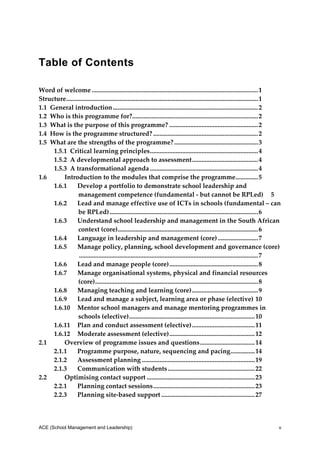
Table of Contents
 
Word of welcome ....................................................................................................... 1 
Structure ...................................................................................................................... 1 
             .
1.1  General introduction .......................................................................................... 2 
1.2  Who is this programme for? ............................................................................. 2 
                                                    .
1.3  What is the purpose of this programme? ....................................................... 2 
1.4  How is the programme structured? ................................................................. 2 
1.5  What are the strengths of the programme? .................................................... 3 
        1.5.1  Critical learning principles ................................................................... 4 
        1.5.2  A developmental approach to assessment  ........................................ 4 
                                                                                         .
        1.5.3  A transformational agenda ................................................................... 4 
1.6         Introduction to the modules that comprise the programme  ............. 5                                .
        1.6.1  Develop a portfolio to demonstrate school leadership and 
                  management competence (fundamental ‐ but cannot be RPLed)  5 
        1.6.2  Lead and manage effective use of ICTs in schools (fundamental – can 
                  be RPLed) ............................................................................................ 6 
        1.6.3  Understand school leadership and management in the South African 
                  context (core)  ...................................................................................... 6 
                                           .
        1.6.4  Language in leadership and management (core) ......................... 7 
        1.6.5  Manage policy, planning, school development and governance (core)
                   ............................................................................................................... 7 
        1.6.6  Lead and manage people (core) ....................................................... 8 
        1.6.7  Manage organisational systems, physical and financial resources 
                  (core) ..................................................................................................... 8 
        1.6.8  Managing teaching and learning (core) ......................................... 9 
        1.6.9  Lead and manage a subject, learning area or phase (elective) 10 
        1.6.10  Mentor school managers and manage mentoring programmes in 
                  schools (elective) .............................................................................. 10 
        1.6.11  Plan and conduct assessment (elective) ....................................... 11 
        1.6.12  Moderate assessment (elective) ..................................................... 12 
2.1         Overview of programme issues and questions .................................. 14 
        2.1.1  Programme purpose, nature, sequencing and pacing ............... 14 
        2.1.2  Assessment planning ...................................................................... 19 
        2.1.3  Communication with students ...................................................... 22 
2.2         Optimising contact support ................................................................... 23 
        2.2.1  Planning contact sessions ............................................................... 23 
        2.2.3  Planning site‐based support .......................................................... 27 


ACE (School Management and Leadership)                                                                                             v
2.3      General learner support issues  ............................................................. 29 
                                                          .
     2.3.1  Open learning and adult students ................................................ 29 
     2.3.2  Planning, facilitating and evaluating networking contact sessions 30 
     2.3.3  The facilitator as a counsellor ........................................................ 31 
     2.3.4  Providing feedback on assessment .............................................. 33 
                                                                         .
     2.3.5  Monitoring student progress ......................................................... 35 
2.4      Concluding remarks ................................................................................ 36 
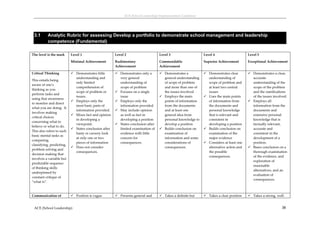
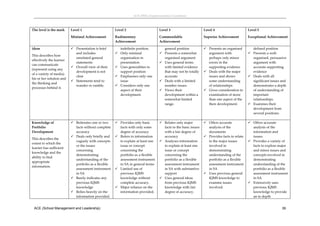
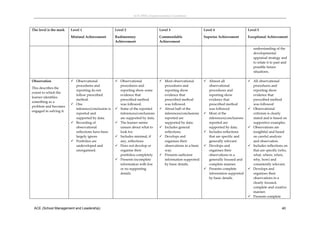
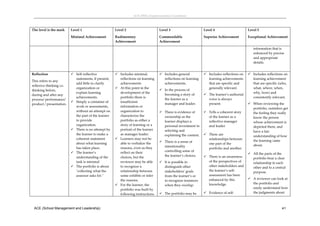
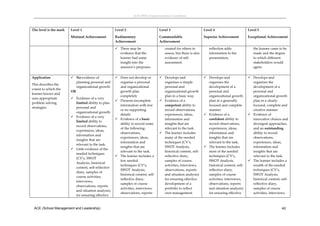
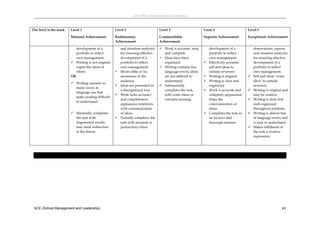
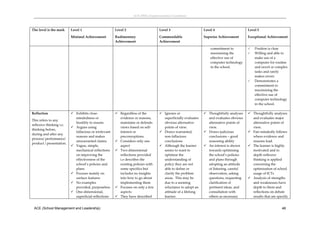
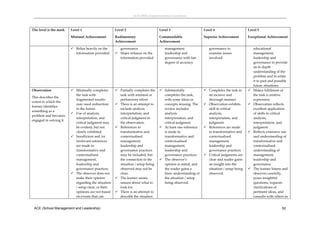
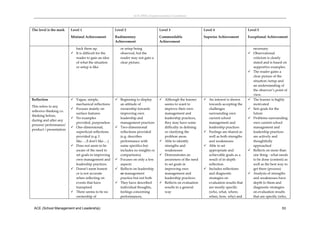
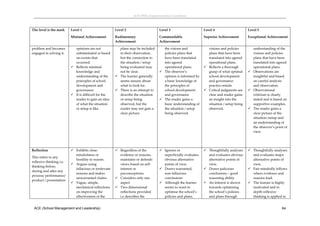
     3.1  Analytic Rubric for assessing Develop a portfolio to demonstrate 
           school management and leadership competence (Fundamental)38 
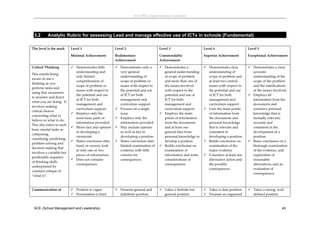
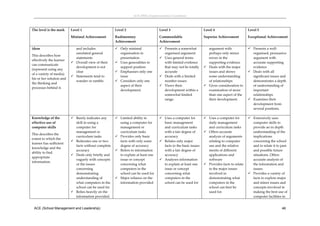
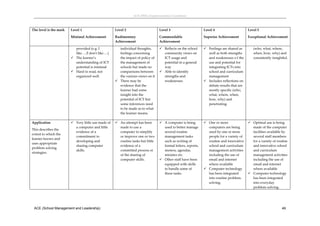
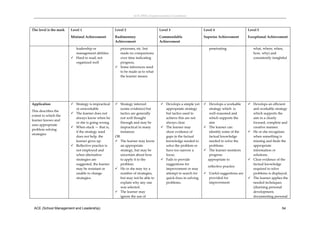
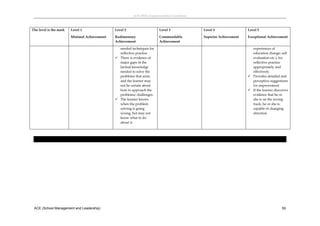
     3.2  Analytic Rubric for assessing Lead and manage effective use of ICTs in 
           schools (Fundamental) ........................................................................ 45 
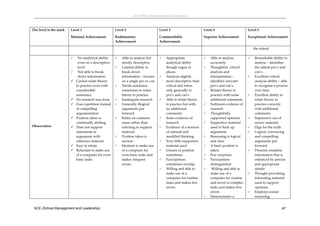
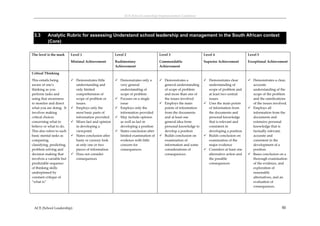
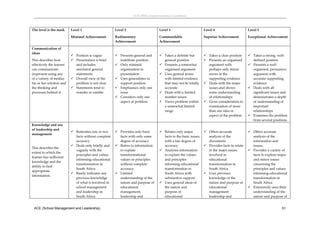
     3.3  Analytic Rubric for assessing Understand school leadership and 
           management in the South African context (Core) ......................... 50 
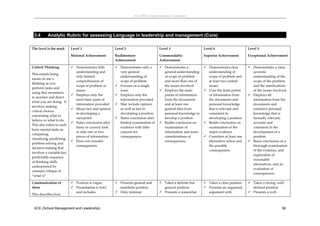
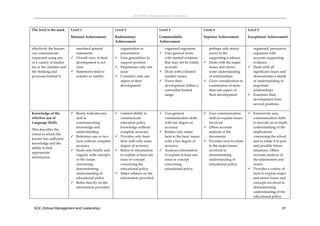
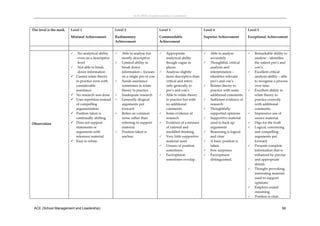
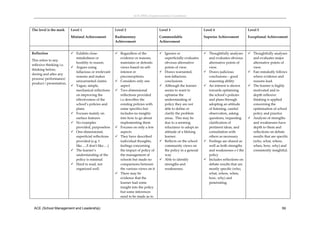
     3.4  Analytic Rubric for assessing Language in leadership and management 
           (Core) ...................................................................................................... 56 
     3.5  Analytic Rubric for assessing Manage policy, planning, school 
           development and governance (Core) ............................................... 61 
                                                                        .
     3.6  Analytic Rubric for assessing Manage organizational systems, physical 
           and financial resources (Core) ........................................................... 67 
     3.7  Analytic Rubric for assessing Lead and manage people (Core) . 73 
     3.8  Analytic Rubric for assessing Managing teaching and learning (Core)
             0 
           8
     3.9  Analytic Rubric for assessing Leading and managing a subject area / 
           learning area/ phase (Elective) ........................................................... 85 
     3.10  Analytic Rubric for assessing Mentor school managers and manage 
           mentoring programmes in schools (Elective) ................................. 91 
     3.11  Analytic Rubric for assessing Plan and conduct assessment (Elective)
           96 
     3.12  Analytic Rubric for assessing Moderate assessment (Elective) 104 


ACE (School Management and Leadership)                                                                                    vi
Acknowledgements

      This material is the product of a collaborative endeavour involving representatives 
      of the following organisations and institutions: 
       
      Cooper King 
      Department of Education – Education Management and Governance Development 
      Directorate 
      GMSA Foundation           
      Management of Schools Training Programme (MSTP) 
      Matthew Goniwe School of Leadership and Governance (MGSLG) 
      National Association of Professional Teachers of South Africa (NAPTOSA) 
      National Association of Teacher Unions (NATU) 
      Pauline Matlhaela and Associates, Skills Development Services Pty (Ltd) 
      Regenesys 
      South African Democratic Teachers Union (SADTU) 
      South African Institute for Distance Education (SAIDE) 
      South African Principals’ Association (SAPA) 
      Shuttleworth Foundation 
      Ukukhula Projects 
      University of Fort Hare 
      University of South Africa (UNISA) 
      University of Stellenbosch 
      University of the Free State 
      University of the Witwatersrand 
      Zenex Foundation 
       
      as well as a number of individual consultants, and reflects feedback received from 
      personnel from all the Higher Education Institutions involved in developing this 
      course. 


ACE (School Management and Leadership)                                                       vii
Foreword


Foreword
The  ACE  (School  Management  and  Leadership)  represents  an  exciting  initiative  in  the 
professional development of aspirant school principals. 
 
This  manual  provides  an  overview  of  the  design  and  expected  delivery  of  the  new 
programme. 


Philosophy and thinking underpinning the ACE (School Management and
Leadership) programme
 
The key focus of the ACE (School Management and Leadership) programme is to facilitate 
real transformation in schools that is grounded in recognition of the challenges of particular 
contexts and the values underpinning the South African Constitution. Principals and would‐
be principals must understand that it is not acceptable simply to pay lip service to the ideas 
presented in the programme, to develop polices that are not implemented in practice or to 
adopt  a  minimal  compliance  stance.  Instead,  a  deliberate  attempt  is  made  to  encourage 
critical reflection on current practices, planning for improvement, action based on informed 
understandings  and  monitoring  and  evaluation  that  is  critical  and  responsive.  The 
assessment tasks set for students in this programme must yield evidence that the school has 
changed for the better in ways that reflect a commitment to and practice of transformational 
leadership. In this process, critical issues such as gender equality, HIV/AIDS, and improved 
and improving learner performance must be squarely addressed. 


ACE (School Management and Leadership)                                                         viii
ACE SML Implementation Guidelines


Acronyms and Abbreviations
 
AC           Assessment Criteria 
ACE          Advanced Certificate in Education 
CCFO         Critical cross‐field outcome 
DSG          Development Support Group 
EC DoE       Eastern Cape Department of Education 
EMD          Education Management Development 
ETQA         Education and Training Quality Assurance body 
INSET        In‐service Education and Training 
IQMS         Integrated Quality Management System 
NCS          National Curriculum Statement 
NLH          Notional Learning Hours – an estimate of actual study time 
NLRD         National Learners’ Records Database 
NQF          National Qualifications Framework 
OBA          Outcomes‐Based Assessment 
OBE          Outcomes‐Based Education 
PGP          Personal Growth Plan 
PoE          Portfolio of Evidence 
RPL          Recognition of Prior Learning 
SACE         South African Council of Educators 
SAQA         South African Qualifications Authority 
SDT          Staff Development Team 
SGB          School Governing Body 
SGB          Standards Generating Body 
SMT          School Management Team 
SO           Specific Outcome 
US           Unit Standard  


ACE (School Management and Leadership)                                     ix
ACE (SML) Implementation Guidelines 


Overview

Word of welcome
Welcome  to  this  implementation  guide  for  the  ACE  (School  Leadership)  programme.  The 
aim  of  this  implementation  guide  is  to  help  HEIs  identify  the  key  design  and  delivery 
implications of the programme. It will be complemented by a training session. 
By  the  time  you  have  finished  working  through  this  manual,  we  hope  that  you  will  feel 
better able to: 
       identify the key design characteristics of the programme 
       identify  key  questions  and  issues  which  your  institution  will  need  to  address  in 
        planning for the implementation of the programme 
       identify the assessment criteria linked to each module of the programme. 


Structure
The manual is divided into three sections as detailed below. 
 
Section 1: Programme overview 
 
Section 2:  Key questions and issues 
 
Section 3:  Assessment rubrics. 


ACE (School Management and Leadership)                                                             1
ACE (SML) Implementation Guidelines 


    Section 1: Programme overview

1.1 General introduction
Welcome to the Advanced Certificate: Education (School Management and Leadership).


1.2 Who is this programme for?
 
The ACE programme is aimed at empowering school leaders to lead and manage schools
effectively in a time of great change, challenge and opportunity. It is targeted at serving
School Management Team members who aspire to principalship.


1.3 What is the purpose of this programme?

The programme seeks to provide structured learning opportunities that promote quality
education in South African schools through the development of a corps of education leaders
who apply critical understanding, values, knowledge and skills to school leadership and
management within the vision of democratic transformation.

It seeks to empower/enable these educators to develop the skills, knowledge, and values
needed to lead and manage schools effectively and to contribute to improving the delivery of
education across the school system.


1.4 How is the programme structured?
 
The ACE (School Leadership) is a programme that has been registered on the NQF at NQF
Level 6 with an exit level at REQV14.

The programme will normally take two years of part-time study to complete.

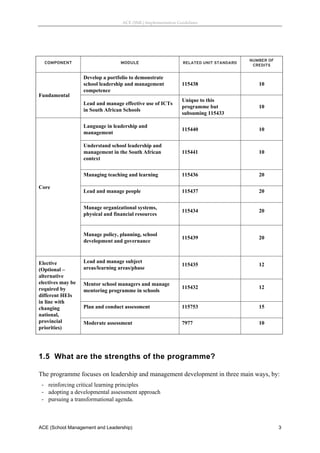
Each component of the programme comprises a number of modules as summarized in the
table below.


ACE (School Management and Leadership)                                                    2
ACE (SML) Implementation Guidelines 


                                                                                        NUMBER OF
     COMPONENT                      MODULE                      RELATED UNIT STANDARD
                                                                                         CREDITS


                    Develop a portfolio to demonstrate
                    school leadership and management            115438                     10
                    competence
Fundamental
                                                                Unique to this
                    Lead and manage effective use of ICTs
                                                                programme but              10
                    in South African Schools
                                                                subsuming 115433

                    Language in leadership and
                                                                115440                     10
                    management

                    Understand school leadership and
                    management in the South African             115441                     10
                    context


                    Managing teaching and learning              115436                     20

Core
                    Lead and manage people                      115437                     20


                    Manage organizational systems,
                                                                115434                     20
                    physical and financial resources


                    Manage policy, planning, school
                                                                115439                     20
                    development and governance


Elective            Lead and manage subject
                                                                115435                     12
(Optional –         areas/learning areas/phase
alternative
electives may be    Mentor school managers and manage
required by                                                     115432                     12
                    mentoring programme in schools
different HEIs
in line with
changing            Plan and conduct assessment                 115753                     15
national,
provincial          Moderate assessment                         7977                       10
priorities)


1.5 What are the strengths of the programme?
 
The programme focuses on leadership and management development in three main ways, by:
    ‐ reinforcing critical learning principles
    ‐ adopting a developmental assessment approach
    ‐ pursuing a transformational agenda.


ACE (School Management and Leadership)                                                              3
ACE (SML) Implementation Guidelines 


1.5.1 Critical learning principles
The following learning principles underpin the teaching and assessment of the programme:
    ‐ Directed and self‐directed learning in teams and clusters 
    ‐ Site based learning (dependent on the content) 
    ‐ Variety  of  learning  strategies  i.e.  lectures,  practice  and  research  portfolios  amongst 
      others 
    ‐ Parallel use throughout of individual and group contexts of learning 
    ‐ Collaborative learning through interactive group activities e.g. simulations, debates 
    ‐ Problem‐focused deliberation and debate in group contexts 
    ‐ Critical reflection on group processes, group effectiveness 
    ‐ Critical reflection and reporting on personal growth and insights developed 
    ‐ Research and experimentation. 


1.5.2 A developmental approach to assessment
The assessment strategy includes a variety of options to demonstrate and provide evidence of
practice, based on the anticipated outcomes and against the assessment criteria. Depending on
the institution and circumstances, this could include activities such as case studies, problem
solving assignments, practice in simulated and in real contexts, projects, written and oral
presentations.
    ‐ The  assessment  is  focused  on  applied  competence.    The  assessment  evidence  
      should include: 
             o Assignments and/or examinations, providing evidence of the ability to apply 
                 knowledge to practice 
             o Oral Presentations, which should be observed in context to observe ability to 
                 communicate with comprehension 
             o Two  or  more  work  based  projects  to  demonstrate  the  application  of  the 
                 learning and insights from preferably the core modules 
             o A portfolio of practice evidence, which will support all modules 
             o Evidence  of  self‐,  peer‐,  tutor  assessment  as  well  as  on‐site  verification  of 
                 leadership and management competence. 

As students work through the programme, they will keep a reflective journal and prepare a
portfolio of evidence of their growth and achievements. This evidence will contribute
towards their final summative assessment.


1.5.3 A transformational agenda
The programme is offered through a practice-based part-time mode so that students can work
and learn at the same time. They will find that about 50% of the work that they need to do for
the programme comprises activities that they will plan, execute and evaluate at their school.
By the time they have completed the programme, it should be possible to provide evidence
that their participation has helped to change their school for the better.


ACE (School Management and Leadership)                                                               4
ACE (SML) Implementation Guidelines 


1.6     Introduction to the modules that comprise the programme
 
This section provides an overview of each module in the programme organized into the 
sequence in which students will most likely engage with them. The overview can be cross‐
referenced with the relevant unit standard in the course outline and the associated analytic 
assessment rubric in part three of this document. 


1.6.1 Develop a portfolio to demonstrate school leadership and management
      competence (fundamental - but cannot be RPLed)
 
The main purpose of this module is to assist students to compile a reflective portfolio with 
evidence of their competence in school management and leadership. The secondary purpose 
is  to  enable  them  to  understand  the  use  of  portfolios  as  an  assessment  instrument,  so  that 
they  will  be  able  to  promote  their  use  for  assessing  learners  in  their  school.  The  module 
should  enable  students  to  successfully  complete  the  unit  standard,  ‘Develop  a  portfolio  to 
demonstrate  school  management  and  leadership’  (SAQA  ID  number  115438)  which  is 
included in the ACE qualification. The module will also assist them to put together relevant 
evidence  to  demonstrate  their  competence  in  the  other  unit  standards  of  the  ACE 
qualification. 
 
The portfolio unit standard has been included in the qualification because the designers of 
the  qualification  assumed  that  not  all  students  in  this  programme  would  know  how  to 
develop  a  portfolio  that  reflects  their  management  and  leadership  competence.  Therefore 
this module guides them through the process of developing a reflective portfolio to record 
all evidence relevant to the core unit standards of the ACE qualification that cover the key 
competencies of school managers/leaders.  
 
These core unit standards are described in the portfolio unit standard as the ‘core exit level 
outcomes’: 
 

   Demonstrate effective language skills in school leadership and management (ID number 
    115440); 
     
   Manage policy, planning, school development and governance (ID number 115439); 
 
   Lead and manage people (ID number 115437); 

   Manage  organizational  systems  and  physical  and  financial  resources  (ID  number 
    115434); and 


ACE (School Management and Leadership)                                                                  5
ACE (SML) Implementation Guidelines 


   Managing teaching and learning (ID number 115436). 

The final portfolio will therefore be a comprehensive record of all the evidence that students 
produced  during  these  core  modules  of  the  programme,  which  would  include  completed 
assignments, written tests and work‐based projects. The portfolio will also contain relevant 
evidence  that  students  may  have  produced  during  the  execution  of  their  regular  school 
management/leadership functions, either before or during the programme, on condition that 
these  relate  directly  to  the  outcomes  in  the  above‐mentioned  core  unit  standards.  The 
portfolio  will  also  include  a  journal  that  represents  a  working  document  linked  to  all  the 
modules in the programme as determined by each HEI. 


1.6.2 Lead and manage effective use of ICTs in schools (fundamental – can be
      RPLed)
 
This  module  is  premised  on  the  understanding  that  it  is  difficult  for  a  school  leader  and 
manager to be optimally effective without making use of computer technology at least at a 
basic level to create documents, manage information, speed up routine procedures and data 
processing and stay informed about changes that will impact on the school. The module first 
makes the case for why school leaders and managers should seek to develop their computer 
literacy skills and then proceeds into a formal basic introduction to the nature of computers, 
how  they  work  and  the  names  and  functions  of  the  various  parts.  The  module  makes  a 
deliberate attempt to demystify the technology and to examine how the day‐to‐day tasks of 
the  leader  and  manager  could  be  simplified  by  the  use  of  appropriate  technology  and 
software.  The  module  therefore  provides  basic  skills  for  navigating  and  using  word‐
processing,  database,  spreadsheet  and  internet/email  functions  to  optimise  daily  functions 
such as recording, reporting, budgeting and curriculum design and delivery. It then briefly 
explores  how  ICTs  may  be  integrated  optimally  into  teaching,  learning  and  management 
processes. 


1.6.3 Understand school leadership and management in the South African
      context (core)

This module gives an overview of what management and leadership is about in a school
setting. From the perspective of an aspiring principal it begins a process of developing
understanding about the challenges that face principals on a daily basis and allows students to
also explore their own realities and decide on new and better action. In addition, they will
look at some of the international trends in management and leadership and will compare what
is happening in the South Africa scene to others.

The main purpose of this module is to give students an understanding of some of the debates
around leading and managing schools and to frame these debates within three scenarios,


ACE (School Management and Leadership)                                                                 6
ACE (SML) Implementation Guidelines 


namely: a reflection of themselves as a future leader within the realities they have to face on
a daily basis, a reflection of themselves as a team player but also a leader and manager of the
school and finally a reflection of their work as a present day manager within the context of
the broader educational field.

In completing this range of reflections they will be learning a skill to help them complete
their learning journal and portfolio. This will in turn set a benchmark for their work and for
the way that they continue to work when completing the other modules.
 
In  many  ways  this  module  sets  the  foundation  on  which  the  core  programme  is  built.  It 
raises  issues  which  are  therefore  explored  in  the  other  core  modules  dealing  with  leading 
and managing people, policy, language, organisational, physical and financial resources and 
managing teaching and learning in more detail. 


1.6.4 Language in leadership and management (core)

This module serves a dual purpose. On the one hand it is aimed at developing the reading,
writing, speaking and listening skills students need to successfully work their way through all
the modules included in this ACE programme. On the other hand the module is aimed at
providing them with the ability to use language as a management and leadership tool,
specifically in the area of policy development and implementation.

This module explores a number of questions and/or issues, namely:
    ‐ How  can  educational  managers  and  leaders  use  language  to  inform,  educate  and 
      influence people? This question is explored in Units 1, 2 and 3. 
    ‐ How can the effective use of language enhance communication and establish supportive 
      relationships with those inside and outside schools? This question is explored in Units 1, 
      2 and 3. 
    ‐ Which  writing  skills  should  school  principals  and  classroom  teachers  have  in  order  to 
      effectively  perform  their  respective  management  and  leadership  functions?    This 
      question is explored in Unit 3. 
    ‐ What  skills  are  required  to  critically  read  and  understand  policy  documents?  This 
      question is explored in Units 4 and 5.  


1.6.5 Manage policy, planning, school development and governance (core)
 
This core module is about understanding, and managing the requirements of education law, 
policy, planning, school development and governance, and the changes which schools must 
implement and manage. 
The module examines the role of the principal and school management team in managing 
policy, planning, governance and school development. It considers how values, vision and 


ACE (School Management and Leadership)                                                                7
ACE (SML) Implementation Guidelines 


mission can be developed and communicated within the school as an organisation, and the 
personal characteristics of the principal in establishing and maintaining these key areas. It 
foregrounds the knowledge, and the actions which school leaders must take to comply with 
the legislative and policy requirements, as critical to the functionality of the school through 
good management and governance. 


1.6.6 Lead and manage people (core)
 
There seems to be a movement away from the term human resource management and instead
“people management and leadership” is presently used when dealing with the people in the
organization, which implies that it is the people in a school who ‘win or lose the battle’
towards achieving the set goals.

It is increasingly acknowledged that people play a critical role in the school and that people
leadership and management has ultimately become the responsibility of the SMT (School
Management Team) of a school. The Minister of Education, Naledi Pandor, expressed her
concern about education leadership by saying:
       “We have a (school) leadership that cannot analyse, cannot problem-solve, cannot
       devise strategic interventions and plans and cannot formulate perspectives that are
       directed at achieving success”.
       (Business Day, 30 December 2004)
This type of concern correlates with the views of Jones and George (2003:98) that refer to the
role of the leader to set the values, norms and standards for behaviour, and to communicate
the expectations that influence the way in which individuals, groups and teams interact with
one another and co-operate to achieve organisational goals.

The task of people leadership and management reveals both a tactical and a strategic role
within every aspect of planning, allocating, supporting and evaluating work, as well as
developing personal and professional skills and creating an environment conducive to
collective bargaining, collaboration and negotiation.

The module explores these issues through a set of expanding lenses that begin by exploring
personal qualities with reference to relevant theory and then move on to consider
management of oneself and others, staffing and labour relations.


1.6.7 Manage organisational systems, physical and financial resources (core)

This module examines the structures, systems and processes that should be established in
order for a school to be effective. The expectation of all stakeholders in the school
environment is that an effective school will be able to provide an education of progressively
higher quality for all learners.


ACE (School Management and Leadership)                                                         8
ACE (SML) Implementation Guidelines 


The premise of this module is that effective education is built upon, and grounded in,
policies, principles and values. The acts, regulations and policies of national and provincial
governments have created the framework and values within which the school’s organisational
systems, and physical and financial resources should be managed.

If a school is to be managed effectively, it must be well organised, and this applies to every
part of the school system. Furthermore, the interrelationships between the different systems
must also be managed effectively, since they depend on one another for effective functioning.

A school is an organisation that consists of many different parts. The principal is not only an
educational manager; he/she is also the leader of the school, and a vital part of his/her role is
to manage the school’s organisational systems and physical and financial resources.

This module further holds that there are certain core areas of performance that are essential
for schools to be successful and fulfil their mandates. These core performance areas are the
elements from the model for ‘whole-school development’, which are dealt with in more detail
in the module. The core performance areas are interrelated and are supportive of one another.
Similarly, any one policy or principle of the legislative framework governs a number of these
core areas of performance. Examples of core areas of performance are effective leadership
and management, information management and communication systems.


1.6.8 Managing teaching and learning (core)
 
This module focuses on the core business of transforming schools, that of teaching and
learning. The purpose of this module is to enable students to acquire relevant knowledge and
skills as well as to develop appropriate attitudes and values in order to manage teaching and
learning effectively.

The module begins by exploring the school as a learning organization and promoting a
culture of learning and teaching, which is dedicated to constant renewal and improvement. It
also tackles the issue of context, and looks at the ways in which the physical environment of
the school impacts on the quality of learning. This leads into an exploration of the challenges
of effectively planning, implementing, monitoring and evaluating a curriculum that needs
constantly to change and reinvent itself in line with the changing needs of a changing society.
In particular, the module focuses on what is required to improve teaching and learning in
order to produce enhanced learner outcomes. This paves the way for the identification and
development of the skills and processes needed to lead and manage effective teaching and
learning.


ACE (School Management and Leadership)                                                         9
ACE (SML) Implementation Guidelines 


1.6.9 Lead and manage a subject, learning area or phase (elective)
 
The  purpose  of  this  module  is  to  develop  effective  curriculum  leaders  and  managers  who 
will  enhance  the  quality  of  teaching  and  learning  through  application  of  the  theories, 
concepts and issues handled in this module. It is hoped that in examining these issues school 
principals and SMT members will be more conscious of their role of leading and facilitating 
transformation in schools. 
 
The  module  focuses  on  management  and  leadership  regarding  implementation  of  subject 
and learning areas in different phases of learning and teaching, from Grade R to Grade 12. 
 
It  should  be  noted  that  many  of  the  topics  and  issues  discussed  in  this  module  feature  in 
other  modules  as  well,  particularly  the  core  module  on  Managing  Teaching  and  Learning. 
However,  this  module  deals  with  these  topics  from  the  perspective  of  formal  curriculum 
delivery  at  school  and  classroom  level.  Curriculum  delivery  in  this  sense  means  the 
implementation of subject and learning areas in all phases of schooling. Learning Outcomes 
and syllabuses as well as the subjects and learning areas are documented into a curriculum 
for schools. Viewed from this perspective, this module is about curriculum delivery. 


1.6.10 Mentor school managers and manage mentoring programmes in
       schools (elective)
 
Mentoring  is  increasingly  seen  as  an  effective  way  of  helping  people  develop  in  their  jobs 
and careers.  
 
In a constantly changing environment, there is a great need for people to change, adopt and 
adapt  to  the  changes.  This  is  no  less  true  of  schools.  School  managers  seem  to  be  natural 
candidates as  mentors  in  schools.  They  have  an  important  role  to  play  in  developing  their 
colleagues to cope with the new pressures and new imperatives. In view of the changes, all 
school  managers  are  expected  to  be  seeking  to  add  value  to  their  schools  by  acquiring 
mentoring skills and the ability to manage mentoring programmes.  
 
In  the  South  African  context  the  changes  mentioned  above  include  the  introduction  of  the 
new curriculum, a new approach to school governance where the community is encouraged 
to be actively involved and participatory management of schools. 


ACE (School Management and Leadership)                                                                 10
ACE (SML) Implementation Guidelines 


The  mentoring  programmes  and  mentoring  skills  which  schools  are  supposed  to  develop 
are also relevant to teachers whose responsibilities may include mentoring other educators 
so that high quality teaching and effective use of resources result in improved standards of 
achievement  for  all  learners.    This  module  aims  at  empowering  school  managers  and 
teachers to develop and implement appropriate mentoring programmes. 


1.6.11 Plan and conduct assessment (elective)
 
The  focus  of  this  module  is  not  on  assessment  per  se  but  on  its  management  and/or 
administration. In this module they will learn how to plan for and conduct assessment in such a 
way that it becomes an integral part of the teaching and learning programme rather than an 
additional administrative burden.  
 
A well‐conceived assessment plan does not only benefit teachers; it also contributes to more 
effective  learning  in  the  sense  that  learners  know  beforehand  when  and  how  assessments 
will  be  conducted  and  are  therefore  able  to  plan  ahead,  accepting  some  responsibility  for 
their  own  learning  as  stipulated  in  the  SAQA  critical  cross‐field  outcomes.  In  addition,  it 
might help to change perceptions of assessment as an event to be dreaded to a perception of 
assessment as a learning experience, a process that is not aimed at ‘catching out’ learners but 
rather  at  supporting  and  monitoring  their  learning  towards  the  achievement  of  pre‐
determined outcomes.  
 
Siebörger (1998:75) suggests that the way assessment takes place in a school is an important 
indicator  of  the  overall  quality  of  that  school,  not  only  in  terms  of  the  academic 
achievements of the learners, but also in terms of the extent to which the school is achieving 
its aims and contributing to national aims and goals. Siebörger’s comments link assessment 
with management, administration and leadership, another role required of all teachers and a role 
that is particularly pertinent to the Advanced Certificate in Education (School Leadership). 
In this regard the Norms and Standards for Educators, states that educators will be required to 
‘make  decisions  appropriate  to  the  level  (concerned),  manage  learning  in  the  classroom, 
carry  out  classroom  administrative  duties  efficiently  and  participate  in  school  decision‐
making structures … in ways which are democratic, which support learners and colleagues, 
and which demonstrate responsiveness to changing circumstances and needs’. 
 
This module is aimed at helping students perform these roles to the best of their ability. As 
such,  it  provides  them  with  information  on  assessment  and  evaluation  in  general  and  on 
outcomes‐based assessment in particular.  


ACE (School Management and Leadership)                                                                11
ACE (SML) Implementation Guidelines 


It attempts to show them how assessment contributes to quality teaching and learning and 
how it promotes accountability. Most importantly, though, it places assessment in a systemic 
context, indicating how it could be used as a tool for transformation.   
 
What this module does not do is to teach students how to design assessment instruments or 
how  to  integrate  assessment  into  teaching  and  learning.  These  aspects  of  assessment  are 
dealt with in other modules in this course. The design of this module is, therefore, informed 
by the assumption that students have already mastered the basics of assessment, that they 
know how to design assessment instruments and that their school has an assessment policy 
in  place.    In  this  sense  this  module  builds  on  previous  modules  that  dealt  with  teaching, 
learning, management and policy development. Its purpose is two‐fold: to stimulate critical 
thinking  on  assessment,  with  particular  reference  to  outcomes‐based  assessment,  and  to 
enable students to effectively and efficiently manage assessment at different systemic levels. 


1.6.12 Moderate assessment (elective)
 
The focus of this module is on the moderation of assessment. With the current emphasis on 
accountability  and  quality  assurance  in  education  all  over  the  world,  moderation  has 
become  a  crucial  means  of  ensuring  fairness  and  consistency  in  educational  assessments. 
Ensuring  the  quality,  fairness  and  integrity  of  assessments  is  also  a  crucial  part  of 
educational management.  
 
With the move to outcomes‐based education, which is an assessment intensive system, there 
has  been  a  need  to  ensure  that  the  quality  of  assessment  does  not  negatively  impact  on 
teaching  and  learning.  In  the  past,  the  bulk  of  quality  assurance  activities  took  place 
externally  to  the  school  itself  –  with  the  Grade  12  external  examination  being  the  prime 
indicator of the quality of education taking place at a particular school. In outcomes‐based 
education, schools themselves have to accept this responsibility. It is, therefore, important to 
ensure that all educators, but especially educational managers, have the knowledge and/or 
expertise  to  establish  and  maintain  systems  and  processes  that  reflect  best  practice. 
Moderation is one such process and this module is aimed at assisting current and aspiring 
educational managers to develop the requisite expertise in this area.  
 
Based on the assumption that everyone that is registered for this module is an educator and 
that all of them are aspiring to be educational managers some day, the learning content has 
been  carefully  selected  to  reflect  educational  situations  where  a  critical  understanding  of 
quality  assurance,  standards  and  moderation  is  crucial.  Consequently,  the  activities  and 
assignments in this module require students to apply everything they learn in establishing 
and maintaining moderation systems and processes to their own school.  


ACE (School Management and Leadership)                                                                12
ACE (SML) Implementation Guidelines 


         Section 2: Key questions and
                    issues
In this section we identify some of the questions and issues that HEIs will need to address in 
their planning for the roll‐out of the ACE (School Management and Leadership). The issues 
and questions have been divided into three sections as follows: 
 
2.1      Programme issues 
2.1.1    Programme purpose, nature, sequencing and pacing 
2.1.2    Assessment planning 
2.1.3    Communication with students. 
 
2.2      Optimising contact support 
2.2.1    Planning contact sessions 
2.2.3    Planning site‐based support. 
 
2.3      General learner support issues 
2.3.1    Open learning and adult students 
2.3.2    Planning, facilitating and evaluating networking contact sessions 
2.3.3    The facilitator as a counsellor 
2.3.4    Providing feedback on assessment 
2.3.5    Monitoring student progress. 
 
The  issues  and  questions  identified  in  this  section  are  illustrative  only.  There  may  well  be 
additional issues and questions that will arise as HEIs engage with their planning processes. 
We will first present the questions that have occurred to us. Then we will discuss some of 
the  issues  related  to  finding  answers  to  these  questions.  At  the  end  of  each  section,  we 
present  a  case  study  of  a  fictional  HEI  called  the  National  University  of  South  Africa 
(NUSA).  The  NUSA  case  studies  represent  one  way  in  which  the  questions  and  issues 
discussed might be addressed and are based on experience of practises at several HEIs. The 
case studies should not be construed as the answer but rather as an answer to the questions 
posed.  You  may  well  disagree  with  NUSA’s  approach,  but  hopefully  the  case  study  will 
serve to help focus your own institutional discussions. 


ACE (School Management and Leadership)                                                                 13
ACE (SML) Implementation Guidelines 


2.1     Overview of programme issues and questions


2.1.1 Programme purpose, nature, sequencing and pacing
 

Key questions 
Does everybody involved share a common understanding of the purpose and nature of the 
programme? 
In what sequence will students work through the modules? 
How will the workload be split between semesters and years of study? 
How will the institution ensure that students remain on track with the workload and cross‐
cutting activities such as the development of their portfolios? 
 

Discussion 
By  the  time  that  you  read  this,  we  assume  that  you  will  have  already  engaged  with  the 
programme overview in Section One of this guide. This programme overview appears in the 
Portfolio and Context modules that underpin the ACE (SML) programme because we want 
students  to  think  of  the  modules  as  parts  of  a  coherent,  integrated  programme  and  not  as 
discrete sets of information to be “passed” and forgotten. 
 
What  are  the  key  design  concerns  of  the  programme?  The  first  main  emphasis  in  this 
programme is to understand the importance of context. The core module Understand School 
Leadership  and  Management  in  Context  can  be  seen  as  the  foundational  module  of  the 
programme in this regard. 
 
In designing and developing the materials, we have been guided by the following criteria: 
 
A consistent, integrated but explicit common understanding across the modules 
We  have  tried  to  ensure  that  here  is  a  consistent  ‘voice’  or  awareness  through  all  the 
modules  of  the  programme:    the  modules  speak  from  a  position  of  authority  (a  value 
position)  about  matters  such  as:    the  moral  purpose  of  leadership  in  the  South  African 
context  and  in  schools;  the  constitutional  basis  of  power  and  acceptance  of  the  exercise  of 
authority/leadership  within  the  rule  of  law  –  subject  to  transparency,  accountability, 
inclusion, participative processes, legitimacy; confidence in the underlying values regarding 
transformation  of  society  through  educational  leadership;  the  multiple  roles  of  school 
leadership and management; the relationship of the student/candidate to knowledge, skills, 
values, personal attributes/behaviour – i.e. learning is not to master knowledge but to apply 


ACE (School Management and Leadership)                                                                 14
ACE (SML) Implementation Guidelines 


it  responsibly  in  a  given  social  context;  and  the  fact  that  leadership  and  management  is 
primarily  not  an  efficiency  matter  but  about  building  people  –  staff  and  students. 
Assessment tasks set by HEIs will have a key role to play in making this a reality. 
 
A strong and focused sense communicated of the strategic importance of the ACE 
This ACE is about developing principalship.  The aim of the programme is to make a major 
intervention  into  South  African  society  and  build  effective  democratic  citizenship  through 
more effective leadership in the principalship of the nation’s schools.  The material invites in 
candidates a mind set that asks: 
       What are my/our goals and aspirations? 
       Where do I fit in? 
       Who do I need to work with and how will we win (reach the goals)? 
       What capabilities do I/we have? 
       What leadership and management skills, systems and structures do I/we need? 
 
A  pervading  sense  of  how  directly  the  South  African  context  influences  the  purpose  of 
the modules, the knowledge they impart and the practices they encourage  
Here  we  are  concerned  with  issues  such  as  relevance,  immediacy,  authenticity,  challenge, 
appeal  and opportunity.    It  is absolutely  essential  to  have  the  required  impact  in  the  South 
African context, and this ACE programme therefore tries to establish its notions of leadership 
and  management,  especially  the  role  of  the  principal,  fundamentally  in  certain  realities  of 
the country’s actual context.   
 
Underpinning values 
This ACE programme aims at developing leadership and management that supports ideals 
such  as  ‘transformation’,  ‘empowerment’  and  ‘democratisation’.    To  stop  these  from  being 
merely  rhetorical,  we  have  tried  to  ensure  consistent  and  conscious  awareness  in  all  the 
modules  of  governance,  leadership  and  management  as  being  to  do  with  the  exercise  of 
power and authority.  If justice and legitimacy are taken as central values to do with power, 
then there needs to be quite a strong emphasis on values and evidence of behaviour that are 
conducive  to  justice  and  legitimacy,  e.g.  accountability,  transparency,  openness,  fairness, 
giving  a  voice,  hearing  all  sides,  participation,  inclusion,  due  process,  right  of  appeal, 
administrative justice, etc. 
 
Knowledge base, theory 
As  already  suggested  above  there  should  be  a  sense  of  engaging  with  knowledge  and 
knowledge  construction  throughout  the  programme.    Part  of  the  context  of  this  ACE 


ACE (School Management and Leadership)                                                                 15
ACE (SML) Implementation Guidelines 


programme  is  that  it  proposes/invites  an  innovative  approach  to  theory  and  knowledge 
building.  Being site‐based and with the strong role for the portfolio (including the emphasis 
on being a ‘critical reflective practitioner’), we want to teach the candidate a habit of using 
their  own  and  others’  narratives  and  the  experience  of  their  own  school  contexts  as  a 
primary research resource. In this programme theorising therefore means to think abstractly, 
analytically and critically about one’s own situation and plan actively to improve it.  
 
Applied knowledge 
This has been an underpinning value and methodological approach from the outset, and so 
should  be  strongly  apparent  in  all  modules.    This  is  indicated  in  a  strong  emphasis  on  all 
forms of practice; site based activity; a school focus; the candidate being actively involved in 
leadership,  management  and  organizational  behaviour;  working  in  relationships,  with 
teams  and  within  multiple  structures.    It  also,  hopefully,  contradicts  the  supposed 
dichotomy  between  theory  and  practice  by  showing  how  critical  reflection  (review, 
‘research’) is an activity that leaders must do themselves, initiate, or lead others to do and 
that  leads  to  strategizing,  planning  change  (speculating,  ‘theorising’)  and  implementing 
action plans.   
 
The student’s context 
As  opposed  to  the  broad  South  African  context,  it  has  been  agreed  that  modules  and 
assessment activities should, as far as possible, be relevant to and feasible in the local context 
where  the  candidate  operates.    This  means  that  examples,  exercises  and  applications  must 
give  scope  for  a  wide  range  of  situations  and  responses,  from  urban,  township,  privileged 
elite, rural, and assume both high and low Provincial Education Department support. 
 
Personal reflection; growth   
This  has  also  been  stressed  as  a  key  methodological  strand  and  a  main  outcome  of  the 
programme. 
 
Assessment methodology  
This will be a subject for discussion during a workshop with HEIs. However, key features 
under this heading are: 
   Relevance and actuality for the most part strongly task‐ and site‐based in line with the 
    other criteria mentioned above 
   As much integration as possible, i.e. not a proliferation of activities; three or four main 
    activities per module 


ACE (School Management and Leadership)                                                                 16
ACE (SML) Implementation Guidelines 


   Where possible, building awareness of other modules – although for the most part, other 
    than in the portfolio, it is not feasible to combine assessment for more than one module 
    when these are not studied concurrently 
   A balanced distribution of work‐load between modules (in line with credits) 
   The feasibility of the assessment – i.e. how will it be assessed, by whom and when? 
 
Technical aspects; presentation. 
This covers issues such as how theoretical matter is incorporated, e.g. blocks of quoted text; 
how much referencing is done and how; length of paragraphs and variation of style within 
blocks  of  text;  frequency  of  headings  and  subheadings;  ‘units’  within  modules  –  how 
conceived and how divided, including volume of text per ‘unit’.  
 
With respect to this last item, an attempt has been made to design materials in a format that 
facilitates  independent  study,  in  line  with  the  ‘studying  while  working’  practice‐based 
nature of the programme, but also to provide the materials in ways that institutions can use 
and  adapt  most  easily.  For  this  reason,  the  materials  have  been  developed  in  an  MSWord 
template that allows for fairly easy adaptation and also in a PDF format where institutions 
can choose to use the materials in their original format without further adaptation. 
 
It will be noted from the programme outline in Section One that there are twelve modules in 
the  programme:  two  fundamentals  (only  one  of  which  can  be  RPLed);  six  core  and  four 
electives.  Institutions  will  need  to  decide  what  seems  like  the  most  appropriate  sequence 
and workload pacing to suit their own need and context. 
 

How NUSA responded 
NUSA  constituted  a  core  programme  team  of  six  academic  staff  to  run  the  programme.  Each  staff 
member  was  allocated  two  modules  and  20%  of  their  workload  time  (320  hours)  to  implement  the 
programme.  One  member  of  the  team  was  allocated  an  extra  10%  (160  hours)  to  take  overall 
responsibility for managing and coordinating the programme. 
 
The core team put two days aside to brainstorm the purpose and nature of the programme and to tease 
out  the  practical  implications  for  implementation.  They  invited  members  of  various  support 
departments such as postal administration and finance to participate in this workshop. Having found 
the discussions very useful in clarifying their own thinking, the workshop agreed that students needed 
to receive an ‘orientation’ to the programme both in print form and during the first contact session. 
The  meeting  further  agreed  that  a  semester  system  would  work  best  for  NUSA,  and  the  following 
sequencing was decided upon: 


ACE (School Management and Leadership)                                                                   17
ACE (SML) Implementation Guidelines 


Year One, Semester One: 
Fundamental: Basic computer literacy for school management (or RPL) 
Fundamental: Develop a portfolio to demonstrate school management and leadership competence 
Core: Understand school leadership and management in the South African context. 
Core: Demonstrate effective language skills in school management and leadership  
This would take care of the fundamental and foundational issues and activities that would cut across 
the programme from start to end. On completion of the Context module, students would embark on 
their first school‐based project. 
 
Year One, Semester Two: 
Core: Manage policy, planning, school development and governance 
Core: Manage organisational systems, physical and financial resources 
It  was  felt  that  the  these  modules  would  extend  the  cross‐cutting  issues  introduced  in  the  context 
module. 
 
Year Two, Semester One: 
Core: Lead and manage people  
Core: Managing teaching and learning 
It  was  felt  that  the  first  core  module  would  complete  the  suite  of  necessary  inputs  for  success, 
recognising  in  particular  that  schools  are  people‐based  entities.  The  second  core  module  would 
represent the rationale for the core programme – the reason for having schools at all and the central 
processes that are dependent for their success in appropriate leadership and management of the issues 
covered in the other core modules. 
At the end of this Semester, students would be expected to start on their second and major site‐based 
project. 
 
Year Two, Semester Two: 
Any  two  electives,  with  the  caveat  that  Moderate  assessment  would  require  prior  completion  of 
Plan and conduct assessment or an appropriate RPL process.  
Submission of second site‐based project. 
Submission of completed portfolio. 
Although completion of two electives would take students slightly over the 120 credits needed for an 
ACE,  it  was  felt  that  this  could  be  managed  given  the  practice‐based  nature  of  the  programme.  In 
addition,  NUSA  wanted  to  encourage  (but  would  not  force)  all  students  to  take  at  least  the  first 


ACE (School Management and Leadership)                                                                        18
ACE (SML) Implementation Guidelines 


assessment  module  because  experience  had  shown  that  assessment  was  a  problem  area  for  many 
school‐based educators. 


2.1.2 Assessment planning
 

Key questions 
The  key  assessment  tasks  for  the  programme  as  a  whole  comprise  a  portfolio  and  at  least 
two  integrated  workplace‐based  projects.  What  tasks  and  evidence  will  the  institution 
require with respect to these key elements of the assessment strategy? 
Institutions  may,  and  probably  will,  wish  to  set  additional  assessment  tasks  in  addition  to 
the  above  integrating  activities.  What  will  these  additional  tasks  comprise  of?  How  much 
study time will they require? When will students complete them? When and how will they 
get feedback? What will happen if students do not perform well on these additional tasks? 
How will RPL of Fundamental modules be managed? 
 

Discussion 
Many Higher Education Institutions have student information systems that are premised on 
modularisation  and  which  require  a  year  mark  based  on  work  completed  throughout  the 
course and an examination mark. The three main cross‐cutting integrated tasks required by 
the  programme  design  therefore  present  something  of  a  challenge.  In  addition,  there  is  a 
danger  that  in  the  wish  to  emphasise  the  achievement  of  integrated  programme  exit  level 
outcomes, we do not provide students with sufficient opportunity to master the constituent 
parts of the programme.  
 
The  integrated,  workplace‐based  projects  and  the  portfolio  could  draw  upon  smaller 
assessment tasks that are more module‐specific. 
 
Given  the  transformational  nature  of  the  programme,  it  also  seems  clear  that  the  projects 
need  to  guide  students  through  a  development  cycle  involving  observation,  analysis  and 
evaluation  of  the  current  state  of  affairs  at  the  school;  identification  of  areas  for 
improvement; development of an intervention strategy of some kind; implementation of the 
strategy; evaluation, reflection and re‐planning. If the programme fails to engage students in 
activities of this nature, it cannot hope to bring about change. 
 
The portfolio needs to be more than simply a collection of information. It needs to tell a story 
about the student’s experiences and growth throughout the programme as well as indicating 
the breadth and depth of his/her learning. Clearly, there must be a careful orientation to the 


ACE (School Management and Leadership)                                                                19
ACE (SML) Implementation Guidelines 


portfolio  and  continuing  support  thereafter.  Students  must  also  realise  that  although  they 
can include evidence of achievement in the form of work outputs from other modules, what 
will  make  that  evidence  an  appropriate  portfolio  item  will  be  the  accompanying  reflective 
narrative  explaining  the  rationale  for  their  choice  and  what  they  have  learned  from  the 
process. 
 
It should be noted that RPL can be granted for only one of the two fundamental modules. 
The RPL process should be explained on registration and completed as quickly as possible, 
preferably even before students start the main programme. The essence of the RPL process, 
is that students must provide evidence that they can achieve the relevant exit level outcomes 
of the module. How they managed to acquire the necessary knowledge, skills, attitudes and 
values embedded in the outcomes is irrelevant. 
 

How NUSA responded 
NUSA  understood  that  the  fundamental  modules  dealt  with  knowledge,  skills  and  attitudes/values 
that would be used by other modules throughout the course. Therefore they placed these modules in 
the first semester. When students enquired and/or registered, the RPL process for the ICT module was 
explained to them. In essence, NUSA’s institutional RPL process allowed for a direct credit exchange 
if  students  had  completed  an  equivalent  course  at  another  accredited  institution  (e.g.  an  assessed 
ETDP  SETA  course  for  the  unit  standard;  a  beginner’s  computer  course  of  about  40  hours  from  a 
reputable  provider)  or  the  compilation  of  a  portfolio  of  evidence  of  equivalent  competence  and/or  a 
challenge test on the necessary competences. The RPL applications and evaluation had to be completed 
by  the  middle  of  the  first  semester  (preferably  earlier;  and  if  possible  before  the  programme 
commenced). 
 
Like most institutions, NUSA’s student system required a year mark and an exam mark per module. 
In addition, the NUSA programme team wanted to prepare students with smaller tasks ahead of the 
major projects.  
 
The team therefore agreed to set two additional assignments per module (thus addressing the system 
requirements). The two assignments would build on one another and provide insights and evidence 
that would be useful for the major projects. The two assignments per module  would be weighted at 
40% and 60% (so that students could use feedback on the first to improve the second and so still do 
quite well).  
 
The two assignments per module were to require school‐based application of the issues addressed in 
the module, and should take the average student about 20% of the notional learning time for a module 
to complete. In essence, then, the module‐specific assessments would account for 20% of the site‐based 
practice requirement. The assignments would be marked by regionalised marking teams involving the 


ACE (School Management and Leadership)                                                                        20
ACE (SML) Implementation Guidelines 


local tutors and one or more members of the core programme team. These assignment tasks would be 
designed after the tasks for the two site‐based projects had been designed so that it could be ensured 
that the assignments would build the necessary competences to undertake the cross‐cutting projects. 
 
NUSA students would also complete two site‐based projects. The first would represent some form of 
baseline  assessment  of  the  school’s  current  performance.  The  programme  team  agreed  that  this  task 
would involve a guided critical evaluation of the school’s improvement plan and the development, in 
consultation with the wider school community, of an improved plan for the next cycle. The evaluation 
and re‐development would need to address demonstrably all of the key issues to be explored in the core 
modules.  It  was  expected  that  this  activity  would  take  at  least  120  hours  or  15  days  to  complete 
properly  –  that  is  10%  of  the  NLH  for  the  programme.  The  project,  as  with  the  portfolio,  would 
involve  self‐,  peer‐  and  tutor  assessment  against  a  set  of  criteria  and  central  moderation  by  the 
programme team. 
 
The  second  project  would  involve  the  development  and  implementation  of  a  mini‐action  research 
investigation  into  one  or  more  issues  raised  in  or  suggested  by  engagement  with  the  core  and/or 
chosen electives. This would be expected to take about 120 hours or 15 days to complete and would 
therefore represent the remaining 10% of practice‐based work and assessment. 
 
On average, NUSA students could expect to be spending their time as follows: 
        Institutional contact sessions led by local tutors – 10% NLH 
        Cluster/study group sessions led by students – 10% NLH 
        Practice‐based, module‐specific assignments – 20% NLH 
        Project 1 based on core programme – 10% NLH 
        Project 2 based on elective options – 10% NLH 
        Portfolio development – 10% NLH 
        Independent reading/activities – 30% NLH. 
 
Students achieving only Level 1 or 2 in respect of the relevant analytic rubric would be counselled by 
the local tutor, or in extreme cases referred to a member of the core programme team, and would then 
have a further three weeks in which to redo and resubmit the task. 
 
From  a  systems  perspective,  the  portfolio,  with  its  constituent  school‐based  projects  and  journal, 
would be classified as ‘additional departmental requirements’. In order to get an overall pass, students 
would need to get a Level 3 rating or above for each module and an equivalent rating for the portfolio. 
For a distinction, all modules would have to be rated at Level 4 or above and the portfolio at Level 5. 


ACE (School Management and Leadership)                                                                        21
ACE (SML) Implementation Guidelines 


2.1.3 Communication with students
 

Key question 
It  is  expected  that  students  will  spend  only  about  10%  of  the  notional  learning  time  in 
institutional contact sessions. How will the institution then maintain communications with 
students before and during the course of the year on issues such as: programme design and 
assessment  requirements,  module  design  and  assessment  requirements,  contact  sessions, 
workplace‐based  assessment  and  support,  formative  and  summative  feedback  on 
assessment tasks? 
 

Discussion 
In  this  programme,  students  spend  most  of  their  time  ‘studying’  while  working  at  their 
schools.  Although  it  is  expected  that  HEIs  will  offer  at  least  10%  of  NLH  in  the  form  of 
institutional  contact  sessions,  these  sessions  might  not  happen  at  the  main  campus  and 
might not be led by members of the core ACE (SML) team. Clearly, therefore, ways must be 
found  of  encouraging  two‐way  communication  between  students  and  the  providing 
institution. 
 

How NUSA responded 
NUSA  is  located  near  a  provincial  border  and  traditionally  draws  its  students  from  three  different 
provinces. For the ACE (SML) programme, the NUSA team had met with provincial authorities and 
agreed  to  accommodate  100  learners  from  each  province,  spread  over  9‐12  school  clusters  per 
province. It was agreed that NUSA would identify, recruit, train and monitor appropriately‐qualified 
local  tutors  who  would  have  primary  responsibility  for  communicating  with  students.  These  local 
tutors  would  be  given  a  telephone  allowance  and  would  be  expected  to  be  available  to  students 
telephonically,  between  negotiated  hours,  for  student  queries.  Each  institutional  contact  session 
would have a session about ‘general’ issues including updates on the latest programme information. 
NUSA also developed a system of tutorial letters to address this. Students would receive two kinds of 
tutorial letter from the institution: 
       P‐series tutorial letters which would talk about the whole programme 
       M‐series tutorial letters which would talk about particular modules. 
 
The P‐series of letters would cover topics such as: 
       P01      An overview of the programme 
       P02      Assessment strategy for the programme 
       P03      Arrangements for contact sessions 


ACE (School Management and Leadership)                                                                       22
ACE (SML) Implementation Guidelines 


       P04      Arrangements for site visits 
       P05      Programme changes and updates etc. 
 
The M‐series of letters would cover topics such as: 
       M01      Overview of module and assignments for the year 
       M02      Module changes and updates 
       M03      General feedback on assignment 1 
       M04      General feedback on assignment 2 
       M05      General feedback on assignment 3 and examination preparation etc. 
 
These  tutorial  letters  would  be  posted  to  students  and  would  be  available  digitally  on‐line  to 
registered  students.  (PO1,  PO2  and  MO1s  for  each  module  would  be  part  of  the  original  study 
package which students could receive by tracked mail or collect in person.) 
 
Supporting ways of communicating with students would include: 
       Individual and bulk SMS messaging (for assignment deadline reminders etc.) 
       Email and telephone numbers for core ACE team 
       A programme internet chat room 
       Radio announcements and discussions (where opportunity allows) 
       Video‐  and  teleconferencing  (NUSA  has  at  least  one  such  facility  in  each  province  and 
        introductory and concluding discussion lectures are envisaged by the core ACE team) 
       Site  visits  (it  is  envisaged  that  one  or  more  tutors  in  each  province  will  be  a  retired  school 
        principal who will be contracted to visit each student at least twice during the course of each 
        year of the programme to discuss the impact of the student’s context on his/her work output 
        for the programme and the impact of the student’s work output on his/her school. Given the 
        cluster nature of enrolment, it is believed that these 3‐4 retiree tutors will be able to visit 2‐3 
        students in a day and would therefore need to be contracted for an additional 150 days over 
        and above their normal tutoring time of about 60 hours).  


2.2 Optimising contact support


2.2.1 Planning contact sessions


ACE (School Management and Leadership)                                                                              23
ACE (SML) Implementation Guidelines 


Key questions 
Where and when will contact sessions be offered? 
What  should  happen  during  these  contact  sessions  to  make  the  best  use  of  the  time 
available,  taking  cognisance  of  the  collaborative  learning  strategies  advocated  in  the 
programme decision? 
Who  will  run  these  contact  sessions  and  how  will  they  be  identified,  inducted,  trained, 
monitored and supported through the programme delivery cycle? 
 

Discussion 
It is expected that about 120 hours of contact‐based support (10% of NLH) will be offered to 
students over the two years of their part‐time study.  
 
Given that students are all already in full‐time employment, these contact sessions will need 
to happen after school hours, over weekends or during school holidays (and here care needs 
to be taken about possible clashes with provincial training initiatives). 
 
Experience suggests that students will be willing to attend contact sessions if the dates are 
known well in advance so that plans can be made and if the venue is easy for students to get 
to and from, especially those who are dependent on public transport. Students will also be 
willing to return to contact sessions if they find them useful. However, 100% attendance is 
unlikely,  so  it  suggested  that  contact  sessions  should  not  be  the  only  means  of 
communicating and discussing ‘new’ information. 
 
Contact  session  venues  need  not  be  state‐of‐the‐art.  Often  a  high  school  classroom  is 
adequate provided the school and its classrooms are well‐maintained. (Avoid using primary 
schools because the furniture is often too small for adults.) 
 
It  is  important  that  tutors  realise  that  they  are  working  for  the  same  national  programme. 
They  should  not  be  introducing  their  own  ‘additional’  materials  and  ideas  during  contact 
sessions but should rather be supporting and reinforcing the core programme materials and 
assessment  tasks.  Consideration  will  need  to  be  given  to  the  characteristics,  skills  and 
experiences of a ‘suitable’ tutor and plans made for recruitment, induction, monitoring and 
supporting of these local tutors. 
 

How NUSA responded 
NUSA discussed this issue with their provincial counterparts and it was agreed that as far as possible 
the ‘tutors’ on the programme would be drawn from circuit and district offices. The advantage of this 


ACE (School Management and Leadership)                                                                24
ACE (SML) Implementation Guidelines 


is  that  monitoring  and  support  for  the  programme  could  be  more  effectively  integrated  into  the 
routine  work  of  provincial  officials  and  the  there  would  be  an  added  HRD  dimension  to  the 
intervention.  In  exchange  for  their  extra  work,  the  Provincial  authorities  agreed  that  NUSA  could 
pay the ‘tutors’ an honorarium for their services (per contact session and per script) and reimburse 
them for the cost of transport to and from centres and for their programme‐related telephone expenses 
(a fixed amount). 
 
In general, tutors needed to have qualifications at BEd Hons level or above with some specialisation in 
education leadership and management and practical experience in school leadership and management 
development.  Previous  tutoring  experience  would  be  seen  as  an  added  advantage.  Tutors  who  have 
not successfully completed an Assessment module during their Honours studies will be expected to 
register  for  and  complete  ETDP  Assessor  training.  Their  involvement  in  the  programme  will  be 
deferred until this training is successfully completed. 
 
Two  members  of  the  core  team  would  be  responsible  for  orientating  the  provincial  tutors,  leading 
marking  sessions  and  visiting  centres  at  random  during  contact  sessions  for  quality  assurance  and 
support  purposes.  Contact  sessions  would  be  expected  to  take  the  form  of  group  and  plenary 
discussion based on engagement with the course materials and reflective accounts of experience from 
the students. No lecturing of content was to be expected or desired. 
 
It was further agreed that contact sessions would take place at a high school central to each grouping 
of school clusters as identified by the province. This would mean that if there was 100% attendance, 
each tutor would be working with 30‐35 students in a classroom built to cater for 45 learners. 
 
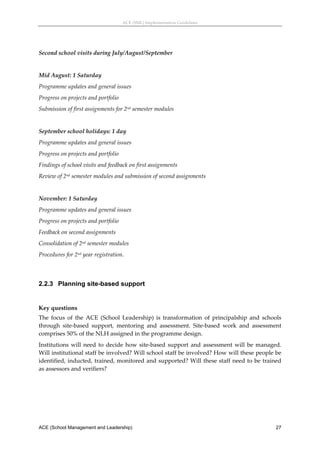
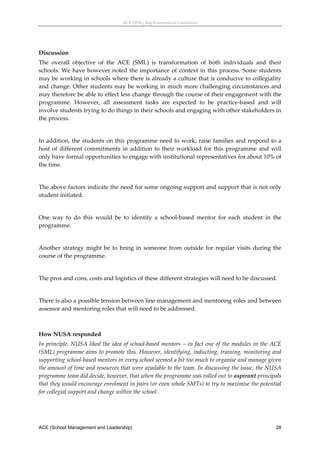
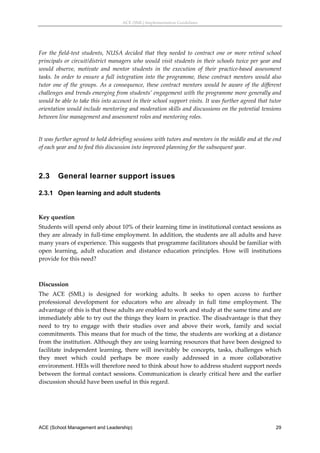
It was further agreed that tutors would offer 12 days (at about 5 hours per day) of contact per year, 
during school holidays organised as follows for the first year: 


ACE (School Management and Leadership)                                                                     25
ACE (SML) Implementation Guidelines 


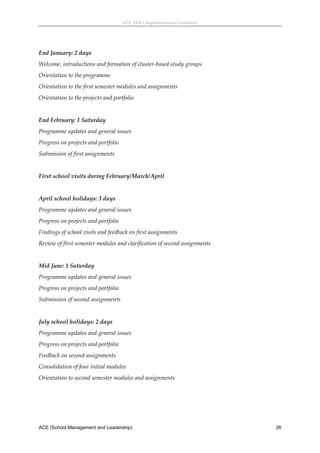
End January: 2 days 
Welcome, introductions and formation of cluster‐based study groups 
Orientation to the programme 
Orientation to the first semester modules and assignments 
Orientation to the projects and portfolio 
 
End February: 1 Saturday 
Programme updates and general issues 
Progress on projects and portfolio 
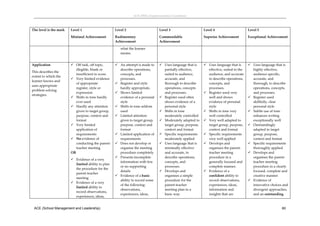
Submission of first assignments 
 
First school visits during February/March/April 
 
April school holidays: 3 days 
Programme updates and general issues 
Progress on projects and portfolio 
Findings of school visits and feedback on first assignments 
Review of first semester modules and clarification of second assignments 
 
Mid June: 1 Saturday 
Programme updates and general issues 
Progress on projects and portfolio 
Submission of second assignments 
 
July school holidays: 2 days 
Programme updates and general issues 
Progress on projects and portfolio 
Feedback on second assignments 
Consolidation of four initial modules  
Orientation to second semester modules and assignments 


ACE (School Management and Leadership)                                       26
ACE (SML) Implementation Guidelines 


Second school visits during July/August/September 
 
Mid August: 1 Saturday 
Programme updates and general issues 
Progress on projects and portfolio 
Submission of first assignments for 2nd semester modules 
 
September school holidays: 1 day 
Programme updates and general issues 
Progress on projects and portfolio 
Findings of school visits and feedback on first assignments 
Review of 2nd semester modules and submission of second assignments 
 
November: 1 Saturday 
Programme updates and general issues 
Progress on projects and portfolio 
Feedback on second assignments 
Consolidation of 2nd semester modules  
Procedures for 2nd year registration. 


2.2.3 Planning site-based support
 

Key questions 
The  focus  of  the  ACE  (School  Leadership)  is  transformation  of  principalship  and  schools 
through  site‐based  support,  mentoring  and  assessment.  Site‐based  work  and  assessment 
comprises 50% of the NLH assigned in the programme design. 
Institutions  will  need  to  decide  how  site‐based  support  and  assessment  will  be  managed. 
Will institutional staff be involved? Will school staff be involved? How will these people be 
identified, inducted, trained, monitored and supported? Will these staff need to be trained 
as assessors and verifiers? 


ACE (School Management and Leadership)                                                           27
ACE (SML) Implementation Guidelines 


Discussion 
The  overall  objective  of  the  ACE  (SML)  is  transformation  of  both  individuals  and  their 
schools.  We  have  however  noted  the  importance  of  context  in  this  process.  Some  students 
may be working in schools where there is already a culture that is conducive to collegiality 
and change. Other students may be working in much more challenging circumstances and 
may therefore be able to effect less change through the course of their engagement with the 
programme.  However,  all  assessment  tasks  are  expected  to  be  practice‐based  and  will 
involve students trying to do things in their schools and engaging with other stakeholders in 
the process. 
 
In addition, the students on this programme need to work, raise families and respond to a 
host  of  different  commitments  in  addition  to  their  workload  for  this  programme  and  will 
only have formal opportunities to engage with institutional representatives for about 10% of 
the time. 
 
The above factors indicate the need for some ongoing support and support that is not only 
student initiated. 
 
One  way  to  do  this  would  be  to  identify  a  school‐based  mentor  for  each  student  in  the 
programme. 
 
Another  strategy  might  be  to  bring  in  someone  from  outside  for  regular  visits  during  the 
course of the programme. 
 
The pros and cons, costs and logistics of these different strategies will need to be discussed. 
 
There is also a possible tension between line management and mentoring roles and between 
assessor and mentoring roles that will need to be addressed. 
 

How NUSA responded 
In principle, NUSA liked the idea of school‐based mentors – in fact one of the modules in the ACE 
(SML) programme aims to promote this. However, identifying, inducting, training, monitoring and 
supporting school‐based mentors in every school seemed a bit too much to organise and manage given 
the amount of time and resources that were available to the team. In discussing the issue, the NUSA 
programme team did decide, however, that when the programme was rolled out to aspirant principals 
that they would encourage enrolment in pairs (or even whole SMTs) to try to maximise the potential 
for collegial support and change within the school. 


ACE (School Management and Leadership)                                                              28
ACE (SML) Implementation Guidelines 


For  the  field‐test  students,  NUSA  decided  that  they  needed  to  contract  one  or  more  retired  school 
principals or circuit/district managers who would visit students in their schools twice per year and 
would  observe,  motivate  and  mentor  students  in  the  execution  of  their  practice‐based  assessment 
tasks.  In  order  to  ensure  a  full  integration  into  the  programme,  these  contract  mentors  would  also 
tutor  one  of  the  groups.  As  a  consequence,  these  contract  mentors  would  be  aware  of  the  different 
challenges and trends emerging from students’ engagement with the programme more generally and 
would be able to take this into account in their school support visits. It was further agreed that tutor 
orientation would include mentoring and moderation skills and discussions on the potential tensions 
between line management and assessment roles and mentoring roles. 
 
It was further agreed to hold debriefing sessions with tutors and mentors in the middle and at the end 
of each year and to feed this discussion into improved planning for the subsequent year. 


2.3      General learner support issues

2.3.1 Open learning and adult students
 

Key question 
Students will spend only about 10% of their learning time in institutional contact sessions as 
they are already in full‐time employment. In addition, the students are all adults and have 
many years of experience. This suggests that programme facilitators should be familiar with 
open  learning,  adult  education  and  distance  education  principles.  How  will  institutions 
provide for this need? 
 

Discussion 
The  ACE  (SML)  is  designed  for  working  adults.  It  seeks  to  open  access  to  further 
professional  development  for  educators  who  are  already  in  full  time  employment.  The 
advantage of this is that these adults are enabled to work and study at the same time and are 
immediately able to try out the things they learn in practice. The disadvantage is that they 
need  to  try  to  engage  with  their  studies  over  and  above  their  work,  family  and  social 
commitments. This means that for much of the time, the students are working at a distance 
from the institution. Although they are using learning resources that have been designed to 
facilitate  independent  learning,  there  will  inevitably  be  concepts,  tasks,  challenges  which 
they  meet  which  could  perhaps  be  more  easily  addressed  in  a  more  collaborative 
environment. HEIs will therefore need to think about how to address student support needs 
between  the  formal  contact  sessions.  Communication  is  clearly  critical  here  and  the earlier 
discussion should have been useful in this regard. 


ACE (School Management and Leadership)                                                                        29
ACE (SML) Implementation Guidelines 


However,  there  is  also  need  to  have  a  sound  understanding  of  the  context.  Hence  it  will 
probably  also  be  necessary  to  explore  the  notion  of  open  learning  and  the  associated 
contexts of distance education and resource‐based learning, and then use this to develop a 
more  informed  understanding  of  the  potential  needs  of  the  students  on  the  ACE  (SML) 
programme. 
 
Is should also be noted that if an HEI is intending to make use of local tutors/mentors, that 
these people might have limited experience in the education and training of adults. 
 

How NUSA responded 
NUSA decided to include in its tutor/mentor training pack some information on issues regarding the 
principles of open learning, distance education and adult learning and to include some discussion of 
the  implications  of  these  concepts  for  identifying  and  pro‐actively  seeking  to  address  the  potential 
learning needs of students regarding academic, informational and personal support and counselling. 
 
The  programme  team  also  decided  that  students  would  need  to  be  encouraged  and  supported  in  the 
formation and maintenance of study groups. 


2.3.2 Planning, facilitating and evaluating networking contact sessions
 

Key question 
How  will  institutions  not  only  maximise  the  use  of  institutional  contact  sessions  but  also 
encourage the formation of student‐led networking in school clusters etc.? 
 

Discussion 
Higher education generally in South Africa does not have a good track record of retaining 
and graduating students. Where students repeatedly fail assessments in large numbers this 
is  often  taken  as  an  indication  of  underpreparedness  of  students  and  the  maintenance  of 
high standards, rather than leading to questions about the appropriateness of the assessment 
tasks and the adequacy of institutions’ preparation of students for these tasks. We recognise 
that  often  students  come  into  programmes  with  inadequate  background  knowledge  and 
skills but we often neglect to adapt our fundamental modules/courses to try to address this 
need. 
 
However, research suggests that we lose many students even before they submit assessment 
tasks, and this is particularly the case in part‐time or distance education study. If students 


ACE (School Management and Leadership)                                                                        30
ACE (SML) Implementation Guidelines 


do not feel supported in a continuous way, even a small problem may begin to feel like an 
insurmountable hurdle and they may lose motivation and drop out of the programme. This 
can  in  part be  addressed  by  ensuring  that  contact  sessions are  spread  throughout  the  year 
and that there is a continuous stream of communication through snailmail, SMS messaging 
and other forms of ongoing communication such as email and chatroom interaction. 
 
However, one area that is often not exploited sufficiently is students’ own knowledge and 
experience.  After  all,  a  programme  like  the  ACE  (SML)  is  targeted  at  working  adults.  If 
students are made to realise through the contact sessions that there is a lot that they can do 
to learn from and support one another, then there is a possibility that this kind of interaction 
will  continue  outside  of  the  formal  contact  session.  However,  the  formation  and 
maintenance of an effective study group is not a simple thing and students will usually need 
some guidance in this area. 
 

How NUSA responded 
In  the  longer  term,  NUSA  decided  to  focus  its  marketing  and  recruitment  strategy  at  SMTs  as  a 
whole so that in the ideal situation no student would be working alone in any particular school. It was 
felt that the programme’s main project might then be reoriented as a group rather than an individual 
assignment. 
 
In the shorter term, the NUSA team decided to devote some time during the first contact session to 
identifying  and  forming  geographically  organised  study  groups  and  to  support  these  groups  by 
providing some guidelines in their programme tutorial letter M01. 
 
In addition, it was decided that the formal contact sessions would involve a lot of group discussion of 
case  studies,  scenarios  and  experiences  and  open‐ended  responses  and  that  students  would  be 
constantly encouraged to engage critically with the learning material and to provide additional and 
even  alternative  strategies  to  those  suggested.  It  seemed  clear  to  the  team  that  their  tutor  training 
sessions  would  need  to  incorporate  some  discussion  about  facilitation  methods.    It  was  also  decided 
that tutors should write a short report after the contact sessions that would summarise some of these 
discussions and experiences discussed so that they could be integrated into the revised materials. 


2.3.3 The facilitator as a counsellor
 

Key question 
Higher  education  generally  is  currently  characterised  by  low  retention  and  high  drop‐out 
figures. It is believed that one of the major causes for this is personal and/or family problems 


ACE (School Management and Leadership)                                                                           31
ACE (SML) Implementation Guidelines 


which cause the student to lose motivation. How will institutional staff be equipped to play 
a motivating and/or counselling role? What additional support facilities will students have 
access to? 
 

Discussion 
Traditionally,  teachers  and  tutors  have  seen  their  role  as  being  mostly  about  dealing  with 
the academic problems of students. However, there is an increasing awareness that students 
encounter  non‐academic  problems  which  they  may  want  to  discuss  with  their  facilitator. 
The kinds of issues that arise stem from the fact that these students are often trying to juggle 
family, career and study commitments and may range from inability to manage their time, 
or lack of an appropriate work space to traumatic events such as the death of a loved one. 
 
 
Again,  our  first  piece  of  advice  here  is  for  staff  to  listen.  Often  all  that  students  need  is  a 
sounding  board  and  an  opportunity  to  vent  their  frustrations.  We  suggest  that  staff  avoid 
making judgements or giving advice. Most staff are not trained counsellors or specialists in 
all the different areas that a student may be encountering problems with. If necessary, they 
should refer the student to someone who is qualified to help them – a social worker, a priest, 
a clinical psychologist etc. 
 
However, there are some issues that from experience we know come up time and again and 
for which programme staff should be prepared to help. These are issues to do with students’ 
doubts  about  their  own  abilities,  their  motivation  to  succeed  and  their  ability  to  manage 
their time and workspace.  
 

How NUSA responded 
NUSA  decided  to  devote  a  discussion  to  counselling  as  part  of  its  tutor/mentor  training  (what  had 
started out as a 2‐day orientation was now shaping up as a 5‐day workshop). 
 
With regard to these issues, NUSA advised their tutors/mentors as follows: 
        deal sensitively with students’ doubts and concerns and respond to problems that can be dealt 
         with (course related) and refer them to specialists where you are not qualified to help; 
        encourage  and  motivate  students  in  all  that  you  do  –  by  providing  constructive  feedback, 
         recognising good work and effort, actively using the students’ own experiences, expertise and 
         problems as the launch pads for discussion and keeping clear in everybody’s minds the value 
         of successfully completing the ACE programme; 
        help students to organise their study space and time management (time spent on this at the 
         beginning of the year can save a lot of wasted time later). 


ACE (School Management and Leadership)                                                                        32
ACE (SML) Implementation Guidelines 


One  of  the  areas  in  which  you  can  combine  a  motivating,  academic  and  professional  development 
agenda is in the way in which you give feedback on assessment.  


2.3.4 Providing feedback on assessment
 

Key questions 
Given the relatively limited direct contact with students, feedback on assessment will be a 
particularly critical aspect of the programme. 
How will institutions communicate feedback to students? 
What training/support will assessment staff receive in providing assessment feedback? 
How will marking and assessment be standardised and monitored? 
 

Discussion 
The provision of feedback on assessment is a critical aspect of the outcomes‐based nature of 
the  ACE  (SML)  programme.  It  is  vitally  important  at  the  beginning  of  the  programme  to 
review the learning outcomes and assessment standards that inform the unit standards that 
underpin each module of the ACE programme. It will be necessary to return to these often 
as the students work through the programme so that everybody is constantly informed by 
the purpose and intent of the qualification. 
 
It is likely that each module will have assignments that need to be completed and submitted 
for  assessment.  It  is  important  that  these  are  discussed  before  students  attempt  them  and 
again  after  they  have  attempted  them.  No  students  should  have  to  ‘guess’  what  the  task 
requires or how it will be assessed. Given the limited nature of the face‐to‐face contact that 
HEIs  will  have  with  students,  the  written  feedback  that  markers  provide  on  their 
assignments becomes all that more critical. 
 
Using the key assessment tasks as a teaching tool in this way can help to: 
       consolidate learning 
       check progress 
       provide academic support 
       motivate 
       contribute  to  ongoing  course  development  (if  ALL  the  students  have  problems, 
        perhaps the task itself is inappropriate or inadequately scaffolded). 


ACE (School Management and Leadership)                                                                  33
ACE (SML) Implementation Guidelines 


Ideally,  to  ensure  consistency  of  assessment  across  the  programme,  all  assignments  would 
be assessed through group marking strategies. 
 

How NUSA responded 
As  noted  previously,  the  NUSA  team  had  already  decided  to  design  down  in  formulating  their 
assessment tasks. The project tasks would be formulated first and would be structured in such a way 
as to elicit evidence of competence in line with the overall programme design. Then the team would 
interrogate  the  contribution  that  each  module  could  make  in  enabling  the  integrated  project  task. 
Module‐specific assignments would then be structured in such a way that they would address both 
the issues in the module and also build cumulatively the SKVAs needed to execute the project tasks. 
 
Each  assessment  task  would  detail  the  assessment  criteria  and  for  each  task  students  would  be 
expected to complete a self‐assessment and a peer‐assessment (by another student) form. Tutors would 
then mark assignments in provincial marking groups under the leadership of two of the core NUSA 
programme team members. Where the tutor  marking differed from the  self‐ and peer‐assessment,  or 
where all three assessments resulted in a low achievement rating (2 or less), extensive feedback would 
need to be provided and the student would be given three weeks in which to re‐submit. 
 
The following guidelines were agreed overall: 
       develop a system for giving feedback that is consistent across all the assessment tasks and easy 
        to understand 
       make comments that demonstrate that you have read the assignment and are maintaining a 
        dialogue with the student 
       make  comments  which  indicate  errors  or  simple  misunderstandings  of  the  course  material 
        with  reference  to  the  course  material,  so  that  students  can  check  and  make  their  own 
        corrections 
       make comments about the relevance or approach used by the student 
       make  comments  which  offer  support  and  encouragement  (even  if  the  student  is  not  doing 
        well) 
       make  comments  on  assignment‐writing  skills  and  integrate  advice  on  study  skills  and 
        strategies 
       make comments which explain the grade/mark/classification that they have been given 
       make a general comment at the beginning or end as well as specific comments next to relevant 
        sections of the assignment itself 
       develop a system for correcting language errors. 


ACE (School Management and Leadership)                                                                     34
ACE (SML) Implementation Guidelines 


2.3.5 Monitoring student progress
 

Key questions 
How will institutions monitor student progress? 
In  particular,  how  will  at‐risk  students  be  identified  early  in  the  process  and  how  will 
additional support for these students be mediated? 
 

Discussion 
There  are  a  number  of  reasons  for  integrating  assessment  into  our  learning  and  teaching 
activities  and  these  include  providing  us  with  feedback  on  the  effectiveness  of  the 
programme  and  our  own  interventions  and  also  helping  us  to  monitor  our  students’ 
progress. 
 
There  is  no  reason  why  all  the  students  on  the  ACE  (SML)  programme  should  not  be 
successful. However, some may take longer than others and some may need to make more 
than one attempt.  
 
A lot of this monitoring will happen informally during networking contact sessions as tutors 
observe, listen to and engage with students’ discussion of activities and problems. For this 
purpose it is a good idea to have a notebook to hand in which to jot down short reminders 
e.g. ‘Thabo seems unsure about managing discipline’. ‘Martha gave a good example of how 
she  manages  the  school  timetable’.  After  reflection,  these  comments  could  affect  how  staff 
engage with these students and the learning activities in future sessions. 
 
Clearly  we  also  need  to  keep  track  of  who  is  submitting  their  assignments  for  assessment 
and how are they are doing and (re‐)designing our interventions accordingly.  
 
Monitoring  student  progress  is  an  important  part  of  the  work  of  the  tutor.  Timeous 
submission  of  completed  marksheets  and  comments  on  any  emerging  trends  or  problems 
can make the difference between a successful and an unsuccessful programme. 
 

How NUSA responded 
NUSA  decided  that  deadlines  would  be  set  for  all  assessment  tasks  and  communicated  to  students 
both  in  the  programme  tutorial  letters  and  during  the  contact  sessions.  In  addition,  reminders  of 
assignment deadlines (and contact session dates) would be sent out using bulk SMS messaging. 


ACE (School Management and Leadership)                                                                      35
ACE (SML) Implementation Guidelines 


After each contact session, tutors would be expected to follow up telephonically on those students who 
did not attend. 
After  each  marking  session,  tutors  would  be  expected  to  follow  up  telephonically  on  those  students 
who did not submit an assignment or who did particularly poorly and who needed to resubmit. 


2.4     Concluding remarks
 
This  brings  us  to  the  end  of  our  current  discussion  on  issues  and  questions  regarding  the 
implementation  of  the  ACE  (SML).  As  noted  previously,  the  content  here  is  neither 
exhaustive nor does it present all the answers to the challenges that HEIs will face. We hope, 
however,  that  there  is  sufficient  here  to  help  you  begin  your  planning  for  a  successful 
delivery of the ACE (SML). 


ACE (School Management and Leadership)                                                                       36
ACE (SML) Implementation Guidelines 


     Section 3: Assessment rubrics
This section provides suggested assessment rubrics for each of the modules that comprise 
the ACE (School Leadership) programme. You can cross refer with the course outline which 
has been supplied as a separate document. 


ACE (School Management and Leadership)                                                 37
ACE (School Leadership) Implementation Guidelines 


    3.1     Analytic Rubric for assessing Develop a portfolio to demonstrate school management and leadership
            competence (Fundamental)
                                                                                        

The level is the mark       Level 1                       Level 2                      Level 3                          Level 4                     Level 5

                            Minimal Achievement           Rudimentary                  Commendable                      Superior Achievement        Exceptional Achievement  
                                                          Achievement                  Achievement 

Critical Thinking            Demonstrates little          Demonstrates only a         Demonstrates a                  Demonstrates clear         Demonstrates a clear, 
                              understanding and             very general                 general understanding            understanding of            accurate 
This entails being 
                              only limited                  understanding of             of scope of problem              scope of problem and        understanding of the 
aware of one’s 
                              comprehension of              scope of problem             and more than one of             at least two central        scope of the problem 
thinking as you 
                              scope of problem or          Focuses on a single          the issues involved              issues                      and the ramifications 
perform tasks and 
                              issues.                       issue                       Employs the main                Uses the main points        of the issues involved. 
using that awareness 
                             Employs only the             Employs only the             points of information            of information from        Employs all 
to monitor and direct 
                              most basic parts of           information provided         from the documents               the documents and           information from the 
what you are doing.  It 
                              information provided.        May include opinion          and at least one                 personal knowledge          documents and 
involves making 
                             Mixes fact and opinion        as well as fact in           general idea from                that is relevant and        extensive personal 
critical choices 
                              in developing a               developing a position        personal knowledge to            consistent in               knowledge that is 
concerning what to 
                              viewpoint.                   States conclusion after      develop a position               developing a position       factually relevant, 
believe or what to do.  
                             States conclusion after       limited examination of      Builds conclusion on            Builds conclusion on        accurate and 
This also refers to such 
                              hasty or cursory look         evidence with little         examination of                   examination of the          consistent in the 
basic mental tasks as 
                              at only one or two            concern for                  information and some             major evidence              development of a 
comparing, 
                              pieces of information         consequences.                considerations of               Considers at least one      position. 
classifying, predicting, 
                             Does not consider                                          consequences.                    alternative action and     Bases conclusion on a 
problem solving and 
                              consequences.                                                                               the possible                thorough examination 
decision making that 
                                                                                                                          consequences.               of the evidence, and 
involves a variable but 
                                                                                                                                                      exploration of 
predictable sequence 
                                                                                                                                                      reasonable 
of thinking skills 
                                                                                                                                                      alternatives, and an 
underpinned by 
                                                                                                                                                      evaluation of 
constant critique of 
                                                                                                                                                      consequences. 
“what is”. 


Communication of             Position is vague            Presents general and        Takes a definite but            Takes a clear position     Takes a strong, well‐


    ACE (School Leadership)                                                                                                                                               38
ACE (SML) Implementation Guidelines 


The level is the mark      Level 1                      Level 2                      Level 3                      Level 4                       Level 5

                           Minimal Achievement          Rudimentary                  Commendable                  Superior Achievement          Exceptional Achievement  
                                                        Achievement                  Achievement 

ideas                       Presentation is brief        indefinite position.         general position            Presents an organised         defined position 
                             and includes                Only minimal                Presents a somewhat          argument with                Presents a well‐
This describes how 
                             unrelated general            organisation in              organised argument           perhaps only minor            organised, persuasive 
effectively the learner 
                             statements                   presentation                Uses general terms           errors in the                 argument with 
can communicate 
                            Overall view of their       Uses generalities to         with limited evidence        supporting evidence           accurate supporting 
(represent using any 
                             development is not           support position             that may not be totally     Deals with the major          evidence 
of a variety of media) 
                             clear                       Emphasises only one          accurate                     issues and shows             Deals with all 
his or her solution and 
                            Statements tend to           issue                       Deals with a limited         some understanding            significant issues and 
the thinking and 
                             wander or ramble.           Considers only one           number issues                of relationships              demonstrates a depth 
processes behind it. 
                                                          aspect of their             Views their                 Gives consideration to        of understanding of 
                                                          development.                 development within a         examination of more           important 
                                                                                       somewhat limited             than one aspect of the        relationships 
 
                                                                                       range.                       their development.           Examines their 
                                                                                                                                                  development from 
                                                                                                                                                  several positions. 
                                                                                                                                                 
Knowledge of                Reiterates one or two       Provides only basic         Relates only major          Offers accurate              Offers accurate 
Portfolio                    facts without complete       facts with only some         facts to the basic issues    analysis of the               analysis of the 
Development                  accuracy                     degree of accuracy           with a fair degree of        documents                     information and 
                            Deals only briefly and      Refers to information        accuracy                    Provides facts to relate      issues. 
This describes the 
                             vaguely with concepts        to explain at least one     Analyses information         to the major issues          Provides a variety of 
extent to which the 
                             or the issues                issue or concept             to explain at least one      involved in                   facts to explore major 
learner has sufficient 
                             concerning                   concerning the               issue or concept             demonstrating                 and minor issues and 
knowledge and the 
                             demonstrating                portfolio as a flexible      concerning the               understanding of the          concepts involved in 
ability to find 
                             understanding of the         assessment instrument        portfolio as a flexible      portfolio as a flexible       demonstrating 
appropriate 
                             portfolio as a flexible      in SA in general terms       assessment instrument        assessment instrument         understanding of the 
information. 
                             assessment instrument       Limited use of               in SA with substantive       in SA                         portfolio as a flexible 
                             in SA                        previous IQMS                support                     Uses previous general         assessment instrument 
                            Barely indicates any         knowledge without           Uses general ideas           IQMS knowledge to             in SA 
 
                             previous IQMS                complete accuracy.           from previous IQMS           examine issues               Extensively uses 
                             knowledge                   Major reliance on the        knowledge with fair          involved.                     previous IQMS 
                            Relies heavily on the        information provided.        degree of accuracy.                                        knowledge to provide 
                             information provided.                                                                                                an in depth 


    ACE (School Management and Leadership)                                                                                                                           39
ACE (SML) Implementation Guidelines 


The level is the mark     Level 1                      Level 2                     Level 3                      Level 4                      Level 5

                          Minimal Achievement          Rudimentary                 Commendable                  Superior Achievement         Exceptional Achievement  
                                                       Achievement                 Achievement 

                                                                                                                                                understanding of the 
                                                                                                                                                developmental 
                                                                                                                                                appraisal strategy and 
                                                                                                                                                to relate it to past and 
                                                                                                                                                possible future 
                                                                                                                                                situations.  
                                                                                                                                              
Observation                Observational               Observational              Most observational             Almost all               All observational 
                            procedures and               procedures and              procedures and                  observational             procedures and 
This describes the 
                            reporting do not             reporting show some         reporting show                  procedures and            reporting show 
extent to which the 
                            follow prescribed            evidence that               evidence that                   reporting show            evidence that 
learner identifies 
                            method.                      prescribed method           prescribed method               evidence that             prescribed method 
something as a 
                           One                          was followed.               was followed.                   prescribed method         was followed  
problem and becomes 
                            inference/conclusion is     Some of the reported       About half of the               was followed.            Observational 
engaged in solving it. 
                            reported and                 inferences/conclusions      inferences/conclusions         Most of the               criticism is clearly 
                            supported by data.           are supported by data.      reported are                    inferences/conclusions    stated and is based on 
                           Recording of                The learner seems           supported by data.              reported are              supportive examples.  
                            observational                unsure about what to       Includes general                supported by data.       Observations are 
                            reflections have been        look for.                   reflections.                   Includes reflections      insightful and based 
                            largely ignore              Includes minimal, if       Develops and                    that are specific and     on careful analysis 
                           Portfolios are               any, reflections            organises their                 generally relevant.       and observation.  
                            undeveloped and             Does not develop or         observations in a basic        Develops and             Includes reflections on 
                            unorganised.                 organise their              way.                            organises their           that are specific (who, 
                                                         portfolios completely      Presents sufficient             observations in a         what, where, when, 
                                                        Presents incomplete         information supported           generally focused and     why, how) and 
                                                         information with few        by basic details.               complete manner.          consistently relevant. 
                                                         or no supporting                                           Presents complete        Develops and 
                                                         details.                                                    information supported     organises their 
                                                                                                                     by basic details.         observations in a 
                                                                                                                                               clearly focused, 
                                                                                                                                               complete and creative 
                                                                                                                 
                                                                                                                                               manner. 
                                                                                                                                              Presents complete 


 ACE (School Management and Leadership)                                                                                                                             40
ACE (SML) Implementation Guidelines 


The level is the mark      Level 1                      Level 2                      Level 3                      Level 4                      Level 5

                           Minimal Achievement          Rudimentary                  Commendable                  Superior Achievement         Exceptional Achievement  
                                                        Achievement                  Achievement 

                                                                                                                                                   information that is 
                                                                                                                                                   enhanced by precise 
                                                                                                                                                   and appropriate 
                                                                                                                                                   details. 
                                                                                                                                                

Reflection                  Self‐reflective             Includes minimal,           Includes general            Includes reflections on     Includes reflections on 
                             statements, if present,      reflections on learning      reflections on learning      learning achievements        learning achievement 
This refers to any 
                             add little to clarify        achievements                 achievements.                that are specific and        that are specific (who, 
reflexive thinking i.e. 
                             organization or             At this point in the                                      generally relevant.          what, where, when, 
thinking before,                                                                      In the process of 
                             explain learning             development of the                                                                     why, how) and 
during and after any                                                                   becoming a story of         The learner’s authorial 
                             achievements.                portfolio there is                                                                     consistently relevant. 
process/ performance/                                                                  the learner as a             voice is always 
                            Simply a container of        insufficient 
product / presentation.                                                                manager and leader.          present.                    When reviewing the 
                             work or assessments,         information or 
                                                                                                                                                 portfolio, outsiders get 
                             without an attempt on        organization to             There is evidence of      Tells a coherent story         the feeling they really 
                             the part of the learner      characterize the             ownership as the           of the learner as a            know the person 
                             to provide                   portfolio as either a        learner displays a         reflective manager             whose achievement is 
                             organization.                story of learning or a       personal investment in     and leader                     depicted there, and 
                            There is no attempt by       portrait of the learner      selecting and                                             have a fair 
                             the learner to make a        as manager leader.           explaining the content.   There are                      understanding of how 
                             coherent statement          Learners may not be                                     relationships between 
                                                                                      There is a sense of                                       the learning came 
                             about what learning          able to verbalize the                                   one part of the 
                                                                                       intentionality                                            about.  
                             has taken place.             reasons, even as they                                   portfolio and another.  
                            The learner’s                reflect on their             controlling some of 
                                                                                                                                             All the parts of the 
                             understanding of the         choices, but the             the learner’s choices.    There is an awareness       portfolio bear a clear 
                             task is minimal              reviewer may be able        It is possible to            of the perspectives of    relationship to each 
                            The portfolio is about       to recognize a               distinguish other            other stakeholders and    other and to a central 
                             ʺcollecting what the         relationship between         stakeholdersʹ goals          the learner’s self‐       purpose.  
                             assessor asks for.ʺ          some exhibits or infer       from the learner’s or        assessment has been 
                                                          the reasons.                                              enhanced by this         A reviewer can look at 
                                                                                       to recognize instances 
                                                         For the learner, the                                      knowledge.                the portfolio and 
                                                                                       when they overlap.  
                                                          portfolio was built by                                                              easily understand how 
                                                          following instructions.     The portfolio may be        Evidence of self‐         the judgments about 


 ACE (School Management and Leadership)                                                                                                                              41
ACE (SML) Implementation Guidelines 


The level is the mark   Level 1                       Level 2                       Level 3                          Level 4                       Level 5

                        Minimal Achievement           Rudimentary                   Commendable                      Superior Achievement          Exceptional Achievement  
                                                      Achievement                   Achievement 

                                                       There may be                    created for others to           reflection adds               the learner came to be 
                                                        evidence that the               assess, but there is also       information to the            made and the degree 
                                                        learner had some                evidence of self‐               presentation,                 to which different 
                                                        insight into the                assessment.                                                   stakeholders would 
                                                        assessor’s purposes.                                                                          agree.  
                                                                                     
Application              No evidence of               Does not develop or          Develops and                    Develops and                 Develops and 
                          planning personal and         organise a personal           organises a simple               organises the                 organises the 
This describes the 
                          organizational growth         and organizational            personal and                     development of a              development of a 
extent to which the 
                        OR                              growth plan                   organizational growth            personal and                  personal and 
learner knows and 
                                                        completely                    plan in a basic way.             organizational growth         organizational growth 
uses appropriate         Evidence of a very 
                                                       Presents incomplete          Evidence of a                    plan in a generally           plan in a clearly 
problem solving           limited ability to plan 
                                                        information with few          competent ability to             focused and complete          focused, complete and 
strategies.               personal and 
                                                        or no supporting              record observations,             manner.                       creative manner 
                          organizational growth 
                                                        details                       experiences, ideas,             Evidence of a                Evidence of 
                         Evidence of a very 
                                                       Evidence of a basic           information and                  confident ability to          innovative choices and 
                          limited ability to 
                                                        ability to record some        insights that are                record observations,          divergent approaches, 
                          record observations, 
                                                        of the following:             relevant to the task.            experiences, ideas,           and an outstanding 
                          experiences, ideas, 
                                                        observations,                The learner includes             information and               ability to record 
                          information and 
                                                        experiences, ideas,           many of the needed               insights that are             observations, 
                          insights that are 
                                                        information and               techniques (CV’s,                relevant to the task.         experiences, ideas, 
                          relevant to the task. 
                                                        insights that are             SWOT Analysis,                  The learner includes          information and 
                         Little evidence of the 
                                                        relevant to the task.         historical content, self‐        most of the needed            insights that are 
                          needed techniques 
                                                       The learner includes a        reflective diary,                techniques (CV’s,             relevant to the task. 
                          (CV’s, SWOT 
                                                        few needed                    samples of course                SWOT Analysis,               The learner includes a 
                          Analysis, historical 
                                                        techniques (CV’s,             activities, interviews,          historical content, self‐     wealth of the needed 
                          content, self‐reflective 
                                                        SWOT Analysis,                observations, reports            reflective diary,             techniques (CV’s, 
                          diary, samples of 
                                                        historical content, self‐     and situation analysis)          samples of course             SWOT Analysis, 
                          course activities, 
                                                        reflective diary,             for ensuring effective           activities, interviews,       historical content, self‐
                          interviews, 
                                                        samples of course             development of a                 observations, reports         reflective diary, 
                          observations, reports 
                                                        activities, interviews,       portfolio to reflect             and situation analysis)       samples of course 
                          and situation analysis) 
                                                        observations, reports         own management.                  for ensuring effective        activities, interviews, 
                          for ensuring effective 


 ACE (School Management and Leadership)                                                                                                                                  42
ACE (SML) Implementation Guidelines 


The level is the mark   Level 1                       Level 2                        Level 3                      Level 4                      Level 5

                        Minimal Achievement           Rudimentary                    Commendable                  Superior Achievement         Exceptional Achievement  
                                                      Achievement                    Achievement 

                          development of a                and situation analysis)     Work is accurate, neat,        development of a             observations, reports 
                          portfolio to reflect            for ensuring effective       and complete                   portfolio to reflect         and situation analysis) 
                          own management.                 development of a            Ideas have been                own management.              for ensuring effective 
                         Writing is not original;        portfolio to reflect         organized                     Effectively presents         development of a 
                          copies the ideas of             own management.             Writing contains few           self and ideas to            portfolio to reflect 
                          others                         Shows little or no           language errors; ideas         outside reviewer             own management. 
                        OR                                awareness or the             are not difficult to          Writing is original         Self and ideas ʺcome 
                                                          audience                     understand                    Writing is clear and         aliveʺ to outside 
                         Writing contains so 
                                                         Ideas are presented in      Substantially                  organized                    reviewer  
                          many errors in 
                                                          a disorganized way           completes the task,           Work is accurate and        Writing is original and 
                          language use that 
                                                         Work lacks accuracy          with some ideas or             complete; appearance         may be creative  
                          make reading difficult 
                                                          and completeness;            concepts missing.              helps the                   Writing is clear and 
                          to understand  
                                                          appearance interferes                                       communication of             well‐organized 
                         
                                                          with communication                                          ideas                        throughout portfolio  
                         Minimally completes             of ideas                                                   Completes the task in       Writing is almost free 
                          the task with                  Partially completes the                                     an incisive and              of language errors and 
                          fragmented results‐             task with minimal or                                        thorough manner.             is easy to understand  
                          may need redirection            perfunctory effort.                                                                     Makes fulfilment of 
                          in the future.                                                                                                           the task a creative 
                                                       
                                                                                                                                                   expression.  


 ACE (School Management and Leadership)                                                                                                                               43
ACE (SML) Implementation Guidelines 


ACE (School Management and Leadership)                                          44
ACE (SML) Implementation Guidelines 


    3.2    Analytic Rubric for assessing Lead and manage effective use of ICTs in schools (Fundamental)
                                                                                       

The level is the mark       Level 1                      Level 2                      Level 3                    Level 4                     Level 5

                            Minimal Achievement          Rudimentary                  Commendable                Superior Achievement        Exceptional Achievement  
                                                         Achievement                  Achievement 

Critical Thinking            Demonstrates little         Demonstrates only a         Demonstrates a            Demonstrates clear         Demonstrates a clear, 
                              understanding and            very general                 general understanding      understanding of            accurate 
This entails being 
                              only limited                 understanding of             of scope of problem        scope of problem and        understanding of the 
aware of one’s 
                              comprehension of             scope of problem or          and more than one of       at least two central        scope of the problem 
thinking as you 
                              scope of problem or          issues with respect to       the issues involved        issues with respect to      and the ramifications 
perform tasks and 
                              issues with respect to       the potential and use        with respect to the        the potential and use       of the issues involved. 
using that awareness 
                              the potential and use        of ICT for both              potential and use of       of ICT for both            Employs all 
to monitor and direct 
                              of ICT for both              management and               ICT for both               management and              information from the 
what you are doing.  It 
                              management and               curriculum support           management and             curriculum support          documents and 
involves making 
                              curriculum support.         Focuses on a single          curriculum support        Uses the main points        extensive personal 
critical choices 
                             Employs only the             issue                       Employs the main           of information from         knowledge that is 
concerning what to 
                              most basic parts of         Employs only the             points of information      the documents and           factually relevant, 
believe or what to do.  
                              information provided.        information provided         from the documents         personal knowledge          accurate and 
This also refers to such 
                             Mixes fact and opinion      May include opinion          and at least one           that is relevant and        consistent in the 
basic mental tasks as 
                              in developing a              as well as fact in           general idea from          consistent in               development of a 
comparing, 
                              viewpoint.                   developing a position        personal knowledge to      developing a position       position. 
classifying, predicting, 
                             States conclusion after     States conclusion after      develop a position        Builds conclusion on       Bases conclusion on a 
problem solving and 
                              hasty or cursory look        limited examination of      Builds conclusion on       examination of the          thorough examination 
decision making that 
                              at only one or two           evidence with little         examination of             major evidence              of the evidence, and 
involves a variable but 
                              pieces of information.       concern for                  information and some      Considers at least one      exploration of 
predictable sequence 
                             Does not consider            consequences.                considerations of          alternative action and      reasonable 
of thinking skills 
                              consequences.                                             consequences.              the possible                alternatives, and an 
underpinned by 
                                                                                                                   consequences.               evaluation of 
constant critique of 
                                                                                                                                               consequences. 
“what is”. 


Communication of             Position is vague           Presents general and        Takes a definite but      Takes a clear position     Takes a strong, well‐
                             Presentation is brief        indefinite position.         general position          Presents an organised       defined position 


    ACE (School Management and Leadership)                                                                                                                         45
ACE (SML) Implementation Guidelines 


The level is the mark      Level 1                     Level 2                      Level 3                      Level 4                       Level 5

                           Minimal Achievement         Rudimentary                  Commendable                  Superior Achievement          Exceptional Achievement  
                                                       Achievement                  Achievement 

ideas                        and includes               Only minimal                Presents a somewhat          argument with                Presents a well‐
                             unrelated general           organisation in              organised argument           perhaps only minor            organised, persuasive 
This describes how 
                             statements                  presentation                Uses general terms           errors in the                 argument with 
effectively the learner 
                            Overall view of their      Uses generalities to         with limited evidence        supporting evidence           accurate supporting 
can communicate 
                             development is not          support position             that may not be totally     Deals with the major          evidence 
(represent using any 
                             clear                      Emphasises only one          accurate                     issues and shows             Deals with all 
of a variety of media) 
                            Statements tend to          issue                       Deals with a limited         some understanding            significant issues and 
his or her solution and 
                             wander or ramble.          Considers only one           number issues                of relationships              demonstrates a depth 
the thinking and 
                                                         aspect of their             Views their                 Gives consideration to        of understanding of 
processes behind it. 
                                                         development.                 development within a         examination of more           important 
                                                                                      somewhat limited             than one aspect of the        relationships 
                                                                                      range.                       their development.           Examines their 
 
                                                                                                                                                 development from 
                                                                                                                                                 several positions. 
                                                                                                                                                
Knowledge of the            Barely indicates any       Limited ability in          Uses a computer for         Uses a computer for          Extensively uses 
effective use of             skill in using a            using a computer for         basic management             daily management              computer skills to 
computer skills              computer for                management or                and curriculum tasks         and curriculum tasks          provide an in depth 
                             management or               curriculum tasks             with a fair degree of       Offers accurate               understanding of the 
This describes the 
                             curriculum tasks           Provides only basic          accuracy                     analysis of arguments         implications 
extent to which the 
                            Reiterates one or two       facts with only some        Relates only major           relating to computer          concerning the school 
learner has sufficient 
                             facts without complete      degree of accuracy           facts to the basic issues    use and the relative          and to relate it to past 
knowledge and the 
                             accuracy                   Refers to information        with a fair degree of        merits of different           and possible future 
ability to find 
                            Deals only briefly and      to explain at least one      accuracy                     applications and              situations. Offers 
appropriate 
                             vaguely with concepts       issue or concept            Analyses information         software                      accurate analysis of 
information. 
                             or the issues               concerning what              to explain at least one     Provides facts to relate      the information and 
                             concerning                  computers in the             issue or concept             to the major issues           issues. 
                             demonstrating               school can be used for       concerning what              involved in                  Provides a variety of 
 
                             understanding of           Major reliance on the        computers in the             demonstrating what            facts to explore major 
                             what computers in the       information provided         school can be used for       computers in the              and minor issues and 
                             school can be used for                                                                school can best be            concepts involved in 
                            Relies heavily on the                                                                 used for.                     making the best use of 
                             information provided.                                                                                               computer facilities in 


    ACE (School Management and Leadership)                                                                                                                           46
ACE (SML) Implementation Guidelines 


The level is the mark   Level 1                        Level 2                       Level 3                       Level 4                       Level 5

                        Minimal Achievement            Rudimentary                   Commendable                   Superior Achievement          Exceptional Achievement  
                                                       Achievement                   Achievement 

                                                                                                                                                     the school. 
                                                                                                                                                  
                            No analytical ability        Able to analyse but          Appropriate                  Able to analyse              Remarkable ability to 
                             even on a descriptive         mostly descriptive            analytical ability            accurately                    analyse – identifies 
                             level                        Limited ability to            though vague in              Thoughtful, critical          the salient pro’s and 
                            Not able to break             break down                    places                        analysis and                  con’s. 
                             down information              information – focuses        Analysis slightly             interpretation –             Excellent critical 
                           Cannot relate theory           on a single pro or con        more descriptive than         identifies relevant           analysis ability – able 
                            to practice even with         Needs assistance              critical and refers           pro’s and con’s               to recognise a process 
                            considerable                   sometimes to relate           only generally to            Relates theory to             over time.   
                            assistance                     theory to practice            pro’s and con’s               practice with some           Excellent ability to 
                           No research was done          Inadequate research          Able to relate theory         additional comments.          relate theory to 
                           Uses repetition instead       Generally illogical           to practice but with         Sufficient evidence of        practice correctly 
                            of compelling                  arguments put                 no additional                 research                      with additional 
                            argumentation                  forward                       comments.                    Thoughtfully                  comments.  
                           Position taken is             Relies on common             Some evidence of              supported opinions           Impressive use of 
                            continually shifting           sense rather than             research                     Supportive material           source material.  
Observation                Does not support               referring to support         Evidence of a mixture         used to back up              Digs for the truth  
                            statements or                  material.                     of rational and               arguments                    Logical, convincing 
                            arguments with                Position taken is             muddled thinking.            Reasoning is logical          and compelling 
                            reference material             unclear                      Very little supportive        and clear                     arguments put 
                           Easy to refute                Hesitant to make use          material used                A basic position is           forward 
                           Reluctant to make use          of a computer for            Unsure of position            taken.                       Presents complete 
                            of a computer for even         even basic tasks and          sometimes.                   Few surprises.                information that is 
                            basic tasks.                   makes frequent               Fact/opinion                 Fact/opinion                  enhanced by precise 
                                                           errors.                       sometimes overlap             distinguished                 and appropriate 
                                                                                        Willing and able to           Willing and able to          details  
                                                                                         make use of a                 make use of a                Thought provoking, 
                                                                                         computer for routine          computer for routine          interesting material 
                                                                                         tasks and makes few           and novel or complex          used to support 
                                                                                         errors.                       tasks and makes few           opinions 
                                                                                                                       errors                       Employs sound 
                                                                                                                      Demonstrates a                reasoning.   


 ACE (School Management and Leadership)                                                                                                                                 47
ACE (SML) Implementation Guidelines 


The level is the mark      Level 1                       Level 2                     Level 3                      Level 4                    Level 5

                           Minimal Achievement           Rudimentary                 Commendable                  Superior Achievement       Exceptional Achievement  
                                                         Achievement                 Achievement 

                                                                                                                      commitment to             Position is clear 
                                                                                                                      maximising the            Willing and able to 
                                                                                                                      effective use of           make use of a 
                                                                                                                      computer technology        computer for routine 
                                                                                                                      in the school.             and novel or complex  
                                                                                                                                                 tasks and rarely 
                                                                                                                                                 makes errors 
                                                                                                                   
                                                                                                                                                Demonstrates a 
                                                                                                                                                 commitment to 
                                                                                                                                                 maximising the 
                                                                                                                                                 effective use of 
                                                                                                                                                 computer technology 
                                                                                                                                                 in the school. 
                                                                                                                                              
Reflection                  Exhibits close‐              Regardless of the          Ignores or                  Thoughtfully analyses     Thoughtfully analyses 
                             mindedness or                 evidence or reasons,        superficially evaluates      and evaluates obvious      and evaluates major 
This refers to any 
                             hostility to reason.          maintains or defends        obvious alternative          alternative points of      alternative points of 
reflexive thinking i.e. 
                            Argues using                  views based on self‐        points of view.              view.                      view.   
thinking before, 
                             fallacious or irrelevant      interest or                Draws warranted,            Draws judicious           Fair‐mindedly follows 
during and after any 
                             reasons and makes             preconceptions.             non‐fallacious               conclusions – good         where evidence and 
process/ performance/ 
                             unwarranted claims           Considers only one          conclusions                  reasoning ability          reasons lead. 
product / presentation. 
                            Vague, simple,                aspect                     Although the learner        An interest is shown      The learner is highly 
                             mechanical reflections       Two‐dimensional             seems to want to             towards optimising         motivated and in 
                             on improving the              reflections provided        optimise the                 the school’s policies      depth reflexive 
                             effectiveness of the          i.e describes the           understanding of             and plans through          thinking is applied 
                             school’s policies and         existing policies with      policy they are not          adopting an attitude       concerning the 
                             plans                         some specifics but          able to define or            of listening, careful      optimisation of school 
                            Focuses mainly on             includes no insights        clarify the problem          observation, asking        usage of ICTs 
                             surface features              into how to go about        areas.  This may be          questions, requesting     Analysis of strengths 
                            No examples                   implementing them           due to a seeming             clarification of           and weaknesses have 
                             provided, purposeless        Focuses on only a few       reluctance to adopt an       pertinent ideas, and       depth to them and 
                            One‐dimensional,              aspects                     attitude of a lifelong       consultation with          reflections on debate 
                             superficial reflections      They have described         learner.                     others as necessary        results that are specific 


 ACE (School Management and Leadership)                                                                                                                             48
ACE (SML) Implementation Guidelines 


The level is the mark   Level 1                      Level 2                       Level 3                       Level 4                     Level 5

                        Minimal Achievement          Rudimentary                   Commendable                   Superior Achievement        Exceptional Achievement  
                                                     Achievement                   Achievement 

                           provided (e.g. I            individual thoughts,         Reflects on the school       Feelings are shared as       (who, what, where, 
                           like…./I donʹt like….)      feelings concerning           community views on            well as both strengths       when, how, why) and 
                         The learner’s                the impact of policy of       ICT usage and                 and weaknesses o f the       consistently insightful. 
                           understanding of ICT        the management of             potential in a general        use and potential for     
                           potential is minimal        schools but made no           way                           integrating ICTs into 
                         Hard to read, not            comparisons between          Able to identify              school and curriculum 
                           organized well.             the various views on it       strengths and                 management 
                                                      There may be                  weaknesses.                  Includes reflections on 
                                                       evidence that the                                           debate results that are 
                                                       learner had some                                            mostly specific (who, 
                                                       insight into the                                            what, where, when, 
                                                       potential of ICT but                                        how, why) and 
                                                       some inferences need                                        penetrating. 
                                                       to be made as to what                                      
                                                       the learner means.  
                                                      
Application              Very little use made of     An attempt has been          A computer is being          One or more               Optimal use is being 
                          a computer and little        made to use a                 used to better manage         computers are being        made of the computer 
This describes the 
                          evidence of a                computer to simplify          several routine               used by one or more        facilities available by 
extent to which the 
                          commitment to                or improve one or two         management tasks              people for a variety of    several staff members 
learner knows and 
                          developing and               routine tasks but little      such as writing of            routine and innovative     for a variety of routine 
uses appropriate 
                          sharing computer             evidence of a                 formal letters, reports,      school and curriculum      and innovative school 
problem solving 
                          skills.                      committed process or          memos, agendas,               management activities      and curriculum 
strategies. 
                                                       of the sharing of             minutes etc.                  including the use of       management activities 
                                                       computer skills.             Other staff have been         email and internet         including the use of 
                                                                                     equipped with skills          where available            email and internet 
                                                                                     to handle some of            Computer technology        where available 
                                                                                     these tasks.                  has been integrated       Computer technology 
                                                                                                                   into routine problem‐      has been integrated 
                                                                                                                   solving.                   into everyday 
                                                                                                                                              problem‐solving. 


 ACE (School Management and Leadership)                                                                                                                             49
ACE (School Leadership) Implementation Guidelines 


 3.3       Analytic Rubric for assessing Understand school leadership and management in the South African context
           (Core)
                                                                                        

The level is the mark       Level 1                       Level 2                      Level 3                          Level 4                     Level 5

                            Minimal Achievement           Rudimentary                  Commendable                      Superior Achievement        Exceptional Achievement  
                                                          Achievement                  Achievement 

Critical Thinking                                                                                                                                    

This entails being           Demonstrates little          Demonstrates only a         Demonstrates a                  Demonstrates clear         Demonstrates a clear, 
aware of one’s                understanding and             very general                 general understanding            understanding of            accurate 
thinking as you               only limited                  understanding of             of scope of problem              scope of problem and        understanding of the 
perform tasks and             comprehension of              scope of problem             and more than one of             at least two central        scope of the problem 
using that awareness          scope of problem or          Focuses on a single          the issues involved              issues                      and the ramifications 
to monitor and direct         issues.                       issue                       Employs the main                Uses the main points        of the issues involved. 
what you are doing.  It      Employs only the             Employs only the             points of information            of information from        Employs all 
involves making               most basic parts of           information provided         from the documents               the documents and           information from the 
critical choices              information provided.        May include opinion          and at least one                 personal knowledge          documents and 
concerning what to           Mixes fact and opinion        as well as fact in           general idea from                that is relevant and        extensive personal 
believe or what to do.        in developing a               developing a position        personal knowledge to            consistent in               knowledge that is 
This also refers to such      viewpoint.                   States conclusion after      develop a position               developing a position       factually relevant, 
basic mental tasks as        States conclusion after       limited examination of      Builds conclusion on            Builds conclusion on        accurate and 
comparing,                    hasty or cursory look         evidence with little         examination of                   examination of the          consistent in the 
classifying, predicting,      at only one or two            concern for                  information and some             major evidence              development of a 
problem solving and           pieces of information         consequences.                considerations of               Considers at least one      position. 
decision making that         Does not consider                                          consequences.                    alternative action and     Bases conclusion on a 
involves a variable but       consequences                                                                                the possible                thorough examination 
predictable sequence                                                                                                      consequences                of the evidence, and 
of thinking skills                                                                                                                                    exploration of 
underpinned by                                                                                                                                        reasonable 
constant critique of                                                                                                                                  alternatives, and an 
“what is”                                                                                                                                             evaluation of 
                                                                                                                                                      consequences. 


 ACE (School Leadership)                                                                                                                                                  50
ACE (SML) Implementation Guidelines 


The level is the mark      Level 1                     Level 2                     Level 3                      Level 4                       Level 5

                           Minimal Achievement         Rudimentary                 Commendable                  Superior Achievement          Exceptional Achievement  
                                                       Achievement                 Achievement 

Communication of                                                                                                                               
ideas 
                            Position is vague          Presents general and       Takes a definite but        Takes a clear position       Takes a strong, well‐
This describes how          Presentation is brief       indefinite position.        general position            Presents an organised         defined position 
effectively the learner      and includes               Only minimal               Presents a somewhat          argument with                Presents a well‐
can communicate              unrelated general           organisation in             organised argument           perhaps only minor            organised, persuasive 
(represent using any         statements                  presentation               Uses general terms           errors in the                 argument with 
of a variety of media)      Overall view of the        Uses generalities to        with limited evidence        supporting evidence           accurate supporting 
his or her solution and      problem is not clear        support position            that may not be totally     Deals with the major          evidence 
the thinking and            Statements tend to         Emphasises only one         accurate                     issues and shows             Deals with all 
processes behind it.         wander or ramble.           issue                      Deals with a limited         some understanding            significant issues and 
                                                        Considers only one          number issues                of relationships              demonstrates a depth 
 
                                                         aspect of problem          Views problem within        Gives consideration to        of understanding of 
                                                                                     a somewhat limited           examination of more           important 
                                                                                     range                        than one idea or              relationships 
 
                                                                                                                  aspect of the problem        Examines the problem 
                                                                                                                                                from several positions  
Knowledge and use                                                                                                                              
of leadership and 
                            Reiterates one or two      Provides only basic        Relates only major          Offers accurate              Offers accurate 
management 
                             facts without complete      facts with only some        facts to the basic issues    analysis of the               analysis of the 
                             accuracy                    degree of accuracy          with a fair degree of        documents                     information and 
                            Deals only briefly and     Refers to information       accuracy                    Provides facts to relate      issues. 
This describes the 
                             vaguely with the            to explain                 Analyses information         to the major issues          Provides a variety of 
extent to which the 
                             principles and values       transformational            to explain the values        involved in                   facts to explore major 
learner has sufficient 
                             informing educational       values or principles        and principles               educational                   and minor issues 
knowledge and the 
                             transformation in           without complete            informing educational        transformation in             concerning the 
ability to find 
                             South Africa                accuracy.                   transformation in            South Africa                  principles and values 
appropriate 
                            Barely indicates any       Limited                     South Africa with           Uses previous                 informing educational 
information. 
                             previous knowledge          understanding of the        substantive support          knowledge of the              transformation in 
                             of what is involved in      nature and purpose of      Uses general ideas of        nature and purpose of         South Africa 
                             school management           educational                 the nature and               educational                  Extensively uses their 
 
                             and leadership in           management,                 purpose of                   management                    understanding of the 
                             South Africa                leadership and              educational                  leadership and                nature and purpose of 


    ACE (School Management and Leadership)                                                                                                                         51
ACE (SML) Implementation Guidelines 


The level is the mark     Level 1                      Level 2                      Level 3                     Level 4                      Level 5

                          Minimal Achievement          Rudimentary                  Commendable                 Superior Achievement         Exceptional Achievement  
                                                       Achievement                  Achievement 

                           Relies heavily on the        governance                     management                 governance to                 educational 
                            information provided.       Major reliance on the          leadership and             examine issues                management, 
                                                         information provided           governance with fair       involved                      leadership and 
                                                                                        degree of accuracy                                       governance to provide 
                                                                                                                                                 an in depth 
                                                                                                                                                 understanding of the 
                                                                                                                                                 problem and to relate 
                                                                                                                                                 it to past and possible 
                                                                                                                                                 future situations.  
Observation                Minimally completes         Partially completes the     Substantially              Completes the task in         Makes fulfilment of 
                            the task with                task with minimal or         completes the task,         an incisive and                the task a creative 
This describes the 
                            fragmented results‐          perfunctory effort.          with some ideas or          thorough manner.               expression.  
extent to which the 
                            may need redirection        There is an attempt to       concepts missing. The      Observation exhibits          Observation reflects 
learner identifies 
                            in the future.               include analysis             review includes             skill in critical              excellent application 
something as a 
                           Use of analysis,             interpretation, and          analysis                    analysis,                      of skills in critical 
problem and becomes 
                            interpretation, and          critical judgment in         interpretation, and         interpretation, and            analysis, 
engaged in solving it. 
                            critical judgment may        the observation.             critical judgment.          judgment.                      interpretation, and 
                            be evident, but not         References to               At least one reference     References are made            judgment.  
                            clearly exhibited.           transformative and           is made to                  to transformative and         Reflects extensive use 
                           Insufficient and /or         contextualised               transformative and          contextualised                 and understanding of 
                            irrelevant references        management,                  contextualised              management,                    transformative and 
                            are made to                  leadership and               management,                 leadership and                 contextualised 
                            transformative and           governance practices         leadership and              governance practices           understanding of 
                            contextualised               may be included, but         governance practices       Critical judgments are         management, 
                            management,                  the connection to the       The observer’s              clear and reader gains         leadership and 
                            leadership and               situation / setup being      opinion is stated, and      an insight into the            governance 
                            governance practices.        observed may not be          the reader gains a          situation / setup being       The learner listens and 
                           The observer does not        clear.                       basic understanding of      observed.                      observes carefully, 
                            make their opinion          The learner seems            the situation / setup                                      poses insightful 
                            regarding the situation      unsure about what to         being observed.                                            questions, requests 
                            / setup clear, or their      look for.                                                                               clarifications of 
                            opinions are not based      There is an attempt to                                                                  pertinent ideas, and 
                            on events that can           describe the situation                                                                  consults with others as 


    ACE (School Management and Leadership)                                                                                                                          52
ACE (SML) Implementation Guidelines 


The level is the mark      Level 1                      Level 2                      Level 3                     Level 4                      Level 5

                           Minimal Achievement          Rudimentary                  Commendable                 Superior Achievement         Exceptional Achievement  
                                                        Achievement                  Achievement 

                             back them up.                 or setup being                                                                       necessary.   
                            It is difficult for the       observed, but the                                                                   Observational 
                             reader to gain an idea        reader may not gain a                                                                criticism is clearly 
                             of what the situation         clear picture.                                                                       stated and is based on 
                             or setup is like.                                                                                                  supportive examples.  
                                                                                                                                               The reader gains a 
                                                                                                                                                clear picture of the 
                                                                                                                                                situation /setup and 
                                                                                                                                                an understanding of 
                                                                                                                                                the observer’s point of 
                                                                                                                                                view. 
Reflection                  Vague, simple,              Beginning to display        Although the learner       An interest is shown        The learner is highly 
                             mechanical reflections       an attitude of               seems to want to            towards accepting the        motivated 
This refers to any 
                            Focuses mainly on            ownership towards            improve their own           challenges                  Sets goals for the 
reflexive thinking i.e. 
                             surface features             improving own                management and              surrounding own              future 
thinking before, 
                            No examples                  leadership and               leadership practices,       current school              Problems surrounding 
during and after any 
                             provided, purposeless        management practices         they may have some          management and               own current school 
process/ performance/ 
                            One‐dimensional,            Two‐dimensional              difficulty in defining      leadership practices         management and 
product / presentation  
                             superficial reflections      reflections provided         or clarifying the          Feelings are shared as       leadership practices 
                             provided (e.g. I             (e.g. describes              problem areas.              well as both strengths       are actively and 
                             like…./I donʹt like….)       performance with            Able to identify            and weaknesses               thoughtfully 
                            Does not seem to be          some specifics but           strengths and              Able to set                  approached 
                             aware of the need to         includes no insights or      weaknesses                  appropriate and             Reflects on more than 
                             set goals in improving       comparisons)                Demonstrates an             achievable goals as a        one thing ‐ what needs 
                             own management and          Focuses on only a few        awareness of the need       result of in‐depth           to be done (content) as 
                             leadership practices.        aspects                      to set goals in             reflection                   well as the best way to 
                            Doesnʹt seem honest         Reflects on leadership       improving own              Includes reflections         get there (process) 
                             or is not accurate           or management                management and              and diagnostic              Analysis of strengths 
                             when reflecting on           practice but not both        leadership practices.       strategies on                and weaknesses have 
                             events that have            They have described         Reflects on evaluation      evaluation results that      depth to them and 
                             transpired                   individual thoughts,         results in a general        are mostly specific          diagnostic strategies 
                            There seems to be no         feelings concerning          way                         (who, what, where,           on evaluation results 
                             ownership of                 performances,                                            when, how, why) and          that are specific (who, 


 ACE (School Management and Leadership)                                                                                                                            53
ACE (SML) Implementation Guidelines 


The level is the mark   Level 1                      Level 2                      Level 3                          Level 4                       Level 5

                        Minimal Achievement          Rudimentary                  Commendable                      Superior Achievement          Exceptional Achievement  
                                                     Achievement                  Achievement 

                           leadership or               processes, etc. but                                             penetrating                   what, where, when, 
                           management abilities        made no comparisons                                                                           how, why) and 
                         Hard to read, not            over time indicating                                                                          consistently insightful 
                                                                                                                    
                           organized well              progress,                                                                                  
                                                      Some inferences need 
                                                       to be made as to what 
                                                       the learner means 


Application              Strategy is impractical     Strategy inferred               Develops a simple yet       Develops a workable          Develops an efficient 
                          or unworkable                 (some evidence) but              appropriate strategy            strategy which  is        and workable strategy 
This describes the 
                         The learner does not          tactics are generally            but tactics used to             well‐reasoned and         which supports the 
extent to which the 
                          always know when he           not well thought                 achieve this are not            which supports the        aim in a clearly 
learner knows and 
                          or she is going wrong.        through and may be               always clear                    aim                       focused, complete and 
uses appropriate 
                         When stuck — that is,         impractical in many            The learner may             The learner can               creative manner. 
problem solving 
                          if the strategy used          instances                        show evidence of                identify some of the     He or she recognises 
strategies 
                          does not help, the         OR                                  gaps in the factual             factual knowledge         when something is 
                          learner gives up.           The learner may know              knowledge needed to             needed to solve the       missing and finds the 
                         Reflective practice is        an appropriate                   solve the problem or            problems                  appropriate 
                          not employed and              strategy, but may be             have too narrow a          The learner monitors          information or 
                          when alternative              uncertain about how              focus.                          progress                  solutions.   
                          strategies are                to apply it to the             Fails to provide                appropriate to            Clear evidence of the 
                          suggested, the learner        problem.                         suggestions for                                           factual knowledge 
                                                                                                                        reflective practice 
                          may be resistant or         He or she may try a               improvement or may                                        required to solve 
                          unable to change              number of strategies,            attempt to search for      Useful suggestions are        problems is displayed.   
                          strategies.                   but may not be able to           quick‐fixes in solving      provided for                 The learner applies the 
                                                        explain why any one              problems.                   improvement                   needed techniques 
                                                        was selected.                                                                              (diarising personal 
                                                      The learner may                                                                             development, 
                                                                                       
                                                        ignore the use of                                                                          documenting personal 


 ACE (School Management and Leadership)                                                                                                                                 54
ACE (SML) Implementation Guidelines 


The level is the mark   Level 1                Level 2                     Level 3               Level 4                 Level 5

                        Minimal Achievement    Rudimentary                 Commendable           Superior Achievement    Exceptional Achievement  
                                               Achievement                 Achievement 

                                                 needed techniques for                                                     experiences of 
                                                 reflective practice                                                       education change; self 
                                                                             
                                                There is evidence of                                                      evaluation etc.), for 
                                                 major gaps in the                                                         reflective practice 
                                                 factual knowledge                                                         appropriately and 
                                                 needed to solve the                                                       effectively. 
                                                 problems that arise,                                                     Provides detailed and 
                                                 and the learner may                                                       perceptive suggestions 
                                                 not be certain about                                                      for improvement 
                                                 how to approach the                                                      If the learner discovers 
                                                 problems/ challenges.                                                     evidence that he or 
                                                The learner knows                                                         she is on the wrong 
                                                 when the problem                                                          track, he or she is 
                                                 solving is going                                                          capable of changing 
                                                 wrong, but may not                                                        direction.   
                                                 know what to do                                                          
                                                 about it.   


 ACE (School Management and Leadership)                                                                                                        55
ACE (SML) Implementation Guidelines 


 3.4       Analytic Rubric for assessing Language in leadership and management (Core)
                                                                                       

The level is the mark       Level 1                      Level 2                      Level 3                    Level 4                     Level 5

                            Minimal Achievement          Rudimentary                  Commendable                Superior Achievement        Exceptional Achievement  
                                                         Achievement                  Achievement 

Critical Thinking            Demonstrates little         Demonstrates only a         Demonstrates a            Demonstrates clear         Demonstrates a clear, 
                              understanding and            very general                 general understanding      understanding of            accurate 
This entails being 
                              only limited                 understanding of             of scope of problem        scope of problem and        understanding of the 
aware of one’s 
                              comprehension of             scope of problem             and more than one of       at least two central        scope of the problem 
thinking as you 
                              scope of problem or         Focuses on a single          the issues involved        issues                      and the ramifications 
perform tasks and 
                              issues.                      issue                       Employs the main          Uses the main points        of the issues involved. 
using that awareness 
                             Employs only the            Employs only the             points of information      of information from        Employs all 
to monitor and direct 
                              most basic parts of          information provided         from the documents         the documents and           information from the 
what you are doing.  It 
                              information provided.       May include opinion          and at least one           personal knowledge          documents and 
involves making 
                             Mixes fact and opinion       as well as fact in           general idea from          that is relevant and        extensive personal 
critical choices 
                              in developing a              developing a position        personal knowledge to      consistent in               knowledge that is 
concerning what to 
                              viewpoint.                  States conclusion after      develop a position         developing a position       factually relevant, 
believe or what to do.  
                             States conclusion after      limited examination of      Builds conclusion on      Builds conclusion on        accurate and 
This also refers to such 
                              hasty or cursory look        evidence with little         examination of             examination of the          consistent in the 
basic mental tasks as 
                              at only one or two           concern for                  information and some       major evidence              development of a 
comparing, 
                              pieces of information        consequences.                considerations of         Considers at least one      position. 
classifying, predicting, 
                             Does not consider                                         consequences.              alternative action and     Bases conclusion on a 
problem solving and 
                              consequences.                                                                        the possible                thorough examination 
decision making that 
                                                                                                                   consequences.               of the evidence, and 
involves a variable but 
                                                                                                                                               exploration of 
predictable sequence 
                                                                                                                                               reasonable 
of thinking skills 
                                                                                                                                               alternatives, and an 
underpinned by 
                                                                                                                                               evaluation of 
constant critique of 
                                                                                                                                               consequences. 
“what is” 
                                                                                                                                              
Communication of             Position is vague           Presents general and        Takes a definite but      Takes a clear position     Takes a strong, well‐
ideas                        Presentation is brief        indefinite position.         general position          Presents an organised       defined position 
                              and includes                Only minimal                Presents a somewhat        argument with              Presents a well‐
This describes how 


 ACE (School Management and Leadership)                                                                                                                            56
ACE (SML) Implementation Guidelines 


The level is the mark      Level 1                     Level 2                      Level 3                        Level 4                       Level 5

                           Minimal Achievement         Rudimentary                  Commendable                    Superior Achievement          Exceptional Achievement  
                                                       Achievement                  Achievement 

effectively the learner      unrelated general           organisation in              organised argument             perhaps only minor            organised, persuasive 
can communicate              statements                  presentation                Uses general terms             errors in the                 argument with 
(represent using any        Overall view of their      Uses generalities to         with limited evidence          supporting evidence           accurate supporting 
of a variety of media)       development is not          support position             that may not be totally       Deals with the major          evidence 
his or her solution and      clear                      Emphasises only one          accurate                       issues and shows             Deals with all 
the thinking and            Statements tend to          issue                       Deals with a limited           some understanding            significant issues and 
processes behind it.         wander or ramble.          Considers only one           number issues                  of relationships              demonstrates a depth 
                                                         aspect of their             Views their                   Gives consideration to        of understanding of 
 
                                                         development.                 development within a           examination of more           important 
                                                                                      somewhat limited               than one aspect of            relationships 
                                                                                      range.                         their development.           Examines their 
                                                                                                                                                   development from 
                                                                                                                                                   several positions. 
                                                                                                                                                  
Knowledge of the            Barely indicates any       Limited ability to          Uses general                  Uses communication           Extensively uses 
effective use of             skill in                    communicate                  communication skills           skills to explain issues      communication skills 
Language Skills              communicating               education policy             with fair degree of            involved                      to provide an in depth 
                             knowledge and               knowledge without            accuracy                      Offers accurate               understanding of the 
This describes the 
                             understanding               complete accuracy           Relates only major             analysis of the               implications 
extent to which the 
                            Reiterates one or two      Provides only basic          facts to the basic issues      documents                     concerning the school 
learner has sufficient 
                             facts without complete      facts with only some         with a fair degree of         Provides facts to relate      and to relate it to past 
knowledge and the 
                             accuracy                    degree of accuracy           accuracy                       to the major issues           and possible future 
ability to find 
                            Deals only briefly and     Refers to information       Analyses information           involved in                   situations. Offers 
appropriate 
                             vaguely with concepts       to explain at least one      to explain at least one        demonstrating                 accurate analysis of 
information. 
                             or the issues               issue or concept             issue or concept               understanding of              the information and 
                             concerning                  concerning the               concerning                     educational policy.           issues. 
                             demonstrating               educational policy           educational policy.                                         Provides a variety of 
 
                             understanding of           Major reliance on the                                                                     facts to explore major 
                             educational policy          information provided.                                                                     and minor issues and 
                            Relies heavily on the                                                                                                 concepts involved in 
                             information provided.                                                                                                 demonstrating 
                                                                                                                                                   understanding of the 
                                                                                                                                                   educational policy. 


    ACE (School Management and Leadership)                                                                                                                             57
ACE (SML) Implementation Guidelines 


The level is the mark   Level 1                        Level 2                       Level 3                       Level 4                       Level 5

                        Minimal Achievement            Rudimentary                   Commendable                   Superior Achievement          Exceptional Achievement  
                                                       Achievement                   Achievement 

                                                                                                                                                  
                            No analytical ability        Able to analyse but          Appropriate                  Able to analyse              Remarkable ability to 
                             even on a descriptive         mostly descriptive            analytical ability            accurately                    analyse – identifies 
                             level                        Limited ability to            though vague in              Thoughtful, critical          the salient pro’s and 
                            Not able to break             break down                    places                        analysis and                  con’s. 
                             down information              information – focuses        Analysis slightly             interpretation –             Excellent critical 
                           Cannot relate theory           on a single pro or con        more descriptive than         identifies relevant           analysis ability – able 
                            to practice even with         Needs assistance              critical and refers           pro’s and con’s               to recognise a process 
                            considerable                   sometimes to relate           only generally to            Relates theory to             over time.   
                            assistance                     theory to practice            pro’s and con’s               practice with some           Excellent ability to 
                           No research was done          Inadequate research          Able to relate theory         additional comments.          relate theory to 
                           Uses repetition instead       Generally illogical           to practice but with         Sufficient evidence of        practice correctly 
                            of compelling                  arguments put                 no additional                 research                      with additional 
                            argumentation                  forward                       comments.                    Thoughtfully                  comments.  
                           Position taken is             Relies on common             Some evidence of              supported opinions           Impressive use of 
                            continually shifting           sense rather than             research                     Supportive material           source material.  
Observation                Does not support               referring to support         Evidence of a mixture         used to back up              Digs for the truth  
                            statements or                  material.                     of rational and               arguments                    Logical, convincing 
                            arguments with                Position taken is             muddled thinking.            Reasoning is logical          and compelling 
                            reference material             unclear.                     Very little supportive        and clear                     arguments put 
                           Easy to refute.                                              material used                A basic position is           forward 
                                                                                        Unsure of position            taken.                       Presents complete 
                                                                                         sometimes.                   Few surprises.                information that is 
                                                                                        Fact/opinion                 Fact/opinion                  enhanced by precise 
                                                                                         sometimes overlap.            distinguished.                and appropriate 
                                                                                                                                                     details  
                                                                                                                                                    Thought provoking, 
                                                                                                                    
                                                                                                                                                     interesting material 
                                                                                                                                                     used to support 
                                                                                                                                                     opinions 
                                                                                                                                                    Employs sound 
                                                                                                                                                     reasoning.   
                                                                                                                                                    Position is clear. 


 ACE (School Management and Leadership)                                                                                                                                 58
ACE (SML) Implementation Guidelines 


The level is the mark      Level 1                        Level 2                      Level 3                      Level 4                      Level 5

                           Minimal Achievement            Rudimentary                  Commendable                  Superior Achievement         Exceptional Achievement  
                                                          Achievement                  Achievement 


Reflection                  Exhibits close‐               Regardless of the           Ignores or                  Thoughtfully analyses       Thoughtfully analyses 
                              mindedness or                 evidence or reasons,         superficially evaluates      and evaluates obvious        and evaluates major 
This refers to any 
                              hostility to reason.          maintains or defends         obvious alternative          alternative points of        alternative points of 
reflexive thinking i.e. 
                            Argues using                   views based on self‐         points of view.              view.                        view.   
thinking before, 
                              fallacious or irrelevant      interest or                 Draws warranted,            Draws judicious             Fair‐mindedly follows 
during and after any 
                              reasons and makes             preconceptions.              non‐fallacious               conclusions – good           where evidence and 
process/ performance/ 
                              unwarranted claims           Considers only one           conclusions                  reasoning ability            reasons lead. 
product / presentation. 
                            Vague, simple,                 aspect                      Although the learner        An interest is shown        The learner is highly 
                              mechanical reflections       Two‐dimensional              seems to want to             towards optimising           motivated and in 
                              on improving the              reflections provided         optimise the                 the school’s policies        depth reflexive 
                              effectiveness of the          i.e describes the            understanding of             and plans through            thinking is applied 
                              school’s policies and         existing policies with       policy they are not          adopting an attitude         concerning the 
                              plans                         some specifics but           able to define or            of listening, careful        optimisation of school 
                            Focuses mainly on              includes no insights         clarify the problem          observation, asking          policy and practice 
                              surface features              into how to go about         areas.  This may be          questions, requesting       Analysis of strengths 
                            No examples                    implementing them            due to a seeming             clarification of             and weaknesses have 
                              provided, purposeless        Focuses on only a few        reluctance to adopt an       pertinent ideas, and         depth to them and 
                            One‐dimensional,               aspects                      attitude of a lifelong       consultation with            reflections on debate 
                              superficial reflections      They have described          learner.                     others as necessary          results that are specific 
                              provided (e.g. I              individual thoughts,        Reflects on the school      Feelings are shared as       (who, what, where, 
                              like…./I donʹt like….)        feelings concerning          community views on           well as both strengths       when, how, why) and 
                            The learner’s                  the impact of policy of      the policy in a general      and weaknesses o f the       consistently insightful. 
                              understanding of the          the management of            way                          policy                      
                              policy is minimal             schools but made no         Able to identify            Includes reflections on 
                            Hard to read, not              comparisons between          strengths and                debate results that are 
                              organized well.               the various views on it      weaknesses.                  mostly specific (who, 
                                                           There may be                                              what, where, when, 
                                                            evidence that the                                         how, why) and 
                                                            learner had some                                          penetrating. 
                                                            insight into the policy                                  
                                                            but some inferences 
                                                            need to be made as to 


 ACE (School Management and Leadership)                                                                                                                                 59
ACE (SML) Implementation Guidelines 


The level is the mark   Level 1                      Level 2                      Level 3                     Level 4                       Level 5

                        Minimal Achievement          Rudimentary                  Commendable                 Superior Achievement          Exceptional Achievement  
                                                     Achievement                  Achievement 

                                                         what the learner 
                                                         means. 
                                                      

Application              Off task, off topic,        An attempt is made to       Uses language that is      Uses language that is        Uses language that is 
                          illegible, blank or          describe operations,         partially effective,        effective, suited to the      highly effective, 
This describes the 
                          insufficient to score.       concepts, and                suited to audience,         audience, and accurate        audience specific, 
extent to which the 
                         Very limited evidence        processes.                   accurate, and               to describe operations,       accurate, and 
learner knows and 
                          of appropriate              Register and style           thorough to describe        concepts, and                 thorough, to describe 
uses appropriate 
                          register, style or           hardly appropriate,          operations, concepts        processes.                    operations, concepts, 
problem solving 
                          expression                  Shows limited                and processes.             Register used very            and processes. 
strategies. 
                         Shifts in tone hardly        evidence of a personal      Register used often         well and shows               Register used 
                          ever used                    style                        shows evidence of a         evidence of personal          skillfully, clear 
                         Hardly any attention        Shifts in tone seldom        personal style              style                         personal style 
                          given to target group,       used                        Shifts in tone             Shifts in tone very          Subtle use of tone 
                          purpose, context and        Limited attention            moderately controlled       well controlled               enhances writing 
                          format                       given to target group,      Moderately adapted to      Very well adapted to          exceptionally well 
                         Very limited                 purpose, context and         target group, purpose,      target group, purpose,       Outstandingly 
                          application of               format                       context and format          context and format            adapted to target 
                          requirements                Limited application of      Specific requirements      Specific requirements         group, purpose, 
                         No evidence of               requirements                 moderately applied          very well applied             context and format 
                          conducting the parent‐      Does not develop or         Uses language that is      Develops and                 Specific requirements 
                          teacher meeting              organise the meeting         minimally effective         organises the parent‐         thoroughly applied 
                        OR                             procedure completely         and accurate, to            teacher meeting              Develops and 
                                                      Presents incomplete          describe operations,        procedure in a                organises the parent‐
                         Evidence of a very 
                                                       information with few         concepts, and               generally focused and         teacher meeting 
                          limited ability to plan 
                                                       or no supporting             processes.                  complete manner.              procedure in a clearly 
                          the procedure for the 
                                                       details                     Develops and               Evidence of a                 focused, complete and 
                          parent‐teacher 
                                                      Evidence of a basic          organises a simple          confident ability to          creative manner 
                          meeting 
                                                       ability to record some       procedure for the           record observations,         Evidence of 
                         Evidence of a very 
                                                       of the following:            parent‐teacher              experiences, ideas,           innovative choices and 
                          limited ability to 
                                                       observations,                meeting plan in a           information and               divergent approaches, 
                          record observations, 
                                                       experiences, ideas,          basic way.                  insights that are             and an outstanding 
                          experiences, ideas, 


 ACE (School Management and Leadership)                                                                                                                         60
ACE (SML) Implementation Guidelines 


The level is the mark   Level 1                     Level 2                      Level 3                      Level 4                    Level 5

                        Minimal Achievement         Rudimentary                  Commendable                  Superior Achievement       Exceptional Achievement  
                                                    Achievement                  Achievement 

                          information and             information and             Evidence of a                relevant to the task.        ability to record 
                          insights that are           insights that are            competent ability to        Writing is original          observations, 
                          relevant to the task.       relevant to the task.        record observations,        Writing is clear and         experiences, ideas, 
                         Writing contains so        Ideas are presented in       experiences, ideas,          organized                    information and 
                          many errors in              a disorganized way           information and             Work is accurate and         insights that are 
                          language use that          Work lacks accuracy          insights that are            complete; appearance         relevant to the task. 
                          make reading difficult      and completeness;            relevant to the task.        helps the                   Writing is original and 
                          to understand               appearance interferes       Work is accurate, neat,      communication of             may be creative  
                         Minimally completes         with communication           and complete                 ideas                       Writing is clear and 
                          the task with               of ideas                    Ideas have been             Completes the task in        well‐organized 
                          fragmented results‐        Partially completes the      organized                    an incisive and              throughout  
                          may need redirection        task with minimal or        Writing contains few         thorough manner.            Writing is almost free 
                          in the future.              perfunctory effort.          language errors; ideas                                    of language errors and 
                                                                                   are not difficult to                                      is easy to understand  
                                                     
                                                                                   understand                                               Makes fulfilment of 
                                                                                  Substantially                                             the task a creative 
                                                                                   completes the task,                                       expression.  
                                                                                   with some ideas or                                     
                                                                                   concepts missing. 


 3.5       Analytic Rubric for assessing Manage policy, planning, school development and governance (Core)
                                                                                  

The level is the mark   Level 1                     Level 2                      Level 3                      Level 4                    Level 5

                        Minimal Achievement         Rudimentary                  Commendable                  Superior Achievement       Exceptional Achievement  
                                                    Achievement                  Achievement 

Critical Thinking                                                                                                                         

This entails being       Demonstrates little        Demonstrates only a         Demonstrates a              Demonstrates clear        Demonstrates a clear, 
aware of one’s            understanding and           very general                 general understanding        understanding of           accurate 


 ACE (School Management and Leadership)                                                                                                                         61
ACE (SML) Implementation Guidelines 


The level is the mark       Level 1                        Level 2                        Level 3                      Level 4                     Level 5

                            Minimal Achievement            Rudimentary                    Commendable                  Superior Achievement        Exceptional Achievement  
                                                           Achievement                    Achievement 

thinking as you                 only limited                   understanding of             of scope of problem      scope of problem and            understanding of the 
perform tasks and               comprehension of               scope of problem             and more than one of     at least two central            scope of the problem 
using that awareness            scope of problem or           Focuses on a single          the issues involved      issues                          and the ramifications 
to monitor and direct           issues.                        issue                       Employs the main        Uses the main points            of the issues involved. 
what you are doing.  It        Employs only the              Employs only the             points of information    of information from            Employs all 
involves making                 most basic parts of            information provided         from the documents       the documents and               information from the 
critical choices                information provided.         May include opinion          and at least one         personal knowledge              documents and 
concerning what to             Mixes fact and opinion         as well as fact in           general idea from        that is relevant and            extensive personal 
believe or what to do.          in developing a                developing a position        personal knowledge to    consistent in                   knowledge that is 
This also refers to such        viewpoint.                    States conclusion after      develop a position       developing a position           factually relevant, 
basic mental tasks as          States conclusion after        limited examination of      Builds conclusion on    Builds conclusion on            accurate and 
comparing,                      hasty or cursory look          evidence with little         examination of           examination of the              consistent in the 
classifying, predicting,        at only one or two             concern for                  information and some     major evidence                  development of a 
problem solving and             pieces of information          consequences.                considerations of       Considers at least one          position. 
decision making that           Does not consider                                           consequences.            alternative action and         Bases conclusion on a 
involves a variable but         consequences                                                                         the possible                    thorough examination 
predictable sequence                                                                                                 consequences                    of the evidence, and 
of thinking skills                                                                                                                                   exploration of 
underpinned by                                                                                                                                       reasonable 
constant critique of                                                                                                                                 alternatives, and an 
“what is”                                                                                                                                            evaluation of 
                                                                                                                                                     consequences. 
Communication of                                                                                                                                    
ideas 
                             Position is vague             Presents general and          Takes a definite but        Takes a clear position     Takes a strong, well‐
This describes how           Presentation is brief          indefinite position.           general position            Presents an organised       defined position 
effectively the learner       and includes                  Only minimal                  Presents a somewhat          argument with              Presents a well‐
can communicate               unrelated general              organisation in                organised argument           perhaps only minor          organised, persuasive 
(represent using any          statements                     presentation                  Uses general terms           errors in the               argument with 
of a variety of media)       Overall view of the           Uses generalities to           with limited evidence        supporting evidence         accurate supporting 
his or her solution and       problem is not clear           support position               that may not be totally     Deals with the major        evidence 
the thinking and             Statements tend to            Emphasises only one            accurate                     issues and shows           Deals with all 
processes behind it.          wander or ramble.              issue                         Deals with a limited         some understanding          significant issues and 


 ACE (School Management and Leadership)                                                                                                                                  62
ACE (SML) Implementation Guidelines 


The level is the mark     Level 1                     Level 2                     Level 3                      Level 4                       Level 5

                          Minimal Achievement         Rudimentary                 Commendable                  Superior Achievement          Exceptional Achievement  
                                                      Achievement                 Achievement 

                                                       Considers only one          number issues                of relationships              demonstrates a depth 
                                                        aspect of problem          Views problem within        Gives consideration to        of understanding of 
 
                                                                                    a somewhat limited           examination of more           important 
                                                                                    range                        than one idea or              relationships 
                                                                                                                 aspect of the problem        Examines the problem 
                                                                                                                                               from several positions  
Knowledge of                                                                                                                                  
managing policy, 
                           Reiterates one or two      Provides only basic        Relates only major          Offers accurate              Offers accurate 
planning, school 
                            facts without complete      facts with only some        facts to the basic issues    analysis of the               analysis of the 
development and 
                            accuracy                    degree of accuracy          with a fair degree of        documents                     information and 
governance 
                           Deals only briefly and     Refers to information       accuracy                    Provides facts to relate      issues. 
This describes the          vaguely with the            to explain the             Explains the values          to the major issues          Provides a variety of 
extent to which the         principles and values       principles and values       and principles               involved in optimal           facts to explore major 
learner has sufficient      informing optimal           informing optimal           informing optimal            school management             and minor issues 
knowledge and the           school management           school management           school management            and governance                concerning the 
ability to find             and governance              and governance              and governance               practices                     principles and values 
appropriate                 practices                   practices without           practices with              Uses previous                 informing optimal 
information.               Barely indicates any        complete accuracy.          substantive support          knowledge of                  school management 
                            previous knowledge         Limited                    Uses general ideas of        contemporary policy           and governance 
 
                            of contemporary             understanding of            the nature and               to examine issues             practices 
                            policy                      contemporary policy         purpose of                   involved in effective        Extensively uses their 
                           Relies heavily on the      Major reliance on the       contemporary policy          management and                understanding and 
 
                            information provided.       information provided        with a fair degree of        school development            knowledge of 
                                                                                    accuracy                                                   contemporary policy 
                                                                                                                                               to intervene and 
                                                                                                                                               establish optimal  
Observation                Minimally completes        Partially completes the   Substantially                Completes the task in        Makes fulfilment of 
                            the task with               task with minimal or       completes the task,           an incisive and               the task a creative 
This describes the 
                            fragmented results‐         perfunctory effort.        with some ideas or            thorough manner.              expression.  
extent to which the 
                            may need redirection       References to the          concepts missing.            The observation              Observation reflects 
learner identifies 
                            in the future.              implementation of the   The observation                 includes many                 an in depth 
something as a 
                           The observer’s              vision, policies and       includes references to        references to the             knowledge and 


    ACE (School Management and Leadership)                                                                                                                        63
ACE (SML) Implementation Guidelines 


The level is the mark      Level 1                       Level 2                     Level 3                      Level 4                    Level 5

                           Minimal Achievement           Rudimentary                 Commendable                  Superior Achievement       Exceptional Achievement  
                                                         Achievement                 Achievement 

problem and becomes          opinions are not              plans may be included       the visions and           visions and policies          understanding of the 
engaged in solving it.       substantiated or based        in their observation,       policies plans that       plans that have been          visions and policies 
                             on events that                but the connection to       have been translated      translated into agreed        plans that have been 
                             occurred.                     the situation / setup       into agreed               operational plans.            translated into agreed 
                            Reflects minimal              being evaluated may         operational plans.       Reflects a thorough           operational plans.  
                             knowledge and                 not be clear.              The observer’s            grasp of what optimal        Observations are 
                             understanding of the         The learner generally       opinion is informed by    school development            insightful and based 
                             principles of school          seems unsure about          a basic knowledge of      and governance                on careful analysis 
                             development and               what to look for.           the principles of         practice entails              and observation.  
                             governance                   There is an attempt to      school development       Critical judgments are       Observational 
                            It is difficult for the       describe the situation      and governance            clear and reader gains        criticism is clearly 
                             reader to gain an idea        or setup being             The reader gains a        an insight into the           stated and is based on 
                             of what the situation         observed, but the           basic understanding of    situation / setup being       supportive examples.  
                             or setup is like.             reader may not gain a       the situation / setup     observed.                    The reader gains a 
                                                           clear picture.              being observed.                                         clear picture of the 
                                                                                                                                               situation /setup and 
                                                                                                                                               an understanding of 
                                                                                                                                               the observer’s point of 
                                                                                                                                               view. 


Reflection                  Exhibits close‐              Regardless of the          Ignores or                  Thoughtfully analyses     Thoughtfully analyses 
                             mindedness or                 evidence or reasons,        superficially evaluates      and evaluates obvious      and evaluates major 
This refers to any 
                             hostility to reason.          maintains or defends        obvious alternative          alternative points of      alternative points of 
reflexive thinking i.e. 
                            Argues using                  views based on self‐        points of view.              view.                      view.   
thinking before, 
                             fallacious or irrelevant      interest or                Draws warranted,            Draws judicious           Fair‐mindedly follows 
during and after any 
                             reasons and makes             preconceptions.             non‐fallacious               conclusions – good         where evidence and 
process/ performance/ 
                             unwarranted claims           Considers only one          conclusions                  reasoning ability          reasons lead. 
product / presentation 
                            Vague, simple,                aspect                     Although the learner        An interest is shown      The learner is highly 
                             mechanical reflections       Two‐dimensional             seems to want to             towards optimising         motivated and in 
                             on improving the              reflections provided        optimise the school’s        the school’s policies      depth reflexive 
                             effectiveness of the          i.e describes the           policies and plans,          and plans through          thinking is applied in 


 ACE (School Management and Leadership)                                                                                                                            64

Implementation guidelines: ACE School Management and Leadership (PDF)

  • 1.
    ACE (School   Management and     Leadership)         Implementation guidelines                                        
  • 2.
    Department of Education    Implementation Guidelines for  ACE (School Leadership)  © Department of Education 2008    Creative Commons License The copyright for this work is held by the Department of Education. However, to maximise  distribution and  application,  the  work  is  licensed  under  the  Creative  Commons  License.  This allows you to copy, distribute, and display the work under the following conditions:     By  attribution.  You  must  attribute  the  work  in  the  manner  specified  by  the  Department of Education.      For  non  commercial  use1.  You  may  not  use  this  work  for  commercial  purposes.  Profit‐making  entities who  charge  a  fee  for  access  to  the work  are  not  permitted  to  copy, distribute and display the work.     By attribution, share‐alike. Should this core material be supplemented in any way to  create  a  derivative  work,  it  is  expected  that  the  derivative  work  will  be  made  available to the Department of Education to post onto the Thutong website for others  to access and adapt as needed.    o For  any  reuse  or  distribution,  you  must  make  clear  to  others  the  license  terms  of  this  work.    o Any  of  these  conditions  can  be  waived  if  you  get  permission  from  the  Department  of  Education.                                                           1 How does the Department of Education define commercial use? A commercial use would involve the  assessment of a direct or indirect fee by a for‐profit entity for use of the Department of Education Creative  Commons (CC) materials, or any derivation or modification of the Department of Education CC material, or any  other commercial exploitation of the Department of Education CC materials.   
  • 3.
      ACE (School Leadership) Implementation guidelines                                      
  • 4.
  • 5.
    Table of Contents   Word of welcome ....................................................................................................... 1  Structure ...................................................................................................................... 1  . 1.1  General introduction .......................................................................................... 2  1.2  Who is this programme for? ............................................................................. 2  . 1.3  What is the purpose of this programme? ....................................................... 2  1.4  How is the programme structured? ................................................................. 2  1.5  What are the strengths of the programme? .................................................... 3  1.5.1  Critical learning principles ................................................................... 4  1.5.2  A developmental approach to assessment  ........................................ 4  . 1.5.3  A transformational agenda ................................................................... 4  1.6  Introduction to the modules that comprise the programme  ............. 5  . 1.6.1  Develop a portfolio to demonstrate school leadership and  management competence (fundamental ‐ but cannot be RPLed)  5  1.6.2  Lead and manage effective use of ICTs in schools (fundamental – can  be RPLed) ............................................................................................ 6  1.6.3  Understand school leadership and management in the South African  context (core)  ...................................................................................... 6  . 1.6.4  Language in leadership and management (core) ......................... 7  1.6.5  Manage policy, planning, school development and governance (core)  ............................................................................................................... 7  1.6.6  Lead and manage people (core) ....................................................... 8  1.6.7  Manage organisational systems, physical and financial resources  (core) ..................................................................................................... 8  1.6.8  Managing teaching and learning (core) ......................................... 9  1.6.9  Lead and manage a subject, learning area or phase (elective) 10  1.6.10  Mentor school managers and manage mentoring programmes in  schools (elective) .............................................................................. 10  1.6.11  Plan and conduct assessment (elective) ....................................... 11  1.6.12  Moderate assessment (elective) ..................................................... 12  2.1  Overview of programme issues and questions .................................. 14  2.1.1  Programme purpose, nature, sequencing and pacing ............... 14  2.1.2  Assessment planning ...................................................................... 19  2.1.3  Communication with students ...................................................... 22  2.2     Optimising contact support ................................................................... 23  2.2.1  Planning contact sessions ............................................................... 23  2.2.3  Planning site‐based support .......................................................... 27  ACE (School Management and Leadership) v
  • 6.
    2.3  General learner support issues  ............................................................. 29  . 2.3.1  Open learning and adult students ................................................ 29  2.3.2  Planning, facilitating and evaluating networking contact sessions 30  2.3.3  The facilitator as a counsellor ........................................................ 31  2.3.4  Providing feedback on assessment .............................................. 33  . 2.3.5  Monitoring student progress ......................................................... 35  2.4  Concluding remarks ................................................................................ 36  3.1  Analytic Rubric for assessing Develop a portfolio to demonstrate  school management and leadership competence (Fundamental)38  3.2  Analytic Rubric for assessing Lead and manage effective use of ICTs in  schools (Fundamental) ........................................................................ 45  3.3  Analytic Rubric for assessing Understand school leadership and  management in the South African context (Core) ......................... 50  3.4  Analytic Rubric for assessing Language in leadership and management  (Core) ...................................................................................................... 56  3.5  Analytic Rubric for assessing Manage policy, planning, school  development and governance (Core) ............................................... 61  . 3.6  Analytic Rubric for assessing Manage organizational systems, physical  and financial resources (Core) ........................................................... 67  3.7  Analytic Rubric for assessing Lead and manage people (Core) . 73  3.8  Analytic Rubric for assessing Managing teaching and learning (Core)   0  8 3.9  Analytic Rubric for assessing Leading and managing a subject area /  learning area/ phase (Elective) ........................................................... 85  3.10  Analytic Rubric for assessing Mentor school managers and manage  mentoring programmes in schools (Elective) ................................. 91  3.11  Analytic Rubric for assessing Plan and conduct assessment (Elective)   96  3.12  Analytic Rubric for assessing Moderate assessment (Elective) 104           ACE (School Management and Leadership) vi
  • 7.
    Acknowledgements This material is the product of a collaborative endeavour involving representatives  of the following organisations and institutions:    Cooper King  Department of Education – Education Management and Governance Development  Directorate  GMSA Foundation    Management of Schools Training Programme (MSTP)  Matthew Goniwe School of Leadership and Governance (MGSLG)  National Association of Professional Teachers of South Africa (NAPTOSA)  National Association of Teacher Unions (NATU)  Pauline Matlhaela and Associates, Skills Development Services Pty (Ltd)  Regenesys  South African Democratic Teachers Union (SADTU)  South African Institute for Distance Education (SAIDE)  South African Principals’ Association (SAPA)  Shuttleworth Foundation  Ukukhula Projects  University of Fort Hare  University of South Africa (UNISA)  University of Stellenbosch  University of the Free State  University of the Witwatersrand  Zenex Foundation    as well as a number of individual consultants, and reflects feedback received from  personnel from all the Higher Education Institutions involved in developing this  course.      ACE (School Management and Leadership) vii
  • 8.
    Foreword Foreword The  ACE  (School Management  and  Leadership)  represents  an  exciting  initiative  in  the  professional development of aspirant school principals.    This  manual  provides  an  overview  of  the  design  and  expected  delivery  of  the  new  programme.    Philosophy and thinking underpinning the ACE (School Management and Leadership) programme   The key focus of the ACE (School Management and Leadership) programme is to facilitate  real transformation in schools that is grounded in recognition of the challenges of particular  contexts and the values underpinning the South African Constitution. Principals and would‐ be principals must understand that it is not acceptable simply to pay lip service to the ideas  presented in the programme, to develop polices that are not implemented in practice or to  adopt  a  minimal  compliance  stance.  Instead,  a  deliberate  attempt  is  made  to  encourage  critical reflection on current practices, planning for improvement, action based on informed  understandings  and  monitoring  and  evaluation  that  is  critical  and  responsive.  The  assessment tasks set for students in this programme must yield evidence that the school has  changed for the better in ways that reflect a commitment to and practice of transformational  leadership. In this process, critical issues such as gender equality, HIV/AIDS, and improved  and improving learner performance must be squarely addressed.  ACE (School Management and Leadership) viii
  • 9.
    ACE SML ImplementationGuidelines Acronyms and Abbreviations   AC  Assessment Criteria  ACE  Advanced Certificate in Education  CCFO  Critical cross‐field outcome  DSG  Development Support Group  EC DoE  Eastern Cape Department of Education  EMD  Education Management Development  ETQA  Education and Training Quality Assurance body  INSET  In‐service Education and Training  IQMS  Integrated Quality Management System  NCS  National Curriculum Statement  NLH  Notional Learning Hours – an estimate of actual study time  NLRD  National Learners’ Records Database  NQF  National Qualifications Framework  OBA  Outcomes‐Based Assessment  OBE  Outcomes‐Based Education  PGP  Personal Growth Plan  PoE  Portfolio of Evidence  RPL  Recognition of Prior Learning  SACE  South African Council of Educators  SAQA  South African Qualifications Authority  SDT  Staff Development Team  SGB  School Governing Body  SGB  Standards Generating Body  SMT  School Management Team  SO  Specific Outcome  US  Unit Standard   ACE (School Management and Leadership) ix
  • 10.
    ACE (SML) Implementation Guidelines  Overview Word of welcome Welcome to  this  implementation  guide  for  the  ACE  (School  Leadership)  programme.  The  aim  of  this  implementation  guide  is  to  help  HEIs  identify  the  key  design  and  delivery  implications of the programme. It will be complemented by a training session.  By  the  time  you  have  finished  working  through  this  manual,  we  hope  that  you  will  feel  better able to:   identify the key design characteristics of the programme   identify  key  questions  and  issues  which  your  institution  will  need  to  address  in  planning for the implementation of the programme   identify the assessment criteria linked to each module of the programme.      Structure The manual is divided into three sections as detailed below.    Section 1: Programme overview    Section 2:  Key questions and issues    Section 3:  Assessment rubrics.    ACE (School Management and Leadership) 1
  • 11.
    ACE (SML) Implementation Guidelines  Section 1: Programme overview 1.1 General introduction Welcome to the Advanced Certificate: Education (School Management and Leadership).   1.2 Who is this programme for?   The ACE programme is aimed at empowering school leaders to lead and manage schools effectively in a time of great change, challenge and opportunity. It is targeted at serving School Management Team members who aspire to principalship.   1.3 What is the purpose of this programme? The programme seeks to provide structured learning opportunities that promote quality education in South African schools through the development of a corps of education leaders who apply critical understanding, values, knowledge and skills to school leadership and management within the vision of democratic transformation. It seeks to empower/enable these educators to develop the skills, knowledge, and values needed to lead and manage schools effectively and to contribute to improving the delivery of education across the school system.   1.4 How is the programme structured?   The ACE (School Leadership) is a programme that has been registered on the NQF at NQF Level 6 with an exit level at REQV14. The programme will normally take two years of part-time study to complete. Each component of the programme comprises a number of modules as summarized in the table below. ACE (School Management and Leadership) 2
  • 12.
    ACE (SML) Implementation Guidelines  NUMBER OF COMPONENT MODULE RELATED UNIT STANDARD CREDITS Develop a portfolio to demonstrate school leadership and management 115438 10 competence Fundamental Unique to this Lead and manage effective use of ICTs programme but 10 in South African Schools subsuming 115433 Language in leadership and 115440 10 management Understand school leadership and management in the South African 115441 10 context Managing teaching and learning 115436 20 Core Lead and manage people 115437 20 Manage organizational systems, 115434 20 physical and financial resources Manage policy, planning, school 115439 20 development and governance Elective Lead and manage subject 115435 12 (Optional – areas/learning areas/phase alternative electives may be Mentor school managers and manage required by 115432 12 mentoring programme in schools different HEIs in line with changing Plan and conduct assessment 115753 15 national, provincial Moderate assessment 7977 10 priorities)   1.5 What are the strengths of the programme?   The programme focuses on leadership and management development in three main ways, by: ‐ reinforcing critical learning principles ‐ adopting a developmental assessment approach ‐ pursuing a transformational agenda. ACE (School Management and Leadership) 3
  • 13.
    ACE (SML) Implementation Guidelines  1.5.1 Critical learningprinciples The following learning principles underpin the teaching and assessment of the programme: ‐ Directed and self‐directed learning in teams and clusters  ‐ Site based learning (dependent on the content)  ‐ Variety  of  learning  strategies  i.e.  lectures,  practice  and  research  portfolios  amongst  others  ‐ Parallel use throughout of individual and group contexts of learning  ‐ Collaborative learning through interactive group activities e.g. simulations, debates  ‐ Problem‐focused deliberation and debate in group contexts  ‐ Critical reflection on group processes, group effectiveness  ‐ Critical reflection and reporting on personal growth and insights developed  ‐ Research and experimentation.  1.5.2 A developmental approach to assessment The assessment strategy includes a variety of options to demonstrate and provide evidence of practice, based on the anticipated outcomes and against the assessment criteria. Depending on the institution and circumstances, this could include activities such as case studies, problem solving assignments, practice in simulated and in real contexts, projects, written and oral presentations. ‐ The  assessment  is  focused  on  applied  competence.    The  assessment  evidence   should include:  o Assignments and/or examinations, providing evidence of the ability to apply  knowledge to practice  o Oral Presentations, which should be observed in context to observe ability to  communicate with comprehension  o Two  or  more  work  based  projects  to  demonstrate  the  application  of  the  learning and insights from preferably the core modules  o A portfolio of practice evidence, which will support all modules  o Evidence  of  self‐,  peer‐,  tutor  assessment  as  well  as  on‐site  verification  of  leadership and management competence.  As students work through the programme, they will keep a reflective journal and prepare a portfolio of evidence of their growth and achievements. This evidence will contribute towards their final summative assessment.   1.5.3 A transformational agenda The programme is offered through a practice-based part-time mode so that students can work and learn at the same time. They will find that about 50% of the work that they need to do for the programme comprises activities that they will plan, execute and evaluate at their school. By the time they have completed the programme, it should be possible to provide evidence that their participation has helped to change their school for the better.   ACE (School Management and Leadership) 4
  • 14.
    ACE (SML) Implementation Guidelines  1.6 Introduction to the modules that comprise the programme   This section provides an overview of each module in the programme organized into the  sequence in which students will most likely engage with them. The overview can be cross‐ referenced with the relevant unit standard in the course outline and the associated analytic  assessment rubric in part three of this document.    1.6.1 Develop a portfolio to demonstrate school leadership and management competence (fundamental - but cannot be RPLed)   The main purpose of this module is to assist students to compile a reflective portfolio with  evidence of their competence in school management and leadership. The secondary purpose  is  to  enable  them  to  understand  the  use  of  portfolios  as  an  assessment  instrument,  so  that  they  will  be  able  to  promote  their  use  for  assessing  learners  in  their  school.  The  module  should  enable  students  to  successfully  complete  the  unit  standard,  ‘Develop  a  portfolio  to  demonstrate  school  management  and  leadership’  (SAQA  ID  number  115438)  which  is  included in the ACE qualification. The module will also assist them to put together relevant  evidence  to  demonstrate  their  competence  in  the  other  unit  standards  of  the  ACE  qualification.    The portfolio unit standard has been included in the qualification because the designers of  the  qualification  assumed  that  not  all  students  in  this  programme  would  know  how  to  develop  a  portfolio  that  reflects  their  management  and  leadership  competence.  Therefore  this module guides them through the process of developing a reflective portfolio to record  all evidence relevant to the core unit standards of the ACE qualification that cover the key  competencies of school managers/leaders.     These core unit standards are described in the portfolio unit standard as the ‘core exit level  outcomes’:     Demonstrate effective language skills in school leadership and management (ID number  115440);     Manage policy, planning, school development and governance (ID number 115439);     Lead and manage people (ID number 115437);   Manage  organizational  systems  and  physical  and  financial  resources  (ID  number  115434); and  ACE (School Management and Leadership) 5
  • 15.
    ACE (SML) Implementation Guidelines   Managing teaching and learning (ID number 115436).  The final portfolio will therefore be a comprehensive record of all the evidence that students  produced  during  these  core  modules  of  the  programme,  which  would  include  completed  assignments, written tests and work‐based projects. The portfolio will also contain relevant  evidence  that  students  may  have  produced  during  the  execution  of  their  regular  school  management/leadership functions, either before or during the programme, on condition that  these  relate  directly  to  the  outcomes  in  the  above‐mentioned  core  unit  standards.  The  portfolio  will  also  include  a  journal  that  represents  a  working  document  linked  to  all  the  modules in the programme as determined by each HEI.    1.6.2 Lead and manage effective use of ICTs in schools (fundamental – can be RPLed)   This  module  is  premised  on  the  understanding  that  it  is  difficult  for  a  school  leader  and  manager to be optimally effective without making use of computer technology at least at a  basic level to create documents, manage information, speed up routine procedures and data  processing and stay informed about changes that will impact on the school. The module first  makes the case for why school leaders and managers should seek to develop their computer  literacy skills and then proceeds into a formal basic introduction to the nature of computers,  how  they  work  and  the  names  and  functions  of  the  various  parts.  The  module  makes  a  deliberate attempt to demystify the technology and to examine how the day‐to‐day tasks of  the  leader  and  manager  could  be  simplified  by  the  use  of  appropriate  technology  and  software.  The  module  therefore  provides  basic  skills  for  navigating  and  using  word‐ processing,  database,  spreadsheet  and  internet/email  functions  to  optimise  daily  functions  such as recording, reporting, budgeting and curriculum design and delivery. It then briefly  explores  how  ICTs  may  be  integrated  optimally  into  teaching,  learning  and  management  processes.    1.6.3 Understand school leadership and management in the South African context (core) This module gives an overview of what management and leadership is about in a school setting. From the perspective of an aspiring principal it begins a process of developing understanding about the challenges that face principals on a daily basis and allows students to also explore their own realities and decide on new and better action. In addition, they will look at some of the international trends in management and leadership and will compare what is happening in the South Africa scene to others. The main purpose of this module is to give students an understanding of some of the debates around leading and managing schools and to frame these debates within three scenarios, ACE (School Management and Leadership) 6
  • 16.
    ACE (SML) Implementation Guidelines  namely: a reflectionof themselves as a future leader within the realities they have to face on a daily basis, a reflection of themselves as a team player but also a leader and manager of the school and finally a reflection of their work as a present day manager within the context of the broader educational field. In completing this range of reflections they will be learning a skill to help them complete their learning journal and portfolio. This will in turn set a benchmark for their work and for the way that they continue to work when completing the other modules.   In  many  ways  this  module  sets  the  foundation  on  which  the  core  programme  is  built.  It  raises  issues  which  are  therefore  explored  in  the  other  core  modules  dealing  with  leading  and managing people, policy, language, organisational, physical and financial resources and  managing teaching and learning in more detail.    1.6.4 Language in leadership and management (core) This module serves a dual purpose. On the one hand it is aimed at developing the reading, writing, speaking and listening skills students need to successfully work their way through all the modules included in this ACE programme. On the other hand the module is aimed at providing them with the ability to use language as a management and leadership tool, specifically in the area of policy development and implementation. This module explores a number of questions and/or issues, namely: ‐ How  can  educational  managers  and  leaders  use  language  to  inform,  educate  and  influence people? This question is explored in Units 1, 2 and 3.  ‐ How can the effective use of language enhance communication and establish supportive  relationships with those inside and outside schools? This question is explored in Units 1,  2 and 3.  ‐ Which  writing  skills  should  school  principals  and  classroom  teachers  have  in  order  to  effectively  perform  their  respective  management  and  leadership  functions?    This  question is explored in Unit 3.  ‐ What  skills  are  required  to  critically  read  and  understand  policy  documents?  This  question is explored in Units 4 and 5.     1.6.5 Manage policy, planning, school development and governance (core)   This core module is about understanding, and managing the requirements of education law,  policy, planning, school development and governance, and the changes which schools must  implement and manage.  The module examines the role of the principal and school management team in managing  policy, planning, governance and school development. It considers how values, vision and  ACE (School Management and Leadership) 7
  • 17.
    ACE (SML) Implementation Guidelines  mission can be developed and communicated within the school as an organisation, and the  personal characteristics of the principal in establishing and maintaining these key areas. It  foregrounds the knowledge, and the actions which school leaders must take to comply with  the legislative and policy requirements, as critical to the functionality of the school through  good management and governance.  1.6.6 Lead andmanage people (core)   There seems to be a movement away from the term human resource management and instead “people management and leadership” is presently used when dealing with the people in the organization, which implies that it is the people in a school who ‘win or lose the battle’ towards achieving the set goals. It is increasingly acknowledged that people play a critical role in the school and that people leadership and management has ultimately become the responsibility of the SMT (School Management Team) of a school. The Minister of Education, Naledi Pandor, expressed her concern about education leadership by saying: “We have a (school) leadership that cannot analyse, cannot problem-solve, cannot devise strategic interventions and plans and cannot formulate perspectives that are directed at achieving success”. (Business Day, 30 December 2004) This type of concern correlates with the views of Jones and George (2003:98) that refer to the role of the leader to set the values, norms and standards for behaviour, and to communicate the expectations that influence the way in which individuals, groups and teams interact with one another and co-operate to achieve organisational goals. The task of people leadership and management reveals both a tactical and a strategic role within every aspect of planning, allocating, supporting and evaluating work, as well as developing personal and professional skills and creating an environment conducive to collective bargaining, collaboration and negotiation. The module explores these issues through a set of expanding lenses that begin by exploring personal qualities with reference to relevant theory and then move on to consider management of oneself and others, staffing and labour relations.   1.6.7 Manage organisational systems, physical and financial resources (core) This module examines the structures, systems and processes that should be established in order for a school to be effective. The expectation of all stakeholders in the school environment is that an effective school will be able to provide an education of progressively higher quality for all learners. ACE (School Management and Leadership) 8
  • 18.
    ACE (SML) Implementation Guidelines  The premise ofthis module is that effective education is built upon, and grounded in, policies, principles and values. The acts, regulations and policies of national and provincial governments have created the framework and values within which the school’s organisational systems, and physical and financial resources should be managed. If a school is to be managed effectively, it must be well organised, and this applies to every part of the school system. Furthermore, the interrelationships between the different systems must also be managed effectively, since they depend on one another for effective functioning. A school is an organisation that consists of many different parts. The principal is not only an educational manager; he/she is also the leader of the school, and a vital part of his/her role is to manage the school’s organisational systems and physical and financial resources. This module further holds that there are certain core areas of performance that are essential for schools to be successful and fulfil their mandates. These core performance areas are the elements from the model for ‘whole-school development’, which are dealt with in more detail in the module. The core performance areas are interrelated and are supportive of one another. Similarly, any one policy or principle of the legislative framework governs a number of these core areas of performance. Examples of core areas of performance are effective leadership and management, information management and communication systems.         1.6.8 Managing teaching and learning (core)   This module focuses on the core business of transforming schools, that of teaching and learning. The purpose of this module is to enable students to acquire relevant knowledge and skills as well as to develop appropriate attitudes and values in order to manage teaching and learning effectively. The module begins by exploring the school as a learning organization and promoting a culture of learning and teaching, which is dedicated to constant renewal and improvement. It also tackles the issue of context, and looks at the ways in which the physical environment of the school impacts on the quality of learning. This leads into an exploration of the challenges of effectively planning, implementing, monitoring and evaluating a curriculum that needs constantly to change and reinvent itself in line with the changing needs of a changing society. In particular, the module focuses on what is required to improve teaching and learning in order to produce enhanced learner outcomes. This paves the way for the identification and development of the skills and processes needed to lead and manage effective teaching and learning.   ACE (School Management and Leadership) 9
  • 19.
    ACE (SML) Implementation Guidelines  1.6.9 Lead andmanage a subject, learning area or phase (elective)   The  purpose  of  this  module  is  to  develop  effective  curriculum  leaders  and  managers  who  will  enhance  the  quality  of  teaching  and  learning  through  application  of  the  theories,  concepts and issues handled in this module. It is hoped that in examining these issues school  principals and SMT members will be more conscious of their role of leading and facilitating  transformation in schools.    The  module  focuses  on  management  and  leadership  regarding  implementation  of  subject  and learning areas in different phases of learning and teaching, from Grade R to Grade 12.    It  should  be  noted  that  many  of  the  topics  and  issues  discussed  in  this  module  feature  in  other  modules  as  well,  particularly  the  core  module  on  Managing  Teaching  and  Learning.  However,  this  module  deals  with  these  topics  from  the  perspective  of  formal  curriculum  delivery  at  school  and  classroom  level.  Curriculum  delivery  in  this  sense  means  the  implementation of subject and learning areas in all phases of schooling. Learning Outcomes  and syllabuses as well as the subjects and learning areas are documented into a curriculum  for schools. Viewed from this perspective, this module is about curriculum delivery.    1.6.10 Mentor school managers and manage mentoring programmes in schools (elective)   Mentoring  is  increasingly  seen  as  an  effective  way  of  helping  people  develop  in  their  jobs  and careers.     In a constantly changing environment, there is a great need for people to change, adopt and  adapt  to  the  changes.  This  is  no  less  true  of  schools.  School  managers  seem  to  be  natural  candidates as  mentors  in  schools.  They  have  an  important  role  to  play  in  developing  their  colleagues to cope with the new pressures and new imperatives. In view of the changes, all  school  managers  are  expected  to  be  seeking  to  add  value  to  their  schools  by  acquiring  mentoring skills and the ability to manage mentoring programmes.     In  the  South  African  context  the  changes  mentioned  above  include  the  introduction  of  the  new curriculum, a new approach to school governance where the community is encouraged  to be actively involved and participatory management of schools.    ACE (School Management and Leadership) 10
  • 20.
    ACE (SML) Implementation Guidelines  The  mentoring  programmes and  mentoring  skills  which  schools  are  supposed  to  develop  are also relevant to teachers whose responsibilities may include mentoring other educators  so that high quality teaching and effective use of resources result in improved standards of  achievement  for  all  learners.    This  module  aims  at  empowering  school  managers  and  teachers to develop and implement appropriate mentoring programmes.    1.6.11 Plan and conduct assessment (elective)   The  focus  of  this  module  is  not  on  assessment  per  se  but  on  its  management  and/or  administration. In this module they will learn how to plan for and conduct assessment in such a  way that it becomes an integral part of the teaching and learning programme rather than an  additional administrative burden.     A well‐conceived assessment plan does not only benefit teachers; it also contributes to more  effective  learning  in  the  sense  that  learners  know  beforehand  when  and  how  assessments  will  be  conducted  and  are  therefore  able  to  plan  ahead,  accepting  some  responsibility  for  their  own  learning  as  stipulated  in  the  SAQA  critical  cross‐field  outcomes.  In  addition,  it  might help to change perceptions of assessment as an event to be dreaded to a perception of  assessment as a learning experience, a process that is not aimed at ‘catching out’ learners but  rather  at  supporting  and  monitoring  their  learning  towards  the  achievement  of  pre‐ determined outcomes.     Siebörger (1998:75) suggests that the way assessment takes place in a school is an important  indicator  of  the  overall  quality  of  that  school,  not  only  in  terms  of  the  academic  achievements of the learners, but also in terms of the extent to which the school is achieving  its aims and contributing to national aims and goals. Siebörger’s comments link assessment  with management, administration and leadership, another role required of all teachers and a role  that is particularly pertinent to the Advanced Certificate in Education (School Leadership).  In this regard the Norms and Standards for Educators, states that educators will be required to  ‘make  decisions  appropriate  to  the  level  (concerned),  manage  learning  in  the  classroom,  carry  out  classroom  administrative  duties  efficiently  and  participate  in  school  decision‐ making structures … in ways which are democratic, which support learners and colleagues,  and which demonstrate responsiveness to changing circumstances and needs’.    This module is aimed at helping students perform these roles to the best of their ability. As  such,  it  provides  them  with  information  on  assessment  and  evaluation  in  general  and  on  outcomes‐based assessment in particular.   ACE (School Management and Leadership) 11
  • 21.
    ACE (SML) Implementation Guidelines  It attempts to show them how assessment contributes to quality teaching and learning and  how it promotes accountability. Most importantly, though, it places assessment in a systemic  context, indicating how it could be used as a tool for transformation.      What this module does not do is to teach students how to design assessment instruments or  how  to  integrate assessment  into  teaching  and  learning.  These  aspects  of  assessment  are  dealt with in other modules in this course. The design of this module is, therefore, informed  by the assumption that students have already mastered the basics of assessment, that they  know how to design assessment instruments and that their school has an assessment policy  in  place.    In  this  sense  this  module  builds  on  previous  modules  that  dealt  with  teaching,  learning, management and policy development. Its purpose is two‐fold: to stimulate critical  thinking  on  assessment,  with  particular  reference  to  outcomes‐based  assessment,  and  to  enable students to effectively and efficiently manage assessment at different systemic levels.    1.6.12 Moderate assessment (elective)   The focus of this module is on the moderation of assessment. With the current emphasis on  accountability  and  quality  assurance  in  education  all  over  the  world,  moderation  has  become  a  crucial  means  of  ensuring  fairness  and  consistency  in  educational  assessments.  Ensuring  the  quality,  fairness  and  integrity  of  assessments  is  also  a  crucial  part  of  educational management.     With the move to outcomes‐based education, which is an assessment intensive system, there  has  been  a  need  to  ensure  that  the  quality  of  assessment  does  not  negatively  impact  on  teaching  and  learning.  In  the  past,  the  bulk  of  quality  assurance  activities  took  place  externally  to  the  school  itself  –  with  the  Grade  12  external  examination  being  the  prime  indicator of the quality of education taking place at a particular school. In outcomes‐based  education, schools themselves have to accept this responsibility. It is, therefore, important to  ensure that all educators, but especially educational managers, have the knowledge and/or  expertise  to  establish  and  maintain  systems  and  processes  that  reflect  best  practice.  Moderation is one such process and this module is aimed at assisting current and aspiring  educational managers to develop the requisite expertise in this area.     Based on the assumption that everyone that is registered for this module is an educator and  that all of them are aspiring to be educational managers some day, the learning content has  been  carefully  selected  to  reflect  educational  situations  where  a  critical  understanding  of  quality  assurance,  standards  and  moderation  is  crucial.  Consequently,  the  activities  and  assignments in this module require students to apply everything they learn in establishing  and maintaining moderation systems and processes to their own school.   ACE (School Management and Leadership) 12
  • 22.
    ACE (SML) Implementation Guidelines  Section 2: Key questions and issues In this section we identify some of the questions and issues that HEIs will need to address in  their planning for the roll‐out of the ACE (School Management and Leadership). The issues  and questions have been divided into three sections as follows:    2.1  Programme issues  2.1.1  Programme purpose, nature, sequencing and pacing  2.1.2  Assessment planning  2.1.3  Communication with students.    2.2  Optimising contact support  2.2.1  Planning contact sessions  2.2.3  Planning site‐based support.    2.3  General learner support issues  2.3.1  Open learning and adult students  2.3.2  Planning, facilitating and evaluating networking contact sessions  2.3.3  The facilitator as a counsellor  2.3.4  Providing feedback on assessment  2.3.5  Monitoring student progress.    The  issues  and  questions  identified  in  this  section  are  illustrative  only.  There  may  well  be  additional issues and questions that will arise as HEIs engage with their planning processes.  We will first present the questions that have occurred to us. Then we will discuss some of  the  issues  related  to  finding  answers  to  these  questions.  At  the  end  of  each  section,  we  present  a  case  study  of  a  fictional  HEI  called  the  National  University  of  South  Africa  (NUSA).  The  NUSA  case  studies  represent  one  way  in  which  the  questions  and  issues  discussed might be addressed and are based on experience of practises at several HEIs. The  case studies should not be construed as the answer but rather as an answer to the questions  posed.  You  may  well  disagree  with  NUSA’s  approach,  but  hopefully  the  case  study  will  serve to help focus your own institutional discussions.  ACE (School Management and Leadership) 13
  • 23.
    ACE (SML) Implementation Guidelines  2.1 Overview of programme issues and questions   2.1.1 Programme purpose, nature, sequencing and pacing   Key questions  Does everybody involved share a common understanding of the purpose and nature of the  programme?  In what sequence will students work through the modules?  How will the workload be split between semesters and years of study?  How will the institution ensure that students remain on track with the workload and cross‐ cutting activities such as the development of their portfolios?    Discussion  By  the  time  that  you  read  this,  we  assume  that  you  will  have  already  engaged  with  the  programme overview in Section One of this guide. This programme overview appears in the  Portfolio and Context modules that underpin the ACE (SML) programme because we want  students  to  think  of  the  modules  as  parts  of  a  coherent,  integrated  programme  and  not  as  discrete sets of information to be “passed” and forgotten.    What  are  the  key  design  concerns  of  the  programme?  The  first  main  emphasis  in  this  programme is to understand the importance of context. The core module Understand School  Leadership  and  Management  in  Context  can  be  seen  as  the  foundational  module  of  the  programme in this regard.    In designing and developing the materials, we have been guided by the following criteria:    A consistent, integrated but explicit common understanding across the modules  We  have  tried  to  ensure  that  here  is  a  consistent  ‘voice’  or  awareness  through  all  the  modules  of  the  programme:    the  modules  speak  from  a  position  of  authority  (a  value  position)  about  matters  such  as:    the  moral  purpose  of  leadership  in  the  South  African  context  and  in  schools;  the  constitutional  basis  of  power  and  acceptance  of  the  exercise  of  authority/leadership  within  the  rule  of  law  –  subject  to  transparency,  accountability,  inclusion, participative processes, legitimacy; confidence in the underlying values regarding  transformation  of  society  through  educational  leadership;  the  multiple  roles  of  school  leadership and management; the relationship of the student/candidate to knowledge, skills,  values, personal attributes/behaviour – i.e. learning is not to master knowledge but to apply  ACE (School Management and Leadership) 14
  • 24.
    ACE (SML) Implementation Guidelines  it  responsibly  in a  given  social  context;  and  the  fact  that  leadership  and  management  is  primarily  not  an  efficiency  matter  but  about  building  people  –  staff  and  students.  Assessment tasks set by HEIs will have a key role to play in making this a reality.    A strong and focused sense communicated of the strategic importance of the ACE  This ACE is about developing principalship.  The aim of the programme is to make a major  intervention  into  South  African  society  and  build  effective  democratic  citizenship  through  more effective leadership in the principalship of the nation’s schools.  The material invites in  candidates a mind set that asks:   What are my/our goals and aspirations?   Where do I fit in?   Who do I need to work with and how will we win (reach the goals)?   What capabilities do I/we have?   What leadership and management skills, systems and structures do I/we need?    A  pervading  sense  of  how  directly  the  South  African  context  influences  the  purpose  of  the modules, the knowledge they impart and the practices they encourage   Here  we  are  concerned  with  issues  such  as  relevance,  immediacy,  authenticity,  challenge,  appeal  and opportunity.    It  is absolutely  essential  to  have  the  required  impact  in  the  South  African context, and this ACE programme therefore tries to establish its notions of leadership  and  management,  especially  the  role  of  the  principal,  fundamentally  in  certain  realities  of  the country’s actual context.      Underpinning values  This ACE programme aims at developing leadership and management that supports ideals  such  as  ‘transformation’,  ‘empowerment’  and  ‘democratisation’.    To  stop  these  from  being  merely  rhetorical,  we  have  tried  to  ensure  consistent  and  conscious  awareness  in  all  the  modules  of  governance,  leadership  and  management  as  being  to  do  with  the  exercise  of  power and authority.  If justice and legitimacy are taken as central values to do with power,  then there needs to be quite a strong emphasis on values and evidence of behaviour that are  conducive  to  justice  and  legitimacy,  e.g.  accountability,  transparency,  openness,  fairness,  giving  a  voice,  hearing  all  sides,  participation,  inclusion,  due  process,  right  of  appeal,  administrative justice, etc.    Knowledge base, theory  As  already  suggested  above  there  should  be  a  sense  of  engaging  with  knowledge  and  knowledge  construction  throughout  the  programme.    Part  of  the  context  of  this  ACE  ACE (School Management and Leadership) 15
  • 25.
    ACE (SML) Implementation Guidelines  programme  is  that it  proposes/invites  an  innovative  approach  to  theory  and  knowledge  building.  Being site‐based and with the strong role for the portfolio (including the emphasis  on being a ‘critical reflective practitioner’), we want to teach the candidate a habit of using  their  own  and  others’  narratives  and  the  experience  of  their  own  school  contexts  as  a  primary research resource. In this programme theorising therefore means to think abstractly,  analytically and critically about one’s own situation and plan actively to improve it.     Applied knowledge  This has been an underpinning value and methodological approach from the outset, and so  should  be  strongly  apparent  in  all  modules.    This  is  indicated  in  a  strong  emphasis  on  all  forms of practice; site based activity; a school focus; the candidate being actively involved in  leadership,  management  and  organizational  behaviour;  working  in  relationships,  with  teams  and  within  multiple  structures.    It  also,  hopefully,  contradicts  the  supposed  dichotomy  between  theory  and  practice  by  showing  how  critical  reflection  (review,  ‘research’) is an activity that leaders must do themselves, initiate, or lead others to do and  that  leads  to  strategizing,  planning  change  (speculating,  ‘theorising’)  and  implementing  action plans.      The student’s context  As  opposed  to  the  broad  South  African  context,  it  has  been  agreed  that  modules  and  assessment activities should, as far as possible, be relevant to and feasible in the local context  where  the  candidate  operates.    This  means  that  examples,  exercises  and  applications  must  give  scope  for  a  wide  range  of  situations  and  responses,  from  urban,  township,  privileged  elite, rural, and assume both high and low Provincial Education Department support.    Personal reflection; growth    This  has  also  been  stressed  as  a  key  methodological  strand  and  a  main  outcome  of  the  programme.    Assessment methodology   This will be a subject for discussion during a workshop with HEIs. However, key features  under this heading are:   Relevance and actuality for the most part strongly task‐ and site‐based in line with the  other criteria mentioned above   As much integration as possible, i.e. not a proliferation of activities; three or four main  activities per module  ACE (School Management and Leadership) 16
  • 26.
    ACE (SML) Implementation Guidelines   Where possible, building awareness of other modules – although for the most part, other  than in the portfolio, it is not feasible to combine assessment for more than one module  when these are not studied concurrently   A balanced distribution of work‐load between modules (in line with credits)   The feasibility of the assessment – i.e. how will it be assessed, by whom and when?    Technical aspects; presentation.  This covers issues such as how theoretical matter is incorporated, e.g. blocks of quoted text;  how much referencing is done and how; length of paragraphs and variation of style within  blocks  of  text;  frequency  of  headings  and  subheadings;  ‘units’  within  modules  –  how  conceived and how divided, including volume of text per ‘unit’.     With respect to this last item, an attempt has been made to design materials in a format that  facilitates  independent  study,  in  line  with  the  ‘studying  while  working’  practice‐based  nature of the programme, but also to provide the materials in ways that institutions can use  and  adapt  most  easily.  For  this  reason,  the  materials  have  been  developed  in  an  MSWord  template that allows for fairly easy adaptation and also in a PDF format where institutions  can choose to use the materials in their original format without further adaptation.    It will be noted from the programme outline in Section One that there are twelve modules in  the  programme:  two  fundamentals  (only  one  of  which  can  be  RPLed);  six  core  and  four  electives.  Institutions  will  need  to  decide  what  seems  like  the  most  appropriate  sequence  and workload pacing to suit their own need and context.    How NUSA responded  NUSA  constituted  a  core  programme  team  of  six  academic  staff  to  run  the  programme.  Each  staff  member  was  allocated  two  modules  and  20%  of  their  workload  time  (320  hours)  to  implement  the  programme.  One  member  of  the  team  was  allocated  an  extra  10%  (160  hours)  to  take  overall  responsibility for managing and coordinating the programme.    The core team put two days aside to brainstorm the purpose and nature of the programme and to tease  out  the  practical  implications  for  implementation.  They  invited  members  of  various  support  departments such as postal administration and finance to participate in this workshop. Having found  the discussions very useful in clarifying their own thinking, the workshop agreed that students needed  to receive an ‘orientation’ to the programme both in print form and during the first contact session.  The  meeting  further  agreed  that  a  semester  system  would  work  best  for  NUSA,  and  the  following  sequencing was decided upon:  ACE (School Management and Leadership) 17
  • 27.
    ACE (SML) Implementation Guidelines    Year One, Semester One:  Fundamental: Basic computer literacy for school management (or RPL)  Fundamental: Develop a portfolio to demonstrate school management and leadership competence  Core: Understand school leadership and management in the South African context.  Core: Demonstrate effective language skills in school management and leadership   This would take care of the fundamental and foundational issues and activities that would cut across  the programme from start to end. On completion of the Context module, students would embark on  their first school‐based project.    Year One, Semester Two:  Core: Manage policy, planning, school development and governance  Core: Manage organisational systems, physical and financial resources  It  was  felt that  the  these  modules  would  extend  the  cross‐cutting  issues  introduced  in  the  context  module.    Year Two, Semester One:  Core: Lead and manage people   Core: Managing teaching and learning  It  was  felt  that  the  first  core  module  would  complete  the  suite  of  necessary  inputs  for  success,  recognising  in  particular  that  schools  are  people‐based  entities.  The  second  core  module  would  represent the rationale for the core programme – the reason for having schools at all and the central  processes that are dependent for their success in appropriate leadership and management of the issues  covered in the other core modules.  At the end of this Semester, students would be expected to start on their second and major site‐based  project.    Year Two, Semester Two:  Any  two  electives,  with  the  caveat  that  Moderate  assessment  would  require  prior  completion  of  Plan and conduct assessment or an appropriate RPL process.   Submission of second site‐based project.  Submission of completed portfolio.  Although completion of two electives would take students slightly over the 120 credits needed for an  ACE,  it  was  felt  that  this  could  be  managed  given  the  practice‐based  nature  of  the  programme.  In  addition,  NUSA  wanted  to  encourage  (but  would  not  force)  all  students  to  take  at  least  the  first  ACE (School Management and Leadership) 18
  • 28.
    ACE (SML) Implementation Guidelines  assessment  module  because experience  had  shown  that  assessment  was  a  problem  area  for  many  school‐based educators.    2.1.2 Assessment planning   Key questions  The  key  assessment  tasks  for  the  programme  as  a  whole  comprise  a  portfolio  and  at  least  two  integrated  workplace‐based  projects.  What  tasks  and  evidence  will  the  institution  require with respect to these key elements of the assessment strategy?  Institutions  may,  and  probably  will,  wish  to  set  additional  assessment  tasks  in  addition  to  the  above  integrating  activities.  What  will  these  additional  tasks  comprise  of?  How  much  study time will they require? When will students complete them? When and how will they  get feedback? What will happen if students do not perform well on these additional tasks?  How will RPL of Fundamental modules be managed?    Discussion  Many Higher Education Institutions have student information systems that are premised on  modularisation  and  which  require  a  year  mark  based  on  work  completed  throughout  the  course and an examination mark. The three main cross‐cutting integrated tasks required by  the  programme  design  therefore  present  something  of  a  challenge.  In  addition,  there  is  a  danger  that  in  the  wish  to  emphasise  the  achievement  of  integrated  programme  exit  level  outcomes, we do not provide students with sufficient opportunity to master the constituent  parts of the programme.     The  integrated,  workplace‐based  projects  and  the  portfolio  could  draw  upon  smaller  assessment tasks that are more module‐specific.    Given  the  transformational  nature  of  the  programme,  it  also  seems  clear  that  the  projects  need  to  guide  students  through  a  development  cycle  involving  observation,  analysis  and  evaluation  of  the  current  state  of  affairs  at  the  school;  identification  of  areas  for  improvement; development of an intervention strategy of some kind; implementation of the  strategy; evaluation, reflection and re‐planning. If the programme fails to engage students in  activities of this nature, it cannot hope to bring about change.    The portfolio needs to be more than simply a collection of information. It needs to tell a story  about the student’s experiences and growth throughout the programme as well as indicating  the breadth and depth of his/her learning. Clearly, there must be a careful orientation to the  ACE (School Management and Leadership) 19
  • 29.
    ACE (SML) Implementation Guidelines  portfolio  and  continuing support  thereafter.  Students  must  also  realise  that  although  they  can include evidence of achievement in the form of work outputs from other modules, what  will  make  that  evidence  an  appropriate  portfolio  item  will  be  the  accompanying  reflective  narrative  explaining  the  rationale  for  their  choice  and  what  they  have  learned  from  the  process.    It should be noted that RPL can be granted for only one of the two fundamental modules.  The RPL process should be explained on registration and completed as quickly as possible,  preferably even before students start the main programme. The essence of the RPL process,  is that students must provide evidence that they can achieve the relevant exit level outcomes  of the module. How they managed to acquire the necessary knowledge, skills, attitudes and  values embedded in the outcomes is irrelevant.    How NUSA responded  NUSA  understood  that  the  fundamental  modules  dealt  with  knowledge,  skills  and  attitudes/values  that would be used by other modules throughout the course. Therefore they placed these modules in  the first semester. When students enquired and/or registered, the RPL process for the ICT module was  explained to them. In essence, NUSA’s institutional RPL process allowed for a direct credit exchange  if  students  had  completed  an  equivalent  course  at  another  accredited  institution  (e.g.  an  assessed  ETDP  SETA  course  for  the  unit  standard;  a  beginner’s  computer  course  of  about  40  hours  from  a  reputable  provider)  or  the  compilation  of  a  portfolio  of  evidence  of  equivalent  competence  and/or  a  challenge test on the necessary competences. The RPL applications and evaluation had to be completed  by  the  middle  of  the  first  semester  (preferably  earlier;  and  if  possible  before  the  programme  commenced).    Like most institutions, NUSA’s student system required a year mark and an exam mark per module.  In addition, the NUSA programme team wanted to prepare students with smaller tasks ahead of the  major projects.     The team therefore agreed to set two additional assignments per module (thus addressing the system  requirements). The two assignments would build on one another and provide insights and evidence  that would be useful for the major projects. The two assignments per module  would be weighted at  40% and 60% (so that students could use feedback on the first to improve the second and so still do  quite well).     The two assignments per module were to require school‐based application of the issues addressed in  the module, and should take the average student about 20% of the notional learning time for a module  to complete. In essence, then, the module‐specific assessments would account for 20% of the site‐based  practice requirement. The assignments would be marked by regionalised marking teams involving the  ACE (School Management and Leadership) 20
  • 30.
    ACE (SML) Implementation Guidelines  local tutors and one or more members of the core programme team. These assignment tasks would be  designed after the tasks for the two site‐based projects had been designed so that it could be ensured  that the assignments would build the necessary competences to undertake the cross‐cutting projects.    NUSA students would also complete two site‐based projects. The first would represent some form of  baseline  assessment  of the  school’s  current  performance.  The  programme  team  agreed  that  this  task  would involve a guided critical evaluation of the school’s improvement plan and the development, in  consultation with the wider school community, of an improved plan for the next cycle. The evaluation  and re‐development would need to address demonstrably all of the key issues to be explored in the core  modules.  It  was  expected  that  this  activity  would  take  at  least  120  hours  or  15  days  to  complete  properly  –  that  is  10%  of  the  NLH  for  the  programme.  The  project,  as  with  the  portfolio,  would  involve  self‐,  peer‐  and  tutor  assessment  against  a  set  of  criteria  and  central  moderation  by  the  programme team.    The  second  project  would  involve  the  development  and  implementation  of  a  mini‐action  research  investigation  into  one  or  more  issues  raised  in  or  suggested  by  engagement  with  the  core  and/or  chosen electives. This would be expected to take about 120 hours or 15 days to complete and would  therefore represent the remaining 10% of practice‐based work and assessment.    On average, NUSA students could expect to be spending their time as follows:   Institutional contact sessions led by local tutors – 10% NLH   Cluster/study group sessions led by students – 10% NLH   Practice‐based, module‐specific assignments – 20% NLH   Project 1 based on core programme – 10% NLH   Project 2 based on elective options – 10% NLH   Portfolio development – 10% NLH   Independent reading/activities – 30% NLH.    Students achieving only Level 1 or 2 in respect of the relevant analytic rubric would be counselled by  the local tutor, or in extreme cases referred to a member of the core programme team, and would then  have a further three weeks in which to redo and resubmit the task.    From  a  systems  perspective,  the  portfolio,  with  its  constituent  school‐based  projects  and  journal,  would be classified as ‘additional departmental requirements’. In order to get an overall pass, students  would need to get a Level 3 rating or above for each module and an equivalent rating for the portfolio.  For a distinction, all modules would have to be rated at Level 4 or above and the portfolio at Level 5.    ACE (School Management and Leadership) 21
  • 31.
    ACE (SML) Implementation Guidelines  2.1.3 Communication withstudents   Key question  It  is  expected  that  students  will  spend  only  about  10%  of  the  notional  learning  time  in  institutional contact sessions. How will the institution then maintain communications with  students before and during the course of the year on issues such as: programme design and  assessment  requirements,  module  design  and  assessment  requirements,  contact  sessions,  workplace‐based  assessment  and  support,  formative  and  summative  feedback  on  assessment tasks?    Discussion  In  this  programme,  students  spend  most  of  their  time  ‘studying’  while  working  at  their  schools.  Although  it  is  expected  that  HEIs  will  offer  at  least  10%  of  NLH  in  the  form  of  institutional  contact  sessions,  these  sessions  might  not  happen  at  the  main  campus  and  might not be led by members of the core ACE (SML) team. Clearly, therefore, ways must be  found  of  encouraging  two‐way  communication  between  students  and  the  providing  institution.    How NUSA responded  NUSA  is  located  near  a  provincial  border  and  traditionally  draws  its  students  from  three  different  provinces. For the ACE (SML) programme, the NUSA team had met with provincial authorities and  agreed  to  accommodate  100  learners  from  each  province,  spread  over  9‐12  school  clusters  per  province. It was agreed that NUSA would identify, recruit, train and monitor appropriately‐qualified  local  tutors  who  would  have  primary  responsibility  for  communicating  with  students.  These  local  tutors  would  be  given  a  telephone  allowance  and  would  be  expected  to  be  available  to  students  telephonically,  between  negotiated  hours,  for  student  queries.  Each  institutional  contact  session  would have a session about ‘general’ issues including updates on the latest programme information.  NUSA also developed a system of tutorial letters to address this. Students would receive two kinds of  tutorial letter from the institution:   P‐series tutorial letters which would talk about the whole programme   M‐series tutorial letters which would talk about particular modules.    The P‐series of letters would cover topics such as:   P01  An overview of the programme   P02  Assessment strategy for the programme   P03  Arrangements for contact sessions  ACE (School Management and Leadership) 22
  • 32.
    ACE (SML) Implementation Guidelines   P04  Arrangements for site visits   P05  Programme changes and updates etc.    The M‐series of letters would cover topics such as:   M01  Overview of module and assignments for the year   M02  Module changes and updates   M03  General feedback on assignment 1   M04  General feedback on assignment 2   M05  General feedback on assignment 3 and examination preparation etc.    These  tutorial  letters  would  be  posted  to  students  and  would  be  available  digitally  on‐line  to  registered  students.  (PO1,  PO2  and  MO1s  for  each  module  would  be  part  of  the  original  study  package which students could receive by tracked mail or collect in person.)    Supporting ways of communicating with students would include:   Individual and bulk SMS messaging (for assignment deadline reminders etc.)   Email and telephone numbers for core ACE team   A programme internet chat room   Radio announcements and discussions (where opportunity allows)   Video‐  and  teleconferencing  (NUSA  has  at  least  one  such  facility  in  each  province  and  introductory and concluding discussion lectures are envisaged by the core ACE team)   Site  visits  (it  is  envisaged  that  one  or  more  tutors  in  each  province  will  be  a  retired  school  principal who will be contracted to visit each student at least twice during the course of each  year of the programme to discuss the impact of the student’s context on his/her work output  for the programme and the impact of the student’s work output on his/her school. Given the  cluster nature of enrolment, it is believed that these 3‐4 retiree tutors will be able to visit 2‐3  students in a day and would therefore need to be contracted for an additional 150 days over  and above their normal tutoring time of about 60 hours).     2.2 Optimising contact support   2.2.1 Planning contact sessions   ACE (School Management and Leadership) 23
  • 33.
    ACE (SML) Implementation Guidelines  Key questions  Where and when will contact sessions be offered?  What  should  happen during  these  contact  sessions  to  make  the  best  use  of  the  time  available,  taking  cognisance  of  the  collaborative  learning  strategies  advocated  in  the  programme decision?  Who  will  run  these  contact  sessions  and  how  will  they  be  identified,  inducted,  trained,  monitored and supported through the programme delivery cycle?    Discussion  It is expected that about 120 hours of contact‐based support (10% of NLH) will be offered to  students over the two years of their part‐time study.     Given that students are all already in full‐time employment, these contact sessions will need  to happen after school hours, over weekends or during school holidays (and here care needs  to be taken about possible clashes with provincial training initiatives).    Experience suggests that students will be willing to attend contact sessions if the dates are  known well in advance so that plans can be made and if the venue is easy for students to get  to and from, especially those who are dependent on public transport. Students will also be  willing to return to contact sessions if they find them useful. However, 100% attendance is  unlikely,  so  it  suggested  that  contact  sessions  should  not  be  the  only  means  of  communicating and discussing ‘new’ information.    Contact  session  venues  need  not  be  state‐of‐the‐art.  Often  a  high  school  classroom  is  adequate provided the school and its classrooms are well‐maintained. (Avoid using primary  schools because the furniture is often too small for adults.)    It  is  important  that  tutors  realise  that  they  are  working  for  the  same  national  programme.  They  should  not  be  introducing  their  own  ‘additional’  materials  and  ideas  during  contact  sessions but should rather be supporting and reinforcing the core programme materials and  assessment  tasks.  Consideration  will  need  to  be  given  to  the  characteristics,  skills  and  experiences of a ‘suitable’ tutor and plans made for recruitment, induction, monitoring and  supporting of these local tutors.    How NUSA responded  NUSA discussed this issue with their provincial counterparts and it was agreed that as far as possible  the ‘tutors’ on the programme would be drawn from circuit and district offices. The advantage of this  ACE (School Management and Leadership) 24
  • 34.
    ACE (SML) Implementation Guidelines  is  that  monitoring and  support  for  the  programme  could  be  more  effectively  integrated  into  the  routine  work  of  provincial  officials  and  the  there  would  be  an  added  HRD  dimension  to  the  intervention.  In  exchange  for  their  extra  work,  the  Provincial  authorities  agreed  that  NUSA  could  pay the ‘tutors’ an honorarium for their services (per contact session and per script) and reimburse  them for the cost of transport to and from centres and for their programme‐related telephone expenses  (a fixed amount).    In general, tutors needed to have qualifications at BEd Hons level or above with some specialisation in  education leadership and management and practical experience in school leadership and management  development.  Previous  tutoring  experience  would  be  seen  as  an  added  advantage.  Tutors  who  have  not successfully completed an Assessment module during their Honours studies will be expected to  register  for  and  complete  ETDP  Assessor  training.  Their  involvement  in  the  programme  will  be  deferred until this training is successfully completed.    Two  members  of  the  core  team  would  be  responsible  for  orientating  the  provincial  tutors,  leading  marking  sessions  and  visiting  centres  at  random  during  contact  sessions  for  quality  assurance  and  support  purposes.  Contact  sessions  would  be  expected  to  take  the  form  of  group  and  plenary  discussion based on engagement with the course materials and reflective accounts of experience from  the students. No lecturing of content was to be expected or desired.    It was further agreed that contact sessions would take place at a high school central to each grouping  of school clusters as identified by the province. This would mean that if there was 100% attendance,  each tutor would be working with 30‐35 students in a classroom built to cater for 45 learners.    It was further agreed that tutors would offer 12 days (at about 5 hours per day) of contact per year,  during school holidays organised as follows for the first year:  ACE (School Management and Leadership) 25
  • 35.
    ACE (SML) Implementation Guidelines  End January: 2 days  Welcome, introductions and formation of cluster‐based study groups  Orientation to the programme  Orientation to the first semester modules and assignments  Orientation to the projects and portfolio    End February: 1 Saturday  Programme updates and general issues  Progress on projects and portfolio  Submission of first assignments    First school visits during February/March/April    April school holidays: 3 days  Programme updates and general issues  Progress on projects and portfolio  Findings of school visits and feedback on first assignments  Review of first semester modules and clarification of second assignments    Mid June: 1 Saturday  Programme updates and general issues  Progress on projects and portfolio  Submission of second assignments    July school holidays: 2 days  Programme updates and general issues  Progress on projects and portfolio  Feedback on second assignments  Consolidation of four initial modules   Orientation to second semester modules and assignments    ACE (School Managementand Leadership) 26
  • 36.
    ACE (SML) Implementation Guidelines  Second school visits during July/August/September    Mid August: 1 Saturday  Programme updates and general issues  Progress on projects and portfolio  Submission of first assignments for 2nd semester modules    September school holidays: 1 day  Programme updates and general issues  Progress on projects and portfolio  Findings of school visits and feedback on first assignments  Review of 2nd semester modules and submission of second assignments    November: 1 Saturday  Programme updates and general issues  Progress on projects and portfolio  Feedback on second assignments  Consolidation of 2nd semester modules   Procedures for 2nd year registration.    2.2.3 Planning site-basedsupport   Key questions  The  focus  of  the  ACE  (School  Leadership)  is  transformation  of  principalship  and  schools  through  site‐based  support,  mentoring  and  assessment.  Site‐based  work  and  assessment  comprises 50% of the NLH assigned in the programme design.  Institutions  will  need  to  decide  how  site‐based  support  and  assessment  will  be  managed.  Will institutional staff be involved? Will school staff be involved? How will these people be  identified, inducted, trained, monitored and supported? Will these staff need to be trained  as assessors and verifiers?    ACE (School Management and Leadership) 27
  • 37.
    ACE (SML) Implementation Guidelines  Discussion  The  overall  objective of  the  ACE  (SML)  is  transformation  of  both  individuals  and  their  schools.  We  have  however  noted  the  importance  of  context  in  this  process.  Some  students  may be working in schools where there is already a culture that is conducive to collegiality  and change. Other students may be working in much more challenging circumstances and  may therefore be able to effect less change through the course of their engagement with the  programme.  However,  all  assessment  tasks  are  expected  to  be  practice‐based  and  will  involve students trying to do things in their schools and engaging with other stakeholders in  the process.    In addition, the students on this programme need to work, raise families and respond to a  host  of  different  commitments  in  addition  to  their  workload  for  this  programme  and  will  only have formal opportunities to engage with institutional representatives for about 10% of  the time.    The above factors indicate the need for some ongoing support and support that is not only  student initiated.    One  way  to  do  this  would  be  to  identify  a  school‐based  mentor  for  each  student  in  the  programme.    Another  strategy  might  be  to  bring  in  someone  from  outside  for  regular  visits  during  the  course of the programme.    The pros and cons, costs and logistics of these different strategies will need to be discussed.    There is also a possible tension between line management and mentoring roles and between  assessor and mentoring roles that will need to be addressed.    How NUSA responded  In principle, NUSA liked the idea of school‐based mentors – in fact one of the modules in the ACE  (SML) programme aims to promote this. However, identifying, inducting, training, monitoring and  supporting school‐based mentors in every school seemed a bit too much to organise and manage given  the amount of time and resources that were available to the team. In discussing the issue, the NUSA  programme team did decide, however, that when the programme was rolled out to aspirant principals  that they would encourage enrolment in pairs (or even whole SMTs) to try to maximise the potential  for collegial support and change within the school.  ACE (School Management and Leadership) 28
  • 38.
    ACE (SML) Implementation Guidelines  For  the  field‐test students,  NUSA  decided  that  they  needed  to  contract  one  or  more  retired  school  principals or circuit/district managers who would visit students in their schools twice per year and  would  observe,  motivate  and  mentor  students  in  the  execution  of  their  practice‐based  assessment  tasks.  In  order  to  ensure  a  full  integration  into  the  programme,  these  contract  mentors  would  also  tutor  one  of  the  groups.  As  a  consequence,  these  contract  mentors  would  be  aware  of  the  different  challenges and trends emerging from students’ engagement with the programme more generally and  would be able to take this into account in their school support visits. It was further agreed that tutor  orientation would include mentoring and moderation skills and discussions on the potential tensions  between line management and assessment roles and mentoring roles.    It was further agreed to hold debriefing sessions with tutors and mentors in the middle and at the end  of each year and to feed this discussion into improved planning for the subsequent year.    2.3 General learner support issues 2.3.1 Open learning and adult students   Key question  Students will spend only about 10% of their learning time in institutional contact sessions as  they are already in full‐time employment. In addition, the students are all adults and have  many years of experience. This suggests that programme facilitators should be familiar with  open  learning,  adult  education  and  distance  education  principles.  How  will  institutions  provide for this need?    Discussion  The  ACE  (SML)  is  designed  for  working  adults.  It  seeks  to  open  access  to  further  professional  development  for  educators  who  are  already  in  full  time  employment.  The  advantage of this is that these adults are enabled to work and study at the same time and are  immediately able to try out the things they learn in practice. The disadvantage is that they  need  to  try  to  engage  with  their  studies  over  and  above  their  work,  family  and  social  commitments. This means that for much of the time, the students are working at a distance  from the institution. Although they are using learning resources that have been designed to  facilitate  independent  learning,  there  will  inevitably  be  concepts,  tasks,  challenges  which  they  meet  which  could  perhaps  be  more  easily  addressed  in  a  more  collaborative  environment. HEIs will therefore need to think about how to address student support needs  between  the  formal  contact  sessions.  Communication  is  clearly  critical  here  and  the earlier  discussion should have been useful in this regard.    ACE (School Management and Leadership) 29
  • 39.
    ACE (SML) Implementation Guidelines  However,  there  is also  need  to  have  a  sound  understanding  of  the  context.  Hence  it  will  probably  also  be  necessary  to  explore  the  notion  of  open  learning  and  the  associated  contexts of distance education and resource‐based learning, and then use this to develop a  more  informed  understanding  of  the  potential  needs  of  the  students  on  the  ACE  (SML)  programme.    Is should also be noted that if an HEI is intending to make use of local tutors/mentors, that  these people might have limited experience in the education and training of adults.    How NUSA responded  NUSA decided to include in its tutor/mentor training pack some information on issues regarding the  principles of open learning, distance education and adult learning and to include some discussion of  the  implications  of  these  concepts  for  identifying  and  pro‐actively  seeking  to  address  the  potential  learning needs of students regarding academic, informational and personal support and counselling.    The  programme  team  also  decided  that  students  would  need  to  be  encouraged  and  supported  in  the  formation and maintenance of study groups.    2.3.2 Planning, facilitating and evaluating networking contact sessions   Key question  How  will  institutions  not  only  maximise  the  use  of  institutional  contact  sessions  but  also  encourage the formation of student‐led networking in school clusters etc.?    Discussion  Higher education generally in South Africa does not have a good track record of retaining  and graduating students. Where students repeatedly fail assessments in large numbers this  is  often  taken  as  an  indication  of  underpreparedness  of  students  and  the  maintenance  of  high standards, rather than leading to questions about the appropriateness of the assessment  tasks and the adequacy of institutions’ preparation of students for these tasks. We recognise  that  often  students  come  into  programmes  with  inadequate  background  knowledge  and  skills but we often neglect to adapt our fundamental modules/courses to try to address this  need.    However, research suggests that we lose many students even before they submit assessment  tasks, and this is particularly the case in part‐time or distance education study. If students  ACE (School Management and Leadership) 30
  • 40.
    ACE (SML) Implementation Guidelines  do not feel supported in a continuous way, even a small problem may begin to feel like an  insurmountable hurdle and they may lose motivation and drop out of the programme. This  can  in  part be addressed  by  ensuring  that  contact  sessions are  spread  throughout  the  year  and that there is a continuous stream of communication through snailmail, SMS messaging  and other forms of ongoing communication such as email and chatroom interaction.    However, one area that is often not exploited sufficiently is students’ own knowledge and  experience.  After  all,  a  programme  like  the  ACE  (SML)  is  targeted  at  working  adults.  If  students are made to realise through the contact sessions that there is a lot that they can do  to learn from and support one another, then there is a possibility that this kind of interaction  will  continue  outside  of  the  formal  contact  session.  However,  the  formation  and  maintenance of an effective study group is not a simple thing and students will usually need  some guidance in this area.    How NUSA responded  In  the  longer  term,  NUSA  decided  to  focus  its  marketing  and  recruitment  strategy  at  SMTs  as  a  whole so that in the ideal situation no student would be working alone in any particular school. It was  felt that the programme’s main project might then be reoriented as a group rather than an individual  assignment.    In the shorter term, the NUSA team decided to devote some time during the first contact session to  identifying  and  forming  geographically  organised  study  groups  and  to  support  these  groups  by  providing some guidelines in their programme tutorial letter M01.    In addition, it was decided that the formal contact sessions would involve a lot of group discussion of  case  studies,  scenarios  and  experiences  and  open‐ended  responses  and  that  students  would  be  constantly encouraged to engage critically with the learning material and to provide additional and  even  alternative  strategies  to  those  suggested.  It  seemed  clear  to  the  team  that  their  tutor  training  sessions  would  need  to  incorporate  some  discussion  about  facilitation  methods.    It  was  also  decided  that tutors should write a short report after the contact sessions that would summarise some of these  discussions and experiences discussed so that they could be integrated into the revised materials.    2.3.3 The facilitator as a counsellor   Key question  Higher  education  generally  is  currently  characterised  by  low  retention  and  high  drop‐out  figures. It is believed that one of the major causes for this is personal and/or family problems  ACE (School Management and Leadership) 31
  • 41.
    ACE (SML) Implementation Guidelines  which cause the student to lose motivation. How will institutional staff be equipped to play  a motivating and/or counselling role? What additional support facilities will students have  access to?    Discussion  Traditionally,  teachers  and tutors  have  seen  their  role  as  being  mostly  about  dealing  with  the academic problems of students. However, there is an increasing awareness that students  encounter  non‐academic  problems  which  they  may  want  to  discuss  with  their  facilitator.  The kinds of issues that arise stem from the fact that these students are often trying to juggle  family, career and study commitments and may range from inability to manage their time,  or lack of an appropriate work space to traumatic events such as the death of a loved one.      Again,  our  first  piece  of  advice  here  is  for  staff  to  listen.  Often  all  that  students  need  is  a  sounding  board  and  an  opportunity  to  vent  their  frustrations.  We  suggest  that  staff  avoid  making judgements or giving advice. Most staff are not trained counsellors or specialists in  all the different areas that a student may be encountering problems with. If necessary, they  should refer the student to someone who is qualified to help them – a social worker, a priest,  a clinical psychologist etc.    However, there are some issues that from experience we know come up time and again and  for which programme staff should be prepared to help. These are issues to do with students’  doubts  about  their  own  abilities,  their  motivation  to  succeed  and  their  ability  to  manage  their time and workspace.     How NUSA responded  NUSA  decided  to  devote  a  discussion  to  counselling  as  part  of  its  tutor/mentor  training  (what  had  started out as a 2‐day orientation was now shaping up as a 5‐day workshop).    With regard to these issues, NUSA advised their tutors/mentors as follows:   deal sensitively with students’ doubts and concerns and respond to problems that can be dealt  with (course related) and refer them to specialists where you are not qualified to help;   encourage  and  motivate  students  in  all  that  you  do  –  by  providing  constructive  feedback,  recognising good work and effort, actively using the students’ own experiences, expertise and  problems as the launch pads for discussion and keeping clear in everybody’s minds the value  of successfully completing the ACE programme;   help students to organise their study space and time management (time spent on this at the  beginning of the year can save a lot of wasted time later).  ACE (School Management and Leadership) 32
  • 42.
    ACE (SML) Implementation Guidelines  One  of  the areas  in  which  you  can  combine  a  motivating,  academic  and  professional  development  agenda is in the way in which you give feedback on assessment.     2.3.4 Providing feedback on assessment   Key questions  Given the relatively limited direct contact with students, feedback on assessment will be a  particularly critical aspect of the programme.  How will institutions communicate feedback to students?  What training/support will assessment staff receive in providing assessment feedback?  How will marking and assessment be standardised and monitored?    Discussion  The provision of feedback on assessment is a critical aspect of the outcomes‐based nature of  the  ACE  (SML)  programme.  It  is  vitally  important  at  the  beginning  of  the  programme  to  review the learning outcomes and assessment standards that inform the unit standards that  underpin each module of the ACE programme. It will be necessary to return to these often  as the students work through the programme so that everybody is constantly informed by  the purpose and intent of the qualification.    It is likely that each module will have assignments that need to be completed and submitted  for  assessment.  It  is  important  that  these  are  discussed  before  students  attempt  them  and  again  after  they  have  attempted  them.  No  students  should  have  to  ‘guess’  what  the  task  requires or how it will be assessed. Given the limited nature of the face‐to‐face contact that  HEIs  will  have  with  students,  the  written  feedback  that  markers  provide  on  their  assignments becomes all that more critical.    Using the key assessment tasks as a teaching tool in this way can help to:   consolidate learning   check progress   provide academic support   motivate   contribute  to  ongoing  course  development  (if  ALL  the  students  have  problems,  perhaps the task itself is inappropriate or inadequately scaffolded).    ACE (School Management and Leadership) 33
  • 43.
    ACE (SML) Implementation Guidelines  Ideally,  to  ensure consistency  of  assessment  across  the  programme,  all  assignments  would  be assessed through group marking strategies.    How NUSA responded  As  noted  previously,  the  NUSA  team  had  already  decided  to  design  down  in  formulating  their  assessment tasks. The project tasks would be formulated first and would be structured in such a way  as to elicit evidence of competence in line with the overall programme design. Then the team would  interrogate  the  contribution  that  each  module  could  make  in  enabling  the  integrated  project  task.  Module‐specific assignments would then be structured in such a way that they would address both  the issues in the module and also build cumulatively the SKVAs needed to execute the project tasks.    Each  assessment  task  would  detail  the  assessment  criteria  and  for  each  task  students  would  be  expected to complete a self‐assessment and a peer‐assessment (by another student) form. Tutors would  then mark assignments in provincial marking groups under the leadership of two of the core NUSA  programme team members. Where the tutor  marking differed from the  self‐ and peer‐assessment,  or  where all three assessments resulted in a low achievement rating (2 or less), extensive feedback would  need to be provided and the student would be given three weeks in which to re‐submit.    The following guidelines were agreed overall:   develop a system for giving feedback that is consistent across all the assessment tasks and easy  to understand   make comments that demonstrate that you have read the assignment and are maintaining a  dialogue with the student   make  comments  which  indicate  errors  or  simple  misunderstandings  of  the  course  material  with  reference  to  the  course  material,  so  that  students  can  check  and  make  their  own  corrections   make comments about the relevance or approach used by the student   make  comments  which  offer  support  and  encouragement  (even  if  the  student  is  not  doing  well)   make  comments  on  assignment‐writing  skills  and  integrate  advice  on  study  skills  and  strategies   make comments which explain the grade/mark/classification that they have been given   make a general comment at the beginning or end as well as specific comments next to relevant  sections of the assignment itself   develop a system for correcting language errors.    ACE (School Management and Leadership) 34
  • 44.
    ACE (SML) Implementation Guidelines  2.3.5 Monitoring studentprogress   Key questions  How will institutions monitor student progress?  In  particular,  how  will  at‐risk  students  be  identified  early  in  the  process  and  how  will  additional support for these students be mediated?    Discussion  There  are  a  number  of  reasons  for  integrating  assessment  into  our  learning  and  teaching  activities  and  these  include  providing  us  with  feedback  on  the  effectiveness  of  the  programme  and  our  own  interventions  and  also  helping  us  to  monitor  our  students’  progress.    There  is  no  reason  why  all  the  students  on  the  ACE  (SML)  programme  should  not  be  successful. However, some may take longer than others and some may need to make more  than one attempt.     A lot of this monitoring will happen informally during networking contact sessions as tutors  observe, listen to and engage with students’ discussion of activities and problems. For this  purpose it is a good idea to have a notebook to hand in which to jot down short reminders  e.g. ‘Thabo seems unsure about managing discipline’. ‘Martha gave a good example of how  she  manages  the  school  timetable’.  After  reflection,  these  comments  could  affect  how  staff  engage with these students and the learning activities in future sessions.    Clearly  we  also  need  to  keep  track  of  who  is  submitting  their  assignments  for  assessment  and how are they are doing and (re‐)designing our interventions accordingly.     Monitoring  student  progress  is  an  important  part  of  the  work  of  the  tutor.  Timeous  submission  of  completed  marksheets  and  comments  on  any  emerging  trends  or  problems  can make the difference between a successful and an unsuccessful programme.    How NUSA responded  NUSA  decided  that  deadlines  would  be  set  for  all  assessment  tasks  and  communicated  to  students  both  in  the  programme  tutorial  letters  and  during  the  contact  sessions.  In  addition,  reminders  of  assignment deadlines (and contact session dates) would be sent out using bulk SMS messaging.    ACE (School Management and Leadership) 35
  • 45.
    ACE (SML) Implementation Guidelines  After each contact session, tutors would be expected to follow up telephonically on those students who  did not attend.  After  each  marking session,  tutors  would  be  expected  to  follow  up  telephonically  on  those  students  who did not submit an assignment or who did particularly poorly and who needed to resubmit.    2.4 Concluding remarks   This  brings  us  to  the  end  of  our  current  discussion  on  issues  and  questions  regarding  the  implementation  of  the  ACE  (SML).  As  noted  previously,  the  content  here  is  neither  exhaustive nor does it present all the answers to the challenges that HEIs will face. We hope,  however,  that  there  is  sufficient  here  to  help  you  begin  your  planning  for  a  successful  delivery of the ACE (SML).  ACE (School Management and Leadership) 36
  • 46.
    ACE (SML) Implementation Guidelines  Section 3: Assessment rubrics This section provides suggested assessment rubrics for each of the modules that comprise  the ACE (School Leadership) programme. You can cross refer with the course outline which  has been supplied as a separate document.    ACE (School Management and Leadership) 37
  • 47.
    ACE (School Leadership) Implementation Guidelines  3.1 Analytic Rubric for assessing Develop a portfolio to demonstrate school management and leadership competence (Fundamental)   The level is the mark Level 1  Level 2 Level 3 Level 4 Level 5 Minimal Achievement  Rudimentary  Commendable  Superior Achievement  Exceptional Achievement   Achievement  Achievement  Critical Thinking  Demonstrates little   Demonstrates only a   Demonstrates a   Demonstrates clear   Demonstrates a clear,  understanding and  very general  general understanding  understanding of  accurate  This entails being  only limited  understanding of  of scope of problem  scope of problem and  understanding of the  aware of one’s  comprehension of  scope of problem  and more than one of  at least two central  scope of the problem  thinking as you  scope of problem or   Focuses on a single  the issues involved  issues  and the ramifications  perform tasks and  issues.  issue   Employs the main   Uses the main points  of the issues involved.  using that awareness   Employs only the   Employs only the  points of information  of information from   Employs all  to monitor and direct  most basic parts of  information provided  from the documents  the documents and  information from the  what you are doing.  It  information provided.   May include opinion  and at least one  personal knowledge  documents and  involves making   Mixes fact and opinion  as well as fact in  general idea from  that is relevant and  extensive personal  critical choices  in developing a  developing a position  personal knowledge to  consistent in  knowledge that is  concerning what to  viewpoint.   States conclusion after  develop a position  developing a position  factually relevant,  believe or what to do.    States conclusion after  limited examination of   Builds conclusion on   Builds conclusion on  accurate and  This also refers to such  hasty or cursory look  evidence with little  examination of  examination of the  consistent in the  basic mental tasks as  at only one or two  concern for  information and some  major evidence  development of a  comparing,  pieces of information  consequences.   considerations of   Considers at least one  position.  classifying, predicting,   Does not consider  consequences.  alternative action and   Bases conclusion on a  problem solving and  consequences.  the possible  thorough examination  decision making that  consequences.  of the evidence, and  involves a variable but  exploration of  predictable sequence  reasonable  of thinking skills  alternatives, and an  underpinned by  evaluation of  constant critique of  consequences.  “what is”.    Communication of   Position is vague   Presents general and   Takes a definite but   Takes a clear position   Takes a strong, well‐ ACE (School Leadership)         38
  • 48.
    ACE (SML) Implementation Guidelines  The level is the mark Level 1  Level 2 Level 3 Level 4 Level 5 Minimal Achievement  Rudimentary  Commendable  Superior Achievement  Exceptional Achievement   Achievement  Achievement  ideas   Presentation is brief  indefinite position.  general position   Presents an organised  defined position  and includes   Only minimal   Presents a somewhat  argument with   Presents a well‐ This describes how  unrelated general  organisation in  organised argument  perhaps only minor  organised, persuasive  effectively the learner  statements  presentation   Uses general terms  errors in the  argument with  can communicate   Overall view of their   Uses generalities to  with limited evidence  supporting evidence  accurate supporting  (represent using any  development is not  support position  that may not be totally   Deals with the major  evidence  of a variety of media)  clear   Emphasises only one  accurate  issues and shows   Deals with all  his or her solution and   Statements tend to  issue   Deals with a limited  some understanding  significant issues and  the thinking and  wander or ramble.   Considers only one  number issues  of relationships  demonstrates a depth  processes behind it.  aspect of their   Views their   Gives consideration to  of understanding of    development.  development within a  examination of more  important  somewhat limited  than one aspect of the  relationships    range.  their development.   Examines their  development from  several positions.    Knowledge of   Reiterates one or two   Provides only basic   Relates only major   Offers accurate   Offers accurate  Portfolio  facts without complete  facts with only some  facts to the basic issues  analysis of the  analysis of the  Development  accuracy  degree of accuracy  with a fair degree of  documents  information and   Deals only briefly and   Refers to information  accuracy   Provides facts to relate  issues.  This describes the  vaguely with concepts  to explain at least one   Analyses information  to the major issues   Provides a variety of  extent to which the  or the issues  issue or concept  to explain at least one  involved in  facts to explore major  learner has sufficient  concerning  concerning the  issue or concept  demonstrating  and minor issues and  knowledge and the  demonstrating  portfolio as a flexible  concerning the  understanding of the  concepts involved in  ability to find  understanding of the  assessment instrument  portfolio as a flexible  portfolio as a flexible  demonstrating  appropriate  portfolio as a flexible  in SA in general terms  assessment instrument  assessment instrument  understanding of the  information.  assessment instrument   Limited use of  in SA with substantive  in SA  portfolio as a flexible    in SA  previous IQMS  support   Uses previous general  assessment instrument   Barely indicates any  knowledge without   Uses general ideas  IQMS knowledge to  in SA    previous IQMS  complete accuracy.  from previous IQMS  examine issues   Extensively uses    knowledge   Major reliance on the  knowledge with fair  involved.  previous IQMS   Relies heavily on the  information provided.  degree of accuracy.  knowledge to provide  information provided.  an in depth  ACE (School Management and Leadership) 39
  • 49.
    ACE (SML) Implementation Guidelines  The level is the mark Level 1  Level 2 Level 3 Level 4 Level 5 Minimal Achievement  Rudimentary  Commendable  Superior Achievement  Exceptional Achievement   Achievement  Achievement    understanding of the  developmental  appraisal strategy and  to relate it to past and  possible future  situations.     Observation  Observational   Observational   Most observational   Almost all   All observational  procedures and  procedures and  procedures and  observational  procedures and  This describes the  reporting do not  reporting show some  reporting show  procedures and  reporting show  extent to which the  follow prescribed  evidence that  evidence that  reporting show  evidence that  learner identifies  method.  prescribed method  prescribed method  evidence that  prescribed method  something as a   One  was followed.  was followed.  prescribed method  was followed   problem and becomes  inference/conclusion is   Some of the reported   About half of the  was followed.    Observational  engaged in solving it.  reported and  inferences/conclusions  inferences/conclusions   Most of the  criticism is clearly  supported by data.  are supported by data.  reported are  inferences/conclusions  stated and is based on   Recording of   The learner seems  supported by data.  reported are  supportive examples.   observational  unsure about what to   Includes general  supported by data.   Observations are  reflections have been  look for.   reflections.   Includes reflections  insightful and based  largely ignore   Includes minimal, if   Develops and  that are specific and  on careful analysis   Portfolios are  any, reflections   organises their  generally relevant.  and observation.   undeveloped and   Does not develop or  observations in a basic   Develops and   Includes reflections on  unorganised.  organise their  way.  organises their  that are specific (who,    portfolios completely   Presents sufficient  observations in a  what, where, when,   Presents incomplete  information supported  generally focused and  why, how) and  information with few  by basic details.  complete manner.  consistently relevant.  or no supporting   Presents complete   Develops and  details.  information supported  organises their  by basic details.  observations in a     clearly focused,  complete and creative    manner.   Presents complete  ACE (School Management and Leadership) 40
  • 50.
    ACE (SML) Implementation Guidelines  The level is the mark Level 1  Level 2 Level 3 Level 4 Level 5 Minimal Achievement  Rudimentary  Commendable  Superior Achievement  Exceptional Achievement   Achievement  Achievement  information that is  enhanced by precise  and appropriate  details.    Reflection  Self‐reflective   Includes minimal,   Includes general   Includes reflections on   Includes reflections on  statements, if present,  reflections on learning  reflections on learning  learning achievements  learning achievement  This refers to any  add little to clarify  achievements  achievements.  that are specific and  that are specific (who,  reflexive thinking i.e.  organization or   At this point in the  generally relevant.  what, where, when,  thinking before,   In the process of  explain learning  development of the  why, how) and  during and after any  becoming a story of   The learner’s authorial  achievements.  portfolio there is  consistently relevant.  process/ performance/  the learner as a  voice is always   Simply a container of  insufficient  product / presentation.  manager and leader.   present.    When reviewing the  work or assessments,  information or  portfolio, outsiders get  without an attempt on  organization to   There is evidence of   Tells a coherent story  the feeling they really  the part of the learner  characterize the  ownership as the  of the learner as a  know the person  to provide  portfolio as either a  learner displays a  reflective manager  whose achievement is  organization.   story of learning or a  personal investment in  and leader  depicted there, and   There is no attempt by  portrait of the learner  selecting and  have a fair  the learner to make a  as manager leader.   explaining the content.   There are  understanding of how  coherent statement   Learners may not be  relationships between   There is a sense of  the learning came  about what learning  able to verbalize the  one part of the  intentionality  about.   has taken place.   reasons, even as they  portfolio and another.    The learner’s  reflect on their  controlling some of   All the parts of the  understanding of the  choices, but the  the learner’s choices.    There is an awareness  portfolio bear a clear  task is minimal  reviewer may be able   It is possible to  of the perspectives of  relationship to each   The portfolio is about  to recognize a  distinguish other  other stakeholders and  other and to a central  ʺcollecting what the  relationship between  stakeholdersʹ goals  the learner’s self‐ purpose.   assessor asks for.ʺ   some exhibits or infer  from the learner’s or  assessment has been    the reasons.   enhanced by this   A reviewer can look at  to recognize instances   For the learner, the  knowledge.   the portfolio and  when they overlap.   portfolio was built by  easily understand how  following instructions.   The portfolio may be   Evidence of self‐ the judgments about  ACE (School Management and Leadership) 41
  • 51.
    ACE (SML) Implementation Guidelines  The level is the mark Level 1  Level 2 Level 3 Level 4 Level 5 Minimal Achievement  Rudimentary  Commendable  Superior Achievement  Exceptional Achievement   Achievement  Achievement   There may be  created for others to  reflection adds  the learner came to be  evidence that the  assess, but there is also  information to the  made and the degree  learner had some  evidence of self‐ presentation,  to which different  insight into the  assessment.   stakeholders would  assessor’s purposes.   agree.       Application  No evidence of   Does not develop or   Develops and   Develops and   Develops and  planning personal and  organise a personal  organises a simple  organises the  organises the  This describes the  organizational growth  and organizational  personal and  development of a  development of a  extent to which the  OR  growth plan  organizational growth  personal and  personal and  learner knows and  completely  plan in a basic way.  organizational growth  organizational growth  uses appropriate   Evidence of a very   Presents incomplete   Evidence of a  plan in a generally  plan in a clearly  problem solving  limited ability to plan  information with few  competent ability to  focused and complete  focused, complete and  strategies.  personal and  or no supporting  record observations,  manner.  creative manner  organizational growth  details   experiences, ideas,   Evidence of a   Evidence of   Evidence of a very   Evidence of a basic  information and  confident ability to  innovative choices and  limited ability to  ability to record some  insights that are  record observations,  divergent approaches,  record observations,  of the following:  relevant to the task.  experiences, ideas,  and an outstanding  experiences, ideas,  observations,   The learner includes  information and  ability to record  information and  experiences, ideas,  many of the needed  insights that are  observations,  insights that are  information and  techniques (CV’s,  relevant to the task.  experiences, ideas,  relevant to the task.  insights that are  SWOT Analysis,   The learner includes  information and   Little evidence of the  relevant to the task.  historical content, self‐ most of the needed  insights that are  needed techniques   The learner includes a  reflective diary,  techniques (CV’s,  relevant to the task.  (CV’s, SWOT  few needed  samples of course  SWOT Analysis,   The learner includes a  Analysis, historical  techniques (CV’s,  activities, interviews,  historical content, self‐ wealth of the needed  content, self‐reflective  SWOT Analysis,  observations, reports  reflective diary,  techniques (CV’s,  diary, samples of  historical content, self‐ and situation analysis)  samples of course  SWOT Analysis,  course activities,  reflective diary,  for ensuring effective  activities, interviews,  historical content, self‐ interviews,  samples of course  development of a  observations, reports  reflective diary,  observations, reports  activities, interviews,  portfolio to reflect  and situation analysis)  samples of course  and situation analysis)  observations, reports  own management.  for ensuring effective  activities, interviews,  for ensuring effective  ACE (School Management and Leadership) 42
  • 52.
    ACE (SML) Implementation Guidelines  The level is the mark Level 1  Level 2 Level 3 Level 4 Level 5 Minimal Achievement  Rudimentary  Commendable  Superior Achievement  Exceptional Achievement   Achievement  Achievement  development of a  and situation analysis)   Work is accurate, neat,  development of a  observations, reports  portfolio to reflect  for ensuring effective  and complete   portfolio to reflect  and situation analysis)  own management.  development of a   Ideas have been  own management.  for ensuring effective   Writing is not original;  portfolio to reflect  organized    Effectively presents  development of a  copies the ideas of  own management.   Writing contains few  self and ideas to  portfolio to reflect  others    Shows little or no  language errors; ideas  outside reviewer   own management.  OR  awareness or the  are not difficult to   Writing is original    Self and ideas ʺcome  audience   understand   Writing is clear and  aliveʺ to outside   Writing contains so   Ideas are presented in   Substantially  organized   reviewer   many errors in  a disorganized way   completes the task,   Work is accurate and   Writing is original and  language use that   Work lacks accuracy  with some ideas or  complete; appearance  may be creative   make reading difficult  and completeness;  concepts missing.  helps the   Writing is clear and  to understand   appearance interferes    communication of  well‐organized    with communication  ideas   throughout portfolio    Minimally completes  of ideas    Completes the task in   Writing is almost free  the task with   Partially completes the  an incisive and  of language errors and  fragmented results‐ task with minimal or  thorough manner.   is easy to understand   may need redirection  perfunctory effort.      Makes fulfilment of  in the future.   the task a creative      expression.       ACE (School Management and Leadership) 43
  • 53.
  • 54.
    ACE (SML) Implementation Guidelines  3.2 Analytic Rubric for assessing Lead and manage effective use of ICTs in schools (Fundamental)   The level is the mark Level 1  Level 2 Level 3 Level 4 Level 5 Minimal Achievement  Rudimentary  Commendable  Superior Achievement  Exceptional Achievement   Achievement  Achievement  Critical Thinking  Demonstrates little   Demonstrates only a   Demonstrates a   Demonstrates clear   Demonstrates a clear,  understanding and  very general  general understanding  understanding of  accurate  This entails being  only limited  understanding of  of scope of problem  scope of problem and  understanding of the  aware of one’s  comprehension of  scope of problem or  and more than one of  at least two central  scope of the problem  thinking as you  scope of problem or  issues with respect to  the issues involved  issues with respect to  and the ramifications  perform tasks and  issues with respect to  the potential and use  with respect to the  the potential and use  of the issues involved.  using that awareness  the potential and use  of ICT for both  potential and use of  of ICT for both   Employs all  to monitor and direct  of ICT for both  management and  ICT for both  management and  information from the  what you are doing.  It  management and  curriculum support  management and  curriculum support  documents and  involves making  curriculum support.   Focuses on a single  curriculum support    Uses the main points  extensive personal  critical choices   Employs only the  issue   Employs the main  of information from  knowledge that is  concerning what to  most basic parts of   Employs only the  points of information  the documents and  factually relevant,  believe or what to do.   information provided.  information provided  from the documents  personal knowledge  accurate and  This also refers to such   Mixes fact and opinion   May include opinion  and at least one  that is relevant and  consistent in the  basic mental tasks as  in developing a  as well as fact in  general idea from  consistent in  development of a  comparing,  viewpoint.  developing a position  personal knowledge to  developing a position  position.  classifying, predicting,   States conclusion after   States conclusion after  develop a position   Builds conclusion on   Bases conclusion on a  problem solving and  hasty or cursory look  limited examination of   Builds conclusion on  examination of the  thorough examination  decision making that  at only one or two  evidence with little  examination of  major evidence  of the evidence, and  involves a variable but  pieces of information.  concern for  information and some   Considers at least one  exploration of  predictable sequence   Does not consider  consequences.   considerations of  alternative action and  reasonable  of thinking skills  consequences.  consequences.  the possible  alternatives, and an  underpinned by  consequences.  evaluation of  constant critique of  consequences.  “what is”.      Communication of   Position is vague   Presents general and   Takes a definite but   Takes a clear position   Takes a strong, well‐  Presentation is brief  indefinite position.  general position   Presents an organised  defined position  ACE (School Management and Leadership) 45
  • 55.
    ACE (SML) Implementation Guidelines  The level is the mark Level 1  Level 2 Level 3 Level 4 Level 5 Minimal Achievement  Rudimentary  Commendable  Superior Achievement  Exceptional Achievement   Achievement  Achievement  ideas  and includes   Only minimal   Presents a somewhat  argument with   Presents a well‐ unrelated general  organisation in  organised argument  perhaps only minor  organised, persuasive  This describes how  statements  presentation   Uses general terms  errors in the  argument with  effectively the learner   Overall view of their   Uses generalities to  with limited evidence  supporting evidence  accurate supporting  can communicate  development is not  support position  that may not be totally   Deals with the major  evidence  (represent using any  clear   Emphasises only one  accurate  issues and shows   Deals with all  of a variety of media)   Statements tend to  issue   Deals with a limited  some understanding  significant issues and  his or her solution and  wander or ramble.   Considers only one  number issues  of relationships  demonstrates a depth  the thinking and  aspect of their   Views their   Gives consideration to  of understanding of  processes behind it.  development.  development within a  examination of more  important    somewhat limited  than one aspect of the  relationships  range.  their development.   Examines their    development from  several positions.    Knowledge of the   Barely indicates any   Limited ability in   Uses a computer for   Uses a computer for   Extensively uses  effective use of  skill in using a  using a computer for  basic management  daily management  computer skills to  computer skills  computer for  management or  and curriculum tasks  and curriculum tasks  provide an in depth  management or  curriculum tasks  with a fair degree of   Offers accurate  understanding of the  This describes the  curriculum tasks   Provides only basic  accuracy  analysis of arguments  implications  extent to which the   Reiterates one or two  facts with only some   Relates only major  relating to computer  concerning the school  learner has sufficient  facts without complete  degree of accuracy  facts to the basic issues  use and the relative  and to relate it to past  knowledge and the  accuracy   Refers to information  with a fair degree of  merits of different  and possible future  ability to find   Deals only briefly and  to explain at least one  accuracy  applications and  situations. Offers  appropriate  vaguely with concepts  issue or concept   Analyses information  software  accurate analysis of  information.  or the issues  concerning what  to explain at least one   Provides facts to relate  the information and    concerning  computers in the  issue or concept  to the major issues  issues.  demonstrating  school can be used for  concerning what  involved in   Provides a variety of    understanding of   Major reliance on the  computers in the  demonstrating what  facts to explore major    what computers in the  information provided  school can be used for  computers in the  and minor issues and  school can be used for  school can best be  concepts involved in   Relies heavily on the  used for.  making the best use of  information provided.    computer facilities in  ACE (School Management and Leadership) 46
  • 56.
    ACE (SML) Implementation Guidelines  The level is the mark Level 1  Level 2 Level 3 Level 4 Level 5 Minimal Achievement  Rudimentary  Commendable  Superior Achievement  Exceptional Achievement   Achievement  Achievement  the school.     No analytical ability   Able to analyse but   Appropriate   Able to analyse   Remarkable ability to  even on a descriptive  mostly descriptive   analytical ability  accurately   analyse – identifies  level   Limited ability to  though vague in   Thoughtful, critical  the salient pro’s and   Not able to break  break down  places  analysis and  con’s.  down information   information – focuses   Analysis slightly  interpretation –   Excellent critical   Cannot relate theory  on a single pro or con  more descriptive than  identifies relevant  analysis ability – able  to practice even with    Needs assistance  critical and refers  pro’s and con’s   to recognise a process  considerable  sometimes to relate  only generally to   Relates theory to  over time.    assistance   theory to practice   pro’s and con’s   practice with some   Excellent ability to   No research was done    Inadequate research   Able to relate theory  additional comments.  relate theory to   Uses repetition instead   Generally illogical  to practice but with   Sufficient evidence of  practice correctly  of compelling  arguments put  no additional  research   with additional  argumentation   forward  comments.    Thoughtfully  comments.    Position taken is   Relies on common   Some evidence of  supported opinions    Impressive use of  continually shifting   sense rather than  research    Supportive material  source material.   Observation    Does not support  referring to support   Evidence of a mixture  used to back up   Digs for the truth   statements or  material.  of rational and  arguments    Logical, convincing  arguments with   Position taken is  muddled thinking.     Reasoning is logical  and compelling  reference material   unclear   Very little supportive  and clear  arguments put   Easy to refute   Hesitant to make use  material used    A basic position is  forward   Reluctant to make use  of a computer for   Unsure of position  taken.     Presents complete  of a computer for even  even basic tasks and  sometimes.   Few surprises.   information that is  basic tasks.     makes frequent   Fact/opinion   Fact/opinion  enhanced by precise    errors.  sometimes overlap  distinguished  and appropriate     Willing and able to    Willing and able to  details   make use of a  make use of a   Thought provoking,  computer for routine  computer for routine  interesting material  tasks and makes few  and novel or complex   used to support  errors.  tasks and makes few  opinions    errors   Employs sound   Demonstrates a  reasoning.    ACE (School Management and Leadership) 47
  • 57.
    ACE (SML) Implementation Guidelines  The level is the mark Level 1  Level 2 Level 3 Level 4 Level 5 Minimal Achievement  Rudimentary  Commendable  Superior Achievement  Exceptional Achievement   Achievement  Achievement  commitment to   Position is clear  maximising the   Willing and able to  effective use of  make use of a  computer technology  computer for routine  in the school.  and novel or complex     tasks and rarely  makes errors     Demonstrates a  commitment to  maximising the  effective use of  computer technology  in the school.    Reflection  Exhibits close‐  Regardless of the   Ignores or   Thoughtfully analyses   Thoughtfully analyses  mindedness or  evidence or reasons,  superficially evaluates  and evaluates obvious  and evaluates major  This refers to any  hostility to reason.  maintains or defends  obvious alternative  alternative points of  alternative points of  reflexive thinking i.e.   Argues using  views based on self‐ points of view.  view.  view.    thinking before,  fallacious or irrelevant  interest or   Draws warranted,   Draws judicious   Fair‐mindedly follows  during and after any  reasons and makes  preconceptions.  non‐fallacious  conclusions – good  where evidence and  process/ performance/  unwarranted claims   Considers only one  conclusions  reasoning ability  reasons lead.  product / presentation.   Vague, simple,  aspect   Although the learner   An interest is shown   The learner is highly  mechanical reflections   Two‐dimensional  seems to want to  towards optimising  motivated and in  on improving the  reflections provided  optimise the  the school’s policies  depth reflexive  effectiveness of the  i.e describes the  understanding of  and plans through  thinking is applied  school’s policies and  existing policies with  policy they are not  adopting an attitude  concerning the  plans  some specifics but  able to define or  of listening, careful  optimisation of school   Focuses mainly on  includes no insights  clarify the problem  observation, asking  usage of ICTs  surface features  into how to go about  areas.  This may be  questions, requesting   Analysis of strengths   No examples  implementing them  due to a seeming  clarification of  and weaknesses have  provided, purposeless   Focuses on only a few  reluctance to adopt an  pertinent ideas, and  depth to them and   One‐dimensional,  aspects  attitude of a lifelong  consultation with  reflections on debate  superficial reflections   They have described  learner.  others as necessary  results that are specific  ACE (School Management and Leadership) 48
  • 58.
    ACE (SML) Implementation Guidelines  The level is the mark Level 1  Level 2 Level 3 Level 4 Level 5 Minimal Achievement  Rudimentary  Commendable  Superior Achievement  Exceptional Achievement   Achievement  Achievement  provided (e.g. I  individual thoughts,   Reflects on the school   Feelings are shared as  (who, what, where,  like…./I donʹt like….)  feelings concerning  community views on  well as both strengths  when, how, why) and   The learner’s  the impact of policy of  ICT usage and  and weaknesses o f the  consistently insightful.  understanding of ICT  the management of  potential in a general  use and potential for    potential is minimal  schools but made no  way  integrating ICTs into   Hard to read, not  comparisons between   Able to identify  school and curriculum  organized well.  the various views on it  strengths and  management     There may be  weaknesses.   Includes reflections on     evidence that the    debate results that are  learner had some  mostly specific (who,  insight into the  what, where, when,  potential of ICT but  how, why) and  some inferences need  penetrating.  to be made as to what    the learner means.     Application  Very little use made of   An attempt has been   A computer is being   One or more   Optimal use is being  a computer and little  made to use a  used to better manage  computers are being  made of the computer  This describes the  evidence of a  computer to simplify  several routine  used by one or more  facilities available by  extent to which the  commitment to  or improve one or two  management tasks  people for a variety of  several staff members  learner knows and  developing and  routine tasks but little  such as writing of  routine and innovative  for a variety of routine  uses appropriate  sharing computer  evidence of a  formal letters, reports,  school and curriculum  and innovative school  problem solving  skills.  committed process or  memos, agendas,  management activities  and curriculum  strategies.  of the sharing of  minutes etc.  including the use of  management activities  computer skills.   Other staff have been  email and internet  including the use of  equipped with skills  where available  email and internet  to handle some of   Computer technology  where available  these tasks.  has been integrated   Computer technology  into routine problem‐ has been integrated  solving.  into everyday  problem‐solving.  ACE (School Management and Leadership) 49
  • 59.
    ACE (School Leadership) Implementation Guidelines  3.3 Analytic Rubric for assessing Understand school leadership and management in the South African context (Core)   The level is the mark Level 1  Level 2 Level 3 Level 4 Level 5 Minimal Achievement  Rudimentary  Commendable  Superior Achievement  Exceptional Achievement   Achievement  Achievement  Critical Thinking           This entails being   Demonstrates little   Demonstrates only a   Demonstrates a   Demonstrates clear   Demonstrates a clear,  aware of one’s  understanding and  very general  general understanding  understanding of  accurate  thinking as you  only limited  understanding of  of scope of problem  scope of problem and  understanding of the  perform tasks and  comprehension of  scope of problem  and more than one of  at least two central  scope of the problem  using that awareness  scope of problem or   Focuses on a single  the issues involved  issues  and the ramifications  to monitor and direct  issues.  issue   Employs the main   Uses the main points  of the issues involved.  what you are doing.  It   Employs only the   Employs only the  points of information  of information from   Employs all  involves making  most basic parts of  information provided  from the documents  the documents and  information from the  critical choices  information provided.   May include opinion  and at least one  personal knowledge  documents and  concerning what to   Mixes fact and opinion  as well as fact in  general idea from  that is relevant and  extensive personal  believe or what to do.   in developing a  developing a position  personal knowledge to  consistent in  knowledge that is  This also refers to such  viewpoint.   States conclusion after  develop a position  developing a position  factually relevant,  basic mental tasks as   States conclusion after  limited examination of   Builds conclusion on   Builds conclusion on  accurate and  comparing,  hasty or cursory look  evidence with little  examination of  examination of the  consistent in the  classifying, predicting,  at only one or two  concern for  information and some  major evidence  development of a  problem solving and  pieces of information  consequences.   considerations of   Considers at least one  position.  decision making that   Does not consider  consequences.  alternative action and   Bases conclusion on a  involves a variable but  consequences  the possible  thorough examination  predictable sequence  consequences  of the evidence, and  of thinking skills  exploration of  underpinned by  reasonable  constant critique of  alternatives, and an  “what is”  evaluation of  consequences.    ACE (School Leadership)         50
  • 60.
    ACE (SML) Implementation Guidelines  The level is the mark Level 1  Level 2 Level 3 Level 4 Level 5 Minimal Achievement  Rudimentary  Commendable  Superior Achievement  Exceptional Achievement   Achievement  Achievement  Communication of            ideas   Position is vague   Presents general and   Takes a definite but   Takes a clear position   Takes a strong, well‐ This describes how   Presentation is brief  indefinite position.  general position   Presents an organised  defined position  effectively the learner  and includes   Only minimal   Presents a somewhat  argument with   Presents a well‐ can communicate  unrelated general  organisation in  organised argument  perhaps only minor  organised, persuasive  (represent using any  statements  presentation   Uses general terms  errors in the  argument with  of a variety of media)   Overall view of the   Uses generalities to  with limited evidence  supporting evidence  accurate supporting  his or her solution and  problem is not clear  support position  that may not be totally   Deals with the major  evidence  the thinking and   Statements tend to   Emphasises only one  accurate  issues and shows   Deals with all  processes behind it.  wander or ramble.  issue   Deals with a limited  some understanding  significant issues and   Considers only one  number issues  of relationships  demonstrates a depth    aspect of problem   Views problem within   Gives consideration to  of understanding of    a somewhat limited  examination of more  important  range  than one idea or  relationships    aspect of the problem   Examines the problem  from several positions   Knowledge and use            of leadership and   Reiterates one or two   Provides only basic   Relates only major   Offers accurate   Offers accurate  management  facts without complete  facts with only some  facts to the basic issues  analysis of the  analysis of the    accuracy  degree of accuracy  with a fair degree of  documents  information and   Deals only briefly and   Refers to information  accuracy   Provides facts to relate  issues.  This describes the  vaguely with the  to explain   Analyses information  to the major issues   Provides a variety of  extent to which the  principles and values  transformational  to explain the values  involved in  facts to explore major  learner has sufficient  informing educational  values or principles  and principles  educational  and minor issues  knowledge and the  transformation in  without complete  informing educational  transformation in  concerning the  ability to find  South Africa   accuracy.  transformation in  South Africa   principles and values  appropriate   Barely indicates any   Limited  South Africa with   Uses previous  informing educational  information.  previous knowledge  understanding of the  substantive support  knowledge of the  transformation in    of what is involved in  nature and purpose of   Uses general ideas of  nature and purpose of  South Africa  school management  educational  the nature and  educational   Extensively uses their    and leadership in  management,  purpose of  management  understanding of the  South Africa  leadership and  educational  leadership and  nature and purpose of  ACE (School Management and Leadership) 51
  • 61.
    ACE (SML) Implementation Guidelines  The level is the mark Level 1  Level 2 Level 3 Level 4 Level 5 Minimal Achievement  Rudimentary  Commendable  Superior Achievement  Exceptional Achievement   Achievement  Achievement     Relies heavily on the  governance   management  governance to  educational  information provided.   Major reliance on the  leadership and  examine issues  management,  information provided  governance with fair  involved  leadership and  degree of accuracy  governance to provide    an in depth  understanding of the  problem and to relate  it to past and possible  future situations.   Observation  Minimally completes   Partially completes the   Substantially   Completes the task in   Makes fulfilment of  the task with  task with minimal or  completes the task,  an incisive and  the task a creative  This describes the  fragmented results‐ perfunctory effort.   with some ideas or  thorough manner.   expression.   extent to which the  may need redirection   There is an attempt to  concepts missing. The   Observation exhibits   Observation reflects  learner identifies  in the future.   include analysis  review includes  skill in critical  excellent application  something as a   Use of analysis,  interpretation, and  analysis  analysis,  of skills in critical  problem and becomes  interpretation, and  critical judgment in  interpretation, and  interpretation, and  analysis,  engaged in solving it.  critical judgment may  the observation.    critical judgment.  judgment.   interpretation, and  be evident, but not   References to   At least one reference   References are made  judgment.   clearly exhibited.   transformative and  is made to  to transformative and   Reflects extensive use   Insufficient and /or  contextualised  transformative and  contextualised  and understanding of  irrelevant references  management,  contextualised  management,  transformative and  are made to  leadership and  management,  leadership and  contextualised  transformative and  governance practices  leadership and  governance practices   understanding of  contextualised  may be included, but  governance practices    Critical judgments are  management,  management,  the connection to the   The observer’s  clear and reader gains  leadership and  leadership and  situation / setup being  opinion is stated, and  an insight into the  governance  governance practices.  observed may not be  the reader gains a  situation / setup being   The learner listens and   The observer does not  clear.   basic understanding of  observed.   observes carefully,  make their opinion   The learner seems  the situation / setup    poses insightful  regarding the situation  unsure about what to  being observed.   questions, requests  / setup clear, or their  look for.     clarifications of  opinions are not based   There is an attempt to  pertinent ideas, and  on events that can  describe the situation  consults with others as  ACE (School Management and Leadership) 52
  • 62.
    ACE (SML) Implementation Guidelines  The level is the mark Level 1  Level 2 Level 3 Level 4 Level 5 Minimal Achievement  Rudimentary  Commendable  Superior Achievement  Exceptional Achievement   Achievement  Achievement  back them up.   or setup being  necessary.     It is difficult for the  observed, but the   Observational  reader to gain an idea  reader may not gain a  criticism is clearly  of what the situation  clear picture.  stated and is based on  or setup is like.  supportive examples.      The reader gains a  clear picture of the  situation /setup and  an understanding of  the observer’s point of  view.  Reflection  Vague, simple,   Beginning to display   Although the learner   An interest is shown   The learner is highly  mechanical reflections  an attitude of  seems to want to  towards accepting the  motivated  This refers to any   Focuses mainly on  ownership towards  improve their own  challenges   Sets goals for the  reflexive thinking i.e.  surface features  improving own  management and  surrounding own  future  thinking before,   No examples  leadership and  leadership practices,  current school   Problems surrounding  during and after any  provided, purposeless  management practices  they may have some  management and  own current school  process/ performance/   One‐dimensional,   Two‐dimensional  difficulty in defining  leadership practices  management and  product / presentation   superficial reflections  reflections provided  or clarifying the   Feelings are shared as  leadership practices  provided (e.g. I  (e.g. describes  problem areas.    well as both strengths  are actively and  like…./I donʹt like….)  performance with   Able to identify  and weaknesses  thoughtfully   Does not seem to be  some specifics but  strengths and   Able to set  approached  aware of the need to  includes no insights or  weaknesses  appropriate and   Reflects on more than  set goals in improving  comparisons)   Demonstrates an  achievable goals as a  one thing ‐ what needs  own management and   Focuses on only a few  awareness of the need  result of in‐depth  to be done (content) as  leadership practices.   aspects  to set goals in  reflection  well as the best way to   Doesnʹt seem honest   Reflects on leadership  improving own   Includes reflections  get there (process)  or is not accurate  or management  management and  and diagnostic   Analysis of strengths  when reflecting on  practice but not both  leadership practices.   strategies on  and weaknesses have  events that have   They have described   Reflects on evaluation  evaluation results that  depth to them and  transpired  individual thoughts,  results in a general  are mostly specific  diagnostic strategies   There seems to be no  feelings concerning  way  (who, what, where,  on evaluation results  ownership of  performances,  when, how, why) and  that are specific (who,  ACE (School Management and Leadership) 53
  • 63.
    ACE (SML) Implementation Guidelines  The level is the mark Level 1  Level 2 Level 3 Level 4 Level 5 Minimal Achievement  Rudimentary  Commendable  Superior Achievement  Exceptional Achievement   Achievement  Achievement  leadership or  processes, etc. but    penetrating  what, where, when,  management abilities  made no comparisons    how, why) and   Hard to read, not  over time indicating  consistently insightful    organized well  progress,        Some inferences need     to be made as to what  the learner means          Application  Strategy is impractical   Strategy inferred   Develops a simple yet   Develops a workable   Develops an efficient  or unworkable  (some evidence) but  appropriate strategy  strategy which  is  and workable strategy  This describes the   The learner does not  tactics are generally  but tactics used to  well‐reasoned and  which supports the  extent to which the  always know when he  not well thought  achieve this are not  which supports the  aim in a clearly  learner knows and  or she is going wrong.  through and may be  always clear  aim  focused, complete and  uses appropriate   When stuck — that is,  impractical in many   The learner may   The learner can  creative manner.  problem solving  if the strategy used  instances   show evidence of  identify some of the   He or she recognises  strategies  does not help, the  OR  gaps in the factual  factual knowledge  when something is  learner gives up.    The learner may know  knowledge needed to  needed to solve the  missing and finds the   Reflective practice is  an appropriate  solve the problem or  problems  appropriate  not employed and  strategy, but may be  have too narrow a   The learner monitors  information or  when alternative  uncertain about how  focus.   progress   solutions.    strategies are  to apply it to the   Fails to provide       appropriate to       Clear evidence of the  suggested, the learner  problem.  suggestions for  factual knowledge       reflective practice  may be resistant or   He or she may try a  improvement or may  required to solve  unable to change  number of strategies,  attempt to search for   Useful suggestions are  problems is displayed.    strategies.  but may not be able to  quick‐fixes in solving  provided for   The learner applies the  explain why any one  problems.  improvement  needed techniques  was selected.       (diarising personal   The learner may  development,    ignore the use of  documenting personal  ACE (School Management and Leadership) 54
  • 64.
    ACE (SML) Implementation Guidelines  The level is the mark Level 1  Level 2 Level 3 Level 4 Level 5 Minimal Achievement  Rudimentary  Commendable  Superior Achievement  Exceptional Achievement   Achievement  Achievement  needed techniques for    experiences of  reflective practice  education change; self     There is evidence of  evaluation etc.), for  major gaps in the  reflective practice  factual knowledge  appropriately and  needed to solve the  effectively.  problems that arise,   Provides detailed and  and the learner may  perceptive suggestions  not be certain about  for improvement  how to approach the   If the learner discovers  problems/ challenges.   evidence that he or   The learner knows  she is on the wrong  when the problem  track, he or she is  solving is going  capable of changing  wrong, but may not  direction.    know what to do    about it.        ACE (School Management and Leadership) 55
  • 65.
    ACE (SML) Implementation Guidelines  3.4 Analytic Rubric for assessing Language in leadership and management (Core)   The level is the mark Level 1  Level 2 Level 3 Level 4 Level 5 Minimal Achievement  Rudimentary  Commendable  Superior Achievement  Exceptional Achievement   Achievement  Achievement  Critical Thinking  Demonstrates little   Demonstrates only a   Demonstrates a   Demonstrates clear   Demonstrates a clear,  understanding and  very general  general understanding  understanding of  accurate  This entails being  only limited  understanding of  of scope of problem  scope of problem and  understanding of the  aware of one’s  comprehension of  scope of problem  and more than one of  at least two central  scope of the problem  thinking as you  scope of problem or   Focuses on a single  the issues involved  issues  and the ramifications  perform tasks and  issues.  issue   Employs the main   Uses the main points  of the issues involved.  using that awareness   Employs only the   Employs only the  points of information  of information from   Employs all  to monitor and direct  most basic parts of  information provided  from the documents  the documents and  information from the  what you are doing.  It  information provided.   May include opinion  and at least one  personal knowledge  documents and  involves making   Mixes fact and opinion  as well as fact in  general idea from  that is relevant and  extensive personal  critical choices  in developing a  developing a position  personal knowledge to  consistent in  knowledge that is  concerning what to  viewpoint.   States conclusion after  develop a position  developing a position  factually relevant,  believe or what to do.    States conclusion after  limited examination of   Builds conclusion on   Builds conclusion on  accurate and  This also refers to such  hasty or cursory look  evidence with little  examination of  examination of the  consistent in the  basic mental tasks as  at only one or two  concern for  information and some  major evidence  development of a  comparing,  pieces of information  consequences.   considerations of   Considers at least one  position.  classifying, predicting,   Does not consider  consequences.  alternative action and   Bases conclusion on a  problem solving and  consequences.  the possible  thorough examination  decision making that  consequences.  of the evidence, and  involves a variable but  exploration of  predictable sequence  reasonable  of thinking skills  alternatives, and an  underpinned by  evaluation of  constant critique of  consequences.  “what is”    Communication of   Position is vague   Presents general and   Takes a definite but   Takes a clear position   Takes a strong, well‐ ideas   Presentation is brief  indefinite position.  general position   Presents an organised  defined position  and includes   Only minimal   Presents a somewhat  argument with   Presents a well‐ This describes how  ACE (School Management and Leadership) 56
  • 66.
    ACE (SML) Implementation Guidelines  The level is the mark Level 1  Level 2 Level 3 Level 4 Level 5 Minimal Achievement  Rudimentary  Commendable  Superior Achievement  Exceptional Achievement   Achievement  Achievement  effectively the learner  unrelated general  organisation in  organised argument  perhaps only minor  organised, persuasive  can communicate  statements  presentation   Uses general terms  errors in the  argument with  (represent using any   Overall view of their   Uses generalities to  with limited evidence  supporting evidence  accurate supporting  of a variety of media)  development is not  support position  that may not be totally   Deals with the major  evidence  his or her solution and  clear   Emphasises only one  accurate  issues and shows   Deals with all  the thinking and   Statements tend to  issue   Deals with a limited  some understanding  significant issues and  processes behind it.  wander or ramble.   Considers only one  number issues  of relationships  demonstrates a depth  aspect of their   Views their   Gives consideration to  of understanding of    development.  development within a  examination of more  important    somewhat limited  than one aspect of  relationships  range.  their development.   Examines their  development from  several positions.    Knowledge of the   Barely indicates any   Limited ability to   Uses general   Uses communication   Extensively uses  effective use of  skill in  communicate  communication skills  skills to explain issues  communication skills  Language Skills  communicating  education policy  with fair degree of  involved   to provide an in depth  knowledge and  knowledge without  accuracy   Offers accurate  understanding of the  This describes the  understanding   complete accuracy    Relates only major  analysis of the  implications  extent to which the   Reiterates one or two   Provides only basic  facts to the basic issues  documents  concerning the school  learner has sufficient  facts without complete  facts with only some  with a fair degree of   Provides facts to relate  and to relate it to past  knowledge and the  accuracy  degree of accuracy  accuracy  to the major issues  and possible future  ability to find   Deals only briefly and   Refers to information   Analyses information  involved in  situations. Offers  appropriate  vaguely with concepts  to explain at least one  to explain at least one  demonstrating  accurate analysis of  information.  or the issues  issue or concept  issue or concept  understanding of  the information and    concerning  concerning the  concerning  educational policy.  issues.  demonstrating  educational policy  educational policy.     Provides a variety of    understanding of   Major reliance on the    facts to explore major    educational policy  information provided.  and minor issues and   Relies heavily on the  concepts involved in  information provided.  demonstrating  understanding of the  educational policy.  ACE (School Management and Leadership) 57
  • 67.
    ACE (SML) Implementation Guidelines  The level is the mark Level 1  Level 2 Level 3 Level 4 Level 5 Minimal Achievement  Rudimentary  Commendable  Superior Achievement  Exceptional Achievement   Achievement  Achievement     No analytical ability   Able to analyse but   Appropriate   Able to analyse   Remarkable ability to  even on a descriptive  mostly descriptive   analytical ability  accurately   analyse – identifies  level   Limited ability to  though vague in   Thoughtful, critical  the salient pro’s and   Not able to break  break down  places  analysis and  con’s.  down information   information – focuses   Analysis slightly  interpretation –   Excellent critical   Cannot relate theory  on a single pro or con  more descriptive than  identifies relevant  analysis ability – able  to practice even with    Needs assistance  critical and refers  pro’s and con’s   to recognise a process  considerable  sometimes to relate  only generally to   Relates theory to  over time.    assistance   theory to practice   pro’s and con’s   practice with some   Excellent ability to   No research was done    Inadequate research   Able to relate theory  additional comments.  relate theory to   Uses repetition instead   Generally illogical  to practice but with   Sufficient evidence of  practice correctly  of compelling  arguments put  no additional  research   with additional  argumentation   forward  comments.    Thoughtfully  comments.    Position taken is   Relies on common   Some evidence of  supported opinions    Impressive use of  continually shifting   sense rather than  research    Supportive material  source material.   Observation    Does not support  referring to support   Evidence of a mixture  used to back up   Digs for the truth   statements or  material.  of rational and  arguments    Logical, convincing  arguments with   Position taken is  muddled thinking.     Reasoning is logical  and compelling  reference material   unclear.   Very little supportive  and clear  arguments put   Easy to refute.        material used    A basic position is  forward     Unsure of position  taken.     Presents complete  sometimes.   Few surprises.   information that is   Fact/opinion   Fact/opinion  enhanced by precise  sometimes overlap.  distinguished.   and appropriate      details    Thought provoking,    interesting material  used to support  opinions   Employs sound  reasoning.     Position is clear.  ACE (School Management and Leadership) 58
  • 68.
    ACE (SML) Implementation Guidelines  The level is the mark Level 1  Level 2 Level 3 Level 4 Level 5 Minimal Achievement  Rudimentary  Commendable  Superior Achievement  Exceptional Achievement   Achievement  Achievement  Reflection  Exhibits close‐  Regardless of the   Ignores or   Thoughtfully analyses   Thoughtfully analyses  mindedness or  evidence or reasons,  superficially evaluates  and evaluates obvious  and evaluates major  This refers to any  hostility to reason.  maintains or defends  obvious alternative  alternative points of  alternative points of  reflexive thinking i.e.   Argues using  views based on self‐ points of view.  view.  view.    thinking before,  fallacious or irrelevant  interest or   Draws warranted,   Draws judicious   Fair‐mindedly follows  during and after any  reasons and makes  preconceptions.  non‐fallacious  conclusions – good  where evidence and  process/ performance/  unwarranted claims   Considers only one  conclusions  reasoning ability  reasons lead.  product / presentation.   Vague, simple,  aspect   Although the learner   An interest is shown   The learner is highly  mechanical reflections   Two‐dimensional  seems to want to  towards optimising  motivated and in  on improving the  reflections provided  optimise the  the school’s policies  depth reflexive  effectiveness of the  i.e describes the  understanding of  and plans through  thinking is applied  school’s policies and  existing policies with  policy they are not  adopting an attitude  concerning the  plans  some specifics but  able to define or  of listening, careful  optimisation of school   Focuses mainly on  includes no insights  clarify the problem  observation, asking  policy and practice  surface features  into how to go about  areas.  This may be  questions, requesting   Analysis of strengths   No examples  implementing them  due to a seeming  clarification of  and weaknesses have  provided, purposeless   Focuses on only a few  reluctance to adopt an  pertinent ideas, and  depth to them and   One‐dimensional,  aspects  attitude of a lifelong  consultation with  reflections on debate  superficial reflections   They have described  learner.  others as necessary  results that are specific  provided (e.g. I  individual thoughts,   Reflects on the school   Feelings are shared as  (who, what, where,  like…./I donʹt like….)  feelings concerning  community views on  well as both strengths  when, how, why) and   The learner’s  the impact of policy of  the policy in a general  and weaknesses o f the  consistently insightful.  understanding of the  the management of  way  policy    policy is minimal  schools but made no   Able to identify   Includes reflections on   Hard to read, not  comparisons between  strengths and  debate results that are  organized well.  the various views on it  weaknesses.  mostly specific (who,     There may be    what, where, when,     evidence that the  how, why) and  learner had some  penetrating.  insight into the policy    but some inferences  need to be made as to  ACE (School Management and Leadership) 59
  • 69.
    ACE (SML) Implementation Guidelines  The level is the mark Level 1  Level 2 Level 3 Level 4 Level 5 Minimal Achievement  Rudimentary  Commendable  Superior Achievement  Exceptional Achievement   Achievement  Achievement  what the learner  means.    Application  Off task, off topic,   An attempt is made to   Uses language that is   Uses language that is   Uses language that is  illegible, blank or  describe operations,  partially effective,  effective, suited to the  highly effective,  This describes the  insufficient to score.  concepts, and  suited to audience,  audience, and accurate  audience specific,  extent to which the   Very limited evidence  processes.   accurate, and  to describe operations,  accurate, and  learner knows and  of appropriate   Register and style  thorough to describe  concepts, and  thorough, to describe  uses appropriate  register, style or  hardly appropriate,  operations, concepts  processes.  operations, concepts,  problem solving  expression   Shows limited  and processes.   Register used very  and processes.  strategies.   Shifts in tone hardly  evidence of a personal   Register used often  well and shows   Register used  ever used  style  shows evidence of a  evidence of personal  skillfully, clear   Hardly any attention   Shifts in tone seldom  personal style  style  personal style  given to target group,  used   Shifts in tone   Shifts in tone very   Subtle use of tone  purpose, context and   Limited attention  moderately controlled  well controlled  enhances writing  format  given to target group,   Moderately adapted to   Very well adapted to  exceptionally well   Very limited  purpose, context and  target group, purpose,  target group, purpose,   Outstandingly  application of  format  context and format  context and format  adapted to target  requirements   Limited application of   Specific requirements   Specific requirements  group, purpose,   No evidence of  requirements  moderately applied  very well applied  context and format  conducting the parent‐  Does not develop or   Uses language that is   Develops and   Specific requirements  teacher meeting   organise the meeting  minimally effective  organises the parent‐ thoroughly applied  OR  procedure completely  and accurate, to  teacher meeting   Develops and   Presents incomplete  describe operations,  procedure in a  organises the parent‐  Evidence of a very  information with few  concepts, and  generally focused and  teacher meeting  limited ability to plan  or no supporting  processes.  complete manner.  procedure in a clearly  the procedure for the  details    Develops and   Evidence of a  focused, complete and  parent‐teacher   Evidence of a basic  organises a simple  confident ability to  creative manner  meeting  ability to record some  procedure for the  record observations,   Evidence of   Evidence of a very  of the following:  parent‐teacher  experiences, ideas,  innovative choices and  limited ability to  observations,  meeting plan in a  information and  divergent approaches,  record observations,  experiences, ideas,  basic way.  insights that are  and an outstanding  experiences, ideas,  ACE (School Management and Leadership) 60
  • 70.
    ACE (SML) Implementation Guidelines  The level is the mark Level 1  Level 2 Level 3 Level 4 Level 5 Minimal Achievement  Rudimentary  Commendable  Superior Achievement  Exceptional Achievement   Achievement  Achievement  information and  information and   Evidence of a  relevant to the task.  ability to record  insights that are  insights that are  competent ability to   Writing is original   observations,  relevant to the task.  relevant to the task.  record observations,   Writing is clear and  experiences, ideas,   Writing contains so   Ideas are presented in  experiences, ideas,  organized   information and  many errors in  a disorganized way   information and   Work is accurate and  insights that are  language use that   Work lacks accuracy  insights that are  complete; appearance  relevant to the task.  make reading difficult  and completeness;  relevant to the task.  helps the   Writing is original and  to understand   appearance interferes   Work is accurate, neat,  communication of  may be creative    Minimally completes  with communication  and complete   ideas    Writing is clear and  the task with  of ideas    Ideas have been   Completes the task in  well‐organized  fragmented results‐  Partially completes the  organized   an incisive and  throughout   may need redirection  task with minimal or   Writing contains few  thorough manner.    Writing is almost free  in the future.   perfunctory effort.   language errors; ideas    of language errors and    are not difficult to  is easy to understand     understand   Makes fulfilment of   Substantially  the task a creative  completes the task,  expression.   with some ideas or    concepts missing.    3.5 Analytic Rubric for assessing Manage policy, planning, school development and governance (Core)   The level is the mark Level 1  Level 2 Level 3 Level 4 Level 5 Minimal Achievement  Rudimentary  Commendable  Superior Achievement  Exceptional Achievement   Achievement  Achievement  Critical Thinking           This entails being   Demonstrates little   Demonstrates only a   Demonstrates a   Demonstrates clear   Demonstrates a clear,  aware of one’s  understanding and  very general  general understanding  understanding of  accurate  ACE (School Management and Leadership) 61
  • 71.
    ACE (SML) Implementation Guidelines  The level is the mark Level 1  Level 2 Level 3 Level 4 Level 5 Minimal Achievement  Rudimentary  Commendable  Superior Achievement  Exceptional Achievement   Achievement  Achievement  thinking as you  only limited  understanding of  of scope of problem  scope of problem and  understanding of the  perform tasks and  comprehension of  scope of problem  and more than one of  at least two central  scope of the problem  using that awareness  scope of problem or   Focuses on a single  the issues involved  issues  and the ramifications  to monitor and direct  issues.  issue   Employs the main   Uses the main points  of the issues involved.  what you are doing.  It   Employs only the   Employs only the  points of information  of information from   Employs all  involves making  most basic parts of  information provided  from the documents  the documents and  information from the  critical choices  information provided.   May include opinion  and at least one  personal knowledge  documents and  concerning what to   Mixes fact and opinion  as well as fact in  general idea from  that is relevant and  extensive personal  believe or what to do.   in developing a  developing a position  personal knowledge to  consistent in  knowledge that is  This also refers to such  viewpoint.   States conclusion after  develop a position  developing a position  factually relevant,  basic mental tasks as   States conclusion after  limited examination of   Builds conclusion on   Builds conclusion on  accurate and  comparing,  hasty or cursory look  evidence with little  examination of  examination of the  consistent in the  classifying, predicting,  at only one or two  concern for  information and some  major evidence  development of a  problem solving and  pieces of information  consequences.   considerations of   Considers at least one  position.  decision making that   Does not consider  consequences.  alternative action and   Bases conclusion on a  involves a variable but  consequences  the possible  thorough examination  predictable sequence  consequences  of the evidence, and  of thinking skills  exploration of  underpinned by  reasonable  constant critique of  alternatives, and an  “what is”  evaluation of  consequences.  Communication of            ideas   Position is vague   Presents general and   Takes a definite but   Takes a clear position   Takes a strong, well‐ This describes how   Presentation is brief  indefinite position.  general position   Presents an organised  defined position  effectively the learner  and includes   Only minimal   Presents a somewhat  argument with   Presents a well‐ can communicate  unrelated general  organisation in  organised argument  perhaps only minor  organised, persuasive  (represent using any  statements  presentation   Uses general terms  errors in the  argument with  of a variety of media)   Overall view of the   Uses generalities to  with limited evidence  supporting evidence  accurate supporting  his or her solution and  problem is not clear  support position  that may not be totally   Deals with the major  evidence  the thinking and   Statements tend to   Emphasises only one  accurate  issues and shows   Deals with all  processes behind it.  wander or ramble.  issue   Deals with a limited  some understanding  significant issues and  ACE (School Management and Leadership) 62
  • 72.
    ACE (SML) Implementation Guidelines  The level is the mark Level 1  Level 2 Level 3 Level 4 Level 5 Minimal Achievement  Rudimentary  Commendable  Superior Achievement  Exceptional Achievement   Achievement  Achievement     Considers only one  number issues  of relationships  demonstrates a depth  aspect of problem   Views problem within   Gives consideration to  of understanding of    a somewhat limited  examination of more  important  range  than one idea or  relationships  aspect of the problem   Examines the problem  from several positions   Knowledge of            managing policy,   Reiterates one or two   Provides only basic   Relates only major   Offers accurate   Offers accurate  planning, school  facts without complete  facts with only some  facts to the basic issues  analysis of the  analysis of the  development and  accuracy  degree of accuracy  with a fair degree of  documents  information and  governance   Deals only briefly and   Refers to information  accuracy   Provides facts to relate  issues.  This describes the  vaguely with the  to explain the   Explains the values  to the major issues   Provides a variety of  extent to which the  principles and values  principles and values  and principles  involved in optimal  facts to explore major  learner has sufficient  informing optimal  informing optimal  informing optimal  school management  and minor issues  knowledge and the  school management  school management  school management  and governance  concerning the  ability to find  and governance  and governance  and governance  practices  principles and values  appropriate  practices  practices without  practices with   Uses previous  informing optimal  information.   Barely indicates any  complete accuracy.  substantive support  knowledge of  school management  previous knowledge   Limited   Uses general ideas of  contemporary policy  and governance    of contemporary  understanding of  the nature and  to examine issues  practices    policy  contemporary policy  purpose of  involved in effective   Extensively uses their   Relies heavily on the   Major reliance on the  contemporary policy  management and  understanding and    information provided.  information provided  with a fair degree of  school development  knowledge of  accuracy  contemporary policy    to intervene and  establish optimal   Observation  Minimally completes   Partially completes the   Substantially   Completes the task in   Makes fulfilment of  the task with  task with minimal or  completes the task,  an incisive and  the task a creative  This describes the  fragmented results‐ perfunctory effort.   with some ideas or  thorough manner.   expression.   extent to which the  may need redirection   References to the  concepts missing.   The observation   Observation reflects  learner identifies  in the future.   implementation of the   The observation  includes many  an in depth  something as a   The observer’s  vision, policies and  includes references to  references to the  knowledge and  ACE (School Management and Leadership) 63
  • 73.
    ACE (SML) Implementation Guidelines  The level is the mark Level 1  Level 2 Level 3 Level 4 Level 5 Minimal Achievement  Rudimentary  Commendable  Superior Achievement  Exceptional Achievement   Achievement  Achievement  problem and becomes  opinions are not  plans may be included  the visions and  visions and policies  understanding of the  engaged in solving it.  substantiated or based  in their observation,  policies plans that  plans that have been  visions and policies  on events that  but the connection to  have been translated  translated into agreed  plans that have been  occurred.   the situation / setup  into agreed  operational plans.  translated into agreed   Reflects minimal  being evaluated may  operational plans.   Reflects a thorough  operational plans.   knowledge and  not be clear.    The observer’s  grasp of what optimal   Observations are  understanding of the   The learner generally  opinion is informed by  school development  insightful and based  principles of school  seems unsure about  a basic knowledge of  and governance  on careful analysis  development and  what to look for.   the principles of  practice entails  and observation.   governance   There is an attempt to  school development   Critical judgments are   Observational   It is difficult for the  describe the situation  and governance  clear and reader gains  criticism is clearly  reader to gain an idea  or setup being   The reader gains a  an insight into the  stated and is based on  of what the situation  observed, but the  basic understanding of  situation / setup being  supportive examples.   or setup is like.  reader may not gain a  the situation / setup  observed.    The reader gains a    clear picture.  being observed.     clear picture of the    situation /setup and  an understanding of  the observer’s point of  view.        Reflection  Exhibits close‐  Regardless of the   Ignores or   Thoughtfully analyses   Thoughtfully analyses  mindedness or  evidence or reasons,  superficially evaluates  and evaluates obvious  and evaluates major  This refers to any  hostility to reason.  maintains or defends  obvious alternative  alternative points of  alternative points of  reflexive thinking i.e.   Argues using  views based on self‐ points of view.  view.  view.    thinking before,  fallacious or irrelevant  interest or   Draws warranted,   Draws judicious   Fair‐mindedly follows  during and after any  reasons and makes  preconceptions.  non‐fallacious  conclusions – good  where evidence and  process/ performance/  unwarranted claims   Considers only one  conclusions  reasoning ability  reasons lead.  product / presentation   Vague, simple,  aspect   Although the learner   An interest is shown   The learner is highly  mechanical reflections   Two‐dimensional  seems to want to  towards optimising  motivated and in  on improving the  reflections provided  optimise the school’s  the school’s policies  depth reflexive  effectiveness of the  i.e describes the  policies and plans,  and plans through  thinking is applied in  ACE (School Management and Leadership) 64