Project on : “HUMAN RESOURCE
INFORMATION SYSTEM”
RADHIKA GUPTA
32 - MBA
DEFINITION OF HRIS
• It is a systematic way of storing data & information for each
individual employee to aid planning, decision making &
submitting of returns and reports to the external agencies.
• A method by which an organization collects, analyses &
reports the information about people and job.
• To make the desired information available in the right form to
the right person and at the right time.
• To supply the desired information at a reasonable cost.
• To use the most efficient method of processing data.
• To offer sufficient, comprehensive & ongoing information
about people & jobs.
• To supply up to date information at a reasonable cost.
• To offer data security & personal privacy.
OBJECTIVES OF HRIS
ATTRIBUTES OF HRIS
• A part of the organization's larger management information
system
• An integration of HRM and Information Systems
• Helps HR managers to perform the functions in an effective
and systematic way
• The system used to acquire, store, manipulate, analyze,
retrieve, and distribute pertinent information regarding human
resources
• To make decisions H.R. and line managers require accurate
human resource information
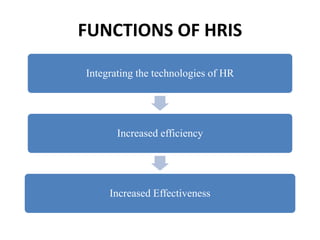
Integrating the technologies of HR
Increased efficiency
Increased Effectiveness
FUNCTIONS OF HRIS
The developments in Information Technology have
dramatically affected every HR function (example,
compensation, staffing, and training) experiencing some sort
of reengineering of its processes. However, this process of
change has created significant challenges for HR professionals
resulting in the transformation of traditional processes into on-
line processes.
INTEGRATING THE TECHNOLOGIES OF
HR
Rapid computing technology has allowed more transactions to
occur with fewer fixed resources. Typical examples are
payroll, flexible benefits administration, and health benefits
processing.
INCREASED EFFICIENCY
Most often, as with processes, computer technology is
designed to improve effectiveness either by in terms of the
accuracy of information or by using the technology to simplify
the process. For instance, pension and profit sharing
applications, benefits administration, and employee activities
are just to mention but a few. Using computer technology in
these processes ensures accurate results and offer substantial
simplification and timeliness over manual processing.
Consequently, the vast majority of HR functions have had
some degree of automation applied in order to gain both
efficiency and effectiveness.
INCREASED EFFECTIVENESS
HRIS CONTAINS INFORMATION
ABOUT:
• Jobs
• Positions
• People
APPLICATIONS OF HRIS
• Personnel administration
• Salary administration
• Leave/absence recording
• Skill inventory
• Medical History
• Accident monitoring
• Performance appraisal
• Training and development
• Human resource planning
• Recruitment
IMPORTANCE OF HRIS
• Large amount of data and information to be processed.
• Project based work environment.
• Employee empowerment.
• Increase of knowledge workers & associated information.
• Learning organization
BENEFITS OF HRIS
• Higher speed of retrieval and processing of data
• Reduction in duplication of efforts leading to reduced cost
• Ease in classifying and reclassifying data
• Better analysis leading to more effective decision making
• Higher accuracy of information/report generated
• Fast response to answer queries
• Improved quality of reports
• Better work culture
• Establishing of streamlined and systematic procedures
• More transparency in the system
LIMITATIONS OF HRIS
• It may be expensive in terms of finance and manpower
• It may be inconvenient for computer illiterates or people with
mere knowledge of computer
• Computers can not substitute human
BARRIERS TO THE SUCCESS OF
HRIS
• Lack of management commitment
• Satisfaction with the status quo
• No or poorly done needs analysis
• Failure to include key people
• Failure to keep project team intact
• Politics / hidden agendas
• Failure to involve / consult significant groups
• Lack of communication
• Bad timing (time of year and duration

Human resource information system

  • 1.
    Project on :“HUMAN RESOURCE INFORMATION SYSTEM” RADHIKA GUPTA 32 - MBA
  • 2.
    DEFINITION OF HRIS •It is a systematic way of storing data & information for each individual employee to aid planning, decision making & submitting of returns and reports to the external agencies. • A method by which an organization collects, analyses & reports the information about people and job.
  • 3.
    • To makethe desired information available in the right form to the right person and at the right time. • To supply the desired information at a reasonable cost. • To use the most efficient method of processing data. • To offer sufficient, comprehensive & ongoing information about people & jobs. • To supply up to date information at a reasonable cost. • To offer data security & personal privacy. OBJECTIVES OF HRIS
  • 4.
    ATTRIBUTES OF HRIS •A part of the organization's larger management information system • An integration of HRM and Information Systems • Helps HR managers to perform the functions in an effective and systematic way • The system used to acquire, store, manipulate, analyze, retrieve, and distribute pertinent information regarding human resources • To make decisions H.R. and line managers require accurate human resource information
  • 5.
    Integrating the technologiesof HR Increased efficiency Increased Effectiveness FUNCTIONS OF HRIS
  • 6.
    The developments inInformation Technology have dramatically affected every HR function (example, compensation, staffing, and training) experiencing some sort of reengineering of its processes. However, this process of change has created significant challenges for HR professionals resulting in the transformation of traditional processes into on- line processes. INTEGRATING THE TECHNOLOGIES OF HR
  • 7.
    Rapid computing technologyhas allowed more transactions to occur with fewer fixed resources. Typical examples are payroll, flexible benefits administration, and health benefits processing. INCREASED EFFICIENCY
  • 8.
    Most often, aswith processes, computer technology is designed to improve effectiveness either by in terms of the accuracy of information or by using the technology to simplify the process. For instance, pension and profit sharing applications, benefits administration, and employee activities are just to mention but a few. Using computer technology in these processes ensures accurate results and offer substantial simplification and timeliness over manual processing. Consequently, the vast majority of HR functions have had some degree of automation applied in order to gain both efficiency and effectiveness. INCREASED EFFECTIVENESS
  • 9.
    HRIS CONTAINS INFORMATION ABOUT: •Jobs • Positions • People
  • 10.
    APPLICATIONS OF HRIS •Personnel administration • Salary administration • Leave/absence recording • Skill inventory • Medical History • Accident monitoring • Performance appraisal • Training and development • Human resource planning • Recruitment
  • 11.
    IMPORTANCE OF HRIS •Large amount of data and information to be processed. • Project based work environment. • Employee empowerment. • Increase of knowledge workers & associated information. • Learning organization
  • 12.
    BENEFITS OF HRIS •Higher speed of retrieval and processing of data • Reduction in duplication of efforts leading to reduced cost • Ease in classifying and reclassifying data • Better analysis leading to more effective decision making • Higher accuracy of information/report generated • Fast response to answer queries • Improved quality of reports • Better work culture • Establishing of streamlined and systematic procedures • More transparency in the system
  • 13.
    LIMITATIONS OF HRIS •It may be expensive in terms of finance and manpower • It may be inconvenient for computer illiterates or people with mere knowledge of computer • Computers can not substitute human
  • 14.
    BARRIERS TO THESUCCESS OF HRIS • Lack of management commitment • Satisfaction with the status quo • No or poorly done needs analysis • Failure to include key people • Failure to keep project team intact • Politics / hidden agendas • Failure to involve / consult significant groups • Lack of communication • Bad timing (time of year and duration