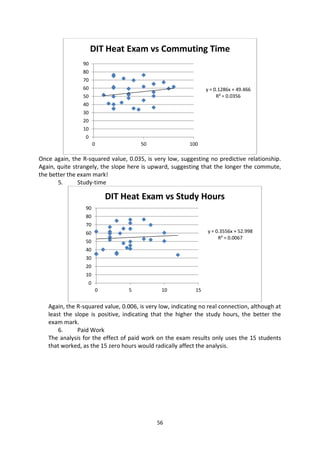
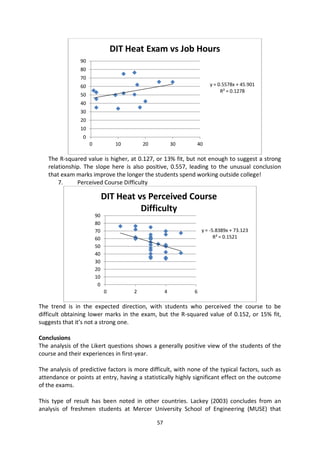
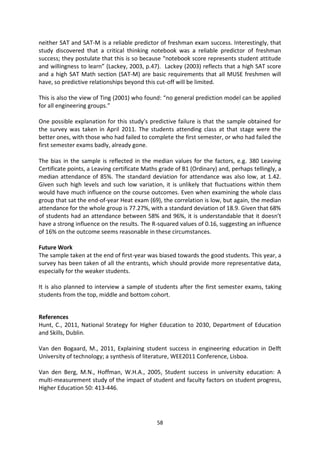
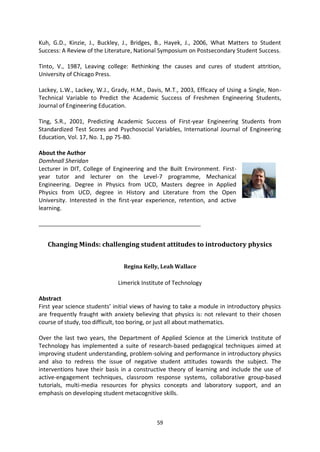
Conference Sponsors
The organisers gratefully acknowledge the support of the following sponsors for their significant
                                        contributions.


                                               1
All rights reserved. No part of this book may be reprinted or reproduced or utilised in any form or by
any electronic, mechanical or other means, now known or hereafter invented, including
photocopying and recording, or in any information storage or retrieval system, without permission in
writing from the publishers.


                                                  2
Contents
Foreword .......................................................................................................................................... 5
4th Annual LIN Conference – October 27th, Ashling Hotel, Dublin ........................................................ 6
Sub-theme 1 – First Year Experience .................................................................................................. 7
   Applying a three-step model to first year course design to champion creativity and satisfy the
   evolving objectives of business education .................................................................................... 7
       1
           Jeff Taylor, 2Conor Horan .......................................................................................................... 7
   Social Media and/in Education- where do you stand? ................................................................ 15
       Geraldine McDermott .............................................................................................................. 15
   Shared Social Video in Higher Education ‘Blended’ Business Programmes ................................. 26
       Denis Cullinane ........................................................................................................................ 26
   Action Accounting: supporting the first year student ................................................................. 38
       Frances Boylan, Tony Kiely, Alice Luby ..................................................................................... 38
   Seeking a New Level – an examination of the factors that affect Level 7 first year Engineering
   Students in DIT ............................................................................................................................ 48
       Domhnall Sheridan, Michael Carr, Anselm Griffin ..................................................................... 48
   Changing Minds: challenging student attitudes to introductory physics ..................................... 59
       Regina Kelly, Leah Wallace ....................................................................................................... 59
   Integrating theory and practice: enhancing assessment in the First Year ................................... 67
       Elizabeth Noonan, Geraldine O’Neill, ....................................................................................... 67
Sub-theme 2 – Diversity of the learner Experience .......................................................................... 75
   The Importance of Body Language to International Students ..................................................... 75
       Brian Toolan ............................................................................................................................ 75
   Enhancing Student Learning Experience and Diversity of Learning Styles Through Project Based
   Learning and Continuous Assessment ......................................................................................... 77
       Kevin Furlong ........................................................................................................................... 77
   Charting the learning journey of a group of adults returning to education ................................. 88
       Des Mooney ............................................................................................................................ 88
   Learner Experience with the MyElvin Social Network for Practicing Languages ......................... 98
       Darragh Coakley, Maria Murray ............................................................................................... 98
   Work placement blogs to harness diverse learning experiences and foster a community of
   practice ..................................................................................................................................... 108
       Julie Dunne ............................................................................................................................ 108
   Taking the LEAD: Reflections on enhancing employability skills development? ....................... 116
       Jen Harvey, Sinead McNulty, Rachel O’Connor, ...................................................................... 116


                                                                         3
Sub-theme 3 – STAFF DEVELOPMENT ............................................................................................ 123
   Engaging and preparing students for future roles – community-based learning in DIT ............. 123
      Catherine Bates ..................................................................................................................... 123
   Managing a time effective assessment process to maximise a quality learning experience ..... 132
      Jen Harvey, Dublin Institute of Technology ............................................................................ 132
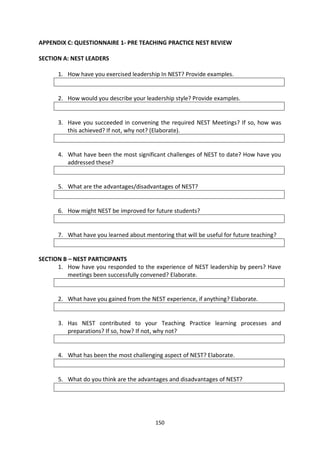
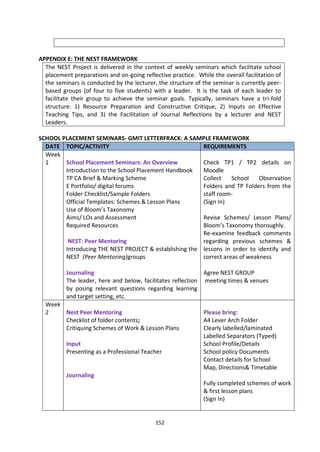
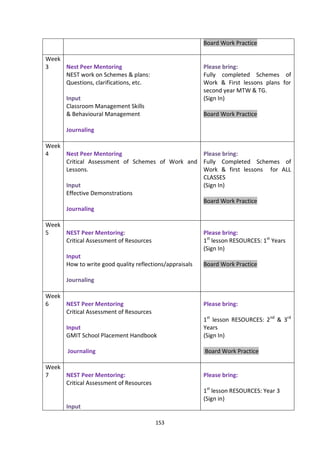
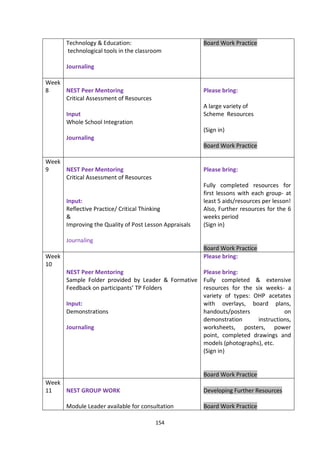
   THE NEST PROJECT: AN INNOVATIVE APPROACH TO TEACHER TRAINING ................................ 140
      Pauline Logue Collins, Kate Dunne, Dr. Angelika Rauch .......................................................... 140
   Lecturers are doin’ it for themselves The experience of MUGS in GMIT ................................... 156
      Miriam Mc Sweeney, Nicholas Canny and Patricia Mc Cann ................................................... 156
   “Different ways of knowing” - Fostering Learners engagement in the creation and dissemination
   of knowledge via motivational self systems and life-wide learning experiences. ..................... 168
      Valerie Mannix ...................................................................................................................... 168
   Evaluation of impact of professional development training in the area of technology enhanced
   learning ..................................................................................................................................... 178
      Michael McMahon ................................................................................................................. 178


                                                                         4
Foreword

Welcome to the 4th Annual Learning Innovation Network (LIN) Conference in the
Ashling Hotel in Dublin. LIN is the flagship teaching and learning initiative for the
institutes of technology (IoT) sector in Ireland and is managed by the LIN Co-
ordination Group, supported by Institutes of Technology Ireland (IOTI). LIN aims
to disseminate and promote best practice and innovation in teaching and learning
at sectoral level. It is in the area of academic professional development (APD) that
LIN has made its most distinctive contribution. Within the last year LIN has had a
number of milestone achievements, the validation of the postgraduate diploma in
Learning, Teaching and Assessment being chief among those achievements. This programme will be
formally launched at the conference this year. LIN operates as a collaboration project between
thirteen Institutes of Technology and Dublin Institute of Technology. The seminal contribution and
ongoing support of DIT for this initiative from the outset must be acknowledged at this time. This
has been instrumental in making LIN the success it is today. Within participating institutes, members
of staff from a wide range of academic departments and students’ support services complete LIN
programmes. Therefore LIN has established itself as an inter-departmental as well as an inter-
institutional project.

We anticipate the conference will provide much opportunity to share experiences and discuss
developments and innovations in the provision of a quality higher education to an ever more diverse
student body. We hope that you find the conference beneficial to your professional practice, that
the material presented will assist you in meeting the challenges of Enhancing the Learning
Experience and that you have the opportunity to meet and form new networks with colleagues from
across the sector who face similar challenges.


Best Wishes,


Dr. Richard Thorn
Director of Flexible Learning, IOTI
National Higher Education Strategy Project Manager, HEA


                                                 5
4th Annual LIN Conference – October 27th, Ashling Hotel, Dublin

CONFERENCE THEME
Enhancing the Learning Experience: Learning for an Unknown Future (Barnett, 2004) 1

SUB-THEMES
    The first year experience
     Diversity of the learner experience
     Staff development for learning / Innovation in teaching and learning

ABOUT THE CONFERENCE ORGANISERS
LIN - The Learning Innovation Network - was established in 2007 with the aim of 'working
collaboratively to enhance Learning and Teaching in Institutes of Technology’. The project was a
three year collaborative project between the thirteen Irish Institutes of Technology and Dublin
Institute of Technology. Funded by the Strategic Innovation Fund (Cycle 1) LIN received the highest
possible rating from the Gordon Davis SIF review. As a result, LIN has secured further funding to
sustain its activities under the auspices of the SIF 2 Flexible Learning project. LIN’s priority is the
provision and support of Academic Professional Development (APD) opportunities within the sector
and we recently validated the modular Postgraduate Diploma in Learning Teaching and Assessment.
LIN is run by the LIN Co-ordination Group and each institute has a LIN contact. The LIN contacts are
listed in the table below.

    Contact                                Institute
    Nuala Harding                          Athlone Institute of Technology
    Daniel McSweeney                       Institute of Technology Blanchardstown
    Anne Carpenter                         Institute of Technology Carlow
    Stephen Cassidy                        Cork Institute of Technology
    Jen Harvey                             Dublin Institute of Technology
    John Dallat                            Dundalk Institute of Technology
    Mary Anne O’Carroll                    Dun Laoghaire Institute of Art, Design and Technology
    Aedin O’hEocha & Carina Ginty          Galway-Mayo Institute of Technology
    Denis McFadden                         Letterkenny Institute of Technology
    Terry Twomey                           Limerick Institute of Technology
    Stephanie Donegan                      Institute of Technology Sligo
    Rose Cooper                            Institute of Technology Tallaght, Dublin
    Brid McElligott                        Institute of Technology Tralee
    Carol O’Byrne & John Wall              Waterford Institute of Technology
    Niamh Rushe                            LIN Co-ordinator – IOTI
    Marion Palmer                          Chair of the LIN Co-ordination Group


1
 Barnett, R. (2004) Learning for an Unknown Future. Higher Education Research and Development, 23 (3), pp.
247-260.

                                                     6
Sub-theme 1 – First Year Experience

     Applying a three-step model to first year course design to champion
     creativity and satisfy the evolving objectives of business education
                                   1Jeff   Taylor, 2Conor Horan

                  1
                      Dublin Business School, 2Dublin Institute of Technology

Abstract
This paper discusses the objectives of business education at third level and proposes
creativity and associated skills be placed at the forefront of the first year experience. As
business teaching is increasingly conducted by authority rather than creativity there exists a
necessity to ensure students new to the college experience are challenged and encouraged
to engage in harnessing their creative potential during their first academic year. This paper
will develop the need for first year course design, to follow the 3 steps outlined in the model
(Provide Opportunities for Creative Behaviour (before); Develop Skills for Creative Learning
(during); and Reward Creative Achievements (after).) to allow students the freedom to
explore the business discipline in their own unique manner while maintaining the check and
balances required from Quality Assurance. This paper will show how this template should be
considered during programmatic design and reviews with consideration to continuous
assessment design, in order to allow course lecturers the freedom to both design and
reward continuous assessment with creative skills in mind.

Introduction
At the start of every academic cycle, students eagerly, excitedly and almost certainly
nervously enter into the world of higher education. Business schools are no exception, and
first year students begin their journey for knowledge with a raw enthusiasm. It is at this
juncture that institutions have the most flexibility with which to nurture and develop
business leaders of the future.

Higher education is often a forum for creative products such as inventions, medical
discoveries, entrepreneurial endeavours, books and stage productions. However, Torrence
(1977) laments that too often these accomplishments have been achieved outside of college
requirements and sponsorship. He continues that dissertations and theses, usually regarded
as original contributions, tend to be evaluated for correctness of methodology rather than
in terms of originality, power, and worth of ideas developed and tested.

Business education has become an important part of the young and upcoming executive’s
preparation for success in business (Van der Colff, 2004). Here it is argued that in order for
business graduates to contribute in the evolving economy business schools must equip
students with diverse talents cultivated by creativity. It is proposed that such an innovative
skill set should be fostered from the outset, and that course design be the tool to champion
the cause of creativity.

A simple three-part process, derived from earlier work on creativity in the classroom by
Torrence (1977) is proposed to facilitate course design in allowing student imagination and

                                                  7
individuality to prosper. This three-stage process is before, during and after: Provide
Opportunities for Creative Behaviour (before); Develop Skills for Creative Learning (during);
and Reward Creative Achievements (after). By incorporating this process, course review and
course design will cultivate an atmosphere of broad skills development.

The weight of present evidence indicates people fundamentally prefer to learn in creative
ways (Torrence, 1977). Currently the proposed model for creativity is not employed by
Business Schools and introducing this model to influence course design a creative
environment can be cultured to the benefit of the scholarship of business undergraduates. It
is argued herein that the implementation of this model is of significant relevance in first
year in order to connect students to a more creative environment.

The Role of the Business School
It is common to review a business school’s curriculum and bear witness to the provision of
courses in management, marketing, retail and more. Orr (1991) describes the modern
business school curriculum as being a world “fragmented into bits and pieces called
disciplines and sub-disciplines”. He argues the consequence of such institutional design is a
graduating student, despite 12 or 16 or 20 years of education, devoid of any broad
integrated sense of unity and their surrounding environment. The current trend in
education is increasing specialization into narrowly defined academic disciplines, coupled
with departmental and other institutional barriers to collaboration amongst faculty and
amongst students. All too often university organizational structure prohibits faculty from
pursuing their creative ideas. (Bacon, 2010).

Recently there have been calls to treat university students as customers. As customers,
students are implicitly encouraged to adopt the passive attitude of receiving a service,
rather than actively participate and become equal stakeholders in their studies (Furedi,
2006). As a result, the conceptual difference between studying in a university and being
taught in a school has become blurred. With this in mind, it is absolutely essential that first
year course design break the current teaching and learning methods and allow students
embark upon a new path of self directed learning. Indeed, Graham (2002) notes that there
is a qualitative difference between pupils – who are for the most part directed by others –
and students who are expected to be more self-directed.

Should a business school not be educating students for more than just an understanding in a
limited field of commerce and allowing their faculty the freedom to implement unique
teaching approaches? It has long been argued that education is ‘the most personal, the
most intimate, of all human affairs’ (Dewey, 1903). It is within education more than
anywhere else that character, and intelligence of the individual be celebrated. Indeed,
Furedi (2006) mourns the absence of intellectual stimulation and challenge on
contemporary campuses. There is a compulsion of modern institutions to force all kinds of
facts, techniques, methods and information into the mind of the student, with little regard
for how and with what effect it will be used (Orr, 1991). It would be wise of modern
business schools to revisit the work of Dewey (1903) who would suggest the remedy is not
to have one expert dictating educational methods and subject-matter to a body of passive,
recipient students, but the adoption of intellectual initiative, discussion, and decision
throughout.

                                              8
As a consequence, as Furedi (2006) is concerned with the proliferation of undergraduates
who are profoundly bored by their university experiences, now is the time to champion
Dewey’s (1903) call for initiative and innovation.

The challenge for business schools is thus ever evolving. Likely challenges facing leaders will
be immeasurably diverse across several disciplines from technology to psychology to ethics
to the environment and the political arena. The implication for management educators is
clear. They have to ensure to develop the cross-disciplinary skills necessary for future
leaders and managers to ensure organisational success (Van der Colff, 2004). This position is
supported by Bosch and Louw (1998) who argue that business Schools, as pivotal role-
players in developing managerial competence, cannot escape their responsibility to deliver
appropriately educated business executives, who, through their intellectual skills and
community sensitive values, may lead future transformation processes. It would be remiss
of business schools to persist with the status quo and fail to engage in the call for a more
rounded business graduate.

Furthermore, an international trend with regards to skills development is the shifting world
of work. The new economy requires a set of skills that is fundamentally different to that
which was traditionally appropriate. Skills demanded by the new labour market include
innovation, entrepreneurship and critical thinking as the cornerstone of the new global
leader (Van der Colff, 2004). According to the authors the management skills that are most
in demand right now include:

       an ability to contribute to the strategic development of the organisation;
       an ability to take a broad holistic view of management issues, including the capacity
       to see issues in the context of an evolving internal and a changing external
       environment;
       the capacity for imagination and creativity as well as analytical skills;
       interpersonal skills, group work, team projects, negotiation, networking and other
       critical social skills;
       personal learning skills, especially the ability to learn from, and help others learn
       from experience; and
       an ability to analyse critically management problems at a strategic level.

As can be seen these skills focus on the universal skills with broad applicability, regardless of
the direction a student may take upon graduation. Self directed development will allow a
student develop the associated management skills. Course design should facilitate this
development.

Business schools are compelled to embrace creativity and interdisciplinary skills. Crucially,
course design can be tailored to champion creativity from the outset, providing first year
undergraduate students the skills they require to develop and hone their creative
sensibilities throughout their studies. The modern skills in demand include imagination,
creativity, an awereness of broad contexts, and personal learning. With this in mind the
merit of model proposed in this paper becomes ever greater, alluding to the necessity of
broad cross-disciplinary skills.


                                               9
The overarching objective of teaching in a university context is to provide the best learning
environment possible for students, so that they can develop the capability to achieve the
learning outcomes of the units being taught (Blount and McNeill, 2011). This paper contests
that such a learning environment can be developed by implementing the model proposed
below.

Proposed Model to support Creativity and its impact on Course Design
Given the evolving demands of business schools there exists a developing requirement for
graduates to possess a broad range of skills. Every person’s education is their own personal
journey upon which they should be encouraged to experiment and investigate material in
their own unique way. Current business course design reinforces passivity, monologue,
domination, and artificiality (Orr, 1991). This current business academic stasis contrasts
significantly to future objectives of business schools. A simple three-step process is derived
from the work of Torrence (1977) on creativity in the classroom. It is proposed that this
process be implemented into programmatic review and course/module design. By
embracing such an initiative the cycle of conformity can be broken. Course design is the
ideal format with which to champion creativity.

Creativity is the ability to produce work that is both new and valuable (Martins, 2011). New
means unusual, unique, new point of view, varied, original, breaking from existing patterns
and contributing something to the field which was not there before. Valuable indicates that
the product meets a need or solves a problem; it is useful, effective, and efficient, serves a
purpose and contributes to society. This definition proposed by Martins (2011) from his
literature review on creativity highlights key attributes that business school objectives
demand of modern graduates.

Additionally, this definition of creativity reveals that it is still very subjective. The subjectivity
of creativity makes it hard to measure and can be considered to be a major obstacle for
Quality Assurance in academia where a more quantifiable quality is desired. The model
outlined here stresses the importance of creativity, yet allows the rigours of Quality
Assurance to hold steadfast.


                                                 10
Before: Provide Opportunities for Creative Behaviour:
A very practical way of providing conditions for creative learning is to offer a curriculum
with plenty of opportunities for creative behaviour. Torrence (1977) proposes that this can
be done in many ways, by making assignments which call for original work, independent
learning, self-initiated projects and experimentation. Blount and McNeil (2011) insist
assessment provide engaging and challenging opportunities for students to test and apply
what they have learned. By directing a student to complete a non-examination assessment
with defined parameters such as method of submission, required word count, required
formatting style, prescribed reference quantity and much more limitations, naturally the
scope for innovation is curtailed.

Creativity is served by an environment that welcomes new ideas. Creativity needs a certain
level of tolerance for unusual or even subversive people and ideas (Sutton, 2001). The
challenge here it is for course design to be both agreeable by Quality Assurance moderators
and yet flexible enough to embrace such unusual and undefined ideas.

A business school adopting this model would design courses and assessments with language
that allows lecturers and programmatic reviewers the flexibility in the method of
assessment and the marking criteria. While substance of work is still of value, credit should
be available within the parameters set out in the course/assessment design for unique
methods of submission and evidence of creativity and independent learning.

During: Develop Skills for Creative Learning:
Learning in creative ways requires certain skills not required by authority – the skills and
strategies of inquiry, creative research and problem solving (Torrence, 1977). Further
creativity literature expresses that students ought to be encouraged to use their
imagination in art and design, music, dance, imagination, role-play and stories. While it may
be easy to argue that music and dance have no obvious link business academics, it is not the


                                             11
place of course and assessment design to educate students out of creativity and into
conformity (Robinson, 2007). If a student excels at an extra-curricular activity, they ought to
be encouraged to bring these external talents into a classroom environment. How this may
manifest itself should be an unknown, and should be dependent on the various gifts and
abilities by a particular group of students. One such example of this is a marketing project
which saw a group of students performing various pieces of music of varied moods as a
background effect to the same TV car advert, highlighting the sensory capabilities of the
viewer and the importance of music to the advertising effect.

This model, correctly implemented into course design, would allow students the
opportunities to challenge their creative abilities. By witnessing their peers succeed in their
creative academic endeavours, a student may be encouraged to compete or participate in
the same process with the same enthusiasm. If this mindset was encouraged from first year,
upon completion of a three to four year degree course students will have born witness to a
wide range of broad talent and learning methodologies, and would no longer be limited to
classroom and textbook learning.

After: Reward Creative Achievements:
Creative thinking should be legitimate and rewarding (Torrence, 1977) and seeking out
creative avenues should be reflected in a student’s grades. He continues that educational
research has indicated repeatedly that people tend to learn along the lines they find
rewarding. In order to meet with the future objectives of business schools, then course and
assessment design must embrace any means by which to reward creative behaviour.
Students are rewarded not only in grades but they should feel as if their effort has been of
value to themselves personally, and not merely as a completion of a task or academic
purpose.

If course design prescribes every method by which learning outcomes ought to be achieved,
curiosity is neglected. Students are rewarded via the voyage of discovery, answering their
own questions via self initiated learning rather than answering a set question during
assessment. Students should be encouraged to manage their own learning since the
assessment and evaluation should be their personal concern and can ultimately only be
judged according to their criteria (Rae and Gray 2003). It is essential that this be established
from the outset in first year, students should be aware that they are the driving force
behind their education, and this should be reflected in course design. If courses and
assessments are too regimented, then it follows that students will not engage with the idea
of academic ownership. In contrast however, were a student afforded the environment to
tackle key subject matter in their own innovative manner, the sense of ownership would be
greatly increased and be much more worthwhile and rewarding.

Self initiated learning is another outcome of the implementation of this model. Torrence
(1977) argues that overly detailed supervision, too much reliance upon prescribed curricula,
and attempts to cover too much material with no opportunity for reflection interfere
seriously with such efforts. Attempting to cover vast amounts of information can result in
student apathy as they feel unengaged with the material.


                                              12
Finally, course design should provide a chance for learners to learn, think and discover
without threat of immediate evaluation (Torrence, 1977). Within this construct, this model
proposes that the first year learning experience by markedly different than that of final and
interim years. In order to foster creativity, the burden of heavily graded pieces of work
should be introduced slowly and incrementally over the degree delivery period. Having
uniform assessment techniques from first year through to graduation heaps excess pressure
on first year students unfamiliar with the process, and who will be reluctant to challenge
convention. Rather, this paper proposes that first year course design allow a greater
flexibility, free from the shackles of excess grading, in order to encourage creativity and a
learning momentum. The remit of Quality Assurance remains as quantitative grading criteria
will exist in greater detail in later years of a degree programme; however, a first year
programme should be more open to the growth and maturing of its students.

Conclusion
Modern business school must develop a way of learning that is entirely appropriate to the
learning needs of future managers, that continually engages student interest and that brings
about internalized changes in the way the student thinks (Rae and Gray, 2003). The model
proposed recognises that students have various abilities and indeed, various reasons for
participating in different degree programmes. Embracing creativity is to recognise that
students have different needs, different bases of knowledge, different interests and
different learning modes. This paper seeks to encourage business schools to implement the
model outlined above into first year course and assessment design in order to address the
nuances and differences in student individuality. Business course objectives demand
creativity is at the forefront of learning for years to come. Implementing this model will
support creativity amongst first year students via course and assessment design.

The model itself acts as a guideline, itself a champion of simplicity, benefiting from greater
scope and interpretative flexibility. Much as the model advocates creativity and freedom of
expression, so to it should be implemented by business schools in their very own creative
manner with freedom and interpretation varying from business school to business school.
The model is not prescriptive, nor should it be. How one business school implements the
model may be markedly different from how another school uses it. No two situations will be
identical, so uniformity cannot be the ideal. Likewise, no two students are identical, and the
potential for innovation is limitless, and it is not up to colleges to limit that potential, rather
to encourage it, and develop it.

References
Bacon, C.M, et al. (2010) “Creation of an integrated curriculum” International Journal of
Sustainability in Higher Education, Vol. 12 No. 2, pp. 193-208

Blount, Y and McNeill, M (2011) “Fostering independent learning and engagement for
postgraduate students - Using a publisher-supplied software program”, International Journal
of Educational Management, Vol. 25 No. 4, pp. 390-404.

Bosch, J.K. and Louw, L. (1998) “Graduate Perceptions on the Status and Nature of South
African MBA Programmes” Centre for Applied Business Management, UPE.


                                                13
Furedi, Frank (2006) “Where Have All the Intellectuals Gone?” Continuum Publishing,
London.

Graham, G. (2002) “Universities: The recovery of an idea.” Thorverton, Imprint Academic.

Martens, Yuri (2011) “Creative workplace: instrumental and symbolic support for
Creativity”, Bartlett School of Architecture, UCL, London, Vol. 29 No. 1/2, pp. 63-79.

Orr, David (1991) “What Is Education For? Six myths about the foundations of modern
education, and six new principles to replace them.” The Learning Revolution, Winter 1991,
Page 52, Context Institute. pp. 499-507.

Rae, John and Gray, Harry, (2003) "Strategic leadership: A learning partnership",
Development and Learning in Organizations, Vol. 17 Iss: 5, pp.16 - 18

Robinson, Ken (2007) “Schools kill creativity” TED Conference, Ted.com,
www.ted.com/talks/ken_robinson_says_schools_kill_creativity.html Accessed September
26th, 2011.

Sukirno D.S. and Siengthai S. (2011) “Does participative decision making affect lecturer
performance in higher education?” International Journal of Educational Management, Vol.
25 No. 5, 2011 pp. 494-508.

Sutton, R. (2001), “Weird Ideas That Work: 11 1/2 Practices for Promoting, Managing, and
Sustaining Innovation”, Alan Lane/Penguin, London.

Torrence, E. Paul (1977) “Creativity in the Classroom: What research says to the teacher.”
National Education Association, Washington, D.C.

Van der Colff, Linda (2004) “A new paradigm for business education - The role of the
business educator and business school” Management Decision, Vol. 42 No. 3/4, 2004

About the Authors
Jeff Taylor BSC, MSC (International Business)
Jeff is currently engaged in research into business education while lecturing in Dublin
Business School and the Institute of Business and Technology.
Having completed both a degree and masters from the Dublin Institute of Technology, Jeff
worked in academic quality assurance before pursuing lecturing in marketing. With industry
experience predominantly in the event management industry Jeff’s teaching interests
include event and project management and marketing.
Jeff’s research interests lie in the role and scope of business education and developing
creativity within academia.

Conor Horan BBLS, MBS (Marketing)
Conor.horan@dit.ie


                                            14
Conor is a research methodologist, who has previously lectured and researched in the
Smurfit School of Business (UCD), and as a guest lecturer at the Czech University of Life
Sciences.

Conor has an honours Master in Business Studies (Marketing) from the Smurfit School of
Business and a Bachelors in Business and Legal Studies. He has researched in the area of
online marketing and e-commerce strategy. His Phd research is in the area of Inter-
Organisational Knowledge Creation and Markets-as-Networks. Conor is also a member of
the Industrial Marketing & Purchasing Group (IMP). Conor is currently completing his PhD at
the University of Strathclyde, Glasgow.

Conor has taught a range of courses from Marketing Management to Business Research
Methods. He is also published in a number of referred journals including the Journal of
Business Research, Journal of Strategic Marketing and Industrial Marketing Management.

_______________________________________________________


              Social Media and/in Education- where do you stand?


                                    Geraldine McDermott

                               Athlone Institute of Technology

The journey of a thousand miles begins with just one step (Lao Tzu)

As different forms of social media continue to become part of our students’ daily lives,
should we go beyond our comfort zones of previous teaching modes and engage with more
cutting edge channels? Is there a chance that the student who fails to engage in a
traditional setting will be more engaged if we use Facebook or Twitter or Second Life? Do
we need to bridge the gap between the digital native and the digital immigrant?

This paper will address this gap and make suggestions for reasonable educational initiatives
to address it.

To maximize engagement and encourage deeper learning, educators must endeavour to
find the best delivery method for his or her subject area. Today, most educators are aware
of the value of online resources for learning and almost all Irish third-level institutions have
embraced the virtual learning environment as an additional portal for their students. For
example, in recent years Learning Management Systems, such as Moodle or Blackboard,
have been adopted by almost all third-level institutions in Ireland. Classified as a content
management system (CMS), a learning management system (LMS) or a virtual learning
environment (VLE), this platform provides Higher Education Institutes with many
opportunities to support flexible learning and e-learning, both synchronously and
asynchronously.


                                              15
However, while many still function as document repositories, the added value for students
lies in the ability of an LMS to become a complete learning environment and educators are
increasingly engaging with the Web 2.0 activities provided by the VLEs to promote both
individual and collaborative learning.

As a stepping stone to using Web 2.0 within education, the VLE has provided educators with
the opportunity to test the validity of activities in a controlled environment. The theory of
social constructionism, which underpins Moodle in particular, sits well within the framework
of Web 2.0 technologies, where user-generated content is the main focus. Social
constructionism posits that “learning is particularly effective when one constructs
something for others to experience” (Forment, 2007) The emphasis is on the interaction
(teacher-student, student-student and activities such as forums, journals and wikis, already
integrated into the VLE invite users to create and communicate; enhancing the learner
experience.

Student engagement with these activities has shown that there is scope for moving beyond
the traditional approaches and exploring other Web 2.0 possibilities. The popularity of social
media in the wider community has prompted many in education to investigate and discuss
its usefulness, but the real challenge is to invite the larger population of educators to join
this discussion.

Kaplan and Haenlein (2010) define social media as "a group of Internet-based applications
that build on the ideological and technological foundations of Web 2.0 and that allow the
creation and exchange of user-generated content." The graphic below, created by Fred
Cavazza (2009) attempts to categorize some of the most popular social media tools available
today.


Figure 1: Social Media Landscape

                                             16
Such a classification is extremely useful given the transient nature of social media websites.
What is popular now will almost certainly soon be out of date and replaced by the next
social media ‘miracle’. Nelson (2010) cites the example of Friendster, which was replaced by
MySpace as the most popular networking site in 2004, while MySpace quickly lost
customers to Facebook as its community grew.

The increase in the use of online social games has been facilitated by the advent of the Xbox
and Playstation live platforms and online games incorporated into social networking sites
(e.g. Angry Birds) are enjoying unprecedented levels of success (Morrison, 2011). Although
the hype surrounding virtual worlds (e.g. Second Life) has lessened since their introduction,
the number of users still passed the 1 billion mark in October 2010. (Watters, 2010)

The statistics relating to the usage of the main social media websites are indicative of the
extent to which they have become part of our reality and many communities have
embraced the opportunities they provide us with to reach a global audience.

Facebook has amassed more than 800 million users globally since its launch in 2004, with in
excess of 350 million active users currently accessing Facebook through their mobile
devices. (http://www.facebook.com, 2011). According to research by Amas (2011), the
Facebook app is the most used smartphone app amongst Ireland’s 1.94 million Facebook
users. YouTube’s 490 million unique users 2 spend approximately 2.9 billion hours on its
website every month, while there are over 175 million Twitter accounts worldwide with in
excess of 200 million tweets per day.

Against a backdrop of such impressive figures, many within the education community have
recognised that they cannot ignore social media and have begun to explore what social
media can offer their disciplines. Priego (2011) argues that “academics are trained to
manage data streams and to make informed appraisals of the sources we find. These skills
suit social media perfectly” and it is this evaluation of social media tools for learning that
educators can easily engage with. In addition, since alternative forms of assessment and
student engagement are hot topics at the moment, there is an appetite to look beyond the
traditional methods to find something more meaningful to the learner.

Experiences with TEL: a qualitative analysis
The discussion surrounding social media in education prompted the team responsible for
the delivery of the LIN module on Technology Enhanced Learning in AIT to incorporate a
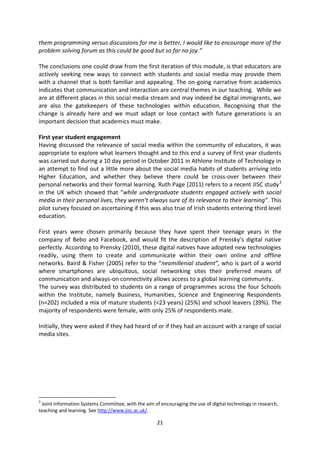
number of social media elements into its design. This module fits into the overall framework
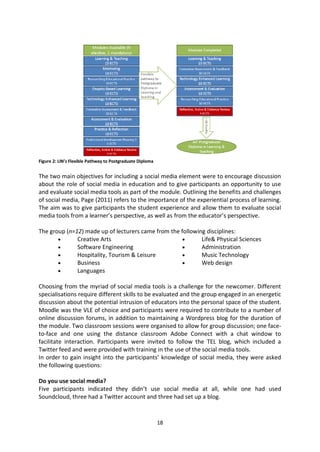
for LIN CPD (see figure 2) on a pathway towards a Postgraduate Diploma in Learning and
Teaching and was delivered over the second semester of the academic year 2010-2011.


2
 This figure refers to the main YouTube website & doesn’t include embedded videos or videos watched on
mobile devices.

                                                   17
Figure 2: LIN’s Flexible Pathway to Postgraduate Diploma


The two main objectives for including a social media element were to encourage discussion
about the role of social media in education and to give participants an opportunity to use
and evaluate social media tools as part of the module. Outlining the benefits and challenges
of social media, Page (2011) refers to the importance of the experiential process of learning.
The aim was to give participants the student experience and allow them to evaluate social
media tools from a learner’s perspective, as well as from the educator’s perspective.

The group (n=12) made up of lecturers came from the following disciplines:
              Creative Arts                                 Life& Physical Sciences
              Software Engineering                          Administration
              Hospitality, Tourism & Leisure                Music Technology
              Business                                      Web design
              Languages

Choosing from the myriad of social media tools is a challenge for the newcomer. Different
specialisations require different skills to be evaluated and the group engaged in an energetic
discussion about the potential intrusion of educators into the personal space of the student.
Moodle was the VLE of choice and participants were required to contribute to a number of
online discussion forums, in addition to maintaining a Wordpress blog for the duration of
the module. Two classroom sessions were organised to allow for group discussion; one face-
to-face and one using the distance classroom Adobe Connect with a chat window to
facilitate interaction. Participants were invited to follow the TEL blog, which included a
Twitter feed and were provided with training in the use of the social media tools.
In order to gain insight into the participants’ knowledge of social media, they were asked
the following questions:

Do you use social media?
Five participants indicated they didn’t use social media at all, while one had used
Soundcloud, three had a Twitter account and three had set up a blog.


                                                           18
What does social media mean to you?
“Social networking - new way of interacting”
“Tools which facilitate communication between learners, not just via teacher”
 “Sites for online group interaction”
“Using web technologies to encourage communication”
“A way of communicating with a wider audience through social networking tools”
“I suppose using any of the technologies that allow interaction”
“It is a tool to communicate with a wider audience”
“Computer technology with interaction with people”
 “Anything that allows people to interact with each other: student-teacher, student-
student”
“Any web technology that allows learning to take place”
“Any media that allows communication”

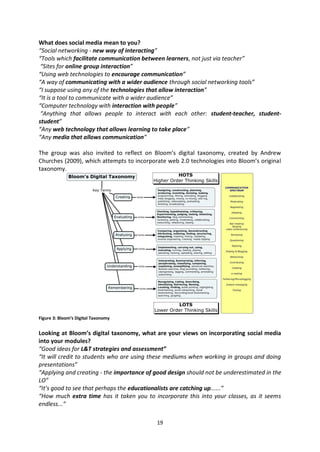
The group was also invited to reflect on Bloom’s digital taxonomy, created by Andrew
Churches (2009), which attempts to incorporate web 2.0 technologies into Bloom’s original
taxonomy.


Figure 3: Bloom’s Digital Taxonomy


Looking at Bloom’s digital taxonomy, what are your views on incorporating social media
into your modules?
“Good ideas for L&T strategies and assessment”
“It will credit to students who are using these mediums when working in groups and doing
presentations”
“Applying and creating - the importance of good design should not be underestimated in the
LO”
“It’s good to see that perhaps the educationalists are catching up......”
“How much extra time has it taken you to incorporate this into your classes, as it seems
endless...”

                                           19
“Have you found student performance has improved?”
“It's because it's such a massive area that keeping track of the resources /tools is crucial, it
seems to me.”
“That’s what I'm hoping for that they (students) interact outside the 2hr class/lab”

Given that “effective teachers are by definition reflective practitioners” (Kapranos, 2007, p8),
the group was also invited to reflect on whether they could (or would) incorporate social
media into the delivery or assessment of their individual subject areas. At the end of the
module, the participants were asked if the discussion on / use of social media tools during
the TEL module to help [them] gain a better understanding of these?

“Absolutely! Exposure to the range of tools and potential of these from an educational
perspective was great. To hear the experience of participants who had used some of the
social media tools was useful.”

“The TEL module definitely inspired me to explore the world of social media, and although I
know I’m only at the tip of the iceberg I have actually begun using it more.”

“Have I gained a better understanding yes, I would have been familiar with a lot of the tools
but to actually use them no. It may be just me, but I didn't use the blog after the course, I
think it depends on the person. I'm not usually a forum person (usually a lurker...) but I liked
helping out some of the other participants with problems.[…]
 […] the discussion of social media did help me understand social media better.

Finally, they were asked if they had actually used any social media activities into their
teaching since completion of the module.
“I am using Moodle blogs/journal and Moodle discussion forums. I also use YouTube. Have
not ventured into twitter/Facebook etc. as I do not think these are used for work purposes
(personal opinion!) by our students and they are already distracted enough!”
“I now routinely use YouTube clips in class. Whereas before I might have vaguely mentioned
it to the students, now I use the clips as a learning tool.
I now use forums on Moodle, routinely for news and information, Q&A, but this year I’m also
using them for formative assessment.
One of my lab groups are using a Wordpress blog to write up a lab report.
And finally I use Twitter for my own research. One of the big issues I had before was trying
to keep up with the most current research in my area, now I get tweets from the main
players so I feel like I am part of the action again. As tweets are so concise I find that I can
scan through them easily and decide what I want to investigate further when I have the
chance.”

“[…] I'm afraid I haven't been very innovative this semester - more of the same stuff -
Forums, Journal etc. […]I have to say I am not a great fan of Facebook. If you haven't
checked in in a couple of days, it doesn't show you ALL the activity. . If only people would
move over to Google Plus...”
“No would be the answer. […]I did put a help forum on my moodle page for each of my
classes, but so far no posts. Some of the activities on social networking don't lend themselves
to some engineering courses, my subject are mathematical (programming etc.) so getting

                                              20
them programming versus discussions for me is better, I would like to encourage more of the
problem solving forum as this could be good but so far no joy.”

The conclusions one could draw from the first iteration of this module, is that educators are
actively seeking new ways to connect with students and social media may provide them
with a channel that is both familiar and appealing. The on-going narrative from academics
indicates that communication and interaction are central themes in our teaching. While we
are at different places in this social media stream and may indeed be digital immigrants, we
are also the gatekeepers of these technologies within education. Recognising that the
change is already here and we must adapt or lose contact with future generations is an
important decision that academics must make.

First year student engagement
Having discussed the relevance of social media within the community of educators, it was
appropriate to explore what learners thought and to this end a survey of first year students
was carried out during a 10 day period in October 2011 in Athlone Institute of Technology in
an attempt to find out a little more about the social media habits of students arriving into
Higher Education, and whether they believe there could be cross-over between their
personal networks and their formal learning. Ruth Page (2011) refers to a recent JISC study 3
in the UK which showed that “while undergraduate students engaged actively with social
media in their personal lives, they weren’t always sure of its relevance to their learning”. This
pilot survey focused on ascertaining if this was also true of Irish students entering third level
education.

First years were chosen primarily because they have spent their teenage years in the
company of Bebo and Facebook, and would fit the description of Prensky’s digital native
perfectly. According to Prensky (2010), these digital natives have adopted new technologies
readily, using them to create and communicate within their own online and offline
networks. Baird & Fisher (2005) refer to the “neomillenial student”, who is part of a world
where smartphones are ubiquitous, social networking sites their preferred means of
communication and always-on connectivity allows access to a global learning community.
The survey was distributed to students on a range of programmes across the four Schools
within the Institute, namely Business, Humanities, Science and Engineering Respondents
(n=202) included a mix of mature students (<23 years) (25%) and school leavers (39%). The
majority of respondents were female, with only 25% of respondents male.

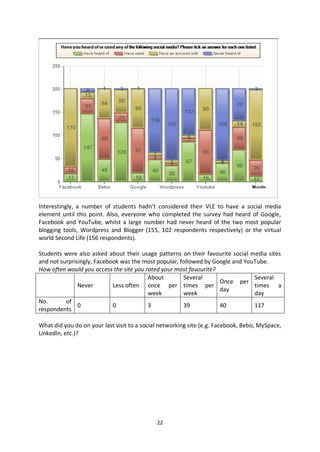
Initially, they were asked if they had heard of or if they had an account with a range of social
media sites.


3
 Joint Information Systems Committee, with the aim of encouraging the use of digital technology in research,
teaching and learning. See http://www.jisc.ac.uk/.

                                                     21
Interestingly, a number of students hadn’t considered their VLE to have a social media
element until this point. Also, everyone who completed the survey had heard of Google,
Facebook and YouTube, whilst a large number had never heard of the two most popular
blogging tools, Wordpress and Blogger (155, 102 respondents respectively) or the virtual
world Second Life (156 respondents).

Students were also asked about their usage patterns on their favourite social media sites
and not surprisingly, Facebook was the most popular, followed by Google and YouTube.
How often would you access the site you rated your most favourite?
                                         About        Several                  Several
                                                                   Once per
               Never        Less often once per times per                      times a
                                                                   day
                                         week         week                     day
No.       of
               0            0            3            39           40          117
respondents

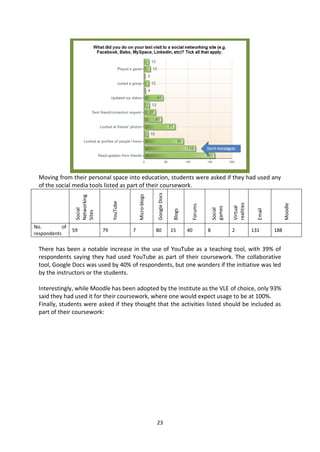
What did you do on your last visit to a social networking site (e.g. Facebook, Bebo, MySpace,
LinkedIn, etc.)?


                                             22
Moving from their personal space into education, students were asked if they had used any
  of the social media tools listed as part of their coursework.
                                                                Google Docs
                                                  Micro-blogs
                  Networking


                                    YouTube


                                                                                                              realities


                                                                                                                                          Moodle
                                                                                        Forums


                                                                                                              Virtual
                                                                                                     games
                  Social


                                                                                                     Social


                                                                                                                            Email
                                                                               Blogs
                  Sites


No.         of
                 59            79             7                 80            15       40        8            2           131       188
respondents

  There has been a notable increase in the use of YouTube as a teaching tool, with 39% of
  respondents saying they had used YouTube as part of their coursework. The collaborative
  tool, Google Docs was used by 40% of respondents, but one wonders if the initiative was led
  by the instructors or the students.

  Interestingly, while Moodle has been adopted by the Institute as the VLE of choice, only 93%
  said they had used it for their coursework, where one would expect usage to be at 100%.
  Finally, students were asked if they thought that the activities listed should be included as
  part of their coursework:


                                                                23
Again, it is interesting to note that in most cases students were in favour of using these new
channels within an educational context, with both social networks (52%) and online videos
(62%) garnering most support.

Conclusion
Our educational system exists within an ever-changing social and economic environment. In
Ireland, the National Strategy for Higher Education (NSHE) was borne out of a need for
rationalisation and will shape our educational system of the future. This report makes
reference to the role that technology will play in the ‘institutional change’ to come. Bradwell
(2009), quoted in the NSHE, 2011, p.48, suggests that “the internet, social networks,
collaborative online tools that allow people to work together more easily, and open access to
content are both the cause of change for universities, and a tool with which they can
respond”.

Over the course of our professional lives as educators, the tools we will use to reach our
students will change a number of times, yet each tool will be approached with caution, until
its usefulness within education is clearly identified. But for now our generation of students
is, to quote Jimmy Wales, founder of Wikipedia, “WTF – Wiki Twitter Facebook”.

References
Amas (2011) State of the Net. [Internet], 21. Available from: http://amas.ie/online-
research/state-of-the-net/state-of-the-net-issue-21-summer-2011/7-mobile/ [Accessed 10th
October, 2011].


Baird D. and Fisher M. (2005) Neo-millennial user experience design strategies: utilizing
social networking media to support "always on" learning styles. Journal of Educational
Technology Systems, 34 (1), pp. 5 – 32.

                                              24
Bradwell, Peter. (2009) The Edgeless University – Why Higher Education must Embrace
Technology London: Demos 2009, p.8. See http://

www.jisc.ac.uk/media/documents/publications/edgelessuniversity.pdf.       Quoted      in
Department of Education. (2011) National Strategy for Higher Education to 2030 [ONLINE]
Available at: http://www.hea.ie/files/files/DES_Higher_Ed_Main_Report.pdf. [Accessed 18
November 2011]

Bloom’s digital taxonomy concept map [Online image].                      Available   from:    <
http://edorigami.wikispaces.com/Bloom%27s+Digital+Taxonomy >

Forment, M. (2007) A Social Constructionist Approach to Learning Communities: Moodle. In:
Lytras, M and Ambjörn Naeve. ed. Open Source for Knowledge and Learning Management:
Strategies Beyond Tools. London, Idea Group Publishing, pp.369- 380.

Kaplan A., and Haenlein, M. (2010) Users of the world, unite! The challenges and
opportunities of social media. Business Horizons 53 (1), pp.59-68.

Kapranos, P. (2007) 21st Century Teaching & Learning Kolb Cycle & Reflective Thinking as
part of teaching, creativity, innovation, enterprise and ethics to engineers. In: International
Symposium for Engineering Education, 2007, Dublin. Dublin, Dublin City University, pp.3-11.

Learning Innovation Network Flexible Pathway to Progression [Online image]. Available
from: <http://www.linireland.com/lin-pg-diploma.html>

Morrison, C. (2011) An In-Depth Look at the Social Gaming Industry’s Performance and Prospects on
Facebook [Online]. Available at: http://www.insidefacebook.com/2011/01/24/an-in-depth-look-
at-the-social-gaming-industry%E2%80%99s-performance-and-prospects-on-facebook/
[Accessed 9 October 2011].

Nelson, P. (2010) From Friendster To MySpace To Facebook: The Evolution and Deaths Of
Social Networks [Online]. Available at:

http://www.longislandpress.com/2010/09/30/from-friendster-to-myspace-to-facebook-the-
evolution-and-deaths-of-social-networks/ [Accessed 12th October 2011].

Priego, E. (2011) How Twitter will revolutionise academic research and teaching. Higher
Education     Network    12    September     [Internet   blog].  Available   from:    <
http://www.guardian.co.uk/higher-education-network/blog/2011/sep/12/twitter-
revolutionise-academia-research > [Accessed 21 October 2011]

Social    Media    Landscape.     (2008)     [Online    image].            Available  from:
<http://www.fredcavazza.net/2008/06/09/social-media-landscape/            > [Accessed 10th
October 2011].


                                               25
Watters, A. (2010) Number of Virtual World Users Breaks 1 Billion, Roughly Half Under Age
15 [Online]. Available at:

http://www.readwriteweb.com/archives/number_of_virtual_world_users_breaks_the_1_bi
llion.php [Accessed 12th October 2011].

Prensky, M. (2001) Digital Natives, Digital Immigrants. On the Horizon, 9 (5) October, pp. 1-
6.

_______________________________________________________


 Shared Social Video in Higher Education ‘Blended’ Business Programmes


                                       Denis Cullinane

                    Dun Laoghaire Institute of Art Design and Technology

Introduction
The term ‘Web 2.0’ was first used by O’Reilly Media (O'Reilly, 2005) as a means of capturing
the evolution of the web to what has also been called the ‘read/write web’ or ‘the social
web’. ‘Web 2.0’ is used to describe web applications and services such as blogs, wikis, social
bookmarking/tagging, content management and collaboration, social networking sites,
virtual worlds and digital media sharing sites such as Flickr and YouTube. ‘Web 2.0’ or ‘Social
Web’ is being increasingly used internationally in nearly all areas of higher education,
including academic, administrative and support areas (Franklin & Armstrong, 2008).

YouTube has been one of the most successful media sharing ‘Web 2.0’ sites since its
inception in April 2005, and is estimated to have more than 1bn ‘views’ of its video content
per day. Many media outlets and educational institutions now have dedicated channels on
YouTube for their video content.

Although YouTube is primarily perceived as an entertainment video site, it has a growing
volume of educational video content posted by educators, students and professionals from
all sectors of business and education. It was this ever growing number of ‘educational
videos’ on YouTube and other video sharing sites like Vimeo, TED, and Blip TV that
contributed to the impetus for this study. This research was conducted to explore the
student experience of using ‘Web 2.0’ or social media shared video in blended business
education. Approximately 155-160 videos from digital media sharing sites were used to
introduce emerging Internet and new media applications and technologies to business,
enterprise and arts management students. The majority of the videos were from social
media sharing sites such as YouTube, TED, and Blip TV. The videos were used extensively in
the classroom and online in the Blackboard Virtual Learning Environment (VLE).
There were two objectives for this study:-
               To explore the use of shared social media videos as part of an eLearning
        resource in a blended business classroom scenario.


                                              26
To monitor and obtain student opinions on the eLearning resource used in
       class and online on the Blackboard VLE as part of the teaching and learning of ‘Web
       2.0’ or ‘Social Media’ applications as tools for the worlds of business, enterprise and
       arts management.

The research methods that were used in the study were:-
               Ongoing observation of student use of the video content in computer
       laboratory sessions.
               Semi-structured ‘in situ’ interviews with individuals and small groups of
       students at the end of the term. All the interviews were digitally recorded.
               Analysis of written reflective review reports at end of year from students on
       their usage of the VLE and other applications incorporating a section on the video
       content used to introduce the concept of ‘Web 2.0’ Apps' and other learning related
       material.

Results and Discussion
The study resulted in qualitative data from observations, interviews, and written reports
from 108 of a potential 140 students across three cohorts. Coding of the statements was
conducted to provide a method for identifying trends in the student attitudes about the
online resource and its video content in particular. Qualitative analysis was limited to
identification of recurring themes in the students’ responses across all data sets; data
gathered by observations of students use in-class, data gathered from semi-structured
interviews, and data gathered from Year End Report comments on video content in the
course.
Analysis of the gathered data was by transcription of all observations and interviews and
then repeated processing of the statements to identify themes. This was achieved by
extracting statements that were all commenting on the same key issues - technical,
navigational, and educational. These extracts were combined with extracts of comments
made in written review reports submitted by students at year end. The range of themes that
emerged from the data analysis is summarized and discussed under the following headings:-
               Technical Implications of VLE Embedded Video Content
               Screen Design Considerations
               Educational Value of Shared Social Video
               Curriculum Design Implications of Shared Social Video


Technical Implications of VLE Embedded Video Content
Observation of student usage of the video content embedded in the VLE revealed that
initially there were a number of issues interfering with the effectiveness of the online video
content in the lecture and laboratory sessions.
                 Access to the VLE was problematic for many students in the first 3 months of
         the year due to password, account, server or Java applet issues.
                 Delays in the loading of video content, if accessed through the VLE, while
         direct access to the source site was often quicker. This encouraged students to
         ‘double click’ on the embedded video in the VLE and then access the source site
         directly thus ‘by passing’ any associated text or links in the VLE interface. Students
         reported that such delays only occurred while accessing the VLE video on campus.

                                              27
Audio element of video was not accessible on campus as students may not
       have personal earphones and library PCs may not have sound cards installed. Thus
       students were often reliant on the in-built sound systems in the classrooms and
       computer labs to hear the content of video chosen by lecturer. It took some time for
       students to become familiar with the practicalities of using multimedia in their
       learning routine as they did not use such features to any great extent in other
       business modules.
              Issues around browser compatibility with VLE also had some effect on the
       user experience as various browser applications such as Opera & Firefox often
       rendered the VLE screen layout differently.

Observing the student engagement with the VLE was an opportunity to assist and guide
their exploration and to gather informal feedback and make ‘field notes’. Some continued
to report ‘technical issues’ throughout the study. Similar issues have been reported by
Williams (2002) as being one of the major barriers to students using technology and have
been highlighted in the JISC Info Kit website entitled Effective Use of Virtual Learning
Environments (2009).

Screen Design Considerations
Navigation limitations of the VLE module interface were strongly evident. As the homepage
interface was being developed on an ongoing basis there were often times when the
interface was challenging for students to navigate through. Thus screen design in the VLE
can be a barrier to student learning with online video, which has to be overcome. While
some students disliked the user interface of the VLE and decided to bypass the VLE and
access videos directly on the source sites, other students liked the pre-selection of videos
from the multitude that are on the source sites such as YouTube. They appreciated the work
conducted in selecting the videos and the structure or scaffolding that the VLE gave to the
use of video in their learning. This may be due to the VLE interface acting as a kind of blinker
to filter out the surrounding distracting content on source sites.

These findings are consistent with findings of Kay and Knaack (2007) that ‘organization of
the layout, learner control, clear instructions and theme were critical hotspots where the
use of learning objects enhanced or inhibited learning’ (p.24). Poor navigational design is
often included under the general heading of poor usability, but navigational complexity was
singled out as a particular problem in VLEs by several respondents in a study by Dunn
(2003).

The empirical study by Parizotto-Ribeiro, Hammond, Mansano, & Cziulik, (2004) found a
positive relationship between aesthetics and perceived usability when using a VLE. The
implementation of instruction design principles and procedures is thus ever more important
in an increasingly complex blended learning environment incorporating online shared social
media such as video.
Educational Value of Shared Social Video
Of the 107 students who submitted reports 76% commented positively on the video content
in the VLE with 24% not commenting on the use of video in the online resource supporting
the programmes.


                                              28
There was a range of opinions and attitudes expressed in the interviews and the reports
towards the video content and the medium through which it was delivered. Videos are not
for everyone and about 24% of students appeared to be indifferent to them and did not use
them to any great extent as they may have considered video a waste of time in an
educational context.

This seems to concur with Carvin (2007) and Snelson and Perkin’s (2009) reports on
educational value and that, for some students, the use of social video is not serious enough
in an educational setting and they may consider it as detrimental in terms of time.

Conversely about 76% of students believed that videos are a good way to learn, a different
way to learn, a break from reading lots of text and a good way to get ‘the big picture’ on the
use of Internet Applications in business. This is consistent with the findings of Conole et al
(2008) that ‘students are using a different range of e-learning strategies and appropriating
the tools to meet their own needs’ (p.522).

Of the 81(76%) students, who commented critically on the online video content, all were
generally favourable for mostly the same reasons that online video is easy and interesting to
use in a learning situation. This is in alignment with research showing that nearly four-fifths
of college students (79%) agree that the Internet has a positive impact on their college
experience (Jones, 2002).

Curriculum Design Implications of Shared Social Video
The reasons for 26 (24%) of students not making any comment on the video content in their
reports can only be deduced from observations made in-class and by some of the negative
comments received in both the interviews and in the reports.

Videos need to be relevant and related to learning activities and assessment; they need to
be short and direct. They may not engage many of the learners unless they have specific
relevant information. The need for such video to be ‘coupled with hands on learning’, as
indicated by Duffy (2008, p.125) and also argued by Karpinnen (2005) and the seminal work
of Laurillard (1993) in which she argues that ‘knowledge must be used in authentic activity
in order to form a full understanding of the knowledge and how it operated’ (p.17).

Most students also seemed to prefer good quality and short duration videos as first
indicated by research into educational film in the 1920s as described by Saettler (2004).
Snelson & Perkins (2009) indicate how ‘the idea of short single concept film relates well to
the current video clip phenomenon’ (p.11).

Conclusions and Recommendations
The range of shared online video content suitable for use in Higher Education is becoming
extensive and is likely to do so over the coming years. Incorporating such video into the
learning environment is also becoming easier. However as outlined by Karppinen (2005),
Snelson (2008)and Bonk (2008) videos are just one component in the complexity of a
blended classroom activity.


                                              29
In this study a range of approximately 160 social media shared videos were used in a
blended business classroom to introduce students to emerging new media Internet
applications and technologies. In the face-to-face classroom or computer laboratory it was
observed that these videos were an important asset in attracting and maintaining student
attention and creating a context for learning tasks and discussions in business related topics.
In the blended business classroom online video is only part of the learning mix and there are
advantages and disadvantages in the use of such video online in the Blackboard VLE. The
design of the VLE user interface needs to be monitored to ensure that it is user friendly and
supportive of the learning process. In today’s world of engaging social media sites like
Facebook and Twitter the danger of information overload and subsequent learner switch off
is very apparent. However there is also a possible advantage of the VLE, which can act as
filter to remove related distracting information and replace it with information to guide the
learning tasks and activities associated with an embedded video.

The purpose and content of the video has to be apparent to students. Some students may
have low expectations of what can be learned from video and may not be visual learners.
Thus the content needs to be both relevant and be seen to be relevant. Linking activity with
the video appears to be important to most learners as highlighted by Karppinen (2005).

In this study it would appear that many higher education business students like the concept
of learning with shared social video but it needs to be short in duration, relevant, focused
and linked with assessment and learning outcomes. Students appear to like the addition of
video to the mix of learning materials in a blended classroom but also need guidance and
support in using it to maximum effect. The design of the user interfaces and the learning
activities and assessment procedures are key to its success.

From the lecturer angle it is a time consuming process to pre-select videos for use in
teaching and online virtual learning and it might be better to allow the students to become
involved in this process and thus become active in constructing their own perspective on the
knowledge of a particular subject or topic. In the year following this study, a video
production project was built into the assessment for one cohort of students and it proved
very successful. Thus the task was moving in the direction advised by Karppinen (2005) of
being active, constructive, collaborative, conservational, contextual, guided, emotionally
involving and engaging.

More research, like that of Burden and Atkinson (2007, 2008 ) on developing a video
learning designs framework to engage learners in higher level cognitive activities using ten
different ‘learning designs’ in a variety of ‘learning spaces’, is required. Their initial learning
designs included stimulation-engagement, narrative or storytelling, collaborative,
conceptual, problem solving, student authoring, empathy or role play and figurative or
allegorical uses of video.

This increasing use of social web-based video in education indicates the need for evaluation
studies designed to investigate the potential value or pitfalls in this rapidly evolving
phenomenon (Snelson, 2008). The kinds of ‘digital pedagogies’ that work in these digital
social spaces and how they are perceived and experienced by students was one of the
questions remaining to be answered (Hemmi, Bayne, & Land, 2009). Further research is also

                                                30
required on the forms of ‘technoliteracy’ required by students to manage and produce
academic knowledge within such spaces (Kahn & Kelner, 2005).

References


Aesthetics and perceived usability of VLEs: preliminary results. Parizotto-Ribeiro, R, et al. 2004. 2004.
HCI 2004 Proceedings . pp. 217-221.

An Assessment of Faculty Usage of YouTube as a Teaching Resource. Burke, S, Synder, S and Rager,
R C. 2009. 1, 2009, Journal of Allied Health Sciences and Pratice, Vol. 7, pp. 1-7.
http://ijahsp.nova.edu ISSN 1540-580X.

Burke, S, Synder, S and Rager, R C. 2009. 1, 2009, Journal of Allied Health Sciences and Pratice, Vol.
7.

An Assessment of Faculty Usage of YouTube as a Teaching Resource. Burke, Sloane C, Ryder, Shonna
and Rager, Robin C. 2009. 1, Jan 2009, The Internet Journal of Allied Health Sciences and Practice,
Vol. 7.

Analysis Based Problem solving: making analysis and reasoning the focus of physics instruction.
Leonard, J. W., Gerace, W. J. and Dufresne, R. J. 2002. 2002, Science Teaching, pp. 1-23.

Animation as an aid to multimedia learning. Mayer, R E and Moreno, R. 2002. 1, 2002, Educational
Psychology Review, Vol. 14, pp. 87-99.

Beyond Content: Developing Transferable Learning Designs with Digital Video Archives. Burden,
Kevin and Atkinson, Simon. 2008. Chesapeake, VA : ACCE, 2008. In Proceedings of World
Conference on Educational Multimedia, Hypermedia and Telecommunications 2008. pp. 4041-4030.

Bielawski, L and Metcalf, D. 2003. Blended eLearning: Integrating knowledge, performance support,
and online learning. Amherst, MA : HRD Press, 2003.

—. 2003. Blended eLearning: Integrating knowledge, performance support, and online learning. .
Amherst, MA : HRD Press, 2003.

Blended Learning in Virtual Communications Classroom: Student Reflections on a Multimedia Course.
George-Palilonis, Jennifer and Filak, Vincent. 2009. 2009, Electronic Journal of eLearning, pp. 247-
256.

Blended Learning: Uncovering its transformative potential in higher education. Garrison, R and
Vaughan, H. 2004. 2004, Internet and Higher Education, pp. 95-105.

Blended Learning: Uncovering its transformative potential in higher education. Garrison, R and
Vaughan, H. 2004. 2004, Internet and Higher Education, pp. 95-105.

Bonk, Curtis J. 2009. The World is Open: How Web Technology Is Revolutionizing Education. San
Francisco : Jossey-Bass, 2009.


                                                   31
—. 2008. YouTube Anchors and Enders: The Use of Shared Online Video Content as a Macrocontext
for Learning. PublicationShare. [Online] 23rd March 2008. [Cited: 13th June 2010.] Paper presented
at the American Educational Research Association (AERA) 2008 Annual Meeting, New York, NY..
http://www.publicationshare.com/SFX7EED.pdf.

Cann, Alan J. 2007. Podcasting is Dead. Long Live Video. Bioscience Education eJournal. [Online]
2007. [Cited: 18th August 2010.] http://www.bioscience.heacademy.ac.uk/journal/vol10/beej-10-
C1.pdf.

—. 2007. Podcasting is Dead. Long Live Video. Bioscience Education eJournal. [Online] 2007.
http://www.bioscience.heacademy.ac.uk/journal/vol10/beej-10-C1.pdf.

Carvin, A. 2007. Learning now:At the crossroads of Internet culture and education. YouTube 101: Yes
it's a real class. [Online] 18 September 2007. [Cited: 20 August 2010.]

Classroom response systems: a review of the literature. Fies, C. and Marshall, J. 2006. 2006, Journal
of Science Education and Technology.

Clickers in the large classroom: current research and best practice tips. . Caldwell, J. 2007. 2007, Life
Sciences Education, pp. 9-20.

Cloudworks: Social Networking for learning design. Conole, Gráinne, et al. 2008. Melbourne :
Ascilite, 2008. Proceedings ascilite Melbourne 2008. pp. 187-196.

Cognitive Pronciples of multimedia learning: The role of modality and contiguity. Moreno, R and
Mayer, R E. 1999. 1999, Journal of Educational Psychology, Vol. 91, pp. 358-368.

Cohen, J. W. 1988. Statistical Power Analysis for the behavioural sciences. Hillsdale, NJ : Lawrence
Erlbaum Associates, 1988.

Cohen, L, Mannion, L and Morrison, K. 2007. Research Methods in Education. New York : Routledge,
2007.

Committee of Inquiry into the Changing Learner Experience. 2009. Higher Education in a Web 2.0
World. London : The Committee of Inquiry into the Changing Learner Experience, 2009. p.
www.clex.org.uk.

Deal, A. 2007. Teaching with Technology White Paper: Podcasting. Educause CONNECT. [Online]
2007. [Cited: 10 August 2010.] http://connect.educause.edu/files/CMU_Podcasting_Jun07.pdf.

'Disruptive technologies', 'pedagogical innovation': What's new? Findings from an in-depth study of
students' use and perception of technology. Conole, Grainne, et al. 2008. 2, 2008, Computers and
Education, Vol. 50, pp. 511-524. Available online www.sciencedirect.com.

Conole, Grainne, et al. 2007. 2007, Computers and Education, pp. 511-524.

Dunn, S. 2003. Return to SENDA? Implementing accessibility for disabled students in virtual learning
environments in UK further and higher education. Sara Dunn VLE Report. [Online] 2003. [Cited: 27th
August 2010.] http://www.saradunn.net/VLEreport/documents/VLEreport.pdf.


                                                   32
2009. Effective Use of Virtual Learning Environments. JISC infoNet. [Online] 2009. [Cited: 27th August
2010.] http://www.bisinfonet.ac.uk/InfoKits/effective-use-of-VLEs/intro-to-VLEs/introtovle-moving-
forward/introtovle-issues.

E-Learning: The Hype and the Reality. Conole, G. 2004. 12, 28th Sept 2004, Journal of Interactive
Media in Education. www- jime. open. ac. uk/ 2004/ 12].

Engaging the YouTube Google-Eyed Generation: Strategies for Using Web 2.0 in Teaching and
Learning. Duffy, Peter. 2008. 2008, Electronic Journal of e-Learning, pp. 119-130. available online at
www.ejel.org.

Evaluating the learning in learning objects. Kay, Robin H and Knaack, Liesel. 2007. 2007, Open
Learning, Vol. 22, pp. 5-28.

Exploring the synergy between pedagogical research, teaching and learning in introducotry physics.
Wallace, L. 2010. Dublin : NAIRTL, 2010. LIN Conference: Flexible Learning.

Facilitating an authentic learning experience in introductory physics at the Limerick Institute of
Technology. Wallace, L. and Boyle, L. 2010. Dublin : Castel, 2010. SMEC2010: Inquiry based learning:
facilitating authentic learning experiences in science and mathematics. pp. 19-24.

Factors Influencing the Usage of Websites. Heijden, van der H. 2003. 2003, Netherlands Information
and Management, Vol. 40, pp. 541-549.

Faculty Perceptions on the Use of Video in a Hybrid Faculty Orientation Course. Arakaki, Margret.
2009. Hawaii : Technology Colleges Community (TCC) Worldwide Online Conference, 2009. TCC
Proceedings 2009. pp. 1-5.

Felder, R. 2011. Learning Styles. Resources in Science and Engineering Education. [Online] 14 August
2011. [Cited: 10 September 2011.]
http://www4.ncsu.edu/unity/lockers/users/f/felder/public/Learning_Styles.html.

Franklin, T and van Harmelen, M. 2007. Web 2.0 for Content for Learning and Teaching in Higher
Education. UK. s.l. : JISC, 2007.

Franklin, Tom and Armstrong, Jill. 2008. A review of current and developing international practice in
the use of social networking (Web 2.0) in higher education. Manchester : Frankling Consulting &
CLEX, 2008.

Franklin, Tom and van Harmelen, Mark. 2007. Web 2.0 for Content for Learning and Teaching in
Higher Education. UK : JISC, 2007.

From Silent Film to YouTube: Tracing the Historical Roots of Motion Picture Technologies in
Education. Snelson, Chareen and Perkins, Ross. 2009. 2009, Journal of Visual Literacy, Vol. 28, pp. 1-
27.

Graham, C. 2006. Blended learning systems. Definitions, current trends and future directions. [book
auth.] C Bonk and C Graham. The handbook of blended learning: Global persoectives, local designs.
San Francisco : John Wiley and Sons, 2006.


                                                  33
—. 2006. Blended learning systems. Definitions, current trends and future directions. [book auth.] C
Bonk and C Graham. The handbook of blended learning: Global persoectives, local designs. San
Fransico : John Wiley and Sons, 2006.

Guardian Online. 2010. University guide: Open University Our at-a-glance guide to the Open
University. Guardian.co.uk/education. [Online] 8 June 2010. [Cited: 9 June 2010.]
http://www.guardian.co.uk/education/2009/may/10/universityguide-open-uni.

Heller, P. and Heller, K. 1999. Cooperative Group Problem solving in physics. University of
Minnesota Physics Education Research and Development. [Online] 1999. [Cited: 10 September 2009.]
http://groups.physics.umn.edu/physed/Research/CGPS/GreenBook.html.

How are universities involved in blended instruction? Oh, Eunjoo and Park, Suhong. 2009. 3, 2009,
Educational Technology and Society, Vol. 12, pp. 327-342.

Interactive engagement vs traditional methods: a six-thousand student survey of mechanics test data
for introductory physics courses. Hake, R. R. 1998. 1998, American Journal of Physics.

JISC. 2008. Evaluation the Tanglible Benefits of E-learning. Newcastle : JISC, 2008.

Jones, S. 2002. Pew Internet & American Life Project. The Internet Goes to College: How students are
living in the future with today's technology. [Online] 15 September 2002. [Cited: 21 August 2010.]
http://www.pewinternet.org/~/media//Files/Reports/2002/PIP_College_Report.pdf.pdf.

Jumping on the YouTube bandwagon? Using digital video clips to develop personalised. Burden,
Kevin and Atkinson, Simon. 2007. Singapore : s.n., 2007. ASCILITE. p. Poster.

Jumping on the YouTube bandwagon? Using digital video clips to develop personalised learning
strategies. Burden, Kevin and Atkinson, Simon. 2007. s.l. :
http://www.ascilite.org.au/conferences/singapore07/procs/burden-poster.pdf, 2007. In
ICT:Providing choices for learners and learning. Proceedings ascilite Singpore 2007. pp. 96-98.

Just in Time Teaching: active learner pedagogy with www. Novak, G. and Patterson, E. 1998.
Cancun, Mexico : s.n., 1998. International conference on computers and advanced technology in
eduation.

Keelan, Jennifer. 2007. YouTube as a Source of Information on Immunization: A Content Analysis.
Journal of American Medical Asociation. [Online] 5 December 2007. [Cited: 13th June 2010.]
http://jama.ama-assn.org/cgi/content/full/298/21/2482.

Keelan, Jennifer;. 2007. YouTube as a Source of Information on Immunization: A Content Analysis.
Journal of American Medical Asociation. [Online] 5 December 2007. [Cited: 13th June 2010.]
http://jama.ama-assn.org/cgi/content/full/298/21/2482.

Keller, J. 2006. Motivational Design. ARCS Model. [Online] 2006. [Cited: 29 August 2011.]
www.arcsmodel.org.

Knight, R. D. 2002. An instructors guide to introductory physics. San Fransisco, CA : Addison Wesley,
2002.


                                                  34
Kristen Purcell. 2010. State-of-Online-Video . Pew Internet and American Life Project. [Online] 3rd
June 2010. [Cited: 10th June 2010.] http://pewinternet.org/Reports/2010/State-of-Online-
Video.aspx.

Kuhlmann, Tom. 2009. The rapid elearning Blog-Are Your E-Learning Courses Pushed or Pulled?
Articulate. [Online] 19 May 2009. [Cited: 21 October 2011.] http://www.articulate.com/rapid-
elearning/are-your-e-learning-courses-pushed-or-pulled.

Laurillard, D. 1993. Rethinking university teaching. A framework for the effective use of educational
technology. London : Routledge, 1993.

Learner and Instructioal Factors Influencing Learner Outcomes within a Blended Learning
Environment. Lim, Hun Doo and Morris, Lane Michael. 2009. 4, 2009, Educational Technology and
Society, Vol. 12, p. 282 293.

—. Lim, Hun Doo and Morris, Lane Michael. 2009. 2009, Educational Technology and Society, p. 282
293.

Learning online: a review of recent literature in a rapidly expanding field. Williams, C. 2002. 3, 2002,
Journal of Further and Higher Education, Vol. 26.

Learning to think like a physicist: a review of research based instructional strategies. Van Heuvelen,
A. 1991. 1991, American Journal of Physics, pp. 891-897.

LeCompte, M and Preissle, J. 1993. Ethnography and Qualitative Design in Educational Research.
London : Academic Press, 1993.

—. 1993. Ethnography and Qualitative Design in Educational Research. 2nd . London : Academic
Press, 1993. p. 108.

Lorencova, Viera. 2008. YouTube Dilemmas: The Appropriaton of User-Generated Online Videos in
Teaching and Learning. Currents in Teaching and Learning. Fall, 2008, Vol. 1, 1, pp. 62-71.

—. 2008. YouTube Dilemmas: The Appropriaton of User-Generated Online Videos in Teaching and
Learning. Currents in Teaching and Learning. Fall, 2008, Vol. 1, 1.

Marsh II, G E, McFadden, A C and Price, B P. 2004. Blended Instruction: Adapting conventional
instrument for large classes. The Univerisity of Alabama : Institute for Interactive Technology, 2004.

Mayer, R E and Moreno, R. 1998. A cognitive theory for multimedia learning:Implications for design
principles. [Online] 1998. [Cited: 10 August 2010.] http://www.unm.edu/~moreno/PDFS/chi.pdf.

—. 2002. Animation as an aid to multimedia learning. Educational Psychological Review. 2002, Vol.
14, 1, pp. 87-99.

Mayer, R E. 2001. Multimedia Learning. New York : Cambridge University Press., 2001.

Mazur, E. 1997. Peer Instruction. New Jersey : Prentice Hall, 1997.


                                                   35
Meaningful Learning with Digital and Online Videos: Theoretical Perspectives. Karppinen, Paivi.
2005. 2005, Association for the Advancement of Computing in Education (AACE) Journal, pp. 233-
250.

Micolich, Adam. 2008. How I learned to stop worrying and love YouTube. University World News.
[Online] 2008. [Cited: 13th June 2010.]
http://www.universityworldnews.com/article.php?story=20081127124726106.

Mixed Methods Research: A Research Paradigm Whose Time Has Come. Burke Johnson, R and
Onwueguzie, Anthony J. 2004. 7, 2004, Educational Researcher, Vol. 33, pp. 14-26.

New Approaches, new vision: capturing teacher experiences in a brave new online world. Connolly,
Michael, Jones, Cath and Jones, Norah. 2007. 1, 2007, Open Learning, Vol. 22, pp. 43-56.

No single cause: Learning gains, student attitudes, and the impacts of multiple effective reforms.
Pollock, S. J. 2004. 2004. Physics Education Research Conference.

O'Reilly, T. 2005. What is Web 2.0? O'Reilly Media. [Online] 2005. [Cited: 9th August 2010.]
http://oreilly.com/web2/archive/what-is-web-20.html.

Purcell, K. 2010. State-of-Online-Video. Pew Internet and American Life Project. [Online] 3rd June
2010. [Cited: 10th June 2010.] http://pewinternet.org/Reports/2010/State-of-Online-Video.aspx.

Purcell, Kristen. 2010. State-of-Online-Video. Pew Internet and American Life Project. [Online] 3rd
June 2010. [Cited: 10th June 2010.] http://pewinternet.org/Reports/2010/State-of-Online-
Video.aspx.

Reconstructing Technoliteracy: a multiple literacies approach. Kahn, K and Kelner, D. 2005. 3, 2005,
E-Learning, Vol. 2, pp. 238-251.

Redish, E. F. 2003. Teaching Physics with the Physics Suite. Hobokern, NJ : John Wiley & Sons, Inc,
2003.

Replicating and understanding successful innovations: Implementing tutorials in introductory physics.
Finkelstein, N. D. and Pollock, S. J. . 2005. 2005, Physical Review Special Topics - PER, pp. 1-13.

RL-PER1: Resource letter on physics education research. McDermott, L. C. and Redish, E. F. 1999.
1999, Te American Journal of Physics.

Rossett, A, Douglis, F and Frazee, R. 2003. Strategies for building blended learning. Learning Circuits.
[Online] 2003. [Cited: 9th June 2010.] http://www.essentiallearning.net/news/Strategies for Building
Blended Learning.pdf.

Saettler, P. 2004. The evolution of American educational technology. . Greenwich : CT: Information
Age Publishing, 2004.

Screen design: a location of information and its effects on learning. Aspillagae, M. 1991. 3, 1991,
Journal of Computer-Based Instruction, Vol. 18, pp. 89-92.


                                                  36
Snelson, Chareen and Perkins, Ross. 2009. From Silent Film to YouTube: Tracing the Historical Roots
of Motion Picture Technologies in Education. Journal of Visual Literacy. 2009, Vol. 28, pp. 1-27.

Sokoloff, D and Thornton, R. 2004. Interactive lecture demonstrations, active learning in
introductory physics. s.l. : Wiley, 2004.

Studying conceptual change in learning physics. Dykstra, D. I., Boyle, C. F. and Monarch, I. A. 1992.
1992, Science Education, pp. 615-652.

Success factors for blended learning. Stacey, Elizabeth and Gerbic, Philippa. 2008. 2008. Proceedings
Ascilite Melbourne 2008. pp. 964-968.

—. Stacey, Elizabeth and Gerbic, Philippa. 2008. 2008. Proceedings ascilite Melbourne 2008. pp.
964-968.

The appropriation and repurposing of social technologies in higher education. Hemmi, Akiko, Bayne,
Sian and Land, Ray. 2009. 2009, Journal of Computer Assisted Learning, pp. 19-30.

The constructivist view in science education- what it has to offer and what should not be expected
from it. Duit, R. 1994. Concepcion, Chile : s.n., 1994. Proceedings of the International conference
"Science and Mathematics for the 21st century: towards innovatory approaches.

the implication of cognitive studies for teaching physics. Redish, E. F. 1994. 1994, American Journal
of Physics, pp. 796-803.

The New Media Consortium & EDUCAUSE Learning Initiative. 2010. The 2010 Horizon Report.
Stanford : The New Media Consortium, 2010.

The promise of multimedia learning: Using the same instructional design methods across different
media. Mayer, R. 2003. 2003, Learning and Instruction, Vol. 13, pp. 125-139.

—. Mayer, R. 2003. 2003, Learning and Instruction, pp. 125-139.

The relationship between high school students' motivational and metacognitive factors in science
learning and their science achievment. Lan, W. and Skoog, G. 2003. Chicago, Illinois : s.n., 2003.
American Educational Research Association 2003 Annual Meeting.

The role of deliberate practice in the acquisition of expert performance. Ericsson, K., Krampe, R. and
Tesch-Romer, C. 1993. 1993, Psychological Review, pp. 363-404.

Towards characterising the relationship between students' interest in and their beliefs about physics.
Perkins, K. K., et al. 2005. 2005. Proceedings of the PERC.

Ward, K. 2003. An Ethnographic Study of Internt Consumption in Ireland: Between Domesticity and
the Public Participation. DCU : European Media and Technology in Everyday Life Network, 2003.

Web-based Video in Education: Possibilities and Pitfalls. Snelson, Chareen. 2008. Hawaii :
Technology, Colleges, Community(TCC) Worldwide Online Conference, 2008. TCC 2008 Proceedings.
pp. 214-221.


                                                  37
What makes physics difficult. Ornek, F., Robinson, W. and Haugan, M. 2008. 2008, International
Journal of Environmental and Science Education, pp. 30-34.

YouTube comes to the classroom. Adam, A and Mowers, H. 2007. 50, 2007, School Library Journal,
pp. 408-412.

YouTube Dilemmas: The Appropriaton of User-Generated Online Videos in Teaching and Learning.
Lorencova, Viera. 2008. 1, s.l. : Worchester Edu/Currents, 2008, Vol. 1, pp. 62-71.

YouTube: An Innovative Learning Resource for College Health Education Courses. Burke, Sloane C
and Synder, Shonna L. 2008. 11, 2008, International Electronic Journal of Health Education, pp. 39-
46.

_______________________________________________________


               Action Accounting: supporting the first year student
                            Frances Boylan, Tony Kiely, Alice Luby

                                   Dublin Institute of Technology


Introduction
The Dublin Institute of Technology (DIT) is one of the largest and most innovative higher
education (HE) institutions in Ireland with over 1,545 academic staff and approximately
20,000 registered students. Emphasising distinction in learning, teaching, scholarship,
research, and support for entrepreneurship, DIT combines the academic excellence of a
traditional university with career-focussed learning and discovery. It is also committed to
nurturing innovation and creativity and making higher education accessible to all
(www.dit.ie/about/about-dit/mission). All efforts to facilitate student-centred learning,
enhance the first year experience, and improve first year retention rates, are whole-
heartedly supported, and indeed encouraged, at DIT. In addition, given the government’s
plan to double by 2013 the number of students with sensory, physical and multiple
disabilities participating in HE, DIT is faced currently with the challenge of promoting an
inclusive learning environment and supporting its staff adapt their teaching approaches to
accommodate these students.

This paper details a project initiated by a cross-faculty group of accounting lecturers who
were concerned about the number of first year students experiencing difficulties with
accounting modules and so not engaging with the subject, particularly those for whom the
traditional classroom setting can prove a barrier to their learning. Furthermore, the needs of
dyslexic students became apparent early in the project and so their specific learning needs
were factored in also.

Anxious to improve and enhance the learning experience of these students, and encouraged
by the body of research available on the educational value of simulations and games for
learning, the team explored the feasibility of developing interactive online accounting


                                                 38
simulations or scenarios to give struggling students a real opportunity to apply their existing
knowledge, control the pace of their learning, and receive immediate feedback.

Target Audience
While all students studying first year financial accounting at DIT will benefit from the Action
Accounting elearning resources, the project particularly targeted those who find the third
level environment challenging, such as:

a) the 240 young adults and 90 mature students from socio-economically disadvantaged
backgrounds who entered first year in September 2011 through the institutions’ ‘Access’
programmes, and
b) the 580 students registered with the institution’s disability support service as suffering
from the learning difficulty dyslexia. Dyslexia is known for hindering the learning of literacy
skills (i.e. reading, writing and spelling) but it can also make learning other symbolic systems
such as mathematics and music very difficult. Despite the fact that research has shown that
dyslexic students find information and communication technologies (ICTs) helpful to the
learning process (Rooney 2006) by reinforcing learning “in a meaningful non-threatening
manner”, empowering the students to “achieve greater independence and allow for greater
participation” (http://www.sess.ie/dyslexia-section/dyslexia-and-information-and-communication-
technology), current traditional teaching methods often fail to utilise this approach.

The Action Accounting project purposely targeted these students, building e-learning
activities that would provide meaningful opportunities to interact with module content as
well as including hints and feedback that would help build knowledge and confidence.

Action Accounting Project
Financial accounting and management accounting modules are now part and parcel of at
least forty-five programmes at DIT, including programmes as diverse as Automation
Engineering, Construction Technology, and Hospitality Management. So, the problem of first
year students underperforming in the subject, and dyslexic students experiencing difficulty
with it, was a cross faculty one. Initially five lecturers, along with a member of DIT’s Learning
Teaching and Technology Centre (LTTC), came together to discuss the problem, and the
‘Action Accounting Project’ was initiated. As a group they felt that their students had
unfavourable preconceived perceptions about the subject seeing it as old, dusty and
uninteresting, that they were not engaging with it, and that in many cases they viewed it as
a non-core unimportant module on their programme.

Wishing to a) enhance the students’ learning experience, b) improve student retention, c)
accommodate different learning styles, and d) increase the variety of learning conduits, thus
facilitating non-traditional students, the team decided to explore the possibility of
developing interactive elearning activities that could be made available online. According to
the literature, students using ICTs in their courses perform better, have heightened
satisfaction and more fulfilling experiences, and engage in more equitable and diverse
communication (Hutchins 2001). Very little research has been done with regard to the
impact of ICTs on students learning in accounting education specifically however, but
McDowall and Jackling (2006) and Jebeile and Abeysekera (2010) have found that ICTs have
the potential to positively impact on academic performance. Encouraged by this, the action

                                               39
accounting project team envisaged that their elearning resources would support the student
in assimilating the material covered in class, give them a real opportunity to apply their
existing knowledge, control the pace of their learning, and allow them the flexibility to learn
from anywhere at any time, whilst also receiving immediate feedback. It was also felt that
the use of these elearning activities would help motivate these struggling students, promote
student-centred learning, enhance their learning experience and, ultimately, improve their
performance.

How the Project Developed
The team took an action research approach to this project and the design and redesign of
the interactive accounting scenarios were directed by the team’s own experiences and
those of their students during piloting. The first phase of this project took the best part of
two academic years and the initial activities piloted were created in-house using Adobe
Flash in the first instance, then Adobe Dreamweaver, Articulate, and Zohosheets online. The
following screenshot shows an example of those early designs.


Figure 1: Screenshot of some of the activities piloted with students

As any activities were developed they were then tested by groups of students familiar with
the content. This group included students with dyslexia. Through the use of a questionnaire,
their opinions on the activities’ design, usability, and perceived benefits were sought.


                                                       40
Project map and timeline

                       Sample software developed (November 2008)
                       Pilot testing & student feedback (December 2008)
                       Sample software developed (March 2009)
                       Pilot testing & student feedback (April 2009)
                       Revised software developed (November 2009)
                       Pilot testing & student feedback (December 2009)
                       Sample Scenario drafted (February 2010)
                       Additional     Scenarios    drafted     (March   2010)


Figure 2: Project Map and Timeline

Each student review highlighted key issues that needed to be considered and overcome.
From the onset students appeared favourable towards the idea of elearning activities but
the initial design was negatively viewed in relation to general appearance and navigation.

Key Lessons learned:
              Students indicated that the initial design was clumsy and had navigational
       issues.
              Students indicated that the initial design was too similar to an online
       assessment and it wasn’t viewed as interesting.
              Students indicated that they favoured learning by repetition and by practicing
       similar concepts over and over again.
              Students required feedback to reinforce their learning and tips if they were
       stuck.
              Style of font, as well as content wording, was vital for dyslexic students and
       can have a significant impact on the student’s ability to learn from the resource.

The team also became concerned that a significant number of students who lacked
confidence with numbers also lacked confidence with technology. When navigation wasn’t
intuitive it had an impact on student engagement with the software and further hindered
the learning process. It was essential that whatever software was developed it must be
user-friendly to minimise any fear of technology.

The team decided to move to a scenario based approach which would provide an overview
of a realistic business situation containing a number of basic everyday transactions.
Feedback would be provided to each student input along with tips when the wrong answer
was input. The system must also be capable of providing a bank of scenarios where students
could practice similar transactions. However, the major concern was that to date the team
had been unable to produce a really professional product with good navigation.

As the project team began to address the comments made by the students during those
pilot sessions and incorporate the features that they had requested in their feedback, it
came to their attention that one of the students in the pilot group was a mature student
who had started his own multimedia company a number of years previously. He approached

                                               41
the team and offered his opinions on the redevelopment of some of the activities. It became
clear that he could envisage immediately how to develop software through which these
activities could be built that would offer the project team maximum flexibility in their design
whilst also incorporating the features that the students desired. His company was
www.wedowebsites.ie and following a detailed design specification and systems
requirements brief in May 2010, we entered into an agreement in June 2010 for the
software to be created.

An interactive web-based graphic user interface, with a relational database at the backend,
facilitates non-technology skilled accounting lecturers develop an unlimited amount of
scenarios and input them into a user-interface without the pain of developing web code and
specialist software. However, future developments will only be possible by specialist
designers, which is a concern for the project team.

It took over 12 months for the software to be complete to the team’s satisfaction and to a
point where they could start building some scenarios and piloting them with students. It
took time to get bugs in the software fixed and a bank of scenarios built, but the team were
ready finally to roll out the activities to students in early October 2011.


Figure 3: Screenshots of the completed Action Accounting elearning scenario


                                                    42
Figure 4: Screenshots of the Action Accounting interactive web-based graphic user interface through which the
scenarios are built


Student Evaluation of Action Accounting
The first two Action Accounting scenarios were presented to 38 first year students
registered on a level 8 higher degree in marketing during their tutorial sessions on
05/10/2011. This module was considered an ideal module to pilot these new scenarios with
as the students in question may not have anticipated their degree in marketing to contain
such significant numeric or accounting based material. 10 students (23.3%) from the group
had no prior experience of accounting, and 6 students (15.8%) indicated that they lacked
confidence with numeric content. Asked if accounting terminology is confusing 5 students
(13.1%) indicated that it was.
The scenarios in question were built to give the students an opportunity to practice the
basics of ‘double entry’ which had been covered during lecturers the week previously. After
having spent some time using the software they were asked to fill in a short online survey
about the experience.

32 students (84.2%) indicated that on first impression the software seemed ‘impressive and
professional’ while the remainder of the students indicated that the software seemed
‘average’. No student indicated that the software was ‘hard to navigate’ (76.3% indicated it
was ‘easy’ and 23.7% indicated ‘average’). Only one student indicated that the ‘colour
scheme was unsuitable’.

Action Accounting aims to present transactions in a realistic real life situation requiring a
clear decision process when recording transaction, and so, the software provides an
introductory overview of the scenario at the beginning. 35 students (92.1%) indicated that
this was helpful.


                                                     43
Figure 5: Screenshots of sample scenario overview

Subsequently, each transaction breaks down the decision process into a number of steps. 37
students (97.4%) indicated that this was helpful.


Figure 6: Screenshot of transactions broken down

Feedback is provided at each stage. Whilst 31 students (81.6%) indicated that the feedback
was clear and helpful, 7 students indicated that the feedback was too detailed. However, of
those 7 students, 4 had prior experience of accounting and may have found that the
feedback was unnecessary. But, as 3 of the students who indicated that the feedback was
too detailed had no prior experience of accounting, Further research needs to be carried
out in relation to feedback and the style of appropriate feedback.


                                                    44
Figure 7: Sample feedback

Overall 37 students (97.4%) found that the Action Accounting elearning scenarios was a
useful learning tool with 79% of them stating that they could see their place as part of a
blended approach rather than the sole approach to learning accounting. The one student
who indicated that the system wasn’t useful had classed themselves as numerically
confident but had indicated that they had no prior experience of accounting. They were the
only student to indicate that they favoured the traditional question approach to learning
accounting.

                a.The
             traditional      Role of Action Accounting
            paper based
              question                                       b.The Action
                 3%                                          Accounting
                                                              approach
                                                                 18%


                     c.A mixture of
                        the two
                      approaches
                          79%


                                           45
View of Action Accouting
                                           Average
                                    Good     3%
                                     8%


                                                     Excellent
                                                       34%


                                   Very good
                                     55%


Sample of Positive Comments from students
“I found it to be an easier and more clear way of understanding accounting and I liked the
way that you were physically answering the question yourself.”

“There was more time to work it out alone and to think the answer through where as in class
i find it harder to get the answer straight away.”

“I found it very easy to follow and made everything I learnt in lectures really come together.”

“It was different to sitting in an accounting lecture so was good way of learning while
doing.”

“It gave me the confidence to understand better my limited knowledge of accountancy.
Watching it visually helped greatly in my understanding recording transactions.”

“I tried to learn the basics of double entry accounting over the summer from a leaving cert
book.... this is faaaaar easier!”

“It’s fun and takes away the boredom of writing out accounts by pen and paper.”

The survey also indicated that there were issues with Action Accounting that need to be
addressed. During testing a slight bug became apparent in ‘balancing’, which has been
reported to the programmer. Furthermore, some students indicated that when they got an
answer wrong the system told them how to do it correctly too quickly. Finally, students
indicated that after a while using the software became repetitive. They offered some
suggested modifications which the project team will evaluate.

Conclusion
In conclusion, the survey found that Action Accounting enhances the student learning
experience providing them with an alternative mode of learning. It is best used to support


                                               46
the traditional approach and should not be used as a replacement. The methodological
approach of grounding the activities in real life experiences is sound but the style of
feedback needs to be investigated. While students need to practice to learn, and repetition
facilitates learning, the perception of repetition needs to be overcome as it may prevent
students in fully engaging with the tool.

References

Hutchins, H.M. (2001) Emhancing the Business Communications Course through WebCT.
Business Communication Quarterly, 64(3), 93.

Jebeile, S & Abeysekera, I (2010) The Spread of ICT Innovation in Accounting Education.
International Journal of Teaching and Learning in Higher Education. 22(2), 158-168.

McDowall, T. & Jackling, B. (2006) The Impact of Computer-Assisted Learning on Academic
Grades: An Asssesment of Students’ Perceptions. Accounting Education, 15(4), 377-389.

Rooney, P ( 2006) Learning Technologies and Dyslexic Students at Third Level. Paper
presented at Fourth Annual Conference on Teaching and Learning in Higher Education,
National University of Ireland, Galway, June 2006.

About the Authors
Alice Luby
Alice is a lecturer in Accounting the Faculty of Business, and has a substantial
experience of developing e-learning resources, developing and running a distance
learning course in Accounting for Erasmus students (DIT students studying abroad),
and publishing accounting text books.

Frances Boylan
Frances graduated from Mary Immaculate College, Limerick (NUI) with a BEd (Hons)
and taught for a number of years at primary level before attending Trinity College
Dublin to undertake an MEd, specialising in Educational Management, followed by an
MSc in IT in Education. She pursued her Doctorate with the University of Sheffield
where she researched the feasibility of borrowing the Failure Mode and Effects
Analysis technique for the field of higher education and research, which culminated
in the development of the Failure Mode Effects Reflective Analysis technique for the field.

Tony Kiely
Tony is a lecturer in both Accounting and Strategic Management in the Faculty of Tourism and Food.
He holds a MSc in Strategic Management. He is experienced in delivering business development
programmes within the hospitality and tourism industry.

_______________________________________________________


                                                 47
Seeking a New Level – an examination of the factors that affect Level 7 first
                    year Engineering Students in DIT


                      Domhnall Sheridan, Michael Carr, Anselm Griffin

                                Dublin institute of Technology

Abstract
The First year Experience: An analysis of first-year DIT students of Mechanical Engineering
(Level 7), their perceptions of the course, and the factors, if any, that influence their results
at the end of first-year.

The paper analyses different metrics, such as Leaving Certificate points, attendance,
commuting distance, study-hours, paid-work hours, against the end-of-year results, to see
which had the most influence on the outcomes.

Introduction
“Common sense,” Einstein is alleged to have said, “is the collection of prejudices acquired
by age eighteen.” There are many common sense beliefs about how and why students
succeed or fail. There are also clear common sense definitions of what ‘success’ or ‘failure’
mean. The question for third-level institutions today is whether or not those common sense
beliefs are rooted in reality, or are merely acquired prejudices. It is also vital to be clear
about what success means. For the limited scope of this paper, ‘success’ is defined as
completing first-year modules in the minimum time (i.e. no repeat assignments or exams).

Success and failure at third-level is a vital matter in today’s harsh economic climate. Third-
level education is expensive, and governments around the world are looking for good
returns on their investment. The student drop-out is also an investment failure rate, and it
seems likely that funding models will move towards successful outcomes, rather than the
current block grants or per student grants.

In Ireland, the Higher Education Authority (HEA) funds third-level institutions using the
Recurrent Grant Allocation Model (RGRAM), in which the funding is distributed on a per
student basis, with weighting for different types of courses. However, the National Strategy
for Higher Education in Ireland review (2011), chaired by Dr. Colin Hunt, looks to a system of
funding based on service agreements, with performance enhancement a key element: “A
system of service level agreements will be put in place as part of this strategic dialogue.
These agreements will cover the key outputs and levels of service to be delivered by the
institution and the resources allocated by the State to achieve them. (Hunt, 2011, p. 116).

High drop-out rates, and delays in students completing their programme have a serious
effect on funding. In Delft University of Technology (DUT), for instance, “35 to 50% of the
students leave without a diploma. The students who do graduate take 7.2 years on average
for a 5 year programme.” (van den Bogaard, 2011, p.1) Ideally then, a third-level institution
would like to have a model so that it could “predict the effects of policies regarding dropout
and delay” (van den Bogaard, 2011, p.1). However, as van den Boggard says, issues of

                                               48
“dropout and study delays are very complex and are influenced by many different factors on
many different levels.” (van den Bogaard, 2011, p.1).

Some of these factors were categorized by van den Berg and Hoffman (2005):
      1.      External factors, i.e. grant related factors;
      2.      Educational factors, i.e. course and institute factors;
      3.      Intake characteristics of students;
      4.      Economic factors and
      5.      Social and psychological factors that are all student related.

In a 2006 report for the National Symposium on Postsecondary Student Success (Kuh 2006),
the authors review the literature to identify the factors, student and institutional, that affect
student success.


From Kuh 2006

Kuh’s report identifies student engagement as the key variable, as it is the one that colleges
have some control over:
“the college experience itself—includes two central features: students’ behaviours and
institutional conditions. Student behaviours include such aspects as the time and effort
students put into their studies, interaction with faculty, and peer involvement. Institutional
conditions include resources, educational polices, programs and practices, and structural
features.


                                               49
At the intersection of student behaviours and institutional conditions is student
engagement. We focus on student engagement because it represents aspects of student
behaviour and institutional performance that colleges and universities can do something
about, at least on the margins, whereas many other factors such as precollege
characteristics are typically beyond the direct control of the student or the college or
university.” (Kuh 2006, p. 8)

The sociological perspective on student success (or negatively, student retention) is
dominated by Vince Tinto’s interactionalist theory (Tinto 1993), which suggests that
students must first separate from their former groups, family or secondary school, and
transition into a new college group. Students who fail to break away from their old groups
and incorporate the new values of the college group will drop out. Conversely, according to
Tinto, a student who commits to college life, both academically and socially, is more likely to
graduate.

This paper looks at some of these factors, such as intake characteristics of students,
economic factors, as evidenced by outside work done by students during term, and social
and psychological factors (students’ perceptions of the course and the learning
environment). It is a first attempt at such an evaluation, and has insufficient data to qualify
as a thorough examination of the factors.
Background to the Group

The first-year level seven students of Mechanical Engineering in DIT constitute an above
average (for level- 7 nationally) group of students, with Leaving Certificate entry points
typically around 350. The class numbers are usually between 60 and 70, though in the
Academic year 2010-11, the number was 83. It is also worth mentioning the overwhelming
male bias of the 2010 class, with only three female students starting the course, and only
two finishing first-year.

The students study a range of modules: Mathematics, Physics (Integrated Principles of
Technology and Heat and Energy), Mechanics and Materials, Instrumentation, Professional
Development, Workshop Processes, Drawing and Computation.

Survey Results
A total of 30 students returned a fully-completed survey form. This is from a total of 69
students who remained by the end of first-year. The group, by the very fact that they were
in attendance on the day of the survey are slightly atypical; the variation between their
attendance and that of the whole group is only 8%.

The following are the responses to the questions asked:
Question                                       Response (Median value)
Leaving Certificate Points                     380
Leaving Certificate Maths Mark                 Ordinary Level B1
Attendance                                     85% (recorded 86%)
Job hours per week                             0.5 (although this is skewed by the fact that
                                               50% of students had no work hours; the
                                               median without those is 12 hours per week)

                                              50
Social hours (games etc) per week                 3
Study hours per week                              4
Morning commuting time                            35 minutes (but 6 students, 20%, had
                                                  commutes of an hour or more)

The students were also asked if a member of their family was an engineer. Twelve, or 40%
had an engineer in their families.
             A number of other questions were asked as a five option Likert:
          Q1 How did you rate the lectures? (Heat module) 1 poor to 5 excellent.

                                        Histogram
                               15
                   Frequency


                               10

                               5

                               0
                                    1   2     3       4       5

                                       Average 3.15.
      Q2 How did you rate the level of teamwork in the course? 1 poor to 5 excellent.

                                        Histogram
                               15
                   Frequency


                               10

                               5

                               0
                                    1   2     3       4       5

                                       Average 3.3
    Q3 How did you rate the practical experiences of the course? 1 poor to 5 excellent.

                                        Histogram
                               20

                               15
                   Frequency


                               10

                               5

                               0
                                    1   2     3       4       5

                                     Average 3.63
       Q4 How did you rate the overall difficulty of the course? 1 easy to 5 difficult.


                                             51
Histogram
                                15


                    Frequency
                                10

                                5

                                0
                                     1    2       3         4   5

                                       Average 3.25
           Q5 How did you rate your first year experience? 1 poor to 5 excellent.

                                          Histogram
                                15
                    Frequency


                                10

                                5

                                0
                                     1    2       3         4   5

                                      Average 3.13
           Q6 How did you rate the learning environment? 1 poor to 5 excellent.

                                          Histogram
                                15
                    Frequency


                                10

                                5

                                0
                                     1    2       3         4   5

                                              Average 3.2
Analysis of Possible Predictive Factors

A number of factors were examined as possible predictive factors for success in DIT’s first-
year exams, including Leaving Certificate points for Physics and Maths, Leaving Certificate
Maths marks for DITs maths exam, attendance, commuting time, work time, social time,
study time, perceived difficulty.

As a test of the students’ responses, a Chi squared analysis of actual against perceived
attendance was done, resulting in a Chi squared value of 0.449, which says that statistically,
the actual and expected values, i.e. the official attendance figures and the students’


                                                  52
perception of their own attendance, are the same (critical value = 39.09, at 10% rejection). A
scatter-graph was also done, giving an R-squared value of 0.413.

                        Recorded vs Perceived Attendance
               12

               10                                                y = 0.8576x + 1.0678
                                                                      R² = 0.4132
                8

                6

                4

                2

                0
                    0                5         10          15

       1.     Leaving Certificate Points
       The relationship between Leaving Certificate points and DIT exam results was
       studied for two modules, Maths and Heat.

                                 DIT Maths vs Leaving Cert Points
                        90
                        80
                        70
                                                                      y = 0.021x + 54.056
                        60                                                 R² = 0.0037
                        50
                        40
                        30
                        20
                        10
                         0
                             0           200        400         600


                                               53
DIT Heat Marks vs Leaving Cert Points

                       90
                       80
                       70                                           y = -0.0611x + 77.597
                       60                                                 R² = 0.0516
                       50
                       40
                       30
                       20
                       10
                        0
                            0         200         400         600


As can be seen in both cases, the R-squared value is very low, 0.003 for Maths and 0.051 for
Heat, essentially suggesting no predictive relationship whatsoever. Bizarrely, the slope of
the Heat graph is negative, albeit only slightly (-0.061), suggesting that the higher the
Leaving Certificate points on entry, the lower the Heat exam marks!

       2.        Leaving Certificate Maths Marks and DITs Maths Exam

                        DIT Maths vs LC Maths
        90

        80

        70                                                             y = 0.6778x + 55.945
                                                                            R² = 0.0161
        60

        50

        40

        30

        20

        10

         0
             0              5         10          15          20

Note that Leaving Certificate Grades have been assigned numbers, with an OD3 = 1, OD2 =
2, OD3 = 3, OC1 = 4, etc. As can be seen, the R-squared value is 0.016, essentially suggesting
no predictive relationship whatsoever.
       3.      Attendance


                                             54
DIT Heat Exam Results vs Attendance
               90
               80
               70
               60                                                y = 4.0607x + 21.66
               50                                                    R² = 0.1788
               40
               30
               20
               10
                0
                    0           5            10            15

The R-squared value here is much higher than in the first two cases, but at 0.178, or 18% fit,
it would be stretching things to say that Attendance was a definitive predictor of exam
success.

                        DIT Heat Exam vs Attendance All
               90
               80
               70
               60                                               y = 3.3676x + 25.026
               50                                                    R² = 0.1619
               40
               30
               20
               10
                0
                    0           5            10            15

The same analysis done for the whole class from official records, shows a slightly lower R-
squared of 0.161.
      4.      Commuting Time


                                             55
DIT Heat Exam vs Commuting Time
                90
                80
                70
                60                                              y = 0.1286x + 49.466
                50                                                   R² = 0.0356
                40
                30
                20
                10
                 0
                      0               50                 100

Once again, the R-squared value, 0.035, is very low, suggesting no predictive relationship.
Again, quite strangely, the slope here is upward, suggesting that the longer the commute,
the better the exam mark!
       5.      Study-time

                          DIT Heat Exam vs Study Hours
                 90
                 80
                 70
                 60                                             y = 0.3556x + 52.998
                                                                     R² = 0.0067
                 50
                 40
                 30
                 20
                 10
                  0
                      0           5           10           15


   Again, the R-squared value, 0.006, is very low, indicating no real connection, although at
   least the slope is positive, indicating that the higher the study hours, the better the
   exam mark.
       6.     Paid Work
   The analysis for the effect of paid work on the exam results only uses the 15 students
   that worked, as the 15 zero hours would radically affect the analysis.


                                             56
DIT Heat Exam vs Job Hours
                90
                80
                70
                60                                                    y = 0.5578x + 45.901
                                                                           R² = 0.1278
                50
                40
                30
                20
                10
                 0
                     0             10       20            30   40

   The R-squared value is higher, at 0.127, or 13% fit, but not enough to suggest a strong
   relationship. The slope here is also positive, 0.557, leading to the unusual conclusion
   that exam marks improve the longer the students spend working outside college!
       7.     Perceived Course Difficulty

                              DIT Heat vs Perceived Course
                                        Difficulty
                         90
                         80
                         70                                        y = -5.8389x + 73.123
                         60                                              R² = 0.1521
                         50
                         40
                         30
                         20
                         10
                          0
                              0         2             4        6

The trend is in the expected direction, with students who perceived the course to be
difficult obtaining lower marks in the exam, but the R-squared value of 0.152, or 15% fit,
suggests that it’s not a strong one.

Conclusions
The analysis of the Likert questions shows a generally positive view of the students of the
course and their experiences in first-year.

The analysis of predictive factors is more difficult, with none of the typical factors, such as
attendance or points at entry, having a statistically highly significant effect on the outcome
of the exams.

This type of result has been noted in other countries. Lackey (2003) concludes from an
analysis of freshmen students at Mercer University School of Engineering (MUSE) that

                                                 57
neither SAT and SAT-M is a reliable predictor of freshman exam success. Interestingly, that
study discovered that a critical thinking notebook was a reliable predictor of freshman
success; they postulate that this is so because “notebook score represents student attitude
and willingness to learn” (Lackey, 2003, p.47). Lackey (2003) reflects that a high SAT score
and a high SAT Math section (SAT-M) are basic requirements that all MUSE freshmen will
have, so predictive relationships beyond this cut-off will be limited.

This is also the view of Ting (2001) who found: “no general prediction model can be applied
for all engineering groups.”

One possible explanation for this study’s predictive failure is that the sample obtained for
the survey was taken in April 2011. The students attending class at that stage were the
better ones, with those who had failed to complete the first semester, or who had failed the
first semester exams badly, already gone.

The bias in the sample is reflected in the median values for the factors, e.g. 380 Leaving
Certificate points, a Leaving certificate Maths grade of B1 (Ordinary) and, perhaps tellingly, a
median attendance of 85%. The standard deviation for attendance was also low, at 1.42.
Given such high levels and such low variation, it is unlikely that fluctuations within them
would have much influence on the course outcomes. Even when examining the whole class
group that sat the end-of-year Heat exam (69), the correlation is low, but again, the median
attendance for the whole group is 77.27%, with a standard deviation of 18.9. Given that 68%
of students had an attendance between 58% and 96%, it is understandable that it doesn’t
have a strong influence on the results. The R-squared values of 0.16, suggesting an influence
of 16% on the outcome seems reasonable in these circumstances.

Future Work
The sample taken at the end of first-year was biased towards the good students. This year, a
survey has been taken of all the entrants, which should provide more representative data,
especially for the weaker students.

It is also planned to interview a sample of students after the first semester exams, taking
students from the top, middle and bottom cohort.


References
Hunt, C., 2011, National Strategy for Higher Education to 2030, Department of Education
and Skills, Dublin.

Van den Bogaard, M., 2011, Explaining student success in engineering education in Delft
University of technology; a synthesis of literature, WEE2011 Conference, Lisboa.

Van den Berg, M.N., Hoffman, W.H.A., 2005, Student success in university education: A
multi-measurement study of the impact of student and faculty factors on student progress,
Higher Education 50: 413-446.


                                              58
Kuh, G.D., Kinzie, J., Buckley, J., Bridges, B., Hayek, J., 2006, What Matters to Student
Success: A Review of the Literature, National Symposium on Postsecondary Student Success.

Tinto, V., 1987, Leaving college: Rethinking the causes and cures of student attrition,
University of Chicago Press.

Lackey, L.W., Lackey, W.J., Grady, H.M., Davis, M.T., 2003, Efficacy of Using a Single, Non-
Technical Variable to Predict the Academic Success of Freshmen Engineering Students,
Journal of Engineering Education.

Ting, S.R., 2001, Predicting Academic Success of First-year Engineering Students from
Standardized Test Scores and Psychosocial Variables, International Journal of Engineering
Education, Vol. 17, No. 1, pp 75-80.

About the Author
Domhnall Sheridan
Lecturer in DIT, College of Engineering and the Built Environment. First-
year tutor and lecturer on the Level-7 programme, Mechanical
Engineering. Degree in Physics from UCD, Masters degree in Applied
Physics from UCD, degree in History and Literature from the Open
University. Interested in the first-year experience, retention, and active
learning.

_______________________________________________________


   Changing Minds: challenging student attitudes to introductory physics


                                Regina Kelly, Leah Wallace

                              Limerick Institute of Technology

Abstract
First year science students’ initial views of having to take a module in introductory physics
are frequently fraught with anxiety believing that physics is: not relevant to their chosen
course of study, too difficult, too boring, or just all about mathematics.

Over the last two years, the Department of Applied Science at the Limerick Institute of
Technology has implemented a suite of research-based pedagogical techniques aimed at
improving student understanding, problem-solving and performance in introductory physics
and also to redress the issue of negative student attitudes towards the subject. The
interventions have their basis in a constructive theory of learning and include the use of
active-engagement techniques, classroom response systems, collaborative group-based
tutorials, multi-media resources for physics concepts and laboratory support, and an
emphasis on developing student metacognitive skills.


                                             59
Two years of quantitative and qualitative data from a wide range of instruments –
attitudinal surveys, open-ended survey questions, focus groups and examination results-
indicate that there is a significant improvement in performance in introductory physics,
particularly in mathematical problem-solving and conceptual understanding, in comparison
with past cohorts. A substantial change in student attitudes to physics with respect to its
relevance to their course and the real world, as well as improved problem-solving skills is
reported.

This paper presents the findings of these test instruments, presents some student
commentary, and proposes that the improved performance and attitude observed in our
cohorts over the past two years is attributable to the suite of pedagogical techniques used
to teach introductory physics.

Background
The physics education research (PER) movement over the last three decades has revealed
that traditional instruction in introductory physics is not conducive to or effective for
developing genuine understanding of physics in a conceptual sense (Hake, 1998), addressing
students’ naïve conceptions of physics (Dykstra, Boyle, & Monarch, 1992), fostering robust
problem-solving skills (Leonard, Gerace, & Dufresne, 2002), or developing coherent mental
models of physics (Redish, 1994). The response to these findings has been the development
of numerous research-based instructional strategies aimed at redressing the deficiencies in
physics instruction and ultimately, student understanding in physics (McDermott & Redish,
1999). These innovative pedagogical strategies include ConcepTests (Mazur, 1997),
cooperative group problem-solving (Heller & Heller, 1999), effective teaching based on
student learning styles profiles (Felder, 2011), learner response systems (Caldwell, 2007),
Just-In-Time Teaching (Novak & Patterson, 1998), and Interactive Lecture Demonstrations
(Sokoloff & Thornton, 2004). In addition to diagnosing and addressing students’ cognitive
difficulties in physics, a number of researchers have investigated the affective domain of
student motivation, attitudes and opinions about physics and how it relates to their
engagement in that subject and the learning process (Lan & Skoog, 2003). Empirical
evidence has shown that there is a link between student motivation and success in physics
(Ornek, Robinson, & Haugan, 2008) and that using active engagement and group learning
strategies can positively influence students’ self-efficacy and motivation in science learning
(Lan & Skoog, 2003). The ARCS model of motivational design (Keller, 2006) is an instructional
design process that endeavours to promote and sustain motivation in class through four
steps: Attention, Relevance, Confidence, and Satisfaction (ARCS).

Over the last decade, physics education research has come into a new era: pedagogical
strategies that have been developed at large, research-led universities are now beginning to
be implemented by practitioners (Knight, 2002, Redish, 2003). When choosing appropriate
instructional strategies, understanding the student cohort is important (Wallace & Boyle,
2010). Physics education research projects being carried out in the Department of Applied
Science at the Limerick Institute of Technology (LIT) are currently investigating the efficacy
of the implementation of multiple pedagogical interventions into introductory physics
modules. At LIT, our examination of our first year science students’ backgrounds over the
last two years has provided us with a comprehensive student profile based on instruments
including a learning styles profile survey, a mathematics diagnostic test, prior knowledge of

                                             60
science subjects and CAO points data (Wallace, 2010). Coupled to this is qualitative survey
data that revealed students’ attitudes and opinions about physics.

Students were asked the following open-ended questions in order to probe their
perceptions of and attitudes to physics: ‘If you took physics for the Leaving Certificate did
you enjoy studying it? ‘If you chose not to study Physics for your Leaving Certificate, what
was your reason?’’ ‘Do you feel that Physics is a relevant subject to be included in your
chosen course of study?’ Of the small number of students that studied physics, the majority
agreed that they enjoyed it for its real world relevance or the laboratory practical aspect of
the course.

Of the students that did not chose physics as a Leaving Certificate subject many believed
that there was too much mathematics involved in physics. Two very telling quotes from
students are: “the maths frightened me” and “I didn’t think I would have been good enough
at maths to pass in physics”. In addition to this it appears that many students’ experience of
physics at Junior Certificate level was enough to convince them that physics was not a viable
prospect for further study. They state that they either did not like it, found it too difficult or
boring, or simply did not understand it. Word of mouth – general perception - also appears
to be a factor. “I found the physics section of Science for the Junior Certificate difficult and I
did not enjoy physics”, “I did not like it in the Junior Certificate as I found it difficult. I also
heard it was really tough in Leaving Certificate” and “heard it was too difficult to
understand” are typical comments.

Students were also asked if they believed physics was relevant to their chosen course of
study. With the exception of a significant number of students on the biology programme,
most others felt physics was relevant based on its links with other science subjects, and the
use of analytical instrumentation in their courses. However, over one third of students
admitted they felt ‘unprepared’ to undertake physics at the outset of the academic year.
When the disparate factors of students’ academic and attitudinal profiles are considered
and examined, it is clear that instructors of introductory physics face challenges when trying
to achieve physics module learning outcomes and provide an enriching and lasting
experience of physics for our students.

Methodology
Instructional Strategies
However, with challenges come opportunities. The findings of the profiling discussed above
can suggest ways in which to optimize student learning by the methods in which the
instructor makes physics learning accessible. Carefully selected, research-based pedagogical
techniques have been embedded into traditional delivery modes in the introductory physics
modules in the Department of Applied Science in LIT.

Based on the work of Felder (2011) on effective instruction for learning styles, the work of
Mayer (2001) on multimedia learning and work of Keller (2006) on ARCS motivational
design, our physics lecture presentations and notes have been crafted to optimise learning
and increase student motivation, which it is believed will positively influence student
performance and attitudes to physics. The following techniques are employed:


                                                61
the use of highly visual, multimedia presentations and applets, hands-on
       equipment demonstrations where possible for sensing, visual and global learning
              Think-Pair-Share and group based DIY questions for active and reflective
       learning
              Coherence between lectures, labs and tutorials for sensing and intuitive
       learning
              Establishing relevance to everyday life and scientific/industrial applications
       through images and discussion for sensing and global learning
              Small-group assignments for active and reflective learning
              Use of Learner Response Systems for active and reflective learning

This paper focuses on the lecture and interventions implemented therein, specifically the
use of learner response systems and their role in promoting motivation in students. As the
first step in the ARCS model, Keller (2006) advises that perceptual or inquiry arousal is
needed for getting students’ attention, promoting and sustaining motivation in the learning
process. Inquiry arousal encourages student interest by introducing challenging questions to
be solved in class. Keller further advises that an instructor must establish relevance in order
to increase a learner’s motivation. In our introductory physics lectures we use Learning
Response Systems (LRS) to offer a wide variety of conceptual physics questions that have
real-world and scientific/industrial relevance in order to increase motivation. One form of
questioning involves asking challenging conceptual questions where answers could be
disputed, thereby stimulating cognitive conflict. This usually allows for diversity in student
responses. Student-student discussion of these questions is therefore an option. This can be
followed by a class discussion facilitated by the instructor. Student confidence and
satisfaction is fostered by providing meaningful feedback, providing a forum for students to
use newly acquired knowledge in a meaningful way and providing a forum for students to
see that their efforts in class can pay off. A typical LSR question used is:
What is a primary reason why fur helps keep a grizzly bear warm?
A.      The low emissivity of fur.
B.      The high condensation rate of water.
C.       The      low      conductivity      of     water/bear      fluids.  (Mazur,      1997)

Data Collection Methods
Numerous data collection instruments were used to assess students’ performance in
physics, and their attitudes and opinions. Grade data was collected from Christmas, Easter
and summer exam stages in order to chart learner performance in physics over the course
of the academic year. On-line and paper surveys administered at various intervals
throughout the year gathered qualitative data on their opinions about the instructional
techniques used in class, and their attitudes to physics as a subject. The following section
outlines the findings of these instruments.
Findings

The findings presented in this section originate from data gathered in academic year 2010-
11 for two separate cohorts of first year students undertaking modules in introductory
physics (N = 55, N = 27). Cohorts are determined by programmes of study. The findings are
separated into themes, based on the instruments used to gather the data.
Learner Response System Survey Data


                                              62
First year students were surveyed electronically on their opinions about the efficacy of LRS
towards the end of the academic year. The findings of these surveys clearly demonstrate
that all four ARCS components for fostering student motivation are present in students’
responses. The findings also reveal that LRS is an effective form of instruction for fostering
students understanding and retention of material in introductory physics.

Fifty two students answered a survey question relating to the merit of learner response
systems at helping them remember content. The vast majority of students agreed that
learner response systems did improve their retention of lecture content. Only two students
disagreed with this statement. One student commented that by using the learner response
systems you had to think about the questions therefore it helped to remember the correct
answer more. Another student commented that they could remember the concept of the
questions they answered. In addition a student observed “Having pictures and participating
in small quizzes with the clickers was very helpful”.

An indication of the student’s awareness that the LRS were an effective tool for learning was
their honesty when answering the LRS questions. The majority of students claimed to have
made a genuine attempt when answering the learner response system questions. There
were no marks allocate towards a final grade so this may have deterred any temptation to
cheat. The students seized the opportunity to be active in class, receive feedback and
increase their understanding.

Keller advises that student feedback is needed for promoting and sustaining motivation in
the learning process. Again, the majority of students surveyed agreed that the immediate
feedback the learner response systems awarded them in lectures was something they
valued. Fies & Marshall (2006) and Ericsson, Krampe, & Tesch-Romer (1993) merit the use of
learner response systems as an instrument to provide feedback to students about their
learning is classroom response systems.

When asked about having their answers to LSR questions corrected immediately, the
majority of students agreed that they appreciate immediate feedback. Students commented
that is was comforting to know that they were not the only students who could not fully
understand a problem. Several students noted that to get confirmation that their answers
were correct improved their confidence in the subject. Student feedback can reveal student
misconceptions. Where misconceptions are revealed they must also be addressed. Caldwell,
(2007) demonstrated the potential of learner response systems to address student
misconceptions as part of formative assessment. This means the instructor responds to the
misconceptions and may use them to adapt the lecture. Poor responses can be used to
prompt further explanation and peer discussion. Strong performance on a given topic
indicates the lecture can proceed without further explanation. Using the learner response
system feedback the instructor can therefore adapt the content to facilitate the students’
needs.

Student satisfaction is important for promoting and sustaining motivation in the learning
process. This can be obtained via a sense of enjoyment or friendly competition. From our
research involving learning response systems it was very clear that the students enjoyed
using them. Students were asked to rate their enjoyment of learner response systems used

                                             63
in their physics lectures. Their responses indicated that the vast majority of students
strongly agreed that they were enjoyable. Open-ended comments were very positive
regarding the learner response systems. One student commented “…it’s a great way of
introducing students to a topic in that it brings variety to the learning process”. Other
students highlighted the entertaining value of the learner response systems: “I enjoyed
being able to test myself using the clickers and it eliminated boredom that may occur in
some lectures”, “Keeps it entertaining and it’s easier to pay attention”. Other students like
the variety in the lectures that the learner response systems afforded. “They can also help to
make the lecture more interesting because you are not just listening to the lecturer the
whole time”. “It’s a break from mundane notes”. Not one student disagreed with the
statement that the learner response systems were enjoyable. This reflects the overall trend
in the literature that most students like using learner response systems. Caldwell, 2007
wrote that approximately 88% of students either “frequently” or “always” enjoyed using the
clickers in class.

Examination Data
Student physics examination grade data for each exam stage – Christmas, Easter and
summer- was matched and two-way ANOVA performed to determine if there were
significant changes in performance over time for the two cohorts involved. Effect size
statistics were also carried out to provide a measure of how effective interventions are.
Statistical testing revealed that there was statistically significant improvement in physics
performance at each examination stage, with ρ 0.001 for both cohorts (N = 55 and N = 27).
Effect size statistics yield 2 (eta-squared) values that indicate a moderate to large effect
present (Cohen, 1988) which can be attributed to pedagogical interventions.

Attitudinal Survey Data
Qualitative data in the form of open-ended survey questions was gathered from the two
cohorts towards the end of the 2010-11 academic year. These questions sought to elicit
students’ opinions on various elements of their physics module including the relevance of
physics to their course of study, and their attitude to physics as a subject. The questions had
a Likert-scale component and a text box that encouraged open-ended explanations for their
choice on the rating scale.

By the end of the academic year over 90% of students surveys believed that physics is
relevant to their field of study. When students were asked to respond to the statement
“This module has changed my attitude to physics” over 80% of both cohorts agreed that
their attitude had changed in a positive sense. Over 90% of first years agreed with the
statement “Overall this module has stimulated my interest in physics”. Again over 90% of
students agreed with the statement: “Interactive engagement techniques were of benefit to
me & my understanding of physics topics in the classroom”.

Conclusion
This paper provides an overview of various instructional strategies that have been
developed in response to the findings of physics education research that indicate the
deficiencies in physics knowledge that students typically display as a result of traditional
instruction. At LIT, a selection of instructional strategies, including the use of learner
response systems, have been implemented and analysed to measure their efficacy at

                                              64
addressing these deficiencies. The findings of qualitative and quantitative research indicate
that the use of learner response systems is effective for motivating students in class,
following the ARCS instructional design technique, and that student performance in physics
shows statistically significant improvement from start to end of year. It is proposed that
increase in student motivation is a factor in their success in physics, and that this motivation
is stimulated, in part, by learner response systems.

References

Caldwell, J. (2007). Clickers in the large classroom: current research and best practice tips. .
Life Sciences Education, 9-20.

Cohen, J. W. (1988). Statistical Power Analysis for the behavioural sciences. Hillsdale, NJ:
Lawrence Erlbaum Associates.

Duit, R. (1994). The constructivist view in science education- what it has to offer and what
should not be expected from it. Proceedings of the International conference "Science and
Mathematics for the 21st century: towards innovatory approaches. Concepcion, Chile.

Dykstra, D. I., Boyle, C., & Monarch, I. (1992). Studying conceptual change in learning
physics. Science Education, 615-652.

Ericsson, K., Krampe, R., & Tesch-Romer, C. (1993). The role of deliberate practice in the
acquisition of expert performance. Psychological Review, 363-404.

Felder, R. (2011, August 14). Learning Styles. Retrieved September 10, 2011, from Resources
in               Science              and                Engineering             Education:
http://www4.ncsu.edu/unity/lockers/users/f/felder/public/Learning_Styles.html

Fies, C., & Marshall, J. (2006). Classroom response systems: a review of the literature.
Journal of Science Education and Technology.

Finkelstein, N. D., & Pollock, S. (2005). Replicating and understanding successful innovations:
Implementing tutorials in introductory physics. Physical Review Special Topics - PER, 1-13.

Hake, R. R. (1998). Interactive engagement vs traditional methods: a six-thousand student
survey of mechanics test data for introductory physics courses. American Journal of Physics.

Heller, P., & Heller, K. (1999). Cooperative Group Problem solving in physics. Retrieved
September 10, 2009, from University of Minnesota Physics Education Research and
Development: http://groups.physics.umn.edu/physed/Research/CGPS/GreenBook.html

Keller, J. (2006). Motivational Design. Retrieved August 29, 2011, from ARCS Model:
www.arcsmodel.org

Knight, R. D. (2002). An instructors guide to introductory physics. San Fransisco, CA: Addison
Wesley.

                                              65
Lan, W., & Skoog, G. (2003). The relationship between high school students' motivational
and metacognitive factors in science learning and their science achievment. American
Educational Research Association 2003 Annual Meeting. Chicago, Illinois.

Leonard, J. W., Gerace, W., & Dufresne, R. (2002). Analysis Based Problem solving: making
analysis and reasoning the focus of physics instruction. Science Teaching, 1-23.

Mazur, E. (1997). Peer Instruction. New Jersey: Prentice Hall.

McDermott, L. C., & Redish, E. (1999). RL-PER1: Resource letter on physics education
research. Te American Journal of Physics.

Novak, G., & Patterson, E. (1998). Just in Time Teaching: active learner pedagogy with www.
International conference on computers and advanced technology in eduation. Cancun,
Mexico.

Ornek, F., Robinson, W., & Haugan, M. (2008). What makes physics difficult. International
Journal of Environmental and Science Education, 30-34.

Perkins, K. K., Gratny, M., Adams, W., Finkelstein, N., & Wieman, C. (2005). Towards
characterising the relationship between students' interest in and their beliefs about physics.
Proceedings of the PERC.

Pollock, S. J. (2004). No single cause: Learning gains, student attitudes, and the impacts of
multiple effective reforms. Physics Education Research Conference.

Redish, E. F. (1994). the implication of cognitive studies for teaching physics. American
Journal of Physics, 796-803.

Redish, E. F. (2003). Teaching Physics with the Physics Suite. Hobokern, NJ: John Wiley &
Sons, Inc.
Sokoloff, D., & Thornton, R. (2004). Interactive lecture demonstrations, active learning in
introductory physics. Wiley.

Van Heuvelen, A. (1991). Learning to think like a physicist: a review of research based
instructional strategies. American Journal of Physics, 891-897.

Wallace, L. (2010). Exploring the synergy between pedagogical research, teaching and
learning in introducotry physics. LIN Conference: Flexible Learning. Dublin: NAIRTL.

Wallace, L., & Boyle, L. (2010). Facilitating an authentic learning experience in introductory
physics at the Limerick Institute of Technology. SMEC2010: Inquiry based learning:
facilitating authentic learning experiences in science and mathematics (pp. 19-24). Dublin:
Castel.


                                              66
About the Authors
Leah Wallace is a lecturer in introductory physics with the Department of
Applied Science in the Limerick Institute of Technology. Research interests
include collaborative group problem solving, development and use of research-
based problem-solving strategies for novice students of physics, and
metacognitive development in first year science undergraduates.

Regina Kelly is in her third year of research as a post graduate student in
Limerick Institute of Technology. Her research area is Physics Education. She
is researching the use of technology to improve the teaching and learning of
undergraduate physics in LIT.

_______________________________________________________


  Integrating theory and practice: enhancing assessment in the First Year


                            Elizabeth Noonan, Geraldine O’Neill,

                                 UCD Teaching and Learning

Introduction
In higher education you often hear the statement that ‘assessment drives student learning’,
and yet Knight describes assessment as the Achilles heel of quality in today’s institutions of
higher education (Knight, 2002). Assessment in the first year of the student learning
experience is therefore crucial, in particular its role in addressing engagement in this year of
transition (Taylor, 2008). Student engagement in the first year of university has received
considerable attention by higher education researchers and policymakers internationally
(Krause et al 2005; Nicol, 2009b). UCD’s current Strategic Plan to 2014 has prioritised
fostering early and lasting student engagement (UCD, 2010). Arising from the plan, the
University’s “Focus on First Year” strategic project was initiated and an important part of
this initiative included a focus on assessment in the First Year. In line with other
international and national experiences in this area, UCD was attempting explore how
assessment practices could engage and empower students in order to achieve the level of
social and academic integration necessary for successful first year learning (Nicol, 2009b).

The main objectives of this project, therefore, were to evaluate how first year assessment
could support successful first year learning and to make informed recommendations from
theory for enhancement of these assessment practices.

Project Methodology and Initial Findings
In order to explore assessment’s role in successful learning in first year and start to consider
some recommendations, both theoretical data and evidence of current institutional practice
were gathered and critically evaluated. Four specific methodologies were used to gain a
mixture of local, national and international data in this area, i.e. 1) Local institutional data
analysis of First Year assessment; 2) a comprehensive literature review; 3) case-studies of


                                              67
institutional practice; and 4) expert practitioner advice. These methodologies integrated
evidence from both theory and practice.

At a local level the institutional data informed us that in 1st year 1st semester:
        ‘.. 53.4% of modules have three or more assessments, 33% of modules have two
        assessments. The global average is 2.8 assessments/module. The cumulative effect
        for students and staff on some programmes is upwards of 16 assessments per
        semester. There are discernible peaks of assessment activity: in weeks 7&8; 11 &12;
        and 14-15; Assessment loads vary between semester 1 and semester 2, with
        semester 1 appearing higher in some instances; There is a high use of summative
        MCQ’s; There is a high proportion and high weighting of exams as a major form of
        assessment, in addition to substantial continuous assessment activities’ (O’Neill &
        Noonan, 2011a) . (See also Figure 1).


Figure 1: The Frequency, Timing and Types of Assessments in UCD Semester 1.

 20000      Timing of Assessment Submission: Semester 1STUDIO
 18000                                                                           SEMINAR
 16000                                                                           PROJECT
 14000                                                                           PRESENT
 12000                                                                           PRACTICAL
 10000                                                                           PORTFOLIO
  8000                                                                           ORAL_EXAM
  6000                                                                           MCQ_SHRT
  4000
                                                                                 MCQ
  2000
                                                                                 LAB_REP
     0
                                                                                 JOURNAL
                                                                                 GRP_PROJ


Although there was a high usage of examinations (see orange in Figure 1), there was also
some excellent practices in the use of continuous assessment. Therefore, we were also able
to draw together a series of UCD best practice first year ‘case-studies’, that represented
what Nicol (2009b) emphasised as an important aspect of the first year experience i.e.
student engagement and the social integration (see O’Neill & Noonan, 2010b, the Case
Studies). The international literature around curriculum design and assessment highlighted
many issues that are more exacerbated in first year, for example, large classes (Cuseo,
2007), lack of discipline identity (Breen & Lindsay, 2002); lack of space to engage in deeper
learning (Knight, 2001); over-assessment; low emphasis of student feedback/self monitoring
(Nicol, 2009a, 2009b; Sadler, In Press); and isolation and retention issues (Krause et al,


                                              68
2005). These four methodologies permitted the integration of some very useful theoretical
and practical information.

Development of the Deliberative Design Framework
Based on this evaluation from multiple sources it became evident that a focused set of
recommendation for the first year experience was important. These recommendations, it
was believed would be best presented as a ‘deliberative design’ framework, as this
emphasised that a conscious thought process and planning activity are needed to address a
complex issue. Some of the issues would not be possible to address at module design level
only, for example, over-assessment and space in the curriculum, so the design framework
would need to incorporate a dual focus to address the design at module level whilst also
providing a more strategic design perspective from the vantage point of a School or
Programme (see Table 1). Nine design principles emerged: six module and three strategic
design principles. These principles provided the structure for the development of an
extensive suite of expert resources*. These were made openly accessible on the UCD
webpage to assist academic staff planning changes to first year assessment (O’Neill &
Noonan, 2011a, 2011b, 2011c). One resource incorporated all the resources into one
document, i.e. O’Neill & Noonan (2011a).

Table 1: The Module and Strategic Design Principles
Six Module Design Principles:                Strategic Design Principles

  1. Regular low stakes assessment with        1. Create space in the curriculum for inducting
  feedback                                     learners into the key discipline/subject
  2. In class student peer review of           concepts
  learning
  3. Well      structured    collaborative     2. Develop a strategic approach to the
  learning and assessment                      selection of assessment methods, i.e. mapping
  4. Effective sequencing of module            assessments to ‘core’
  learning and assessment activities           learning outcomes for the stage
  5. Active/task-based learning using
  authentic assessments                        3. Implement a range of approaches to
  6. Reduce        student     assessment      streamline assessment workload for staff and
  workload within and across modules           students

*O’Neill & Noonan (2011c)                      *O’Neill & Noonan (2011a)

The Design Principles
In the design of a module, it was apparent that there is a strong need early in the curriculum
to emphasize assessment for learning (Knight, 2000; Nicol, 2009a; Nicol 2007; Taylor, 2008).
This emphasis in particular allows students early in a programme to develop a measure of
how they are progressing, or as in the case of some students ‘not progressing’. This formed
the basis of the first design principle, i.e. ‘Regular Low Stakes Assessment with Feedback’.
However the work of David Nicol (2009a, b) in the QAA Scottish Enhancement Themes
project, who was one of our external experts, brought this idea one step further. He and
others (Sadler, in press; REAP, 2011) maintain that involving the students in a process of self
and peer monitoring of their work is an even more efficient and effective approach to

                                              69
students’ knowing how well they are doing. Therefore, this became the second principle and
we were able to develop some case studies and resources on how best to implement this
idea. In addition, as we were also conscious of the issue of assessment overload, it was
highlighted that this could be an in–class activity, i.e. the 2nd principle supported ‘In-class
Student Peer Review of their Learning’.

As the social aspect of learning and indeed the need for reducing isolation in first year are
both highlighted in the literature (Krause et al, 2005), the next module design principle
highlighted the importance of collaborative learning and its assessment (Johnson et al.
1998). However, as many staff and students find assessing group work and/or peer work
challenging (Oakley et al, 2005) the resources emphasized the important of this activity
being well-structured for the students. The accompanying resources therefore highlighted
the different group assessment options, such as individual assessment of product,
assessment of process only, formative assessment of group work, etc. (AAHE, 1996; CSHE,
2010).

The e-learning literature (Littlejohn & Pegler, 2007) and other module design literature
(Fink, 2004) gave us some useful insights into the importance of the planned sequencing of
the different learning experiences of students, including the importance of more task-based
learning. Given the common situation of multiple large 1st year lecture experiences there is
a need and an opportunity to develop a more creative approach to the design of the
learning experience. The traditional design has centered around the ‘lecture’ at the centre
of the experience and the examination as the assessment. The concept of the student-effort
hours accompanying all learning activities, as a fundamental principle of the ECT credit
system, allows greater opportunity for a more creative approach to how we use and
sequence in and out of class student activity time. This concept formed the basis of the
fourth module design principle as it highlighted the importance of giving consideration to
the sequence of these elements, i.e. ‘Effective Sequencing of Module Learning and
Assessment Activities’ . For example, could some lectures be replaced by on-line resources
allowing more independent individual or group work, which is linked with a specific
assessment task? Littlejohn and Pegler’s (Littlejohn & Pegler, 2007) and Gilly Salmons’
(2004) e-tivities work in this area gave very useful evidence of this approach.

This task-based approach to learning (Prince, 2003) was also emphasized in the fifth design
principle, but this principle also highlighted the importance of more authentic assessments,
i.e. ‘Active/task Based Learning using Authentic Assessments’. Authentic assessments are
assessments that students consider are legitimate and make sense for the subject they are
undertaking. Given that the literature (Breen & Lindsay, 2002) and some of the discussions
in the project team highlighted that students in some areas have poor subject identity in 1st
year, the use of assessments that enhance this would be important, for example, posters in
the Sciences, doing a case study in health sciences.

The final module design principle overlapped with one of the more strategic design
principles, i.e. to ‘Reduce Assessment Overload for Staff and Students’ (module) and
‘Implement a Range of Approaches to Streamline Assessment Workload of Staff and
Students’ (strategic). It was felt that some of this could be addressed at module level, such
as removing an examination if doing more continuous assessment, an issue highlighted in

                                              70
the data in Figure 1. However, as some of the over-assessment issues were related to size of
modules, lack of oversight of the stage learning outcomes, discrepancies in expectation of
workload for assignments, a School/Programme overview was also needed in this area.
Some recommendations were made to Deans of programmes (O’Neill & Noonan, 2011a),
such as, the move to a 10 credit module where a case was made for more active learning
and engagement module designs. A similar approach had been taken in Edinburgh Napier
University (2005, 2010) (note the standard UCD module size is 5 credits).

A related strategic design principle highlighted the importance of a strategic overview of the
types of assessments experience in first year, i.e. ‘Develop a Strategic Approach to Selection
of Assessment Methods’. This would require a more explicit mapping exercise at programme
level of the first year assessment practices. In addition to highlighting over-use of certain
types of assessments, it would also establish any gaps in the assessment of the learning
outcomes for the stage (Hornby, 2003; Mutch, 2002; O’Neill, 2009; Ross, 2010).

Finally, there was a need to allow more ‘space’ (Knight, 2001) in first year experience for
more deeper and reflective learning rather than accelerated content coverage, as one staff
member described, ‘first year is like jumping on a fast moving train as students race from
subject to subject’ . This would require an overview of amount of content, in addition to the
type of assessments, and required a more monitored review of the first year experience.
Some literature and ideas were suggested in the resources around this area, including: the
design of specific modules in each semester that allowed this more reflective time; or the
chunking of content into more wider categories such as designing more theme-based (Dirkx
& Prenger, 1997) or threshold concepts (Meyer & Land, 2005) approaches to the curriculum
(see also Gibney et al, 2010).

Progress and Challenges to Design Implementation
The first year of this institutional project has given UCD a guiding set of module and
strategic design principles. It has provided a new and explicit perspective on how to
consider 1st year assessment, however the challenge over the next few years is to
implement some of this principles into institutional practice. There has been some initial
success with the strategic design of some specific modules for deeper active learning, arising
from the meetings with the Deans. In addition, there have been multiple opportunities
promoting engagement with the ideas of regular lows stakes assessment and in-class peer
review, including workshops (UCD Teaching and Learning, 2011), podcasts (O’Neill, 2011)
and School meetings. Further work is on-going on promotion and implementation of the
other design principles.

These principles based on integration the theory with UCD and other institutional practises
could be transferrable to other first year contexts in higher education. In particular the
principles could be useful for either local (module) and/or strategic redesign of assessment.
In addition, the accessible resources are available for others to use as a guide for improving
assessment practises to ‘drive student learning’. We hope that these principles will enhance
support student empowerment and engagement in order to achieve the level of social and
academic integration necessary for successful first year learning (Nicol, 2009b).


                                             71
References
AAHE. (1996). AAHE Bulletin. Washington, DC: American Association for Higher Education,
Assessing group work: http://www.brookes.ac.uk/services/ocsd/firstwords/fw26.html

Breen, R., Lindsay, R. (2002) “Different Disciplines Require Different Motivations for Student
Success”, Research in Higher Education, 43, Number 6: pp 693-725

CSHE (Centre for the Study of Higher Education) (2010) Assessing Group Work.
http://www.cshe.unimelb.edu.au/assessinglearning/03/group.html

Cuseo, J. (2007). ‘The empirical case against large class size: adverse effects on the teaching,
learning,     and      retention      of    first-year       students’.     Accessed      online
https://wiki.doit.wisc.edu/confluence/download/attachments/20938768/Cuseo.pdf

Dirkx, J. M., Prenger, S. M. (1997) A Guide for Planning and Implementing
Instruction for Adults: A Theme-Based Approach. San Francisco: Jossey-Bass,
Edinburgh        Napier      University     (2005)      The     20     Credit        Handbook
http://staff.napier.ac.uk/services/academicdevelopment/LTA/Documents/20-
Credit%20Handbook.pdf accessed 26th November 2010.

Edinburgh Napier University (2010) Assessment Handbook : An Integrative Approach to
enhancing our practice
http://staff.napier.ac.uk/services/academicdevelopment/LTA/Documents/Assessment%20H
andbook_Oct2010_FINAL.pdf

Fink, L.D. (2004) A Self-Directed Guide to Designing Courses for Significant Learning
http://trc.virginia.edu/Workshops/2004/Fink_Designing_Courses_2004.pdf

Gibney, A., Moore, N., Murphy, F., O’Sullivan, S. (2010). The first semester of university life:
‘will I be able to manage it at all? Higher Education, DOI 10.1007/s10734-010-9392-9

Hornby, W (2003) Strategies for Streamlining Assessment: Case Studies from the Chalk Face
http://papers.ssrn.com/sol3/papers.cfm?abstract_id=405760
http://www.enhancementthemes.ac.uk/documents/firstyear/FirstYear_TransformingAssess
.pdf

Johnson, D., Johnson, R., Smith, K (1998) Cooperative Learning Returns to College: What
Evidence is there that it Works?’ Change, 30(4): 26-35.

Knight, P. T. (2001). Complexity and curriculum: a process approach to curriculum-making.
Teaching in Higher Education, 6(3), 369 -381.

Knight, P.T. (2000) The Value of a Programme-wide Approach to Assessment. Assessment &
Evaluation, 25 (3), 237-251.

Knight, P.T (2002) The Achilles Heel of Quality: The Assessment of Student Learning. Quality
in Higher Education, 8 (1), 107-115

                                              72
Kift, S., Moody, M., Kim E. (2009) Harnessing assessment and feedback in the first year to
support learning success, engagement and retention. In: ATN Assessment Conference 2009
Proceedings, 19 – 20 November, 2009, RMIT University, Melbourne.

Krause, K., Hartley, R., James, R., & McInnis, C. (2005). The first year experience in Australian
universities: Findings from a decade of national studies 4. (PDF 1.2Mb) Canberra: Australian
Department of Education, Science and Training

Littlejohn, A., Pegler, C. (2007) Documenting e-learning blends, In, Preparing for Blended E-
Learning. 70-93. New York: Routledge.

Meyer JHF, Land R (2005). Threshold concepts and troublesome knowledge (2):
Epistemological considerations and a conceptual framework for teaching and learning,
Higher Education, 49(3), 373-388.
Mutch, A, (2002) Thinking Strategically about Assessment. Assessment & Evaluation in
Higher Education, 27, 2, 2002

Nicol, D (2007) E-assessment by design: using multiple-choice tests to good effect, Journal of
Further and Higher Education.31(1), 53-64.

Nicol, D (2009a), Assessment for learner self-regulation: Enhancing achievement in the first
year using learning technologies, Assessment and Evaluation in Higher Education, 34(3),
335-352

Nicol, D (2009b), Transforming assessment and feedback: Enhancing integration and
empowerment in the first year, Published by Quality Assurance Agency, Scotland

O’Neill, G (2009) A programme-wide approach to assessment: a reflection on some
curriculum               mapping              tools,           Dublin:          AISHE
http://ocs.aishe.org/aishe/index.php/international/2009/schedConf/presentations

O’Neill, G. Noonan, E. (2011a) The Strategic Design Principles, UCD Teaching and Learning
website, http://www.ucd.ie/t4cms/designifyassess.pdf

O’Neill, G., Noonan, E. (2011b) The Case Studies, UCD Teaching and Learning website,
http://www.ucd.ie/t4cms/casestudiesffa.pdf

O’Neill, G. Noonan, E. (2011c) The Module Design Principles, UCD Teaching and Learning
website http://www.ucd.ie/t4cms/moddesignfyassess.pdf

O’Neill, G (2011) Six ways to Engage Students with Feedback, The UCD Focus on First Year
podcasts, http://www.ucd.ie/teaching/showcase/audiopodcasts/name,77075,en.html

Oakley, B, Felder, R.B, Brent, R., Elhajj, I. (2003) Turning Student Groups into Effective
Teams. Journal of Student Centered Learning 2, ( 1), 9-34.


                                               73
Prince, M. (2004). ‘Does Active Learning Work? A Review of the Research.’ Journal of
Engineering Education 93(3): 223-231.

REAP (2011) Reengineering Assessment Practices. www.reap.ac.uk.

Ross, D (2010) Streamlining assessment - how to make assessment more efficient and more
effective – An overview
http://www.google.co.uk/search?hl=en&q=Streamlining+assessment+-
+how+to+make+assessment+more+efficient&meta= accessed 27th Nov 2010.

Sadler, D. R. (in press) Beyond feedback: Developing student capability in complex appraisal,
Assessment & Evaluation in Higher Education.

Salmon, G (2004) E-tivities: The Key to Active Online Learning. London; Kogan Page Ltd.
Taylor, J.A. (2008) Assessment in First Year University: A Model to Manage Transition.
Journal of University Teaching and Learning Practice , 5 (1), 20-33

UCD     (2010)   UCD    Strategic  Plan           to   2014:    Forming    Global     Minds.
http://www.ucd.ie/t4cms/04_education.pdf

UCD Teaching and Learning, (2011)                  Calendar    of   Workshops    2011-2012.
http://www.ucd.ie/teaching/calendar/

About the Authors
Elizabeth Noonan is Director of Academic Development in UCD Teaching &
Learning with responsibility for teaching reward and recognition initiatives,
accredited and non – accredited development activities and enhancement
projects such as the First Year Assessment Project. She is Joint Director of
the UCD Fellowships in Teaching & Academic Development (established in
2007) with Professor Bairbre Redmond (Deputy Registrar). In 2004-2008
she supported the policy development and implementation of an ECTS approach at UCD.
Prior to joining UCD, Elizabeth was Head of Quality Assurance at Edinburgh Napier
University. Contact: Elizabeth.Noonan@ucd.ie
Elizabeth Noonan


Dr Geraldine O’Neill is a Senior Lecturer in Educational Development in
UCD Teaching and Learning. She has been involved in many institutional
projects, such as, 1st Year Assessment, Choice of Assessment Methods,
Enquiry-Based Learning. She teaches on the University’s Graduate
Diploma in University Teaching and Learning in the areas of curriculum
and module design. Her research interests are in the area of assessment, curriculum
design and graduate teaching assistants’ training.
Contact: geraldine.m.oneill@ucd.ie

_______________________________________________________


                                             74
Sub-theme 2 – Diversity of the learner Experience

          The Importance of Body Language to International Students


                                         Brian Toolan

                               Athlone Institute of Technology

This paper is designed to prove the ability of the Body Language of an educator to control,
motivate and convey information to international students and how this can be done easily
to improve the learning environment for international students.

The first part of the presentation will be delivered entirely without the use of language. The
presentation will convey and hopefully prove that the four main elements of Body language
may be used to communicate and contextualise information.

Some International students are not very familiar with English and may even be struggling
with English characters (letters). In the absence of understanding the words, shown on a
PowerPoint presentation for example, the educator must convey meaning in another mode.
Body language can be used to aid learning, by using the four elements to elaborate,
emphasise, animate and visualise the message that educators wish to deliver.

The Stance we adopt immediately in the classroom environment will help establish control.
Choice of clothes should be consistent with the message we wish to convey. The
recommended stance is upright. This allows you gain an extra cm in height which boosts
your confidence. Your spine is straight resulting in your vocal chords sounding more
authoritative and controlled. Stand level and pick a spot on the horizon level with your
eyesight, just above the heads of the participants. This does make you aloof and distant so
you need to dip below this horizon frequently to establish eye contact with your participants
and therefore acknowledge all in the room. Having set yourself up as the boss of the room,
you now need to be friendlier and less threatening!

Legs should be together or slightly apart but definitely not crossed. Crossing legs, like hands,
is an overtly defensive stance.

Above all we should feel comfortable and particularly with our hands. Practice and
experience is invaluable. Lecterns, tables, overhead projectors, hand held pointers and
markers are all devises that can be used to put the speaker at ease.
The use of hands is very effective. For International students, however, caution must be
emphasised. Different countries can interpret open handed gestures in different and
sometimes opposite ways. Some innocent hand gestures are very offensive in different
cultures.

My experience is that it will depend on the context of the class. If you have a single culture
class then it is necessary to conform, within reason, to that culture. For multinational classes
the standard Irish gestures are acceptable, within reason, even if no Irish student is present.

                                              75
In much the same way that we amend style of presentation to single or mixed gender
classes.
Our hands can be used to gesticulate (point), to emphasise, to enlarge and animate, to
encourage and silence. Hand gestures can convey right and wrong.
It is important to establish eye contact immediately at the start but we need to achieve this
without staring (eyeballing) students.

Even at a Rock Concert the people at the back of the stadium will see and feel the performer
looking at them.

By combining mouth and eye facial expressions we will communicate with others. Happiness
is a sincere broad smile, raised cheeks and round eyes. Anger can be established by lowered
eyebrow, tightly pursed lips and an intensive stare. Surprise is wide open eyes, open mouth
and raised eyebrows. The emotion of fear is an open mouth, round eyes and a pale face.
Disgust is a wrinkled nose, raised upper lip and lowered eyelids
Sadness is conveyed by lowering the corners of your mouth and sad eyes.

But what about conflicting information? International students may interpret or miss some
of the verbal and non-verbal communication variables. Which is most important? There is
an experiment that you can carry out at a restaurant. While saying one thing, we can, at the
same time, say the opposite, with our body language. So far the result has always been the
same. People see or hear what they want (or expect). Therefore the context and prejudice is
more important than any element. It is imperative of the lecturer to control that
environment and put effort to ensure the context is right.

So the set-up of the room is vital. It is a traditional lecture or a participatory tutorial? The
layout of chairs becomes crucial. In this way educators can help manage the expectations of
the students.

About the Author
The Author, Brian M Toolan, is a lecturer at Athlone Institute of
Technology, where he has experience of teaching over 40 different
nationalities. He has experience of a range of students from
Transition year secondary school up to International PhD level
postgraduates. Brian has lectured in the Business school since 1995,
prior to this he was a Merchant Banker for 10 years in London. He is a
graduate of NUIG and UCD and is a member of the Institute of Bankers.

_______________________________________________________


                                              76
Enhancing Student Learning Experience and Diversity of Learning Styles
      Through Project Based Learning and Continuous Assessment


                                      Kevin Furlong

                               Dublin Institute of Technology

Abstract
Using an Action Research methodology, this study was based in Dublin Institute of
Technology and conducted with the cooperation of three groups of Level Six Building
Services students over a ten-month period (three cycles). The main aim of the research
project was to establish if a deeper understanding and application of Building Services
Applied Calculations could be achieved through the implementation of Project-Based
Learning (PBL) and continuous formative assessment within the programme of study. This
was in contrast to the current summative assessments used to evaluate learning and depth
of knowledge within the programme. The research question was examined through the
design, implementation and evaluation of real world building services mathematical tasks
and problems applied within a construction design project.

Research literature shows that not only in Ireland but also abroad, third level education is
experiencing what is described as a ‘maths problem’. With applied calculations and
mathematics being a fundamental and essential part of Building Services Engineering in
general, many students are failing module examinations because of an inadequate
understanding of basic mathematical principles.

The qualitative data gathered and analysed from questionnaires, focus group interviews,
observational and reflective diaries culminated in findings to show that this learning
paradigm significantly improved the mathematical competence, understanding, motivation
and confidence of those participating in the research. Noticeable improvements in other key
skills such as group participation, reflective learning, and self-assessment also emerged
through this pedagogical implementation.

The main recommendations arising from the study were that a form of student-centred
pedagogy such as project-based learning aligned to continuous and formative assessments
could be used to better reflect projects and problems typical of those found in real-life
industry situations. This allows students to work on, and understand, meaningful issues and
topics where they find real solutions to real problems, unlike current summative assessment
practices.

Since this research study I have extended the use of PBL and Continuous Assessment to
programmes at Levels 7 & 8 in Construction Management where current on-going research
is also showing most favourable results in terms of understanding, peer-learning and
acquisition of key-skills such as communication, critical thinking and self-assessment.


                                            77
Context of the research
Within modern educational literature it is commonly agreed that assessment is the single
most powerful driver on learning in postgraduate education (Zou, 2008). The literature also
describes how summative type, time constrained assessments, combined with didactical
teaching methods, contribute to the use of rote learning techniques by students. This in turn
is contributing to what the research literature describes as the ‘maths problem’ both in
second and third level education.

Within engineering education over the past number of years there has been a paradigm
shift with an emphasis that reflects away from traditional teaching styles, towards a more
constructivist view of learning and assessment, (Gibson, 2003). “This shift has involved a
greater use of projects in the learning and assessment process” (Gibson, 2003, p. 331). The
European Society for Engineering Education in their mission statement also recognise that
the teaching and learning environment in Europe is moving from “classical” lecturing to
project oriented education and e-learning, etc. (SEFI, 2005). Engineers-Ireland (2010) also
support the ‘Project Maths’ initiative, which places an emphasis on understanding and
interpretation of problems rather than rote learning. Speaking of engineering education in
general however, Mills and Treagust (2003) also postulate that the dominant pedagogy is
still ‘chalk and talk’; despite the large body of educational research that demonstrates its
ineffectiveness. Students are graduating with good knowledge of fundamental engineering
science, but they don’t know how to apply that in practice (Mills & Treagust, 2003). Project-
based learning differs in so far as students are encouraged to generate questions (Helle,
Tynjala, & Olkinuora, 2006; Mills & Treagust, 2003) and take responsibility for their own
learning (Gibson, et al., 2002), (Oldfield & Rose, 2004).

Within the context of the above literature this research studied the initial knowledge state
of three separate consecutive groups of level six students (48 people in total) in relation to
applied calculations and mathematics. Their progress through each course was
subsequently monitored and evaluated through the use of project-work. Observational and
reflective diaries used throughout the research process, recorded the variations in the
participating students approaches to problem solving, their awareness of the learning
process, and their self and peer-assessment abilities. End of term interviews and
questionnaires subsequently provided the remaining data and findings.

Project-Based Learning (PBL)

Defining PBL
Project-based learning is an entire pedagogical approach to learning, teaching and
assessment with a long history. As far back as the 1900s, John Dewey (Grant, 2002) and
William Heard Kilpatrick (Heitmann, 1996) supported ‘learning by doing’. It is designed to
focus on teaching by engaging students in investigations of authentic problems (Blumenfeld,
et al., 1991) and also includes curriculum design, tutoring, assessment practices, support
and feedback (Barron, et al., 1998).

Project-based learning has been defined as problem and/or project-based learning (Stewart,
2007), where similarities are that both methods endeavour to mimic professional situations
in either exploring a problem or a project with more than one way to either solve the

                                             78
problem or implement the project. However, the essence of project-based learning is that a
question or problem serves to organise and drive activities; and these activities culminate in
a final product that addresses the driving question (Blumenfeld, et al., 1991). The main idea
beyond both project work and problem-based learning is the emphasis on learning rather
than on teaching (Kolmos, 1996). For the aim of this research study the term PBL was taken
to mean project-based learning, even though all project-based activities involve inter alia
problem solving of one kind or another (Gibson, 2003).

PBL is a constructivist pedagogy that intends to develop deep learning by allowing learners
to use an inquiry-based approach to engage with issues and questions that are real and
relevant to the subject being studied (Milentijevic, Ciric, & Vojinovic, 2008). It also places
students in realistic, contextualised problem solving environments where projects can build
bridges between phenomena in the classroom and real-life experiences (Blumenfeld, et al.,
1991). The nucleus of the student’s activity consists of building meanings related to their
own previous experience (Moreno-Armella & Waldegg, 1993) and is designed to be used for
complex issues that require students to explore in an effort to fully understand (Barron, et
al., 1998). The projects will have varying complexity, but all will relate in some way to the
fundamental theories and techniques of the chosen discipline (Mills & Treagust, 2003).

Being learner centred, PBL provides learners with the opportunity for in-depth
investigations of worthy topics (Grant, 2002), where the role of the teacher is to support,
guide and facilitate this constructive process rather than to transmit discrete knowledge
(Stipek, et al., 2001). “The teacher is no longer a content expert but, more importantly, an
expert of learning and problem-solving processes” (Stauffacher, Walter, Lang, Wiek, &
Scholz, 2006).

PBL Pedagogical Issues
PBL is pedagogically based on constructivist learning in a setting represented by Kolb’s
learning cycle. Project-based learning projects are also adaptable to different types of
learners and learning situations (Blumenfeld, et al., 1991). The pedagogical rationale for
introducing real-world mathematical projects to students within this research study was to
provide learning experiences that help to develop competency in practical problems
(Baldock & Chanson, 2006). With traditional teaching and assessment methods, far too
many students are motivated by situations that encourage the use of surface learning rather
than deep learning approaches, i.e. memory recall rather than understanding (Gibson,
O'Reilly, & Hughes, 2002). Increasingly, engineering educators, employers, professional
accreditation organisations and universities have recognised that PBL shapes a pedagogical
environment with desirable characteristics (Schachterle & Vinther, 1996).

The projects used in this study were designed to be relevant, yet challenging enough to
encourage students to generate real industry-related questions, which is in contrast to the
‘chalk and talk’ pedagogy where education equals the answer to questions that no one ever
asked (Helle, et al., 2006). These types of projects may be carried out by individuals or in
small working groups (Mills & Treagust, 2003), where there will always be a final result, (in
the case of this study, a mathematical building services design) (Kolmos, 1996).


                                             79
Assessment within PBL
Assessment within project-based learning must involve methods that focus on
understanding rather than just memory recall and surface learning. The National Council of
Teachers of Mathematics, Standards, (NCTM, 2009) also emphasise that mathematics need
to be taught as a dynamic tool for thought, not just a set of operators to be learned. The
standards also stipulate that students need opportunities to communicate mathematical
ideas and solve problems with others, and that teacher’s should use assessment strategies
that focus on understanding rather than on correct answers (Stipek, et al., 2001). This
approach to mathematics instruction referred to often as ‘inquiry-orientated’ (also
‘constructivist’ or ‘social-constructivist’), represents fundamental changes in teaching and
assessment practices (Stipek, et al., 2001).

It was in an effort to change the perception that mathematics is a challenge to just ‘get the
right answer’; to an understanding of the meaning of the project task, that motivated this
research study. I believe that this pursuit can be helped to a significant extent through the
introduction of PBL within Construction/Engineering education. The project tasks used in
the research study needed to be carefully constructed and closely related to real world
design problems as, previous work on tasks suggests that they serve as critical links among
student motivation, student cognition, instruction and learning (Blumenfeld, et al., 1991). It
is also argued that through the introduction of more cognitively complex tasks, which
provide opportunities for solving real problems, students may overcome their lack of
understanding of content and process, along with poor attitudes towards learning
(Blumenfeld, et al., 1991).

Many tools can be used for assessment within PBL, but all are pushing towards the common
goal of creating a framework to assist learning and understanding. This framework should
support students in their assessment, self-assessment, and presentations whilst also
facilitating reflective learning (Willey & Freeman, 2006). The integration of learning,
instruction and assessment within PBL is necessary and one cannot generally go without
another (Bergh, et al, 2006).

From the findings of each individual research cycle, the research holds that the majority of
those who participated reported a distinct increase in both their level of understanding and
competence, in the use of applied calculations. This was also measured through weekly
submissions of solutions to tasks and problems where there was a large degree of
independent learning and self-assessment built into the projects. Their project-work in turn
acted as a test and a presentation of their learning and understanding.

While also listing validity and reliability as good characteristics of PBL assessment PBLE-
Guide (2003) also advise of assessments having four purposes, namely,

Formative, (giving feedback that helps the student to shape his or her future learning)
Summative, (providing a judgement of performance, such as a grade)
Diagnostic, (helping the lecturer identify which parts of the programme are causing
difficulties)
Informative, (providing the student with a clear understanding of the purpose of the module
and how it integrates with other studies)

                                             80
(PBLE-Guide, 2003)

In PBL, the process of constructing a concrete artefact (in this case a mathematical building
services design), also focuses the student or student team to think through the steps of the
construction process and complete tasks in a logical sequence, similar to a mechanical or
construction team (Helle, et al., 2006). As there was a sequential, logical and reflective path
to be followed in this process, and where an understanding had to be achieved in order to
progress through the design, the reason for rote learning was practically removed. I believe
that this is more representative and worthwhile to engineering students to achieve an
understanding of why and where they can use design calculations directly in their line of
work.

Analysis and Findings
This section presents the collective qualitative findings from the data collated throughout
the three cyclical phases of the research project. As this was an action research project, the
analysis of qualitative data continued throughout the life of the project and was therefore
not a self-contained phase of its own.

Throughout the research the attitude of the students was, with very few exceptions, very
positive. Among the contributing factors, was the awareness that they were in charge of
their own learning, along with the feeling of freedom in planning and carrying out the
project-work. There appeared to be a genuine willingness and interest in learning among
the students where they see a relationship to their discipline, and a means of applying this
knowledge to real-life practical situations. The highest motivational aspect to learning that
emerged from the findings came from the authenticity of the projects, and their relevance
to real world design work and problems.

Even though most of the research participants had completed a Leaving Certificate
examination it became evident from the research data collected that most of the group
chose not to study any form of applied calculations or mathematics since previous
summative assessments. The reason for this at the early stages of the research was not
evident, as most of the participating group suggested their level of mathematical ability was
between average and good. However, further analysis of the data showed that although
their mathematical ability was sufficient to learn mathematics for previous summative
assessments, the relationship between these calculations and real-world industry tasks was
not evident to most students.

Student E in a focus group session commented that, ‘I always had the ability to do maths in
my exams, but I didn’t know why I was doing them’ there was general agreement with this
from the group where student C also reported that ‘I didn’t know where in industry these
maths could be used, they were just written on the board and we were told to follow them
for the exam’. There seemed little reason then for these students to continue with any
applied calculations or mathematics when they could see no practical reason to do so.
From the projects that the students produced, to any of the data analysed, it appears
reasonable to suggest that the majority of the students have the ability to learn applied
calculations and are happy to use them where they can see a clear and practical purpose to
do so. There was a general feeling among research participants that having gone through

                                              81
the PBL method of applied mathematics they could now use this knowledge and apply it to a
real building services design. Student F commented that “I could now see what the
calculations were doing in the project building;

There was general consensus among each group that PBL was a better mathematical
learning experience than they previously had. Many students expressed enjoyment of the
learning experience and thought that other subjects should be delivered in this manner.
During the focus group interviews, it was most interesting to listen to students still
discussing knowledgeably with each other, the mathematical formulas they had used in the
various projects a number of weeks previously. When questioned on this they expressed an
ease of understanding having used these formulas to produce an end product. Student A
made the point that, “when I did heat-loss calculations before I finished with a number that
meant nothing, this time I had to go and find a heat-emitter to match and also make sure it
would fit in the space, now it means something to me”. Most of this group agreed that they
could now understand these calculations better and they had also learned where they could
be used within their chosen discipline.

From the research data, there is strong evidence to suggest that the students really wished
to learn more about their industry. When given an opportunity to learn and apply it to their
projects they willingly undertook the tasks and were interested in coming up with a
workable solution. Most of the comments relating to this in focus group interviews and in
classroom discussions concurred, that studying questions and subjects for an end of term
summative assessment was not increasing their engineering knowledge. Student F summed
up the feelings of most groups with; “it would have been great to do all the building services
subjects and design them within the project, I would definitely have learned much more
about building services”. Student C followed; “if we were assessed on this it would be much
better and we would learn far more than trying to remember questions”. Student B also
made the point that; “it would be great to see how all the different systems like heating and
plumbing join up with each other in a building, at the moment we just do everything
separately for examinations, it is just read out and I can never see how they all link
together”.

Mathematical confidence
Gaining confidence in any talent usually results in more enjoyment being extracted from it.
Findings from all three cycles of the research period show that this relationship also exists
with applied calculations. With few exceptions students showed an increase in confidence in
their ability to use and understand applied calculations over the research period. The use
and practice of applied calculations through PBL contributed to a distinctive increase in
mathematical confidence levels over the course of the research study. With this increase in
confidence, many students throughout the research period, showed initiatives to extend
their mathematical skills beyond the curriculum.

Mathematical understanding
One of the major aims from this research project, was the provision of a platform to enable
a deeper understanding of building services applied calculations and mathematics to be
achieved.


                                             82
From the findings of each individual action research cycle the research holds that the
majority of those who participated in the research reported a distinct increase in both their
level of understanding and competence, in the use of applied calculations.

Initial data had shown a low number of students who had ever used applied calculations to
design any part of a building services system. However, later findings revealed that with
added confidence in their knowledge and understanding, most would now feel able to
accomplish many design-orientated tasks and work related problems. The feedback from
the majority of students together with all of the research findings has shown that PBL, when
used in the correct circumstances, has the ability to create learning environments that are
facilitative to deep levels of learning and understanding. I believe that this has made the
largest impact on the outcomes of this research project.

The findings and discussions presented in detail above, along with positive feedback from
students during the course of this study, leave me confident to report that I believe a
deeper understanding and application of applied calculations and mathematics can be
achieved through the implementation of Project-Based learning and assessment.

Conclusions and recommendations
For more than two decades there has been a paradigm shift in education from a focus on
teaching to a focus on learning (Rust, 2002). This research project set out to investigate if a
paradigm shift from teacher-centred to student-centred learning could achieve an
improvement in teaching practice on behalf of the lecturer, and deeper levels of
understanding and activity on behalf of the student. This paradigm shift took the form of a
project-based learning pedagogy, which removed the responsibility for learning from the
lecturer whilst making the students more accountable for what and how they learn
(Robinson & Udall, 2006). The implementation of this pedagogy through an action research
methodology was used in an effort to actively engage students in their own learning and
assessment, and also to develop their higher-order thinking skills. Self-assessment is also
advocated as a means to encourage students to develop critical thinking skills (Fitzpatrick,
2006).

Often the words ‘deep’ and ‘surface’ are used to describe approaches to learning, but more
precisely they are approaches to ‘assessment’ (Bryan & Clegg, 2006). Most students can
adopt either surface or deep approaches to their learning and one of the most important
influences on which approach they take is course design and assessment (Rust, 2002). It is
assessment that frames learning, creates learning activity and is the driving force for
motivation, types of learning and teaching, and understanding (Bryan & Clegg, 2006). In
many cases it is assessment that has more impact on learning than does teaching (G. Gibbs,
2006).

There is therefore, room to probe for alternative models for enhancing curricular coherence
between what and how students learn and how they are assessed (Mentkowski, 2006).
Formative and continuous assessment procedures with regular feedback to students can
enhance these learning processes (Murphy, 2006). Continuous assessment with less reliance
on end of term examinations, also opens greater possibilities for assessment for learning
(Murphy, 2006). Throughout this research study it can also be seen that through the use of

                                              83
PBL along with regular student feedback, levels of applied mathematical confidence, self-
directed and peer-learning, understanding, and self-assessment improved over each action
research cycle.

Many programmes with end of term summative and time constrained examinations, do not
encourage students to engage in the type of ‘learning by understanding’ advocated
throughout recent educational literature. Subsequently, the use of rote learning is very
apparent. Also the pressure placed on lecturers to deliver large amounts of curricular
content for examination purposes, can lead to an environment led by traditional lecture-
centric teaching methods, and to surface learning on behalf of the students. The majority of
participants showed high enthusiasm to learn about their profession, but most found it
difficult to learn under the pressure of the curriculum content and associated summative
examinations. I believe this situation is exacerbated in relation to construction and
engineering, where linking theory to real practical purposes has been shown to increase
learning and understanding. Research evidence suggests that to increase engagement and
activity levels the use of assessment strategies such as project work, group work and
problem-based learning is recommended (Rust, 2002).

Preparing engineering students for real-life work should involve engaging them in tasks to
make complex judgements about their own work and for making decisions in uncertain and
unpredictable circumstances in which they will find themselves in the future (Boud &
Falchikov, 2006). This involves removing assessment from the domain of the assessors into
the hands of the learners, making it an indispensable accompaniment to lifelong learning
(Boud, 2000).

Students engaged with the PBL research also got the chance to work collaboratively with
their colleagues and avail of peer learning. The potential benefits of peer learning have long
been recognised but many existing assessment practices act to undermine these and lead
students to reject learning cooperatively (Boud, Cohen, & Sampson, 1999). The use of group
projects and collaborative learning also encourages students to learn from other students as
well as from the lecturer (Keppell, Eliza Au, Ada, & Chan, 2006).

This research study was carried out using just one subject from a very large curriculum
wherein rote learning is seen to be extensive. It was beyond the control of this project to
change any of the summative assessments, but it was a change from the constraints of this
curriculum and to test student-centred learning that inspired much of the research. With
very few exceptions, the students who participated in this study agreed that they found the
PBL method of learning and teaching more productive to their learning needs, more
engaging through challenging real-life design work, and more resourceful in providing them
with the competencies they need to work within their chosen discipline. What is generally
agreed throughout the research literature is that modern society requires a fundamentally
different conceptual discourse for assessment (Clegg & Bryan, 2006). Such assessment
activities should not only address the immediate needs of certification to students on their
current learning, but also contribute in some way to their prospective learning (Boud &
Falchikov, 2006).


                                             84
Society now demands more than passive graduates who have complied with a rigid regime,
and employers and professional groups are placing expectations on institutions to deliver
graduates who are prepared for and can cope with the real world of work (Boud, 2006).
Student-centred learning can foster knowledgeable, competent, reflective and committed
learners (Mentkowski, 2006), that are more prepared for the unorthodox type of real work
problems that are associated with engineering disciplines. Students may escape from poor
teaching through their own activities, but they are trapped by the consequences of poor
assessment, as it is something they are required to endure if they want to graduate (Boud,
2006). The more we can engage students in assessment activities that are meaningful to
them and which contribute to their learning, the more satisfying will be their educational
experience (Boud, 2006).

Concluding remarks
It is with one of these student participants that I leave the final remark.
“I remember every project that I have ever done, I sat an exam last Friday and I can’t
remember what was in it.” (Student from cycle two remarking on PBL and the final
summative assessment)

References
BALDOCK, T. E. & CHANSON, H. 2006. Undergraduate teaching of ideal and real fluid flows:
the value of real-world experimental projects. European Journal of Engineering Education,
31, 729-739.

BARRON, B. J. S., SCHWARTZ, D. L., VYE, N. J., MOORE, A., PETROSINO, A., ZECH, L. &
BRANSFORD, J. D. 1998. Doing with Understanding: Lessons from Research on Problem and
Projrct-Based Learning. The Journal of the Learning Sciences, 7, 271-311.

BERGH, V. V. D., MORTELMANS, D., SPOOREN, P., PETEGEM, P. V., GIJBELS, D. &
VANTHOURNOUT, G. 2006. New Assessment Modes Within Project-Based Education - The
Stakeholders. Studies in Educational Evaluation, 32, 345-368.

BLUMENFELD, P. C., SOLOWAY, E., MARX, R. W., KRAJCIK, J. S., GUZDIAL, M. & PALINCSAR,
A. 1991. Motivating Project Based Learning: Sustaining the Doing, Supporting the Learning.
Educational Psychologist, 26, 369-398.

BOUD, D. 2000. Sustainable Assessment: rethinking assessment for the learning society.
Studies in Continuing Education, 22, 151-167.

BOUD, D. 2006. Foreword. In: BRYAN, C. & CLEGG, K. (eds.) Inovative Assessment in Higher
Education. London: Routledge.

BOUD, D. 2007. Reframing assessment as if learning were important. In: BOUD, D. &
FALCHIKOV, N. (eds.) Rethinking Assessment for Higher Education: Learning for the Longer
Term. London: Routledge.

BOUD, D., COHEN, R. & SAMPSON, J. 1999. Peer Learning and Assessment. Assessment &
Evaluation in Higher Education, 24, 413-426.

                                           85
BOUD, D. & FALCHIKOV, N. 2006. Aligning assessment with long-term learning. Assessment
& Evaluation in Higher Education, 31, 399-413.

BRYAN, C. & CLEGG, K. 2006. Introduction. In: BRYAN, C. & CLEGG, K. (eds.) Innovative
Assessment in Higher Education. London: Routledge.

CLEGG, K. & BRYAN, C. 2006. Reflections, rationales and realities. In: BRYAN, C. & CLEGG, K.
(eds.) Innovative Assessment in Higher Education. London: Routledge.

ENGINEERS-IRELAND 2010. Report of Task Force on Education of Mathematics and Science
at Second Level.

FITZPATRICK, J. 2006. Self-assessment as a strategy to provoke integrative learning within a
professional degree programme. Learning in Health and Social Care, 5, 23-34.

GIBBS, G. 2006. How assessment Frames Student Learning. In: BRYAN, C. & CLEGG, K. (eds.)
Innovative Assessment in Higher Education. London: Routledge.

GIBSON, I. S. 2003. From solo-run to mainstream thinking: project-based learning in
enginering design. European journal of Engineering Education, 28, 331-337.

GIBSON, I. S., O'REILLY, C. & HUGHES, M. 2002. Integration of ICT within a project-based
learning environment. European journal of Engineering Education, 27, 21-30.

GRANT, M. M. 2002. Getting a grip on project based learning: Theory, cases and
recommendations Meridian: A Middle School Computer Technologies Journal, 5.

HEITMANN, G. 1996. Project-oriented Study and Project-organised Curricula. European
journal of Engineering Education, 21, 121-131.

HELLE, L., TYNJALA, P. & OLKINUORA, E. 2006. Project-based learning in post-secondary
education - theory, practice and rubber sling shots. Higher Education, 51, 287-314.

KEPPELL, M., ELIZA AU, ADA & CHAN, C. 2006. Peer learning and learning-oriented
assessment in technology-enhanced environments. Assessment and Evaluation in Higher
Education, 31, 453-464.

KOLMOS, A. 1996. Reflections on Project Work and Problem-based Learning. European
Journal of Engineering Education, 21, 141-148.

MENTKOWSKI, M. 2006. Accessible and adaptable elements of Alverno student assessment-
as-learning: Strategies and challenges for peer review. In: BRYAN, C. & CLEGG, K. (eds.)
Innovative Assessment in Higher Education. London: Routledge.

MILENTIJEVIC, I., CIRIC, V. & VOJINOVIC, O. 2008. Version control in project-based learning.
Computers and Education, 50, 1331-1338.

                                            86
MILLS, J. E. & TREAGUST, D. F. 2003. Engineering Education - is Problem-Based or Project-
Based Learning the Answer? Australasian Journal of Engineering Education., online
publication, 04, 1-16.

MORENO-ARMELLA, L. & WALDEGG, G. 1993. Constructivism and mathematical education.
International Journal of Mathematical Education in Science and Technology, 24, 653-661.

MURPHY, R. 2006. Evaluating New Priorities for Assessment. In: BRYAN, C. & CLEGG, K.
(eds.) Innovative Assessment in Higher Education. London: Routledge.

NCTM. (2009). The National Council of Teachers of Mathematics. Retrieved 19th November
2009, from http://standards.nctm.org/document/chapter2/index.htm

OLDFIELD, N. & ROSE, C. 2004. Learning delivers the best return. Industrial and Commercial
Training, 36, 25-28.

PBLE-GUIDE 2003. A Guide to Learning Engineering Through Projects. In: NOTTINGHAM, U.
O. (ed.) Project Based Learning in Engineering.

ROBINSON, A. & UDALL, M. 2006. Using formative assessment to improve student learning
through critical reflection In: BRYAN, C. & CLEGG, K. (eds.) Innovative Assessment in Higher
Education. London: Routledge.

RUST, C. 2002. The impact of assessment on student learning. Active Learning in Higher
Education, 3, 145-158.

SCHACHTERLE, L. & VINTHER, O. 1996. The Role of Projects in Engineering Education.
European journal of Engineering Education, 21, 115-120.

SEFI. 2005. European Society for Engineering Education - Mission Statement [Online].
Available:
http://www.sefi.be/wp-content/uploads/SEFI%20Mission%20Statement%2016.09.05.pdf
[Accessed 29th November 2009].

STAUFFACHER, M., WALTER, A. I., LANG, D. J., WIEK, A., & SCHOLZ, R. W. (2006). Learning to
research environmental problems from a functional socio-cultural constructivism
perspective. International Journal of Sustainability in Higher Education, 7(3), 252-275.

STEWART, R. A. 2007. Investigating the link between self directed learning readiness and
project-based learning outcomes: the case of international Masters students in an
engineering management course. European Journal of Engineering Education, 32, 453-465.

STIPEK, D. J., GIVVIN, K. B., SALMON, J. M., & MACGYVERS, V. L. (2001). Teachers' beliefs and
practices related to mathematics instruction. Teaching and Teacher Education, 17, 213-226.


                                             87
WILLEY, K. & FREEMAN, M. 2006. Improving Teamwork and Engagement: The case for Self
and Peer Assessment. Australasian Journal of Engineering Education., online publication, 02,
1-19.

ZOU, P. X. W. 2008. Designing EffectiveAssessment in Postgraduate Construction Project
Management Studies. Journal for Education in the Built Environment, 3, 80-94.

About the Author
Kevin Furlong is a Lecturer of Mechanical Building Services and
Research Methodology at Dublin Institute of Technology (DIT). Kevin
joined the DIT from DKIT as a lecturer in 2004. In his career to date, he
has held a wide variety of positions in construction, education,
research and training. Kevin is a member of The Chartered Institute
Plumbing and Heating Engineering and holds a Masters Degree from
Dublin Institute of Technology. He is currently completing a PhD in Education in DIT, where
he is investigating how the implementation of project and problem-based learning and
continuous assessment may enhance the learning needs required by students and
employers within the built environment and related industries.

_______________________________________________________


  Charting the learning journey of a group of adults returning to education


                                         Des Mooney

                                Dublin Institute of Technology

Abstract
Using a qualitative case study method the researcher studied a group of adult
‘returning’ students completing a childcare course. Methods used included focus
groups, a questionnaire and observations. Using a holistic analysis approach (Yin 2003)
of the case the researcher then focused on a number of key issues. From this analysis
the themes of identity, education as a facilitator of positive risk taking behaviour,
education and perspective transformation, and, connectedness emerged. This study
has shown that there is a need for a wider study in the area of returners to education
with implications for teaching methods, access to information and student
involvement in the classes.
‘The classroom with all its limitations remains a location of possibility. In that field of
possibility we have the opportunity to labour for freedom, to demand of ourselves
and our comrades, an openness of mind and heart that allows us to face reality even
as we collectively imagine ways to move beyond boundaries, to transgress. This is
education as the practice of freedom.’ (hooks, 1994, 207).

Introduction
Lisa’s husband left her for another woman and after a while she decided to go back to
education to get herself out of the rut she had got into. Sophie was cajoled into returning to

                                               88
education by her relatives who thought she could do better for herself. Sophie was, by the
way, quite happy being a stay at home mom. Theresa spoke about meeting people from all
walks of life and exchanging ideas, information and learning while Georgina thinks that
being involved in education has helped her become more focused in all aspects of her life.

This study concerned a group of adult ‘returners’ (Bird, 1999) to education; and the learning
journey they experienced as they undertook a Further Education and Training Awards
Council Level (FETAC) 5 childcare course. Qualitative in nature this case study was bounded
by time (nine months) and by a single case (one college). The main themes that emerged
from this study include identity, education as a facilitator or risk taking behaviour,
perspective transformation, and, belonging.

Carl Rogers (1969, 1994) writes of education being a facilitator of personal growth and
change, while Knud Illeris (2003) discusses the motivations that adults have to return to
education. In Illeris’s viewpoint most adults do not want to go back to education but do so
because of personal or career pressures. Many participants in the study said that they had
learned much by attending adult education, but that much of this learning was about
facilitating change and adapting to new ideas about themselves.

Malcolm Knowles (1980) sees andragogy; the art and science of helping adults learn; as
‘learner centred’ and ‘constructivist’ in nature. This study examined the role of the student
in the construction of knowledge. Also significant are communities of practice (Lave &
Wenger, 1991) within which learning takes place as a product of social participation. The
study also looked at the work of Jack Mezirow (1991, 1998) and his ideas on critical
reflection and perspective transformation and how this resonated with the students. Finally
the study looked at ‘women’s ways of knowing’ (Belenky, Clinchy, Goldberger & Tarule,
1986) and discusses the relationship between belonging and learning. In addition this study
examined some of the criticisms the students had about the educational process and
suggests ways in which these criticisms can be addressed.

Context
This small scale study concerned a group of students currently completing a child care
course in a Vocational college in the South East area of Ireland. The course; ‘Certificate in
Childcare’; is a FETAC level five course. The course consists of eight modules; six compulsory
and two elective.

The study group consisted of a group of twenty-six female students. This group
encompassed two classes studying for a Certificate in Childcare. All of the group save one
were mothers. The ages of the participants range from twenty-six to fifty-nine.
Approximately one third of the group were currently working in childcare in some capacity
at the time of the study. The remainder were working in the home, in other employments,
returning to work having raised a family, or actively seeking a career change.

Jean Piaget (1963) writes of cognitive conflicts brought about by new learning and of the
disequilibrium or destabilisation of existing ideas. Peter Alheit (1994) argues that “living a
life’ has become more problematic and unpredictable. It is a laboratory for developing skills
whose usefulness is unknown” (as cited in Antikainen, 1998). In his study ‘In Search of the

                                             89
Meaning of Education’ (1995) Antikainen examines the meaning of education and learning
in the lives of Finns and uses the term ‘significant learning experience’. This study is
concerned with how the process, and impact, of education contributes to those significant
learning experiences.

Methodology
This qualitative case study concerned a group of female adult education students as they
completed a childcare course. Bromley defines case study as “a systematic inquiry into an
event or a set of related events which aims to describe and explain the phenomenon of
interest” (Bromley, 1990, p.302, in Zucker, 2001). This case study is descriptive in nature
(Robson, 2002) while the analysis of the data incorporated a holistic approach; as the
“researcher examines the entire case (Yin, 2003) and presents descriptions, themes,
interpretations and assertions related to the whole case” (Creswell, 2007, p. 245). The study
also incorporates narrative approaches so as to allow the students explain their experiences.
As is the nature of qualitative inquiry, findings are not representative of all women
(Wrushen & Sherman, 2008, p. 460).

The first part of the study consisted of discussions with both classes and the college
administration, to obtain permission to conduct the study. I also conducted an extensive
literature review on the subject of adult’s returning to education both here in Ireland and
Internationally. The second part of the study consisted of a questionnaire. Following analysis
of the questionnaire the researcher conducted three focus groups, consisting of a total of
twenty-six students. These focus groups followed up on issues raised in the questionnaire
and consisted of a general discussion about the reasons for attending the course, the
learning journey to date, and, further expectations and hopes from the course. In addition I
also used participant observation and formal and informal discussions with the students as
part of my data collection.

From analysis of the data themes of identity; education as a facilitator of positive risk taking
behaviour; education and perspective transformation; and, connectedness emerged.

Themes
Identity
Knud Illeris (2003) writes of most adults approaching education in very ambivalent ways.
The social motives are dominant, “but they are always mingled with other motives for
qualification or personal development, and with elements of passive resistance and
perplexity” (p. 14). What the students conceived of as stable factors in their lives have
become uncertain or simply no longer exist. They have to find new life orientations in
addition to the ones that already exist. In addition the development of a new identity means
discarding parts of the old and the latter is often a painful process (p. 16).

A number of the students acknowledged that along with attending adult education changes
had taken place to their personal situations. Others spoke of ‘thinking about things
differently’. Many spoke of a growth in confidence and self-belief and of having more focus.
Still others spoke of feeling more knowledgeable and independent and of having a better
sense of their own worth. One or two of the group spoke of being nervous before classes,


                                              90
and of feeling overawed initially by the class, the subject and the other students. However
over time this feeling lessened.

Education as a facilitator of positive risk taking behaviour
Carl Roger’s sees the role of education as being one that facilitates change and learning, and
writes of two types of learning (1969, 1994). The first, learning by rote, or as Rogers puts it,
the learning of nonsense syllables (1994, p. 35), has no meaning in their lives and is
therefore quickly forgotten. The second type; significant, meaningful or experiential learning
takes place in everyday life and has personal meaning. Another element is pervasiveness,
that it makes a difference to the behaviour, attitude or personality of the learner. Yet
another is the learner’s evaluation of the event. “The locus of evaluation, we might say,
resides definitely in the learner. Its essence is meaning. When such learning takes place, the
element of meaning to the learner is built into the whole experience” (p. 36).

Malcolm Knowles (1980) writes of three ultimate needs and goals of fulfilment of
individuals; the prevention of obsolescence; the need of individuals to achieve self-identity
through the development of their full potentialities, and thirdly, the need for individuals to
mature. Abraham Maslow (1943) arranged human needs in a hierarchal order. He proposed
that gratification of one need, starting from the lower level; survival or physiological needs,
frees the person for higher levels of gratification; esteem needs or need for self-
actualisation. Furthermore healthy persons are those whose basic needs have been met so
that they are principally motivated by their needs to actualise their highest potentialities
(Knowles, 1980, p. 29). Knowles writes that this concept implies that the role of the
educator is to assist the learner in learning what is required to satisfy that need at whatever
level they are struggling.

For example, Lisa is a separated woman in her early forties. She has four children.
Throughout the term Lisa said very little. When asked to contribute to the class discussions
she would be nervous but would contribute. Lisa however did enjoy the group activities and
made a real effort in group situations. When I spoke with Lisa I was quite surprised that she
had so much to say and had enjoyed the class so much. I feel as an educator that Lisa was
definitely engaging with the subject on a personal level and that her experience of adult
education was involving, as Rogers would put it, the whole person. Furthermore I feel that
Lisa was well aware of her needs, was seeking to have them met and was coming from a
perspective of not having her needs met for a long time, and believing that this was her lot.
In addition Lisa had taken considerable risks along the way. She describes her situation and
the changes she experienced in the following way:

     I felt nervous when I started; I’ve had a horrible few years on my own. My husband left
     and moved in with a younger woman. Today I am a stronger woman, memories will
     always be there….. I decided to make a life for myself and the kids. Do course, get job
     and be happy. I think it’s about the teachers too, how interesting they make it for
     you………Adult education, yes, is brilliant for the likes of me; a mother who wasn’t able
     to get education in earlier years.

In addition Lisa spoke about the setting in which the learning was took place. Antikainen
(1998) writes that with each significant learning experience, personal and social relations

                                              91
that support learning are easily detectable, and, “that the attempt to link learning in its
social context led us to notice that learning has both its local environment and distant
environment. The former are always concrete human beings, the latter are often symbolic
or representational images” (Antikainen, 1998, p. 231).

Education and perspective transformation
Transformational learning is defined as “learning that induces more far-reaching change in
the learner than other kinds of learning, especially learning experiences which shape the
learner and produce a significant impact, or paradigm shift, which affects the learner's
subsequent experiences” (Clark, 1993, in Cooper, 2009).

Many of the students spoke of being more connected with the world in general and of
having a better understanding of their experiences of childhood, and parenthood, through a
process of critical reflection. Mezirow (1998) describes reflection as “a “turning back” on
experience, a simple awareness of an object, event or state, including awareness of a
perception, thought, disposition, intention, action, or, of one’s habits of doing things”
(Mezirow, 1998, p. 48). Critical reflection on the other hand “may be either implicit, as
when we mindlessly choose between good and evil because of our assimilated values, or
explicit, as when we bring the process of choice into the awareness to examine and assess
the reasons for making the choice” (p. 49).

Tom Inglis’s (1997) article on ‘Empowerment and Emancipation’ makes the point that since
the appearance of ‘Pedagogy of the Oppressed’ (Freire, 1970, 1983) learning to challenge
existing systems of adult education has been a dominant issue. Freire is adamant that
freedom from oppression can only take place through theory and praxis (Inglis, 1997, p. 7).
Mezirow stresses that praxis is necessary for transformative learning, arguing that
transformative learning all too frequently remains at the level of individual development
and does not move into the task of “learning to successfully overcome oppressing power in
one’s external world through social action” (p. 7).

There was much evidence of increased critical reflection and perspective transformation
among many in the study group. In addition the students who were in their second year
appeared lot more confident that those in their first year. They questioned and debated and
are engaged in a high level of critical thinking including both critical reflection and critical
self-reflection (Mezirow, 1998). Somehow the fear the students had in first year had been
replaced by a curiosity and confidence. They questioned the way the classes were
presented, asking for less reading of notes and more group work and class discussion, as
one student put it “we can read at home”. Questions were also asked of the teaching ability
of some of the tutors on the course. The students were effectively contributing to their own
learning by being open and correctly reasoned that group work, especially in the context of
a child care course was the best way for them to learn. A significant criticism voiced by the
group was that there was not enough cross referencing between modules, and that tutors
were not “teaching from the same page”. Others spoke of being overawed by too much
information being squeezed into a twelve week module, while another student remarked
that some of the modules were too long, “we were looking for things to do”, and others too
short, that if there was more communication between tutors this would not have been the
case.

                                              92
Antikainen (1998) notes that, “we discovered also that rarely or hardly ever, had a
significant learning experience event taken place when an interviewee was studying in a
compulsory school or in general education” (p. 222). Many in the group spoke of how
nervous they had been at school and of how intimidated they had felt at the notion of
questioning the teacher. The move to adult education, and the freedom and increased
confidence to challenge both the teaching methods and the subject matter, was keenly felt.
Students also highlighted examples from personal experience; variety in classroom
instruction, the use of handouts, group work and the use of the computer among their
favoured teaching methods. It appeared that the students felt much more involved in the
learning experience by their involvement in group work and were able to recall the
information far better as a result. In addition the group of students I spoke to all seemed to
agree that they were a support to each other in times of distress.

Connectedness
Jane Lave and Etienne Wenger (1991) put forward the ‘situated learning’ model of learning.
Learning is not seen as the acquisition of knowledge by individuals but as a process and
product of social participation. Jeela Jones in her 2007 article ‘Connected Learning in Co-
operative Education’ describes a connected learning approach where knowledge is gained
by connecting with other people and things and writes that, to enter this sphere of self-
development learners must engage in relationship and relationship building, feel emotion
and perceive the other as “a person on the same level with different but equally valuable
experiences and perceptions” (Jones, 2007, p. 264). Significantly learners must value real-
life experience as a tool in building knowledge. “With each of these elements in place
learners have the opportunity to enhance their personal growth and development and
therefore, gain more than a support system” (p. 265).

Relationships among the students and a mutual support system emerged as key factors in
this study. Students spoke of the cultural differences between some of the students and of
this being a significant learning experience for them while reference was made to the age
differences frequently. A majority of the students spoke of their experience as being
enhanced through the forming of friendships and mutual support systems. While some of
the students stayed apart from others and worked independently a much greater
percentage formed groups. Also significant is that of the students who dropped out of the
course all tended to stay by themselves and did not align themselves to one group or
another prior to leaving.

Discussion
It appears that the strength of relationships was a key factor in many of the students
enjoying their learning experience. Belenky et al. (1986) describe this as “connecting rather
than separating from others” (Jones, 2007, p. 269). The ‘community of practice’ (Lave &
Wenger, 1991) that existed within the group was a huge support for many in the class, with
some students saying they may have left without it. For us as educators there appears to be
an onus on us to promote this sense of community more through listening and the
involvement of the students in the teaching and learning process, and, curriculum design
and delivery.


                                             93
Many of the students spoke of ‘feeling differently’ about themselves. Illeris (2003) writes of
‘Identities at risk’; “The problems of identity are part of the baggage participants bring with
them into adult education institutions” (p. 16). A number of the student’s spoke of the
positive changes they were experiencing in relation to their feelings of identity while others
spoke of this change as being ‘scarey’ as they now had to live up to what they perceived as
other people’s unrealistic expectations. One woman spoke of how she had not changed but
during discussions it became apparent how aware she had become of some of the changes;
from loving being away from the home and family in order to attend college; “they’re there,
so I’m here!”; she quipped; to realising that she had become a strong ‘voice’ within the
class.

This study shows that while the group acknowledged changes to their identity many within
the group find this a troubling change with increased expectations and the fear of stepping
out of their comfort zone. However over time this ‘fear’ lessens as the new identity takes
root. At the level of ‘returners’ to education tutors need to be aware of the complex shifts in
lifestyles and challenges to identity that many of the students are experiencing. Being
available and honest as well as encouraging and listening to the students is essential to aid
this process. Pieterse (1992, in Antikainen, 1998) describes the core of empowerment being
found in a participatory approach; “transformation in the individual’s self-identity and
transformation of social environment through participation (p. 221).

Studies show that many mature students are in periods of transition and use education as a
stepping stone towards some kind of recovery (Aslanian & Brickell, 1980). For many of the
students returning to education is the catalyst that supports the taking of significant
personal and professional risks. For many of the study group this was the first time they had
been in a classroom situation in a long time, and a number of them were suspicious of
behaviourist approaches of old which, “views the mind as a ‘black box’ in the sense that
response to stimulus can be observed quantatively, totally ignoring the possibility of
thought processes occurring in the mind” (Mergel, 1998, p, 3). Vygotsky (1978) proposes
that learning is a social event and that we need people around us who can scaffold our
experience of learning (Kelly, 2009). This study shows that for many of the students it was
important to their own learning processes that they be involved in the construction of their
knowledge. Consequently class discussion and group work were by far the most favoured
teaching methods.

Conclusion
The study looked at learning journey of a group of adult returning to education. Certainly
the role of ‘others’ is significant with many in the study group suggesting that they not only
enjoyed the company of their colleagues but at times needed them. Relationships and their
place in the teaching and learning process was highlighted by this group as was the role of
education in the area of positive risk taking.

Rogers (1994) writes of experiential learning as not being about the end product but about
the conditions for learning and of learning involving the ‘whole’ person. Identity issues were
significant with many in the study group saying they enjoyed the changes but had struggled
with them. These changes included a renewed confidence and self-belief in themselves and
their abilities.

                                              94
The study showed that many in the class had engaged in a high level of critical thinking and
this had in turn led to a high level of debate and subsequent learning in class. It was notable
that the perspectives of many in the class had changed as their confidence grew. The
students’ initial fear in their first year of adult education had by the end of the second year
been replaced by a curiosity and high level of critical thinking and reflection (Mezirow,
1991).

Of note were the students’ criticisms of teaching methods employed and of their need to be
heard in this regard. The tutor meanwhile has a role beyond imparting information to
others. Particularly with a class where there is quite a wide range of educational experience
it is imperative that the tutor is mindful of Knowles’ concept of assisting the learner satisfy
the educational need, at whatever level they are struggling.

References
Alheit P., (1994), The Biographical Question’ as a challenge to Adult Education, International
Review of Education vol. 40 no 3-5, pp. 283-298

Antikainen A., (1998) Between Structure and Subjectivity: Life-Histories and Lifelong
Learning, Manuscript for International Review of Education, Vol. 44 no.2-3, pp. 215-234.

Antikainen A., Houtsonen J., Kauppila J., & Turunen A., (1993) In Search of the Meaning of
Education: The Case of Finland, Scandinavian Journal of Educational Research, vol. 39, no. 4

Aslanian, C. B., & Brickell, H. M. (1980) Americans in transition: Life changes as reasons for
adult learning. New York: College Entrance Examination Board.

Baxter P. & Jack S. (2008) Qualitative case study methodology: Study design and
implementation for novice researchers, The Qualitative Report, vol. 13, no. 4, 544-559.
Available :http;//nova.edu/sss/QR/QR13-4/Baxter.pdf
[Accessed on Mar 3 2010]

Belenky M. F., Clinchy B. Mc., Goldberger N. R., and Tarule J. M. (1986) Women’s Ways of
Knowing, The Development of Self, Voice and Mind, New York, Basic Books.

Bhattacharya K. & Han, S. (2001) Piaget and cognitive development, In M. Orey (Ed.),
Emerging perspectives on learning, teaching, and technology.
Available: http://projects.coe.uga.edu/epltt/
[Accessed on Feb. 6. 2010]

Bird E. (1999) Lifelines and lifetimes: retraining for women returning to higher level
occupations- policy and practice in the U.K, International Journal of Lifelong Education, vol.
18, no. 3, 203-216.

Cooper S. (2004) Theories of Learning in Educational Psychology: Jack Mezirow:
Transformational Learning Theory, On-line article,
Available : http://www.lifecirclesinc.com/Learningtheories/humanist/mezirow.html

                                              95
[Accessed on Nov 18 2009]

Cranton C. (1994) Understanding and Promoting Transformative Learning, San Francisco,
Jossey-Bass

Creswell J. W. (1994) Qualitative Inquiry and Research Design, Choosing Among Five
Traditions, Sage Publications inc., Thousand Oaks, California.

Creswell J. W. (2007) Qualitative Inquiry and Research Design, Choosing Among Five
Approaches, Sage Publications inc., Thousand Oaks, California.

Cypher A. (1986) Notes on In A Different Voice BY Carol Gilligan,
Available: http;//acypher.com/bookNotes/Gilligan.html.
[Accessed on Nov 22 2009]

Dewey J. (1998) How We Think, Houghton Mifflin Company Boston.

Freire P. (1983) Pedagogy of the Oppressed, 20th anniversary edition, New York, Continuum
publishing company.

Gilligan C. (1982) In a Different Voice, Harvard University Press.

Hanks, W.F. (1991) Forward by William F. Hanks (13-24). Situated Learning: Legitimate
Peripheral Participation, edited by J. Lave and E. Wenger, New York: Cambridge University
Press.

hooks b. (1994) in Burke B. (2004) 'bell hooks on education', the encyclopedia of informal
education. Available : www.infed.org/thinkers/hooks.htm
[Accessed on April 20 2010]

Illeris K. (2003) Adult education experienced by the learners, International Journal of Lifelong
Education, vol. 22, no. 1, Jan-Feb, 13-23.

Inglis T. (1997) Empowerment and Emancipation, Adult Education Quarterly, vol. 48, issue1,
p.3-18.

Jones J. (2007) Connected Learning in Co-operative Education, International Journal of
Teaching and Learning in Higher Education, vol 19, no. 3, 263-273.

Jordan A. Carlile O. and Stack A., (2008) Approaches To Learning, A Guide For Teachers,
McGraw Hill, Open University Press.

Kelly F. (2009) The Psychology of learning; Social Constructivism;
Available: http://webcourses.dit.ie/webct/urw/lc5122011.tp0/cobaltMainFrame.dowebct
[Accessed Nov. 11 2009]

Knowles, M. (1984) Andragogy in Action. Jossey-Bass, San Francisco:

                                               96
Knowles M. (1980) The Modern Practice of Adult Education: From Pedagogy to Andragogy,
Chicago, Follet Publishing Company,

Kolb, D. A. (1984) Experiential Learning, Englewood Cliffs, NJ.: Prentice Hall.

Lave, J. & Wenger, E. (1991) Situated Learning. Legitimate peripheral participation,
Cambridge, University of Cambridge Press,

Lunney M. (2005) Summary of Findings from Women’s ways of Learning, The Development
of Self, Voice and Mind,
Available:
http://media.wiley.com/product_ancillary/17/08138160/DOWNLOAD/3%20findings%20fro
m%20women%20ways%20of%20knowing.doc.
[Accessed on Nov. 26 2009]

Mergel B. May 1998 Instructional design and learning theories,
Available: http://www.usask.ca/education/coursework/802papers/mergel/brenda.htm
[Accesed on Nov. 11 2009]

Mezirow, J. (1978) "Perspective Transformation." Journal of Adult Education, vol. 28 p. 100-
110.

Mezirow J. (1991) Transformative dimensions of adult learning, Jossey-Bass, San Francisco.

Mezirow, J. (1998) On critical reflection, Adult Education Quarterly, [Serial online], Available:
http;//0search.ebscohost.com.ditlib.dit.ie;80/login.aspx?direct=truedb=aph&AN=569549&si
te=ehost-live.
[Accessed on Dec 14 2009]

Patterson, C.H. (1977) Foundations for a Theory of Instruction and Educational Psychology.
Harper and Row, New York.

Piaget, J. (2001) The psychology of intelligence. (Classics Edition), New York: Routledge.

Nederven Pieterese J., (1992), Emancipations, Modern and Postmodern. In Nederven
Pieterese J., (ed.), Emancipations, Modern and Postmodern, London Sage.

Rogers C. and Frieberg H. J., (1994) Freedom To Learn, 3rd ed., Prentice Hall inc Third
Edition, Prentice Hall, Inc., New Jersey

Savicevic D., (1999), Adult Education: From Pedagogy to Theory Building, vol. 27, In Poggler
F., (ed), Studies in Pedagogy, Andragogy, and Gerontagogy, Frankfurt Am Main, Peter Lang.

Soy S. K. (1997) The Case Study as a research Method. Unpublished paper, University of
Texas, Austin. Available: http;//www.ischool.utexas.edu/~ssoy/usesusers/1391dIb.htm.
[Accessed on Mar.17.2010]

                                               97
Stake R. (1995) The Art of Case Study Research, Thousand Oaks, CA, Sage.

Wenger E. (2006) Communities of Practice, A brief introduction,
Available: http://www.ewenger.com/theory/index.htm. [Accessed on Dec. 22 2009]

Wrushen B. and Whitney H. S. (2008) Women secondary school principals: multicultural
voices from the field, International Journal of Qualitative studies in Education, vol. 21, no. 5,
457-469.

Yin R.K. (2003) Case Study Research; Design and Method, (3rd ed.), Thousand Oaks, CA; Sage

Zucker D. M. (2001) Using Case Study Methodology In Nursing Research, The Qualitative
report [On-Line serial], vol. 6, no. 2.
Available: http://wwwnova.edu/ssss/QR/QR6-2/zucker.html [Accessed on Mar.3 2010]

_______________________________________________________


     Learner Experience with the MyElvin Social Network for Practicing
                                Languages


                               Darragh Coakley, Maria Murray

                                 Cork Institute of Technology

Introduction
On the 25th of February 2011, a process of non-violent civil resistance begin across Egypt
which would see the resignation of President Mohammed Hosni Mubarak on February 11th,
a mere 2 weeks later. The uprising was fuelled in a large part by the use of social media
tools. One activist noted "We use Facebook to schedule the protests, Twitter to coordinate,
and YouTube to tell the world." (Howard, 2011). Such was the power of social networking
revolution that the Egyptian government shut down internet access for most of the country
on the 27th of January - two days after the uprising began (BBC, 2011). Between August 6
and 10 August 2011, a number of areas in London were subject to rioting and looting. The
use of social media was blamed in the mainstream media as an accelerant and facilitator of
the riots, with some publications labelling those using social media to co-ordinate attacks as
“Twitter rioters” (France & Flynn, 2011). At the same time, Twitter was utilised by some to
help co-ordinate efforts to repair some of the damage done by the rioting under a banner of
“# riotcleanup” (BBC, 2011). As noted by M. Boler: “People are using new media approaches
to intervene in public debate and to try to gain a seat at the table. Central to this has been
the introduction of the sociable web”. (Boler, 2008)

A small number of social networking platforms now count users in the hundreds of millions
and have changed the way in which a generation interacts with other computers. This paper
will examine the experiences of the DEIS Department in the Cork Institute of Technology in


                                               98
developing a new social network as a result of the experiences of the Department in the EU-
funded “ELVIN” Project.

The Elvin Project Concept
The ELVIN (European Languages Virtual Network) project (http://www.myelvin.com/) is a
European Union (EU) KA2 Lifelong Learning Programme Project aimed at creating an
informal social network to support and facilitate language practice. The project is
coordinated by the Castile and Lion School of Public Administration, started in November
2009 and is currently on the second and last year of its development. Ten institutions from
six different countries are involved in the project.

The aim of the ELVIN project lies in creating a multilingual online social community of
language learners, based on existing social network software, enhanced with tools
developed by the project. The primary target group of this project are learners in the field of
public administration (e.g.: professionals already working and students preparing for a
career in this field which may well require proficiency with a number of languages). In
addition to the social network, this community is also supported by an online language
learning content repository.


The MyElvin logo
Following from its aims to bring together online social networks, professional profiles and
language practice in an informal educational context, the main deliverable of the project is
an online platform based on social network software. This platform is named “MyElvin” and
since its initiation in November 2009, until now, the project has been focused on the
technological development and prototyping of the main MyElvin platform as a primary goal.


                                              99
A screenshot of the MyElvin social network in its piloting stage
Development of the MyElvin Platform
The process for the development of MyElvin began with an examination of the various open
source platforms available to develop social networks. After profiling the different solutions
available, the partner consortium, led by DEIS, choose to develop the My Elvin platform
based on the popular open source social networking engine “Elgg”, an open source web
application combining elements of weblogging, e-portfolios, and social networking to create
a "learning landscape where learners engage in the whole process both academically and
socially" (Tosh & Werdmuller, 2004).


A screenshot of the ELGG social network platform in its default appearance

As per standard social network software, the Elgg social networking platform is built in PHP
connected to a MySQL server with a front-end end rendered in HTML/CSS/JavaScript. For
the MyElvin platform, an instance of ELGG was installed on a Linux server with LAMP stack
(Apache, PHP, MySQL) and an additional PHP extension “JSON” to support Ajax features. As
part of this development process, the Learning Object (LO) model (IEEE, 2002) was also

                                             100
defined and the MyElvin repository was implemented based on DSPACE (Smith et al, 2003) –
fulfilling the aim to develop a social network platform with a focus on academic and social
learning, integrated with a digital repository to facilitate the provision of re-usable learning
resources.


The inter-relationship between the MyElvin portal and Learning Object model in the DSPACE
document repository

As part of its mission statement to a provide "learning landscape where learners engage in
the whole process both academically and socially”, the ELGG platform contains a number of
tools which were suitably positioned within MyElvin to facilitate the practice and transfer of
language skills, including blogs, bookmarking, discussion groups, collaborative web pages,
messaging functions and a instant messaging tool. In addition to these tools, in order to
achieve the functionality outlined in the aims and objectives for the MyElvin platform and to
best facilitate language learning via a social network, a number of custom widgets were
developed in-house, including both friend suggestion and content suggestion widgets which
suggest relevant friends and content to a user depending on commonality in terms of both a
common language known at a specific level and a common professional interest or set of
interests, and a content library widget to communicate with the external MyElvin digital
repository based on the DSPACE open source repository.

The use of MyElvin and other Social Networks for learning
The use of a social network as an educational tool has been somewhat overshadowed by
the ubiquitousness of popular social network platforms (such as Facebook) in everyday life.
However, social software has a role in education, facilitating new modes of e-learning which
are organic and emergent, formed from bottom-up control rather than top-down design.
(Dron, 2007). The use of MyElvin as a social network platform for learning is facilitated by
the advantages which a social networking system offers in terms of online learning, and in
the case of MyElvin, with a particular focus on language learning - information sharing, mass
collaboration and communication are but 3 of these advantages offered by MyElvin.


                                              101
Information sharing in social network platforms typically revolve around the use of a core
set of tools which allow the publishing of updatable web pages – such as wikis and blogs.
For example, within the MyElvin platform, a blog post could be used to outline a user’s
opinion or interpretation of some information, a link to a resource, etc. A blog post can be
as long or as short as the writer wants it to be and can be tagged to allow users access
similar subject posts immediately from one post. A blog can therefore quickly and easily
address a large number of users with whatever form of information is required. When
considering a social network platform with an educational objective such as MyElvin, it is
beneficial to consider information sharing in a social context – e.g: information may be
shared one-to-one, one-to many, many-to-many, many-to-one, etc. This in turn can
determine the tool which is used to share information.

Mass online collaborative projects in education are often deemed suitable for social
network platforms as these projects are often facilitated using a combination of social
software and collaboration tools – with probably the most widely known instance of this
being wikis, and in particular Wikipedia. Mass collaboration processes in social network
platforms will typically involve a large number of collaborators working on a single platform/
project, or can also refer to a piece of content on the platform which anybody can add to or
edit in some way. The pages tool within the MyElvin platform, for example, functions in a
similar fashion to that of a wiki – MyElvin pages allow users to save and store hierarchically-
organized pages of text, and then allow or restrict other user's ability to read and write
these. Pages can be created and/or updated by potentially any user and a history of the
page's revisions can also be accessed. For the development of online language learning, for
example, the use of pages can aid users by providing an extensible document which can be
constantly added to, such as a list of useful Spanish phrases.

Communication is possibly the primary tool of a social network platform and many of its
component functions are leveraged at providing communication in one form or another. As
communication in a social network platform is so myriad and as there are so many tools for
communication, for educational purposes it is often easier to think of communication in a
social networking platform in terms of its social context and its appropriateness in reaching
its intended target audience – e.g.: communication tools may be one-to-one, one-to many,
many-to-many, many-to-one, etc. An additional consideration in using communication tools
in a social network platform is whether a tool is synchronous or asynchronous. Within the
MyElvin platform, for example, there are a number of asynchronous communication tools
such as discussion groups and message boards which can aid in the development of
language acquisition by facilitating functions which can be used to enhance written
language skills and which can challenge students to develop their language skills through
communication (with a subjective context). Synchronous communication tools in MyElvin is
mainly focused on language practice and developing communicative skills, ensuring correct
pronunciation, asking and answering questions, etc. (as well as building up real-life
advantages such as forming contacts with native language speakers on MyElvin).

MyElvin Piloting
Following development and initial testing of the MyElvin environment, the process of
piloting the system to prospective learners began. The platform was ready for initial
usability testing and piloting in autumn of 2010 with the first pilot action carried out from

                                             102
November 4th, 2010 until December 10th, 2010. The first MyElvin pilot action sought to
identify interests and expectations by the MyElvin pilot participants, the interactions
triggered by the platform, the areas of the platform which could be improved, etc.


A screenshot of the MyElvin interface

The process of piloting the platform necessitated the sourcing of a minimum of 10 pilot
participants from each of the Elvin project partners (according to local conditions). As an
indication of how many participants took part, review statistics gleaned from Google
analytics, from the period of November 1st to December 16th 2010, there were 2489 visits
from 636 unique visitors. Following initial registration by participants to the platform,
introductory questionnaires were issued in order to identify users’ expectations and initial
assessments of the portal. Users were then asked to participate in typical platform tasks,
interacting with people and content in MyElvin.

User’s participation was centred on a number of tasks and/ or scenarios which pilot
participants were asked to perform, including:
   Publically discussing topics, practicing language, sharing web resources together in
   groups / forums, etc;
   Privately discussing topics, practicing language, sharing web resources together, such as
   chat / email / Skype one-to-one;
   Solving problems with the platform by interacting in conversations and discussions with
   tutors (expert users) in one-to-one interactions, groups, forums, as well as using help
   desks monitored by tutors, or other kinds of support suggested by tutors;


                                            103
A screenshot of a MyElvin group discussion

Tasks defined as necessary for the piloting were both central to the main goals and concerns
(of the product) and also had a high probability of uncovering usability problems (Dumas J &
Redish J, 1999). The methodology applied gathered data on:
1. The degree of MyElvin users’ satisfaction with the social network;
2. The mechanisms and dynamics of the software that supports the Social Engine:
    characteristics, mechanisms of content provision and resources; matching, etc.;
3. The language practice and informal learning dynamics used;
4. Any other issues of usability.

User piloting experience and the influence of existing social media
The main results gathered from the piloting process were focused on the various
technological impediments encountered by participants. Several usability issues were
identified following the piloting of the MyElvin platform. Chief among these were issues
relating to the use of resources and applications such as the matching and communicating
with users of different nationalities. In addition, some participants unfamiliar with social
network platforms stated that they felt there was a lack of clear prompts and instruction in
the system.

One of the most recurring usability issues expressed by participants which arose throughout
the pilot actions in the separate partner countries, however, came to be referred to
colloquially by project partners as “the Facebook factor” in which participants noted that
their expectations were not met with regard to the platform’s terminology and
functionality. Spanish partners ECLAP, describing a common complaint which arose as part
of their report on their piloting, noted that:
   "The “problem” is that the interface is not like Facebook. This issue was reported by
   several users, they are used to Facebook and it’s hard to change their minds in order to
   learn how to use another tool. This is more a comment, than a problem”.


                                             104
A screenshot of a Facebook “wall”


                 A screenshot of the equivalent in MyElvin (the “dashboard”)

Similarly, during their piloting experience, the DEIS Department encountered a number of
users who, during directly observed “think-aloud” sessions, made explicit references to the
Facebook platform when attempting to complete certain tasks . including: “If I want to add a
friend, I should try to go to their wall” and “okay, how do I like this?”


                                            105
The Facebook “like” function

This concept is tied closely to the process of learning transfer, whereby "prior learning
affecting news learning or performance" (Marini A. & Genereux R., 1995).

Post-piloting changes to MyElvin
In the period concluding the piloting of the myElvin platform, re-development and
refinement of the system took place. One of the main developments undertaken was in
allowing users more freedom in creating discussion groups – with an aim towards
developing communities of practice, thereby eliminating the need for a "tutor/ learner"
scenario and allowing individuals who belong to a community of practice can participate in
self-directed learning with support from their peers.

Another critical issue to be addressed was the “Facebook factor” – specifically, if the project
should attempt to replicate existing social networks. Following careful discussion it was
noted by the project partners that the emergence of specific social networks for specific
functions – such as the emergence of Linkedin as a business-related social networking site
or the use of myspace as a tool for musicians (Vincent F, 2007) – would suggest that the
strength of individual social networks lay in their individual aims and objectives rather than
in any common interface & set of terms.. To this end, it was agreed by consortium members
to attempt to satisfy user usability requirements identified in the pilot in as much as
possible (including the addition of a “like” function and the adaptation of more terminology
more akin to that of existing social networks such as the “News feed”) without actively
attempting to replicate the Facebook interface and/ or terminology.


                                             106
The updated “News feed” (dashboard) with the “like” function
A second project pilot involving more than 800 users has very recently concluded and it is
hoped that this pilot will provide more contextual feedback from users with more of a focus
on the use of the platform for learning, as opposed to the largely technical and usability –
focused feedback from the first pilot action. It is hoped that this information from the
second pilot will aid in the elaboration and improvement of the pedagogical rationale for
the MyElvin platform.

Conclusions
Undoubtedly, the main advantage which using social network platforms for education
provide lies in social interaction. This social/ contextual interaction affects all elements of
the platform’s main characteristics – information sharing, collaboration and communication
– thus leading to the characteristic “bottom-up control” rather than “top-down design”
approach for learners. From DEIS’ experience with the MyElvin platform, the use of social
network platforms can lead to this informal and user-centred learning environment, but it is
necessary to be aware & if possible, develop a plan of action around social interaction on
the platform – including guidelines on the use of particular platform tools for particular
purposes and particular audiences in order to promote, encourage and moderate
interaction.

In this manner, guidelines which address the oft-overlooked social element of online
learning should be developed (such as activity protocols & situation-based learning
exercises) in order to advise users on how they may successfully contribute to the platform
and what the optimal learning activities on the platform are.

Bibliography
Howard, P. N. (2011, February 23). The Arab Spring’s Cascading Effects. Retrieved from
Miller-Mccune: http://www.miller-mccune.com/politics/the-cascading-effects-of-the-arab-
spring-28575/

BBC. (2011, January 28). Egypt severs internet connection amid growing unrest. Retrieved
from BBC News: http://www.bbc.co.uk/news/technology-12306041

France, A., & Flynn, B. (2011, Aug 2011). Nail the Twitter rioters. Retrieved from The Sun:
http://www.thesun.co.uk/sol/homepage/news/3741129/Cops-vow-to-nail-the-Twitter-
rioters.html

BBC. (2011, August 9). England riots: Twitter and Facebook users plan clean-up. Retrieved
from BBC News: http://www.bbc.co.uk/news/uk-england-london-14456857

Boler, M. (2008). Digital Media and Democracy: Tactics in Hard Times. Cambridge: MIT
Press.

Tosh, D. & Werdmuller, B. (2004). Creation of a learning landscape: weblogging and social
networking     in      the      context      of      e-portfolios.   Retrieved      from
http://www.eradc.org/papers/Learning_landscape.pdf


                                             107
IEEE. (2002). Draft Standard for Learning            Object    Metadata.   Retrieved   from:
http://ltsc.ieee.org/doc/wg12/LOM_WD6_4.pdf

Smith M, Barton M, Bass M, Branschofsky M, McClellan G, Stuve D, Tansley R, Walker J.H.
(2003). DSpace. An Open Source Dynamic Digital Repository. D-Lib Magazine. Retrieved
from: http://www.dlib.org/dlib/january03/smith/01smith.html

Dron, J. (2007). Designing the undesignable: Social software and control.Journal of
Educational Technology & Society. International Forum of Educational Technology & Society

Dumas J.S, & Redish J.C (1999). A Practical Guide to Usability Testing (Revised Edition).
England: Exeter.

Marini, A., & Genereux, R. (1995). The challenge of teaching for transfer. Mahwah, NJ:
Lawrence Erlbaum Associates

Vincent F. (2007). MySpace for Musicians. Boston, MA : Thomson Course Technology

_______________________________________________________


Work placement blogs to harness diverse learning experiences and foster a
                         community of practice


                                       Julie Dunne

                              Dublin Institute of Technology

Abstract
Students on work placement will have very different experiences from each other, however
they are generally not connected to their peers, but working with professionals under the
guidance of a college tutor. Therefore during placement they are not formally supported by
peers and cannot learn from the diverse range of activities their peers will experience. An
active learning community and a sense of connectedness to others are critical to real
learning (LaPointe, 2008), while learning through participation in a community of practice
involves sharing experiences and discovering how to improve by regularly interacting with
peers (Wenger, 2002). The aim of this project was to introduce a blog assessment for
pharmacy technician students to encourage reflection on performance and the
development of a community of practice, which together are important steps towards
lifelong learning. Benefits of embedding online discussion forums include engaging students
in collaborative learning, encouraging deeper analysis and critical thinking (McNamara,
2009), and recently the use of blogs as reflective tools for students on placement has been
utilised (Wolf, 2010).

This presentation describes the implementation of online work placement blogs to allow
work placement experiences to be shared with the whole class. Feedback mechanisms are


                                           108
discussed, along with assessment strategies which actively promoted student interaction
with their peers. This ensured that all students had the potential to learn: from each other’s
experiences, from tutor feedback on peer blogs and from the process of peer review.
Pedagogical evaluation was through an anonymous multiple choice questionnaire (N=33)
and results suggest a very positive response to blogs for learning generally, and particularly
for learning through sharing diverse experiences.

Introduction
Students on work placement will have very different experiences from each other, however
they are generally not connected to their peers, but working with professionals under the
guidance of a college tutor. Therefore during placement they are not formally supported by
peers and cannot learn from the diverse range of activities their peers will experience. An
active learning community and a sense of connectedness to others are critical to real
learning (LaPointe, 2008), while learning through participation in a community of practice
involves sharing experiences and discovering how to improve by regularly interacting with
peers (Wenger, 2002). ‘Communities of practice are groups of people who share a concern
or a passion for something they do and learn how to do it better as they interact regularly.’
(Wenger, 2006.). A community of practice has three required characteristics to distinguish it
from a regular community, such as a neighbourhood:
The domain: A shared domain or field of interest and membership of the community of
practice implies commitment to the field.
The community: In pursuing their interest in their domain, members engage in joint
activities and discussions, help each other, and share information. They build relationships
that enable them to learn from each other.
The practice: Members of a community of practice are practitioners. They develop a shared
collection of resources: experiences, tools and ways of addressing recurring problems. This
takes time and sustained interaction.

It is the combination of these three characteristics that form a community of practice. They
may also be known as learning networks, thematic groups, or tech clubs, depending on the
environment. Where members of a community of practice are not in regular personal
contact, it is useful to use technology to assist in allowing the development and sharing of
the groups resources. Online discussion groups, websites, wikis, and other Web 2.0 tools
can be utilised for this purpose. A blog is constructed by people with common interests to
collaboratively set objectives and formats, which is what distinguishes blogs from other
forms of websites (Godwin-Jones, 2003), and have been described as being like a small
learning community (Efimova & Fiedler, 2003).

In education, benefits of embedding online discussion forums, such as blogs, include
engaging students in collaborative learning, encouraging deeper analysis and critical
thinking (McNamara, 2009), and recently the use of blogs as reflective tools and for
supporting a community of practice for students on placement has been utilised (Wolf,
2010, Shih-Hsien, 2009). Another interesting aspect of using blogs while students are on
placement is their ability to uncover the informal ‘hidden curriculum’ which exists
particularly in a learning environment outside the academic institute (Chretien, 2008).


                                             109
The aim of this project was to introduce a blog assessment for pharmacy technician
students to encourage reflection on performance and the development of a community of
practice, which together are important steps towards lifelong learning. This presentation
describes the implementation of online work placement blogs to allow work placement
experiences to be shared with the whole class. Feedback mechanisms are discussed, along
with assessment strategies which actively promoted student interaction with their peers.
Pedagogical evaluation was through an anonymous multiple choice questionnaire (N=33)
and results suggest a very positive response to blogs for learning generally, and particularly
for learning through sharing diverse experiences.

Methodology
The case study group were final year Higher Certificate in Pharmacy Technician Studies
students in DT425, College of Science, Dublin Institute of technology. They must complete a
6 month full time work placement in either a hospital or community placement (module
TFIP2001). Assessment of the placement has three components; an oral presentation (30%),
a report (70%), and a logbook (pass/fail). Traditionally, the report has taken the format of a
short descriptive and reflective commentary of the role of the student in the workplace. In
this project, this was replaced with a work placement blog.

Implementation of Online work placement blogs:
The Institute’s virtual learning environment Blackboard Learning System (Webcourses) was
used to host the blogs, through the ‘Discussion’ tab. Students wrote individual blogs, but
were assigned to blogging groups of three or four. Generally students chose these groups
themselves. They were not necessarily encouraged to form groups depending on the nature
of their work placement (community or hospital pharmacy), and many of the groups were
mixed from this perspective. They were instructed to post an approx. 400 word blog for four
consecutive weeks (on prescribed dates), describing the tasks and experiences they had on
placement, reflection on their performance, and how this all related to the theory they had
previously learned in the associated college modules. They also were instructed to comment
and respond each week to the blogs of the peers in their blogging group. All students in the
class had access to read (and comment on) the complete set of blogs.

The students were familiar with Webcourses, however they had not previously used the
‘Discussion’ facility. They were given a short tutorial on how to use the software.
Feedback mechanisms:
Tutor feedback was provided to each student after the first blog and comment postings, and
utilised the same commenting feature within the discussion forum as students used to
comment on each other’s blog posting. All students had access to the tutor feedback given
to their peers. Feedback focussed on encouraging description, reflection, and relating
experiences to theory and not on the student’s performance in the workplace as described
by the blog.

Peer feedback was obtained through reading the blog posts of other students and their
comments to one another.
Assessment:
Feedback was provided after the first blog postings, and following this, the final three
postings were marked. In addition, the student’s interaction with their group through

                                             110
leaving comments to others students, and replying to comments left on their blog postings
were assessed. No formal rubric for assessing each component has been developed to date.

Pedagogical evaluation:
The student reaction to the blog was captured using a four point Likert rating scale [Strongly
agree, Agree, Disagree, Strongly disagree]. The audience response system ‘Clickers’ from
Turning Technologies was used to record and save the results.

Results
Student feedback:

                                                                           %       %
Section                        Question                                    Overall Overall
                                                                           Agree Disagree

Using the software
                               Using the Webcourses blog software was
                               easy to use                            95             5
                               I was given sufficient training to be able
                               to use the software                        92         8
                               My classmates helped me to use the
                               software                                   59         41

Feelings towards writing
                         I enjoyed writing my blog                         76        24
and posting the blog
                               I was anxious about what the other
                               students would think of my first blog 59              41
                               I was anxious about what the lecturer
                               would think of my first blog
                                                                           78        22
                               I was comfortable posting my blogs by
                               the end                               97              3

Feedback                       I found the lecturer feedback comments
                               on my own first blog was useful to help
                               me improve                              80            20
                               I found the lecturer feedback comments
                               on other students blogs was useful to
                               help me improve                         69            31
                               I found the students comments on my
                               blogs was useful to help me improve     64
                               session                                               36
                               I found reading other students blogs
                               helped me write better blogs
                               report                                  86            14


                                             111
Supporting Community of As a trainee technician, I learned a lot
PracticeI   and    learning from other students experiences
through Reflection          through the blog                     88              12

                                As a trainee technician, my performance
                                on placement improved reading the
                                other students blogs                      68     32
                                The blog is a useful tool for students to
                                share experiences while on placement
                                                                          100    0
                                I read the blogs of students outside my 84       16
                                group performance
                                My                       on    placement
                                improved through my self-reflection for
                                the blog                                63       37
                                Through the blog I felt connected to my
                                                                        74       26
                                class while out on placement
                                I think the blog should be kept as an
                                assessment method for future years,
                                instead of a placement report
                                                                        94       6

Preliminary Blog statistics:
Number of Total          Instructor   Average      Most active group Least active group
student       numbe comment           number       (comments/students (comments/student
participant r       of s              of           )                  )
s             blog                    comment
              posts                   s     per
                                      student
37            704       37            19           29                  7

Discussion
Writing the Blog:
From the results in can be seen that there were no real issues with using the software to
write the blogs. Almost all students felt the software was easy to use, and they were
provided with sufficient training. It seems there was some peer support with using the
software for many students (59%), those that did not seek peer support clarified it was
because they did not require any further help. Use of the software had been a worry for
many in the class prior to the commencement of the blogs, particularly amongst the mature
students. It is recognised that as education embraces technology, that the needs of the
mature student, and their perceived self-efficiency to manage technology based tasks, must
be considered (Heaperman, 2001). However in this case, mature students confirmed that
they had no difficulty once they had been trained.

Most students (76%) enjoyed writing their blog. Initially many students (59%) were anxious
about what their peers would think about their blogs, and probably understandably, even


                                             112
more (78%) were anxious about what the lecturer would think. However, by the end almost
all students (97%) felt very comfortable when making their blog postings.

Most students posted their blogs by the date prescribed. This was a successful outcome of
the manner in which the assessment was designed. It has been reported that students may
delay making blog postings until the end of placement if definite deadlines are not given
(Chretein, 2008). This limits the potential for peer interaction and benefitting from
meaningful engagement in a community of practice. In addition, feedback cannot be given
early when it will be most beneficial for the placement as a whole.

Feedback:
Students generally found that the feedback provided to them helped them to write better
blogs. This is consistent with many studies which claim that feedback is one of the most
powerful tools which can be used to enhance student achievement (Petty, 2009). The
feedback comments given by the lecturer focused on improving self-reflection and relating
experiences to their studies in college, as opposed to directly commenting on their
performances on specific tasks. Shih-Hsien (2009) has reported that comments by
instructors designed to challenge student teachers’ thinking by posting questions and asking
for further reflection resulted in deeper and more critical thinking by students. Most
students (80%) found comments on their own blog were useful, while fewer (69%)
considered that lecturer feedback to other students was valuable to them. Interesting, the
most useful feedback from the students’ perspective was from reading the blog entries of
peers. This is consistent with the previous studies, which describes effective assessment as
allowing students to become confident in making judgements about their own work through
self and peer assessment (Nicol 2010), and report on the value of reading the submissions of
their peers (Dunne 2011).

Reflection:
It is recognised that the accelerating pace of technological, social, and economic change
requires graduates to be Lifelong Learners, and that much of the learning across the lifespan
is unplanned, experiential and emergent (Bourner, 2003). The key to this type of learning is
reflection, which turns experiences into learning (Boud, D. et al., 1985). Many professional
courses recognise the importance of graduates being ‘Reflective Practioners’ as described by
Schon (1983). The use and appreciation of reflection in medical education to promote
professional development and encourage humanistic qualities is increasing, and blogs have
been utilised to help develop these skills (Chretien, 2008). As professional pharmacy
technicians dealing with patients, many of the same qualities of patient care must be
developed. While many students (63%) believed that self-reflection through the blogs
improved their performance, it is not clear at the moment why a significant proportion of
students did not agree. It is possible that insufficient support and explanation of the process
and value of reflective writing was provided from the onset. Bourner (2003) has developed a
model to help students reflect through asking appropriate questions, which may useful
going forward. Providing examples, a tailored rubric for assessment and an appropriate
framework, such as the ‘What? So what? Now what?’ modal developed by Rolfe (2001),
may improve the quality of reflection and presumably the perceived value by students with
respect to its impact on performance and professional development.


                                             113
Community of Practice:
Most trainee technicians (88%) believed they learned a lot from reading about peer
experiences through the blog, and many (69%) also believed their own performance
improved from reading peer blogs, presumably through common incidents shared on the
blog. All students agreed that the blog was a good way of sharing experiences, and most
(84%) read beyond their assigned group. Many students (74%) felt that the blogs allowed
them to feel connected to their class while out on placement. This has been identified by
LaPointe (2008) as being critical for real learning in the case of distance learning students,
who similarly are not in face to face contact with their peers. While the overall number of
comments left by students shows an average of 19 comments per students, this varied
greatly between different groups, with the most active group commenting on average 29
times, and the least active just 7 comments per student, which represents less than the bare
minimum required in the assessment. A full qualitative analysis of the content of student to
student comments has not been carried out at this stage, but the general trend shows
students’ comments related more to peer support of one another, and comments on the
tasks and how they compared to the approach in their own work placement, as opposed to
requesting further information or depth on the content of the blog postings based on
empathy with or reflection on the content. In some cases it seemed as though trivial
comments were being posted in order to meet the criteria of the assessment. Chretien
(2008) recognised a similar problem, and commented that further work was required to
identify ways to make commenting more meaningful and educational for a larger proportion
of students. Perhaps a comprehensive rubric with clear allocations of marks for comments
as well as for the blog postings would encourage students to spend more time and effort on
comments to peers. The aim would not be to discourage the casual language of the
comments which make the blog a source of peer support that students can identify with,
however.

Overall, it appears that the blogs have been successful in supporting the development of a
community of practice, where the students can tap into the diverse range of work
placements of their peers and harness their experiences. Almost all students (94%) agreed
the blog format should be retained. Furthermore, the relaxed format of the blogs by
comparison to the more formal report previously used to assess placement, has exposed
aspects of the hidden curriculum. This is useful for both for peer support and learning, but
also for academics in their support of students while on placement, and in the ongoing
revision of the curriculum as a whole.

Conclusion
The introduction of blogs into a pharmacy work placement module has been successfully
implemented. It has proved very useful in supporting the students to develop a community
of practice where experiences can be shared for the overall learning of the class group.
Tutor feedback on initial blog posts was helpful to students, and generally improved the
quality of the entries, including increasing the reflective content, however it is possible that
further initial training in the skills of reflective writing would improve this further. This could
perhaps be achieved through provision of a tutorial and a model for reflection. A tailored
rubric would be useful in increasing the emphasis on students’ comments to peers, as this
appears to be less important than the blog posts themselves. Overall, the technology did not
pose a problem for any of the diverse student cohort, and they agreed that the blog is a

                                               114
good way to share placement experiences and should be retained. Further qualitative
analysis of the content of the blogs is merited to uncover aspects of the hidden curriculum
which could be used in future revisions of the curriculum proper.

References
Boud, D., Keogh, R. & D. Walker (Eds.). 1985. ‘Reflection: Turning Experience into Learning’.
London: Kogan Page.

Bourner, T., 2003, ‘Assessing Reflective Learning’, Education and Training, 45, 5, pp. 267-272
Chretien, K, Goldman, E, & Faselis, C 2008, 'The Reflective Writing Class Blog: Using
Technology to Promote Reflection and Professional Development', JGIM: Journal of General
Internal Medicine, 23, 12, pp. 2066-2070

Dunne, J.L. 2011, ‘Putting the student in charge: Adding value to the food chemistry
laboratory through student generated experiments, integration of transferable skills, and
peer and audio feedback’. Proceedings of annual Edulearn pp. 4622-4630 (ISBN: 978-84-
615-0441-1)

Efimova, L., & Fiedler, S. 2003. Learning webs: Learning in weblog networks. In P. Kommers,
P. Isaias, & M. B. Nunes (Eds.), Proceedings of the IADIS International Conference Web Based
Communities 2004 (pp.490–494), Lisbon: IADIS Press.

Godwin-Jones, B. 2003, ‘Emerging technologies: Blogs and wikis: Environments for on-line
collaboration’, Language Learning & Technology, 7 (2), pp. 12–16

LaPointe, L. a. R., M. 2008, ‘Belonging Online: Students' Perceptions of the Value and
Efficacy of an Online Learning Community’. International Journal on ELearning, 7, 641-665.

McNamara, J. a. B., K. 2009, Assessment of Online Discussion Forums for Law Students.
Journal of University Teaching & Learning Practice, 6(6).

Nicol, D. 2010, The foundation for Graduate Attributes: developing self-regulation through
self and peer assessment, Published by the Quality Assurance Agency for Higher Education,
available from
http://www.enhancementthemes.ac.uk/themes/21stCGraduates/outcomes.asp and from
www.reap.ac.uk/resources

Petty, G., 2009, 'Evidence Based Teaching' 2nd Edition. Cheltenham: Nelson Thornes

Rolfe, G., Freshwater, D., Jasper, M. 2001. Critical Reflection in Nursing and the Helping
Professions: a User’s Guide. Basingstoke: Palgrave Macmillan

Schön, D. 1983 The reflective practitioner. Basic Books: New York

Shih-Hsien, Y 2009, 'Using Blogs to Enhance Critical Reflection and Community of Practice',
Journal of Educational Technology & Society, 12, 2, pp. 11-21


                                             115
Wenger, E., McDermott, R. and Snyder, W. 2002, Cultivating communities of practice: a
guide to managing knowledge. . Cambridge, Mass.: Harvard Business School Press.

Wenger, E. 2006, Communities of Practice, a brief introduction. Available from:
http://www.ewenger.com/theory/

Wolf, K. 2010, Bridging the distance: the use of blogs as reflective learning tools for
placement students, Higher Education Research & Development, 29 (5), 589 - 602.

About the Author
Julie Dunne holds the BSc (First Hons) Chemistry from the National
University of Ireland, Dublin (UCD) and was awarded her PhD in
Medicinal Chemistry from the same university. She subsequently
worked as a research chemist in the pharmaceutical industry. She
joined DIT in 2003 as a lecturer in Food Chemistry and Analysis,
and is the Chairperson of the Higher Certificate in Pharmacy
Technician Studies (DT425). She holds a Postgraduate Certificate in
Third Level Teaching and Learning (DIT) and was awarded a DIT
Teaching Fellowship in 2010. She has recently been honoured with the DIT College of
Science Teaching Excellence Award 2011. Her pedagogic research interests include
integration of technology, novel feedback mechanisms, peer learning, and embedding
employability in undergraduate science education, and she presented at national and
international educational conferences.

_______________________________________________________


       Taking the LEAD: Reflections on enhancing employability skills
                               development?


                      Jen Harvey, Sinead McNulty, Rachel O’Connor,

                               Dublin Institute of Technology

Abstract
The Hunt report (2010) emphasises the importance of undergraduate education providing
students with the generic skills needed for effective engagement in society and in the
workplace. In 2011, DIT established The Lead, Engage, Achieve, Develop (LEAD) module.
The LEAD Module aims to recognise and award academic credit to the important learning
that takes place outside the confines of formal academic study.

Following an application and shortlisting process, 21 students were selected from across the
Institute for the pilot module. Three to four students were each assigned a module tutor
and negotiated a personal action plan related to the development of their selected
employability skills. Students were asked to maintain an online personal reflective blog. The


                                            116
module was assessed through the completion of a 2000 word Portfolio and associated
evidence of their engagement in activities.

An extensive evaluation was conducted as part of the module pilot. The Module was felt by
students to be both rewarding and challenging. Several students reported difficulties in
maintaining their reflective blog while others felt this aspect of the module had been the
more useful to them. This presentation will report back on the evaluation study data and
make recommendations from this work that are likely to be of interest to any staff exploring
strategies to better support employability skills development across a diverse student
cohort, and develop in students the skill of reflective learning.

Background
The Hunt report (2010) emphasises the importance of undergraduate education in providing
students with the generic skills needed for effective engagement in society and in the
workplace. A recent FÁS study (Condon and McNaboe, 2011) on behalf of the Expert Group
on Future Skills Needs (EGFSN) reported that an increasing number of learners are gaining
education and training awards. While 85% of young (aged 25-34) third level graduates (NFQ
8 and above) in Ireland have been able to find employment, the decreasing job market has
resulted in a greater competition for posts and a greater need for individuals to
demonstrate that they possess the prerequisite skills that the employer seeks. It is generally
recognised that the modern economy needs graduate skills to prosper and that those with
Education qualifications (NFQ 8 and above) are most likely to be in employment (from the
report, 92% were at work). However, the reality is that many new graduates will not gain
employment that directly links to the academic content of their HE curriculum (see for
example Bates et al.2006) It is interesting to note in a study, conducted by the Association
of American Colleges and Universities (AACU, 2006), that the three key skills/abilities
employers felt were most important in recent graduates were related to their possession of
effective teamworking, critical thinking/reasoning and oral/written communication skills.

Many HE institutions have begun to respond to the Hunt report’s (2010) recommendations
by making the development of key skills/graduate attributes more explicit within
programmes. For example, Dublin City University's Generation 21 plan launched in
September 2011, by President Prof Brian MacCraith, aims to 'change the way the university
prepares and shapes graduates for life and work in the 21st century'. All modules have been
reviewed to map the outcomes from each programme and identify gaps: 'It’s our
responsibility to ensure we’ve done all we can to make sure they are developing the
attributes that we know employers want today'. Whether there is need for institutional
models of skills implementation or development through targeted initiatives depends to
certain extent upon the institutional context. Fallows and Steven (2000) provide a useful set
of case studies outlining different models. Yorke and Knight, (2006:2) point out that ‘There
is a need to recognise that the co- and extra curricular achievements of students contribute
to a graduate’s employability’ The Hunt report (2010) suggests that Higher Education
institutes where appropriate ‘Recognise civic engagement of their students through
programme accreditation’


                                             117
Developing graduate attributes within the DIT: the foundation of LEAD
For DIT, a better student experience equals a better graduate. With over 80 active Societies,
40 Clubs, a vibrant Students’ Union as well as a growing culture of volunteering and
involvement, DIT students are clearly very heavily engaged in a myriad of activities beyond
the confines of the lecture hall, lab, or studio in their college community and beyond. One in
three current DIT undergraduates is involved in volunteering activities. The LEAD module
was developed as a collaborative enterprise to help recognise the high level of commitment
demonstrated by students who take a leadership role within these extra-curricular and co-
curricular activities as well as the personal and professional development skills that they
gain through this engagement. The importance of providing an effective balance of the right
learning outcomes is the key not only to successful graduates and the spirit of ‘DIT
Graduateness’ but to the development of successful and fulfilled citizens. Our aim is to
assist our students in realising their full potential and guide them to become exemplar DIT
graduates: committed, connected and honoured to count themselves as DIT Alumni.

        How does LEAD work?
The module is designed to encourage, promote and support student development of a
range of employability skills through taking a leadership role within extra-curricular and co-
curricular activities. These activities could involve leadership roles in coordinating
volunteering, peer mentoring, and participation in student societies, clubs and other
organisations. In designing the LEAD module great care was taken over the type and number
of employability skills that would be developed. The module asks students to chart the
development of three core skills from a range key employability skills. Through the
assessment they have to demonstrate an understanding of these skills and evidence how
they have developed them through their extra curricular activity in DIT and or their
communities. The skills they choose from are:

   1.   Communication Skills
   2.   Teamwork/Working with others
   3.   Problem Solving
   4.   Initiative/Enterprise
   5.   Planning and Organising
   6.   Learning
   7.   Self Management
   8.   Technology

These skills were adopted and agreed after careful consideration of UK and Australian
models of best practice in the areas of Employability and graduate attribute policy
(Australian DOEST (2006), ESECT (2005)).

        How was LEAD 2010 taught and the Learning outcomes achieved?
The module learning outcomes were achieved through participation in three one day
workshops and three tutorials as part of a negotiated programme of extra-curricular, co-
curricular and independent learning activities. The class was divided into 7 small groups of
3-4 students and each group assigned a tutor mentor. The module was completed over a
four month period. Each participant negotiated a personal development plan of activities
with their tutor. This plan was reviewed during the module and then submitted as part of

                                             118
the module assessment. Students were also asked to gather evidence of their skills
development and to reflect on their experiences as they progressed through the module by
maintaining a personal blog. The module was assessed through the completion of a 2000
word reflective portfolio.

LEAD evaluation
At the final session of the Module, students were asked to complete a short questionnaire.
This was followed by a short focus group session. As this was a pilot initiative, one the main
aims of the evaluation was to get feedback from students regarding their module
experience and to make modifications for any future module runs. The questionnaire was
designed around the module content order, structure, workshop delivery and support. We
were particularly interested in exploring aspects related to the tutor /student mentoring
process, blogging and the portfolio assessment.

        General feedback
Out of the total of 19 students who completed the module, sixteen completed the
questionnaire. Over half of these students indicated that the main reason for taking the
course had been to get recognition of their curricular activities work over the years they had
been a student. The opportunity the module provided to further develop their employability
skills was also recognised. Interestingly, 50% commented that they felt the module
experience was different to what they had expected. However, this was generally in relation
to the amount of work involved and, more positively perhaps, the level of support provided.
All respondents felt that the module was relevant to their needs and that adequate support
was provided during the module. The majority felt that it was useful to have the notes and
handouts available to them online, although two people admitted to never accessing the
LEAD website. 12 out of the 16 respondents felt that there should continue to be a limit on
the number of students who were able to take the module.

        Feedback on the Module content and structure
The allocation of a mentor and associated small group mentoring sessions were felt to have
contributed substantially to the overall positive experience of the module. These sessions
were described as being motivational and a useful way for everyone to check progress. The
majority opinion was that next year the module should run from October to June. This
‘would give people time to settle into the year and finishing in April exams wouldn’t interfere
with the blogging’ and it was ‘a period when clubs and societies do more activities’ The
format of three workshops and two mentor meetings appeared to have worked well for the
students as did the assessment method.

During the focus group discussion there was a general feeling from the group that
maintaining their blog was an onerous task, time consuming and not useful. However, over
half the respondents in the survey questionnaire felt that maintaining a blog, although
additional work, was helpful ‘in capturing events that may have forgotten details on
otherwise’ ‘a great opportunity to think back and reflect on the whole year and ‘useful for
capturing events’ ‘it really helped me to vent and evaluate things’ By way of contrast, some
students commented that they ‘didn’t feel comfortable sharing thoughts online’ feeling ‘it
was hard to motivate myself to sit down and do it’ ‘it was an extra thing to do, there is no
need for it’ The selected Blogging software (Blogger www.blogger.com) seemed to cause

                                             119
additional concern. It wasn’t seen to be ‘particularly user friendly’ ’It left me reluctant to log
on’.

         Most and least useful aspects of the module
When asked which aspects of the module they felt were most and least useful, blogging was
the most frequently mentioned in both categories (one third of respondents in each). Ten
out of 16 students felt that taking the module had changed the way in which they undertook
society and club activities. ‘yes it made me reflect more on events that happened hence
changing the way I would do things’ ‘makes you think about the work you’ve done and what
went well and what didn’t + improvements’ Predominantly the most enjoyable aspect of the
module (mentioned by 9) was the interaction with others involved in the module ‘seeing
how other people run societies/clubs and learning from their experience’, ‘developing my
skills with a great bunch of people’
All the students responded both in the focus group and the questionnaire that they would
recommend the module to someone else. ‘it’s a good way to develop your leadership skills +
employability skills’ ‘yes you learn how to represent yourself which is an important skill’ ‘it’s
a great to be acknowledged and to make contacts with the other society leaders’ ‘its going
to be helpful when going to interview’ ‘definitely, it’s a great learning method’

Modifications to LEAD 2011/2
19 of the 21 students who began the Pilot LEAD module received their LEAD award on
September 23rd, 2011. The pilot provided a clear template for LEAD 2011/12. What was
clear from the evaluation data is that aspects of the module needed to change to ensure the
success and longevity of the award. Key areas were;

         Student recruitment onto to LEAD including the number of places
From discussions with students it was clear that demand for LEAD 2011/12 would far exceed
the 20 limited fee-supported places on the LEAD award. To provide a fair selection process,
an on-line application and interview process was agreed. The application process aimed to
capture their past and future student leadership role within their extra/co curricular
activities, their motivation to complete the module and whether they would have the
opportunities to develop their selected three skills. It was hoped that this method would
provide a clear picture of the student’s potential to get the most out of the module and,
ultimately who should be enrolled.
In the pilot, a number of students missed mandatory sessions and crucial training. This put
pressure on both the tutors, tutorials and the students to catch up on what was quite new
material. The on-line application listed the dates of all mandatory sessions and students
were asked if they could attend on those dates. Only students who indicated that they could
attend were invited for interview.

        The number of one day workshops
For the pilot the teaching was carried out over the course of three one-day workshops in
half of semester. This required a huge time commitment from both staff and students.
Students found this problematic at times; there was no flexibility in the schedule. As a
consequence of this feedback, it was agreed that LEAD 2011/12 would be a long thin
module and the three full days be changed to two full days, and two half day sessions over a
longer period of time eg October to June. This reduces the time pressures on both staff and

                                               120
students, and through the optional sessions students can focus their learning on their
specific skills.

         The student’s different abilities for reflection
The LEAD module has students from all colleges and all stages in their college careers. This
does have an impact on the students’ experience of and ability to write reflectively. To help
students achieve the required level of reflection necessary for professional development
more emphasis had to go into the reflective skills training. LEAD 2011/2 will have one full
days training in reflection and writing reflectively. The one-day workshop will be practical
and needs based. Work assigned in the workshop will be completed in the tutorial and then
submitted as part of the student’s reflective portfolio. For students who are still having
difficulties a second optional reflective workshop will be run.

        The structure of the tutorials
Both students and mentors agreed that the module would benefit from more structured
tutorials. In the pilot the content of the tutorial was agreed between the mentors and the
students. This meant a lot of tutorial time was spent negotiating content. This coming year
the tutorials will be structured to match the workshops and work activities started in the
workshops will be completed in tutorials and will be submitted as part of the portfolio
assessment. All tutorials will be two hours.
             1. Tutorial one: reflection
             2. Tutorial two: blogging and Portfolios’
             3. Tutorial three: Writing up

        The need for greater continuous assessment
As part of LEAD 2011 Students were asked to keep a weekly blog that would allow them to
record there activities and reflect on their engagement. While some students really enjoyed
blogging others found it difficult at times and felt a little awkward. As part of the
assessment we need students to log their activities to demonstrate their independent
learning and their Journey through the module. For LEAD 2011/12 we will be moving to
Wordpress (www.wordpress.com) recommended to us by students. We will also introduce
associated work activities that have to be completed in tutorials this will help students
assess their progress and mentors to also provide additional support when required.

       The development of SEAD and a greater emphasis on ‘Leadership’ in LEAD
The success of the LEAD award left us with a conundrum! The students clearly articulated
that they wanted the number of places on LEAD to be limited and that the emphasis of the
module should be on Leadership. It was agreed that a further module was needed that
would recognise the high level of commitment that many students put into extra-curricular
and co-curricular activities as well as the personal development that can be gained through
this engagement. However this module would emphasis not their Leadership but the
programme specific employability skills they gain. The SEAD (Succeed, Engage, Achieve,
Develop) module will be piloted through the College of Arts and Tourism. The SEAD module
also aims to recognise and award credit to the important learning that takes place outside
the confines of formal academic study and which contributes to an overall enhanced
student experience. In addition, it aims to provide participants with the skills and knowledge
to enable them to details and critically reflect on the ways in which they plan, develop and

                                             121
achieve a range of programme specific employability skills though engagement with
extracurricular activities.

Conclusions
The pilot run of the LEAD module was planned and delivered within a very tight timeframe.
The quality of the work produced by the students, the initial evaluative data and feedback
from staff and the level of interest in LEAD 2011/12 would suggest that this pilot has been a
great success on a number of levels. Various factors have contributed to this.
Firstly, we were able to bring together a group of DIT staff with a shared interest in making
the initiative work. Within the group there was a range of key skills, knowledge and
expertise that we were able to draw upon. In addition, other DIT staff could provide train
the trainer support for example related to reflective practice, eportfolio design and personal
development planning.

Secondly, we were able to convince various key individuals within the DIT that the initiative
was both worthwhile and would work. These individuals ranged from a local College Dean to
a local Head of school and to registration officer. All of these staff contributed in different
ways in making sure that the module was integrated within existing core systems.
Thirdly, we were able to identify and encourage a group of students with the relevant
leadership skills and learning opportunities to enrol on the pilot study and to make it work
well. One student commented on the evaluation form: ‘Thanks for the opportunity, I hope I
don’t let you down!

Finally, we have developed a scalable framework for a module that works effectively in
supporting the attainment of our learning outcomes. The uniqueness of the DIT approach is
the explicit link between the skills being developed and their chosen set of 3 Leadership
skills combined with the way in which the skills are evidenced and assessed within their
portfolio.

We have been encouraged by the level of support we have had to continue this initiative
into the future both internally and externally. We have been able to financially support
another run of the module but are hoping to secure sponsorship to cover fees into the
future.

By way of one final endorsement:
‘Meaningful volunteering experience enables students to develop and demonstrate a range
of core skills highly valued by employers: from problem solving to leadership to
communication skills. Undertaking DIT's LEAD module also demonstrates motivation and
commitment to active citizenship and will certainly enhance your CV. I highly recommend it.
Turlough O' Sullivan - former Director General of IBEC

For more information on the LEAD module please check out www.dit.ie/LEAD

References
Kubler, K and Forbes, P (2005) Health Sciences and Practice: Health Studies Student
Employability Profile[Financed by the Enhancing Student Employability Coordination Team
of the Higher Education Academy (ESECT), The Council for Industry and Higher Education

                                             122
(CIHE) and 12 of the Subject Centres in the Higher Education Academy Learning and
Teaching Support Network (LTSN)]

DOEST, Australian Government (2006) Employability Skills from Framework to Practice
Bates P, Tyers C, Loukas G (2006) The Labour Market for Graduates in Scotland SE1726,
Futureskills Scotland, April
http://www.employment-studies.co.uk/pubs/summary.php?id=se1726

Fallows, S. and Steven C. (2000) Integrating key skills in higher education: employability,
transferable skills and learning for life. Kogan page. London

Hunt, C. (2011) National Strategy for Higher Education to 2030, Report of the Strategy
Group, available from http://www.hea.ie/en/node/1303 Last accessed 18 October

Yorke, M. and Knight, P. (2006), Embedding employability into the curriculum, No. 3 of the
ESECT/LTSN Generic Centre "Learning and Employability" series. York: Higher Education
Academy

MacCraith B. (2011) University plans to make its students model graduates, Irish Times,
8September 2011
http://www.irishtimes.com/newspaper/frontpage/2011/0908/1224303702056.html

Condon N and McNaboe J (2011) Monitoring Ireland's Skills Supply - Trends in Education and
Training Outputs. annual report produced by the Skills and Labour Market Research Unit of
FÁS on behalf of the Expert Group on Future Skills Needs. Available from
http://www.skillsireland.ie/publications/2011/title,8222,en.php

_______________________________________________________


Sub-theme 3 – STAFF DEVELOPMENT
   Engaging and preparing students for future roles – community-based learning in DIT


                                      Catherine Bates

                               Dublin Institute of Technology

Abstract
This paper will introduce the principles of Community-Based Learning (CBL), showing how
this pedagogy allows students to use a range of learning methods on real-life projects,
preparing them for a changing professional environment and social context, and enhancing
their college experience. Lecturers and underserved community partners collaboratively
design projects to meet the learning needs of students and to work towards community
goals. Through these curriculum-based projects, students develop greater awareness of
themselves as learners, and of the role of their discipline in society, as well as building a
range of transferable professional skills. This paper will give 2 clear case studies on how

                                            123
modules have been adapted to include this pedagogy in DIT, drawing on three years’
experience of coordinating the Programme for Students Learning With Communities in
Dublin Institute of Technology. Participants will gain a clear sense of what is involved in
using this approach to learning and teaching, and the benefits for their students, as well as
to the participating community partners. They will also have a clear framework for planning
their own projects. Community-based learning (or service-learning) is recommended in the
National Strategy for Higher Education to 2030.

Introduction
In 1897 John Dewey wrote about education: ‘With the advent of democracy and modern
industrial conditions, it is impossible to foretell definitely just what civilization will be twenty
years from now. Hence it is impossible to prepare the [learner] for any precise set of
conditions’. His solution was to activate and combine the learner’s individual talents in
experiential education, in relation to their social context and the service they could offer to
society, from a social justice perspective (Dewey 1897: no page numbers).

The Programme for Students Learning With Communities in the Dublin Institute of
Technology, part of DIT’s Community Links Programme, supports lecturers and students
engaging in community-based learning and research (also known as service-learning, and
science shop), and builds links with communities. ‘Service learning is a teaching and learning
strategy that integrates meaningful community service with instruction and reflection, to
enrich the learning experience, teach civic responsibility and strengthen communities. It is
used in the US in a wide variety of settings, including schools, universities, and community-
based organisations’. (Hunt 2011: 59).

DIT lecturers and/or students work with underserved community partners (local groups,
not-for-profits, etc) to collaboratively develop real-life curriculum-based projects to
enhance students’ learning, as well as working towards community goals. Learning can
come alive for students as they take their subject knowledge out of the lecture theatre and
apply it to real-life projects in various social contexts. These projects require students to
engage in critical reflection and to develop social awareness, and aim to energize them to
work for social change. Through these curriculum-based projects, students develop greater
awareness of themselves as learners, and of the role of their discipline in society, as well as
building a range of transferable professional skills such as communication, social interaction,
teamwork, project management, and problem-solving. The community becomes part of the
teaching process, and the students’ work contributes to the community’s work and goals.
Community-based learning (CBL) ensures that students are actively experiencing, and not
just theorizing on, their discipline in its social context, which also better prepares them for
future life and work. This high-impact pedagogy has been shown to increase student
engagement, transferable skills, and retention (Hurd 2008).

In 2010/11 approximately 1,200 DIT students worked on curriculum-based collaborative
projects with over 100 community partners. One in three undergraduate programmes in DIT
last year offered students the opportunity to work collaboratively with communities. This


                                                124
paper focuses on how lecturers can develop projects with community partners, through two
detailed case studies, and guidelines on how to plan CBL projects 4.

Getting started
Most CBL projects in DIT are carried out within the boundaries of pre-existing module
descriptors. While these projects run in 57 modules, only a few module descriptors
specifically refer to community engagement. Lecturers look for modules with learning
outcomes relating to skills such as: group work; communication; presentation; time
management; project management; ethics; negotiation; project design; professional
development; and workplace adaptability. Modules can also be adapted to include CBL even
if the learning outcomes are more technical and discipline-specific in nature.

In our experience, good CBL or CBR projects should incorporate three key elements: regular
high-quality contact between students and community partners; student reflection to
maximise learning in the realms of the personal, academic and social; and students
presenting a usable end-product to community partners for feedback at the end of the
module. This is also backed up by international research in this area (Hurd 2008, Strand et al
2003, O’Donnachadha 2009).

Case study one
The Professional Practice Studies module in year 2 of the BSc (hons) in Human Nutrition and
Dietetics shows the suitability of a professional development module to CBL projects. This
module is designed to develop competence among students in those skills required for their
practice placements in community and clinical settings later in the year. Learning outcomes
include: students demonstrating their ability to describe a person’s dietary intake; doing a
basic nutritional assessment of a person; developing educational resources/presentations
appropriate to specific client groups; and demonstrating an understanding of ethics in the
context of professional practice (Moloney et al, no date).

In previous years these skills were developed using role-play and case studies. In 2010/11,
Clare Corish and Mary Moloney, the lecturers on this module, wanted to adapt it to include
CBL. Together with Cathrina Murphy of Dublin City Council North Central Area, whose role
includes liaison with older people, they designed a CBL project to benefit students and older
people. Cathrina recruited around a dozen interested older people from the North Central
Area of Dublin to visit DIT to engage with the students and to have their diet evaluated by
them.

At the first visit, two students worked with each older person, one student taking their diet
history, and the other student acting as observer. Observers gave feedback afterwards to
students taking diet histories. After taking the diet histories, students gave short
presentations to the older people on day-to-day dietary issues that they and the lecturers
felt would be of interest, and facilitated a discussion to find out what nutrition-related
topics interested the older people, in preparation for their return visit the following week.


4
 An extended version of this paper, containing more detail on each area we cover, can be found in the
publications section of our website: www.communitylinks.ie/slwc

                                                    125
Between the two visits, the DIT students analysed the diet histories taken, and set dietary
goals for the older person. These were submitted to the lecturers for constructive criticism
before the return visit. Students also researched and prepared presentations on the topics
of interest identified by the older people.

When the older people returned to DIT, the student who had previously acted as observer
now took them through the proposed dietary goals, while the other student now acted as
observer. Students had prepared useful handouts, presentations on their topics of interest,
and a tour of the library and science facilities in the Kevin Street campus for the visitors.

Feedback on this project was overwhelmingly positive from all involved. Not only did
students learn the practicalities of taking a diet history, analyzing it and making
recommendations, but they expanded their learning into other dimensions too, e.g.
developing their social skills. Students learned to overcome their shyness about initiating
conversation with new people – an essential part of the work of a dietitian. Two students
specifically identified ‘talking to people we didn’t know’ as an aspect of the module that was
difficult (Moloney and Corish 2011: 2). Students also had the opportunity to learn about the
very practical issues which concern people about nutrition and health. As one student said:
‘I highly enjoyed the experience. I found it extremely relevant and helpful to my college
work and really helped put theory to practice’. (Murphy 2011)

Staff were very pleased with students’ engagement. ‘Students quickly demonstrated their
total commitment to making their project as successful as possible in a short space of time’
(Moloney and Corish 2011: 1) While the project required extra work from the lecturers, they
felt students had reaped the rewards. Academically the students did well as a group on this
module, and also noticeably outperformed the previous year’s cohort in the subsequent
practical professional competence examination, for which this module was intended to
prepare them (Moloney 2011).

The project also had many benefits for the community partners, who enjoyed the
interaction with the students, received personalized dietary recommendations, and formed
new networks within their own community through the social aspect of the visits to DIT
(Murphy 2011). They commented: ‘The programme was very efficient and covered so much
that we can put most of it into practice daily. The personal attention was very rewarding.’
‘Good to have nutrition labelling explained as this is a mystery to most of us. Never
understood saturated fat or folic acid. The young people I met on this programme were very
friendly and knowledgeable’ (Murphy 2011). After the second visit, the older people were
keen to return to DIT in the autumn to talk to the same group of students’ (Moloney and
Corish 2011). Murphy and the DIT lecturers recently organised this follow on visit, where the
same older people and students (the latter now in third year) met to reassess the older
people’s dietary goals after six months.

All of these positive outcomes, from a project which comprised two morning visits to DIT by
a group of older people, highlight the enormous benefits that can accrue to students from
even a small-scale simple CBL project. These future dietitians are now better equipped for
their future careers, and have amassed a range of professional skills to help them to deal
with a potentially uncertain future.

                                             126
Case study two
Larger multifaceted community-based learning projects can be suited to incorporation into
work placement modules. Academic staff have been exploring CBL as an alternative to
industrial work placements5. This is recommended in the National Strategy for Higher
Education to 2030 (Hunt 2011: 59): ‘One solution to the challenge of finding suitable work
placement for students is service learning. This has the advantage of also providing students
with the opportunity to engage in civic endeavours.’

Computer Science lecturer Ciarán O’Leary and his students, in partnership with Wells for
Zoe, Camara Education, and DIT’s Computer Learning in Communities (CLiC) Programme,
collaborated on a more complex CBL project, involving a stay in Africa, and a 30-credit work-
placement module. O’Leary has been involved in CBL and CBR projects with his students for
almost ten years, and articulates the benefits for students (O’Leary 2011a):
         We see this as an equivalent to work placement, rather than a substitute […] the
         service-learning module provides students with an opportunity not available to
         them through work placement, for example, to take on more responsibility and
         have more control of the direction of their work than they would get in work
         placement. The ability to work autonomously, for example, is a learning outcome
         that can be better achieved, we suspect, in our module than work placement. The
         ability to understand organisational and management structures would be better
         served by work placement. The distinction is in the emphasis, though both modules
         treat more or less the same high-level learning outcomes.

Combining Ciarán’s views with our own reflection on the relationship between CBL/CBR and
work placement, the following table shows the similarities and differences (in italics)
between them.

Industrial work placement                   CBL/CBR placement
Develop professional skills and CV Develop professional skills and CV
experience                                  experience
Develop knowledge of organisational and Develop project management and
management structures                       organisational skills
Learn about industry as potential employer Learn about community/not-for-profit
Develop communication skills with sector as potential employer
colleagues                                  Develop communication skills with clients
Develop understanding of role of discipline Develop understanding of role of discipline
in industry                                 in society
Develop ability to work responsibly in a Develop ability to work autonomously in a
clear line-management structure.            flexible management structure.
Table 1: Differences between learning outcomes on industrial work placement and CBL
placement


5
  A fuller discussion of the use of CBL/CBR in DIT across a range of disciplines as an alternative to
work placement, including an early assessment of Ciarán O’Leary’s module, can be found in the
following paper: Bates, C. and Gamble, E. (2011) ‘Alternatives to industrial work placement at Dublin
Institute of Technology’, Higher Education Management and Policy Journal, 23 (2).

                                                 127
O’Leary devised a module, called service-learning and civic engagement, to match the
existing 30ECTS work placement module, with revised learning outcomes. This module
drew on his previous experiences in CBL, in conjunction with his discussions with community
partners John and Mary Coyne from Wells for Zoe. Wells for Zoe is ‘a sustainable
development organization helping communities in Malawi access clean drinking water’,
which promotes organic agriculture through a test farm, and is involved in early years
education programmes (http://www.wellsforzoe.org/). Students from DIT had previously
volunteered with Wells for Zoe.

This new module had four specific phases. The first phase, pre-commencement, involved an
application form, interview process, and fundraising. Students who were accepted onto the
module had to raise €2,500 each to cover flights, accommodation and vaccinations (O’Leary
2011b). With the ongoing recession in Ireland, successful fundraising experience is a
professional skill that would probably interest potential employers.

The formal start of the module involved two months of preparation work. Several smaller
CBL projects were built into this preparation stage, including students working with Camara,
a computer recycling charity, to learn PC maintenance and repair skills, and students
working with DIT’s Computer Learning in Communities programme to teach older people to
use computers. Students also devised a mission statement with goals for their technical and
organisational learning, and development of social insight, during the project (O’Leary
2011b).

During the third, immersion phase, students spent six weeks in Malawi, involved in all
aspects of Wells for Zoe’s work, supervised by John and Mary Coyne as well as by contacts in
the local University and Technical College. Students were required to conduct a needs
assessment with the organisation. The assessment of this module focused on students
identifying a need, and researching, designing and implementing a solution to that need.
This very open brief allowed students to take responsibility for their own learning
experience, and to take ownership of those projects for which they identified a need, in
collaboration with Wells for Zoe (O’Leary 2011b). Back in Dublin, students spent the
remainder of the module in the final project phase, using their skills and research to meet
the community’s need.

One DIT student worked with students in the local University, and saw that they were not
using computer networks and hardware which had been donated to them. During the
project phase in Dublin, he developed audio and video tutorials on how to set up and use
the hardware and networks they would need, and sent these tutorials to the University in
Malawi. O’Leary expects next year’s students to follow up on these projects, upgrade any
software or systems that need it, and check that these meet the users’ needs (O’Leary
2011b).

The students’ responses to the project were overwhelmingly positive, including learning
about the resourcefulness of the Malawians in the face of lack of equipment and financial
constraints: ‘If we had to go into our own classes at DIT and bring all our own tables and
chairs, or fix all our own broken computers, we wouldn’t know what to do’ said Marc


                                            128
Murray (Lillington 2011). Jean Finlay’s learning focused on tackling new challenges and
‘finding you could solve problems’ (ibid).

Clearly these students developed a range and depth of skills to deal with an uncertain
present in Malawi, which enhance their ability to deal with an uncertain employment future
at home after they graduate. With CVs bursting with experience and initiative, and
confidence in their own problem-solving, social and technical abilities, they epitomise
Dewey’s vision of an experiential education situated in its social context, with a vision of
social justice.

Key considerations in starting a CBL project
To start such a project, we advise lecturers to consider the modules that they already teach.
Ideally the module should have learning outcomes including professional skills
development, and a continuous assessment component, but these are not essential.

The following six key considerations can assist lecturers in getting started:
   ► What are the module learning outcomes – do they need to be adapted (e.g. at the
        next programme review), or can CBL be used in keeping with the existing learning
        outcomes?
   ► What kind of community partner could they work with, and on what kind of work?
        What outcomes might they want from the project which students could reasonably
        deliver?
   ► How might students actually do the community-based learning? The process of
        thinking about structuring the module helps to ensure that the project idea is
        realistic and achievable.
   ► What additional skills will students need – e.g. group work, reflective writing, wiki
        training? How can lecturers and/or other staff members facilitate students in
        developing these skills?
   ► How will the module be assessed? The learning outcomes of the module are
        paramount.
   ► How will the module be evaluated? 6.

The project planning stage begins a process of relationship-building and mutual learning
between lecturers and community partners. Both should introduce each other to their work
and their goals, followed by a collaborative brainstorm of ideas for projects that might sit in
the overlaps between both their goals. These broad ideas can be narrowed to a realistic
small-scale start-up project, which can be built on over the coming years if necessary. Both
sides should manage expectations at this stage –what students are likely to deliver,
including the likely standard of work, and the time and resources the community partner
can commit to the project.


6
    A range of tools and questionnaires for evaluation can be found on our website
(www.communitylinks.ie/slwc)


                                              129
Once the project starts, the relationship between lecturer and community partner is crucial
in ensuring its success. Regular open communication is essential, along with collaborative
review and evaluation of the project as it progresses, including whether goals need to be
revised. Following the handover of results to the community partner, and feedback to
students, together they can assess the strengths and weaknesses of the project, and of their
collaboration, and jointly plan for the year ahead.

Conclusion
Relatively small-scale CBL projects can reap considerable rewards for students and
community partners. Students learn about themselves as learners, as future professionals,
and as citizens, through reflection on course-based, real-life projects where they actively
engage with underserved community groups. They can develop a wide range of professional
skills, from problem-solving to group work and communication skills, as well as becoming
autonomous learners and building their confidence in their ability to cope with new and
challenging situations. Larger, more complex CBL projects, involving a number of community
partners and possibly international cooperation, can be rich alternatives to industrial work
placement, and add intercultural experience to students’ learning. In light of the changing
economic and social landscape, this experiential approach to learning and teaching offers
students an invaluable preparation for life beyond college.

Acknowledgements
With grateful thanks to: Clare Corish, Mary Moloney, Cathrina Murphy and Ciarán O’Leary
for sharing their experiences on these projects as well as for their constructive comments on
a draft of this paper; John and Mary Coyne from Wells for Zoe and all the participating staff
and students for their collaboration on these projects; Sinead McCann for editing this text;
the reviewers of abstracts for the Learning Innovation Network conference; and the funders
of the Programme for Students Learning With Communities in DIT – the DIT Community
Links Programme, the HEA through the Strategic Innovation Fund, and the EU Framework 7
Capacities Programme through the PERARES Project.

Bibliography
Corish, Claire (2011) Phone conversation with author

Dewey, John (1897) ‘My Pedagogic Creed’, School Journal vol. 54 (January), pp. 77-80.
Available at: http://dewey.pragmatism.org/creed.htm (consulted 29/9/11).

Hunt, Colin (2011) National Strategy for Higher Education to 2030, available at
www.hea.ie/files/files/DES_Higher_Ed_Main_Report.pdf (consulted 15/9/11)

Hurd, C.A. (2008) “Is Service-Learning Effective?: A Look at Current Research.” in Shalini, S.
(Ed.), Service-Learning: Perspectives and Applications, ICFAI University Press: India, pp. 44-
60.

Lillington, Karlin (2011) ‘Job placement with a twist’, Irish Times, July 29. Available at:
http://www.irishtimes.com/newspaper/finance/2011/0729/1224301557495.html
(consulted 29/9/11).


                                             130
Moloney, Mary (2011) Conversation with author

Moloney, Mary, and Corish, Clare (2011) Unpublished annual review of Professional Studies
module (form Q6B).

Moloney, Mary, Corish, Claire, Sugrue, Sheila, and McCartney, Daniel (no date), Professional
Practice        Studies           module           descriptor,         available          at
http://modulecatalogue.hosting.heanet.ie/catalogue/module/BIOL2704/               (consulted
15/9/11)

Murphy, Cathrina (2011) Phone conversation and e-mail correspondence with author

O’Donnachadha, B (2009) ‘Service-learning – So What?’ in McIlrath, L, Farrell, A, Hughes, J,
Lillis, S and Lyons, A (Eds) Mapping Civic Engagement within Higher Education in Ireland,
AISHE and Campus Engage: no place given. pp. 192-201.

O’Leary, Ciarán (2011a) E-mail correspondence with author.

O’Leary, Ciarán (2011b) Lecture on Community-based learning as part of DIT Postgraduate
Diploma in Learning and Teaching, DIT Mount St, September 28.

Strand, K, Marullo, S, Cutforth, N, Stoecker, R, and Donohue P (2003) Community-Based
Research and Higher Education, Jossey-Bass: San Francisco. www.wellsforzoe.org,
(consulted 29/9/11)

About the Author
Dr Catherine Bates has been the co-ordinator for Students Learning with
Communities since September 2008. She studied design for her degree
and master’s, and did her PhD in sociology. She lectured in design theory
and history for ten years. In 2006 she moved to the community sector,
where she ran a second-chance education programme for women drug
users in rehabilitation for two years, before taking up her current post in
DIT.

_______________________________________________________


                                             131
Managing a time effective assessment process to maximise a quality
                             learning experience


                        Jen Harvey, Dublin Institute of Technology

            Marion Palmer, Dun Laoghaire Institute of Art, Design & Technology

Abstract
Lecturer time spent around the assessment process is a significant cost to HE. But is this
time used as effectively as it might be? The amount of time spent at different stages of this
process is very much dependant upon the assessment method selected. Some methods are
resource intensive in their planning while others are time consuming in their
implementation. Assessment can determine how students spend their time and effort at
College as well as determining the overall quality of their learning experience.
Working in groups through a structured case study, a recent workshop followed the
assessment process through from the planning and design stages to assessment marking
and evaluation. Participants were encouraged to reflect how they might make best use of
both their time and that of their students in order that they might combine quality with
efficiency in their own assessment practice. The initial outcomes of the exercise are
reported as the value of the exercise is evaluated.

    1.     Overview of assessment in a changing environment
Assessment is a key task of lecturers and time spent on assessment is a significant cost in
higher education. The effective use of lecturer time in assessment is important. In the
current HE environment at the same time as student numbers are increasing so the
resources available to support these students are decreasing with lecturers being subjected
to increasing pressure to cope with, for example, the associated rising assessment related
workload (Hornby, 2003, Ross, 2005). Some of the unintended outcomes of these staff
pressures include slow and often little meaningful feedback to students, little opportunity
being given for students to improve on their work and often no correlation between credit
points and students’ workload on assignments or staff workload on assignments (Hornby,
2003). A lack of coordination between staff in planning assessment can also result in over-
assessment or the clumping of assessments at certain times within the academic calendar
(Mutch 2000). As a consequence it has been noted that students will also adopt their own
coping strategies: working strategically – looking for direction from lecturers as to how they
spend their study time, skipping classes to catch up with what they perceive as important
tasks and/or taking short-cuts including the plagiarism of work (Hornby, 2003, Bloxham and
Boyd, 2007).

A range of strategies to help address these challenges have been proposed by researchers.
These can be categorised as either making traditional assessment methods more efficient or
to put in place mechanisms that give students more responsibility within the assessment
process by for example frontloading assessment or involving students more in assessing
their own and others work (Gibbs and Jenkins, 1992). Boud (2000) emphasises the
importance of putting in place sustainable assessment methods that will develop lifelong
skills that will be of benefit the needs of the student in their future careers. Other studies

                                             132
have shown how formative assessment and feedback might support the development of
learner self-regulation (Nicol and Macfarlane-Dick 2006). Timely, appropriate, feedback on
learning appears to be of particular significance during the first year of study when links
with student retention have been suggested (Yorke and Longden, 2004).

Assessment has been shown to determine largely what students see as being important,
how they spend their study time, and how in general they understand the nature of their
role as students (Gibbs and Simpson, 2004). As a result, it could be argued that assessment
could be used to engage students in active learning over the course of their studies (Gibbs
and Simpson, 2004). However, there appears to be a great variation within and across
universities regarding the volume of assessment students face across programmes and
between modules of the same level. Bloxham and Boyd, (2007) while suggesting that
assessment demands could be calculated in terms of student workload relative to the
allotted number of credits, acknowledge that individual differences to complete
assignments are likely to exist between students. Bloxham and Boyd (2007) point out that
assessment workload for both staff and students also needs to be practical. One
recommendation they make is that summative assessment time should be reduced in
favour of formative assessment strategies. This shift could perhaps be achieved by, for
example, some use of group based, peer or self assessments, more inclass tests and working
ensuring a mixture of fit for purpose assessments linked to programme learning outcomes.
Hornby (2003) also suggests appropriate use of technology to support assessment as well as
front loading strategies to help prepare students for assessment and to ensure that criteria
being used are transparent and clear for all stakeholder groups. Gibbs (1992) talks about
ways in which assessment can be streamlined by either making traditional methods more
efficient or by shifting the responsibility for assessment towards the student.

What is clear from the research is that there is little research into lecturer time spent on
assessment. Gibbs and Jenkins (1992) analyse lecturer assessment workload and how it can
be restructured to cope with large classes. This is a serious gap in the literature of higher
education. Hargreaves (1994, p. 95) argues time structures teaching and teachers’ work.
Clegg (2003, p. 806) argues that the dynamics of time has been neglected in the higher
education literature. This paper provides evidence to show that assessment time i.e. the
time lecturers spend on assessment is difficult to identify and consider.

The following diagram Figure 1 shows a sample assessment cycle for both lecturers and
students and identifies where the different work is required. The amount of time spent at
different stages of this process is very much dependant upon the assessment method
selected. Some methods are resource intensive in their planning while others are time
consuming in their implementation, particularly grading or marking. This paper presents a
case study where lecturers in a workshop were encouraged to work through the assessment
process from the planning and design stages to assessment marking and evaluation from
the point of view of lecturer time. The paper reports the outcomes of the exercise and
reflects on the value of the exercise.


                                            133
Figure 1

   2.      Outline of case study

The paper builds on outcomes from a 1 hour workshop facilitated as part of the Dublin
Regional Higher Education Alliance (DRHEA) eLearning summer school held between 20-24
June 2011. 36 teaching staff, from all 6 of the Alliance institutions staff attended the
session. The aim of the workshop was to encourage participants to identify how much time
both they and their students spent at different stages of the assessment process from the
design and development stage through to marking and the provision of feedback. A generic
case study involving the use of technology to support learning ‘Clicking in the classroom’
was used as a way to engage participants.

Prior to the workshop assessment was analysed as shown in Table 1.

Table 1 Assessment planning process


                                           134
Assessment planning process
         Stage                Teacher Activity                Student Activity               Aids

         Development          Preparing assignment –          None if assignment is          Module descriptor and
                              locating in module              prepared before start of       assessment strategy
                              assessment strategy, brief,     module
                              assessment criteria and         Working on module
                              feedback
         Review               Assignment is reviewed by a     None                           Assignment brief
                              colleague                                                      Assignment assessment
                                                                                             criteria / feedback sheet
         Administration       Assignment is issued to         Students make sense of the     VLE
                              students, any queries           assignment
                              answered and issues clarified
         Completion           Answering queries, providing    Students complete assignment
                              feedback
         Submission           Assignment is received          Submission of completed        VLE submission / hard
                                                              assignment                     copy submission
         Marking/grading      Assignment is
                              marked/graded
         Feedback             Feedback is developed and       Students make sense of
                              issued to students              feedback
         Issuing of results   Results issued to students      Students receive grades/marks VLE
         Evaluation           Assignment is evaluated and     Students evaluate assignment
                              reviewed


The workshop began by participants considering some of the internal and external drivers
encouraging lecturers within their higher education institutions (HEIs) to consider
streamlining assessment to increase efficiency and effectiveness. The assessment planning
process was discussed and the different phases of assessment were identified – before,
during and after the ‘assessment’. Assessment hours (assessment time) were described as
the number of hours a lecturer/tutor spends engaged with some aspect of the assessment
process. This could involve aligning quality assurance (QA) processes, assessment
scheduling, development of support materials during the preparation phase, the provision
of feedback and student support as the assessment is underway and the marking, issuing of
results, evaluation and modification of methods once the assessment is complete.

By way of contextualising the small group task for the workshop, a short exercise where
participants used the clickers to answer questions about the summer school was
undertaken, followed by the showing of a You tube video ‘Clickers in the Classroom’
produced by the University of Colorado. Small groups 4-6 workshop participants were then
provided with a 5 credit module outline ‘Clicking in the classroom’ developed for the
workshop. The aim of the module used in the exercise was to train staff to use Clicker
Software (personal voting systems) effectively as a collaborative tool within their teaching
practice.

The workshop task focussed specifically on the design of two assignments that would meet
the specified learning outcomes. Assignment 1 required participants to design a classroom
scenario and Assignment 2 required participants to design a class reflection on the use of
clickers as a collaborative tool. Groups were assigned one of the two assignments and
asked to develop an outline of the assignment and estimate how much time is spent on
each phase of the assessment. A maximum of ten hours of ‘assessment time’ was
permitted. This time was allotted to either the Before, During or After stage of the

                                                               135
assessment process. A template was provided to support the process. After the group
session, the breakdown of assessment time hours from each group was recorded. Groups
recording a proportionately high or low number of hours to one stage were asked to provide
a rationale for their choices.

    3.      Results from the exercise
While participants appeared to actively engage with the activities, the exercise lacked clarity
for some, certainly during the initial stages of the workshop. Although, the task specified
that participants were being asked to deliver a train the trainer module to 20 staff from
across your Institution, there appeared to be some confusion regarding the module aims
and learning outcomes. Some participants started writing clicker questions not developing
scenarios for use of clickers and trying to align questions with learning outcomes from their
own subject discipline. The maximum of ten hours allowed for the exercise was intended to
force participants to be strategic in their choices. Again, there was also confusion in the
early stages of the exercise regarding the allocation of hours of student and lecturer effort
as part of this. Interestingly however, by the end of the exercise a wide variety of methods
and strategies were apparent across the groups.

Participants time allocations from group exercise 10 hours of assessment time for
assignment 1 and assignment 2 of the Clickers module are noted below. While most of the
group divided their time evenly between each stage, some groups did allot more time to
one stage in particular. Interestingly but perhaps not unexpectedly when the hours are
averaged out between the groups, there is a trend to spend more time in preparation phase
for the first assignment and more time after the assessment on the more reflective
Assignment 2 task. Given that the task was the same for all groups there was a surprising
variation in the assessment methods.

Assignment 1 : A clickers classroom scenario that incorporates use of appropriate questions
Group                        Before                 During                 After
1                            3                      1                      6
2                            5                      3                      2
3                            3                      4                      3
4                            4                      3                      3
5                            5                      2                      3
6                            3                      4                      3
7                            5                      2                      3
Average                      4                      2.7                    3.3


Assignment 2 : Class reflection on the use of clickers as a collaborative learning tool
Group                         Before                  During                   After
1                             3                       3                        4
2                             5                       2                        3
3                             4                       2                        4


                                              136
4                           2                      1                      7
5                           2                      4                      4
6                           4                      5                      1
Average                     3.3                    2.8                    3.8

What was clear from the exercise was that assessment hours was a new and demanding
way of viewing assessment and that it was difficult to identify how lecturer work was
allocated across the three phases – before, during and after.

When the workshop was evaluated 19 out of 19 respondents who had attended the
workshop felt that the session had met or exceeded their expectations. Informal comments
suggested that the opportunity to think about their assessment practice from a different
perspective was a useful activity for them. Reflecting upon these comments and the
summer school evaluation data, we would plan some changes to the workshop format for
any future runs. Some minor changes to the module descriptor would hopefully help to
further clarify the tasks for participants.


    4.     Conclusion and recommendations
Recognition is needed, at all levels in the system, of the time taken up on assessment by
lecturers (assessment time) as well as the total amount of time needed for students to
complete all programme assessment requirements. In a changing HE assessment
environment where class sizes and student diversity are on the increase, academic staff are
perhaps feeling even more pressured to try and achieve more with less (e.g. Hornby, 2003,
Ross, 2005 Gibbs and Jenkins, 2002). Gibbs and Jenkins, (2003) have noted that lecturers
often have difficulty viewing their own and other’s assessments strategically at programme
level.

Various case studies have demonstrated how streamlining of assessment can effective in
practice: see for example, Hornby and Laing’s work (2003) and module redesigns with
technology from the REAP project ( www.reap.ac.uk) were shown to improve learning,
higher student satisfaction and more efficient use of staff time. But perhaps it is not just
enough to provide examples; it is also about engaging lecturers in thinking about how they
can manage their own time more effectively and empowering them to change by providing
them with the appropriate tools and incentives to do so.

This workshop provides a snapshot of how lecturers think about time, particularly about
time for assessment. There was confusion between lecturer time and student time as noted
by Hargreaves (1994, pp. 101-104). The need to be efficient and effective echoes the tempo
and tempo and intensification of academic life noted in the literature (Hargreaves, 1994, p.
108, Clegg, 2003, p. 812).

This paper is proposing that there is a need perhaps to step back and take time to evaluate
what we and our students are doing at each stage of the assessment process both within
modules and across programmes. We would argue that if we review the time spent on
assessment then we can develop time management processes that will enable us to

                                            137
incorporate principles of good assessment and feedback (Nicol, 2007) even with larger
classes. The workshop outlined in this paper was designed to try and challenge staff to
consider the assessment process holistically.

As lecturers are perhaps beginning to feel pressured to think how to streamlining their
selected assessment methods , we would also suggest that more opportunities should be
provided whereby lecturers can discuss, exchange and share ideas as to how this can be
achieved in an effective and more efficient manner.

References
Bloxham, S. and Boyd, P. (2007) Developing Effective Assessment in Higher Education: a
      practical guide. Maidenhead, Open University Press.

Boud, D. (2000) Sustainable assessment: rethinking assessment for the learning society.
      Studies in Continuing Education, 22, 2, 151-167.

Brown, S. and Knight, P. (1994) Assessing learners in higher education. Kogan Page, London.

Clegg, S. (2003) Learning and Teaching Policies in Higher Education: mediations and
       contradictions of practice, British Educational Research Journal, 29(6), pp. 803-819.

Gibbs, G. (1992) Assessing more students. Oxford Centre for Staff Development, Oxford.

Gibbs, G. and Jenkins, A. (1992), Teaching Large Classes in Higher Education: How to
       Maintain Quality with Reduced Resources. Kogan Page, London.

Gibbs, G. and Simpson, C. (2004). Conditions under which assessment supports students'
       learning. Learning and Teaching in Higher Education 1, 3-31.

Hargreaves, A. (1994) Changing Teachers, Changing Times. London: Cassell.

Hornby, W. (2003) Case studies on streamlining assessment. Retrieved on 15 October 2011
      from http://www.enhancementthemes.ac.uk/overview/ROA1.asp .

Mutch, A. (2002) Thinking strategically about assessment. Assessment and evaluation in
      higher education, 27, 2, 163 – 173.

Nicol, D. (2007) Principles of good assessment and feedback: Theory and practice. Retrieved
        on                 15               October               2011                 from
        http://www.iml.uts.edu.au/assessmentfutures/elements/Nicol_Principles_of_good_
        assessment_and_feedback.pdf.

Nicol, D.J. and Macfarlane-Dick, D. (2006). Formative assessment and self-regulated
       learning: A model and seven principles of good feedback practice. Studies in Higher
       Education, 31, 2, 199-218.

Ross, D. A. ( 2005) Streamlining assessment – how to make assessment more efficient and

                                            138
more effective – an overview, in QAA (ed) Enhancing practice: Reflections on
         Assessment, 1. Gloucester: QAA.

Yorke M and Longden B (2004) Retention and student success in higher education.
      Maidenhead: SRHE and Open University Press.

Appendix 1
DRHEA eLearning Summer School June 2011 - Workshop Handout - Assessment Plan


Programme:            DRHEA ELearning programme
Stage:                Year 1
Module:               Clicking in the Classroom
Credits:                      5ECTS (100 hours student effort)

Module aim:
The aim of the module is train staff to use clicker technology effectively as a collaborative
tool within their teaching practice

Module Learning Outcomes:
On successful completion of the module the successful student will be able to:
   1. write effective questions for use with clickers within a given learning context
   2. facilitate small group classroom based collaborative discussion
   3. use clickers as a collaborative learning tool within a classroom context
   4. decide when clickers will be an appropriate tool to use within their teaching

Assessment (s)

 Tasks                          LO1           LO2            LO3         LO4

 Assignment 1                                               
 A      clickers     classroom
 scenario that incorporates
 use of appropriate questions
 Assignment 2                                                           
 Class reflection on the use
 of clickers as a collaborative
 learning tool

_______________________________________________________


                                             139
THE NEST PROJECT: AN INNOVATIVE APPROACH TO TEACHER TRAINING


                   Pauline Logue Collins, Kate Dunne, Dr. Angelika Rauch

                            Galway-Mayo Institute of Technology

    1. INTRODUCTION
This paper presents a critical analysis of the NEST (Nurturing Excellence in Student Teachers)
project - an innovation in teaching and learning within the context of teacher training in the
Galway-Mayo Institute of Technology (GMIT). The NEST project is a structured peer-
mentoring programme aimed at student teachers preparing to teach the technical subjects
at second-level. It facilitates effective preparations of schemes of work, lesson plans and a
variety of teaching resources, and also provides structured peer advice and support for
students on their first school placement. The four central pillars of NEST are professionalism,
leadership, mentoring skills and reflective practice; pillars which closely mirror current
guidelines, criteria and recommendations by the Teaching Council, Ireland (2011a, b, c & d).
From a philosophical perspective, NEST employs a co-learning social constructivist model of
teaching and learning, in the context of a democratic learning community (Rost & Barker,
2000; Mavrinac, 2005; Akar, et al. 2009). It shares with mentoring programmes found
elsewhere the core values of co-learning, collaboration, and mutual exchange among
participants (Dennison 2000; Cornu 2005).

    1.1 The Context of Research
The NEST initiative is embedded within a level eight teacher training programme in GMIT,
Letterfrack, namely, the Design & Technology Education Programme (DTE). Student
teachers, who successfully complete the DTE degree programme are qualified to teach
Materials Technology (Wood) and Technical Graphics at Junior Certificate level and
Construction Studies and Design and Communication Graphics at Leaving Certificate Level.

   1.2 Aims & Objectives
The primary aim of this paper is to establish the overall effectiveness and viability of the
NEST project. Objectives include:
       Critical assessment of the development (or otherwise) of professional, peer
       mentoring, and leadership and reflective practice skills in all NEST participants;

       An analysis of the effectiveness of NEST reflective practice methods.

    1.3 Structure of the Paper
The paper will first outline the details of the NEST project; its origins, purpose and structure.
It will then provide a summary account of the qualitative research methodologies employed
in NEST action research. This will be followed by the research analysis which follows directly
mirrors the research objectives; it is organised around the core themes of professionalism,
leadership, mentoring skills and reflective practice. This thematic analysis has a two-fold
structure; in the case of each theme, positive outcomes will be examined, followed by an
exploration of emerging challenges. Subsequent to the analysis, a discussion will be held on
implications for staff development.

                                              140
1.4 Preliminary Findings
This paper will demonstrate that NEST, for the most part, benefitted participants and that
the majority of NEST participants recommend its further development. It will be established
that NEST provides effective supports for its participants, with respect to professional
development, mentoring skills and leadership skills. Greater ambiguity will be presented in
the findings, in the case of reflective practice skills, where the case for a more technological
approach will be argued. The future viability of NEST will be established, and
recommendations for change outlined. The argument will be offered that the NEST
framework is transferable to other contexts of teacher training, at both second and third
level. Finally, the potential of staff development opportunities, in the area of technology
and education, will be presented, in the context of the future development of NEST.

    2. NEST RESEARCH
NEST action research, which commenced in GMIT Letterfrack, in September 2010, has now
entered its second cycle (2011-2012). In the academic year 2010-2011 NEST was piloted in
GMIT Letterfrack as a twelve week optional programme. Fourth-year students (leaders)
were invited to facilitate weekly support meetings with third-year (non-leader) participants,
preparing for school-based teaching. The criterion for leadership was an honours grade in
the first phase of Teaching Practice. Since, however, the number of fourth-year volunteers
were significantly less than third-year participant numbers (15 leaders and 24 non-leader
participants) NEST pairs were also formed from among the remaining third-year students, as
an alternative parallel model (see images 1-4, below). The project was cross-modular; the
concurrent modules Principles of Education and Professional Studies elaborated upon and
reinforced NEST goals. The traditional media of a personal diary journal and group
reflections (facilitated by staff) were employed in order to support reflective practice during
NEST. Acknowledging that journaling processes are multifaceted and the purposes of
journaling exercises vary considerably (Moon, 2000:2), in the case of NEST journal
reflections were loosely centred on: providing a record of personal learnings, target setting
in relation to school preparations, and the on-going articulation of one’s emerging
philosophy of education.


Images 1 & 2 NEST LEADERS, GMIT 2010


                                              141
Images 3 & 4 NEST PARTICIPANTS, GMIT 2010-2011
NEST leaders and participants were allocated specific roles and responsibilities (see
Appendix A). NEST leaders engaged in leadership training (see Appendix B). Leaders
facilitated:
         The development of professional teaching schemes of work and lesson plans;
         The effective construction of professional classroom resources and artifacts;
         The provision of a peer support structure with regard to classroom management
         and effective teaching strategies, while on school placement;
         The facilitation of reflective journaling on the part of participants.
From a staff development perspective, the NEST initiative was supported by numerous
opportunities offered in GMIT pertaining to teaching and learning, most particularly a level
nine Technology Enhanced Learning (TEL) module offered by Limerick Institute of
Technology (LIT) in partnership with GMIT and with which the authors of this paper
engaged.

   2.1 Research Methodology
Given the relatively small research pool, in the context of a GMIT Letterfrack case study,
quantitative methodologies were not feasible (see Table 1). Out of a potential pool of 42
student teachers preparing for school placements in 2010 and 2011 the research participant
samples were as follows:

 DATE                          LEADERS            NON LEADER PARTICIPANTS
 2010-2011                     15                 24
 2011-2012                     10                 32

TABLE 1: NEST RESEARCH SAMPLE
Within the overall context of action research, two qualitative research methods were
employed in the pilot phase of NEST, namely: individual questionnaires and focus groups.
Specifically these involved:
   A) Forty individual questionnaires with NEST research participants, conducted both
        prior to and subsequent to their School Placement, January to February 2011. These
        examined the effectiveness of NEST from the perspective of developing
        professionalism, mentoring and leadership skills, and reflective practice (see
        Appendices C & D);
   B) Two focus groups, post School Placement, 2011; one with NEST leaders and the
        other with non-leader participants. Using a ‘Strengths, Weaknesses and Suggestions

                                            142
for Improvement’ (SWS) model, the NEST experience was evaluated. Further focus
       group questions were loosely based around the core questions posed in the
       individual questionnaires, but explored in more fluid and semi-structured manner
       (see Appendix C).

    3. ANALYSIS OF FINDINGS
The research analysis is framed thematically, according to key research objectives, namely:
professional development, peer mentoring, leadership skills and reflective practice. In each
case the positive effects will be examined first, followed by discussion of the challenges.
Further discussion points revolving around the significance of staff development and the
future viability of NEST will follow.

   3.1 Professional Development
Recent debates in the field of the sociology of education highlight the complexity of the
term ‘professionalism’ (Hanlon 1998; Whity, 2000). In the context of NEST, the concept of
professionalism is practically aligned with the principles and values espoused by the
Teaching Council in The New Draft Code for the Professional Conduct of Teachers Published
(The Teaching Council, 2007; 2011d).

Beginning with the issue of professional development, a number of positive effects were
identified in the research. Not least was evidence of personal and professional growth on
the part of the majority of participants, mirroring similar findings by Glass and Walter (2000)
in the context of peer mentoring in nursing education. The relevance of NEST in relation to
Initial Teaching (IT) and Continuous Professional Development (CPD) was recognised by all
NEST participants, leaders and non-leaders alike. There was awareness on the part of a
number of leaders of the need for professionalism while mentoring peers. NEST was seen by
one participant as facilitating “personal and professional reflection”. A leader commented
that “one-to-one professional relationships are required” in such a role. An inter-
relationship between professionalism and the peer-mentoring role was also acknowledged.
It was also suggested that part of the NEST reflection included a consideration of
appropriate mentoring relationships. Most indicated that an effective peer working group
led to higher and more professional standards. Modelling best practice was identified as an
important aspect of professionalism. The usefulness of NEST certification, for professional
purposes, was also acknowledged: “(it) may help you have something over another
candidate... it was extracurricular”.

Certain challenges were also encountered. One leader described the difficulty in “accepting
that my way is not always right”. Upon reflection, however, this challenge was positively
recognised as a source of professional growth: “accepting my partner’s views and working
with him proved best... work with and not for your partner.” Two participants questioned
the professional value of being mentored by peers, who might have limited knowledge and
experience. Questions were also raised by two participants about the practical usefulness of
NEST certificates, since school principals were not yet generally informed about NEST.

   3.2 Peer-Mentoring
With respect to peer-mentoring, a number of positive effects were identified. Most
participants strongly valued the experience. Recurring key learnings included: the need for

                                             143
mentors to provide good samples of best practice, the necessity of breaking down complex
learning for learners, the importance of establishing a relationship of trust within the NEST
pair, and the necessity of establishing a good working relationship. Key mentoring skills
were identified. One leader spoke of “the need to recognise that the person mentored may
have different ideas that need to be accommodated; it is a co-learning process”. Another
recognised the “necessity of skills of observation, guidance and communication”. The
importance of inspiring and motivating was highlighted by one leader: “You need to inspire;
especially where participants are unenthusiastic”. Establishing a good mentoring
relationship was also considered significant: participants made such comments as:
“Mentoring has the effect of improving peer relations”; “Teach through dialogue”; "I led
through dialogue. I tried to make it relevant to my partner”; “Mentoring is more about
facilitating than providing answers”, and “I learned to make sure not to give answers and
solutions, but to scaffold”.

Insights gained by non-leader participants include that the mentoring role “requires a lot of
patience”; that it provides “a greater insight into peer teaching”, and that “peers can be able
to help more than lecturers on occasion”. Furthermore, a number of comments specifically
centred on increased self-confidence and self-esteem, including: “I’m not on my own”; “I
grew in confidence”, and “It helps raise morale”. Further benefits included: receiving
practical support in writing schemes and plans, seeing professional work standards in live
examples of work, seeing models of best practice at work, developing ideas, problem solving
in relation to resources and organisation, having a relaxed relationship with a peer mentor,
and learning the skill of dialogue. A sense of security and support that accompanies NEST
mentoring was mentioned on a number of occasions, as was the positive role of
constructive critique and feedback. Other benefits included the development of new
friendships, including Facebook interactions, and increased knowledge and skill, in the area
of active teaching methods.

Challenges for participants centred mainly on time restraints of the project; the majority of
research participants cited difficulties in arranging meetings. Also cited were: a lack of
experienced leaders in some pairs, some mentors having limited knowledge, and the
absence of a formal introduction to the leader at the outset. One leader expressed
frustration: “Some people are not interested in getting help”. He suggested introducing
larger NEST groups, with a single leader, as a counter balance to a potentially dysfunctional
NEST pair. Another participant similarly found NEST of little help since his partner “was
going to do his own thing”. Some individuals mentored by their own class peers found the
experience of limited use: “In our group we bounced ideas off each other, but we do not
know whether these ideas were any good... If you don’t have a fourth year (mentor) it does
not really work”.

    3.3 Leadership Skills
Leadership skills developed in NEST were variously identified, including: initiating and
organising meetings, providing formative feedback, being understanding, preparing for
questions arising, professional communication, passing on information, referring to previous
experience as a guide, setting work targets, tracking down participants, sharing ideas,
helping with placement preparations, critiquing Teaching Practice folders, facilitating an


                                             144
appropriate sharing of resources, leading by example, co-reflecting, and exercising
authority.

NEST leaders identified personal leadership styles. More than one described use of a co-
operative approach: “(I used a) co-operative style of leadership. I did not try to overpower
my partner”, and “(I used) a co-operative, laid-back style, which helped to make the
atmosphere less daunting, and more work was completed”. Others sought to inspire: “I
showed an element of enthusiasm at all times”, and “I tried to inspire my participant”. The
ability to create a non-threatening learning environment was also named: “(I was) laid-back
but firm... “, and “(I was) relaxed but firm, with a definite foresight”. Some leaders put goal-
setting at the heart of their leadership style: “I set goals for the participant to achieve...”
and... “I was precise about getting down to goals”.

Significant challenges were also identified. Four out of eleven leaders commented that they
failed to convene all the required weekly meetings. Reasons cited included time pressure,
wider college commitments, pressures of part-time work, failure of participants to engage
fully and to meet targets, breakdown in communication, a failure to exert authority, and a
lack of model resources to exhibit. One leader reflected that a stricter approach, on his
part, might have been more effective. Acting as a leader while also being a class peer, was
identified as inhibitory, in one case. Finally, a tendency to end up “storytelling”, in meetings,
rather than focus on problem solving, was a difficulty.

     3.4 Reflective Practice
In relation to the skill of reflective practice, a number of positive findings emerged. The
principle of reflection was regarded as valuable by most. Co-reflection was found to be
supportive in a number of cases. One participant found “that problems happening in my
class were happening elsewhere as well”. Another participant commented that he learned a
lot by reflecting on another’s point of view. Many participants exercised problem solving
skills in the context of reflective meetings. A large number of participants took initiative in
the employment of ICT in order to enhance reflection and communication. Participants
opted to use SKYPE/Webcam, e-mail, Instant Messaging and mobile phone calls, as means
of co-reflection.

However, significant challenges were also identified. The method of regular diary reflection
was deemed by the majority of NEST participants to be of limited worth. Many indicated
that they abandoned the process of diary reflection while on school placement; resource
preparations were prioritised instead. Some expressed a lack of confidence in writing
reflections in the absence of a facilitator. A few labelled the reflective component as
“irrelevant”. One leader suggested that the process lacked appropriate integration into the
teaching practice experience and positively suggested that NEST reflections be integrated
into post-lesson rationales and/or appraisals.

    4. STAFF DEVELOPMENT
An unexpected development of NEST was a student-led paradigm shift towards a
prioritisation of the use of technology in the NEST project. A number of students, for
efficiency purposes, independently adopted a more technological approach to reflective
practice and weekly meetings than anticipated. These effectively employed various

                                              145
technologies. There was an overwhelming consensus in post-placement focus groups that
future NEST projects ought to promote greater choice in the use of digital tools for meetings
and reflection.

A significant outcome of this was that staff members involved in the NEST project were
motivated to engage with staff development opportunities in the area of technology and
education. Technologies such as Delicious, Dropbox, Google+, Skype, Web Design Advanced
Moodle, Digital Images, Flip Video, and E portfolios (among others) have since been
variously explored by staff, with a view to enhancing NEST in its second cycle of action
research (2011-2012). Specifically, training on the Technology Enhanced Learning (TEL)
module (LIT/GMIT) will be proactively employed in future NEST development.

     5. CONCLUSIONS & RECOMMENDATIONS
To conclude, a critical assessment of the pilot phase of NEST (2010-2011) strongly indicates
the overall effectiveness and viability of NEST. Participants commented: “(More) emphasis
can be put on NEST; it is not valued enough”; “It has great future potential”; “It benefits
students going on school placement for the first time”, and “It helps teaching and leadership
skills”. As an action research project, transformatory aspects of NEST were clearly identified,
including significantly improved skills in the areas of professionalism, mentoring, and
leadership.

Certain challenges were also identified regarding NEST, such as: reflections are time-
consuming; it takes from other course assignments; the participants may become reliant on
leaders and abdicate responsibility; the participant may incorrectly expect resources to be
freely provided by the leader; the lack of feedback from participants to leaders as to their
effectiveness was a lost opportunity, and a lack of experience on the part of the leader was,
in some cases, problematic.

With respect to recommendations, there was a general consensus that mainstreaming NEST
within the official timetable would be beneficial to all. The need to improve the reflective
component of NEST was highlighted; a greater exploratory use of technology, for NEST
reflections and communications, was suggested. The value of restructuring NEST pairs into
groups was promoted. Finally, it was recommended that the NEST framework be flexibly
applied in other contexts (see Appendix E). To this end further research is needed, both in
GMIT and in other third-level institutions. Elements of NEST can be readily applied both to
other subject areas at second level, and to the mentoring of new lecturers at third level.
Such elements might include: providing official mentoring structures; facilitating peers to
support new teachers/lecturers in framing aims, learning outcomes and assessments for
learning; aligning learning outcomes with assessments; assisting the development of
effective schemes of work, lesson/lecture plans and resources, and providing constructive
critiques and feedback on initial teaching, and supporting a constructive and dialogical
process of reflective practice.


                                             146
6. REFERENCES
Akar, Hanife and Ali Yildirim. (2009) 'Change in teacher candidates' metaphorical images
about classroom management in a social constructivist learning environment', in Teaching in
Higher Education, 14: 4, 401- 415.

Amobi, Funmi A. & Leslie Irwin. (2009) Implementing on-Campus Microteaching to Elicit
Preservice Teacher’s Reflection on Teaching Actions: Fresh Perspectives on Established
Practice, Indianapolis, IN: Indiana University.

Beck, C. & C. Madott Kosnik. (2006) Innovations in teacher education: a social constructivist
approach, New York: Suny Press.

Cornu, R. Le. (2005) Peer Mentoring: Engaging Student Teachers in Mentoring One Another,
in Mentoring and Tutoring, Vol.13, No. 3, Dec: 355-366(12).

Dennison, S. (2000) A Win-Win Peer Mentoring and Tutoring Program: A Collaborative
Model, in The Journal of Primary Prevention, Vol. 20, No. 3:161-174.

Grant-Vallone, E.J., Ensher, E.A. (2000) Effects of Peer Mentoring on Types of Mentor
Support, Program Satisfaction and Graduate Student Stress: A Dyadic Perspective, in Journal
of College Student Development, Vol. 41, No. 6, Nov-Dec: 637-42.

GMIT, LETTERFRACK (2011) School Placement Handbook: Towards Professional, Ethical and
Reflective Teaching Practice, GMIT Letterfrack.

Glass, N. & Walter, R. (2000) ‘An experience of peer mentoring with student nurses:
enhancement of personal and professional growth’, in Journal of Nursing Education, Vol. 39,
no. 4, pp. 1-6.

Hanlon, G. (1998) Professionalism as Enterprise: service class politics and the redefinition of
professionalism, in Sociology, 32(1): 43–63.

Harel & S. Papert (1991) Constructionism, New York: Ablex Publishing.

Mavrinac, M.A. (2005) Transformational Leadership: Peer Mentoring as a Values-Based
Learning Process, in Project Muse, portal: Libraries and the Academy – Vol. 5, No.3, July:
391-404, at
http://muse.jhu.edu/login?uri=/journals/portal_libraries_and_the_academy/v005/5.3mavri
nac.html, accessed 10/10/11.

Moon, J. (2006) Learning Journals: A Handbook for Reflective Practice and Professional
Development, 2nd Ed. New York: Routledge.

NEWB (2007) Developing a Code of Behaviour: Guidelines for Schools. Dublin: NEWB.

OECD (2005) Teachers Matter: Attracting, Developing and Retaining Effective Teachers.
OECD Publishing.

                                             147
Rost, J.C. & R.A. Barker (2000) Leadership Education in Colleges: Towards a 21 st Century
Paradigm, in Journal of Leadership & Organizational Studies, Winter, Vol. 7, No. 1: 3-12.

Teaching Council, The. (2007) Codes of Professional Conduct for Teachers, Dublin: the
Teaching Council.

Teaching Council, The. (2011a) Initial Teacher Education: Criteria and Guidelines for
Programme Providers, Dublin: The Teaching Council.

Teaching Council, The. (2011b) Policy on the Continuum of Teacher Education, Dublin: the
Teaching Council.

Teaching Council, The. (2011c) Further Education: General and Programme Requirements for
the Accreditation of Teacher Education Qualifications. Dublin: The Teaching Council.
Teaching Council, The. (2011d) The Code of the Professional Conduct for Teachers (Draft),
Dublin: The Teaching Council.

Whity, G. (2000) Teacher professionalism in New Times, in Journal of In-Service Education,
26:2, 281-295, at http://dx.doi.org/10.1080/13674580000200121, accessed 10/10/11.

   7. APPENDICES
APPENDIX A: NEST ROLES & RESPONSIBILITIES
            1. ROLES AND RESPONSIBILITIES OF NEST LEADERS

          1. Attend a Leadership training seminar facilitated by the Module Leader (Week
              of Nov 8th at the TP Seminar);
          2. Reflect on & research leadership skills;
          3. Exercise leadership skills, authority & competence in supporting and guiding
              a peer TP student;
          4. Model excellence for the NEST partner, e.g. samples of work; demanding high
              standards;
          5. Devise a weekly work plan in dialogue with the NEST partner and motivate
              the partner to achieve the goals set out, to high standard.
          6. Critique the progress of the NEST partner; strengths, weaknesses and
              suggestions for improvement;
          7. Reflect on the mentoring process and journal key learnings- a weekly entry is
              required (2-3 pages);
          8. Engage with the literature and ‘experts’ in the field in order to address
              challenges arising and problem solve;
          9. Prior to Nov 29th, support folder and resource preparation; post Nov 29th
              support further resource preparation
          10. During TP, to discuss issues arising on a weekly basis (Friday afternoons,
              normally).
          11. At the end to TP to engage in a group reflection and journal on the NEST
              experience.


                                           148
2. ROLES AND RESPONSIBILITIES OF NEST PAIRS


         1. Attend a Leadership training seminar facilitated by the Module Leader (Week
         of Nov 8th at the TP Seminar);
         2. Devise a weekly work plan in dialogue with the NEST partner and motivate
         each other to achieve the goals set out, to a standard of excellence.
         3. Co-critique each others’ work;
         4. Reflect on the mentoring process and journal key learnings- a weekly entry is
         required (2 pages);
         5. Engage with the literature and ‘experts’ in the field in order to address
            challenges arising and to problem solve;
         6. Prior to Nov 29th, support folder and resource preparation; post Nov 29th
            support further resource preparation
         7. During TP, discuss issues arising on a weekly basis (Friday afternoons,
            normally).
         8. At the end to TP to engage in a group reflection and journal on the overall
            NEST experience


APPENDIX B: NEST LEADERSHIP SKILLS
     Source: Leadership Management Basics (2006), Leadership- summary at
     http://www.leadership-basics.com/leadership-summary119.shtml, accessed
     01/11/10.

            Review your own leadership and training skills and make a positive effort to
            work on one of your weaknesses.
            Practice and improve delegation skills.
            Develop your appraisal technique.
            Observe motivators at work- learn from them
            They have a vision and a plan to get there.
            Keep calm in crisis and seeks solutions and not blame.
            Motivate rather than intimidate and manipulate.
            Give the credit to others and be prepared to take (rather than pass) the
            blame as necessary.
            Providing influence at the right time.
            They are able to organise themselves before they attempt to influence
            others.
            Seek the best solution rather than the quick solution.
            Endure personal sacrifice in order to add value to others and to the
            organisation.
            They are proactive and not reactive, leading rather than following.
            Setbacks are handled in a positive manner and lessons are learned.


                                         149
APPENDIX C: QUESTIONNAIRE 1- PRE TEACHING PRACTICE NEST REVIEW

SECTION A: NEST LEADERS

      1. How have you exercised leadership In NEST? Provide examples.


      2. How would you describe your leadership style? Provide examples.


      3. Have you succeeded in convening the required NEST Meetings? If so, how was
         this achieved? If not, why not? (Elaborate).


      4. What have been the most significant challenges of NEST to date? How have you
         addressed these?


      5. What are the advantages/disadvantages of NEST?


      6. How might NEST be improved for future students?


      7. What have you learned about mentoring that will be useful for future teaching?


SECTION B – NEST PARTICIPANTS
      1. How have you responded to the experience of NEST leadership by peers? Have
          meetings been successfully convened? Elaborate.


      2. What have you gained from the NEST experience, if anything? Elaborate.


      3. Has NEST contributed to your Teaching Practice learning processes and
         preparations? If so, how? If not, why not?


      4. What has been the most challenging aspect of NEST? Elaborate.


      5. What do you think are the advantages and disadvantages of NEST?


                                          150
6. Have you any suggestions regarding the improvement of future NEST
      programmes?


   7. What have you learned about mentoring that might benefit you in future
      teaching?


APPENDIX D: QUESTIONNAIRE 2 – POST TEACHING PRACTICE NEST REVIEW
1. Have you succeeded in continuing the NEST meetings by telephone or otherwise
   during TP? If so, how many meetings were held and which methods of
   communication were used? If not, why not?


2. How effective were these meetings? Did they help you with TP challenges? Give
   examples, if appropriate.


3. Was time management an issue for you during NEST while on TP? Explain.


4. How did you find the reflective writing aspect of NEST while on TP (i.e. 6 reflections)?
   Elaborate.


5. Would you advise that NEST be used while on TP in future years? Explain your
   answer.


6. What was the greatest learning experience for you as a NEST participant and/or
   leader?


7. If NEST were to continue in future years what would you suggest?


8. Do you think that the NEST Certificate will be of benefit to you in regards to
   employment? Explain.


9. Do you have other comments/suggestions? [Minimum of one please]


10.        While acknowledging your contribution as a class, can I, as a researcher, have
permission to write up NEST research findings, with a view to presentation/publication,
and also include digital images/videos of NEST work and participants?


                                         151
APPENDIX E: THE NEST FRAMEWORK
  The NEST Project is delivered in the context of weekly seminars which facilitate school
  placement preparations and on-going reflective practice. While the overall facilitation of
  the seminars is conducted by the lecturer, the structure of the seminar is currently peer-
  based groups (of four to five students) with a leader. It is the task of each leader to
  facilitate their group to achieve the seminar goals. Typically, seminars have a tri-fold
  structure: 1) Resource Preparation and Constructive Critique, 2) Inputs on Effective
  Teaching Tips, and 3) the Facilitation of Journal Reflections by a lecturer and NEST
  Leaders.

SCHOOL PLACEMENT SEMINARS- GMIT LETTERFRACK: A SAMPLE FRAMEWORK
  DATE TOPIC/ACTIVITY                                   REQUIREMENTS
  Week
  1     School Placement Seminars: An Overview          Check TP1 / TP2 details on
        Introduction to the School Placement Handbook   Moodle
        TP CA Brief & Marking Scheme                    Collect    School    Observation
        E Portfolio/ digital forums                     Folders and TP Folders from the
        Folder Checklist/Sample Folders                 staff room-
        Official Templates: Schemes & Lesson Plans      (Sign In)
        Use of Bloom’s Taxonomy
        Aims/ LOs and Assessment                        Revise Schemes/ Lesson Plans/
        Required Resources                              Bloom’s Taxonomy thoroughly.
                                                        Re-examine feedback comments
         NEST: Peer Mentoring                           regarding previous schemes &
        Introducing THE NEST PROJECT & establishing the lessons in order to identify and
        NEST (Peer Mentoring)groups                     correct areas of weakness

          Journaling                                         Agree NEST GROUP
          The leader, here and below, facilitates reflection meeting times & venues
          by posing relevant questions regarding learning
          and target setting, etc.
  Week
  2    Nest Peer Mentoring                                    Please bring:
       Checklist of folder contents;                          A4 Lever Arch Folder
       Critiquing Schemes of Work & Lesson Plans              Clearly labelled/laminated
                                                              Labelled Separators (Typed)
          Input                                               School Profile/Details
          Presenting as a Professional Teacher                School policy Documents
                                                              Contact details for School
                                                              Map, Directions& Timetable
          Journaling
                                                              Fully completed schemes of work
                                                              & first lesson plans
                                                              (Sign In)


                                            152
Board Work Practice

Week
3    Nest Peer Mentoring                                  Please bring:
     NEST work on Schemes & plans:                        Fully completed Schemes of
     Questions, clarifications, etc.                      Work & First lessons plans for
                                                          second year MTW & TG.
       Input                                              (Sign In)
       Classroom Management Skills
       & Behavioural Management                           Board Work Practice

       Journaling

Week
4    Nest Peer Mentoring                        Please bring:
     Critical Assessment of Schemes of Work and Fully Completed Schemes of
     Lessons.                                   Work & first lessons for ALL
                                                CLASSES
     Input                                      (Sign In)
     Effective Demonstrations
                                                Board Work Practice
     Journaling

Week
5    NEST Peer Mentoring:                                 Please bring:
     Critical Assessment of Resources                     1st lesson RESOURCES: 1st Years
                                                          (Sign In)
       Input
       How to write good quality reflections/appraisals   Board Work Practice

       Journaling

Week
6    NEST Peer Mentoring                                  Please bring:
     Critical Assessment of Resources
                                                          1st lesson RESOURCES: 2nd & 3rd
       Input                                              Years
       GMIT School Placement Handbook                     (Sign In)

       Journaling                                         Board Work Practice

Week
7    NEST Peer Mentoring:                                 Please bring:
     Critical Assessment of Resources
                                                          1st lesson RESOURCES: Year 3
                                                          (Sign in)
       Input

                                        153
Technology & Education:                           Board Work Practice
       technological tools in the classroom

       Journaling

Week
8    NEST Peer Mentoring                                 Please bring:
     Critical Assessment of Resources
                                                         A large variety of
       Input                                             Scheme Resources
       Whole School Integration
                                                         (Sign in)
       Journaling
                                                         Board Work Practice

Week
9    NEST Peer Mentoring                                 Please bring:
     Critical Assessment of Resources
                                                         Fully completed resources for
                                                         first lessons with each group- at
       Input:                                            least 5 aids/resources per lesson!
       Reflective Practice/ Critical Thinking            Also, Further resources for the 6
       &                                                 weeks period
       Improving the Quality of Post Lesson Appraisals   (Sign in)

       Journaling
                                                         Board Work Practice
Week                                                     Please bring:
10
       NEST Peer Mentoring                          Please bring:
       Sample Folder provided by Leader & Formative Fully completed & extensive
       Feedback on participants’ TP Folders         resources for the six weeks- a
                                                    variety of types: OHP acetates
       Input:                                       with overlays, board plans,
       Demonstrations                               handouts/posters             on
                                                    demonstration      instructions,
       Journaling                                   worksheets, posters, power
                                                    point, completed drawings and
                                                    models (photographs), etc.
                                                    (Sign in)


                                                         Board Work Practice
Week
11   NEST GROUP WORK                                     Developing Further Resources

       Module Leader available for consultation          Board Work Practice

                                        154
NB. Please make an appointment to meet with
          the GMIT placement tutor (supervisor) who is
          making the initial assessment of the TP folder.
          The purpose of this meeting is feedback &
          guidance prior to TP.

  Week
  12   TP Folder Submission                                   Fully      completed     folders
                                                              submitted
                                                              On Monday 5th Dec,
                                                               10 am- TP1
                                                              11am- TP2,
                                                              Staff Office
                                                              To be collected by the
                                                              Module Leader

                                                              (Sign in )

                                                              Developing Resources
                                                              Board Work Practice
  Week
  13   Individual Consultation with Placement Tutors & Developing Resources
       feedback                                        Board Work Practice

About the Authors

Dr. Pauline Logue Collins is a lecturer on the Bachelor of Science
(Honours) in Design and Technology Education, at GMIT Letterfrack. She
has acted as co-ordinator and secretary of the Bachelor of Science
(Honours) in Design & Technology Education and lecture on the Higher
Diploma in Design & Technology Education at GMIT Letterfrack. Her areas
of expertise include Teaching Practice Preparation, Teaching Practice
Supervision, Teaching and management Techniques, Principles of
Education, and Professional Studies, and Ethics, and research supervision.

Dr. Kate Dunne is a lecturer on the Bachelor of Science (Honours) in
Furniture Wood Technology at GMIT Letterfrack. Her areas of expertise
include Operations Management, and Automation and Control. In her
mentoring of research students, she has a keen interest in promoting
advanced technological tools in the skill of Academic Writing and Research.
She is actively engaged in on-going action-research in the context of
teaching and learning and acts as a research supervisor for students specializing in her
subject areas. She also plays a significant role in mentoring students on placement in
industry.


                                            155
Dr. Angelika Rauch
Dr. Rauch’s area of expertise includes Furniture Making and
Conservation, Manufacturing Technology, and Materials. She has
acted as Co-ordinator and Chair in the Bachelor of Science (Honours)
in Design & Technology Education since its origins and is currently
contributing to the areas of academic integrity, curriculum
development, e portfolio development and conferencing planning in the context of
technical education.

All three have engaged with the Technology Enhanced Learning (TEL) - a level 9 module -
offered by LIT in partnership with GMIT, in the context of staff development.

_______________________________________________________


    Lecturers are doin’ it for themselves The experience of MUGS in GMIT


                Miriam Mc Sweeney, Nicholas Canny and Patricia Mc Cann

                            Galway-Mayo Institute of Technology

Abstract
Many third level lecturers recognise the need to enhance their teaching and learning with
modern technologies. For individual lecturers the question can be “how do I go about
engaging with the technology in my subject discipline?” Since lecturers can operate in
largely autonomus roles, a change from traditional teaching methods may require a change
in our school environment.

This paper presents the results of a recent study carried out in the School of Business at the
Galway Mayo Instititute of Technology (GMIT). It discusses the difficulties lecturers had in
engaging with new teaching and learning technologies, and the experience of the lecturers
in their search for a suitable solution. It demonstrates how a team of lecturers formed a
small group, a Moodle Users Group or MUGS to enhance their proficiency in the use of new
teaching and learning technologies. Moodle is a free open source learning management
system that has been formally adopted by GMIT.

Introduction
The aim of this paper is to investigate the difficulties that lecturers experience in using
technology to support their teaching practice in an Institute of Technology. Information and
communication technology (ICT) is likely to change the teaching environment of the twenty
first century. This general notion is reflected in both Hunt (2011) and in the Galway Mayo
Institute of Technology (GMIT) strategic plan (2010 – 2015). Institutes of higher education
are facing the challenge of enabling their academic staff to enhance their pedagogic practice
using ICT. Schneckenberg (2009) notes, that the adoption rate of teaching related
technologies among European academic staff has been disappointing. Evidence from a pilot
study conducted at GMIT in 2009 suggested a low level of engagement with the available
Learning Management System (LMS) MOODLE.The focus of this study is to investigate the

                                             156
level of engagement with MOODLE in the School of Business at GMIT. The study explores
the views of a small group of lecturers on how they engage with ICT in their teaching
environment. The paper also describes the experience of two lecturers who are
representative of this small group in the School of Business who integrated MOODLE into
their pedagogic practice.

Theoretical Background
This section discusses Activity Theory and its key characteristics of (i) the activity system (ii)
contradictions and (iii) expansive learning. The study draws on Activity Theory which has its
origins in the work of the Russian psychologist Lev Vygotsky. The notion of mediation, i.e.
how humans interact with their environment through the use of tools, is central to this
theory. For Vygotsky (1978), humans use both psychological and technical tools to shape the
world and in turn they themselves are also shaped by these tools. Many researchers in
various fields including education (Engeström, 1999), human computer interaction
(Kaptelinin, 1996; Kutti, 1996; Nardi, 1996; Zinchenko, 1996; Russell, 2002) and cultural
psychology (Ratner, 2006) have drawn upon this Activity Theory tradition to conduct
scholarly analyses.

(i) Activity Theory - The Activity System
Kaptelinin (1996) asserts that cultural historic Activity Theory analyses human beings in their
natural environment. It gives a framework for analysing human activities as they relate to
artefacts, collective practices and institutions. As Daniels (2008) puts it, activity theorists are
concerned with the psychological impacts of activity and the social conditions and systems
that are produced in and through such activity, i.e. the emergence of culture. If we look at
technology as a cultural tool then we can ask how academic staff change the technology and
are changed by it over time. Activity Theory can be used in order to understand the process
of transformation within a system Engerstom (1987). It is thus particularly appropriate for
this study. Engeström (1987) developed a triangular formation which is adapted in figure1
to show the lecturer’s activity system for this study.


                                               157
Tools (MOODLE)


                Subject                        Object (teaching))     Outcome
             (Lecturer)
                                                                      (delivery/exams)
                                Lecturer


              Rules        Community        Division of labour
    (college rules and         (lecturers, students          (management, support,
       Prodedures,Cultural)     support, management)           teaching, learning)
        Historical)

Figure 1: Lecturer activity system adapted from Engeström, (1987)

The basic unit of analysis is an activity system, defined by its elements as follows: Subject,
Object, Tools, Rules, Community and Division of Labour.

Subject: The subject is the focus of the study, for our purposes it is the lecturer.

Object: The activity system is defined by its object (the purpose or problem space) of the
activity. A lecturer’s object is delivering a course module. The subject transforms the object
into outcomes through the use of tools or mediating artefacts.

Tools: The subject uses tools to act on the object. Tools can be both material (e.g
whiteboard or MOODLE) and psychological (e.g. language). Tools are not neutral, they have
an established history of use and carry within them cultural meanings (Saljo, 1999).
Rules: Rules in the system both afford and constrain behaviour. They include both explicit
and implicit regulations that constrain actions. These rules of behaviour include norms and
conventions and are mostly historically conditioned.

Community: The community refers to all individuals who participate in the activity system.
In the lecturer’s activity system the community includes lecturers, students, management
and support staff.

Division of Labour: The division of labour refers to the distribution of tasks, authority and
benefits among the participants. It describes both a horizontal division among community
members and a vertical division between power and status holders.

Activity Theory presents a systemic view of human behaviour. In an activity system the
elements (subject, object, tools, rules, community and division of labour) are distinct yet
interdependent (Ratner, 2006). Examples of activity systems include: a school, a family, a
classroom. Benson et al., (2008) assert that an Activity Theory perspective on the study of
integration of new technologies in education shifts the focus from the tool itself to tool use
which is at the core of this study.

                                               158
(ii) Contradictions
Contradictions are a core characteristic of activity systems. Engeström (1987) states that
contradictions result in double binds in everyday practices when an individual receives “two
messages or commands which deny each other”. Contradictions may arise for example
when new forms of thinking and acting conflict with previously accepted ways of thinking
and acting. The introduction of MOODLE, for example, to the lecturer’s activity system
caused a tension which manifested itself as a contradiction. Contradictions are historically
evolving tensions that can be detected and dealt with in real activity systems (Engeström
and Sannino, 2010). Understanding the tensions and contradictions in an activity system
gives the possibility for change and learning and thus for improving current practices. For
example, lecturers in an individualistic environment resolving how to apply a collaborative
software tool.

(iii) Expansive Learning
Engeström (1987, 1999) describes expansive learning as the practice of using contradictions
as a springboard for changing activity systems. Engeström (2010) describes expansive
learning as learning what is not yet there, i.e. it has not yet been consciously discovered. He
states that learners construct a new object and concept for their collective activity, and
implement this new object and concept in practice. In expansive learning the object of the
activity system is transformed so as to open up a new horizon of wider possibilities and new
actions. Expansive learning is relevant to this study where the pedagogic practice of
lecturers may undergo some transformation due to the introduction of MOODLE, as
observed by the change in delivery of class material.

Methodology
This section describes the methodology used to collect the data for the study.
In this study lecturers are faced with a new tool (MOODLE) in their work environment and
the question of how they reorganise and develop their work practices accordingly is
explored. The study uses an adaptation of the Change Laboratory (CL), an interventional
methodology, to structure the data collection. CL is an activity-theory based intervention
method for supporting expansive learning in work communities (Engeström, 1996, 2007,
Engeström & Suntio, 2002, Virkkunen & Ahonen, 2004, Pihlaja, 2005). A CL is typically
conducted in an activity system that is facing a major transformation. For example, a change
in lecturers’ pedagogic practice as a result of the introduction of new technology. It can be
used for promoting and supporting expansive learning within an organisation. The CL
consists of a series of interventional sessions or workshops in which participants and
researchers use a set of theoretical tools for jointly analysing, designing and developing
their work activities. Fundamental to CL is Vygotsky’s (1997, 1999) notion of dual
stimulation. Dual stimulation is a principle according to which a participant, when in a
problematic situation, turns to an external means for support in order to be able to act. A
practical example in the case was seeking the advice of an expert outside of the Institution.
The fundamental idea behind CL is that the participants engage in the resolution of double
binds that constrain and hinder their everyday work practices. CL provides the setting for a
researcher to present participants with analysed data collected from their own work
environment. Participants can then use the analytic tools of Activity Theory to model their
own work situations. Through this process the participants can collectively design and


                                             159
implement a new form of activity thus providing solutions to the problems in their everyday
work practices.

Participants
This study was carried out in the School of Business at GMIT. The school has 40 full-time
lecturers and 1100 full time students. The school offers a wide range of business related
programmes at undergraduate and postgraduate level. Using a CL adaptation, six video
recorded workshops were facilitated with a opportunistic sample of twelve participant
lecturers from the School of Business. The participants were all full time lecturers across a
range of subject areas, six male and six female. The participants ranged in age from thirty to
fifty years. The twelve participants attended the first workshop but for all subsequent
workshops the number of attendees varied from eight to twelve. Eight of the participants
attended all six workshops. All of the participants described themselves as basic MOODLE
users at the beginning of the study, i.e. using MOODLE as a data repository.

Data Collection
In order to collect data for the first CL workshop individual interviews were conducted with
each of the twelve participating lecturers. Each interview was approximately 20 to 30
minutes duration. The CL workshops were run over two semesters between January 2010
and December 2010 with each workshop lasting between ninety and one hundred and
twenty minutes. As the workshops progressed, the participating lecturers saw their current
work method as largely individualistic and formed a small support group called MOODLE
User Group (MUGS) to enable them to apply the software tool. This group worked
collaboratively to change their pedagogic practice. The series of workshops enabled
lecturers to move forward with new technologies in the teaching environment while
illuminating tensions and contradictions that existed in the cultural context of the Business
Studies School. The aim of the interventional approach was to gather data from the
participants which on subsequent analysis would provide insights into the cultural context
of the Business Studies School.

Data Analysis
A large amount of qualitative data were collected both from the initial individual interviews
and the six video-recorded workshop sessions that followed. Using the principles of Activity
Theory: subject, object, tools, rules, community and division of labour themes were
identified in the corpus of written transcripts. The use of this approach enabled the
researcher to move back and forth between the field and the theoretical framework.

Ethical Considerations
The study is conducted in accordance with ethical principles as stated by the British Ethical
Research Association (BERA).

Findings
The findings are reported in the following two sections: (i) Participant Experience (ii)
Workshop Findings – Key Points.

(i) Participant Experience


                                             160
The experience of two participant lecturers which is indicative of the experience of the
MUGS participants is outlined below:

MUGS in action – Lecturer A’s practical experience of using MOODLE in Economics
teaching and learning
In the past few years, I, as a lecturer in economics have been asking the following questions:
            o How do I go about engaging with the technology in my subject discipline?
            o How do I create online content for my lectures?
            o How do I present information in such a way that my students can create their
               own individual learning pathways?
I have been conscious of the need to engage students, to aid student retention of
knowledge, to motivate interest in economics, and illustrate and explain the relevance of
many concepts. To facilitate I wished to explore the potential of technology to enhance my
teaching.

I faced many frustrations and dilemmas along the way including the lack of technical
knowledge and support, a heavy workload and the individualistic culture of lecturing in
higher education. The inhouse MOODLE responsibility lay with the Computer Services
Department. There was no apparent policy to promote the use or implementation of
MOODLE.The opportunity to become part of MUGS gave me the confidence to think
differently and to try new technologies in my teaching practice.
The critical success factors for my engagement with new technology were:
    a. Collaboration with internal colleagues
    b. Training received by an external expert, who had expertise in both teaching in an IOT
        and using the technology.

The combination of collaboration and expert external training resulted in the first on-line
microeconomics assessment for first year students in November 2010. Several other
lecturers have since introduced on-line assessments directly as a result of the positive
experience of MUGS.

As a result of participating in MUGS I was also motivated to undertake in a Technology –
Enhanced-Learning module (TEL). I learned of a software tool called Articulate Studio 09.
The features that attracted me to the product included its ease of use and the promise that
non technical people can be quickly trained to create engaging Resuable Learning Objects
(RLOs). (Allen, 2009). I am now converting my powerpoint presentations using Articulate to
create a more engaging delivery.

MUGS in action – Lecturer B’s practical experience of using MOODLE in Accounting
teaching and learning
Traditionally, accounting lecturers in the Business Studies department of GMIT delivered a
class based exam on the basics of financial accounting for first year, approximately 200
students. Due to increased student numbers, the administration of this method of
assessment became cumbersome, time consuming, and its overall value added came into
question from a pedagogic perspective. Facing this challenge, the lecturers concerned
reviewed alternative methods of assessment. Since one of the accounting lecturers involved
was a member of MUGS a decision was taken to use a multiple choice quiz in MOODLE in

                                             161
the college computer laboratories. The tasks for this project were defined, with one lecturer
sourcing questions in the traditional paper based manner and the other lecturer taking
responsibility for LMS aspect of the project. The knowledge gained from the initial Micro
Economics assessment was transferred to the accounting lecturers through the MUGS
initiative. Experiences of lecturers in other Institutes of Technology were also shared
through the MUGS mechanism. The collaborative nature of MUGS (both internal and
external) served to instil confidence in the lecturers to embrace the technology and the
knowledge sharing process.

How it worked?
Four computer laboratories were booked for a two hour period. Students were requested to
log on and reserve a laboratory session and time using MOODLE. This allowed students to
choose a time most suitable for them. Invigilators were present to supervise the
laboratories leaving the lecturers free to deal with any issues arising. In line with the
findings of Masrom et al’s research, the availability of technical support proved to be the
largest stumbling block for this project. Issues arising were resolved on the day, but relied
heavily on the lecturer’s ability to resolve teething problems. After the assessment, a review
was carried out and findings fed back through the MUGS initiative.

Key operational findings for this online MOODLE assessment included:
       Training requirement for invigilators on the delivery of MOODLE based assessment
       Student requirement to provide photo student ID and validate this against system
       log on, lab booking schedule
       Booklet of FAQ’s would benefit future users of this assessment methodology.

The following advantages were identified from the lecturer’s perspective:
        Assessment correction time was eliminated
        Turnaround & feedback time is instantaneous if required, allowing students to take
        more timely corrective action if necessary
        It enabled the possibility for more frequent assessment in line with the true nature
        of continuous assessment
        The risk and opportunity for students to cheat in examinations is reduced
        Students engage with the technology in their own time to take sample tests thus
        using the technology as a proactive revision tool.
        Students overall liked the concept of online assessment

Based on the post assessment review of the process, it has been decided this year to offer
two lab tests during the term, both of a shorter duration, but examining more material using
MOODLE.

(ii) Workshop Findings – Key Points
This study's interest in investigating the difficulties lecturers face in engaging with new
technology is addressed by focusing on contradictions that arise within the context.

Tool/Object Contradiction
The object for the lecturers is to cover course content and develop students understanding
of the material. However the introduction of a new tool highlights a contradiction because

                                             162
the lecturers do not have the technical knowledge to use the tool. This appears to cause a
deep sense of frustration among lecturers, as they display a desire to use the tool but are
unsure how to start the process:–
“I think we are really overwhelmed by technology. We know we have to change how we do
things but there is a lot of fear surrounding that”.

 The lecturers’ focus on teaching (the object) shifts from that of teaching to that of getting
to grips with the new tool, MOODLE.

Subject/Object Contradiction
A subject/object contradiction emerges as lecturers express their own fears and anxieties
about their traditional pedagogic practice:-
“To me this is kinda touching on – I don’t think it’s what we teach at all its more how we do
it and I think this is really the focus of what we’re trying to do here, and how we could do it
differently. I think mind shift”.

The subject becomes the object as the lecturer starts to focus on themselves in their
teaching practice.

Division of Labour/Community Contradiction
MOODLE training was provided by the Computer Services Department. The data suggest
that lecturers did not find the training appropriate for their needs. The participants decided
to look outside the Institute to satisfy this need. This indicated a shift in the division of
labour: –
 “The training is very generic and it possibly won’t deal with the questions that I need
answered. But everyone’s time is valuable and you want it snap snap (while clicking fingers)
answer”.

Subject/Community Contradiction
Lecturers clearly operate in individualistic, autonomous roles. They state the need to
collaborate in order to learn how to use the tool in their pedagogic practice. They see their
current environment as not conducive to collaboration:-
“I‘d love to know what you’re doing, (while asking different participants) I mean even at an
elementary level and let others know what I’m doing”.

Rules/Division of Labour Contradiction
The lecturers want to enhance their engagement with MOODLE and they acknowledge the
need for support. In the absence of an Institute or School policy on the adoption of MOODLE
they feel frustrated, and they organize the training for themselves. This represents a shift in
the division of labour:-
 “I’d like to do more but where do I turn to, to go to the next level”, “I think you need to see
it used in another college but in the same discipline, because we can relate to business”, and
“Ya, then relate to it and try it yourself”.

Discussion
At the beginning of this study in late 2009, a low level of engagement with MOODLE on the
part of the participants was evident. However, the findings suggest that what did exist was

                                              163
an enthusiasm among lecturers to explore the potential of technology to enhance their
practice. In trying to explore the reasons for the low level of engagement a number of issues
must be addressed. Firstly, the academic staff members operate in largely autonomous
roles. The environment is highly individualistic:-
“We don’t have a culture of working together, I paddle my own canoe” and “I do my own
thing, we don’t connect as individuals in the academic sense”.

The individualistic nature of the work environment presents a problem for the lecturers
when they attempt to engage with MOODLE. However, affording the lecturers the
opportunity to become part of a small group (MUGS) provided a collaborative space to
experiment with the technology. The small group setting gave individuals the support
necessary to resolve their problems and to consider new forms of practice and ways of
thinking about their everyday work environment. Through working in the small group over
two semesters participants did engage with many of the features of MOODLE. They
subsequently experimented with the technology in their own practice. The individual
experiments were not without their own problems, but having the support group meant
that there was a place to go to talk about the problem and look for a resolution:-
“I think the main thing is being part of a group like this, where we’re all in it together, we’re
all at a certain level, but it’s just given us confidence, particularly if you feel that you're not
really an IT type of person but yet you want to embrace the technology”) and (“I think a
significant momentum has been built up because of the project that you're doing here, and
it would be a shame for it to stop, because this actually goes beyond MOODLE. I know
MOODLE could become the support, but there's so many new technologies coming on all
the time, like Audacity. I experimented with here with this group this year”.
These data are suggestive of the need and willingness on the part of lecturers to try new
ideas and experiment with technologies that may enhance their teaching. The School of
Business could look towards the possibility of encouraging small groups to come together
for this purpose. A proactive, incremental approach to embracing new technology appears
to be most effective.

Secondly, the findings suggest that in order for lecturers to engage with MOODLE, they need
a structured and supportive learning environment. It seems that traditional ICT courses do
not motivate academic staff to engage with technologies. This may well be because such
initiatives treat pedagogy and technology as two very different worlds as in Snow’s (1959)
idea of teachers and ‘techies’ living in different worlds. Taking the Vygotskian (1978) notion
of mediation into account, a different approach can be conceived. The idea that humans
shape and are shaped by the tools in their environment enables lecturers to think differently
about how they appropriate tools such as MOODLE. In this instance the participants were
using MOODLE as a data repository before the study, but as the workshops progressed they
began to use the tool in different ways thus thinking differently and reshaping their practice.
It is clear from this study that providing the right kind of professional development was
crucial in enabling lecturers to understand and use MOODLE. Salmon (2010) advocates an
incremental approach to the integration of learning technologies, that directly involves
academic staff and assigning them ownership for the process. Conole (2009) states that
workshops only skim the surface of how new technologies may be used and guidance is
usually generic, never specific enough for individual’s needs. This study found that when


                                               164
MUGS were afforded the opportunity to direct, collectively, what kind of support they
required, a more successful outcome was achieved overall.

Thirdly, the study revealed that the individual tasked with the role of trainer was also of
crucial importance. The individual needed to show strong leadership, showcase alternative
practice and have a deep understanding of the lecturers’ everyday activity. This study found
that an external expert who had both teaching and technologic expertise proved and ideal
candidate. It is evident that the participating lecturers looked beyond their own institute for
the appropriate person. The MUGS group were motivated as they learned from someone
who understood both the pedagogic practice and the potential use of ICT as a support tool:-
“Yes, this is what we need someone to show us how to actually use the tool and what we
can do with it to improve our own teaching. Its good that you can show us based on having
actually tried it out with your own students. This is what we don’t get here”.

Fourthly, institutional strategies require the strong commitment of senior management and
sustainable funding schemes for teaching technologies to foster changes in pedagogy and
work practices Schneckenberg (2009). This study found that the absence of a formal
institute or school level strategy for the development of technology enhanced teaching
resulted in the participating lecturers feeling unsupported. This led to an inertia that
ultimately hindered the adoption of technology in the teaching environment. The study
found a lack of ownership for training and development at School level:-
“It comes from the factory floor, its communities of practice a group of people just get their
heads together and say we are going to make this happen. I don’t think it will come from the
management layer, I don’t think it will come from the institute layer, it won’t come from the
school, and it won’t come from the department. And even if it did come from one of those I
don’t think we as a staff would do it. It needs to come from the floor”.

Salmon (2010) further asserts that recognition and reward for staff engagement in such
processes would be a most desirable institutional change.

Conclusion
This study demonstrates that lecturers appreciate the potential of technology to change
their practice for the better, but they are often hesitant to engage because they are
uncertain about how to realise this potential and they have little time to invest in the
development effort (JISC, 2008). Institutes of higher education face the challenge of
integrating technology into the pedagogic practice. To overcome this challenge Institutes
must first seek to understand their own cultural contexts. The real challenge is to find the
most appropriate method of integration. An understanding of the organisational culture is
necessary before appropriate methods can be considered. It is anticipated that the findings
of this study will contribute to GMIT’s ongoing development as a third level Institute in the
21st century.


                                             165
References
Benson, A., Lawler, C. & Whitworth, A. (2008). Rules, roles and tools: Activity Theory and
the comparative study of e-learning. British Journal of Educational Technology, 39(3), 456-
467.

Conole, G. (2009). Stepping over the edge: the implications of new technologies for
education. In: Lee, Mark J.W. and McLoughlin, Catherine eds. Web 2.0-Based E-Learning:
Applying Social Informatics for Tertiary Teaching. Hershey, PA: Information Science
Publishing.

Daniels, H., 2008. Vygotsky and Research. London:Routledge.

Engeström, Y. (1987) Learning by expanding: An activity-theoretical approach to
developmental research, Helsinki: Orienta-Konsultit.

Engeström, Y. (1996a) ‘Developmental work research as educational research: Looking ten
years back and into the zone of proximal development’. Nordisk Pedagogik, 16, 131-143.

Engeström, Y. (1996b) ‘Innovative learning in work teams: Analyzing cycles of knowledge
creation in practice’. Paper presented at the international conference ‘Work and Learning in
Transition: Toward a Research Agenda’, San Diego, CA: Russell Sage Foundation.

Engeström, Y., Virkkunen, J., Helle, M., Pihlaja, J., Poikela, R., (1996) ‘The Change Laboratory
as a Tool For Transforming Work’, Lifelong Learning in Europe Vol 2 10-17.

Engeström, Y. (1999). Activity Theory and individual social transformation. In Y. Engeström,
R. Miettined & R. Punmaki (Eds.), Perspectives on Activity Theory (pp.19-38). New York, NY:
Cambridge University Press.

Engeström, Y, Engeström, R. & Suntio, A. (2002a). Can a school community learn to master
its own future? An activity theoretical study of expansive learning among middle school
teachers. In G. Wells & G. Claxton (Eds.), Learning for life in the 21st Century: Sociocultural
perspectives on the future of education (p. 211-224). Cambridge, MA: Blackwell.

Engeström, Y. And Sannino, A. (2010), “Studies of expansive learning: foundations, findings
and future challenges”, Educational research Review, Vol. 38 No. 1. pp 1-24.

GMIT, Galway Mayo Institute of Technology (2010) Strategic Plan (2010 – 2015), Galway:
GMIT Pub.

Hunt. (2011). National Higher Education Strategy 2030. Dublin: HEA.

JISC infoNet (2008) Exploring Tangible Benefits of e-Learning: does investment yield
interest? Retrieved 5 September 2011 from www.jiscinfonet.ac.uk/case-studies/tangible/tb-
briefing-paper.pdf


                                              166
Kaptelinin, V. (1996). Activity Theory: Implications for human-computer interaction. In
Nardi, B. A. (Ed.) Context and consciousness: Activity Theory and human-computer
interaction, 103-116. Cambridge, MA: The MIT Press.

Kutti, K. (1996). Activity Theory as a potential framework for human-computer interaction
research. In Nardi, B. A. (Ed.) Context and consciousness: Activity Theory and human-
computer interaction, 103-116. Cambridge, MA: The MIT Press.

Masrom, M. (2008). Critical Success in E-Learning: An Examination of Technological and
Institutional Support Factors: International Journal of Cyber Society and Education

Nardi, B. (Ed.), (1996) Context and Consciousness: Activity Theory and Human-Computer
Interaction, The MIT Press, Cambridge

Pihlaja, J. (2005). Learning in and for production: An activity-theoretical study of the
historical development of distributed systems of generalizing. Helsinki: University of
Helsinki, Department of Education.

Ratner, K. (2006). Cultural psychology: a perspective on psychological functioning and social
reform. Mahwah, NJ: Lawrence Erlbaum Associates.

Ruckreim, G. ‘Digital Technology and Mediation: A challenge to Activity Theory’, in Sannino,
A, Daniels, H., Gutierez, K.D. (eds), Learning and expanding with Activity Theory, Cambridge
University Press, pp 88 – 111.

Russell, D. (2002) Looking beyond the interface: Activity Theory and distributed learning. M
Lea and K Nicoll (eds.) Distributed Learning, London, RoutledgeFalmer.

Salmon, G. 2010. Learning innovation for the 21 st century. In Changing cultures in higher
education, ed. U.D. Ehlers and D. Schneckenberg, 52 – 68. New York: Springer International.

Saljo R 1999. Learning as the use of tools: A sociocultural perspective on the human
technology link. In K Littleton & P Light (eds), Learning with computers: Analysing productive
interaction, (144-161). London: Routledge.

Sannino, A., Daniels, H., Gutierez, K.D., (2009). Learning and expanding with Activity Theory,
Cambridge University Press.

Snow, C.P. (1959). The two cultures. London: Cambridge University Press.

Schneckenberg, D. (2009). ‘Understanding the real barriers to technology-enhanced
innovation in higher education’, Educational Research, 51:4, 411-424.

Vygotsky, L.S. (1978). Mind in society: The development of higher psychological processes.
Cambridge, MA: Harvard University Press.


                                             167
Zinchenko, V. (1996) Developing Activity Theory: the zone of proximal development and
beyond. In Nardi, B. A. (Ed.) Context and consciousness: Activity Theory and human-
computer interaction, 103-116. Cambridge, MA: The MIT Press.

_______________________________________________________


   “Different ways of knowing” - Fostering Learners engagement in the
creation and dissemination of knowledge via motivational self systems and
                      life-wide learning experiences.


                                       Valerie Mannix

                             Waterford Institute of Technology

Abstract
The papers focuses on the concept and characteristic elements of both motivational self
systems, life wide learning and the vital importance thereof for educators in regard to the
facilitation of learners in becoming “co-creators of knowledge”. In more recent times
students do want a more active role in regard to knowledge creation in the undergraduate
classroom (Mannix, 2008).

In this paper, it is advocated that engaging with the knowledge, interests and life situations
of learners contributes not only to a collaborative teaching/learning process, but also
facilitates learners in the reconstruction of how they perceive knowledge and of their own
identities (possible and ideal selves). Furthermore, it is viewed that the further and deeper
students are willing to think and draw on their knowledge and own experiences (different
learning spaces in which students reside), the more creative and metacognitive they can
become.

Educational goals of collaboration and empowerment of learners stand in contrast to
teaching approaches, which place more emphasis on behavioural control and the
attainment only of specified learning outcomes. Focusing education reform effort on high
academic standards does have its merits but this approach often puts content, curriculum,
and assessment, not students, at the centre.

Finally, in order to facilitate learners in becoming “co-creators of knowledge” and in the
reconstruction of identities (possible and ideal selves), is a domain of practice that creates
positive relationships between learners and facilitators of learning. Such domains of practice
requires learning facilitators firstly to know and reflect on what they know about learners
and learning both inside and outside formal educational settings, secondly to have the
capacity to identify beliefs and discrepancies between their own perspectives and student
perspectives on practices, and thirdly to identify staff development needs. Developing self-
assessment and reflection tools for facilitators of learning may be useful in that regard.

1. Introduction

                                             168
This theoretical paper, draws on a PhD research study (Mannix, 2008), which investigated
the perceived sources of language learner and teacher motivation in the Institute of
Technology sector and a theoretical paper entitled “Learning for the Future- Motivational
Self Systems (Mannix, 2010), which focused on motivational self systems and life-wide
learning.

It firstly briefly discusses a key finding of the PhD research project and in light of this aims to
discuss learner engagement in the creation and dissemination of knowledge and skills and
enhancement of learner dispositions and qualities via motivational self systems and life-
wide learning experiences. There is also a focus on the possible implications thereof for
third level education.

To aid the discussion, the paper also presents an initial brief overview of the theory of
motivational self systems and the concept of life wide learning.

2. PhD research study- Possible and Ideal Selves and Life-Wide Learning in the context of
learning a Second Language.
My interest in the area of possible and ideal selves and indeed its applicability with lifewide
learning stems from one of the key research findings of my PhD research (Mannix, 2008),
which investigated the perceived sources of language learner and teacher motivation. In
regard to language learners, it was found that students pursuing language studies at
Waterford Institute of Technology were more motivated and self-determined in their
learning and had developed a more defined sense of self or future self having spent an
academic year abroad (alternative learning space).

Such students were more inclined to relate aspects of their previous learning experience to
their current one and use creative strategies in achieving their learning goals. Furthermore,
they reported being able to identify more with the second language and culture and their
attitudes towards learning other languages and their perceptions of other cultures
(alternative spaces of learning) had also been positively influenced (perceptions of their
actual and future selves). Furthermore, having spent time in a L2 (second language)
community, learners’ perceptions of the difficulty of language learning and their perceptions
of their ability to succeed in learning the language had also significantly changed in a
positive way.

These results were in stark contrast to the results obtained from learners who did not
partake in the academic year abroad (For further information: Mannix, 2010).

The results of this research project are not surprising as several international and renowned
researchers in the field of second language acquisition have provided strong evidence that
learners who encounter and draw on different spaces of learning are more self-determined
in their learning and are more willing to engage in new and multiple spaces of learning
(Dörnyei, 2009; Macintyre, 2009; Ushioda, 2009).

3. Motivational Self Systems (Markus and Nurius, 1986) - Possible and Ideal Selves
According to Markus and Nurius (1986, p.954) in their seminal paper, possible selves, a
future self state rather than a current one, represents the ideas which an individual has

                                               169
regarding what they could become (hoped for self), what they would like to become (ideal
self) and what they are afraid of becoming (feared self). Information derived from past
experiences also plays a significant role in this regard.

The work of Markus and Nurius has been of significant importance to researchers and
practitioners. As Markus (2006, p. xi) summarises:

      “By focusing on possible selves, we were given a licence to speculate about the
       remarkable power of imagination in human life. We also had room to think about
       the importance of the self-structure as a dynamic interpretive matrix for thought,
       feeling, and action, and to begin to theorize about the role of sociocultural contexts
       in behaviour. Finally the concept wove together our mutual interests in social
       psychology, social work, and clinical psychology”.

Indeed, Markus and Nurius (ibid., 957) provide a broad outline of the scope of possible
selves, that is, multiple future orientated selves, but do not provide a finite taxonomy, in
contrast to the work of Higgins (1985, 1987).

Such possible selves, as proposed by Markus and Nurius (ibid.), that are hoped for might
include: the successful self, the creative self, the rich self, or the loved or admired self. The
dreaded of feared self could include the alone self; the depressed self, the incompetent self,
the alcoholic self, or the unemployed self (ibid.).

Furthermore, it could be assumed that each individual has a wide repertoire of self
representations and that the working self-concept is “an integrated subset of all the
available self-representations”. It is also “ continually active”, and is a “shifting array of
accessible self knowledge” (Ruvolo and Markus, 1992, p.98).

In this sense, according to Dörnyei (2009, p.11) possible selves are deemed to “act as ‘future
self guides’, reflecting a dynamic, forward moving conception that can explain how
someone is moved from the present towards the future”.

4. Towards a systematic framework of the interrelations among different self-states.
In an attempt to create a “systematic framework of the interrelations among the different
self-states, Higgins et al. (1985) and Higgins (1987) also investigated the concepts of self
states and proposed a self-discrepancy theory.

This taxonomy, proposed by Higgins et al (ibid.) consisted of three self domains (actual self,
ideal self, and ought self) and two standpoints, which advocated a discrimination among
self-state representations by considering whose perspective on the self is involved (one’s
own standpoint and the standpoint of a significant other).
Dörnyei also highlights (ibid., p.14) that

       “An important difference between Higgins’s and Markus and Nurius’s
       conceptualisations of the future-orientated self dimensions is that while the authors
       (Markus and Nurius) talk about multiple possible selves, including, for example,
       more than one ideal self, Higgins talks about a single ideal and a single ought self for

                                              170
each individual, viewing these as composite self guides that sum up all the relevant
       attributes”.

Higgins (1987, p. 320) describes actual, ideal and ought selves in the following way: The
actual self consists of representations of the attributes, which an individual (himself or
another) believes he actually possesses. The ideal self consists of the representation of the
attributes (hopes, aspirations or wishes for an individual), which someone (an individual or
another) would like himself ideally to possess. The ought self is a representation of the
attributes of that an individual (himself or another) believes he should or ought to possess
(sense of duty, obligations or responsibilities)

It could also be argued that the teacher-student relationship is a representation of the
hopes, aspirations or wishes of the learner(s) and the hopes, wishes and aspirations which
teachers hold for learners, which are representations of the ideal and ought self.

According to Dörnyei (ibid., 18), there are several implications of such self-state
representations. Firstly, individuals differ as to which self-state they are motivated towards.
Secondly, individuals are motivated to reach a condition, which matches their personally
relevant self-guides. Thirdly, applied to an educational context, the motivation to learn
involves the desire to reduce the discrepancy between one’s actual self and the projected
behavioural standards of the ideal/ought self. Fourthly, the desire to reduce such a
discrepancy would imply that future self-guides provide incentive, direction and impetus for
action. Fifthly, the discrepancy between actual and future selves initiates self- regulatory
strategies to reduce the discrepancy.

5. The promotion of possible and ideal selves (being and becoming through life learning
and learning spaces – eliciting future possible selves (dispositions and qualities) and co-
creation of knowledge and skills.
The concept of lifewide learning is described by Ronald Barnett as learning in different and
multiple spaces simultaneously (Barnett, 2010, p.1). Such learning goes beyond the
boundaries of disciplines, as learners draw on various experiences in their learning. Indeed
the argument could be made that the wider the array of contexts, (spaces for learning- past,
present and future), the more capable and willing individuals will be to generate possible
and ideal selves.

Barnett (ibid.) provides a number of examples of learning spaces, where it could be deemed
that individuals multiple self-representations (actual, possible, feared and ideal selves) are
to be found. Such spaces include work, non-work or occupational networks; family, leisure,
social networks and engagements; manifold channels of news, information and
communication; and physical and global mobility (actual and virtual).

Savin- Baden (2008, p.12) also provides a number of creative learning spaces which
individuals may inhibit. Such spaces might include:
        bounded learning spaces (days away in which to think and reflect as a group);
        formal learning spaces (courses and conferences);
        social learning spaces (dialogue and debate in informal settings);


                                             171
silent learning spaces (away from noise that erodes creativity, innovation and space
       to think);
       writing space (places not only to write but to consider one’s stances and ideas);
       dialogic spaces (critical conversations where the relationship between the oral and
       the written can be explored);
       reflective learning spaces (which reach beyond contemplation and reconsidering
       past thought, they are spaces of meaning-making and consciousness-raising);
       digital learning spaces (where explorations occur about new types of visuality,
       literacy, pedagogy, representations of knowledge, communication and
       embodiment).

With respect to learning spaces, Deleuze and Guattari (1998, p.478) differentiate between
striated and smooth learning spaces. According to Savin- Badin (ibid., p. 13) Striated
Learning Spaces are characterised by “a strong sense of organisation and boundedness”
and are typical of most higher education institutions . Such spaces could be deemed to be
“spaces of arrival or a strong sense of authorship”. Associated with such spaces is “a clear
definition of outcomes, of a point that one is expected to reach”.

Smooth learning, by contrast, occurs in “open, flexible and contested spaces in which both
learning and learners are always on the move” (Savin-Baden, ibid., p.13) . Such spaces could
be perceived as spaces of becoming. Associated with such spaces is also “a sense of
displacement of notions of time and place so that the learning space is not defined but is
defined by the creator of the space” (ibid., p.14).

There is, according to Barnett (ibid., p.7), an onus on higher education institutions to
contribute to the enhancement of student’s lifewide learning and there are also are a
number of forms of possible university response to this issue. Such responses would be of
value in regard to the promotion of motivational self-systems (multiple selves).
Such possible forms may include:
        Encouraging and facilitating students in gaining worthwhile experiences beyond their
        programme of studies;
        Accrediting students’ wider lifewide learning experiences
        Offering opportunities for systematic reflection on those learning experiences such
        that the learning and personal value of those experiences are enhanced.
        Shaping the universities own courses so that they offer the student the best chance
        of maximising the learning potential of their lifewide experiences
                                                             (ibid, p.7)

In order for such possible forms of response to be effective requires also an in-depth
understanding of the precise categories of life-wide learning.

When categorising forms of life-wide learning, therefore, the language of knowledge and
skills is insufficient, according to Barnett (ibid.), to capture the complexity of the learning
process, which many individuals are undergoing. The domains of knowledge and skills need
to be supplemented, Barnett (ibid.) advocates with a sense of a student’s being and indeed,
their continuing becoming. In this regard the dispositions and qualities of learners, both in
smooth and striated spaces of learning, are equally of significant importance.

                                             172
This would imply that investment in learning through different spaces and in various forms
is also an investment in the learner’s complex identity. Further exploration of the
possibilities for the creation of smooth spaces in striated environments is required for
higher education.

6. The need for systematic reflection and feedback on the impact of the learning
experience (multiple learning spaces) on the motivational self system.
According to Dörnyei (2009, p.37), most researchers in the area of possible/ideal selves
highlight the fact that future self-guides are only effective, if they are accompanied by a set
of concrete action plans. He also argues that “good teachers in any subject matter seem to
have the instinctive talent to provide an engaging framework that keeps the enthusiasts
going and the less-than –enthusiasts thinking (ibid., p.37).

In the field of second language acquisition (SLA), Dörnyei and Otto (1998) developed a
process-orientated model of L2 motivation, which could be applied to any particular
learning experience (including multiple smooth and striated learning spaces).

This model differs from other motivational scaffolding techniques in that it passes the
ownership of motivation from the teacher to the learner (Dörnyei, 2005, p.114). Although
there is scope for the teacher as facilitator of learning to provide effective feedback, which
also could include feedback incorporating potential future possibilities throughout each
stage of the model. The model includes a preactional, actional and postactional phase, but
of particular relevance are the components of the actual phase. Some aspects of this
particular phase include:

        satiation control strategies (adding a twist to a task; using one’s fantasy to liven up
        the task.;
        emotion control strategies (managing emotional states; self-encouragement; using
        relaxation and meditation techniques);
         environmental control strategies ( eliminating negative environmental influences
        and exploiting positive environmental influences).
                                                             (ibid.,14).

Other potential models of systematic reflection include the Hock et al. (2006) possible selves
tree programme and Oyserman et al. (2006) self-training programme.

7. Pedagogical Implications and recommendations
Promoting the notion of possible and ideal selves and life-wide learning, and in particular
the encouragement of learning, particularly in smooth spaces in striated environments has
manifold implications for pedagogy and curriculum development and assessment in higher
education.

It could argued that there needs to be a reconsideration of curricula and pedagogy to reflect
the possible role of imaginative capacity in the formation of new learner identities, qualities,
dispositions, knowledge formation and skills acquisition. Associated with this, is a promotion
of visual learning style and emotional intelligence competences (self and social awareness,
self and social management).

                                              173
There needs to be a reconsideration of curricula and pedagogy to include systematic
reflection for learnes regarding the possible creation and maintenance of smooth spaces in
striated environments and subsequent post-actional reflection. This also implies that we as
facilitators of learning are aware of ways in which striated spaces and systems have
moulded our assumptions, perceptions and pedagogies.

There is a need for spatial ecology: the idea that staff and students come to understand how
they interact with one another and the various learning spaces in which they live, work and
learn.

Curriculum design needs to reflect learning intentions as opposed to outcomes pedagogy.
Reflective spaces need to be seen as transformative positions from which change, reflexivity
and new stances can emerge. Dörnyei and Otto (1998) process model of learning motivation
may prove useful in this regard.

Utilzing approaches to learning such as problem-based learning, project –based learning and
action learning approaches, which enable students to see knowledge as being changeable
and uncertain, could equip them to be independent enquirers who know how to find
knowledge and develop capabilities for working in a shifting and uncertain world (liquid
contestable knowledge). Such approaches would need to take into consideration robust
assessment procedures for liquid learning outcomes, which might include peer and self-
assessment or the promotion of collaboration in learning and assessment.

The provision of feedback incorporating future possibilities is a vital step to changing
perceptions of learning and the reconstruction of future identities.

8. Conclusion
In linking the notion of actual, possible and ideal selves with a categorisation of lifewide
learning, which focuses on the notion of being and becoming, it is argued in this paper that
knowledge and skills domains as well as the development and enhancement of learner
dispositions and qualities is very much influenced by learners personal self guides (Higgins
et al, 1987- self-discrepancy theory) and the need to examine the world from a new and
different perspective. This implies a different set of assumptions for learning, where the
learner is an active agent, not constrained by set boundaries (variations or new examples of
existing knowledge) and where there is evidence of a promotion of an active self reflection
process in the construction of new knowledge. It also implies a view of learning, which
“involves not simply the human mind, but the living human being in continuous interaction
with it’s environment” (Hodikinson et al., 2008, 38).

Furthermore, it is advocated that changes in motivation to learn may partly be explained
with reference to changing perceptions and the reconstruction of identities (such as the
changing global reality), which impacts on the choices of the learner regarding the
different spaces and forms of learning (creation of knowledge). It is, therefore, argued
that investment in learning through different spaces and in various forms is also an
investment in the learner’s complex identity/ habitus (Bourdieu, 1977) and indeed as is
highlighted by Hodokinson (ibid, 38) that the social aspect of learning is not “outside” the
individual but “exists in and though interaction, participation and communication”.

                                            174
Several academics in field of education have indeed advocated that students in third level
education need “an alternative epistemological view” of learning, one “that enables them
to see themselves as creators of ‘personal knowledge’, …and that allows them to develop
personal learning techniques” ( Gamache, 2002, pg. 277) and therefore it is imperative to
“escape a ‘one size-fits all” approach to teaching and learning” (ibid, 278).

Finally it is concluded that the teacher-student relationship is a representation of the hopes,
aspirations or wishes of the learner(s) and the hopes, wishes and aspirations which teachers
hold for learners, which are representations of the ideal and ought self. The paper
advocates that there is a need for a domain of practice that creates positive relationships
between learners and facilitators of learning. Such domains of practice requires learning
facilitators firstly to know and reflect on what they know about learners and learning both
inside and outside formal educational settings, secondly to have the capacity to identify
beliefs and discrepancies between their own perspectives and student perspectives on
practices, and thirdly to identify staff development needs. It is advocated that developing
self-assessment and reflection tools for facilitators of learning may be useful in that regard.

References
Al-Shehi (2009) Motivation and Vision: the Relation between the Ideal L2 Self, Imagination
and Visual Style. In Zoltán Dörnyei and Ema Ushioda (ed.) Motivation, Language Identity and
the L2 Self (pp. 9-39 ). Bristol: Multilingual Matters

Barnett, R. (2005) A will to learn: Being a student in age of uncertainty: Buckingham: Open
University Press, McGraw Hill Education.

Barnett, R. (2010) Lifewide education: A new and Transformative concept for higher
education? In N. J. Jackson and R. K. Law (eds) Enabling a more complete Education:
Encouraging , recognising and valuing Lifewide Learning in Higher Education(pp. (.pp 23-35)
On-line at http:/lifewidelearningconference.pbworks.com/E-proceedings.

Berkovits, S. (2005) Guided Imagery: Successful Techniques to improve school performance
and self-esteem. Duluth, MN: Whole Person Associates.

Cameron, J. E. (1999) Social identity and the pursuit of possible selves: Implications for the
psychological well being of university students. Group Dynamics: Theory, Research and
Practice 3 (3), 179-189.

Colby, K.M. (1968). A programmable theory of cognition and affect in individual personal
belief systems. In R. P. Abelson, E. Aronson. W. J. McGuire, T. M. Newcomb, M. J.
Rosenberg, and P. H. Tannenbaum (Eds.), Theories of cognitive consistency: A source book
(pp.520-525). Chicago: Rand McNally.

Deleuze, G. and Guattari, F. (1988) A Thousand Plateaus: Capitalism and Schizophrenia.
London: Continuum.

Dörnyei Z. (2009) The L2 motivational self system. In Zoltán Dörnyei and Ema Ushioda (ed.)
Motivation, Language Identity and the L2 Self (pp. 9-39 ). Bristol: Multilingual Matters

                                             175
Dörnyei, Z. and Ottó, I. (1998). Motivation in action: A process model of L2 motivation.
Working Papers in Applied Linguistics, (Thames Valley University, London) 4, 43-69. Online:
http://eprints.nottingham.ac.uk/archive/00000039/00/Motivation_in_action.pdf

Fezler, W. (1989) Creative Imagery: How to visualize in all five senses. New York: Simon and
Schuster.

Gamache, P. (2002) University students as creators of personal knowledge: an alternative
espistemological view. Teaching in Higher Education. Vol 7, No. 3, 277-294.

Gould, D., Damarjian, N. and Greenleaf, C. (2002) Imagery training for peak performance. In
J. L. Van Raalte abd B. W. Brewer (eds) Exploring sport and exercise psychology (2nd edn,
pp.49-74). Washington, DC: American Psychological Association.

Higgins, E. T., Klein, R. and Strauman, T. (1985). Self-concept discrepancy theory: A
psychological model for distinguishing among different aspects of depression and anxiety.
Social Cognition, 3, 51-76.

Higgins, E. T. (1987) Self-Discrepancy: A theory relation Self and Affect. Psychological Review
Vol 94, No.3, 319-340.

Hodkinson, P., Biesta, B. and David, J. (2008) Understanding learning culturally: Overcoming
the Dualism between Social and Individual views of learning. Vocations and Learning 1, 27-
47.

Jackson, N. J. (2010) Enabling a more complete Education: In N. J. Jackson (eds) Enabling a
more complete Education: Encouraging recognising and valuing Lifewide Learning in Higher
Education. (pp. 12-23) On-line at http:/lifewidelearningconference.pbworks.com/E-
proceedings.

James, W. (1948). Psychology. New York: world (Original work published 1890).

Kosslyn (2006) S. M. , Thompson, W. L. and Ganis, C. (2006) The Case for Mental Imagery.
New York: Oxford University Press.

Leary, M.R. (2007) Motivational and emotional aspects of the self. Annual Review of
Psychology 58, 317-344.

Leondari, A. Syngokllitou, E. and Kiosseoglou, G. (1998) Academic achievement, motivation
and possible selves. Journal of Adolescence, 21, 219-222.

MacIntyre, P.D., Mackinnon, S. P. and Clément, R. (2009) Toward the development of a scale
to assess Possible Selves as a source of Language Learning Motivation. in Zoltán Dörnyei
and Ema Ushioda (ed.) Motivation, Language Identity and the L2 Self (pp. 43-65 ). Bristol:
Multilingual Matters


                                             176
Mannix, V. (2008) Motivation – the Language Learner and Teacher. Unpublished PhD
dissertation, University College Cork

Mannix, V. (2010) ‘Learning for the Future – Motivational Self-Systems’, AISHE C
International Conference Series: Designing & Delivering curricula for the Future, Dublin City
University,        26th       &         27th        August          (Available       online:
http://ocs.aishe.org/index.php/international/2010/schedConf/presentations)

Markus H. R. (2006) Foreward. In C. Dunkel and J. Kerpelman (eds) Possible Selves: Theory,
Research and Applications (pp.xi-xiv). New York: Nova Science.

Markus, H.R. and Nurius, P. (1986) Possible selves. American Psychologist, 41, 954-969.

Markus, H. R. and Ruvolo, A. (1989) Possible selves: Personalized representations of goals.
In L. A. Pervin (ed.) Goal Concepts in Personality and Social Psychology (pp.211-241).
Hillsdale, NJ: Lawrence Erlbaum.

Osyerman, D. and Markus, H. R. (1990) Possible selves and delinquency. Journal of
Personality and Social Psychology 59,112-125.

Rogers, C. R. (1961). On becoming a person. Boston: Houghton

Roffe, L. Schmidt, K. and Ernst, E. (2005) A systematic review of guided imagery as an
adjuvant cancer therapy. Psycho-Oncology 14, 607-617.

Ruvolo A. P. and Markus H. R. (1992) Possible selves and performance: the power of self
relevant imagery. Social Cognition 10 (1), 95-124.

Savin-Baden, M. (2008). Learning Spaces: Creating Opportunities for Knowledge creation in
academic life. Open University Press, McGraw Hill: England.

Segal, H. G. (2006) Possible selves, fantasy distortion, and the anticipated life history:
Exploring the role of imagination in social cognition. In C. Dunkel and J. Kerpelman (eds)
Possible selves: theory, Research and Applications (pp. 79-96). New York: Nova Science.

Taylor, S., Pham, L., Rivkin, L. and Armor, D. (1998) Harnessing the imagination: Mental
simulation, self-regulation, and coping. American Psychologist 53 (4), 429-439.

Ushioda,. E. (2009) A Person-in-context Relational View of Emergent Motivation, Self and
Identity in Zoltán Dörnyei and Ema Ushioda (ed.) Motivation, Language Identity and the L2
Self (pp. 215-228 ). Bristol: Multilingual Matters

Wenger, E. (1998) Communities of Practice: Learning, Meaning and Identity. Cambridge:
Cambridge University Press.

About the Author
Dr. Valerie Mannix

                                            177
Valerie Mannix is Lecturer in German and Language Education at
Waterford Institute of Technology, where she has worked since 2000,
having previously taught German at Cork Institute of Technology (1995-
2000). She has been actively involved in the promotion of languages and in
teaching and supervision at both undergraduate and postgraduate levels
across disciplines. She has been actively involved and has a keen interest in
the professional development of teachers both at primary and secondary
level and in further education. Valerie received her PhD from the University College Cork in
2008, for a thesis entitled “Motivation –the language learner and teacher” and prior to this
a Masters Degree in Education in 1998. Her current research interests lie both in the field of
second language acquisition and higher education and education studies and include
learner, teacher and faculty motivation, possible and ideal selves, individual learner
differences and learning styles as well as curriculum and assessment. Valerie has also
presented and published in the area of language learner and teacher motivation, faculty
motivation, possible and ideal selves and life wide learning.

_______________________________________________________


  Evaluation of impact of professional development training in the area of
                       technology enhanced learning


                                       Michael McMahon

                                Athlone Institute of Technology

Context and rationale
While there is a difficulty in obtaining accurate figures in Ireland, in the UK it is reported that
Dyslexia occurs in about 4% of the population (The National Working Party on Dyslexia in
Higher Education, 1999). In Higher Education its incidence is of the order of between 1.2%
and 1.5%. In Higher Education it is therefore to be expected that lecturers will encounter
dyslexic students on a regular basis. There is very little if any academic professional
development given to lecturers on how to present to dyslexic students and there is
anecdotal evidence that there is scope for enhancing the delivery of courses, particularly in
the area of PowerPoint and online presentations.

Research question/Hypothesis/Aim
This project intends to assess the quality of such presentations and enhance it by the
provision of a fully online academic professional development module. On completion of
the module the lecturer will be able to prepare and construct their presentations. The
research question is “can a fully online programme lead to a quantifiable improvement in
the delivery of presentations by a lecturer with respect to improving accessibility for
dyslexic students. At the end of the module it is intended that there will be an online
resource which will have demonstrably enhanced the delivery of third level courses. The
resource is targeted at third level lecturers even though it would be of benefit to educators
at all levels, presenters, trainers and even politicians.


                                               178
What is dyslexia?
One of the definitions offered which is widely accepted is that of the World Federation of
Neurologists which views it as “a disorder manifested by difficulty in learning to read,
despite     conventional      instruction,   adequate     intelligence     and     sociocultural
opportunity” (Lenneberg & Lenneberg, 1999, p. 361). It is also viewed as a disorder which is
discernable by learning difficulties in reading and spelling in students with normal
intelligence in the absence of brain damage, sensory impairment or environmental
deprivation. (Catts & Kamki, 2005) (McBride-Chang, 1995). Dyslexia may lead to acute
academic problems with related behavioural and emotional problems. (Osmond, 1993). The
Scottish Government in conjunction with Dyslexia Scotland have developed the following
definition. “Dyslexia can be described as a continuum of difficulties in learning to read, write
and/or spell, which persist despite the provision of appropriate learning opportunities.
These difficulties often do not reflect an individual's cognitive abilities and may not be
typical of performance in other areas.” (The Scottish Government-Riaghaltas na hAlba,
2009)
The Scottish Government also identifies the following as learning difficulties associated with
dyslexia.
· auditory and /or visual processing of language-based information
· phonological awareness
· oral language skills and reading fluency
· short-term and working memory
· sequencing and directionality
· number skills
· organisational ability
It also offers the view that motor skills and co-ordination may also be affected. Pumfrey &
Reason (1991) cite the UK Dyslexia Institute stating that the problems that students
experience include restrictions in their “competencies in information processing, in motor
skills and working memory, so causing limitations in some or all of the skills of speech,
reading, spelling, writing, essay writing, numeracy and behaviour” (p. 14)

Is dyslexia common?
Recent studies in the UK show that Dyslexia is the most common form of disability among
students in Higher Education. Statistics taken from the Annual Reports of the Higher
Education Statistics Agency, for the years 2000, 2003 and 2008 have been tabulated and are
shown in Table 1(click here for table).These figures are for students taking the first year of
their first degree in a full time mode.

                                         Academic year     Academic year      Academic year
                                         1998/1999         2001/2002          2006/2007


    Overall number of students           282304            302420             325550

    Overall number       of   disabled 14571               18165              26480
    students


                                              179
Overall number        of    dyslexic 4273             8440              13830
    students.

    Percentage of overall students 5.16                   6.01              8.13
    disabled

    Percentage of overall students 1.51                   2.79              4.25
    dyslexic

    Percentage       of        disabled   29.33           46.46             52.23
    students dyslexic

Table 1.

UK statistics for first year first degree students
Source: Higher Education Statistics Agency Annual reports 2000, 2003, 2008

It is clear from these figures that there is an increase in the recorded incidence of dyslexia
among students entering full time Higher Education for the first time. What is also clear is
that recorded dyslexics consist of a growing proportion of the overall number of disabled
students increasing to over 50% by 2006. There has been a similar experience in the United
States. O Connor (2009) reports that between 2000 and 2004 there was a 50% increase in
the recorded incidence of dyslexic students. She also offers the opinion that the incidence
may be understated as postsecondary students have to self-identify their disability. Out of
fear of being stigmatised many students will not self-identify. She cites a 2005 report which
found that only 40% of postsecondary students have volunteered the fact that they are
disabled to their institutions. A similar view with regard to the UK is taken by Mortimore &
Crozier (2006) who state that the statistics available underestimate the incidence of dyslexia
to an indeterminate extent as students who have difficulties similar to dyslexia, the
undiagnosed and those who do not identify themselves to their Institution are not
identified.

What are the effects of dyslexia?
 While the effects of dyslexia with regard to primary and second levels are well documented
there is surprisingly little research into the nature of barriers faced by dyslexic students
within the higher education environment. (Baron, Phillips, & Stalker, 1996). What little
research there has been has indicated that from a student perspective the main difficulties
lie in the areas of note taking, participation, confidence, concentration, and the longer time
it takes them to complete tasks (Adams & Brown, 2006). (Klein, 1993) (McLoughlin,
Fitzgibbon, & Young, 1994) (Gilroy & Miles, 1996). A survey carried out by Mortimore and
Crozier (2006) of 136 male students, 62 with dyslexia and 74 without dyslexia, from 17
British higher education institutions provided the results shown in table 2 (click here for
table).

The study demonstrates that the area which dyslexic students showed the greatest difficulty
with was with regard to note talking with 78% of dyslexics reporting problems by
comparison with 18% of the control group. Table 3 (click here for table) taken from the

                                              180
same study shows that the difficulties with note taking become progressively worse as
students advance from primary through to third level education with the number of
students reporting difficulties more than doubling. Clearly there is a consensus among
researchers that note taking is an area which significantly hinders the accessibility of
dyslexic students to third level education.

How can these issues be resolved?
Clearly if there is an issue with note taking the obvious solution is to eliminate the need for
note taking. The provision of notes in the form of handouts or PowerPoint presentations
which can be printed in advance by the student is recommended. (Loftus, 2009) The student
can then concentrate on the lesson rather than on writing down the notes. This raises
another issue. Even if notes are provided the results of Mortimore and Croziers research
shows that there is a significant number of dyslexic students with reported difficulties in
reading and reading speed.
                   %          %              Chi-square % Dyslexia            % Dyslexia
                   Dyslexia Comparison dyslexia vs. Old                       New
                                             comparison Universities          Universities


Reading          47          6              29.73***      54                40

Reading speed 64             7              47.47***      64                67

Spelling         62          7              45.20***      54                70

Note taking      78          18             46.07***      71                83

Organising       76          8              61.89***      71                80
Essays
General          67          36             12.45***      64                70
Organisation
Time keeping     55          31             8.02**        57                53

Expressing       24          10             4.93*         25                23
ideas orally
Expressing       72          11             51.00***      64                80
ideas in writing
Handwriting      64          18             28.39***      64                63

Concentration    52          25             9.85**        43                60

Remembering      57          14             26.84***      54                60
facts
Listening        40          12             13.29***      36                43


                                             181
*r<0.05 **r<0.01 ***r<0.001

Table 2
Percentage of dyslexia and comparison groups reporting difficulties in Higher Education
Source: Mortimore and Crozier. Dyslexia and difficulties with study skills in higher education.
(p. 240)
                       Primary                Secondary                  Higher
Reading                60                     52                         47
Reading speed          62                     62                         64
Spelling               74                     76                         62
Note taking            36                     59                         78
Organising Essays      34                     64                         76
General Organisation 43                       53                         67
Time keeping           28                     43                         55
Expressing      ideas 15                      21                         24
orally
Expressing ideas in 47                        71                         72
writing
Handwriting            62                     65                         64
Concentration          55                     62                         52
Remembering facts      43                     64                         57
Listening              38                     43                         40

Table 3
Percentage of students in the dyslexia group reporting difficulties at three stages of
education.
Source: Mortimore and Crozier .Dyslexia and difficulties with study skills in higher education.
(p. 243)

There are a number of strategies which may help to ameliorate this problem for example
Phipps et al (2002, p. 25) report that

"Coloured overlays, glasses and lamps with coloured films have all been found to help those
with poor visual processing skills that may not necessarily be linked to visual acuity. Poor
visual processing can result in tracking problems, reversing letters, failing to notice whole
words, jumping lines of text and skipping sections. When using a computer, changing the
desktop colours can help, as well as finding the most comfortable font, spacing and column
widths."

The question of visual deficiencies in dyslexics was the subject of the most prevalent and
influential research in the twentieth century. (Vellutino, Scanlon, Sipay, Chen, Pratt, &
Denckla, 1996). A study in the United States investigated the issue as to whether dyslexics
have a preferred print size to facilitate faster reading. (O Brien, Mansfield, & Legge, 2005)
The study found that the behaviour of dyslexic readers was similar to that of younger non
dyslexic readers in that they had slower maximum reading rates and higher critical print
sizes. This would indicate that print sizes would have an effect on the reading rates of
dyslexics. The issue of crowding that is the “impaired recognition of a target due to the

                                             182
presence of neighbouring objects in the peripheral visual field” (Bouma, 1970) has also been
the subject of research. An Italian study has found that while compensating for crowding
will improve the reading rate of dyslexics it will not raise it to the level of skilled
readers. (Martelli, Di Filippo, Spinelli, & Zoccolotti, 2006)

Ontology, Epistemology/Theoretical perspective
I hold the view that learning cannot take place in a vacuum. In order for a person to learn
there has to be some form of feedback. Whether this feedback takes the format of dialogue
with an individual or a computer programmed to respond by an individual is immaterial,
what is important is that there is a dialogue. This is a form of social constructivism in that
the learning is achieved through interaction rather than observation. The theoretical
grounding for this research project is Constructivism. Jonassen et al (1995) view the most
important epistemological assumption of constructivism as being that knowledge is
constructed from an individual’s interpretation of their experiences rather than being a
function of what someone else says is true. They also offer the view that “Constructivists
engage the learners so that the knowledge they construct is not inert, but rather usable in
new and different situations.” (p. 11) As the learner will be required to apply the knowledge
gained during the course to a work situation and as it is not possible to cover every possible
scenario within the course the constructivist approach is the most appropriate in this case
and its success is critical to the achievement of the outcomes. Savery and Duffy (2001) have
proposed the three fundamental tenets of Constructivism as being;

   1. Understanding is in our interactions with the environment.
   2. Cognitive conflict or puzzlement is the stimulus for learning and determines the
      organization and nature of what is learned.
   3. Knowledge evolves through social negotiation and through the evaluation of the
      viability of individual understandings. (p. 1)

Moving on they identify the instructional principles which originate from constructivism and
they are related to my project as follows. All learning activities should be anchored to a
specific larger task or problem rather than just being learning for the sake of learning. In this
case the larger task is the improvement of a lecturer’s delivery to enhance the learning
experience of a dyslexic student. I intend to support the learner in developing ownership for
the overall problem or task by in the initial lessons giving learners an appreciation of the
problems that dyslexic students encounter. It is hoped that the learner lecturer will
empathise with the student and adopt the problem as their own. This should be made
easier in that the final assessment will not be an exam rather it will be self-assessment by
the student. The maturity of the learners should also have a positive effect. Cognition must
be situated by constructive instructional designers within real world contexts. (Karagiorgi &
Symeou, 2005). This will be achieved by allowing learners to choose the material that they
work with from the resources which they use every day.

Methodology and Method
The project consists of a case study of a group of lecturers taking the online module for their
professional development. Following from the literature review a framework for the
evaluation of presentations will be derived and at the commencement of the course a
typical presentation provided by the student/lecturer will be assessed within the context of

                                              183
that framework. To enable a quantitative assessment a scoring system based on the
framework will be developed and used. At the conclusion of the course a further
presentation which has been developed will be self-assessed by the student/lecturer. This
will also be assessed and a comparison with the initial piece provided will enable
conclusions to be drawn with regard to the effectiveness of the course. A qualitative
assessment will also take place which will be used if appropriate to validate the scoring
system. This will be by means of interview with dyslexic students. While the model by which
the resource is developed could be described as being a variation of the ADDIE
model, (Molenda, 2003) it is intended as an iterative process and can be described as being
similar to the Spiral Model of Software Development as described by Boehm (1986).

The resource
The design of the resource is such that it can be hosted on either a website, a learning
management system such as moodle or can be given to the student in DVD format. For the
purposes of the research that I am carrying out the pilot will be hosted internally on
moodle. The resource will utilise PowerPoint, the Articulate suite of software, screencasts
(Camtasia) and flash video. Feedback will generally be instant through the use of the
Articulate quizmaster. The resource will be designed in accordance with best practice for
presenting to those suffering from dyslexia or visual stress.

The online module is broken up into six distinct learning blocks. The first block is mainly
introductory providing information as to the programme and learning outcomes, for whom
it is designed, mode of delivery, methods of assessment, an estimation of study time
required for each block and a frequently asked questions section. This is basically for
information purposes and there are no assessment or feedback elements for this block.
The function of the second block is to engender within the learner, knowledge of dyslexia
and an appreciation of what it is. They will also know the main theories as to its cause, and
its incidence within the population in general and specifically amongst third level students.
A number of links to websites containing videos, cartoons and blogs etc. which describe
what it is like to be dyslexic are also provided. The purposes of these are to aid the learner
in developing an understanding of how a dyslexic student feels therefore through the
engendered empathy being more appreciative of the requirements of the student. While
not critical to the learning outcomes of the module, formative feedback is introduced
through the use of articulate quizzes. The purpose of these quizzes is to familiarise the
learner with the mechanics of the online quizzes and to engender within the user the
confidence gained by familiarity.

In the third block the learner explores the learning difficulties which face the dyslexic
student. This is broken down into two large chunks, general learning difficulties and
difficulties specific to third level students, which are further broken down into sub chunks.
In designing this I have taken the advice of Articulate Guru Tom Kuhlmann (2009) who
advocates the creation of small chunks of learning which are composed of information
followed by a knowledge check. The design approach is consistent with his pull approach
which involves providing objectives which create a reason for the learner to use the content.
The learner is central to the content and pulls the content that he needs. As he uses the
content he is assessed. This is distinct from what he terms the push approach where the


                                             184
objectives are provided initially and then the learning chunks are presented sequentially
with an assessment on completion.

Block four deals with the means by which support can be provided by lecturers to dyslexic
students. The block is broken into five sub units which are further broken down and the
design approach is similar to that of the previous block.

Block five is the block which is central to the resource. In it a person learns how to apply
best practice in the formatting and presentation of their class resources. It is broken down
into three main sub units which are

    1. Dyslexia friendly text
    2. Accessible Formats.
    3. Website design.
As before these are broken down in to “bite sized” chunks of learning with inbuilt online
instant formative assessment. On the conclusion of this block the learner is asked to
produce a presentation incorporating all that she has learned and submit this.
Block six introduces the framework for the evaluation of presentations and the learner is
instructed in its application again in chunks with formative feedback. The typical
presentation provided by the learner at the beginning of the module is returned to her and
she is then required to evaluate the presentation within the evaluation frame work. The
learner is then required to evaluate the presentation produced as part of block six. A
comparison of both presentations will demonstrate whether the module has been effective.

Conclusion
In conclusion the deliverable from this project will be reusable resource which is a
standalone training programme which will hopefully have been proven to lead to an
enhancement of the learning experience for dyslexic students.

Bibliography
British Educational Research Association. (2004). Revised Ethical Guidelines for Educational
Research (2004). Southwell: BERA.

Adams, M., & Brown, S. (2006). Inclusive Learning in Higher Education: Improving Provision
for Disabled Students. London: Routledge Falmer.

Adystrain. (2006). Dyslexia examples of good practice. Retrieved April 10, 2011, from
Adystrain: http://www.adystrain.org/adystrain_bp.pdf

Baron, S., Phillips, R., & Stalker, K. (1996, September 1). Barriers to Training for Disabled
Social Work Students. Disability & Society, Volume 11, Number 3, , pp. 361-378.

Boehm, B. (1986). A Spiral Model of Software Development and Enhancement. ACM
SIGSOFT Software Engineering Notes", "ACM", 11(4) , 14-24.

Bouma, H. (1970). Interaction effects in parafoveal letter recognition. Nature,226 , 177-178.


                                             185
British Dyslexia Association. (2010, April 9). BDA Dyslexia Style Guide. Retrieved April 10,
2011,               from              British             Dyslexia              Association:
http://www.bdadyslexia.org.uk/files/BDA%20Dyslexia%20Style%20Guide.pdf

Catts, H. W., & Kamki, A. G. (2005). Defining reading disabilities. . Boston: Allyn & Bacon.

Gilroy, D. E., & Miles, T. R. (1996). Dyslexia at college. London: Whurr.

Jonassen, D., Davidson, M., Collins, M., Campbell, J. a., & Bannan, B. (1995). Constructivism
and computer-mediated communication in distance education. THE AMERICAN JOURNAL OF
DISTANCE EDUCATION Vol. 9 No. 2 , 7-26.

Karagiorgi, Y., & Symeou, L. (2005). Translating Constructivism into Instructional Design:
Potential and Limitations. Journal of Educational Technology & Society Volume 8 Number 1 ,
17-27.

Klein, C. (1993). Diagnosing dyslexia. London: Avanti.

Kuhlmann, T. (2009, May 19). The rapid elearning Blog-Are Your E-Learning Courses Pushed
or Pulled? Retrieved October 21, 2011, from Articulate: http://www.articulate.com/rapid-
elearning/are-your-e-learning-courses-pushed-or-pulled

Lenneberg, E. H., & Lenneberg, E. (1999). Foundations of language development: a
multidisciplinary approach (vol. 2). New York: Academic Press.

Loftus, T. (2009). Supporting Students with Dyslexia Practical guidelines for institutions of
further and higher education. Dublin: AHEAD Educational Press.

Martelli, M., Di Filippo, G., Spinelli, D., & Zoccolotti, P. (2006). Crowding, reading, and
developmental dyslexia. Journal of Vision (2009) 9(4):14, , 1–18.

McBride-Chang, C. (1995). What is Phonological awareness? Journal of Educational
Psychology , 179-192.

McLoughlin, D., Fitzgibbon, G., & Young, V. (1994). Adult dyslexia: assessment, counselling
and training. London: Whurr.

Molenda, M. (2003, May/June). In Search of the Elusive ADDIE Model. Performance
improvement 42 (5) , pp. 34-37.

Mortimore, T., & Crozier, R. (2006). Dyslexia and difficulties with study skills in higher
education. Studies in Higher Education Vol. 31, No. 2, , 235-251.

O Brien, B. A., Mansfield, J. S., & Legge, G. E. (2005). The Effect of Print Size on Reading
Speed in Dyslexia. Journal of Research in Reading, 28(3 , 332-349.


                                              186
O Connor, L. (2009). Applying Universal Design to Information Literacy: Teaching Students
Who Learn Differently at Landmark College. Reference & User Services Quarterly .

Osmond, J. (1993). The reality of dyslexia. London: Cassell.

Phipps, L., Sutherland, A., & Seale, J. (2002). Access All Areas:disability, technology and
learning. London: TechDis.

Powell, N., Moore, D., Gray, J., Finlay, J., & Reaney, J. (2004). Dyslexia and learning computer
programming. Retrieved April 11, 2011, from The Higher Education Academy, Information
and Computer Sciences: http://www.ics.heacademy.ac.uk/italics/Vol3-2/dyslexia.htm

Pumfrey, P., & Reason, R. (1991). Specific learning difficulties. (Dyslexia) Challenges and
responses. London: Routledge.

Savery, J. R., & Duffy, T. M. (2001). Problem Based Learning:An instructional model and its
constructivist framework. Bloomington: The Center for Research on Learning and
Technology.

The National Working Party on Dyslexia in Higher Education. (1999). Dyslexia in Higher
Education: Policy,Provision and Practice. Hull: University of Hull.

The Scottish Government-Riaghaltas na hAlba. (2009, January 16). Dyslexia. Retrieved April
8,     2011,     from    The      Scottish     Government-Riaghaltas        na     hAlba:
http://www.scotland.gov.uk/Topics/Education/Schools/welfare/ASL/dyslexia

Vellutino, F., Scanlon, D., Sipay, E. S., Chen, R., Pratt, A., & Denckla, M. (1996). Cognitive
Profiles of Difficult-to-Remediate and Readily Remediated Poor Readers: Early Intervention
as a Vehicle for Distinguishing Between Cognitive and Experiential Deficits as Basic Causes of
Specific Reading Disability. Journal of Educational Psychology, 88(4) , 601-638.


                                              187
188

2011 Conference Proceedings - Enhancing the learning experience: Learning for an unknown future (Barnett, 2004)

  • 2.
    Conference Sponsors The organisersgratefully acknowledge the support of the following sponsors for their significant contributions. 1
  • 3.
    All rights reserved.No part of this book may be reprinted or reproduced or utilised in any form or by any electronic, mechanical or other means, now known or hereafter invented, including photocopying and recording, or in any information storage or retrieval system, without permission in writing from the publishers. 2
  • 4.
    Contents Foreword .......................................................................................................................................... 5 4thAnnual LIN Conference – October 27th, Ashling Hotel, Dublin ........................................................ 6 Sub-theme 1 – First Year Experience .................................................................................................. 7 Applying a three-step model to first year course design to champion creativity and satisfy the evolving objectives of business education .................................................................................... 7 1 Jeff Taylor, 2Conor Horan .......................................................................................................... 7 Social Media and/in Education- where do you stand? ................................................................ 15 Geraldine McDermott .............................................................................................................. 15 Shared Social Video in Higher Education ‘Blended’ Business Programmes ................................. 26 Denis Cullinane ........................................................................................................................ 26 Action Accounting: supporting the first year student ................................................................. 38 Frances Boylan, Tony Kiely, Alice Luby ..................................................................................... 38 Seeking a New Level – an examination of the factors that affect Level 7 first year Engineering Students in DIT ............................................................................................................................ 48 Domhnall Sheridan, Michael Carr, Anselm Griffin ..................................................................... 48 Changing Minds: challenging student attitudes to introductory physics ..................................... 59 Regina Kelly, Leah Wallace ....................................................................................................... 59 Integrating theory and practice: enhancing assessment in the First Year ................................... 67 Elizabeth Noonan, Geraldine O’Neill, ....................................................................................... 67 Sub-theme 2 – Diversity of the learner Experience .......................................................................... 75 The Importance of Body Language to International Students ..................................................... 75 Brian Toolan ............................................................................................................................ 75 Enhancing Student Learning Experience and Diversity of Learning Styles Through Project Based Learning and Continuous Assessment ......................................................................................... 77 Kevin Furlong ........................................................................................................................... 77 Charting the learning journey of a group of adults returning to education ................................. 88 Des Mooney ............................................................................................................................ 88 Learner Experience with the MyElvin Social Network for Practicing Languages ......................... 98 Darragh Coakley, Maria Murray ............................................................................................... 98 Work placement blogs to harness diverse learning experiences and foster a community of practice ..................................................................................................................................... 108 Julie Dunne ............................................................................................................................ 108 Taking the LEAD: Reflections on enhancing employability skills development? ....................... 116 Jen Harvey, Sinead McNulty, Rachel O’Connor, ...................................................................... 116 3
  • 5.
    Sub-theme 3 –STAFF DEVELOPMENT ............................................................................................ 123 Engaging and preparing students for future roles – community-based learning in DIT ............. 123 Catherine Bates ..................................................................................................................... 123 Managing a time effective assessment process to maximise a quality learning experience ..... 132 Jen Harvey, Dublin Institute of Technology ............................................................................ 132 THE NEST PROJECT: AN INNOVATIVE APPROACH TO TEACHER TRAINING ................................ 140 Pauline Logue Collins, Kate Dunne, Dr. Angelika Rauch .......................................................... 140 Lecturers are doin’ it for themselves The experience of MUGS in GMIT ................................... 156 Miriam Mc Sweeney, Nicholas Canny and Patricia Mc Cann ................................................... 156 “Different ways of knowing” - Fostering Learners engagement in the creation and dissemination of knowledge via motivational self systems and life-wide learning experiences. ..................... 168 Valerie Mannix ...................................................................................................................... 168 Evaluation of impact of professional development training in the area of technology enhanced learning ..................................................................................................................................... 178 Michael McMahon ................................................................................................................. 178 4
  • 6.
    Foreword Welcome to the4th Annual Learning Innovation Network (LIN) Conference in the Ashling Hotel in Dublin. LIN is the flagship teaching and learning initiative for the institutes of technology (IoT) sector in Ireland and is managed by the LIN Co- ordination Group, supported by Institutes of Technology Ireland (IOTI). LIN aims to disseminate and promote best practice and innovation in teaching and learning at sectoral level. It is in the area of academic professional development (APD) that LIN has made its most distinctive contribution. Within the last year LIN has had a number of milestone achievements, the validation of the postgraduate diploma in Learning, Teaching and Assessment being chief among those achievements. This programme will be formally launched at the conference this year. LIN operates as a collaboration project between thirteen Institutes of Technology and Dublin Institute of Technology. The seminal contribution and ongoing support of DIT for this initiative from the outset must be acknowledged at this time. This has been instrumental in making LIN the success it is today. Within participating institutes, members of staff from a wide range of academic departments and students’ support services complete LIN programmes. Therefore LIN has established itself as an inter-departmental as well as an inter- institutional project. We anticipate the conference will provide much opportunity to share experiences and discuss developments and innovations in the provision of a quality higher education to an ever more diverse student body. We hope that you find the conference beneficial to your professional practice, that the material presented will assist you in meeting the challenges of Enhancing the Learning Experience and that you have the opportunity to meet and form new networks with colleagues from across the sector who face similar challenges. Best Wishes, Dr. Richard Thorn Director of Flexible Learning, IOTI National Higher Education Strategy Project Manager, HEA 5
  • 7.
    4th Annual LINConference – October 27th, Ashling Hotel, Dublin CONFERENCE THEME Enhancing the Learning Experience: Learning for an Unknown Future (Barnett, 2004) 1 SUB-THEMES  The first year experience  Diversity of the learner experience  Staff development for learning / Innovation in teaching and learning ABOUT THE CONFERENCE ORGANISERS LIN - The Learning Innovation Network - was established in 2007 with the aim of 'working collaboratively to enhance Learning and Teaching in Institutes of Technology’. The project was a three year collaborative project between the thirteen Irish Institutes of Technology and Dublin Institute of Technology. Funded by the Strategic Innovation Fund (Cycle 1) LIN received the highest possible rating from the Gordon Davis SIF review. As a result, LIN has secured further funding to sustain its activities under the auspices of the SIF 2 Flexible Learning project. LIN’s priority is the provision and support of Academic Professional Development (APD) opportunities within the sector and we recently validated the modular Postgraduate Diploma in Learning Teaching and Assessment. LIN is run by the LIN Co-ordination Group and each institute has a LIN contact. The LIN contacts are listed in the table below. Contact Institute Nuala Harding Athlone Institute of Technology Daniel McSweeney Institute of Technology Blanchardstown Anne Carpenter Institute of Technology Carlow Stephen Cassidy Cork Institute of Technology Jen Harvey Dublin Institute of Technology John Dallat Dundalk Institute of Technology Mary Anne O’Carroll Dun Laoghaire Institute of Art, Design and Technology Aedin O’hEocha & Carina Ginty Galway-Mayo Institute of Technology Denis McFadden Letterkenny Institute of Technology Terry Twomey Limerick Institute of Technology Stephanie Donegan Institute of Technology Sligo Rose Cooper Institute of Technology Tallaght, Dublin Brid McElligott Institute of Technology Tralee Carol O’Byrne & John Wall Waterford Institute of Technology Niamh Rushe LIN Co-ordinator – IOTI Marion Palmer Chair of the LIN Co-ordination Group 1 Barnett, R. (2004) Learning for an Unknown Future. Higher Education Research and Development, 23 (3), pp. 247-260. 6
  • 8.
    Sub-theme 1 –First Year Experience Applying a three-step model to first year course design to champion creativity and satisfy the evolving objectives of business education 1Jeff Taylor, 2Conor Horan 1 Dublin Business School, 2Dublin Institute of Technology Abstract This paper discusses the objectives of business education at third level and proposes creativity and associated skills be placed at the forefront of the first year experience. As business teaching is increasingly conducted by authority rather than creativity there exists a necessity to ensure students new to the college experience are challenged and encouraged to engage in harnessing their creative potential during their first academic year. This paper will develop the need for first year course design, to follow the 3 steps outlined in the model (Provide Opportunities for Creative Behaviour (before); Develop Skills for Creative Learning (during); and Reward Creative Achievements (after).) to allow students the freedom to explore the business discipline in their own unique manner while maintaining the check and balances required from Quality Assurance. This paper will show how this template should be considered during programmatic design and reviews with consideration to continuous assessment design, in order to allow course lecturers the freedom to both design and reward continuous assessment with creative skills in mind. Introduction At the start of every academic cycle, students eagerly, excitedly and almost certainly nervously enter into the world of higher education. Business schools are no exception, and first year students begin their journey for knowledge with a raw enthusiasm. It is at this juncture that institutions have the most flexibility with which to nurture and develop business leaders of the future. Higher education is often a forum for creative products such as inventions, medical discoveries, entrepreneurial endeavours, books and stage productions. However, Torrence (1977) laments that too often these accomplishments have been achieved outside of college requirements and sponsorship. He continues that dissertations and theses, usually regarded as original contributions, tend to be evaluated for correctness of methodology rather than in terms of originality, power, and worth of ideas developed and tested. Business education has become an important part of the young and upcoming executive’s preparation for success in business (Van der Colff, 2004). Here it is argued that in order for business graduates to contribute in the evolving economy business schools must equip students with diverse talents cultivated by creativity. It is proposed that such an innovative skill set should be fostered from the outset, and that course design be the tool to champion the cause of creativity. A simple three-part process, derived from earlier work on creativity in the classroom by Torrence (1977) is proposed to facilitate course design in allowing student imagination and 7
  • 9.
    individuality to prosper.This three-stage process is before, during and after: Provide Opportunities for Creative Behaviour (before); Develop Skills for Creative Learning (during); and Reward Creative Achievements (after). By incorporating this process, course review and course design will cultivate an atmosphere of broad skills development. The weight of present evidence indicates people fundamentally prefer to learn in creative ways (Torrence, 1977). Currently the proposed model for creativity is not employed by Business Schools and introducing this model to influence course design a creative environment can be cultured to the benefit of the scholarship of business undergraduates. It is argued herein that the implementation of this model is of significant relevance in first year in order to connect students to a more creative environment. The Role of the Business School It is common to review a business school’s curriculum and bear witness to the provision of courses in management, marketing, retail and more. Orr (1991) describes the modern business school curriculum as being a world “fragmented into bits and pieces called disciplines and sub-disciplines”. He argues the consequence of such institutional design is a graduating student, despite 12 or 16 or 20 years of education, devoid of any broad integrated sense of unity and their surrounding environment. The current trend in education is increasing specialization into narrowly defined academic disciplines, coupled with departmental and other institutional barriers to collaboration amongst faculty and amongst students. All too often university organizational structure prohibits faculty from pursuing their creative ideas. (Bacon, 2010). Recently there have been calls to treat university students as customers. As customers, students are implicitly encouraged to adopt the passive attitude of receiving a service, rather than actively participate and become equal stakeholders in their studies (Furedi, 2006). As a result, the conceptual difference between studying in a university and being taught in a school has become blurred. With this in mind, it is absolutely essential that first year course design break the current teaching and learning methods and allow students embark upon a new path of self directed learning. Indeed, Graham (2002) notes that there is a qualitative difference between pupils – who are for the most part directed by others – and students who are expected to be more self-directed. Should a business school not be educating students for more than just an understanding in a limited field of commerce and allowing their faculty the freedom to implement unique teaching approaches? It has long been argued that education is ‘the most personal, the most intimate, of all human affairs’ (Dewey, 1903). It is within education more than anywhere else that character, and intelligence of the individual be celebrated. Indeed, Furedi (2006) mourns the absence of intellectual stimulation and challenge on contemporary campuses. There is a compulsion of modern institutions to force all kinds of facts, techniques, methods and information into the mind of the student, with little regard for how and with what effect it will be used (Orr, 1991). It would be wise of modern business schools to revisit the work of Dewey (1903) who would suggest the remedy is not to have one expert dictating educational methods and subject-matter to a body of passive, recipient students, but the adoption of intellectual initiative, discussion, and decision throughout. 8
  • 10.
    As a consequence,as Furedi (2006) is concerned with the proliferation of undergraduates who are profoundly bored by their university experiences, now is the time to champion Dewey’s (1903) call for initiative and innovation. The challenge for business schools is thus ever evolving. Likely challenges facing leaders will be immeasurably diverse across several disciplines from technology to psychology to ethics to the environment and the political arena. The implication for management educators is clear. They have to ensure to develop the cross-disciplinary skills necessary for future leaders and managers to ensure organisational success (Van der Colff, 2004). This position is supported by Bosch and Louw (1998) who argue that business Schools, as pivotal role- players in developing managerial competence, cannot escape their responsibility to deliver appropriately educated business executives, who, through their intellectual skills and community sensitive values, may lead future transformation processes. It would be remiss of business schools to persist with the status quo and fail to engage in the call for a more rounded business graduate. Furthermore, an international trend with regards to skills development is the shifting world of work. The new economy requires a set of skills that is fundamentally different to that which was traditionally appropriate. Skills demanded by the new labour market include innovation, entrepreneurship and critical thinking as the cornerstone of the new global leader (Van der Colff, 2004). According to the authors the management skills that are most in demand right now include: an ability to contribute to the strategic development of the organisation; an ability to take a broad holistic view of management issues, including the capacity to see issues in the context of an evolving internal and a changing external environment; the capacity for imagination and creativity as well as analytical skills; interpersonal skills, group work, team projects, negotiation, networking and other critical social skills; personal learning skills, especially the ability to learn from, and help others learn from experience; and an ability to analyse critically management problems at a strategic level. As can be seen these skills focus on the universal skills with broad applicability, regardless of the direction a student may take upon graduation. Self directed development will allow a student develop the associated management skills. Course design should facilitate this development. Business schools are compelled to embrace creativity and interdisciplinary skills. Crucially, course design can be tailored to champion creativity from the outset, providing first year undergraduate students the skills they require to develop and hone their creative sensibilities throughout their studies. The modern skills in demand include imagination, creativity, an awereness of broad contexts, and personal learning. With this in mind the merit of model proposed in this paper becomes ever greater, alluding to the necessity of broad cross-disciplinary skills. 9
  • 11.
    The overarching objectiveof teaching in a university context is to provide the best learning environment possible for students, so that they can develop the capability to achieve the learning outcomes of the units being taught (Blount and McNeill, 2011). This paper contests that such a learning environment can be developed by implementing the model proposed below. Proposed Model to support Creativity and its impact on Course Design Given the evolving demands of business schools there exists a developing requirement for graduates to possess a broad range of skills. Every person’s education is their own personal journey upon which they should be encouraged to experiment and investigate material in their own unique way. Current business course design reinforces passivity, monologue, domination, and artificiality (Orr, 1991). This current business academic stasis contrasts significantly to future objectives of business schools. A simple three-step process is derived from the work of Torrence (1977) on creativity in the classroom. It is proposed that this process be implemented into programmatic review and course/module design. By embracing such an initiative the cycle of conformity can be broken. Course design is the ideal format with which to champion creativity. Creativity is the ability to produce work that is both new and valuable (Martins, 2011). New means unusual, unique, new point of view, varied, original, breaking from existing patterns and contributing something to the field which was not there before. Valuable indicates that the product meets a need or solves a problem; it is useful, effective, and efficient, serves a purpose and contributes to society. This definition proposed by Martins (2011) from his literature review on creativity highlights key attributes that business school objectives demand of modern graduates. Additionally, this definition of creativity reveals that it is still very subjective. The subjectivity of creativity makes it hard to measure and can be considered to be a major obstacle for Quality Assurance in academia where a more quantifiable quality is desired. The model outlined here stresses the importance of creativity, yet allows the rigours of Quality Assurance to hold steadfast. 10
  • 12.
    Before: Provide Opportunitiesfor Creative Behaviour: A very practical way of providing conditions for creative learning is to offer a curriculum with plenty of opportunities for creative behaviour. Torrence (1977) proposes that this can be done in many ways, by making assignments which call for original work, independent learning, self-initiated projects and experimentation. Blount and McNeil (2011) insist assessment provide engaging and challenging opportunities for students to test and apply what they have learned. By directing a student to complete a non-examination assessment with defined parameters such as method of submission, required word count, required formatting style, prescribed reference quantity and much more limitations, naturally the scope for innovation is curtailed. Creativity is served by an environment that welcomes new ideas. Creativity needs a certain level of tolerance for unusual or even subversive people and ideas (Sutton, 2001). The challenge here it is for course design to be both agreeable by Quality Assurance moderators and yet flexible enough to embrace such unusual and undefined ideas. A business school adopting this model would design courses and assessments with language that allows lecturers and programmatic reviewers the flexibility in the method of assessment and the marking criteria. While substance of work is still of value, credit should be available within the parameters set out in the course/assessment design for unique methods of submission and evidence of creativity and independent learning. During: Develop Skills for Creative Learning: Learning in creative ways requires certain skills not required by authority – the skills and strategies of inquiry, creative research and problem solving (Torrence, 1977). Further creativity literature expresses that students ought to be encouraged to use their imagination in art and design, music, dance, imagination, role-play and stories. While it may be easy to argue that music and dance have no obvious link business academics, it is not the 11
  • 13.
    place of courseand assessment design to educate students out of creativity and into conformity (Robinson, 2007). If a student excels at an extra-curricular activity, they ought to be encouraged to bring these external talents into a classroom environment. How this may manifest itself should be an unknown, and should be dependent on the various gifts and abilities by a particular group of students. One such example of this is a marketing project which saw a group of students performing various pieces of music of varied moods as a background effect to the same TV car advert, highlighting the sensory capabilities of the viewer and the importance of music to the advertising effect. This model, correctly implemented into course design, would allow students the opportunities to challenge their creative abilities. By witnessing their peers succeed in their creative academic endeavours, a student may be encouraged to compete or participate in the same process with the same enthusiasm. If this mindset was encouraged from first year, upon completion of a three to four year degree course students will have born witness to a wide range of broad talent and learning methodologies, and would no longer be limited to classroom and textbook learning. After: Reward Creative Achievements: Creative thinking should be legitimate and rewarding (Torrence, 1977) and seeking out creative avenues should be reflected in a student’s grades. He continues that educational research has indicated repeatedly that people tend to learn along the lines they find rewarding. In order to meet with the future objectives of business schools, then course and assessment design must embrace any means by which to reward creative behaviour. Students are rewarded not only in grades but they should feel as if their effort has been of value to themselves personally, and not merely as a completion of a task or academic purpose. If course design prescribes every method by which learning outcomes ought to be achieved, curiosity is neglected. Students are rewarded via the voyage of discovery, answering their own questions via self initiated learning rather than answering a set question during assessment. Students should be encouraged to manage their own learning since the assessment and evaluation should be their personal concern and can ultimately only be judged according to their criteria (Rae and Gray 2003). It is essential that this be established from the outset in first year, students should be aware that they are the driving force behind their education, and this should be reflected in course design. If courses and assessments are too regimented, then it follows that students will not engage with the idea of academic ownership. In contrast however, were a student afforded the environment to tackle key subject matter in their own innovative manner, the sense of ownership would be greatly increased and be much more worthwhile and rewarding. Self initiated learning is another outcome of the implementation of this model. Torrence (1977) argues that overly detailed supervision, too much reliance upon prescribed curricula, and attempts to cover too much material with no opportunity for reflection interfere seriously with such efforts. Attempting to cover vast amounts of information can result in student apathy as they feel unengaged with the material. 12
  • 14.
    Finally, course designshould provide a chance for learners to learn, think and discover without threat of immediate evaluation (Torrence, 1977). Within this construct, this model proposes that the first year learning experience by markedly different than that of final and interim years. In order to foster creativity, the burden of heavily graded pieces of work should be introduced slowly and incrementally over the degree delivery period. Having uniform assessment techniques from first year through to graduation heaps excess pressure on first year students unfamiliar with the process, and who will be reluctant to challenge convention. Rather, this paper proposes that first year course design allow a greater flexibility, free from the shackles of excess grading, in order to encourage creativity and a learning momentum. The remit of Quality Assurance remains as quantitative grading criteria will exist in greater detail in later years of a degree programme; however, a first year programme should be more open to the growth and maturing of its students. Conclusion Modern business school must develop a way of learning that is entirely appropriate to the learning needs of future managers, that continually engages student interest and that brings about internalized changes in the way the student thinks (Rae and Gray, 2003). The model proposed recognises that students have various abilities and indeed, various reasons for participating in different degree programmes. Embracing creativity is to recognise that students have different needs, different bases of knowledge, different interests and different learning modes. This paper seeks to encourage business schools to implement the model outlined above into first year course and assessment design in order to address the nuances and differences in student individuality. Business course objectives demand creativity is at the forefront of learning for years to come. Implementing this model will support creativity amongst first year students via course and assessment design. The model itself acts as a guideline, itself a champion of simplicity, benefiting from greater scope and interpretative flexibility. Much as the model advocates creativity and freedom of expression, so to it should be implemented by business schools in their very own creative manner with freedom and interpretation varying from business school to business school. The model is not prescriptive, nor should it be. How one business school implements the model may be markedly different from how another school uses it. No two situations will be identical, so uniformity cannot be the ideal. Likewise, no two students are identical, and the potential for innovation is limitless, and it is not up to colleges to limit that potential, rather to encourage it, and develop it. References Bacon, C.M, et al. (2010) “Creation of an integrated curriculum” International Journal of Sustainability in Higher Education, Vol. 12 No. 2, pp. 193-208 Blount, Y and McNeill, M (2011) “Fostering independent learning and engagement for postgraduate students - Using a publisher-supplied software program”, International Journal of Educational Management, Vol. 25 No. 4, pp. 390-404. Bosch, J.K. and Louw, L. (1998) “Graduate Perceptions on the Status and Nature of South African MBA Programmes” Centre for Applied Business Management, UPE. 13
  • 15.
    Furedi, Frank (2006)“Where Have All the Intellectuals Gone?” Continuum Publishing, London. Graham, G. (2002) “Universities: The recovery of an idea.” Thorverton, Imprint Academic. Martens, Yuri (2011) “Creative workplace: instrumental and symbolic support for Creativity”, Bartlett School of Architecture, UCL, London, Vol. 29 No. 1/2, pp. 63-79. Orr, David (1991) “What Is Education For? Six myths about the foundations of modern education, and six new principles to replace them.” The Learning Revolution, Winter 1991, Page 52, Context Institute. pp. 499-507. Rae, John and Gray, Harry, (2003) "Strategic leadership: A learning partnership", Development and Learning in Organizations, Vol. 17 Iss: 5, pp.16 - 18 Robinson, Ken (2007) “Schools kill creativity” TED Conference, Ted.com, www.ted.com/talks/ken_robinson_says_schools_kill_creativity.html Accessed September 26th, 2011. Sukirno D.S. and Siengthai S. (2011) “Does participative decision making affect lecturer performance in higher education?” International Journal of Educational Management, Vol. 25 No. 5, 2011 pp. 494-508. Sutton, R. (2001), “Weird Ideas That Work: 11 1/2 Practices for Promoting, Managing, and Sustaining Innovation”, Alan Lane/Penguin, London. Torrence, E. Paul (1977) “Creativity in the Classroom: What research says to the teacher.” National Education Association, Washington, D.C. Van der Colff, Linda (2004) “A new paradigm for business education - The role of the business educator and business school” Management Decision, Vol. 42 No. 3/4, 2004 About the Authors Jeff Taylor BSC, MSC (International Business) Jeff is currently engaged in research into business education while lecturing in Dublin Business School and the Institute of Business and Technology. Having completed both a degree and masters from the Dublin Institute of Technology, Jeff worked in academic quality assurance before pursuing lecturing in marketing. With industry experience predominantly in the event management industry Jeff’s teaching interests include event and project management and marketing. Jeff’s research interests lie in the role and scope of business education and developing creativity within academia. Conor Horan BBLS, MBS (Marketing) Conor.horan@dit.ie 14
  • 16.
    Conor is aresearch methodologist, who has previously lectured and researched in the Smurfit School of Business (UCD), and as a guest lecturer at the Czech University of Life Sciences. Conor has an honours Master in Business Studies (Marketing) from the Smurfit School of Business and a Bachelors in Business and Legal Studies. He has researched in the area of online marketing and e-commerce strategy. His Phd research is in the area of Inter- Organisational Knowledge Creation and Markets-as-Networks. Conor is also a member of the Industrial Marketing & Purchasing Group (IMP). Conor is currently completing his PhD at the University of Strathclyde, Glasgow. Conor has taught a range of courses from Marketing Management to Business Research Methods. He is also published in a number of referred journals including the Journal of Business Research, Journal of Strategic Marketing and Industrial Marketing Management. _______________________________________________________ Social Media and/in Education- where do you stand? Geraldine McDermott Athlone Institute of Technology The journey of a thousand miles begins with just one step (Lao Tzu) As different forms of social media continue to become part of our students’ daily lives, should we go beyond our comfort zones of previous teaching modes and engage with more cutting edge channels? Is there a chance that the student who fails to engage in a traditional setting will be more engaged if we use Facebook or Twitter or Second Life? Do we need to bridge the gap between the digital native and the digital immigrant? This paper will address this gap and make suggestions for reasonable educational initiatives to address it. To maximize engagement and encourage deeper learning, educators must endeavour to find the best delivery method for his or her subject area. Today, most educators are aware of the value of online resources for learning and almost all Irish third-level institutions have embraced the virtual learning environment as an additional portal for their students. For example, in recent years Learning Management Systems, such as Moodle or Blackboard, have been adopted by almost all third-level institutions in Ireland. Classified as a content management system (CMS), a learning management system (LMS) or a virtual learning environment (VLE), this platform provides Higher Education Institutes with many opportunities to support flexible learning and e-learning, both synchronously and asynchronously. 15
  • 17.
    However, while manystill function as document repositories, the added value for students lies in the ability of an LMS to become a complete learning environment and educators are increasingly engaging with the Web 2.0 activities provided by the VLEs to promote both individual and collaborative learning. As a stepping stone to using Web 2.0 within education, the VLE has provided educators with the opportunity to test the validity of activities in a controlled environment. The theory of social constructionism, which underpins Moodle in particular, sits well within the framework of Web 2.0 technologies, where user-generated content is the main focus. Social constructionism posits that “learning is particularly effective when one constructs something for others to experience” (Forment, 2007) The emphasis is on the interaction (teacher-student, student-student and activities such as forums, journals and wikis, already integrated into the VLE invite users to create and communicate; enhancing the learner experience. Student engagement with these activities has shown that there is scope for moving beyond the traditional approaches and exploring other Web 2.0 possibilities. The popularity of social media in the wider community has prompted many in education to investigate and discuss its usefulness, but the real challenge is to invite the larger population of educators to join this discussion. Kaplan and Haenlein (2010) define social media as "a group of Internet-based applications that build on the ideological and technological foundations of Web 2.0 and that allow the creation and exchange of user-generated content." The graphic below, created by Fred Cavazza (2009) attempts to categorize some of the most popular social media tools available today. Figure 1: Social Media Landscape 16
  • 18.
    Such a classificationis extremely useful given the transient nature of social media websites. What is popular now will almost certainly soon be out of date and replaced by the next social media ‘miracle’. Nelson (2010) cites the example of Friendster, which was replaced by MySpace as the most popular networking site in 2004, while MySpace quickly lost customers to Facebook as its community grew. The increase in the use of online social games has been facilitated by the advent of the Xbox and Playstation live platforms and online games incorporated into social networking sites (e.g. Angry Birds) are enjoying unprecedented levels of success (Morrison, 2011). Although the hype surrounding virtual worlds (e.g. Second Life) has lessened since their introduction, the number of users still passed the 1 billion mark in October 2010. (Watters, 2010) The statistics relating to the usage of the main social media websites are indicative of the extent to which they have become part of our reality and many communities have embraced the opportunities they provide us with to reach a global audience. Facebook has amassed more than 800 million users globally since its launch in 2004, with in excess of 350 million active users currently accessing Facebook through their mobile devices. (http://www.facebook.com, 2011). According to research by Amas (2011), the Facebook app is the most used smartphone app amongst Ireland’s 1.94 million Facebook users. YouTube’s 490 million unique users 2 spend approximately 2.9 billion hours on its website every month, while there are over 175 million Twitter accounts worldwide with in excess of 200 million tweets per day. Against a backdrop of such impressive figures, many within the education community have recognised that they cannot ignore social media and have begun to explore what social media can offer their disciplines. Priego (2011) argues that “academics are trained to manage data streams and to make informed appraisals of the sources we find. These skills suit social media perfectly” and it is this evaluation of social media tools for learning that educators can easily engage with. In addition, since alternative forms of assessment and student engagement are hot topics at the moment, there is an appetite to look beyond the traditional methods to find something more meaningful to the learner. Experiences with TEL: a qualitative analysis The discussion surrounding social media in education prompted the team responsible for the delivery of the LIN module on Technology Enhanced Learning in AIT to incorporate a number of social media elements into its design. This module fits into the overall framework for LIN CPD (see figure 2) on a pathway towards a Postgraduate Diploma in Learning and Teaching and was delivered over the second semester of the academic year 2010-2011. 2 This figure refers to the main YouTube website & doesn’t include embedded videos or videos watched on mobile devices. 17
  • 19.
    Figure 2: LIN’sFlexible Pathway to Postgraduate Diploma The two main objectives for including a social media element were to encourage discussion about the role of social media in education and to give participants an opportunity to use and evaluate social media tools as part of the module. Outlining the benefits and challenges of social media, Page (2011) refers to the importance of the experiential process of learning. The aim was to give participants the student experience and allow them to evaluate social media tools from a learner’s perspective, as well as from the educator’s perspective. The group (n=12) made up of lecturers came from the following disciplines: Creative Arts Life& Physical Sciences Software Engineering Administration Hospitality, Tourism & Leisure Music Technology Business Web design Languages Choosing from the myriad of social media tools is a challenge for the newcomer. Different specialisations require different skills to be evaluated and the group engaged in an energetic discussion about the potential intrusion of educators into the personal space of the student. Moodle was the VLE of choice and participants were required to contribute to a number of online discussion forums, in addition to maintaining a Wordpress blog for the duration of the module. Two classroom sessions were organised to allow for group discussion; one face- to-face and one using the distance classroom Adobe Connect with a chat window to facilitate interaction. Participants were invited to follow the TEL blog, which included a Twitter feed and were provided with training in the use of the social media tools. In order to gain insight into the participants’ knowledge of social media, they were asked the following questions: Do you use social media? Five participants indicated they didn’t use social media at all, while one had used Soundcloud, three had a Twitter account and three had set up a blog. 18
  • 20.
    What does socialmedia mean to you? “Social networking - new way of interacting” “Tools which facilitate communication between learners, not just via teacher” “Sites for online group interaction” “Using web technologies to encourage communication” “A way of communicating with a wider audience through social networking tools” “I suppose using any of the technologies that allow interaction” “It is a tool to communicate with a wider audience” “Computer technology with interaction with people” “Anything that allows people to interact with each other: student-teacher, student- student” “Any web technology that allows learning to take place” “Any media that allows communication” The group was also invited to reflect on Bloom’s digital taxonomy, created by Andrew Churches (2009), which attempts to incorporate web 2.0 technologies into Bloom’s original taxonomy. Figure 3: Bloom’s Digital Taxonomy Looking at Bloom’s digital taxonomy, what are your views on incorporating social media into your modules? “Good ideas for L&T strategies and assessment” “It will credit to students who are using these mediums when working in groups and doing presentations” “Applying and creating - the importance of good design should not be underestimated in the LO” “It’s good to see that perhaps the educationalists are catching up......” “How much extra time has it taken you to incorporate this into your classes, as it seems endless...” 19
  • 21.
    “Have you foundstudent performance has improved?” “It's because it's such a massive area that keeping track of the resources /tools is crucial, it seems to me.” “That’s what I'm hoping for that they (students) interact outside the 2hr class/lab” Given that “effective teachers are by definition reflective practitioners” (Kapranos, 2007, p8), the group was also invited to reflect on whether they could (or would) incorporate social media into the delivery or assessment of their individual subject areas. At the end of the module, the participants were asked if the discussion on / use of social media tools during the TEL module to help [them] gain a better understanding of these? “Absolutely! Exposure to the range of tools and potential of these from an educational perspective was great. To hear the experience of participants who had used some of the social media tools was useful.” “The TEL module definitely inspired me to explore the world of social media, and although I know I’m only at the tip of the iceberg I have actually begun using it more.” “Have I gained a better understanding yes, I would have been familiar with a lot of the tools but to actually use them no. It may be just me, but I didn't use the blog after the course, I think it depends on the person. I'm not usually a forum person (usually a lurker...) but I liked helping out some of the other participants with problems.[…] […] the discussion of social media did help me understand social media better. Finally, they were asked if they had actually used any social media activities into their teaching since completion of the module. “I am using Moodle blogs/journal and Moodle discussion forums. I also use YouTube. Have not ventured into twitter/Facebook etc. as I do not think these are used for work purposes (personal opinion!) by our students and they are already distracted enough!” “I now routinely use YouTube clips in class. Whereas before I might have vaguely mentioned it to the students, now I use the clips as a learning tool. I now use forums on Moodle, routinely for news and information, Q&A, but this year I’m also using them for formative assessment. One of my lab groups are using a Wordpress blog to write up a lab report. And finally I use Twitter for my own research. One of the big issues I had before was trying to keep up with the most current research in my area, now I get tweets from the main players so I feel like I am part of the action again. As tweets are so concise I find that I can scan through them easily and decide what I want to investigate further when I have the chance.” “[…] I'm afraid I haven't been very innovative this semester - more of the same stuff - Forums, Journal etc. […]I have to say I am not a great fan of Facebook. If you haven't checked in in a couple of days, it doesn't show you ALL the activity. . If only people would move over to Google Plus...” “No would be the answer. […]I did put a help forum on my moodle page for each of my classes, but so far no posts. Some of the activities on social networking don't lend themselves to some engineering courses, my subject are mathematical (programming etc.) so getting 20
  • 22.
    them programming versusdiscussions for me is better, I would like to encourage more of the problem solving forum as this could be good but so far no joy.” The conclusions one could draw from the first iteration of this module, is that educators are actively seeking new ways to connect with students and social media may provide them with a channel that is both familiar and appealing. The on-going narrative from academics indicates that communication and interaction are central themes in our teaching. While we are at different places in this social media stream and may indeed be digital immigrants, we are also the gatekeepers of these technologies within education. Recognising that the change is already here and we must adapt or lose contact with future generations is an important decision that academics must make. First year student engagement Having discussed the relevance of social media within the community of educators, it was appropriate to explore what learners thought and to this end a survey of first year students was carried out during a 10 day period in October 2011 in Athlone Institute of Technology in an attempt to find out a little more about the social media habits of students arriving into Higher Education, and whether they believe there could be cross-over between their personal networks and their formal learning. Ruth Page (2011) refers to a recent JISC study 3 in the UK which showed that “while undergraduate students engaged actively with social media in their personal lives, they weren’t always sure of its relevance to their learning”. This pilot survey focused on ascertaining if this was also true of Irish students entering third level education. First years were chosen primarily because they have spent their teenage years in the company of Bebo and Facebook, and would fit the description of Prensky’s digital native perfectly. According to Prensky (2010), these digital natives have adopted new technologies readily, using them to create and communicate within their own online and offline networks. Baird & Fisher (2005) refer to the “neomillenial student”, who is part of a world where smartphones are ubiquitous, social networking sites their preferred means of communication and always-on connectivity allows access to a global learning community. The survey was distributed to students on a range of programmes across the four Schools within the Institute, namely Business, Humanities, Science and Engineering Respondents (n=202) included a mix of mature students (<23 years) (25%) and school leavers (39%). The majority of respondents were female, with only 25% of respondents male. Initially, they were asked if they had heard of or if they had an account with a range of social media sites. 3 Joint Information Systems Committee, with the aim of encouraging the use of digital technology in research, teaching and learning. See http://www.jisc.ac.uk/. 21
  • 23.
    Interestingly, a numberof students hadn’t considered their VLE to have a social media element until this point. Also, everyone who completed the survey had heard of Google, Facebook and YouTube, whilst a large number had never heard of the two most popular blogging tools, Wordpress and Blogger (155, 102 respondents respectively) or the virtual world Second Life (156 respondents). Students were also asked about their usage patterns on their favourite social media sites and not surprisingly, Facebook was the most popular, followed by Google and YouTube. How often would you access the site you rated your most favourite? About Several Several Once per Never Less often once per times per times a day week week day No. of 0 0 3 39 40 117 respondents What did you do on your last visit to a social networking site (e.g. Facebook, Bebo, MySpace, LinkedIn, etc.)? 22
  • 24.
    Moving from theirpersonal space into education, students were asked if they had used any of the social media tools listed as part of their coursework. Google Docs Micro-blogs Networking YouTube realities Moodle Forums Virtual games Social Social Email Blogs Sites No. of 59 79 7 80 15 40 8 2 131 188 respondents There has been a notable increase in the use of YouTube as a teaching tool, with 39% of respondents saying they had used YouTube as part of their coursework. The collaborative tool, Google Docs was used by 40% of respondents, but one wonders if the initiative was led by the instructors or the students. Interestingly, while Moodle has been adopted by the Institute as the VLE of choice, only 93% said they had used it for their coursework, where one would expect usage to be at 100%. Finally, students were asked if they thought that the activities listed should be included as part of their coursework: 23
  • 25.
    Again, it isinteresting to note that in most cases students were in favour of using these new channels within an educational context, with both social networks (52%) and online videos (62%) garnering most support. Conclusion Our educational system exists within an ever-changing social and economic environment. In Ireland, the National Strategy for Higher Education (NSHE) was borne out of a need for rationalisation and will shape our educational system of the future. This report makes reference to the role that technology will play in the ‘institutional change’ to come. Bradwell (2009), quoted in the NSHE, 2011, p.48, suggests that “the internet, social networks, collaborative online tools that allow people to work together more easily, and open access to content are both the cause of change for universities, and a tool with which they can respond”. Over the course of our professional lives as educators, the tools we will use to reach our students will change a number of times, yet each tool will be approached with caution, until its usefulness within education is clearly identified. But for now our generation of students is, to quote Jimmy Wales, founder of Wikipedia, “WTF – Wiki Twitter Facebook”. References Amas (2011) State of the Net. [Internet], 21. Available from: http://amas.ie/online- research/state-of-the-net/state-of-the-net-issue-21-summer-2011/7-mobile/ [Accessed 10th October, 2011]. Baird D. and Fisher M. (2005) Neo-millennial user experience design strategies: utilizing social networking media to support "always on" learning styles. Journal of Educational Technology Systems, 34 (1), pp. 5 – 32. 24
  • 26.
    Bradwell, Peter. (2009)The Edgeless University – Why Higher Education must Embrace Technology London: Demos 2009, p.8. See http:// www.jisc.ac.uk/media/documents/publications/edgelessuniversity.pdf. Quoted in Department of Education. (2011) National Strategy for Higher Education to 2030 [ONLINE] Available at: http://www.hea.ie/files/files/DES_Higher_Ed_Main_Report.pdf. [Accessed 18 November 2011] Bloom’s digital taxonomy concept map [Online image]. Available from: < http://edorigami.wikispaces.com/Bloom%27s+Digital+Taxonomy > Forment, M. (2007) A Social Constructionist Approach to Learning Communities: Moodle. In: Lytras, M and Ambjörn Naeve. ed. Open Source for Knowledge and Learning Management: Strategies Beyond Tools. London, Idea Group Publishing, pp.369- 380. Kaplan A., and Haenlein, M. (2010) Users of the world, unite! The challenges and opportunities of social media. Business Horizons 53 (1), pp.59-68. Kapranos, P. (2007) 21st Century Teaching & Learning Kolb Cycle & Reflective Thinking as part of teaching, creativity, innovation, enterprise and ethics to engineers. In: International Symposium for Engineering Education, 2007, Dublin. Dublin, Dublin City University, pp.3-11. Learning Innovation Network Flexible Pathway to Progression [Online image]. Available from: <http://www.linireland.com/lin-pg-diploma.html> Morrison, C. (2011) An In-Depth Look at the Social Gaming Industry’s Performance and Prospects on Facebook [Online]. Available at: http://www.insidefacebook.com/2011/01/24/an-in-depth-look- at-the-social-gaming-industry%E2%80%99s-performance-and-prospects-on-facebook/ [Accessed 9 October 2011]. Nelson, P. (2010) From Friendster To MySpace To Facebook: The Evolution and Deaths Of Social Networks [Online]. Available at: http://www.longislandpress.com/2010/09/30/from-friendster-to-myspace-to-facebook-the- evolution-and-deaths-of-social-networks/ [Accessed 12th October 2011]. Priego, E. (2011) How Twitter will revolutionise academic research and teaching. Higher Education Network 12 September [Internet blog]. Available from: < http://www.guardian.co.uk/higher-education-network/blog/2011/sep/12/twitter- revolutionise-academia-research > [Accessed 21 October 2011] Social Media Landscape. (2008) [Online image]. Available from: <http://www.fredcavazza.net/2008/06/09/social-media-landscape/ > [Accessed 10th October 2011]. 25
  • 27.
    Watters, A. (2010)Number of Virtual World Users Breaks 1 Billion, Roughly Half Under Age 15 [Online]. Available at: http://www.readwriteweb.com/archives/number_of_virtual_world_users_breaks_the_1_bi llion.php [Accessed 12th October 2011]. Prensky, M. (2001) Digital Natives, Digital Immigrants. On the Horizon, 9 (5) October, pp. 1- 6. _______________________________________________________ Shared Social Video in Higher Education ‘Blended’ Business Programmes Denis Cullinane Dun Laoghaire Institute of Art Design and Technology Introduction The term ‘Web 2.0’ was first used by O’Reilly Media (O'Reilly, 2005) as a means of capturing the evolution of the web to what has also been called the ‘read/write web’ or ‘the social web’. ‘Web 2.0’ is used to describe web applications and services such as blogs, wikis, social bookmarking/tagging, content management and collaboration, social networking sites, virtual worlds and digital media sharing sites such as Flickr and YouTube. ‘Web 2.0’ or ‘Social Web’ is being increasingly used internationally in nearly all areas of higher education, including academic, administrative and support areas (Franklin & Armstrong, 2008). YouTube has been one of the most successful media sharing ‘Web 2.0’ sites since its inception in April 2005, and is estimated to have more than 1bn ‘views’ of its video content per day. Many media outlets and educational institutions now have dedicated channels on YouTube for their video content. Although YouTube is primarily perceived as an entertainment video site, it has a growing volume of educational video content posted by educators, students and professionals from all sectors of business and education. It was this ever growing number of ‘educational videos’ on YouTube and other video sharing sites like Vimeo, TED, and Blip TV that contributed to the impetus for this study. This research was conducted to explore the student experience of using ‘Web 2.0’ or social media shared video in blended business education. Approximately 155-160 videos from digital media sharing sites were used to introduce emerging Internet and new media applications and technologies to business, enterprise and arts management students. The majority of the videos were from social media sharing sites such as YouTube, TED, and Blip TV. The videos were used extensively in the classroom and online in the Blackboard Virtual Learning Environment (VLE). There were two objectives for this study:- To explore the use of shared social media videos as part of an eLearning resource in a blended business classroom scenario. 26
  • 28.
    To monitor andobtain student opinions on the eLearning resource used in class and online on the Blackboard VLE as part of the teaching and learning of ‘Web 2.0’ or ‘Social Media’ applications as tools for the worlds of business, enterprise and arts management. The research methods that were used in the study were:- Ongoing observation of student use of the video content in computer laboratory sessions. Semi-structured ‘in situ’ interviews with individuals and small groups of students at the end of the term. All the interviews were digitally recorded. Analysis of written reflective review reports at end of year from students on their usage of the VLE and other applications incorporating a section on the video content used to introduce the concept of ‘Web 2.0’ Apps' and other learning related material. Results and Discussion The study resulted in qualitative data from observations, interviews, and written reports from 108 of a potential 140 students across three cohorts. Coding of the statements was conducted to provide a method for identifying trends in the student attitudes about the online resource and its video content in particular. Qualitative analysis was limited to identification of recurring themes in the students’ responses across all data sets; data gathered by observations of students use in-class, data gathered from semi-structured interviews, and data gathered from Year End Report comments on video content in the course. Analysis of the gathered data was by transcription of all observations and interviews and then repeated processing of the statements to identify themes. This was achieved by extracting statements that were all commenting on the same key issues - technical, navigational, and educational. These extracts were combined with extracts of comments made in written review reports submitted by students at year end. The range of themes that emerged from the data analysis is summarized and discussed under the following headings:- Technical Implications of VLE Embedded Video Content Screen Design Considerations Educational Value of Shared Social Video Curriculum Design Implications of Shared Social Video Technical Implications of VLE Embedded Video Content Observation of student usage of the video content embedded in the VLE revealed that initially there were a number of issues interfering with the effectiveness of the online video content in the lecture and laboratory sessions. Access to the VLE was problematic for many students in the first 3 months of the year due to password, account, server or Java applet issues. Delays in the loading of video content, if accessed through the VLE, while direct access to the source site was often quicker. This encouraged students to ‘double click’ on the embedded video in the VLE and then access the source site directly thus ‘by passing’ any associated text or links in the VLE interface. Students reported that such delays only occurred while accessing the VLE video on campus. 27
  • 29.
    Audio element ofvideo was not accessible on campus as students may not have personal earphones and library PCs may not have sound cards installed. Thus students were often reliant on the in-built sound systems in the classrooms and computer labs to hear the content of video chosen by lecturer. It took some time for students to become familiar with the practicalities of using multimedia in their learning routine as they did not use such features to any great extent in other business modules. Issues around browser compatibility with VLE also had some effect on the user experience as various browser applications such as Opera & Firefox often rendered the VLE screen layout differently. Observing the student engagement with the VLE was an opportunity to assist and guide their exploration and to gather informal feedback and make ‘field notes’. Some continued to report ‘technical issues’ throughout the study. Similar issues have been reported by Williams (2002) as being one of the major barriers to students using technology and have been highlighted in the JISC Info Kit website entitled Effective Use of Virtual Learning Environments (2009). Screen Design Considerations Navigation limitations of the VLE module interface were strongly evident. As the homepage interface was being developed on an ongoing basis there were often times when the interface was challenging for students to navigate through. Thus screen design in the VLE can be a barrier to student learning with online video, which has to be overcome. While some students disliked the user interface of the VLE and decided to bypass the VLE and access videos directly on the source sites, other students liked the pre-selection of videos from the multitude that are on the source sites such as YouTube. They appreciated the work conducted in selecting the videos and the structure or scaffolding that the VLE gave to the use of video in their learning. This may be due to the VLE interface acting as a kind of blinker to filter out the surrounding distracting content on source sites. These findings are consistent with findings of Kay and Knaack (2007) that ‘organization of the layout, learner control, clear instructions and theme were critical hotspots where the use of learning objects enhanced or inhibited learning’ (p.24). Poor navigational design is often included under the general heading of poor usability, but navigational complexity was singled out as a particular problem in VLEs by several respondents in a study by Dunn (2003). The empirical study by Parizotto-Ribeiro, Hammond, Mansano, & Cziulik, (2004) found a positive relationship between aesthetics and perceived usability when using a VLE. The implementation of instruction design principles and procedures is thus ever more important in an increasingly complex blended learning environment incorporating online shared social media such as video. Educational Value of Shared Social Video Of the 107 students who submitted reports 76% commented positively on the video content in the VLE with 24% not commenting on the use of video in the online resource supporting the programmes. 28
  • 30.
    There was arange of opinions and attitudes expressed in the interviews and the reports towards the video content and the medium through which it was delivered. Videos are not for everyone and about 24% of students appeared to be indifferent to them and did not use them to any great extent as they may have considered video a waste of time in an educational context. This seems to concur with Carvin (2007) and Snelson and Perkin’s (2009) reports on educational value and that, for some students, the use of social video is not serious enough in an educational setting and they may consider it as detrimental in terms of time. Conversely about 76% of students believed that videos are a good way to learn, a different way to learn, a break from reading lots of text and a good way to get ‘the big picture’ on the use of Internet Applications in business. This is consistent with the findings of Conole et al (2008) that ‘students are using a different range of e-learning strategies and appropriating the tools to meet their own needs’ (p.522). Of the 81(76%) students, who commented critically on the online video content, all were generally favourable for mostly the same reasons that online video is easy and interesting to use in a learning situation. This is in alignment with research showing that nearly four-fifths of college students (79%) agree that the Internet has a positive impact on their college experience (Jones, 2002). Curriculum Design Implications of Shared Social Video The reasons for 26 (24%) of students not making any comment on the video content in their reports can only be deduced from observations made in-class and by some of the negative comments received in both the interviews and in the reports. Videos need to be relevant and related to learning activities and assessment; they need to be short and direct. They may not engage many of the learners unless they have specific relevant information. The need for such video to be ‘coupled with hands on learning’, as indicated by Duffy (2008, p.125) and also argued by Karpinnen (2005) and the seminal work of Laurillard (1993) in which she argues that ‘knowledge must be used in authentic activity in order to form a full understanding of the knowledge and how it operated’ (p.17). Most students also seemed to prefer good quality and short duration videos as first indicated by research into educational film in the 1920s as described by Saettler (2004). Snelson & Perkins (2009) indicate how ‘the idea of short single concept film relates well to the current video clip phenomenon’ (p.11). Conclusions and Recommendations The range of shared online video content suitable for use in Higher Education is becoming extensive and is likely to do so over the coming years. Incorporating such video into the learning environment is also becoming easier. However as outlined by Karppinen (2005), Snelson (2008)and Bonk (2008) videos are just one component in the complexity of a blended classroom activity. 29
  • 31.
    In this studya range of approximately 160 social media shared videos were used in a blended business classroom to introduce students to emerging new media Internet applications and technologies. In the face-to-face classroom or computer laboratory it was observed that these videos were an important asset in attracting and maintaining student attention and creating a context for learning tasks and discussions in business related topics. In the blended business classroom online video is only part of the learning mix and there are advantages and disadvantages in the use of such video online in the Blackboard VLE. The design of the VLE user interface needs to be monitored to ensure that it is user friendly and supportive of the learning process. In today’s world of engaging social media sites like Facebook and Twitter the danger of information overload and subsequent learner switch off is very apparent. However there is also a possible advantage of the VLE, which can act as filter to remove related distracting information and replace it with information to guide the learning tasks and activities associated with an embedded video. The purpose and content of the video has to be apparent to students. Some students may have low expectations of what can be learned from video and may not be visual learners. Thus the content needs to be both relevant and be seen to be relevant. Linking activity with the video appears to be important to most learners as highlighted by Karppinen (2005). In this study it would appear that many higher education business students like the concept of learning with shared social video but it needs to be short in duration, relevant, focused and linked with assessment and learning outcomes. Students appear to like the addition of video to the mix of learning materials in a blended classroom but also need guidance and support in using it to maximum effect. The design of the user interfaces and the learning activities and assessment procedures are key to its success. From the lecturer angle it is a time consuming process to pre-select videos for use in teaching and online virtual learning and it might be better to allow the students to become involved in this process and thus become active in constructing their own perspective on the knowledge of a particular subject or topic. In the year following this study, a video production project was built into the assessment for one cohort of students and it proved very successful. Thus the task was moving in the direction advised by Karppinen (2005) of being active, constructive, collaborative, conservational, contextual, guided, emotionally involving and engaging. More research, like that of Burden and Atkinson (2007, 2008 ) on developing a video learning designs framework to engage learners in higher level cognitive activities using ten different ‘learning designs’ in a variety of ‘learning spaces’, is required. Their initial learning designs included stimulation-engagement, narrative or storytelling, collaborative, conceptual, problem solving, student authoring, empathy or role play and figurative or allegorical uses of video. This increasing use of social web-based video in education indicates the need for evaluation studies designed to investigate the potential value or pitfalls in this rapidly evolving phenomenon (Snelson, 2008). The kinds of ‘digital pedagogies’ that work in these digital social spaces and how they are perceived and experienced by students was one of the questions remaining to be answered (Hemmi, Bayne, & Land, 2009). Further research is also 30
  • 32.
    required on theforms of ‘technoliteracy’ required by students to manage and produce academic knowledge within such spaces (Kahn & Kelner, 2005). References Aesthetics and perceived usability of VLEs: preliminary results. Parizotto-Ribeiro, R, et al. 2004. 2004. HCI 2004 Proceedings . pp. 217-221. An Assessment of Faculty Usage of YouTube as a Teaching Resource. Burke, S, Synder, S and Rager, R C. 2009. 1, 2009, Journal of Allied Health Sciences and Pratice, Vol. 7, pp. 1-7. http://ijahsp.nova.edu ISSN 1540-580X. Burke, S, Synder, S and Rager, R C. 2009. 1, 2009, Journal of Allied Health Sciences and Pratice, Vol. 7. An Assessment of Faculty Usage of YouTube as a Teaching Resource. Burke, Sloane C, Ryder, Shonna and Rager, Robin C. 2009. 1, Jan 2009, The Internet Journal of Allied Health Sciences and Practice, Vol. 7. Analysis Based Problem solving: making analysis and reasoning the focus of physics instruction. Leonard, J. W., Gerace, W. J. and Dufresne, R. J. 2002. 2002, Science Teaching, pp. 1-23. Animation as an aid to multimedia learning. Mayer, R E and Moreno, R. 2002. 1, 2002, Educational Psychology Review, Vol. 14, pp. 87-99. Beyond Content: Developing Transferable Learning Designs with Digital Video Archives. Burden, Kevin and Atkinson, Simon. 2008. Chesapeake, VA : ACCE, 2008. In Proceedings of World Conference on Educational Multimedia, Hypermedia and Telecommunications 2008. pp. 4041-4030. Bielawski, L and Metcalf, D. 2003. Blended eLearning: Integrating knowledge, performance support, and online learning. Amherst, MA : HRD Press, 2003. —. 2003. Blended eLearning: Integrating knowledge, performance support, and online learning. . Amherst, MA : HRD Press, 2003. Blended Learning in Virtual Communications Classroom: Student Reflections on a Multimedia Course. George-Palilonis, Jennifer and Filak, Vincent. 2009. 2009, Electronic Journal of eLearning, pp. 247- 256. Blended Learning: Uncovering its transformative potential in higher education. Garrison, R and Vaughan, H. 2004. 2004, Internet and Higher Education, pp. 95-105. Blended Learning: Uncovering its transformative potential in higher education. Garrison, R and Vaughan, H. 2004. 2004, Internet and Higher Education, pp. 95-105. Bonk, Curtis J. 2009. The World is Open: How Web Technology Is Revolutionizing Education. San Francisco : Jossey-Bass, 2009. 31
  • 33.
    —. 2008. YouTubeAnchors and Enders: The Use of Shared Online Video Content as a Macrocontext for Learning. PublicationShare. [Online] 23rd March 2008. [Cited: 13th June 2010.] Paper presented at the American Educational Research Association (AERA) 2008 Annual Meeting, New York, NY.. http://www.publicationshare.com/SFX7EED.pdf. Cann, Alan J. 2007. Podcasting is Dead. Long Live Video. Bioscience Education eJournal. [Online] 2007. [Cited: 18th August 2010.] http://www.bioscience.heacademy.ac.uk/journal/vol10/beej-10- C1.pdf. —. 2007. Podcasting is Dead. Long Live Video. Bioscience Education eJournal. [Online] 2007. http://www.bioscience.heacademy.ac.uk/journal/vol10/beej-10-C1.pdf. Carvin, A. 2007. Learning now:At the crossroads of Internet culture and education. YouTube 101: Yes it's a real class. [Online] 18 September 2007. [Cited: 20 August 2010.] Classroom response systems: a review of the literature. Fies, C. and Marshall, J. 2006. 2006, Journal of Science Education and Technology. Clickers in the large classroom: current research and best practice tips. . Caldwell, J. 2007. 2007, Life Sciences Education, pp. 9-20. Cloudworks: Social Networking for learning design. Conole, Gráinne, et al. 2008. Melbourne : Ascilite, 2008. Proceedings ascilite Melbourne 2008. pp. 187-196. Cognitive Pronciples of multimedia learning: The role of modality and contiguity. Moreno, R and Mayer, R E. 1999. 1999, Journal of Educational Psychology, Vol. 91, pp. 358-368. Cohen, J. W. 1988. Statistical Power Analysis for the behavioural sciences. Hillsdale, NJ : Lawrence Erlbaum Associates, 1988. Cohen, L, Mannion, L and Morrison, K. 2007. Research Methods in Education. New York : Routledge, 2007. Committee of Inquiry into the Changing Learner Experience. 2009. Higher Education in a Web 2.0 World. London : The Committee of Inquiry into the Changing Learner Experience, 2009. p. www.clex.org.uk. Deal, A. 2007. Teaching with Technology White Paper: Podcasting. Educause CONNECT. [Online] 2007. [Cited: 10 August 2010.] http://connect.educause.edu/files/CMU_Podcasting_Jun07.pdf. 'Disruptive technologies', 'pedagogical innovation': What's new? Findings from an in-depth study of students' use and perception of technology. Conole, Grainne, et al. 2008. 2, 2008, Computers and Education, Vol. 50, pp. 511-524. Available online www.sciencedirect.com. Conole, Grainne, et al. 2007. 2007, Computers and Education, pp. 511-524. Dunn, S. 2003. Return to SENDA? Implementing accessibility for disabled students in virtual learning environments in UK further and higher education. Sara Dunn VLE Report. [Online] 2003. [Cited: 27th August 2010.] http://www.saradunn.net/VLEreport/documents/VLEreport.pdf. 32
  • 34.
    2009. Effective Useof Virtual Learning Environments. JISC infoNet. [Online] 2009. [Cited: 27th August 2010.] http://www.bisinfonet.ac.uk/InfoKits/effective-use-of-VLEs/intro-to-VLEs/introtovle-moving- forward/introtovle-issues. E-Learning: The Hype and the Reality. Conole, G. 2004. 12, 28th Sept 2004, Journal of Interactive Media in Education. www- jime. open. ac. uk/ 2004/ 12]. Engaging the YouTube Google-Eyed Generation: Strategies for Using Web 2.0 in Teaching and Learning. Duffy, Peter. 2008. 2008, Electronic Journal of e-Learning, pp. 119-130. available online at www.ejel.org. Evaluating the learning in learning objects. Kay, Robin H and Knaack, Liesel. 2007. 2007, Open Learning, Vol. 22, pp. 5-28. Exploring the synergy between pedagogical research, teaching and learning in introducotry physics. Wallace, L. 2010. Dublin : NAIRTL, 2010. LIN Conference: Flexible Learning. Facilitating an authentic learning experience in introductory physics at the Limerick Institute of Technology. Wallace, L. and Boyle, L. 2010. Dublin : Castel, 2010. SMEC2010: Inquiry based learning: facilitating authentic learning experiences in science and mathematics. pp. 19-24. Factors Influencing the Usage of Websites. Heijden, van der H. 2003. 2003, Netherlands Information and Management, Vol. 40, pp. 541-549. Faculty Perceptions on the Use of Video in a Hybrid Faculty Orientation Course. Arakaki, Margret. 2009. Hawaii : Technology Colleges Community (TCC) Worldwide Online Conference, 2009. TCC Proceedings 2009. pp. 1-5. Felder, R. 2011. Learning Styles. Resources in Science and Engineering Education. [Online] 14 August 2011. [Cited: 10 September 2011.] http://www4.ncsu.edu/unity/lockers/users/f/felder/public/Learning_Styles.html. Franklin, T and van Harmelen, M. 2007. Web 2.0 for Content for Learning and Teaching in Higher Education. UK. s.l. : JISC, 2007. Franklin, Tom and Armstrong, Jill. 2008. A review of current and developing international practice in the use of social networking (Web 2.0) in higher education. Manchester : Frankling Consulting & CLEX, 2008. Franklin, Tom and van Harmelen, Mark. 2007. Web 2.0 for Content for Learning and Teaching in Higher Education. UK : JISC, 2007. From Silent Film to YouTube: Tracing the Historical Roots of Motion Picture Technologies in Education. Snelson, Chareen and Perkins, Ross. 2009. 2009, Journal of Visual Literacy, Vol. 28, pp. 1- 27. Graham, C. 2006. Blended learning systems. Definitions, current trends and future directions. [book auth.] C Bonk and C Graham. The handbook of blended learning: Global persoectives, local designs. San Francisco : John Wiley and Sons, 2006. 33
  • 35.
    —. 2006. Blendedlearning systems. Definitions, current trends and future directions. [book auth.] C Bonk and C Graham. The handbook of blended learning: Global persoectives, local designs. San Fransico : John Wiley and Sons, 2006. Guardian Online. 2010. University guide: Open University Our at-a-glance guide to the Open University. Guardian.co.uk/education. [Online] 8 June 2010. [Cited: 9 June 2010.] http://www.guardian.co.uk/education/2009/may/10/universityguide-open-uni. Heller, P. and Heller, K. 1999. Cooperative Group Problem solving in physics. University of Minnesota Physics Education Research and Development. [Online] 1999. [Cited: 10 September 2009.] http://groups.physics.umn.edu/physed/Research/CGPS/GreenBook.html. How are universities involved in blended instruction? Oh, Eunjoo and Park, Suhong. 2009. 3, 2009, Educational Technology and Society, Vol. 12, pp. 327-342. Interactive engagement vs traditional methods: a six-thousand student survey of mechanics test data for introductory physics courses. Hake, R. R. 1998. 1998, American Journal of Physics. JISC. 2008. Evaluation the Tanglible Benefits of E-learning. Newcastle : JISC, 2008. Jones, S. 2002. Pew Internet & American Life Project. The Internet Goes to College: How students are living in the future with today's technology. [Online] 15 September 2002. [Cited: 21 August 2010.] http://www.pewinternet.org/~/media//Files/Reports/2002/PIP_College_Report.pdf.pdf. Jumping on the YouTube bandwagon? Using digital video clips to develop personalised. Burden, Kevin and Atkinson, Simon. 2007. Singapore : s.n., 2007. ASCILITE. p. Poster. Jumping on the YouTube bandwagon? Using digital video clips to develop personalised learning strategies. Burden, Kevin and Atkinson, Simon. 2007. s.l. : http://www.ascilite.org.au/conferences/singapore07/procs/burden-poster.pdf, 2007. In ICT:Providing choices for learners and learning. Proceedings ascilite Singpore 2007. pp. 96-98. Just in Time Teaching: active learner pedagogy with www. Novak, G. and Patterson, E. 1998. Cancun, Mexico : s.n., 1998. International conference on computers and advanced technology in eduation. Keelan, Jennifer. 2007. YouTube as a Source of Information on Immunization: A Content Analysis. Journal of American Medical Asociation. [Online] 5 December 2007. [Cited: 13th June 2010.] http://jama.ama-assn.org/cgi/content/full/298/21/2482. Keelan, Jennifer;. 2007. YouTube as a Source of Information on Immunization: A Content Analysis. Journal of American Medical Asociation. [Online] 5 December 2007. [Cited: 13th June 2010.] http://jama.ama-assn.org/cgi/content/full/298/21/2482. Keller, J. 2006. Motivational Design. ARCS Model. [Online] 2006. [Cited: 29 August 2011.] www.arcsmodel.org. Knight, R. D. 2002. An instructors guide to introductory physics. San Fransisco, CA : Addison Wesley, 2002. 34
  • 36.
    Kristen Purcell. 2010.State-of-Online-Video . Pew Internet and American Life Project. [Online] 3rd June 2010. [Cited: 10th June 2010.] http://pewinternet.org/Reports/2010/State-of-Online- Video.aspx. Kuhlmann, Tom. 2009. The rapid elearning Blog-Are Your E-Learning Courses Pushed or Pulled? Articulate. [Online] 19 May 2009. [Cited: 21 October 2011.] http://www.articulate.com/rapid- elearning/are-your-e-learning-courses-pushed-or-pulled. Laurillard, D. 1993. Rethinking university teaching. A framework for the effective use of educational technology. London : Routledge, 1993. Learner and Instructioal Factors Influencing Learner Outcomes within a Blended Learning Environment. Lim, Hun Doo and Morris, Lane Michael. 2009. 4, 2009, Educational Technology and Society, Vol. 12, p. 282 293. —. Lim, Hun Doo and Morris, Lane Michael. 2009. 2009, Educational Technology and Society, p. 282 293. Learning online: a review of recent literature in a rapidly expanding field. Williams, C. 2002. 3, 2002, Journal of Further and Higher Education, Vol. 26. Learning to think like a physicist: a review of research based instructional strategies. Van Heuvelen, A. 1991. 1991, American Journal of Physics, pp. 891-897. LeCompte, M and Preissle, J. 1993. Ethnography and Qualitative Design in Educational Research. London : Academic Press, 1993. —. 1993. Ethnography and Qualitative Design in Educational Research. 2nd . London : Academic Press, 1993. p. 108. Lorencova, Viera. 2008. YouTube Dilemmas: The Appropriaton of User-Generated Online Videos in Teaching and Learning. Currents in Teaching and Learning. Fall, 2008, Vol. 1, 1, pp. 62-71. —. 2008. YouTube Dilemmas: The Appropriaton of User-Generated Online Videos in Teaching and Learning. Currents in Teaching and Learning. Fall, 2008, Vol. 1, 1. Marsh II, G E, McFadden, A C and Price, B P. 2004. Blended Instruction: Adapting conventional instrument for large classes. The Univerisity of Alabama : Institute for Interactive Technology, 2004. Mayer, R E and Moreno, R. 1998. A cognitive theory for multimedia learning:Implications for design principles. [Online] 1998. [Cited: 10 August 2010.] http://www.unm.edu/~moreno/PDFS/chi.pdf. —. 2002. Animation as an aid to multimedia learning. Educational Psychological Review. 2002, Vol. 14, 1, pp. 87-99. Mayer, R E. 2001. Multimedia Learning. New York : Cambridge University Press., 2001. Mazur, E. 1997. Peer Instruction. New Jersey : Prentice Hall, 1997. 35
  • 37.
    Meaningful Learning withDigital and Online Videos: Theoretical Perspectives. Karppinen, Paivi. 2005. 2005, Association for the Advancement of Computing in Education (AACE) Journal, pp. 233- 250. Micolich, Adam. 2008. How I learned to stop worrying and love YouTube. University World News. [Online] 2008. [Cited: 13th June 2010.] http://www.universityworldnews.com/article.php?story=20081127124726106. Mixed Methods Research: A Research Paradigm Whose Time Has Come. Burke Johnson, R and Onwueguzie, Anthony J. 2004. 7, 2004, Educational Researcher, Vol. 33, pp. 14-26. New Approaches, new vision: capturing teacher experiences in a brave new online world. Connolly, Michael, Jones, Cath and Jones, Norah. 2007. 1, 2007, Open Learning, Vol. 22, pp. 43-56. No single cause: Learning gains, student attitudes, and the impacts of multiple effective reforms. Pollock, S. J. 2004. 2004. Physics Education Research Conference. O'Reilly, T. 2005. What is Web 2.0? O'Reilly Media. [Online] 2005. [Cited: 9th August 2010.] http://oreilly.com/web2/archive/what-is-web-20.html. Purcell, K. 2010. State-of-Online-Video. Pew Internet and American Life Project. [Online] 3rd June 2010. [Cited: 10th June 2010.] http://pewinternet.org/Reports/2010/State-of-Online-Video.aspx. Purcell, Kristen. 2010. State-of-Online-Video. Pew Internet and American Life Project. [Online] 3rd June 2010. [Cited: 10th June 2010.] http://pewinternet.org/Reports/2010/State-of-Online- Video.aspx. Reconstructing Technoliteracy: a multiple literacies approach. Kahn, K and Kelner, D. 2005. 3, 2005, E-Learning, Vol. 2, pp. 238-251. Redish, E. F. 2003. Teaching Physics with the Physics Suite. Hobokern, NJ : John Wiley & Sons, Inc, 2003. Replicating and understanding successful innovations: Implementing tutorials in introductory physics. Finkelstein, N. D. and Pollock, S. J. . 2005. 2005, Physical Review Special Topics - PER, pp. 1-13. RL-PER1: Resource letter on physics education research. McDermott, L. C. and Redish, E. F. 1999. 1999, Te American Journal of Physics. Rossett, A, Douglis, F and Frazee, R. 2003. Strategies for building blended learning. Learning Circuits. [Online] 2003. [Cited: 9th June 2010.] http://www.essentiallearning.net/news/Strategies for Building Blended Learning.pdf. Saettler, P. 2004. The evolution of American educational technology. . Greenwich : CT: Information Age Publishing, 2004. Screen design: a location of information and its effects on learning. Aspillagae, M. 1991. 3, 1991, Journal of Computer-Based Instruction, Vol. 18, pp. 89-92. 36
  • 38.
    Snelson, Chareen andPerkins, Ross. 2009. From Silent Film to YouTube: Tracing the Historical Roots of Motion Picture Technologies in Education. Journal of Visual Literacy. 2009, Vol. 28, pp. 1-27. Sokoloff, D and Thornton, R. 2004. Interactive lecture demonstrations, active learning in introductory physics. s.l. : Wiley, 2004. Studying conceptual change in learning physics. Dykstra, D. I., Boyle, C. F. and Monarch, I. A. 1992. 1992, Science Education, pp. 615-652. Success factors for blended learning. Stacey, Elizabeth and Gerbic, Philippa. 2008. 2008. Proceedings Ascilite Melbourne 2008. pp. 964-968. —. Stacey, Elizabeth and Gerbic, Philippa. 2008. 2008. Proceedings ascilite Melbourne 2008. pp. 964-968. The appropriation and repurposing of social technologies in higher education. Hemmi, Akiko, Bayne, Sian and Land, Ray. 2009. 2009, Journal of Computer Assisted Learning, pp. 19-30. The constructivist view in science education- what it has to offer and what should not be expected from it. Duit, R. 1994. Concepcion, Chile : s.n., 1994. Proceedings of the International conference "Science and Mathematics for the 21st century: towards innovatory approaches. the implication of cognitive studies for teaching physics. Redish, E. F. 1994. 1994, American Journal of Physics, pp. 796-803. The New Media Consortium & EDUCAUSE Learning Initiative. 2010. The 2010 Horizon Report. Stanford : The New Media Consortium, 2010. The promise of multimedia learning: Using the same instructional design methods across different media. Mayer, R. 2003. 2003, Learning and Instruction, Vol. 13, pp. 125-139. —. Mayer, R. 2003. 2003, Learning and Instruction, pp. 125-139. The relationship between high school students' motivational and metacognitive factors in science learning and their science achievment. Lan, W. and Skoog, G. 2003. Chicago, Illinois : s.n., 2003. American Educational Research Association 2003 Annual Meeting. The role of deliberate practice in the acquisition of expert performance. Ericsson, K., Krampe, R. and Tesch-Romer, C. 1993. 1993, Psychological Review, pp. 363-404. Towards characterising the relationship between students' interest in and their beliefs about physics. Perkins, K. K., et al. 2005. 2005. Proceedings of the PERC. Ward, K. 2003. An Ethnographic Study of Internt Consumption in Ireland: Between Domesticity and the Public Participation. DCU : European Media and Technology in Everyday Life Network, 2003. Web-based Video in Education: Possibilities and Pitfalls. Snelson, Chareen. 2008. Hawaii : Technology, Colleges, Community(TCC) Worldwide Online Conference, 2008. TCC 2008 Proceedings. pp. 214-221. 37
  • 39.
    What makes physicsdifficult. Ornek, F., Robinson, W. and Haugan, M. 2008. 2008, International Journal of Environmental and Science Education, pp. 30-34. YouTube comes to the classroom. Adam, A and Mowers, H. 2007. 50, 2007, School Library Journal, pp. 408-412. YouTube Dilemmas: The Appropriaton of User-Generated Online Videos in Teaching and Learning. Lorencova, Viera. 2008. 1, s.l. : Worchester Edu/Currents, 2008, Vol. 1, pp. 62-71. YouTube: An Innovative Learning Resource for College Health Education Courses. Burke, Sloane C and Synder, Shonna L. 2008. 11, 2008, International Electronic Journal of Health Education, pp. 39- 46. _______________________________________________________ Action Accounting: supporting the first year student Frances Boylan, Tony Kiely, Alice Luby Dublin Institute of Technology Introduction The Dublin Institute of Technology (DIT) is one of the largest and most innovative higher education (HE) institutions in Ireland with over 1,545 academic staff and approximately 20,000 registered students. Emphasising distinction in learning, teaching, scholarship, research, and support for entrepreneurship, DIT combines the academic excellence of a traditional university with career-focussed learning and discovery. It is also committed to nurturing innovation and creativity and making higher education accessible to all (www.dit.ie/about/about-dit/mission). All efforts to facilitate student-centred learning, enhance the first year experience, and improve first year retention rates, are whole- heartedly supported, and indeed encouraged, at DIT. In addition, given the government’s plan to double by 2013 the number of students with sensory, physical and multiple disabilities participating in HE, DIT is faced currently with the challenge of promoting an inclusive learning environment and supporting its staff adapt their teaching approaches to accommodate these students. This paper details a project initiated by a cross-faculty group of accounting lecturers who were concerned about the number of first year students experiencing difficulties with accounting modules and so not engaging with the subject, particularly those for whom the traditional classroom setting can prove a barrier to their learning. Furthermore, the needs of dyslexic students became apparent early in the project and so their specific learning needs were factored in also. Anxious to improve and enhance the learning experience of these students, and encouraged by the body of research available on the educational value of simulations and games for learning, the team explored the feasibility of developing interactive online accounting 38
  • 40.
    simulations or scenariosto give struggling students a real opportunity to apply their existing knowledge, control the pace of their learning, and receive immediate feedback. Target Audience While all students studying first year financial accounting at DIT will benefit from the Action Accounting elearning resources, the project particularly targeted those who find the third level environment challenging, such as: a) the 240 young adults and 90 mature students from socio-economically disadvantaged backgrounds who entered first year in September 2011 through the institutions’ ‘Access’ programmes, and b) the 580 students registered with the institution’s disability support service as suffering from the learning difficulty dyslexia. Dyslexia is known for hindering the learning of literacy skills (i.e. reading, writing and spelling) but it can also make learning other symbolic systems such as mathematics and music very difficult. Despite the fact that research has shown that dyslexic students find information and communication technologies (ICTs) helpful to the learning process (Rooney 2006) by reinforcing learning “in a meaningful non-threatening manner”, empowering the students to “achieve greater independence and allow for greater participation” (http://www.sess.ie/dyslexia-section/dyslexia-and-information-and-communication- technology), current traditional teaching methods often fail to utilise this approach. The Action Accounting project purposely targeted these students, building e-learning activities that would provide meaningful opportunities to interact with module content as well as including hints and feedback that would help build knowledge and confidence. Action Accounting Project Financial accounting and management accounting modules are now part and parcel of at least forty-five programmes at DIT, including programmes as diverse as Automation Engineering, Construction Technology, and Hospitality Management. So, the problem of first year students underperforming in the subject, and dyslexic students experiencing difficulty with it, was a cross faculty one. Initially five lecturers, along with a member of DIT’s Learning Teaching and Technology Centre (LTTC), came together to discuss the problem, and the ‘Action Accounting Project’ was initiated. As a group they felt that their students had unfavourable preconceived perceptions about the subject seeing it as old, dusty and uninteresting, that they were not engaging with it, and that in many cases they viewed it as a non-core unimportant module on their programme. Wishing to a) enhance the students’ learning experience, b) improve student retention, c) accommodate different learning styles, and d) increase the variety of learning conduits, thus facilitating non-traditional students, the team decided to explore the possibility of developing interactive elearning activities that could be made available online. According to the literature, students using ICTs in their courses perform better, have heightened satisfaction and more fulfilling experiences, and engage in more equitable and diverse communication (Hutchins 2001). Very little research has been done with regard to the impact of ICTs on students learning in accounting education specifically however, but McDowall and Jackling (2006) and Jebeile and Abeysekera (2010) have found that ICTs have the potential to positively impact on academic performance. Encouraged by this, the action 39
  • 41.
    accounting project teamenvisaged that their elearning resources would support the student in assimilating the material covered in class, give them a real opportunity to apply their existing knowledge, control the pace of their learning, and allow them the flexibility to learn from anywhere at any time, whilst also receiving immediate feedback. It was also felt that the use of these elearning activities would help motivate these struggling students, promote student-centred learning, enhance their learning experience and, ultimately, improve their performance. How the Project Developed The team took an action research approach to this project and the design and redesign of the interactive accounting scenarios were directed by the team’s own experiences and those of their students during piloting. The first phase of this project took the best part of two academic years and the initial activities piloted were created in-house using Adobe Flash in the first instance, then Adobe Dreamweaver, Articulate, and Zohosheets online. The following screenshot shows an example of those early designs. Figure 1: Screenshot of some of the activities piloted with students As any activities were developed they were then tested by groups of students familiar with the content. This group included students with dyslexia. Through the use of a questionnaire, their opinions on the activities’ design, usability, and perceived benefits were sought. 40
  • 42.
    Project map andtimeline Sample software developed (November 2008) Pilot testing & student feedback (December 2008) Sample software developed (March 2009) Pilot testing & student feedback (April 2009) Revised software developed (November 2009) Pilot testing & student feedback (December 2009) Sample Scenario drafted (February 2010) Additional Scenarios drafted (March 2010) Figure 2: Project Map and Timeline Each student review highlighted key issues that needed to be considered and overcome. From the onset students appeared favourable towards the idea of elearning activities but the initial design was negatively viewed in relation to general appearance and navigation. Key Lessons learned:  Students indicated that the initial design was clumsy and had navigational issues.  Students indicated that the initial design was too similar to an online assessment and it wasn’t viewed as interesting.  Students indicated that they favoured learning by repetition and by practicing similar concepts over and over again.  Students required feedback to reinforce their learning and tips if they were stuck.  Style of font, as well as content wording, was vital for dyslexic students and can have a significant impact on the student’s ability to learn from the resource. The team also became concerned that a significant number of students who lacked confidence with numbers also lacked confidence with technology. When navigation wasn’t intuitive it had an impact on student engagement with the software and further hindered the learning process. It was essential that whatever software was developed it must be user-friendly to minimise any fear of technology. The team decided to move to a scenario based approach which would provide an overview of a realistic business situation containing a number of basic everyday transactions. Feedback would be provided to each student input along with tips when the wrong answer was input. The system must also be capable of providing a bank of scenarios where students could practice similar transactions. However, the major concern was that to date the team had been unable to produce a really professional product with good navigation. As the project team began to address the comments made by the students during those pilot sessions and incorporate the features that they had requested in their feedback, it came to their attention that one of the students in the pilot group was a mature student who had started his own multimedia company a number of years previously. He approached 41
  • 43.
    the team andoffered his opinions on the redevelopment of some of the activities. It became clear that he could envisage immediately how to develop software through which these activities could be built that would offer the project team maximum flexibility in their design whilst also incorporating the features that the students desired. His company was www.wedowebsites.ie and following a detailed design specification and systems requirements brief in May 2010, we entered into an agreement in June 2010 for the software to be created. An interactive web-based graphic user interface, with a relational database at the backend, facilitates non-technology skilled accounting lecturers develop an unlimited amount of scenarios and input them into a user-interface without the pain of developing web code and specialist software. However, future developments will only be possible by specialist designers, which is a concern for the project team. It took over 12 months for the software to be complete to the team’s satisfaction and to a point where they could start building some scenarios and piloting them with students. It took time to get bugs in the software fixed and a bank of scenarios built, but the team were ready finally to roll out the activities to students in early October 2011. Figure 3: Screenshots of the completed Action Accounting elearning scenario 42
  • 44.
    Figure 4: Screenshotsof the Action Accounting interactive web-based graphic user interface through which the scenarios are built Student Evaluation of Action Accounting The first two Action Accounting scenarios were presented to 38 first year students registered on a level 8 higher degree in marketing during their tutorial sessions on 05/10/2011. This module was considered an ideal module to pilot these new scenarios with as the students in question may not have anticipated their degree in marketing to contain such significant numeric or accounting based material. 10 students (23.3%) from the group had no prior experience of accounting, and 6 students (15.8%) indicated that they lacked confidence with numeric content. Asked if accounting terminology is confusing 5 students (13.1%) indicated that it was. The scenarios in question were built to give the students an opportunity to practice the basics of ‘double entry’ which had been covered during lecturers the week previously. After having spent some time using the software they were asked to fill in a short online survey about the experience. 32 students (84.2%) indicated that on first impression the software seemed ‘impressive and professional’ while the remainder of the students indicated that the software seemed ‘average’. No student indicated that the software was ‘hard to navigate’ (76.3% indicated it was ‘easy’ and 23.7% indicated ‘average’). Only one student indicated that the ‘colour scheme was unsuitable’. Action Accounting aims to present transactions in a realistic real life situation requiring a clear decision process when recording transaction, and so, the software provides an introductory overview of the scenario at the beginning. 35 students (92.1%) indicated that this was helpful. 43
  • 45.
    Figure 5: Screenshotsof sample scenario overview Subsequently, each transaction breaks down the decision process into a number of steps. 37 students (97.4%) indicated that this was helpful. Figure 6: Screenshot of transactions broken down Feedback is provided at each stage. Whilst 31 students (81.6%) indicated that the feedback was clear and helpful, 7 students indicated that the feedback was too detailed. However, of those 7 students, 4 had prior experience of accounting and may have found that the feedback was unnecessary. But, as 3 of the students who indicated that the feedback was too detailed had no prior experience of accounting, Further research needs to be carried out in relation to feedback and the style of appropriate feedback. 44
  • 46.
    Figure 7: Samplefeedback Overall 37 students (97.4%) found that the Action Accounting elearning scenarios was a useful learning tool with 79% of them stating that they could see their place as part of a blended approach rather than the sole approach to learning accounting. The one student who indicated that the system wasn’t useful had classed themselves as numerically confident but had indicated that they had no prior experience of accounting. They were the only student to indicate that they favoured the traditional question approach to learning accounting. a.The traditional Role of Action Accounting paper based question b.The Action 3% Accounting approach 18% c.A mixture of the two approaches 79% 45
  • 47.
    View of ActionAccouting Average Good 3% 8% Excellent 34% Very good 55% Sample of Positive Comments from students “I found it to be an easier and more clear way of understanding accounting and I liked the way that you were physically answering the question yourself.” “There was more time to work it out alone and to think the answer through where as in class i find it harder to get the answer straight away.” “I found it very easy to follow and made everything I learnt in lectures really come together.” “It was different to sitting in an accounting lecture so was good way of learning while doing.” “It gave me the confidence to understand better my limited knowledge of accountancy. Watching it visually helped greatly in my understanding recording transactions.” “I tried to learn the basics of double entry accounting over the summer from a leaving cert book.... this is faaaaar easier!” “It’s fun and takes away the boredom of writing out accounts by pen and paper.” The survey also indicated that there were issues with Action Accounting that need to be addressed. During testing a slight bug became apparent in ‘balancing’, which has been reported to the programmer. Furthermore, some students indicated that when they got an answer wrong the system told them how to do it correctly too quickly. Finally, students indicated that after a while using the software became repetitive. They offered some suggested modifications which the project team will evaluate. Conclusion In conclusion, the survey found that Action Accounting enhances the student learning experience providing them with an alternative mode of learning. It is best used to support 46
  • 48.
    the traditional approachand should not be used as a replacement. The methodological approach of grounding the activities in real life experiences is sound but the style of feedback needs to be investigated. While students need to practice to learn, and repetition facilitates learning, the perception of repetition needs to be overcome as it may prevent students in fully engaging with the tool. References Hutchins, H.M. (2001) Emhancing the Business Communications Course through WebCT. Business Communication Quarterly, 64(3), 93. Jebeile, S & Abeysekera, I (2010) The Spread of ICT Innovation in Accounting Education. International Journal of Teaching and Learning in Higher Education. 22(2), 158-168. McDowall, T. & Jackling, B. (2006) The Impact of Computer-Assisted Learning on Academic Grades: An Asssesment of Students’ Perceptions. Accounting Education, 15(4), 377-389. Rooney, P ( 2006) Learning Technologies and Dyslexic Students at Third Level. Paper presented at Fourth Annual Conference on Teaching and Learning in Higher Education, National University of Ireland, Galway, June 2006. About the Authors Alice Luby Alice is a lecturer in Accounting the Faculty of Business, and has a substantial experience of developing e-learning resources, developing and running a distance learning course in Accounting for Erasmus students (DIT students studying abroad), and publishing accounting text books. Frances Boylan Frances graduated from Mary Immaculate College, Limerick (NUI) with a BEd (Hons) and taught for a number of years at primary level before attending Trinity College Dublin to undertake an MEd, specialising in Educational Management, followed by an MSc in IT in Education. She pursued her Doctorate with the University of Sheffield where she researched the feasibility of borrowing the Failure Mode and Effects Analysis technique for the field of higher education and research, which culminated in the development of the Failure Mode Effects Reflective Analysis technique for the field. Tony Kiely Tony is a lecturer in both Accounting and Strategic Management in the Faculty of Tourism and Food. He holds a MSc in Strategic Management. He is experienced in delivering business development programmes within the hospitality and tourism industry. _______________________________________________________ 47
  • 49.
    Seeking a NewLevel – an examination of the factors that affect Level 7 first year Engineering Students in DIT Domhnall Sheridan, Michael Carr, Anselm Griffin Dublin institute of Technology Abstract The First year Experience: An analysis of first-year DIT students of Mechanical Engineering (Level 7), their perceptions of the course, and the factors, if any, that influence their results at the end of first-year. The paper analyses different metrics, such as Leaving Certificate points, attendance, commuting distance, study-hours, paid-work hours, against the end-of-year results, to see which had the most influence on the outcomes. Introduction “Common sense,” Einstein is alleged to have said, “is the collection of prejudices acquired by age eighteen.” There are many common sense beliefs about how and why students succeed or fail. There are also clear common sense definitions of what ‘success’ or ‘failure’ mean. The question for third-level institutions today is whether or not those common sense beliefs are rooted in reality, or are merely acquired prejudices. It is also vital to be clear about what success means. For the limited scope of this paper, ‘success’ is defined as completing first-year modules in the minimum time (i.e. no repeat assignments or exams). Success and failure at third-level is a vital matter in today’s harsh economic climate. Third- level education is expensive, and governments around the world are looking for good returns on their investment. The student drop-out is also an investment failure rate, and it seems likely that funding models will move towards successful outcomes, rather than the current block grants or per student grants. In Ireland, the Higher Education Authority (HEA) funds third-level institutions using the Recurrent Grant Allocation Model (RGRAM), in which the funding is distributed on a per student basis, with weighting for different types of courses. However, the National Strategy for Higher Education in Ireland review (2011), chaired by Dr. Colin Hunt, looks to a system of funding based on service agreements, with performance enhancement a key element: “A system of service level agreements will be put in place as part of this strategic dialogue. These agreements will cover the key outputs and levels of service to be delivered by the institution and the resources allocated by the State to achieve them. (Hunt, 2011, p. 116). High drop-out rates, and delays in students completing their programme have a serious effect on funding. In Delft University of Technology (DUT), for instance, “35 to 50% of the students leave without a diploma. The students who do graduate take 7.2 years on average for a 5 year programme.” (van den Bogaard, 2011, p.1) Ideally then, a third-level institution would like to have a model so that it could “predict the effects of policies regarding dropout and delay” (van den Bogaard, 2011, p.1). However, as van den Boggard says, issues of 48
  • 50.
    “dropout and studydelays are very complex and are influenced by many different factors on many different levels.” (van den Bogaard, 2011, p.1). Some of these factors were categorized by van den Berg and Hoffman (2005): 1. External factors, i.e. grant related factors; 2. Educational factors, i.e. course and institute factors; 3. Intake characteristics of students; 4. Economic factors and 5. Social and psychological factors that are all student related. In a 2006 report for the National Symposium on Postsecondary Student Success (Kuh 2006), the authors review the literature to identify the factors, student and institutional, that affect student success. From Kuh 2006 Kuh’s report identifies student engagement as the key variable, as it is the one that colleges have some control over: “the college experience itself—includes two central features: students’ behaviours and institutional conditions. Student behaviours include such aspects as the time and effort students put into their studies, interaction with faculty, and peer involvement. Institutional conditions include resources, educational polices, programs and practices, and structural features. 49
  • 51.
    At the intersectionof student behaviours and institutional conditions is student engagement. We focus on student engagement because it represents aspects of student behaviour and institutional performance that colleges and universities can do something about, at least on the margins, whereas many other factors such as precollege characteristics are typically beyond the direct control of the student or the college or university.” (Kuh 2006, p. 8) The sociological perspective on student success (or negatively, student retention) is dominated by Vince Tinto’s interactionalist theory (Tinto 1993), which suggests that students must first separate from their former groups, family or secondary school, and transition into a new college group. Students who fail to break away from their old groups and incorporate the new values of the college group will drop out. Conversely, according to Tinto, a student who commits to college life, both academically and socially, is more likely to graduate. This paper looks at some of these factors, such as intake characteristics of students, economic factors, as evidenced by outside work done by students during term, and social and psychological factors (students’ perceptions of the course and the learning environment). It is a first attempt at such an evaluation, and has insufficient data to qualify as a thorough examination of the factors. Background to the Group The first-year level seven students of Mechanical Engineering in DIT constitute an above average (for level- 7 nationally) group of students, with Leaving Certificate entry points typically around 350. The class numbers are usually between 60 and 70, though in the Academic year 2010-11, the number was 83. It is also worth mentioning the overwhelming male bias of the 2010 class, with only three female students starting the course, and only two finishing first-year. The students study a range of modules: Mathematics, Physics (Integrated Principles of Technology and Heat and Energy), Mechanics and Materials, Instrumentation, Professional Development, Workshop Processes, Drawing and Computation. Survey Results A total of 30 students returned a fully-completed survey form. This is from a total of 69 students who remained by the end of first-year. The group, by the very fact that they were in attendance on the day of the survey are slightly atypical; the variation between their attendance and that of the whole group is only 8%. The following are the responses to the questions asked: Question Response (Median value) Leaving Certificate Points 380 Leaving Certificate Maths Mark Ordinary Level B1 Attendance 85% (recorded 86%) Job hours per week 0.5 (although this is skewed by the fact that 50% of students had no work hours; the median without those is 12 hours per week) 50
  • 52.
    Social hours (gamesetc) per week 3 Study hours per week 4 Morning commuting time 35 minutes (but 6 students, 20%, had commutes of an hour or more) The students were also asked if a member of their family was an engineer. Twelve, or 40% had an engineer in their families. A number of other questions were asked as a five option Likert: Q1 How did you rate the lectures? (Heat module) 1 poor to 5 excellent. Histogram 15 Frequency 10 5 0 1 2 3 4 5 Average 3.15. Q2 How did you rate the level of teamwork in the course? 1 poor to 5 excellent. Histogram 15 Frequency 10 5 0 1 2 3 4 5 Average 3.3 Q3 How did you rate the practical experiences of the course? 1 poor to 5 excellent. Histogram 20 15 Frequency 10 5 0 1 2 3 4 5 Average 3.63 Q4 How did you rate the overall difficulty of the course? 1 easy to 5 difficult. 51
  • 53.
    Histogram 15 Frequency 10 5 0 1 2 3 4 5 Average 3.25 Q5 How did you rate your first year experience? 1 poor to 5 excellent. Histogram 15 Frequency 10 5 0 1 2 3 4 5 Average 3.13 Q6 How did you rate the learning environment? 1 poor to 5 excellent. Histogram 15 Frequency 10 5 0 1 2 3 4 5 Average 3.2 Analysis of Possible Predictive Factors A number of factors were examined as possible predictive factors for success in DIT’s first- year exams, including Leaving Certificate points for Physics and Maths, Leaving Certificate Maths marks for DITs maths exam, attendance, commuting time, work time, social time, study time, perceived difficulty. As a test of the students’ responses, a Chi squared analysis of actual against perceived attendance was done, resulting in a Chi squared value of 0.449, which says that statistically, the actual and expected values, i.e. the official attendance figures and the students’ 52
  • 54.
    perception of theirown attendance, are the same (critical value = 39.09, at 10% rejection). A scatter-graph was also done, giving an R-squared value of 0.413. Recorded vs Perceived Attendance 12 10 y = 0.8576x + 1.0678 R² = 0.4132 8 6 4 2 0 0 5 10 15 1. Leaving Certificate Points The relationship between Leaving Certificate points and DIT exam results was studied for two modules, Maths and Heat. DIT Maths vs Leaving Cert Points 90 80 70 y = 0.021x + 54.056 60 R² = 0.0037 50 40 30 20 10 0 0 200 400 600 53
  • 55.
    DIT Heat Marksvs Leaving Cert Points 90 80 70 y = -0.0611x + 77.597 60 R² = 0.0516 50 40 30 20 10 0 0 200 400 600 As can be seen in both cases, the R-squared value is very low, 0.003 for Maths and 0.051 for Heat, essentially suggesting no predictive relationship whatsoever. Bizarrely, the slope of the Heat graph is negative, albeit only slightly (-0.061), suggesting that the higher the Leaving Certificate points on entry, the lower the Heat exam marks! 2. Leaving Certificate Maths Marks and DITs Maths Exam DIT Maths vs LC Maths 90 80 70 y = 0.6778x + 55.945 R² = 0.0161 60 50 40 30 20 10 0 0 5 10 15 20 Note that Leaving Certificate Grades have been assigned numbers, with an OD3 = 1, OD2 = 2, OD3 = 3, OC1 = 4, etc. As can be seen, the R-squared value is 0.016, essentially suggesting no predictive relationship whatsoever. 3. Attendance 54
  • 56.
    DIT Heat ExamResults vs Attendance 90 80 70 60 y = 4.0607x + 21.66 50 R² = 0.1788 40 30 20 10 0 0 5 10 15 The R-squared value here is much higher than in the first two cases, but at 0.178, or 18% fit, it would be stretching things to say that Attendance was a definitive predictor of exam success. DIT Heat Exam vs Attendance All 90 80 70 60 y = 3.3676x + 25.026 50 R² = 0.1619 40 30 20 10 0 0 5 10 15 The same analysis done for the whole class from official records, shows a slightly lower R- squared of 0.161. 4. Commuting Time 55
  • 57.
    DIT Heat Examvs Commuting Time 90 80 70 60 y = 0.1286x + 49.466 50 R² = 0.0356 40 30 20 10 0 0 50 100 Once again, the R-squared value, 0.035, is very low, suggesting no predictive relationship. Again, quite strangely, the slope here is upward, suggesting that the longer the commute, the better the exam mark! 5. Study-time DIT Heat Exam vs Study Hours 90 80 70 60 y = 0.3556x + 52.998 R² = 0.0067 50 40 30 20 10 0 0 5 10 15 Again, the R-squared value, 0.006, is very low, indicating no real connection, although at least the slope is positive, indicating that the higher the study hours, the better the exam mark. 6. Paid Work The analysis for the effect of paid work on the exam results only uses the 15 students that worked, as the 15 zero hours would radically affect the analysis. 56
  • 58.
    DIT Heat Examvs Job Hours 90 80 70 60 y = 0.5578x + 45.901 R² = 0.1278 50 40 30 20 10 0 0 10 20 30 40 The R-squared value is higher, at 0.127, or 13% fit, but not enough to suggest a strong relationship. The slope here is also positive, 0.557, leading to the unusual conclusion that exam marks improve the longer the students spend working outside college! 7. Perceived Course Difficulty DIT Heat vs Perceived Course Difficulty 90 80 70 y = -5.8389x + 73.123 60 R² = 0.1521 50 40 30 20 10 0 0 2 4 6 The trend is in the expected direction, with students who perceived the course to be difficult obtaining lower marks in the exam, but the R-squared value of 0.152, or 15% fit, suggests that it’s not a strong one. Conclusions The analysis of the Likert questions shows a generally positive view of the students of the course and their experiences in first-year. The analysis of predictive factors is more difficult, with none of the typical factors, such as attendance or points at entry, having a statistically highly significant effect on the outcome of the exams. This type of result has been noted in other countries. Lackey (2003) concludes from an analysis of freshmen students at Mercer University School of Engineering (MUSE) that 57
  • 59.
    neither SAT andSAT-M is a reliable predictor of freshman exam success. Interestingly, that study discovered that a critical thinking notebook was a reliable predictor of freshman success; they postulate that this is so because “notebook score represents student attitude and willingness to learn” (Lackey, 2003, p.47). Lackey (2003) reflects that a high SAT score and a high SAT Math section (SAT-M) are basic requirements that all MUSE freshmen will have, so predictive relationships beyond this cut-off will be limited. This is also the view of Ting (2001) who found: “no general prediction model can be applied for all engineering groups.” One possible explanation for this study’s predictive failure is that the sample obtained for the survey was taken in April 2011. The students attending class at that stage were the better ones, with those who had failed to complete the first semester, or who had failed the first semester exams badly, already gone. The bias in the sample is reflected in the median values for the factors, e.g. 380 Leaving Certificate points, a Leaving certificate Maths grade of B1 (Ordinary) and, perhaps tellingly, a median attendance of 85%. The standard deviation for attendance was also low, at 1.42. Given such high levels and such low variation, it is unlikely that fluctuations within them would have much influence on the course outcomes. Even when examining the whole class group that sat the end-of-year Heat exam (69), the correlation is low, but again, the median attendance for the whole group is 77.27%, with a standard deviation of 18.9. Given that 68% of students had an attendance between 58% and 96%, it is understandable that it doesn’t have a strong influence on the results. The R-squared values of 0.16, suggesting an influence of 16% on the outcome seems reasonable in these circumstances. Future Work The sample taken at the end of first-year was biased towards the good students. This year, a survey has been taken of all the entrants, which should provide more representative data, especially for the weaker students. It is also planned to interview a sample of students after the first semester exams, taking students from the top, middle and bottom cohort. References Hunt, C., 2011, National Strategy for Higher Education to 2030, Department of Education and Skills, Dublin. Van den Bogaard, M., 2011, Explaining student success in engineering education in Delft University of technology; a synthesis of literature, WEE2011 Conference, Lisboa. Van den Berg, M.N., Hoffman, W.H.A., 2005, Student success in university education: A multi-measurement study of the impact of student and faculty factors on student progress, Higher Education 50: 413-446. 58
  • 60.
    Kuh, G.D., Kinzie,J., Buckley, J., Bridges, B., Hayek, J., 2006, What Matters to Student Success: A Review of the Literature, National Symposium on Postsecondary Student Success. Tinto, V., 1987, Leaving college: Rethinking the causes and cures of student attrition, University of Chicago Press. Lackey, L.W., Lackey, W.J., Grady, H.M., Davis, M.T., 2003, Efficacy of Using a Single, Non- Technical Variable to Predict the Academic Success of Freshmen Engineering Students, Journal of Engineering Education. Ting, S.R., 2001, Predicting Academic Success of First-year Engineering Students from Standardized Test Scores and Psychosocial Variables, International Journal of Engineering Education, Vol. 17, No. 1, pp 75-80. About the Author Domhnall Sheridan Lecturer in DIT, College of Engineering and the Built Environment. First- year tutor and lecturer on the Level-7 programme, Mechanical Engineering. Degree in Physics from UCD, Masters degree in Applied Physics from UCD, degree in History and Literature from the Open University. Interested in the first-year experience, retention, and active learning. _______________________________________________________ Changing Minds: challenging student attitudes to introductory physics Regina Kelly, Leah Wallace Limerick Institute of Technology Abstract First year science students’ initial views of having to take a module in introductory physics are frequently fraught with anxiety believing that physics is: not relevant to their chosen course of study, too difficult, too boring, or just all about mathematics. Over the last two years, the Department of Applied Science at the Limerick Institute of Technology has implemented a suite of research-based pedagogical techniques aimed at improving student understanding, problem-solving and performance in introductory physics and also to redress the issue of negative student attitudes towards the subject. The interventions have their basis in a constructive theory of learning and include the use of active-engagement techniques, classroom response systems, collaborative group-based tutorials, multi-media resources for physics concepts and laboratory support, and an emphasis on developing student metacognitive skills. 59
  • 61.
    Two years ofquantitative and qualitative data from a wide range of instruments – attitudinal surveys, open-ended survey questions, focus groups and examination results- indicate that there is a significant improvement in performance in introductory physics, particularly in mathematical problem-solving and conceptual understanding, in comparison with past cohorts. A substantial change in student attitudes to physics with respect to its relevance to their course and the real world, as well as improved problem-solving skills is reported. This paper presents the findings of these test instruments, presents some student commentary, and proposes that the improved performance and attitude observed in our cohorts over the past two years is attributable to the suite of pedagogical techniques used to teach introductory physics. Background The physics education research (PER) movement over the last three decades has revealed that traditional instruction in introductory physics is not conducive to or effective for developing genuine understanding of physics in a conceptual sense (Hake, 1998), addressing students’ naïve conceptions of physics (Dykstra, Boyle, & Monarch, 1992), fostering robust problem-solving skills (Leonard, Gerace, & Dufresne, 2002), or developing coherent mental models of physics (Redish, 1994). The response to these findings has been the development of numerous research-based instructional strategies aimed at redressing the deficiencies in physics instruction and ultimately, student understanding in physics (McDermott & Redish, 1999). These innovative pedagogical strategies include ConcepTests (Mazur, 1997), cooperative group problem-solving (Heller & Heller, 1999), effective teaching based on student learning styles profiles (Felder, 2011), learner response systems (Caldwell, 2007), Just-In-Time Teaching (Novak & Patterson, 1998), and Interactive Lecture Demonstrations (Sokoloff & Thornton, 2004). In addition to diagnosing and addressing students’ cognitive difficulties in physics, a number of researchers have investigated the affective domain of student motivation, attitudes and opinions about physics and how it relates to their engagement in that subject and the learning process (Lan & Skoog, 2003). Empirical evidence has shown that there is a link between student motivation and success in physics (Ornek, Robinson, & Haugan, 2008) and that using active engagement and group learning strategies can positively influence students’ self-efficacy and motivation in science learning (Lan & Skoog, 2003). The ARCS model of motivational design (Keller, 2006) is an instructional design process that endeavours to promote and sustain motivation in class through four steps: Attention, Relevance, Confidence, and Satisfaction (ARCS). Over the last decade, physics education research has come into a new era: pedagogical strategies that have been developed at large, research-led universities are now beginning to be implemented by practitioners (Knight, 2002, Redish, 2003). When choosing appropriate instructional strategies, understanding the student cohort is important (Wallace & Boyle, 2010). Physics education research projects being carried out in the Department of Applied Science at the Limerick Institute of Technology (LIT) are currently investigating the efficacy of the implementation of multiple pedagogical interventions into introductory physics modules. At LIT, our examination of our first year science students’ backgrounds over the last two years has provided us with a comprehensive student profile based on instruments including a learning styles profile survey, a mathematics diagnostic test, prior knowledge of 60
  • 62.
    science subjects andCAO points data (Wallace, 2010). Coupled to this is qualitative survey data that revealed students’ attitudes and opinions about physics. Students were asked the following open-ended questions in order to probe their perceptions of and attitudes to physics: ‘If you took physics for the Leaving Certificate did you enjoy studying it? ‘If you chose not to study Physics for your Leaving Certificate, what was your reason?’’ ‘Do you feel that Physics is a relevant subject to be included in your chosen course of study?’ Of the small number of students that studied physics, the majority agreed that they enjoyed it for its real world relevance or the laboratory practical aspect of the course. Of the students that did not chose physics as a Leaving Certificate subject many believed that there was too much mathematics involved in physics. Two very telling quotes from students are: “the maths frightened me” and “I didn’t think I would have been good enough at maths to pass in physics”. In addition to this it appears that many students’ experience of physics at Junior Certificate level was enough to convince them that physics was not a viable prospect for further study. They state that they either did not like it, found it too difficult or boring, or simply did not understand it. Word of mouth – general perception - also appears to be a factor. “I found the physics section of Science for the Junior Certificate difficult and I did not enjoy physics”, “I did not like it in the Junior Certificate as I found it difficult. I also heard it was really tough in Leaving Certificate” and “heard it was too difficult to understand” are typical comments. Students were also asked if they believed physics was relevant to their chosen course of study. With the exception of a significant number of students on the biology programme, most others felt physics was relevant based on its links with other science subjects, and the use of analytical instrumentation in their courses. However, over one third of students admitted they felt ‘unprepared’ to undertake physics at the outset of the academic year. When the disparate factors of students’ academic and attitudinal profiles are considered and examined, it is clear that instructors of introductory physics face challenges when trying to achieve physics module learning outcomes and provide an enriching and lasting experience of physics for our students. Methodology Instructional Strategies However, with challenges come opportunities. The findings of the profiling discussed above can suggest ways in which to optimize student learning by the methods in which the instructor makes physics learning accessible. Carefully selected, research-based pedagogical techniques have been embedded into traditional delivery modes in the introductory physics modules in the Department of Applied Science in LIT. Based on the work of Felder (2011) on effective instruction for learning styles, the work of Mayer (2001) on multimedia learning and work of Keller (2006) on ARCS motivational design, our physics lecture presentations and notes have been crafted to optimise learning and increase student motivation, which it is believed will positively influence student performance and attitudes to physics. The following techniques are employed: 61
  • 63.
    the use ofhighly visual, multimedia presentations and applets, hands-on equipment demonstrations where possible for sensing, visual and global learning Think-Pair-Share and group based DIY questions for active and reflective learning Coherence between lectures, labs and tutorials for sensing and intuitive learning Establishing relevance to everyday life and scientific/industrial applications through images and discussion for sensing and global learning Small-group assignments for active and reflective learning Use of Learner Response Systems for active and reflective learning This paper focuses on the lecture and interventions implemented therein, specifically the use of learner response systems and their role in promoting motivation in students. As the first step in the ARCS model, Keller (2006) advises that perceptual or inquiry arousal is needed for getting students’ attention, promoting and sustaining motivation in the learning process. Inquiry arousal encourages student interest by introducing challenging questions to be solved in class. Keller further advises that an instructor must establish relevance in order to increase a learner’s motivation. In our introductory physics lectures we use Learning Response Systems (LRS) to offer a wide variety of conceptual physics questions that have real-world and scientific/industrial relevance in order to increase motivation. One form of questioning involves asking challenging conceptual questions where answers could be disputed, thereby stimulating cognitive conflict. This usually allows for diversity in student responses. Student-student discussion of these questions is therefore an option. This can be followed by a class discussion facilitated by the instructor. Student confidence and satisfaction is fostered by providing meaningful feedback, providing a forum for students to use newly acquired knowledge in a meaningful way and providing a forum for students to see that their efforts in class can pay off. A typical LSR question used is: What is a primary reason why fur helps keep a grizzly bear warm? A. The low emissivity of fur. B. The high condensation rate of water. C. The low conductivity of water/bear fluids. (Mazur, 1997) Data Collection Methods Numerous data collection instruments were used to assess students’ performance in physics, and their attitudes and opinions. Grade data was collected from Christmas, Easter and summer exam stages in order to chart learner performance in physics over the course of the academic year. On-line and paper surveys administered at various intervals throughout the year gathered qualitative data on their opinions about the instructional techniques used in class, and their attitudes to physics as a subject. The following section outlines the findings of these instruments. Findings The findings presented in this section originate from data gathered in academic year 2010- 11 for two separate cohorts of first year students undertaking modules in introductory physics (N = 55, N = 27). Cohorts are determined by programmes of study. The findings are separated into themes, based on the instruments used to gather the data. Learner Response System Survey Data 62
  • 64.
    First year studentswere surveyed electronically on their opinions about the efficacy of LRS towards the end of the academic year. The findings of these surveys clearly demonstrate that all four ARCS components for fostering student motivation are present in students’ responses. The findings also reveal that LRS is an effective form of instruction for fostering students understanding and retention of material in introductory physics. Fifty two students answered a survey question relating to the merit of learner response systems at helping them remember content. The vast majority of students agreed that learner response systems did improve their retention of lecture content. Only two students disagreed with this statement. One student commented that by using the learner response systems you had to think about the questions therefore it helped to remember the correct answer more. Another student commented that they could remember the concept of the questions they answered. In addition a student observed “Having pictures and participating in small quizzes with the clickers was very helpful”. An indication of the student’s awareness that the LRS were an effective tool for learning was their honesty when answering the LRS questions. The majority of students claimed to have made a genuine attempt when answering the learner response system questions. There were no marks allocate towards a final grade so this may have deterred any temptation to cheat. The students seized the opportunity to be active in class, receive feedback and increase their understanding. Keller advises that student feedback is needed for promoting and sustaining motivation in the learning process. Again, the majority of students surveyed agreed that the immediate feedback the learner response systems awarded them in lectures was something they valued. Fies & Marshall (2006) and Ericsson, Krampe, & Tesch-Romer (1993) merit the use of learner response systems as an instrument to provide feedback to students about their learning is classroom response systems. When asked about having their answers to LSR questions corrected immediately, the majority of students agreed that they appreciate immediate feedback. Students commented that is was comforting to know that they were not the only students who could not fully understand a problem. Several students noted that to get confirmation that their answers were correct improved their confidence in the subject. Student feedback can reveal student misconceptions. Where misconceptions are revealed they must also be addressed. Caldwell, (2007) demonstrated the potential of learner response systems to address student misconceptions as part of formative assessment. This means the instructor responds to the misconceptions and may use them to adapt the lecture. Poor responses can be used to prompt further explanation and peer discussion. Strong performance on a given topic indicates the lecture can proceed without further explanation. Using the learner response system feedback the instructor can therefore adapt the content to facilitate the students’ needs. Student satisfaction is important for promoting and sustaining motivation in the learning process. This can be obtained via a sense of enjoyment or friendly competition. From our research involving learning response systems it was very clear that the students enjoyed using them. Students were asked to rate their enjoyment of learner response systems used 63
  • 65.
    in their physicslectures. Their responses indicated that the vast majority of students strongly agreed that they were enjoyable. Open-ended comments were very positive regarding the learner response systems. One student commented “…it’s a great way of introducing students to a topic in that it brings variety to the learning process”. Other students highlighted the entertaining value of the learner response systems: “I enjoyed being able to test myself using the clickers and it eliminated boredom that may occur in some lectures”, “Keeps it entertaining and it’s easier to pay attention”. Other students like the variety in the lectures that the learner response systems afforded. “They can also help to make the lecture more interesting because you are not just listening to the lecturer the whole time”. “It’s a break from mundane notes”. Not one student disagreed with the statement that the learner response systems were enjoyable. This reflects the overall trend in the literature that most students like using learner response systems. Caldwell, 2007 wrote that approximately 88% of students either “frequently” or “always” enjoyed using the clickers in class. Examination Data Student physics examination grade data for each exam stage – Christmas, Easter and summer- was matched and two-way ANOVA performed to determine if there were significant changes in performance over time for the two cohorts involved. Effect size statistics were also carried out to provide a measure of how effective interventions are. Statistical testing revealed that there was statistically significant improvement in physics performance at each examination stage, with ρ 0.001 for both cohorts (N = 55 and N = 27). Effect size statistics yield 2 (eta-squared) values that indicate a moderate to large effect present (Cohen, 1988) which can be attributed to pedagogical interventions. Attitudinal Survey Data Qualitative data in the form of open-ended survey questions was gathered from the two cohorts towards the end of the 2010-11 academic year. These questions sought to elicit students’ opinions on various elements of their physics module including the relevance of physics to their course of study, and their attitude to physics as a subject. The questions had a Likert-scale component and a text box that encouraged open-ended explanations for their choice on the rating scale. By the end of the academic year over 90% of students surveys believed that physics is relevant to their field of study. When students were asked to respond to the statement “This module has changed my attitude to physics” over 80% of both cohorts agreed that their attitude had changed in a positive sense. Over 90% of first years agreed with the statement “Overall this module has stimulated my interest in physics”. Again over 90% of students agreed with the statement: “Interactive engagement techniques were of benefit to me & my understanding of physics topics in the classroom”. Conclusion This paper provides an overview of various instructional strategies that have been developed in response to the findings of physics education research that indicate the deficiencies in physics knowledge that students typically display as a result of traditional instruction. At LIT, a selection of instructional strategies, including the use of learner response systems, have been implemented and analysed to measure their efficacy at 64
  • 66.
    addressing these deficiencies.The findings of qualitative and quantitative research indicate that the use of learner response systems is effective for motivating students in class, following the ARCS instructional design technique, and that student performance in physics shows statistically significant improvement from start to end of year. It is proposed that increase in student motivation is a factor in their success in physics, and that this motivation is stimulated, in part, by learner response systems. References Caldwell, J. (2007). Clickers in the large classroom: current research and best practice tips. . Life Sciences Education, 9-20. Cohen, J. W. (1988). Statistical Power Analysis for the behavioural sciences. Hillsdale, NJ: Lawrence Erlbaum Associates. Duit, R. (1994). The constructivist view in science education- what it has to offer and what should not be expected from it. Proceedings of the International conference "Science and Mathematics for the 21st century: towards innovatory approaches. Concepcion, Chile. Dykstra, D. I., Boyle, C., & Monarch, I. (1992). Studying conceptual change in learning physics. Science Education, 615-652. Ericsson, K., Krampe, R., & Tesch-Romer, C. (1993). The role of deliberate practice in the acquisition of expert performance. Psychological Review, 363-404. Felder, R. (2011, August 14). Learning Styles. Retrieved September 10, 2011, from Resources in Science and Engineering Education: http://www4.ncsu.edu/unity/lockers/users/f/felder/public/Learning_Styles.html Fies, C., & Marshall, J. (2006). Classroom response systems: a review of the literature. Journal of Science Education and Technology. Finkelstein, N. D., & Pollock, S. (2005). Replicating and understanding successful innovations: Implementing tutorials in introductory physics. Physical Review Special Topics - PER, 1-13. Hake, R. R. (1998). Interactive engagement vs traditional methods: a six-thousand student survey of mechanics test data for introductory physics courses. American Journal of Physics. Heller, P., & Heller, K. (1999). Cooperative Group Problem solving in physics. Retrieved September 10, 2009, from University of Minnesota Physics Education Research and Development: http://groups.physics.umn.edu/physed/Research/CGPS/GreenBook.html Keller, J. (2006). Motivational Design. Retrieved August 29, 2011, from ARCS Model: www.arcsmodel.org Knight, R. D. (2002). An instructors guide to introductory physics. San Fransisco, CA: Addison Wesley. 65
  • 67.
    Lan, W., &Skoog, G. (2003). The relationship between high school students' motivational and metacognitive factors in science learning and their science achievment. American Educational Research Association 2003 Annual Meeting. Chicago, Illinois. Leonard, J. W., Gerace, W., & Dufresne, R. (2002). Analysis Based Problem solving: making analysis and reasoning the focus of physics instruction. Science Teaching, 1-23. Mazur, E. (1997). Peer Instruction. New Jersey: Prentice Hall. McDermott, L. C., & Redish, E. (1999). RL-PER1: Resource letter on physics education research. Te American Journal of Physics. Novak, G., & Patterson, E. (1998). Just in Time Teaching: active learner pedagogy with www. International conference on computers and advanced technology in eduation. Cancun, Mexico. Ornek, F., Robinson, W., & Haugan, M. (2008). What makes physics difficult. International Journal of Environmental and Science Education, 30-34. Perkins, K. K., Gratny, M., Adams, W., Finkelstein, N., & Wieman, C. (2005). Towards characterising the relationship between students' interest in and their beliefs about physics. Proceedings of the PERC. Pollock, S. J. (2004). No single cause: Learning gains, student attitudes, and the impacts of multiple effective reforms. Physics Education Research Conference. Redish, E. F. (1994). the implication of cognitive studies for teaching physics. American Journal of Physics, 796-803. Redish, E. F. (2003). Teaching Physics with the Physics Suite. Hobokern, NJ: John Wiley & Sons, Inc. Sokoloff, D., & Thornton, R. (2004). Interactive lecture demonstrations, active learning in introductory physics. Wiley. Van Heuvelen, A. (1991). Learning to think like a physicist: a review of research based instructional strategies. American Journal of Physics, 891-897. Wallace, L. (2010). Exploring the synergy between pedagogical research, teaching and learning in introducotry physics. LIN Conference: Flexible Learning. Dublin: NAIRTL. Wallace, L., & Boyle, L. (2010). Facilitating an authentic learning experience in introductory physics at the Limerick Institute of Technology. SMEC2010: Inquiry based learning: facilitating authentic learning experiences in science and mathematics (pp. 19-24). Dublin: Castel. 66
  • 68.
    About the Authors LeahWallace is a lecturer in introductory physics with the Department of Applied Science in the Limerick Institute of Technology. Research interests include collaborative group problem solving, development and use of research- based problem-solving strategies for novice students of physics, and metacognitive development in first year science undergraduates. Regina Kelly is in her third year of research as a post graduate student in Limerick Institute of Technology. Her research area is Physics Education. She is researching the use of technology to improve the teaching and learning of undergraduate physics in LIT. _______________________________________________________ Integrating theory and practice: enhancing assessment in the First Year Elizabeth Noonan, Geraldine O’Neill, UCD Teaching and Learning Introduction In higher education you often hear the statement that ‘assessment drives student learning’, and yet Knight describes assessment as the Achilles heel of quality in today’s institutions of higher education (Knight, 2002). Assessment in the first year of the student learning experience is therefore crucial, in particular its role in addressing engagement in this year of transition (Taylor, 2008). Student engagement in the first year of university has received considerable attention by higher education researchers and policymakers internationally (Krause et al 2005; Nicol, 2009b). UCD’s current Strategic Plan to 2014 has prioritised fostering early and lasting student engagement (UCD, 2010). Arising from the plan, the University’s “Focus on First Year” strategic project was initiated and an important part of this initiative included a focus on assessment in the First Year. In line with other international and national experiences in this area, UCD was attempting explore how assessment practices could engage and empower students in order to achieve the level of social and academic integration necessary for successful first year learning (Nicol, 2009b). The main objectives of this project, therefore, were to evaluate how first year assessment could support successful first year learning and to make informed recommendations from theory for enhancement of these assessment practices. Project Methodology and Initial Findings In order to explore assessment’s role in successful learning in first year and start to consider some recommendations, both theoretical data and evidence of current institutional practice were gathered and critically evaluated. Four specific methodologies were used to gain a mixture of local, national and international data in this area, i.e. 1) Local institutional data analysis of First Year assessment; 2) a comprehensive literature review; 3) case-studies of 67
  • 69.
    institutional practice; and4) expert practitioner advice. These methodologies integrated evidence from both theory and practice. At a local level the institutional data informed us that in 1st year 1st semester: ‘.. 53.4% of modules have three or more assessments, 33% of modules have two assessments. The global average is 2.8 assessments/module. The cumulative effect for students and staff on some programmes is upwards of 16 assessments per semester. There are discernible peaks of assessment activity: in weeks 7&8; 11 &12; and 14-15; Assessment loads vary between semester 1 and semester 2, with semester 1 appearing higher in some instances; There is a high use of summative MCQ’s; There is a high proportion and high weighting of exams as a major form of assessment, in addition to substantial continuous assessment activities’ (O’Neill & Noonan, 2011a) . (See also Figure 1). Figure 1: The Frequency, Timing and Types of Assessments in UCD Semester 1. 20000 Timing of Assessment Submission: Semester 1STUDIO 18000 SEMINAR 16000 PROJECT 14000 PRESENT 12000 PRACTICAL 10000 PORTFOLIO 8000 ORAL_EXAM 6000 MCQ_SHRT 4000 MCQ 2000 LAB_REP 0 JOURNAL GRP_PROJ Although there was a high usage of examinations (see orange in Figure 1), there was also some excellent practices in the use of continuous assessment. Therefore, we were also able to draw together a series of UCD best practice first year ‘case-studies’, that represented what Nicol (2009b) emphasised as an important aspect of the first year experience i.e. student engagement and the social integration (see O’Neill & Noonan, 2010b, the Case Studies). The international literature around curriculum design and assessment highlighted many issues that are more exacerbated in first year, for example, large classes (Cuseo, 2007), lack of discipline identity (Breen & Lindsay, 2002); lack of space to engage in deeper learning (Knight, 2001); over-assessment; low emphasis of student feedback/self monitoring (Nicol, 2009a, 2009b; Sadler, In Press); and isolation and retention issues (Krause et al, 68
  • 70.
    2005). These fourmethodologies permitted the integration of some very useful theoretical and practical information. Development of the Deliberative Design Framework Based on this evaluation from multiple sources it became evident that a focused set of recommendation for the first year experience was important. These recommendations, it was believed would be best presented as a ‘deliberative design’ framework, as this emphasised that a conscious thought process and planning activity are needed to address a complex issue. Some of the issues would not be possible to address at module design level only, for example, over-assessment and space in the curriculum, so the design framework would need to incorporate a dual focus to address the design at module level whilst also providing a more strategic design perspective from the vantage point of a School or Programme (see Table 1). Nine design principles emerged: six module and three strategic design principles. These principles provided the structure for the development of an extensive suite of expert resources*. These were made openly accessible on the UCD webpage to assist academic staff planning changes to first year assessment (O’Neill & Noonan, 2011a, 2011b, 2011c). One resource incorporated all the resources into one document, i.e. O’Neill & Noonan (2011a). Table 1: The Module and Strategic Design Principles Six Module Design Principles: Strategic Design Principles 1. Regular low stakes assessment with 1. Create space in the curriculum for inducting feedback learners into the key discipline/subject 2. In class student peer review of concepts learning 3. Well structured collaborative 2. Develop a strategic approach to the learning and assessment selection of assessment methods, i.e. mapping 4. Effective sequencing of module assessments to ‘core’ learning and assessment activities learning outcomes for the stage 5. Active/task-based learning using authentic assessments 3. Implement a range of approaches to 6. Reduce student assessment streamline assessment workload for staff and workload within and across modules students *O’Neill & Noonan (2011c) *O’Neill & Noonan (2011a) The Design Principles In the design of a module, it was apparent that there is a strong need early in the curriculum to emphasize assessment for learning (Knight, 2000; Nicol, 2009a; Nicol 2007; Taylor, 2008). This emphasis in particular allows students early in a programme to develop a measure of how they are progressing, or as in the case of some students ‘not progressing’. This formed the basis of the first design principle, i.e. ‘Regular Low Stakes Assessment with Feedback’. However the work of David Nicol (2009a, b) in the QAA Scottish Enhancement Themes project, who was one of our external experts, brought this idea one step further. He and others (Sadler, in press; REAP, 2011) maintain that involving the students in a process of self and peer monitoring of their work is an even more efficient and effective approach to 69
  • 71.
    students’ knowing howwell they are doing. Therefore, this became the second principle and we were able to develop some case studies and resources on how best to implement this idea. In addition, as we were also conscious of the issue of assessment overload, it was highlighted that this could be an in–class activity, i.e. the 2nd principle supported ‘In-class Student Peer Review of their Learning’. As the social aspect of learning and indeed the need for reducing isolation in first year are both highlighted in the literature (Krause et al, 2005), the next module design principle highlighted the importance of collaborative learning and its assessment (Johnson et al. 1998). However, as many staff and students find assessing group work and/or peer work challenging (Oakley et al, 2005) the resources emphasized the important of this activity being well-structured for the students. The accompanying resources therefore highlighted the different group assessment options, such as individual assessment of product, assessment of process only, formative assessment of group work, etc. (AAHE, 1996; CSHE, 2010). The e-learning literature (Littlejohn & Pegler, 2007) and other module design literature (Fink, 2004) gave us some useful insights into the importance of the planned sequencing of the different learning experiences of students, including the importance of more task-based learning. Given the common situation of multiple large 1st year lecture experiences there is a need and an opportunity to develop a more creative approach to the design of the learning experience. The traditional design has centered around the ‘lecture’ at the centre of the experience and the examination as the assessment. The concept of the student-effort hours accompanying all learning activities, as a fundamental principle of the ECT credit system, allows greater opportunity for a more creative approach to how we use and sequence in and out of class student activity time. This concept formed the basis of the fourth module design principle as it highlighted the importance of giving consideration to the sequence of these elements, i.e. ‘Effective Sequencing of Module Learning and Assessment Activities’ . For example, could some lectures be replaced by on-line resources allowing more independent individual or group work, which is linked with a specific assessment task? Littlejohn and Pegler’s (Littlejohn & Pegler, 2007) and Gilly Salmons’ (2004) e-tivities work in this area gave very useful evidence of this approach. This task-based approach to learning (Prince, 2003) was also emphasized in the fifth design principle, but this principle also highlighted the importance of more authentic assessments, i.e. ‘Active/task Based Learning using Authentic Assessments’. Authentic assessments are assessments that students consider are legitimate and make sense for the subject they are undertaking. Given that the literature (Breen & Lindsay, 2002) and some of the discussions in the project team highlighted that students in some areas have poor subject identity in 1st year, the use of assessments that enhance this would be important, for example, posters in the Sciences, doing a case study in health sciences. The final module design principle overlapped with one of the more strategic design principles, i.e. to ‘Reduce Assessment Overload for Staff and Students’ (module) and ‘Implement a Range of Approaches to Streamline Assessment Workload of Staff and Students’ (strategic). It was felt that some of this could be addressed at module level, such as removing an examination if doing more continuous assessment, an issue highlighted in 70
  • 72.
    the data inFigure 1. However, as some of the over-assessment issues were related to size of modules, lack of oversight of the stage learning outcomes, discrepancies in expectation of workload for assignments, a School/Programme overview was also needed in this area. Some recommendations were made to Deans of programmes (O’Neill & Noonan, 2011a), such as, the move to a 10 credit module where a case was made for more active learning and engagement module designs. A similar approach had been taken in Edinburgh Napier University (2005, 2010) (note the standard UCD module size is 5 credits). A related strategic design principle highlighted the importance of a strategic overview of the types of assessments experience in first year, i.e. ‘Develop a Strategic Approach to Selection of Assessment Methods’. This would require a more explicit mapping exercise at programme level of the first year assessment practices. In addition to highlighting over-use of certain types of assessments, it would also establish any gaps in the assessment of the learning outcomes for the stage (Hornby, 2003; Mutch, 2002; O’Neill, 2009; Ross, 2010). Finally, there was a need to allow more ‘space’ (Knight, 2001) in first year experience for more deeper and reflective learning rather than accelerated content coverage, as one staff member described, ‘first year is like jumping on a fast moving train as students race from subject to subject’ . This would require an overview of amount of content, in addition to the type of assessments, and required a more monitored review of the first year experience. Some literature and ideas were suggested in the resources around this area, including: the design of specific modules in each semester that allowed this more reflective time; or the chunking of content into more wider categories such as designing more theme-based (Dirkx & Prenger, 1997) or threshold concepts (Meyer & Land, 2005) approaches to the curriculum (see also Gibney et al, 2010). Progress and Challenges to Design Implementation The first year of this institutional project has given UCD a guiding set of module and strategic design principles. It has provided a new and explicit perspective on how to consider 1st year assessment, however the challenge over the next few years is to implement some of this principles into institutional practice. There has been some initial success with the strategic design of some specific modules for deeper active learning, arising from the meetings with the Deans. In addition, there have been multiple opportunities promoting engagement with the ideas of regular lows stakes assessment and in-class peer review, including workshops (UCD Teaching and Learning, 2011), podcasts (O’Neill, 2011) and School meetings. Further work is on-going on promotion and implementation of the other design principles. These principles based on integration the theory with UCD and other institutional practises could be transferrable to other first year contexts in higher education. In particular the principles could be useful for either local (module) and/or strategic redesign of assessment. In addition, the accessible resources are available for others to use as a guide for improving assessment practises to ‘drive student learning’. We hope that these principles will enhance support student empowerment and engagement in order to achieve the level of social and academic integration necessary for successful first year learning (Nicol, 2009b). 71
  • 73.
    References AAHE. (1996). AAHEBulletin. Washington, DC: American Association for Higher Education, Assessing group work: http://www.brookes.ac.uk/services/ocsd/firstwords/fw26.html Breen, R., Lindsay, R. (2002) “Different Disciplines Require Different Motivations for Student Success”, Research in Higher Education, 43, Number 6: pp 693-725 CSHE (Centre for the Study of Higher Education) (2010) Assessing Group Work. http://www.cshe.unimelb.edu.au/assessinglearning/03/group.html Cuseo, J. (2007). ‘The empirical case against large class size: adverse effects on the teaching, learning, and retention of first-year students’. Accessed online https://wiki.doit.wisc.edu/confluence/download/attachments/20938768/Cuseo.pdf Dirkx, J. M., Prenger, S. M. (1997) A Guide for Planning and Implementing Instruction for Adults: A Theme-Based Approach. San Francisco: Jossey-Bass, Edinburgh Napier University (2005) The 20 Credit Handbook http://staff.napier.ac.uk/services/academicdevelopment/LTA/Documents/20- Credit%20Handbook.pdf accessed 26th November 2010. Edinburgh Napier University (2010) Assessment Handbook : An Integrative Approach to enhancing our practice http://staff.napier.ac.uk/services/academicdevelopment/LTA/Documents/Assessment%20H andbook_Oct2010_FINAL.pdf Fink, L.D. (2004) A Self-Directed Guide to Designing Courses for Significant Learning http://trc.virginia.edu/Workshops/2004/Fink_Designing_Courses_2004.pdf Gibney, A., Moore, N., Murphy, F., O’Sullivan, S. (2010). The first semester of university life: ‘will I be able to manage it at all? Higher Education, DOI 10.1007/s10734-010-9392-9 Hornby, W (2003) Strategies for Streamlining Assessment: Case Studies from the Chalk Face http://papers.ssrn.com/sol3/papers.cfm?abstract_id=405760 http://www.enhancementthemes.ac.uk/documents/firstyear/FirstYear_TransformingAssess .pdf Johnson, D., Johnson, R., Smith, K (1998) Cooperative Learning Returns to College: What Evidence is there that it Works?’ Change, 30(4): 26-35. Knight, P. T. (2001). Complexity and curriculum: a process approach to curriculum-making. Teaching in Higher Education, 6(3), 369 -381. Knight, P.T. (2000) The Value of a Programme-wide Approach to Assessment. Assessment & Evaluation, 25 (3), 237-251. Knight, P.T (2002) The Achilles Heel of Quality: The Assessment of Student Learning. Quality in Higher Education, 8 (1), 107-115 72
  • 74.
    Kift, S., Moody,M., Kim E. (2009) Harnessing assessment and feedback in the first year to support learning success, engagement and retention. In: ATN Assessment Conference 2009 Proceedings, 19 – 20 November, 2009, RMIT University, Melbourne. Krause, K., Hartley, R., James, R., & McInnis, C. (2005). The first year experience in Australian universities: Findings from a decade of national studies 4. (PDF 1.2Mb) Canberra: Australian Department of Education, Science and Training Littlejohn, A., Pegler, C. (2007) Documenting e-learning blends, In, Preparing for Blended E- Learning. 70-93. New York: Routledge. Meyer JHF, Land R (2005). Threshold concepts and troublesome knowledge (2): Epistemological considerations and a conceptual framework for teaching and learning, Higher Education, 49(3), 373-388. Mutch, A, (2002) Thinking Strategically about Assessment. Assessment & Evaluation in Higher Education, 27, 2, 2002 Nicol, D (2007) E-assessment by design: using multiple-choice tests to good effect, Journal of Further and Higher Education.31(1), 53-64. Nicol, D (2009a), Assessment for learner self-regulation: Enhancing achievement in the first year using learning technologies, Assessment and Evaluation in Higher Education, 34(3), 335-352 Nicol, D (2009b), Transforming assessment and feedback: Enhancing integration and empowerment in the first year, Published by Quality Assurance Agency, Scotland O’Neill, G (2009) A programme-wide approach to assessment: a reflection on some curriculum mapping tools, Dublin: AISHE http://ocs.aishe.org/aishe/index.php/international/2009/schedConf/presentations O’Neill, G. Noonan, E. (2011a) The Strategic Design Principles, UCD Teaching and Learning website, http://www.ucd.ie/t4cms/designifyassess.pdf O’Neill, G., Noonan, E. (2011b) The Case Studies, UCD Teaching and Learning website, http://www.ucd.ie/t4cms/casestudiesffa.pdf O’Neill, G. Noonan, E. (2011c) The Module Design Principles, UCD Teaching and Learning website http://www.ucd.ie/t4cms/moddesignfyassess.pdf O’Neill, G (2011) Six ways to Engage Students with Feedback, The UCD Focus on First Year podcasts, http://www.ucd.ie/teaching/showcase/audiopodcasts/name,77075,en.html Oakley, B, Felder, R.B, Brent, R., Elhajj, I. (2003) Turning Student Groups into Effective Teams. Journal of Student Centered Learning 2, ( 1), 9-34. 73
  • 75.
    Prince, M. (2004).‘Does Active Learning Work? A Review of the Research.’ Journal of Engineering Education 93(3): 223-231. REAP (2011) Reengineering Assessment Practices. www.reap.ac.uk. Ross, D (2010) Streamlining assessment - how to make assessment more efficient and more effective – An overview http://www.google.co.uk/search?hl=en&q=Streamlining+assessment+- +how+to+make+assessment+more+efficient&meta= accessed 27th Nov 2010. Sadler, D. R. (in press) Beyond feedback: Developing student capability in complex appraisal, Assessment & Evaluation in Higher Education. Salmon, G (2004) E-tivities: The Key to Active Online Learning. London; Kogan Page Ltd. Taylor, J.A. (2008) Assessment in First Year University: A Model to Manage Transition. Journal of University Teaching and Learning Practice , 5 (1), 20-33 UCD (2010) UCD Strategic Plan to 2014: Forming Global Minds. http://www.ucd.ie/t4cms/04_education.pdf UCD Teaching and Learning, (2011) Calendar of Workshops 2011-2012. http://www.ucd.ie/teaching/calendar/ About the Authors Elizabeth Noonan is Director of Academic Development in UCD Teaching & Learning with responsibility for teaching reward and recognition initiatives, accredited and non – accredited development activities and enhancement projects such as the First Year Assessment Project. She is Joint Director of the UCD Fellowships in Teaching & Academic Development (established in 2007) with Professor Bairbre Redmond (Deputy Registrar). In 2004-2008 she supported the policy development and implementation of an ECTS approach at UCD. Prior to joining UCD, Elizabeth was Head of Quality Assurance at Edinburgh Napier University. Contact: Elizabeth.Noonan@ucd.ie Elizabeth Noonan Dr Geraldine O’Neill is a Senior Lecturer in Educational Development in UCD Teaching and Learning. She has been involved in many institutional projects, such as, 1st Year Assessment, Choice of Assessment Methods, Enquiry-Based Learning. She teaches on the University’s Graduate Diploma in University Teaching and Learning in the areas of curriculum and module design. Her research interests are in the area of assessment, curriculum design and graduate teaching assistants’ training. Contact: geraldine.m.oneill@ucd.ie _______________________________________________________ 74
  • 76.
    Sub-theme 2 –Diversity of the learner Experience The Importance of Body Language to International Students Brian Toolan Athlone Institute of Technology This paper is designed to prove the ability of the Body Language of an educator to control, motivate and convey information to international students and how this can be done easily to improve the learning environment for international students. The first part of the presentation will be delivered entirely without the use of language. The presentation will convey and hopefully prove that the four main elements of Body language may be used to communicate and contextualise information. Some International students are not very familiar with English and may even be struggling with English characters (letters). In the absence of understanding the words, shown on a PowerPoint presentation for example, the educator must convey meaning in another mode. Body language can be used to aid learning, by using the four elements to elaborate, emphasise, animate and visualise the message that educators wish to deliver. The Stance we adopt immediately in the classroom environment will help establish control. Choice of clothes should be consistent with the message we wish to convey. The recommended stance is upright. This allows you gain an extra cm in height which boosts your confidence. Your spine is straight resulting in your vocal chords sounding more authoritative and controlled. Stand level and pick a spot on the horizon level with your eyesight, just above the heads of the participants. This does make you aloof and distant so you need to dip below this horizon frequently to establish eye contact with your participants and therefore acknowledge all in the room. Having set yourself up as the boss of the room, you now need to be friendlier and less threatening! Legs should be together or slightly apart but definitely not crossed. Crossing legs, like hands, is an overtly defensive stance. Above all we should feel comfortable and particularly with our hands. Practice and experience is invaluable. Lecterns, tables, overhead projectors, hand held pointers and markers are all devises that can be used to put the speaker at ease. The use of hands is very effective. For International students, however, caution must be emphasised. Different countries can interpret open handed gestures in different and sometimes opposite ways. Some innocent hand gestures are very offensive in different cultures. My experience is that it will depend on the context of the class. If you have a single culture class then it is necessary to conform, within reason, to that culture. For multinational classes the standard Irish gestures are acceptable, within reason, even if no Irish student is present. 75
  • 77.
    In much thesame way that we amend style of presentation to single or mixed gender classes. Our hands can be used to gesticulate (point), to emphasise, to enlarge and animate, to encourage and silence. Hand gestures can convey right and wrong. It is important to establish eye contact immediately at the start but we need to achieve this without staring (eyeballing) students. Even at a Rock Concert the people at the back of the stadium will see and feel the performer looking at them. By combining mouth and eye facial expressions we will communicate with others. Happiness is a sincere broad smile, raised cheeks and round eyes. Anger can be established by lowered eyebrow, tightly pursed lips and an intensive stare. Surprise is wide open eyes, open mouth and raised eyebrows. The emotion of fear is an open mouth, round eyes and a pale face. Disgust is a wrinkled nose, raised upper lip and lowered eyelids Sadness is conveyed by lowering the corners of your mouth and sad eyes. But what about conflicting information? International students may interpret or miss some of the verbal and non-verbal communication variables. Which is most important? There is an experiment that you can carry out at a restaurant. While saying one thing, we can, at the same time, say the opposite, with our body language. So far the result has always been the same. People see or hear what they want (or expect). Therefore the context and prejudice is more important than any element. It is imperative of the lecturer to control that environment and put effort to ensure the context is right. So the set-up of the room is vital. It is a traditional lecture or a participatory tutorial? The layout of chairs becomes crucial. In this way educators can help manage the expectations of the students. About the Author The Author, Brian M Toolan, is a lecturer at Athlone Institute of Technology, where he has experience of teaching over 40 different nationalities. He has experience of a range of students from Transition year secondary school up to International PhD level postgraduates. Brian has lectured in the Business school since 1995, prior to this he was a Merchant Banker for 10 years in London. He is a graduate of NUIG and UCD and is a member of the Institute of Bankers. _______________________________________________________ 76
  • 78.
    Enhancing Student LearningExperience and Diversity of Learning Styles Through Project Based Learning and Continuous Assessment Kevin Furlong Dublin Institute of Technology Abstract Using an Action Research methodology, this study was based in Dublin Institute of Technology and conducted with the cooperation of three groups of Level Six Building Services students over a ten-month period (three cycles). The main aim of the research project was to establish if a deeper understanding and application of Building Services Applied Calculations could be achieved through the implementation of Project-Based Learning (PBL) and continuous formative assessment within the programme of study. This was in contrast to the current summative assessments used to evaluate learning and depth of knowledge within the programme. The research question was examined through the design, implementation and evaluation of real world building services mathematical tasks and problems applied within a construction design project. Research literature shows that not only in Ireland but also abroad, third level education is experiencing what is described as a ‘maths problem’. With applied calculations and mathematics being a fundamental and essential part of Building Services Engineering in general, many students are failing module examinations because of an inadequate understanding of basic mathematical principles. The qualitative data gathered and analysed from questionnaires, focus group interviews, observational and reflective diaries culminated in findings to show that this learning paradigm significantly improved the mathematical competence, understanding, motivation and confidence of those participating in the research. Noticeable improvements in other key skills such as group participation, reflective learning, and self-assessment also emerged through this pedagogical implementation. The main recommendations arising from the study were that a form of student-centred pedagogy such as project-based learning aligned to continuous and formative assessments could be used to better reflect projects and problems typical of those found in real-life industry situations. This allows students to work on, and understand, meaningful issues and topics where they find real solutions to real problems, unlike current summative assessment practices. Since this research study I have extended the use of PBL and Continuous Assessment to programmes at Levels 7 & 8 in Construction Management where current on-going research is also showing most favourable results in terms of understanding, peer-learning and acquisition of key-skills such as communication, critical thinking and self-assessment. 77
  • 79.
    Context of theresearch Within modern educational literature it is commonly agreed that assessment is the single most powerful driver on learning in postgraduate education (Zou, 2008). The literature also describes how summative type, time constrained assessments, combined with didactical teaching methods, contribute to the use of rote learning techniques by students. This in turn is contributing to what the research literature describes as the ‘maths problem’ both in second and third level education. Within engineering education over the past number of years there has been a paradigm shift with an emphasis that reflects away from traditional teaching styles, towards a more constructivist view of learning and assessment, (Gibson, 2003). “This shift has involved a greater use of projects in the learning and assessment process” (Gibson, 2003, p. 331). The European Society for Engineering Education in their mission statement also recognise that the teaching and learning environment in Europe is moving from “classical” lecturing to project oriented education and e-learning, etc. (SEFI, 2005). Engineers-Ireland (2010) also support the ‘Project Maths’ initiative, which places an emphasis on understanding and interpretation of problems rather than rote learning. Speaking of engineering education in general however, Mills and Treagust (2003) also postulate that the dominant pedagogy is still ‘chalk and talk’; despite the large body of educational research that demonstrates its ineffectiveness. Students are graduating with good knowledge of fundamental engineering science, but they don’t know how to apply that in practice (Mills & Treagust, 2003). Project- based learning differs in so far as students are encouraged to generate questions (Helle, Tynjala, & Olkinuora, 2006; Mills & Treagust, 2003) and take responsibility for their own learning (Gibson, et al., 2002), (Oldfield & Rose, 2004). Within the context of the above literature this research studied the initial knowledge state of three separate consecutive groups of level six students (48 people in total) in relation to applied calculations and mathematics. Their progress through each course was subsequently monitored and evaluated through the use of project-work. Observational and reflective diaries used throughout the research process, recorded the variations in the participating students approaches to problem solving, their awareness of the learning process, and their self and peer-assessment abilities. End of term interviews and questionnaires subsequently provided the remaining data and findings. Project-Based Learning (PBL) Defining PBL Project-based learning is an entire pedagogical approach to learning, teaching and assessment with a long history. As far back as the 1900s, John Dewey (Grant, 2002) and William Heard Kilpatrick (Heitmann, 1996) supported ‘learning by doing’. It is designed to focus on teaching by engaging students in investigations of authentic problems (Blumenfeld, et al., 1991) and also includes curriculum design, tutoring, assessment practices, support and feedback (Barron, et al., 1998). Project-based learning has been defined as problem and/or project-based learning (Stewart, 2007), where similarities are that both methods endeavour to mimic professional situations in either exploring a problem or a project with more than one way to either solve the 78
  • 80.
    problem or implementthe project. However, the essence of project-based learning is that a question or problem serves to organise and drive activities; and these activities culminate in a final product that addresses the driving question (Blumenfeld, et al., 1991). The main idea beyond both project work and problem-based learning is the emphasis on learning rather than on teaching (Kolmos, 1996). For the aim of this research study the term PBL was taken to mean project-based learning, even though all project-based activities involve inter alia problem solving of one kind or another (Gibson, 2003). PBL is a constructivist pedagogy that intends to develop deep learning by allowing learners to use an inquiry-based approach to engage with issues and questions that are real and relevant to the subject being studied (Milentijevic, Ciric, & Vojinovic, 2008). It also places students in realistic, contextualised problem solving environments where projects can build bridges between phenomena in the classroom and real-life experiences (Blumenfeld, et al., 1991). The nucleus of the student’s activity consists of building meanings related to their own previous experience (Moreno-Armella & Waldegg, 1993) and is designed to be used for complex issues that require students to explore in an effort to fully understand (Barron, et al., 1998). The projects will have varying complexity, but all will relate in some way to the fundamental theories and techniques of the chosen discipline (Mills & Treagust, 2003). Being learner centred, PBL provides learners with the opportunity for in-depth investigations of worthy topics (Grant, 2002), where the role of the teacher is to support, guide and facilitate this constructive process rather than to transmit discrete knowledge (Stipek, et al., 2001). “The teacher is no longer a content expert but, more importantly, an expert of learning and problem-solving processes” (Stauffacher, Walter, Lang, Wiek, & Scholz, 2006). PBL Pedagogical Issues PBL is pedagogically based on constructivist learning in a setting represented by Kolb’s learning cycle. Project-based learning projects are also adaptable to different types of learners and learning situations (Blumenfeld, et al., 1991). The pedagogical rationale for introducing real-world mathematical projects to students within this research study was to provide learning experiences that help to develop competency in practical problems (Baldock & Chanson, 2006). With traditional teaching and assessment methods, far too many students are motivated by situations that encourage the use of surface learning rather than deep learning approaches, i.e. memory recall rather than understanding (Gibson, O'Reilly, & Hughes, 2002). Increasingly, engineering educators, employers, professional accreditation organisations and universities have recognised that PBL shapes a pedagogical environment with desirable characteristics (Schachterle & Vinther, 1996). The projects used in this study were designed to be relevant, yet challenging enough to encourage students to generate real industry-related questions, which is in contrast to the ‘chalk and talk’ pedagogy where education equals the answer to questions that no one ever asked (Helle, et al., 2006). These types of projects may be carried out by individuals or in small working groups (Mills & Treagust, 2003), where there will always be a final result, (in the case of this study, a mathematical building services design) (Kolmos, 1996). 79
  • 81.
    Assessment within PBL Assessmentwithin project-based learning must involve methods that focus on understanding rather than just memory recall and surface learning. The National Council of Teachers of Mathematics, Standards, (NCTM, 2009) also emphasise that mathematics need to be taught as a dynamic tool for thought, not just a set of operators to be learned. The standards also stipulate that students need opportunities to communicate mathematical ideas and solve problems with others, and that teacher’s should use assessment strategies that focus on understanding rather than on correct answers (Stipek, et al., 2001). This approach to mathematics instruction referred to often as ‘inquiry-orientated’ (also ‘constructivist’ or ‘social-constructivist’), represents fundamental changes in teaching and assessment practices (Stipek, et al., 2001). It was in an effort to change the perception that mathematics is a challenge to just ‘get the right answer’; to an understanding of the meaning of the project task, that motivated this research study. I believe that this pursuit can be helped to a significant extent through the introduction of PBL within Construction/Engineering education. The project tasks used in the research study needed to be carefully constructed and closely related to real world design problems as, previous work on tasks suggests that they serve as critical links among student motivation, student cognition, instruction and learning (Blumenfeld, et al., 1991). It is also argued that through the introduction of more cognitively complex tasks, which provide opportunities for solving real problems, students may overcome their lack of understanding of content and process, along with poor attitudes towards learning (Blumenfeld, et al., 1991). Many tools can be used for assessment within PBL, but all are pushing towards the common goal of creating a framework to assist learning and understanding. This framework should support students in their assessment, self-assessment, and presentations whilst also facilitating reflective learning (Willey & Freeman, 2006). The integration of learning, instruction and assessment within PBL is necessary and one cannot generally go without another (Bergh, et al, 2006). From the findings of each individual research cycle, the research holds that the majority of those who participated reported a distinct increase in both their level of understanding and competence, in the use of applied calculations. This was also measured through weekly submissions of solutions to tasks and problems where there was a large degree of independent learning and self-assessment built into the projects. Their project-work in turn acted as a test and a presentation of their learning and understanding. While also listing validity and reliability as good characteristics of PBL assessment PBLE- Guide (2003) also advise of assessments having four purposes, namely, Formative, (giving feedback that helps the student to shape his or her future learning) Summative, (providing a judgement of performance, such as a grade) Diagnostic, (helping the lecturer identify which parts of the programme are causing difficulties) Informative, (providing the student with a clear understanding of the purpose of the module and how it integrates with other studies) 80
  • 82.
    (PBLE-Guide, 2003) In PBL,the process of constructing a concrete artefact (in this case a mathematical building services design), also focuses the student or student team to think through the steps of the construction process and complete tasks in a logical sequence, similar to a mechanical or construction team (Helle, et al., 2006). As there was a sequential, logical and reflective path to be followed in this process, and where an understanding had to be achieved in order to progress through the design, the reason for rote learning was practically removed. I believe that this is more representative and worthwhile to engineering students to achieve an understanding of why and where they can use design calculations directly in their line of work. Analysis and Findings This section presents the collective qualitative findings from the data collated throughout the three cyclical phases of the research project. As this was an action research project, the analysis of qualitative data continued throughout the life of the project and was therefore not a self-contained phase of its own. Throughout the research the attitude of the students was, with very few exceptions, very positive. Among the contributing factors, was the awareness that they were in charge of their own learning, along with the feeling of freedom in planning and carrying out the project-work. There appeared to be a genuine willingness and interest in learning among the students where they see a relationship to their discipline, and a means of applying this knowledge to real-life practical situations. The highest motivational aspect to learning that emerged from the findings came from the authenticity of the projects, and their relevance to real world design work and problems. Even though most of the research participants had completed a Leaving Certificate examination it became evident from the research data collected that most of the group chose not to study any form of applied calculations or mathematics since previous summative assessments. The reason for this at the early stages of the research was not evident, as most of the participating group suggested their level of mathematical ability was between average and good. However, further analysis of the data showed that although their mathematical ability was sufficient to learn mathematics for previous summative assessments, the relationship between these calculations and real-world industry tasks was not evident to most students. Student E in a focus group session commented that, ‘I always had the ability to do maths in my exams, but I didn’t know why I was doing them’ there was general agreement with this from the group where student C also reported that ‘I didn’t know where in industry these maths could be used, they were just written on the board and we were told to follow them for the exam’. There seemed little reason then for these students to continue with any applied calculations or mathematics when they could see no practical reason to do so. From the projects that the students produced, to any of the data analysed, it appears reasonable to suggest that the majority of the students have the ability to learn applied calculations and are happy to use them where they can see a clear and practical purpose to do so. There was a general feeling among research participants that having gone through 81
  • 83.
    the PBL methodof applied mathematics they could now use this knowledge and apply it to a real building services design. Student F commented that “I could now see what the calculations were doing in the project building; There was general consensus among each group that PBL was a better mathematical learning experience than they previously had. Many students expressed enjoyment of the learning experience and thought that other subjects should be delivered in this manner. During the focus group interviews, it was most interesting to listen to students still discussing knowledgeably with each other, the mathematical formulas they had used in the various projects a number of weeks previously. When questioned on this they expressed an ease of understanding having used these formulas to produce an end product. Student A made the point that, “when I did heat-loss calculations before I finished with a number that meant nothing, this time I had to go and find a heat-emitter to match and also make sure it would fit in the space, now it means something to me”. Most of this group agreed that they could now understand these calculations better and they had also learned where they could be used within their chosen discipline. From the research data, there is strong evidence to suggest that the students really wished to learn more about their industry. When given an opportunity to learn and apply it to their projects they willingly undertook the tasks and were interested in coming up with a workable solution. Most of the comments relating to this in focus group interviews and in classroom discussions concurred, that studying questions and subjects for an end of term summative assessment was not increasing their engineering knowledge. Student F summed up the feelings of most groups with; “it would have been great to do all the building services subjects and design them within the project, I would definitely have learned much more about building services”. Student C followed; “if we were assessed on this it would be much better and we would learn far more than trying to remember questions”. Student B also made the point that; “it would be great to see how all the different systems like heating and plumbing join up with each other in a building, at the moment we just do everything separately for examinations, it is just read out and I can never see how they all link together”. Mathematical confidence Gaining confidence in any talent usually results in more enjoyment being extracted from it. Findings from all three cycles of the research period show that this relationship also exists with applied calculations. With few exceptions students showed an increase in confidence in their ability to use and understand applied calculations over the research period. The use and practice of applied calculations through PBL contributed to a distinctive increase in mathematical confidence levels over the course of the research study. With this increase in confidence, many students throughout the research period, showed initiatives to extend their mathematical skills beyond the curriculum. Mathematical understanding One of the major aims from this research project, was the provision of a platform to enable a deeper understanding of building services applied calculations and mathematics to be achieved. 82
  • 84.
    From the findingsof each individual action research cycle the research holds that the majority of those who participated in the research reported a distinct increase in both their level of understanding and competence, in the use of applied calculations. Initial data had shown a low number of students who had ever used applied calculations to design any part of a building services system. However, later findings revealed that with added confidence in their knowledge and understanding, most would now feel able to accomplish many design-orientated tasks and work related problems. The feedback from the majority of students together with all of the research findings has shown that PBL, when used in the correct circumstances, has the ability to create learning environments that are facilitative to deep levels of learning and understanding. I believe that this has made the largest impact on the outcomes of this research project. The findings and discussions presented in detail above, along with positive feedback from students during the course of this study, leave me confident to report that I believe a deeper understanding and application of applied calculations and mathematics can be achieved through the implementation of Project-Based learning and assessment. Conclusions and recommendations For more than two decades there has been a paradigm shift in education from a focus on teaching to a focus on learning (Rust, 2002). This research project set out to investigate if a paradigm shift from teacher-centred to student-centred learning could achieve an improvement in teaching practice on behalf of the lecturer, and deeper levels of understanding and activity on behalf of the student. This paradigm shift took the form of a project-based learning pedagogy, which removed the responsibility for learning from the lecturer whilst making the students more accountable for what and how they learn (Robinson & Udall, 2006). The implementation of this pedagogy through an action research methodology was used in an effort to actively engage students in their own learning and assessment, and also to develop their higher-order thinking skills. Self-assessment is also advocated as a means to encourage students to develop critical thinking skills (Fitzpatrick, 2006). Often the words ‘deep’ and ‘surface’ are used to describe approaches to learning, but more precisely they are approaches to ‘assessment’ (Bryan & Clegg, 2006). Most students can adopt either surface or deep approaches to their learning and one of the most important influences on which approach they take is course design and assessment (Rust, 2002). It is assessment that frames learning, creates learning activity and is the driving force for motivation, types of learning and teaching, and understanding (Bryan & Clegg, 2006). In many cases it is assessment that has more impact on learning than does teaching (G. Gibbs, 2006). There is therefore, room to probe for alternative models for enhancing curricular coherence between what and how students learn and how they are assessed (Mentkowski, 2006). Formative and continuous assessment procedures with regular feedback to students can enhance these learning processes (Murphy, 2006). Continuous assessment with less reliance on end of term examinations, also opens greater possibilities for assessment for learning (Murphy, 2006). Throughout this research study it can also be seen that through the use of 83
  • 85.
    PBL along withregular student feedback, levels of applied mathematical confidence, self- directed and peer-learning, understanding, and self-assessment improved over each action research cycle. Many programmes with end of term summative and time constrained examinations, do not encourage students to engage in the type of ‘learning by understanding’ advocated throughout recent educational literature. Subsequently, the use of rote learning is very apparent. Also the pressure placed on lecturers to deliver large amounts of curricular content for examination purposes, can lead to an environment led by traditional lecture- centric teaching methods, and to surface learning on behalf of the students. The majority of participants showed high enthusiasm to learn about their profession, but most found it difficult to learn under the pressure of the curriculum content and associated summative examinations. I believe this situation is exacerbated in relation to construction and engineering, where linking theory to real practical purposes has been shown to increase learning and understanding. Research evidence suggests that to increase engagement and activity levels the use of assessment strategies such as project work, group work and problem-based learning is recommended (Rust, 2002). Preparing engineering students for real-life work should involve engaging them in tasks to make complex judgements about their own work and for making decisions in uncertain and unpredictable circumstances in which they will find themselves in the future (Boud & Falchikov, 2006). This involves removing assessment from the domain of the assessors into the hands of the learners, making it an indispensable accompaniment to lifelong learning (Boud, 2000). Students engaged with the PBL research also got the chance to work collaboratively with their colleagues and avail of peer learning. The potential benefits of peer learning have long been recognised but many existing assessment practices act to undermine these and lead students to reject learning cooperatively (Boud, Cohen, & Sampson, 1999). The use of group projects and collaborative learning also encourages students to learn from other students as well as from the lecturer (Keppell, Eliza Au, Ada, & Chan, 2006). This research study was carried out using just one subject from a very large curriculum wherein rote learning is seen to be extensive. It was beyond the control of this project to change any of the summative assessments, but it was a change from the constraints of this curriculum and to test student-centred learning that inspired much of the research. With very few exceptions, the students who participated in this study agreed that they found the PBL method of learning and teaching more productive to their learning needs, more engaging through challenging real-life design work, and more resourceful in providing them with the competencies they need to work within their chosen discipline. What is generally agreed throughout the research literature is that modern society requires a fundamentally different conceptual discourse for assessment (Clegg & Bryan, 2006). Such assessment activities should not only address the immediate needs of certification to students on their current learning, but also contribute in some way to their prospective learning (Boud & Falchikov, 2006). 84
  • 86.
    Society now demandsmore than passive graduates who have complied with a rigid regime, and employers and professional groups are placing expectations on institutions to deliver graduates who are prepared for and can cope with the real world of work (Boud, 2006). Student-centred learning can foster knowledgeable, competent, reflective and committed learners (Mentkowski, 2006), that are more prepared for the unorthodox type of real work problems that are associated with engineering disciplines. Students may escape from poor teaching through their own activities, but they are trapped by the consequences of poor assessment, as it is something they are required to endure if they want to graduate (Boud, 2006). The more we can engage students in assessment activities that are meaningful to them and which contribute to their learning, the more satisfying will be their educational experience (Boud, 2006). Concluding remarks It is with one of these student participants that I leave the final remark. “I remember every project that I have ever done, I sat an exam last Friday and I can’t remember what was in it.” (Student from cycle two remarking on PBL and the final summative assessment) References BALDOCK, T. E. & CHANSON, H. 2006. Undergraduate teaching of ideal and real fluid flows: the value of real-world experimental projects. European Journal of Engineering Education, 31, 729-739. BARRON, B. J. S., SCHWARTZ, D. L., VYE, N. J., MOORE, A., PETROSINO, A., ZECH, L. & BRANSFORD, J. D. 1998. Doing with Understanding: Lessons from Research on Problem and Projrct-Based Learning. The Journal of the Learning Sciences, 7, 271-311. BERGH, V. V. D., MORTELMANS, D., SPOOREN, P., PETEGEM, P. V., GIJBELS, D. & VANTHOURNOUT, G. 2006. New Assessment Modes Within Project-Based Education - The Stakeholders. Studies in Educational Evaluation, 32, 345-368. BLUMENFELD, P. C., SOLOWAY, E., MARX, R. W., KRAJCIK, J. S., GUZDIAL, M. & PALINCSAR, A. 1991. Motivating Project Based Learning: Sustaining the Doing, Supporting the Learning. Educational Psychologist, 26, 369-398. BOUD, D. 2000. Sustainable Assessment: rethinking assessment for the learning society. Studies in Continuing Education, 22, 151-167. BOUD, D. 2006. Foreword. In: BRYAN, C. & CLEGG, K. (eds.) Inovative Assessment in Higher Education. London: Routledge. BOUD, D. 2007. Reframing assessment as if learning were important. In: BOUD, D. & FALCHIKOV, N. (eds.) Rethinking Assessment for Higher Education: Learning for the Longer Term. London: Routledge. BOUD, D., COHEN, R. & SAMPSON, J. 1999. Peer Learning and Assessment. Assessment & Evaluation in Higher Education, 24, 413-426. 85
  • 87.
    BOUD, D. &FALCHIKOV, N. 2006. Aligning assessment with long-term learning. Assessment & Evaluation in Higher Education, 31, 399-413. BRYAN, C. & CLEGG, K. 2006. Introduction. In: BRYAN, C. & CLEGG, K. (eds.) Innovative Assessment in Higher Education. London: Routledge. CLEGG, K. & BRYAN, C. 2006. Reflections, rationales and realities. In: BRYAN, C. & CLEGG, K. (eds.) Innovative Assessment in Higher Education. London: Routledge. ENGINEERS-IRELAND 2010. Report of Task Force on Education of Mathematics and Science at Second Level. FITZPATRICK, J. 2006. Self-assessment as a strategy to provoke integrative learning within a professional degree programme. Learning in Health and Social Care, 5, 23-34. GIBBS, G. 2006. How assessment Frames Student Learning. In: BRYAN, C. & CLEGG, K. (eds.) Innovative Assessment in Higher Education. London: Routledge. GIBSON, I. S. 2003. From solo-run to mainstream thinking: project-based learning in enginering design. European journal of Engineering Education, 28, 331-337. GIBSON, I. S., O'REILLY, C. & HUGHES, M. 2002. Integration of ICT within a project-based learning environment. European journal of Engineering Education, 27, 21-30. GRANT, M. M. 2002. Getting a grip on project based learning: Theory, cases and recommendations Meridian: A Middle School Computer Technologies Journal, 5. HEITMANN, G. 1996. Project-oriented Study and Project-organised Curricula. European journal of Engineering Education, 21, 121-131. HELLE, L., TYNJALA, P. & OLKINUORA, E. 2006. Project-based learning in post-secondary education - theory, practice and rubber sling shots. Higher Education, 51, 287-314. KEPPELL, M., ELIZA AU, ADA & CHAN, C. 2006. Peer learning and learning-oriented assessment in technology-enhanced environments. Assessment and Evaluation in Higher Education, 31, 453-464. KOLMOS, A. 1996. Reflections on Project Work and Problem-based Learning. European Journal of Engineering Education, 21, 141-148. MENTKOWSKI, M. 2006. Accessible and adaptable elements of Alverno student assessment- as-learning: Strategies and challenges for peer review. In: BRYAN, C. & CLEGG, K. (eds.) Innovative Assessment in Higher Education. London: Routledge. MILENTIJEVIC, I., CIRIC, V. & VOJINOVIC, O. 2008. Version control in project-based learning. Computers and Education, 50, 1331-1338. 86
  • 88.
    MILLS, J. E.& TREAGUST, D. F. 2003. Engineering Education - is Problem-Based or Project- Based Learning the Answer? Australasian Journal of Engineering Education., online publication, 04, 1-16. MORENO-ARMELLA, L. & WALDEGG, G. 1993. Constructivism and mathematical education. International Journal of Mathematical Education in Science and Technology, 24, 653-661. MURPHY, R. 2006. Evaluating New Priorities for Assessment. In: BRYAN, C. & CLEGG, K. (eds.) Innovative Assessment in Higher Education. London: Routledge. NCTM. (2009). The National Council of Teachers of Mathematics. Retrieved 19th November 2009, from http://standards.nctm.org/document/chapter2/index.htm OLDFIELD, N. & ROSE, C. 2004. Learning delivers the best return. Industrial and Commercial Training, 36, 25-28. PBLE-GUIDE 2003. A Guide to Learning Engineering Through Projects. In: NOTTINGHAM, U. O. (ed.) Project Based Learning in Engineering. ROBINSON, A. & UDALL, M. 2006. Using formative assessment to improve student learning through critical reflection In: BRYAN, C. & CLEGG, K. (eds.) Innovative Assessment in Higher Education. London: Routledge. RUST, C. 2002. The impact of assessment on student learning. Active Learning in Higher Education, 3, 145-158. SCHACHTERLE, L. & VINTHER, O. 1996. The Role of Projects in Engineering Education. European journal of Engineering Education, 21, 115-120. SEFI. 2005. European Society for Engineering Education - Mission Statement [Online]. Available: http://www.sefi.be/wp-content/uploads/SEFI%20Mission%20Statement%2016.09.05.pdf [Accessed 29th November 2009]. STAUFFACHER, M., WALTER, A. I., LANG, D. J., WIEK, A., & SCHOLZ, R. W. (2006). Learning to research environmental problems from a functional socio-cultural constructivism perspective. International Journal of Sustainability in Higher Education, 7(3), 252-275. STEWART, R. A. 2007. Investigating the link between self directed learning readiness and project-based learning outcomes: the case of international Masters students in an engineering management course. European Journal of Engineering Education, 32, 453-465. STIPEK, D. J., GIVVIN, K. B., SALMON, J. M., & MACGYVERS, V. L. (2001). Teachers' beliefs and practices related to mathematics instruction. Teaching and Teacher Education, 17, 213-226. 87
  • 89.
    WILLEY, K. &FREEMAN, M. 2006. Improving Teamwork and Engagement: The case for Self and Peer Assessment. Australasian Journal of Engineering Education., online publication, 02, 1-19. ZOU, P. X. W. 2008. Designing EffectiveAssessment in Postgraduate Construction Project Management Studies. Journal for Education in the Built Environment, 3, 80-94. About the Author Kevin Furlong is a Lecturer of Mechanical Building Services and Research Methodology at Dublin Institute of Technology (DIT). Kevin joined the DIT from DKIT as a lecturer in 2004. In his career to date, he has held a wide variety of positions in construction, education, research and training. Kevin is a member of The Chartered Institute Plumbing and Heating Engineering and holds a Masters Degree from Dublin Institute of Technology. He is currently completing a PhD in Education in DIT, where he is investigating how the implementation of project and problem-based learning and continuous assessment may enhance the learning needs required by students and employers within the built environment and related industries. _______________________________________________________ Charting the learning journey of a group of adults returning to education Des Mooney Dublin Institute of Technology Abstract Using a qualitative case study method the researcher studied a group of adult ‘returning’ students completing a childcare course. Methods used included focus groups, a questionnaire and observations. Using a holistic analysis approach (Yin 2003) of the case the researcher then focused on a number of key issues. From this analysis the themes of identity, education as a facilitator of positive risk taking behaviour, education and perspective transformation, and, connectedness emerged. This study has shown that there is a need for a wider study in the area of returners to education with implications for teaching methods, access to information and student involvement in the classes. ‘The classroom with all its limitations remains a location of possibility. In that field of possibility we have the opportunity to labour for freedom, to demand of ourselves and our comrades, an openness of mind and heart that allows us to face reality even as we collectively imagine ways to move beyond boundaries, to transgress. This is education as the practice of freedom.’ (hooks, 1994, 207). Introduction Lisa’s husband left her for another woman and after a while she decided to go back to education to get herself out of the rut she had got into. Sophie was cajoled into returning to 88
  • 90.
    education by herrelatives who thought she could do better for herself. Sophie was, by the way, quite happy being a stay at home mom. Theresa spoke about meeting people from all walks of life and exchanging ideas, information and learning while Georgina thinks that being involved in education has helped her become more focused in all aspects of her life. This study concerned a group of adult ‘returners’ (Bird, 1999) to education; and the learning journey they experienced as they undertook a Further Education and Training Awards Council Level (FETAC) 5 childcare course. Qualitative in nature this case study was bounded by time (nine months) and by a single case (one college). The main themes that emerged from this study include identity, education as a facilitator or risk taking behaviour, perspective transformation, and, belonging. Carl Rogers (1969, 1994) writes of education being a facilitator of personal growth and change, while Knud Illeris (2003) discusses the motivations that adults have to return to education. In Illeris’s viewpoint most adults do not want to go back to education but do so because of personal or career pressures. Many participants in the study said that they had learned much by attending adult education, but that much of this learning was about facilitating change and adapting to new ideas about themselves. Malcolm Knowles (1980) sees andragogy; the art and science of helping adults learn; as ‘learner centred’ and ‘constructivist’ in nature. This study examined the role of the student in the construction of knowledge. Also significant are communities of practice (Lave & Wenger, 1991) within which learning takes place as a product of social participation. The study also looked at the work of Jack Mezirow (1991, 1998) and his ideas on critical reflection and perspective transformation and how this resonated with the students. Finally the study looked at ‘women’s ways of knowing’ (Belenky, Clinchy, Goldberger & Tarule, 1986) and discusses the relationship between belonging and learning. In addition this study examined some of the criticisms the students had about the educational process and suggests ways in which these criticisms can be addressed. Context This small scale study concerned a group of students currently completing a child care course in a Vocational college in the South East area of Ireland. The course; ‘Certificate in Childcare’; is a FETAC level five course. The course consists of eight modules; six compulsory and two elective. The study group consisted of a group of twenty-six female students. This group encompassed two classes studying for a Certificate in Childcare. All of the group save one were mothers. The ages of the participants range from twenty-six to fifty-nine. Approximately one third of the group were currently working in childcare in some capacity at the time of the study. The remainder were working in the home, in other employments, returning to work having raised a family, or actively seeking a career change. Jean Piaget (1963) writes of cognitive conflicts brought about by new learning and of the disequilibrium or destabilisation of existing ideas. Peter Alheit (1994) argues that “living a life’ has become more problematic and unpredictable. It is a laboratory for developing skills whose usefulness is unknown” (as cited in Antikainen, 1998). In his study ‘In Search of the 89
  • 91.
    Meaning of Education’(1995) Antikainen examines the meaning of education and learning in the lives of Finns and uses the term ‘significant learning experience’. This study is concerned with how the process, and impact, of education contributes to those significant learning experiences. Methodology This qualitative case study concerned a group of female adult education students as they completed a childcare course. Bromley defines case study as “a systematic inquiry into an event or a set of related events which aims to describe and explain the phenomenon of interest” (Bromley, 1990, p.302, in Zucker, 2001). This case study is descriptive in nature (Robson, 2002) while the analysis of the data incorporated a holistic approach; as the “researcher examines the entire case (Yin, 2003) and presents descriptions, themes, interpretations and assertions related to the whole case” (Creswell, 2007, p. 245). The study also incorporates narrative approaches so as to allow the students explain their experiences. As is the nature of qualitative inquiry, findings are not representative of all women (Wrushen & Sherman, 2008, p. 460). The first part of the study consisted of discussions with both classes and the college administration, to obtain permission to conduct the study. I also conducted an extensive literature review on the subject of adult’s returning to education both here in Ireland and Internationally. The second part of the study consisted of a questionnaire. Following analysis of the questionnaire the researcher conducted three focus groups, consisting of a total of twenty-six students. These focus groups followed up on issues raised in the questionnaire and consisted of a general discussion about the reasons for attending the course, the learning journey to date, and, further expectations and hopes from the course. In addition I also used participant observation and formal and informal discussions with the students as part of my data collection. From analysis of the data themes of identity; education as a facilitator of positive risk taking behaviour; education and perspective transformation; and, connectedness emerged. Themes Identity Knud Illeris (2003) writes of most adults approaching education in very ambivalent ways. The social motives are dominant, “but they are always mingled with other motives for qualification or personal development, and with elements of passive resistance and perplexity” (p. 14). What the students conceived of as stable factors in their lives have become uncertain or simply no longer exist. They have to find new life orientations in addition to the ones that already exist. In addition the development of a new identity means discarding parts of the old and the latter is often a painful process (p. 16). A number of the students acknowledged that along with attending adult education changes had taken place to their personal situations. Others spoke of ‘thinking about things differently’. Many spoke of a growth in confidence and self-belief and of having more focus. Still others spoke of feeling more knowledgeable and independent and of having a better sense of their own worth. One or two of the group spoke of being nervous before classes, 90
  • 92.
    and of feelingoverawed initially by the class, the subject and the other students. However over time this feeling lessened. Education as a facilitator of positive risk taking behaviour Carl Roger’s sees the role of education as being one that facilitates change and learning, and writes of two types of learning (1969, 1994). The first, learning by rote, or as Rogers puts it, the learning of nonsense syllables (1994, p. 35), has no meaning in their lives and is therefore quickly forgotten. The second type; significant, meaningful or experiential learning takes place in everyday life and has personal meaning. Another element is pervasiveness, that it makes a difference to the behaviour, attitude or personality of the learner. Yet another is the learner’s evaluation of the event. “The locus of evaluation, we might say, resides definitely in the learner. Its essence is meaning. When such learning takes place, the element of meaning to the learner is built into the whole experience” (p. 36). Malcolm Knowles (1980) writes of three ultimate needs and goals of fulfilment of individuals; the prevention of obsolescence; the need of individuals to achieve self-identity through the development of their full potentialities, and thirdly, the need for individuals to mature. Abraham Maslow (1943) arranged human needs in a hierarchal order. He proposed that gratification of one need, starting from the lower level; survival or physiological needs, frees the person for higher levels of gratification; esteem needs or need for self- actualisation. Furthermore healthy persons are those whose basic needs have been met so that they are principally motivated by their needs to actualise their highest potentialities (Knowles, 1980, p. 29). Knowles writes that this concept implies that the role of the educator is to assist the learner in learning what is required to satisfy that need at whatever level they are struggling. For example, Lisa is a separated woman in her early forties. She has four children. Throughout the term Lisa said very little. When asked to contribute to the class discussions she would be nervous but would contribute. Lisa however did enjoy the group activities and made a real effort in group situations. When I spoke with Lisa I was quite surprised that she had so much to say and had enjoyed the class so much. I feel as an educator that Lisa was definitely engaging with the subject on a personal level and that her experience of adult education was involving, as Rogers would put it, the whole person. Furthermore I feel that Lisa was well aware of her needs, was seeking to have them met and was coming from a perspective of not having her needs met for a long time, and believing that this was her lot. In addition Lisa had taken considerable risks along the way. She describes her situation and the changes she experienced in the following way: I felt nervous when I started; I’ve had a horrible few years on my own. My husband left and moved in with a younger woman. Today I am a stronger woman, memories will always be there….. I decided to make a life for myself and the kids. Do course, get job and be happy. I think it’s about the teachers too, how interesting they make it for you………Adult education, yes, is brilliant for the likes of me; a mother who wasn’t able to get education in earlier years. In addition Lisa spoke about the setting in which the learning was took place. Antikainen (1998) writes that with each significant learning experience, personal and social relations 91
  • 93.
    that support learningare easily detectable, and, “that the attempt to link learning in its social context led us to notice that learning has both its local environment and distant environment. The former are always concrete human beings, the latter are often symbolic or representational images” (Antikainen, 1998, p. 231). Education and perspective transformation Transformational learning is defined as “learning that induces more far-reaching change in the learner than other kinds of learning, especially learning experiences which shape the learner and produce a significant impact, or paradigm shift, which affects the learner's subsequent experiences” (Clark, 1993, in Cooper, 2009). Many of the students spoke of being more connected with the world in general and of having a better understanding of their experiences of childhood, and parenthood, through a process of critical reflection. Mezirow (1998) describes reflection as “a “turning back” on experience, a simple awareness of an object, event or state, including awareness of a perception, thought, disposition, intention, action, or, of one’s habits of doing things” (Mezirow, 1998, p. 48). Critical reflection on the other hand “may be either implicit, as when we mindlessly choose between good and evil because of our assimilated values, or explicit, as when we bring the process of choice into the awareness to examine and assess the reasons for making the choice” (p. 49). Tom Inglis’s (1997) article on ‘Empowerment and Emancipation’ makes the point that since the appearance of ‘Pedagogy of the Oppressed’ (Freire, 1970, 1983) learning to challenge existing systems of adult education has been a dominant issue. Freire is adamant that freedom from oppression can only take place through theory and praxis (Inglis, 1997, p. 7). Mezirow stresses that praxis is necessary for transformative learning, arguing that transformative learning all too frequently remains at the level of individual development and does not move into the task of “learning to successfully overcome oppressing power in one’s external world through social action” (p. 7). There was much evidence of increased critical reflection and perspective transformation among many in the study group. In addition the students who were in their second year appeared lot more confident that those in their first year. They questioned and debated and are engaged in a high level of critical thinking including both critical reflection and critical self-reflection (Mezirow, 1998). Somehow the fear the students had in first year had been replaced by a curiosity and confidence. They questioned the way the classes were presented, asking for less reading of notes and more group work and class discussion, as one student put it “we can read at home”. Questions were also asked of the teaching ability of some of the tutors on the course. The students were effectively contributing to their own learning by being open and correctly reasoned that group work, especially in the context of a child care course was the best way for them to learn. A significant criticism voiced by the group was that there was not enough cross referencing between modules, and that tutors were not “teaching from the same page”. Others spoke of being overawed by too much information being squeezed into a twelve week module, while another student remarked that some of the modules were too long, “we were looking for things to do”, and others too short, that if there was more communication between tutors this would not have been the case. 92
  • 94.
    Antikainen (1998) notesthat, “we discovered also that rarely or hardly ever, had a significant learning experience event taken place when an interviewee was studying in a compulsory school or in general education” (p. 222). Many in the group spoke of how nervous they had been at school and of how intimidated they had felt at the notion of questioning the teacher. The move to adult education, and the freedom and increased confidence to challenge both the teaching methods and the subject matter, was keenly felt. Students also highlighted examples from personal experience; variety in classroom instruction, the use of handouts, group work and the use of the computer among their favoured teaching methods. It appeared that the students felt much more involved in the learning experience by their involvement in group work and were able to recall the information far better as a result. In addition the group of students I spoke to all seemed to agree that they were a support to each other in times of distress. Connectedness Jane Lave and Etienne Wenger (1991) put forward the ‘situated learning’ model of learning. Learning is not seen as the acquisition of knowledge by individuals but as a process and product of social participation. Jeela Jones in her 2007 article ‘Connected Learning in Co- operative Education’ describes a connected learning approach where knowledge is gained by connecting with other people and things and writes that, to enter this sphere of self- development learners must engage in relationship and relationship building, feel emotion and perceive the other as “a person on the same level with different but equally valuable experiences and perceptions” (Jones, 2007, p. 264). Significantly learners must value real- life experience as a tool in building knowledge. “With each of these elements in place learners have the opportunity to enhance their personal growth and development and therefore, gain more than a support system” (p. 265). Relationships among the students and a mutual support system emerged as key factors in this study. Students spoke of the cultural differences between some of the students and of this being a significant learning experience for them while reference was made to the age differences frequently. A majority of the students spoke of their experience as being enhanced through the forming of friendships and mutual support systems. While some of the students stayed apart from others and worked independently a much greater percentage formed groups. Also significant is that of the students who dropped out of the course all tended to stay by themselves and did not align themselves to one group or another prior to leaving. Discussion It appears that the strength of relationships was a key factor in many of the students enjoying their learning experience. Belenky et al. (1986) describe this as “connecting rather than separating from others” (Jones, 2007, p. 269). The ‘community of practice’ (Lave & Wenger, 1991) that existed within the group was a huge support for many in the class, with some students saying they may have left without it. For us as educators there appears to be an onus on us to promote this sense of community more through listening and the involvement of the students in the teaching and learning process, and, curriculum design and delivery. 93
  • 95.
    Many of thestudents spoke of ‘feeling differently’ about themselves. Illeris (2003) writes of ‘Identities at risk’; “The problems of identity are part of the baggage participants bring with them into adult education institutions” (p. 16). A number of the student’s spoke of the positive changes they were experiencing in relation to their feelings of identity while others spoke of this change as being ‘scarey’ as they now had to live up to what they perceived as other people’s unrealistic expectations. One woman spoke of how she had not changed but during discussions it became apparent how aware she had become of some of the changes; from loving being away from the home and family in order to attend college; “they’re there, so I’m here!”; she quipped; to realising that she had become a strong ‘voice’ within the class. This study shows that while the group acknowledged changes to their identity many within the group find this a troubling change with increased expectations and the fear of stepping out of their comfort zone. However over time this ‘fear’ lessens as the new identity takes root. At the level of ‘returners’ to education tutors need to be aware of the complex shifts in lifestyles and challenges to identity that many of the students are experiencing. Being available and honest as well as encouraging and listening to the students is essential to aid this process. Pieterse (1992, in Antikainen, 1998) describes the core of empowerment being found in a participatory approach; “transformation in the individual’s self-identity and transformation of social environment through participation (p. 221). Studies show that many mature students are in periods of transition and use education as a stepping stone towards some kind of recovery (Aslanian & Brickell, 1980). For many of the students returning to education is the catalyst that supports the taking of significant personal and professional risks. For many of the study group this was the first time they had been in a classroom situation in a long time, and a number of them were suspicious of behaviourist approaches of old which, “views the mind as a ‘black box’ in the sense that response to stimulus can be observed quantatively, totally ignoring the possibility of thought processes occurring in the mind” (Mergel, 1998, p, 3). Vygotsky (1978) proposes that learning is a social event and that we need people around us who can scaffold our experience of learning (Kelly, 2009). This study shows that for many of the students it was important to their own learning processes that they be involved in the construction of their knowledge. Consequently class discussion and group work were by far the most favoured teaching methods. Conclusion The study looked at learning journey of a group of adult returning to education. Certainly the role of ‘others’ is significant with many in the study group suggesting that they not only enjoyed the company of their colleagues but at times needed them. Relationships and their place in the teaching and learning process was highlighted by this group as was the role of education in the area of positive risk taking. Rogers (1994) writes of experiential learning as not being about the end product but about the conditions for learning and of learning involving the ‘whole’ person. Identity issues were significant with many in the study group saying they enjoyed the changes but had struggled with them. These changes included a renewed confidence and self-belief in themselves and their abilities. 94
  • 96.
    The study showedthat many in the class had engaged in a high level of critical thinking and this had in turn led to a high level of debate and subsequent learning in class. It was notable that the perspectives of many in the class had changed as their confidence grew. The students’ initial fear in their first year of adult education had by the end of the second year been replaced by a curiosity and high level of critical thinking and reflection (Mezirow, 1991). Of note were the students’ criticisms of teaching methods employed and of their need to be heard in this regard. The tutor meanwhile has a role beyond imparting information to others. Particularly with a class where there is quite a wide range of educational experience it is imperative that the tutor is mindful of Knowles’ concept of assisting the learner satisfy the educational need, at whatever level they are struggling. References Alheit P., (1994), The Biographical Question’ as a challenge to Adult Education, International Review of Education vol. 40 no 3-5, pp. 283-298 Antikainen A., (1998) Between Structure and Subjectivity: Life-Histories and Lifelong Learning, Manuscript for International Review of Education, Vol. 44 no.2-3, pp. 215-234. Antikainen A., Houtsonen J., Kauppila J., & Turunen A., (1993) In Search of the Meaning of Education: The Case of Finland, Scandinavian Journal of Educational Research, vol. 39, no. 4 Aslanian, C. B., & Brickell, H. M. (1980) Americans in transition: Life changes as reasons for adult learning. New York: College Entrance Examination Board. Baxter P. & Jack S. (2008) Qualitative case study methodology: Study design and implementation for novice researchers, The Qualitative Report, vol. 13, no. 4, 544-559. Available :http;//nova.edu/sss/QR/QR13-4/Baxter.pdf [Accessed on Mar 3 2010] Belenky M. F., Clinchy B. Mc., Goldberger N. R., and Tarule J. M. (1986) Women’s Ways of Knowing, The Development of Self, Voice and Mind, New York, Basic Books. Bhattacharya K. & Han, S. (2001) Piaget and cognitive development, In M. Orey (Ed.), Emerging perspectives on learning, teaching, and technology. Available: http://projects.coe.uga.edu/epltt/ [Accessed on Feb. 6. 2010] Bird E. (1999) Lifelines and lifetimes: retraining for women returning to higher level occupations- policy and practice in the U.K, International Journal of Lifelong Education, vol. 18, no. 3, 203-216. Cooper S. (2004) Theories of Learning in Educational Psychology: Jack Mezirow: Transformational Learning Theory, On-line article, Available : http://www.lifecirclesinc.com/Learningtheories/humanist/mezirow.html 95
  • 97.
    [Accessed on Nov18 2009] Cranton C. (1994) Understanding and Promoting Transformative Learning, San Francisco, Jossey-Bass Creswell J. W. (1994) Qualitative Inquiry and Research Design, Choosing Among Five Traditions, Sage Publications inc., Thousand Oaks, California. Creswell J. W. (2007) Qualitative Inquiry and Research Design, Choosing Among Five Approaches, Sage Publications inc., Thousand Oaks, California. Cypher A. (1986) Notes on In A Different Voice BY Carol Gilligan, Available: http;//acypher.com/bookNotes/Gilligan.html. [Accessed on Nov 22 2009] Dewey J. (1998) How We Think, Houghton Mifflin Company Boston. Freire P. (1983) Pedagogy of the Oppressed, 20th anniversary edition, New York, Continuum publishing company. Gilligan C. (1982) In a Different Voice, Harvard University Press. Hanks, W.F. (1991) Forward by William F. Hanks (13-24). Situated Learning: Legitimate Peripheral Participation, edited by J. Lave and E. Wenger, New York: Cambridge University Press. hooks b. (1994) in Burke B. (2004) 'bell hooks on education', the encyclopedia of informal education. Available : www.infed.org/thinkers/hooks.htm [Accessed on April 20 2010] Illeris K. (2003) Adult education experienced by the learners, International Journal of Lifelong Education, vol. 22, no. 1, Jan-Feb, 13-23. Inglis T. (1997) Empowerment and Emancipation, Adult Education Quarterly, vol. 48, issue1, p.3-18. Jones J. (2007) Connected Learning in Co-operative Education, International Journal of Teaching and Learning in Higher Education, vol 19, no. 3, 263-273. Jordan A. Carlile O. and Stack A., (2008) Approaches To Learning, A Guide For Teachers, McGraw Hill, Open University Press. Kelly F. (2009) The Psychology of learning; Social Constructivism; Available: http://webcourses.dit.ie/webct/urw/lc5122011.tp0/cobaltMainFrame.dowebct [Accessed Nov. 11 2009] Knowles, M. (1984) Andragogy in Action. Jossey-Bass, San Francisco: 96
  • 98.
    Knowles M. (1980)The Modern Practice of Adult Education: From Pedagogy to Andragogy, Chicago, Follet Publishing Company, Kolb, D. A. (1984) Experiential Learning, Englewood Cliffs, NJ.: Prentice Hall. Lave, J. & Wenger, E. (1991) Situated Learning. Legitimate peripheral participation, Cambridge, University of Cambridge Press, Lunney M. (2005) Summary of Findings from Women’s ways of Learning, The Development of Self, Voice and Mind, Available: http://media.wiley.com/product_ancillary/17/08138160/DOWNLOAD/3%20findings%20fro m%20women%20ways%20of%20knowing.doc. [Accessed on Nov. 26 2009] Mergel B. May 1998 Instructional design and learning theories, Available: http://www.usask.ca/education/coursework/802papers/mergel/brenda.htm [Accesed on Nov. 11 2009] Mezirow, J. (1978) "Perspective Transformation." Journal of Adult Education, vol. 28 p. 100- 110. Mezirow J. (1991) Transformative dimensions of adult learning, Jossey-Bass, San Francisco. Mezirow, J. (1998) On critical reflection, Adult Education Quarterly, [Serial online], Available: http;//0search.ebscohost.com.ditlib.dit.ie;80/login.aspx?direct=truedb=aph&AN=569549&si te=ehost-live. [Accessed on Dec 14 2009] Patterson, C.H. (1977) Foundations for a Theory of Instruction and Educational Psychology. Harper and Row, New York. Piaget, J. (2001) The psychology of intelligence. (Classics Edition), New York: Routledge. Nederven Pieterese J., (1992), Emancipations, Modern and Postmodern. In Nederven Pieterese J., (ed.), Emancipations, Modern and Postmodern, London Sage. Rogers C. and Frieberg H. J., (1994) Freedom To Learn, 3rd ed., Prentice Hall inc Third Edition, Prentice Hall, Inc., New Jersey Savicevic D., (1999), Adult Education: From Pedagogy to Theory Building, vol. 27, In Poggler F., (ed), Studies in Pedagogy, Andragogy, and Gerontagogy, Frankfurt Am Main, Peter Lang. Soy S. K. (1997) The Case Study as a research Method. Unpublished paper, University of Texas, Austin. Available: http;//www.ischool.utexas.edu/~ssoy/usesusers/1391dIb.htm. [Accessed on Mar.17.2010] 97
  • 99.
    Stake R. (1995)The Art of Case Study Research, Thousand Oaks, CA, Sage. Wenger E. (2006) Communities of Practice, A brief introduction, Available: http://www.ewenger.com/theory/index.htm. [Accessed on Dec. 22 2009] Wrushen B. and Whitney H. S. (2008) Women secondary school principals: multicultural voices from the field, International Journal of Qualitative studies in Education, vol. 21, no. 5, 457-469. Yin R.K. (2003) Case Study Research; Design and Method, (3rd ed.), Thousand Oaks, CA; Sage Zucker D. M. (2001) Using Case Study Methodology In Nursing Research, The Qualitative report [On-Line serial], vol. 6, no. 2. Available: http://wwwnova.edu/ssss/QR/QR6-2/zucker.html [Accessed on Mar.3 2010] _______________________________________________________ Learner Experience with the MyElvin Social Network for Practicing Languages Darragh Coakley, Maria Murray Cork Institute of Technology Introduction On the 25th of February 2011, a process of non-violent civil resistance begin across Egypt which would see the resignation of President Mohammed Hosni Mubarak on February 11th, a mere 2 weeks later. The uprising was fuelled in a large part by the use of social media tools. One activist noted "We use Facebook to schedule the protests, Twitter to coordinate, and YouTube to tell the world." (Howard, 2011). Such was the power of social networking revolution that the Egyptian government shut down internet access for most of the country on the 27th of January - two days after the uprising began (BBC, 2011). Between August 6 and 10 August 2011, a number of areas in London were subject to rioting and looting. The use of social media was blamed in the mainstream media as an accelerant and facilitator of the riots, with some publications labelling those using social media to co-ordinate attacks as “Twitter rioters” (France & Flynn, 2011). At the same time, Twitter was utilised by some to help co-ordinate efforts to repair some of the damage done by the rioting under a banner of “# riotcleanup” (BBC, 2011). As noted by M. Boler: “People are using new media approaches to intervene in public debate and to try to gain a seat at the table. Central to this has been the introduction of the sociable web”. (Boler, 2008) A small number of social networking platforms now count users in the hundreds of millions and have changed the way in which a generation interacts with other computers. This paper will examine the experiences of the DEIS Department in the Cork Institute of Technology in 98
  • 100.
    developing a newsocial network as a result of the experiences of the Department in the EU- funded “ELVIN” Project. The Elvin Project Concept The ELVIN (European Languages Virtual Network) project (http://www.myelvin.com/) is a European Union (EU) KA2 Lifelong Learning Programme Project aimed at creating an informal social network to support and facilitate language practice. The project is coordinated by the Castile and Lion School of Public Administration, started in November 2009 and is currently on the second and last year of its development. Ten institutions from six different countries are involved in the project. The aim of the ELVIN project lies in creating a multilingual online social community of language learners, based on existing social network software, enhanced with tools developed by the project. The primary target group of this project are learners in the field of public administration (e.g.: professionals already working and students preparing for a career in this field which may well require proficiency with a number of languages). In addition to the social network, this community is also supported by an online language learning content repository. The MyElvin logo Following from its aims to bring together online social networks, professional profiles and language practice in an informal educational context, the main deliverable of the project is an online platform based on social network software. This platform is named “MyElvin” and since its initiation in November 2009, until now, the project has been focused on the technological development and prototyping of the main MyElvin platform as a primary goal. 99
  • 101.
    A screenshot ofthe MyElvin social network in its piloting stage Development of the MyElvin Platform The process for the development of MyElvin began with an examination of the various open source platforms available to develop social networks. After profiling the different solutions available, the partner consortium, led by DEIS, choose to develop the My Elvin platform based on the popular open source social networking engine “Elgg”, an open source web application combining elements of weblogging, e-portfolios, and social networking to create a "learning landscape where learners engage in the whole process both academically and socially" (Tosh & Werdmuller, 2004). A screenshot of the ELGG social network platform in its default appearance As per standard social network software, the Elgg social networking platform is built in PHP connected to a MySQL server with a front-end end rendered in HTML/CSS/JavaScript. For the MyElvin platform, an instance of ELGG was installed on a Linux server with LAMP stack (Apache, PHP, MySQL) and an additional PHP extension “JSON” to support Ajax features. As part of this development process, the Learning Object (LO) model (IEEE, 2002) was also 100
  • 102.
    defined and theMyElvin repository was implemented based on DSPACE (Smith et al, 2003) – fulfilling the aim to develop a social network platform with a focus on academic and social learning, integrated with a digital repository to facilitate the provision of re-usable learning resources. The inter-relationship between the MyElvin portal and Learning Object model in the DSPACE document repository As part of its mission statement to a provide "learning landscape where learners engage in the whole process both academically and socially”, the ELGG platform contains a number of tools which were suitably positioned within MyElvin to facilitate the practice and transfer of language skills, including blogs, bookmarking, discussion groups, collaborative web pages, messaging functions and a instant messaging tool. In addition to these tools, in order to achieve the functionality outlined in the aims and objectives for the MyElvin platform and to best facilitate language learning via a social network, a number of custom widgets were developed in-house, including both friend suggestion and content suggestion widgets which suggest relevant friends and content to a user depending on commonality in terms of both a common language known at a specific level and a common professional interest or set of interests, and a content library widget to communicate with the external MyElvin digital repository based on the DSPACE open source repository. The use of MyElvin and other Social Networks for learning The use of a social network as an educational tool has been somewhat overshadowed by the ubiquitousness of popular social network platforms (such as Facebook) in everyday life. However, social software has a role in education, facilitating new modes of e-learning which are organic and emergent, formed from bottom-up control rather than top-down design. (Dron, 2007). The use of MyElvin as a social network platform for learning is facilitated by the advantages which a social networking system offers in terms of online learning, and in the case of MyElvin, with a particular focus on language learning - information sharing, mass collaboration and communication are but 3 of these advantages offered by MyElvin. 101
  • 103.
    Information sharing insocial network platforms typically revolve around the use of a core set of tools which allow the publishing of updatable web pages – such as wikis and blogs. For example, within the MyElvin platform, a blog post could be used to outline a user’s opinion or interpretation of some information, a link to a resource, etc. A blog post can be as long or as short as the writer wants it to be and can be tagged to allow users access similar subject posts immediately from one post. A blog can therefore quickly and easily address a large number of users with whatever form of information is required. When considering a social network platform with an educational objective such as MyElvin, it is beneficial to consider information sharing in a social context – e.g: information may be shared one-to-one, one-to many, many-to-many, many-to-one, etc. This in turn can determine the tool which is used to share information. Mass online collaborative projects in education are often deemed suitable for social network platforms as these projects are often facilitated using a combination of social software and collaboration tools – with probably the most widely known instance of this being wikis, and in particular Wikipedia. Mass collaboration processes in social network platforms will typically involve a large number of collaborators working on a single platform/ project, or can also refer to a piece of content on the platform which anybody can add to or edit in some way. The pages tool within the MyElvin platform, for example, functions in a similar fashion to that of a wiki – MyElvin pages allow users to save and store hierarchically- organized pages of text, and then allow or restrict other user's ability to read and write these. Pages can be created and/or updated by potentially any user and a history of the page's revisions can also be accessed. For the development of online language learning, for example, the use of pages can aid users by providing an extensible document which can be constantly added to, such as a list of useful Spanish phrases. Communication is possibly the primary tool of a social network platform and many of its component functions are leveraged at providing communication in one form or another. As communication in a social network platform is so myriad and as there are so many tools for communication, for educational purposes it is often easier to think of communication in a social networking platform in terms of its social context and its appropriateness in reaching its intended target audience – e.g.: communication tools may be one-to-one, one-to many, many-to-many, many-to-one, etc. An additional consideration in using communication tools in a social network platform is whether a tool is synchronous or asynchronous. Within the MyElvin platform, for example, there are a number of asynchronous communication tools such as discussion groups and message boards which can aid in the development of language acquisition by facilitating functions which can be used to enhance written language skills and which can challenge students to develop their language skills through communication (with a subjective context). Synchronous communication tools in MyElvin is mainly focused on language practice and developing communicative skills, ensuring correct pronunciation, asking and answering questions, etc. (as well as building up real-life advantages such as forming contacts with native language speakers on MyElvin). MyElvin Piloting Following development and initial testing of the MyElvin environment, the process of piloting the system to prospective learners began. The platform was ready for initial usability testing and piloting in autumn of 2010 with the first pilot action carried out from 102
  • 104.
    November 4th, 2010until December 10th, 2010. The first MyElvin pilot action sought to identify interests and expectations by the MyElvin pilot participants, the interactions triggered by the platform, the areas of the platform which could be improved, etc. A screenshot of the MyElvin interface The process of piloting the platform necessitated the sourcing of a minimum of 10 pilot participants from each of the Elvin project partners (according to local conditions). As an indication of how many participants took part, review statistics gleaned from Google analytics, from the period of November 1st to December 16th 2010, there were 2489 visits from 636 unique visitors. Following initial registration by participants to the platform, introductory questionnaires were issued in order to identify users’ expectations and initial assessments of the portal. Users were then asked to participate in typical platform tasks, interacting with people and content in MyElvin. User’s participation was centred on a number of tasks and/ or scenarios which pilot participants were asked to perform, including: Publically discussing topics, practicing language, sharing web resources together in groups / forums, etc; Privately discussing topics, practicing language, sharing web resources together, such as chat / email / Skype one-to-one; Solving problems with the platform by interacting in conversations and discussions with tutors (expert users) in one-to-one interactions, groups, forums, as well as using help desks monitored by tutors, or other kinds of support suggested by tutors; 103
  • 105.
    A screenshot ofa MyElvin group discussion Tasks defined as necessary for the piloting were both central to the main goals and concerns (of the product) and also had a high probability of uncovering usability problems (Dumas J & Redish J, 1999). The methodology applied gathered data on: 1. The degree of MyElvin users’ satisfaction with the social network; 2. The mechanisms and dynamics of the software that supports the Social Engine: characteristics, mechanisms of content provision and resources; matching, etc.; 3. The language practice and informal learning dynamics used; 4. Any other issues of usability. User piloting experience and the influence of existing social media The main results gathered from the piloting process were focused on the various technological impediments encountered by participants. Several usability issues were identified following the piloting of the MyElvin platform. Chief among these were issues relating to the use of resources and applications such as the matching and communicating with users of different nationalities. In addition, some participants unfamiliar with social network platforms stated that they felt there was a lack of clear prompts and instruction in the system. One of the most recurring usability issues expressed by participants which arose throughout the pilot actions in the separate partner countries, however, came to be referred to colloquially by project partners as “the Facebook factor” in which participants noted that their expectations were not met with regard to the platform’s terminology and functionality. Spanish partners ECLAP, describing a common complaint which arose as part of their report on their piloting, noted that: "The “problem” is that the interface is not like Facebook. This issue was reported by several users, they are used to Facebook and it’s hard to change their minds in order to learn how to use another tool. This is more a comment, than a problem”. 104
  • 106.
    A screenshot ofa Facebook “wall” A screenshot of the equivalent in MyElvin (the “dashboard”) Similarly, during their piloting experience, the DEIS Department encountered a number of users who, during directly observed “think-aloud” sessions, made explicit references to the Facebook platform when attempting to complete certain tasks . including: “If I want to add a friend, I should try to go to their wall” and “okay, how do I like this?” 105
  • 107.
    The Facebook “like”function This concept is tied closely to the process of learning transfer, whereby "prior learning affecting news learning or performance" (Marini A. & Genereux R., 1995). Post-piloting changes to MyElvin In the period concluding the piloting of the myElvin platform, re-development and refinement of the system took place. One of the main developments undertaken was in allowing users more freedom in creating discussion groups – with an aim towards developing communities of practice, thereby eliminating the need for a "tutor/ learner" scenario and allowing individuals who belong to a community of practice can participate in self-directed learning with support from their peers. Another critical issue to be addressed was the “Facebook factor” – specifically, if the project should attempt to replicate existing social networks. Following careful discussion it was noted by the project partners that the emergence of specific social networks for specific functions – such as the emergence of Linkedin as a business-related social networking site or the use of myspace as a tool for musicians (Vincent F, 2007) – would suggest that the strength of individual social networks lay in their individual aims and objectives rather than in any common interface & set of terms.. To this end, it was agreed by consortium members to attempt to satisfy user usability requirements identified in the pilot in as much as possible (including the addition of a “like” function and the adaptation of more terminology more akin to that of existing social networks such as the “News feed”) without actively attempting to replicate the Facebook interface and/ or terminology. 106
  • 108.
    The updated “Newsfeed” (dashboard) with the “like” function A second project pilot involving more than 800 users has very recently concluded and it is hoped that this pilot will provide more contextual feedback from users with more of a focus on the use of the platform for learning, as opposed to the largely technical and usability – focused feedback from the first pilot action. It is hoped that this information from the second pilot will aid in the elaboration and improvement of the pedagogical rationale for the MyElvin platform. Conclusions Undoubtedly, the main advantage which using social network platforms for education provide lies in social interaction. This social/ contextual interaction affects all elements of the platform’s main characteristics – information sharing, collaboration and communication – thus leading to the characteristic “bottom-up control” rather than “top-down design” approach for learners. From DEIS’ experience with the MyElvin platform, the use of social network platforms can lead to this informal and user-centred learning environment, but it is necessary to be aware & if possible, develop a plan of action around social interaction on the platform – including guidelines on the use of particular platform tools for particular purposes and particular audiences in order to promote, encourage and moderate interaction. In this manner, guidelines which address the oft-overlooked social element of online learning should be developed (such as activity protocols & situation-based learning exercises) in order to advise users on how they may successfully contribute to the platform and what the optimal learning activities on the platform are. Bibliography Howard, P. N. (2011, February 23). The Arab Spring’s Cascading Effects. Retrieved from Miller-Mccune: http://www.miller-mccune.com/politics/the-cascading-effects-of-the-arab- spring-28575/ BBC. (2011, January 28). Egypt severs internet connection amid growing unrest. Retrieved from BBC News: http://www.bbc.co.uk/news/technology-12306041 France, A., & Flynn, B. (2011, Aug 2011). Nail the Twitter rioters. Retrieved from The Sun: http://www.thesun.co.uk/sol/homepage/news/3741129/Cops-vow-to-nail-the-Twitter- rioters.html BBC. (2011, August 9). England riots: Twitter and Facebook users plan clean-up. Retrieved from BBC News: http://www.bbc.co.uk/news/uk-england-london-14456857 Boler, M. (2008). Digital Media and Democracy: Tactics in Hard Times. Cambridge: MIT Press. Tosh, D. & Werdmuller, B. (2004). Creation of a learning landscape: weblogging and social networking in the context of e-portfolios. Retrieved from http://www.eradc.org/papers/Learning_landscape.pdf 107
  • 109.
    IEEE. (2002). DraftStandard for Learning Object Metadata. Retrieved from: http://ltsc.ieee.org/doc/wg12/LOM_WD6_4.pdf Smith M, Barton M, Bass M, Branschofsky M, McClellan G, Stuve D, Tansley R, Walker J.H. (2003). DSpace. An Open Source Dynamic Digital Repository. D-Lib Magazine. Retrieved from: http://www.dlib.org/dlib/january03/smith/01smith.html Dron, J. (2007). Designing the undesignable: Social software and control.Journal of Educational Technology & Society. International Forum of Educational Technology & Society Dumas J.S, & Redish J.C (1999). A Practical Guide to Usability Testing (Revised Edition). England: Exeter. Marini, A., & Genereux, R. (1995). The challenge of teaching for transfer. Mahwah, NJ: Lawrence Erlbaum Associates Vincent F. (2007). MySpace for Musicians. Boston, MA : Thomson Course Technology _______________________________________________________ Work placement blogs to harness diverse learning experiences and foster a community of practice Julie Dunne Dublin Institute of Technology Abstract Students on work placement will have very different experiences from each other, however they are generally not connected to their peers, but working with professionals under the guidance of a college tutor. Therefore during placement they are not formally supported by peers and cannot learn from the diverse range of activities their peers will experience. An active learning community and a sense of connectedness to others are critical to real learning (LaPointe, 2008), while learning through participation in a community of practice involves sharing experiences and discovering how to improve by regularly interacting with peers (Wenger, 2002). The aim of this project was to introduce a blog assessment for pharmacy technician students to encourage reflection on performance and the development of a community of practice, which together are important steps towards lifelong learning. Benefits of embedding online discussion forums include engaging students in collaborative learning, encouraging deeper analysis and critical thinking (McNamara, 2009), and recently the use of blogs as reflective tools for students on placement has been utilised (Wolf, 2010). This presentation describes the implementation of online work placement blogs to allow work placement experiences to be shared with the whole class. Feedback mechanisms are 108
  • 110.
    discussed, along withassessment strategies which actively promoted student interaction with their peers. This ensured that all students had the potential to learn: from each other’s experiences, from tutor feedback on peer blogs and from the process of peer review. Pedagogical evaluation was through an anonymous multiple choice questionnaire (N=33) and results suggest a very positive response to blogs for learning generally, and particularly for learning through sharing diverse experiences. Introduction Students on work placement will have very different experiences from each other, however they are generally not connected to their peers, but working with professionals under the guidance of a college tutor. Therefore during placement they are not formally supported by peers and cannot learn from the diverse range of activities their peers will experience. An active learning community and a sense of connectedness to others are critical to real learning (LaPointe, 2008), while learning through participation in a community of practice involves sharing experiences and discovering how to improve by regularly interacting with peers (Wenger, 2002). ‘Communities of practice are groups of people who share a concern or a passion for something they do and learn how to do it better as they interact regularly.’ (Wenger, 2006.). A community of practice has three required characteristics to distinguish it from a regular community, such as a neighbourhood: The domain: A shared domain or field of interest and membership of the community of practice implies commitment to the field. The community: In pursuing their interest in their domain, members engage in joint activities and discussions, help each other, and share information. They build relationships that enable them to learn from each other. The practice: Members of a community of practice are practitioners. They develop a shared collection of resources: experiences, tools and ways of addressing recurring problems. This takes time and sustained interaction. It is the combination of these three characteristics that form a community of practice. They may also be known as learning networks, thematic groups, or tech clubs, depending on the environment. Where members of a community of practice are not in regular personal contact, it is useful to use technology to assist in allowing the development and sharing of the groups resources. Online discussion groups, websites, wikis, and other Web 2.0 tools can be utilised for this purpose. A blog is constructed by people with common interests to collaboratively set objectives and formats, which is what distinguishes blogs from other forms of websites (Godwin-Jones, 2003), and have been described as being like a small learning community (Efimova & Fiedler, 2003). In education, benefits of embedding online discussion forums, such as blogs, include engaging students in collaborative learning, encouraging deeper analysis and critical thinking (McNamara, 2009), and recently the use of blogs as reflective tools and for supporting a community of practice for students on placement has been utilised (Wolf, 2010, Shih-Hsien, 2009). Another interesting aspect of using blogs while students are on placement is their ability to uncover the informal ‘hidden curriculum’ which exists particularly in a learning environment outside the academic institute (Chretien, 2008). 109
  • 111.
    The aim ofthis project was to introduce a blog assessment for pharmacy technician students to encourage reflection on performance and the development of a community of practice, which together are important steps towards lifelong learning. This presentation describes the implementation of online work placement blogs to allow work placement experiences to be shared with the whole class. Feedback mechanisms are discussed, along with assessment strategies which actively promoted student interaction with their peers. Pedagogical evaluation was through an anonymous multiple choice questionnaire (N=33) and results suggest a very positive response to blogs for learning generally, and particularly for learning through sharing diverse experiences. Methodology The case study group were final year Higher Certificate in Pharmacy Technician Studies students in DT425, College of Science, Dublin Institute of technology. They must complete a 6 month full time work placement in either a hospital or community placement (module TFIP2001). Assessment of the placement has three components; an oral presentation (30%), a report (70%), and a logbook (pass/fail). Traditionally, the report has taken the format of a short descriptive and reflective commentary of the role of the student in the workplace. In this project, this was replaced with a work placement blog. Implementation of Online work placement blogs: The Institute’s virtual learning environment Blackboard Learning System (Webcourses) was used to host the blogs, through the ‘Discussion’ tab. Students wrote individual blogs, but were assigned to blogging groups of three or four. Generally students chose these groups themselves. They were not necessarily encouraged to form groups depending on the nature of their work placement (community or hospital pharmacy), and many of the groups were mixed from this perspective. They were instructed to post an approx. 400 word blog for four consecutive weeks (on prescribed dates), describing the tasks and experiences they had on placement, reflection on their performance, and how this all related to the theory they had previously learned in the associated college modules. They also were instructed to comment and respond each week to the blogs of the peers in their blogging group. All students in the class had access to read (and comment on) the complete set of blogs. The students were familiar with Webcourses, however they had not previously used the ‘Discussion’ facility. They were given a short tutorial on how to use the software. Feedback mechanisms: Tutor feedback was provided to each student after the first blog and comment postings, and utilised the same commenting feature within the discussion forum as students used to comment on each other’s blog posting. All students had access to the tutor feedback given to their peers. Feedback focussed on encouraging description, reflection, and relating experiences to theory and not on the student’s performance in the workplace as described by the blog. Peer feedback was obtained through reading the blog posts of other students and their comments to one another. Assessment: Feedback was provided after the first blog postings, and following this, the final three postings were marked. In addition, the student’s interaction with their group through 110
  • 112.
    leaving comments toothers students, and replying to comments left on their blog postings were assessed. No formal rubric for assessing each component has been developed to date. Pedagogical evaluation: The student reaction to the blog was captured using a four point Likert rating scale [Strongly agree, Agree, Disagree, Strongly disagree]. The audience response system ‘Clickers’ from Turning Technologies was used to record and save the results. Results Student feedback: % % Section Question Overall Overall Agree Disagree Using the software Using the Webcourses blog software was easy to use 95 5 I was given sufficient training to be able to use the software 92 8 My classmates helped me to use the software 59 41 Feelings towards writing I enjoyed writing my blog 76 24 and posting the blog I was anxious about what the other students would think of my first blog 59 41 I was anxious about what the lecturer would think of my first blog 78 22 I was comfortable posting my blogs by the end 97 3 Feedback I found the lecturer feedback comments on my own first blog was useful to help me improve 80 20 I found the lecturer feedback comments on other students blogs was useful to help me improve 69 31 I found the students comments on my blogs was useful to help me improve 64 session 36 I found reading other students blogs helped me write better blogs report 86 14 111
  • 113.
    Supporting Community ofAs a trainee technician, I learned a lot PracticeI and learning from other students experiences through Reflection through the blog 88 12 As a trainee technician, my performance on placement improved reading the other students blogs 68 32 The blog is a useful tool for students to share experiences while on placement 100 0 I read the blogs of students outside my 84 16 group performance My on placement improved through my self-reflection for the blog 63 37 Through the blog I felt connected to my 74 26 class while out on placement I think the blog should be kept as an assessment method for future years, instead of a placement report 94 6 Preliminary Blog statistics: Number of Total Instructor Average Most active group Least active group student numbe comment number (comments/students (comments/student participant r of s of ) ) s blog comment posts s per student 37 704 37 19 29 7 Discussion Writing the Blog: From the results in can be seen that there were no real issues with using the software to write the blogs. Almost all students felt the software was easy to use, and they were provided with sufficient training. It seems there was some peer support with using the software for many students (59%), those that did not seek peer support clarified it was because they did not require any further help. Use of the software had been a worry for many in the class prior to the commencement of the blogs, particularly amongst the mature students. It is recognised that as education embraces technology, that the needs of the mature student, and their perceived self-efficiency to manage technology based tasks, must be considered (Heaperman, 2001). However in this case, mature students confirmed that they had no difficulty once they had been trained. Most students (76%) enjoyed writing their blog. Initially many students (59%) were anxious about what their peers would think about their blogs, and probably understandably, even 112
  • 114.
    more (78%) wereanxious about what the lecturer would think. However, by the end almost all students (97%) felt very comfortable when making their blog postings. Most students posted their blogs by the date prescribed. This was a successful outcome of the manner in which the assessment was designed. It has been reported that students may delay making blog postings until the end of placement if definite deadlines are not given (Chretein, 2008). This limits the potential for peer interaction and benefitting from meaningful engagement in a community of practice. In addition, feedback cannot be given early when it will be most beneficial for the placement as a whole. Feedback: Students generally found that the feedback provided to them helped them to write better blogs. This is consistent with many studies which claim that feedback is one of the most powerful tools which can be used to enhance student achievement (Petty, 2009). The feedback comments given by the lecturer focused on improving self-reflection and relating experiences to their studies in college, as opposed to directly commenting on their performances on specific tasks. Shih-Hsien (2009) has reported that comments by instructors designed to challenge student teachers’ thinking by posting questions and asking for further reflection resulted in deeper and more critical thinking by students. Most students (80%) found comments on their own blog were useful, while fewer (69%) considered that lecturer feedback to other students was valuable to them. Interesting, the most useful feedback from the students’ perspective was from reading the blog entries of peers. This is consistent with the previous studies, which describes effective assessment as allowing students to become confident in making judgements about their own work through self and peer assessment (Nicol 2010), and report on the value of reading the submissions of their peers (Dunne 2011). Reflection: It is recognised that the accelerating pace of technological, social, and economic change requires graduates to be Lifelong Learners, and that much of the learning across the lifespan is unplanned, experiential and emergent (Bourner, 2003). The key to this type of learning is reflection, which turns experiences into learning (Boud, D. et al., 1985). Many professional courses recognise the importance of graduates being ‘Reflective Practioners’ as described by Schon (1983). The use and appreciation of reflection in medical education to promote professional development and encourage humanistic qualities is increasing, and blogs have been utilised to help develop these skills (Chretien, 2008). As professional pharmacy technicians dealing with patients, many of the same qualities of patient care must be developed. While many students (63%) believed that self-reflection through the blogs improved their performance, it is not clear at the moment why a significant proportion of students did not agree. It is possible that insufficient support and explanation of the process and value of reflective writing was provided from the onset. Bourner (2003) has developed a model to help students reflect through asking appropriate questions, which may useful going forward. Providing examples, a tailored rubric for assessment and an appropriate framework, such as the ‘What? So what? Now what?’ modal developed by Rolfe (2001), may improve the quality of reflection and presumably the perceived value by students with respect to its impact on performance and professional development. 113
  • 115.
    Community of Practice: Mosttrainee technicians (88%) believed they learned a lot from reading about peer experiences through the blog, and many (69%) also believed their own performance improved from reading peer blogs, presumably through common incidents shared on the blog. All students agreed that the blog was a good way of sharing experiences, and most (84%) read beyond their assigned group. Many students (74%) felt that the blogs allowed them to feel connected to their class while out on placement. This has been identified by LaPointe (2008) as being critical for real learning in the case of distance learning students, who similarly are not in face to face contact with their peers. While the overall number of comments left by students shows an average of 19 comments per students, this varied greatly between different groups, with the most active group commenting on average 29 times, and the least active just 7 comments per student, which represents less than the bare minimum required in the assessment. A full qualitative analysis of the content of student to student comments has not been carried out at this stage, but the general trend shows students’ comments related more to peer support of one another, and comments on the tasks and how they compared to the approach in their own work placement, as opposed to requesting further information or depth on the content of the blog postings based on empathy with or reflection on the content. In some cases it seemed as though trivial comments were being posted in order to meet the criteria of the assessment. Chretien (2008) recognised a similar problem, and commented that further work was required to identify ways to make commenting more meaningful and educational for a larger proportion of students. Perhaps a comprehensive rubric with clear allocations of marks for comments as well as for the blog postings would encourage students to spend more time and effort on comments to peers. The aim would not be to discourage the casual language of the comments which make the blog a source of peer support that students can identify with, however. Overall, it appears that the blogs have been successful in supporting the development of a community of practice, where the students can tap into the diverse range of work placements of their peers and harness their experiences. Almost all students (94%) agreed the blog format should be retained. Furthermore, the relaxed format of the blogs by comparison to the more formal report previously used to assess placement, has exposed aspects of the hidden curriculum. This is useful for both for peer support and learning, but also for academics in their support of students while on placement, and in the ongoing revision of the curriculum as a whole. Conclusion The introduction of blogs into a pharmacy work placement module has been successfully implemented. It has proved very useful in supporting the students to develop a community of practice where experiences can be shared for the overall learning of the class group. Tutor feedback on initial blog posts was helpful to students, and generally improved the quality of the entries, including increasing the reflective content, however it is possible that further initial training in the skills of reflective writing would improve this further. This could perhaps be achieved through provision of a tutorial and a model for reflection. A tailored rubric would be useful in increasing the emphasis on students’ comments to peers, as this appears to be less important than the blog posts themselves. Overall, the technology did not pose a problem for any of the diverse student cohort, and they agreed that the blog is a 114
  • 116.
    good way toshare placement experiences and should be retained. Further qualitative analysis of the content of the blogs is merited to uncover aspects of the hidden curriculum which could be used in future revisions of the curriculum proper. References Boud, D., Keogh, R. & D. Walker (Eds.). 1985. ‘Reflection: Turning Experience into Learning’. London: Kogan Page. Bourner, T., 2003, ‘Assessing Reflective Learning’, Education and Training, 45, 5, pp. 267-272 Chretien, K, Goldman, E, & Faselis, C 2008, 'The Reflective Writing Class Blog: Using Technology to Promote Reflection and Professional Development', JGIM: Journal of General Internal Medicine, 23, 12, pp. 2066-2070 Dunne, J.L. 2011, ‘Putting the student in charge: Adding value to the food chemistry laboratory through student generated experiments, integration of transferable skills, and peer and audio feedback’. Proceedings of annual Edulearn pp. 4622-4630 (ISBN: 978-84- 615-0441-1) Efimova, L., & Fiedler, S. 2003. Learning webs: Learning in weblog networks. In P. Kommers, P. Isaias, & M. B. Nunes (Eds.), Proceedings of the IADIS International Conference Web Based Communities 2004 (pp.490–494), Lisbon: IADIS Press. Godwin-Jones, B. 2003, ‘Emerging technologies: Blogs and wikis: Environments for on-line collaboration’, Language Learning & Technology, 7 (2), pp. 12–16 LaPointe, L. a. R., M. 2008, ‘Belonging Online: Students' Perceptions of the Value and Efficacy of an Online Learning Community’. International Journal on ELearning, 7, 641-665. McNamara, J. a. B., K. 2009, Assessment of Online Discussion Forums for Law Students. Journal of University Teaching & Learning Practice, 6(6). Nicol, D. 2010, The foundation for Graduate Attributes: developing self-regulation through self and peer assessment, Published by the Quality Assurance Agency for Higher Education, available from http://www.enhancementthemes.ac.uk/themes/21stCGraduates/outcomes.asp and from www.reap.ac.uk/resources Petty, G., 2009, 'Evidence Based Teaching' 2nd Edition. Cheltenham: Nelson Thornes Rolfe, G., Freshwater, D., Jasper, M. 2001. Critical Reflection in Nursing and the Helping Professions: a User’s Guide. Basingstoke: Palgrave Macmillan Schön, D. 1983 The reflective practitioner. Basic Books: New York Shih-Hsien, Y 2009, 'Using Blogs to Enhance Critical Reflection and Community of Practice', Journal of Educational Technology & Society, 12, 2, pp. 11-21 115
  • 117.
    Wenger, E., McDermott,R. and Snyder, W. 2002, Cultivating communities of practice: a guide to managing knowledge. . Cambridge, Mass.: Harvard Business School Press. Wenger, E. 2006, Communities of Practice, a brief introduction. Available from: http://www.ewenger.com/theory/ Wolf, K. 2010, Bridging the distance: the use of blogs as reflective learning tools for placement students, Higher Education Research & Development, 29 (5), 589 - 602. About the Author Julie Dunne holds the BSc (First Hons) Chemistry from the National University of Ireland, Dublin (UCD) and was awarded her PhD in Medicinal Chemistry from the same university. She subsequently worked as a research chemist in the pharmaceutical industry. She joined DIT in 2003 as a lecturer in Food Chemistry and Analysis, and is the Chairperson of the Higher Certificate in Pharmacy Technician Studies (DT425). She holds a Postgraduate Certificate in Third Level Teaching and Learning (DIT) and was awarded a DIT Teaching Fellowship in 2010. She has recently been honoured with the DIT College of Science Teaching Excellence Award 2011. Her pedagogic research interests include integration of technology, novel feedback mechanisms, peer learning, and embedding employability in undergraduate science education, and she presented at national and international educational conferences. _______________________________________________________ Taking the LEAD: Reflections on enhancing employability skills development? Jen Harvey, Sinead McNulty, Rachel O’Connor, Dublin Institute of Technology Abstract The Hunt report (2010) emphasises the importance of undergraduate education providing students with the generic skills needed for effective engagement in society and in the workplace. In 2011, DIT established The Lead, Engage, Achieve, Develop (LEAD) module. The LEAD Module aims to recognise and award academic credit to the important learning that takes place outside the confines of formal academic study. Following an application and shortlisting process, 21 students were selected from across the Institute for the pilot module. Three to four students were each assigned a module tutor and negotiated a personal action plan related to the development of their selected employability skills. Students were asked to maintain an online personal reflective blog. The 116
  • 118.
    module was assessedthrough the completion of a 2000 word Portfolio and associated evidence of their engagement in activities. An extensive evaluation was conducted as part of the module pilot. The Module was felt by students to be both rewarding and challenging. Several students reported difficulties in maintaining their reflective blog while others felt this aspect of the module had been the more useful to them. This presentation will report back on the evaluation study data and make recommendations from this work that are likely to be of interest to any staff exploring strategies to better support employability skills development across a diverse student cohort, and develop in students the skill of reflective learning. Background The Hunt report (2010) emphasises the importance of undergraduate education in providing students with the generic skills needed for effective engagement in society and in the workplace. A recent FÁS study (Condon and McNaboe, 2011) on behalf of the Expert Group on Future Skills Needs (EGFSN) reported that an increasing number of learners are gaining education and training awards. While 85% of young (aged 25-34) third level graduates (NFQ 8 and above) in Ireland have been able to find employment, the decreasing job market has resulted in a greater competition for posts and a greater need for individuals to demonstrate that they possess the prerequisite skills that the employer seeks. It is generally recognised that the modern economy needs graduate skills to prosper and that those with Education qualifications (NFQ 8 and above) are most likely to be in employment (from the report, 92% were at work). However, the reality is that many new graduates will not gain employment that directly links to the academic content of their HE curriculum (see for example Bates et al.2006) It is interesting to note in a study, conducted by the Association of American Colleges and Universities (AACU, 2006), that the three key skills/abilities employers felt were most important in recent graduates were related to their possession of effective teamworking, critical thinking/reasoning and oral/written communication skills. Many HE institutions have begun to respond to the Hunt report’s (2010) recommendations by making the development of key skills/graduate attributes more explicit within programmes. For example, Dublin City University's Generation 21 plan launched in September 2011, by President Prof Brian MacCraith, aims to 'change the way the university prepares and shapes graduates for life and work in the 21st century'. All modules have been reviewed to map the outcomes from each programme and identify gaps: 'It’s our responsibility to ensure we’ve done all we can to make sure they are developing the attributes that we know employers want today'. Whether there is need for institutional models of skills implementation or development through targeted initiatives depends to certain extent upon the institutional context. Fallows and Steven (2000) provide a useful set of case studies outlining different models. Yorke and Knight, (2006:2) point out that ‘There is a need to recognise that the co- and extra curricular achievements of students contribute to a graduate’s employability’ The Hunt report (2010) suggests that Higher Education institutes where appropriate ‘Recognise civic engagement of their students through programme accreditation’ 117
  • 119.
    Developing graduate attributeswithin the DIT: the foundation of LEAD For DIT, a better student experience equals a better graduate. With over 80 active Societies, 40 Clubs, a vibrant Students’ Union as well as a growing culture of volunteering and involvement, DIT students are clearly very heavily engaged in a myriad of activities beyond the confines of the lecture hall, lab, or studio in their college community and beyond. One in three current DIT undergraduates is involved in volunteering activities. The LEAD module was developed as a collaborative enterprise to help recognise the high level of commitment demonstrated by students who take a leadership role within these extra-curricular and co- curricular activities as well as the personal and professional development skills that they gain through this engagement. The importance of providing an effective balance of the right learning outcomes is the key not only to successful graduates and the spirit of ‘DIT Graduateness’ but to the development of successful and fulfilled citizens. Our aim is to assist our students in realising their full potential and guide them to become exemplar DIT graduates: committed, connected and honoured to count themselves as DIT Alumni. How does LEAD work? The module is designed to encourage, promote and support student development of a range of employability skills through taking a leadership role within extra-curricular and co- curricular activities. These activities could involve leadership roles in coordinating volunteering, peer mentoring, and participation in student societies, clubs and other organisations. In designing the LEAD module great care was taken over the type and number of employability skills that would be developed. The module asks students to chart the development of three core skills from a range key employability skills. Through the assessment they have to demonstrate an understanding of these skills and evidence how they have developed them through their extra curricular activity in DIT and or their communities. The skills they choose from are: 1. Communication Skills 2. Teamwork/Working with others 3. Problem Solving 4. Initiative/Enterprise 5. Planning and Organising 6. Learning 7. Self Management 8. Technology These skills were adopted and agreed after careful consideration of UK and Australian models of best practice in the areas of Employability and graduate attribute policy (Australian DOEST (2006), ESECT (2005)). How was LEAD 2010 taught and the Learning outcomes achieved? The module learning outcomes were achieved through participation in three one day workshops and three tutorials as part of a negotiated programme of extra-curricular, co- curricular and independent learning activities. The class was divided into 7 small groups of 3-4 students and each group assigned a tutor mentor. The module was completed over a four month period. Each participant negotiated a personal development plan of activities with their tutor. This plan was reviewed during the module and then submitted as part of 118
  • 120.
    the module assessment.Students were also asked to gather evidence of their skills development and to reflect on their experiences as they progressed through the module by maintaining a personal blog. The module was assessed through the completion of a 2000 word reflective portfolio. LEAD evaluation At the final session of the Module, students were asked to complete a short questionnaire. This was followed by a short focus group session. As this was a pilot initiative, one the main aims of the evaluation was to get feedback from students regarding their module experience and to make modifications for any future module runs. The questionnaire was designed around the module content order, structure, workshop delivery and support. We were particularly interested in exploring aspects related to the tutor /student mentoring process, blogging and the portfolio assessment. General feedback Out of the total of 19 students who completed the module, sixteen completed the questionnaire. Over half of these students indicated that the main reason for taking the course had been to get recognition of their curricular activities work over the years they had been a student. The opportunity the module provided to further develop their employability skills was also recognised. Interestingly, 50% commented that they felt the module experience was different to what they had expected. However, this was generally in relation to the amount of work involved and, more positively perhaps, the level of support provided. All respondents felt that the module was relevant to their needs and that adequate support was provided during the module. The majority felt that it was useful to have the notes and handouts available to them online, although two people admitted to never accessing the LEAD website. 12 out of the 16 respondents felt that there should continue to be a limit on the number of students who were able to take the module. Feedback on the Module content and structure The allocation of a mentor and associated small group mentoring sessions were felt to have contributed substantially to the overall positive experience of the module. These sessions were described as being motivational and a useful way for everyone to check progress. The majority opinion was that next year the module should run from October to June. This ‘would give people time to settle into the year and finishing in April exams wouldn’t interfere with the blogging’ and it was ‘a period when clubs and societies do more activities’ The format of three workshops and two mentor meetings appeared to have worked well for the students as did the assessment method. During the focus group discussion there was a general feeling from the group that maintaining their blog was an onerous task, time consuming and not useful. However, over half the respondents in the survey questionnaire felt that maintaining a blog, although additional work, was helpful ‘in capturing events that may have forgotten details on otherwise’ ‘a great opportunity to think back and reflect on the whole year and ‘useful for capturing events’ ‘it really helped me to vent and evaluate things’ By way of contrast, some students commented that they ‘didn’t feel comfortable sharing thoughts online’ feeling ‘it was hard to motivate myself to sit down and do it’ ‘it was an extra thing to do, there is no need for it’ The selected Blogging software (Blogger www.blogger.com) seemed to cause 119
  • 121.
    additional concern. Itwasn’t seen to be ‘particularly user friendly’ ’It left me reluctant to log on’. Most and least useful aspects of the module When asked which aspects of the module they felt were most and least useful, blogging was the most frequently mentioned in both categories (one third of respondents in each). Ten out of 16 students felt that taking the module had changed the way in which they undertook society and club activities. ‘yes it made me reflect more on events that happened hence changing the way I would do things’ ‘makes you think about the work you’ve done and what went well and what didn’t + improvements’ Predominantly the most enjoyable aspect of the module (mentioned by 9) was the interaction with others involved in the module ‘seeing how other people run societies/clubs and learning from their experience’, ‘developing my skills with a great bunch of people’ All the students responded both in the focus group and the questionnaire that they would recommend the module to someone else. ‘it’s a good way to develop your leadership skills + employability skills’ ‘yes you learn how to represent yourself which is an important skill’ ‘it’s a great to be acknowledged and to make contacts with the other society leaders’ ‘its going to be helpful when going to interview’ ‘definitely, it’s a great learning method’ Modifications to LEAD 2011/2 19 of the 21 students who began the Pilot LEAD module received their LEAD award on September 23rd, 2011. The pilot provided a clear template for LEAD 2011/12. What was clear from the evaluation data is that aspects of the module needed to change to ensure the success and longevity of the award. Key areas were; Student recruitment onto to LEAD including the number of places From discussions with students it was clear that demand for LEAD 2011/12 would far exceed the 20 limited fee-supported places on the LEAD award. To provide a fair selection process, an on-line application and interview process was agreed. The application process aimed to capture their past and future student leadership role within their extra/co curricular activities, their motivation to complete the module and whether they would have the opportunities to develop their selected three skills. It was hoped that this method would provide a clear picture of the student’s potential to get the most out of the module and, ultimately who should be enrolled. In the pilot, a number of students missed mandatory sessions and crucial training. This put pressure on both the tutors, tutorials and the students to catch up on what was quite new material. The on-line application listed the dates of all mandatory sessions and students were asked if they could attend on those dates. Only students who indicated that they could attend were invited for interview. The number of one day workshops For the pilot the teaching was carried out over the course of three one-day workshops in half of semester. This required a huge time commitment from both staff and students. Students found this problematic at times; there was no flexibility in the schedule. As a consequence of this feedback, it was agreed that LEAD 2011/12 would be a long thin module and the three full days be changed to two full days, and two half day sessions over a longer period of time eg October to June. This reduces the time pressures on both staff and 120
  • 122.
    students, and throughthe optional sessions students can focus their learning on their specific skills. The student’s different abilities for reflection The LEAD module has students from all colleges and all stages in their college careers. This does have an impact on the students’ experience of and ability to write reflectively. To help students achieve the required level of reflection necessary for professional development more emphasis had to go into the reflective skills training. LEAD 2011/2 will have one full days training in reflection and writing reflectively. The one-day workshop will be practical and needs based. Work assigned in the workshop will be completed in the tutorial and then submitted as part of the student’s reflective portfolio. For students who are still having difficulties a second optional reflective workshop will be run. The structure of the tutorials Both students and mentors agreed that the module would benefit from more structured tutorials. In the pilot the content of the tutorial was agreed between the mentors and the students. This meant a lot of tutorial time was spent negotiating content. This coming year the tutorials will be structured to match the workshops and work activities started in the workshops will be completed in tutorials and will be submitted as part of the portfolio assessment. All tutorials will be two hours. 1. Tutorial one: reflection 2. Tutorial two: blogging and Portfolios’ 3. Tutorial three: Writing up The need for greater continuous assessment As part of LEAD 2011 Students were asked to keep a weekly blog that would allow them to record there activities and reflect on their engagement. While some students really enjoyed blogging others found it difficult at times and felt a little awkward. As part of the assessment we need students to log their activities to demonstrate their independent learning and their Journey through the module. For LEAD 2011/12 we will be moving to Wordpress (www.wordpress.com) recommended to us by students. We will also introduce associated work activities that have to be completed in tutorials this will help students assess their progress and mentors to also provide additional support when required. The development of SEAD and a greater emphasis on ‘Leadership’ in LEAD The success of the LEAD award left us with a conundrum! The students clearly articulated that they wanted the number of places on LEAD to be limited and that the emphasis of the module should be on Leadership. It was agreed that a further module was needed that would recognise the high level of commitment that many students put into extra-curricular and co-curricular activities as well as the personal development that can be gained through this engagement. However this module would emphasis not their Leadership but the programme specific employability skills they gain. The SEAD (Succeed, Engage, Achieve, Develop) module will be piloted through the College of Arts and Tourism. The SEAD module also aims to recognise and award credit to the important learning that takes place outside the confines of formal academic study and which contributes to an overall enhanced student experience. In addition, it aims to provide participants with the skills and knowledge to enable them to details and critically reflect on the ways in which they plan, develop and 121
  • 123.
    achieve a rangeof programme specific employability skills though engagement with extracurricular activities. Conclusions The pilot run of the LEAD module was planned and delivered within a very tight timeframe. The quality of the work produced by the students, the initial evaluative data and feedback from staff and the level of interest in LEAD 2011/12 would suggest that this pilot has been a great success on a number of levels. Various factors have contributed to this. Firstly, we were able to bring together a group of DIT staff with a shared interest in making the initiative work. Within the group there was a range of key skills, knowledge and expertise that we were able to draw upon. In addition, other DIT staff could provide train the trainer support for example related to reflective practice, eportfolio design and personal development planning. Secondly, we were able to convince various key individuals within the DIT that the initiative was both worthwhile and would work. These individuals ranged from a local College Dean to a local Head of school and to registration officer. All of these staff contributed in different ways in making sure that the module was integrated within existing core systems. Thirdly, we were able to identify and encourage a group of students with the relevant leadership skills and learning opportunities to enrol on the pilot study and to make it work well. One student commented on the evaluation form: ‘Thanks for the opportunity, I hope I don’t let you down! Finally, we have developed a scalable framework for a module that works effectively in supporting the attainment of our learning outcomes. The uniqueness of the DIT approach is the explicit link between the skills being developed and their chosen set of 3 Leadership skills combined with the way in which the skills are evidenced and assessed within their portfolio. We have been encouraged by the level of support we have had to continue this initiative into the future both internally and externally. We have been able to financially support another run of the module but are hoping to secure sponsorship to cover fees into the future. By way of one final endorsement: ‘Meaningful volunteering experience enables students to develop and demonstrate a range of core skills highly valued by employers: from problem solving to leadership to communication skills. Undertaking DIT's LEAD module also demonstrates motivation and commitment to active citizenship and will certainly enhance your CV. I highly recommend it. Turlough O' Sullivan - former Director General of IBEC For more information on the LEAD module please check out www.dit.ie/LEAD References Kubler, K and Forbes, P (2005) Health Sciences and Practice: Health Studies Student Employability Profile[Financed by the Enhancing Student Employability Coordination Team of the Higher Education Academy (ESECT), The Council for Industry and Higher Education 122
  • 124.
    (CIHE) and 12of the Subject Centres in the Higher Education Academy Learning and Teaching Support Network (LTSN)] DOEST, Australian Government (2006) Employability Skills from Framework to Practice Bates P, Tyers C, Loukas G (2006) The Labour Market for Graduates in Scotland SE1726, Futureskills Scotland, April http://www.employment-studies.co.uk/pubs/summary.php?id=se1726 Fallows, S. and Steven C. (2000) Integrating key skills in higher education: employability, transferable skills and learning for life. Kogan page. London Hunt, C. (2011) National Strategy for Higher Education to 2030, Report of the Strategy Group, available from http://www.hea.ie/en/node/1303 Last accessed 18 October Yorke, M. and Knight, P. (2006), Embedding employability into the curriculum, No. 3 of the ESECT/LTSN Generic Centre "Learning and Employability" series. York: Higher Education Academy MacCraith B. (2011) University plans to make its students model graduates, Irish Times, 8September 2011 http://www.irishtimes.com/newspaper/frontpage/2011/0908/1224303702056.html Condon N and McNaboe J (2011) Monitoring Ireland's Skills Supply - Trends in Education and Training Outputs. annual report produced by the Skills and Labour Market Research Unit of FÁS on behalf of the Expert Group on Future Skills Needs. Available from http://www.skillsireland.ie/publications/2011/title,8222,en.php _______________________________________________________ Sub-theme 3 – STAFF DEVELOPMENT Engaging and preparing students for future roles – community-based learning in DIT Catherine Bates Dublin Institute of Technology Abstract This paper will introduce the principles of Community-Based Learning (CBL), showing how this pedagogy allows students to use a range of learning methods on real-life projects, preparing them for a changing professional environment and social context, and enhancing their college experience. Lecturers and underserved community partners collaboratively design projects to meet the learning needs of students and to work towards community goals. Through these curriculum-based projects, students develop greater awareness of themselves as learners, and of the role of their discipline in society, as well as building a range of transferable professional skills. This paper will give 2 clear case studies on how 123
  • 125.
    modules have beenadapted to include this pedagogy in DIT, drawing on three years’ experience of coordinating the Programme for Students Learning With Communities in Dublin Institute of Technology. Participants will gain a clear sense of what is involved in using this approach to learning and teaching, and the benefits for their students, as well as to the participating community partners. They will also have a clear framework for planning their own projects. Community-based learning (or service-learning) is recommended in the National Strategy for Higher Education to 2030. Introduction In 1897 John Dewey wrote about education: ‘With the advent of democracy and modern industrial conditions, it is impossible to foretell definitely just what civilization will be twenty years from now. Hence it is impossible to prepare the [learner] for any precise set of conditions’. His solution was to activate and combine the learner’s individual talents in experiential education, in relation to their social context and the service they could offer to society, from a social justice perspective (Dewey 1897: no page numbers). The Programme for Students Learning With Communities in the Dublin Institute of Technology, part of DIT’s Community Links Programme, supports lecturers and students engaging in community-based learning and research (also known as service-learning, and science shop), and builds links with communities. ‘Service learning is a teaching and learning strategy that integrates meaningful community service with instruction and reflection, to enrich the learning experience, teach civic responsibility and strengthen communities. It is used in the US in a wide variety of settings, including schools, universities, and community- based organisations’. (Hunt 2011: 59). DIT lecturers and/or students work with underserved community partners (local groups, not-for-profits, etc) to collaboratively develop real-life curriculum-based projects to enhance students’ learning, as well as working towards community goals. Learning can come alive for students as they take their subject knowledge out of the lecture theatre and apply it to real-life projects in various social contexts. These projects require students to engage in critical reflection and to develop social awareness, and aim to energize them to work for social change. Through these curriculum-based projects, students develop greater awareness of themselves as learners, and of the role of their discipline in society, as well as building a range of transferable professional skills such as communication, social interaction, teamwork, project management, and problem-solving. The community becomes part of the teaching process, and the students’ work contributes to the community’s work and goals. Community-based learning (CBL) ensures that students are actively experiencing, and not just theorizing on, their discipline in its social context, which also better prepares them for future life and work. This high-impact pedagogy has been shown to increase student engagement, transferable skills, and retention (Hurd 2008). In 2010/11 approximately 1,200 DIT students worked on curriculum-based collaborative projects with over 100 community partners. One in three undergraduate programmes in DIT last year offered students the opportunity to work collaboratively with communities. This 124
  • 126.
    paper focuses onhow lecturers can develop projects with community partners, through two detailed case studies, and guidelines on how to plan CBL projects 4. Getting started Most CBL projects in DIT are carried out within the boundaries of pre-existing module descriptors. While these projects run in 57 modules, only a few module descriptors specifically refer to community engagement. Lecturers look for modules with learning outcomes relating to skills such as: group work; communication; presentation; time management; project management; ethics; negotiation; project design; professional development; and workplace adaptability. Modules can also be adapted to include CBL even if the learning outcomes are more technical and discipline-specific in nature. In our experience, good CBL or CBR projects should incorporate three key elements: regular high-quality contact between students and community partners; student reflection to maximise learning in the realms of the personal, academic and social; and students presenting a usable end-product to community partners for feedback at the end of the module. This is also backed up by international research in this area (Hurd 2008, Strand et al 2003, O’Donnachadha 2009). Case study one The Professional Practice Studies module in year 2 of the BSc (hons) in Human Nutrition and Dietetics shows the suitability of a professional development module to CBL projects. This module is designed to develop competence among students in those skills required for their practice placements in community and clinical settings later in the year. Learning outcomes include: students demonstrating their ability to describe a person’s dietary intake; doing a basic nutritional assessment of a person; developing educational resources/presentations appropriate to specific client groups; and demonstrating an understanding of ethics in the context of professional practice (Moloney et al, no date). In previous years these skills were developed using role-play and case studies. In 2010/11, Clare Corish and Mary Moloney, the lecturers on this module, wanted to adapt it to include CBL. Together with Cathrina Murphy of Dublin City Council North Central Area, whose role includes liaison with older people, they designed a CBL project to benefit students and older people. Cathrina recruited around a dozen interested older people from the North Central Area of Dublin to visit DIT to engage with the students and to have their diet evaluated by them. At the first visit, two students worked with each older person, one student taking their diet history, and the other student acting as observer. Observers gave feedback afterwards to students taking diet histories. After taking the diet histories, students gave short presentations to the older people on day-to-day dietary issues that they and the lecturers felt would be of interest, and facilitated a discussion to find out what nutrition-related topics interested the older people, in preparation for their return visit the following week. 4 An extended version of this paper, containing more detail on each area we cover, can be found in the publications section of our website: www.communitylinks.ie/slwc 125
  • 127.
    Between the twovisits, the DIT students analysed the diet histories taken, and set dietary goals for the older person. These were submitted to the lecturers for constructive criticism before the return visit. Students also researched and prepared presentations on the topics of interest identified by the older people. When the older people returned to DIT, the student who had previously acted as observer now took them through the proposed dietary goals, while the other student now acted as observer. Students had prepared useful handouts, presentations on their topics of interest, and a tour of the library and science facilities in the Kevin Street campus for the visitors. Feedback on this project was overwhelmingly positive from all involved. Not only did students learn the practicalities of taking a diet history, analyzing it and making recommendations, but they expanded their learning into other dimensions too, e.g. developing their social skills. Students learned to overcome their shyness about initiating conversation with new people – an essential part of the work of a dietitian. Two students specifically identified ‘talking to people we didn’t know’ as an aspect of the module that was difficult (Moloney and Corish 2011: 2). Students also had the opportunity to learn about the very practical issues which concern people about nutrition and health. As one student said: ‘I highly enjoyed the experience. I found it extremely relevant and helpful to my college work and really helped put theory to practice’. (Murphy 2011) Staff were very pleased with students’ engagement. ‘Students quickly demonstrated their total commitment to making their project as successful as possible in a short space of time’ (Moloney and Corish 2011: 1) While the project required extra work from the lecturers, they felt students had reaped the rewards. Academically the students did well as a group on this module, and also noticeably outperformed the previous year’s cohort in the subsequent practical professional competence examination, for which this module was intended to prepare them (Moloney 2011). The project also had many benefits for the community partners, who enjoyed the interaction with the students, received personalized dietary recommendations, and formed new networks within their own community through the social aspect of the visits to DIT (Murphy 2011). They commented: ‘The programme was very efficient and covered so much that we can put most of it into practice daily. The personal attention was very rewarding.’ ‘Good to have nutrition labelling explained as this is a mystery to most of us. Never understood saturated fat or folic acid. The young people I met on this programme were very friendly and knowledgeable’ (Murphy 2011). After the second visit, the older people were keen to return to DIT in the autumn to talk to the same group of students’ (Moloney and Corish 2011). Murphy and the DIT lecturers recently organised this follow on visit, where the same older people and students (the latter now in third year) met to reassess the older people’s dietary goals after six months. All of these positive outcomes, from a project which comprised two morning visits to DIT by a group of older people, highlight the enormous benefits that can accrue to students from even a small-scale simple CBL project. These future dietitians are now better equipped for their future careers, and have amassed a range of professional skills to help them to deal with a potentially uncertain future. 126
  • 128.
    Case study two Largermultifaceted community-based learning projects can be suited to incorporation into work placement modules. Academic staff have been exploring CBL as an alternative to industrial work placements5. This is recommended in the National Strategy for Higher Education to 2030 (Hunt 2011: 59): ‘One solution to the challenge of finding suitable work placement for students is service learning. This has the advantage of also providing students with the opportunity to engage in civic endeavours.’ Computer Science lecturer Ciarán O’Leary and his students, in partnership with Wells for Zoe, Camara Education, and DIT’s Computer Learning in Communities (CLiC) Programme, collaborated on a more complex CBL project, involving a stay in Africa, and a 30-credit work- placement module. O’Leary has been involved in CBL and CBR projects with his students for almost ten years, and articulates the benefits for students (O’Leary 2011a): We see this as an equivalent to work placement, rather than a substitute […] the service-learning module provides students with an opportunity not available to them through work placement, for example, to take on more responsibility and have more control of the direction of their work than they would get in work placement. The ability to work autonomously, for example, is a learning outcome that can be better achieved, we suspect, in our module than work placement. The ability to understand organisational and management structures would be better served by work placement. The distinction is in the emphasis, though both modules treat more or less the same high-level learning outcomes. Combining Ciarán’s views with our own reflection on the relationship between CBL/CBR and work placement, the following table shows the similarities and differences (in italics) between them. Industrial work placement CBL/CBR placement Develop professional skills and CV Develop professional skills and CV experience experience Develop knowledge of organisational and Develop project management and management structures organisational skills Learn about industry as potential employer Learn about community/not-for-profit Develop communication skills with sector as potential employer colleagues Develop communication skills with clients Develop understanding of role of discipline Develop understanding of role of discipline in industry in society Develop ability to work responsibly in a Develop ability to work autonomously in a clear line-management structure. flexible management structure. Table 1: Differences between learning outcomes on industrial work placement and CBL placement 5 A fuller discussion of the use of CBL/CBR in DIT across a range of disciplines as an alternative to work placement, including an early assessment of Ciarán O’Leary’s module, can be found in the following paper: Bates, C. and Gamble, E. (2011) ‘Alternatives to industrial work placement at Dublin Institute of Technology’, Higher Education Management and Policy Journal, 23 (2). 127
  • 129.
    O’Leary devised amodule, called service-learning and civic engagement, to match the existing 30ECTS work placement module, with revised learning outcomes. This module drew on his previous experiences in CBL, in conjunction with his discussions with community partners John and Mary Coyne from Wells for Zoe. Wells for Zoe is ‘a sustainable development organization helping communities in Malawi access clean drinking water’, which promotes organic agriculture through a test farm, and is involved in early years education programmes (http://www.wellsforzoe.org/). Students from DIT had previously volunteered with Wells for Zoe. This new module had four specific phases. The first phase, pre-commencement, involved an application form, interview process, and fundraising. Students who were accepted onto the module had to raise €2,500 each to cover flights, accommodation and vaccinations (O’Leary 2011b). With the ongoing recession in Ireland, successful fundraising experience is a professional skill that would probably interest potential employers. The formal start of the module involved two months of preparation work. Several smaller CBL projects were built into this preparation stage, including students working with Camara, a computer recycling charity, to learn PC maintenance and repair skills, and students working with DIT’s Computer Learning in Communities programme to teach older people to use computers. Students also devised a mission statement with goals for their technical and organisational learning, and development of social insight, during the project (O’Leary 2011b). During the third, immersion phase, students spent six weeks in Malawi, involved in all aspects of Wells for Zoe’s work, supervised by John and Mary Coyne as well as by contacts in the local University and Technical College. Students were required to conduct a needs assessment with the organisation. The assessment of this module focused on students identifying a need, and researching, designing and implementing a solution to that need. This very open brief allowed students to take responsibility for their own learning experience, and to take ownership of those projects for which they identified a need, in collaboration with Wells for Zoe (O’Leary 2011b). Back in Dublin, students spent the remainder of the module in the final project phase, using their skills and research to meet the community’s need. One DIT student worked with students in the local University, and saw that they were not using computer networks and hardware which had been donated to them. During the project phase in Dublin, he developed audio and video tutorials on how to set up and use the hardware and networks they would need, and sent these tutorials to the University in Malawi. O’Leary expects next year’s students to follow up on these projects, upgrade any software or systems that need it, and check that these meet the users’ needs (O’Leary 2011b). The students’ responses to the project were overwhelmingly positive, including learning about the resourcefulness of the Malawians in the face of lack of equipment and financial constraints: ‘If we had to go into our own classes at DIT and bring all our own tables and chairs, or fix all our own broken computers, we wouldn’t know what to do’ said Marc 128
  • 130.
    Murray (Lillington 2011).Jean Finlay’s learning focused on tackling new challenges and ‘finding you could solve problems’ (ibid). Clearly these students developed a range and depth of skills to deal with an uncertain present in Malawi, which enhance their ability to deal with an uncertain employment future at home after they graduate. With CVs bursting with experience and initiative, and confidence in their own problem-solving, social and technical abilities, they epitomise Dewey’s vision of an experiential education situated in its social context, with a vision of social justice. Key considerations in starting a CBL project To start such a project, we advise lecturers to consider the modules that they already teach. Ideally the module should have learning outcomes including professional skills development, and a continuous assessment component, but these are not essential. The following six key considerations can assist lecturers in getting started: ► What are the module learning outcomes – do they need to be adapted (e.g. at the next programme review), or can CBL be used in keeping with the existing learning outcomes? ► What kind of community partner could they work with, and on what kind of work? What outcomes might they want from the project which students could reasonably deliver? ► How might students actually do the community-based learning? The process of thinking about structuring the module helps to ensure that the project idea is realistic and achievable. ► What additional skills will students need – e.g. group work, reflective writing, wiki training? How can lecturers and/or other staff members facilitate students in developing these skills? ► How will the module be assessed? The learning outcomes of the module are paramount. ► How will the module be evaluated? 6. The project planning stage begins a process of relationship-building and mutual learning between lecturers and community partners. Both should introduce each other to their work and their goals, followed by a collaborative brainstorm of ideas for projects that might sit in the overlaps between both their goals. These broad ideas can be narrowed to a realistic small-scale start-up project, which can be built on over the coming years if necessary. Both sides should manage expectations at this stage –what students are likely to deliver, including the likely standard of work, and the time and resources the community partner can commit to the project. 6 A range of tools and questionnaires for evaluation can be found on our website (www.communitylinks.ie/slwc) 129
  • 131.
    Once the projectstarts, the relationship between lecturer and community partner is crucial in ensuring its success. Regular open communication is essential, along with collaborative review and evaluation of the project as it progresses, including whether goals need to be revised. Following the handover of results to the community partner, and feedback to students, together they can assess the strengths and weaknesses of the project, and of their collaboration, and jointly plan for the year ahead. Conclusion Relatively small-scale CBL projects can reap considerable rewards for students and community partners. Students learn about themselves as learners, as future professionals, and as citizens, through reflection on course-based, real-life projects where they actively engage with underserved community groups. They can develop a wide range of professional skills, from problem-solving to group work and communication skills, as well as becoming autonomous learners and building their confidence in their ability to cope with new and challenging situations. Larger, more complex CBL projects, involving a number of community partners and possibly international cooperation, can be rich alternatives to industrial work placement, and add intercultural experience to students’ learning. In light of the changing economic and social landscape, this experiential approach to learning and teaching offers students an invaluable preparation for life beyond college. Acknowledgements With grateful thanks to: Clare Corish, Mary Moloney, Cathrina Murphy and Ciarán O’Leary for sharing their experiences on these projects as well as for their constructive comments on a draft of this paper; John and Mary Coyne from Wells for Zoe and all the participating staff and students for their collaboration on these projects; Sinead McCann for editing this text; the reviewers of abstracts for the Learning Innovation Network conference; and the funders of the Programme for Students Learning With Communities in DIT – the DIT Community Links Programme, the HEA through the Strategic Innovation Fund, and the EU Framework 7 Capacities Programme through the PERARES Project. Bibliography Corish, Claire (2011) Phone conversation with author Dewey, John (1897) ‘My Pedagogic Creed’, School Journal vol. 54 (January), pp. 77-80. Available at: http://dewey.pragmatism.org/creed.htm (consulted 29/9/11). Hunt, Colin (2011) National Strategy for Higher Education to 2030, available at www.hea.ie/files/files/DES_Higher_Ed_Main_Report.pdf (consulted 15/9/11) Hurd, C.A. (2008) “Is Service-Learning Effective?: A Look at Current Research.” in Shalini, S. (Ed.), Service-Learning: Perspectives and Applications, ICFAI University Press: India, pp. 44- 60. Lillington, Karlin (2011) ‘Job placement with a twist’, Irish Times, July 29. Available at: http://www.irishtimes.com/newspaper/finance/2011/0729/1224301557495.html (consulted 29/9/11). 130
  • 132.
    Moloney, Mary (2011)Conversation with author Moloney, Mary, and Corish, Clare (2011) Unpublished annual review of Professional Studies module (form Q6B). Moloney, Mary, Corish, Claire, Sugrue, Sheila, and McCartney, Daniel (no date), Professional Practice Studies module descriptor, available at http://modulecatalogue.hosting.heanet.ie/catalogue/module/BIOL2704/ (consulted 15/9/11) Murphy, Cathrina (2011) Phone conversation and e-mail correspondence with author O’Donnachadha, B (2009) ‘Service-learning – So What?’ in McIlrath, L, Farrell, A, Hughes, J, Lillis, S and Lyons, A (Eds) Mapping Civic Engagement within Higher Education in Ireland, AISHE and Campus Engage: no place given. pp. 192-201. O’Leary, Ciarán (2011a) E-mail correspondence with author. O’Leary, Ciarán (2011b) Lecture on Community-based learning as part of DIT Postgraduate Diploma in Learning and Teaching, DIT Mount St, September 28. Strand, K, Marullo, S, Cutforth, N, Stoecker, R, and Donohue P (2003) Community-Based Research and Higher Education, Jossey-Bass: San Francisco. www.wellsforzoe.org, (consulted 29/9/11) About the Author Dr Catherine Bates has been the co-ordinator for Students Learning with Communities since September 2008. She studied design for her degree and master’s, and did her PhD in sociology. She lectured in design theory and history for ten years. In 2006 she moved to the community sector, where she ran a second-chance education programme for women drug users in rehabilitation for two years, before taking up her current post in DIT. _______________________________________________________ 131
  • 133.
    Managing a timeeffective assessment process to maximise a quality learning experience Jen Harvey, Dublin Institute of Technology Marion Palmer, Dun Laoghaire Institute of Art, Design & Technology Abstract Lecturer time spent around the assessment process is a significant cost to HE. But is this time used as effectively as it might be? The amount of time spent at different stages of this process is very much dependant upon the assessment method selected. Some methods are resource intensive in their planning while others are time consuming in their implementation. Assessment can determine how students spend their time and effort at College as well as determining the overall quality of their learning experience. Working in groups through a structured case study, a recent workshop followed the assessment process through from the planning and design stages to assessment marking and evaluation. Participants were encouraged to reflect how they might make best use of both their time and that of their students in order that they might combine quality with efficiency in their own assessment practice. The initial outcomes of the exercise are reported as the value of the exercise is evaluated. 1. Overview of assessment in a changing environment Assessment is a key task of lecturers and time spent on assessment is a significant cost in higher education. The effective use of lecturer time in assessment is important. In the current HE environment at the same time as student numbers are increasing so the resources available to support these students are decreasing with lecturers being subjected to increasing pressure to cope with, for example, the associated rising assessment related workload (Hornby, 2003, Ross, 2005). Some of the unintended outcomes of these staff pressures include slow and often little meaningful feedback to students, little opportunity being given for students to improve on their work and often no correlation between credit points and students’ workload on assignments or staff workload on assignments (Hornby, 2003). A lack of coordination between staff in planning assessment can also result in over- assessment or the clumping of assessments at certain times within the academic calendar (Mutch 2000). As a consequence it has been noted that students will also adopt their own coping strategies: working strategically – looking for direction from lecturers as to how they spend their study time, skipping classes to catch up with what they perceive as important tasks and/or taking short-cuts including the plagiarism of work (Hornby, 2003, Bloxham and Boyd, 2007). A range of strategies to help address these challenges have been proposed by researchers. These can be categorised as either making traditional assessment methods more efficient or to put in place mechanisms that give students more responsibility within the assessment process by for example frontloading assessment or involving students more in assessing their own and others work (Gibbs and Jenkins, 1992). Boud (2000) emphasises the importance of putting in place sustainable assessment methods that will develop lifelong skills that will be of benefit the needs of the student in their future careers. Other studies 132
  • 134.
    have shown howformative assessment and feedback might support the development of learner self-regulation (Nicol and Macfarlane-Dick 2006). Timely, appropriate, feedback on learning appears to be of particular significance during the first year of study when links with student retention have been suggested (Yorke and Longden, 2004). Assessment has been shown to determine largely what students see as being important, how they spend their study time, and how in general they understand the nature of their role as students (Gibbs and Simpson, 2004). As a result, it could be argued that assessment could be used to engage students in active learning over the course of their studies (Gibbs and Simpson, 2004). However, there appears to be a great variation within and across universities regarding the volume of assessment students face across programmes and between modules of the same level. Bloxham and Boyd, (2007) while suggesting that assessment demands could be calculated in terms of student workload relative to the allotted number of credits, acknowledge that individual differences to complete assignments are likely to exist between students. Bloxham and Boyd (2007) point out that assessment workload for both staff and students also needs to be practical. One recommendation they make is that summative assessment time should be reduced in favour of formative assessment strategies. This shift could perhaps be achieved by, for example, some use of group based, peer or self assessments, more inclass tests and working ensuring a mixture of fit for purpose assessments linked to programme learning outcomes. Hornby (2003) also suggests appropriate use of technology to support assessment as well as front loading strategies to help prepare students for assessment and to ensure that criteria being used are transparent and clear for all stakeholder groups. Gibbs (1992) talks about ways in which assessment can be streamlined by either making traditional methods more efficient or by shifting the responsibility for assessment towards the student. What is clear from the research is that there is little research into lecturer time spent on assessment. Gibbs and Jenkins (1992) analyse lecturer assessment workload and how it can be restructured to cope with large classes. This is a serious gap in the literature of higher education. Hargreaves (1994, p. 95) argues time structures teaching and teachers’ work. Clegg (2003, p. 806) argues that the dynamics of time has been neglected in the higher education literature. This paper provides evidence to show that assessment time i.e. the time lecturers spend on assessment is difficult to identify and consider. The following diagram Figure 1 shows a sample assessment cycle for both lecturers and students and identifies where the different work is required. The amount of time spent at different stages of this process is very much dependant upon the assessment method selected. Some methods are resource intensive in their planning while others are time consuming in their implementation, particularly grading or marking. This paper presents a case study where lecturers in a workshop were encouraged to work through the assessment process from the planning and design stages to assessment marking and evaluation from the point of view of lecturer time. The paper reports the outcomes of the exercise and reflects on the value of the exercise. 133
  • 135.
    Figure 1 2. Outline of case study The paper builds on outcomes from a 1 hour workshop facilitated as part of the Dublin Regional Higher Education Alliance (DRHEA) eLearning summer school held between 20-24 June 2011. 36 teaching staff, from all 6 of the Alliance institutions staff attended the session. The aim of the workshop was to encourage participants to identify how much time both they and their students spent at different stages of the assessment process from the design and development stage through to marking and the provision of feedback. A generic case study involving the use of technology to support learning ‘Clicking in the classroom’ was used as a way to engage participants. Prior to the workshop assessment was analysed as shown in Table 1. Table 1 Assessment planning process 134
  • 136.
    Assessment planning process Stage Teacher Activity Student Activity Aids Development Preparing assignment – None if assignment is Module descriptor and locating in module prepared before start of assessment strategy assessment strategy, brief, module assessment criteria and Working on module feedback Review Assignment is reviewed by a None Assignment brief colleague Assignment assessment criteria / feedback sheet Administration Assignment is issued to Students make sense of the VLE students, any queries assignment answered and issues clarified Completion Answering queries, providing Students complete assignment feedback Submission Assignment is received Submission of completed VLE submission / hard assignment copy submission Marking/grading Assignment is marked/graded Feedback Feedback is developed and Students make sense of issued to students feedback Issuing of results Results issued to students Students receive grades/marks VLE Evaluation Assignment is evaluated and Students evaluate assignment reviewed The workshop began by participants considering some of the internal and external drivers encouraging lecturers within their higher education institutions (HEIs) to consider streamlining assessment to increase efficiency and effectiveness. The assessment planning process was discussed and the different phases of assessment were identified – before, during and after the ‘assessment’. Assessment hours (assessment time) were described as the number of hours a lecturer/tutor spends engaged with some aspect of the assessment process. This could involve aligning quality assurance (QA) processes, assessment scheduling, development of support materials during the preparation phase, the provision of feedback and student support as the assessment is underway and the marking, issuing of results, evaluation and modification of methods once the assessment is complete. By way of contextualising the small group task for the workshop, a short exercise where participants used the clickers to answer questions about the summer school was undertaken, followed by the showing of a You tube video ‘Clickers in the Classroom’ produced by the University of Colorado. Small groups 4-6 workshop participants were then provided with a 5 credit module outline ‘Clicking in the classroom’ developed for the workshop. The aim of the module used in the exercise was to train staff to use Clicker Software (personal voting systems) effectively as a collaborative tool within their teaching practice. The workshop task focussed specifically on the design of two assignments that would meet the specified learning outcomes. Assignment 1 required participants to design a classroom scenario and Assignment 2 required participants to design a class reflection on the use of clickers as a collaborative tool. Groups were assigned one of the two assignments and asked to develop an outline of the assignment and estimate how much time is spent on each phase of the assessment. A maximum of ten hours of ‘assessment time’ was permitted. This time was allotted to either the Before, During or After stage of the 135
  • 137.
    assessment process. Atemplate was provided to support the process. After the group session, the breakdown of assessment time hours from each group was recorded. Groups recording a proportionately high or low number of hours to one stage were asked to provide a rationale for their choices. 3. Results from the exercise While participants appeared to actively engage with the activities, the exercise lacked clarity for some, certainly during the initial stages of the workshop. Although, the task specified that participants were being asked to deliver a train the trainer module to 20 staff from across your Institution, there appeared to be some confusion regarding the module aims and learning outcomes. Some participants started writing clicker questions not developing scenarios for use of clickers and trying to align questions with learning outcomes from their own subject discipline. The maximum of ten hours allowed for the exercise was intended to force participants to be strategic in their choices. Again, there was also confusion in the early stages of the exercise regarding the allocation of hours of student and lecturer effort as part of this. Interestingly however, by the end of the exercise a wide variety of methods and strategies were apparent across the groups. Participants time allocations from group exercise 10 hours of assessment time for assignment 1 and assignment 2 of the Clickers module are noted below. While most of the group divided their time evenly between each stage, some groups did allot more time to one stage in particular. Interestingly but perhaps not unexpectedly when the hours are averaged out between the groups, there is a trend to spend more time in preparation phase for the first assignment and more time after the assessment on the more reflective Assignment 2 task. Given that the task was the same for all groups there was a surprising variation in the assessment methods. Assignment 1 : A clickers classroom scenario that incorporates use of appropriate questions Group Before During After 1 3 1 6 2 5 3 2 3 3 4 3 4 4 3 3 5 5 2 3 6 3 4 3 7 5 2 3 Average 4 2.7 3.3 Assignment 2 : Class reflection on the use of clickers as a collaborative learning tool Group Before During After 1 3 3 4 2 5 2 3 3 4 2 4 136
  • 138.
    4 2 1 7 5 2 4 4 6 4 5 1 Average 3.3 2.8 3.8 What was clear from the exercise was that assessment hours was a new and demanding way of viewing assessment and that it was difficult to identify how lecturer work was allocated across the three phases – before, during and after. When the workshop was evaluated 19 out of 19 respondents who had attended the workshop felt that the session had met or exceeded their expectations. Informal comments suggested that the opportunity to think about their assessment practice from a different perspective was a useful activity for them. Reflecting upon these comments and the summer school evaluation data, we would plan some changes to the workshop format for any future runs. Some minor changes to the module descriptor would hopefully help to further clarify the tasks for participants. 4. Conclusion and recommendations Recognition is needed, at all levels in the system, of the time taken up on assessment by lecturers (assessment time) as well as the total amount of time needed for students to complete all programme assessment requirements. In a changing HE assessment environment where class sizes and student diversity are on the increase, academic staff are perhaps feeling even more pressured to try and achieve more with less (e.g. Hornby, 2003, Ross, 2005 Gibbs and Jenkins, 2002). Gibbs and Jenkins, (2003) have noted that lecturers often have difficulty viewing their own and other’s assessments strategically at programme level. Various case studies have demonstrated how streamlining of assessment can effective in practice: see for example, Hornby and Laing’s work (2003) and module redesigns with technology from the REAP project ( www.reap.ac.uk) were shown to improve learning, higher student satisfaction and more efficient use of staff time. But perhaps it is not just enough to provide examples; it is also about engaging lecturers in thinking about how they can manage their own time more effectively and empowering them to change by providing them with the appropriate tools and incentives to do so. This workshop provides a snapshot of how lecturers think about time, particularly about time for assessment. There was confusion between lecturer time and student time as noted by Hargreaves (1994, pp. 101-104). The need to be efficient and effective echoes the tempo and tempo and intensification of academic life noted in the literature (Hargreaves, 1994, p. 108, Clegg, 2003, p. 812). This paper is proposing that there is a need perhaps to step back and take time to evaluate what we and our students are doing at each stage of the assessment process both within modules and across programmes. We would argue that if we review the time spent on assessment then we can develop time management processes that will enable us to 137
  • 139.
    incorporate principles ofgood assessment and feedback (Nicol, 2007) even with larger classes. The workshop outlined in this paper was designed to try and challenge staff to consider the assessment process holistically. As lecturers are perhaps beginning to feel pressured to think how to streamlining their selected assessment methods , we would also suggest that more opportunities should be provided whereby lecturers can discuss, exchange and share ideas as to how this can be achieved in an effective and more efficient manner. References Bloxham, S. and Boyd, P. (2007) Developing Effective Assessment in Higher Education: a practical guide. Maidenhead, Open University Press. Boud, D. (2000) Sustainable assessment: rethinking assessment for the learning society. Studies in Continuing Education, 22, 2, 151-167. Brown, S. and Knight, P. (1994) Assessing learners in higher education. Kogan Page, London. Clegg, S. (2003) Learning and Teaching Policies in Higher Education: mediations and contradictions of practice, British Educational Research Journal, 29(6), pp. 803-819. Gibbs, G. (1992) Assessing more students. Oxford Centre for Staff Development, Oxford. Gibbs, G. and Jenkins, A. (1992), Teaching Large Classes in Higher Education: How to Maintain Quality with Reduced Resources. Kogan Page, London. Gibbs, G. and Simpson, C. (2004). Conditions under which assessment supports students' learning. Learning and Teaching in Higher Education 1, 3-31. Hargreaves, A. (1994) Changing Teachers, Changing Times. London: Cassell. Hornby, W. (2003) Case studies on streamlining assessment. Retrieved on 15 October 2011 from http://www.enhancementthemes.ac.uk/overview/ROA1.asp . Mutch, A. (2002) Thinking strategically about assessment. Assessment and evaluation in higher education, 27, 2, 163 – 173. Nicol, D. (2007) Principles of good assessment and feedback: Theory and practice. Retrieved on 15 October 2011 from http://www.iml.uts.edu.au/assessmentfutures/elements/Nicol_Principles_of_good_ assessment_and_feedback.pdf. Nicol, D.J. and Macfarlane-Dick, D. (2006). Formative assessment and self-regulated learning: A model and seven principles of good feedback practice. Studies in Higher Education, 31, 2, 199-218. Ross, D. A. ( 2005) Streamlining assessment – how to make assessment more efficient and 138
  • 140.
    more effective –an overview, in QAA (ed) Enhancing practice: Reflections on Assessment, 1. Gloucester: QAA. Yorke M and Longden B (2004) Retention and student success in higher education. Maidenhead: SRHE and Open University Press. Appendix 1 DRHEA eLearning Summer School June 2011 - Workshop Handout - Assessment Plan Programme: DRHEA ELearning programme Stage: Year 1 Module: Clicking in the Classroom Credits: 5ECTS (100 hours student effort) Module aim: The aim of the module is train staff to use clicker technology effectively as a collaborative tool within their teaching practice Module Learning Outcomes: On successful completion of the module the successful student will be able to: 1. write effective questions for use with clickers within a given learning context 2. facilitate small group classroom based collaborative discussion 3. use clickers as a collaborative learning tool within a classroom context 4. decide when clickers will be an appropriate tool to use within their teaching Assessment (s) Tasks LO1 LO2 LO3 LO4 Assignment 1   A clickers classroom scenario that incorporates use of appropriate questions Assignment 2   Class reflection on the use of clickers as a collaborative learning tool _______________________________________________________ 139
  • 141.
    THE NEST PROJECT:AN INNOVATIVE APPROACH TO TEACHER TRAINING Pauline Logue Collins, Kate Dunne, Dr. Angelika Rauch Galway-Mayo Institute of Technology 1. INTRODUCTION This paper presents a critical analysis of the NEST (Nurturing Excellence in Student Teachers) project - an innovation in teaching and learning within the context of teacher training in the Galway-Mayo Institute of Technology (GMIT). The NEST project is a structured peer- mentoring programme aimed at student teachers preparing to teach the technical subjects at second-level. It facilitates effective preparations of schemes of work, lesson plans and a variety of teaching resources, and also provides structured peer advice and support for students on their first school placement. The four central pillars of NEST are professionalism, leadership, mentoring skills and reflective practice; pillars which closely mirror current guidelines, criteria and recommendations by the Teaching Council, Ireland (2011a, b, c & d). From a philosophical perspective, NEST employs a co-learning social constructivist model of teaching and learning, in the context of a democratic learning community (Rost & Barker, 2000; Mavrinac, 2005; Akar, et al. 2009). It shares with mentoring programmes found elsewhere the core values of co-learning, collaboration, and mutual exchange among participants (Dennison 2000; Cornu 2005). 1.1 The Context of Research The NEST initiative is embedded within a level eight teacher training programme in GMIT, Letterfrack, namely, the Design & Technology Education Programme (DTE). Student teachers, who successfully complete the DTE degree programme are qualified to teach Materials Technology (Wood) and Technical Graphics at Junior Certificate level and Construction Studies and Design and Communication Graphics at Leaving Certificate Level. 1.2 Aims & Objectives The primary aim of this paper is to establish the overall effectiveness and viability of the NEST project. Objectives include: Critical assessment of the development (or otherwise) of professional, peer mentoring, and leadership and reflective practice skills in all NEST participants; An analysis of the effectiveness of NEST reflective practice methods. 1.3 Structure of the Paper The paper will first outline the details of the NEST project; its origins, purpose and structure. It will then provide a summary account of the qualitative research methodologies employed in NEST action research. This will be followed by the research analysis which follows directly mirrors the research objectives; it is organised around the core themes of professionalism, leadership, mentoring skills and reflective practice. This thematic analysis has a two-fold structure; in the case of each theme, positive outcomes will be examined, followed by an exploration of emerging challenges. Subsequent to the analysis, a discussion will be held on implications for staff development. 140
  • 142.
    1.4 Preliminary Findings Thispaper will demonstrate that NEST, for the most part, benefitted participants and that the majority of NEST participants recommend its further development. It will be established that NEST provides effective supports for its participants, with respect to professional development, mentoring skills and leadership skills. Greater ambiguity will be presented in the findings, in the case of reflective practice skills, where the case for a more technological approach will be argued. The future viability of NEST will be established, and recommendations for change outlined. The argument will be offered that the NEST framework is transferable to other contexts of teacher training, at both second and third level. Finally, the potential of staff development opportunities, in the area of technology and education, will be presented, in the context of the future development of NEST. 2. NEST RESEARCH NEST action research, which commenced in GMIT Letterfrack, in September 2010, has now entered its second cycle (2011-2012). In the academic year 2010-2011 NEST was piloted in GMIT Letterfrack as a twelve week optional programme. Fourth-year students (leaders) were invited to facilitate weekly support meetings with third-year (non-leader) participants, preparing for school-based teaching. The criterion for leadership was an honours grade in the first phase of Teaching Practice. Since, however, the number of fourth-year volunteers were significantly less than third-year participant numbers (15 leaders and 24 non-leader participants) NEST pairs were also formed from among the remaining third-year students, as an alternative parallel model (see images 1-4, below). The project was cross-modular; the concurrent modules Principles of Education and Professional Studies elaborated upon and reinforced NEST goals. The traditional media of a personal diary journal and group reflections (facilitated by staff) were employed in order to support reflective practice during NEST. Acknowledging that journaling processes are multifaceted and the purposes of journaling exercises vary considerably (Moon, 2000:2), in the case of NEST journal reflections were loosely centred on: providing a record of personal learnings, target setting in relation to school preparations, and the on-going articulation of one’s emerging philosophy of education. Images 1 & 2 NEST LEADERS, GMIT 2010 141
  • 143.
    Images 3 &4 NEST PARTICIPANTS, GMIT 2010-2011 NEST leaders and participants were allocated specific roles and responsibilities (see Appendix A). NEST leaders engaged in leadership training (see Appendix B). Leaders facilitated: The development of professional teaching schemes of work and lesson plans; The effective construction of professional classroom resources and artifacts; The provision of a peer support structure with regard to classroom management and effective teaching strategies, while on school placement; The facilitation of reflective journaling on the part of participants. From a staff development perspective, the NEST initiative was supported by numerous opportunities offered in GMIT pertaining to teaching and learning, most particularly a level nine Technology Enhanced Learning (TEL) module offered by Limerick Institute of Technology (LIT) in partnership with GMIT and with which the authors of this paper engaged. 2.1 Research Methodology Given the relatively small research pool, in the context of a GMIT Letterfrack case study, quantitative methodologies were not feasible (see Table 1). Out of a potential pool of 42 student teachers preparing for school placements in 2010 and 2011 the research participant samples were as follows: DATE LEADERS NON LEADER PARTICIPANTS 2010-2011 15 24 2011-2012 10 32 TABLE 1: NEST RESEARCH SAMPLE Within the overall context of action research, two qualitative research methods were employed in the pilot phase of NEST, namely: individual questionnaires and focus groups. Specifically these involved: A) Forty individual questionnaires with NEST research participants, conducted both prior to and subsequent to their School Placement, January to February 2011. These examined the effectiveness of NEST from the perspective of developing professionalism, mentoring and leadership skills, and reflective practice (see Appendices C & D); B) Two focus groups, post School Placement, 2011; one with NEST leaders and the other with non-leader participants. Using a ‘Strengths, Weaknesses and Suggestions 142
  • 144.
    for Improvement’ (SWS)model, the NEST experience was evaluated. Further focus group questions were loosely based around the core questions posed in the individual questionnaires, but explored in more fluid and semi-structured manner (see Appendix C). 3. ANALYSIS OF FINDINGS The research analysis is framed thematically, according to key research objectives, namely: professional development, peer mentoring, leadership skills and reflective practice. In each case the positive effects will be examined first, followed by discussion of the challenges. Further discussion points revolving around the significance of staff development and the future viability of NEST will follow. 3.1 Professional Development Recent debates in the field of the sociology of education highlight the complexity of the term ‘professionalism’ (Hanlon 1998; Whity, 2000). In the context of NEST, the concept of professionalism is practically aligned with the principles and values espoused by the Teaching Council in The New Draft Code for the Professional Conduct of Teachers Published (The Teaching Council, 2007; 2011d). Beginning with the issue of professional development, a number of positive effects were identified in the research. Not least was evidence of personal and professional growth on the part of the majority of participants, mirroring similar findings by Glass and Walter (2000) in the context of peer mentoring in nursing education. The relevance of NEST in relation to Initial Teaching (IT) and Continuous Professional Development (CPD) was recognised by all NEST participants, leaders and non-leaders alike. There was awareness on the part of a number of leaders of the need for professionalism while mentoring peers. NEST was seen by one participant as facilitating “personal and professional reflection”. A leader commented that “one-to-one professional relationships are required” in such a role. An inter- relationship between professionalism and the peer-mentoring role was also acknowledged. It was also suggested that part of the NEST reflection included a consideration of appropriate mentoring relationships. Most indicated that an effective peer working group led to higher and more professional standards. Modelling best practice was identified as an important aspect of professionalism. The usefulness of NEST certification, for professional purposes, was also acknowledged: “(it) may help you have something over another candidate... it was extracurricular”. Certain challenges were also encountered. One leader described the difficulty in “accepting that my way is not always right”. Upon reflection, however, this challenge was positively recognised as a source of professional growth: “accepting my partner’s views and working with him proved best... work with and not for your partner.” Two participants questioned the professional value of being mentored by peers, who might have limited knowledge and experience. Questions were also raised by two participants about the practical usefulness of NEST certificates, since school principals were not yet generally informed about NEST. 3.2 Peer-Mentoring With respect to peer-mentoring, a number of positive effects were identified. Most participants strongly valued the experience. Recurring key learnings included: the need for 143
  • 145.
    mentors to providegood samples of best practice, the necessity of breaking down complex learning for learners, the importance of establishing a relationship of trust within the NEST pair, and the necessity of establishing a good working relationship. Key mentoring skills were identified. One leader spoke of “the need to recognise that the person mentored may have different ideas that need to be accommodated; it is a co-learning process”. Another recognised the “necessity of skills of observation, guidance and communication”. The importance of inspiring and motivating was highlighted by one leader: “You need to inspire; especially where participants are unenthusiastic”. Establishing a good mentoring relationship was also considered significant: participants made such comments as: “Mentoring has the effect of improving peer relations”; “Teach through dialogue”; "I led through dialogue. I tried to make it relevant to my partner”; “Mentoring is more about facilitating than providing answers”, and “I learned to make sure not to give answers and solutions, but to scaffold”. Insights gained by non-leader participants include that the mentoring role “requires a lot of patience”; that it provides “a greater insight into peer teaching”, and that “peers can be able to help more than lecturers on occasion”. Furthermore, a number of comments specifically centred on increased self-confidence and self-esteem, including: “I’m not on my own”; “I grew in confidence”, and “It helps raise morale”. Further benefits included: receiving practical support in writing schemes and plans, seeing professional work standards in live examples of work, seeing models of best practice at work, developing ideas, problem solving in relation to resources and organisation, having a relaxed relationship with a peer mentor, and learning the skill of dialogue. A sense of security and support that accompanies NEST mentoring was mentioned on a number of occasions, as was the positive role of constructive critique and feedback. Other benefits included the development of new friendships, including Facebook interactions, and increased knowledge and skill, in the area of active teaching methods. Challenges for participants centred mainly on time restraints of the project; the majority of research participants cited difficulties in arranging meetings. Also cited were: a lack of experienced leaders in some pairs, some mentors having limited knowledge, and the absence of a formal introduction to the leader at the outset. One leader expressed frustration: “Some people are not interested in getting help”. He suggested introducing larger NEST groups, with a single leader, as a counter balance to a potentially dysfunctional NEST pair. Another participant similarly found NEST of little help since his partner “was going to do his own thing”. Some individuals mentored by their own class peers found the experience of limited use: “In our group we bounced ideas off each other, but we do not know whether these ideas were any good... If you don’t have a fourth year (mentor) it does not really work”. 3.3 Leadership Skills Leadership skills developed in NEST were variously identified, including: initiating and organising meetings, providing formative feedback, being understanding, preparing for questions arising, professional communication, passing on information, referring to previous experience as a guide, setting work targets, tracking down participants, sharing ideas, helping with placement preparations, critiquing Teaching Practice folders, facilitating an 144
  • 146.
    appropriate sharing ofresources, leading by example, co-reflecting, and exercising authority. NEST leaders identified personal leadership styles. More than one described use of a co- operative approach: “(I used a) co-operative style of leadership. I did not try to overpower my partner”, and “(I used) a co-operative, laid-back style, which helped to make the atmosphere less daunting, and more work was completed”. Others sought to inspire: “I showed an element of enthusiasm at all times”, and “I tried to inspire my participant”. The ability to create a non-threatening learning environment was also named: “(I was) laid-back but firm... “, and “(I was) relaxed but firm, with a definite foresight”. Some leaders put goal- setting at the heart of their leadership style: “I set goals for the participant to achieve...” and... “I was precise about getting down to goals”. Significant challenges were also identified. Four out of eleven leaders commented that they failed to convene all the required weekly meetings. Reasons cited included time pressure, wider college commitments, pressures of part-time work, failure of participants to engage fully and to meet targets, breakdown in communication, a failure to exert authority, and a lack of model resources to exhibit. One leader reflected that a stricter approach, on his part, might have been more effective. Acting as a leader while also being a class peer, was identified as inhibitory, in one case. Finally, a tendency to end up “storytelling”, in meetings, rather than focus on problem solving, was a difficulty. 3.4 Reflective Practice In relation to the skill of reflective practice, a number of positive findings emerged. The principle of reflection was regarded as valuable by most. Co-reflection was found to be supportive in a number of cases. One participant found “that problems happening in my class were happening elsewhere as well”. Another participant commented that he learned a lot by reflecting on another’s point of view. Many participants exercised problem solving skills in the context of reflective meetings. A large number of participants took initiative in the employment of ICT in order to enhance reflection and communication. Participants opted to use SKYPE/Webcam, e-mail, Instant Messaging and mobile phone calls, as means of co-reflection. However, significant challenges were also identified. The method of regular diary reflection was deemed by the majority of NEST participants to be of limited worth. Many indicated that they abandoned the process of diary reflection while on school placement; resource preparations were prioritised instead. Some expressed a lack of confidence in writing reflections in the absence of a facilitator. A few labelled the reflective component as “irrelevant”. One leader suggested that the process lacked appropriate integration into the teaching practice experience and positively suggested that NEST reflections be integrated into post-lesson rationales and/or appraisals. 4. STAFF DEVELOPMENT An unexpected development of NEST was a student-led paradigm shift towards a prioritisation of the use of technology in the NEST project. A number of students, for efficiency purposes, independently adopted a more technological approach to reflective practice and weekly meetings than anticipated. These effectively employed various 145
  • 147.
    technologies. There wasan overwhelming consensus in post-placement focus groups that future NEST projects ought to promote greater choice in the use of digital tools for meetings and reflection. A significant outcome of this was that staff members involved in the NEST project were motivated to engage with staff development opportunities in the area of technology and education. Technologies such as Delicious, Dropbox, Google+, Skype, Web Design Advanced Moodle, Digital Images, Flip Video, and E portfolios (among others) have since been variously explored by staff, with a view to enhancing NEST in its second cycle of action research (2011-2012). Specifically, training on the Technology Enhanced Learning (TEL) module (LIT/GMIT) will be proactively employed in future NEST development. 5. CONCLUSIONS & RECOMMENDATIONS To conclude, a critical assessment of the pilot phase of NEST (2010-2011) strongly indicates the overall effectiveness and viability of NEST. Participants commented: “(More) emphasis can be put on NEST; it is not valued enough”; “It has great future potential”; “It benefits students going on school placement for the first time”, and “It helps teaching and leadership skills”. As an action research project, transformatory aspects of NEST were clearly identified, including significantly improved skills in the areas of professionalism, mentoring, and leadership. Certain challenges were also identified regarding NEST, such as: reflections are time- consuming; it takes from other course assignments; the participants may become reliant on leaders and abdicate responsibility; the participant may incorrectly expect resources to be freely provided by the leader; the lack of feedback from participants to leaders as to their effectiveness was a lost opportunity, and a lack of experience on the part of the leader was, in some cases, problematic. With respect to recommendations, there was a general consensus that mainstreaming NEST within the official timetable would be beneficial to all. The need to improve the reflective component of NEST was highlighted; a greater exploratory use of technology, for NEST reflections and communications, was suggested. The value of restructuring NEST pairs into groups was promoted. Finally, it was recommended that the NEST framework be flexibly applied in other contexts (see Appendix E). To this end further research is needed, both in GMIT and in other third-level institutions. Elements of NEST can be readily applied both to other subject areas at second level, and to the mentoring of new lecturers at third level. Such elements might include: providing official mentoring structures; facilitating peers to support new teachers/lecturers in framing aims, learning outcomes and assessments for learning; aligning learning outcomes with assessments; assisting the development of effective schemes of work, lesson/lecture plans and resources, and providing constructive critiques and feedback on initial teaching, and supporting a constructive and dialogical process of reflective practice. 146
  • 148.
    6. REFERENCES Akar, Hanifeand Ali Yildirim. (2009) 'Change in teacher candidates' metaphorical images about classroom management in a social constructivist learning environment', in Teaching in Higher Education, 14: 4, 401- 415. Amobi, Funmi A. & Leslie Irwin. (2009) Implementing on-Campus Microteaching to Elicit Preservice Teacher’s Reflection on Teaching Actions: Fresh Perspectives on Established Practice, Indianapolis, IN: Indiana University. Beck, C. & C. Madott Kosnik. (2006) Innovations in teacher education: a social constructivist approach, New York: Suny Press. Cornu, R. Le. (2005) Peer Mentoring: Engaging Student Teachers in Mentoring One Another, in Mentoring and Tutoring, Vol.13, No. 3, Dec: 355-366(12). Dennison, S. (2000) A Win-Win Peer Mentoring and Tutoring Program: A Collaborative Model, in The Journal of Primary Prevention, Vol. 20, No. 3:161-174. Grant-Vallone, E.J., Ensher, E.A. (2000) Effects of Peer Mentoring on Types of Mentor Support, Program Satisfaction and Graduate Student Stress: A Dyadic Perspective, in Journal of College Student Development, Vol. 41, No. 6, Nov-Dec: 637-42. GMIT, LETTERFRACK (2011) School Placement Handbook: Towards Professional, Ethical and Reflective Teaching Practice, GMIT Letterfrack. Glass, N. & Walter, R. (2000) ‘An experience of peer mentoring with student nurses: enhancement of personal and professional growth’, in Journal of Nursing Education, Vol. 39, no. 4, pp. 1-6. Hanlon, G. (1998) Professionalism as Enterprise: service class politics and the redefinition of professionalism, in Sociology, 32(1): 43–63. Harel & S. Papert (1991) Constructionism, New York: Ablex Publishing. Mavrinac, M.A. (2005) Transformational Leadership: Peer Mentoring as a Values-Based Learning Process, in Project Muse, portal: Libraries and the Academy – Vol. 5, No.3, July: 391-404, at http://muse.jhu.edu/login?uri=/journals/portal_libraries_and_the_academy/v005/5.3mavri nac.html, accessed 10/10/11. Moon, J. (2006) Learning Journals: A Handbook for Reflective Practice and Professional Development, 2nd Ed. New York: Routledge. NEWB (2007) Developing a Code of Behaviour: Guidelines for Schools. Dublin: NEWB. OECD (2005) Teachers Matter: Attracting, Developing and Retaining Effective Teachers. OECD Publishing. 147
  • 149.
    Rost, J.C. &R.A. Barker (2000) Leadership Education in Colleges: Towards a 21 st Century Paradigm, in Journal of Leadership & Organizational Studies, Winter, Vol. 7, No. 1: 3-12. Teaching Council, The. (2007) Codes of Professional Conduct for Teachers, Dublin: the Teaching Council. Teaching Council, The. (2011a) Initial Teacher Education: Criteria and Guidelines for Programme Providers, Dublin: The Teaching Council. Teaching Council, The. (2011b) Policy on the Continuum of Teacher Education, Dublin: the Teaching Council. Teaching Council, The. (2011c) Further Education: General and Programme Requirements for the Accreditation of Teacher Education Qualifications. Dublin: The Teaching Council. Teaching Council, The. (2011d) The Code of the Professional Conduct for Teachers (Draft), Dublin: The Teaching Council. Whity, G. (2000) Teacher professionalism in New Times, in Journal of In-Service Education, 26:2, 281-295, at http://dx.doi.org/10.1080/13674580000200121, accessed 10/10/11. 7. APPENDICES APPENDIX A: NEST ROLES & RESPONSIBILITIES 1. ROLES AND RESPONSIBILITIES OF NEST LEADERS 1. Attend a Leadership training seminar facilitated by the Module Leader (Week of Nov 8th at the TP Seminar); 2. Reflect on & research leadership skills; 3. Exercise leadership skills, authority & competence in supporting and guiding a peer TP student; 4. Model excellence for the NEST partner, e.g. samples of work; demanding high standards; 5. Devise a weekly work plan in dialogue with the NEST partner and motivate the partner to achieve the goals set out, to high standard. 6. Critique the progress of the NEST partner; strengths, weaknesses and suggestions for improvement; 7. Reflect on the mentoring process and journal key learnings- a weekly entry is required (2-3 pages); 8. Engage with the literature and ‘experts’ in the field in order to address challenges arising and problem solve; 9. Prior to Nov 29th, support folder and resource preparation; post Nov 29th support further resource preparation 10. During TP, to discuss issues arising on a weekly basis (Friday afternoons, normally). 11. At the end to TP to engage in a group reflection and journal on the NEST experience. 148
  • 150.
    2. ROLES ANDRESPONSIBILITIES OF NEST PAIRS 1. Attend a Leadership training seminar facilitated by the Module Leader (Week of Nov 8th at the TP Seminar); 2. Devise a weekly work plan in dialogue with the NEST partner and motivate each other to achieve the goals set out, to a standard of excellence. 3. Co-critique each others’ work; 4. Reflect on the mentoring process and journal key learnings- a weekly entry is required (2 pages); 5. Engage with the literature and ‘experts’ in the field in order to address challenges arising and to problem solve; 6. Prior to Nov 29th, support folder and resource preparation; post Nov 29th support further resource preparation 7. During TP, discuss issues arising on a weekly basis (Friday afternoons, normally). 8. At the end to TP to engage in a group reflection and journal on the overall NEST experience APPENDIX B: NEST LEADERSHIP SKILLS Source: Leadership Management Basics (2006), Leadership- summary at http://www.leadership-basics.com/leadership-summary119.shtml, accessed 01/11/10. Review your own leadership and training skills and make a positive effort to work on one of your weaknesses. Practice and improve delegation skills. Develop your appraisal technique. Observe motivators at work- learn from them They have a vision and a plan to get there. Keep calm in crisis and seeks solutions and not blame. Motivate rather than intimidate and manipulate. Give the credit to others and be prepared to take (rather than pass) the blame as necessary. Providing influence at the right time. They are able to organise themselves before they attempt to influence others. Seek the best solution rather than the quick solution. Endure personal sacrifice in order to add value to others and to the organisation. They are proactive and not reactive, leading rather than following. Setbacks are handled in a positive manner and lessons are learned. 149
  • 151.
    APPENDIX C: QUESTIONNAIRE1- PRE TEACHING PRACTICE NEST REVIEW SECTION A: NEST LEADERS 1. How have you exercised leadership In NEST? Provide examples. 2. How would you describe your leadership style? Provide examples. 3. Have you succeeded in convening the required NEST Meetings? If so, how was this achieved? If not, why not? (Elaborate). 4. What have been the most significant challenges of NEST to date? How have you addressed these? 5. What are the advantages/disadvantages of NEST? 6. How might NEST be improved for future students? 7. What have you learned about mentoring that will be useful for future teaching? SECTION B – NEST PARTICIPANTS 1. How have you responded to the experience of NEST leadership by peers? Have meetings been successfully convened? Elaborate. 2. What have you gained from the NEST experience, if anything? Elaborate. 3. Has NEST contributed to your Teaching Practice learning processes and preparations? If so, how? If not, why not? 4. What has been the most challenging aspect of NEST? Elaborate. 5. What do you think are the advantages and disadvantages of NEST? 150
  • 152.
    6. Have youany suggestions regarding the improvement of future NEST programmes? 7. What have you learned about mentoring that might benefit you in future teaching? APPENDIX D: QUESTIONNAIRE 2 – POST TEACHING PRACTICE NEST REVIEW 1. Have you succeeded in continuing the NEST meetings by telephone or otherwise during TP? If so, how many meetings were held and which methods of communication were used? If not, why not? 2. How effective were these meetings? Did they help you with TP challenges? Give examples, if appropriate. 3. Was time management an issue for you during NEST while on TP? Explain. 4. How did you find the reflective writing aspect of NEST while on TP (i.e. 6 reflections)? Elaborate. 5. Would you advise that NEST be used while on TP in future years? Explain your answer. 6. What was the greatest learning experience for you as a NEST participant and/or leader? 7. If NEST were to continue in future years what would you suggest? 8. Do you think that the NEST Certificate will be of benefit to you in regards to employment? Explain. 9. Do you have other comments/suggestions? [Minimum of one please] 10. While acknowledging your contribution as a class, can I, as a researcher, have permission to write up NEST research findings, with a view to presentation/publication, and also include digital images/videos of NEST work and participants? 151
  • 153.
    APPENDIX E: THENEST FRAMEWORK The NEST Project is delivered in the context of weekly seminars which facilitate school placement preparations and on-going reflective practice. While the overall facilitation of the seminars is conducted by the lecturer, the structure of the seminar is currently peer- based groups (of four to five students) with a leader. It is the task of each leader to facilitate their group to achieve the seminar goals. Typically, seminars have a tri-fold structure: 1) Resource Preparation and Constructive Critique, 2) Inputs on Effective Teaching Tips, and 3) the Facilitation of Journal Reflections by a lecturer and NEST Leaders. SCHOOL PLACEMENT SEMINARS- GMIT LETTERFRACK: A SAMPLE FRAMEWORK DATE TOPIC/ACTIVITY REQUIREMENTS Week 1 School Placement Seminars: An Overview Check TP1 / TP2 details on Introduction to the School Placement Handbook Moodle TP CA Brief & Marking Scheme Collect School Observation E Portfolio/ digital forums Folders and TP Folders from the Folder Checklist/Sample Folders staff room- Official Templates: Schemes & Lesson Plans (Sign In) Use of Bloom’s Taxonomy Aims/ LOs and Assessment Revise Schemes/ Lesson Plans/ Required Resources Bloom’s Taxonomy thoroughly. Re-examine feedback comments NEST: Peer Mentoring regarding previous schemes & Introducing THE NEST PROJECT & establishing the lessons in order to identify and NEST (Peer Mentoring)groups correct areas of weakness Journaling Agree NEST GROUP The leader, here and below, facilitates reflection meeting times & venues by posing relevant questions regarding learning and target setting, etc. Week 2 Nest Peer Mentoring Please bring: Checklist of folder contents; A4 Lever Arch Folder Critiquing Schemes of Work & Lesson Plans Clearly labelled/laminated Labelled Separators (Typed) Input School Profile/Details Presenting as a Professional Teacher School policy Documents Contact details for School Map, Directions& Timetable Journaling Fully completed schemes of work & first lesson plans (Sign In) 152
  • 154.
    Board Work Practice Week 3 Nest Peer Mentoring Please bring: NEST work on Schemes & plans: Fully completed Schemes of Questions, clarifications, etc. Work & First lessons plans for second year MTW & TG. Input (Sign In) Classroom Management Skills & Behavioural Management Board Work Practice Journaling Week 4 Nest Peer Mentoring Please bring: Critical Assessment of Schemes of Work and Fully Completed Schemes of Lessons. Work & first lessons for ALL CLASSES Input (Sign In) Effective Demonstrations Board Work Practice Journaling Week 5 NEST Peer Mentoring: Please bring: Critical Assessment of Resources 1st lesson RESOURCES: 1st Years (Sign In) Input How to write good quality reflections/appraisals Board Work Practice Journaling Week 6 NEST Peer Mentoring Please bring: Critical Assessment of Resources 1st lesson RESOURCES: 2nd & 3rd Input Years GMIT School Placement Handbook (Sign In) Journaling Board Work Practice Week 7 NEST Peer Mentoring: Please bring: Critical Assessment of Resources 1st lesson RESOURCES: Year 3 (Sign in) Input 153
  • 155.
    Technology & Education: Board Work Practice technological tools in the classroom Journaling Week 8 NEST Peer Mentoring Please bring: Critical Assessment of Resources A large variety of Input Scheme Resources Whole School Integration (Sign in) Journaling Board Work Practice Week 9 NEST Peer Mentoring Please bring: Critical Assessment of Resources Fully completed resources for first lessons with each group- at Input: least 5 aids/resources per lesson! Reflective Practice/ Critical Thinking Also, Further resources for the 6 & weeks period Improving the Quality of Post Lesson Appraisals (Sign in) Journaling Board Work Practice Week Please bring: 10 NEST Peer Mentoring Please bring: Sample Folder provided by Leader & Formative Fully completed & extensive Feedback on participants’ TP Folders resources for the six weeks- a variety of types: OHP acetates Input: with overlays, board plans, Demonstrations handouts/posters on demonstration instructions, Journaling worksheets, posters, power point, completed drawings and models (photographs), etc. (Sign in) Board Work Practice Week 11 NEST GROUP WORK Developing Further Resources Module Leader available for consultation Board Work Practice 154
  • 156.
    NB. Please makean appointment to meet with the GMIT placement tutor (supervisor) who is making the initial assessment of the TP folder. The purpose of this meeting is feedback & guidance prior to TP. Week 12 TP Folder Submission Fully completed folders submitted On Monday 5th Dec, 10 am- TP1 11am- TP2, Staff Office To be collected by the Module Leader (Sign in ) Developing Resources Board Work Practice Week 13 Individual Consultation with Placement Tutors & Developing Resources feedback Board Work Practice About the Authors Dr. Pauline Logue Collins is a lecturer on the Bachelor of Science (Honours) in Design and Technology Education, at GMIT Letterfrack. She has acted as co-ordinator and secretary of the Bachelor of Science (Honours) in Design & Technology Education and lecture on the Higher Diploma in Design & Technology Education at GMIT Letterfrack. Her areas of expertise include Teaching Practice Preparation, Teaching Practice Supervision, Teaching and management Techniques, Principles of Education, and Professional Studies, and Ethics, and research supervision. Dr. Kate Dunne is a lecturer on the Bachelor of Science (Honours) in Furniture Wood Technology at GMIT Letterfrack. Her areas of expertise include Operations Management, and Automation and Control. In her mentoring of research students, she has a keen interest in promoting advanced technological tools in the skill of Academic Writing and Research. She is actively engaged in on-going action-research in the context of teaching and learning and acts as a research supervisor for students specializing in her subject areas. She also plays a significant role in mentoring students on placement in industry. 155
  • 157.
    Dr. Angelika Rauch Dr.Rauch’s area of expertise includes Furniture Making and Conservation, Manufacturing Technology, and Materials. She has acted as Co-ordinator and Chair in the Bachelor of Science (Honours) in Design & Technology Education since its origins and is currently contributing to the areas of academic integrity, curriculum development, e portfolio development and conferencing planning in the context of technical education. All three have engaged with the Technology Enhanced Learning (TEL) - a level 9 module - offered by LIT in partnership with GMIT, in the context of staff development. _______________________________________________________ Lecturers are doin’ it for themselves The experience of MUGS in GMIT Miriam Mc Sweeney, Nicholas Canny and Patricia Mc Cann Galway-Mayo Institute of Technology Abstract Many third level lecturers recognise the need to enhance their teaching and learning with modern technologies. For individual lecturers the question can be “how do I go about engaging with the technology in my subject discipline?” Since lecturers can operate in largely autonomus roles, a change from traditional teaching methods may require a change in our school environment. This paper presents the results of a recent study carried out in the School of Business at the Galway Mayo Instititute of Technology (GMIT). It discusses the difficulties lecturers had in engaging with new teaching and learning technologies, and the experience of the lecturers in their search for a suitable solution. It demonstrates how a team of lecturers formed a small group, a Moodle Users Group or MUGS to enhance their proficiency in the use of new teaching and learning technologies. Moodle is a free open source learning management system that has been formally adopted by GMIT. Introduction The aim of this paper is to investigate the difficulties that lecturers experience in using technology to support their teaching practice in an Institute of Technology. Information and communication technology (ICT) is likely to change the teaching environment of the twenty first century. This general notion is reflected in both Hunt (2011) and in the Galway Mayo Institute of Technology (GMIT) strategic plan (2010 – 2015). Institutes of higher education are facing the challenge of enabling their academic staff to enhance their pedagogic practice using ICT. Schneckenberg (2009) notes, that the adoption rate of teaching related technologies among European academic staff has been disappointing. Evidence from a pilot study conducted at GMIT in 2009 suggested a low level of engagement with the available Learning Management System (LMS) MOODLE.The focus of this study is to investigate the 156
  • 158.
    level of engagementwith MOODLE in the School of Business at GMIT. The study explores the views of a small group of lecturers on how they engage with ICT in their teaching environment. The paper also describes the experience of two lecturers who are representative of this small group in the School of Business who integrated MOODLE into their pedagogic practice. Theoretical Background This section discusses Activity Theory and its key characteristics of (i) the activity system (ii) contradictions and (iii) expansive learning. The study draws on Activity Theory which has its origins in the work of the Russian psychologist Lev Vygotsky. The notion of mediation, i.e. how humans interact with their environment through the use of tools, is central to this theory. For Vygotsky (1978), humans use both psychological and technical tools to shape the world and in turn they themselves are also shaped by these tools. Many researchers in various fields including education (Engeström, 1999), human computer interaction (Kaptelinin, 1996; Kutti, 1996; Nardi, 1996; Zinchenko, 1996; Russell, 2002) and cultural psychology (Ratner, 2006) have drawn upon this Activity Theory tradition to conduct scholarly analyses. (i) Activity Theory - The Activity System Kaptelinin (1996) asserts that cultural historic Activity Theory analyses human beings in their natural environment. It gives a framework for analysing human activities as they relate to artefacts, collective practices and institutions. As Daniels (2008) puts it, activity theorists are concerned with the psychological impacts of activity and the social conditions and systems that are produced in and through such activity, i.e. the emergence of culture. If we look at technology as a cultural tool then we can ask how academic staff change the technology and are changed by it over time. Activity Theory can be used in order to understand the process of transformation within a system Engerstom (1987). It is thus particularly appropriate for this study. Engeström (1987) developed a triangular formation which is adapted in figure1 to show the lecturer’s activity system for this study. 157
  • 159.
    Tools (MOODLE) Subject Object (teaching)) Outcome (Lecturer) (delivery/exams) Lecturer Rules Community Division of labour (college rules and (lecturers, students (management, support, Prodedures,Cultural) support, management) teaching, learning) Historical) Figure 1: Lecturer activity system adapted from Engeström, (1987) The basic unit of analysis is an activity system, defined by its elements as follows: Subject, Object, Tools, Rules, Community and Division of Labour. Subject: The subject is the focus of the study, for our purposes it is the lecturer. Object: The activity system is defined by its object (the purpose or problem space) of the activity. A lecturer’s object is delivering a course module. The subject transforms the object into outcomes through the use of tools or mediating artefacts. Tools: The subject uses tools to act on the object. Tools can be both material (e.g whiteboard or MOODLE) and psychological (e.g. language). Tools are not neutral, they have an established history of use and carry within them cultural meanings (Saljo, 1999). Rules: Rules in the system both afford and constrain behaviour. They include both explicit and implicit regulations that constrain actions. These rules of behaviour include norms and conventions and are mostly historically conditioned. Community: The community refers to all individuals who participate in the activity system. In the lecturer’s activity system the community includes lecturers, students, management and support staff. Division of Labour: The division of labour refers to the distribution of tasks, authority and benefits among the participants. It describes both a horizontal division among community members and a vertical division between power and status holders. Activity Theory presents a systemic view of human behaviour. In an activity system the elements (subject, object, tools, rules, community and division of labour) are distinct yet interdependent (Ratner, 2006). Examples of activity systems include: a school, a family, a classroom. Benson et al., (2008) assert that an Activity Theory perspective on the study of integration of new technologies in education shifts the focus from the tool itself to tool use which is at the core of this study. 158
  • 160.
    (ii) Contradictions Contradictions area core characteristic of activity systems. Engeström (1987) states that contradictions result in double binds in everyday practices when an individual receives “two messages or commands which deny each other”. Contradictions may arise for example when new forms of thinking and acting conflict with previously accepted ways of thinking and acting. The introduction of MOODLE, for example, to the lecturer’s activity system caused a tension which manifested itself as a contradiction. Contradictions are historically evolving tensions that can be detected and dealt with in real activity systems (Engeström and Sannino, 2010). Understanding the tensions and contradictions in an activity system gives the possibility for change and learning and thus for improving current practices. For example, lecturers in an individualistic environment resolving how to apply a collaborative software tool. (iii) Expansive Learning Engeström (1987, 1999) describes expansive learning as the practice of using contradictions as a springboard for changing activity systems. Engeström (2010) describes expansive learning as learning what is not yet there, i.e. it has not yet been consciously discovered. He states that learners construct a new object and concept for their collective activity, and implement this new object and concept in practice. In expansive learning the object of the activity system is transformed so as to open up a new horizon of wider possibilities and new actions. Expansive learning is relevant to this study where the pedagogic practice of lecturers may undergo some transformation due to the introduction of MOODLE, as observed by the change in delivery of class material. Methodology This section describes the methodology used to collect the data for the study. In this study lecturers are faced with a new tool (MOODLE) in their work environment and the question of how they reorganise and develop their work practices accordingly is explored. The study uses an adaptation of the Change Laboratory (CL), an interventional methodology, to structure the data collection. CL is an activity-theory based intervention method for supporting expansive learning in work communities (Engeström, 1996, 2007, Engeström & Suntio, 2002, Virkkunen & Ahonen, 2004, Pihlaja, 2005). A CL is typically conducted in an activity system that is facing a major transformation. For example, a change in lecturers’ pedagogic practice as a result of the introduction of new technology. It can be used for promoting and supporting expansive learning within an organisation. The CL consists of a series of interventional sessions or workshops in which participants and researchers use a set of theoretical tools for jointly analysing, designing and developing their work activities. Fundamental to CL is Vygotsky’s (1997, 1999) notion of dual stimulation. Dual stimulation is a principle according to which a participant, when in a problematic situation, turns to an external means for support in order to be able to act. A practical example in the case was seeking the advice of an expert outside of the Institution. The fundamental idea behind CL is that the participants engage in the resolution of double binds that constrain and hinder their everyday work practices. CL provides the setting for a researcher to present participants with analysed data collected from their own work environment. Participants can then use the analytic tools of Activity Theory to model their own work situations. Through this process the participants can collectively design and 159
  • 161.
    implement a newform of activity thus providing solutions to the problems in their everyday work practices. Participants This study was carried out in the School of Business at GMIT. The school has 40 full-time lecturers and 1100 full time students. The school offers a wide range of business related programmes at undergraduate and postgraduate level. Using a CL adaptation, six video recorded workshops were facilitated with a opportunistic sample of twelve participant lecturers from the School of Business. The participants were all full time lecturers across a range of subject areas, six male and six female. The participants ranged in age from thirty to fifty years. The twelve participants attended the first workshop but for all subsequent workshops the number of attendees varied from eight to twelve. Eight of the participants attended all six workshops. All of the participants described themselves as basic MOODLE users at the beginning of the study, i.e. using MOODLE as a data repository. Data Collection In order to collect data for the first CL workshop individual interviews were conducted with each of the twelve participating lecturers. Each interview was approximately 20 to 30 minutes duration. The CL workshops were run over two semesters between January 2010 and December 2010 with each workshop lasting between ninety and one hundred and twenty minutes. As the workshops progressed, the participating lecturers saw their current work method as largely individualistic and formed a small support group called MOODLE User Group (MUGS) to enable them to apply the software tool. This group worked collaboratively to change their pedagogic practice. The series of workshops enabled lecturers to move forward with new technologies in the teaching environment while illuminating tensions and contradictions that existed in the cultural context of the Business Studies School. The aim of the interventional approach was to gather data from the participants which on subsequent analysis would provide insights into the cultural context of the Business Studies School. Data Analysis A large amount of qualitative data were collected both from the initial individual interviews and the six video-recorded workshop sessions that followed. Using the principles of Activity Theory: subject, object, tools, rules, community and division of labour themes were identified in the corpus of written transcripts. The use of this approach enabled the researcher to move back and forth between the field and the theoretical framework. Ethical Considerations The study is conducted in accordance with ethical principles as stated by the British Ethical Research Association (BERA). Findings The findings are reported in the following two sections: (i) Participant Experience (ii) Workshop Findings – Key Points. (i) Participant Experience 160
  • 162.
    The experience oftwo participant lecturers which is indicative of the experience of the MUGS participants is outlined below: MUGS in action – Lecturer A’s practical experience of using MOODLE in Economics teaching and learning In the past few years, I, as a lecturer in economics have been asking the following questions: o How do I go about engaging with the technology in my subject discipline? o How do I create online content for my lectures? o How do I present information in such a way that my students can create their own individual learning pathways? I have been conscious of the need to engage students, to aid student retention of knowledge, to motivate interest in economics, and illustrate and explain the relevance of many concepts. To facilitate I wished to explore the potential of technology to enhance my teaching. I faced many frustrations and dilemmas along the way including the lack of technical knowledge and support, a heavy workload and the individualistic culture of lecturing in higher education. The inhouse MOODLE responsibility lay with the Computer Services Department. There was no apparent policy to promote the use or implementation of MOODLE.The opportunity to become part of MUGS gave me the confidence to think differently and to try new technologies in my teaching practice. The critical success factors for my engagement with new technology were: a. Collaboration with internal colleagues b. Training received by an external expert, who had expertise in both teaching in an IOT and using the technology. The combination of collaboration and expert external training resulted in the first on-line microeconomics assessment for first year students in November 2010. Several other lecturers have since introduced on-line assessments directly as a result of the positive experience of MUGS. As a result of participating in MUGS I was also motivated to undertake in a Technology – Enhanced-Learning module (TEL). I learned of a software tool called Articulate Studio 09. The features that attracted me to the product included its ease of use and the promise that non technical people can be quickly trained to create engaging Resuable Learning Objects (RLOs). (Allen, 2009). I am now converting my powerpoint presentations using Articulate to create a more engaging delivery. MUGS in action – Lecturer B’s practical experience of using MOODLE in Accounting teaching and learning Traditionally, accounting lecturers in the Business Studies department of GMIT delivered a class based exam on the basics of financial accounting for first year, approximately 200 students. Due to increased student numbers, the administration of this method of assessment became cumbersome, time consuming, and its overall value added came into question from a pedagogic perspective. Facing this challenge, the lecturers concerned reviewed alternative methods of assessment. Since one of the accounting lecturers involved was a member of MUGS a decision was taken to use a multiple choice quiz in MOODLE in 161
  • 163.
    the college computerlaboratories. The tasks for this project were defined, with one lecturer sourcing questions in the traditional paper based manner and the other lecturer taking responsibility for LMS aspect of the project. The knowledge gained from the initial Micro Economics assessment was transferred to the accounting lecturers through the MUGS initiative. Experiences of lecturers in other Institutes of Technology were also shared through the MUGS mechanism. The collaborative nature of MUGS (both internal and external) served to instil confidence in the lecturers to embrace the technology and the knowledge sharing process. How it worked? Four computer laboratories were booked for a two hour period. Students were requested to log on and reserve a laboratory session and time using MOODLE. This allowed students to choose a time most suitable for them. Invigilators were present to supervise the laboratories leaving the lecturers free to deal with any issues arising. In line with the findings of Masrom et al’s research, the availability of technical support proved to be the largest stumbling block for this project. Issues arising were resolved on the day, but relied heavily on the lecturer’s ability to resolve teething problems. After the assessment, a review was carried out and findings fed back through the MUGS initiative. Key operational findings for this online MOODLE assessment included: Training requirement for invigilators on the delivery of MOODLE based assessment Student requirement to provide photo student ID and validate this against system log on, lab booking schedule Booklet of FAQ’s would benefit future users of this assessment methodology. The following advantages were identified from the lecturer’s perspective: Assessment correction time was eliminated Turnaround & feedback time is instantaneous if required, allowing students to take more timely corrective action if necessary It enabled the possibility for more frequent assessment in line with the true nature of continuous assessment The risk and opportunity for students to cheat in examinations is reduced Students engage with the technology in their own time to take sample tests thus using the technology as a proactive revision tool. Students overall liked the concept of online assessment Based on the post assessment review of the process, it has been decided this year to offer two lab tests during the term, both of a shorter duration, but examining more material using MOODLE. (ii) Workshop Findings – Key Points This study's interest in investigating the difficulties lecturers face in engaging with new technology is addressed by focusing on contradictions that arise within the context. Tool/Object Contradiction The object for the lecturers is to cover course content and develop students understanding of the material. However the introduction of a new tool highlights a contradiction because 162
  • 164.
    the lecturers donot have the technical knowledge to use the tool. This appears to cause a deep sense of frustration among lecturers, as they display a desire to use the tool but are unsure how to start the process:– “I think we are really overwhelmed by technology. We know we have to change how we do things but there is a lot of fear surrounding that”. The lecturers’ focus on teaching (the object) shifts from that of teaching to that of getting to grips with the new tool, MOODLE. Subject/Object Contradiction A subject/object contradiction emerges as lecturers express their own fears and anxieties about their traditional pedagogic practice:- “To me this is kinda touching on – I don’t think it’s what we teach at all its more how we do it and I think this is really the focus of what we’re trying to do here, and how we could do it differently. I think mind shift”. The subject becomes the object as the lecturer starts to focus on themselves in their teaching practice. Division of Labour/Community Contradiction MOODLE training was provided by the Computer Services Department. The data suggest that lecturers did not find the training appropriate for their needs. The participants decided to look outside the Institute to satisfy this need. This indicated a shift in the division of labour: – “The training is very generic and it possibly won’t deal with the questions that I need answered. But everyone’s time is valuable and you want it snap snap (while clicking fingers) answer”. Subject/Community Contradiction Lecturers clearly operate in individualistic, autonomous roles. They state the need to collaborate in order to learn how to use the tool in their pedagogic practice. They see their current environment as not conducive to collaboration:- “I‘d love to know what you’re doing, (while asking different participants) I mean even at an elementary level and let others know what I’m doing”. Rules/Division of Labour Contradiction The lecturers want to enhance their engagement with MOODLE and they acknowledge the need for support. In the absence of an Institute or School policy on the adoption of MOODLE they feel frustrated, and they organize the training for themselves. This represents a shift in the division of labour:- “I’d like to do more but where do I turn to, to go to the next level”, “I think you need to see it used in another college but in the same discipline, because we can relate to business”, and “Ya, then relate to it and try it yourself”. Discussion At the beginning of this study in late 2009, a low level of engagement with MOODLE on the part of the participants was evident. However, the findings suggest that what did exist was 163
  • 165.
    an enthusiasm amonglecturers to explore the potential of technology to enhance their practice. In trying to explore the reasons for the low level of engagement a number of issues must be addressed. Firstly, the academic staff members operate in largely autonomous roles. The environment is highly individualistic:- “We don’t have a culture of working together, I paddle my own canoe” and “I do my own thing, we don’t connect as individuals in the academic sense”. The individualistic nature of the work environment presents a problem for the lecturers when they attempt to engage with MOODLE. However, affording the lecturers the opportunity to become part of a small group (MUGS) provided a collaborative space to experiment with the technology. The small group setting gave individuals the support necessary to resolve their problems and to consider new forms of practice and ways of thinking about their everyday work environment. Through working in the small group over two semesters participants did engage with many of the features of MOODLE. They subsequently experimented with the technology in their own practice. The individual experiments were not without their own problems, but having the support group meant that there was a place to go to talk about the problem and look for a resolution:- “I think the main thing is being part of a group like this, where we’re all in it together, we’re all at a certain level, but it’s just given us confidence, particularly if you feel that you're not really an IT type of person but yet you want to embrace the technology”) and (“I think a significant momentum has been built up because of the project that you're doing here, and it would be a shame for it to stop, because this actually goes beyond MOODLE. I know MOODLE could become the support, but there's so many new technologies coming on all the time, like Audacity. I experimented with here with this group this year”. These data are suggestive of the need and willingness on the part of lecturers to try new ideas and experiment with technologies that may enhance their teaching. The School of Business could look towards the possibility of encouraging small groups to come together for this purpose. A proactive, incremental approach to embracing new technology appears to be most effective. Secondly, the findings suggest that in order for lecturers to engage with MOODLE, they need a structured and supportive learning environment. It seems that traditional ICT courses do not motivate academic staff to engage with technologies. This may well be because such initiatives treat pedagogy and technology as two very different worlds as in Snow’s (1959) idea of teachers and ‘techies’ living in different worlds. Taking the Vygotskian (1978) notion of mediation into account, a different approach can be conceived. The idea that humans shape and are shaped by the tools in their environment enables lecturers to think differently about how they appropriate tools such as MOODLE. In this instance the participants were using MOODLE as a data repository before the study, but as the workshops progressed they began to use the tool in different ways thus thinking differently and reshaping their practice. It is clear from this study that providing the right kind of professional development was crucial in enabling lecturers to understand and use MOODLE. Salmon (2010) advocates an incremental approach to the integration of learning technologies, that directly involves academic staff and assigning them ownership for the process. Conole (2009) states that workshops only skim the surface of how new technologies may be used and guidance is usually generic, never specific enough for individual’s needs. This study found that when 164
  • 166.
    MUGS were affordedthe opportunity to direct, collectively, what kind of support they required, a more successful outcome was achieved overall. Thirdly, the study revealed that the individual tasked with the role of trainer was also of crucial importance. The individual needed to show strong leadership, showcase alternative practice and have a deep understanding of the lecturers’ everyday activity. This study found that an external expert who had both teaching and technologic expertise proved and ideal candidate. It is evident that the participating lecturers looked beyond their own institute for the appropriate person. The MUGS group were motivated as they learned from someone who understood both the pedagogic practice and the potential use of ICT as a support tool:- “Yes, this is what we need someone to show us how to actually use the tool and what we can do with it to improve our own teaching. Its good that you can show us based on having actually tried it out with your own students. This is what we don’t get here”. Fourthly, institutional strategies require the strong commitment of senior management and sustainable funding schemes for teaching technologies to foster changes in pedagogy and work practices Schneckenberg (2009). This study found that the absence of a formal institute or school level strategy for the development of technology enhanced teaching resulted in the participating lecturers feeling unsupported. This led to an inertia that ultimately hindered the adoption of technology in the teaching environment. The study found a lack of ownership for training and development at School level:- “It comes from the factory floor, its communities of practice a group of people just get their heads together and say we are going to make this happen. I don’t think it will come from the management layer, I don’t think it will come from the institute layer, it won’t come from the school, and it won’t come from the department. And even if it did come from one of those I don’t think we as a staff would do it. It needs to come from the floor”. Salmon (2010) further asserts that recognition and reward for staff engagement in such processes would be a most desirable institutional change. Conclusion This study demonstrates that lecturers appreciate the potential of technology to change their practice for the better, but they are often hesitant to engage because they are uncertain about how to realise this potential and they have little time to invest in the development effort (JISC, 2008). Institutes of higher education face the challenge of integrating technology into the pedagogic practice. To overcome this challenge Institutes must first seek to understand their own cultural contexts. The real challenge is to find the most appropriate method of integration. An understanding of the organisational culture is necessary before appropriate methods can be considered. It is anticipated that the findings of this study will contribute to GMIT’s ongoing development as a third level Institute in the 21st century. 165
  • 167.
    References Benson, A., Lawler,C. & Whitworth, A. (2008). Rules, roles and tools: Activity Theory and the comparative study of e-learning. British Journal of Educational Technology, 39(3), 456- 467. Conole, G. (2009). Stepping over the edge: the implications of new technologies for education. In: Lee, Mark J.W. and McLoughlin, Catherine eds. Web 2.0-Based E-Learning: Applying Social Informatics for Tertiary Teaching. Hershey, PA: Information Science Publishing. Daniels, H., 2008. Vygotsky and Research. London:Routledge. Engeström, Y. (1987) Learning by expanding: An activity-theoretical approach to developmental research, Helsinki: Orienta-Konsultit. Engeström, Y. (1996a) ‘Developmental work research as educational research: Looking ten years back and into the zone of proximal development’. Nordisk Pedagogik, 16, 131-143. Engeström, Y. (1996b) ‘Innovative learning in work teams: Analyzing cycles of knowledge creation in practice’. Paper presented at the international conference ‘Work and Learning in Transition: Toward a Research Agenda’, San Diego, CA: Russell Sage Foundation. Engeström, Y., Virkkunen, J., Helle, M., Pihlaja, J., Poikela, R., (1996) ‘The Change Laboratory as a Tool For Transforming Work’, Lifelong Learning in Europe Vol 2 10-17. Engeström, Y. (1999). Activity Theory and individual social transformation. In Y. Engeström, R. Miettined & R. Punmaki (Eds.), Perspectives on Activity Theory (pp.19-38). New York, NY: Cambridge University Press. Engeström, Y, Engeström, R. & Suntio, A. (2002a). Can a school community learn to master its own future? An activity theoretical study of expansive learning among middle school teachers. In G. Wells & G. Claxton (Eds.), Learning for life in the 21st Century: Sociocultural perspectives on the future of education (p. 211-224). Cambridge, MA: Blackwell. Engeström, Y. And Sannino, A. (2010), “Studies of expansive learning: foundations, findings and future challenges”, Educational research Review, Vol. 38 No. 1. pp 1-24. GMIT, Galway Mayo Institute of Technology (2010) Strategic Plan (2010 – 2015), Galway: GMIT Pub. Hunt. (2011). National Higher Education Strategy 2030. Dublin: HEA. JISC infoNet (2008) Exploring Tangible Benefits of e-Learning: does investment yield interest? Retrieved 5 September 2011 from www.jiscinfonet.ac.uk/case-studies/tangible/tb- briefing-paper.pdf 166
  • 168.
    Kaptelinin, V. (1996).Activity Theory: Implications for human-computer interaction. In Nardi, B. A. (Ed.) Context and consciousness: Activity Theory and human-computer interaction, 103-116. Cambridge, MA: The MIT Press. Kutti, K. (1996). Activity Theory as a potential framework for human-computer interaction research. In Nardi, B. A. (Ed.) Context and consciousness: Activity Theory and human- computer interaction, 103-116. Cambridge, MA: The MIT Press. Masrom, M. (2008). Critical Success in E-Learning: An Examination of Technological and Institutional Support Factors: International Journal of Cyber Society and Education Nardi, B. (Ed.), (1996) Context and Consciousness: Activity Theory and Human-Computer Interaction, The MIT Press, Cambridge Pihlaja, J. (2005). Learning in and for production: An activity-theoretical study of the historical development of distributed systems of generalizing. Helsinki: University of Helsinki, Department of Education. Ratner, K. (2006). Cultural psychology: a perspective on psychological functioning and social reform. Mahwah, NJ: Lawrence Erlbaum Associates. Ruckreim, G. ‘Digital Technology and Mediation: A challenge to Activity Theory’, in Sannino, A, Daniels, H., Gutierez, K.D. (eds), Learning and expanding with Activity Theory, Cambridge University Press, pp 88 – 111. Russell, D. (2002) Looking beyond the interface: Activity Theory and distributed learning. M Lea and K Nicoll (eds.) Distributed Learning, London, RoutledgeFalmer. Salmon, G. 2010. Learning innovation for the 21 st century. In Changing cultures in higher education, ed. U.D. Ehlers and D. Schneckenberg, 52 – 68. New York: Springer International. Saljo R 1999. Learning as the use of tools: A sociocultural perspective on the human technology link. In K Littleton & P Light (eds), Learning with computers: Analysing productive interaction, (144-161). London: Routledge. Sannino, A., Daniels, H., Gutierez, K.D., (2009). Learning and expanding with Activity Theory, Cambridge University Press. Snow, C.P. (1959). The two cultures. London: Cambridge University Press. Schneckenberg, D. (2009). ‘Understanding the real barriers to technology-enhanced innovation in higher education’, Educational Research, 51:4, 411-424. Vygotsky, L.S. (1978). Mind in society: The development of higher psychological processes. Cambridge, MA: Harvard University Press. 167
  • 169.
    Zinchenko, V. (1996)Developing Activity Theory: the zone of proximal development and beyond. In Nardi, B. A. (Ed.) Context and consciousness: Activity Theory and human- computer interaction, 103-116. Cambridge, MA: The MIT Press. _______________________________________________________ “Different ways of knowing” - Fostering Learners engagement in the creation and dissemination of knowledge via motivational self systems and life-wide learning experiences. Valerie Mannix Waterford Institute of Technology Abstract The papers focuses on the concept and characteristic elements of both motivational self systems, life wide learning and the vital importance thereof for educators in regard to the facilitation of learners in becoming “co-creators of knowledge”. In more recent times students do want a more active role in regard to knowledge creation in the undergraduate classroom (Mannix, 2008). In this paper, it is advocated that engaging with the knowledge, interests and life situations of learners contributes not only to a collaborative teaching/learning process, but also facilitates learners in the reconstruction of how they perceive knowledge and of their own identities (possible and ideal selves). Furthermore, it is viewed that the further and deeper students are willing to think and draw on their knowledge and own experiences (different learning spaces in which students reside), the more creative and metacognitive they can become. Educational goals of collaboration and empowerment of learners stand in contrast to teaching approaches, which place more emphasis on behavioural control and the attainment only of specified learning outcomes. Focusing education reform effort on high academic standards does have its merits but this approach often puts content, curriculum, and assessment, not students, at the centre. Finally, in order to facilitate learners in becoming “co-creators of knowledge” and in the reconstruction of identities (possible and ideal selves), is a domain of practice that creates positive relationships between learners and facilitators of learning. Such domains of practice requires learning facilitators firstly to know and reflect on what they know about learners and learning both inside and outside formal educational settings, secondly to have the capacity to identify beliefs and discrepancies between their own perspectives and student perspectives on practices, and thirdly to identify staff development needs. Developing self- assessment and reflection tools for facilitators of learning may be useful in that regard. 1. Introduction 168
  • 170.
    This theoretical paper,draws on a PhD research study (Mannix, 2008), which investigated the perceived sources of language learner and teacher motivation in the Institute of Technology sector and a theoretical paper entitled “Learning for the Future- Motivational Self Systems (Mannix, 2010), which focused on motivational self systems and life-wide learning. It firstly briefly discusses a key finding of the PhD research project and in light of this aims to discuss learner engagement in the creation and dissemination of knowledge and skills and enhancement of learner dispositions and qualities via motivational self systems and life- wide learning experiences. There is also a focus on the possible implications thereof for third level education. To aid the discussion, the paper also presents an initial brief overview of the theory of motivational self systems and the concept of life wide learning. 2. PhD research study- Possible and Ideal Selves and Life-Wide Learning in the context of learning a Second Language. My interest in the area of possible and ideal selves and indeed its applicability with lifewide learning stems from one of the key research findings of my PhD research (Mannix, 2008), which investigated the perceived sources of language learner and teacher motivation. In regard to language learners, it was found that students pursuing language studies at Waterford Institute of Technology were more motivated and self-determined in their learning and had developed a more defined sense of self or future self having spent an academic year abroad (alternative learning space). Such students were more inclined to relate aspects of their previous learning experience to their current one and use creative strategies in achieving their learning goals. Furthermore, they reported being able to identify more with the second language and culture and their attitudes towards learning other languages and their perceptions of other cultures (alternative spaces of learning) had also been positively influenced (perceptions of their actual and future selves). Furthermore, having spent time in a L2 (second language) community, learners’ perceptions of the difficulty of language learning and their perceptions of their ability to succeed in learning the language had also significantly changed in a positive way. These results were in stark contrast to the results obtained from learners who did not partake in the academic year abroad (For further information: Mannix, 2010). The results of this research project are not surprising as several international and renowned researchers in the field of second language acquisition have provided strong evidence that learners who encounter and draw on different spaces of learning are more self-determined in their learning and are more willing to engage in new and multiple spaces of learning (Dörnyei, 2009; Macintyre, 2009; Ushioda, 2009). 3. Motivational Self Systems (Markus and Nurius, 1986) - Possible and Ideal Selves According to Markus and Nurius (1986, p.954) in their seminal paper, possible selves, a future self state rather than a current one, represents the ideas which an individual has 169
  • 171.
    regarding what theycould become (hoped for self), what they would like to become (ideal self) and what they are afraid of becoming (feared self). Information derived from past experiences also plays a significant role in this regard. The work of Markus and Nurius has been of significant importance to researchers and practitioners. As Markus (2006, p. xi) summarises: “By focusing on possible selves, we were given a licence to speculate about the remarkable power of imagination in human life. We also had room to think about the importance of the self-structure as a dynamic interpretive matrix for thought, feeling, and action, and to begin to theorize about the role of sociocultural contexts in behaviour. Finally the concept wove together our mutual interests in social psychology, social work, and clinical psychology”. Indeed, Markus and Nurius (ibid., 957) provide a broad outline of the scope of possible selves, that is, multiple future orientated selves, but do not provide a finite taxonomy, in contrast to the work of Higgins (1985, 1987). Such possible selves, as proposed by Markus and Nurius (ibid.), that are hoped for might include: the successful self, the creative self, the rich self, or the loved or admired self. The dreaded of feared self could include the alone self; the depressed self, the incompetent self, the alcoholic self, or the unemployed self (ibid.). Furthermore, it could be assumed that each individual has a wide repertoire of self representations and that the working self-concept is “an integrated subset of all the available self-representations”. It is also “ continually active”, and is a “shifting array of accessible self knowledge” (Ruvolo and Markus, 1992, p.98). In this sense, according to Dörnyei (2009, p.11) possible selves are deemed to “act as ‘future self guides’, reflecting a dynamic, forward moving conception that can explain how someone is moved from the present towards the future”. 4. Towards a systematic framework of the interrelations among different self-states. In an attempt to create a “systematic framework of the interrelations among the different self-states, Higgins et al. (1985) and Higgins (1987) also investigated the concepts of self states and proposed a self-discrepancy theory. This taxonomy, proposed by Higgins et al (ibid.) consisted of three self domains (actual self, ideal self, and ought self) and two standpoints, which advocated a discrimination among self-state representations by considering whose perspective on the self is involved (one’s own standpoint and the standpoint of a significant other). Dörnyei also highlights (ibid., p.14) that “An important difference between Higgins’s and Markus and Nurius’s conceptualisations of the future-orientated self dimensions is that while the authors (Markus and Nurius) talk about multiple possible selves, including, for example, more than one ideal self, Higgins talks about a single ideal and a single ought self for 170
  • 172.
    each individual, viewingthese as composite self guides that sum up all the relevant attributes”. Higgins (1987, p. 320) describes actual, ideal and ought selves in the following way: The actual self consists of representations of the attributes, which an individual (himself or another) believes he actually possesses. The ideal self consists of the representation of the attributes (hopes, aspirations or wishes for an individual), which someone (an individual or another) would like himself ideally to possess. The ought self is a representation of the attributes of that an individual (himself or another) believes he should or ought to possess (sense of duty, obligations or responsibilities) It could also be argued that the teacher-student relationship is a representation of the hopes, aspirations or wishes of the learner(s) and the hopes, wishes and aspirations which teachers hold for learners, which are representations of the ideal and ought self. According to Dörnyei (ibid., 18), there are several implications of such self-state representations. Firstly, individuals differ as to which self-state they are motivated towards. Secondly, individuals are motivated to reach a condition, which matches their personally relevant self-guides. Thirdly, applied to an educational context, the motivation to learn involves the desire to reduce the discrepancy between one’s actual self and the projected behavioural standards of the ideal/ought self. Fourthly, the desire to reduce such a discrepancy would imply that future self-guides provide incentive, direction and impetus for action. Fifthly, the discrepancy between actual and future selves initiates self- regulatory strategies to reduce the discrepancy. 5. The promotion of possible and ideal selves (being and becoming through life learning and learning spaces – eliciting future possible selves (dispositions and qualities) and co- creation of knowledge and skills. The concept of lifewide learning is described by Ronald Barnett as learning in different and multiple spaces simultaneously (Barnett, 2010, p.1). Such learning goes beyond the boundaries of disciplines, as learners draw on various experiences in their learning. Indeed the argument could be made that the wider the array of contexts, (spaces for learning- past, present and future), the more capable and willing individuals will be to generate possible and ideal selves. Barnett (ibid.) provides a number of examples of learning spaces, where it could be deemed that individuals multiple self-representations (actual, possible, feared and ideal selves) are to be found. Such spaces include work, non-work or occupational networks; family, leisure, social networks and engagements; manifold channels of news, information and communication; and physical and global mobility (actual and virtual). Savin- Baden (2008, p.12) also provides a number of creative learning spaces which individuals may inhibit. Such spaces might include: bounded learning spaces (days away in which to think and reflect as a group); formal learning spaces (courses and conferences); social learning spaces (dialogue and debate in informal settings); 171
  • 173.
    silent learning spaces(away from noise that erodes creativity, innovation and space to think); writing space (places not only to write but to consider one’s stances and ideas); dialogic spaces (critical conversations where the relationship between the oral and the written can be explored); reflective learning spaces (which reach beyond contemplation and reconsidering past thought, they are spaces of meaning-making and consciousness-raising); digital learning spaces (where explorations occur about new types of visuality, literacy, pedagogy, representations of knowledge, communication and embodiment). With respect to learning spaces, Deleuze and Guattari (1998, p.478) differentiate between striated and smooth learning spaces. According to Savin- Badin (ibid., p. 13) Striated Learning Spaces are characterised by “a strong sense of organisation and boundedness” and are typical of most higher education institutions . Such spaces could be deemed to be “spaces of arrival or a strong sense of authorship”. Associated with such spaces is “a clear definition of outcomes, of a point that one is expected to reach”. Smooth learning, by contrast, occurs in “open, flexible and contested spaces in which both learning and learners are always on the move” (Savin-Baden, ibid., p.13) . Such spaces could be perceived as spaces of becoming. Associated with such spaces is also “a sense of displacement of notions of time and place so that the learning space is not defined but is defined by the creator of the space” (ibid., p.14). There is, according to Barnett (ibid., p.7), an onus on higher education institutions to contribute to the enhancement of student’s lifewide learning and there are also are a number of forms of possible university response to this issue. Such responses would be of value in regard to the promotion of motivational self-systems (multiple selves). Such possible forms may include: Encouraging and facilitating students in gaining worthwhile experiences beyond their programme of studies; Accrediting students’ wider lifewide learning experiences Offering opportunities for systematic reflection on those learning experiences such that the learning and personal value of those experiences are enhanced. Shaping the universities own courses so that they offer the student the best chance of maximising the learning potential of their lifewide experiences (ibid, p.7) In order for such possible forms of response to be effective requires also an in-depth understanding of the precise categories of life-wide learning. When categorising forms of life-wide learning, therefore, the language of knowledge and skills is insufficient, according to Barnett (ibid.), to capture the complexity of the learning process, which many individuals are undergoing. The domains of knowledge and skills need to be supplemented, Barnett (ibid.) advocates with a sense of a student’s being and indeed, their continuing becoming. In this regard the dispositions and qualities of learners, both in smooth and striated spaces of learning, are equally of significant importance. 172
  • 174.
    This would implythat investment in learning through different spaces and in various forms is also an investment in the learner’s complex identity. Further exploration of the possibilities for the creation of smooth spaces in striated environments is required for higher education. 6. The need for systematic reflection and feedback on the impact of the learning experience (multiple learning spaces) on the motivational self system. According to Dörnyei (2009, p.37), most researchers in the area of possible/ideal selves highlight the fact that future self-guides are only effective, if they are accompanied by a set of concrete action plans. He also argues that “good teachers in any subject matter seem to have the instinctive talent to provide an engaging framework that keeps the enthusiasts going and the less-than –enthusiasts thinking (ibid., p.37). In the field of second language acquisition (SLA), Dörnyei and Otto (1998) developed a process-orientated model of L2 motivation, which could be applied to any particular learning experience (including multiple smooth and striated learning spaces). This model differs from other motivational scaffolding techniques in that it passes the ownership of motivation from the teacher to the learner (Dörnyei, 2005, p.114). Although there is scope for the teacher as facilitator of learning to provide effective feedback, which also could include feedback incorporating potential future possibilities throughout each stage of the model. The model includes a preactional, actional and postactional phase, but of particular relevance are the components of the actual phase. Some aspects of this particular phase include: satiation control strategies (adding a twist to a task; using one’s fantasy to liven up the task.; emotion control strategies (managing emotional states; self-encouragement; using relaxation and meditation techniques); environmental control strategies ( eliminating negative environmental influences and exploiting positive environmental influences). (ibid.,14). Other potential models of systematic reflection include the Hock et al. (2006) possible selves tree programme and Oyserman et al. (2006) self-training programme. 7. Pedagogical Implications and recommendations Promoting the notion of possible and ideal selves and life-wide learning, and in particular the encouragement of learning, particularly in smooth spaces in striated environments has manifold implications for pedagogy and curriculum development and assessment in higher education. It could argued that there needs to be a reconsideration of curricula and pedagogy to reflect the possible role of imaginative capacity in the formation of new learner identities, qualities, dispositions, knowledge formation and skills acquisition. Associated with this, is a promotion of visual learning style and emotional intelligence competences (self and social awareness, self and social management). 173
  • 175.
    There needs tobe a reconsideration of curricula and pedagogy to include systematic reflection for learnes regarding the possible creation and maintenance of smooth spaces in striated environments and subsequent post-actional reflection. This also implies that we as facilitators of learning are aware of ways in which striated spaces and systems have moulded our assumptions, perceptions and pedagogies. There is a need for spatial ecology: the idea that staff and students come to understand how they interact with one another and the various learning spaces in which they live, work and learn. Curriculum design needs to reflect learning intentions as opposed to outcomes pedagogy. Reflective spaces need to be seen as transformative positions from which change, reflexivity and new stances can emerge. Dörnyei and Otto (1998) process model of learning motivation may prove useful in this regard. Utilzing approaches to learning such as problem-based learning, project –based learning and action learning approaches, which enable students to see knowledge as being changeable and uncertain, could equip them to be independent enquirers who know how to find knowledge and develop capabilities for working in a shifting and uncertain world (liquid contestable knowledge). Such approaches would need to take into consideration robust assessment procedures for liquid learning outcomes, which might include peer and self- assessment or the promotion of collaboration in learning and assessment. The provision of feedback incorporating future possibilities is a vital step to changing perceptions of learning and the reconstruction of future identities. 8. Conclusion In linking the notion of actual, possible and ideal selves with a categorisation of lifewide learning, which focuses on the notion of being and becoming, it is argued in this paper that knowledge and skills domains as well as the development and enhancement of learner dispositions and qualities is very much influenced by learners personal self guides (Higgins et al, 1987- self-discrepancy theory) and the need to examine the world from a new and different perspective. This implies a different set of assumptions for learning, where the learner is an active agent, not constrained by set boundaries (variations or new examples of existing knowledge) and where there is evidence of a promotion of an active self reflection process in the construction of new knowledge. It also implies a view of learning, which “involves not simply the human mind, but the living human being in continuous interaction with it’s environment” (Hodikinson et al., 2008, 38). Furthermore, it is advocated that changes in motivation to learn may partly be explained with reference to changing perceptions and the reconstruction of identities (such as the changing global reality), which impacts on the choices of the learner regarding the different spaces and forms of learning (creation of knowledge). It is, therefore, argued that investment in learning through different spaces and in various forms is also an investment in the learner’s complex identity/ habitus (Bourdieu, 1977) and indeed as is highlighted by Hodokinson (ibid, 38) that the social aspect of learning is not “outside” the individual but “exists in and though interaction, participation and communication”. 174
  • 176.
    Several academics infield of education have indeed advocated that students in third level education need “an alternative epistemological view” of learning, one “that enables them to see themselves as creators of ‘personal knowledge’, …and that allows them to develop personal learning techniques” ( Gamache, 2002, pg. 277) and therefore it is imperative to “escape a ‘one size-fits all” approach to teaching and learning” (ibid, 278). Finally it is concluded that the teacher-student relationship is a representation of the hopes, aspirations or wishes of the learner(s) and the hopes, wishes and aspirations which teachers hold for learners, which are representations of the ideal and ought self. The paper advocates that there is a need for a domain of practice that creates positive relationships between learners and facilitators of learning. Such domains of practice requires learning facilitators firstly to know and reflect on what they know about learners and learning both inside and outside formal educational settings, secondly to have the capacity to identify beliefs and discrepancies between their own perspectives and student perspectives on practices, and thirdly to identify staff development needs. It is advocated that developing self-assessment and reflection tools for facilitators of learning may be useful in that regard. References Al-Shehi (2009) Motivation and Vision: the Relation between the Ideal L2 Self, Imagination and Visual Style. In Zoltán Dörnyei and Ema Ushioda (ed.) Motivation, Language Identity and the L2 Self (pp. 9-39 ). Bristol: Multilingual Matters Barnett, R. (2005) A will to learn: Being a student in age of uncertainty: Buckingham: Open University Press, McGraw Hill Education. Barnett, R. (2010) Lifewide education: A new and Transformative concept for higher education? In N. J. Jackson and R. K. Law (eds) Enabling a more complete Education: Encouraging , recognising and valuing Lifewide Learning in Higher Education(pp. (.pp 23-35) On-line at http:/lifewidelearningconference.pbworks.com/E-proceedings. Berkovits, S. (2005) Guided Imagery: Successful Techniques to improve school performance and self-esteem. Duluth, MN: Whole Person Associates. Cameron, J. E. (1999) Social identity and the pursuit of possible selves: Implications for the psychological well being of university students. Group Dynamics: Theory, Research and Practice 3 (3), 179-189. Colby, K.M. (1968). A programmable theory of cognition and affect in individual personal belief systems. In R. P. Abelson, E. Aronson. W. J. McGuire, T. M. Newcomb, M. J. Rosenberg, and P. H. Tannenbaum (Eds.), Theories of cognitive consistency: A source book (pp.520-525). Chicago: Rand McNally. Deleuze, G. and Guattari, F. (1988) A Thousand Plateaus: Capitalism and Schizophrenia. London: Continuum. Dörnyei Z. (2009) The L2 motivational self system. In Zoltán Dörnyei and Ema Ushioda (ed.) Motivation, Language Identity and the L2 Self (pp. 9-39 ). Bristol: Multilingual Matters 175
  • 177.
    Dörnyei, Z. andOttó, I. (1998). Motivation in action: A process model of L2 motivation. Working Papers in Applied Linguistics, (Thames Valley University, London) 4, 43-69. Online: http://eprints.nottingham.ac.uk/archive/00000039/00/Motivation_in_action.pdf Fezler, W. (1989) Creative Imagery: How to visualize in all five senses. New York: Simon and Schuster. Gamache, P. (2002) University students as creators of personal knowledge: an alternative espistemological view. Teaching in Higher Education. Vol 7, No. 3, 277-294. Gould, D., Damarjian, N. and Greenleaf, C. (2002) Imagery training for peak performance. In J. L. Van Raalte abd B. W. Brewer (eds) Exploring sport and exercise psychology (2nd edn, pp.49-74). Washington, DC: American Psychological Association. Higgins, E. T., Klein, R. and Strauman, T. (1985). Self-concept discrepancy theory: A psychological model for distinguishing among different aspects of depression and anxiety. Social Cognition, 3, 51-76. Higgins, E. T. (1987) Self-Discrepancy: A theory relation Self and Affect. Psychological Review Vol 94, No.3, 319-340. Hodkinson, P., Biesta, B. and David, J. (2008) Understanding learning culturally: Overcoming the Dualism between Social and Individual views of learning. Vocations and Learning 1, 27- 47. Jackson, N. J. (2010) Enabling a more complete Education: In N. J. Jackson (eds) Enabling a more complete Education: Encouraging recognising and valuing Lifewide Learning in Higher Education. (pp. 12-23) On-line at http:/lifewidelearningconference.pbworks.com/E- proceedings. James, W. (1948). Psychology. New York: world (Original work published 1890). Kosslyn (2006) S. M. , Thompson, W. L. and Ganis, C. (2006) The Case for Mental Imagery. New York: Oxford University Press. Leary, M.R. (2007) Motivational and emotional aspects of the self. Annual Review of Psychology 58, 317-344. Leondari, A. Syngokllitou, E. and Kiosseoglou, G. (1998) Academic achievement, motivation and possible selves. Journal of Adolescence, 21, 219-222. MacIntyre, P.D., Mackinnon, S. P. and Clément, R. (2009) Toward the development of a scale to assess Possible Selves as a source of Language Learning Motivation. in Zoltán Dörnyei and Ema Ushioda (ed.) Motivation, Language Identity and the L2 Self (pp. 43-65 ). Bristol: Multilingual Matters 176
  • 178.
    Mannix, V. (2008)Motivation – the Language Learner and Teacher. Unpublished PhD dissertation, University College Cork Mannix, V. (2010) ‘Learning for the Future – Motivational Self-Systems’, AISHE C International Conference Series: Designing & Delivering curricula for the Future, Dublin City University, 26th & 27th August (Available online: http://ocs.aishe.org/index.php/international/2010/schedConf/presentations) Markus H. R. (2006) Foreward. In C. Dunkel and J. Kerpelman (eds) Possible Selves: Theory, Research and Applications (pp.xi-xiv). New York: Nova Science. Markus, H.R. and Nurius, P. (1986) Possible selves. American Psychologist, 41, 954-969. Markus, H. R. and Ruvolo, A. (1989) Possible selves: Personalized representations of goals. In L. A. Pervin (ed.) Goal Concepts in Personality and Social Psychology (pp.211-241). Hillsdale, NJ: Lawrence Erlbaum. Osyerman, D. and Markus, H. R. (1990) Possible selves and delinquency. Journal of Personality and Social Psychology 59,112-125. Rogers, C. R. (1961). On becoming a person. Boston: Houghton Roffe, L. Schmidt, K. and Ernst, E. (2005) A systematic review of guided imagery as an adjuvant cancer therapy. Psycho-Oncology 14, 607-617. Ruvolo A. P. and Markus H. R. (1992) Possible selves and performance: the power of self relevant imagery. Social Cognition 10 (1), 95-124. Savin-Baden, M. (2008). Learning Spaces: Creating Opportunities for Knowledge creation in academic life. Open University Press, McGraw Hill: England. Segal, H. G. (2006) Possible selves, fantasy distortion, and the anticipated life history: Exploring the role of imagination in social cognition. In C. Dunkel and J. Kerpelman (eds) Possible selves: theory, Research and Applications (pp. 79-96). New York: Nova Science. Taylor, S., Pham, L., Rivkin, L. and Armor, D. (1998) Harnessing the imagination: Mental simulation, self-regulation, and coping. American Psychologist 53 (4), 429-439. Ushioda,. E. (2009) A Person-in-context Relational View of Emergent Motivation, Self and Identity in Zoltán Dörnyei and Ema Ushioda (ed.) Motivation, Language Identity and the L2 Self (pp. 215-228 ). Bristol: Multilingual Matters Wenger, E. (1998) Communities of Practice: Learning, Meaning and Identity. Cambridge: Cambridge University Press. About the Author Dr. Valerie Mannix 177
  • 179.
    Valerie Mannix isLecturer in German and Language Education at Waterford Institute of Technology, where she has worked since 2000, having previously taught German at Cork Institute of Technology (1995- 2000). She has been actively involved in the promotion of languages and in teaching and supervision at both undergraduate and postgraduate levels across disciplines. She has been actively involved and has a keen interest in the professional development of teachers both at primary and secondary level and in further education. Valerie received her PhD from the University College Cork in 2008, for a thesis entitled “Motivation –the language learner and teacher” and prior to this a Masters Degree in Education in 1998. Her current research interests lie both in the field of second language acquisition and higher education and education studies and include learner, teacher and faculty motivation, possible and ideal selves, individual learner differences and learning styles as well as curriculum and assessment. Valerie has also presented and published in the area of language learner and teacher motivation, faculty motivation, possible and ideal selves and life wide learning. _______________________________________________________ Evaluation of impact of professional development training in the area of technology enhanced learning Michael McMahon Athlone Institute of Technology Context and rationale While there is a difficulty in obtaining accurate figures in Ireland, in the UK it is reported that Dyslexia occurs in about 4% of the population (The National Working Party on Dyslexia in Higher Education, 1999). In Higher Education its incidence is of the order of between 1.2% and 1.5%. In Higher Education it is therefore to be expected that lecturers will encounter dyslexic students on a regular basis. There is very little if any academic professional development given to lecturers on how to present to dyslexic students and there is anecdotal evidence that there is scope for enhancing the delivery of courses, particularly in the area of PowerPoint and online presentations. Research question/Hypothesis/Aim This project intends to assess the quality of such presentations and enhance it by the provision of a fully online academic professional development module. On completion of the module the lecturer will be able to prepare and construct their presentations. The research question is “can a fully online programme lead to a quantifiable improvement in the delivery of presentations by a lecturer with respect to improving accessibility for dyslexic students. At the end of the module it is intended that there will be an online resource which will have demonstrably enhanced the delivery of third level courses. The resource is targeted at third level lecturers even though it would be of benefit to educators at all levels, presenters, trainers and even politicians. 178
  • 180.
    What is dyslexia? Oneof the definitions offered which is widely accepted is that of the World Federation of Neurologists which views it as “a disorder manifested by difficulty in learning to read, despite conventional instruction, adequate intelligence and sociocultural opportunity” (Lenneberg & Lenneberg, 1999, p. 361). It is also viewed as a disorder which is discernable by learning difficulties in reading and spelling in students with normal intelligence in the absence of brain damage, sensory impairment or environmental deprivation. (Catts & Kamki, 2005) (McBride-Chang, 1995). Dyslexia may lead to acute academic problems with related behavioural and emotional problems. (Osmond, 1993). The Scottish Government in conjunction with Dyslexia Scotland have developed the following definition. “Dyslexia can be described as a continuum of difficulties in learning to read, write and/or spell, which persist despite the provision of appropriate learning opportunities. These difficulties often do not reflect an individual's cognitive abilities and may not be typical of performance in other areas.” (The Scottish Government-Riaghaltas na hAlba, 2009) The Scottish Government also identifies the following as learning difficulties associated with dyslexia. · auditory and /or visual processing of language-based information · phonological awareness · oral language skills and reading fluency · short-term and working memory · sequencing and directionality · number skills · organisational ability It also offers the view that motor skills and co-ordination may also be affected. Pumfrey & Reason (1991) cite the UK Dyslexia Institute stating that the problems that students experience include restrictions in their “competencies in information processing, in motor skills and working memory, so causing limitations in some or all of the skills of speech, reading, spelling, writing, essay writing, numeracy and behaviour” (p. 14) Is dyslexia common? Recent studies in the UK show that Dyslexia is the most common form of disability among students in Higher Education. Statistics taken from the Annual Reports of the Higher Education Statistics Agency, for the years 2000, 2003 and 2008 have been tabulated and are shown in Table 1(click here for table).These figures are for students taking the first year of their first degree in a full time mode. Academic year Academic year Academic year 1998/1999 2001/2002 2006/2007 Overall number of students 282304 302420 325550 Overall number of disabled 14571 18165 26480 students 179
  • 181.
    Overall number of dyslexic 4273 8440 13830 students. Percentage of overall students 5.16 6.01 8.13 disabled Percentage of overall students 1.51 2.79 4.25 dyslexic Percentage of disabled 29.33 46.46 52.23 students dyslexic Table 1. UK statistics for first year first degree students Source: Higher Education Statistics Agency Annual reports 2000, 2003, 2008 It is clear from these figures that there is an increase in the recorded incidence of dyslexia among students entering full time Higher Education for the first time. What is also clear is that recorded dyslexics consist of a growing proportion of the overall number of disabled students increasing to over 50% by 2006. There has been a similar experience in the United States. O Connor (2009) reports that between 2000 and 2004 there was a 50% increase in the recorded incidence of dyslexic students. She also offers the opinion that the incidence may be understated as postsecondary students have to self-identify their disability. Out of fear of being stigmatised many students will not self-identify. She cites a 2005 report which found that only 40% of postsecondary students have volunteered the fact that they are disabled to their institutions. A similar view with regard to the UK is taken by Mortimore & Crozier (2006) who state that the statistics available underestimate the incidence of dyslexia to an indeterminate extent as students who have difficulties similar to dyslexia, the undiagnosed and those who do not identify themselves to their Institution are not identified. What are the effects of dyslexia? While the effects of dyslexia with regard to primary and second levels are well documented there is surprisingly little research into the nature of barriers faced by dyslexic students within the higher education environment. (Baron, Phillips, & Stalker, 1996). What little research there has been has indicated that from a student perspective the main difficulties lie in the areas of note taking, participation, confidence, concentration, and the longer time it takes them to complete tasks (Adams & Brown, 2006). (Klein, 1993) (McLoughlin, Fitzgibbon, & Young, 1994) (Gilroy & Miles, 1996). A survey carried out by Mortimore and Crozier (2006) of 136 male students, 62 with dyslexia and 74 without dyslexia, from 17 British higher education institutions provided the results shown in table 2 (click here for table). The study demonstrates that the area which dyslexic students showed the greatest difficulty with was with regard to note talking with 78% of dyslexics reporting problems by comparison with 18% of the control group. Table 3 (click here for table) taken from the 180
  • 182.
    same study showsthat the difficulties with note taking become progressively worse as students advance from primary through to third level education with the number of students reporting difficulties more than doubling. Clearly there is a consensus among researchers that note taking is an area which significantly hinders the accessibility of dyslexic students to third level education. How can these issues be resolved? Clearly if there is an issue with note taking the obvious solution is to eliminate the need for note taking. The provision of notes in the form of handouts or PowerPoint presentations which can be printed in advance by the student is recommended. (Loftus, 2009) The student can then concentrate on the lesson rather than on writing down the notes. This raises another issue. Even if notes are provided the results of Mortimore and Croziers research shows that there is a significant number of dyslexic students with reported difficulties in reading and reading speed. % % Chi-square % Dyslexia % Dyslexia Dyslexia Comparison dyslexia vs. Old New comparison Universities Universities Reading 47 6 29.73*** 54 40 Reading speed 64 7 47.47*** 64 67 Spelling 62 7 45.20*** 54 70 Note taking 78 18 46.07*** 71 83 Organising 76 8 61.89*** 71 80 Essays General 67 36 12.45*** 64 70 Organisation Time keeping 55 31 8.02** 57 53 Expressing 24 10 4.93* 25 23 ideas orally Expressing 72 11 51.00*** 64 80 ideas in writing Handwriting 64 18 28.39*** 64 63 Concentration 52 25 9.85** 43 60 Remembering 57 14 26.84*** 54 60 facts Listening 40 12 13.29*** 36 43 181
  • 183.
    *r<0.05 **r<0.01 ***r<0.001 Table2 Percentage of dyslexia and comparison groups reporting difficulties in Higher Education Source: Mortimore and Crozier. Dyslexia and difficulties with study skills in higher education. (p. 240) Primary Secondary Higher Reading 60 52 47 Reading speed 62 62 64 Spelling 74 76 62 Note taking 36 59 78 Organising Essays 34 64 76 General Organisation 43 53 67 Time keeping 28 43 55 Expressing ideas 15 21 24 orally Expressing ideas in 47 71 72 writing Handwriting 62 65 64 Concentration 55 62 52 Remembering facts 43 64 57 Listening 38 43 40 Table 3 Percentage of students in the dyslexia group reporting difficulties at three stages of education. Source: Mortimore and Crozier .Dyslexia and difficulties with study skills in higher education. (p. 243) There are a number of strategies which may help to ameliorate this problem for example Phipps et al (2002, p. 25) report that "Coloured overlays, glasses and lamps with coloured films have all been found to help those with poor visual processing skills that may not necessarily be linked to visual acuity. Poor visual processing can result in tracking problems, reversing letters, failing to notice whole words, jumping lines of text and skipping sections. When using a computer, changing the desktop colours can help, as well as finding the most comfortable font, spacing and column widths." The question of visual deficiencies in dyslexics was the subject of the most prevalent and influential research in the twentieth century. (Vellutino, Scanlon, Sipay, Chen, Pratt, & Denckla, 1996). A study in the United States investigated the issue as to whether dyslexics have a preferred print size to facilitate faster reading. (O Brien, Mansfield, & Legge, 2005) The study found that the behaviour of dyslexic readers was similar to that of younger non dyslexic readers in that they had slower maximum reading rates and higher critical print sizes. This would indicate that print sizes would have an effect on the reading rates of dyslexics. The issue of crowding that is the “impaired recognition of a target due to the 182
  • 184.
    presence of neighbouringobjects in the peripheral visual field” (Bouma, 1970) has also been the subject of research. An Italian study has found that while compensating for crowding will improve the reading rate of dyslexics it will not raise it to the level of skilled readers. (Martelli, Di Filippo, Spinelli, & Zoccolotti, 2006) Ontology, Epistemology/Theoretical perspective I hold the view that learning cannot take place in a vacuum. In order for a person to learn there has to be some form of feedback. Whether this feedback takes the format of dialogue with an individual or a computer programmed to respond by an individual is immaterial, what is important is that there is a dialogue. This is a form of social constructivism in that the learning is achieved through interaction rather than observation. The theoretical grounding for this research project is Constructivism. Jonassen et al (1995) view the most important epistemological assumption of constructivism as being that knowledge is constructed from an individual’s interpretation of their experiences rather than being a function of what someone else says is true. They also offer the view that “Constructivists engage the learners so that the knowledge they construct is not inert, but rather usable in new and different situations.” (p. 11) As the learner will be required to apply the knowledge gained during the course to a work situation and as it is not possible to cover every possible scenario within the course the constructivist approach is the most appropriate in this case and its success is critical to the achievement of the outcomes. Savery and Duffy (2001) have proposed the three fundamental tenets of Constructivism as being; 1. Understanding is in our interactions with the environment. 2. Cognitive conflict or puzzlement is the stimulus for learning and determines the organization and nature of what is learned. 3. Knowledge evolves through social negotiation and through the evaluation of the viability of individual understandings. (p. 1) Moving on they identify the instructional principles which originate from constructivism and they are related to my project as follows. All learning activities should be anchored to a specific larger task or problem rather than just being learning for the sake of learning. In this case the larger task is the improvement of a lecturer’s delivery to enhance the learning experience of a dyslexic student. I intend to support the learner in developing ownership for the overall problem or task by in the initial lessons giving learners an appreciation of the problems that dyslexic students encounter. It is hoped that the learner lecturer will empathise with the student and adopt the problem as their own. This should be made easier in that the final assessment will not be an exam rather it will be self-assessment by the student. The maturity of the learners should also have a positive effect. Cognition must be situated by constructive instructional designers within real world contexts. (Karagiorgi & Symeou, 2005). This will be achieved by allowing learners to choose the material that they work with from the resources which they use every day. Methodology and Method The project consists of a case study of a group of lecturers taking the online module for their professional development. Following from the literature review a framework for the evaluation of presentations will be derived and at the commencement of the course a typical presentation provided by the student/lecturer will be assessed within the context of 183
  • 185.
    that framework. Toenable a quantitative assessment a scoring system based on the framework will be developed and used. At the conclusion of the course a further presentation which has been developed will be self-assessed by the student/lecturer. This will also be assessed and a comparison with the initial piece provided will enable conclusions to be drawn with regard to the effectiveness of the course. A qualitative assessment will also take place which will be used if appropriate to validate the scoring system. This will be by means of interview with dyslexic students. While the model by which the resource is developed could be described as being a variation of the ADDIE model, (Molenda, 2003) it is intended as an iterative process and can be described as being similar to the Spiral Model of Software Development as described by Boehm (1986). The resource The design of the resource is such that it can be hosted on either a website, a learning management system such as moodle or can be given to the student in DVD format. For the purposes of the research that I am carrying out the pilot will be hosted internally on moodle. The resource will utilise PowerPoint, the Articulate suite of software, screencasts (Camtasia) and flash video. Feedback will generally be instant through the use of the Articulate quizmaster. The resource will be designed in accordance with best practice for presenting to those suffering from dyslexia or visual stress. The online module is broken up into six distinct learning blocks. The first block is mainly introductory providing information as to the programme and learning outcomes, for whom it is designed, mode of delivery, methods of assessment, an estimation of study time required for each block and a frequently asked questions section. This is basically for information purposes and there are no assessment or feedback elements for this block. The function of the second block is to engender within the learner, knowledge of dyslexia and an appreciation of what it is. They will also know the main theories as to its cause, and its incidence within the population in general and specifically amongst third level students. A number of links to websites containing videos, cartoons and blogs etc. which describe what it is like to be dyslexic are also provided. The purposes of these are to aid the learner in developing an understanding of how a dyslexic student feels therefore through the engendered empathy being more appreciative of the requirements of the student. While not critical to the learning outcomes of the module, formative feedback is introduced through the use of articulate quizzes. The purpose of these quizzes is to familiarise the learner with the mechanics of the online quizzes and to engender within the user the confidence gained by familiarity. In the third block the learner explores the learning difficulties which face the dyslexic student. This is broken down into two large chunks, general learning difficulties and difficulties specific to third level students, which are further broken down into sub chunks. In designing this I have taken the advice of Articulate Guru Tom Kuhlmann (2009) who advocates the creation of small chunks of learning which are composed of information followed by a knowledge check. The design approach is consistent with his pull approach which involves providing objectives which create a reason for the learner to use the content. The learner is central to the content and pulls the content that he needs. As he uses the content he is assessed. This is distinct from what he terms the push approach where the 184
  • 186.
    objectives are providedinitially and then the learning chunks are presented sequentially with an assessment on completion. Block four deals with the means by which support can be provided by lecturers to dyslexic students. The block is broken into five sub units which are further broken down and the design approach is similar to that of the previous block. Block five is the block which is central to the resource. In it a person learns how to apply best practice in the formatting and presentation of their class resources. It is broken down into three main sub units which are 1. Dyslexia friendly text 2. Accessible Formats. 3. Website design. As before these are broken down in to “bite sized” chunks of learning with inbuilt online instant formative assessment. On the conclusion of this block the learner is asked to produce a presentation incorporating all that she has learned and submit this. Block six introduces the framework for the evaluation of presentations and the learner is instructed in its application again in chunks with formative feedback. The typical presentation provided by the learner at the beginning of the module is returned to her and she is then required to evaluate the presentation within the evaluation frame work. The learner is then required to evaluate the presentation produced as part of block six. A comparison of both presentations will demonstrate whether the module has been effective. Conclusion In conclusion the deliverable from this project will be reusable resource which is a standalone training programme which will hopefully have been proven to lead to an enhancement of the learning experience for dyslexic students. Bibliography British Educational Research Association. (2004). Revised Ethical Guidelines for Educational Research (2004). Southwell: BERA. Adams, M., & Brown, S. (2006). Inclusive Learning in Higher Education: Improving Provision for Disabled Students. London: Routledge Falmer. Adystrain. (2006). Dyslexia examples of good practice. Retrieved April 10, 2011, from Adystrain: http://www.adystrain.org/adystrain_bp.pdf Baron, S., Phillips, R., & Stalker, K. (1996, September 1). Barriers to Training for Disabled Social Work Students. Disability & Society, Volume 11, Number 3, , pp. 361-378. Boehm, B. (1986). A Spiral Model of Software Development and Enhancement. ACM SIGSOFT Software Engineering Notes", "ACM", 11(4) , 14-24. Bouma, H. (1970). Interaction effects in parafoveal letter recognition. Nature,226 , 177-178. 185
  • 187.
    British Dyslexia Association.(2010, April 9). BDA Dyslexia Style Guide. Retrieved April 10, 2011, from British Dyslexia Association: http://www.bdadyslexia.org.uk/files/BDA%20Dyslexia%20Style%20Guide.pdf Catts, H. W., & Kamki, A. G. (2005). Defining reading disabilities. . Boston: Allyn & Bacon. Gilroy, D. E., & Miles, T. R. (1996). Dyslexia at college. London: Whurr. Jonassen, D., Davidson, M., Collins, M., Campbell, J. a., & Bannan, B. (1995). Constructivism and computer-mediated communication in distance education. THE AMERICAN JOURNAL OF DISTANCE EDUCATION Vol. 9 No. 2 , 7-26. Karagiorgi, Y., & Symeou, L. (2005). Translating Constructivism into Instructional Design: Potential and Limitations. Journal of Educational Technology & Society Volume 8 Number 1 , 17-27. Klein, C. (1993). Diagnosing dyslexia. London: Avanti. Kuhlmann, T. (2009, May 19). The rapid elearning Blog-Are Your E-Learning Courses Pushed or Pulled? Retrieved October 21, 2011, from Articulate: http://www.articulate.com/rapid- elearning/are-your-e-learning-courses-pushed-or-pulled Lenneberg, E. H., & Lenneberg, E. (1999). Foundations of language development: a multidisciplinary approach (vol. 2). New York: Academic Press. Loftus, T. (2009). Supporting Students with Dyslexia Practical guidelines for institutions of further and higher education. Dublin: AHEAD Educational Press. Martelli, M., Di Filippo, G., Spinelli, D., & Zoccolotti, P. (2006). Crowding, reading, and developmental dyslexia. Journal of Vision (2009) 9(4):14, , 1–18. McBride-Chang, C. (1995). What is Phonological awareness? Journal of Educational Psychology , 179-192. McLoughlin, D., Fitzgibbon, G., & Young, V. (1994). Adult dyslexia: assessment, counselling and training. London: Whurr. Molenda, M. (2003, May/June). In Search of the Elusive ADDIE Model. Performance improvement 42 (5) , pp. 34-37. Mortimore, T., & Crozier, R. (2006). Dyslexia and difficulties with study skills in higher education. Studies in Higher Education Vol. 31, No. 2, , 235-251. O Brien, B. A., Mansfield, J. S., & Legge, G. E. (2005). The Effect of Print Size on Reading Speed in Dyslexia. Journal of Research in Reading, 28(3 , 332-349. 186
  • 188.
    O Connor, L.(2009). Applying Universal Design to Information Literacy: Teaching Students Who Learn Differently at Landmark College. Reference & User Services Quarterly . Osmond, J. (1993). The reality of dyslexia. London: Cassell. Phipps, L., Sutherland, A., & Seale, J. (2002). Access All Areas:disability, technology and learning. London: TechDis. Powell, N., Moore, D., Gray, J., Finlay, J., & Reaney, J. (2004). Dyslexia and learning computer programming. Retrieved April 11, 2011, from The Higher Education Academy, Information and Computer Sciences: http://www.ics.heacademy.ac.uk/italics/Vol3-2/dyslexia.htm Pumfrey, P., & Reason, R. (1991). Specific learning difficulties. (Dyslexia) Challenges and responses. London: Routledge. Savery, J. R., & Duffy, T. M. (2001). Problem Based Learning:An instructional model and its constructivist framework. Bloomington: The Center for Research on Learning and Technology. The National Working Party on Dyslexia in Higher Education. (1999). Dyslexia in Higher Education: Policy,Provision and Practice. Hull: University of Hull. The Scottish Government-Riaghaltas na hAlba. (2009, January 16). Dyslexia. Retrieved April 8, 2011, from The Scottish Government-Riaghaltas na hAlba: http://www.scotland.gov.uk/Topics/Education/Schools/welfare/ASL/dyslexia Vellutino, F., Scanlon, D., Sipay, E. S., Chen, R., Pratt, A., & Denckla, M. (1996). Cognitive Profiles of Difficult-to-Remediate and Readily Remediated Poor Readers: Early Intervention as a Vehicle for Distinguishing Between Cognitive and Experiential Deficits as Basic Causes of Specific Reading Disability. Journal of Educational Psychology, 88(4) , 601-638. 187
  • 189.