CRICOS 00111D TOID 3059
LEARNING WITH
TECHNOLOGY
Professor Mike Keppell
Pro Vice-Chancellor, Learning Transformations
Relevant Background
• Instructional designer
• Solving problems
• Oil and gas industry, Coal miners,
QAL, Medical, Hong Kong Police
Force, distance education,
Australian Digital Futures Institute,
digital literacies
Key Questions
• What are the learning outcomes?
• What are the affordances or ‘action
possibilities’ of the technology?
• Evidence of enhanced learning?
• Professional development of trainers
Learning Ecosystem
• Simple to complex scenarios
• Complementation with other training
• Authentic Assessment
• Refresher training
Guiding Pedagogies
• Authentic learning
• Authentic assessment
• Personalised learning
• Peer learning
Authentic Learning
• …require students to complete
complex real-world tasks over a
period of time in collaboration
with others as they would in a real
setting or workplace (Herrington,
2006)
Herrington
• Authentic context that reflects the way the
knowledge will be used in real life
• Authentic activities
• Access to expert performances
• Multiple roles and perspectives
• Collaborative construction of knowledge
• Reflection
• Articulation
• Coaching and scaffolding
• Authentic assessment
Authentic Assessment
• Empowering the learner by engaging
them in assessment tasks that
simulate or engage the learner in
real-life situations.
• “Engaging and worthy problems
or questions of importance, in
which students must use
knowledge to fashion performances
effectively and creatively”
(Wiggins, 1993, p. 229).
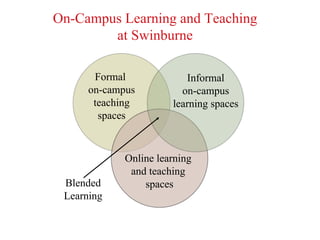
Formal
on-campus
teaching
spaces
Informal
on-campus
learning spaces
Online learning
and teaching
spacesBlended
Learning
On-Campus Learning and Teaching
at Swinburne
2016 Learning with technology

2016 Learning with technology

  • 1.
    CRICOS 00111D TOID3059 LEARNING WITH TECHNOLOGY Professor Mike Keppell Pro Vice-Chancellor, Learning Transformations
  • 2.
    Relevant Background • Instructionaldesigner • Solving problems • Oil and gas industry, Coal miners, QAL, Medical, Hong Kong Police Force, distance education, Australian Digital Futures Institute, digital literacies
  • 3.
    Key Questions • Whatare the learning outcomes? • What are the affordances or ‘action possibilities’ of the technology? • Evidence of enhanced learning? • Professional development of trainers
  • 4.
    Learning Ecosystem • Simpleto complex scenarios • Complementation with other training • Authentic Assessment • Refresher training
  • 5.
    Guiding Pedagogies • Authenticlearning • Authentic assessment • Personalised learning • Peer learning
  • 6.
    Authentic Learning • …requirestudents to complete complex real-world tasks over a period of time in collaboration with others as they would in a real setting or workplace (Herrington, 2006)
  • 7.
    Herrington • Authentic contextthat reflects the way the knowledge will be used in real life • Authentic activities • Access to expert performances • Multiple roles and perspectives • Collaborative construction of knowledge • Reflection • Articulation • Coaching and scaffolding • Authentic assessment
  • 8.
    Authentic Assessment • Empoweringthe learner by engaging them in assessment tasks that simulate or engage the learner in real-life situations. • “Engaging and worthy problems or questions of importance, in which students must use knowledge to fashion performances effectively and creatively” (Wiggins, 1993, p. 229).
  • 9.
    Formal on-campus teaching spaces Informal on-campus learning spaces Online learning andteaching spacesBlended Learning On-Campus Learning and Teaching at Swinburne