PRESENTATION
                   ON
TQM, 5S, KAIZEN, JIT, KANBAN,
        POKA YOKE


      DEPARTMENT OF MECHANICAL ENGINEERING
  AMRUTVAHINI COLLEGE OF ENGINEERING, SANGAMNER
                    2011-2012
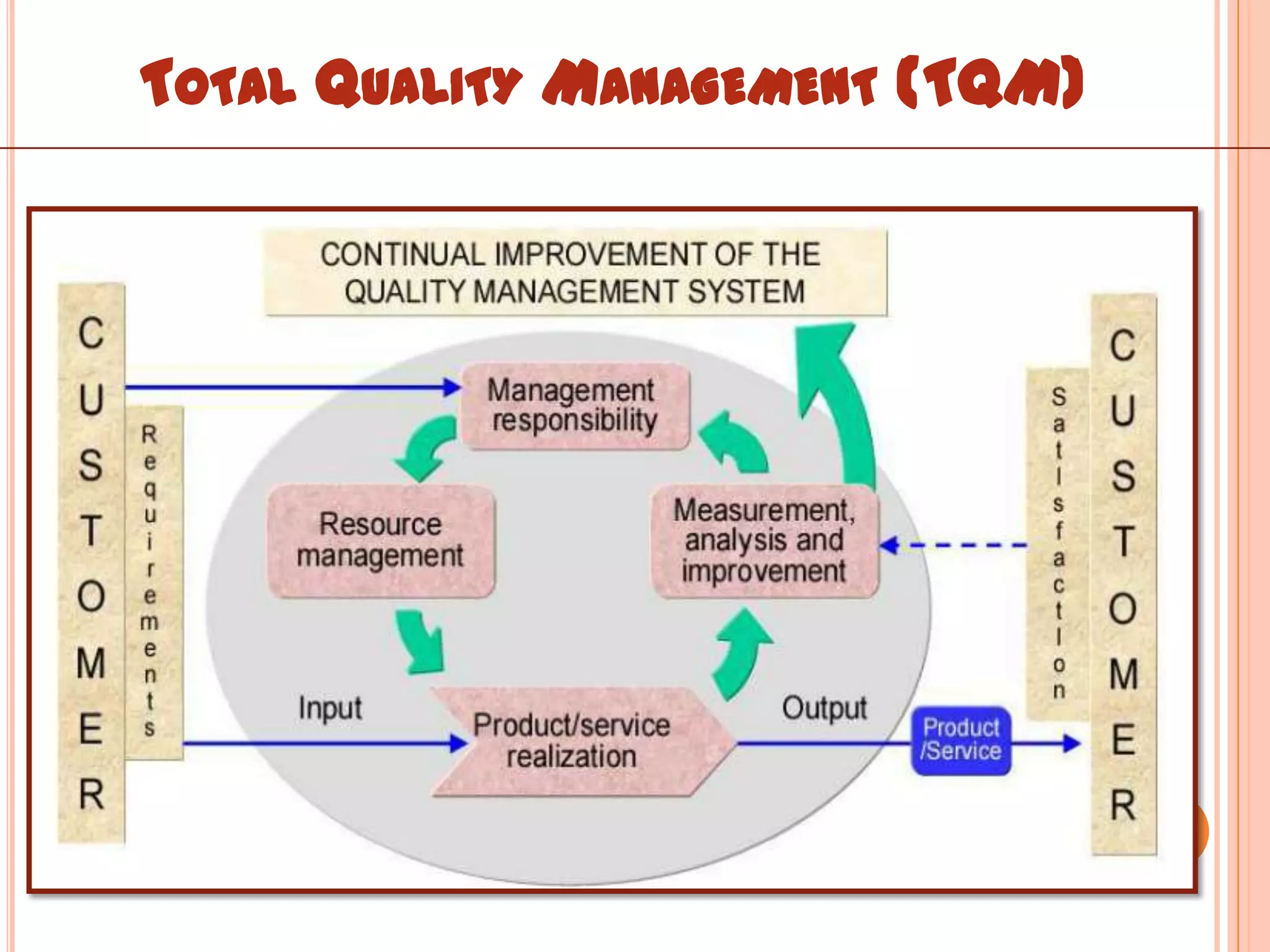
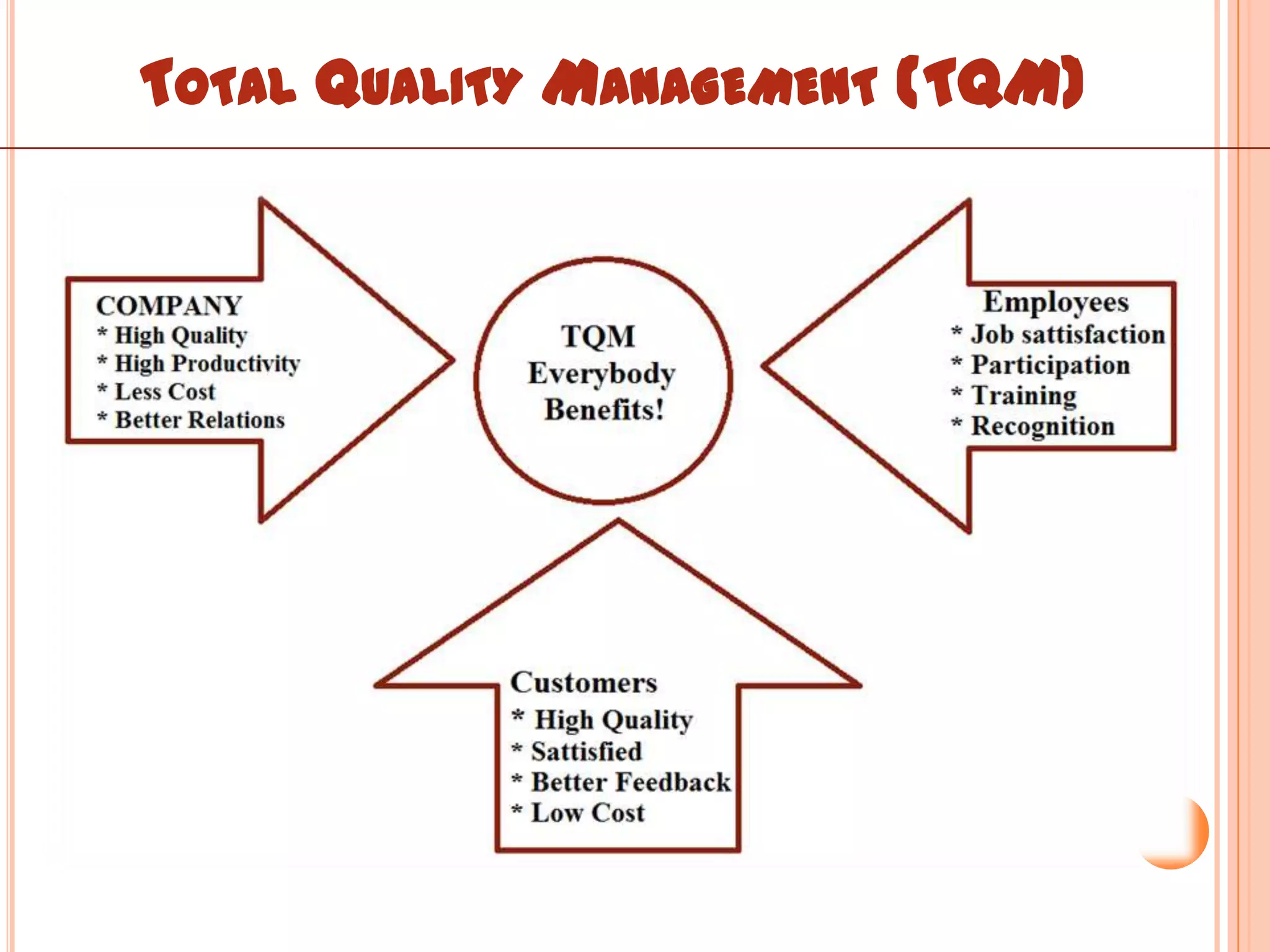
TOTAL QUALITY MANAGEMENT (TQM)
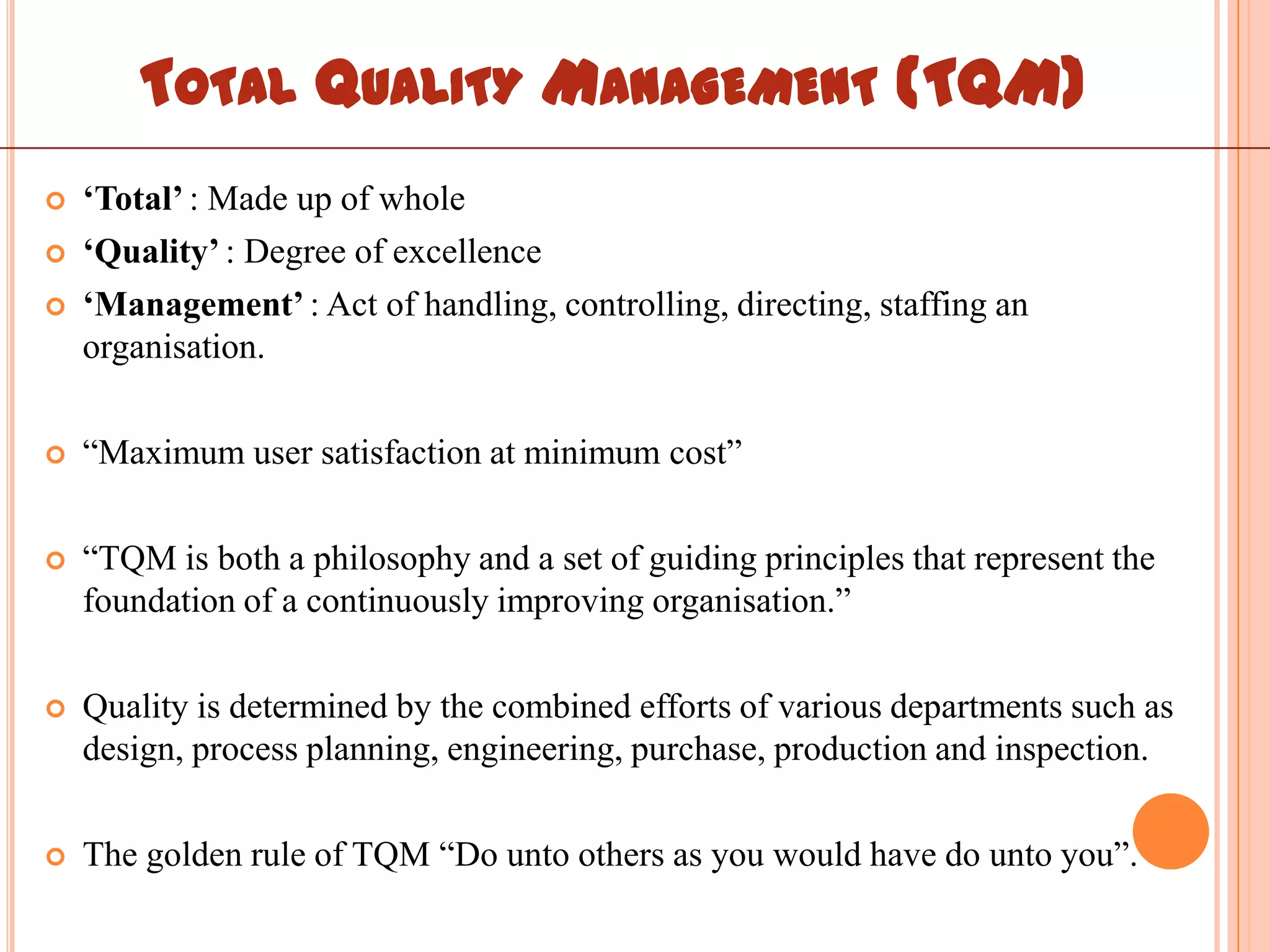
   ‘Total’ : Made up of whole
   ‘Quality’ : Degree of excellence
   ‘Management’ : Act of handling, controlling, directing, staffing an
    organisation.

   “Maximum user satisfaction at minimum cost”

   “TQM is both a philosophy and a set of guiding principles that represent the
    foundation of a continuously improving organisation.”

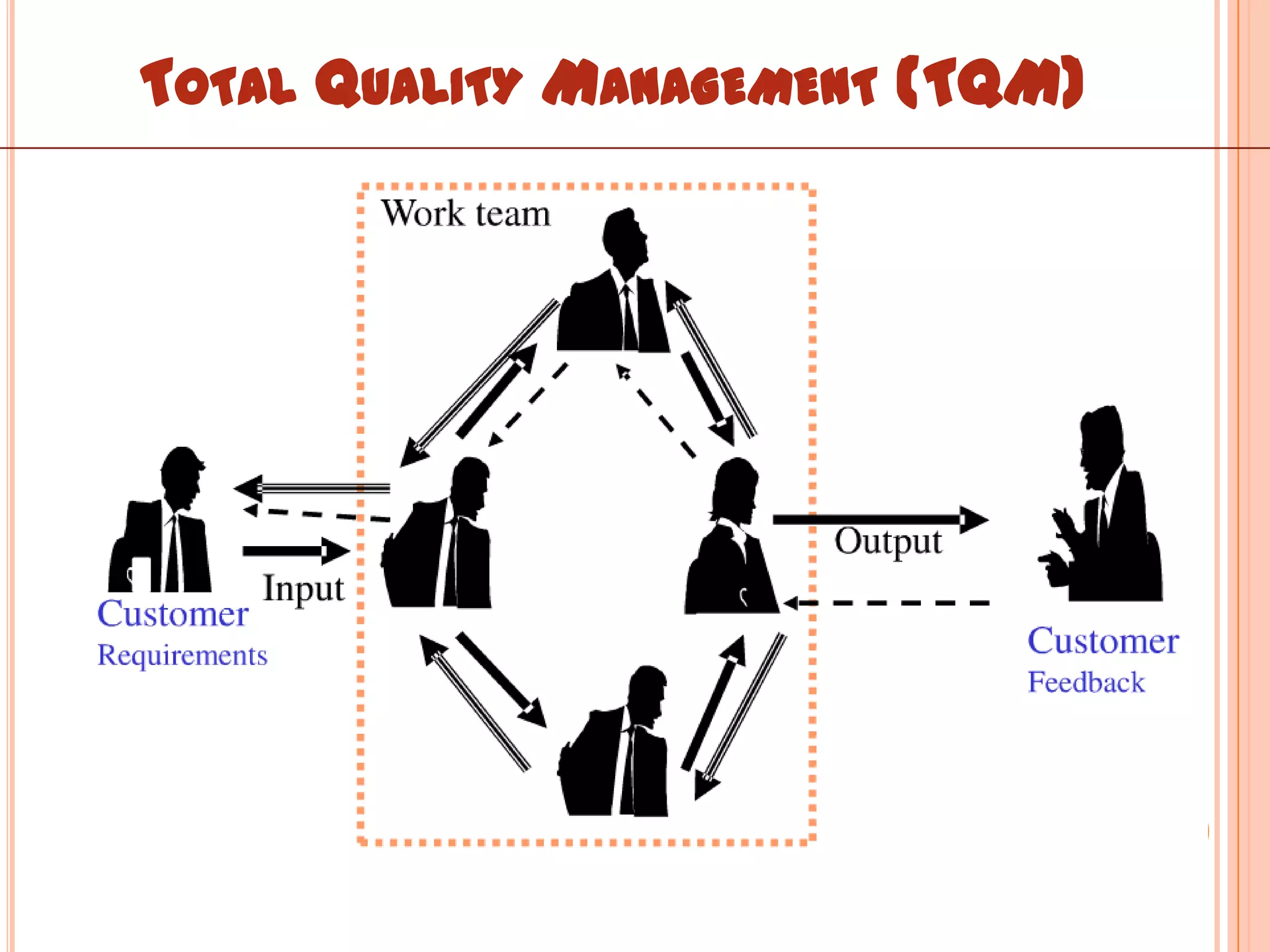
   Quality is determined by the combined efforts of various departments such as
    design, process planning, engineering, purchase, production and inspection.

   The golden rule of TQM “Do unto others as you would have do unto you”.
TOTAL QUALITY MANAGEMENT (TQM)
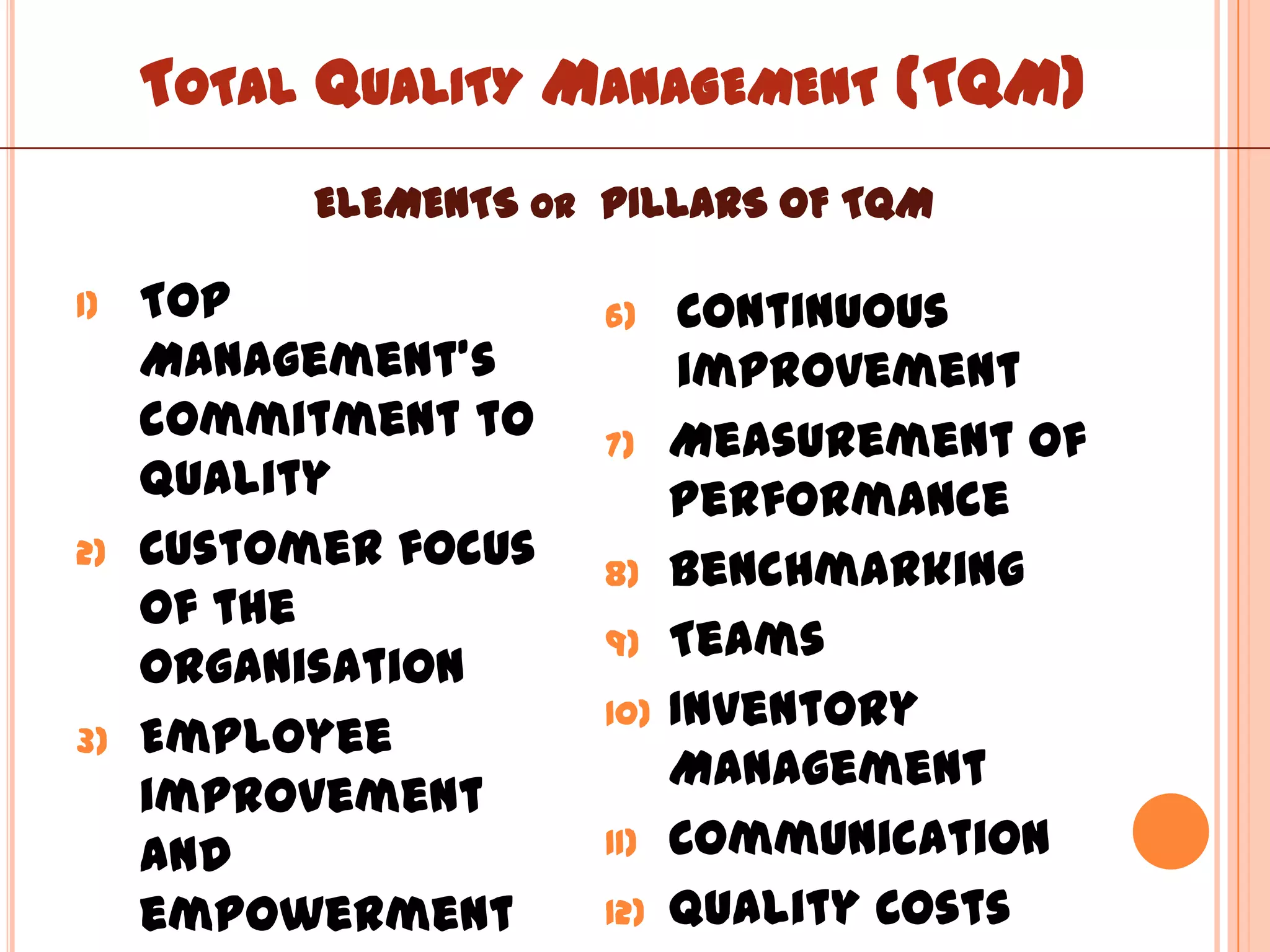
           ELEMENTS OR PILLARS OF TQM

1)   Top               6)     Continuous
     Management’s             improvement
     commitment to     7)    Measurement of
     quality                 performance
2)   Customer focus    8)    Benchmarking
     of the
                       9)    Teams
     organisation
                       10)   Inventory
3)   Employee
                             Management
     improvement
     and               11)   Communication
     empowerment       12)   Quality Costs
TOTAL QUALITY MANAGEMENT (TQM)
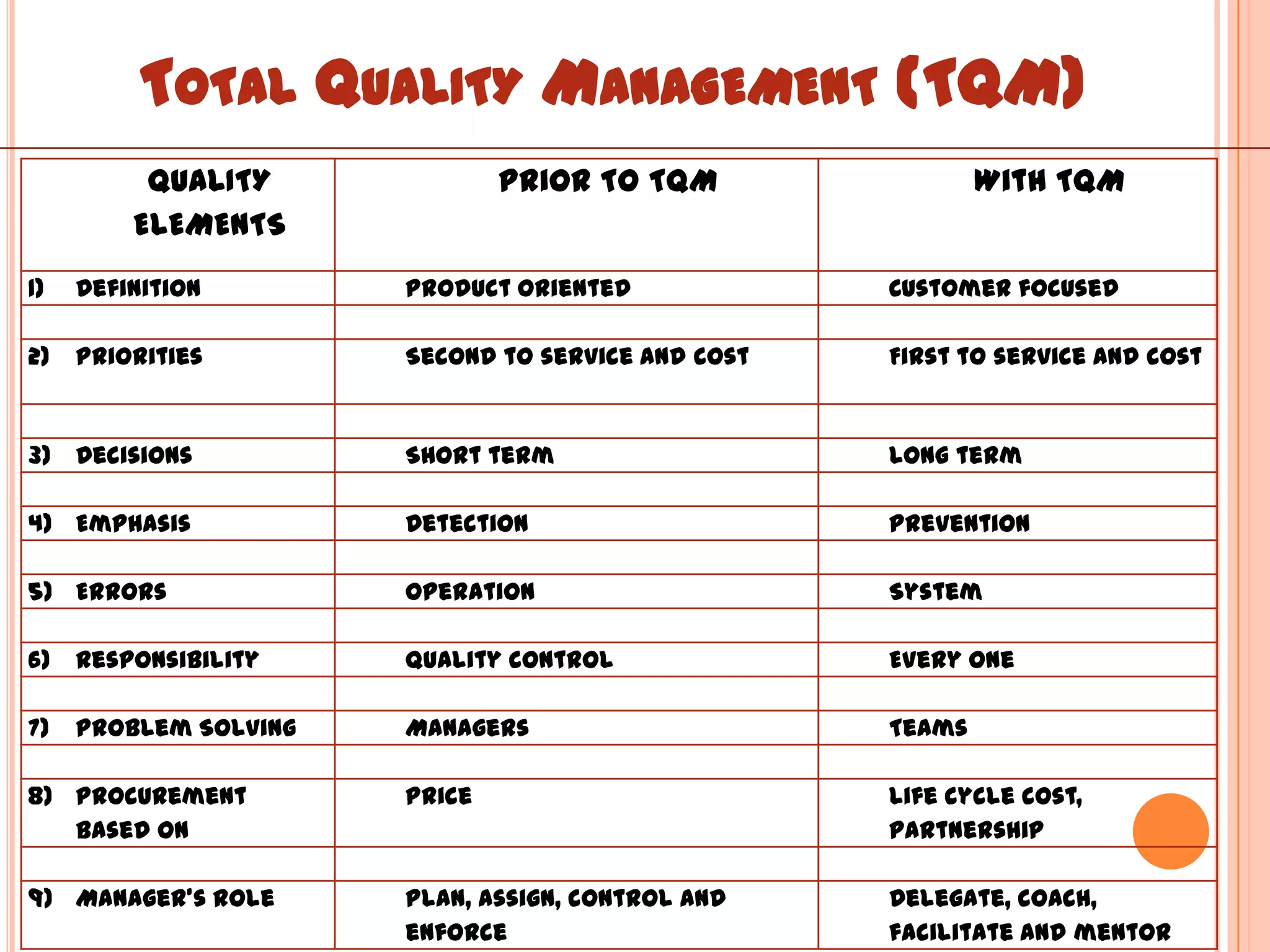
          QUALITY              Prior To TQM                 With TQM
         ELEMENTS
1)   Definition        Product oriented             Customer focused

2)   Priorities        Second to service and cost   First to service and cost


3) Decisions           Short term                   Long term

4) Emphasis            Detection                    Prevention

5) Errors              Operation                    System

6) Responsibility      Quality control              Every one

7)   Problem Solving   Managers                     Teams

8) Procurement         Price                        Life cycle cost,
   based on                                         partnership

9) Manager’s role      Plan, assign, control and    Delegate, coach,
                       enforce                      facilitate and mentor
TOTAL QUALITY MANAGEMENT (TQM)
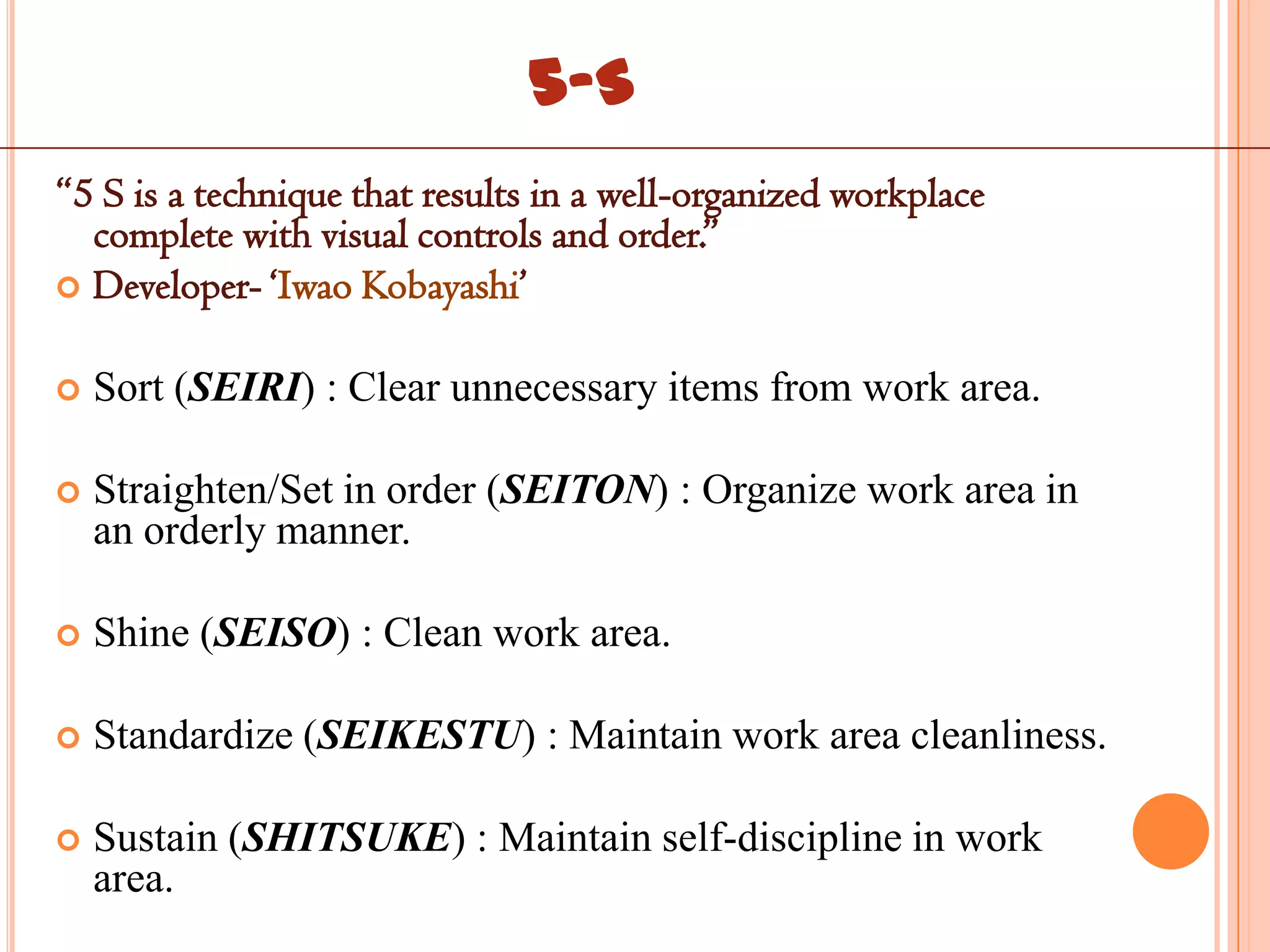
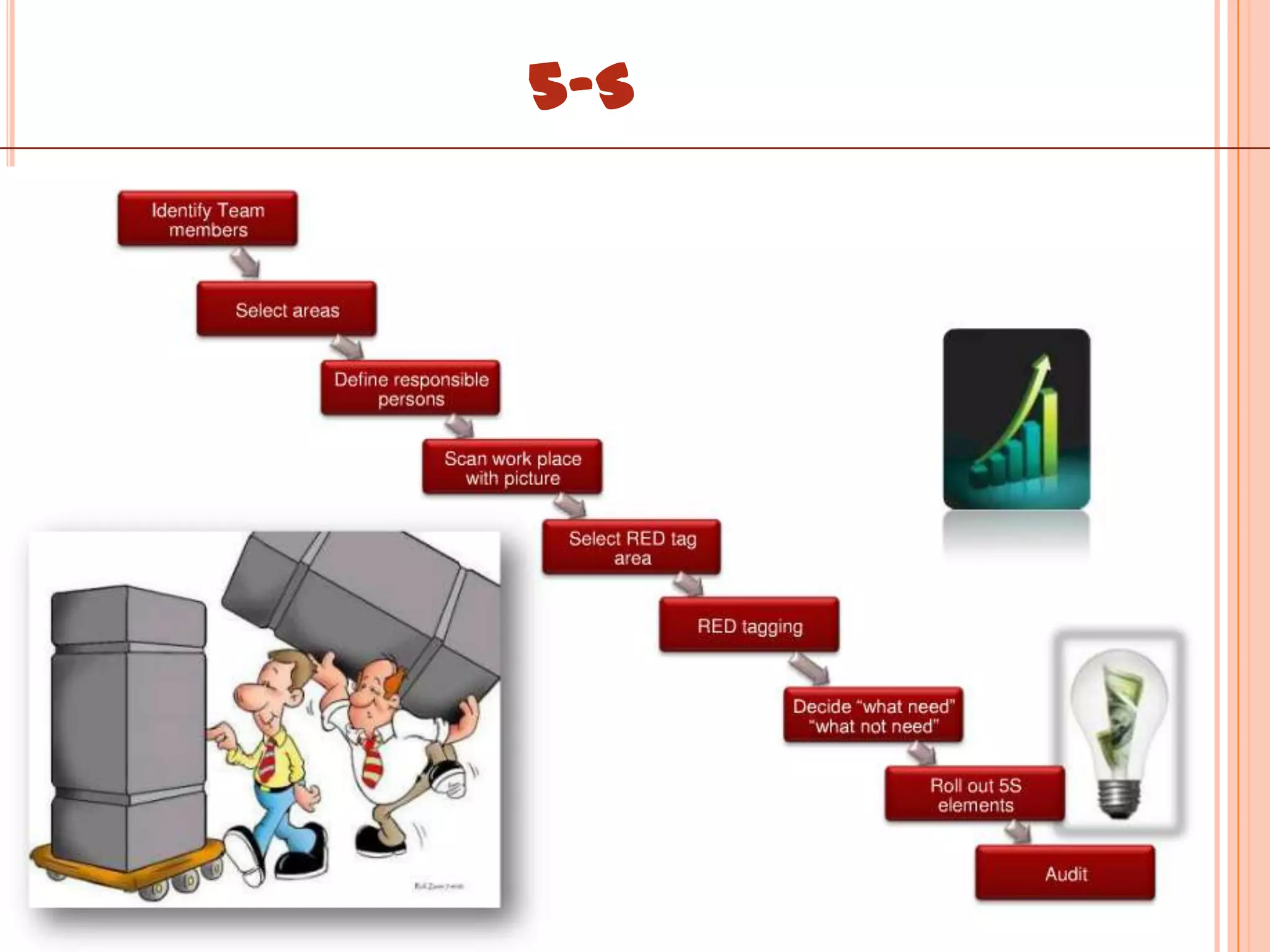
5-S
“5 S is a technique that results in a well-organized workplace
  complete with visual controls and order.”
 Developer- „Iwao Kobayashi‟


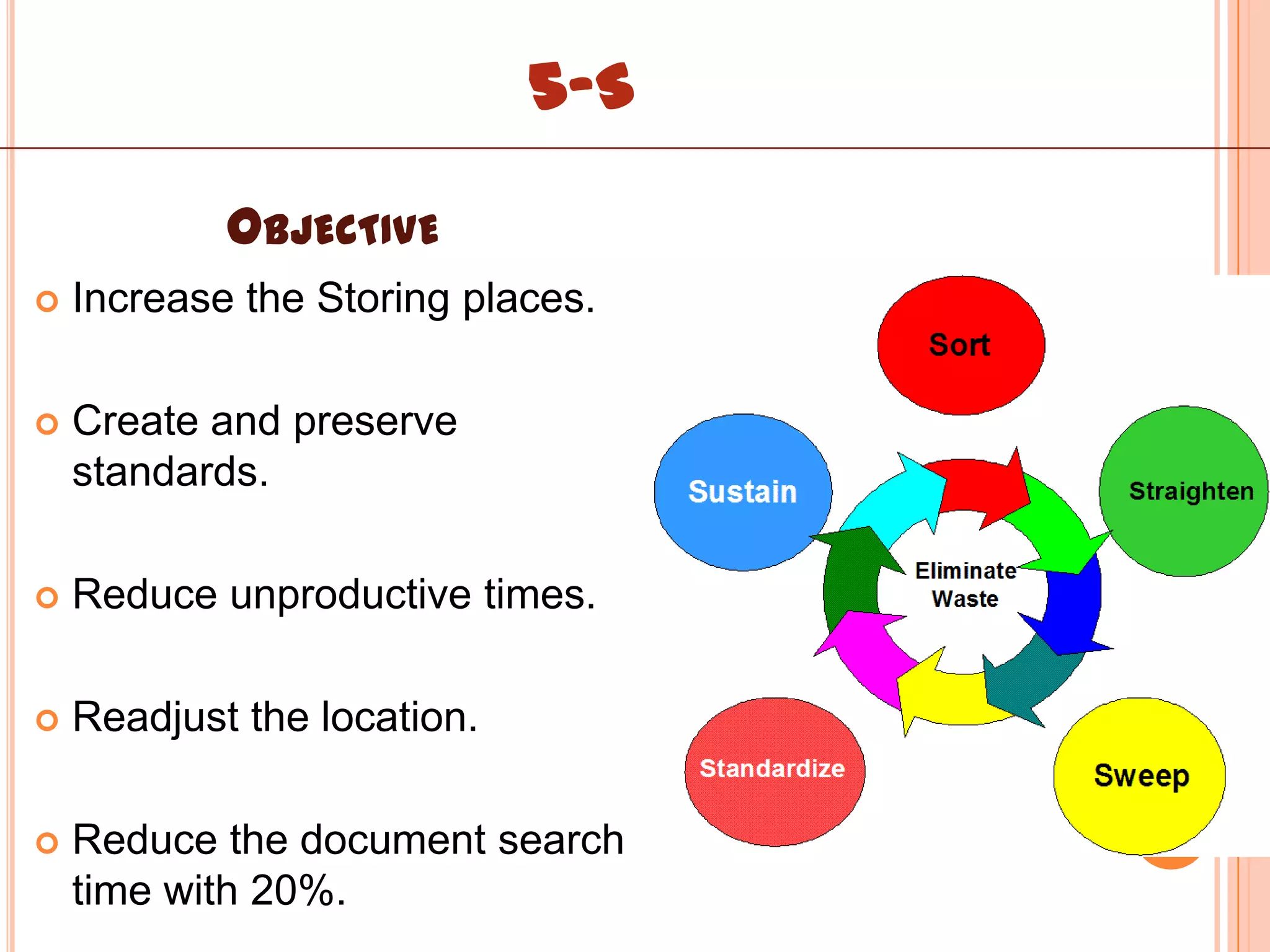
   Sort (SEIRI) : Clear unnecessary items from work area.

   Straighten/Set in order (SEITON) : Organize work area in
    an orderly manner.

   Shine (SEISO) : Clean work area.

   Standardize (SEIKESTU) : Maintain work area cleanliness.

   Sustain (SHITSUKE) : Maintain self-discipline in work
    area.
5-S


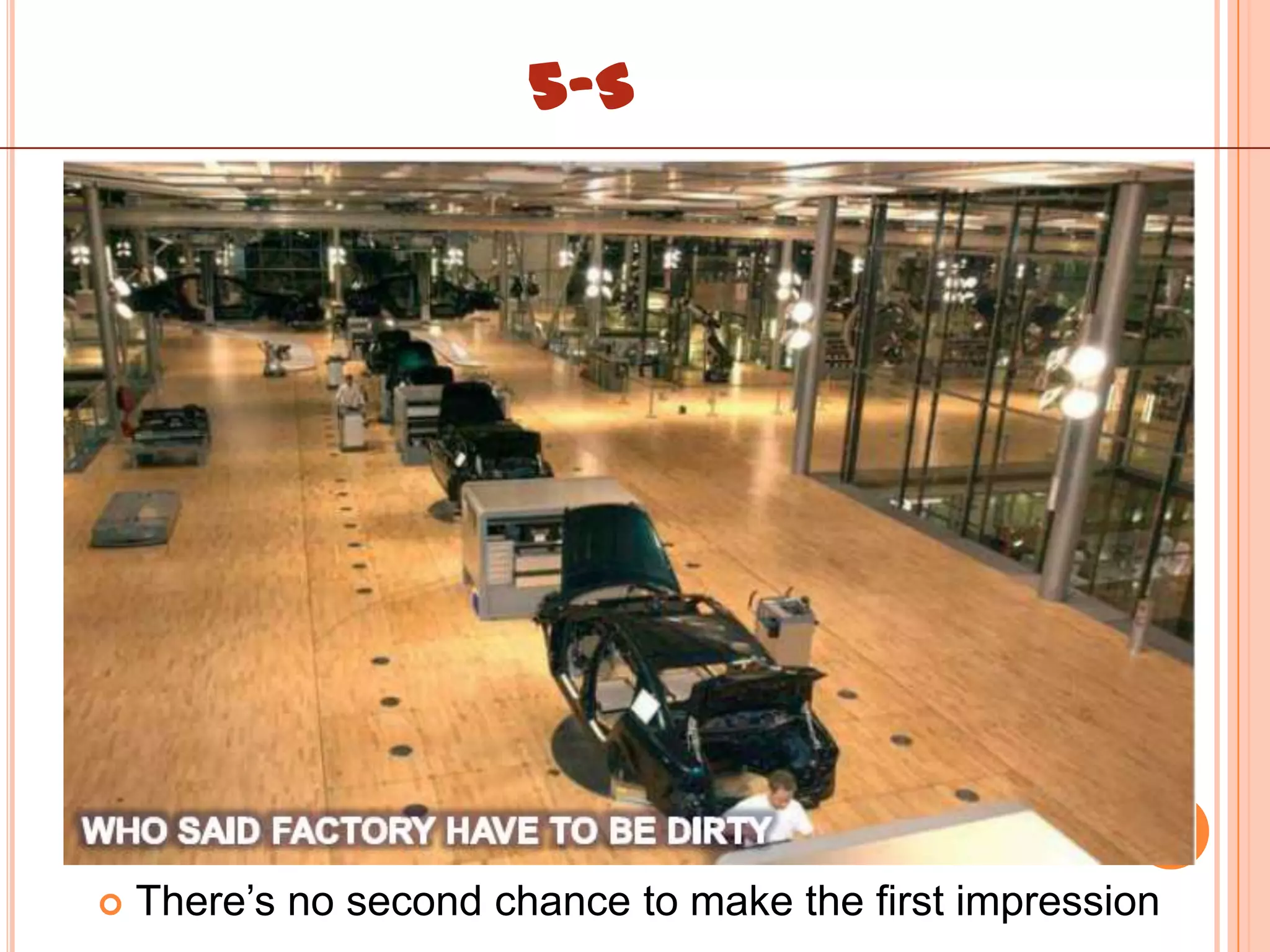
   There’s no second chance to make the first impression
5-S


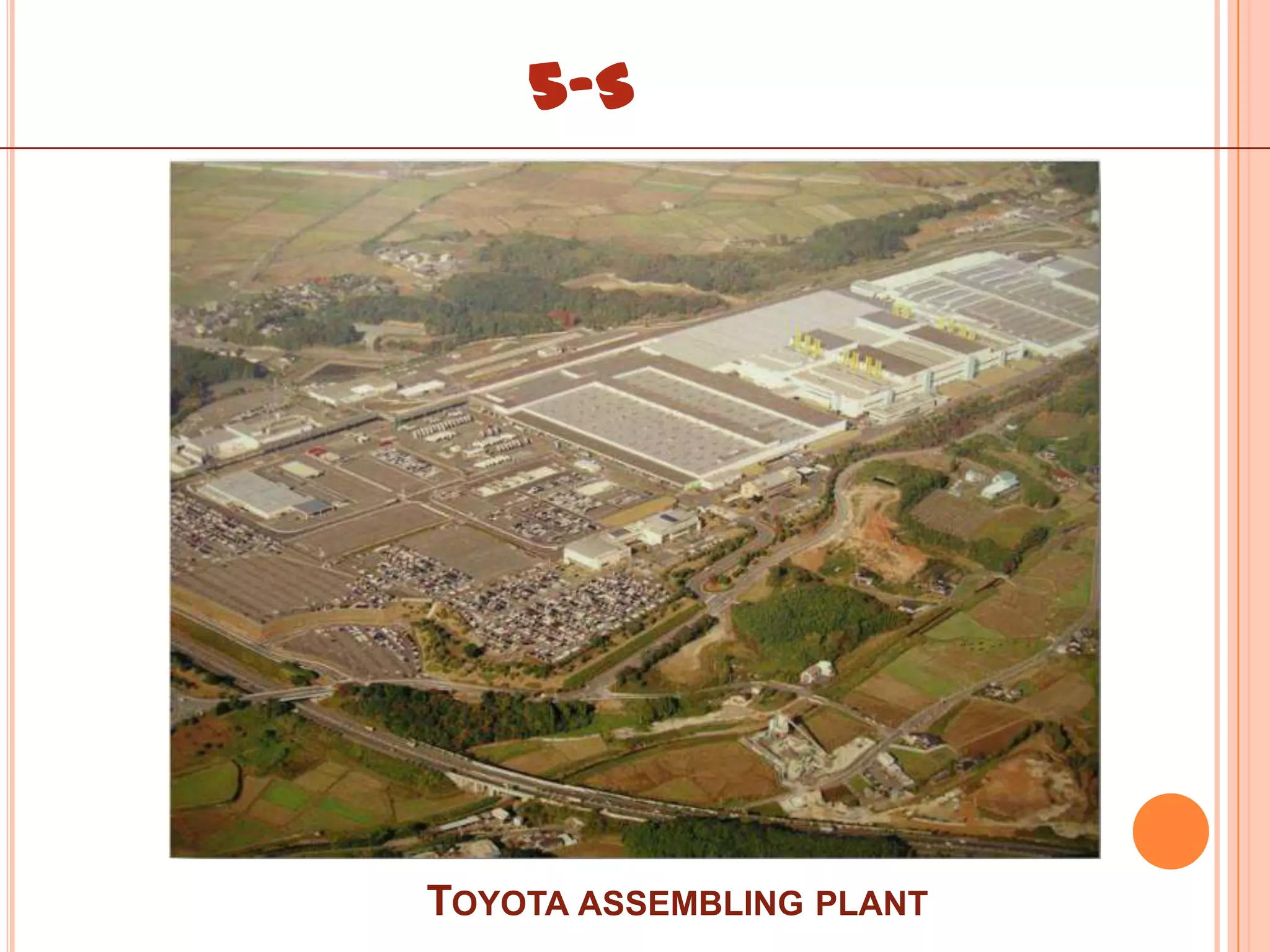
TOYOTA ASSEMBLING PLANT
5-S

            OBJECTIVE
   Increase the Storing places.

   Create and preserve
    standards.

   Reduce unproductive times.

   Readjust the location.

   Reduce the document search
    time with 20%.
5-S


SORT (SEIRI)         SWEEP (SEISO)
5-S


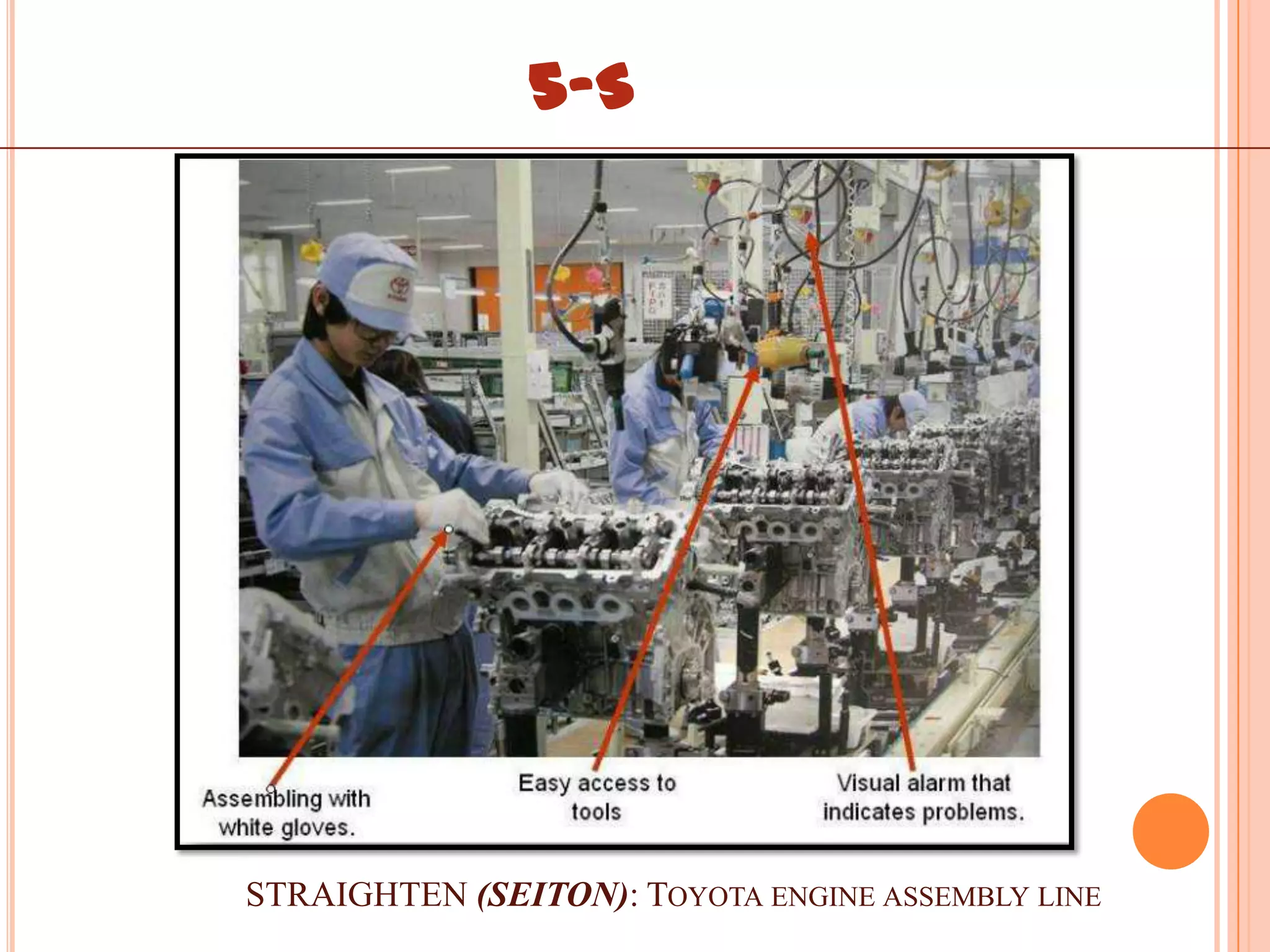
STRAIGHTEN (SEITON): TOYOTA ENGINE ASSEMBLY LINE
5-S


SCHEDULE (SEIKESTU)    SUSTAIN (SHITSUKE)
5-S
5-S
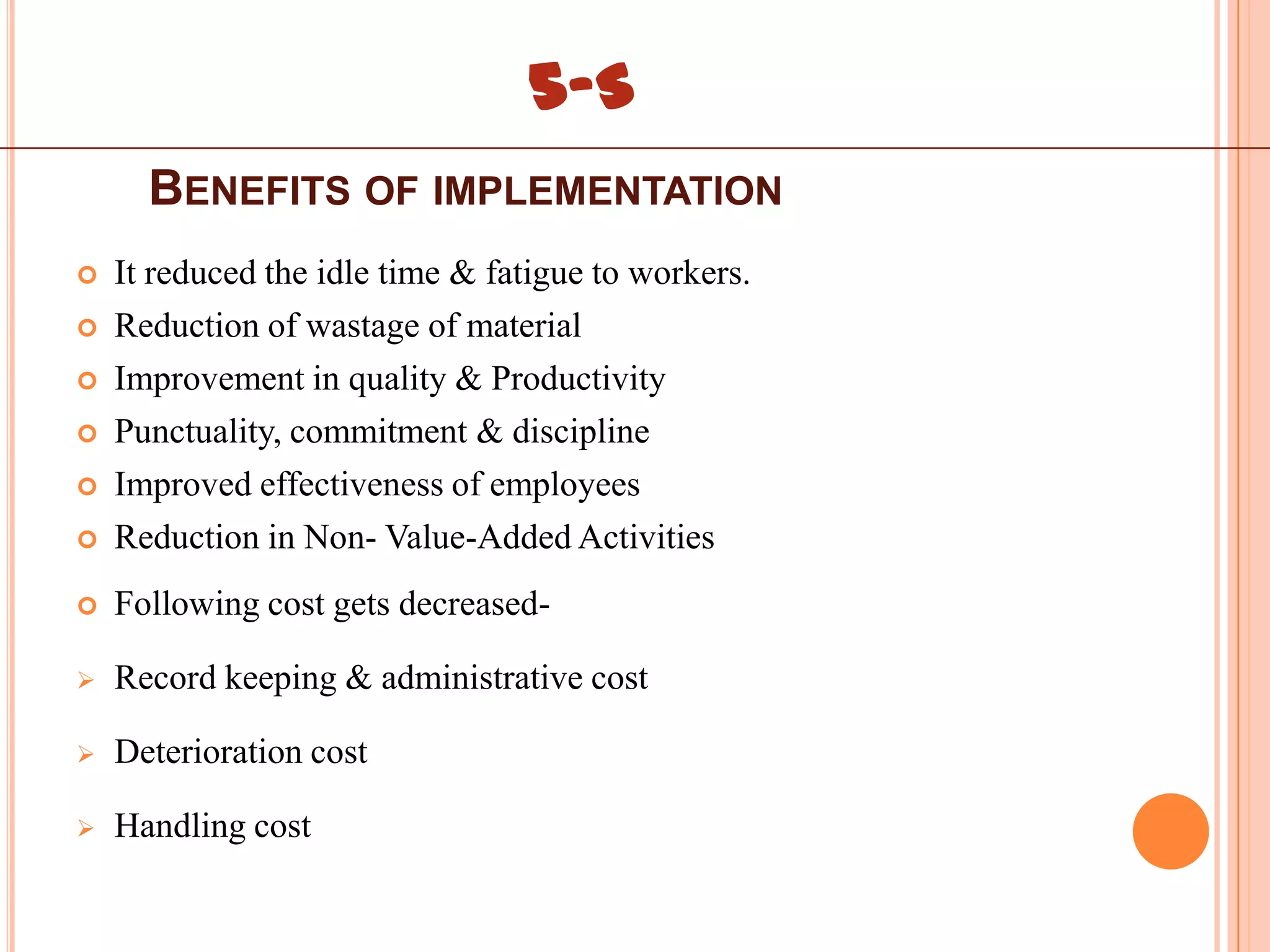
      BENEFITS OF IMPLEMENTATION
   It reduced the idle time & fatigue to workers.
   Reduction of wastage of material
   Improvement in quality & Productivity
   Punctuality, commitment & discipline
   Improved effectiveness of employees
   Reduction in Non- Value-Added Activities
   Following cost gets decreased-

   Record keeping & administrative cost

   Deterioration cost

   Handling cost
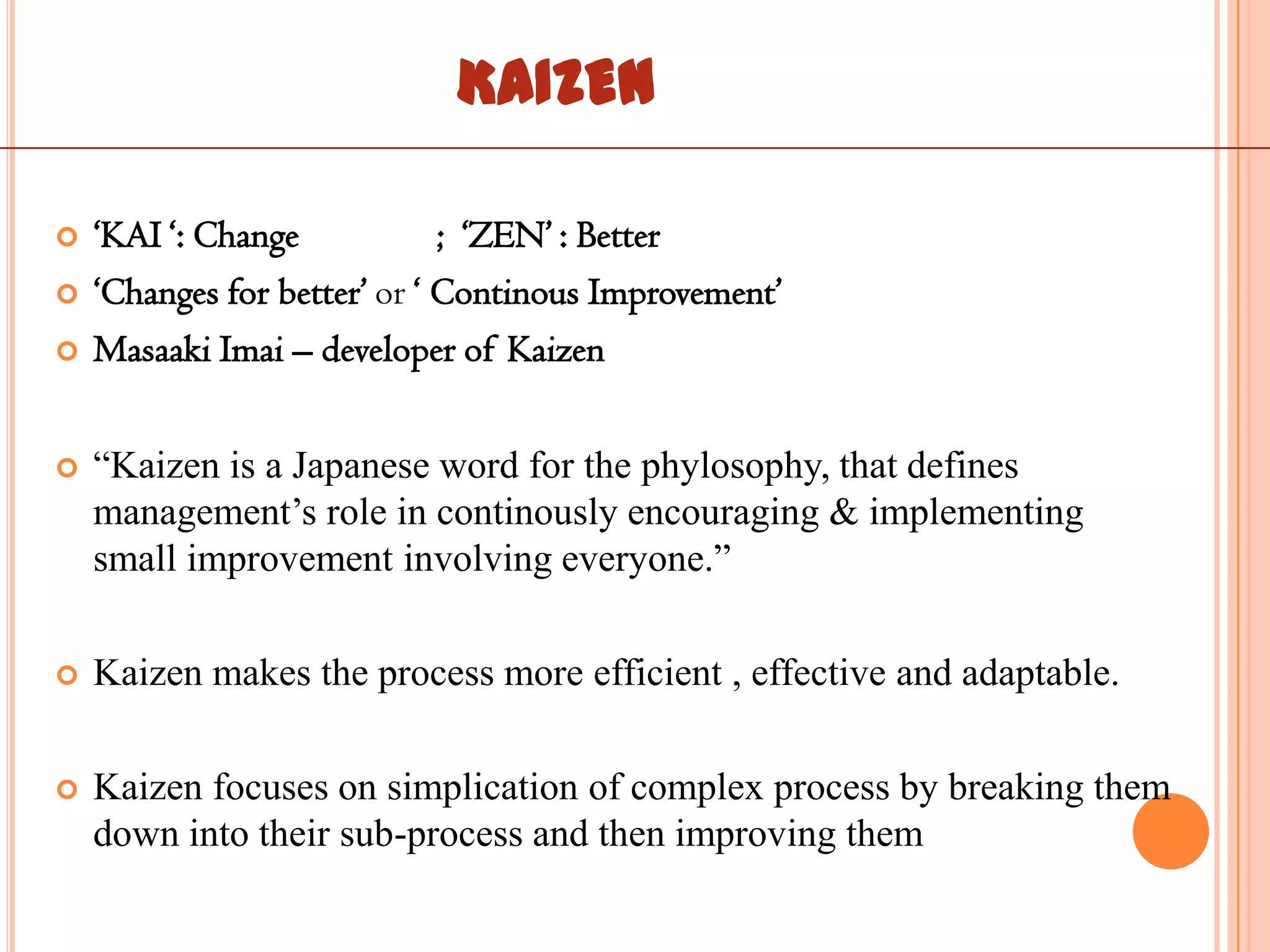
KAIZEN

   „KAI „: Change            ; „ZEN‟ : Better
   „Changes for better‟ or „ Continous Improvement‟
   Masaaki Imai – developer of Kaizen


   “Kaizen is a Japanese word for the phylosophy, that defines
    management’s role in continously encouraging & implementing
    small improvement involving everyone.”

   Kaizen makes the process more efficient , effective and adaptable.

   Kaizen focuses on simplication of complex process by breaking them
    down into their sub-process and then improving them
KAIZEN


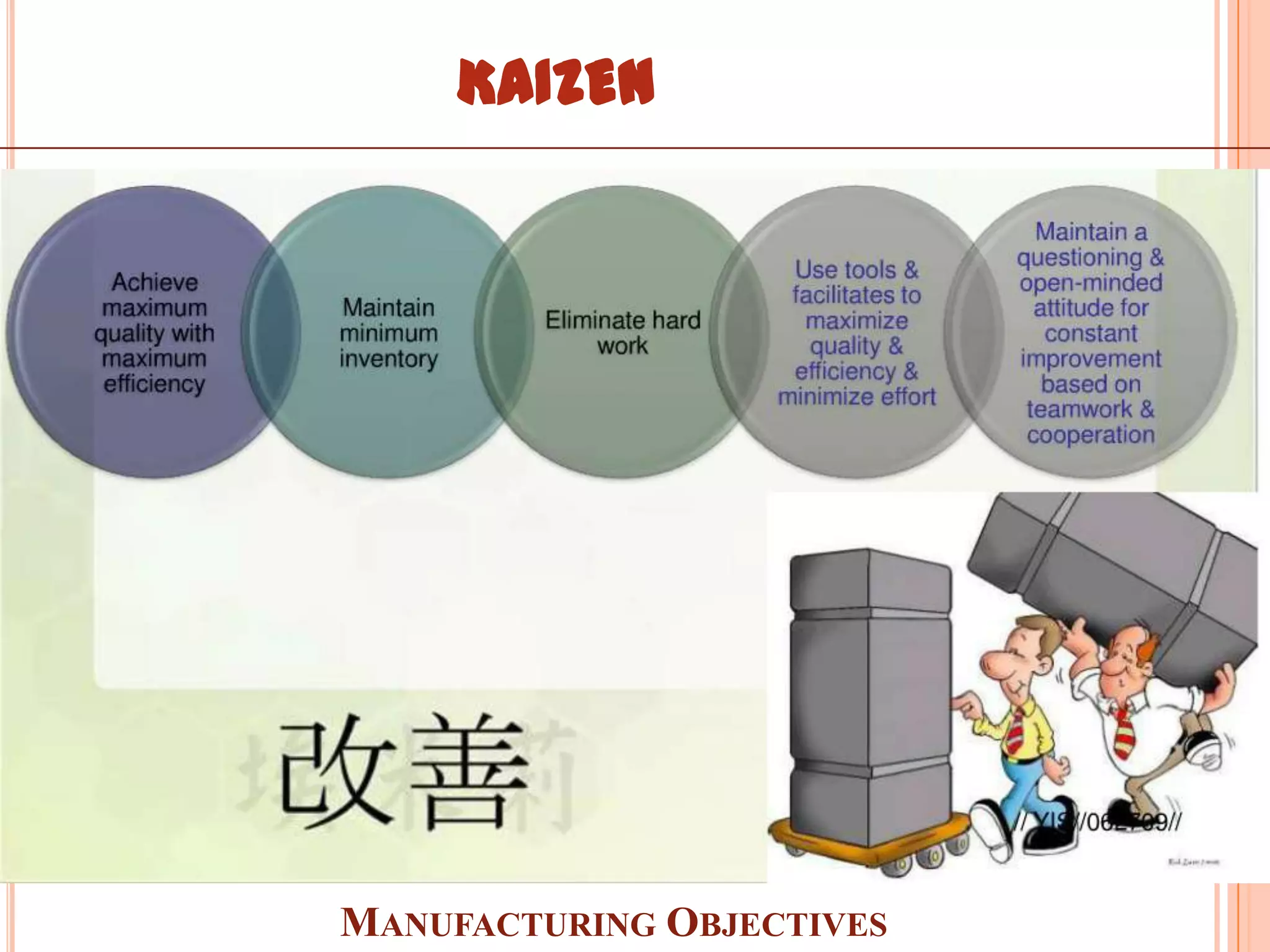
MANUFACTURING OBJECTIVES
KAIZEN

    Key Elements of Kaizen     foundation of Kaizen

 Quality                     Team  Work
 Effort                      Personal

 Involvement of               Discipline
  all employees               Improved

 Willingness to               Morale
  Change                      Quality Circles

 Communication               Suggestions For
                               Improvement
KAIZEN


JOB FUNCTIONS AS PERCIEVED BY JAPANESE MANAGERS
KAIZEN
              KAIZEN IMPROVEMENT FOCUSES ON
    Value added & non-value         Documentation of standard
     added work activities.           operating procedures
    Muda: wastes                    5-S frame work
    1.   Over Production             Better Communication through
    2.   Delay                        visual displays- posters, bulletins.
    3.   Transportation              Just In Time Principles
    4.   Inventory
                                     Poka – Yoke : to prevent or
    5.   Defective Parts              detect errors
    6.   Wasted Motion
                                     Team Effort on Problem solving,
    7.   Processing
                                      conflict reduction &
    Principles of Material           communication.
     Handling
KAIZEN
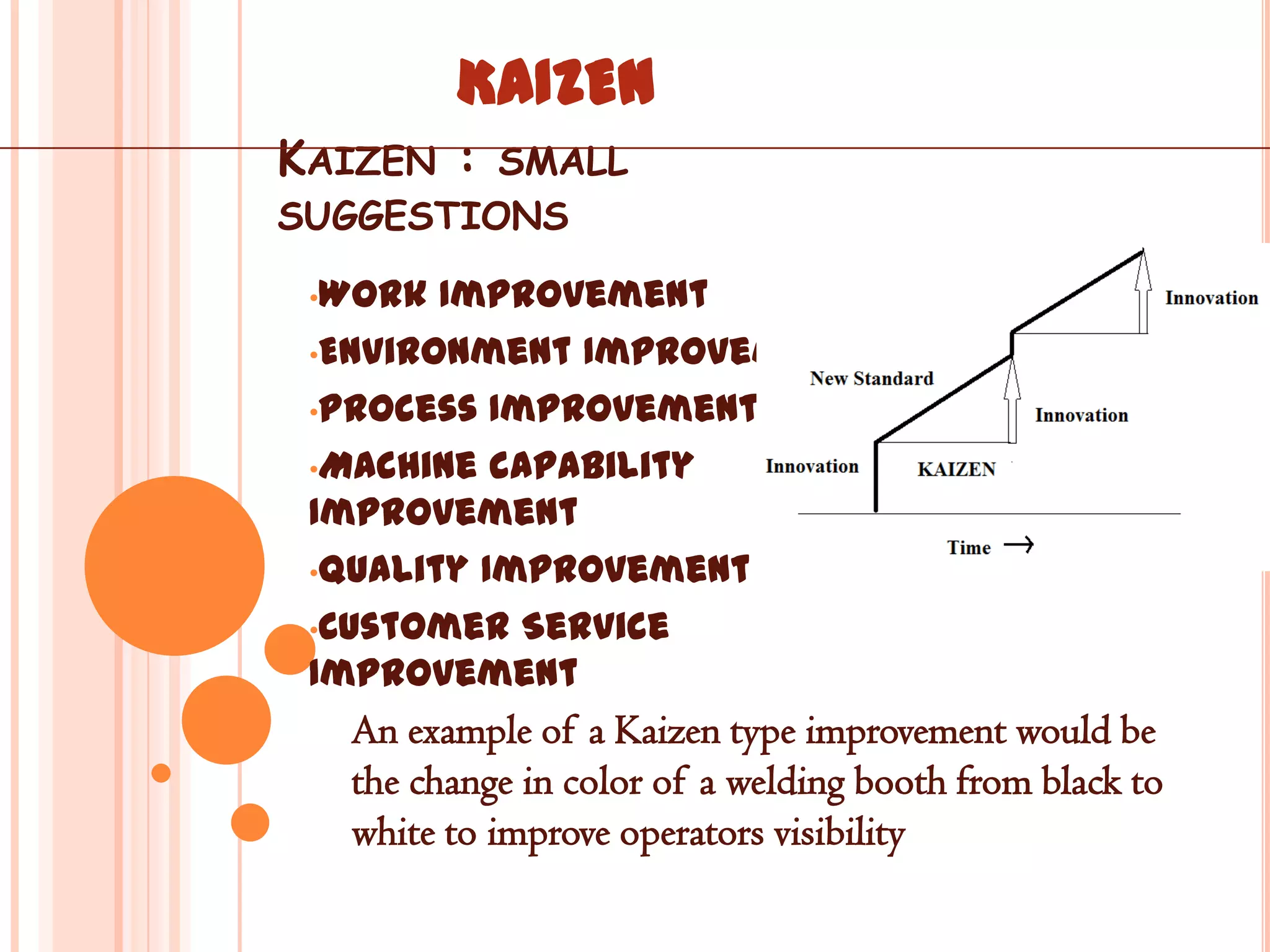
KAIZEN : SMALL
SUGGESTIONS

 •Work  Improvement
 •Environment Improvement

 •Process Improvement

 •Machine capability
 Improvement
 •Quality Improvement

 •Customer Service
 Improvement
  An example of a Kaizen type improvement would be
  the change in color of a welding booth from black to
  white to improve operators visibility
KAIZEN
JUST IN TIME (JIT)
   “JIT is manufacturing philosophy that produces necessary units, with the
    required quality, in the necessary quantities, at the last safe moment.”

   Eliminates waste of time, labour and storage space.

   It’s a “pull” system of production: actual orders provide a signal when to
    manufacture.

   Non-value-adding activities are removed for the purposes of :
     Reducing Cost
     Improving Quality
     Improving Performance
     Improving Delivery Adding Flexibility
     Increase innovativeness
JUST IN TIME (JIT)
JUST IN TIME (JIT)

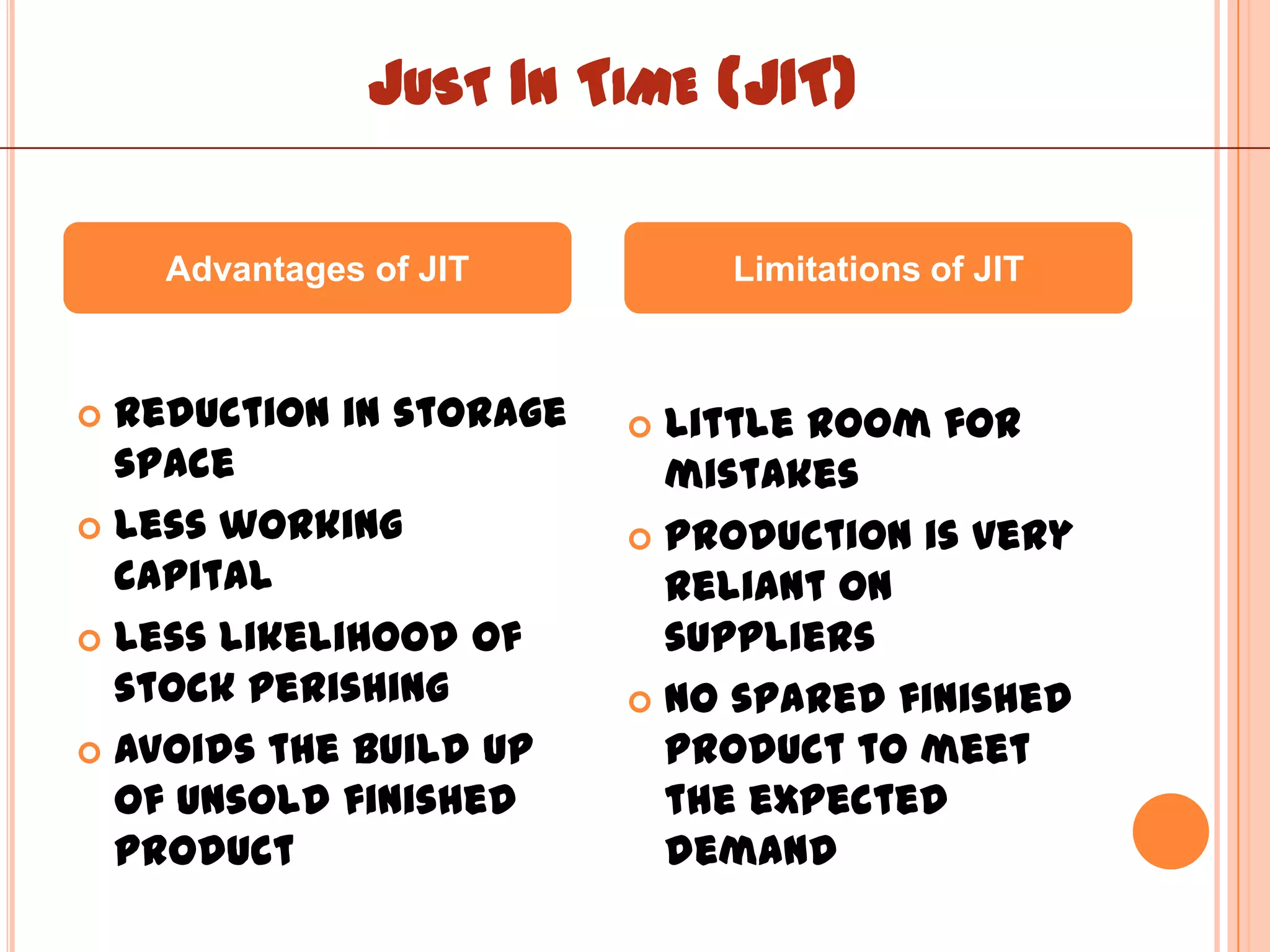
    Advantages of JIT        Limitations of JIT


 Reduction in storage    Little room for
  space                    mistakes
 Less working            Production is very
  capital                  reliant on
 Less likelihood of       suppliers
  stock perishing         No spared finished
 Avoids the build up      product to meet
  of unsold finished       the expected
  product                  demand
KANBAN
„KAN‟ : Card ;            „BAN‟ : Signal
Japanese term for "visual record”

Coined by : Taiichi Ohno


The  Kanban card is “A message that signals depletion of
product , parts or inventory that when received will
trigger replenishment of that product, part or inventory.”

Bernstein identifies as “a highly efficient and effective
factory production system”.

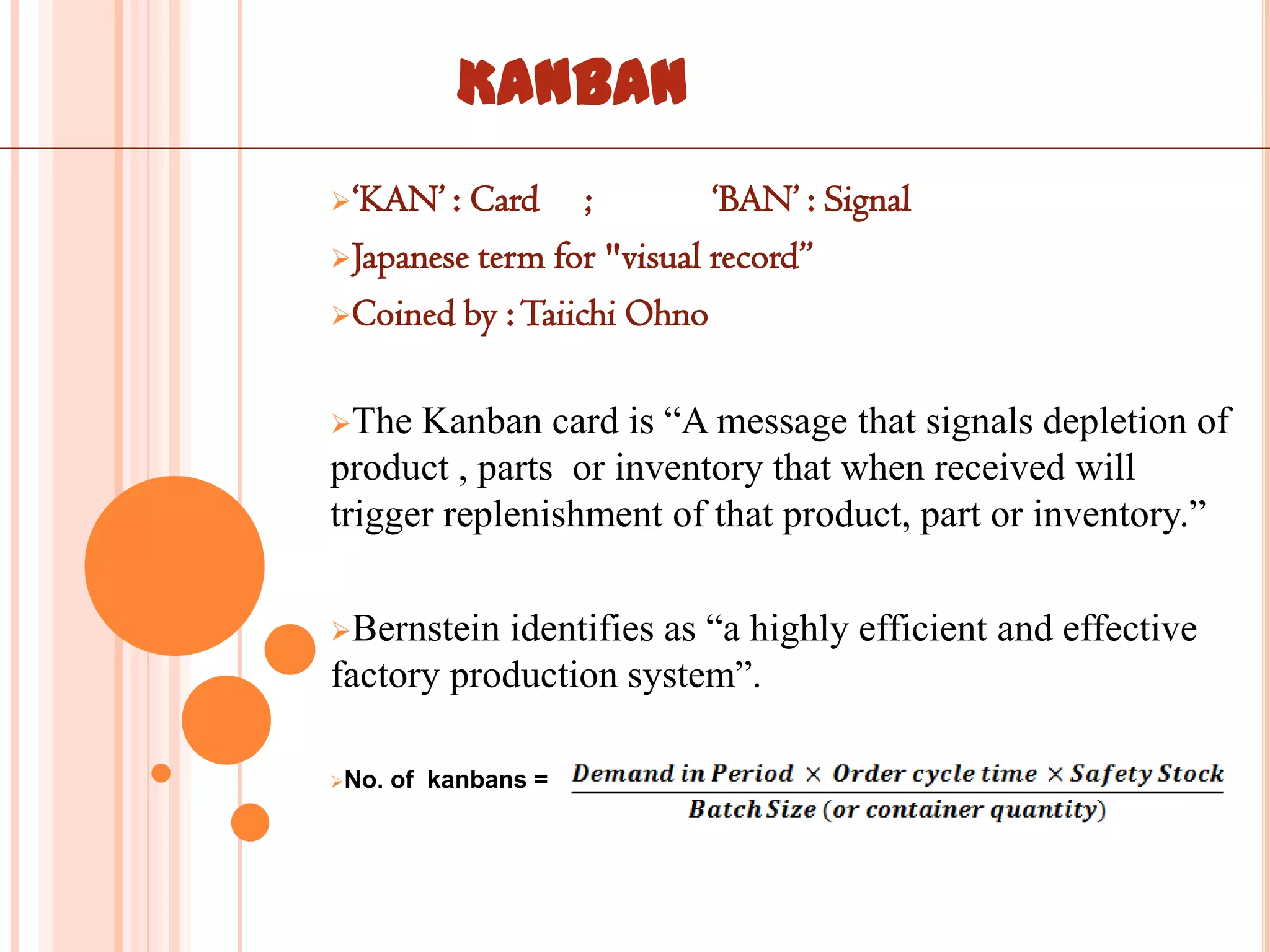
No.   of kanbans =
KANBAN


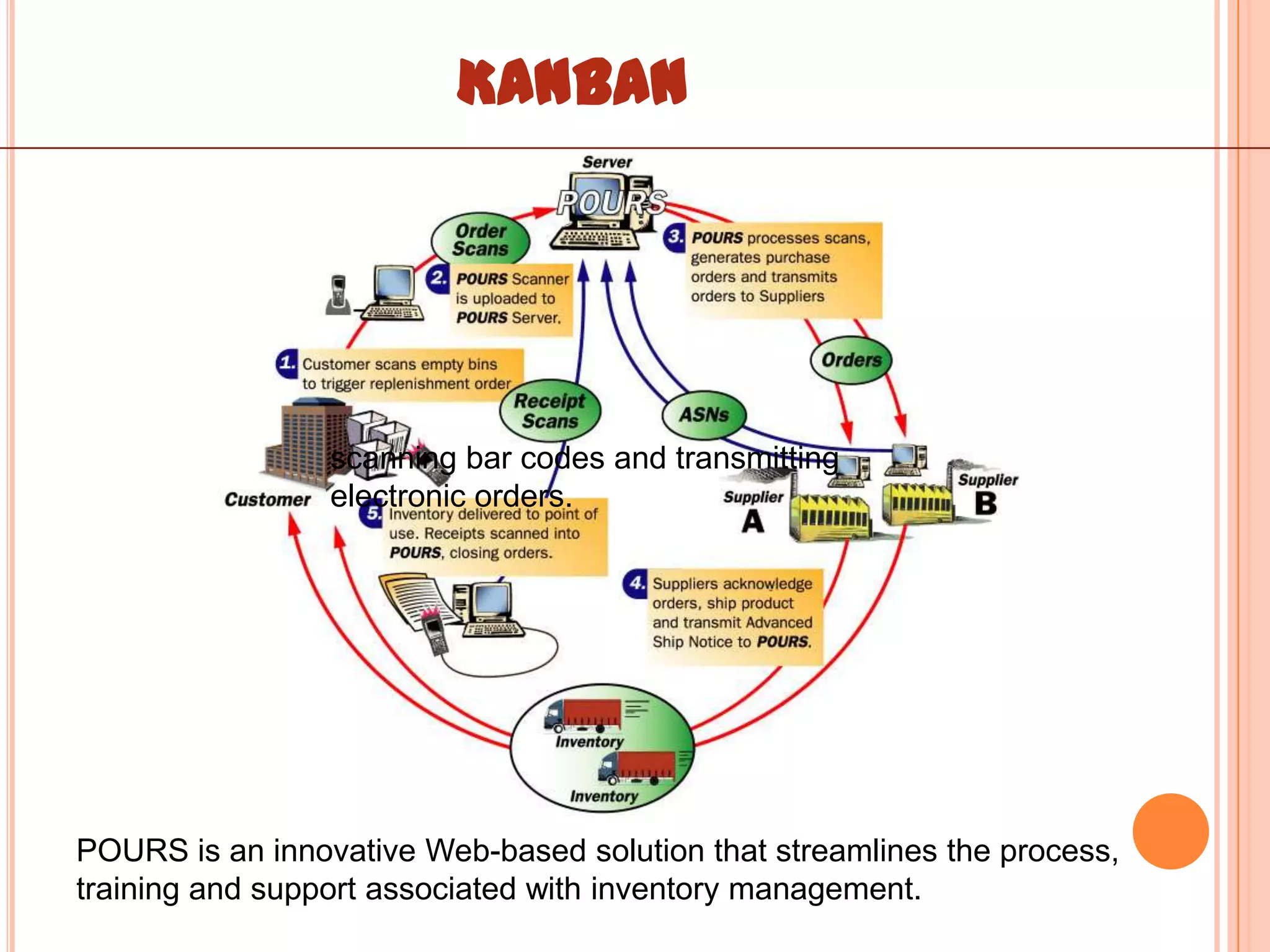
                 scanning bar codes and transmitting
                 electronic orders.


POURS is an innovative Web-based solution that streamlines the process,
training and support associated with inventory management.
POKA- YOKE
   „POKA‟ – „mistake‟ ;         YOKERU – „Proofing‟
   Developer: Shigeo Shingo (1960)- The industrial engineers at Toyota.


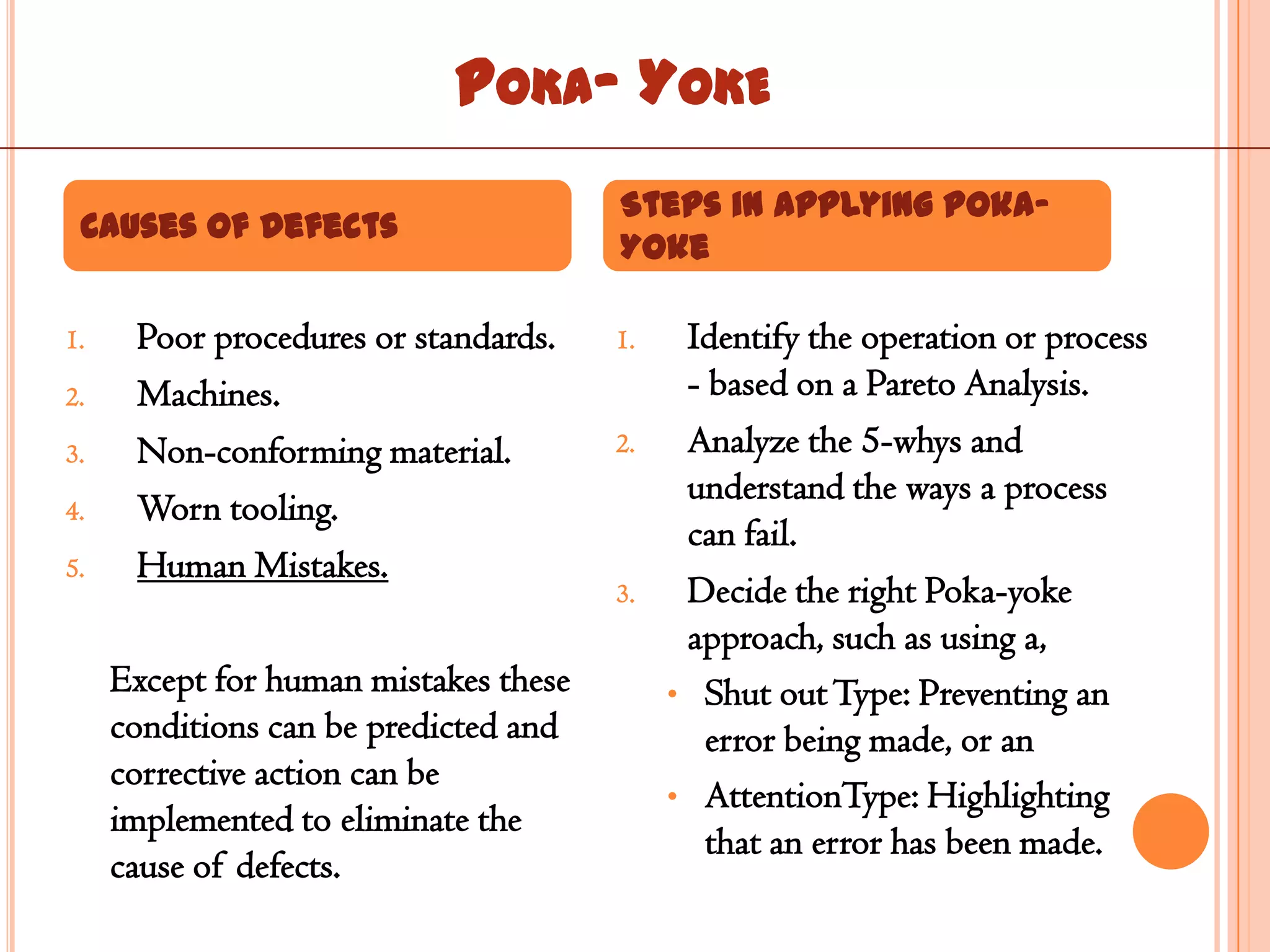
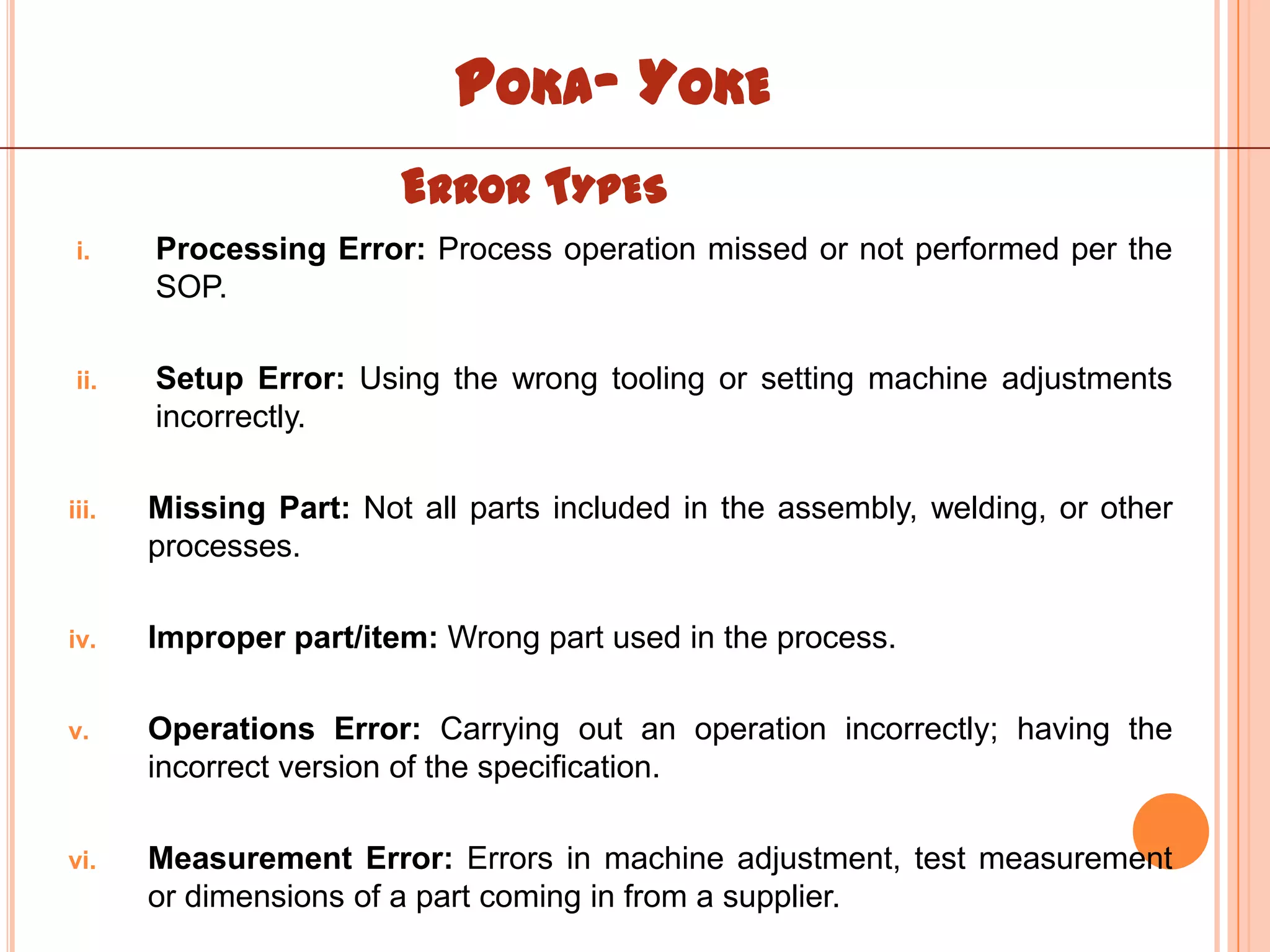
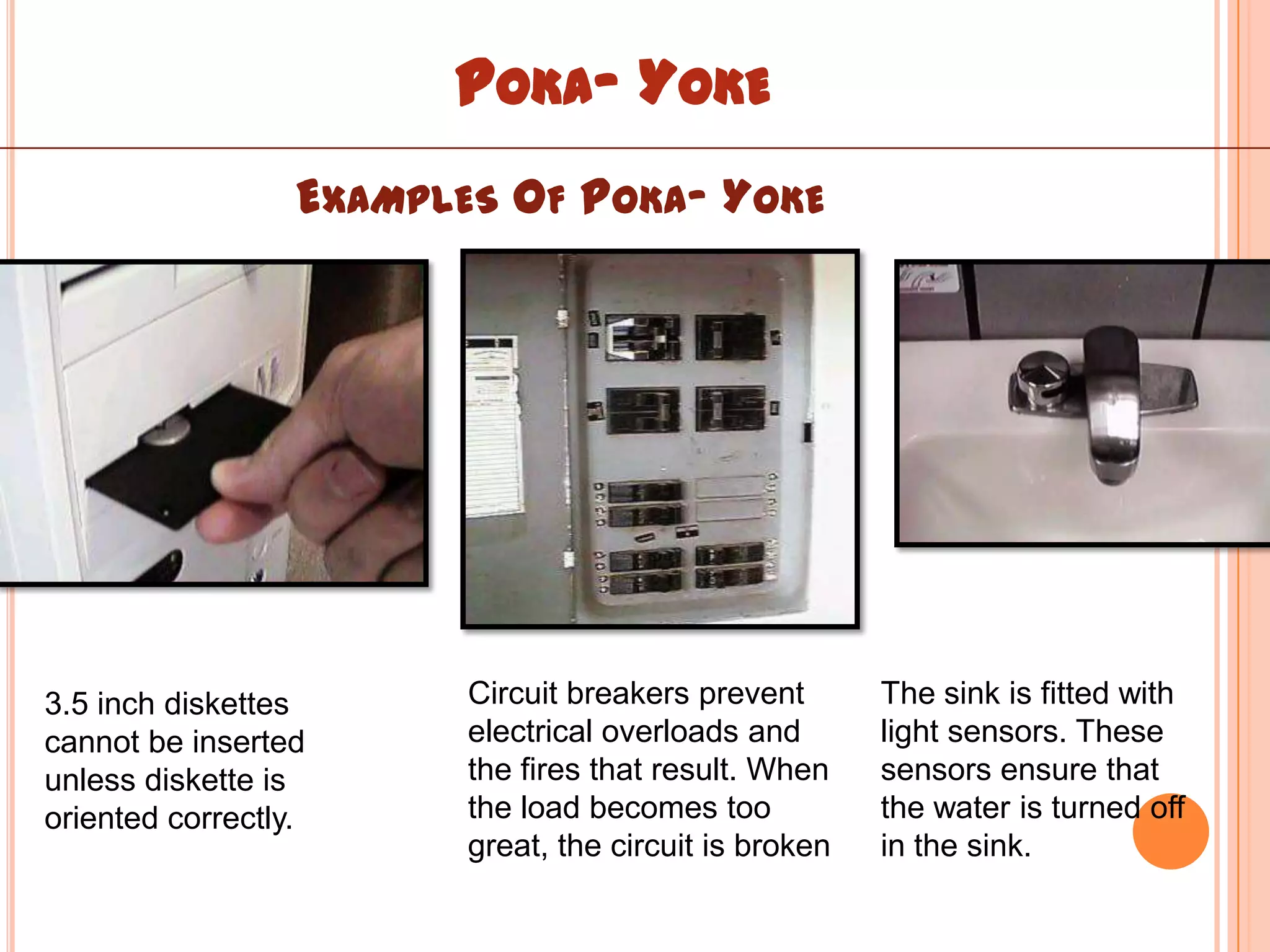
   “Techniques that help operators avoid mistakes in their work caused by choosing the
    wrong part, leaving out a part, installing a part backwards, etc”


   It provides instant feedback and prevention of quality problems
   It is a tool that is
     Mistake-proofing systems
     Does not rely on operators catching mistakes
     Inexpensive ‘Point of Origin inspection’
     Quick feedback 100% of the time


   This tool can be applied to any process, be it in manufacturing or the
    service industry.
POKA- YOKE
                                       Steps in applying Poka-
 Causes Of Defects
                                       Yoke

1.    Poor procedures or standards.    1.    Identify the operation or process
2.    Machines.                              - based on a Pareto Analysis.
3.    Non-conforming material.         2.    Analyze the 5-whys and
                                             understand the ways a process
4.    Worn tooling.
                                             can fail.
5.    Human Mistakes.
                                       3.    Decide the right Poka-yoke
                                             approach, such as using a,
     Except for human mistakes these        • Shut out Type: Preventing an
     conditions can be predicted and           error being made, or an
     corrective action can be
                                            • AttentionType: Highlighting
     implemented to eliminate the
                                               that an error has been made.
     cause of defects.
POKA- YOKE
                        ERROR TYPES
 i.    Processing Error: Process operation missed or not performed per the
       SOP.

 ii.   Setup Error: Using the wrong tooling or setting machine adjustments
       incorrectly.

iii.   Missing Part: Not all parts included in the assembly, welding, or other
       processes.

iv.    Improper part/item: Wrong part used in the process.

v.     Operations Error: Carrying out an operation incorrectly; having the
       incorrect version of the specification.

vi.    Measurement Error: Errors in machine adjustment, test measurement
       or dimensions of a part coming in from a supplier.
POKA- YOKE
                  EXAMPLES OF POKA- YOKE


3.5 inch diskettes       Circuit breakers prevent       The sink is fitted with
cannot be inserted       electrical overloads and       light sensors. These
unless diskette is       the fires that result. When    sensors ensure that
oriented correctly.      the load becomes too           the water is turned off
                         great, the circuit is broken   in the sink.
THANK YOU…

TQM, 5S, Kaizen, Poka-yoke, JIT, KAnban

  • 1.
    PRESENTATION ON TQM, 5S, KAIZEN, JIT, KANBAN, POKA YOKE DEPARTMENT OF MECHANICAL ENGINEERING AMRUTVAHINI COLLEGE OF ENGINEERING, SANGAMNER 2011-2012
  • 2.
    TOTAL QUALITY MANAGEMENT(TQM)  ‘Total’ : Made up of whole  ‘Quality’ : Degree of excellence  ‘Management’ : Act of handling, controlling, directing, staffing an organisation.  “Maximum user satisfaction at minimum cost”  “TQM is both a philosophy and a set of guiding principles that represent the foundation of a continuously improving organisation.”  Quality is determined by the combined efforts of various departments such as design, process planning, engineering, purchase, production and inspection.  The golden rule of TQM “Do unto others as you would have do unto you”.
  • 3.
  • 4.
    TOTAL QUALITY MANAGEMENT(TQM) ELEMENTS OR PILLARS OF TQM 1) Top 6) Continuous Management’s improvement commitment to 7) Measurement of quality performance 2) Customer focus 8) Benchmarking of the 9) Teams organisation 10) Inventory 3) Employee Management improvement and 11) Communication empowerment 12) Quality Costs
  • 5.
  • 6.
    TOTAL QUALITY MANAGEMENT(TQM) QUALITY Prior To TQM With TQM ELEMENTS 1) Definition Product oriented Customer focused 2) Priorities Second to service and cost First to service and cost 3) Decisions Short term Long term 4) Emphasis Detection Prevention 5) Errors Operation System 6) Responsibility Quality control Every one 7) Problem Solving Managers Teams 8) Procurement Price Life cycle cost, based on partnership 9) Manager’s role Plan, assign, control and Delegate, coach, enforce facilitate and mentor
  • 7.
  • 8.
    5-S “5 S isa technique that results in a well-organized workplace complete with visual controls and order.”  Developer- „Iwao Kobayashi‟  Sort (SEIRI) : Clear unnecessary items from work area.  Straighten/Set in order (SEITON) : Organize work area in an orderly manner.  Shine (SEISO) : Clean work area.  Standardize (SEIKESTU) : Maintain work area cleanliness.  Sustain (SHITSUKE) : Maintain self-discipline in work area.
  • 9.
    5-S  There’s no second chance to make the first impression
  • 10.
  • 11.
    5-S OBJECTIVE  Increase the Storing places.  Create and preserve standards.  Reduce unproductive times.  Readjust the location.  Reduce the document search time with 20%.
  • 12.
    5-S SORT (SEIRI) SWEEP (SEISO)
  • 13.
    5-S STRAIGHTEN (SEITON): TOYOTAENGINE ASSEMBLY LINE
  • 14.
    5-S SCHEDULE (SEIKESTU) SUSTAIN (SHITSUKE)
  • 15.
  • 16.
    5-S BENEFITS OF IMPLEMENTATION  It reduced the idle time & fatigue to workers.  Reduction of wastage of material  Improvement in quality & Productivity  Punctuality, commitment & discipline  Improved effectiveness of employees  Reduction in Non- Value-Added Activities  Following cost gets decreased-  Record keeping & administrative cost  Deterioration cost  Handling cost
  • 17.
    KAIZEN  „KAI „: Change ; „ZEN‟ : Better  „Changes for better‟ or „ Continous Improvement‟  Masaaki Imai – developer of Kaizen  “Kaizen is a Japanese word for the phylosophy, that defines management’s role in continously encouraging & implementing small improvement involving everyone.”  Kaizen makes the process more efficient , effective and adaptable.  Kaizen focuses on simplication of complex process by breaking them down into their sub-process and then improving them
  • 18.
  • 19.
    KAIZEN Key Elements of Kaizen foundation of Kaizen  Quality  Team Work  Effort  Personal  Involvement of Discipline all employees  Improved  Willingness to Morale Change  Quality Circles  Communication  Suggestions For Improvement
  • 20.
    KAIZEN JOB FUNCTIONS ASPERCIEVED BY JAPANESE MANAGERS
  • 21.
    KAIZEN KAIZEN IMPROVEMENT FOCUSES ON  Value added & non-value  Documentation of standard added work activities. operating procedures  Muda: wastes  5-S frame work 1. Over Production  Better Communication through 2. Delay visual displays- posters, bulletins. 3. Transportation  Just In Time Principles 4. Inventory  Poka – Yoke : to prevent or 5. Defective Parts detect errors 6. Wasted Motion  Team Effort on Problem solving, 7. Processing conflict reduction &  Principles of Material communication. Handling
  • 22.
    KAIZEN KAIZEN : SMALL SUGGESTIONS •Work Improvement •Environment Improvement •Process Improvement •Machine capability Improvement •Quality Improvement •Customer Service Improvement An example of a Kaizen type improvement would be the change in color of a welding booth from black to white to improve operators visibility
  • 23.
  • 24.
    JUST IN TIME(JIT)  “JIT is manufacturing philosophy that produces necessary units, with the required quality, in the necessary quantities, at the last safe moment.”  Eliminates waste of time, labour and storage space.  It’s a “pull” system of production: actual orders provide a signal when to manufacture.  Non-value-adding activities are removed for the purposes of :  Reducing Cost  Improving Quality  Improving Performance  Improving Delivery Adding Flexibility  Increase innovativeness
  • 25.
  • 26.
    JUST IN TIME(JIT) Advantages of JIT Limitations of JIT  Reduction in storage  Little room for space mistakes  Less working  Production is very capital reliant on  Less likelihood of suppliers stock perishing  No spared finished  Avoids the build up product to meet of unsold finished the expected product demand
  • 27.
    KANBAN „KAN‟ : Card; „BAN‟ : Signal Japanese term for "visual record” Coined by : Taiichi Ohno The Kanban card is “A message that signals depletion of product , parts or inventory that when received will trigger replenishment of that product, part or inventory.” Bernstein identifies as “a highly efficient and effective factory production system”. No. of kanbans =
  • 28.
    KANBAN scanning bar codes and transmitting electronic orders. POURS is an innovative Web-based solution that streamlines the process, training and support associated with inventory management.
  • 29.
    POKA- YOKE  „POKA‟ – „mistake‟ ; YOKERU – „Proofing‟  Developer: Shigeo Shingo (1960)- The industrial engineers at Toyota.  “Techniques that help operators avoid mistakes in their work caused by choosing the wrong part, leaving out a part, installing a part backwards, etc”  It provides instant feedback and prevention of quality problems  It is a tool that is  Mistake-proofing systems  Does not rely on operators catching mistakes  Inexpensive ‘Point of Origin inspection’  Quick feedback 100% of the time  This tool can be applied to any process, be it in manufacturing or the service industry.
  • 30.
    POKA- YOKE Steps in applying Poka- Causes Of Defects Yoke 1. Poor procedures or standards. 1. Identify the operation or process 2. Machines. - based on a Pareto Analysis. 3. Non-conforming material. 2. Analyze the 5-whys and understand the ways a process 4. Worn tooling. can fail. 5. Human Mistakes. 3. Decide the right Poka-yoke approach, such as using a, Except for human mistakes these • Shut out Type: Preventing an conditions can be predicted and error being made, or an corrective action can be • AttentionType: Highlighting implemented to eliminate the that an error has been made. cause of defects.
  • 31.
    POKA- YOKE ERROR TYPES i. Processing Error: Process operation missed or not performed per the SOP. ii. Setup Error: Using the wrong tooling or setting machine adjustments incorrectly. iii. Missing Part: Not all parts included in the assembly, welding, or other processes. iv. Improper part/item: Wrong part used in the process. v. Operations Error: Carrying out an operation incorrectly; having the incorrect version of the specification. vi. Measurement Error: Errors in machine adjustment, test measurement or dimensions of a part coming in from a supplier.
  • 32.
    POKA- YOKE EXAMPLES OF POKA- YOKE 3.5 inch diskettes Circuit breakers prevent The sink is fitted with cannot be inserted electrical overloads and light sensors. These unless diskette is the fires that result. When sensors ensure that oriented correctly. the load becomes too the water is turned off great, the circuit is broken in the sink.
  • 33.