Study On Quality Control & Quality
Management Systems
Quality Control
• Quality control is a process by which entities review the
quality of all factors involved in production.
• ISO 9000 defines quality control as "A part of quality
management focused on fulfilling quality requirements
Quality Management Systems
• Quality Management Systems is a collection of business
processes focused on consistently meeting customer
requirements and enhancing their satisfaction. It is
aligned with an organization's purpose and strategic
direction.
Various principle's in QMS
• Kaizen Principle
• Pareto Principle
• Six Sigma
• PDCA cycle
• Toyota Production Systems
• Total Quality Management
KAIZEN Principle
• Kaizen Principle is a continuous approach in QMS
• Kai- CHANGE, Zen- GOOD
• Kaizen Principle is a long-term approach to work that
systematically seeks to achieve small, incremental
changes in processes in order to improve efficiency and
quality.
• Kaizen can be applied to any kind of work, but it is
perhaps best known for being used in lean manufacturing
and lean programming.
PARETO Principle
• Pareto principle is also known as 80/20 rule, principle of
factor sparsity.
• Pareto principle states that, for many events, roughly 80%
of the effects come from 20% of the causes.
• Pareto principle is given Joseph M. Juran.
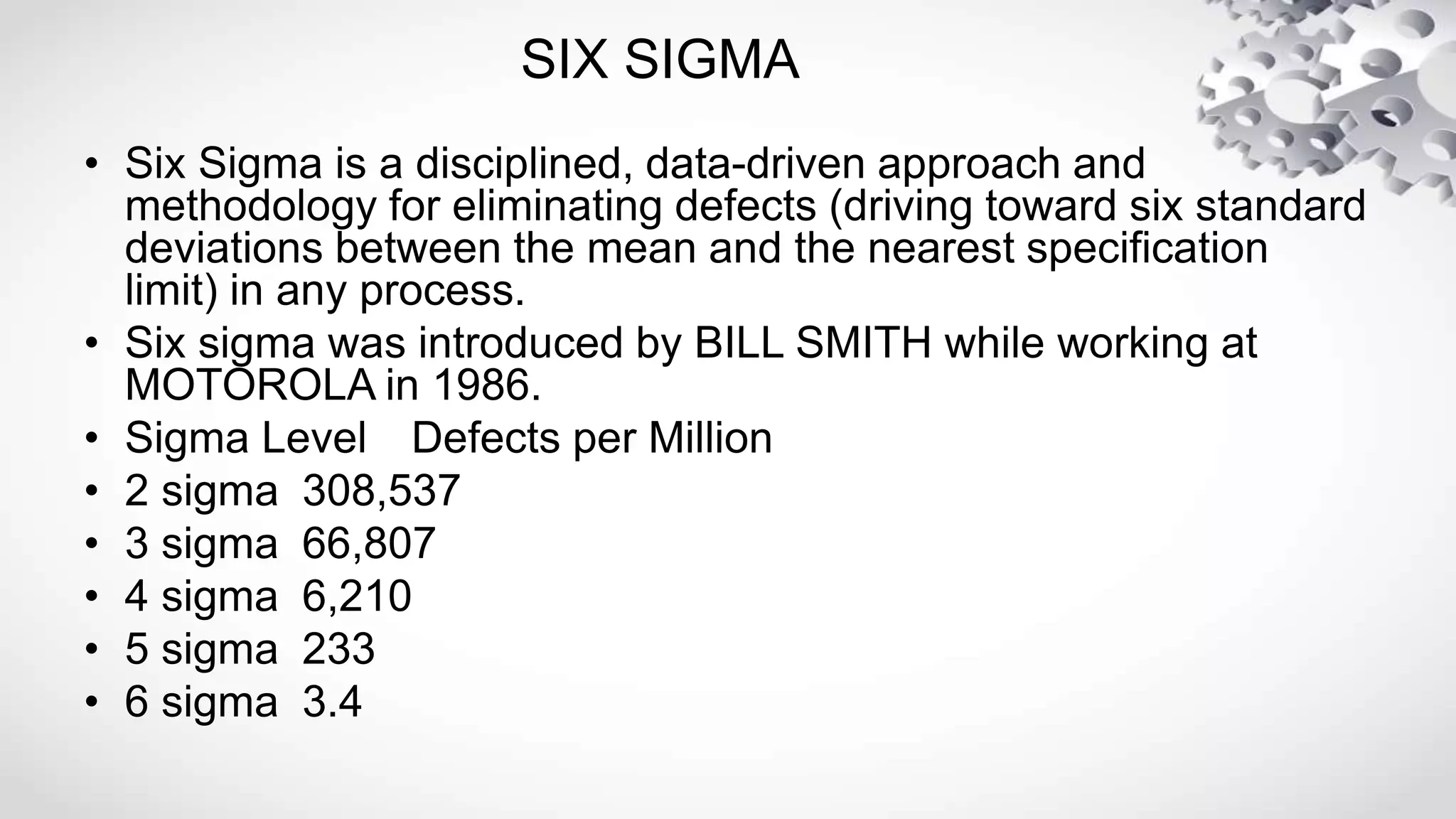
SIX SIGMA
• Six Sigma is a disciplined, data-driven approach and
methodology for eliminating defects (driving toward six standard
deviations between the mean and the nearest specification
limit) in any process.
• Six sigma was introduced by BILL SMITH while working at
MOTOROLA in 1986.
• Sigma Level Defects per Million
• 2 sigma 308,537
• 3 sigma 66,807
• 4 sigma 6,210
• 5 sigma 233
• 6 sigma 3.4
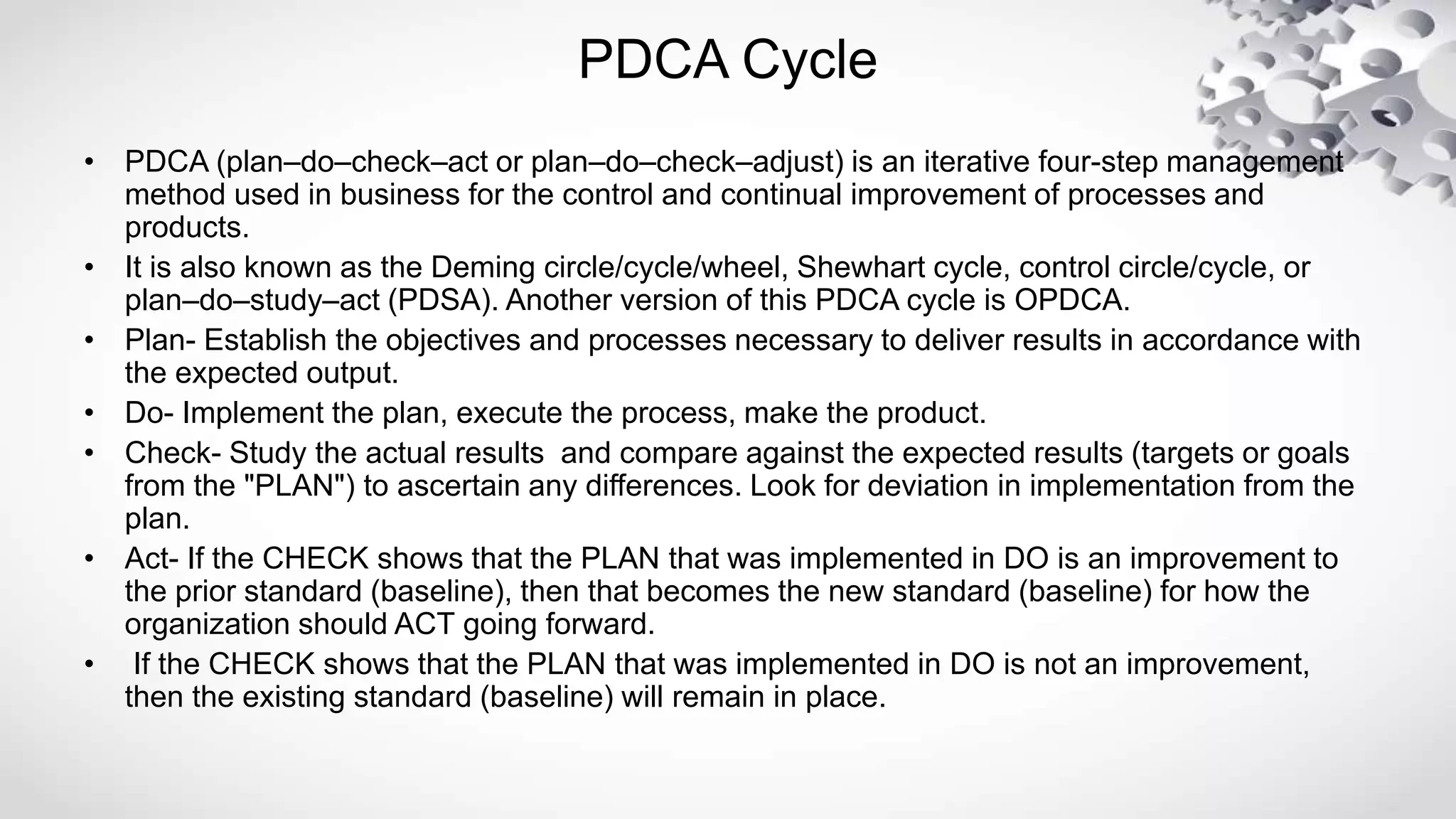
PDCA Cycle
• PDCA (plan–do–check–act or plan–do–check–adjust) is an iterative four-step management
method used in business for the control and continual improvement of processes and
products.
• It is also known as the Deming circle/cycle/wheel, Shewhart cycle, control circle/cycle, or
plan–do–study–act (PDSA). Another version of this PDCA cycle is OPDCA.
• Plan- Establish the objectives and processes necessary to deliver results in accordance with
the expected output.
• Do- Implement the plan, execute the process, make the product.
• Check- Study the actual results and compare against the expected results (targets or goals
from the "PLAN") to ascertain any differences. Look for deviation in implementation from the
plan.
• Act- If the CHECK shows that the PLAN that was implemented in DO is an improvement to
the prior standard (baseline), then that becomes the new standard (baseline) for how the
organization should ACT going forward.
• If the CHECK shows that the PLAN that was implemented in DO is not an improvement,
then the existing standard (baseline) will remain in place.
Lean manufacturing
• Lean manufacturing or lean production, often simply "lean", is a systematic method for the
elimination of waste ("Muda") within a manufacturing system.
• Lean manufacturing also takes into account waste created through overburden ("Muri") and
waste created through unevenness in work loads ("Mura").
• MUDA- Muda is a Japanese word meaning "futility; uselessness; wastefulness",[1] and is a
key concept in the Toyota Production System (TPS) as one of the three types of deviation
from optimal allocation of resources
• Muda Type - I : The non value added activity for end customer but it is necessary.
• Muda Type -II : The non value added activity for end customer which are not necessary. It is
targeted to eliminate this type of wastage.
• MURA- Mura is a Japanese word meaning "unreasonableness; impossible.
Toyota Production Systems
• TPS was 1st used in 1992 and revised in 1998.
• The TPS organizes manufacturing and logistics for the automobile manufacturer, including
interaction with suppliers and customers. The system is a major precursor of the more
generic "lean manufacturing".
• Originally called "just-in-time production", it builds on the approach created by the founder of
Toyota, Sakichi Toyoda, his son Kiichiro Toyoda, and the engineer Taiichi Ohno.
• The TPS is a framework for conserving resources by eliminating waste. People who
participate in the system learn to identify expenditures of material, effort and time that do not
generate value for customers and furthermore we have, avoid a ’how-to’ approach.
• Just-in-time -"Making only what is needed, only when it is needed, and only in the amount
that is needed"
Total Quality Management
• Total quality management (TQM) consists of organization-wide efforts to install and make
permanent a climate in which an organization continuously improves its ability to deliver
high-quality products and services to customers.
• TQM efforts typically draw heavily on the previously developed tools and techniques of
quality control.
• TQM enjoyed widespread attention during the late 1980s and early 1990s before being
overshadowed by ISO 9000, Lean manufacturing, and Six Sigma.
• TQM was developed by USA in late 1980's.
Thank You

Study on quality control & quality management systems

  • 1.
    Study On QualityControl & Quality Management Systems
  • 2.
    Quality Control • Qualitycontrol is a process by which entities review the quality of all factors involved in production. • ISO 9000 defines quality control as "A part of quality management focused on fulfilling quality requirements
  • 3.
    Quality Management Systems •Quality Management Systems is a collection of business processes focused on consistently meeting customer requirements and enhancing their satisfaction. It is aligned with an organization's purpose and strategic direction.
  • 4.
    Various principle's inQMS • Kaizen Principle • Pareto Principle • Six Sigma • PDCA cycle • Toyota Production Systems • Total Quality Management
  • 5.
    KAIZEN Principle • KaizenPrinciple is a continuous approach in QMS • Kai- CHANGE, Zen- GOOD • Kaizen Principle is a long-term approach to work that systematically seeks to achieve small, incremental changes in processes in order to improve efficiency and quality. • Kaizen can be applied to any kind of work, but it is perhaps best known for being used in lean manufacturing and lean programming.
  • 6.
    PARETO Principle • Paretoprinciple is also known as 80/20 rule, principle of factor sparsity. • Pareto principle states that, for many events, roughly 80% of the effects come from 20% of the causes. • Pareto principle is given Joseph M. Juran.
  • 7.
    SIX SIGMA • SixSigma is a disciplined, data-driven approach and methodology for eliminating defects (driving toward six standard deviations between the mean and the nearest specification limit) in any process. • Six sigma was introduced by BILL SMITH while working at MOTOROLA in 1986. • Sigma Level Defects per Million • 2 sigma 308,537 • 3 sigma 66,807 • 4 sigma 6,210 • 5 sigma 233 • 6 sigma 3.4
  • 8.
    PDCA Cycle • PDCA(plan–do–check–act or plan–do–check–adjust) is an iterative four-step management method used in business for the control and continual improvement of processes and products. • It is also known as the Deming circle/cycle/wheel, Shewhart cycle, control circle/cycle, or plan–do–study–act (PDSA). Another version of this PDCA cycle is OPDCA. • Plan- Establish the objectives and processes necessary to deliver results in accordance with the expected output. • Do- Implement the plan, execute the process, make the product. • Check- Study the actual results and compare against the expected results (targets or goals from the "PLAN") to ascertain any differences. Look for deviation in implementation from the plan. • Act- If the CHECK shows that the PLAN that was implemented in DO is an improvement to the prior standard (baseline), then that becomes the new standard (baseline) for how the organization should ACT going forward. • If the CHECK shows that the PLAN that was implemented in DO is not an improvement, then the existing standard (baseline) will remain in place.
  • 9.
    Lean manufacturing • Leanmanufacturing or lean production, often simply "lean", is a systematic method for the elimination of waste ("Muda") within a manufacturing system. • Lean manufacturing also takes into account waste created through overburden ("Muri") and waste created through unevenness in work loads ("Mura"). • MUDA- Muda is a Japanese word meaning "futility; uselessness; wastefulness",[1] and is a key concept in the Toyota Production System (TPS) as one of the three types of deviation from optimal allocation of resources • Muda Type - I : The non value added activity for end customer but it is necessary. • Muda Type -II : The non value added activity for end customer which are not necessary. It is targeted to eliminate this type of wastage. • MURA- Mura is a Japanese word meaning "unreasonableness; impossible.
  • 10.
    Toyota Production Systems •TPS was 1st used in 1992 and revised in 1998. • The TPS organizes manufacturing and logistics for the automobile manufacturer, including interaction with suppliers and customers. The system is a major precursor of the more generic "lean manufacturing". • Originally called "just-in-time production", it builds on the approach created by the founder of Toyota, Sakichi Toyoda, his son Kiichiro Toyoda, and the engineer Taiichi Ohno. • The TPS is a framework for conserving resources by eliminating waste. People who participate in the system learn to identify expenditures of material, effort and time that do not generate value for customers and furthermore we have, avoid a ’how-to’ approach. • Just-in-time -"Making only what is needed, only when it is needed, and only in the amount that is needed"
  • 11.
    Total Quality Management •Total quality management (TQM) consists of organization-wide efforts to install and make permanent a climate in which an organization continuously improves its ability to deliver high-quality products and services to customers. • TQM efforts typically draw heavily on the previously developed tools and techniques of quality control. • TQM enjoyed widespread attention during the late 1980s and early 1990s before being overshadowed by ISO 9000, Lean manufacturing, and Six Sigma. • TQM was developed by USA in late 1980's.
  • 12.