Kaizen
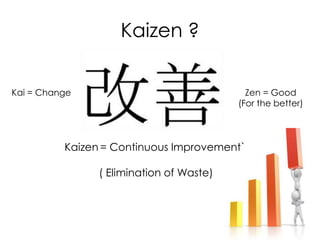
Kaizen ?

Kai = Change                                Zen = Good
                                          (For the better)


          Kaizen = Continuous Improvement`

                ( Elimination of Waste)
Inception

Evolved after World War II, influenced by American’s Experts
Developed by Maaski Imai
(The Key to Japan’s Competitive Success (1986)
First applied In Toyota Production System
Building Blocks

• Elements
  Teamwork, personal discipline, Improved Morale, Quality Circle,
  Suggestion for improvement


• Concept
  PDCA,5S, Quality Circle and Just in time Production


• Role Players
  Top, Middle and lower level Management


• Approach
  Management, Group and Individual Oriented Kaizen
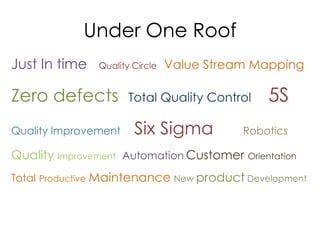
Under One Roof
Just In time   Quality Circle   Value Stream Mapping

Zero defects          Total Quality Control    5S
Quality Improvement    Six Sigma           Robotics

Quality Improvement Automation Customer Orientation
Total Productive Maintenance New product Development
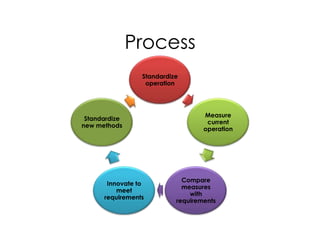
Process
                 Standardize
                  operation


                                   Measure
 Standardize
                                    current
new methods
                                   operation


                             Compare
       Innovate to
                             measures
          meet
                               with
      requirements
                           requirements
A Big Picture
Key Benefits of Kaizen Widely applicable
•   Can be used in both manufacturing and non-manufacturing
    environments Highly effective & results oriented

•   Kaizen events will generate quick results, Measurable results, Establish
    the baseline, and measure the change Higher operational efficiency

•   Reduces wastage, like inventory waste, time waste, workers motion
    Improves space utilization and product quality

•   A Learning Experience – Every member of a Kaizen Team will walk
    away from the event learning something new.

•   Encourages big picture thinking Results in higher employee morale
    and job satisfaction, and lower turn-over.
In a nutshell
   Get Rid Of All Old Assumptions.

   Don't Look For Excuses, Look For Ways To Make Things Happen.

   Say "No" To The Status Quo.

   Don't Worry About Being Perfect - Even If You Only Get It Half Right " Start Now!

   It Does Not Cost Money To Do Kaizen.

   If Something Is Wrong "Fix It Now.

   Good Ideas Flow When The Going Gets Tough.

   Ask "Why" Five Times - Get To The Root Cause.

   Look For Wisdom From Ten People Rather Than One.

   Never Stop Doing Kaizen.
References

http://en.wikipedia.org/wiki/Kaizen

www.wikipedia.org www.howstuffworks.com Masaaki Imai(1986).

www.icmrindia.org

www.toyota.com

Kaizen

  • 1.
  • 2.
    Kaizen ? Kai =Change Zen = Good (For the better) Kaizen = Continuous Improvement` ( Elimination of Waste)
  • 3.
    Inception Evolved after WorldWar II, influenced by American’s Experts Developed by Maaski Imai (The Key to Japan’s Competitive Success (1986) First applied In Toyota Production System
  • 4.
    Building Blocks • Elements Teamwork, personal discipline, Improved Morale, Quality Circle, Suggestion for improvement • Concept PDCA,5S, Quality Circle and Just in time Production • Role Players Top, Middle and lower level Management • Approach Management, Group and Individual Oriented Kaizen
  • 5.
    Under One Roof JustIn time Quality Circle Value Stream Mapping Zero defects Total Quality Control 5S Quality Improvement Six Sigma Robotics Quality Improvement Automation Customer Orientation Total Productive Maintenance New product Development
  • 6.
    Process Standardize operation Measure Standardize current new methods operation Compare Innovate to measures meet with requirements requirements
  • 7.
    A Big Picture KeyBenefits of Kaizen Widely applicable • Can be used in both manufacturing and non-manufacturing environments Highly effective & results oriented • Kaizen events will generate quick results, Measurable results, Establish the baseline, and measure the change Higher operational efficiency • Reduces wastage, like inventory waste, time waste, workers motion Improves space utilization and product quality • A Learning Experience – Every member of a Kaizen Team will walk away from the event learning something new. • Encourages big picture thinking Results in higher employee morale and job satisfaction, and lower turn-over.
  • 8.
    In a nutshell  Get Rid Of All Old Assumptions.  Don't Look For Excuses, Look For Ways To Make Things Happen.  Say "No" To The Status Quo.  Don't Worry About Being Perfect - Even If You Only Get It Half Right " Start Now!  It Does Not Cost Money To Do Kaizen.  If Something Is Wrong "Fix It Now.  Good Ideas Flow When The Going Gets Tough.  Ask "Why" Five Times - Get To The Root Cause.  Look For Wisdom From Ten People Rather Than One.  Never Stop Doing Kaizen.
  • 9.

Editor's Notes

  • #3 Japansephiloy for constantimprpvene