Total Productive Maintenance (TPM) is a system to maintain and improve manufacturing equipment through involvement of all employees. It aims to maximize equipment effectiveness, increase production, and reduce costs by achieving zero defects, breakdowns, and accidents. The key pillars of TPM implementation are 5S, Jishuhozen (autonomous maintenance), Kobetsukaizen (planned maintenance), quality maintenance, training, and safety/health/environment programs. Benefits include increased productivity and quality, reduced accidents, and improved customer satisfaction.
Presentation details including presenter's name and roll number.
An outline of the presentation structure including Introduction, Goals, Implementation, Pillars of TPM, and Benefits.
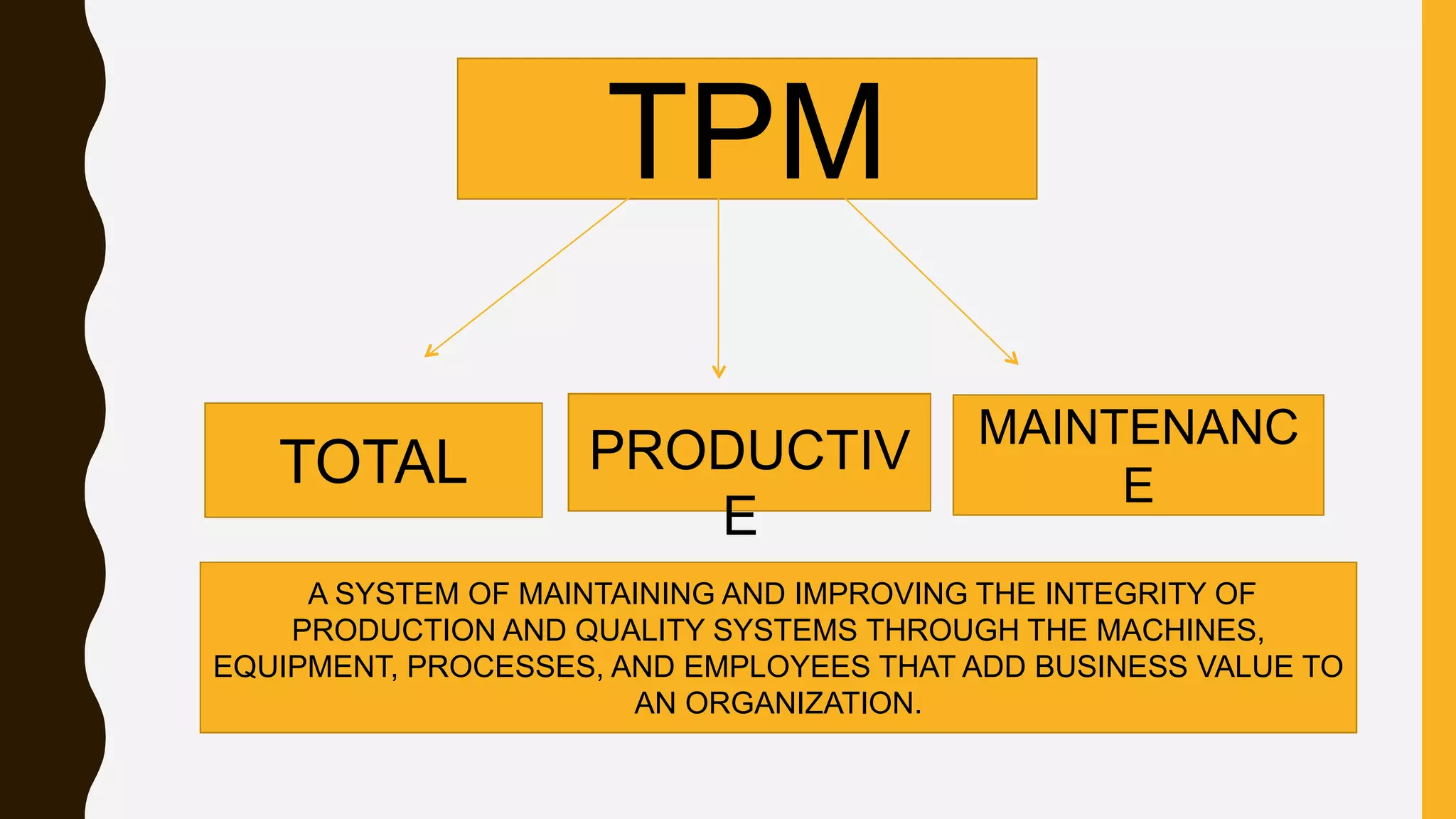
Total Productive Maintenance (TPM) focuses on maintaining production integrity and quality through all elements of production.
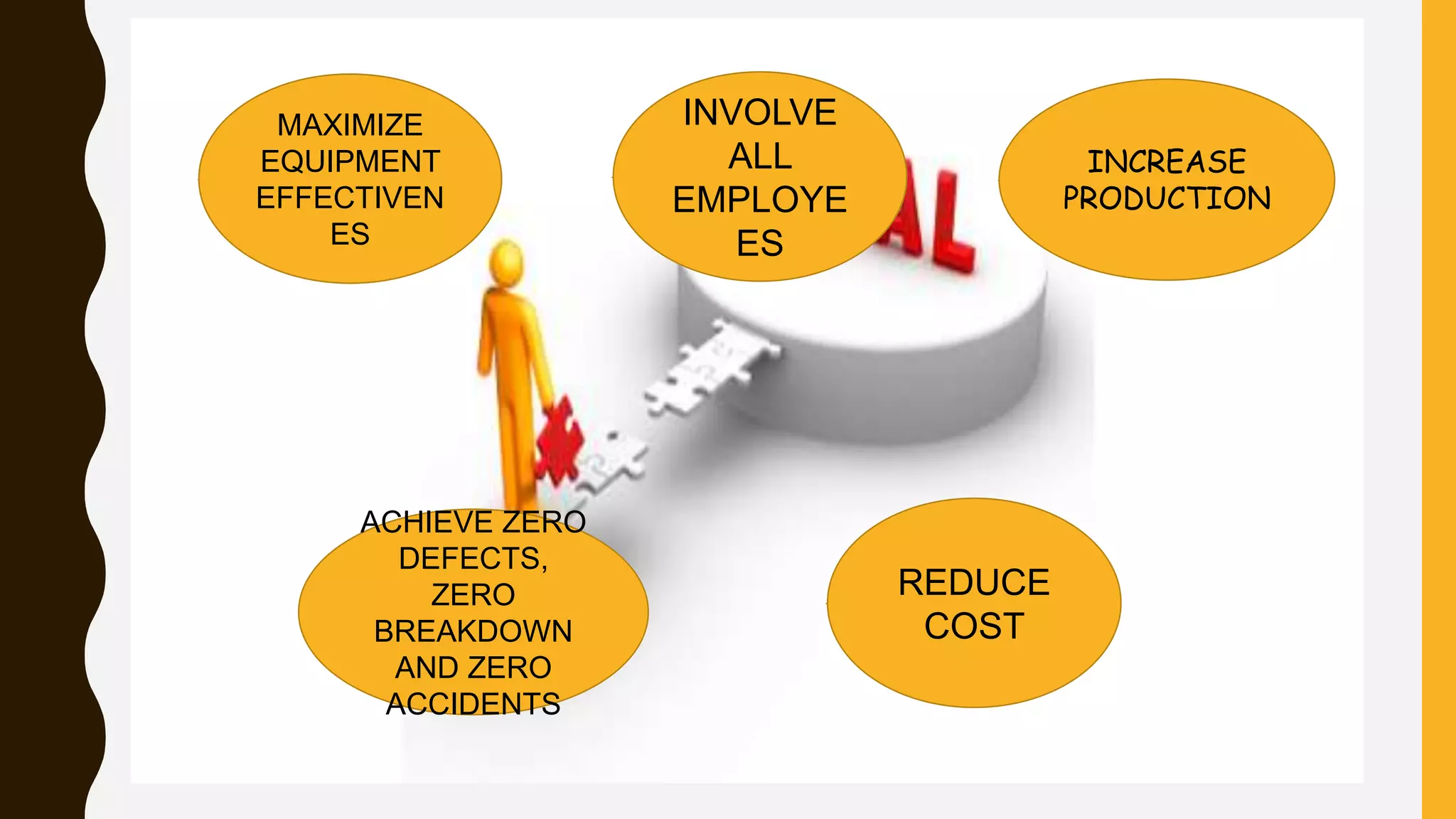
Goals include maximizing equipment effectiveness, involving all employees, increasing production, reducing costs, and aiming for zero defects, breakdowns, and accidents.
Introduction to the implementation phase of TPM.
Key pillars of TPM: 5S, Jishu Hozen, Kobetsu Kaizen, Planned Maintenance, Quality Maintenance, Training, Safety, and Office TPM.
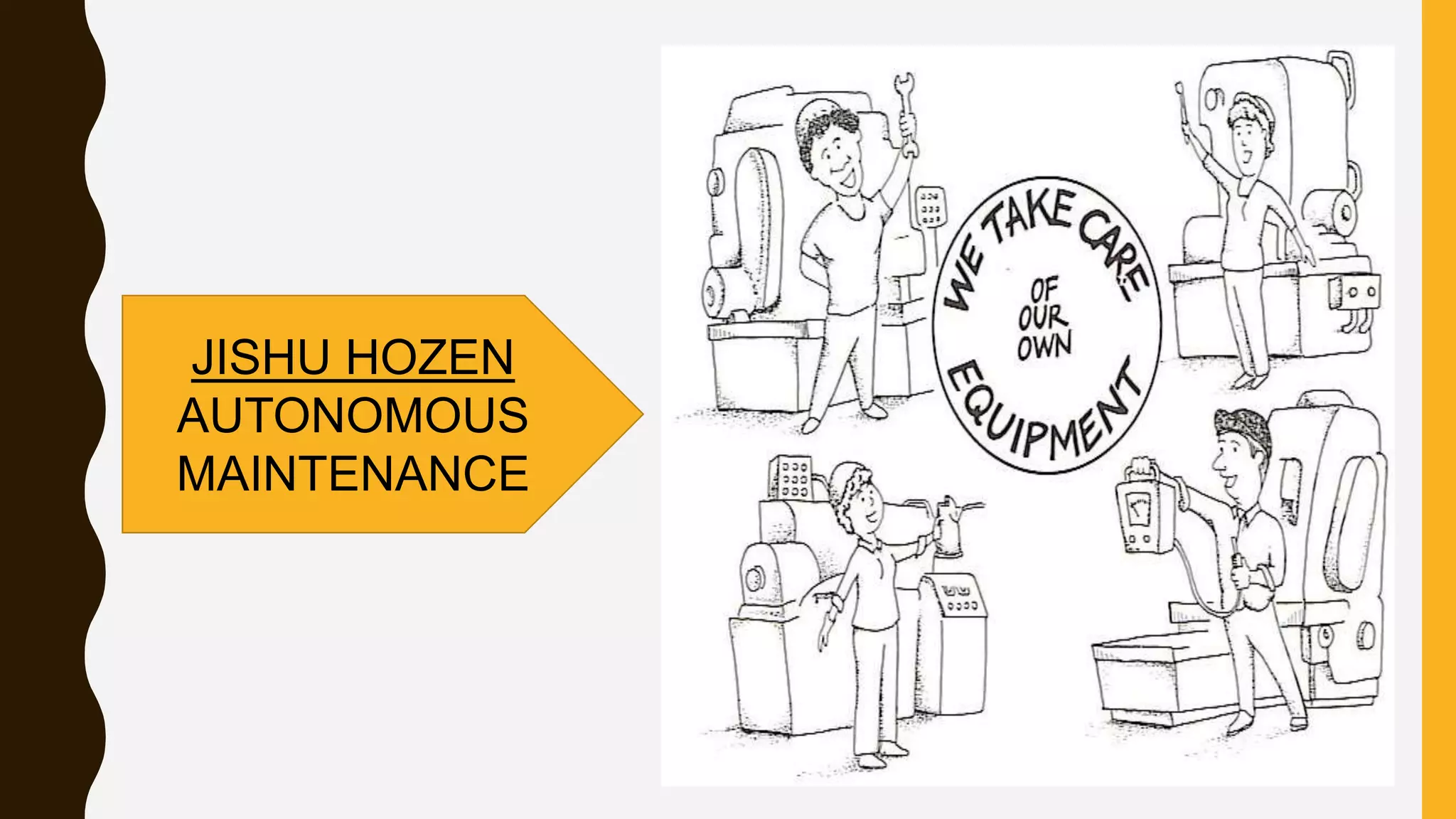
Focus on Autonomous Maintenance as a key pillar to enhance equipment upkeep.
Aim for customer satisfaction through defect-free manufacturing, identifying and eliminating quality concerns.
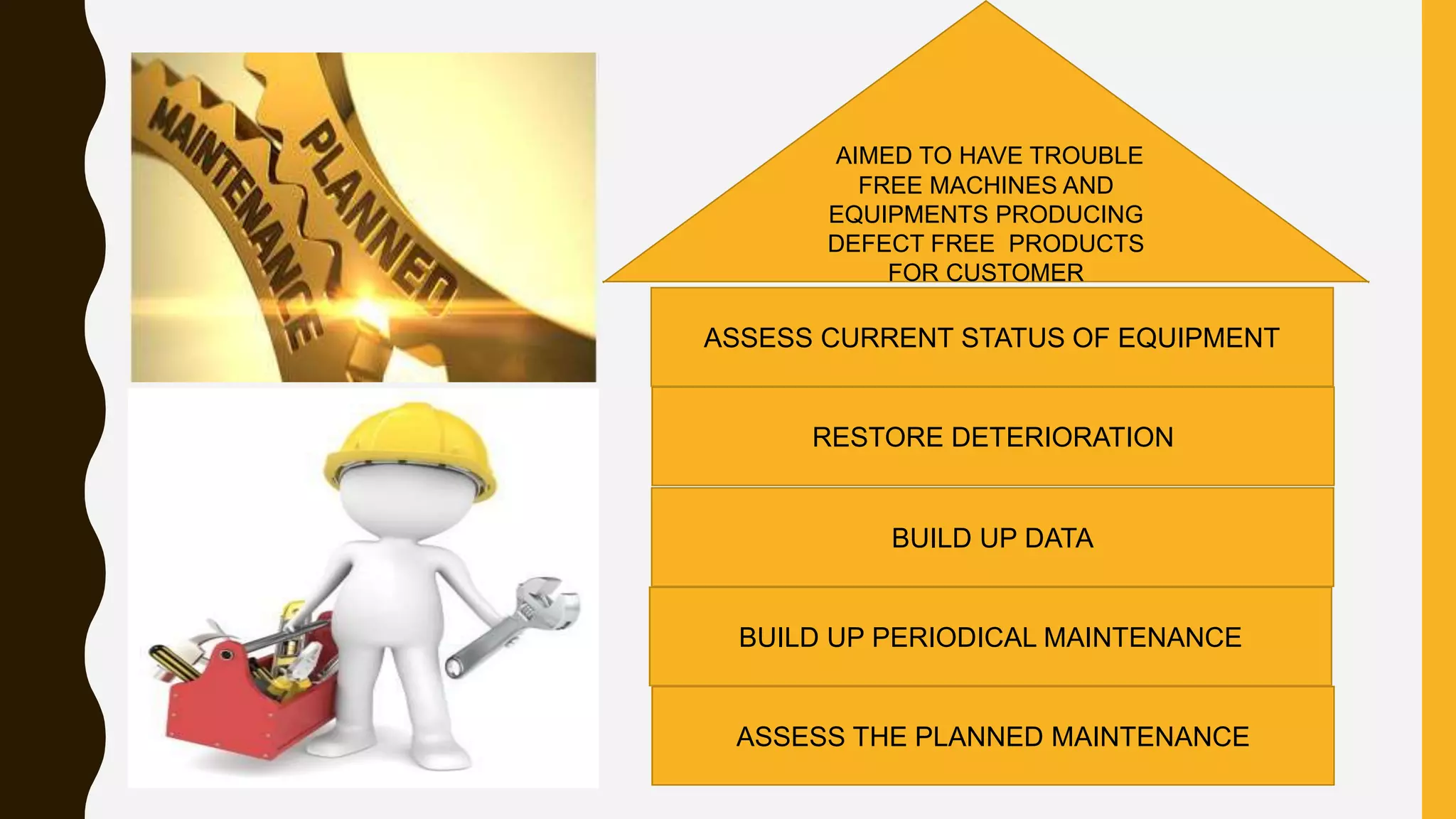
Strategies include assessing equipment status, restoring functionality, creating data maintenance, and ensuring trouble-free operation for quality output.
Framework for skill development, progression from not knowing to being able to teach knowledge.
Initiating Office TPM after other pillars to improve administrative efficiency and performance.
TPM benefits include increased productivity, reduced accidents, improved customer satisfaction, and higher worker confidence.
TPM
TOTAL PRODUCTIV
E
MAINTENANC
E
A SYSTEMOF MAINTAINING AND IMPROVING THE INTEGRITY OF
PRODUCTION AND QUALITY SYSTEMS THROUGH THE MACHINES,
EQUIPMENT, PROCESSES, AND EMPLOYEES THAT ADD BUSINESS VALUE TO
AN ORGANIZATION.
• It isaimed towards customer delight through highest quality
through defect free manufacturing
• We gain understanding of what parts of the equipment affect
product quality and begin to eliminate current quality
concerns then move to potential quality concerns
12.
ASSESS CURRENT STATUSOF EQUIPMENT
RESTORE DETERIORATION
BUILD UP DATA
BUILD UP PERIODICAL MAINTENANCE
ASSESS THE PLANNED MAINTENANCE
AIMED TO HAVE TROUBLE
FREE MACHINES AND
EQUIPMENTS PRODUCING
DEFECT FREE PRODUCTS
FOR CUSTOMER
13.
DO NOT KNOW
KNOWTHEORY
CANNOT DO
CAN DO CANNOT
TEACH
CAN DO AND TEACH
15.
• Office TPMshould be started after activating four other pillars of TPM (JH, KK, QM,
PM)
• Office TPM must be followed to improve productivity, efficiency in the administrative
functions and identify and eliminate losses.
BENEFITS
• Involvement of all people in support functions for focusing on better plant performance
• Better utilized work area
• Reduce repetitive work
• Reduced inventory levels in all parts of the supply chain
OFFICE TPM







![TPM[1]3jjjjjjjjjjjjjjjjjjjjjjjjjjjjjjjjjjjj.pptx](https://cdn.slidesharecdn.com/ss_thumbnails/tpm1-250627061625-633dc9e1-thumbnail.jpg?width=640&height=640&fit=bounds)


![TPM[1]iiiiiiiiiiiiiiiiiiiiiiiiiiiiiiiiiiiiiiii.ppt](https://cdn.slidesharecdn.com/ss_thumbnails/tpm1-250627061842-e3e2df7f-thumbnail.jpg?width=640&height=640&fit=bounds)


