


Guided by: - 
Dr.Mohammed Shiri 
By: - 
Ahmed AL Tememe
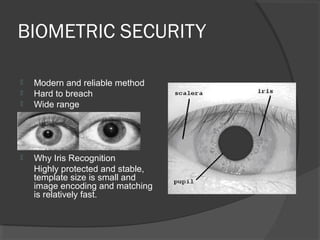
BIOMETRIC SECURITY 
 Modern and reliable method 
 Hard to breach 
 Wide range 
 Why Iris Recognition 
Highly protected and stable, 
template size is small and 
image encoding and matching 
is relatively fast.
INTRODUCTION TO IRIS RECOGNITION 
John Daugman, University of 
Cambridge – Pioneer in Iris 
Recognition. 
Sharbat Gula – aged 12 at 
Afghani refugee camp. 
18 years later at a remote 
location in Afghanistan.
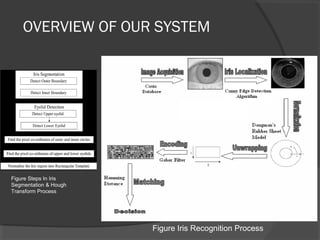
OVERVIEW OF OUR SYSTEM 
Figure Steps In Iris 
Segmentation & Hough 
Transform Process 
Figure Iris Recognition Process
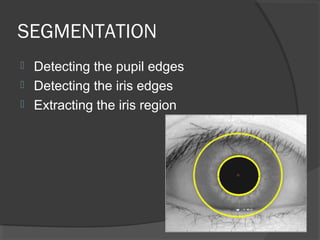
SEGMENTATION 
 Detecting the pupil edges 
 Detecting the iris edges 
 Extracting the iris region
Canny Edge Detection 
Algorithm 
The Canny edge detection algorithm 
consists of following steps: 
 Smooth the image with a Gaussian filter 
 Compute the gradient of image. 
 Apply nonmaxima suppression to the 
gradient image 
 Use double thresholding algorithm to 
detect and link edges.
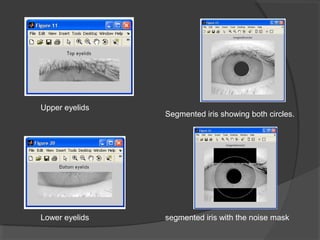
The gradient amplitude image 
while inding outer and inner 
boundary of iris. 
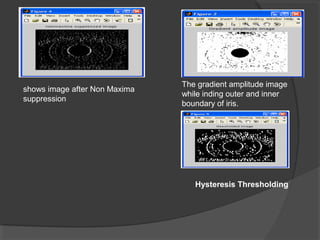
shows image after Non Maxima 
suppression 
Hysteresis Thresholding
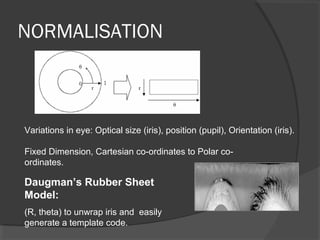
Upper eyelids 
Segmented iris showing both circles. 
Lower eyelids segmented iris with the noise mask
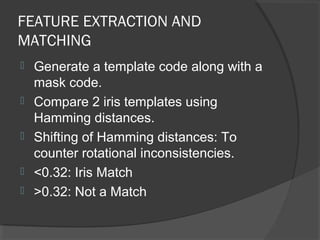
NORMALISATION 
Variations in eye: Optical size (iris), position (pupil), Orientation (iris). 
Fixed Dimension, Cartesian co-ordinates to Polar co-ordinates. 
Daugman’s Rubber Sheet 
Model: 
(R, theta) to unwrap iris and easily 
generate a template code.
FEATURE EXTRACTION AND 
MATCHING 
 Generate a template code along with a 
mask code. 
 Compare 2 iris templates using 
Hamming distances. 
 Shifting of Hamming distances: To 
counter rotational inconsistencies. 
 <0.32: Iris Match 
 >0.32: Not a Match
RESULTS AND CASE STUDIES 
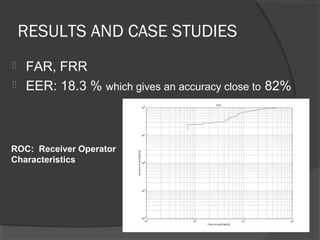
 FAR, FRR 
 EER: 18.3 % which gives an accuracy close to 82% 
ROC: Receiver Operator 
Characteristics
Advantages 
 Uniqueness of iris patterns hence improved 
accuracy. 
 Highly protected, internal organ of the eye 
 Stability : Persistence of iris patterns. 
 Non-invasive : Relatively easy to be 
acquired. 
 Speed : Smaller template size so large 
databases can be easily stored and 
checked. 
 Cannot be easily forged or modified.
Concerns / Possible 
improvements 
 High cost of implementation 
 Person has to be “physically” present. 
 Capture images independent of surroundings 
and environment / Techniques for dark eyes. 
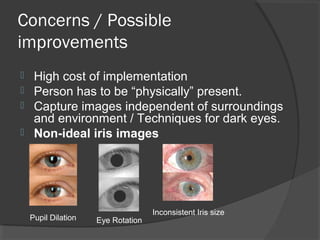
 Non-ideal iris images 
Pupil Dilation Inconsistent Iris size Eye Rotation
REFERENCES 
1] Wildes, R.P, “Iris Recognition: An Emerging 
Biometric Technology”, Proceedings of the IEEE, 
VOL. 85, NO. 9, September 1997, pp. 1348-1363. 
2] John G. Daugman. How Iris Recognition Works. 
Proceedings of 2002 International Conference on 
Image Processing, Vol. 1, 2002. 
5) J. Daugman “High confidence visual recognition of 
persons by a test of statistical independence ,”IEEE 
Trans. Pattern Analyse Machine Intell., vol. 15, pp. 
1148–1161, Nov. 1993. 
6) R. Wildes, “Iris recognition: an emerging biometric
THANK YOU!!!

Final iris recognition

  • 1.
    Guided by: - Dr.Mohammed Shiri By: - Ahmed AL Tememe
  • 2.
    BIOMETRIC SECURITY Modern and reliable method  Hard to breach  Wide range  Why Iris Recognition Highly protected and stable, template size is small and image encoding and matching is relatively fast.
  • 3.
    INTRODUCTION TO IRISRECOGNITION John Daugman, University of Cambridge – Pioneer in Iris Recognition. Sharbat Gula – aged 12 at Afghani refugee camp. 18 years later at a remote location in Afghanistan.
  • 4.
    OVERVIEW OF OURSYSTEM Figure Steps In Iris Segmentation & Hough Transform Process Figure Iris Recognition Process
  • 5.
    SEGMENTATION  Detectingthe pupil edges  Detecting the iris edges  Extracting the iris region
  • 6.
    Canny Edge Detection Algorithm The Canny edge detection algorithm consists of following steps:  Smooth the image with a Gaussian filter  Compute the gradient of image.  Apply nonmaxima suppression to the gradient image  Use double thresholding algorithm to detect and link edges.
  • 7.
    The gradient amplitudeimage while inding outer and inner boundary of iris. shows image after Non Maxima suppression Hysteresis Thresholding
  • 8.
    Upper eyelids Segmentediris showing both circles. Lower eyelids segmented iris with the noise mask
  • 9.
    NORMALISATION Variations ineye: Optical size (iris), position (pupil), Orientation (iris). Fixed Dimension, Cartesian co-ordinates to Polar co-ordinates. Daugman’s Rubber Sheet Model: (R, theta) to unwrap iris and easily generate a template code.
  • 10.
    FEATURE EXTRACTION AND MATCHING  Generate a template code along with a mask code.  Compare 2 iris templates using Hamming distances.  Shifting of Hamming distances: To counter rotational inconsistencies.  <0.32: Iris Match  >0.32: Not a Match
  • 11.
    RESULTS AND CASESTUDIES  FAR, FRR  EER: 18.3 % which gives an accuracy close to 82% ROC: Receiver Operator Characteristics
  • 12.
    Advantages  Uniquenessof iris patterns hence improved accuracy.  Highly protected, internal organ of the eye  Stability : Persistence of iris patterns.  Non-invasive : Relatively easy to be acquired.  Speed : Smaller template size so large databases can be easily stored and checked.  Cannot be easily forged or modified.
  • 13.
    Concerns / Possible improvements  High cost of implementation  Person has to be “physically” present.  Capture images independent of surroundings and environment / Techniques for dark eyes.  Non-ideal iris images Pupil Dilation Inconsistent Iris size Eye Rotation
  • 14.
    REFERENCES 1] Wildes,R.P, “Iris Recognition: An Emerging Biometric Technology”, Proceedings of the IEEE, VOL. 85, NO. 9, September 1997, pp. 1348-1363. 2] John G. Daugman. How Iris Recognition Works. Proceedings of 2002 International Conference on Image Processing, Vol. 1, 2002. 5) J. Daugman “High confidence visual recognition of persons by a test of statistical independence ,”IEEE Trans. Pattern Analyse Machine Intell., vol. 15, pp. 1148–1161, Nov. 1993. 6) R. Wildes, “Iris recognition: an emerging biometric
  • 15.

Editor's Notes

  • #3 1- iris recognition is regarded as the most reliable and accurate biometric identification system available 2-Iris recognition the system captures an image of an individual’s eye 3-Segmentation is used for the localization of the correct iris region in the particular portion of an eye and it should be done accurately and correctly to remove the eyelids, eyelashes, reflection and pupil noises present in iris region 4- we are using simple Canny Edge Detection scheme and Circular Hough Transfor 5-Each individual has a unique iris (see Figure 1) the difference even exists between identical twins and between the left and right eye of the same person.
  • #5 Iris Recognition Process Following are the steps for Iris Recognition[2] Step 1: Image acquisition, the first phase, is one of the major challenges of automated iris recognition since we need to capture a high-quality image of the iris. Step 2: Iris localization takes place to detect the edge of the iris as well as that of the pupil; thus extracting the iris region inconsistencies between eye images due to the stretching of the iris caused by the pupil dilation from varying levels of illumination Defenation of normalization is a process that changes the range of pixel intensity values. Step 3: Normalization is used to be able to transform the iris region to have fixed dimensions, and hence removing the dimensional inconsistencies between eye images due to the stretching of the iris caused by the pupil dilation from varying levels of illumination Step 4: The normalized iris region is unwrapped into a rectangular region. Step 5: Finally, it is time to extract the most discriminating feature in the iris pattern so that a comparison between templates can be done. Therefore, the obtained iris region is encoded using wavelets to construct the iris code.
  • #6 remove non useful information, The success of segmentation depends on the imaging quality of eye images. areas with strong intensity contrast 1-The canny edge detector first smoothens the image to eliminate noise 2-then finds the image gradient to highlight regions with high spatial derivatives. 3-The algorithm then tracks along these regions and suppresses any pixel that is not at the maximum (nonmaxima suppression). 4-Hysteresis is used to track along the remaining pixels that have not been suppressed. Hysteresis uses two thresholds
  • #7 Noise is associated with high frequency, the noise suppression means suppression of high frequencies. Gaussian smoothing operator is a 2D convolution operator which is used to blur images and remove noise and is given by 2D Gaussian equation:
  • #10 Iris Normalization Once the iris region is successfully segmented from an eye image, the next stage is to transform the iris region so that it has fixed dimensions in order to allow comparisons. The images of iris taken at different time or in different place have many differences,