Presented by,
Himansu Parichha
   7th sem(IT)
   0801213054
  JITM(BPUT)
As per wikipedia,
“Biometrics consists of methods for uniquely
  recognizing humans based upon one or more
  intrinsic physical or behavioral traits”

The need for biometrics
  o   -> Rapid development in technology
  o   -> Globalization
1936
 • Idea was proposed by ophthalmologist Frank Burch

1980
 • Appeared in the Bond Films

1987
 • Aram Safir & leonard Flom patented the idea and asked John Doug
   man to create actual algorithms for that. John Dougman created this
   algorithm and patented that in the same year..
1987
 • Licensee Sensar deployed special cameras in ATMs of NCR corps and
   Diebold Corps
1997-1999
 • “Panasonic Authenticam” was ready for use in public places like
   airports
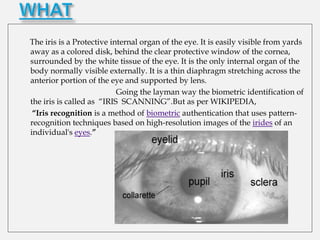
The iris is a Protective internal organ of the eye. It is easily visible from yards
away as a colored disk, behind the clear protective window of the cornea,
surrounded by the white tissue of the eye. It is the only internal organ of the
body normally visible externally. It is a thin diaphragm stretching across the
anterior portion of the eye and supported by lens.
                           Going the layman way the biometric identification of
the iris is called as “IRIS SCANNING”.But as per WIKIPEDIA,
 “Iris recognition is a method of biometric authentication that uses pattern-
recognition techniques based on high-resolution images of the irides of an
individual's eyes.”
The iris is a living password


Artificial duplication is virtually impossible


400 identifying features


Probability of matching of two irises is 1:1078


Genetic independency

Its inherent isolation and protection from
the external environment.
   The design and implementation of a system for
    automated iris recognition can be subdivided in to
    3 major parts:-

   1. IMAGE ACQUISITION
     To acquire images with sufficient          resolution   and
    sharpness to support recognition.

    2. IRIS LOCALIZATION
     To delemit the iris from the rest of the image.


   3. PATTERN MATCHING
     The Iris Code derived from this process is compared
    with previously generated Iris Code.

   · Highly protected, internal organ of the eye
   · Externally visible; patterns imaged from a
    distance
   · Iris patterns possess a high degree of
    randomness
     .Uniqueness: set by combinatorial complexity
    · Changing pupil size confirms natural
    physiology
   · Limited genetic penetrance of iris patterns
   · Patterns apparently stable throughout life
   · Small target (1 cm) to acquire from a distance
    (1m)
   · Located behind a curved, wet, reflecting
    surface
   · Obscured by eyelashes, lenses, reflections
   · Partially occluded by eyelids, often drooping
   · Deforms non-elastically as pupil changes size
   · Illumination should not be visible or bright
    . ATMs
    .Fugitive track record
    .Computer login: The iris as a living password.
   · National Border Controls: The iris as a living password.
   · Ticket less air travel.
   · Premises access control (home, office, laboratory etc.).
   · Driving licenses and other personal certificates.
   · Entitlements and benefits authentication.
   · Forensics, birth certificates, tracking missing or wanted person
   · Credit-card authentication.
   · Automobile ignition and unlocking; anti-theft devices.
   · Anti-terrorism (e.g.:— suspect Screening at airports)
   · Secure financial transaction (e-commerce, banking).
   · Internet security, control of access to privileged information.
Iris recognition system is also finding unexpected applications. The best know
example involved using iris recognition to confirm the identification of a mysterious
young afghan woman named Sharbat Gula originally photographed by Steve
McCurry in 1984.Some 18 years later, McCurry photographed Sharbat Gula in
Afghanistan .At the behest of National Geographic, Dr.John Dougman,developer of
the Iris recognition system, then compared the irises in the photographs using his
algorithms. He concluded that the eyes were a match.
   The technical performance capability of the iris recognition
    process far surpasses that of any biometric technology now
    available. Iridian process is defined for rapid exhaustive
    search for very large databases: distinctive capability
    required for authentication today. The extremely low
    probabilities of getting a false match enable the iris
    recognition algorithms to search through extremely large
    databases, even of a national or planetary scale. Iris-based
    biometric technology has always been an exceptionally
    accurate one, and it may soon grow much more prominent.
   · http://www.cl.cam.ac.uk
   ·http://en.wikipedia.org/wiki/Iris_recognitio
    n
    .www.seminars4u.com
   Daugman J (1999) "Biometric decision landscapes."
    Technical Report No TR482,
   University of Cambridge Computer Laboratory

                 etric decision landscapes." Technical
                 Report No TR482,
                 University of Cambridge Computer
                 Laboratory
Iris scanning

Iris scanning

  • 1.
    Presented by, Himansu Parichha 7th sem(IT) 0801213054 JITM(BPUT)
  • 2.
    As per wikipedia, “Biometricsconsists of methods for uniquely recognizing humans based upon one or more intrinsic physical or behavioral traits” The need for biometrics o -> Rapid development in technology o -> Globalization
  • 4.
    1936 • Ideawas proposed by ophthalmologist Frank Burch 1980 • Appeared in the Bond Films 1987 • Aram Safir & leonard Flom patented the idea and asked John Doug man to create actual algorithms for that. John Dougman created this algorithm and patented that in the same year.. 1987 • Licensee Sensar deployed special cameras in ATMs of NCR corps and Diebold Corps 1997-1999 • “Panasonic Authenticam” was ready for use in public places like airports
  • 5.
    The iris isa Protective internal organ of the eye. It is easily visible from yards away as a colored disk, behind the clear protective window of the cornea, surrounded by the white tissue of the eye. It is the only internal organ of the body normally visible externally. It is a thin diaphragm stretching across the anterior portion of the eye and supported by lens. Going the layman way the biometric identification of the iris is called as “IRIS SCANNING”.But as per WIKIPEDIA, “Iris recognition is a method of biometric authentication that uses pattern- recognition techniques based on high-resolution images of the irides of an individual's eyes.”
  • 6.
    The iris isa living password Artificial duplication is virtually impossible 400 identifying features Probability of matching of two irises is 1:1078 Genetic independency Its inherent isolation and protection from the external environment.
  • 8.
    The design and implementation of a system for automated iris recognition can be subdivided in to 3 major parts:-  1. IMAGE ACQUISITION  To acquire images with sufficient resolution and sharpness to support recognition. 2. IRIS LOCALIZATION  To delemit the iris from the rest of the image.   3. PATTERN MATCHING  The Iris Code derived from this process is compared with previously generated Iris Code.
  • 9.
  • 11.
    · Highly protected, internal organ of the eye  · Externally visible; patterns imaged from a distance  · Iris patterns possess a high degree of randomness .Uniqueness: set by combinatorial complexity · Changing pupil size confirms natural physiology  · Limited genetic penetrance of iris patterns  · Patterns apparently stable throughout life
  • 12.
    · Small target (1 cm) to acquire from a distance (1m)  · Located behind a curved, wet, reflecting surface  · Obscured by eyelashes, lenses, reflections  · Partially occluded by eyelids, often drooping  · Deforms non-elastically as pupil changes size  · Illumination should not be visible or bright
  • 13.
    . ATMs  .Fugitive track record  .Computer login: The iris as a living password.  · National Border Controls: The iris as a living password.  · Ticket less air travel.  · Premises access control (home, office, laboratory etc.).  · Driving licenses and other personal certificates.  · Entitlements and benefits authentication.  · Forensics, birth certificates, tracking missing or wanted person  · Credit-card authentication.  · Automobile ignition and unlocking; anti-theft devices.  · Anti-terrorism (e.g.:— suspect Screening at airports)  · Secure financial transaction (e-commerce, banking).  · Internet security, control of access to privileged information.
  • 14.
    Iris recognition systemis also finding unexpected applications. The best know example involved using iris recognition to confirm the identification of a mysterious young afghan woman named Sharbat Gula originally photographed by Steve McCurry in 1984.Some 18 years later, McCurry photographed Sharbat Gula in Afghanistan .At the behest of National Geographic, Dr.John Dougman,developer of the Iris recognition system, then compared the irises in the photographs using his algorithms. He concluded that the eyes were a match.
  • 15.
    The technical performance capability of the iris recognition process far surpasses that of any biometric technology now available. Iridian process is defined for rapid exhaustive search for very large databases: distinctive capability required for authentication today. The extremely low probabilities of getting a false match enable the iris recognition algorithms to search through extremely large databases, even of a national or planetary scale. Iris-based biometric technology has always been an exceptionally accurate one, and it may soon grow much more prominent.
  • 16.
    · http://www.cl.cam.ac.uk  ·http://en.wikipedia.org/wiki/Iris_recognitio n  .www.seminars4u.com  Daugman J (1999) "Biometric decision landscapes." Technical Report No TR482,  University of Cambridge Computer Laboratory etric decision landscapes." Technical Report No TR482, University of Cambridge Computer Laboratory