Technologies using
counting people METHODs
Supervised by
Dr. Israa Hadi
Presented by
Ahmed S. Gifel
ahmed.altememe@uokerbala.edu.iq
December 2018
Multimedia Systems Course 2018- 2019
1
Topic
•Technologies using counting people
•challenging task
•Camera position
•real-time people counting in cluttered
scenes using depth sensors
2
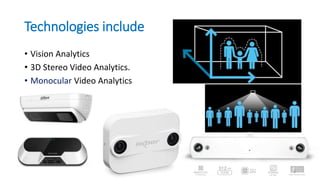
Technologies include
• Vision Analytics
• 3D Stereo Video Analytics.
• Monocular Video Analytics
3
Technologies include (count..)
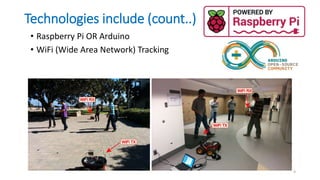
• Raspberry Pi OR Arduino
• WiFi (Wide Area Network) Tracking
4
Technologies include
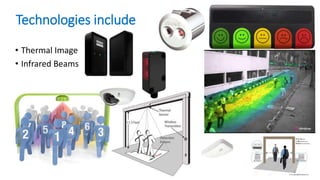
• Thermal Image
• Infrared Beams
5
Technologies include (count..)
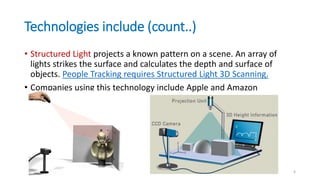
• Structured Light projects a known pattern on a scene. An array of
lights strikes the surface and calculates the depth and surface of
objects. People Tracking requires Structured Light 3D Scanning.
• Companies using this technology include Apple and Amazon
6
Technologies include (count..)
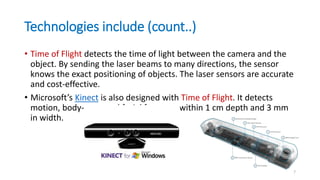
• Time of Flight detects the time of light between the camera and the
object. By sending the laser beams to many directions, the sensor
knows the exact positioning of objects. The laser sensors are accurate
and cost-effective.
• Microsoft’s Kinect is also designed with Time of Flight. It detects
motion, body-type, and facial features, within 1 cm depth and 3 mm
in width.
7
Technologies include (count..)
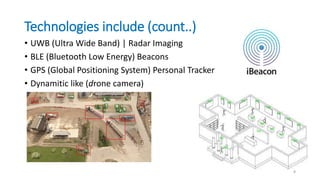
• UWB (Ultra Wide Band) | Radar Imaging
• BLE (Bluetooth Low Energy) Beacons
• GPS (Global Positioning System) Personal Tracker
• Dynamitic like (drone camera)
8
Technologies include (count..)
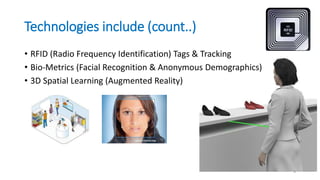
• RFID (Radio Frequency Identification) Tags & Tracking
• Bio-Metrics (Facial Recognition & Anonymous Demographics)
• 3D Spatial Learning (Augmented Reality)
9
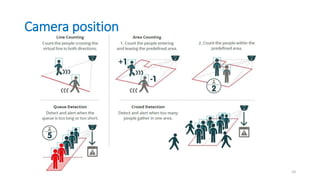
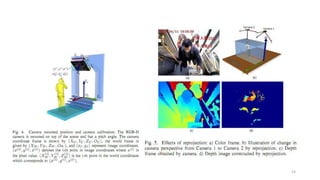
Camera position
10
challenging task
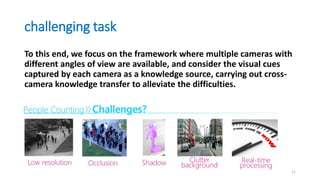
To this end, we focus on the framework where multiple cameras with
different angles of view are available, and consider the visual cues
captured by each camera as a knowledge source, carrying out cross-
camera knowledge transfer to alleviate the difficulties.
11
12
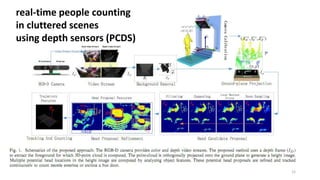
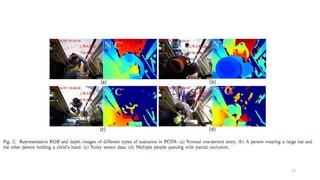
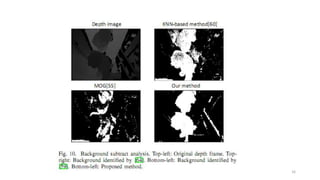
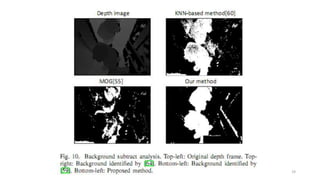
real-time people counting
in cluttered scenes
using depth sensors (PCDS)
13
14
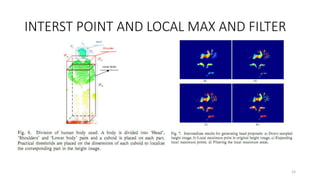
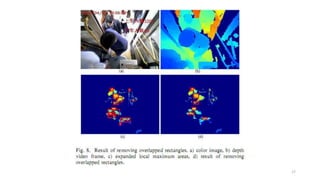
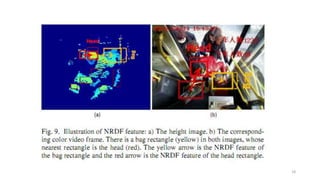
INTERST POINT AND LOCAL MAX AND FILTER
15
16
17
18
19

Technologies using counting people METHODs

  • 1.
    Technologies using counting peopleMETHODs Supervised by Dr. Israa Hadi Presented by Ahmed S. Gifel ahmed.altememe@uokerbala.edu.iq December 2018 Multimedia Systems Course 2018- 2019 1
  • 2.
    Topic •Technologies using countingpeople •challenging task •Camera position •real-time people counting in cluttered scenes using depth sensors 2
  • 3.
    Technologies include • VisionAnalytics • 3D Stereo Video Analytics. • Monocular Video Analytics 3
  • 4.
    Technologies include (count..) •Raspberry Pi OR Arduino • WiFi (Wide Area Network) Tracking 4
  • 5.
    Technologies include • ThermalImage • Infrared Beams 5
  • 6.
    Technologies include (count..) •Structured Light projects a known pattern on a scene. An array of lights strikes the surface and calculates the depth and surface of objects. People Tracking requires Structured Light 3D Scanning. • Companies using this technology include Apple and Amazon 6
  • 7.
    Technologies include (count..) •Time of Flight detects the time of light between the camera and the object. By sending the laser beams to many directions, the sensor knows the exact positioning of objects. The laser sensors are accurate and cost-effective. • Microsoft’s Kinect is also designed with Time of Flight. It detects motion, body-type, and facial features, within 1 cm depth and 3 mm in width. 7
  • 8.
    Technologies include (count..) •UWB (Ultra Wide Band) | Radar Imaging • BLE (Bluetooth Low Energy) Beacons • GPS (Global Positioning System) Personal Tracker • Dynamitic like (drone camera) 8
  • 9.
    Technologies include (count..) •RFID (Radio Frequency Identification) Tags & Tracking • Bio-Metrics (Facial Recognition & Anonymous Demographics) • 3D Spatial Learning (Augmented Reality) 9
  • 10.
  • 11.
    challenging task To thisend, we focus on the framework where multiple cameras with different angles of view are available, and consider the visual cues captured by each camera as a knowledge source, carrying out cross- camera knowledge transfer to alleviate the difficulties. 11
  • 12.
    12 real-time people counting incluttered scenes using depth sensors (PCDS)
  • 13.
  • 14.
  • 15.
    INTERST POINT ANDLOCAL MAX AND FILTER 15
  • 16.
  • 17.
  • 18.
  • 19.