IRIS RECOGNITION
BY :
N.SRUTHI
CONTENTS
 THE NEED FOR BIOMETRIC
 ANATOMY OF HUMAN EYE
 WHAT IS IRIS
 CHARACTERISTICS OF IRIS
 WHAT IS IT?
 WHY?
 HOW:THE SCIENCE BEHIND IT
 MERITS
 DEMERITS
 APPLICATIONS
 CONCLUSION
The need for biometrics
 As per wikipedia,
“Biometrics consists of methods for uniquely recognizing
humans based upon one or more intrinsic physical or
behavioral traits”
 The need for biometrics
-> Rapid development in technology
-> Globalization
Comparision
Anatomy of the Human Eye
• Eye = Camera
• Cornea bends, refracts,
and focuses light.
• Retina = Film for image
projection (converts image
into electrical signals).
• Optical nerve transmits
signals to the brain.
What is Iris?
 The coloured ring around the pupil of the eye is called the iris.
 Controls light levels inside the eye.
 Tiny muscles that dilate and constrict the pupil size.
 Divides the front of the eye from the back of the eye.
 Color comes from melanin.
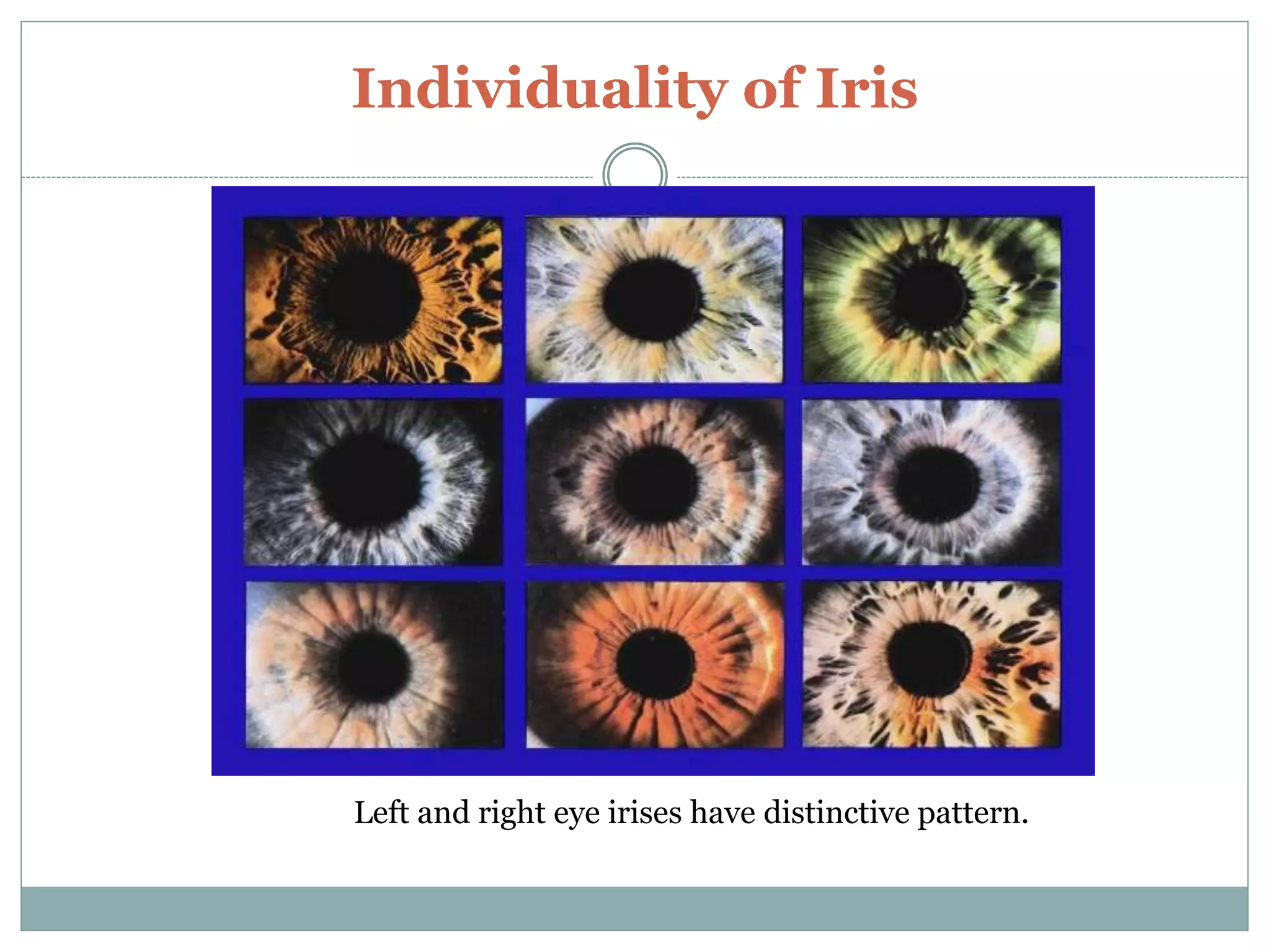
Individuality of Iris
Left and right eye irises have distinctive pattern.
Characteristics of Iris
 Has highly distinguishing texture.
 Right eye differs from left eye.
 Twins have different iris texture.
 Iris pattern remains unchanged after the age of two and does not
degrade overtime or with the environment.
 Iris patterns are extremely complex than other biometric
patterns.
What Is It?
“Iris recognition is a method of biometric authentication that uses
pattern-recognition techniques based on high-resolution images of the
irises of an individual's eyes.”
WHY ?
• The iris is a living password
• Artificial duplication is virtually impossible
• Probability of matching of two irises is 1:1078
• Genetic independency
• Its inherent isolation and protection from the external
environment.
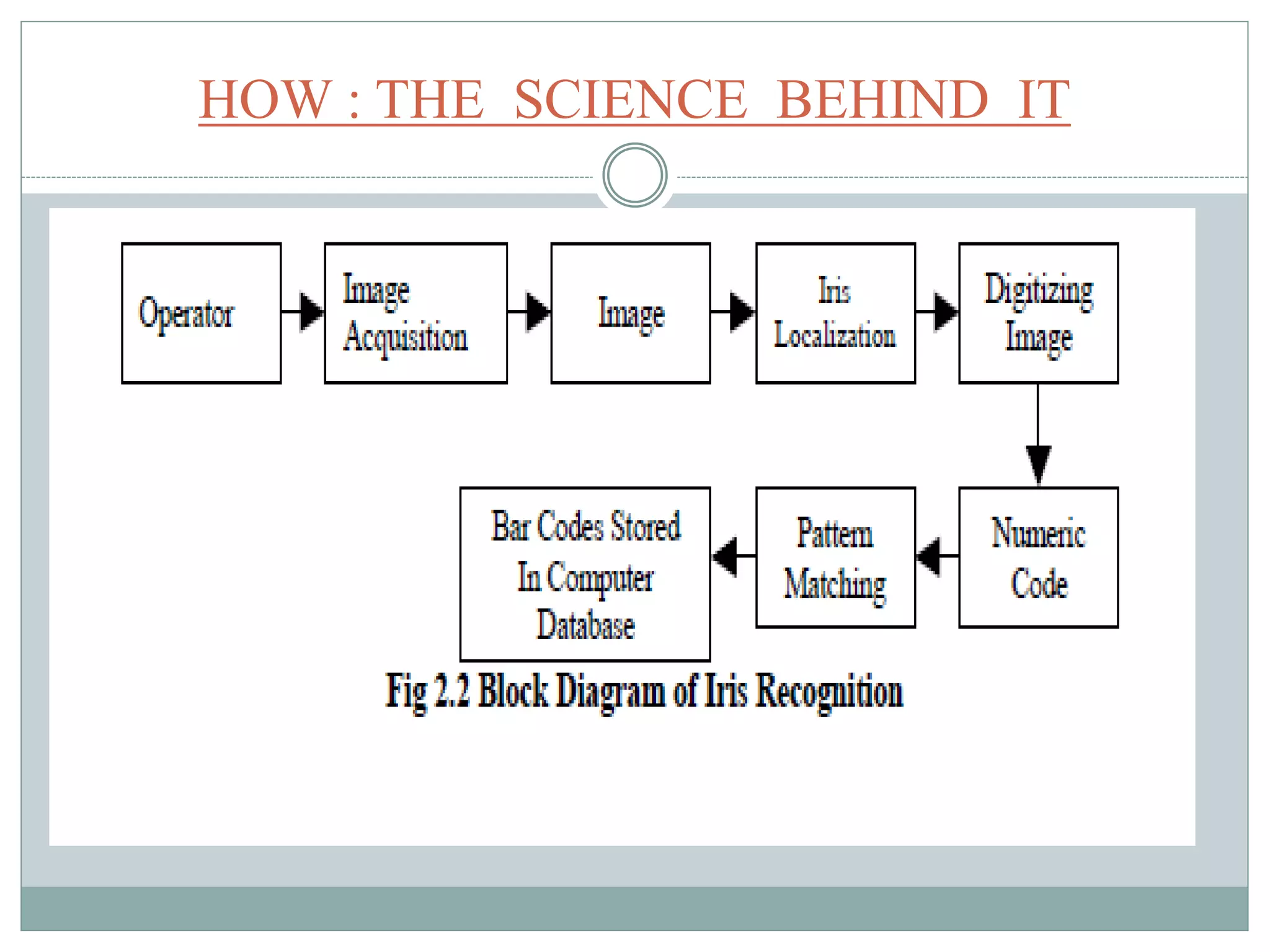
HOW : THE SCIENCE BEHIND IT
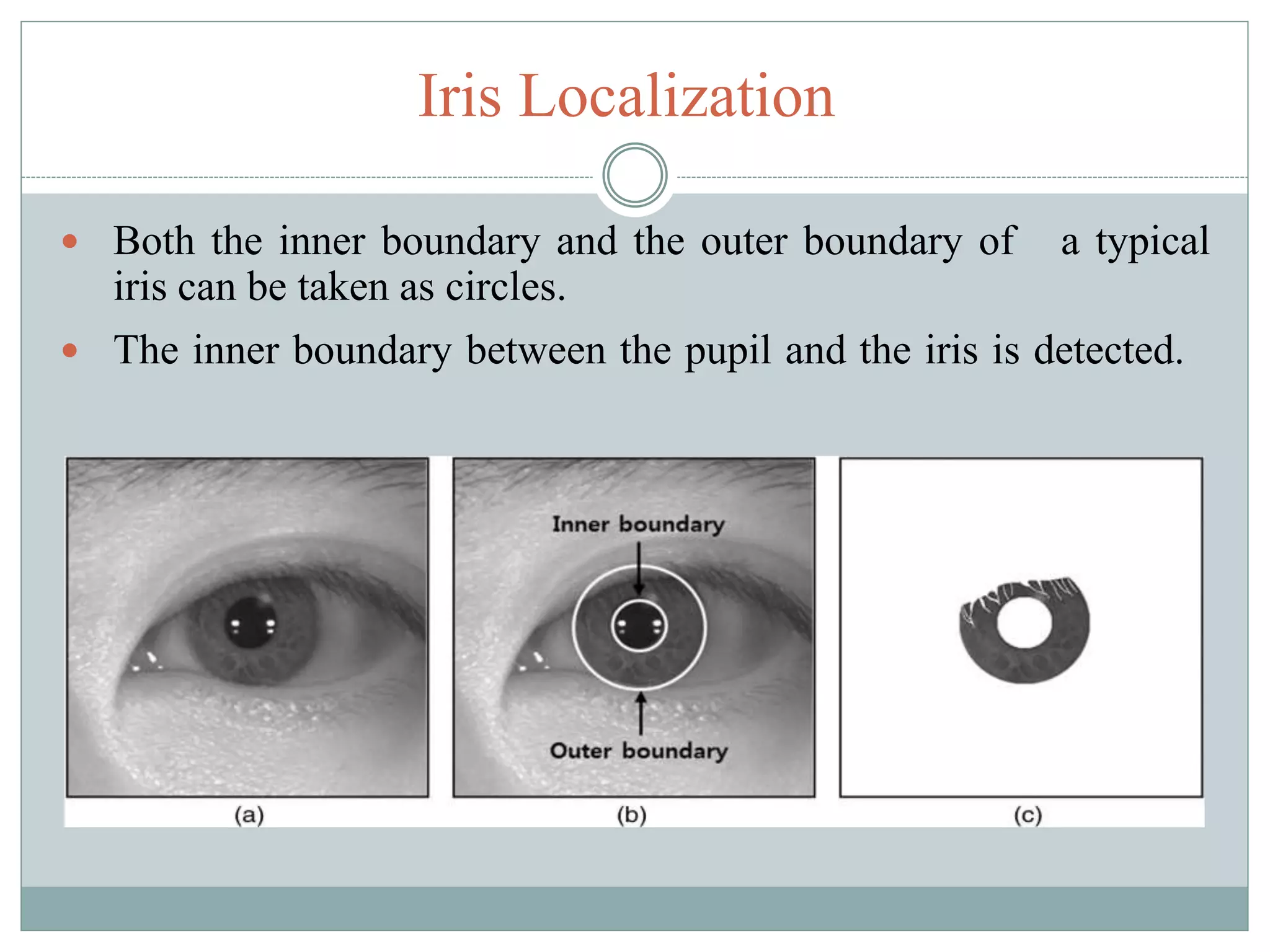
Iris Localization
 Both the inner boundary and the outer boundary of a typical
iris can be taken as circles.
 The inner boundary between the pupil and the iris is detected.
Recording of Identities
 Highly protected, internal organ of the eye
 Iris patterns possess a high degree of randomness
 Patterns apparently stable throughout life.
 A key advantage of iris recognition is its stability, or template
longevity, as a single enrollment can last a lifetime.
Merits
Demerits
 Obscured by eyelashes, lenses, reflections
 Illumination should not be visible or bright.
 Small target to acquire from a distance
 High cost
Applications
 . ATMs
 .Computer login: The iris as a living password.
 · National Border Controls: The iris as a living password.
 · Premises access control (home, office, laboratory etc.).
 · Driving licenses and other personal certificates.
 · Forensics, birth certificates, tracking missing or wanted person
 · Credit-card authentication.
 · Automobile ignition and unlocking; anti-theft devices.
 · Anti-terrorism (e.g.:— suspect Screening at airports)
 · Secure financial transaction (e-commerce, banking).
 · Internet security, control of access to privileged information.
Conclusion
 Iris recognition has proven to be a very useful and
versatile security measure.
 It is a quick and accurate way of identifying an individual
with no chance for human error.
 Iris recognition will prove to be a widely used security
measure in the future.
References
 ·http://en.wikipedia.org/wiki/Iris_recognition
 .www.seminars4u.com
Iris recognition

Iris recognition

  • 1.
  • 2.
    CONTENTS  THE NEEDFOR BIOMETRIC  ANATOMY OF HUMAN EYE  WHAT IS IRIS  CHARACTERISTICS OF IRIS  WHAT IS IT?  WHY?  HOW:THE SCIENCE BEHIND IT  MERITS  DEMERITS  APPLICATIONS  CONCLUSION
  • 3.
    The need forbiometrics  As per wikipedia, “Biometrics consists of methods for uniquely recognizing humans based upon one or more intrinsic physical or behavioral traits”  The need for biometrics -> Rapid development in technology -> Globalization
  • 4.
  • 5.
    Anatomy of theHuman Eye • Eye = Camera • Cornea bends, refracts, and focuses light. • Retina = Film for image projection (converts image into electrical signals). • Optical nerve transmits signals to the brain.
  • 6.
    What is Iris? The coloured ring around the pupil of the eye is called the iris.  Controls light levels inside the eye.  Tiny muscles that dilate and constrict the pupil size.  Divides the front of the eye from the back of the eye.  Color comes from melanin.
  • 7.
    Individuality of Iris Leftand right eye irises have distinctive pattern.
  • 8.
    Characteristics of Iris Has highly distinguishing texture.  Right eye differs from left eye.  Twins have different iris texture.  Iris pattern remains unchanged after the age of two and does not degrade overtime or with the environment.  Iris patterns are extremely complex than other biometric patterns.
  • 9.
    What Is It? “Irisrecognition is a method of biometric authentication that uses pattern-recognition techniques based on high-resolution images of the irises of an individual's eyes.”
  • 10.
    WHY ? • Theiris is a living password • Artificial duplication is virtually impossible • Probability of matching of two irises is 1:1078 • Genetic independency • Its inherent isolation and protection from the external environment.
  • 11.
    HOW : THESCIENCE BEHIND IT
  • 12.
    Iris Localization  Boththe inner boundary and the outer boundary of a typical iris can be taken as circles.  The inner boundary between the pupil and the iris is detected.
  • 13.
  • 14.
     Highly protected,internal organ of the eye  Iris patterns possess a high degree of randomness  Patterns apparently stable throughout life.  A key advantage of iris recognition is its stability, or template longevity, as a single enrollment can last a lifetime. Merits
  • 15.
    Demerits  Obscured byeyelashes, lenses, reflections  Illumination should not be visible or bright.  Small target to acquire from a distance  High cost
  • 16.
    Applications  . ATMs .Computer login: The iris as a living password.  · National Border Controls: The iris as a living password.  · Premises access control (home, office, laboratory etc.).  · Driving licenses and other personal certificates.  · Forensics, birth certificates, tracking missing or wanted person  · Credit-card authentication.  · Automobile ignition and unlocking; anti-theft devices.  · Anti-terrorism (e.g.:— suspect Screening at airports)  · Secure financial transaction (e-commerce, banking).  · Internet security, control of access to privileged information.
  • 17.
    Conclusion  Iris recognitionhas proven to be a very useful and versatile security measure.  It is a quick and accurate way of identifying an individual with no chance for human error.  Iris recognition will prove to be a widely used security measure in the future.
  • 18.