1
Mentor Name
Mr. Gulzar Ahmad(ASST.
PROF.)
KRISHNA NAND MISHRA
RAHUL VASHISHT
JASWANT KUMAR
VIPIN KUMAR
Content
1. Motivation
2. History
3. Introduction to Iris Recognition
4. Why Iris Recognition
5. Structure of Eye
6. Stages
7. Advantages
8. Status of Project
2
Motivation
 Authentication – the process of verifying that a
user requesting a resource is who he, she, or it
claims to be, and vice versa.
 Conventional authentication methods
„something that you have“ – key, magnetic card
or smartcard
„something that you know“ – PIN or password
 Biometric authentication uses personal features
„something that you are“
3
History
 Iris Recognition system was first proposed
by Flom and Safir in 1987. [1][3][4]
 In the year 1994, John Daugman patented
his "biometrics personal identification
system based on iris analysis"[1][3][4].
4
INTRODUCTION TO IRIS RECOGNITION
John Daugman, University of
Cambridge – Pioneer in Iris
Recognition.
Sharbat Gula – aged 12 at
Afghani refugee camp.
18 years later at a remote
location in Afghanistan.
5
Why Iris Recognition?
 Iris patterns are unique.
 Iris patterns do not change with age.
 Non Contact approach.
 Simplicity and ease of implementation.
 Speed – the process of matching the iris
patterns is very fast.
6
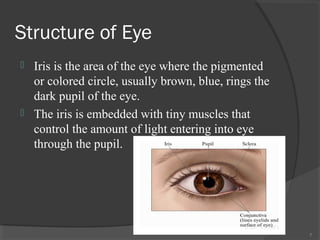
Structure of Eye
 Iris is the area of the eye where the pigmented
or colored circle, usually brown, blue, rings the
dark pupil of the eye.
 The iris is embedded with tiny muscles that
control the amount of light entering into eye
through the pupil.
7
8
Stages
[2]
Stages of iris based recognition algorithm
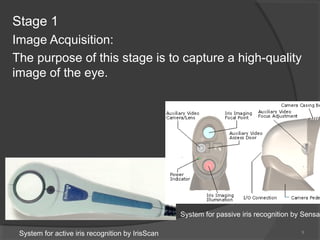
Stage 1
Image Acquisition:
The purpose of this stage is to capture a high-quality
image of the eye.
9System for active iris recognition by IrisScan
System for passive iris recognition by Sensar
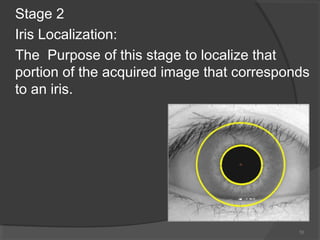
Stage 2
Iris Localization:
The Purpose of this stage to localize that
portion of the acquired image that corresponds
to an iris.
10
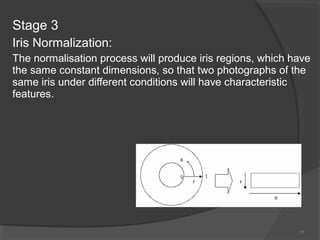
Stage 3
Iris Normalization:
The normalisation process will produce iris regions, which have
the same constant dimensions, so that two photographs of the
same iris under different conditions will have characteristic
features.
11
Stage 4
Feature Extraction:
In this stage, we generate a template code along with a
mask code.
Stage 5
Pattern matching:
Compare two iris templates using Hamming
distances.Shifting of Hamming distances: To counter
rotational inconsistencies.
12
Advantages
 Uniqueness of iris patterns hence improved
accuracy.
 Highly protected, internal organ of the eye
 Stability : Persistence of iris patterns.
 Non-invasive : Relatively easy to be
acquired.
 Speed : Smaller template size so large
databases can be easily stored and
checked.
 Cannot be easily forged or modified.
14
 The project is currently in iris localization phase.
 Eye image dataset used is of Chinese University
of Hong Kong.
15
Some of localized iris images are
16
Captured image
[5]
Eye image with circles
for localization of iris
17
Captured image Eye image with circles
for localization of iris
[5]
REFERENCES
[1]J. Daugman , How iris recognition works, IEEE Trans. On Circuits and Systems for Video
Technology., Vol. 14, No. 1, pp. 21-30, January 2004.
[2]Gargi Amoli, Nitin Thapliyal, Nidhi Sethi, “Iris Preprocessing “, International Journal of Advanced
Research in Computer Science and Software Engineering . ,Volume 2, Issue 6, June 2012 ISSN:
2277 128X page 301-304.
[3] J. Daugman, ―High Confidence Visual Recognition of Persons by a Test of Statistical
Independence , IEEE Trans. on Pattern Analysis and Machine Intelligence, Vol. 15, No.11,‖
pp.1148-1161, 1993.
[4] John Daugman, ―The importance of being random: statistical principles of iris recognition ,‖
Pattern Recognition 36 (2003) 279 – 291, 21 December 2001
[5] Dataset, Chinese University of Hong Kong, “http://www.mae.cuhk.edu.hk/~cvl/main_database.htm”
18
THANK YOU!!!
19

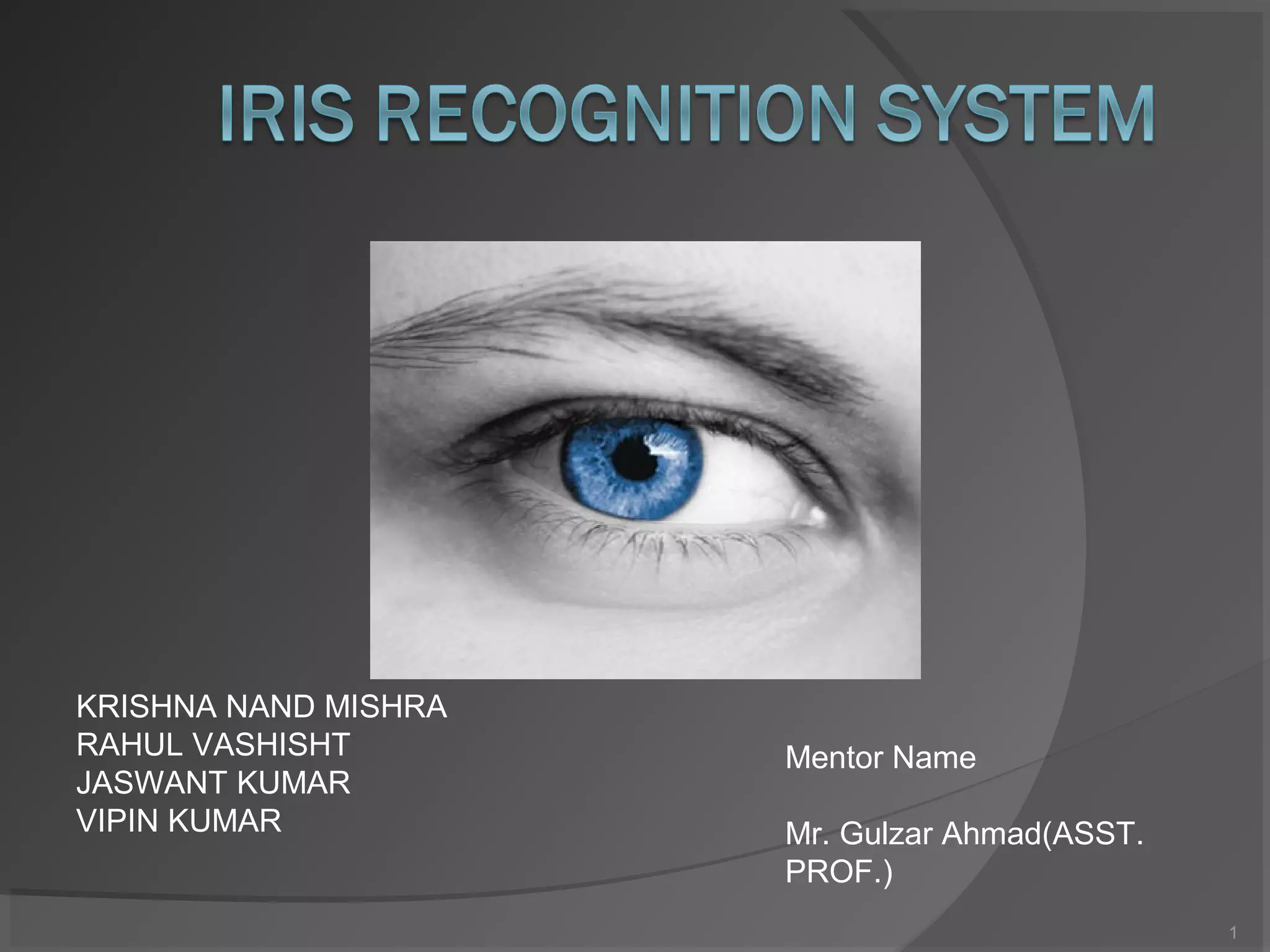
iris recognition system as means of unique identification

  • 1.
    1 Mentor Name Mr. GulzarAhmad(ASST. PROF.) KRISHNA NAND MISHRA RAHUL VASHISHT JASWANT KUMAR VIPIN KUMAR
  • 2.
    Content 1. Motivation 2. History 3.Introduction to Iris Recognition 4. Why Iris Recognition 5. Structure of Eye 6. Stages 7. Advantages 8. Status of Project 2
  • 3.
    Motivation  Authentication –the process of verifying that a user requesting a resource is who he, she, or it claims to be, and vice versa.  Conventional authentication methods „something that you have“ – key, magnetic card or smartcard „something that you know“ – PIN or password  Biometric authentication uses personal features „something that you are“ 3
  • 4.
    History  Iris Recognitionsystem was first proposed by Flom and Safir in 1987. [1][3][4]  In the year 1994, John Daugman patented his "biometrics personal identification system based on iris analysis"[1][3][4]. 4
  • 5.
    INTRODUCTION TO IRISRECOGNITION John Daugman, University of Cambridge – Pioneer in Iris Recognition. Sharbat Gula – aged 12 at Afghani refugee camp. 18 years later at a remote location in Afghanistan. 5
  • 6.
    Why Iris Recognition? Iris patterns are unique.  Iris patterns do not change with age.  Non Contact approach.  Simplicity and ease of implementation.  Speed – the process of matching the iris patterns is very fast. 6
  • 7.
    Structure of Eye Iris is the area of the eye where the pigmented or colored circle, usually brown, blue, rings the dark pupil of the eye.  The iris is embedded with tiny muscles that control the amount of light entering into eye through the pupil. 7
  • 8.
    8 Stages [2] Stages of irisbased recognition algorithm
  • 9.
    Stage 1 Image Acquisition: Thepurpose of this stage is to capture a high-quality image of the eye. 9System for active iris recognition by IrisScan System for passive iris recognition by Sensar
  • 10.
    Stage 2 Iris Localization: ThePurpose of this stage to localize that portion of the acquired image that corresponds to an iris. 10
  • 11.
    Stage 3 Iris Normalization: Thenormalisation process will produce iris regions, which have the same constant dimensions, so that two photographs of the same iris under different conditions will have characteristic features. 11
  • 12.
    Stage 4 Feature Extraction: Inthis stage, we generate a template code along with a mask code. Stage 5 Pattern matching: Compare two iris templates using Hamming distances.Shifting of Hamming distances: To counter rotational inconsistencies. 12
  • 13.
    Advantages  Uniqueness ofiris patterns hence improved accuracy.  Highly protected, internal organ of the eye  Stability : Persistence of iris patterns.  Non-invasive : Relatively easy to be acquired.  Speed : Smaller template size so large databases can be easily stored and checked.  Cannot be easily forged or modified.
  • 14.
  • 15.
     The projectis currently in iris localization phase.  Eye image dataset used is of Chinese University of Hong Kong. 15
  • 16.
    Some of localizediris images are 16 Captured image [5] Eye image with circles for localization of iris
  • 17.
    17 Captured image Eyeimage with circles for localization of iris [5]
  • 18.
    REFERENCES [1]J. Daugman ,How iris recognition works, IEEE Trans. On Circuits and Systems for Video Technology., Vol. 14, No. 1, pp. 21-30, January 2004. [2]Gargi Amoli, Nitin Thapliyal, Nidhi Sethi, “Iris Preprocessing “, International Journal of Advanced Research in Computer Science and Software Engineering . ,Volume 2, Issue 6, June 2012 ISSN: 2277 128X page 301-304. [3] J. Daugman, ―High Confidence Visual Recognition of Persons by a Test of Statistical Independence , IEEE Trans. on Pattern Analysis and Machine Intelligence, Vol. 15, No.11,‖ pp.1148-1161, 1993. [4] John Daugman, ―The importance of being random: statistical principles of iris recognition ,‖ Pattern Recognition 36 (2003) 279 – 291, 21 December 2001 [5] Dataset, Chinese University of Hong Kong, “http://www.mae.cuhk.edu.hk/~cvl/main_database.htm” 18
  • 19.