This document provides an overview of computer vision presented by team 4BIT Coder. It begins with introductions and then covers the following key points in 3 sentences or less each:
- The goal of computer vision is to understand digital images like the human visual system and allow computers to interpret images.
- Computer vision works through pattern recognition, training on large visual datasets to identify and model objects.
- Applications include smartphones, web search, VR/AR, medical imaging, insurance, and self-driving cars through real-time video processing.
TEAM 4BIT CODER
Md.Nayemur Rahman MD. Ashraful Alam
ID: 181-15-1963 ID: 181-15-1844
Fahim Ahammad Niloy Mehedi Hasan Milon
ID: 181-15-1872 ID: 181-15-1713
4.
CONTENT
• Introduction
• Goalof Computer Vision
• How Does Computer Vision Work
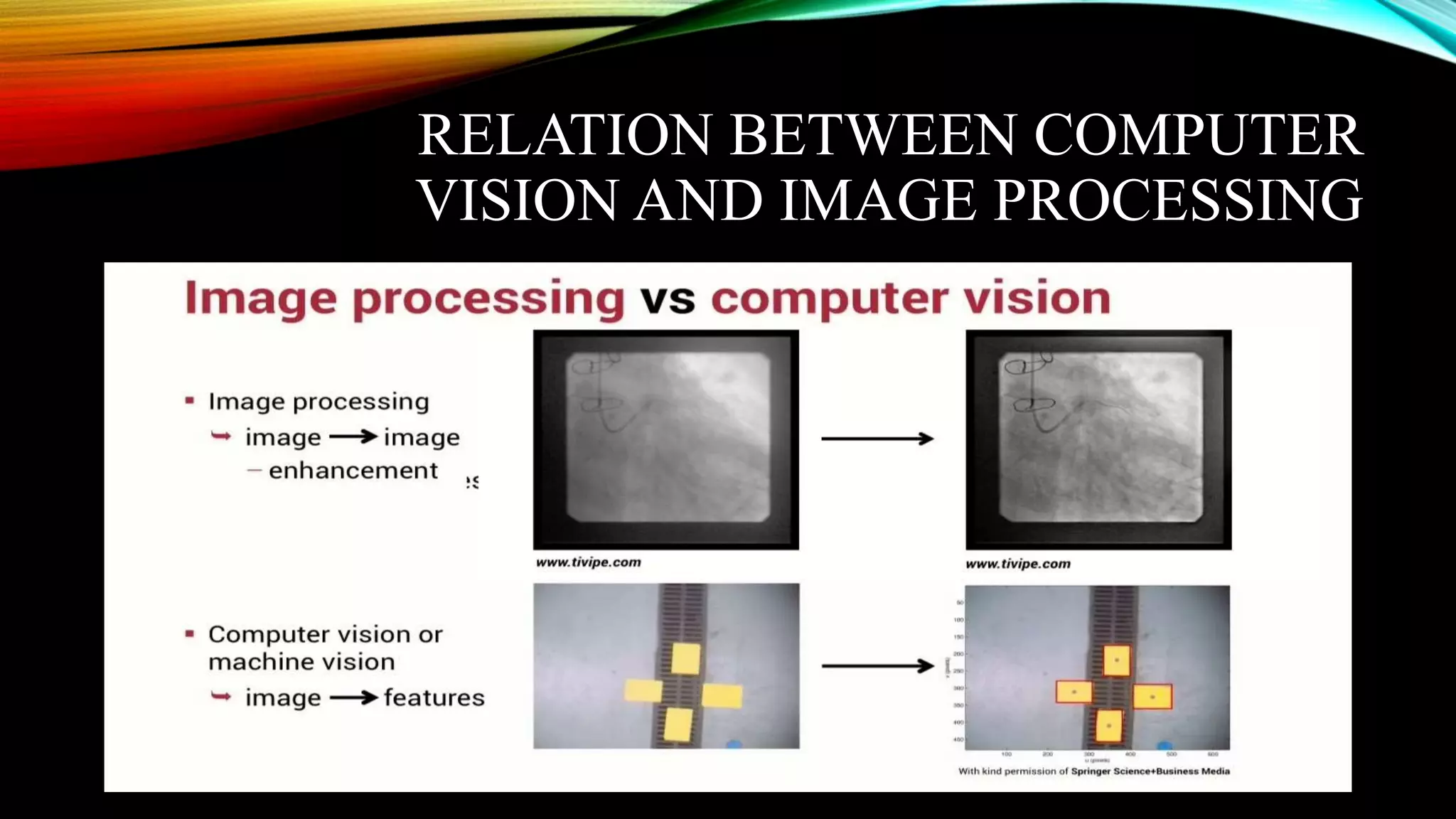
• Relation Between Computer Vision And Image Processing
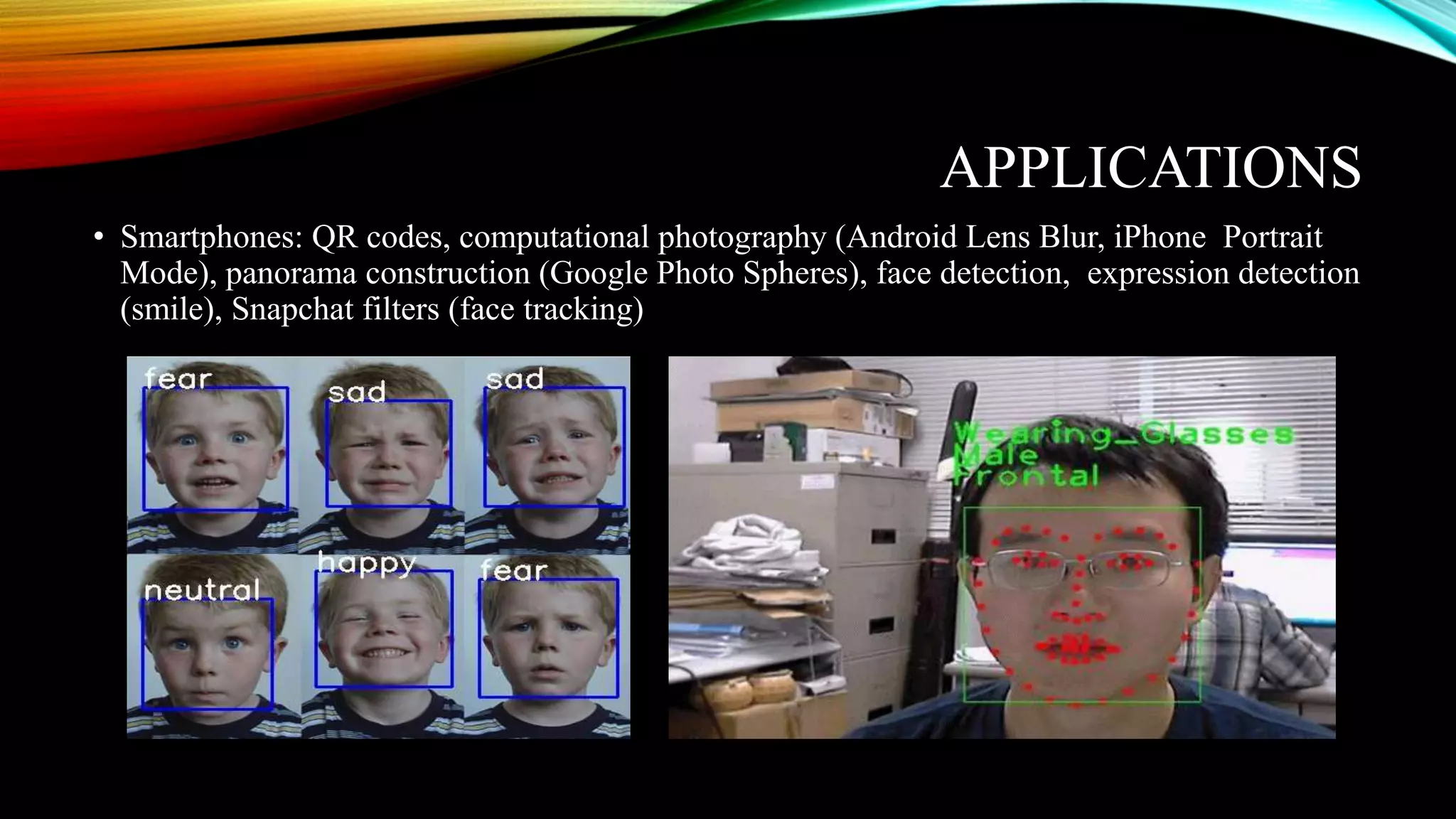
• Applications
• Advantages
• Disadvantages
• Conclusion
5.
INTRODUCTION
What is ComputerVision?
• Computer vision is field of AI.
• Computer vision is an interdisciplinary scientific field that deals with how computers can
gain high-level understanding from digital images or videos. From the perspective of
engineering, it seeks to understand and automate tasks that the human visual system can do.
• Typically, this involves developing methods that attempt to reproduce the capability of
human vision.
6.
GOAL OF COMPUTERVISION
• The goal of computer vision is to understand the content of digital images.
• The ultimate goal of Computer Vision is to imitate the great capabilies of the human visual
system.
• Computer Vision allows the computer not only to record images but also to interpret them.
• Deep learning has helped improve on many tasks and approach new ones in Computer
Vision.
• Deep Learning simplifies the process of feature extraction through mathematical operations.
• The first demonstration of deep learning in computer vision was in image recognition, object
detection and face recognition.
7.
HOW DOES COMPUTERVISION WORK?
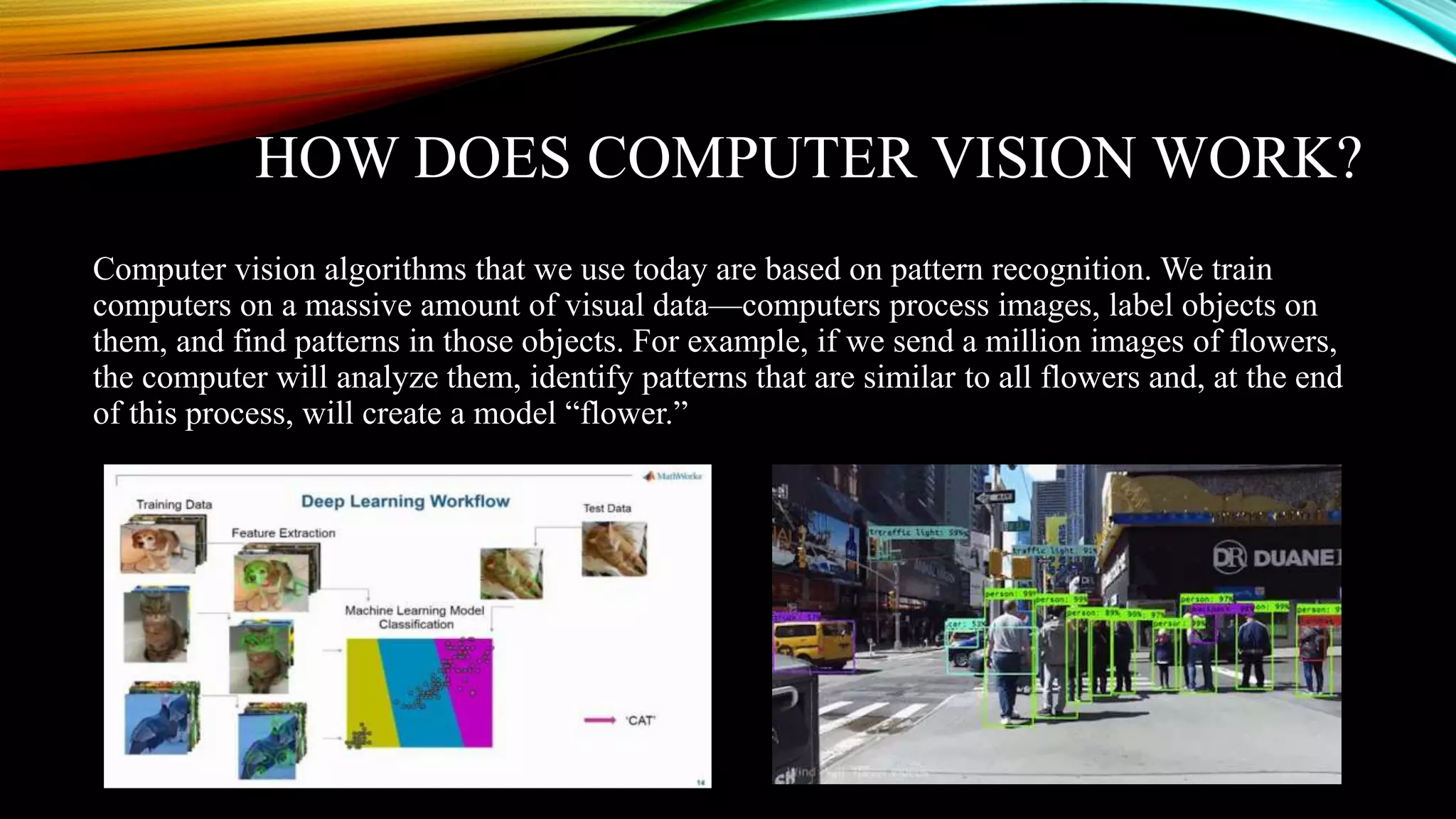
Computer vision algorithms that we use today are based on pattern recognition. We train
computers on a massive amount of visual data—computers process images, label objects on
them, and find patterns in those objects. For example, if we send a million images of flowers,
the computer will analyze them, identify patterns that are similar to all flowers and, at the end
of this process, will create a model “flower.”
8.
HOW DOES COMPUTERVISION WORK?
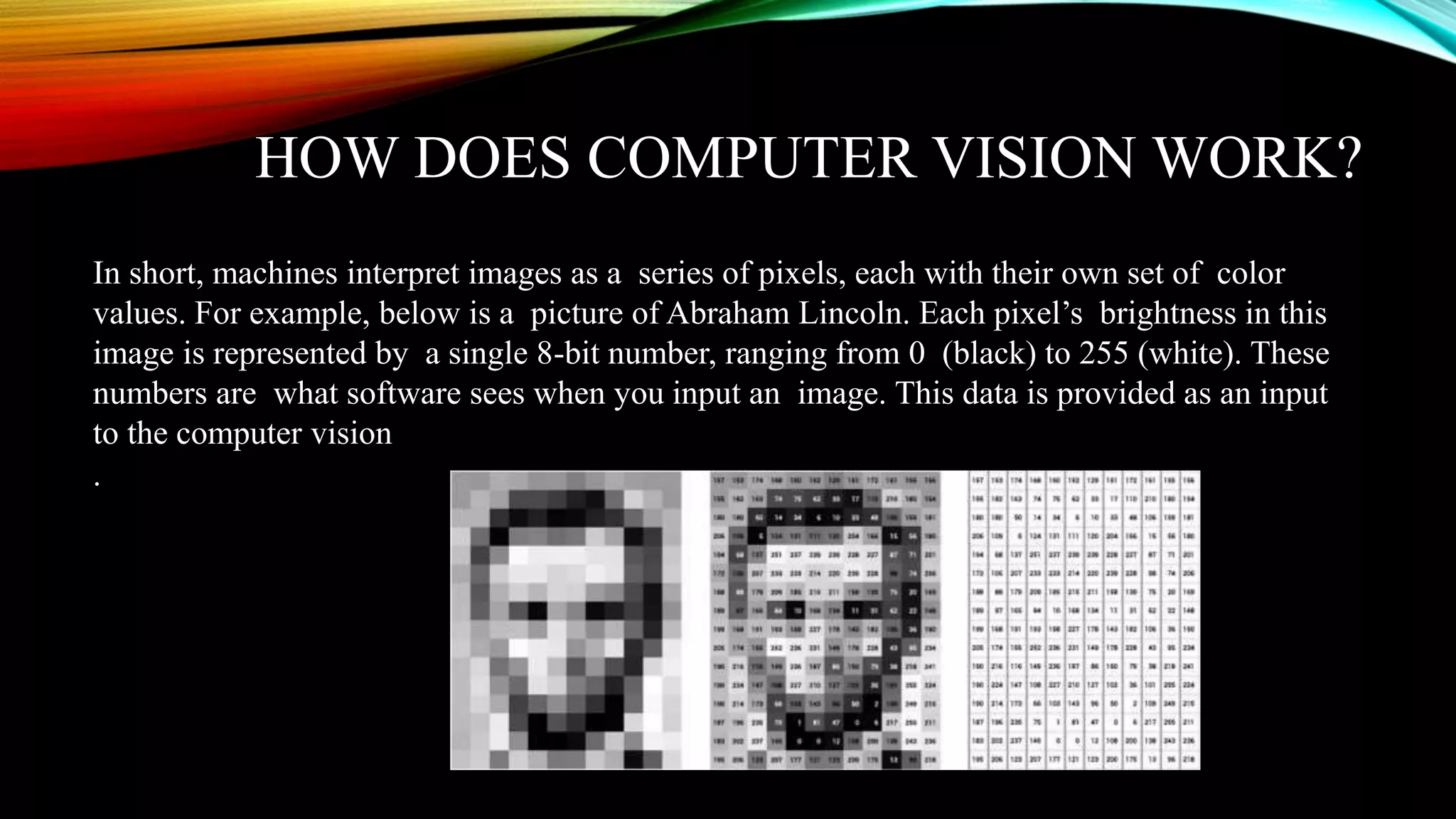
In short, machines interpret images as a series of pixels, each with their own set of color
values. For example, below is a picture of Abraham Lincoln. Each pixel’s brightness in this
image is represented by a single 8-bit number, ranging from 0 (black) to 255 (white). These
numbers are what software sees when you input an image. This data is provided as an input
to the computer vision
.
APPLICATIONS
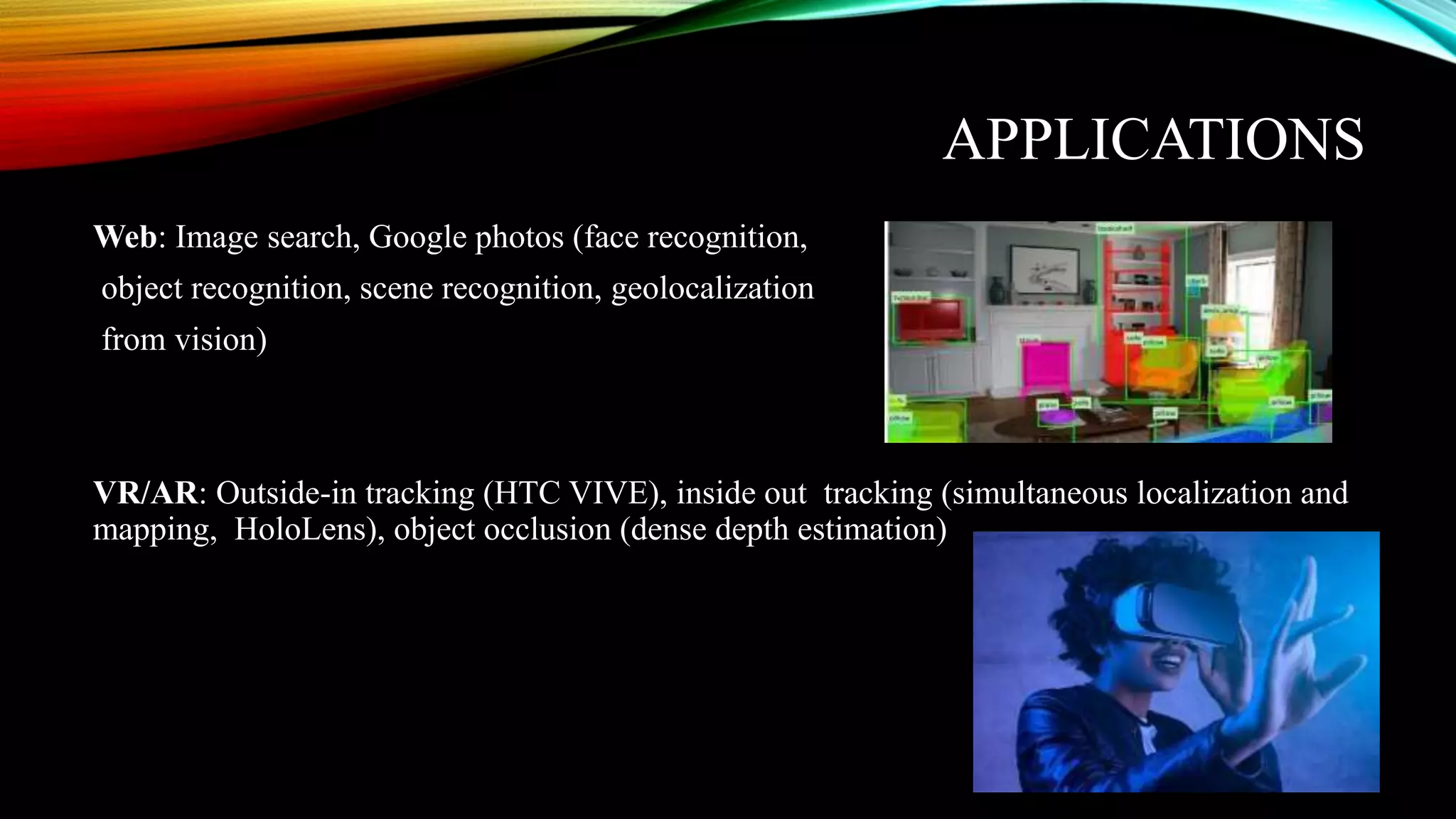
Web: Image search,Google photos (face recognition,
object recognition, scene recognition, geolocalization
from vision)
VR/AR: Outside-in tracking (HTC VIVE), inside out tracking (simultaneous localization and
mapping, HoloLens), object occlusion (dense depth estimation)
12.
APPLICATIONS
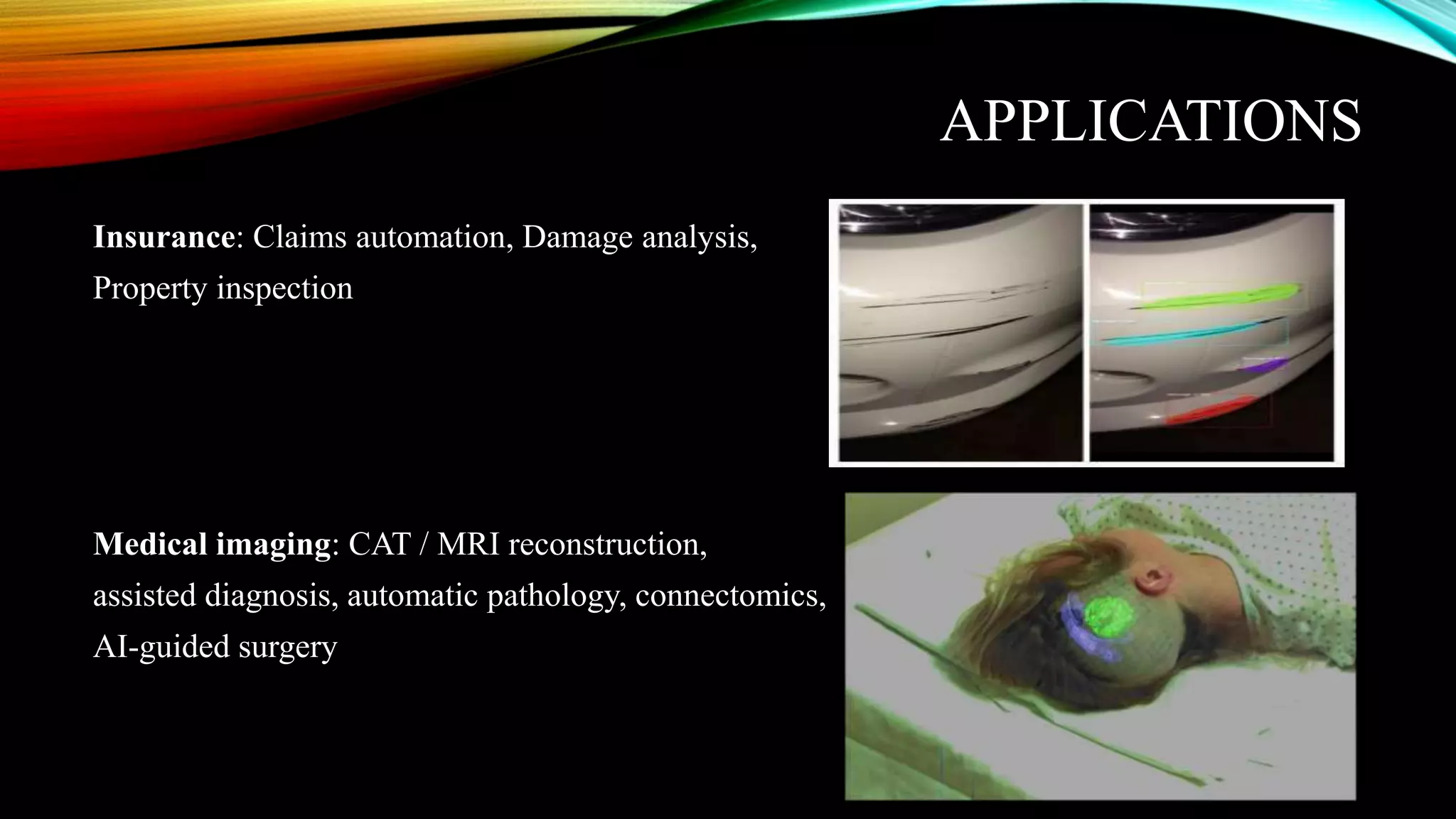
Insurance: Claims automation,Damage analysis,
Property inspection
Medical imaging: CAT / MRI reconstruction,
assisted diagnosis, automatic pathology, connectomics,
AI-guided surgery
13.
APPLICATIONS
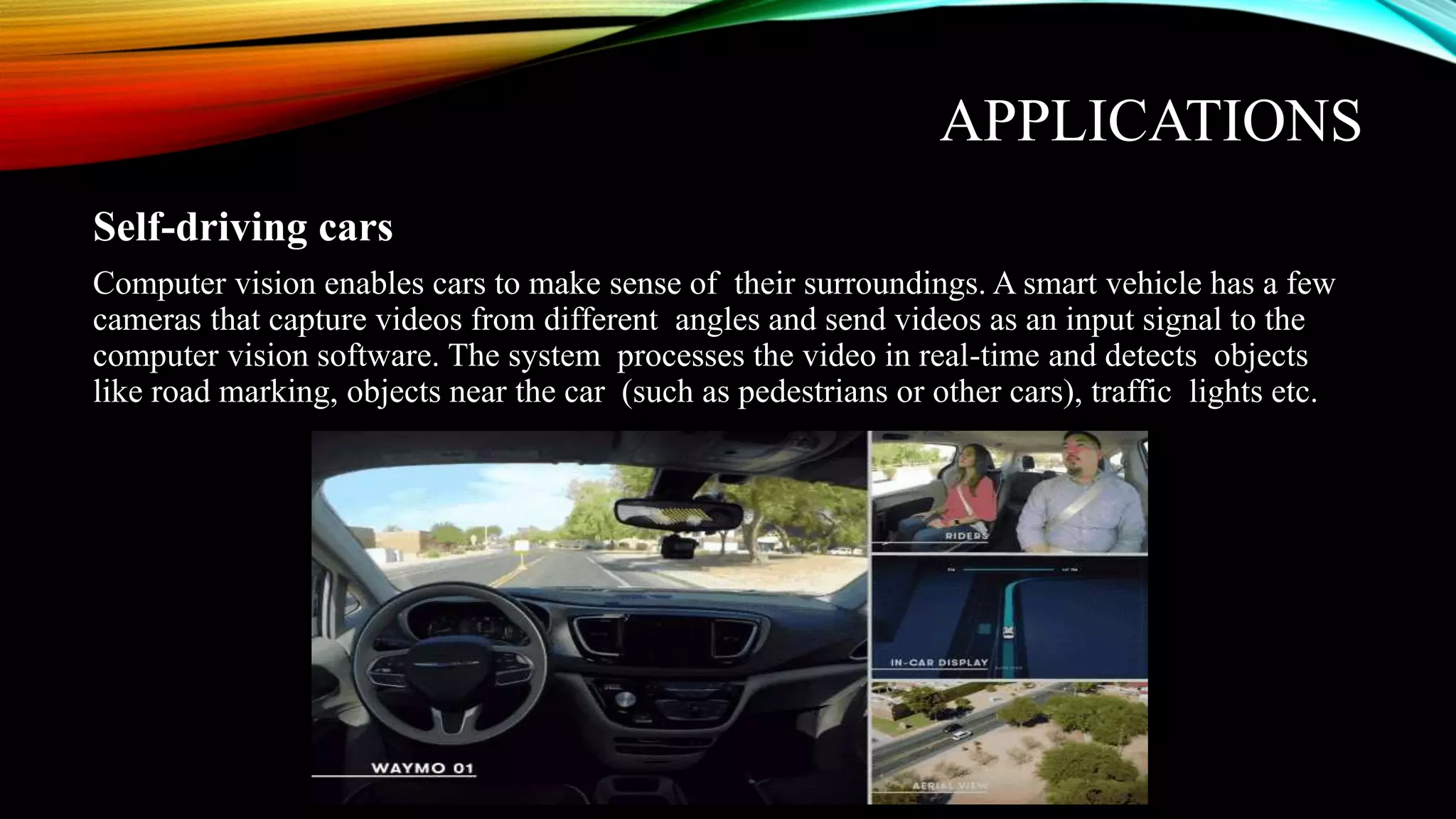
Self-driving cars
Computer visionenables cars to make sense of their surroundings. A smart vehicle has a few
cameras that capture videos from different angles and send videos as an input signal to the
computer vision software. The system processes the video in real-time and detects objects
like road marking, objects near the car (such as pedestrians or other cars), traffic lights etc.
14.
ADVANTAGES
Improved Online Merchandising
Customerswill be able to search via images to find similar styles to what they’re looking for
instead of relying on tags.
Unique Customer Experiences
Services like Snapchat filters are aimed to provide an experience that can only be considered
“unique.”
Seamless Store Experiences
Amazon Go creates a seamless, efficient environment for shopping. No more waiting in long
lines, dealing with cashiers, or worrying about handling your wallet.
15.
DISADVANTAGES
The computer visiondisadvantages regard a hefty issue in the modern age:
privacy.
The driving force that makes computer vision effective also leads to doubt whether it should
be pursued.
By gathering and learning from thousands of photos, videos, etc., everything we do is stored
or owned by corporations.
Users need to become more aware of what sort of data they put out into the world.