Table of Content:
1. Introduction
2. Biometric Technology
3. Iris Recognition
4. How Iris Recognition works?
5. Operating Principle
6. Advantages and Disadvantages of Iris Recognition
7. Comparisons with other Biometric Systems
8. Applications
9. Conclusion
Introduction
Three main types of authentication:
 Password Authentication
Easily crackable due to human nature to make easy to remember passwords.
 Card or Token Authentication
No assurance that the person presenting the card is actual owner.
 Biometric Authentication
Provides secure method of two factor authentication.
Most accurate and fast system.
Biometric Technology
Biometric technology is a technology that uses the measurements of a unique human attribute or feature in order to
distinguish that person from all others. Characteristics fall into two categories:
• Physiological are related to the shape of the body. Examples are facial recognition - 2D, 3D,Thermographic ;
Retinal scanning ; Iris scanning ; Finger Scanning - fingertip, thumb, length, pattem ; Palm Scanning - print,
topography ; Hand Geometry ; Wrist/Hand Vein ; Ear Shape etc.
• Behavioural are related to the behavior of a person. Examples are Voice Prints; Dynamic Signature Verification ;
Keystroke Dynamics etc.
Modes of Operation of a Biometric System
A biometric system can operate in the following two modes:
1. Verification: A one to one comparison of a captured biometric with a stored template to verify that the
individual is who he claims to be.
2. Identification: A one to many comparison of the captured biometric against a biometric database in
attempt to identify an unknown individual.
Performance
1. False accept rate or false match rate (FAR or FMR) the probability that the system incorrectly matches the input pattern to a non-
matching template in the database.
2. False reject rate or false non-match rate (FRR or FNMR) the probability that the system fails to detect a match between the input
pattern and a matching template in the database.
3. Receiver operating characteristic or relative operating characteristic (ROC) The ROC plot is a visual characterization of the trade-
off between the FAR and the FRR.
4. Equal error rate or crossover error rate (EER or CER) the rate at which both accept and reject errors are equal.
5. Failure to enroll rate (FTE or FER) the rate at which attempts to create a template from an input is unsuccessful. This is most
commonly caused by low quality inputs.
6. Failure to capture rate (FTC) Within automatic systems, the probability that the system fails to detect a biometric input when presented
correctly.
7. Template capacity the maximum number of sets of data which can be stored in the system.
Iris Recognition
History
1936,
Ophthalmologist,
Frank Burch
proposed the
concept
1985, Dr, Leonard
Flom & Aran Safir,
Proposed that
know to irides are
alike
1987, Dr. Flom
and Dr. John
Daugman
developed an
algorithm
1993, Defense
Nuclear agency
began work to test
and deliver a
prototype unit
1994, Dr.
Daugman awarded
a patent for his
algorithm
1995, first
commercial
product became
available
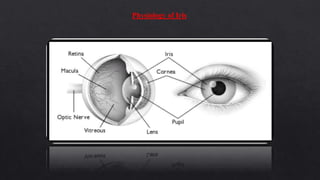
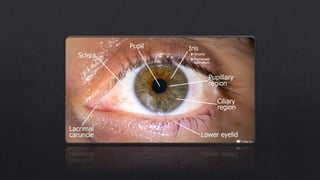
Physiology of Iris
Iris Recognition Working
The process of capturing an iris into a biometric template is made up of 3 steps:
1. Capturing the image
2. Defining the location of the iris and optimizing the image
3. Storing and comparing the image.
Operating Principle
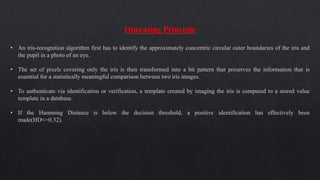
• An iris-recognition algorithm first has to identify the approximately concentric circular outer boundaries of the iris and
the pupil in a photo of an eye.
• The set of pixels covering only the iris is then transformed into a bit pattern that preserves the information that is
essential for a statistically meaningful comparison between two iris images.
• To authenticate via identification or verification, a template created by imaging the iris is compared to a stored value
template in a database.
• If the Hamming Distance is below the decision threshold, a positive identification has effectively been
made(HD<=0.32).
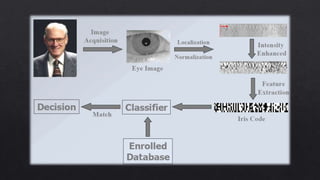
Human iris identification process is basically divided into four steps,
 Localization - The inner and the outer boundaries of the iris are calculated.
 Normalization - Iris of different people may be captured in different size, for the same person also
size may vary because of the variation in illumination and other factors.
 Feature extraction - Iris provides abundant texture information. A feature vector is formed which consists
of the ordered sequence of features extracted from the Various representations of the iris images.
 Matching - The feature vectors are classified through different thresholding techniques like Hamming
Distance, weight vector and winner selection, dissimilarity function, etc.
Image Acquisition
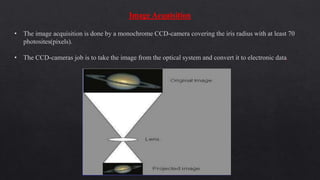
• The image acquisition is done by a monochrome CCD-camera covering the iris radius with at least 70
photosites(pixels).
• The CCD-cameras job is to take the image from the optical system and convert it to electronic data.
Preprocessing
Iris Localization
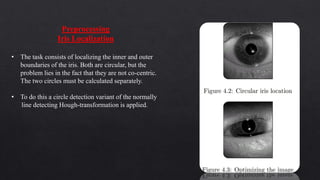
• The task consists of localizing the inner and outer
boundaries of the iris. Both are circular, but the
problem lies in the fact that they are not co-centric.
The two circles must be calculated separately.
• To do this a circle detection variant of the normally
line detecting Hough-transformation is applied.
Normalization
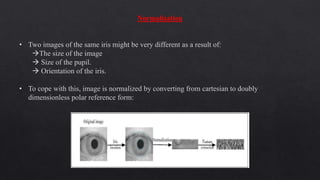
• Two images of the same iris might be very different as a result of:
The size of the image
 Size of the pupil.
 Orientation of the iris.
• To cope with this, image is normalized by converting from cartesian to doubly
dimensionless polar reference form:
Enhancement
• It is necessary to enhance the image to be able to extract the iris patterns later.
• The enhancement contains:
 Sharpening the picture with a sharpening mask.
 Reducing the effect of non-uniform illumination with local histogram
equalization.
Storing and Comparing the Image
• In order to compare the stored IrisCode record with an image just scanned, a calculation of the
Hamming Distance is required.
• The Hamming Distance is a measure of the variation between the IrisCode record for the
current iris and the IrisCode records stored in the database.
• In iris recognition technology, a Hamming Distance of .342 is the nominal CER.
• This means that if the difference between a presented IrisCode record and one in the database
is 34.2% or greater then they are considered to have come from two different subjects.
Iris Image Database
The accuracy of the iris recognition system depends on the image quality of the iris images. Noisy and low
quality images degrade the performance of the system.
Some Iris image database available are:
I. UBIRIS
II. CASIA
III. LEA
IV. MMU
V. ICE database
Advantages
 It is an internal organ that is well protected against damage and wear by a highly transparent and
sensitive membrane (the cornea). This distinguishes it from fingerprints.
 Unique texture of every individual, even for twins.
 Contact less which is very needful these days.
 It is non-invasive, as it does not use any laser technology, just simple video technology.

 It poses no difficulty in enrolling people that wear glasses or contact lenses.
 Proven highest accuracy
 Iris patterns possess a high degree of randomness – variability: 244 degrees-of-freedom . – entropy:
3.2 bits per square-millimeter . – uniqueness: set by combinatorial complexity.
 It would only take 1.7 seconds to compare one million IrisCodes on a 2.2GHz computer.
Disadvantages
 Iris scanning is a relatively new technology and is incompatible with the very substantial investment
that the law enforcement and immigration authorities of some countries have already made into
fingerprint recognition.
 Very difficult to perform at a distance larger than a few meters and if the person to be identified is
not cooperating by holding the head still and looking into the camera.
 Subject who are blind and have cataract can also pose a challenge to technique.
 Poor image quality.
 Camera which is being used needs to have correct amount of illumination.
 Along with illumination comes the problem with reflective surfaces within the range of the camera
as well as any unusual lighting that may occur
Comparison with other biometric systems
 Most high-end fingerprint systems measure approximately 40-60 characteristics; iris recognition
looks at about 240 characteristics to create the unique IrisCode .
 Most systems require physical contact with a scanner device that needs to be kept clean (hygiene
issue).
 Lighting, age, glasses, and head/face coverings all impact false reject rates in facial recognition
whereas iris recognition poses no difficulty in enrolling people that wear glasses or contact lenses.
 Face recognition has Privacy concerns: people do not always know when their picture/image is being
taken and being searched in a database or worse, being enrolled in a database whereas in Iris
Recognition subjects agree to enroll and participate, reducing privacy concerns.
Applications
Some Current and Future Applications of Iris Recognition:
o National border controls: the iris as a living passport.
o Computer login: the iris as a living password.
o Cell phone and other wireless-device-based authentication.
o Secure access to bank accounts at cash machines.
o Premises access control (home, office, laboratory, etc.)
o Driving licenses; other personal certificates
o Forensics; birth certificates; tracing missing or wanted persons
o Credit-card authentication
o Anti-terrorism (e.g. security screening at airports)
o Secure financial transactions (electronic commerce, banking)
o Biometric-Key Cryptography" (stable keys from unstable templates)
Conclusion
Based on the applications, reliability, ease of use, and software and hardware devices that currently support it,
iris recognition technology has potential for widespread use. Iris recognition costs compare favorably with
many other biometric products on the market today . Iris recognition is the most secure biometric technology
available.
Iris Recognition Technology

Iris Recognition Technology

  • 2.
    Table of Content: 1.Introduction 2. Biometric Technology 3. Iris Recognition 4. How Iris Recognition works? 5. Operating Principle 6. Advantages and Disadvantages of Iris Recognition 7. Comparisons with other Biometric Systems 8. Applications 9. Conclusion
  • 3.
    Introduction Three main typesof authentication:  Password Authentication Easily crackable due to human nature to make easy to remember passwords.  Card or Token Authentication No assurance that the person presenting the card is actual owner.  Biometric Authentication Provides secure method of two factor authentication. Most accurate and fast system.
  • 4.
    Biometric Technology Biometric technologyis a technology that uses the measurements of a unique human attribute or feature in order to distinguish that person from all others. Characteristics fall into two categories: • Physiological are related to the shape of the body. Examples are facial recognition - 2D, 3D,Thermographic ; Retinal scanning ; Iris scanning ; Finger Scanning - fingertip, thumb, length, pattem ; Palm Scanning - print, topography ; Hand Geometry ; Wrist/Hand Vein ; Ear Shape etc. • Behavioural are related to the behavior of a person. Examples are Voice Prints; Dynamic Signature Verification ; Keystroke Dynamics etc.
  • 5.
    Modes of Operationof a Biometric System A biometric system can operate in the following two modes: 1. Verification: A one to one comparison of a captured biometric with a stored template to verify that the individual is who he claims to be. 2. Identification: A one to many comparison of the captured biometric against a biometric database in attempt to identify an unknown individual.
  • 6.
    Performance 1. False acceptrate or false match rate (FAR or FMR) the probability that the system incorrectly matches the input pattern to a non- matching template in the database. 2. False reject rate or false non-match rate (FRR or FNMR) the probability that the system fails to detect a match between the input pattern and a matching template in the database. 3. Receiver operating characteristic or relative operating characteristic (ROC) The ROC plot is a visual characterization of the trade- off between the FAR and the FRR. 4. Equal error rate or crossover error rate (EER or CER) the rate at which both accept and reject errors are equal. 5. Failure to enroll rate (FTE or FER) the rate at which attempts to create a template from an input is unsuccessful. This is most commonly caused by low quality inputs. 6. Failure to capture rate (FTC) Within automatic systems, the probability that the system fails to detect a biometric input when presented correctly. 7. Template capacity the maximum number of sets of data which can be stored in the system.
  • 7.
    Iris Recognition History 1936, Ophthalmologist, Frank Burch proposedthe concept 1985, Dr, Leonard Flom & Aran Safir, Proposed that know to irides are alike 1987, Dr. Flom and Dr. John Daugman developed an algorithm 1993, Defense Nuclear agency began work to test and deliver a prototype unit 1994, Dr. Daugman awarded a patent for his algorithm 1995, first commercial product became available
  • 8.
  • 10.
    Iris Recognition Working Theprocess of capturing an iris into a biometric template is made up of 3 steps: 1. Capturing the image 2. Defining the location of the iris and optimizing the image 3. Storing and comparing the image.
  • 12.
    Operating Principle • Aniris-recognition algorithm first has to identify the approximately concentric circular outer boundaries of the iris and the pupil in a photo of an eye. • The set of pixels covering only the iris is then transformed into a bit pattern that preserves the information that is essential for a statistically meaningful comparison between two iris images. • To authenticate via identification or verification, a template created by imaging the iris is compared to a stored value template in a database. • If the Hamming Distance is below the decision threshold, a positive identification has effectively been made(HD<=0.32).
  • 13.
    Human iris identificationprocess is basically divided into four steps,  Localization - The inner and the outer boundaries of the iris are calculated.  Normalization - Iris of different people may be captured in different size, for the same person also size may vary because of the variation in illumination and other factors.  Feature extraction - Iris provides abundant texture information. A feature vector is formed which consists of the ordered sequence of features extracted from the Various representations of the iris images.  Matching - The feature vectors are classified through different thresholding techniques like Hamming Distance, weight vector and winner selection, dissimilarity function, etc.
  • 15.
    Image Acquisition • Theimage acquisition is done by a monochrome CCD-camera covering the iris radius with at least 70 photosites(pixels). • The CCD-cameras job is to take the image from the optical system and convert it to electronic data.
  • 16.
    Preprocessing Iris Localization • Thetask consists of localizing the inner and outer boundaries of the iris. Both are circular, but the problem lies in the fact that they are not co-centric. The two circles must be calculated separately. • To do this a circle detection variant of the normally line detecting Hough-transformation is applied.
  • 17.
    Normalization • Two imagesof the same iris might be very different as a result of: The size of the image  Size of the pupil.  Orientation of the iris. • To cope with this, image is normalized by converting from cartesian to doubly dimensionless polar reference form:
  • 18.
    Enhancement • It isnecessary to enhance the image to be able to extract the iris patterns later. • The enhancement contains:  Sharpening the picture with a sharpening mask.  Reducing the effect of non-uniform illumination with local histogram equalization.
  • 19.
    Storing and Comparingthe Image • In order to compare the stored IrisCode record with an image just scanned, a calculation of the Hamming Distance is required. • The Hamming Distance is a measure of the variation between the IrisCode record for the current iris and the IrisCode records stored in the database. • In iris recognition technology, a Hamming Distance of .342 is the nominal CER. • This means that if the difference between a presented IrisCode record and one in the database is 34.2% or greater then they are considered to have come from two different subjects.
  • 20.
    Iris Image Database Theaccuracy of the iris recognition system depends on the image quality of the iris images. Noisy and low quality images degrade the performance of the system. Some Iris image database available are: I. UBIRIS II. CASIA III. LEA IV. MMU V. ICE database
  • 21.
    Advantages  It isan internal organ that is well protected against damage and wear by a highly transparent and sensitive membrane (the cornea). This distinguishes it from fingerprints.  Unique texture of every individual, even for twins.  Contact less which is very needful these days.  It is non-invasive, as it does not use any laser technology, just simple video technology.  It poses no difficulty in enrolling people that wear glasses or contact lenses.  Proven highest accuracy  Iris patterns possess a high degree of randomness – variability: 244 degrees-of-freedom . – entropy: 3.2 bits per square-millimeter . – uniqueness: set by combinatorial complexity.  It would only take 1.7 seconds to compare one million IrisCodes on a 2.2GHz computer.
  • 22.
    Disadvantages  Iris scanningis a relatively new technology and is incompatible with the very substantial investment that the law enforcement and immigration authorities of some countries have already made into fingerprint recognition.  Very difficult to perform at a distance larger than a few meters and if the person to be identified is not cooperating by holding the head still and looking into the camera.  Subject who are blind and have cataract can also pose a challenge to technique.  Poor image quality.  Camera which is being used needs to have correct amount of illumination.  Along with illumination comes the problem with reflective surfaces within the range of the camera as well as any unusual lighting that may occur
  • 23.
    Comparison with otherbiometric systems  Most high-end fingerprint systems measure approximately 40-60 characteristics; iris recognition looks at about 240 characteristics to create the unique IrisCode .  Most systems require physical contact with a scanner device that needs to be kept clean (hygiene issue).  Lighting, age, glasses, and head/face coverings all impact false reject rates in facial recognition whereas iris recognition poses no difficulty in enrolling people that wear glasses or contact lenses.  Face recognition has Privacy concerns: people do not always know when their picture/image is being taken and being searched in a database or worse, being enrolled in a database whereas in Iris Recognition subjects agree to enroll and participate, reducing privacy concerns.
  • 25.
    Applications Some Current andFuture Applications of Iris Recognition: o National border controls: the iris as a living passport. o Computer login: the iris as a living password. o Cell phone and other wireless-device-based authentication. o Secure access to bank accounts at cash machines. o Premises access control (home, office, laboratory, etc.) o Driving licenses; other personal certificates o Forensics; birth certificates; tracing missing or wanted persons o Credit-card authentication o Credit-card authentication o Anti-terrorism (e.g. security screening at airports) o Secure financial transactions (electronic commerce, banking) o Biometric-Key Cryptography" (stable keys from unstable templates)
  • 26.
    Conclusion Based on theapplications, reliability, ease of use, and software and hardware devices that currently support it, iris recognition technology has potential for widespread use. Iris recognition costs compare favorably with many other biometric products on the market today . Iris recognition is the most secure biometric technology available.