CONTENTS
Introduction
Motivation
Goal of Computer Vision
Relation between Computer Vision and Image
Processing
Interdisciplinary Nature of Computer Vision
Methodology
Applications
Advantages
Disadvantages
References
INTRODUCTION
Computer Vision (CV) is the automation of
Human Visual System so that computers can
obtain high level of understanding of the
environment from digital images and videos.
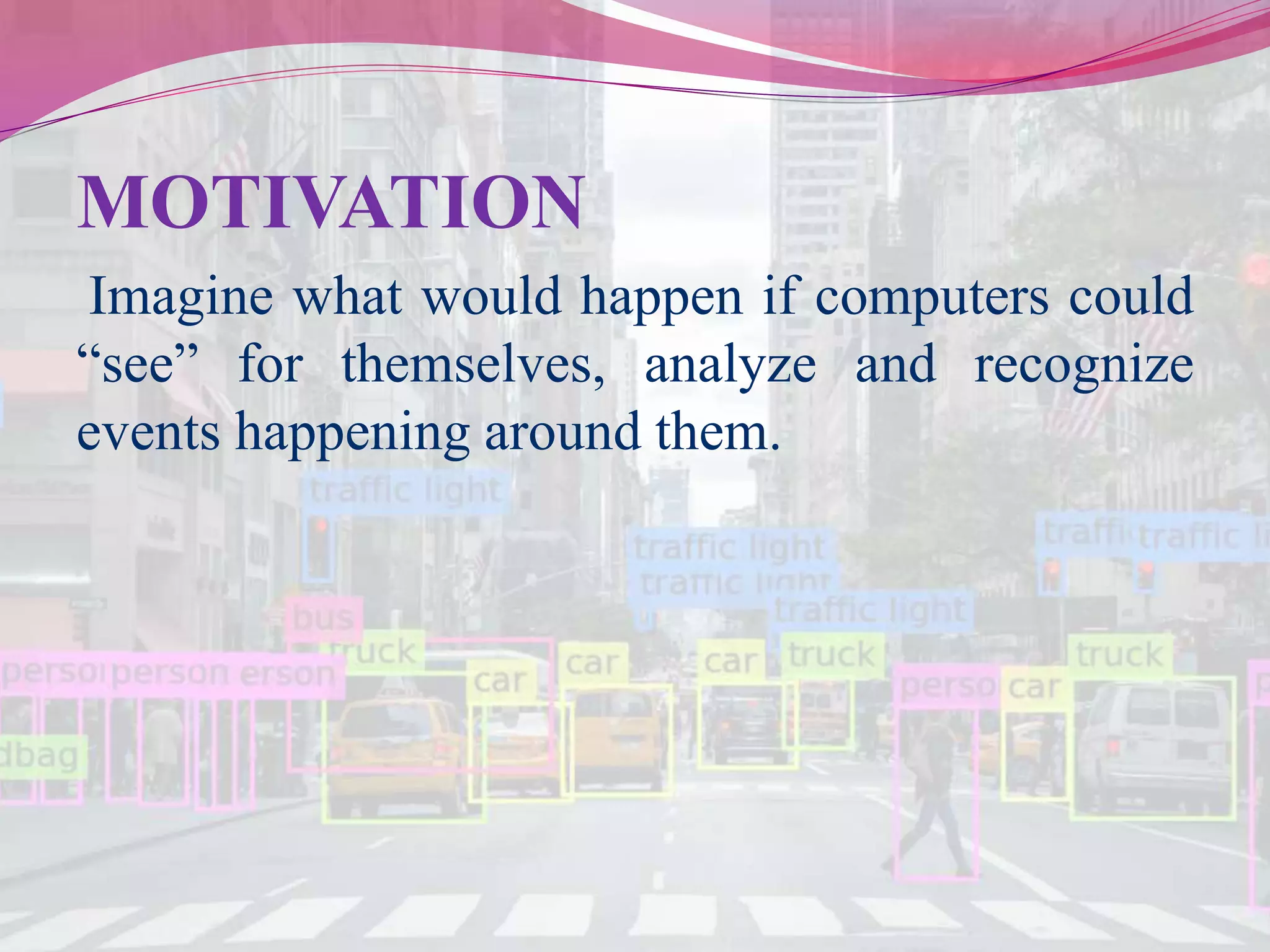
MOTIVATION
Imagine what would happen if computers could
“see” for themselves, analyze and recognize
events happening around them.
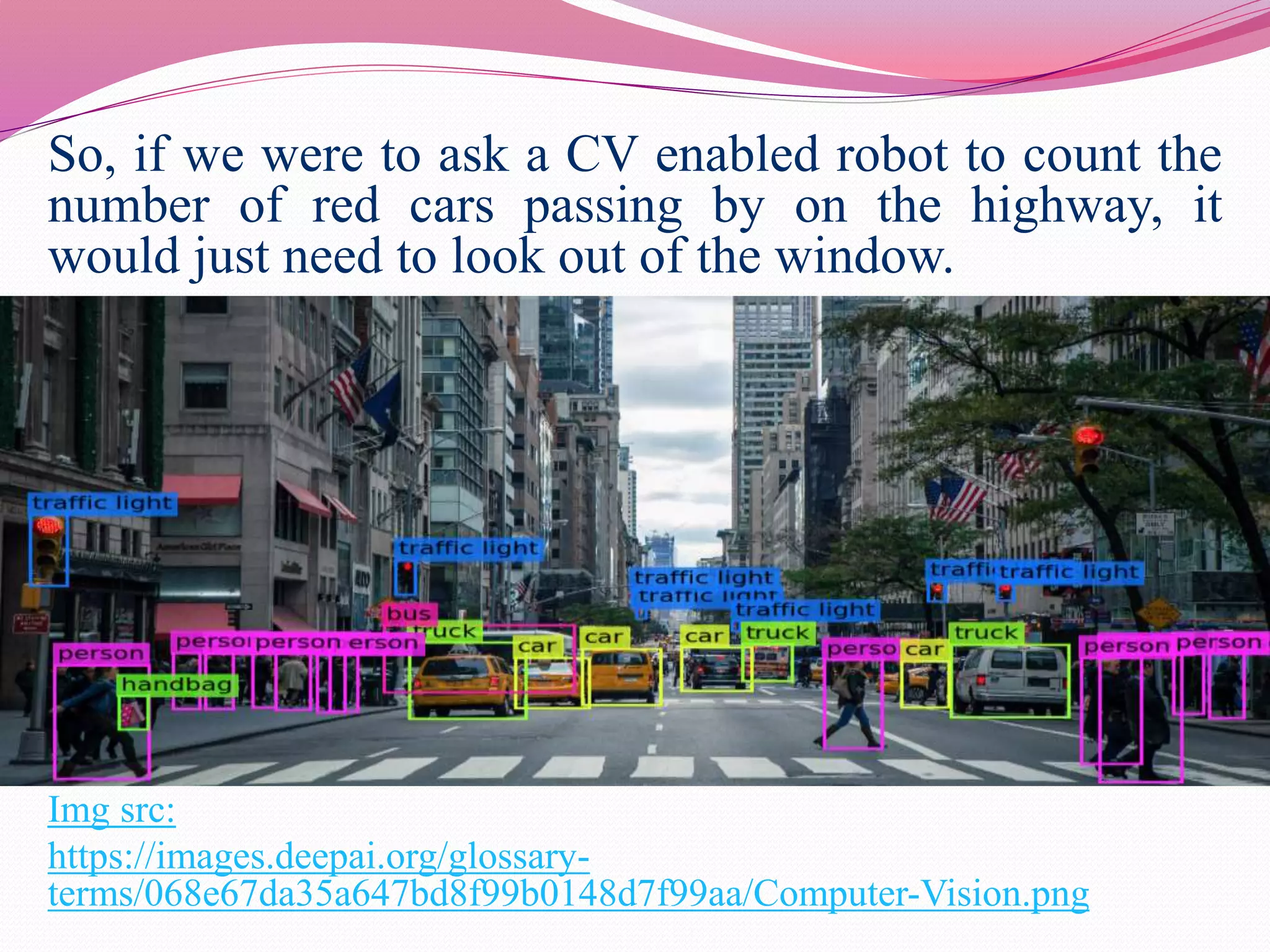
So, if we were to ask a CV enabled robot to count the
number of red cars passing by on the highway, it
would just need to look out of the window.
Img src:
https://images.deepai.org/glossary-
terms/068e67da35a647bd8f99b0148d7f99aa/Computer-Vision.png
GOAL OF COMPUTER VISION
 The ultimate goal of Computer Vision is to imitate the
great capabilies of the human visual system.
 Computer Vision allows the computer not only to
record images but also to interpret them.
 Deep learning has helped improve on many tasks and
approach new ones in Computer Vision.
 Deep Learning simplifies the process of feature
extraction through mathematical operations
(Convolutions).
 The first demonstration of deep learning in computer
vision was in image recognition, object detection and
face recognition.
RELATION BETWEEN COMPUTER
VISION AND IMAGE PROCESSING
Img src:
https://robotacademy.net.au/lesson/image-features/
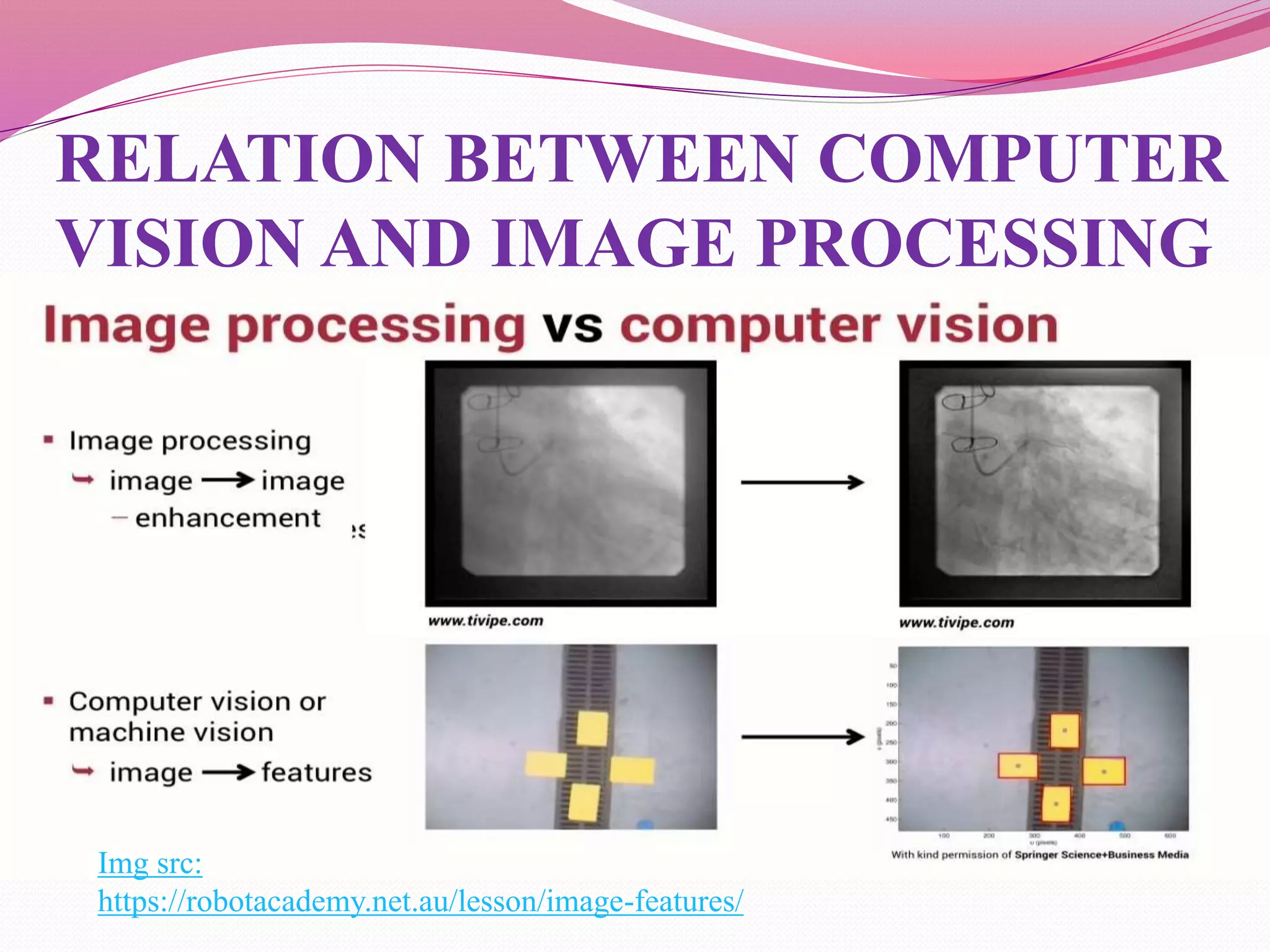
Image processing is a subset of
computer vision.
A computer vision system uses the image processing
algorithms to try and perform emulation of vision at
human scale.
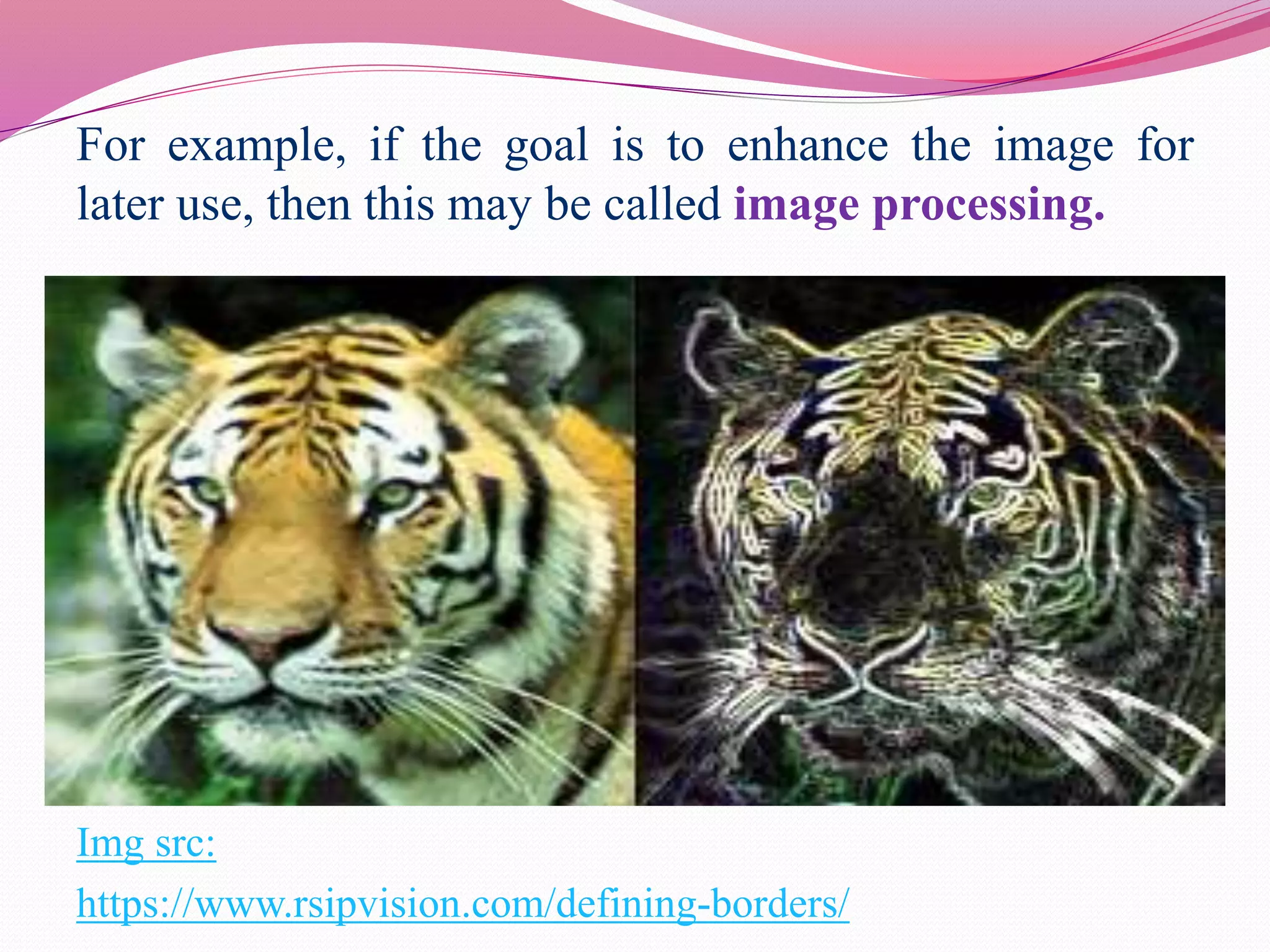
For example, if the goal is to enhance the image for
later use, then this may be called image processing.
Img src:
https://www.rsipvision.com/defining-borders/
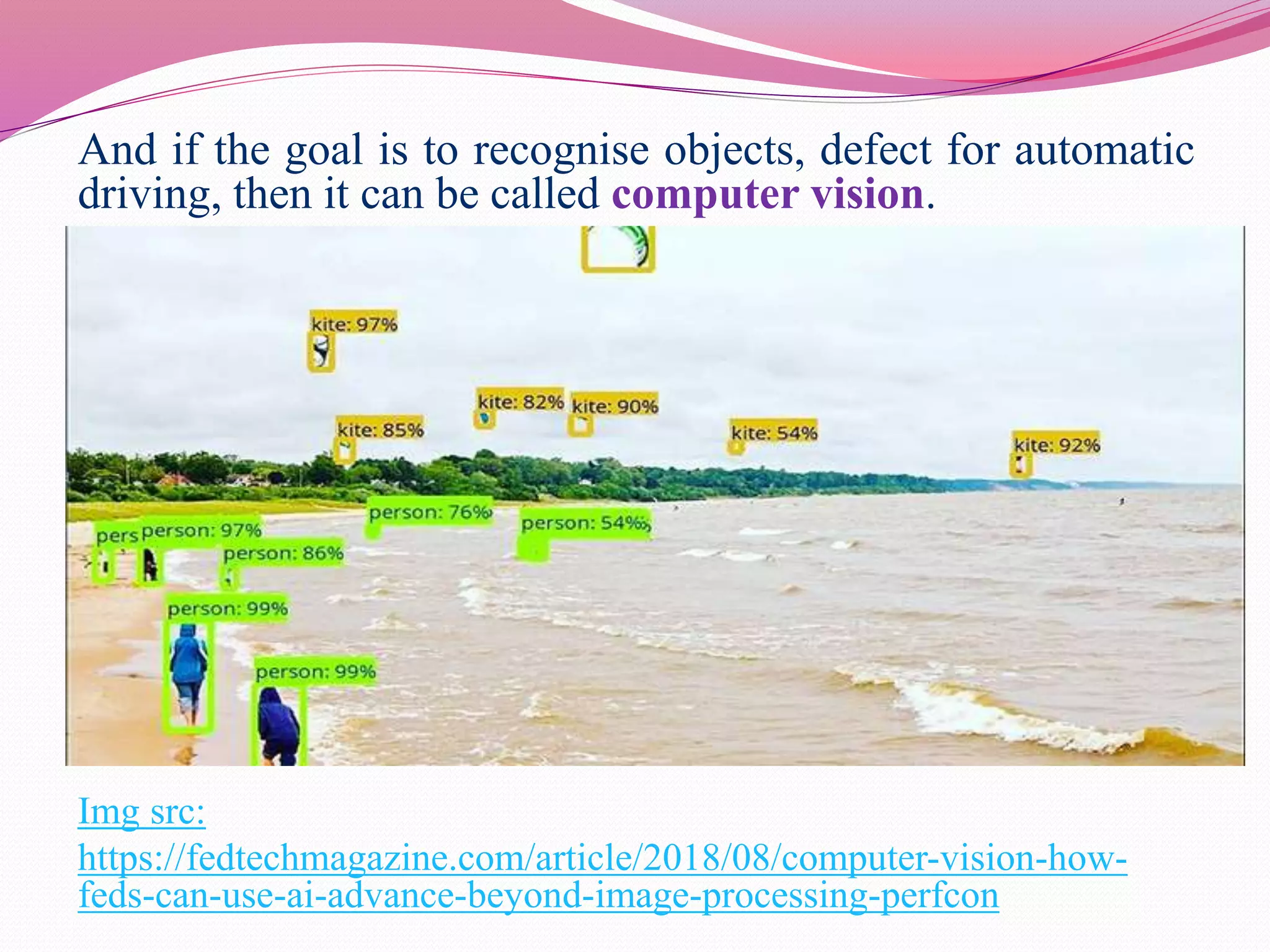
And if the goal is to recognise objects, defect for automatic
driving, then it can be called computer vision.
Img src:
https://fedtechmagazine.com/article/2018/08/computer-vision-how-
feds-can-use-ai-advance-beyond-image-processing-perfcon
INTERDISCIPLINARY NATURE OF
COMPUTER VISION
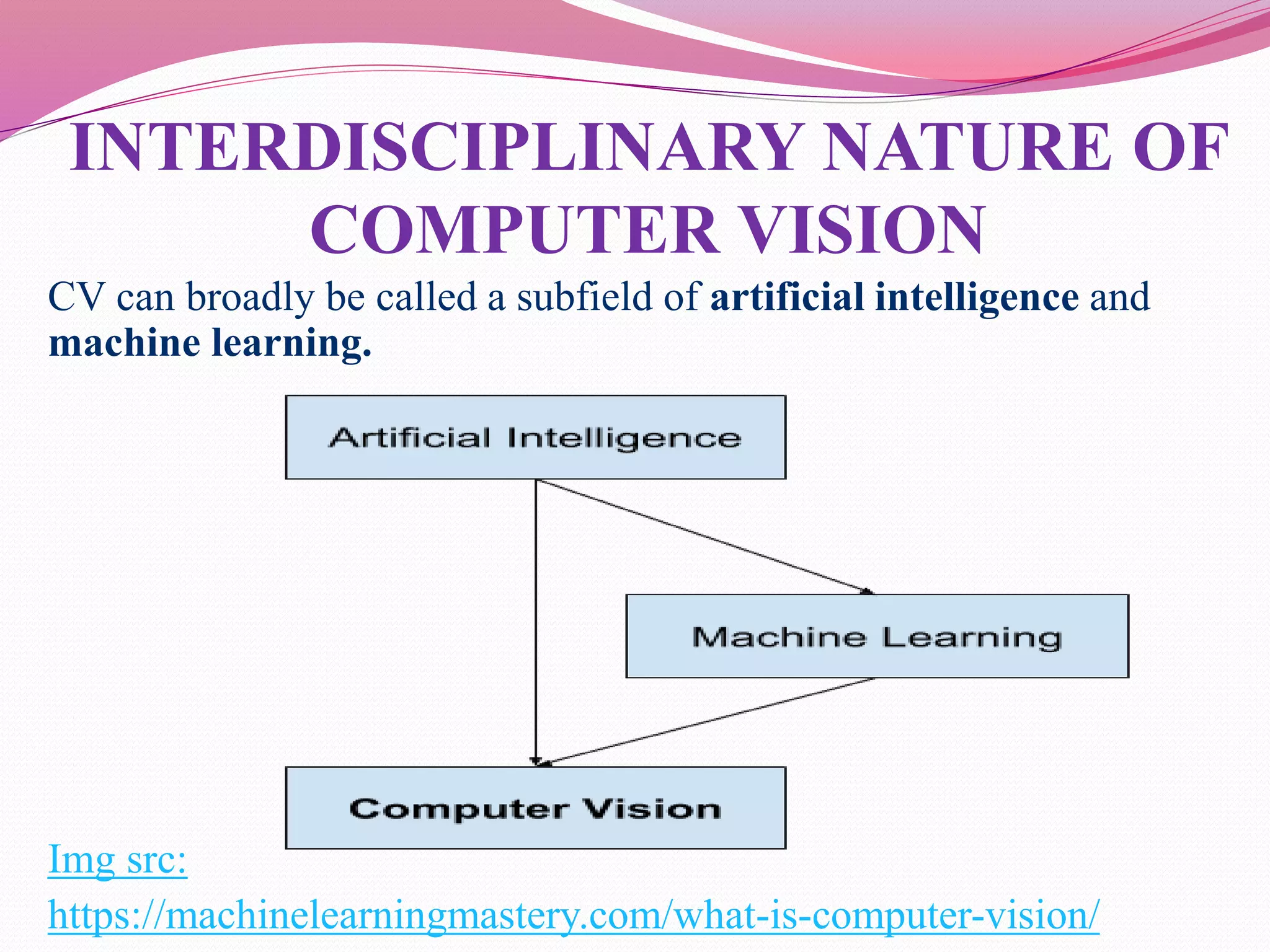
CV can broadly be called a subfield of artificial intelligence and
machine learning.
Img src:
https://machinelearningmastery.com/what-is-computer-vision/
Artificial Intelligence : The word Artificial Intelligence
comprises of two words “Artificial” and “Intelligence”.
Artificial refers to something which is made by human or non
natural thing and Intelligence means ability to understand or
think.
Therefore, it is an intelligence where we want to add all the
capabilities to machine that human contain.
Machine Learning : Machine Learning is the learning in which
machine can learn by its own without being explicitly
programmed.
It is an application of AI that provide system the ability to
automatically learn and improve from experience.
METHODOLOGY
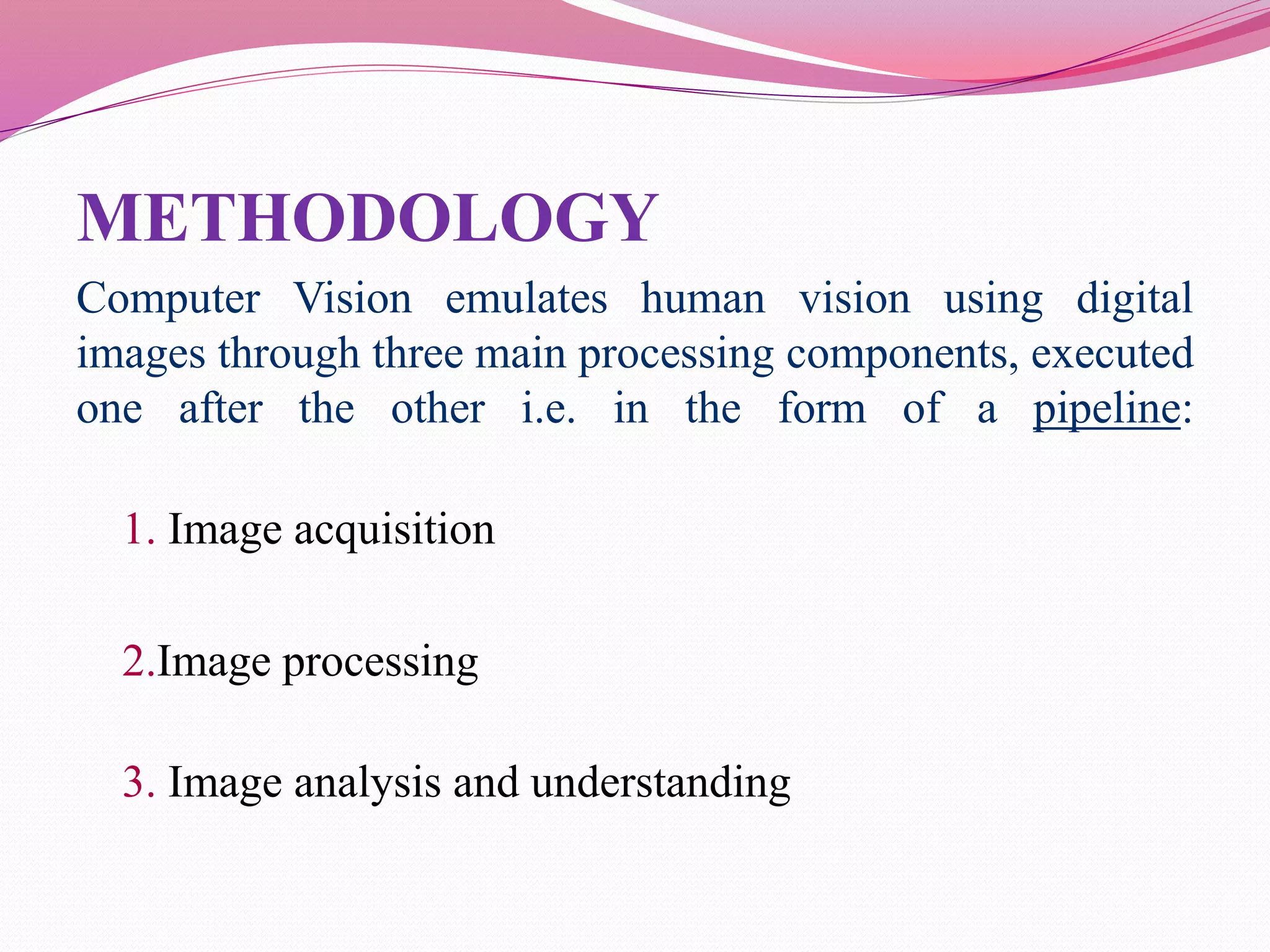
Computer Vision emulates human vision using digital
images through three main processing components, executed
one after the other i.e. in the form of a pipeline:
1. Image acquisition
2.Image processing
3. Image analysis and understanding
As our human visual understanding of world is reflected in our
ability to make decisions through what we see, providing such a
visual understanding to computers would allow them the same
power :
Img src:
https://hayo.io/computer-vision/
Image acquisition
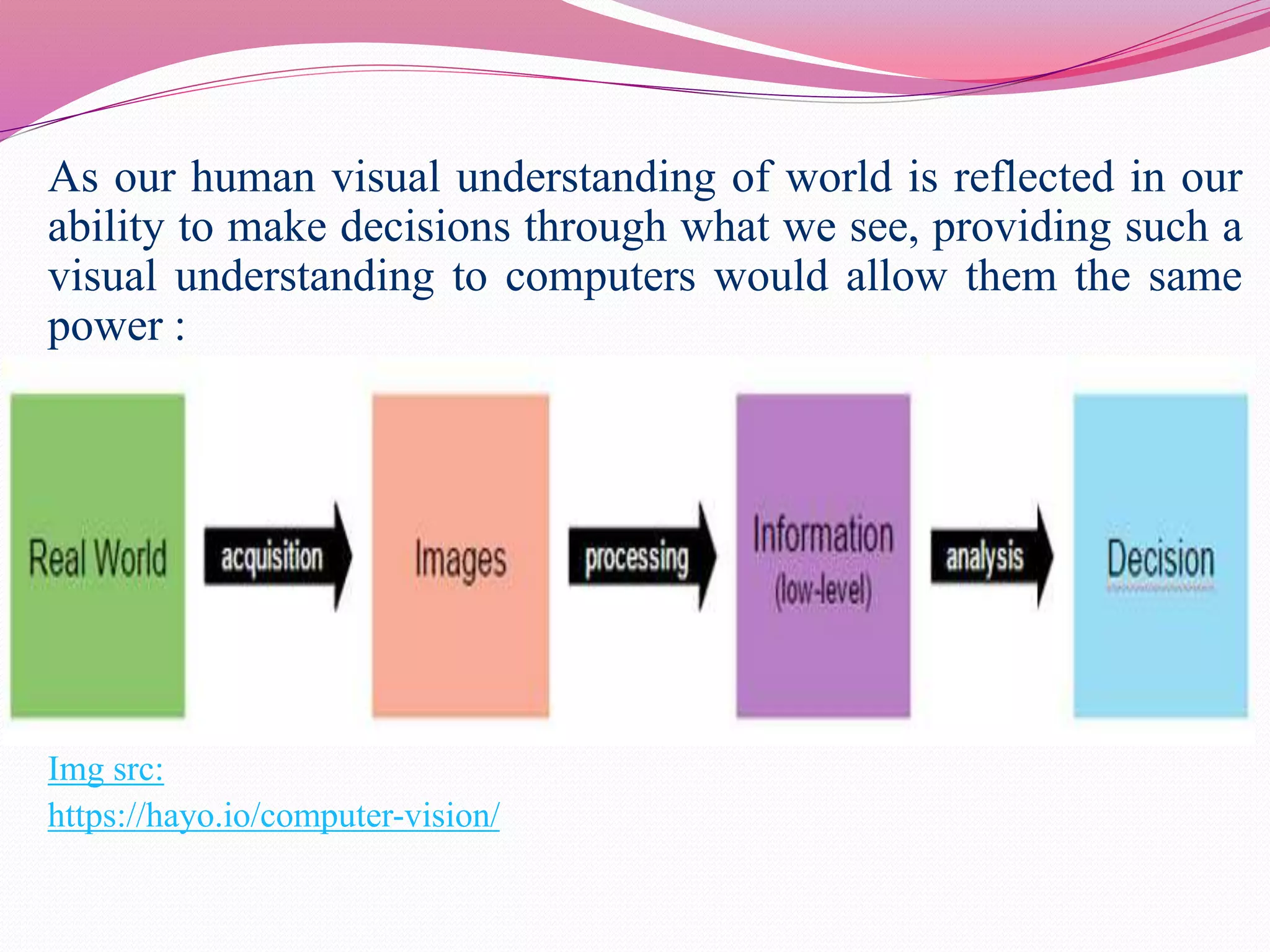
 It is the process of translating the world around us into binary data
composed of zeros and ones, interpreted as digital images.
 Different tools have been created to build such datasets:
1. Webcams & embedded cameras
2. Digital compact cameras & DSLR
3. Consumer 3D cameras & laser range finders
Img src: https://hayo.io/computer-vision/
Webcam DSLR Laser range
finder
3D camera
Embedded
camera
Image processing
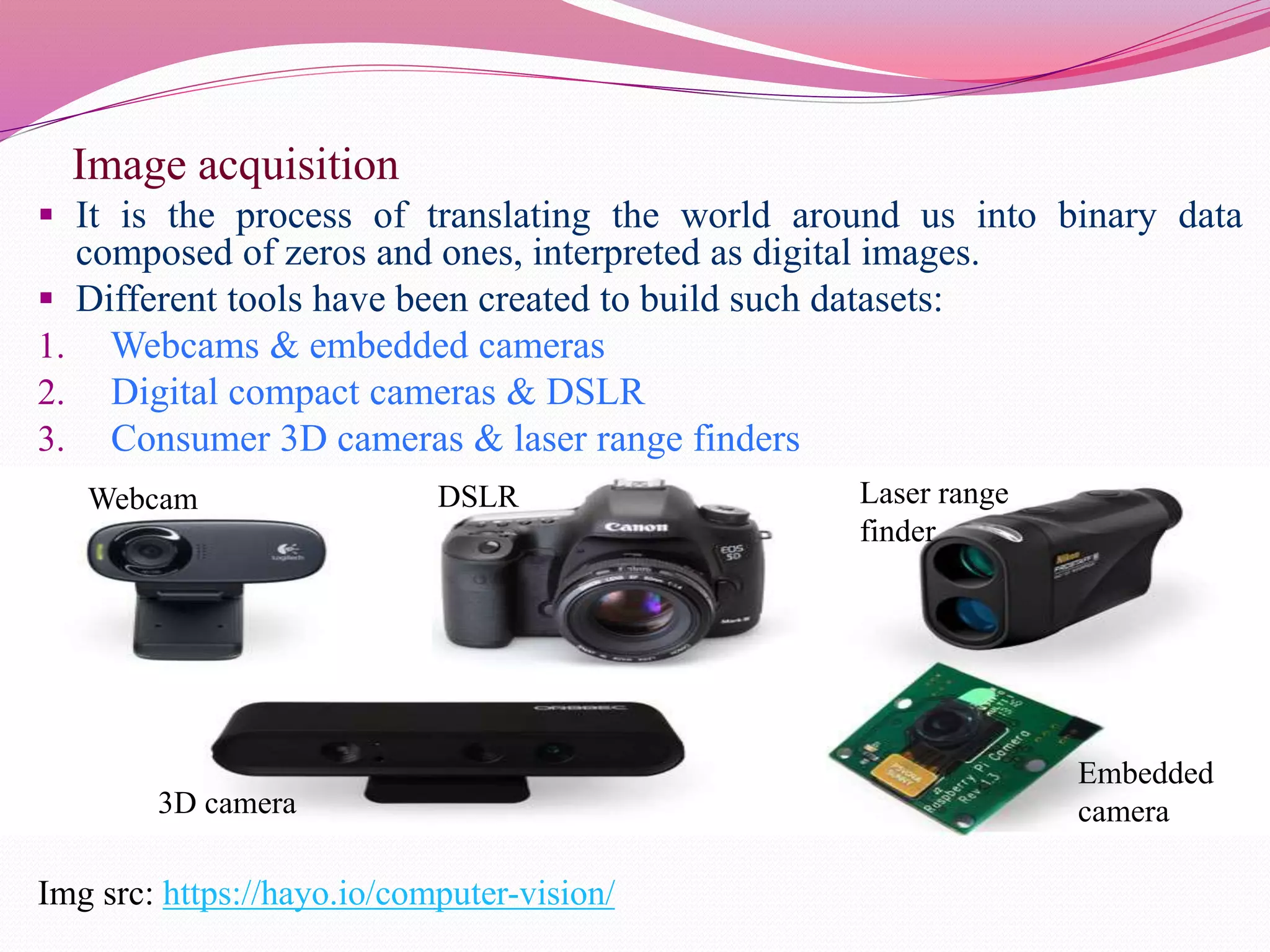
 Algorithms are applied to the binary data acquired in the first step to
infer information on parts of the image.
 The information is characterized by image edges, point features or
segments, etc. which are the basic geometric elements that build objects
in images.
 This step usually involves advanced applied mathematics algorithms and
techniques.
Img src: https://hayo.io/computer-vision/
Edge detection
in a color image.
Image analysis and understanding
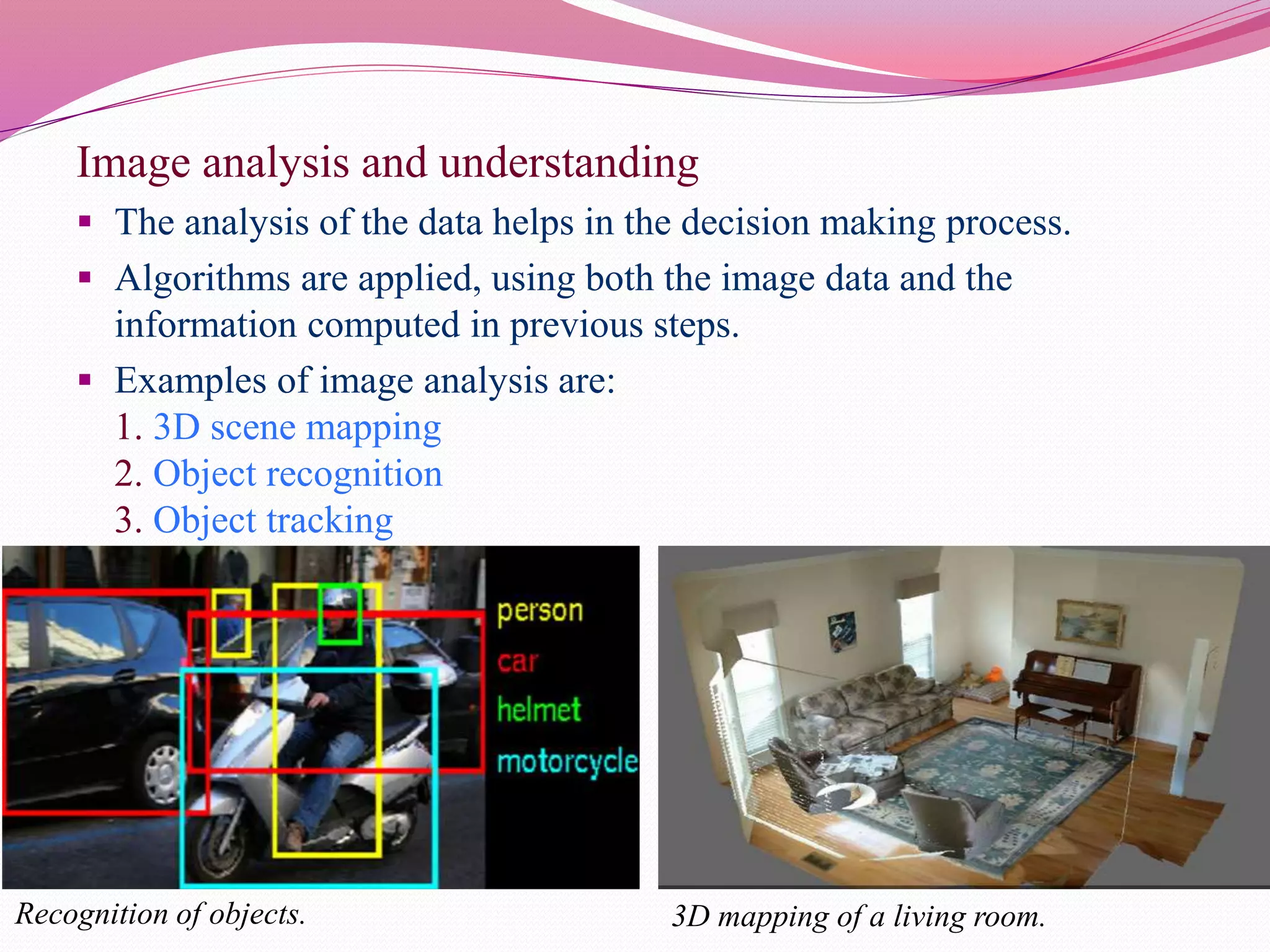
 The analysis of the data helps in the decision making process.
 Algorithms are applied, using both the image data and the
information computed in previous steps.
 Examples of image analysis are:
1. 3D scene mapping
2. Object recognition
3. Object tracking
Recognition of objects. 3D mapping of a living room.
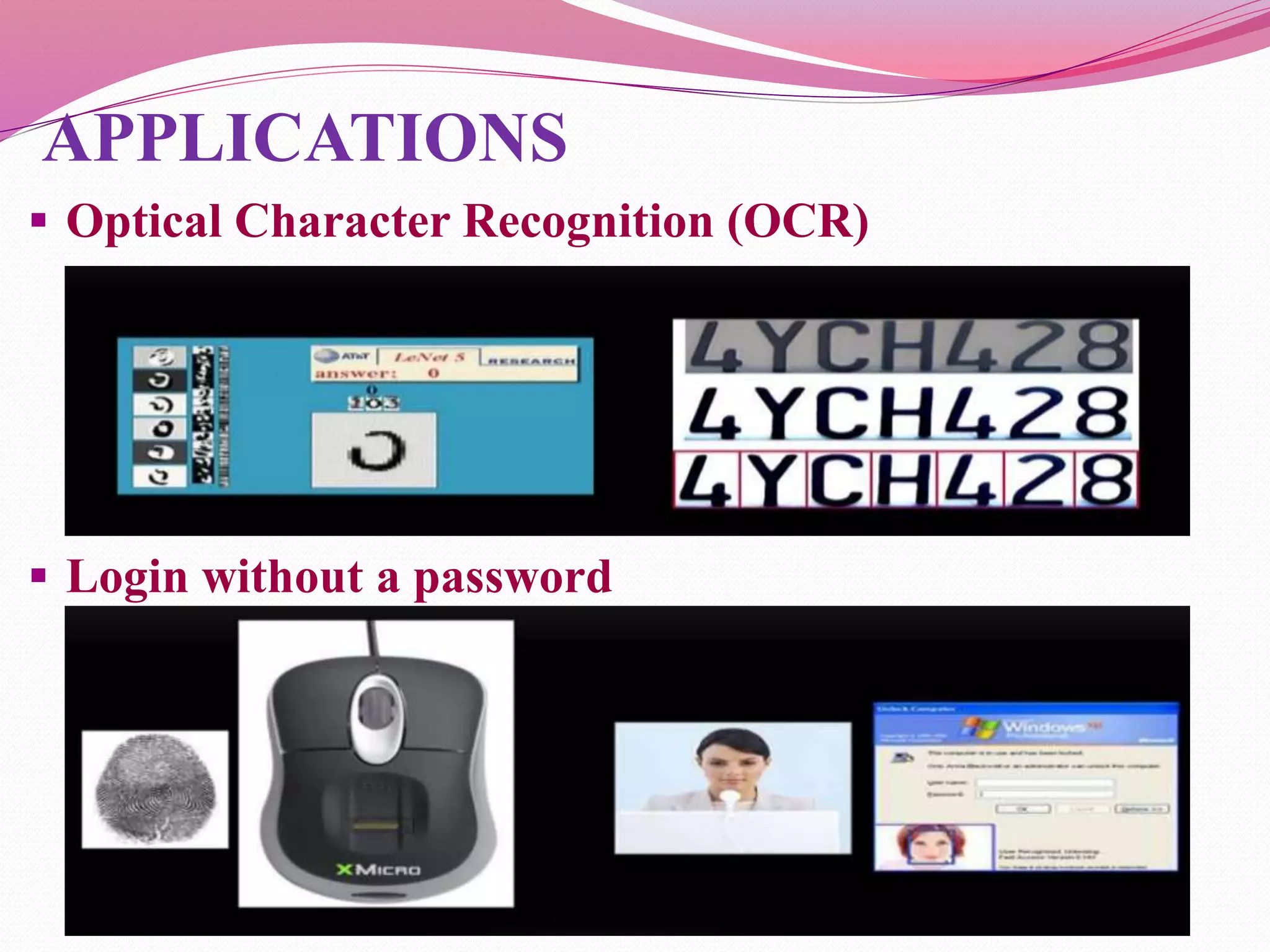
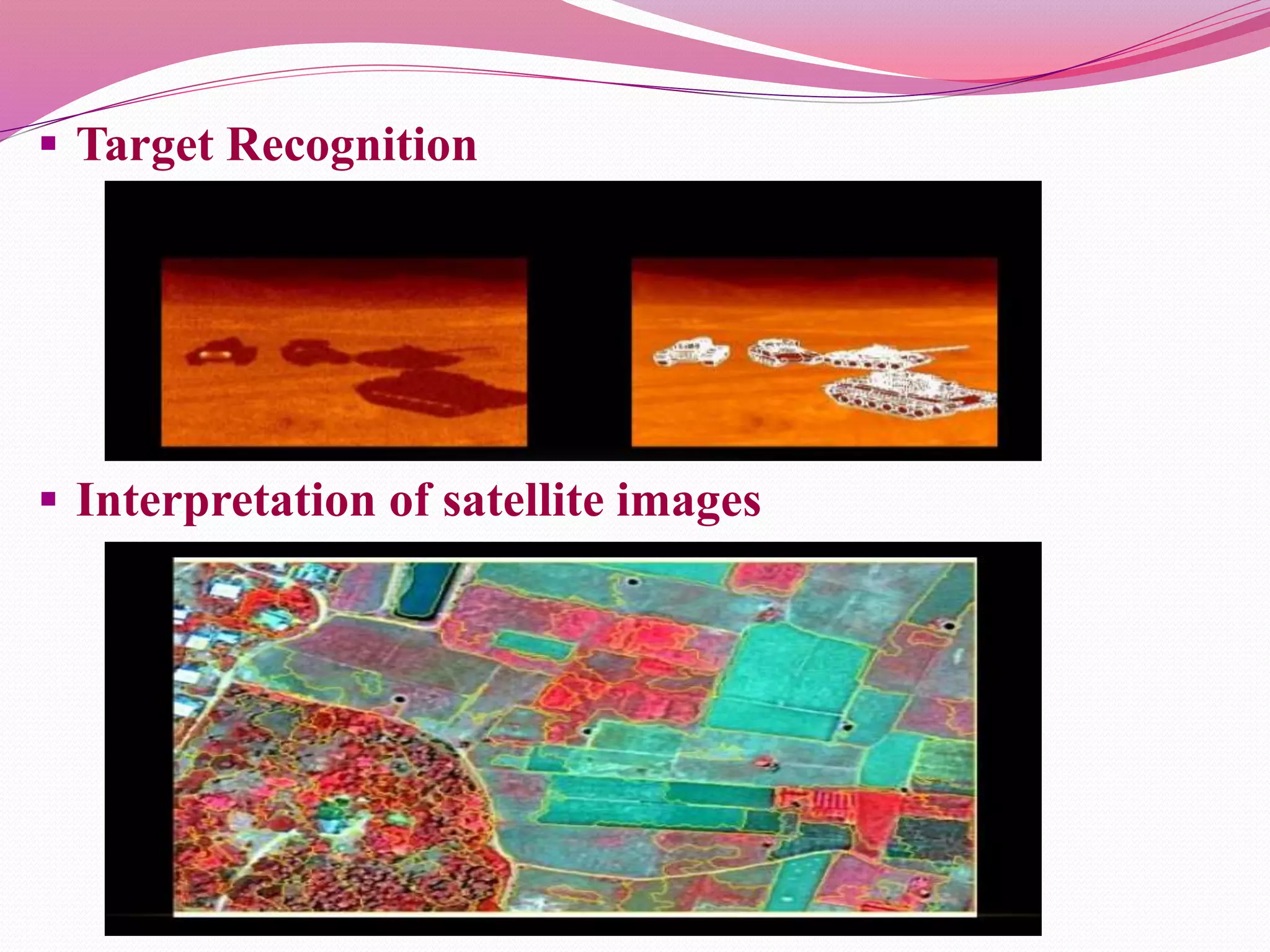
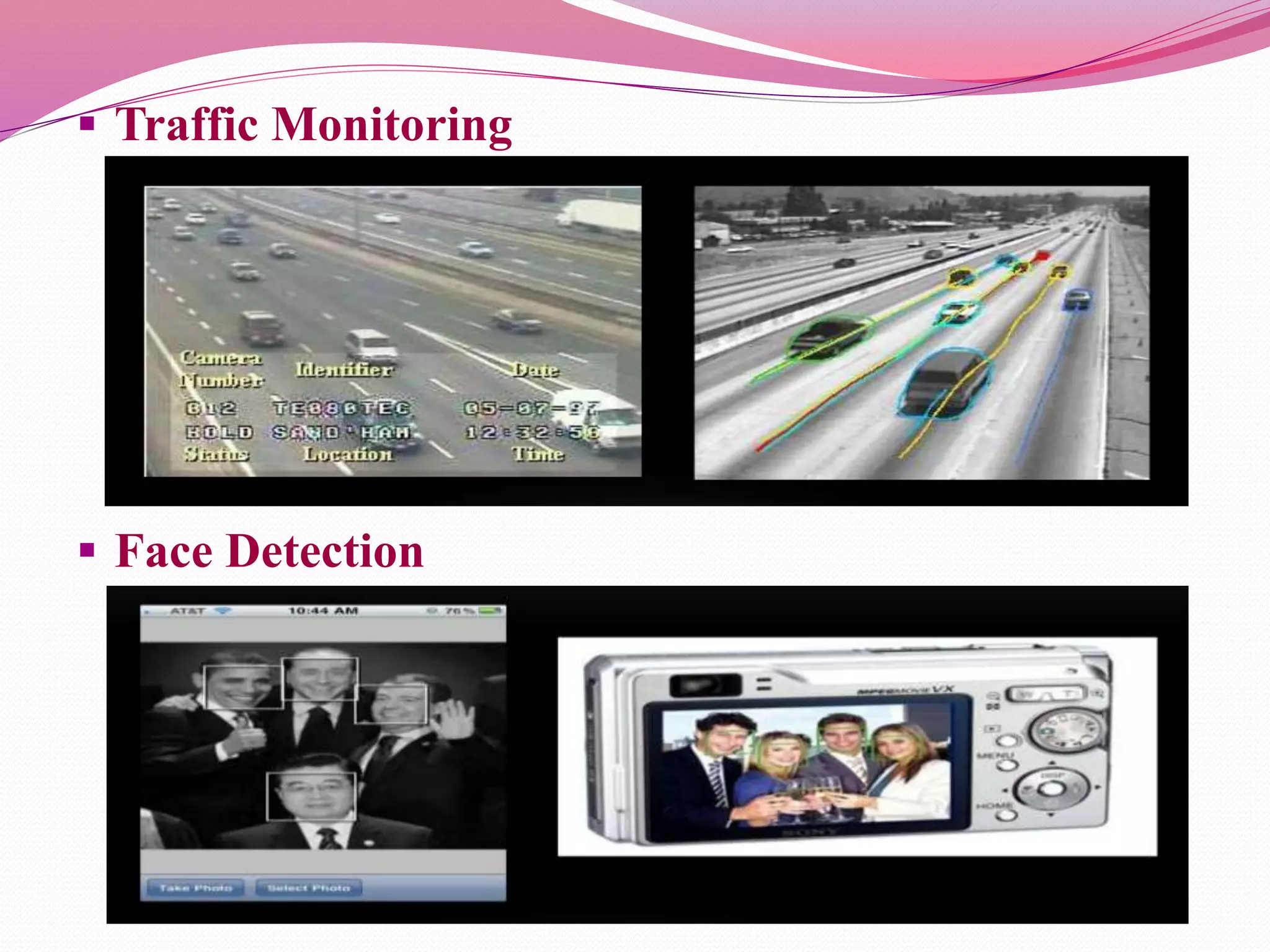
APPLICATIONS
 Optical Character Recognition (OCR)
 Login without a password
 Target Recognition
 Interpretation of satellite images
 Traffic Monitoring
 Face Detection
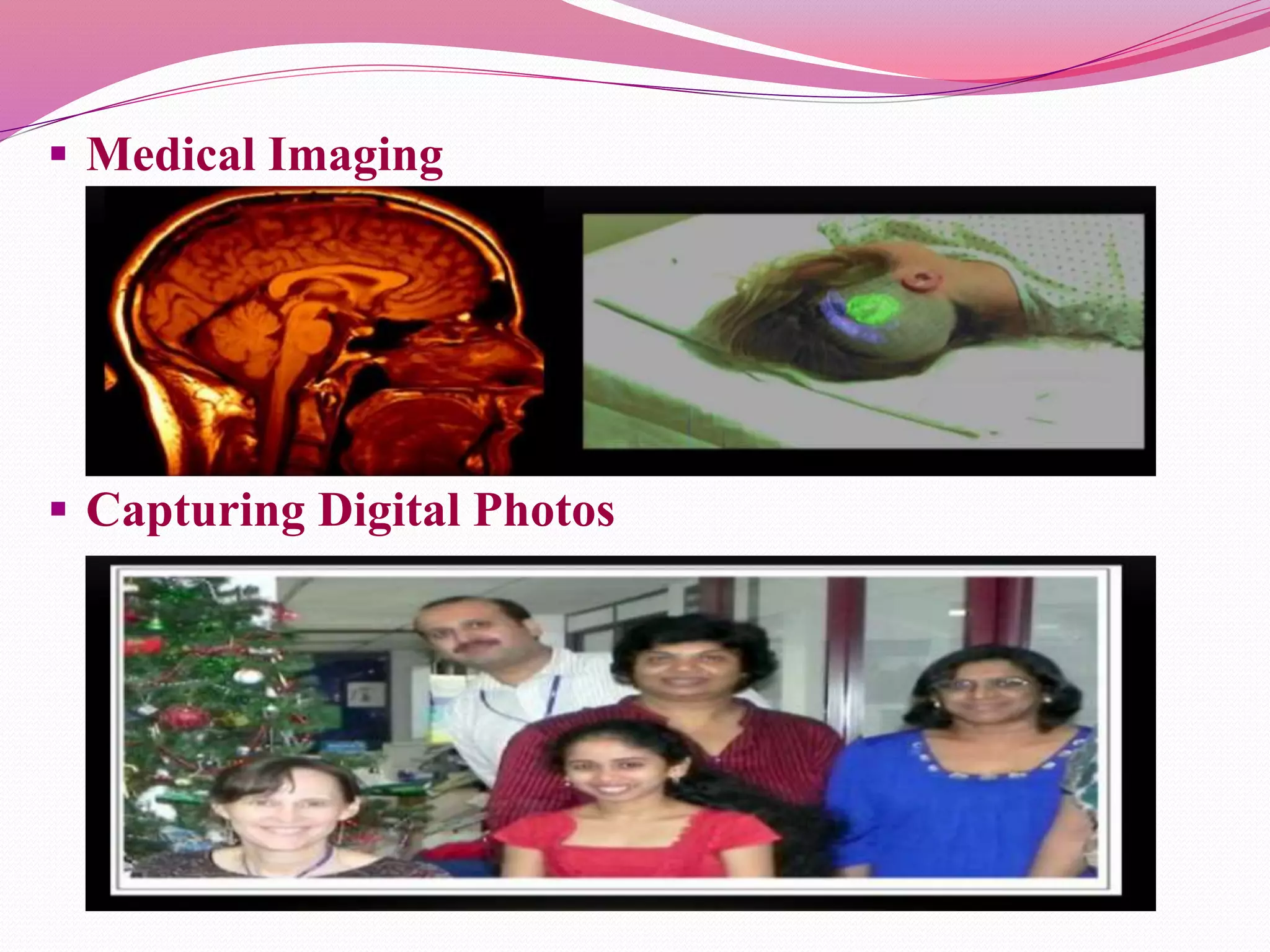
 Medical Imaging
 Capturing Digital Photos
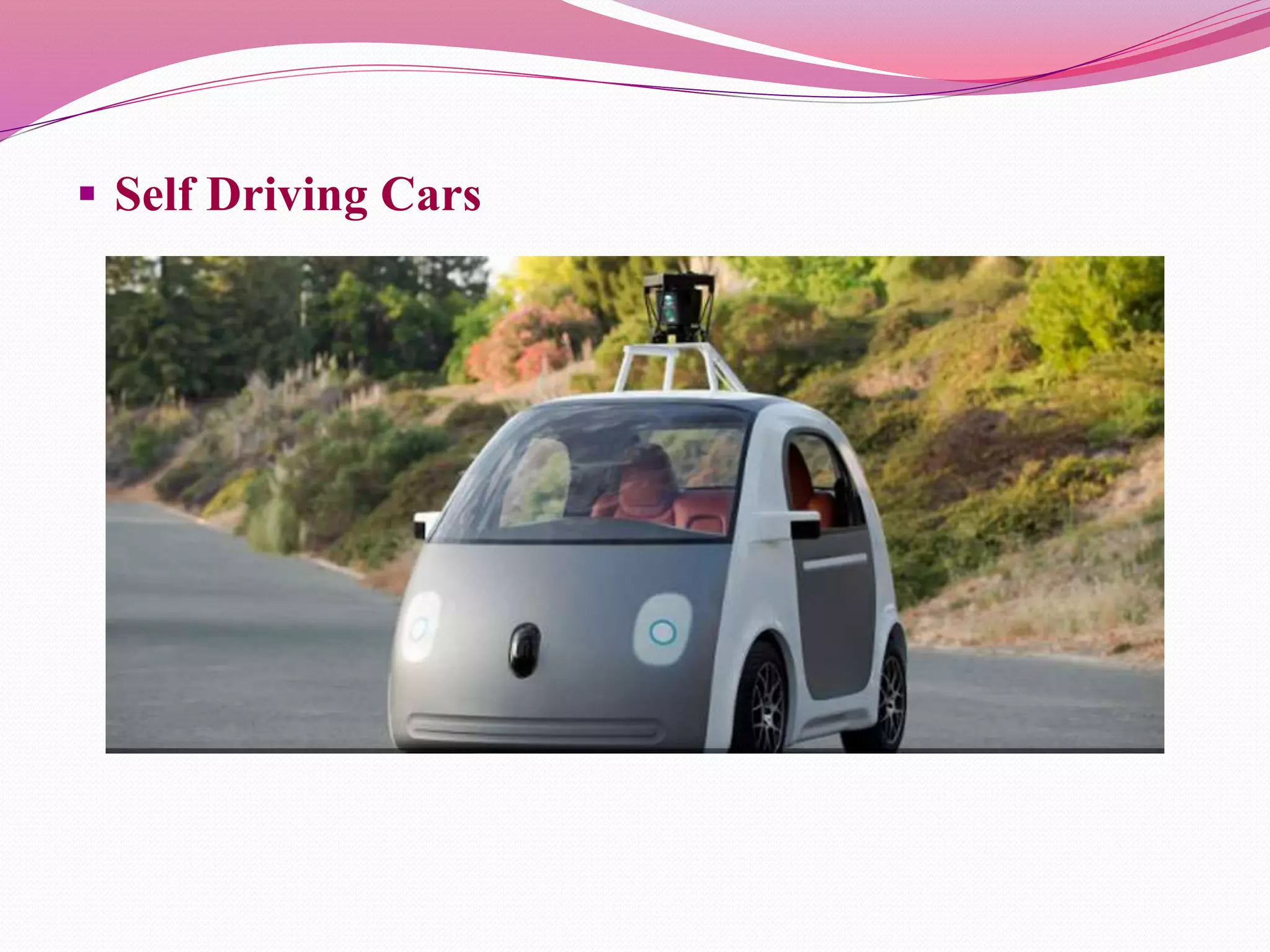
 Self Driving Cars
ADVANTAGES
Improved Online Merchandising
Customers will be able to search via images to find similar
styles to what they’re looking for instead of relying on tags.
Unique Customer Experiences
Services like Snapchat filters are aimed to provide an
experience that can only be considered “unique.”
Seamless Store Experiences
Amazon Go creates a seamless, efficient environment for
shopping. No more waiting in long lines, dealing with cashiers,
or worrying about handling your wallet.
DISADVANTAGES
The computer vision disadvantages regard a hefty issue in
the modern age: privacy.
The driving force that makes computer vision effective
also leads to doubt whether it should be pursued.
By gathering and learning from thousands of photos,
videos, etc., everything we do is stored or owned by
corporations.
Users need to become more aware of what sort of data
they put out into the world.
REFERENCES
https://machinelearningmastery.com/what-is-computer-vision/
https://deepai.org/machine-learning-glossary-and-
terms/computer-vision
https://www.skyfilabs.com/blog/what-is-computer-vision
https://www.geeksforgeeks.org/difference-between-machine-
learning-and-artificial-intelligence/
https://freecontent.manning.com/computer-vision-pipeline-
part-1-the-big-picture/
https://www.analyticsindiamag.com/what-is-the-difference-
between-computer-vision-and-image-processing/
https://lmb.informatik.uni-freiburg.de/lectures/seminar_brox/

Computer Vision

  • 2.
    CONTENTS Introduction Motivation Goal of ComputerVision Relation between Computer Vision and Image Processing Interdisciplinary Nature of Computer Vision Methodology Applications Advantages Disadvantages References
  • 3.
    INTRODUCTION Computer Vision (CV)is the automation of Human Visual System so that computers can obtain high level of understanding of the environment from digital images and videos.
  • 4.
    MOTIVATION Imagine what wouldhappen if computers could “see” for themselves, analyze and recognize events happening around them.
  • 5.
    So, if wewere to ask a CV enabled robot to count the number of red cars passing by on the highway, it would just need to look out of the window. Img src: https://images.deepai.org/glossary- terms/068e67da35a647bd8f99b0148d7f99aa/Computer-Vision.png
  • 6.
    GOAL OF COMPUTERVISION  The ultimate goal of Computer Vision is to imitate the great capabilies of the human visual system.  Computer Vision allows the computer not only to record images but also to interpret them.  Deep learning has helped improve on many tasks and approach new ones in Computer Vision.  Deep Learning simplifies the process of feature extraction through mathematical operations (Convolutions).  The first demonstration of deep learning in computer vision was in image recognition, object detection and face recognition.
  • 7.
    RELATION BETWEEN COMPUTER VISIONAND IMAGE PROCESSING Img src: https://robotacademy.net.au/lesson/image-features/
  • 8.
    Image processing isa subset of computer vision. A computer vision system uses the image processing algorithms to try and perform emulation of vision at human scale.
  • 9.
    For example, ifthe goal is to enhance the image for later use, then this may be called image processing. Img src: https://www.rsipvision.com/defining-borders/
  • 10.
    And if thegoal is to recognise objects, defect for automatic driving, then it can be called computer vision. Img src: https://fedtechmagazine.com/article/2018/08/computer-vision-how- feds-can-use-ai-advance-beyond-image-processing-perfcon
  • 11.
    INTERDISCIPLINARY NATURE OF COMPUTERVISION CV can broadly be called a subfield of artificial intelligence and machine learning. Img src: https://machinelearningmastery.com/what-is-computer-vision/
  • 12.
    Artificial Intelligence :The word Artificial Intelligence comprises of two words “Artificial” and “Intelligence”. Artificial refers to something which is made by human or non natural thing and Intelligence means ability to understand or think. Therefore, it is an intelligence where we want to add all the capabilities to machine that human contain. Machine Learning : Machine Learning is the learning in which machine can learn by its own without being explicitly programmed. It is an application of AI that provide system the ability to automatically learn and improve from experience.
  • 13.
    METHODOLOGY Computer Vision emulateshuman vision using digital images through three main processing components, executed one after the other i.e. in the form of a pipeline: 1. Image acquisition 2.Image processing 3. Image analysis and understanding
  • 14.
    As our humanvisual understanding of world is reflected in our ability to make decisions through what we see, providing such a visual understanding to computers would allow them the same power : Img src: https://hayo.io/computer-vision/
  • 15.
    Image acquisition  Itis the process of translating the world around us into binary data composed of zeros and ones, interpreted as digital images.  Different tools have been created to build such datasets: 1. Webcams & embedded cameras 2. Digital compact cameras & DSLR 3. Consumer 3D cameras & laser range finders Img src: https://hayo.io/computer-vision/ Webcam DSLR Laser range finder 3D camera Embedded camera
  • 16.
    Image processing  Algorithmsare applied to the binary data acquired in the first step to infer information on parts of the image.  The information is characterized by image edges, point features or segments, etc. which are the basic geometric elements that build objects in images.  This step usually involves advanced applied mathematics algorithms and techniques. Img src: https://hayo.io/computer-vision/ Edge detection in a color image.
  • 17.
    Image analysis andunderstanding  The analysis of the data helps in the decision making process.  Algorithms are applied, using both the image data and the information computed in previous steps.  Examples of image analysis are: 1. 3D scene mapping 2. Object recognition 3. Object tracking Recognition of objects. 3D mapping of a living room.
  • 18.
    APPLICATIONS  Optical CharacterRecognition (OCR)  Login without a password
  • 19.
     Target Recognition Interpretation of satellite images
  • 20.
  • 21.
     Medical Imaging Capturing Digital Photos
  • 22.
  • 23.
    ADVANTAGES Improved Online Merchandising Customerswill be able to search via images to find similar styles to what they’re looking for instead of relying on tags. Unique Customer Experiences Services like Snapchat filters are aimed to provide an experience that can only be considered “unique.” Seamless Store Experiences Amazon Go creates a seamless, efficient environment for shopping. No more waiting in long lines, dealing with cashiers, or worrying about handling your wallet.
  • 24.
    DISADVANTAGES The computer visiondisadvantages regard a hefty issue in the modern age: privacy. The driving force that makes computer vision effective also leads to doubt whether it should be pursued. By gathering and learning from thousands of photos, videos, etc., everything we do is stored or owned by corporations. Users need to become more aware of what sort of data they put out into the world.
  • 25.