1
This session Outline
Files Concepts
File Programs
Busy Bee Workshop – Session IXBusy Bee Workshop – Session IX
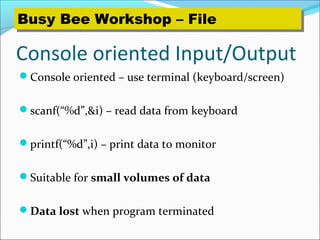
Console oriented Input/Output
ļ‚—Console oriented – use terminal (keyboard/screen)
ļ‚—scanf(ā€œ%dā€,&i) – read data from keyboard
ļ‚—printf(ā€œ%dā€,i) – print data to monitor
ļ‚—Suitable for small volumes of data
ļ‚—Data lost when program terminated
Busy Bee Workshop – FileBusy Bee Workshop – File
Real-life applications
ļ‚—Large data volumes
ļ‚—Need for flexible approach to store/retrieve data
ļ‚—Concept of files
Busy Bee Workshop – FileBusy Bee Workshop – File
Files
ļ‚—File – place on disk where group of related data is stored
ļ‚—E.g. your C programs, executables
ļ‚—High-level programming languages support file operations
ļ‚—Naming
ļ‚—Opening
ļ‚—Reading
ļ‚—Writing
ļ‚—Closing
Busy Bee Workshop – FileBusy Bee Workshop – File
Defining and opening file
ļ‚—To store data file in secondary memory (disk) must
specify to OS
ļ‚—Filename (e.g. sort.c, input.data)
ļ‚—Data structure (e.g. FILE)
ļ‚—Purpose (e.g. reading, writing, appending)
Busy Bee Workshop – FileBusy Bee Workshop – File
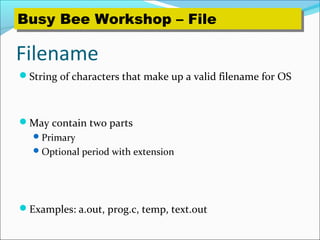
Filename
ļ‚—String of characters that make up a valid filename for OS
ļ‚—May contain two parts
ļ‚—Primary
ļ‚—Optional period with extension
ļ‚—Examples: a.out, prog.c, temp, text.out
Busy Bee Workshop – FileBusy Bee Workshop – File
General format for opening file
ļ‚—fp
ļ‚—contains all information about file
ļ‚—Communication link between system and program
ļ‚—Mode can be
ļ‚—r open file for reading only
ļ‚—w open file for writing only
ļ‚—a open file for appending (adding) data
FILE *fp; /*variable fp is pointer to type FILE*/
fp = fopen(ā€œfilenameā€, ā€œmodeā€);
/*opens file with name filename , assigns identifier to fp */
Busy Bee Workshop – FileBusy Bee Workshop – File
Different modes
ļ‚—Writing mode
ļ‚—if file already exists then contents are deleted,
ļ‚—else new file with specified name created
ļ‚—Appending mode
ļ‚—if file already exists then file opened with contents safe
ļ‚—else new file created
ļ‚—Reading mode
ļ‚—if file already exists then opened with contents safe
ļ‚—else error occurs.
FILE *p1, *p2;
p1 = fopen(ā€œdataā€,ā€rā€);
p2= fopen(ā€œresultsā€, wā€);
Busy Bee Workshop – FileBusy Bee Workshop – File
Additional modes
ļ‚—r+ open to beginning for both reading/writing
ļ‚—w+ same as w except both for reading and writing
ļ‚—a+ same as ā€˜a’ except both for reading and writing
Busy Bee Workshop – FileBusy Bee Workshop – File
Closing a file
ļ‚—File must be closed as soon as all operations on it completed
ļ‚—Ensures
ļ‚— All outstanding information associated with file flushed out from
buffers
ļ‚— All links to file broken
ļ‚— Accidental misuse of file prevented
ļ‚—If want to change mode of file, then first close and open again
Busy Bee Workshop – FileBusy Bee Workshop – File
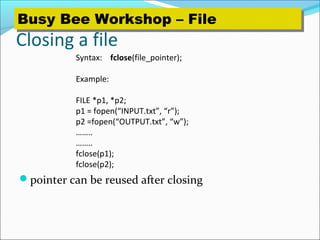
Closing a file
ļ‚—pointer can be reused after closing
Syntax: fclose(file_pointer);
Example:
FILE *p1, *p2;
p1 = fopen(ā€œINPUT.txtā€, ā€œrā€);
p2 =fopen(ā€œOUTPUT.txtā€, ā€œwā€);
……..
……..
fclose(p1);
fclose(p2);
Busy Bee Workshop – FileBusy Bee Workshop – File
Input/Output operations on filesļ‚—C provides several different functions for reading/writing
ļ‚—getc() – read a character
ļ‚—putc() – write a character
ļ‚—fprintf() – write set of data values
ļ‚—fscanf() – read set of data values
ļ‚—getw() – read integer
ļ‚—putw() – write integer
ļ‚—read() – read data from binary file
ļ‚—write() – write data into binary file
Busy Bee Workshop – FileBusy Bee Workshop – File
getc() and putc()
ļ‚—handle one character at a time like getchar() and
putchar()
ļ‚—syntax: putc(c,fp1);
ļ‚—c : a character variable
ļ‚—fp1 : pointer to file opened with mode w
ļ‚—syntax: c = getc(fp2);
ļ‚—c : a character variable
ļ‚—fp2 : pointer to file opened with mode r
ļ‚—file pointer moves by one character position after every
getc() and putc()
ļ‚—getc() returns end-of-file marker EOF when file end
reached
Busy Bee Workshop – FileBusy Bee Workshop – File
Program to read/write using getc/putc
#include <stdio.h>
main()
{ FILE *fp1;
char c;
f1= fopen(ā€œINPUTā€, ā€œwā€); /* open file for writing */
while((c=getchar()) != EOF) /*get char from keyboard until CTL-Z*/
putc(c,f1); /*write a character to INPUT */
fclose(f1); /* close INPUT */
f1=fopen(ā€œINPUTā€, ā€œrā€); /* reopen file */
while((c=getc(f1))!=EOF) /*read character from file INPUT*/
printf(ā€œ%cā€, c); /* print character to screen */
fclose(f1);
} /*end main */
Busy Bee Workshop – FileBusy Bee Workshop – File
fscanf() and fprintf()
ļ‚—similar to scanf() and printf()
ļ‚—in addition provide file-pointer
ļ‚—given the following
ļ‚—file-pointer f1 (points to file opened in write mode)
ļ‚—file-pointer f2 (points to file opened in read mode)
ļ‚—integer variable i
ļ‚—float variable f
ļ‚—Example:
fprintf(f1, ā€œ%d %fnā€, i, f);
fprintf(stdout, ā€œ%f nā€, f); /*note: stdout refers to screen */
fscanf(f2, ā€œ%d %fā€, &i, &f);
ļ‚—fscanf returns EOF when end-of-file reached
Busy Bee Workshop – FileBusy Bee Workshop – File
getw() and putw()
ļ‚—handle one integer at a time
ļ‚—syntax: putw(i,fp1);
ļ‚—i : an integer variable
ļ‚—fp1 : pointer to file ipened with mode w
ļ‚—syntax: i = getw(fp2);
ļ‚—i : an integer variable
ļ‚—fp2 : pointer to file opened with mode r
ļ‚—file pointer moves by one integer position, data stored in
binary format native to local system
ļ‚—getw() returns end-of-file marker EOF when file end
reached
Busy Bee Workshop – FileBusy Bee Workshop – File
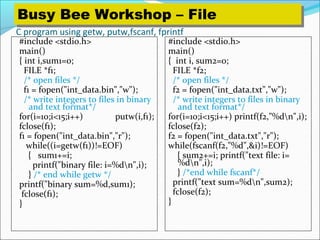
C program using getw, putw,fscanf, fprintf
#include <stdio.h>
main()
{ int i,sum1=0;
FILE *f1;
/* open files */
f1 = fopen("int_data.bin","w");
/* write integers to files in binary
and text format*/
for(i=10;i<15;i++) putw(i,f1);
fclose(f1);
f1 = fopen("int_data.bin","r");
while((i=getw(f1))!=EOF)
{ sum1+=i;
printf("binary file: i=%dn",i);
} /* end while getw */
printf("binary sum=%d,sum1);
fclose(f1);
}
#include <stdio.h>
main()
{ int i, sum2=0;
FILE *f2;
/* open files */
f2 = fopen("int_data.txt","w");
/* write integers to files in binary
and text format*/
for(i=10;i<15;i++) printf(f2,"%dn",i);
fclose(f2);
f2 = fopen("int_data.txt","r");
while(fscanf(f2,"%d",&i)!=EOF)
{ sum2+=i; printf("text file: i=
%dn",i);
} /*end while fscanf*/
printf("text sum=%dn",sum2);
fclose(f2);
}
Busy Bee Workshop – FileBusy Bee Workshop – File
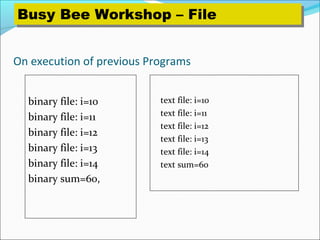
On execution of previous Programs
binary file: i=10
binary file: i=11
binary file: i=12
binary file: i=13
binary file: i=14
binary sum=60,
text file: i=10
text file: i=11
text file: i=12
text file: i=13
text file: i=14
text sum=60
Busy Bee Workshop – FileBusy Bee Workshop – File
Errors that occur during I/O
ļ‚—Typical errors that occur
ļ‚—trying to read beyond end-of-file
ļ‚—trying to use a file that has not been opened
ļ‚—perform operation on file not permitted by ā€˜fopen’ mode
ļ‚—open file with invalid filename
ļ‚—write to write-protected file
Busy Bee Workshop – FileBusy Bee Workshop – File
Error handling
ļ‚—given file-pointer, check if EOF reached, errors while
handling file, problems opening file etc.
ļ‚—check if EOF reached: feof()
ļ‚—feof() takes file-pointer as input, returns nonzero if all
data read and zero otherwise
if(feof(fp))
printf(ā€œEnd of datanā€);
ļ‚—ferror() takes file-pointer as input, returns nonzero
integer if error detected else returns zero
if(ferror(fp) !=0)
printf(ā€œAn error has occurrednā€);
Busy Bee Workshop – FileBusy Bee Workshop – File
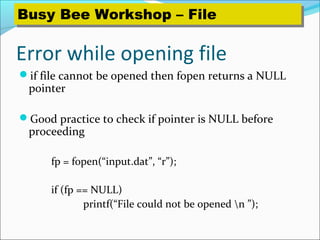
Error while opening file
ļ‚—if file cannot be opened then fopen returns a NULL
pointer
ļ‚—Good practice to check if pointer is NULL before
proceeding
fp = fopen(ā€œinput.datā€, ā€œrā€);
if (fp == NULL)
printf(ā€œFile could not be opened n ā€);
Busy Bee Workshop – FileBusy Bee Workshop – File
Random access to files
ļ‚—how to jump to a given position (byte number) in a file
without reading all the previous data?
ļ‚—fseek (file-pointer, offset, position);
ļ‚—position: 0 (beginning), 1 (current), 2 (end)
ļ‚—offset: number of locations to move from position
Example: fseek(fp,-m, 1); /* move back by m bytes from
current
position */
fseek(fp,m,0); /* move to (m+1)th byte in file */
fseek(fp, -10, 2); /* what is this? */
ļ‚—ftell(fp) returns current byte position in file
ļ‚—rewind(fp) resets position to start of file
Busy Bee Workshop – FileBusy Bee Workshop – File
Command line arguments
ļ‚—can give input to C program from command line
E.g. > prog.c 10 name1 name2
….
ļ‚—how to use these arguments?
main ( int argc, char *argv[] )
ļ‚—argc – gives a count of number of arguments (including
program name)
ļ‚—char *argv[] defines an array of pointers to character (or
array of strings)
ļ‚—argv[0] – program name
ļ‚—argv[1] to argv[argc -1] give the other arguments as strings
Busy Bee Workshop – FileBusy Bee Workshop – File
Example args.c
args.out 2 join leave 6
6
leave
join
2
args.out
#include <stdio.h>
main(int argc,char *argv[])
{
while(argc>0) /* print out all arguments in reverse order*/
{
printf("%sn",argv[argc-1]);
argc--;
}
}
Busy Bee Workshop – FileBusy Bee Workshop – File
File handling-c programming language

File handling-c programming language

  • 1.
    1 This session Outline FilesConcepts File Programs Busy Bee Workshop – Session IXBusy Bee Workshop – Session IX
  • 2.
    Console oriented Input/Output ļ‚—Consoleoriented – use terminal (keyboard/screen) ļ‚—scanf(ā€œ%dā€,&i) – read data from keyboard ļ‚—printf(ā€œ%dā€,i) – print data to monitor ļ‚—Suitable for small volumes of data ļ‚—Data lost when program terminated Busy Bee Workshop – FileBusy Bee Workshop – File
  • 3.
    Real-life applications ļ‚—Large datavolumes ļ‚—Need for flexible approach to store/retrieve data ļ‚—Concept of files Busy Bee Workshop – FileBusy Bee Workshop – File
  • 4.
    Files ļ‚—File – placeon disk where group of related data is stored ļ‚—E.g. your C programs, executables ļ‚—High-level programming languages support file operations ļ‚—Naming ļ‚—Opening ļ‚—Reading ļ‚—Writing ļ‚—Closing Busy Bee Workshop – FileBusy Bee Workshop – File
  • 5.
    Defining and openingfile ļ‚—To store data file in secondary memory (disk) must specify to OS ļ‚—Filename (e.g. sort.c, input.data) ļ‚—Data structure (e.g. FILE) ļ‚—Purpose (e.g. reading, writing, appending) Busy Bee Workshop – FileBusy Bee Workshop – File
  • 6.
    Filename ļ‚—String of charactersthat make up a valid filename for OS ļ‚—May contain two parts ļ‚—Primary ļ‚—Optional period with extension ļ‚—Examples: a.out, prog.c, temp, text.out Busy Bee Workshop – FileBusy Bee Workshop – File
  • 7.
    General format foropening file ļ‚—fp ļ‚—contains all information about file ļ‚—Communication link between system and program ļ‚—Mode can be ļ‚—r open file for reading only ļ‚—w open file for writing only ļ‚—a open file for appending (adding) data FILE *fp; /*variable fp is pointer to type FILE*/ fp = fopen(ā€œfilenameā€, ā€œmodeā€); /*opens file with name filename , assigns identifier to fp */ Busy Bee Workshop – FileBusy Bee Workshop – File
  • 8.
    Different modes ļ‚—Writing mode ļ‚—iffile already exists then contents are deleted, ļ‚—else new file with specified name created ļ‚—Appending mode ļ‚—if file already exists then file opened with contents safe ļ‚—else new file created ļ‚—Reading mode ļ‚—if file already exists then opened with contents safe ļ‚—else error occurs. FILE *p1, *p2; p1 = fopen(ā€œdataā€,ā€rā€); p2= fopen(ā€œresultsā€, wā€); Busy Bee Workshop – FileBusy Bee Workshop – File
  • 9.
    Additional modes ļ‚—r+ opento beginning for both reading/writing ļ‚—w+ same as w except both for reading and writing ļ‚—a+ same as ā€˜a’ except both for reading and writing Busy Bee Workshop – FileBusy Bee Workshop – File
  • 10.
    Closing a file ļ‚—Filemust be closed as soon as all operations on it completed ļ‚—Ensures ļ‚— All outstanding information associated with file flushed out from buffers ļ‚— All links to file broken ļ‚— Accidental misuse of file prevented ļ‚—If want to change mode of file, then first close and open again Busy Bee Workshop – FileBusy Bee Workshop – File
  • 11.
    Closing a file ļ‚—pointercan be reused after closing Syntax: fclose(file_pointer); Example: FILE *p1, *p2; p1 = fopen(ā€œINPUT.txtā€, ā€œrā€); p2 =fopen(ā€œOUTPUT.txtā€, ā€œwā€); …….. …….. fclose(p1); fclose(p2); Busy Bee Workshop – FileBusy Bee Workshop – File
  • 12.
    Input/Output operations onfilesļ‚—C provides several different functions for reading/writing ļ‚—getc() – read a character ļ‚—putc() – write a character ļ‚—fprintf() – write set of data values ļ‚—fscanf() – read set of data values ļ‚—getw() – read integer ļ‚—putw() – write integer ļ‚—read() – read data from binary file ļ‚—write() – write data into binary file Busy Bee Workshop – FileBusy Bee Workshop – File
  • 13.
    getc() and putc() ļ‚—handleone character at a time like getchar() and putchar() ļ‚—syntax: putc(c,fp1); ļ‚—c : a character variable ļ‚—fp1 : pointer to file opened with mode w ļ‚—syntax: c = getc(fp2); ļ‚—c : a character variable ļ‚—fp2 : pointer to file opened with mode r ļ‚—file pointer moves by one character position after every getc() and putc() ļ‚—getc() returns end-of-file marker EOF when file end reached Busy Bee Workshop – FileBusy Bee Workshop – File
  • 14.
    Program to read/writeusing getc/putc #include <stdio.h> main() { FILE *fp1; char c; f1= fopen(ā€œINPUTā€, ā€œwā€); /* open file for writing */ while((c=getchar()) != EOF) /*get char from keyboard until CTL-Z*/ putc(c,f1); /*write a character to INPUT */ fclose(f1); /* close INPUT */ f1=fopen(ā€œINPUTā€, ā€œrā€); /* reopen file */ while((c=getc(f1))!=EOF) /*read character from file INPUT*/ printf(ā€œ%cā€, c); /* print character to screen */ fclose(f1); } /*end main */ Busy Bee Workshop – FileBusy Bee Workshop – File
  • 15.
    fscanf() and fprintf() ļ‚—similarto scanf() and printf() ļ‚—in addition provide file-pointer ļ‚—given the following ļ‚—file-pointer f1 (points to file opened in write mode) ļ‚—file-pointer f2 (points to file opened in read mode) ļ‚—integer variable i ļ‚—float variable f ļ‚—Example: fprintf(f1, ā€œ%d %fnā€, i, f); fprintf(stdout, ā€œ%f nā€, f); /*note: stdout refers to screen */ fscanf(f2, ā€œ%d %fā€, &i, &f); ļ‚—fscanf returns EOF when end-of-file reached Busy Bee Workshop – FileBusy Bee Workshop – File
  • 16.
    getw() and putw() ļ‚—handleone integer at a time ļ‚—syntax: putw(i,fp1); ļ‚—i : an integer variable ļ‚—fp1 : pointer to file ipened with mode w ļ‚—syntax: i = getw(fp2); ļ‚—i : an integer variable ļ‚—fp2 : pointer to file opened with mode r ļ‚—file pointer moves by one integer position, data stored in binary format native to local system ļ‚—getw() returns end-of-file marker EOF when file end reached Busy Bee Workshop – FileBusy Bee Workshop – File
  • 17.
    C program usinggetw, putw,fscanf, fprintf #include <stdio.h> main() { int i,sum1=0; FILE *f1; /* open files */ f1 = fopen("int_data.bin","w"); /* write integers to files in binary and text format*/ for(i=10;i<15;i++) putw(i,f1); fclose(f1); f1 = fopen("int_data.bin","r"); while((i=getw(f1))!=EOF) { sum1+=i; printf("binary file: i=%dn",i); } /* end while getw */ printf("binary sum=%d,sum1); fclose(f1); } #include <stdio.h> main() { int i, sum2=0; FILE *f2; /* open files */ f2 = fopen("int_data.txt","w"); /* write integers to files in binary and text format*/ for(i=10;i<15;i++) printf(f2,"%dn",i); fclose(f2); f2 = fopen("int_data.txt","r"); while(fscanf(f2,"%d",&i)!=EOF) { sum2+=i; printf("text file: i= %dn",i); } /*end while fscanf*/ printf("text sum=%dn",sum2); fclose(f2); } Busy Bee Workshop – FileBusy Bee Workshop – File
  • 18.
    On execution ofprevious Programs binary file: i=10 binary file: i=11 binary file: i=12 binary file: i=13 binary file: i=14 binary sum=60, text file: i=10 text file: i=11 text file: i=12 text file: i=13 text file: i=14 text sum=60 Busy Bee Workshop – FileBusy Bee Workshop – File
  • 19.
    Errors that occurduring I/O ļ‚—Typical errors that occur ļ‚—trying to read beyond end-of-file ļ‚—trying to use a file that has not been opened ļ‚—perform operation on file not permitted by ā€˜fopen’ mode ļ‚—open file with invalid filename ļ‚—write to write-protected file Busy Bee Workshop – FileBusy Bee Workshop – File
  • 20.
    Error handling ļ‚—given file-pointer,check if EOF reached, errors while handling file, problems opening file etc. ļ‚—check if EOF reached: feof() ļ‚—feof() takes file-pointer as input, returns nonzero if all data read and zero otherwise if(feof(fp)) printf(ā€œEnd of datanā€); ļ‚—ferror() takes file-pointer as input, returns nonzero integer if error detected else returns zero if(ferror(fp) !=0) printf(ā€œAn error has occurrednā€); Busy Bee Workshop – FileBusy Bee Workshop – File
  • 21.
    Error while openingfile ļ‚—if file cannot be opened then fopen returns a NULL pointer ļ‚—Good practice to check if pointer is NULL before proceeding fp = fopen(ā€œinput.datā€, ā€œrā€); if (fp == NULL) printf(ā€œFile could not be opened n ā€); Busy Bee Workshop – FileBusy Bee Workshop – File
  • 22.
    Random access tofiles ļ‚—how to jump to a given position (byte number) in a file without reading all the previous data? ļ‚—fseek (file-pointer, offset, position); ļ‚—position: 0 (beginning), 1 (current), 2 (end) ļ‚—offset: number of locations to move from position Example: fseek(fp,-m, 1); /* move back by m bytes from current position */ fseek(fp,m,0); /* move to (m+1)th byte in file */ fseek(fp, -10, 2); /* what is this? */ ļ‚—ftell(fp) returns current byte position in file ļ‚—rewind(fp) resets position to start of file Busy Bee Workshop – FileBusy Bee Workshop – File
  • 23.
    Command line arguments ļ‚—cangive input to C program from command line E.g. > prog.c 10 name1 name2 …. ļ‚—how to use these arguments? main ( int argc, char *argv[] ) ļ‚—argc – gives a count of number of arguments (including program name) ļ‚—char *argv[] defines an array of pointers to character (or array of strings) ļ‚—argv[0] – program name ļ‚—argv[1] to argv[argc -1] give the other arguments as strings Busy Bee Workshop – FileBusy Bee Workshop – File
  • 24.
    Example args.c args.out 2join leave 6 6 leave join 2 args.out #include <stdio.h> main(int argc,char *argv[]) { while(argc>0) /* print out all arguments in reverse order*/ { printf("%sn",argv[argc-1]); argc--; } } Busy Bee Workshop – FileBusy Bee Workshop – File